• WELCOME!!!
• Sign in attendance & choice chapter
• Get a name tag & a questionnaire to
complete on your own.
• Find a seat, then read & reflect on
the 4-item questionnaire.
• We will start at 5:00p.m.
WELCOME TO
LCRT 6915:
SEMINAR & PRACTICUM IN
LITERACY PROFESSIONAL
DEVELOPMENT
APRIL 6, 2015
Tonight’s Agenda
 Checking on progress and next steps
 Topics:
 Cultural diversity and planning & differentiating for effective literacy
instruction
 Interventions, assessment & progress monitoring
 MA Reflection Drafts: Review & Feedback
 PLACE Exam Panel
 Looking ahead
For LCRT 6915 students
graduating Spring 2015:
• The final philosophy paper for LCRT 6915 is due March
30th.
• The Professor will read & provide you comments &
suggestions returning the paper by April 4th so you can
make revisions and submit the final paper to LiveText by
April 10th
• Submit philosophy paper to Livetext for LCRT 6915 – AND
– for MA Portfolio.
• The completed MA Portfolio – including the final &
approved philosophy paper -- is to be submitted to
Livetext on April 10th.
Students graduating
after Spring 2015
•Near-final philosophy paper for LCRT 6915 is due in on
April 13th
•The LCRT 6915 Professor will read & provide you
comments & suggestions by April 27th so you can
make revisions & submit the final philosophy paper
(PBA) to Livetext by May 6th
Looking Ahead
APRIL 13th ONLINE SESSION:
• Evaluating & Selecting Materials
• READING: Vogt & Shearer, Ch. 10
• ONLINE Discussion: Small groups
APRIL 20TH VIDEO COACHING SESSION #2
• Video clip (5-7min) to share it (use laptop or Ipad, NOT phone)
• Completed coaching form & copies for coaching group &
professor.
• READING: Moran Book Chapter “Differentiated Literacy
Coaching” (See Canvas)
AGREE or DISAGREE? WHY?
Core beliefs proposed by Vogt & Shearer about
differentiation & framing literacy intervention:
1. Everyone involved in the school’s educational community is
responsible for creating literate students.
2. Differences in literacy acquisition, use of language and
ethnicity can and do position students outside of the school
culture, often leading to over-identification in special
education programs.
3. We can help all students increase literacy proficiency by
differentiating what we do for individuals within groups and
providing support before they fail.
4. Students need connection; they need their teachers to show
them HOW to bring their different lived experiences & prior
knowledge into the classroom, and how to use these
experiences to enhance their learning.
Assumptions
Agree
Argue
Aim to do
4-A
TEXT & DISCUSSION
PROTOCOL
INDIVIDUAL PREPARATION
Vogt & Shearer, Ch. 6: Differentiating to meet learners’ needs
Ginsberg: Cultural diversity, motivation & differentiation
ON YOUR OWN: Review the texts silently; highlight or write
notes or use post-it notes to answer the following questions in 1
of the texts. Make sure each text is represented by someone in
the group.
1. What ASSUMPTIONS does the author of the text
make?
2. What do you AGREE with in the text? WHY?
3. Which points do feel the need to ARGUE in the
text?
4. What parts of the text do you want to AIM to do or
to continue to do? WHY?
Small-group discussion
• Have each member in the small group
identify one ASSUMPTION made by the
author in one of the texts, cite the text (page
& paragraph). Explain why this assumption
caught your attention.
• Continue around the group, facilitating a
discussion in which each group member
addresses one of the texts in light of the
remaining “A”s... AGREE, ARGUE, AIM to do.
Finalize your discussion &
prepare to share out these key points
• What does this mean for
your work with students?
• What does this mean for
your instructional practices
& how you approach
differentiation?
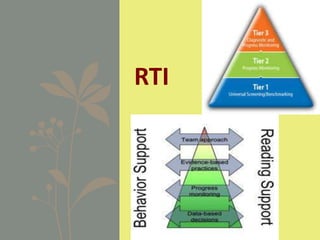
RTI
Enhancing
RtI
Ch. 5 “Interventions for
high-risk learners”
Ch. 6 “Progress monitoring
for student success”
Ch. 7 “Progress monitoring
in action”
Chapter
topics
Fisher & Frey: RtI
Interventions & monitoring progress
SMALL GROUPS
Ch. 5 Interventions for high-risk learners
Ch. 6 Progress monitoring for student success
Ch. 7 Progress monitoring in action
Insert this topic into Q below
- Interventions for high-risk learners
- Progress monitoring for student success
- Progress monitoring in action
A. Why is ____ important or relevant to RtI?
B. What factors contribute to _______ being
effective with respect to reading & writing and
readers & writers?
C. What is the role of the classroom teacher
with respect to _______?
SHARE OUT
Why is ____ relevant to Rti?
What factors contribute to
_______ being effective with
respect to reading & writing
and readers & writers?
What is the role of the
classroom teacher with
respect to _____?
What is your own question or
insight gained?
Ch.5 Interventions
for high-risk Lrs
Ch. 6 Progress
monitoring for
student success
Ch. 7 Progress
monitoring
The MA Reflection is not
an assignment or
requirement in LCRT 6915;
This session is structured
for the benefit of your
preparation & planning for
the MA Portfolio.
MA REFLECTION
DRAFT
MA Reflection
Paper
1. Introduction of the reflection
(1/2 to 1 page)
2. “Best memory(ies)”of MA learning
experiences? (1/2 to 1 page)
3. What have you learned most during the
program about the 6 roles &
responsibilities of a literacy specialist? (3-
4 pages)
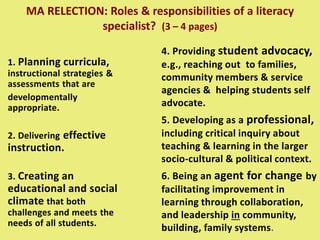
MA RELECTION: Roles & responsibilities of a literacy
specialist? (3 – 4 pages)
1. Planning curricula,
instructional strategies &
assessments that are
developmentally
appropriate.
2. Delivering effective
instruction.
3. Creating an
educational and social
climate that both
challenges and meets the
needs of all students.
4. Providing student advocacy,
e.g., reaching out to families,
community members & service
agencies & helping students self
advocate.
5. Developing as a professional,
including critical inquiry about
teaching & learning in the larger
socio-cultural & political context.
6. Being an agent for change by
facilitating improvement in
learning through collaboration,
and leadership in community,
building, family systems.
QUESTIONS?
MA REFLECTION
DRAFT
May 2nd EXAM DATE
April 10th Registration
deadline
PLACE EXAM
PLACE Exam Panel
QUESTION PROMPTS:
• How did you prepare for the PLACE exam?
• Did you use the study guides? How useful did you find these to
be?
• Were there particular readings from LLCRT courses that you re-
read and found particularly useful for your preparation?
• What insights did you gain about the test items?
• Were there any test-taking strategies you found useful while
you took the test?
• What recommendations do you have for LLCRT students who
plan to take the test in the near future? Re:
Preparation? Readings? Study guides? Interpreting the test
items? Other?
APRIL 13th ONLINE SESSION:
Evaluating & Selecting Materials
READING: Vogt & Shearer, Ch. 10
Engage in threaded discussion
-Post 1st contribution by Thursday, 4/16
-Post 2nd contribution by Saturday, 4/18
Post Reading Notes to Canvas by 4/19,
11pm for Vogt & Shearer, Ch. 10
Select and Post on Canvas: A 2nd article
from the professional organization journal
to share with your classmates
LOOKING
AHEAD

6915 week 10 rti and place panel

  • 1.
    • WELCOME!!! • Signin attendance & choice chapter • Get a name tag & a questionnaire to complete on your own. • Find a seat, then read & reflect on the 4-item questionnaire. • We will start at 5:00p.m. WELCOME TO LCRT 6915: SEMINAR & PRACTICUM IN LITERACY PROFESSIONAL DEVELOPMENT APRIL 6, 2015
  • 2.
    Tonight’s Agenda  Checkingon progress and next steps  Topics:  Cultural diversity and planning & differentiating for effective literacy instruction  Interventions, assessment & progress monitoring  MA Reflection Drafts: Review & Feedback  PLACE Exam Panel  Looking ahead
  • 3.
    For LCRT 6915students graduating Spring 2015: • The final philosophy paper for LCRT 6915 is due March 30th. • The Professor will read & provide you comments & suggestions returning the paper by April 4th so you can make revisions and submit the final paper to LiveText by April 10th • Submit philosophy paper to Livetext for LCRT 6915 – AND – for MA Portfolio. • The completed MA Portfolio – including the final & approved philosophy paper -- is to be submitted to Livetext on April 10th.
  • 4.
    Students graduating after Spring2015 •Near-final philosophy paper for LCRT 6915 is due in on April 13th •The LCRT 6915 Professor will read & provide you comments & suggestions by April 27th so you can make revisions & submit the final philosophy paper (PBA) to Livetext by May 6th
  • 5.
    Looking Ahead APRIL 13thONLINE SESSION: • Evaluating & Selecting Materials • READING: Vogt & Shearer, Ch. 10 • ONLINE Discussion: Small groups APRIL 20TH VIDEO COACHING SESSION #2 • Video clip (5-7min) to share it (use laptop or Ipad, NOT phone) • Completed coaching form & copies for coaching group & professor. • READING: Moran Book Chapter “Differentiated Literacy Coaching” (See Canvas)
  • 6.
    AGREE or DISAGREE?WHY? Core beliefs proposed by Vogt & Shearer about differentiation & framing literacy intervention: 1. Everyone involved in the school’s educational community is responsible for creating literate students. 2. Differences in literacy acquisition, use of language and ethnicity can and do position students outside of the school culture, often leading to over-identification in special education programs. 3. We can help all students increase literacy proficiency by differentiating what we do for individuals within groups and providing support before they fail. 4. Students need connection; they need their teachers to show them HOW to bring their different lived experiences & prior knowledge into the classroom, and how to use these experiences to enhance their learning.
  • 7.
  • 8.
    INDIVIDUAL PREPARATION Vogt &Shearer, Ch. 6: Differentiating to meet learners’ needs Ginsberg: Cultural diversity, motivation & differentiation ON YOUR OWN: Review the texts silently; highlight or write notes or use post-it notes to answer the following questions in 1 of the texts. Make sure each text is represented by someone in the group. 1. What ASSUMPTIONS does the author of the text make? 2. What do you AGREE with in the text? WHY? 3. Which points do feel the need to ARGUE in the text? 4. What parts of the text do you want to AIM to do or to continue to do? WHY?
  • 9.
    Small-group discussion • Haveeach member in the small group identify one ASSUMPTION made by the author in one of the texts, cite the text (page & paragraph). Explain why this assumption caught your attention. • Continue around the group, facilitating a discussion in which each group member addresses one of the texts in light of the remaining “A”s... AGREE, ARGUE, AIM to do.
  • 10.
    Finalize your discussion& prepare to share out these key points • What does this mean for your work with students? • What does this mean for your instructional practices & how you approach differentiation?
  • 11.
  • 12.
    Enhancing RtI Ch. 5 “Interventionsfor high-risk learners” Ch. 6 “Progress monitoring for student success” Ch. 7 “Progress monitoring in action” Chapter topics
  • 13.
    Fisher & Frey:RtI Interventions & monitoring progress SMALL GROUPS Ch. 5 Interventions for high-risk learners Ch. 6 Progress monitoring for student success Ch. 7 Progress monitoring in action
  • 14.
    Insert this topicinto Q below - Interventions for high-risk learners - Progress monitoring for student success - Progress monitoring in action A. Why is ____ important or relevant to RtI? B. What factors contribute to _______ being effective with respect to reading & writing and readers & writers? C. What is the role of the classroom teacher with respect to _______?
  • 15.
    SHARE OUT Why is____ relevant to Rti? What factors contribute to _______ being effective with respect to reading & writing and readers & writers? What is the role of the classroom teacher with respect to _____? What is your own question or insight gained? Ch.5 Interventions for high-risk Lrs Ch. 6 Progress monitoring for student success Ch. 7 Progress monitoring
  • 16.
    The MA Reflectionis not an assignment or requirement in LCRT 6915; This session is structured for the benefit of your preparation & planning for the MA Portfolio. MA REFLECTION DRAFT
  • 17.
    MA Reflection Paper 1. Introductionof the reflection (1/2 to 1 page) 2. “Best memory(ies)”of MA learning experiences? (1/2 to 1 page) 3. What have you learned most during the program about the 6 roles & responsibilities of a literacy specialist? (3- 4 pages)
  • 18.
    MA RELECTION: Roles& responsibilities of a literacy specialist? (3 – 4 pages) 1. Planning curricula, instructional strategies & assessments that are developmentally appropriate. 2. Delivering effective instruction. 3. Creating an educational and social climate that both challenges and meets the needs of all students. 4. Providing student advocacy, e.g., reaching out to families, community members & service agencies & helping students self advocate. 5. Developing as a professional, including critical inquiry about teaching & learning in the larger socio-cultural & political context. 6. Being an agent for change by facilitating improvement in learning through collaboration, and leadership in community, building, family systems.
  • 19.
  • 20.
    May 2nd EXAMDATE April 10th Registration deadline PLACE EXAM
  • 21.
    PLACE Exam Panel QUESTIONPROMPTS: • How did you prepare for the PLACE exam? • Did you use the study guides? How useful did you find these to be? • Were there particular readings from LLCRT courses that you re- read and found particularly useful for your preparation? • What insights did you gain about the test items? • Were there any test-taking strategies you found useful while you took the test? • What recommendations do you have for LLCRT students who plan to take the test in the near future? Re: Preparation? Readings? Study guides? Interpreting the test items? Other?
  • 22.
    APRIL 13th ONLINESESSION: Evaluating & Selecting Materials READING: Vogt & Shearer, Ch. 10 Engage in threaded discussion -Post 1st contribution by Thursday, 4/16 -Post 2nd contribution by Saturday, 4/18 Post Reading Notes to Canvas by 4/19, 11pm for Vogt & Shearer, Ch. 10 Select and Post on Canvas: A 2nd article from the professional organization journal to share with your classmates LOOKING AHEAD

Editor's Notes

  • #14 ADD NAMES of STUDENTS who selected ONE of the THREE chapters
  • #19 HAVE STUDENTS DIVIDE INTO GROUPS….. SHARE THEIR DRAFTS, READ, and give each other feedback