Introduction
The internet makes it easy for people to share and build on each other’s creations. But
sometimes the law makes it hard. Whenever you snap a photograph, record a song, publish
an article, or put your original writing online, that work is automatically considered “all
rights reserved” in the eyes of copyright law .In many cases, that means that other people
can’t reuse or remix your work without asking for your permission first.
But what if you want others to reuse your work? If you want to give people the right to
share, use, and even build upon a work you’ve created, consider publishing under a Creative
Commons license. There are six Creative Commons licenses that can be used .The six
creative commons are:
1. Attribution
2. Attribution-ShareAlike
3. Attribution-NoDerivatives
4. Attribution-NonCommercial
5. Attribution-NonCommercial-ShareAlike
6. Attribution-NonCommercial-NoDerivatives
By Lydia Kumb
CA 420 ONLINE PUBLISHING
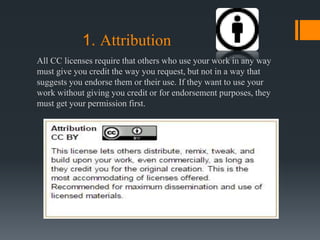
1. Attribution
All CC licenses require that others who use your work in any way
must give you credit the way you request, but not in a way that
suggests you endorse them or their use. If they want to use your
work without giving you credit or for endorsement purposes, they
must get your permission first.
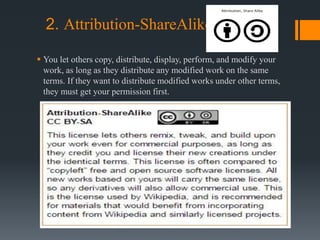
2. Attribution-ShareAlike
 You let others copy, distribute, display, perform, and modify your
work, as long as they distribute any modified work on the same
terms. If they want to distribute modified works under other terms,
they must get your permission first.
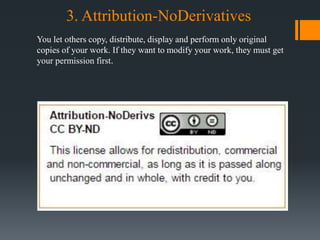
3. Attribution-NoDerivatives
You let others copy, distribute, display and perform only original
copies of your work. If they want to modify your work, they must get
your permission first.
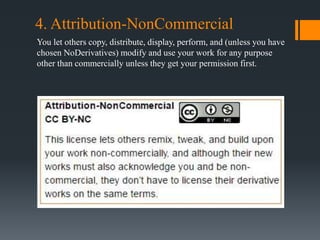
4. Attribution-NonCommercial
You let others copy, distribute, display, perform, and (unless you have
chosen NoDerivatives) modify and use your work for any purpose
other than commercially unless they get your permission first.
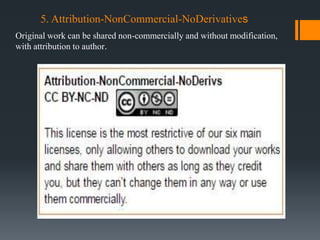
5. Attribution-NonCommercial-NoDerivatives
Original work can be shared non-commercially and without modification,
with attribution to author.
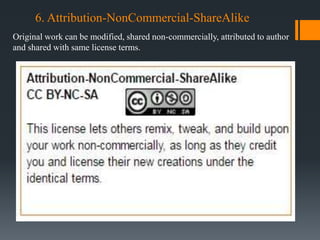
6. Attribution-NonCommercial-ShareAlike
Original work can be modified, shared non-commercially, attributed to author
and shared with same license terms.
Conclusion
Creative Commons is a global nonprofit organization dedicated to supporting an
open and accessible internet that is enriched with free knowledge and creative
resources for people around the world to use, share, and cultivate inforamtions.
A CC license lets you decide which rights you’d like to keep, and it clearly
conveys to those using your work how they're permitted to use it without asking
you in advance. Creative Commons also makes it possible for people to have
access to information that have being done by other people. There are six
creative commons that can be used which are:
1. Attribution
2. Attribution-ShareAlike
3. Attribution-NoDerivatives
4. Attribution-NonCommercial
5. Attribution-NonCommercial-ShareAlike
6. Attribution-NonCommercial-NoDerivatives.

Creative Commons Licenses

  • 1.
    Introduction The internet makesit easy for people to share and build on each other’s creations. But sometimes the law makes it hard. Whenever you snap a photograph, record a song, publish an article, or put your original writing online, that work is automatically considered “all rights reserved” in the eyes of copyright law .In many cases, that means that other people can’t reuse or remix your work without asking for your permission first. But what if you want others to reuse your work? If you want to give people the right to share, use, and even build upon a work you’ve created, consider publishing under a Creative Commons license. There are six Creative Commons licenses that can be used .The six creative commons are: 1. Attribution 2. Attribution-ShareAlike 3. Attribution-NoDerivatives 4. Attribution-NonCommercial 5. Attribution-NonCommercial-ShareAlike 6. Attribution-NonCommercial-NoDerivatives By Lydia Kumb CA 420 ONLINE PUBLISHING
  • 2.
    1. Attribution All CClicenses require that others who use your work in any way must give you credit the way you request, but not in a way that suggests you endorse them or their use. If they want to use your work without giving you credit or for endorsement purposes, they must get your permission first.
  • 3.
    2. Attribution-ShareAlike  Youlet others copy, distribute, display, perform, and modify your work, as long as they distribute any modified work on the same terms. If they want to distribute modified works under other terms, they must get your permission first.
  • 4.
    3. Attribution-NoDerivatives You letothers copy, distribute, display and perform only original copies of your work. If they want to modify your work, they must get your permission first.
  • 5.
    4. Attribution-NonCommercial You letothers copy, distribute, display, perform, and (unless you have chosen NoDerivatives) modify and use your work for any purpose other than commercially unless they get your permission first.
  • 6.
    5. Attribution-NonCommercial-NoDerivatives Original workcan be shared non-commercially and without modification, with attribution to author.
  • 7.
    6. Attribution-NonCommercial-ShareAlike Original workcan be modified, shared non-commercially, attributed to author and shared with same license terms.
  • 8.
    Conclusion Creative Commons isa global nonprofit organization dedicated to supporting an open and accessible internet that is enriched with free knowledge and creative resources for people around the world to use, share, and cultivate inforamtions. A CC license lets you decide which rights you’d like to keep, and it clearly conveys to those using your work how they're permitted to use it without asking you in advance. Creative Commons also makes it possible for people to have access to information that have being done by other people. There are six creative commons that can be used which are: 1. Attribution 2. Attribution-ShareAlike 3. Attribution-NoDerivatives 4. Attribution-NonCommercial 5. Attribution-NonCommercial-ShareAlike 6. Attribution-NonCommercial-NoDerivatives.