

PROPOSAL
REPORT
PRESENTATION
CN505/DCN5051 -
ENVIRONMENTAL
PROJECT 1
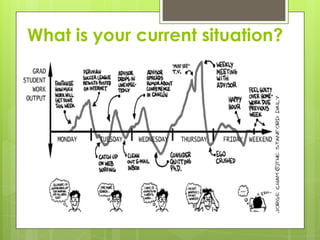
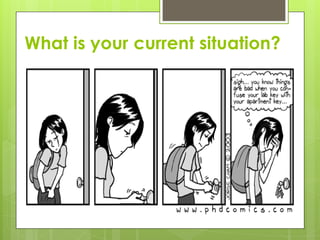
What is your current situation?
Overview
 Goals and components of
the Presentation
 Dividing up the presentation
 Delivering the presentation
with your partner
 Questions to ask yourselves:
organization, slide design,
delivery
A proposal presentation has a distinct
audience and purpose
Persuading evaluators to support
your research project
Assume that your audience
comprises
• experts in your topic
• intelligent generalists with exposure
to your field
How can you make your proposal
compelling?
• Convince audience that project is
worth doing
• Convince audience that you are
capable of carrying it out
Help your audience understand
the motivation for your idea
 Broadly:
 What is the problem?
 What is its (social, scientific)
significance?
 Specifically:
 How have you zeroed in on a
well defined research
question?
•What about your project is
novel, relative to prior work
Help your audience appreciate
the merits of your approach
 Provide a clear overview of the
scope of your plan
 be realistic, not overambitious
 Propose pertinent experiments with
good controls
 Explain your methods succinctly
 Demonstratethe kind of data you
might see
 show how they will illuminate your
central question
 Offer alternative solutions/backup
plan
7 minutes to cover...
 brief project overview
 sufficient background information for everyone to
understand your proposal
 statement of the research problem and goals
 project details and methods
 predicted outcomes if everything goes according to
plan and if nothing does
 needed resources to complete the work
Dividing up the presentation:
general principles
 Each partner should speak
roughly the same amount of time
 • Audience assumption: Change in
speakers corresponds to change
in topic
 Keep shifts to a minimum
 changing speakers can distract
audience/slow the talk down
 Many options for dividing the talk!
depends on the shape of your
presentation...
Revision is an essential part of
the collaborative process
 Be prepared: collaborative
presentations require
more revision than
individual ones
 Invest yourself in the
success of the
presentation as a whole
 don’t get too
emotionally attached to
your own contributions
 •Rehearse before AND
after you revise
Help focus the audience’s
attention on the right speaker
 During overview, identify who will
speak on what topic
 Review/Preview as you proceed
through the talk
 Articulate transitions explicitly -
- “hand off”
 Only one partner “onstage” at a
time
If you’re not speaking, don’t
hover nearby
 Do not interrupt each other
Rehearse as a team
 Familiarize yourself with
partner’s material
 Note timing of each section
and of talk as a whole
 Aim for similar speaking styles
 don’t imitate each other, but
match formality/
engagement levels
 Practice moving into speaking
position at transition points
 Will you advance each other’s
slides?
 • Practice Q&A
Questions to ask yourselves
about organization
 Does our talk fit together as a coherent
whole?
 Are all sections of the talk adequately
developed?
 Do we have a focused, well-defined
hypothesis?
 Is it clear what is going to be done
and how?
 Have we realistically articulated the
scope of the work?
 Have we omitted extraneous material?
 Will our project fire up an audience’s
interest?
Questions to ask yourselves
about slide design
 Is everything on the slide
readable?
 Are our slides a good balance
of text and figures?
 Have we chosen clear, specific
titles that express the main
point of each slide?
 • Is the design/format of our
slides consistent, or were they
obviously designed by different
people?
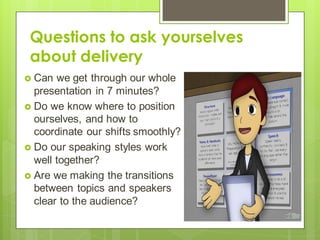
Questions to ask yourselves
about delivery
 Can we get through our whole
presentation in 7 minutes?
 Do we know where to position
ourselves, and how to
coordinate our shifts smoothly?
 Do our speaking styles work
well together?
 Are we making the transitions
between topics and speakers
clear to the audience?
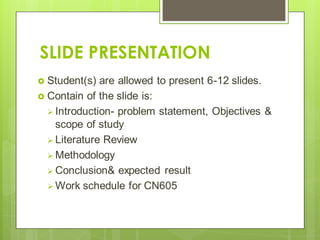
SLIDE PRESENTATION
 Student(s) are allowed to present 6-12 slides.
 Contain of the slide is:
 Introduction- problem statement, Objectives &
scope of study
 Literature Review
 Methodology
 Conclusion& expected result
 Work schedule for CN605
PRESENTATION
 Duration time: is 5-7 minutes in group
 Question& answers: 5-7 minutes
 Dress: formal
 Attitude: Moral & Professional ethic
 Language: English
a. Dress: formal
How can you avoid being nervous then?
Prepare
Relax
Check
Audience
Message
Success

6. proposal report presentation

  • 1.
  • 2.
    What is yourcurrent situation?
  • 3.
    What is yourcurrent situation?
  • 4.
    What is yourcurrent situation?
  • 5.
    Overview  Goals andcomponents of the Presentation  Dividing up the presentation  Delivering the presentation with your partner  Questions to ask yourselves: organization, slide design, delivery
  • 6.
    A proposal presentationhas a distinct audience and purpose Persuading evaluators to support your research project Assume that your audience comprises • experts in your topic • intelligent generalists with exposure to your field How can you make your proposal compelling? • Convince audience that project is worth doing • Convince audience that you are capable of carrying it out
  • 7.
    Help your audienceunderstand the motivation for your idea  Broadly:  What is the problem?  What is its (social, scientific) significance?  Specifically:  How have you zeroed in on a well defined research question? •What about your project is novel, relative to prior work
  • 8.
    Help your audienceappreciate the merits of your approach  Provide a clear overview of the scope of your plan  be realistic, not overambitious  Propose pertinent experiments with good controls  Explain your methods succinctly  Demonstratethe kind of data you might see  show how they will illuminate your central question  Offer alternative solutions/backup plan
  • 9.
    7 minutes tocover...  brief project overview  sufficient background information for everyone to understand your proposal  statement of the research problem and goals  project details and methods  predicted outcomes if everything goes according to plan and if nothing does  needed resources to complete the work
  • 10.
    Dividing up thepresentation: general principles  Each partner should speak roughly the same amount of time  • Audience assumption: Change in speakers corresponds to change in topic  Keep shifts to a minimum  changing speakers can distract audience/slow the talk down  Many options for dividing the talk! depends on the shape of your presentation...
  • 11.
    Revision is anessential part of the collaborative process  Be prepared: collaborative presentations require more revision than individual ones  Invest yourself in the success of the presentation as a whole  don’t get too emotionally attached to your own contributions  •Rehearse before AND after you revise
  • 12.
    Help focus theaudience’s attention on the right speaker  During overview, identify who will speak on what topic  Review/Preview as you proceed through the talk  Articulate transitions explicitly - - “hand off”  Only one partner “onstage” at a time If you’re not speaking, don’t hover nearby  Do not interrupt each other
  • 13.
    Rehearse as ateam  Familiarize yourself with partner’s material  Note timing of each section and of talk as a whole  Aim for similar speaking styles  don’t imitate each other, but match formality/ engagement levels  Practice moving into speaking position at transition points  Will you advance each other’s slides?  • Practice Q&A
  • 14.
    Questions to askyourselves about organization  Does our talk fit together as a coherent whole?  Are all sections of the talk adequately developed?  Do we have a focused, well-defined hypothesis?  Is it clear what is going to be done and how?  Have we realistically articulated the scope of the work?  Have we omitted extraneous material?  Will our project fire up an audience’s interest?
  • 15.
    Questions to askyourselves about slide design  Is everything on the slide readable?  Are our slides a good balance of text and figures?  Have we chosen clear, specific titles that express the main point of each slide?  • Is the design/format of our slides consistent, or were they obviously designed by different people?
  • 16.
    Questions to askyourselves about delivery  Can we get through our whole presentation in 7 minutes?  Do we know where to position ourselves, and how to coordinate our shifts smoothly?  Do our speaking styles work well together?  Are we making the transitions between topics and speakers clear to the audience?
  • 17.
    SLIDE PRESENTATION  Student(s)are allowed to present 6-12 slides.  Contain of the slide is:  Introduction- problem statement, Objectives & scope of study  Literature Review  Methodology  Conclusion& expected result  Work schedule for CN605
  • 18.
    PRESENTATION  Duration time:is 5-7 minutes in group  Question& answers: 5-7 minutes  Dress: formal  Attitude: Moral & Professional ethic  Language: English a. Dress: formal
  • 19.
    How can youavoid being nervous then? Prepare Relax Check Audience Message Success