Generics. Collections. Streams
Алексей Владыкин
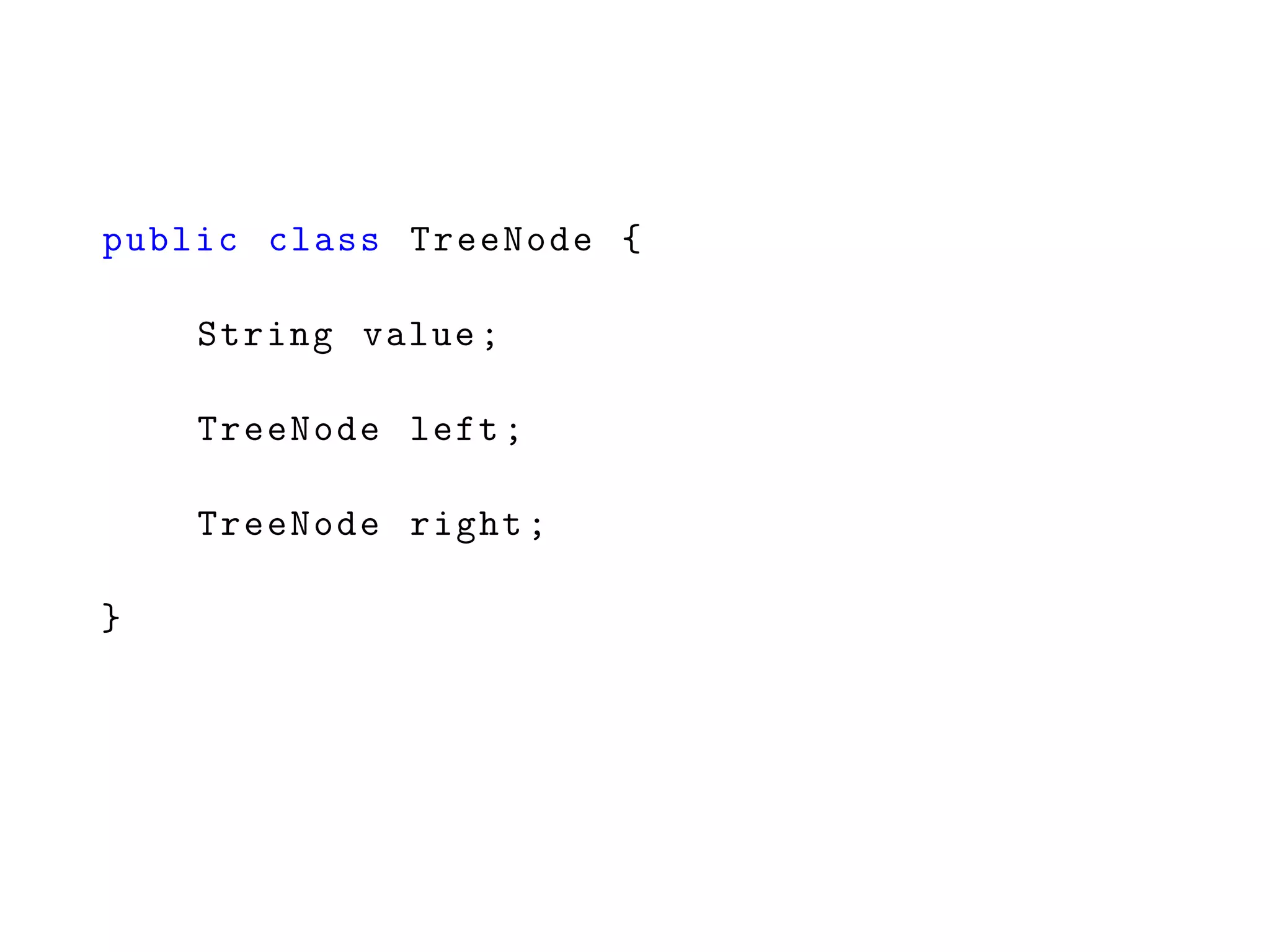
public class TreeNode {
String value;
TreeNode left;
TreeNode right;
}
public static BigDecimal minElement(
BigDecimal [] values) {
if (values.length == 0) {
return null;
}
BigDecimal min = values [0];
for (int i = 1; i < values.length; i++) {
if (min.compareTo(values[i]) > 0) {
min = values[i];
}
}
return min;
}
TreeNode rootNode = new TreeNode ();
rootNode.value = "foobar";
// tree manipulation
String value = (String) rootNode.value;
Object [] arrayOfBigDecimals = {...};
BigDecimal min = (BigDecimal)
minElement(arrayOfBigDecimals );
public static <T extends Comparable <T>> T
minElement(T[] values) {
if (values.length == 0) {
return null;
}
T min = values [0];
for (int i = 1; i < values.length; i++) {
if (min.compareTo(values[i]) > 0) {
min = values[i];
}
}
return min;
}
TreeNode <String > stringNode;
TreeNode <Integer > integerNode;
TreeNode <int[]> intArrayNode;
TreeNode <int > intNode;
TreeNode <10> tenNode;
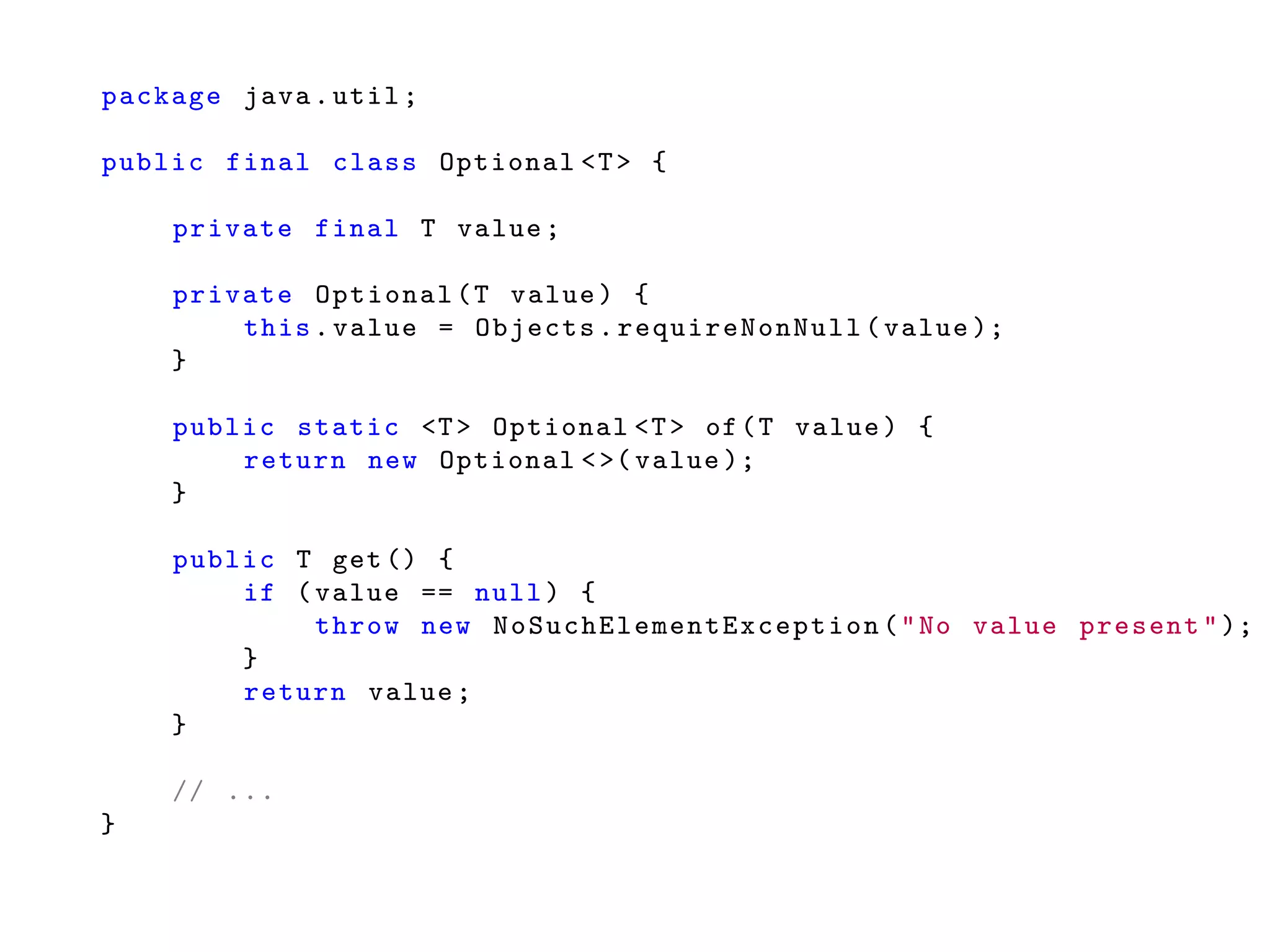
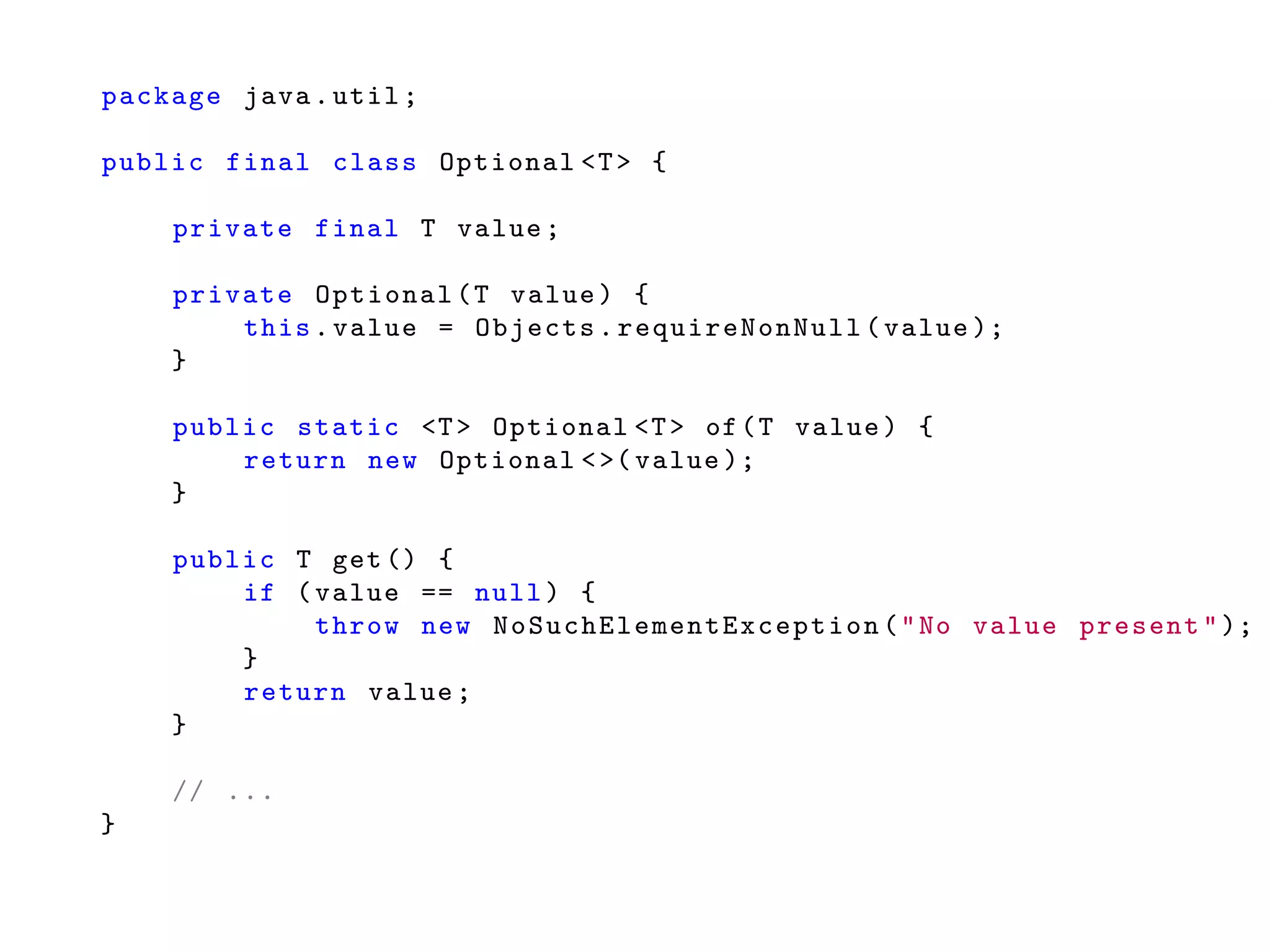
package java.util;
public final class Optional <T> {
private final T value;
private Optional(T value) {
this.value = Objects. requireNonNull (value );
}
public static <T> Optional <T> of(T value) {
return new Optional <>( value );
}
public T get () {
if (value == null) {
throw new NoSuchElementException ("No value present");
}
return value;
}
// ...
}
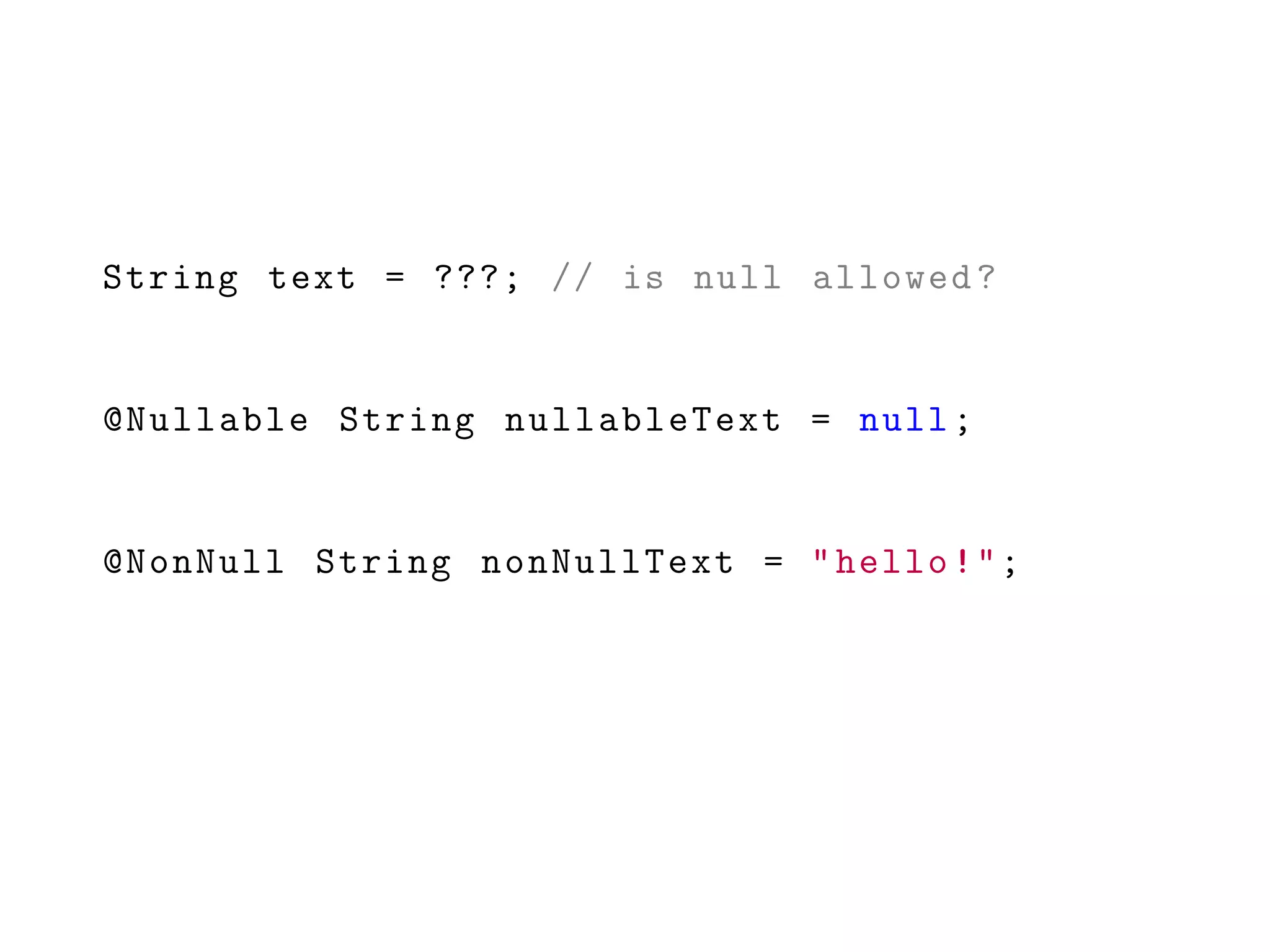
String text = ???; // is null allowed?
@Nullable String nullableText = null;
@NonNull String nonNullText = "hello!";
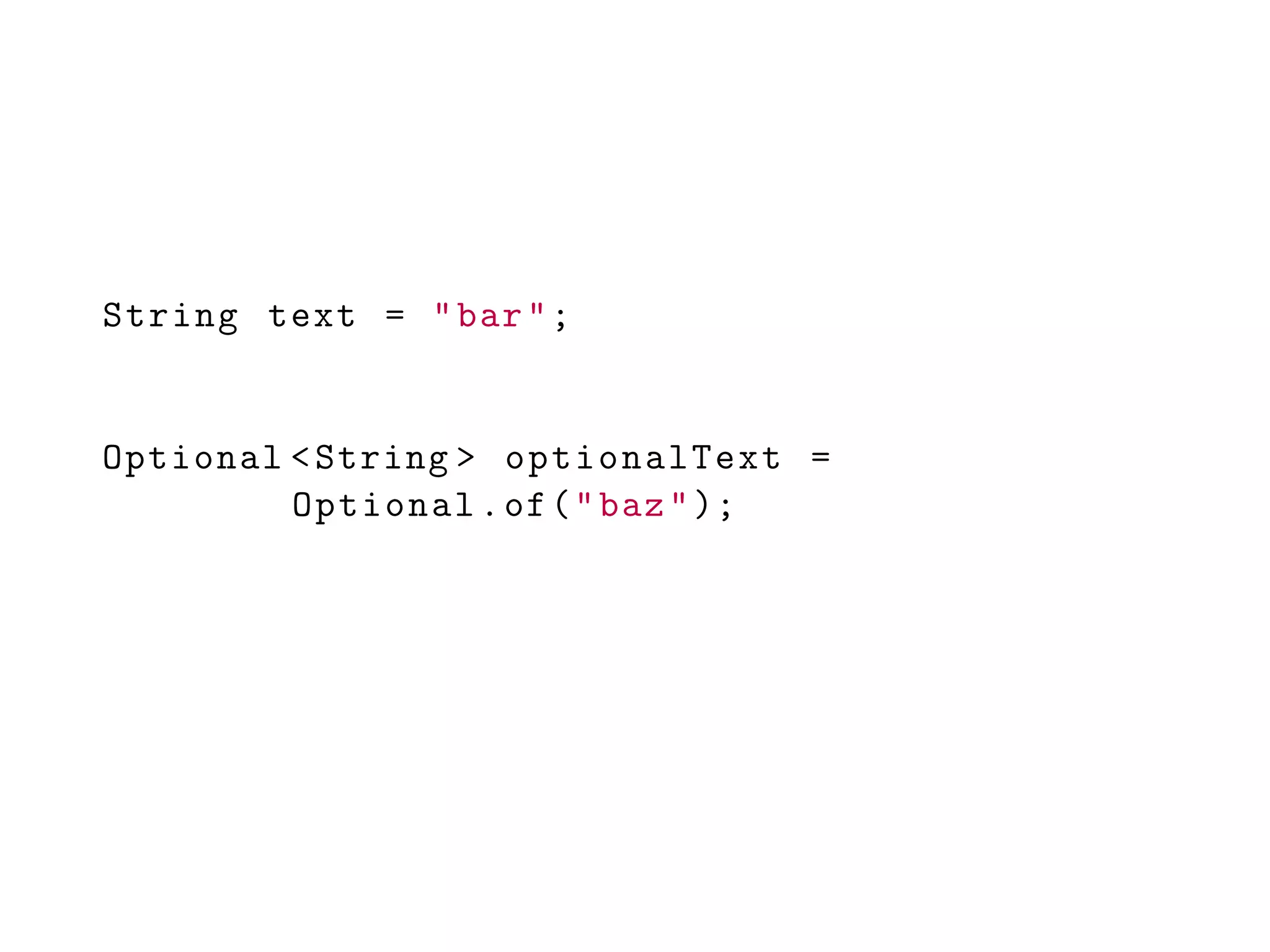
String text = "bar";
Optional <String > optionalText =
Optional.of("baz");
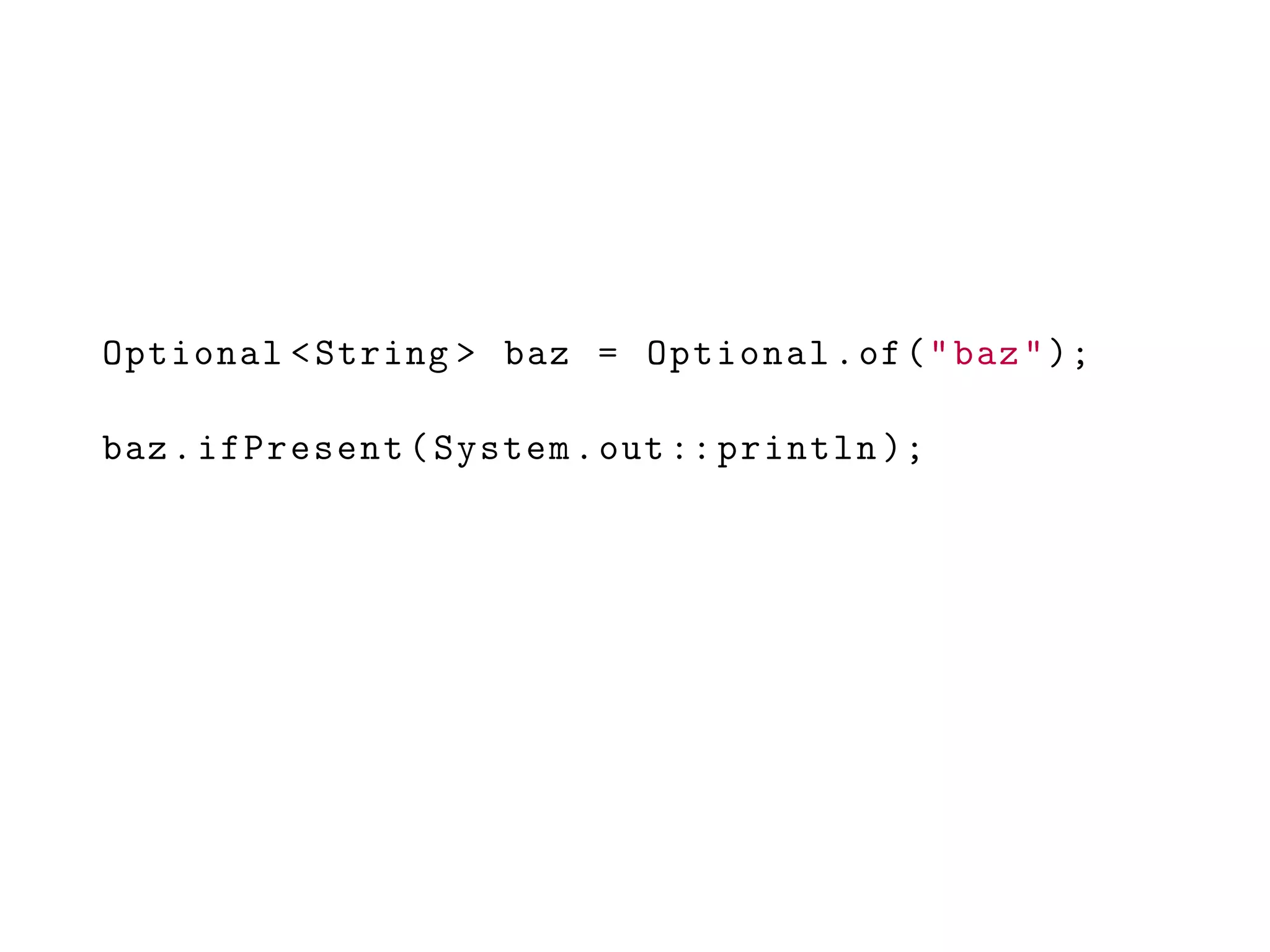
Optional <String > baz = Optional.of("baz");
baz.ifPresent(System.out:: println );
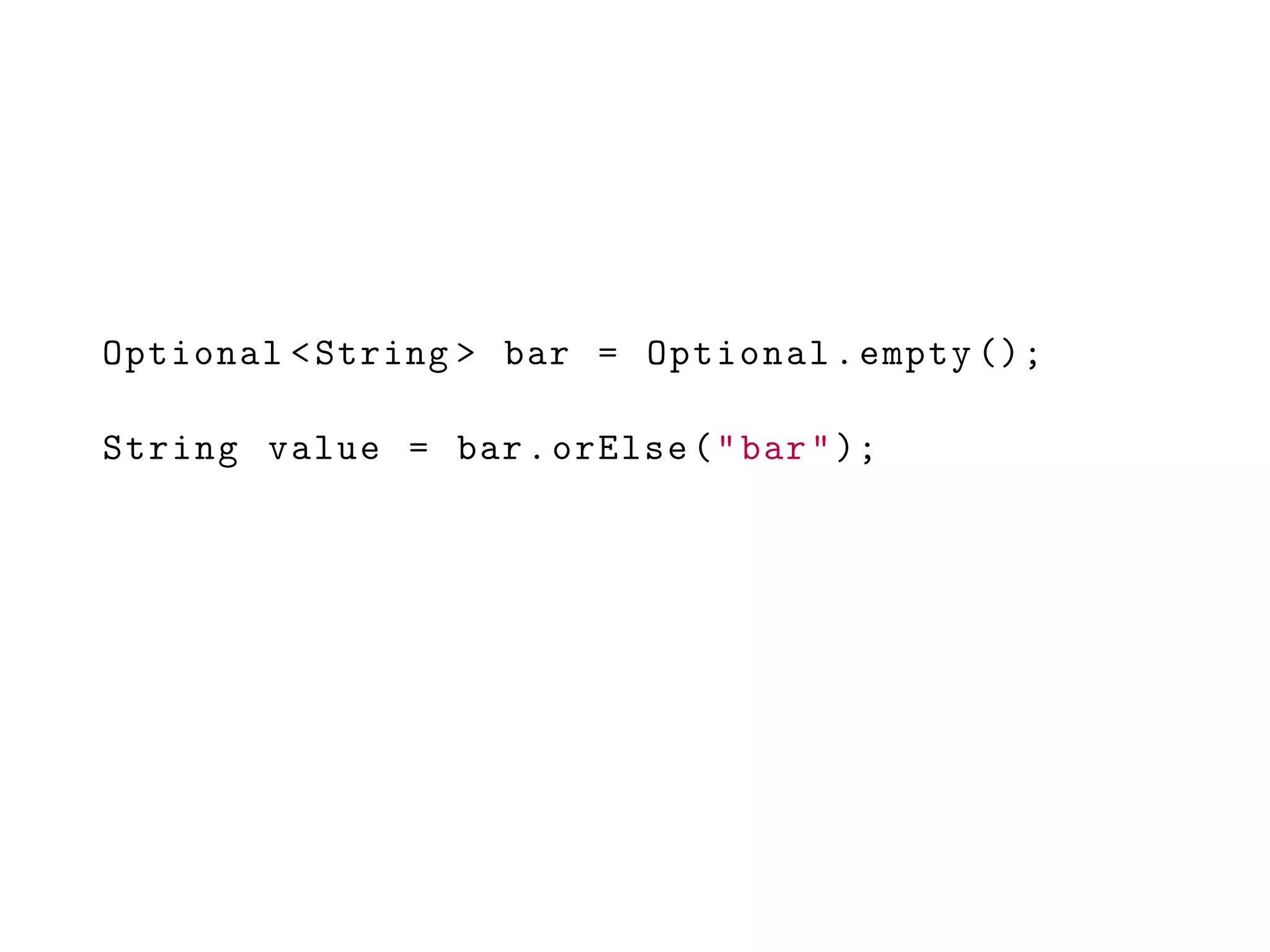
Optional <String > bar = Optional.empty ();
String value = bar.orElse("bar");
package java.util;
public final class Optional <T> {
private final T value;
private Optional(T value) {
this.value = Objects. requireNonNull (value );
}
public static <T> Optional <T> of(T value) {
return new Optional <>( value );
}
public T get () {
if (value == null) {
throw new NoSuchElementException ("No value present");
}
return value;
}
// ...
}
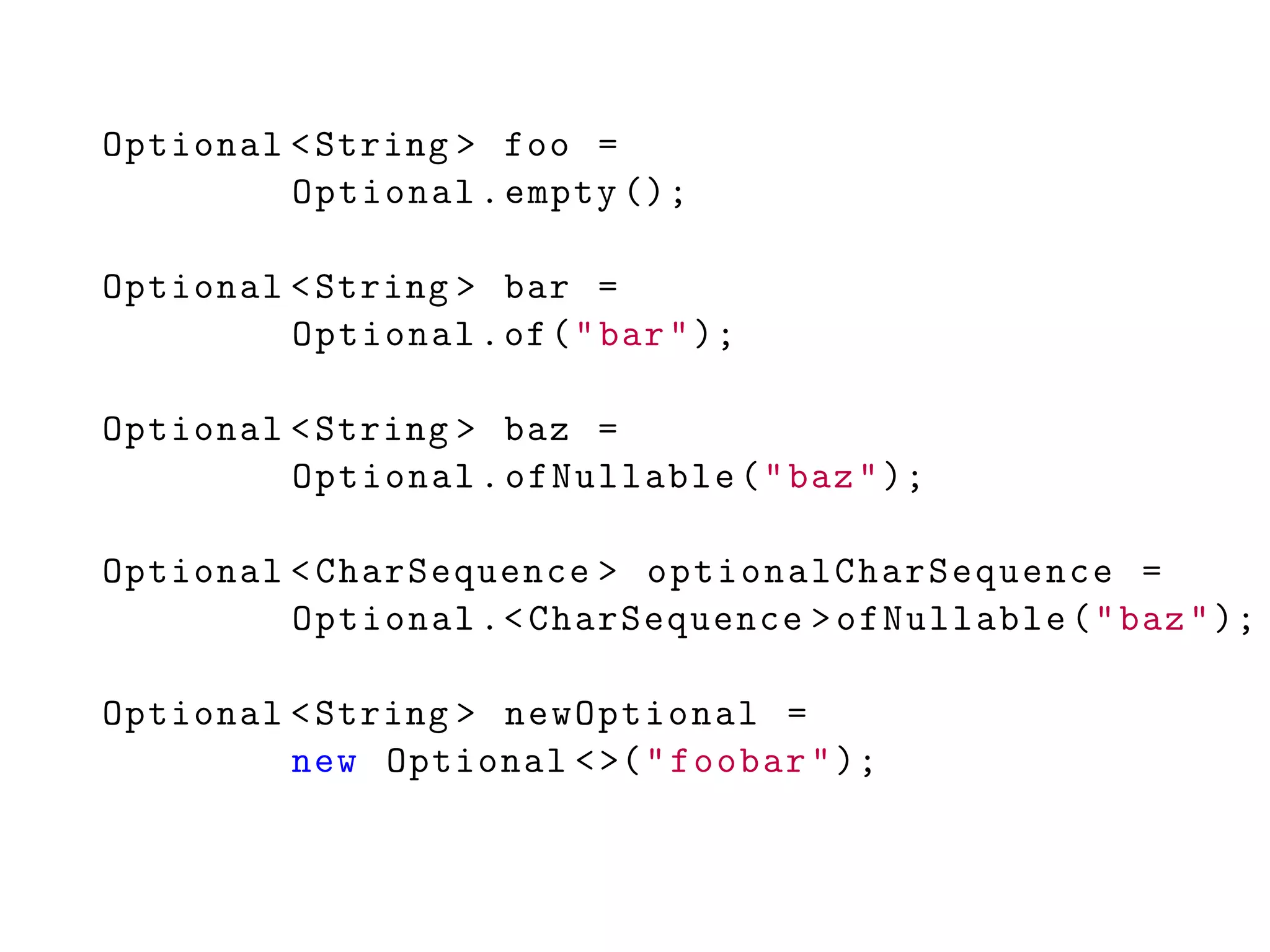
Optional <String > foo =
Optional.empty ();
Optional <String > bar =
Optional.of("bar");
Optional <String > baz =
Optional.ofNullable("baz");
Optional <CharSequence > optionalCharSequence =
Optional.<CharSequence >ofNullable("baz");
Optional <String > newOptional =
new Optional <>("foobar");
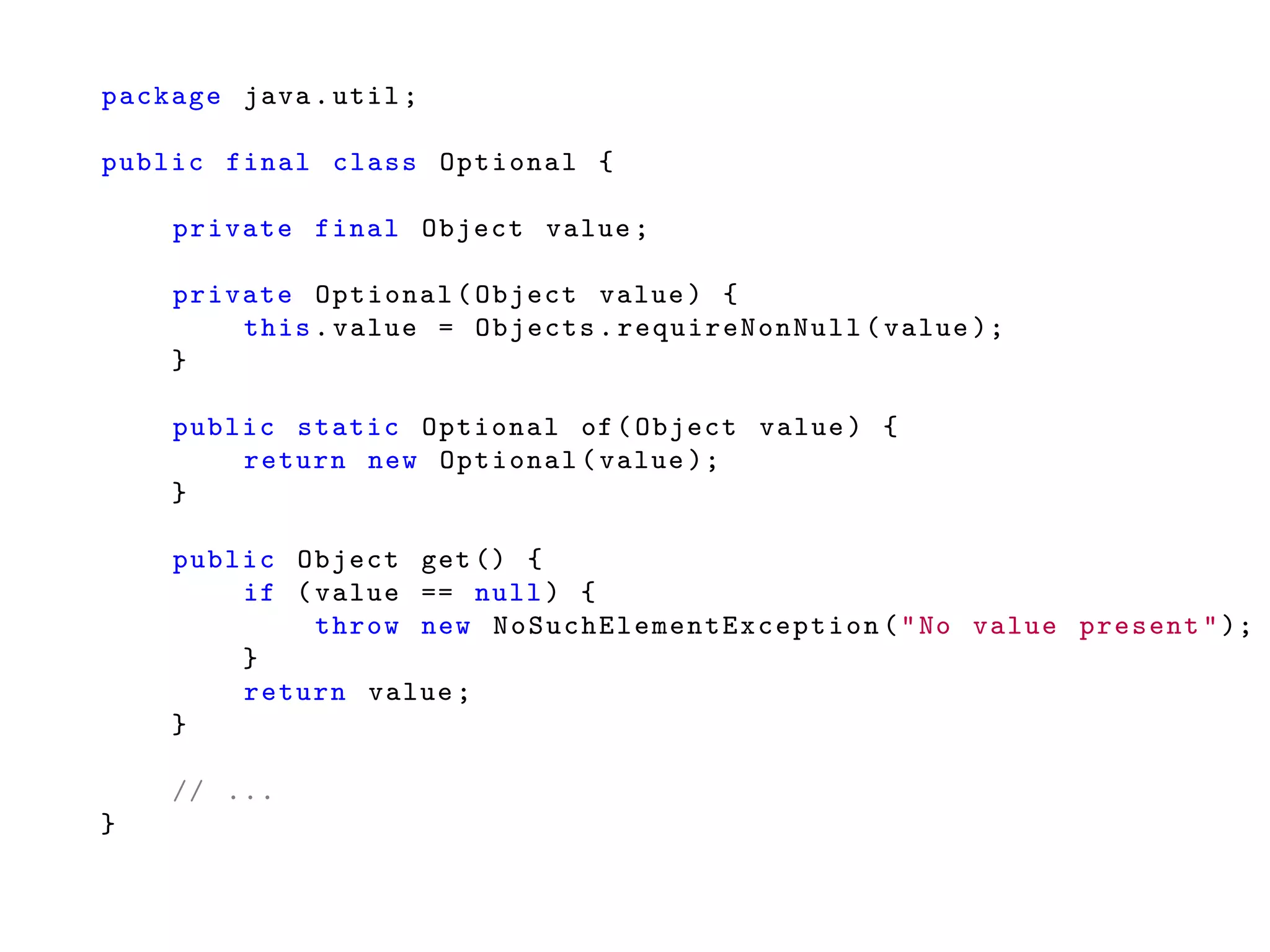
package java.util;
public final class Optional {
private final Object value;
private Optional(Object value) {
this.value = Objects. requireNonNull (value );
}
public static Optional of(Object value) {
return new Optional(value );
}
public Object get() {
if (value == null) {
throw new NoSuchElementException ("No value present");
}
return value;
}
// ...
}
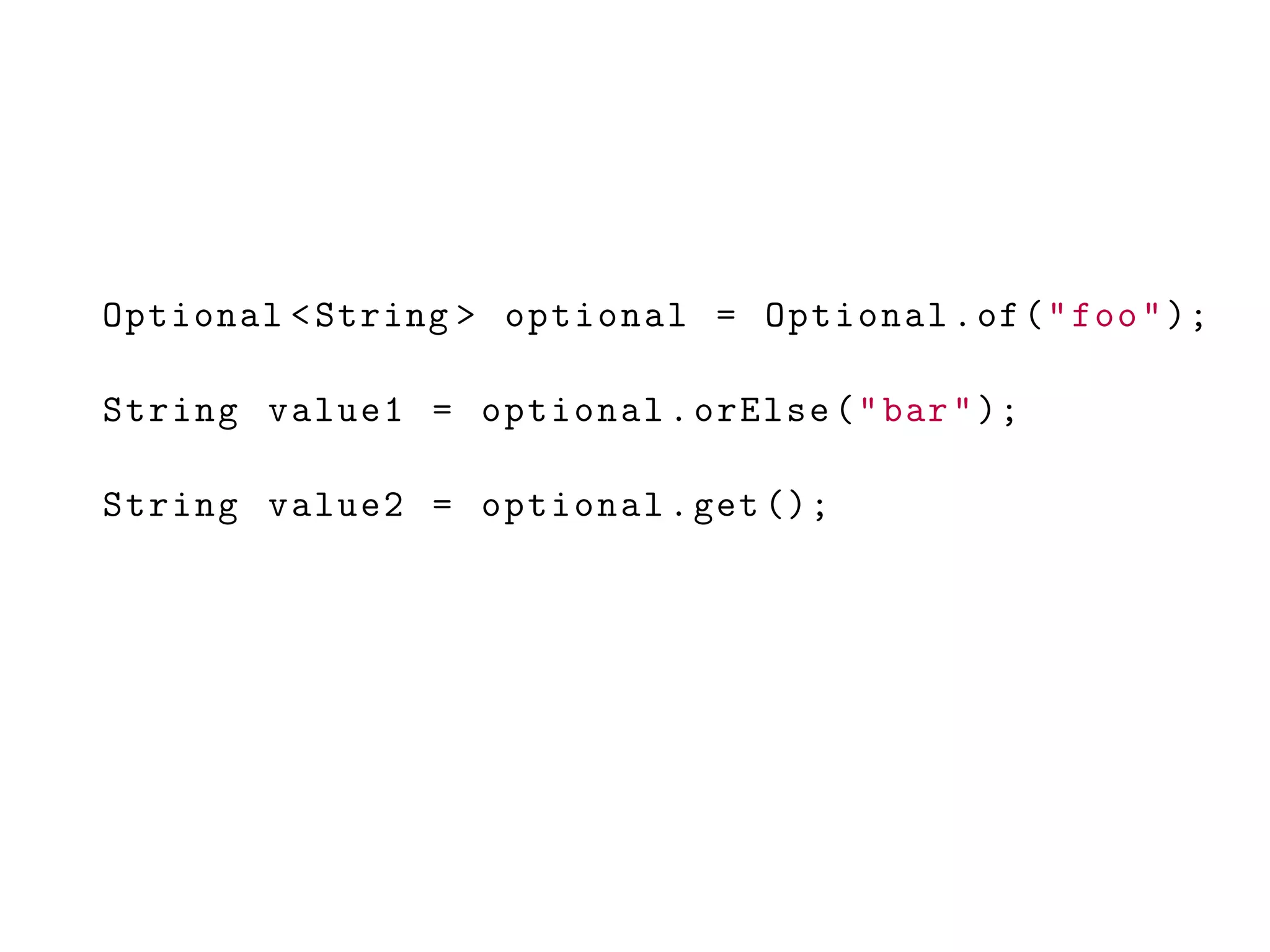
Optional <String > optional = Optional.of("foo");
String value1 = optional.orElse("bar");
String value2 = optional.get ();
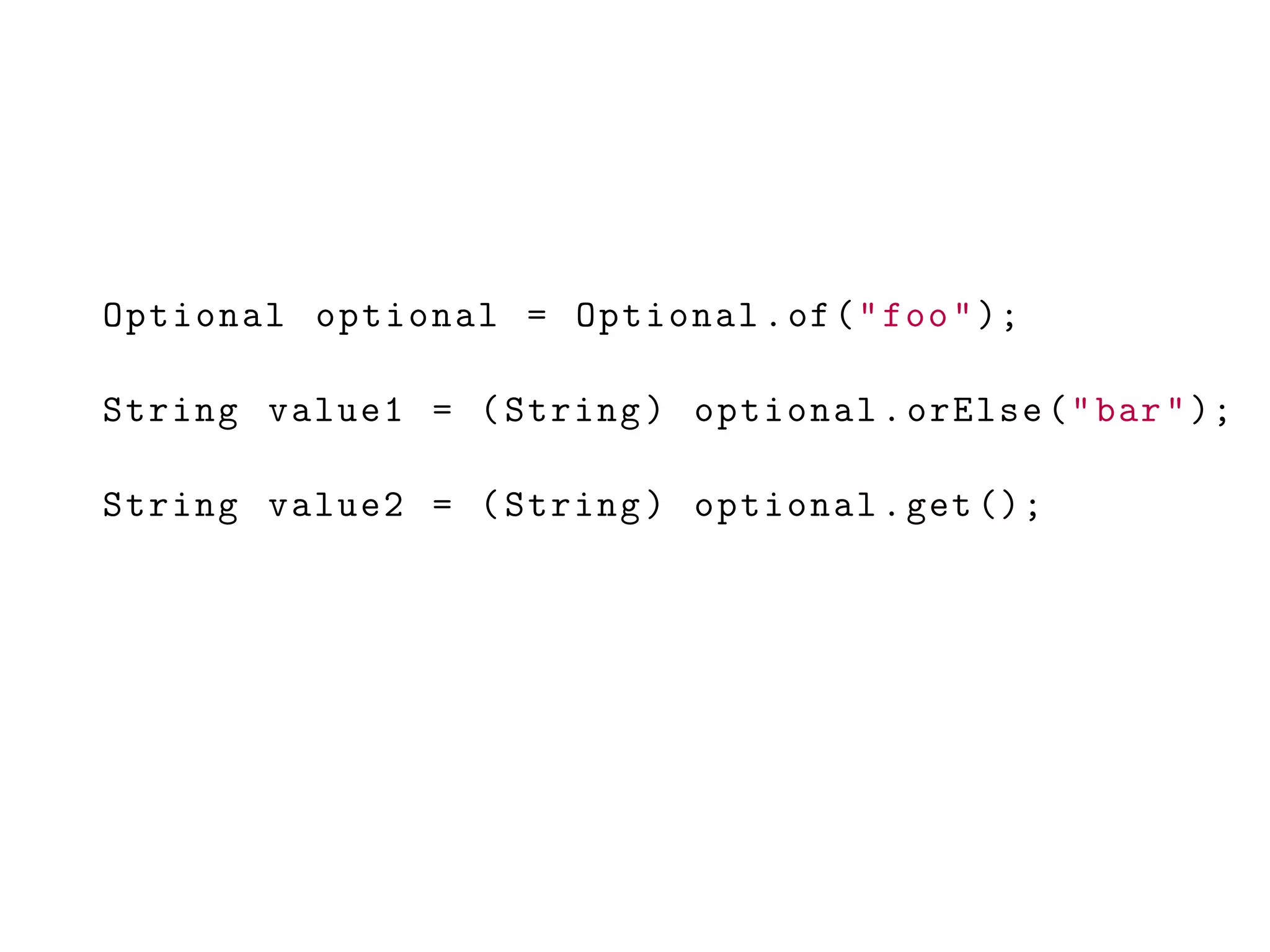
Optional optional = Optional.of("foo");
String value1 = (String) optional.orElse("bar");
String value2 = (String) optional.get ();
T obj = new T();
T[] arr = new T[5];
if (obj instanceof T) {...}
T a = (T) b;
import java.io.IOException ;
public class Hack {
public static void main(String [] args) {
throwAsUnchecked (new IOException ());
}
private static void throwAsUnchecked (Exception e) {
Hack.<RuntimeException > genericThrow (e);
}
private static <T extends Throwable >
void genericThrow (Exception e) throws T {
throw (T) e;
}
}
Number number = new Integer (1);
Number [] numberArray = new Integer [10];
Optional <Integer > optionalInt = Optional.of (1);
Optional <Number > optionalNumber = optionalInt;
optionalNumber.set(new BigDecimal("3.14"));
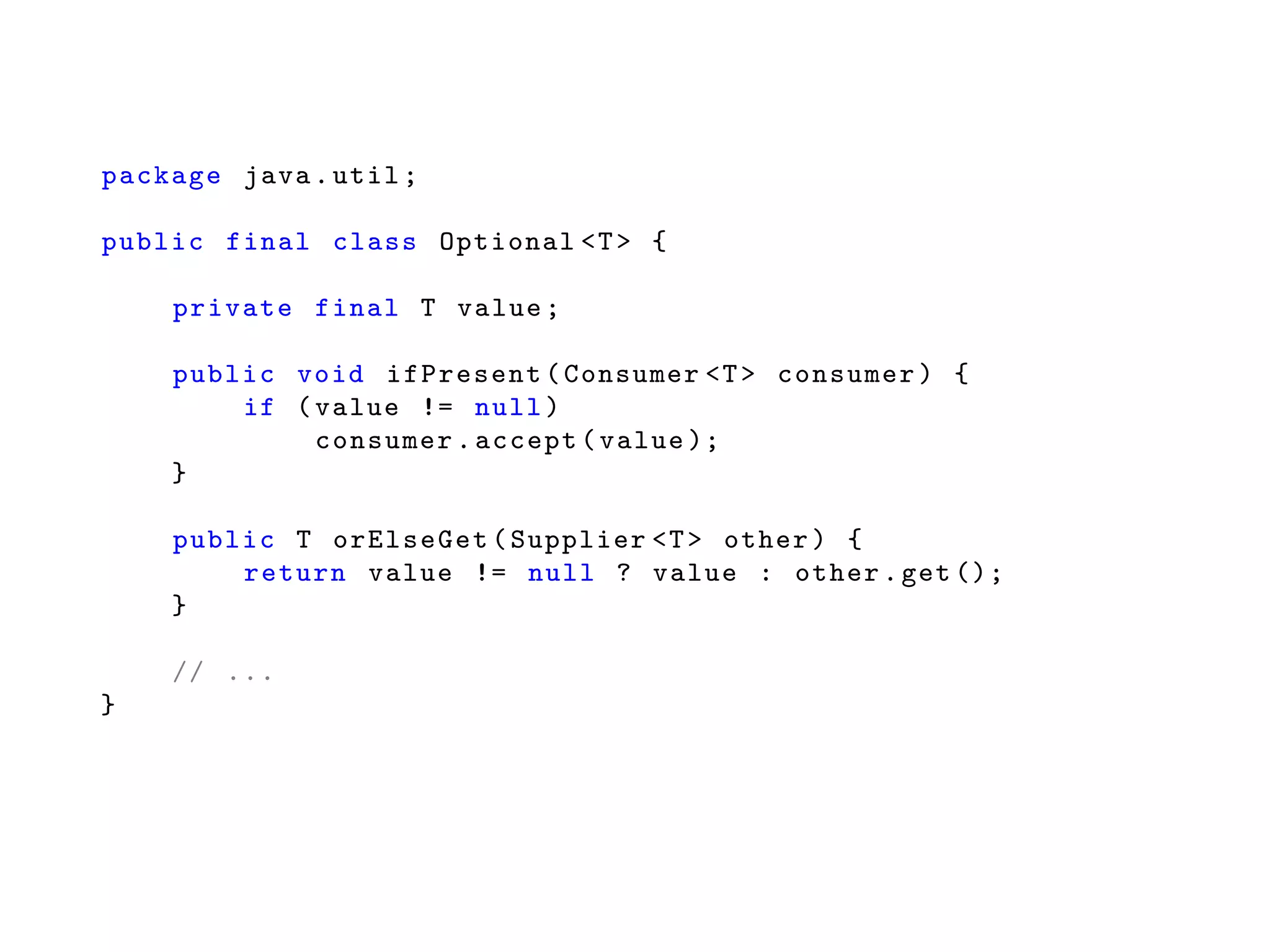
package java.util;
public final class Optional <T> {
private final T value;
public void ifPresent(Consumer <T> consumer) {
if (value != null)
consumer.accept(value );
}
public T orElseGet(Supplier <T> other) {
return value != null ? value : other.get ();
}
// ...
}
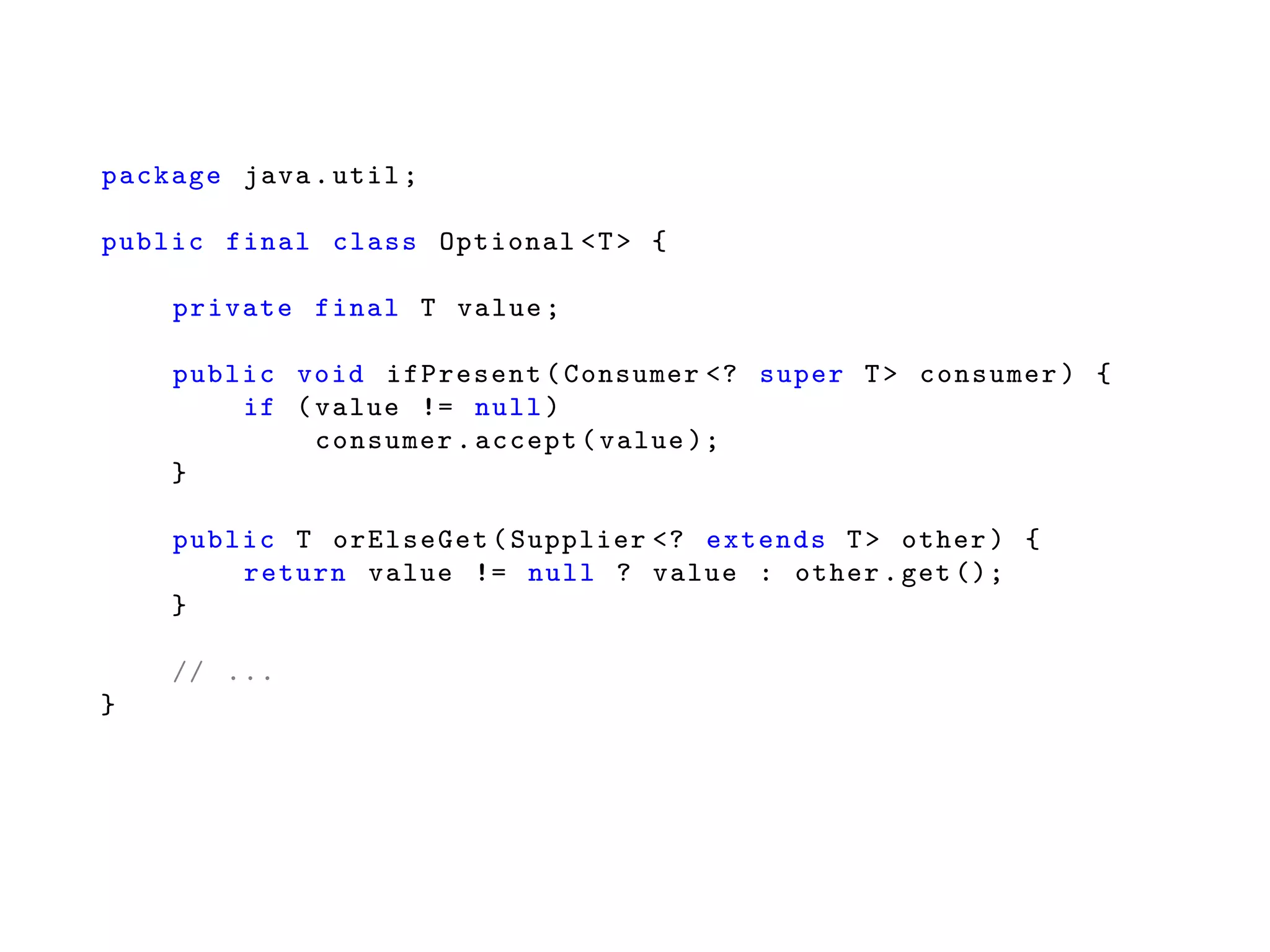
package java.util;
public final class Optional <T> {
private final T value;
public void ifPresent(Consumer <? super T> consumer) {
if (value != null)
consumer.accept(value );
}
public T orElseGet(Supplier <? extends T> other) {
return value != null ? value : other.get ();
}
// ...
}
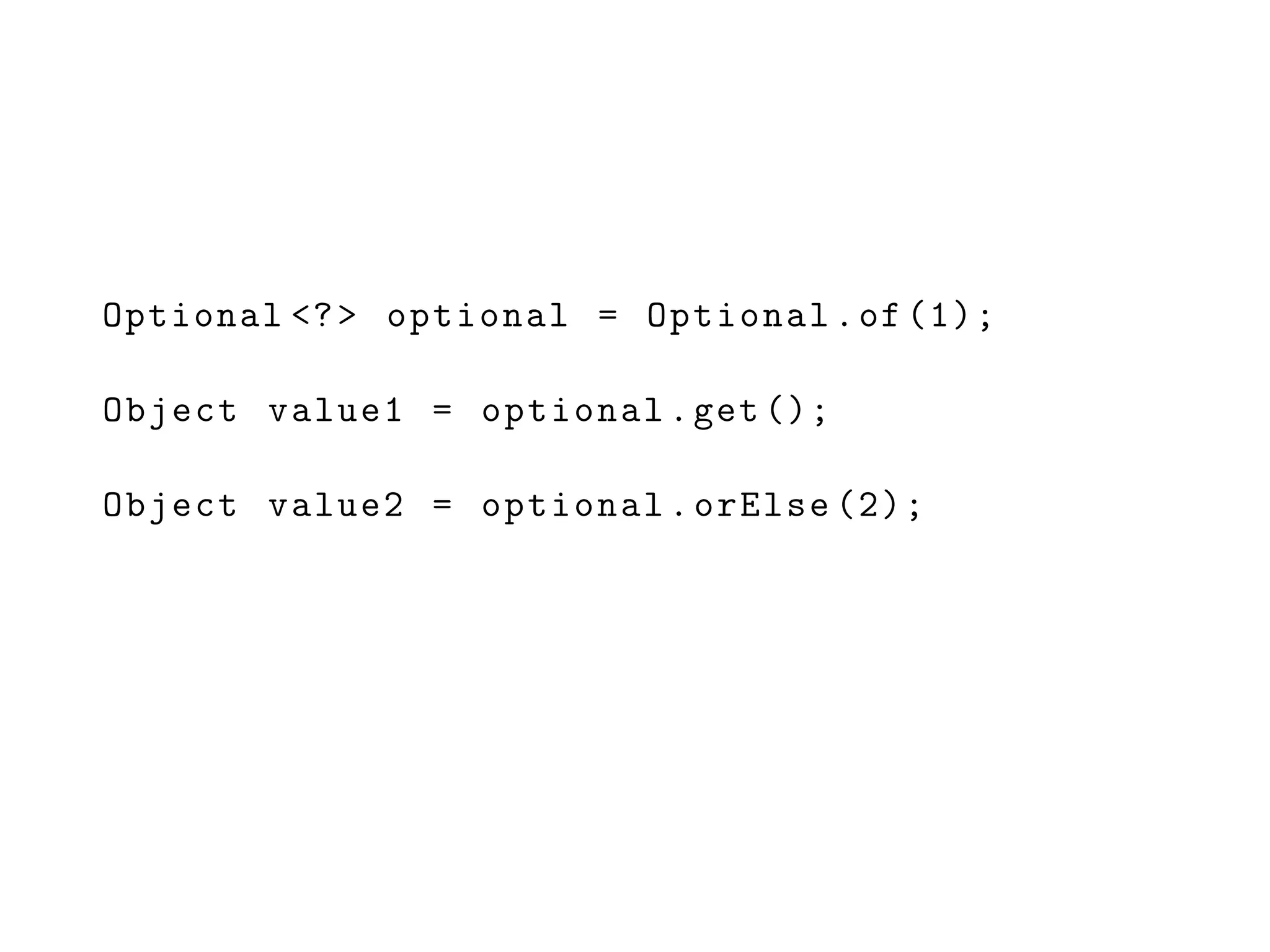
Optional <?> optional = Optional.of (1);
Object value1 = optional.get ();
Object value2 = optional.orElse (2);
int[] oldArray = ...;
int oldLength = oldArray.length;
int newLength = oldLength + 10;
int[] newArray =
Arrays.copyOf(oldArray , newLength );
newArray[oldLength] = newElement1;
newArray[oldLength + 1] = newElement2;
// ...
final int[] array = new int[] {1, 2, 3};
array [0] = 10;
array [1] = 11;
array [2] = 12;
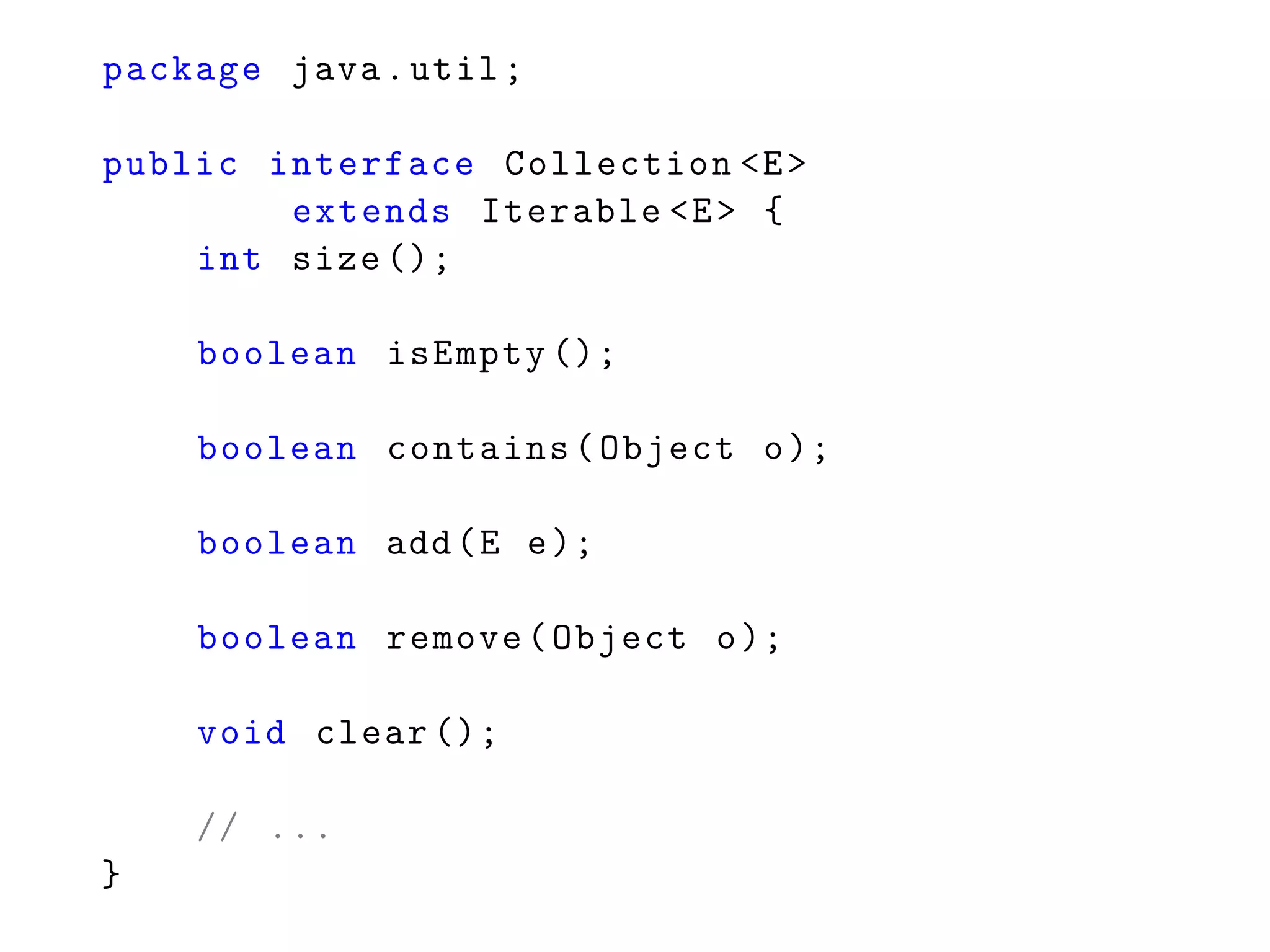
package java.util;
public interface Collection <E>
extends Iterable <E> {
int size ();
boolean isEmpty ();
boolean contains(Object o);
boolean add(E e);
boolean remove(Object o);
void clear ();
// ...
}
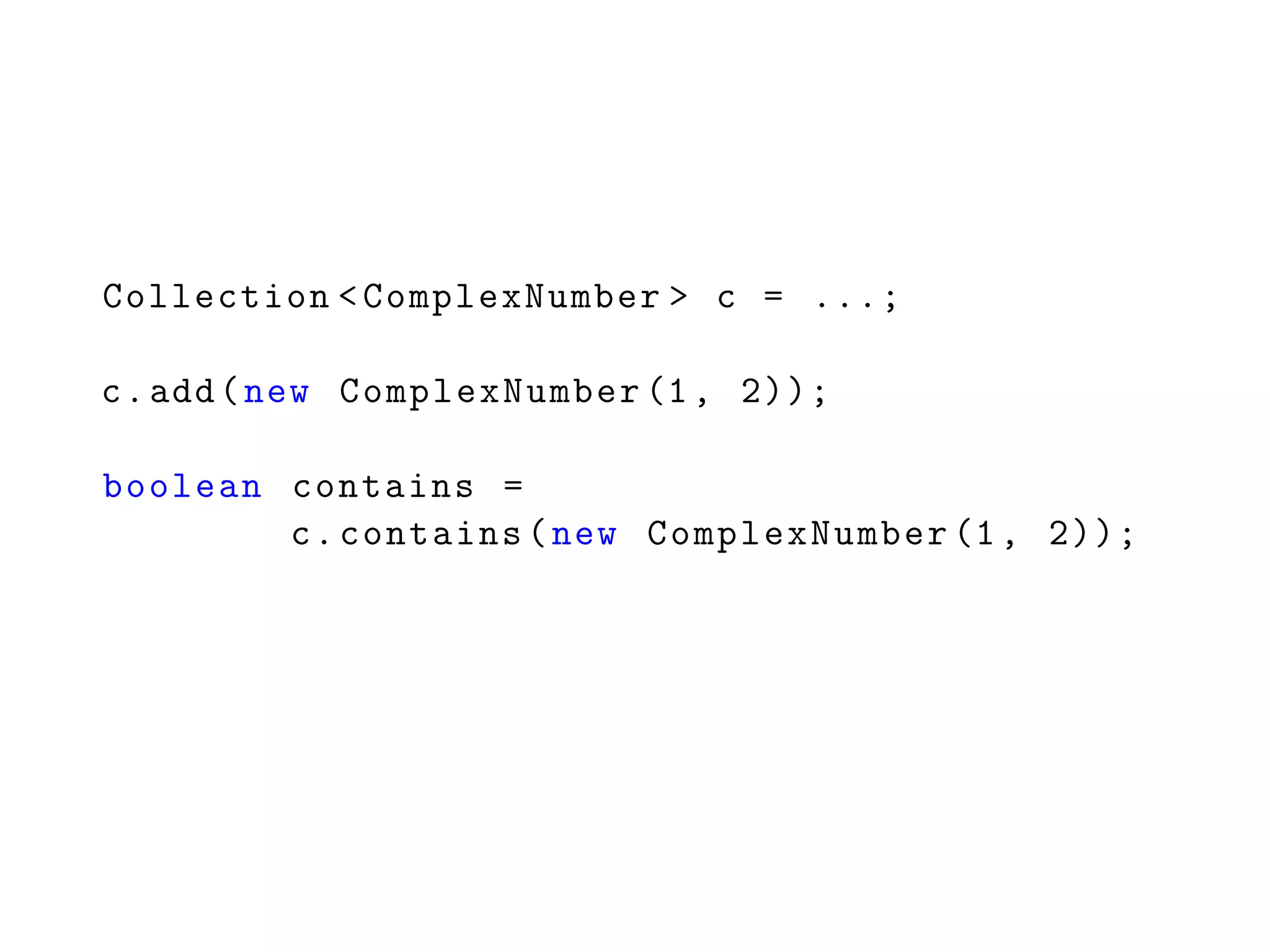
Collection <ComplexNumber > c = ...;
c.add(new ComplexNumber (1, 2));
boolean contains =
c.contains(new ComplexNumber (1, 2));
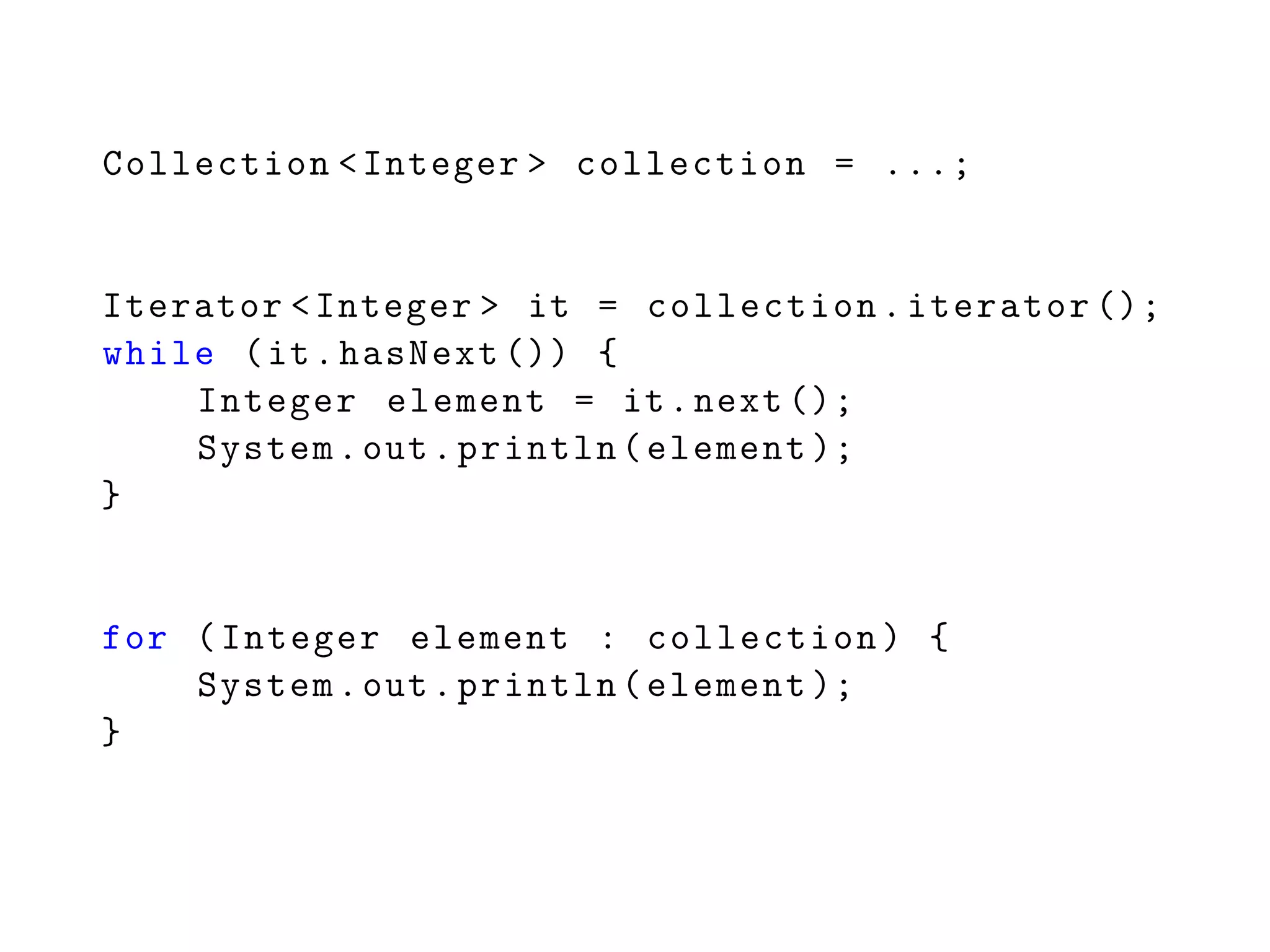
Collection <Integer > collection = ...;
Iterator <Integer > it = collection.iterator ();
while (it.hasNext ()) {
Integer element = it.next ();
System.out.println(element );
}
for (Integer element : collection) {
System.out.println(element );
}
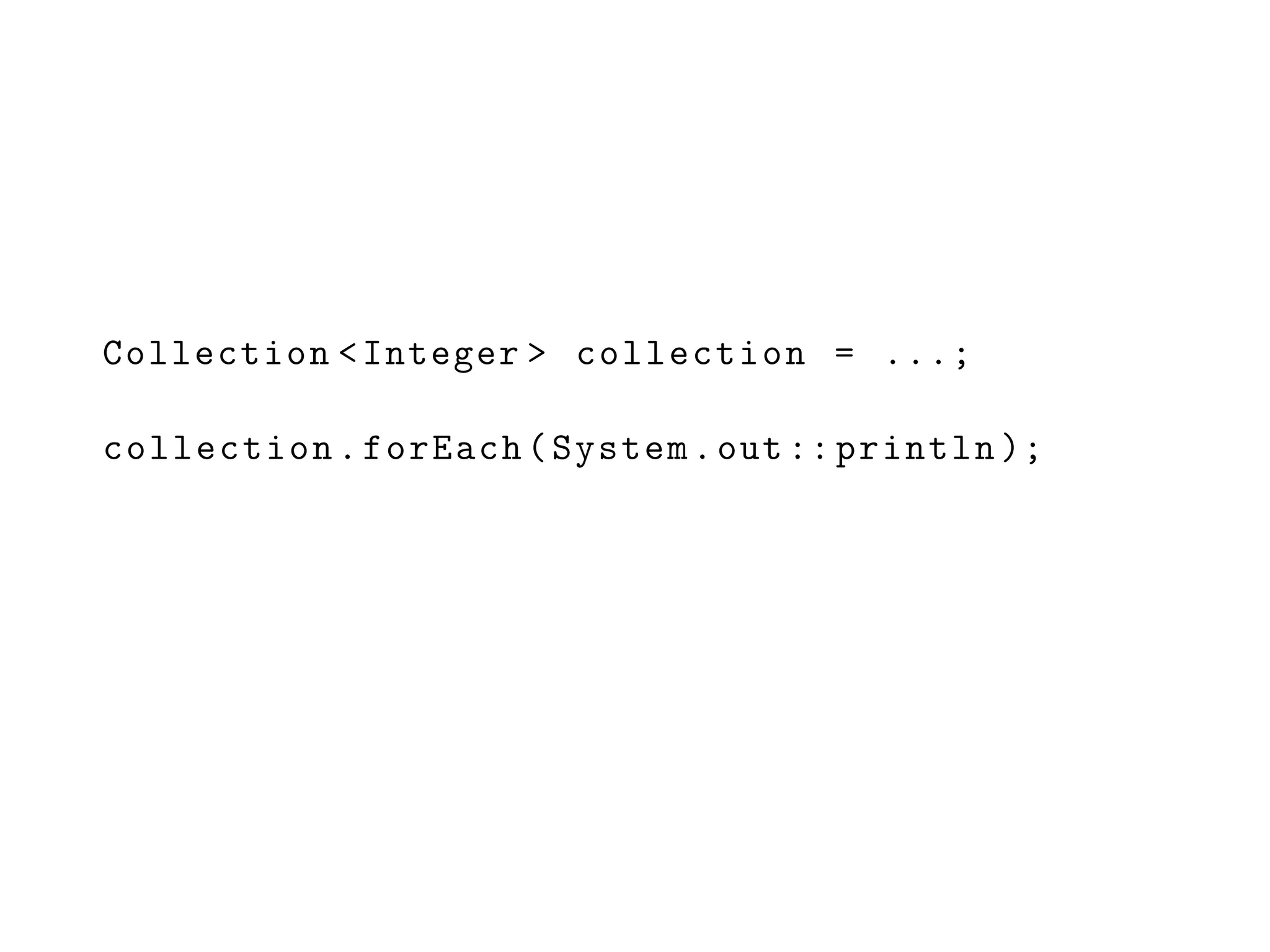
Collection <Integer > collection = ...;
collection.forEach(System.out:: println );
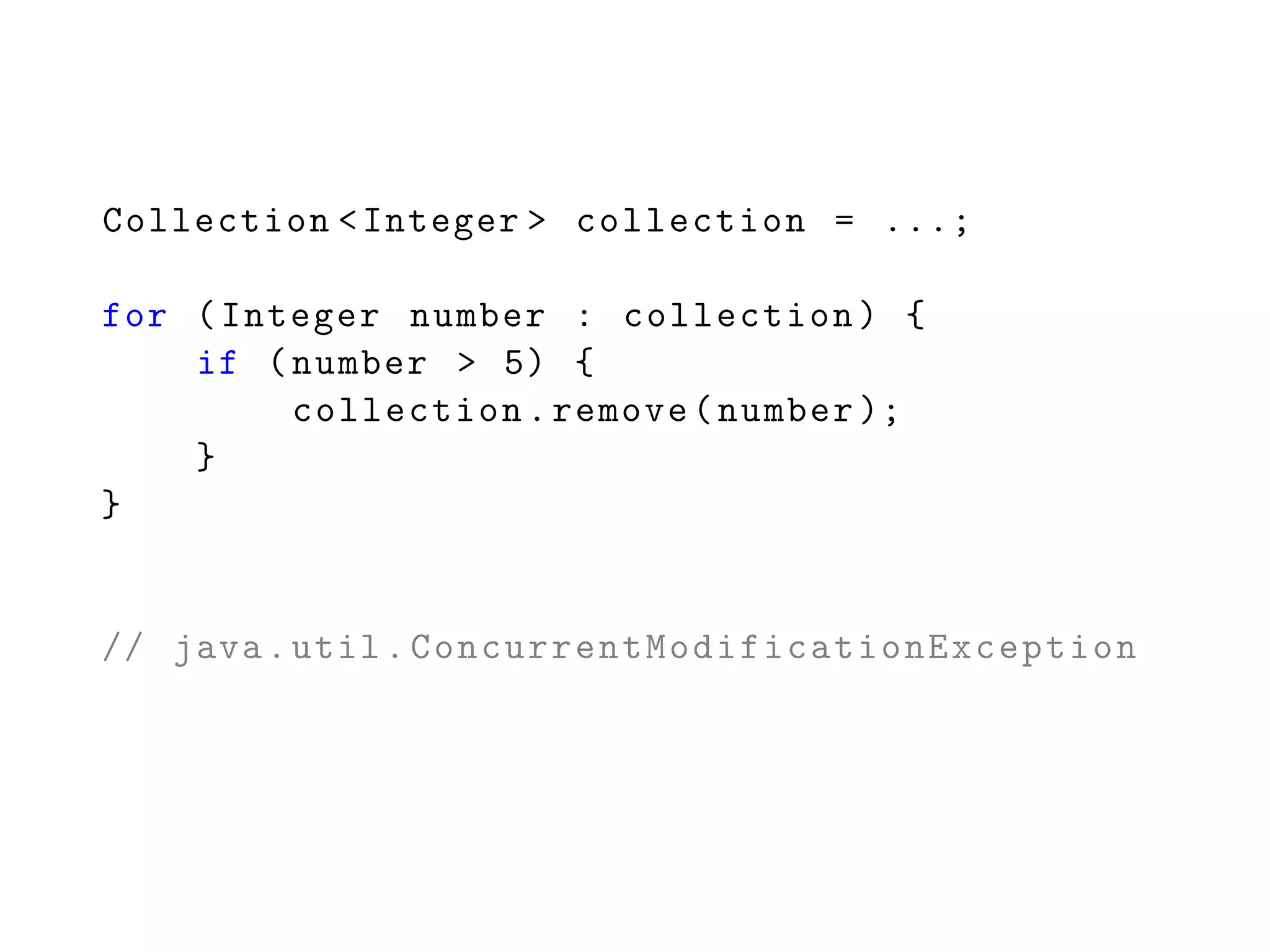
Collection <Integer > collection = ...;
for (Integer number : collection) {
if (number > 5) {
collection.remove(number );
}
}
// java.util. ConcurrentModificationException
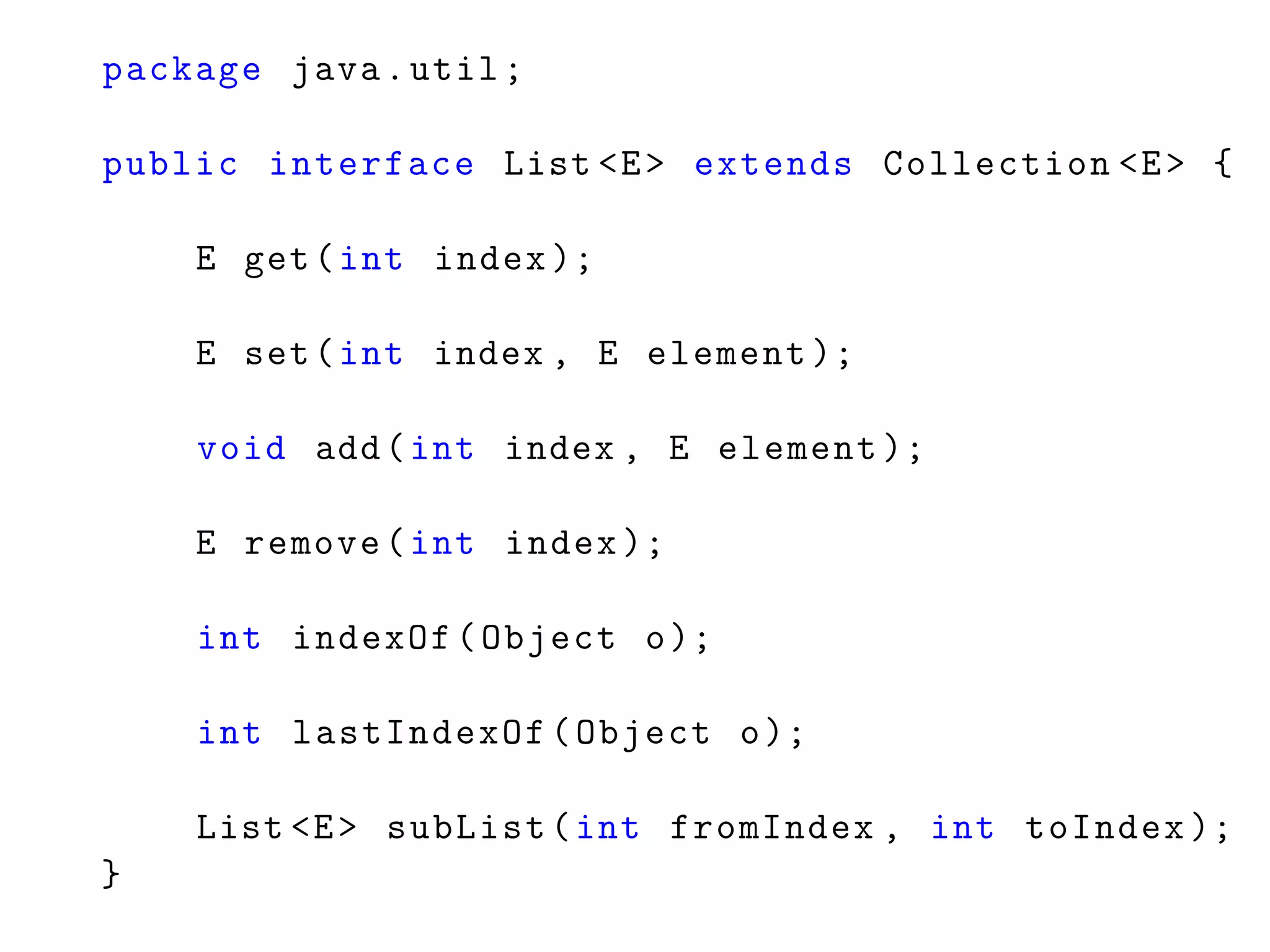
package java.util;
public interface List <E> extends Collection <E> {
E get(int index );
E set(int index , E element );
void add(int index , E element );
E remove(int index );
int indexOf(Object o);
int lastIndexOf(Object o);
List <E> subList(int fromIndex , int toIndex );
}
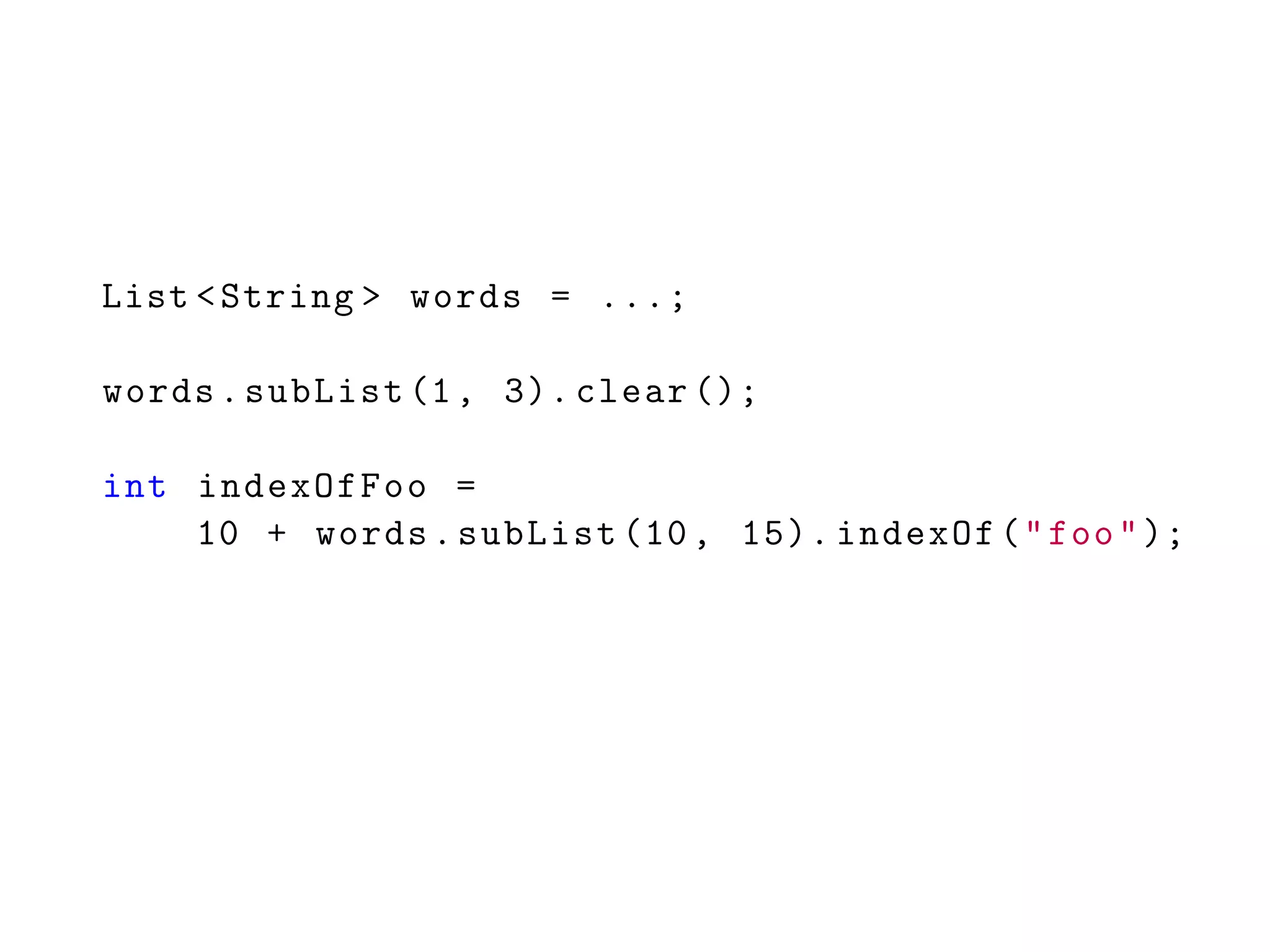
List <String > words = ...;
words.subList (1, 3). clear ();
int indexOfFoo =
10 + words.subList (10, 15). indexOf("foo");
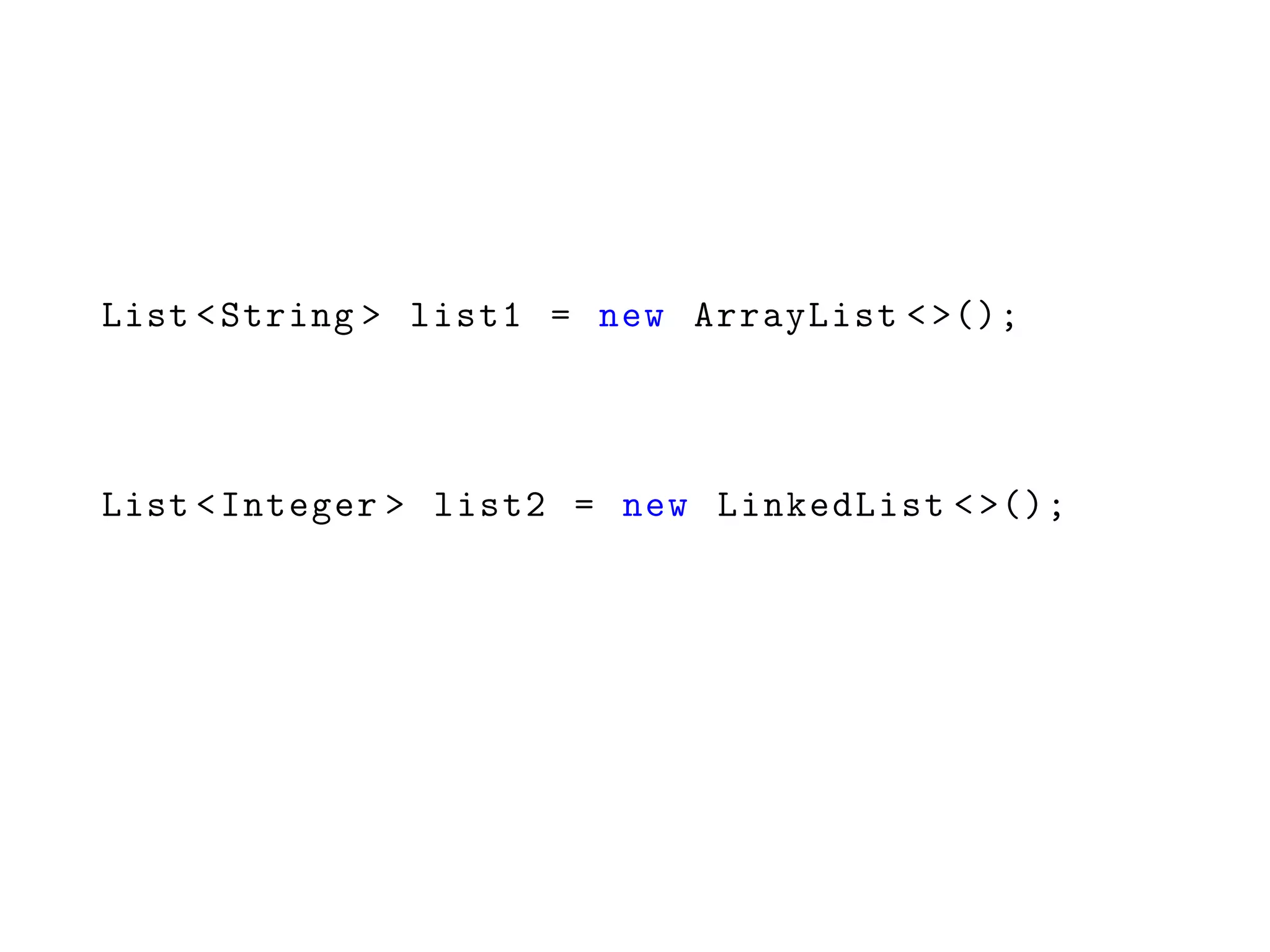
List <String > list1 = new ArrayList <>();
List <Integer > list2 = new LinkedList <>();
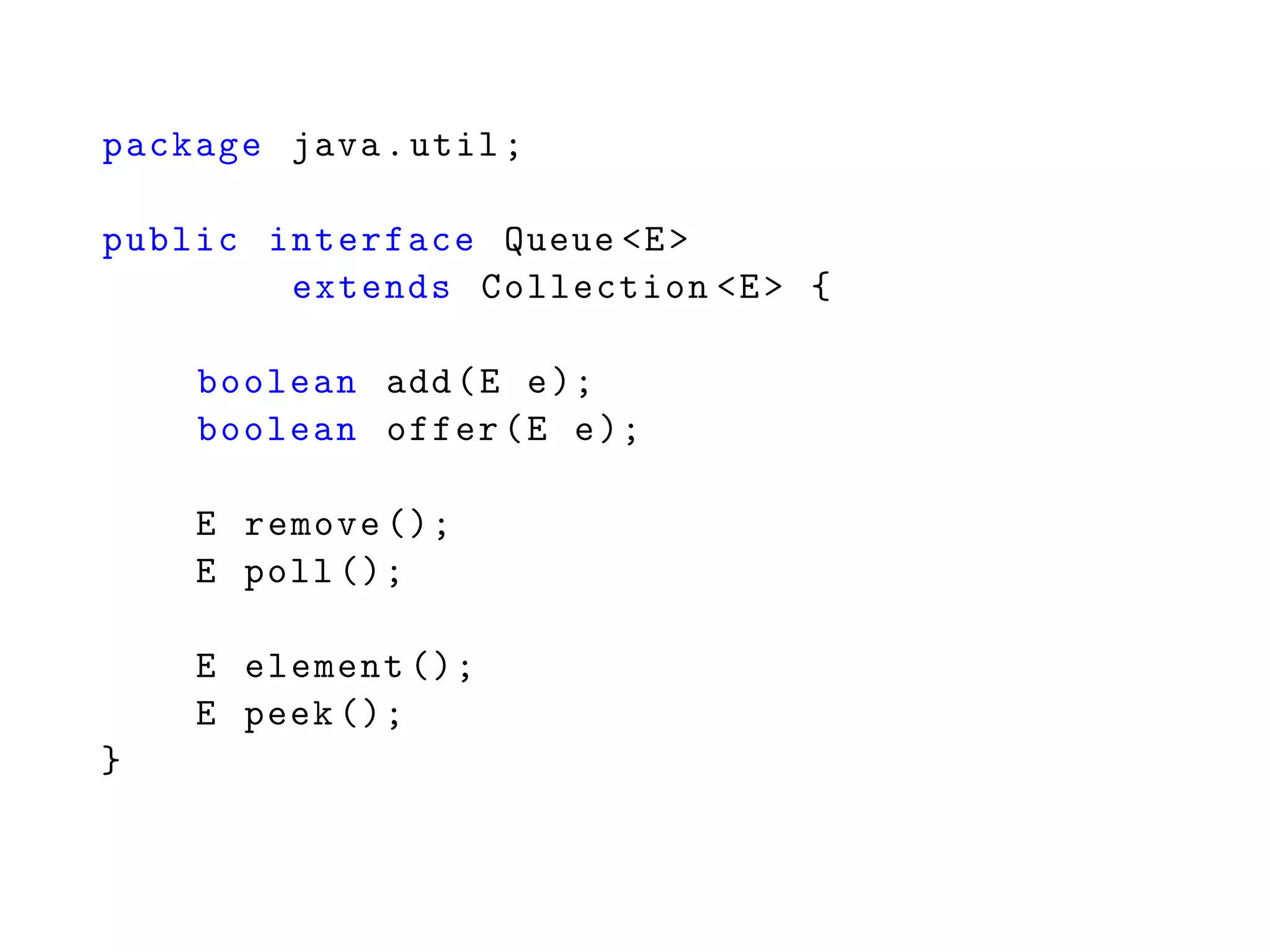
package java.util;
public interface Queue <E>
extends Collection <E> {
boolean add(E e);
boolean offer(E e);
E remove ();
E poll ();
E element ();
E peek ();
}
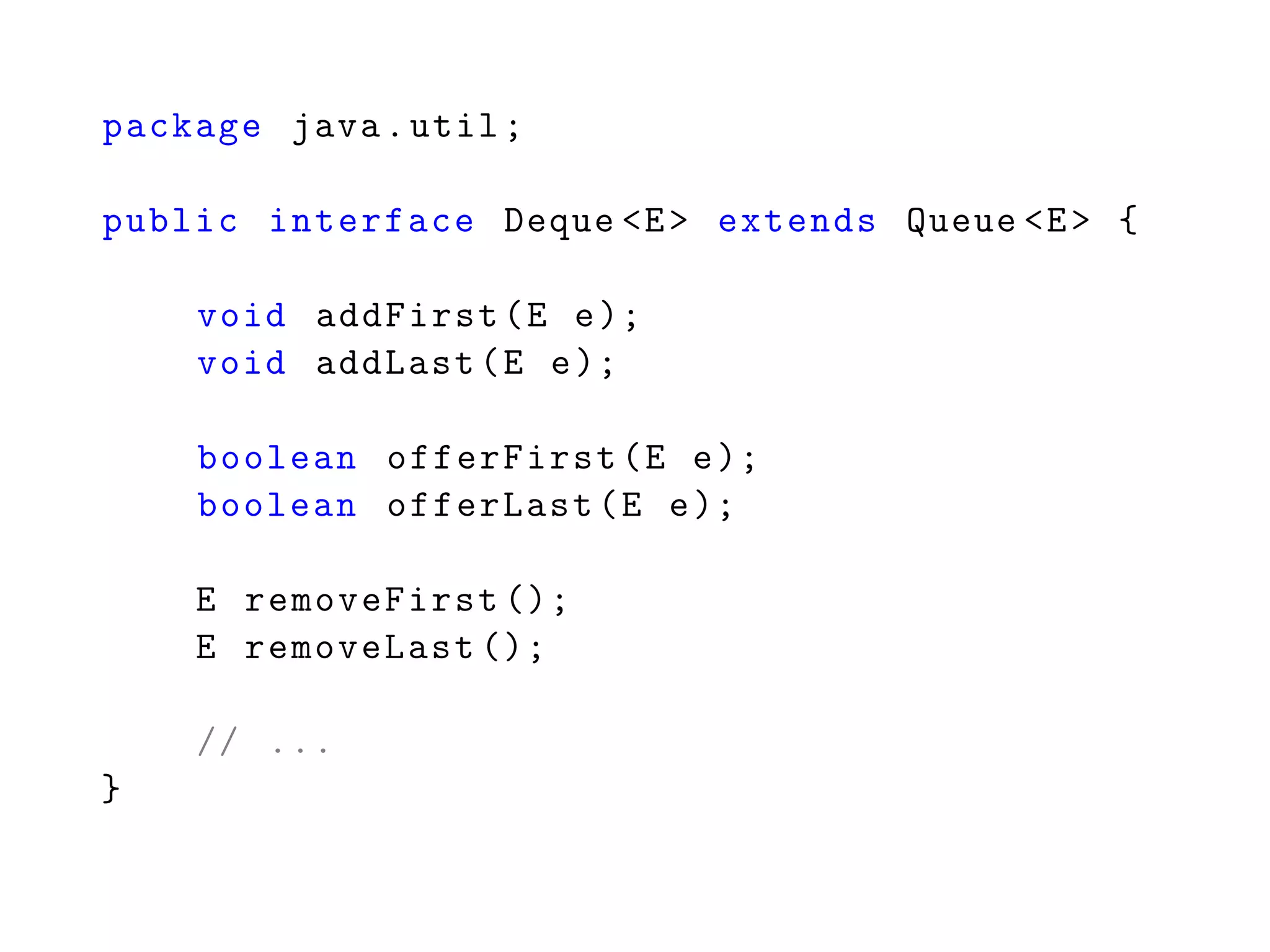
package java.util;
public interface Deque <E> extends Queue <E> {
void addFirst(E e);
void addLast(E e);
boolean offerFirst(E e);
boolean offerLast(E e);
E removeFirst ();
E removeLast ();
// ...
}
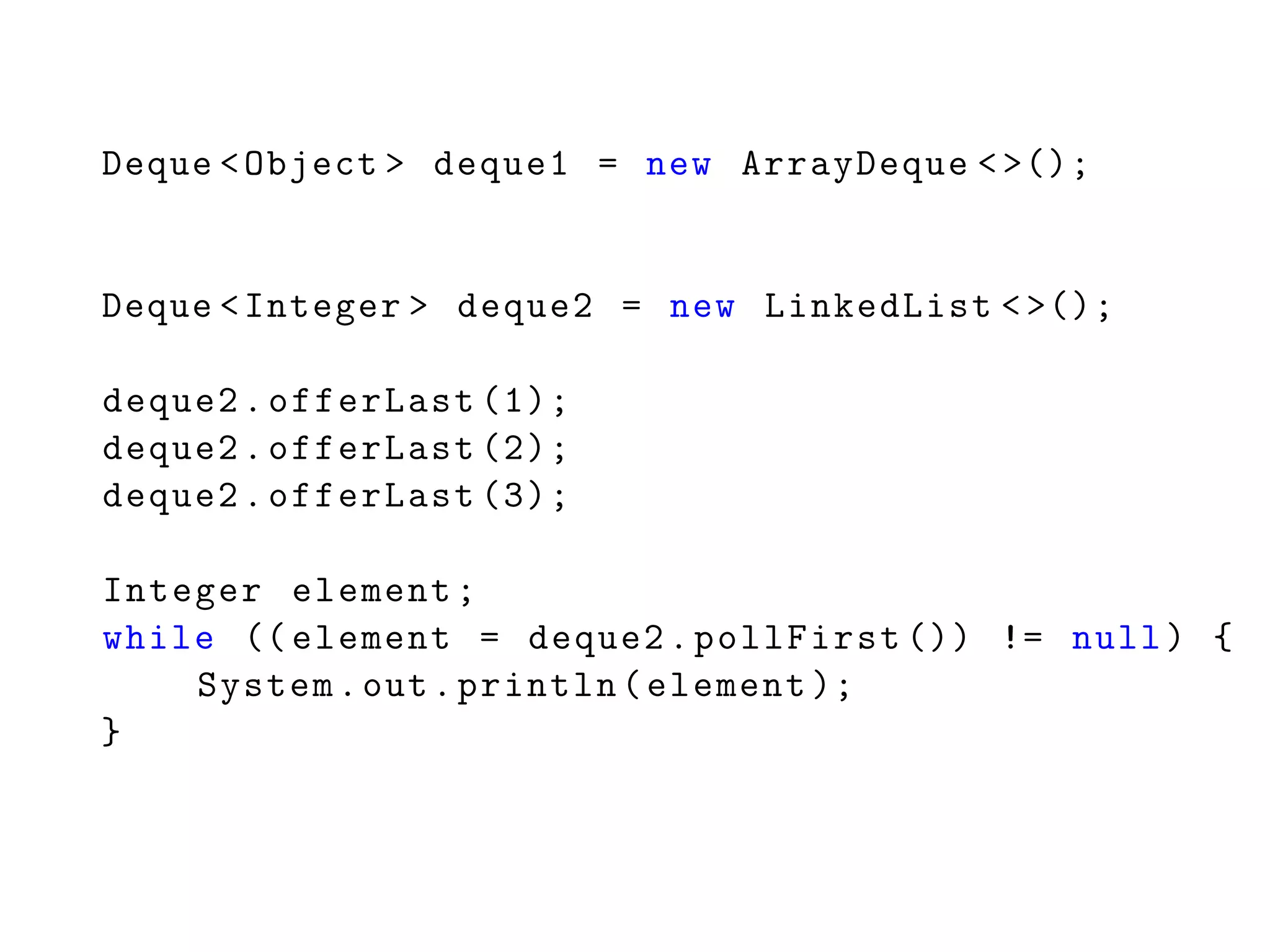
Deque <Object > deque1 = new ArrayDeque <>();
Deque <Integer > deque2 = new LinkedList <>();
deque2.offerLast (1);
deque2.offerLast (2);
deque2.offerLast (3);
Integer element;
while (( element = deque2.pollFirst ()) != null) {
System.out.println(element );
}
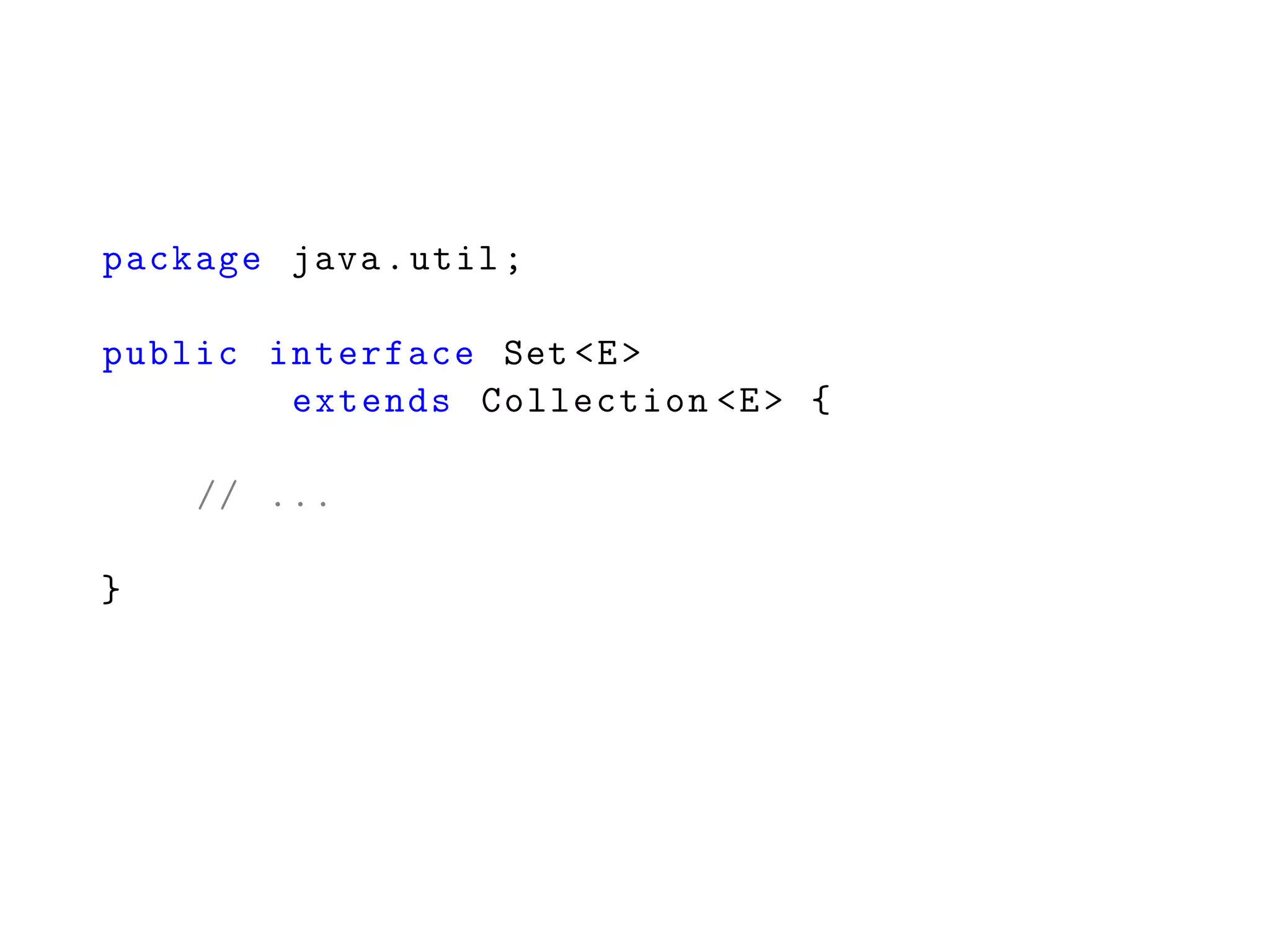
package java.util;
public interface Set <E>
extends Collection <E> {
// ...
}
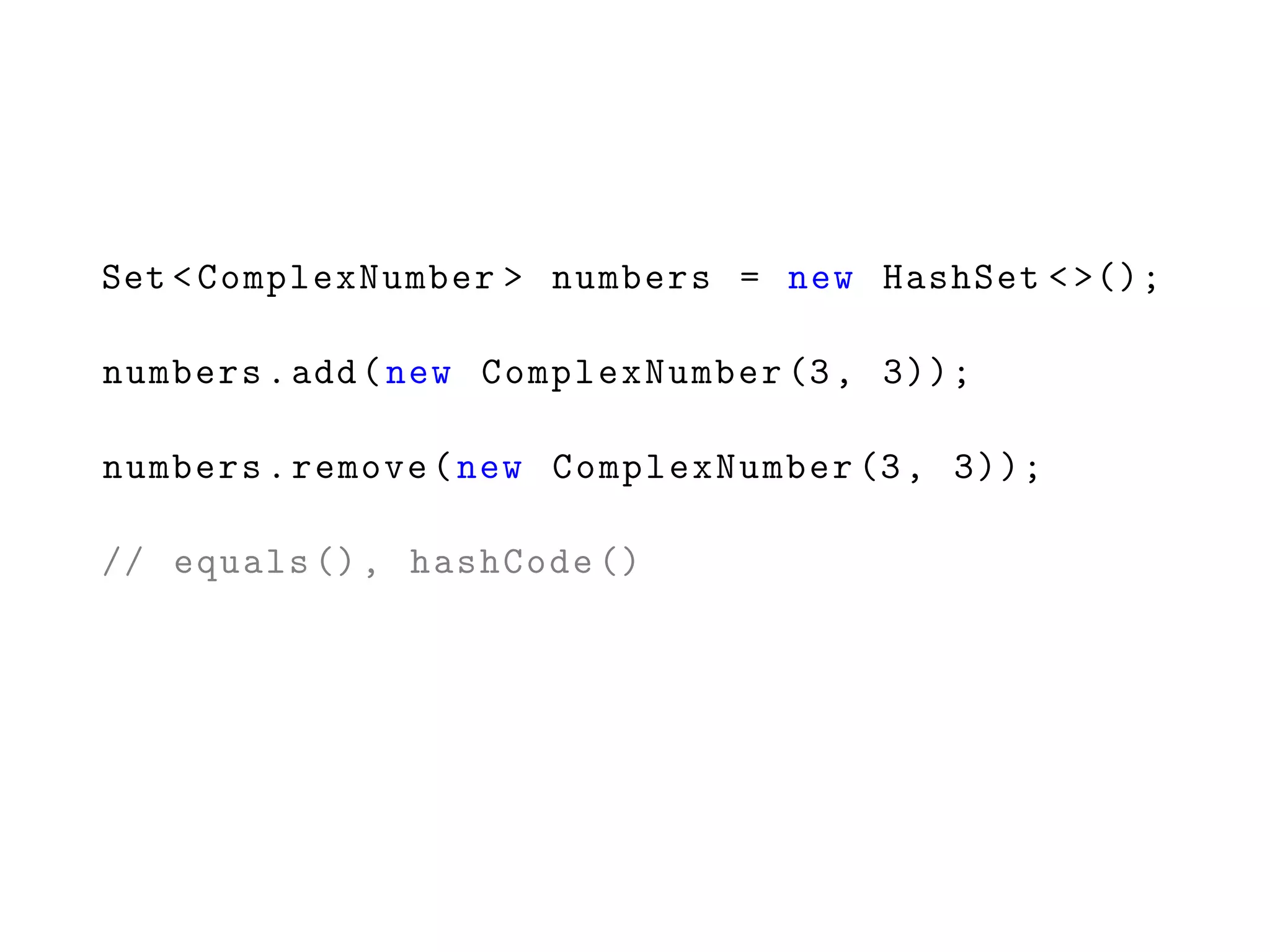
Set <ComplexNumber > numbers = new HashSet <>();
numbers.add(new ComplexNumber (3, 3));
numbers.remove(new ComplexNumber (3, 3));
// equals(), hashCode ()
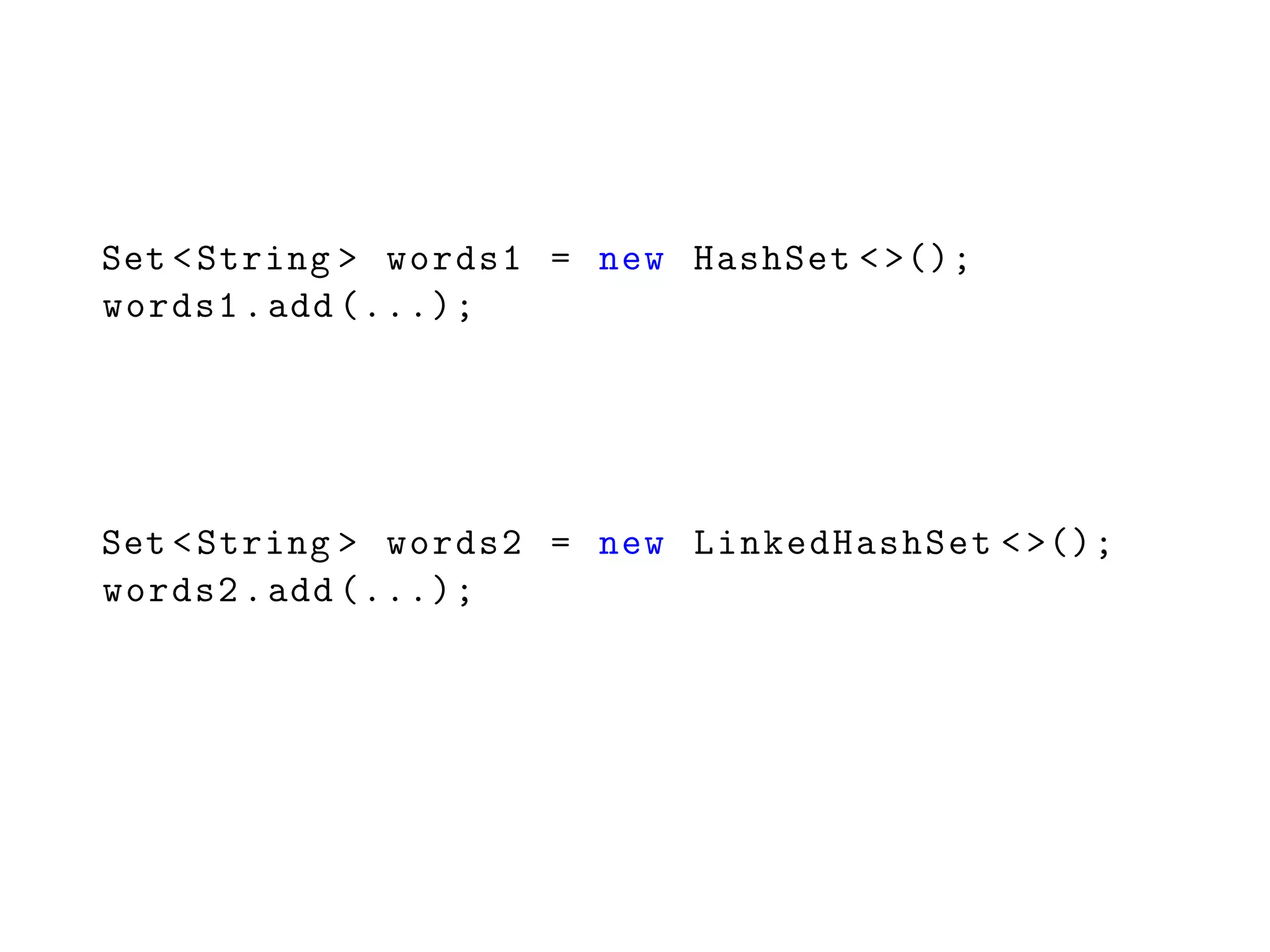
Set <String > words1 = new HashSet <>();
words1.add (...);
Set <String > words2 = new LinkedHashSet <>();
words2.add (...);
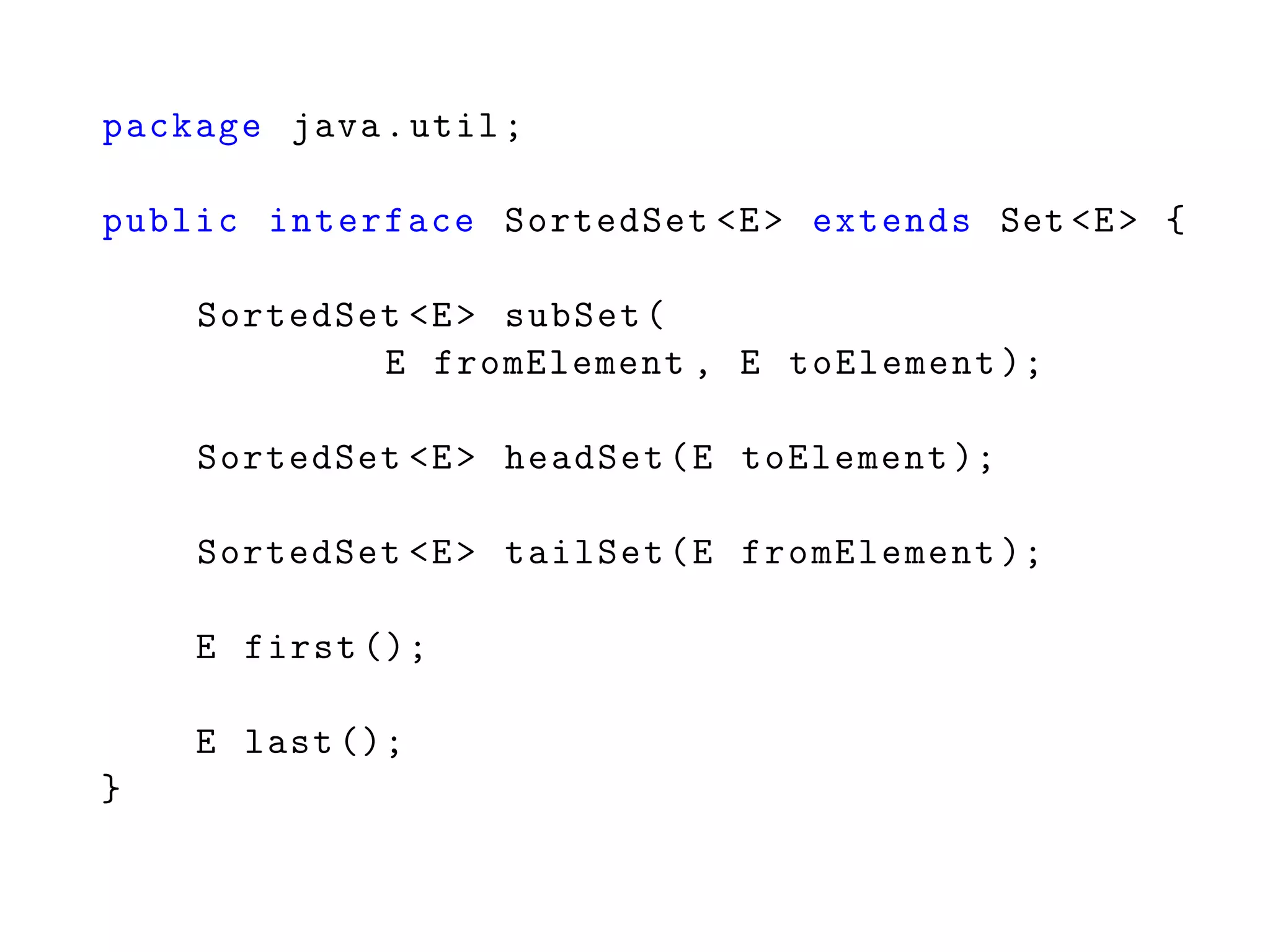
package java.util;
public interface SortedSet <E> extends Set <E> {
SortedSet <E> subSet(
E fromElement , E toElement );
SortedSet <E> headSet(E toElement );
SortedSet <E> tailSet(E fromElement );
E first ();
E last ();
}
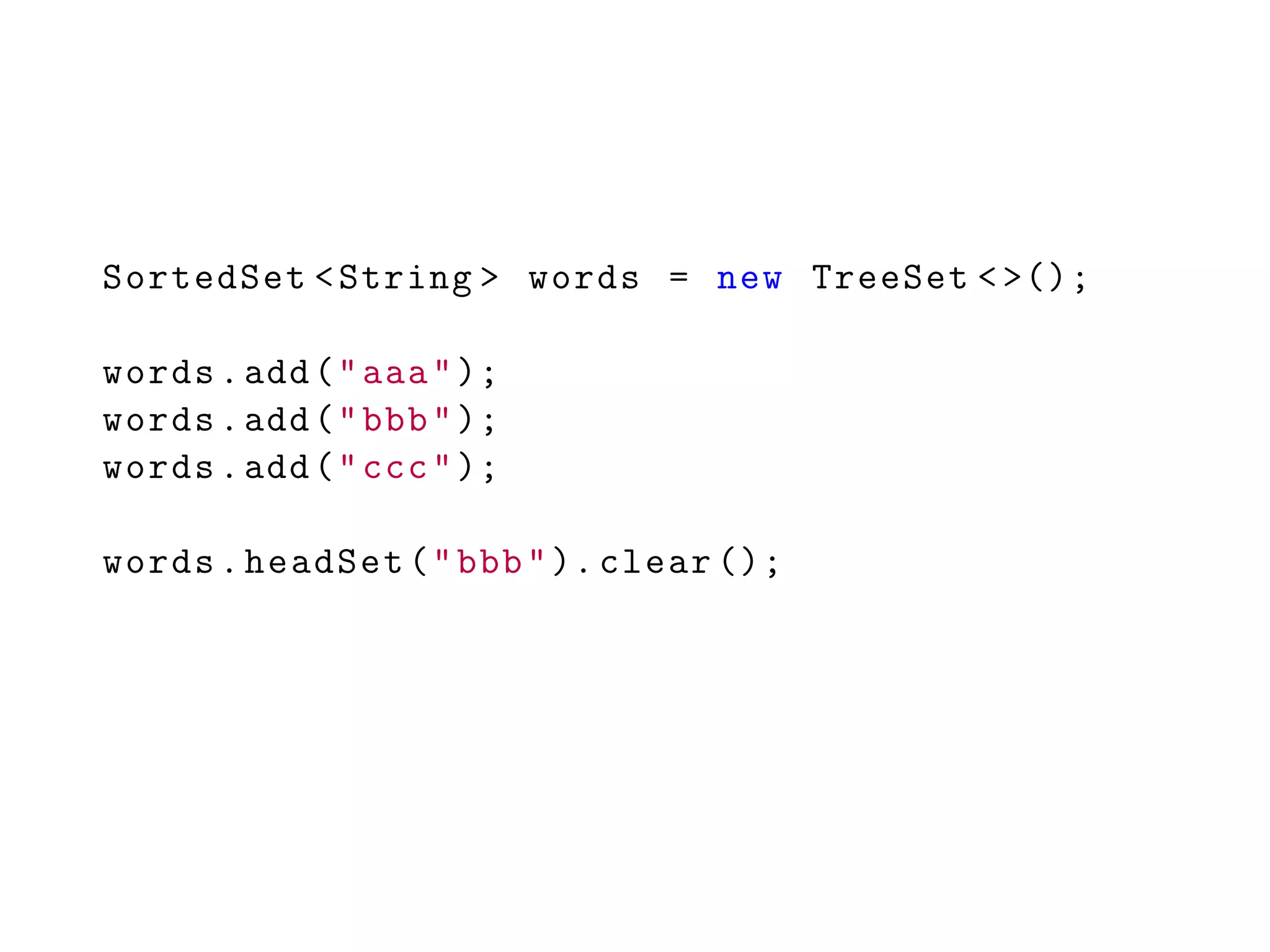
SortedSet <String > words = new TreeSet <>();
words.add("aaa");
words.add("bbb");
words.add("ccc");
words.headSet("bbb"). clear ();
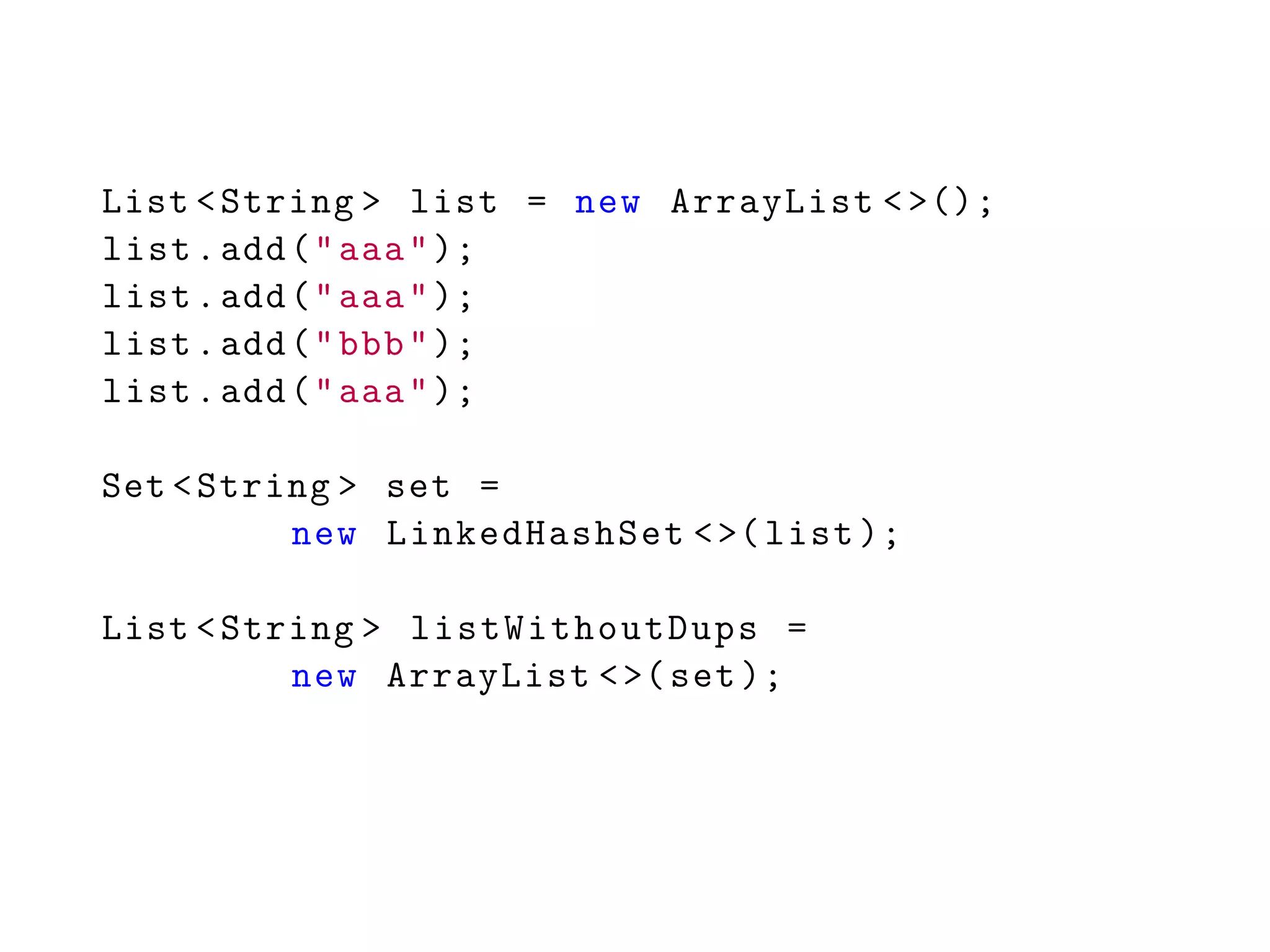
List <String > list = new ArrayList <>();
list.add("aaa");
list.add("aaa");
list.add("bbb");
list.add("aaa");
Set <String > set =
new LinkedHashSet <>(list );
List <String > listWithoutDups =
new ArrayList <>(set);
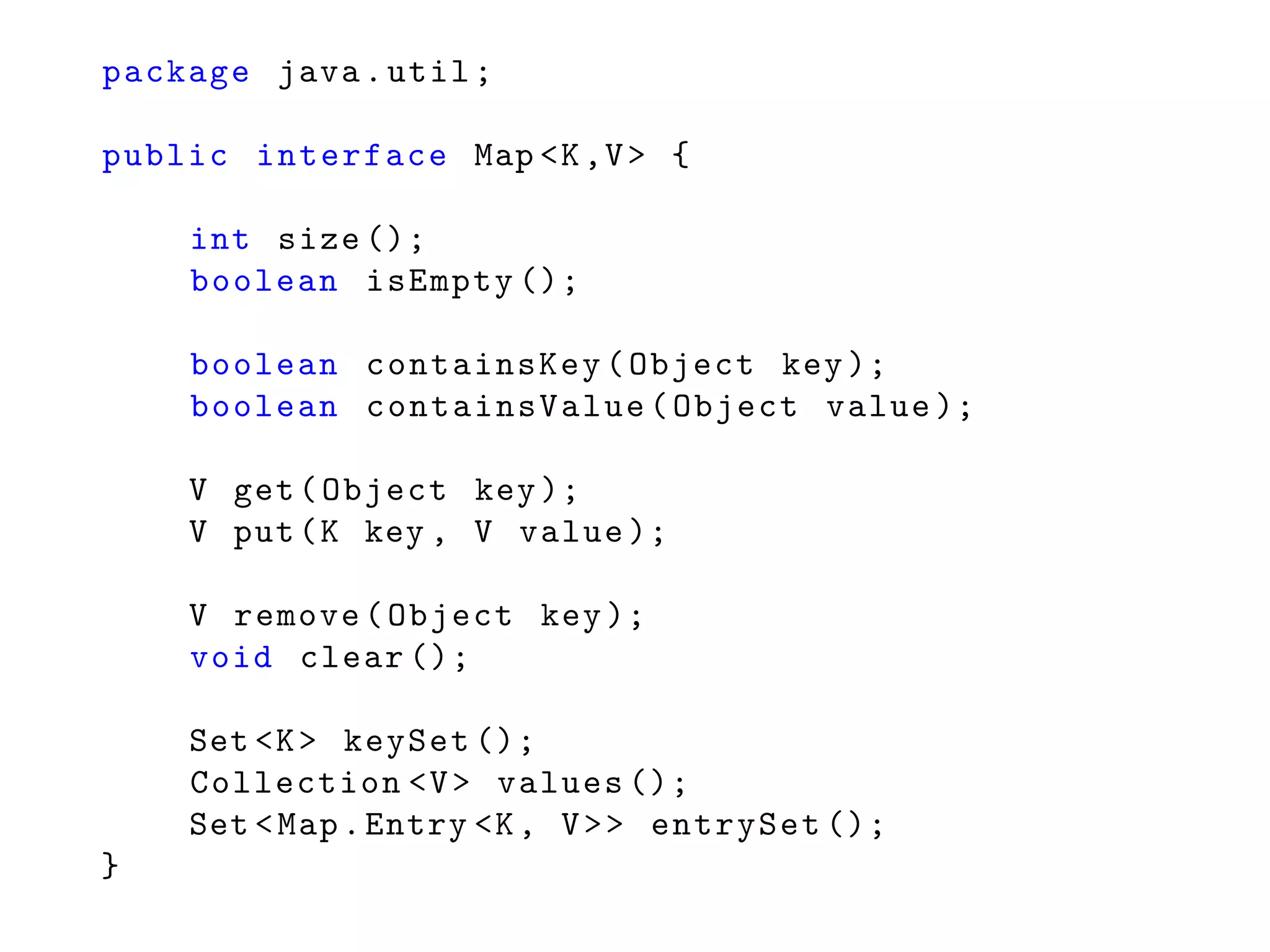
package java.util;
public interface Map <K,V> {
int size ();
boolean isEmpty ();
boolean containsKey(Object key);
boolean containsValue(Object value );
V get(Object key);
V put(K key , V value );
V remove(Object key);
void clear ();
Set <K> keySet ();
Collection <V> values ();
Set <Map.Entry <K, V>> entrySet ();
}
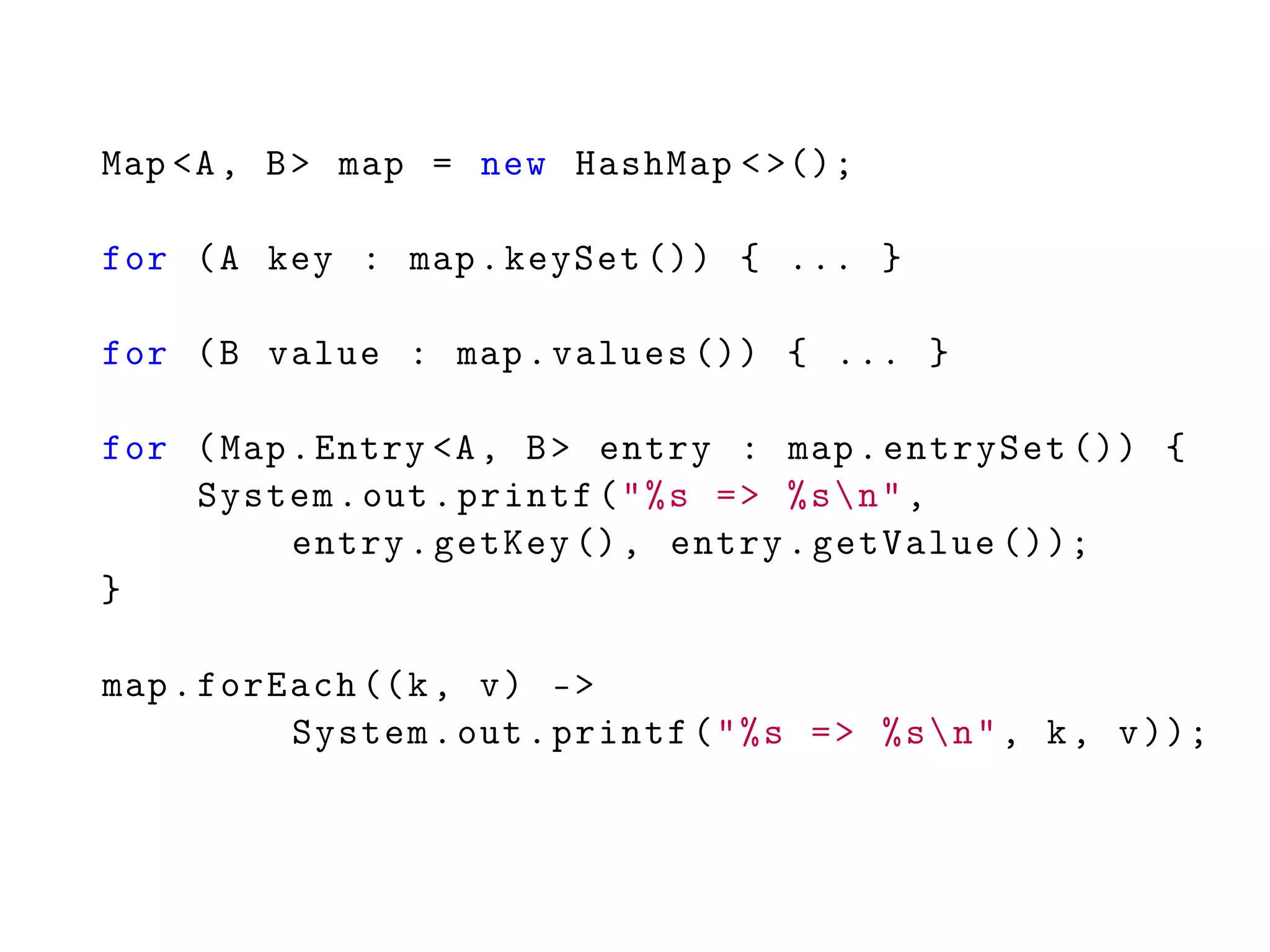
Map <A, B> map = new HashMap <>();
for (A key : map.keySet ()) { ... }
for (B value : map.values ()) { ... }
for (Map.Entry <A, B> entry : map.entrySet ()) {
System.out.printf("%s => %sn",
entry.getKey (), entry.getValue ());
}
map.forEach ((k, v) ->
System.out.printf("%s => %sn", k, v));
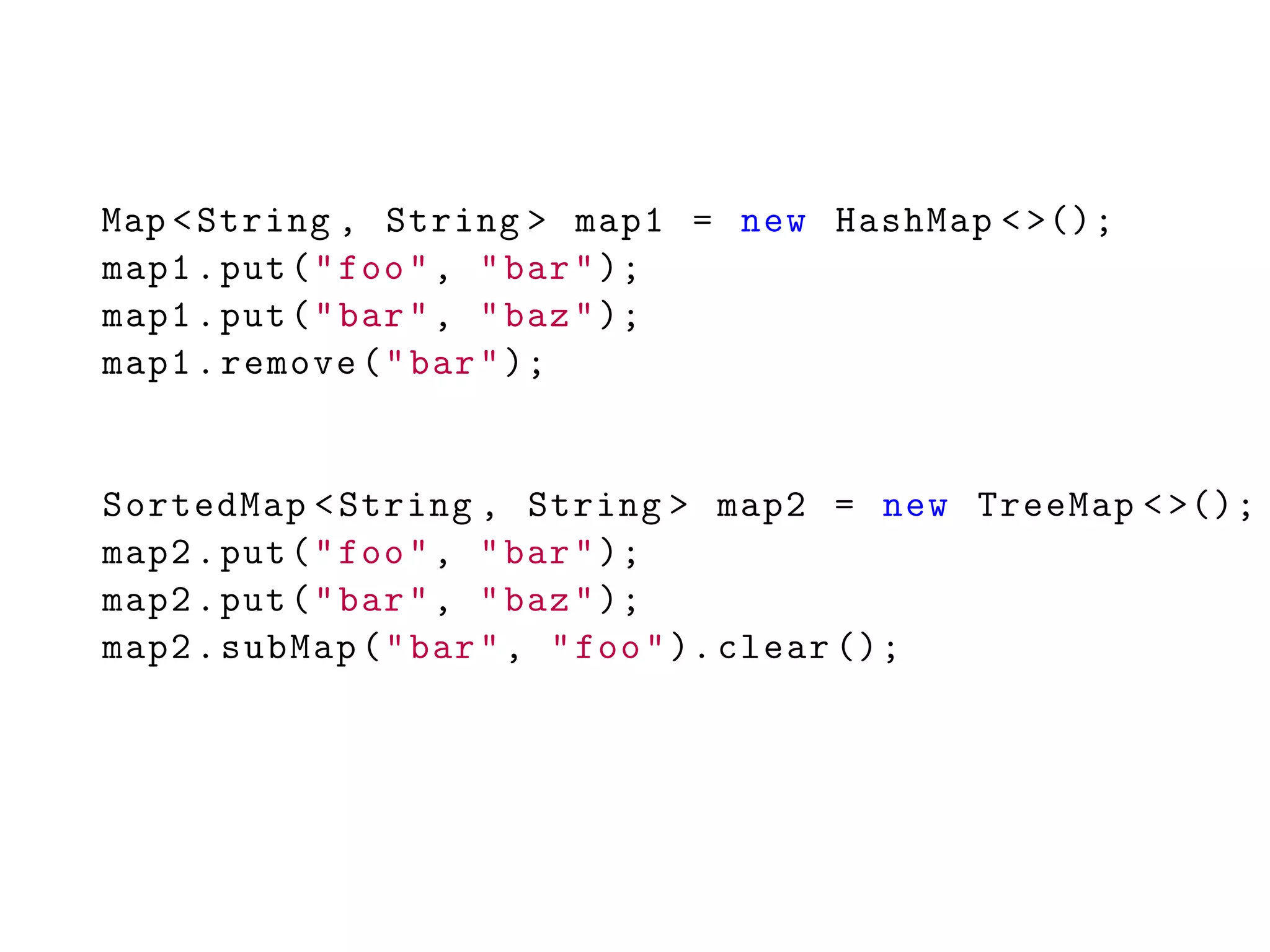
Map <String , String > map1 = new HashMap <>();
map1.put("foo", "bar");
map1.put("bar", "baz");
map1.remove("bar");
SortedMap <String , String > map2 = new TreeMap <>();
map2.put("foo", "bar");
map2.put("bar", "baz");
map2.subMap("bar", "foo"). clear ();
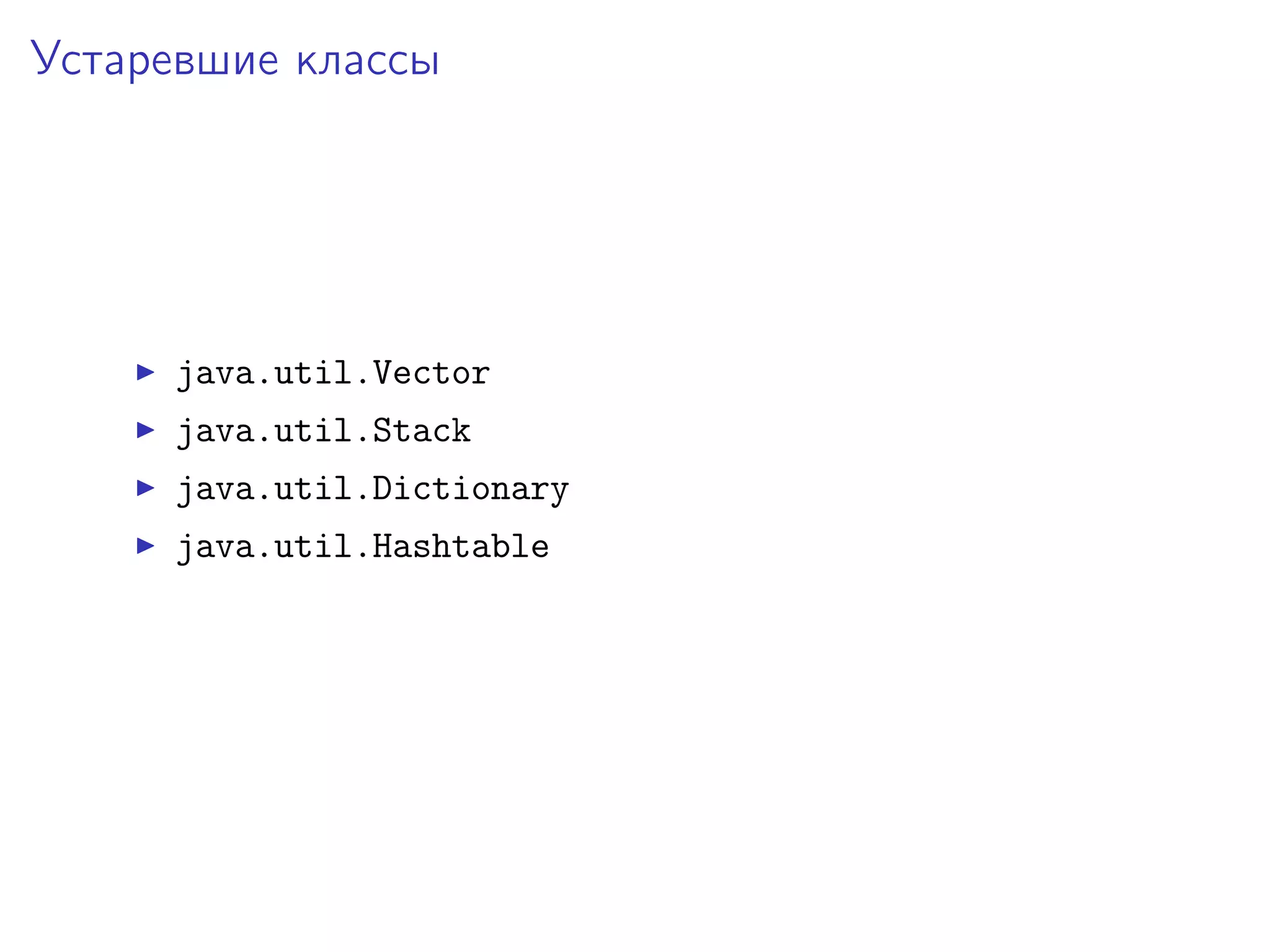
Устаревшие классы
java.util.Vector
java.util.Stack
java.util.Dictionary
java.util.Hashtable
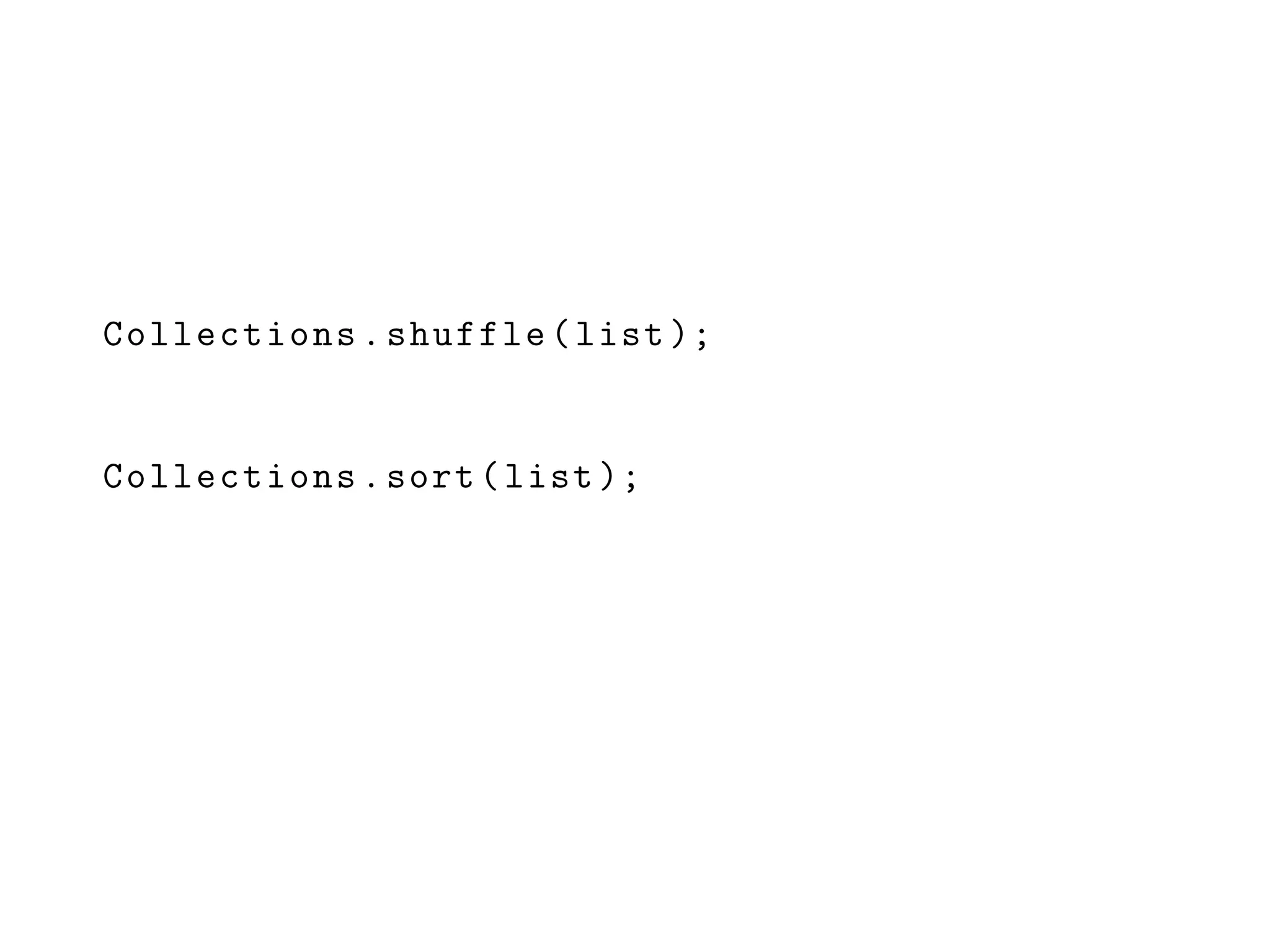
Collections.shuffle(list );
Collections.sort(list );
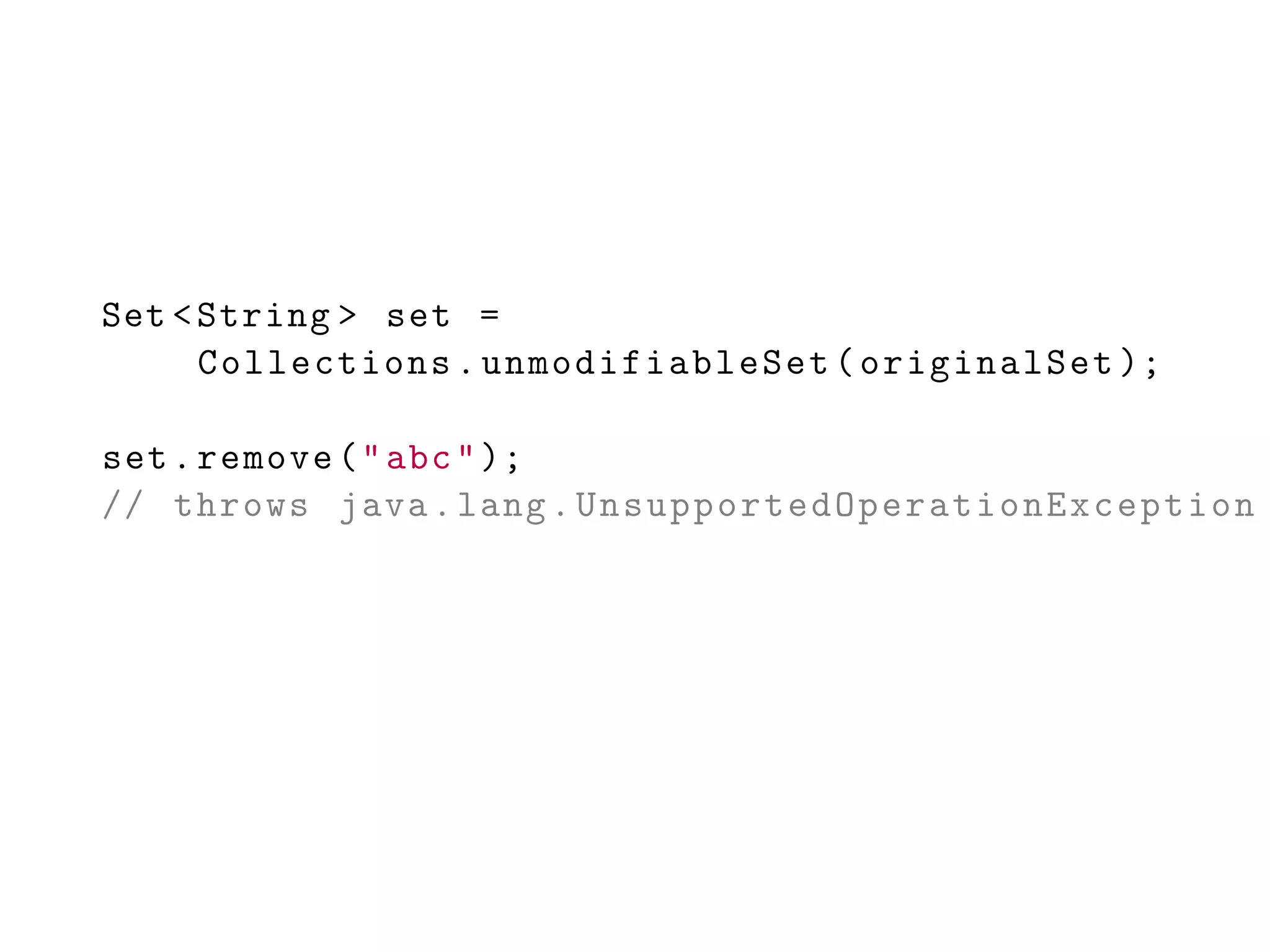
Set <String > set =
Collections.unmodifiableSet(originalSet );
set.remove("abc");
// throws java.lang. UnsupportedOperationException
List <Integer > list = ...;
Object [] array1 = list.toArray ();
Integer [] array2 =
list.toArray(new Integer[list.size ()]);
String [] array = {"A", "B", "C"};
Set <String > set1 =
new HashSet <>(Arrays.asList(array ));
Set <String > set2 = new HashSet <>();
Collections.addAll(set2 , array );
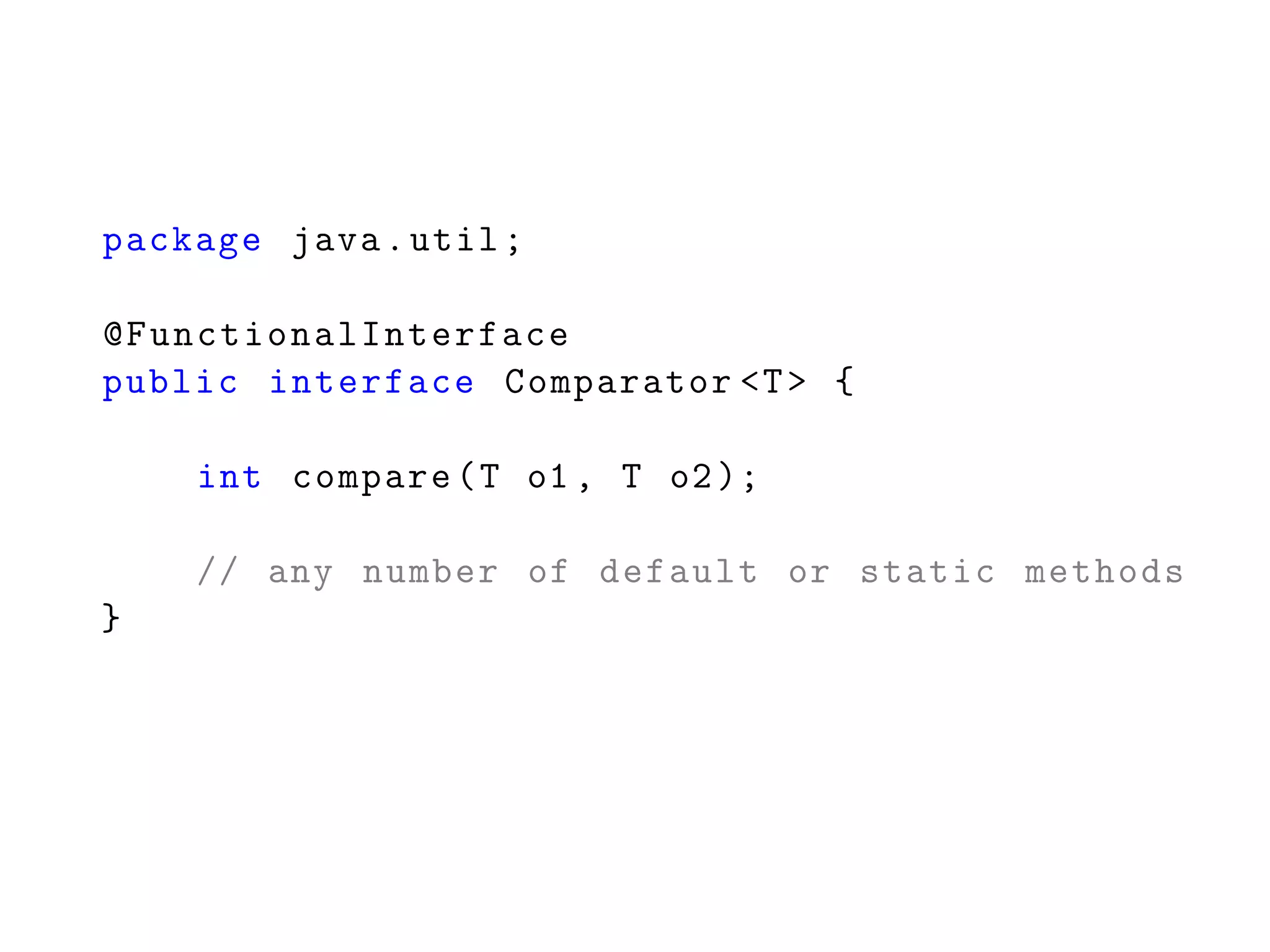
package java.util;
@FunctionalInterface
public interface Comparator <T> {
int compare(T o1 , T o2);
// any number of default or static methods
}
File directory = ...;
File [] javaSourceFiles = directory.listFiles(
new FileFilter () {
@Override
public boolean accept(File file) {
return file.getName (). endsWith(".java");
}
});
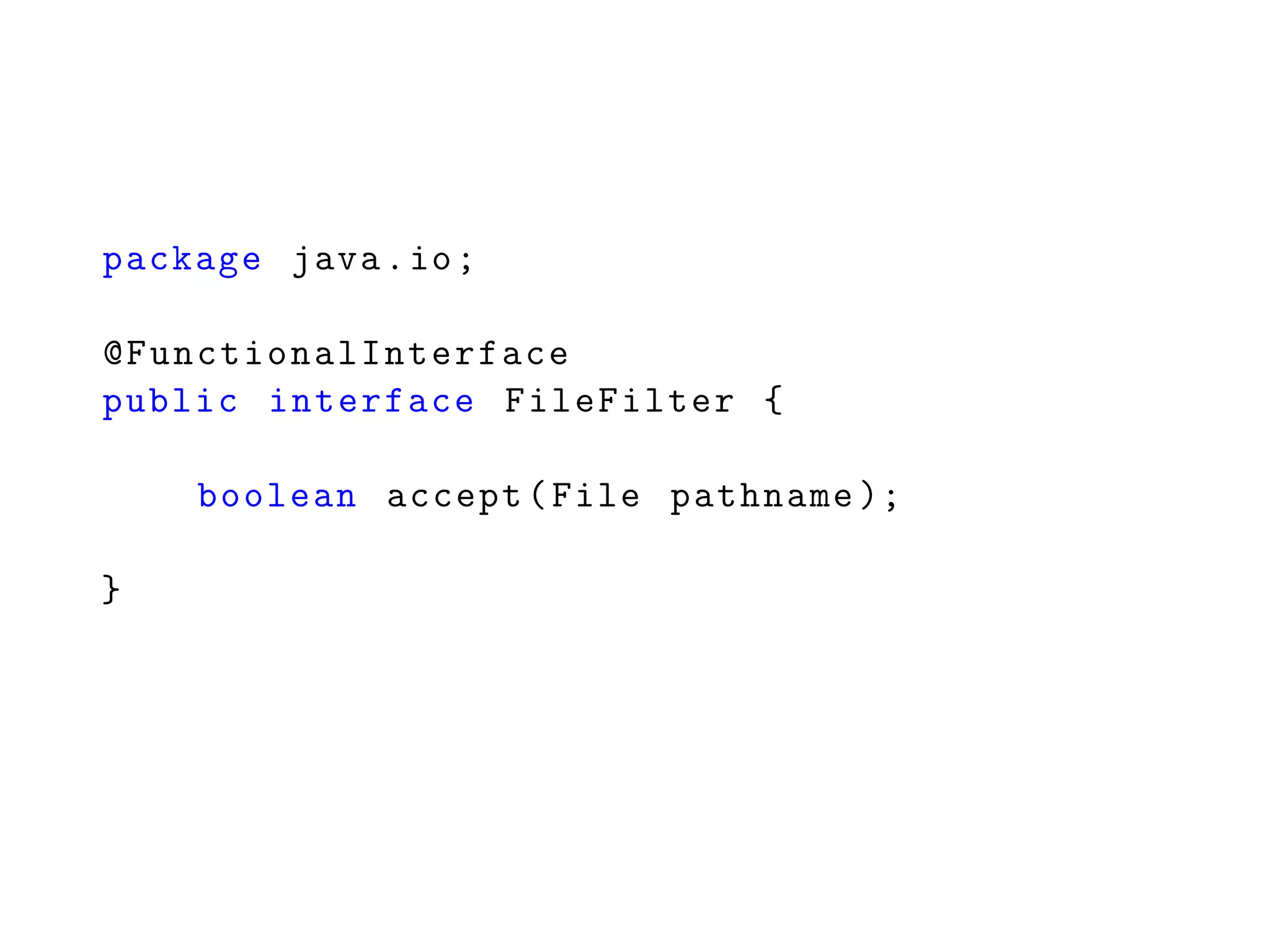
package java.io;
@FunctionalInterface
public interface FileFilter {
boolean accept(File pathname );
}
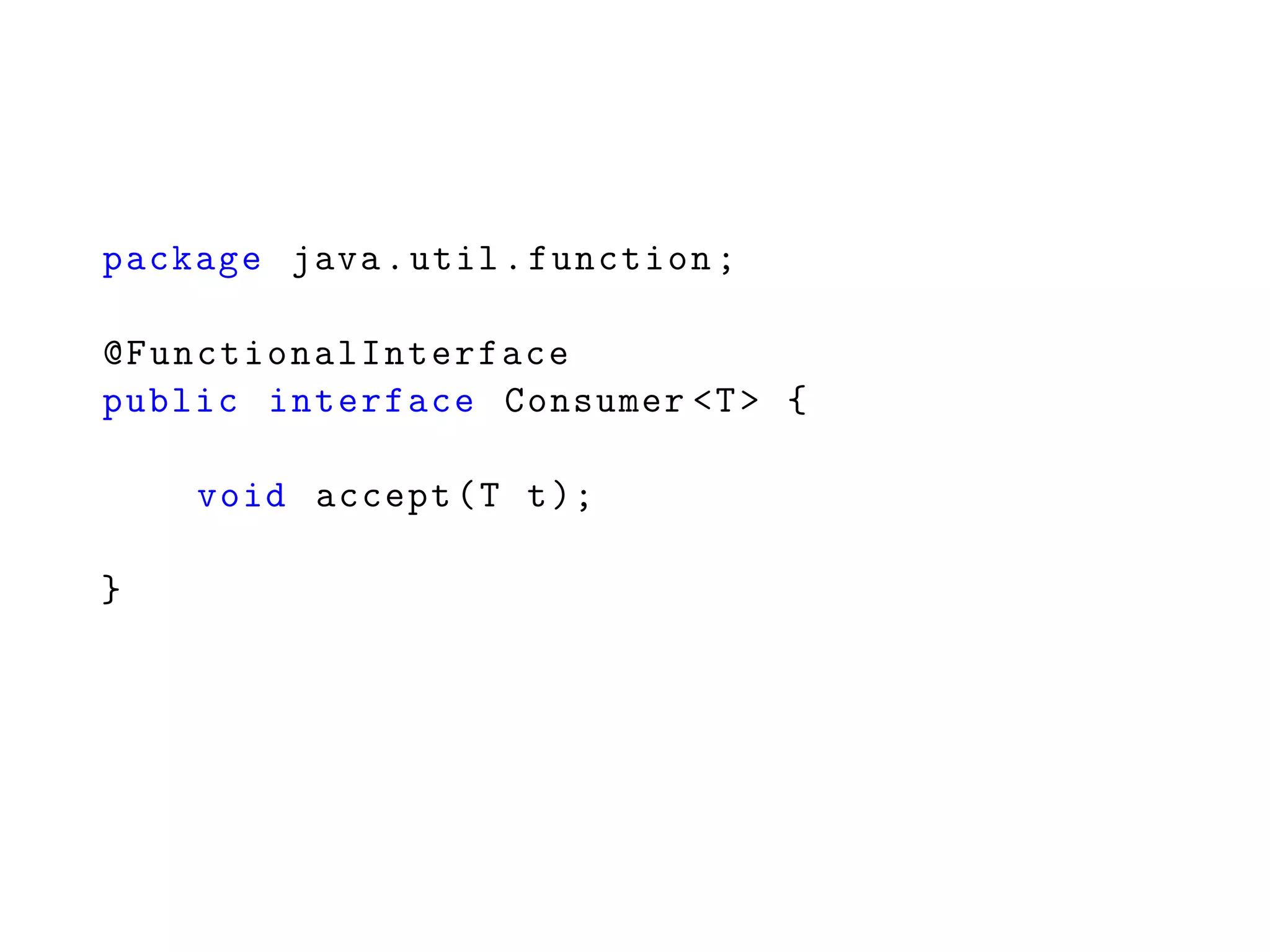
package java.util.function;
@FunctionalInterface
public interface Consumer <T> {
void accept(T t);
}
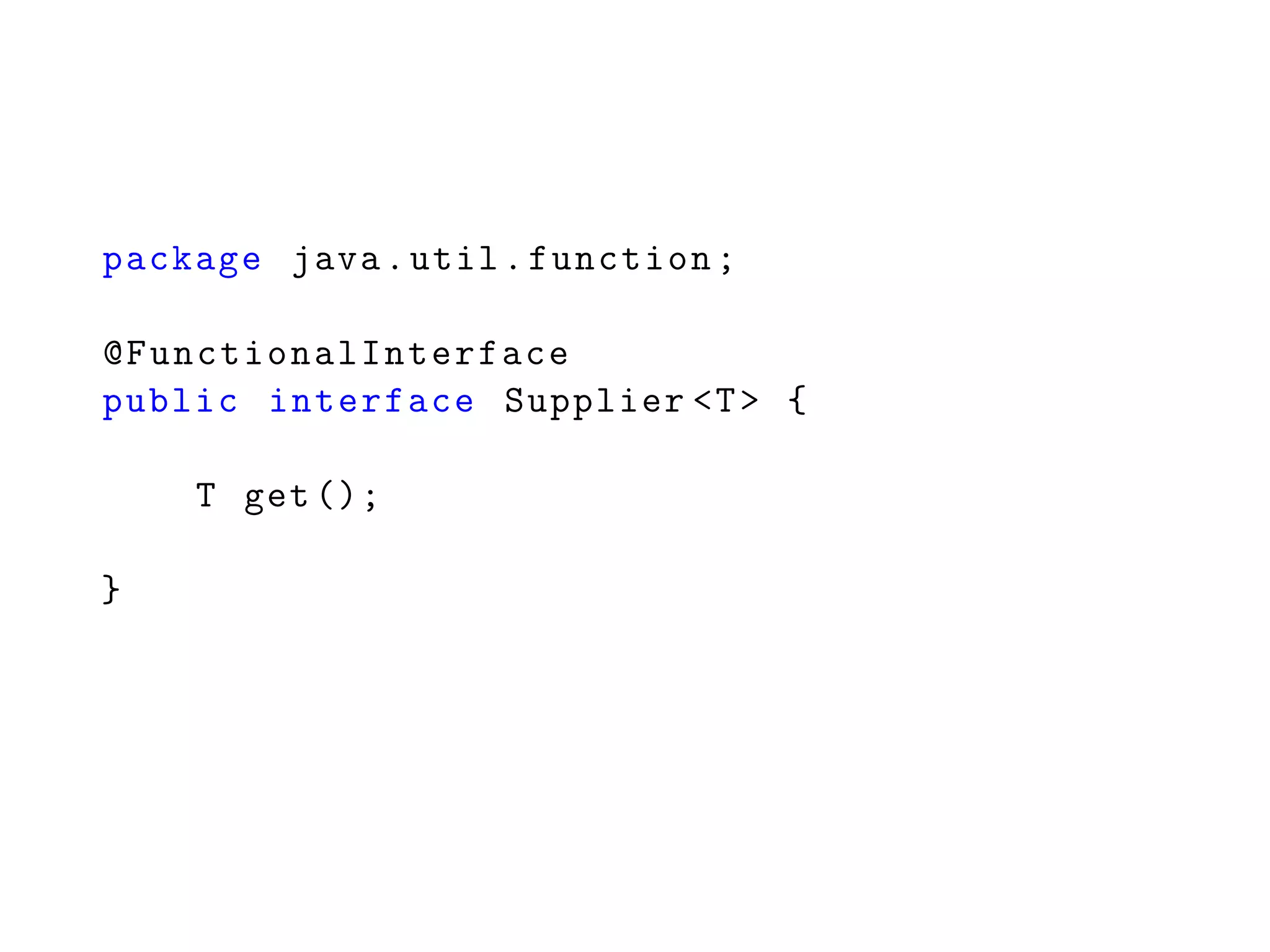
package java.util.function;
@FunctionalInterface
public interface Supplier <T> {
T get ();
}
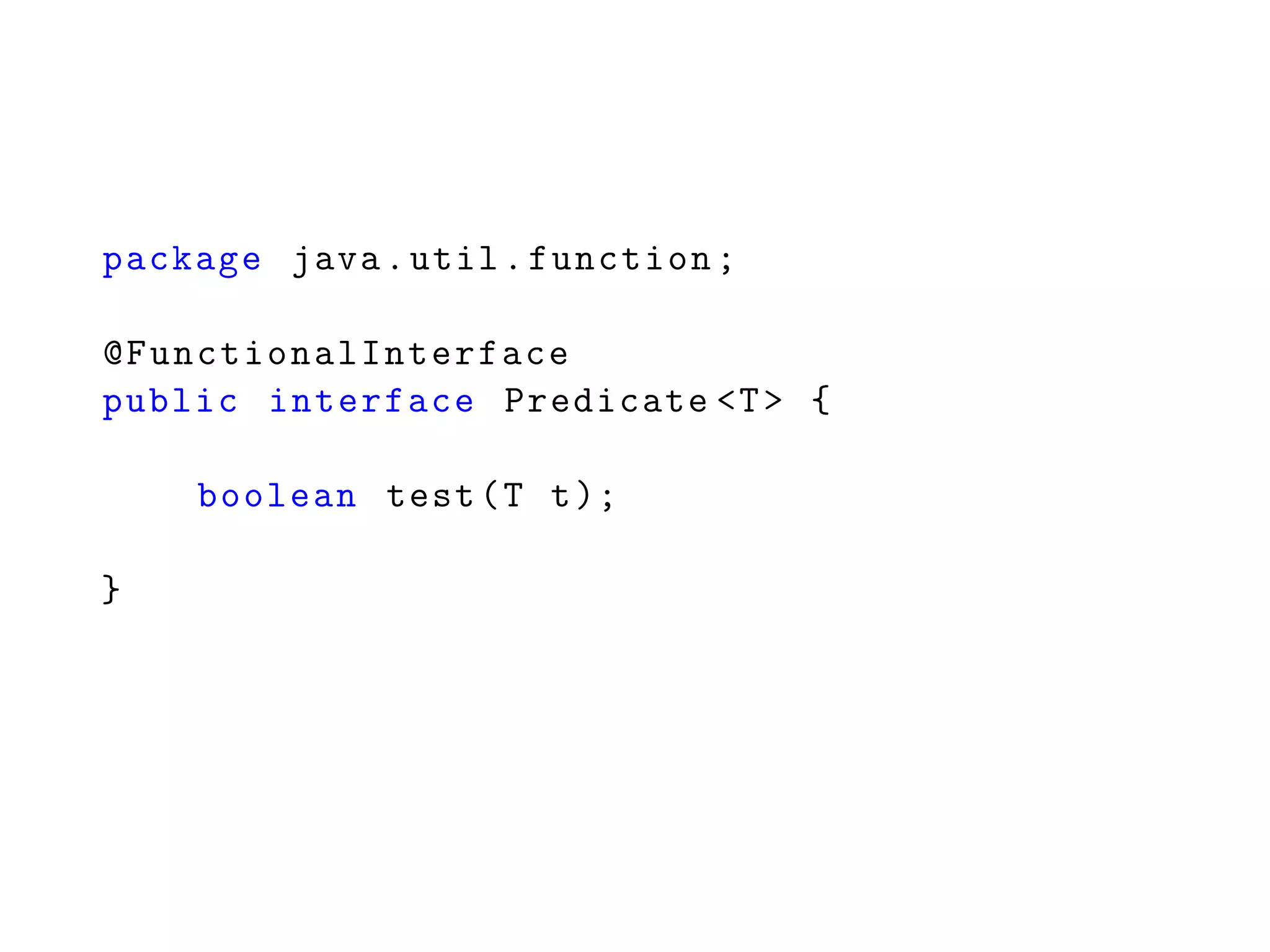
package java.util.function;
@FunctionalInterface
public interface Predicate <T> {
boolean test(T t);
}
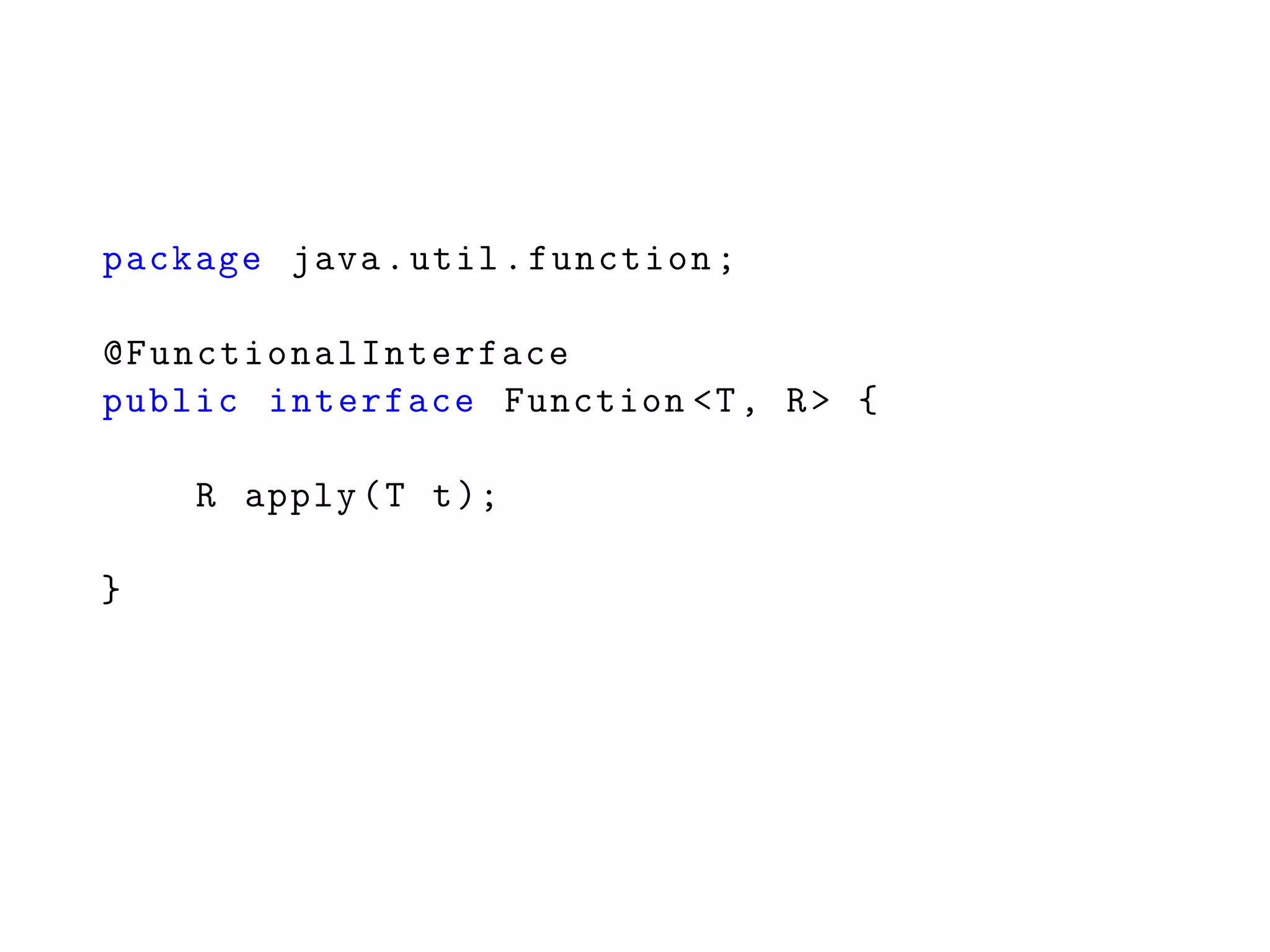
package java.util.function;
@FunctionalInterface
public interface Function <T, R> {
R apply(T t);
}
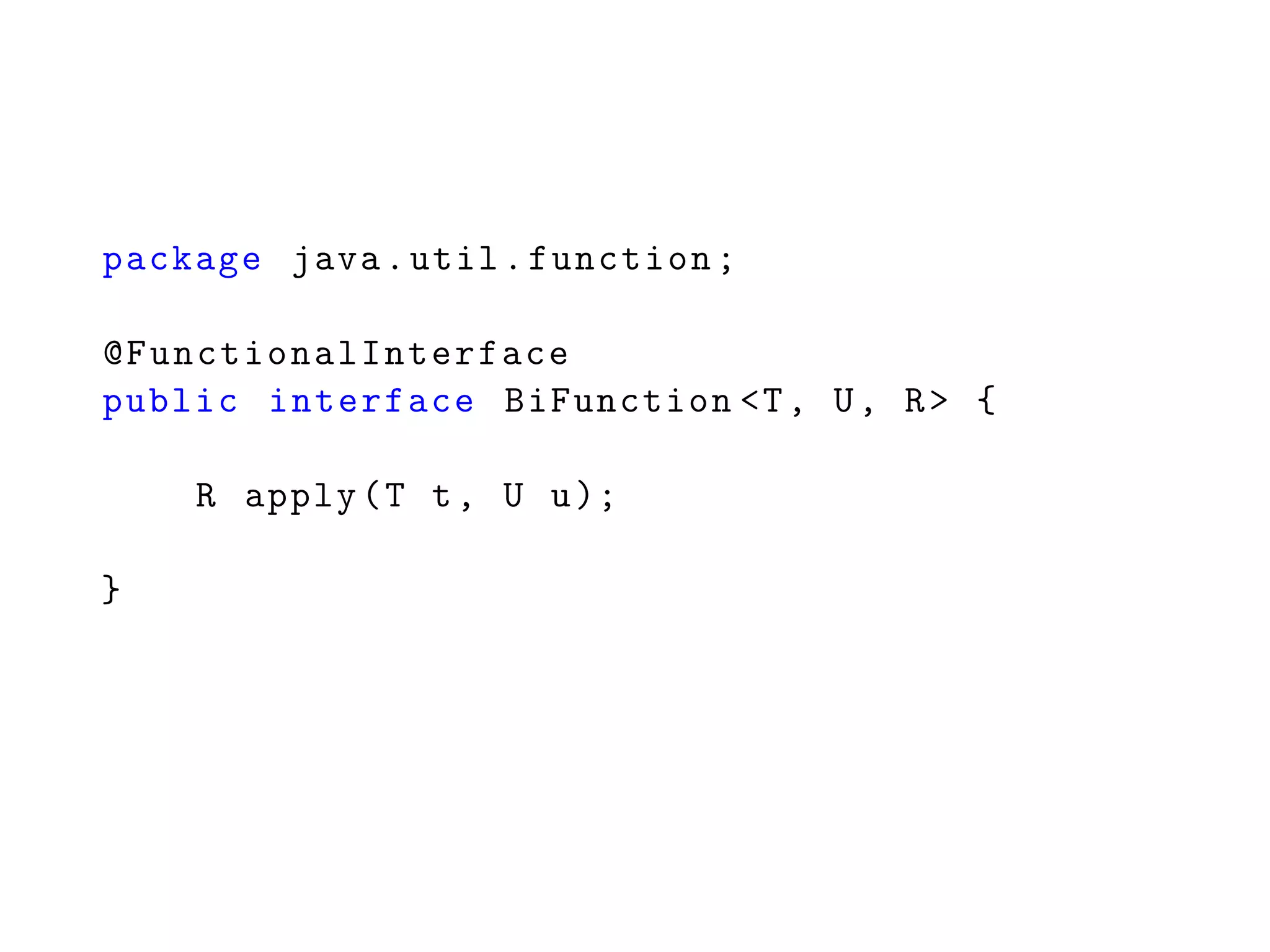
package java.util.function;
@FunctionalInterface
public interface BiFunction <T, U, R> {
R apply(T t, U u);
}
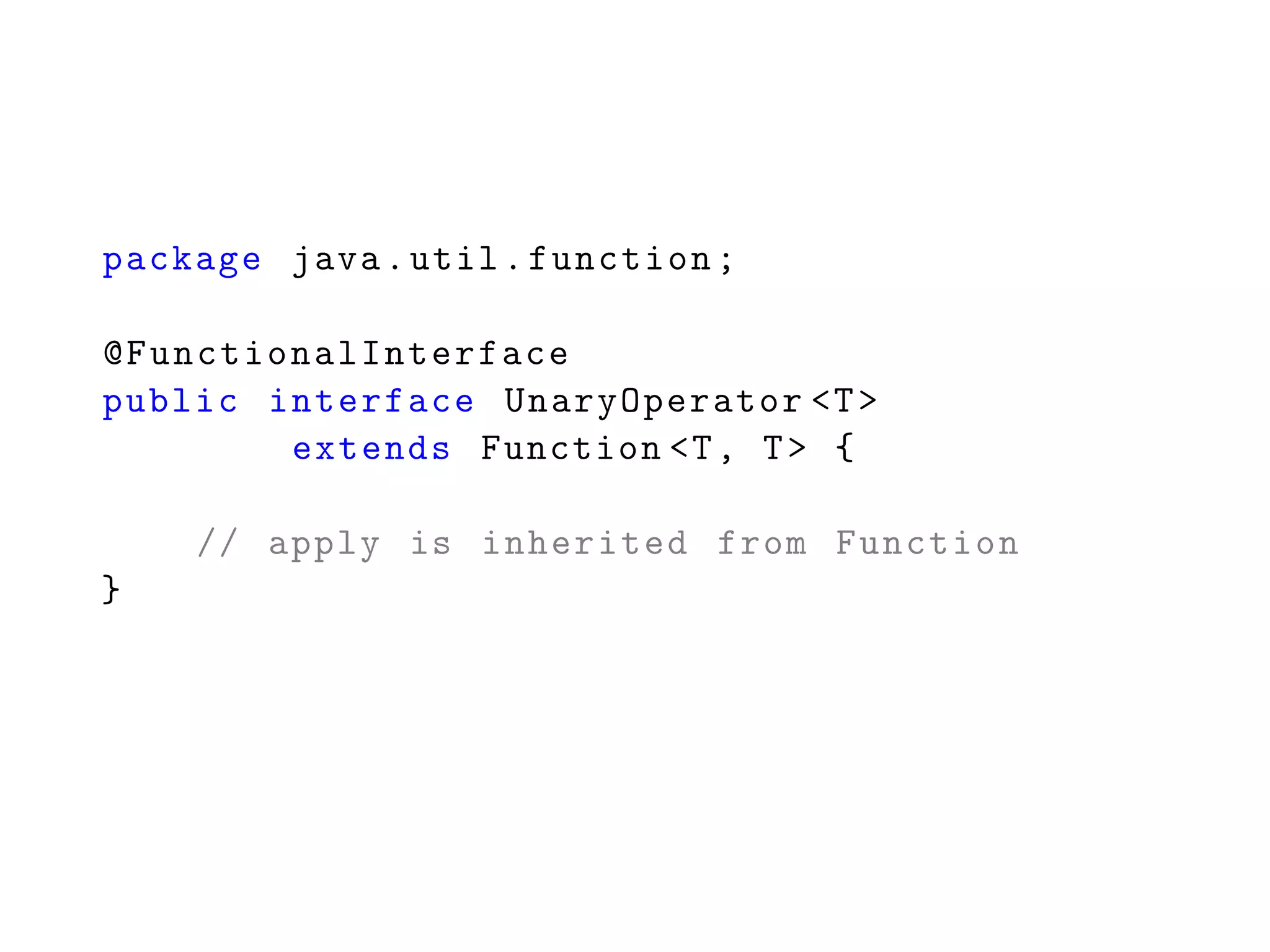
package java.util.function;
@FunctionalInterface
public interface UnaryOperator <T>
extends Function <T, T> {
// apply is inherited from Function
}
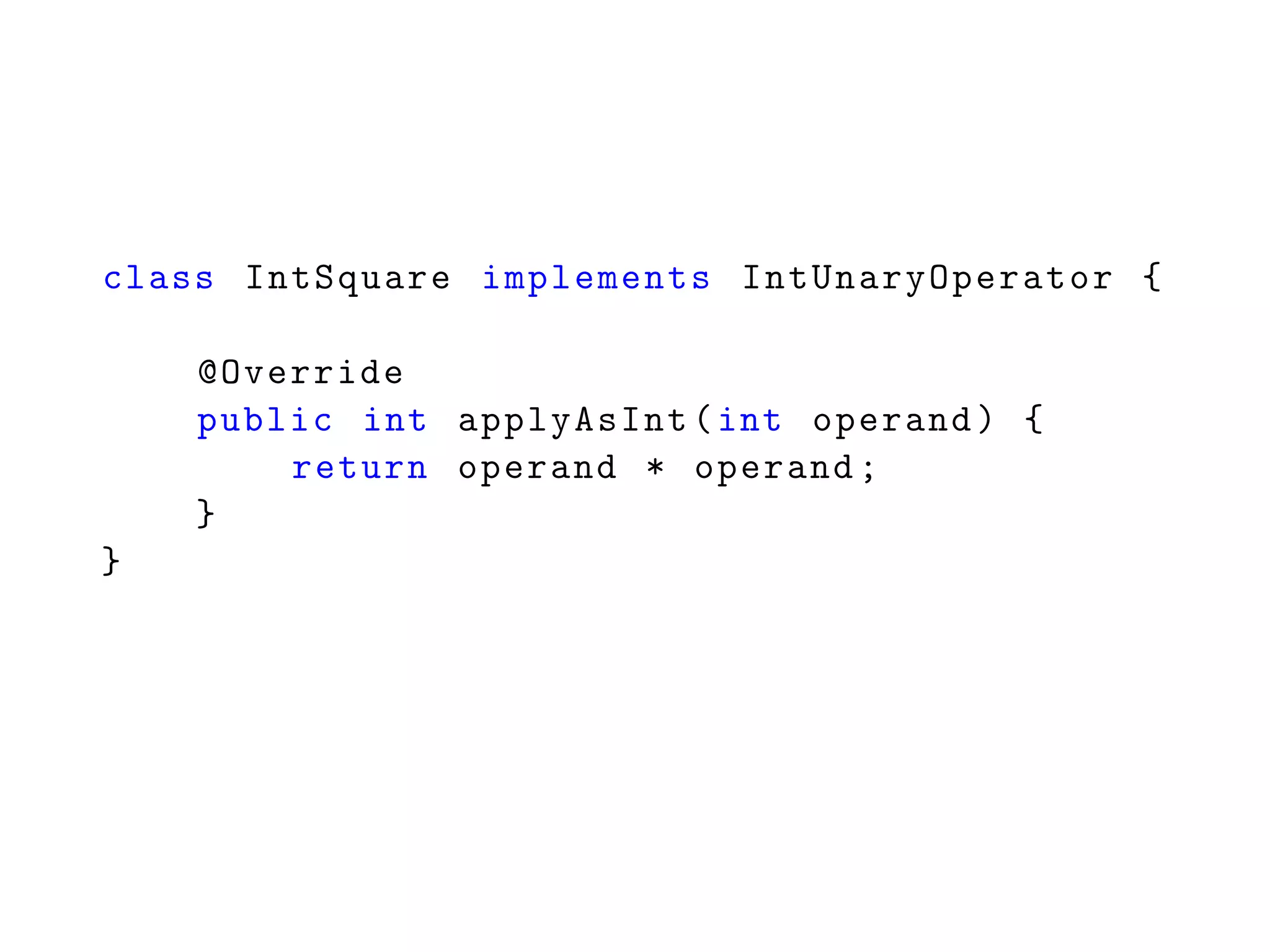
class IntSquare implements IntUnaryOperator {
@Override
public int applyAsInt(int operand) {
return operand * operand;
}
}
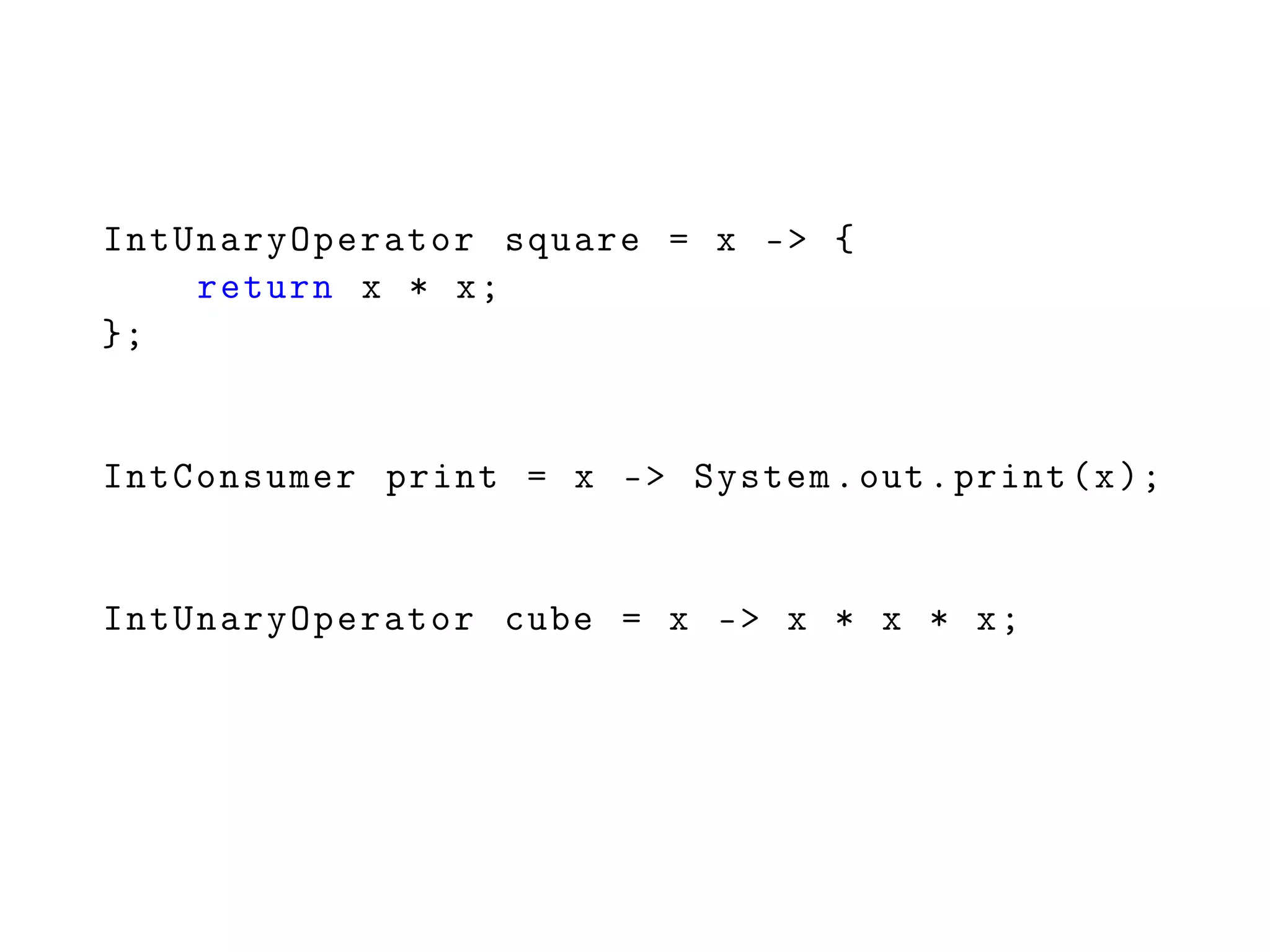
IntUnaryOperator square = x -> {
return x * x;
};
IntConsumer print = x -> System.out.print(x);
IntUnaryOperator cube = x -> x * x * x;
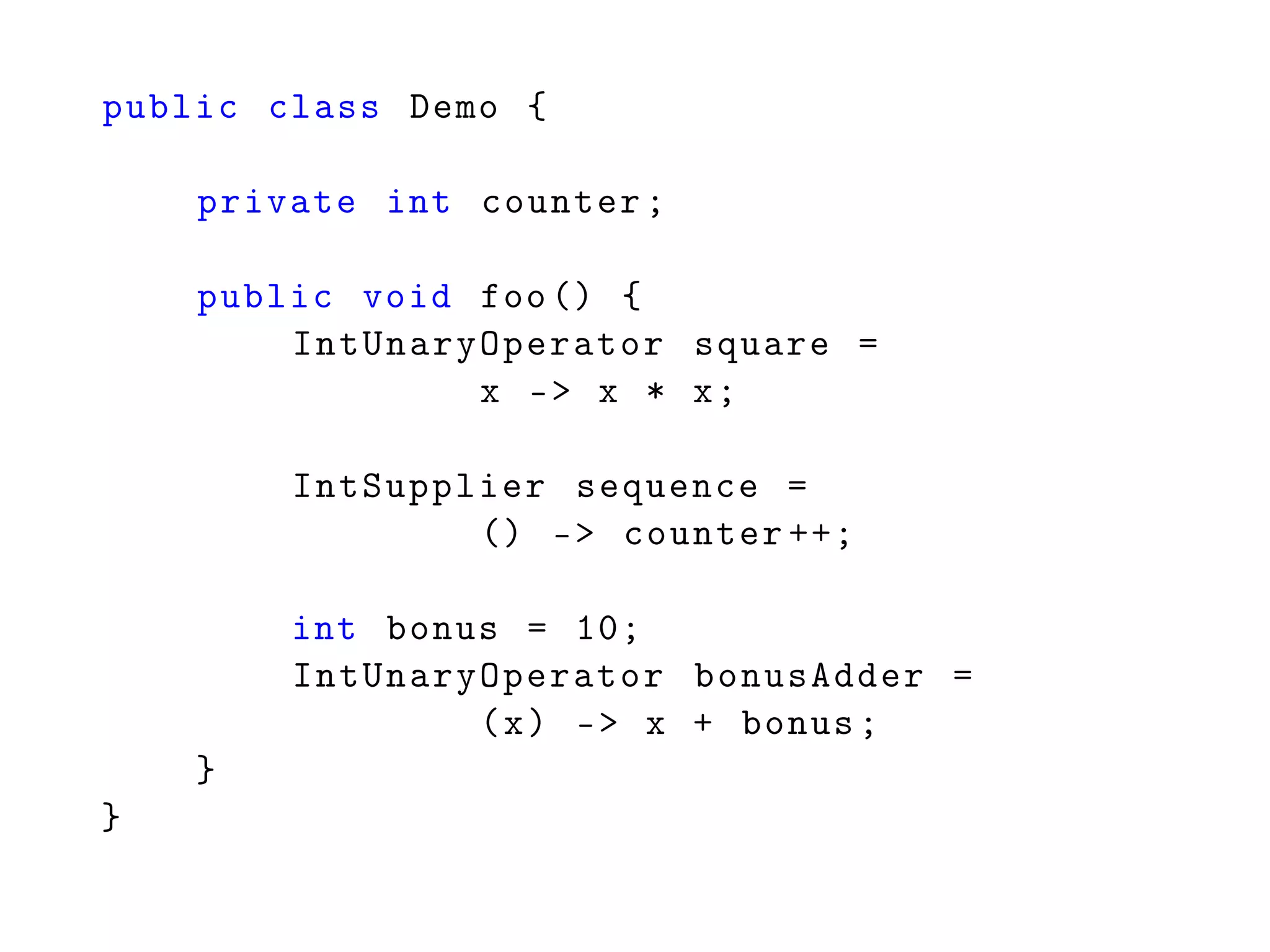
public class Demo {
private int counter;
public void foo() {
IntUnaryOperator square =
x -> x * x;
IntSupplier sequence =
() -> counter ++;
int bonus = 10;
IntUnaryOperator bonusAdder =
(x) -> x + bonus;
}
}
int[] counter = new int[] {0};
IntSupplier sequence = () -> counter [0]++;
ToIntFunction <String > intParser =
Integer :: parseInt;
Consumer <Object > printer =
System.out:: println;
Function <Object , String > objectToString =
Object :: toString;
IntFunction <String []> arrayAllocator =
String []:: new;
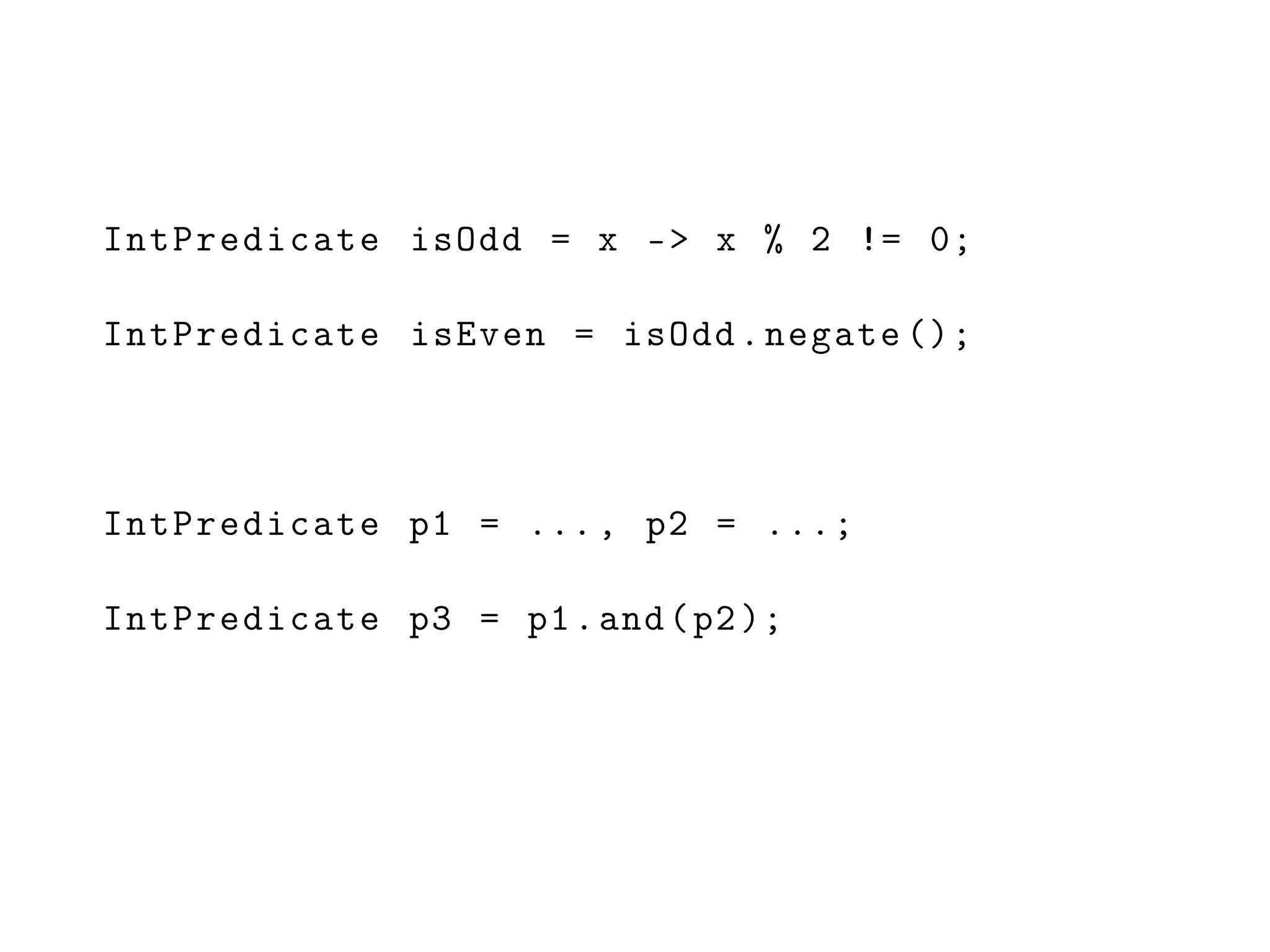
IntPredicate isOdd = x -> x % 2 != 0;
IntPredicate isEven = isOdd.negate ();
IntPredicate p1 = ..., p2 = ...;
IntPredicate p3 = p1.and(p2);
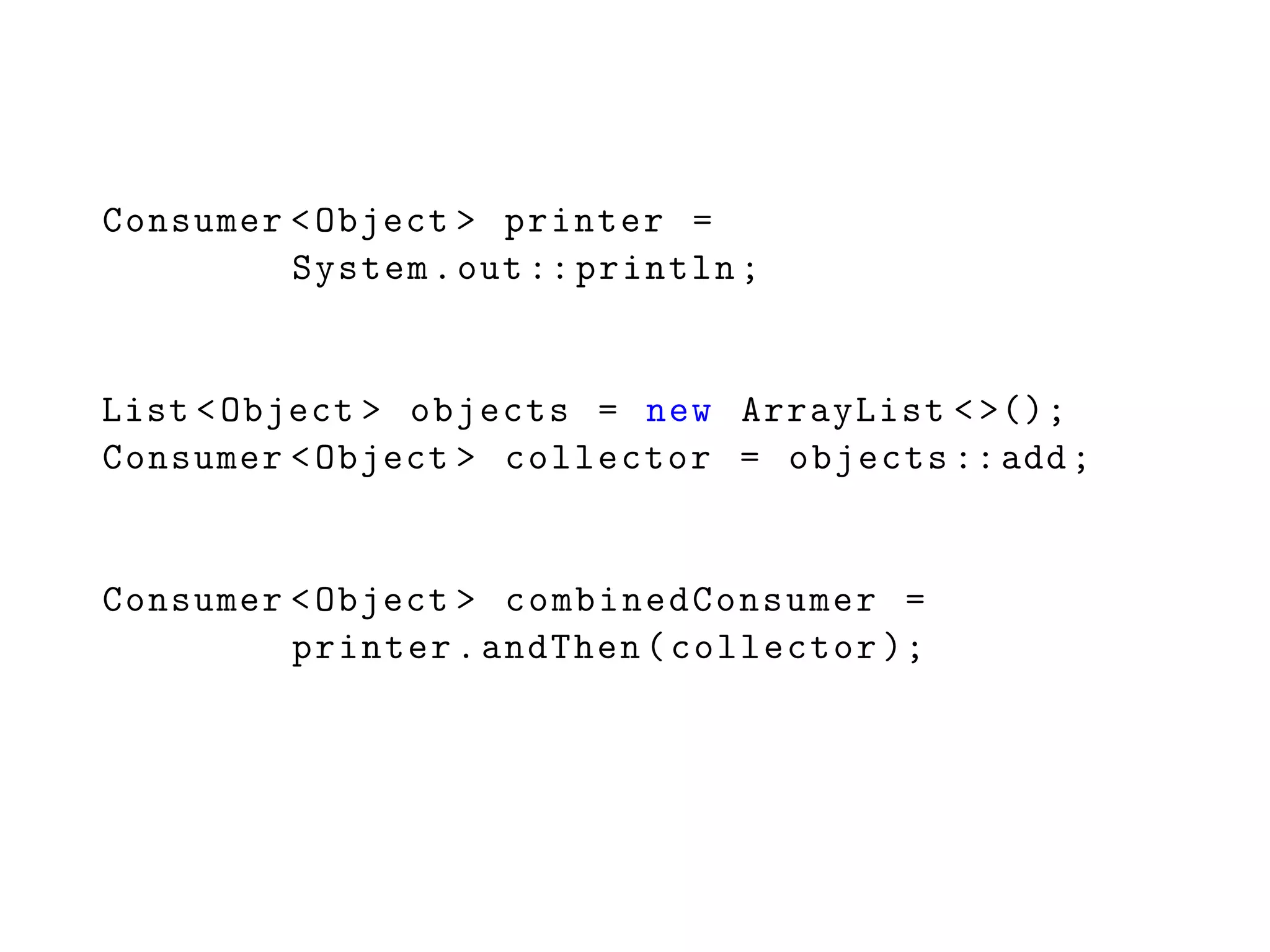
Consumer <Object > printer =
System.out:: println;
List <Object > objects = new ArrayList <>();
Consumer <Object > collector = objects ::add;
Consumer <Object > combinedConsumer =
printer.andThen(collector );
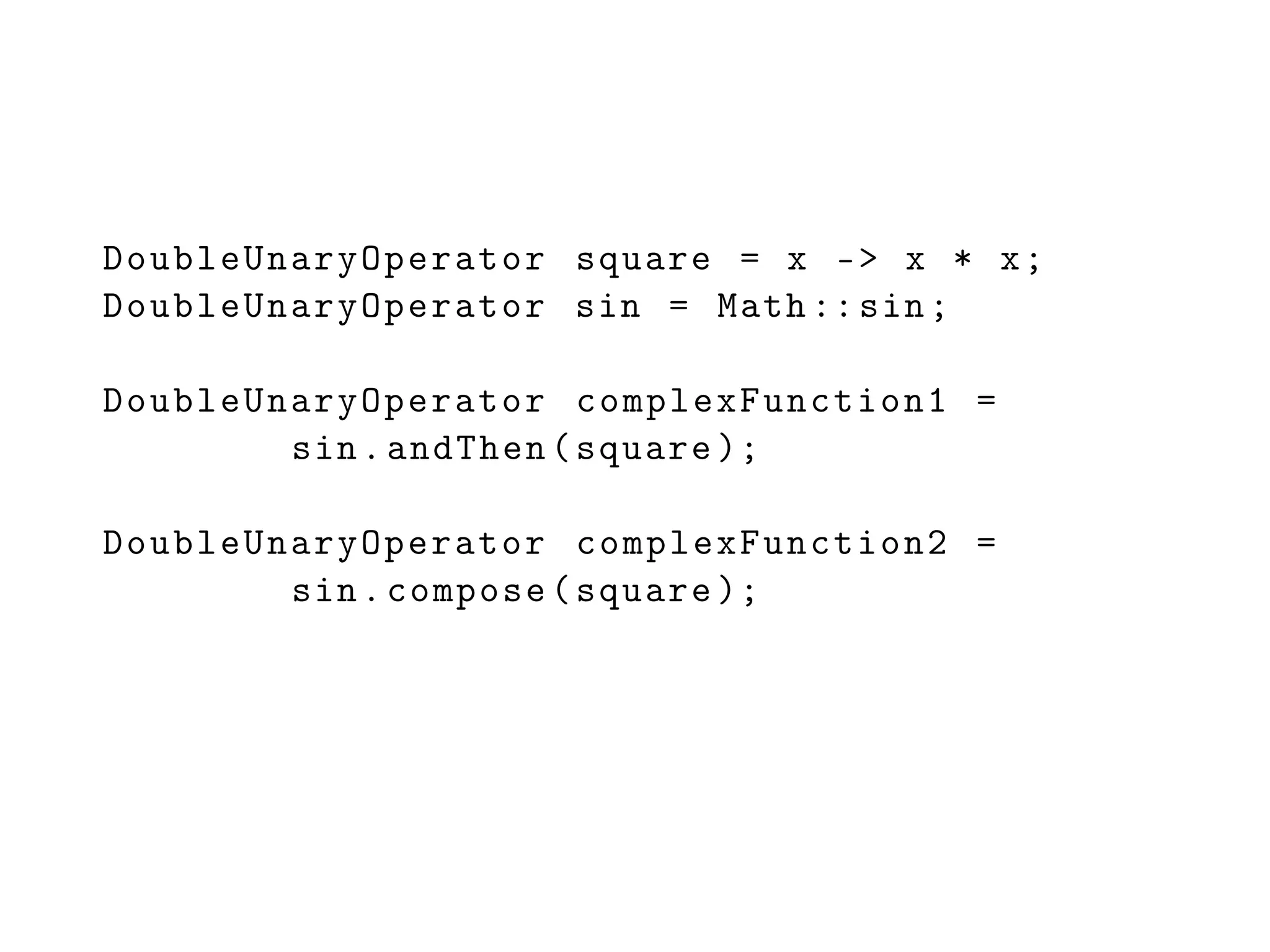
DoubleUnaryOperator square = x -> x * x;
DoubleUnaryOperator sin = Math ::sin;
DoubleUnaryOperator complexFunction1 =
sin.andThen(square );
DoubleUnaryOperator complexFunction2 =
sin.compose(square );
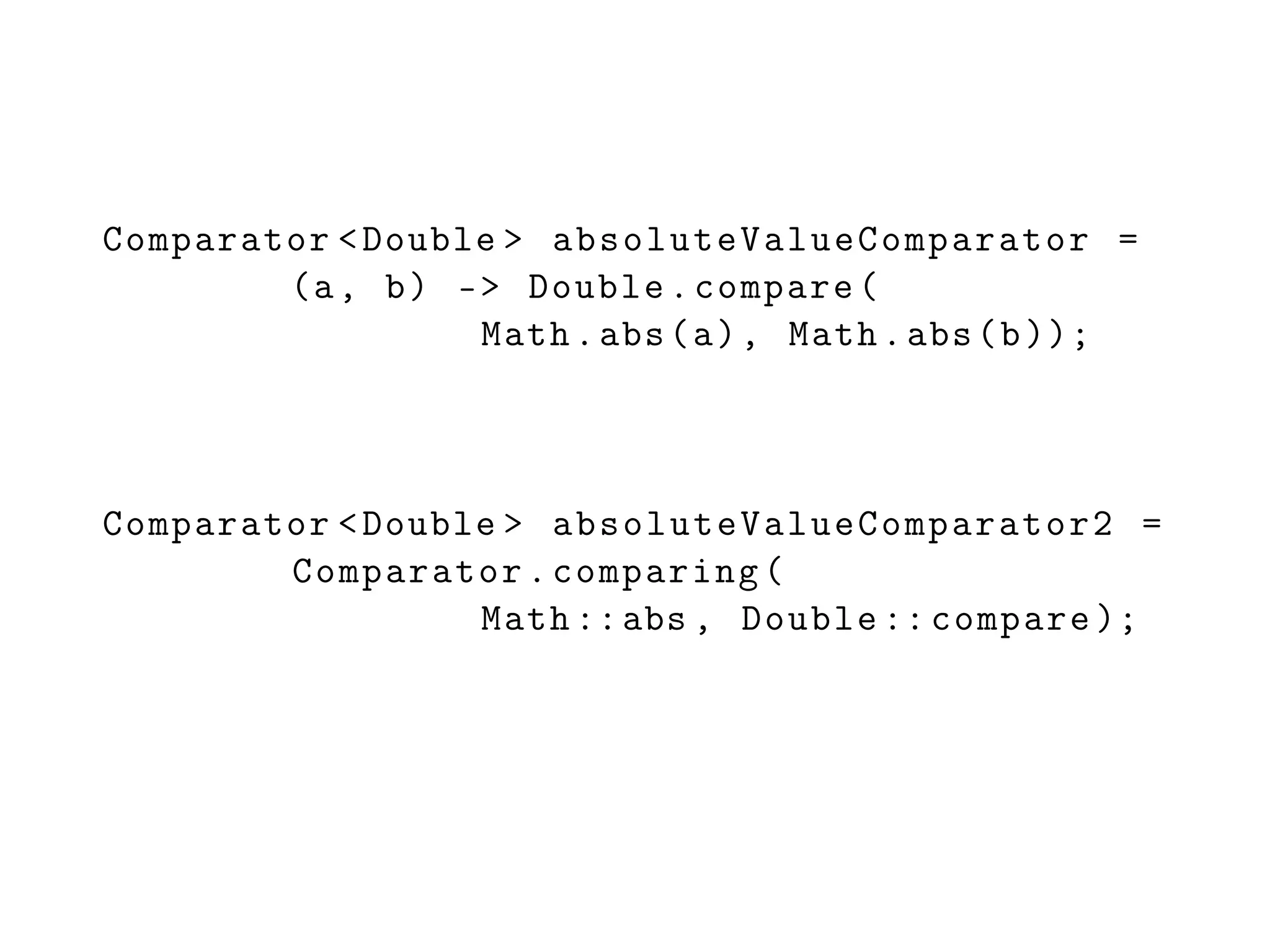
Comparator <Double > absoluteValueComparator =
(a, b) -> Double.compare(
Math.abs(a), Math.abs(b));
Comparator <Double > absoluteValueComparator2 =
Comparator.comparing(
Math ::abs , Double :: compare );
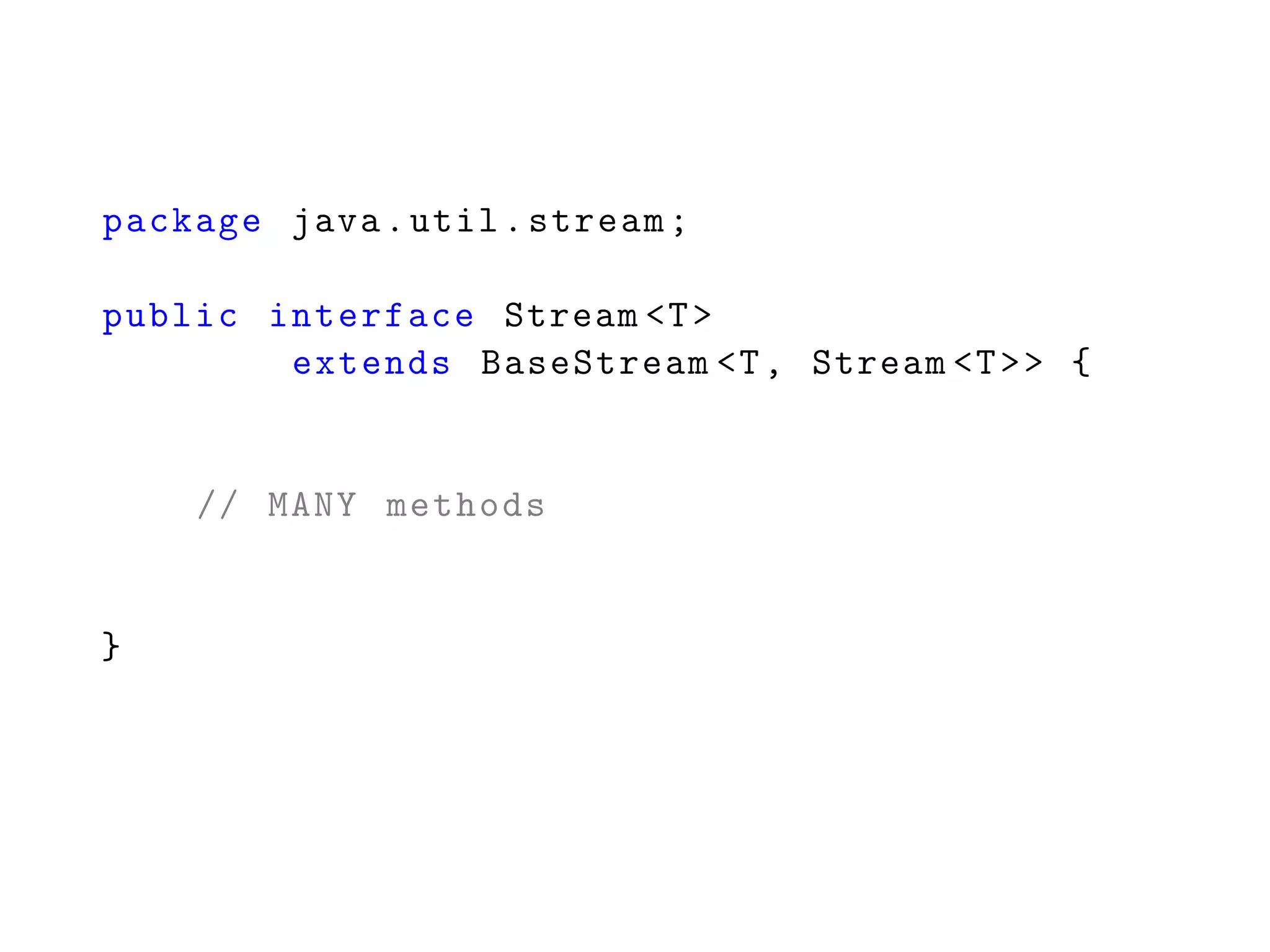
package java.util.stream;
public interface Stream <T>
extends BaseStream <T, Stream <T>> {
// MANY methods
}
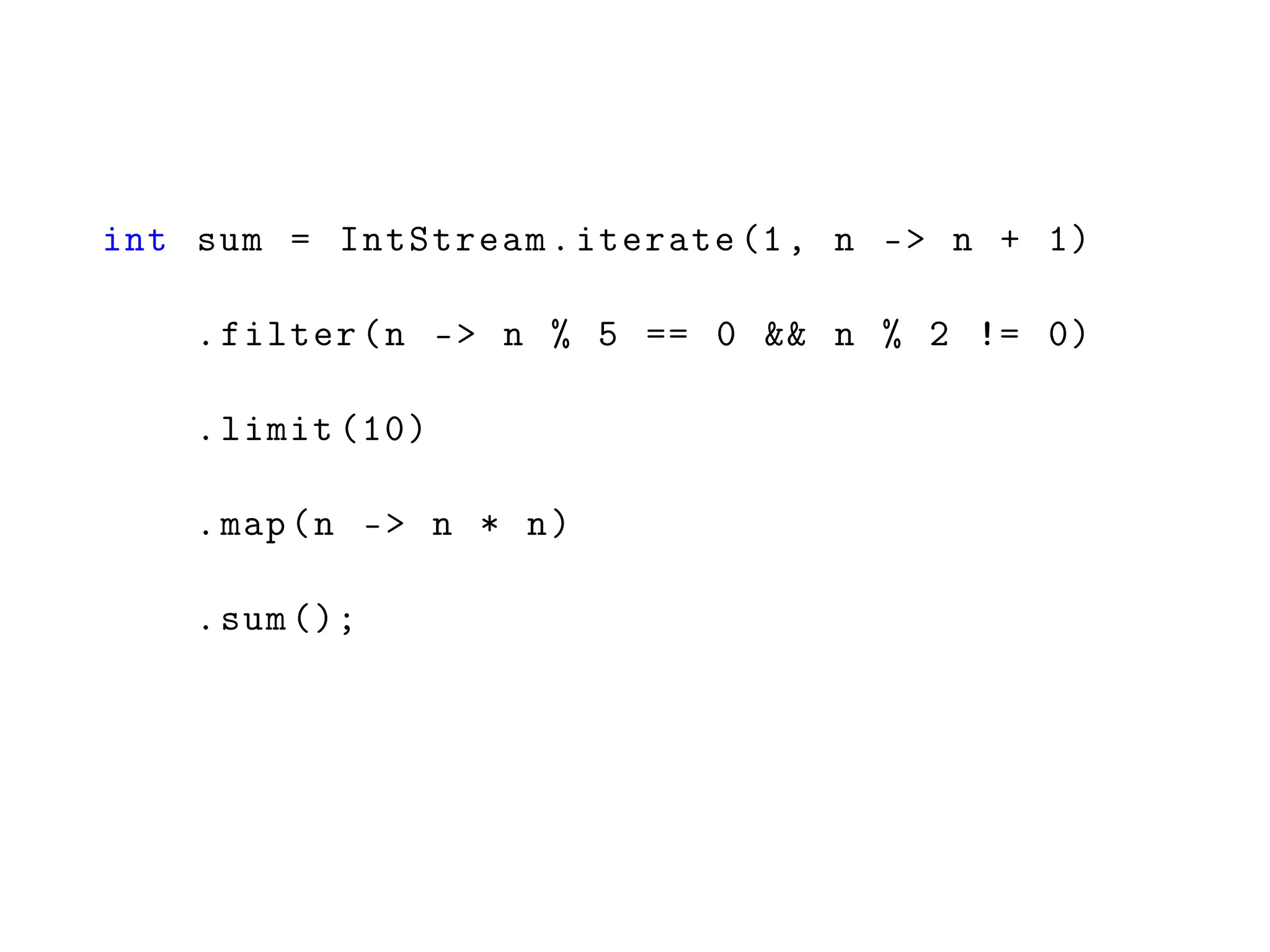
int sum = IntStream.iterate (1, n -> n + 1)
.filter(n -> n % 5 == 0 && n % 2 != 0)
.limit (10)
.map(n -> n * n)
.sum ();
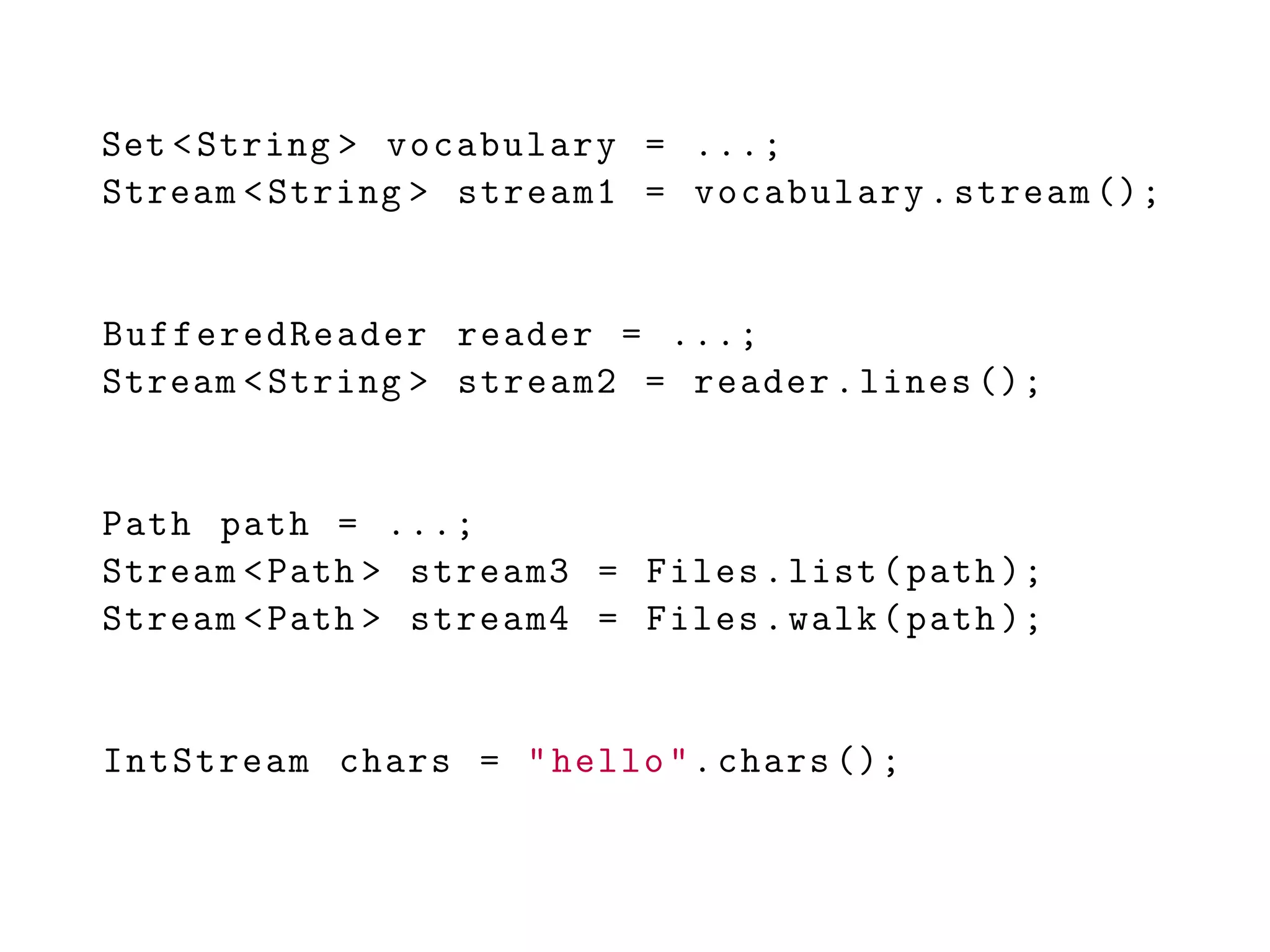
Set <String > vocabulary = ...;
Stream <String > stream1 = vocabulary.stream ();
BufferedReader reader = ...;
Stream <String > stream2 = reader.lines ();
Path path = ...;
Stream <Path > stream3 = Files.list(path );
Stream <Path > stream4 = Files.walk(path );
IntStream chars = "hello".chars ();
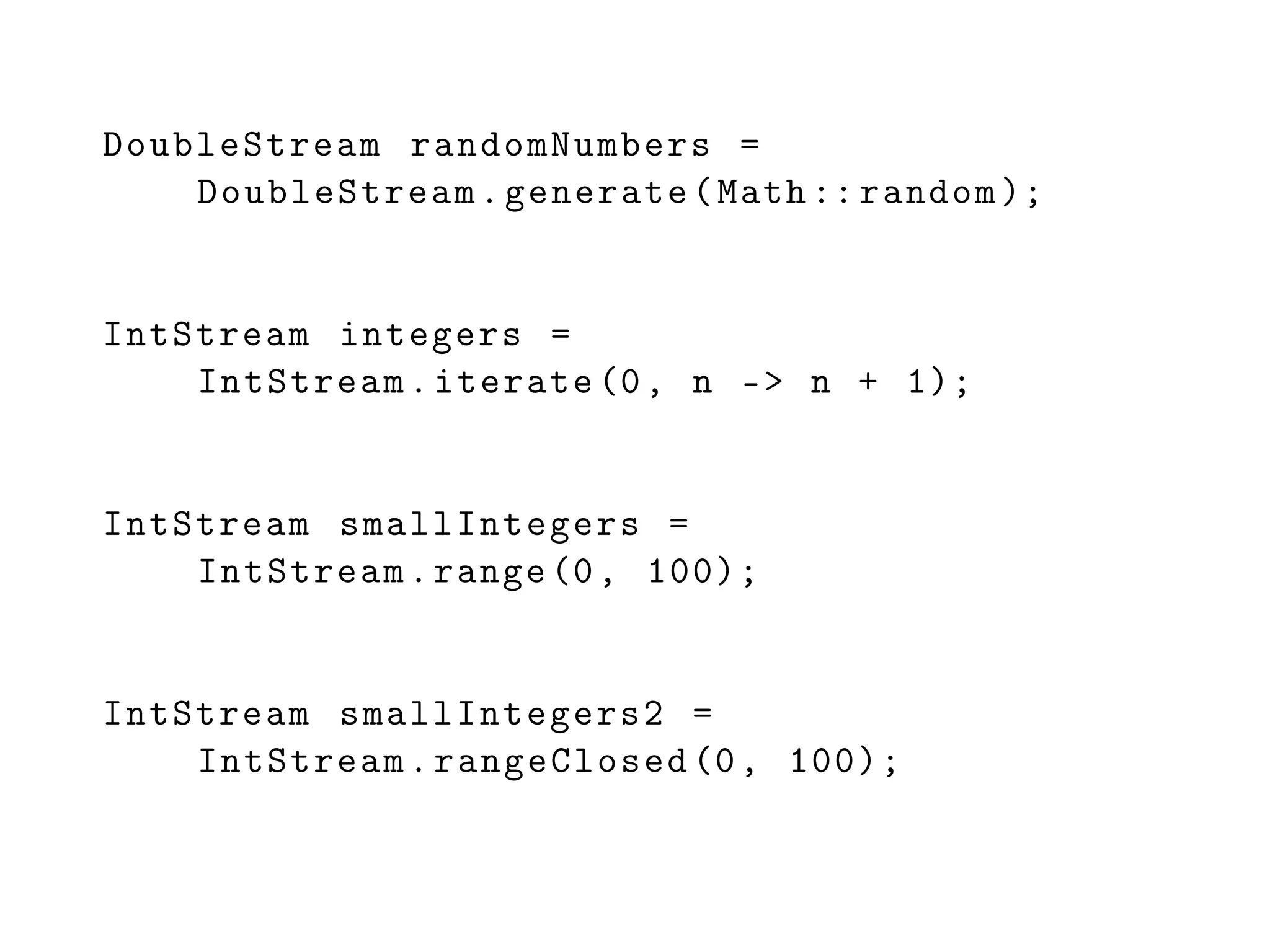
DoubleStream randomNumbers =
DoubleStream.generate(Math :: random );
IntStream integers =
IntStream.iterate (0, n -> n + 1);
IntStream smallIntegers =
IntStream.range(0, 100);
IntStream smallIntegers2 =
IntStream.rangeClosed (0, 100);
IntStream combinedStream =
IntStream.concat(stream1 , stream2 );
IntStream empty = IntStream.empty ();
double [] array = ...;
DoubleStream streamFromArray =
Arrays.stream(array );
IntStream streamOfElements =
IntStream.of(2, 4, 6, 8, 10);
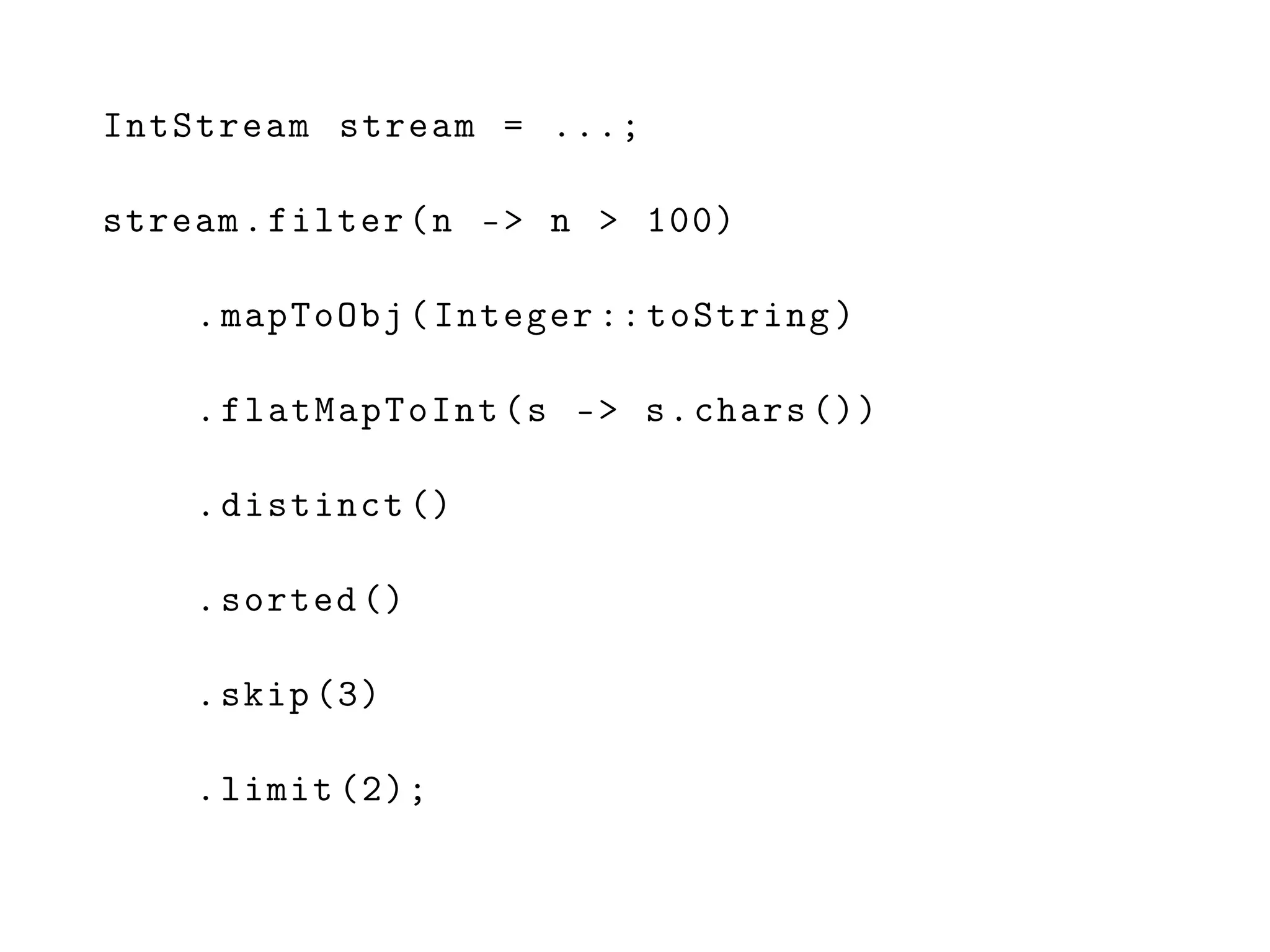
IntStream stream = ...;
stream.filter(n -> n > 100)
.mapToObj(Integer :: toString)
.flatMapToInt(s -> s.chars ())
.distinct ()
.sorted ()
.skip (3)
.limit (2);
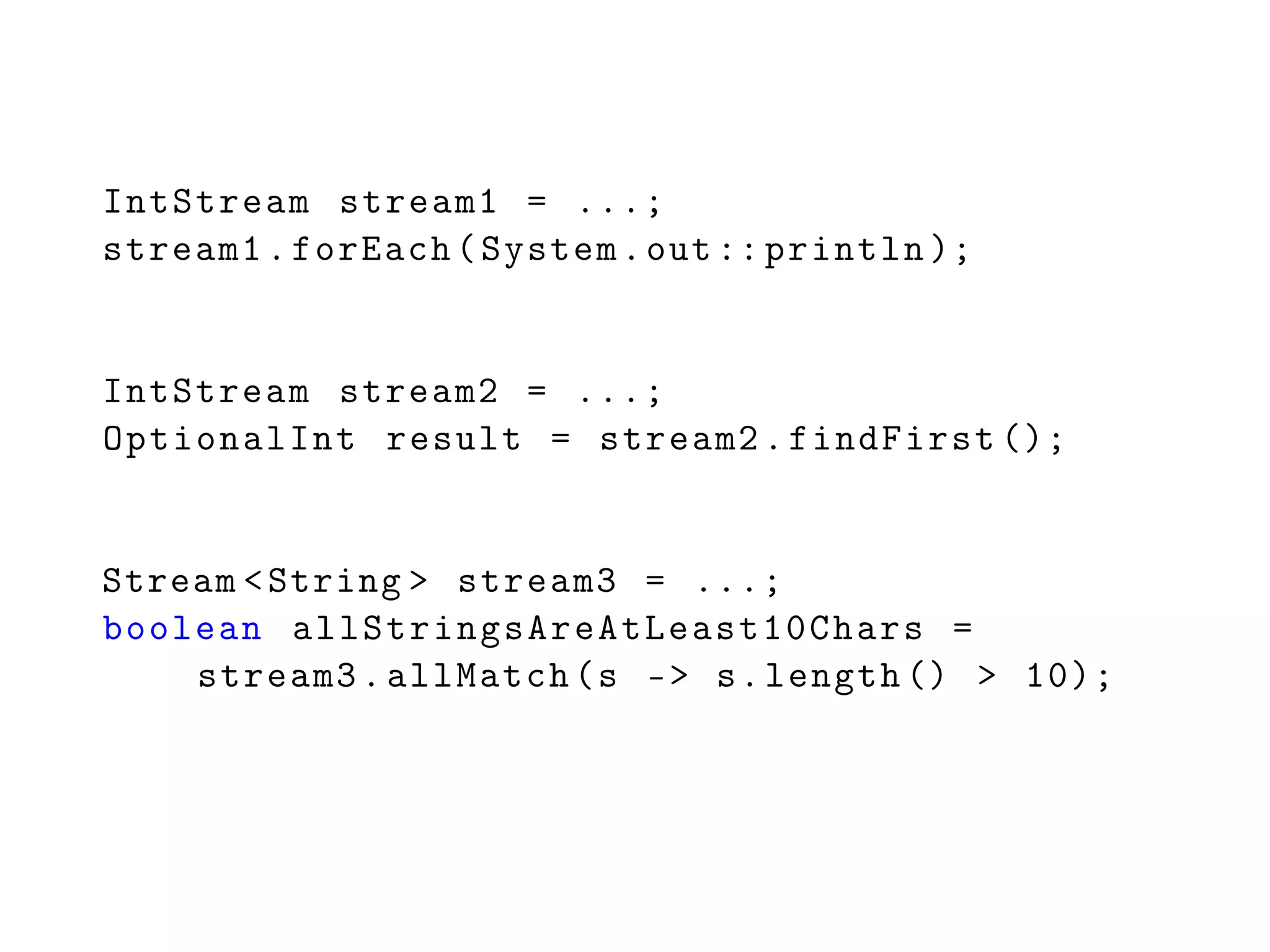
IntStream stream1 = ...;
stream1.forEach(System.out:: println );
IntStream stream2 = ...;
OptionalInt result = stream2.findFirst ();
Stream <String > stream3 = ...;
boolean allStringsAreAtLeast10Chars =
stream3.allMatch(s -> s.length () > 10);
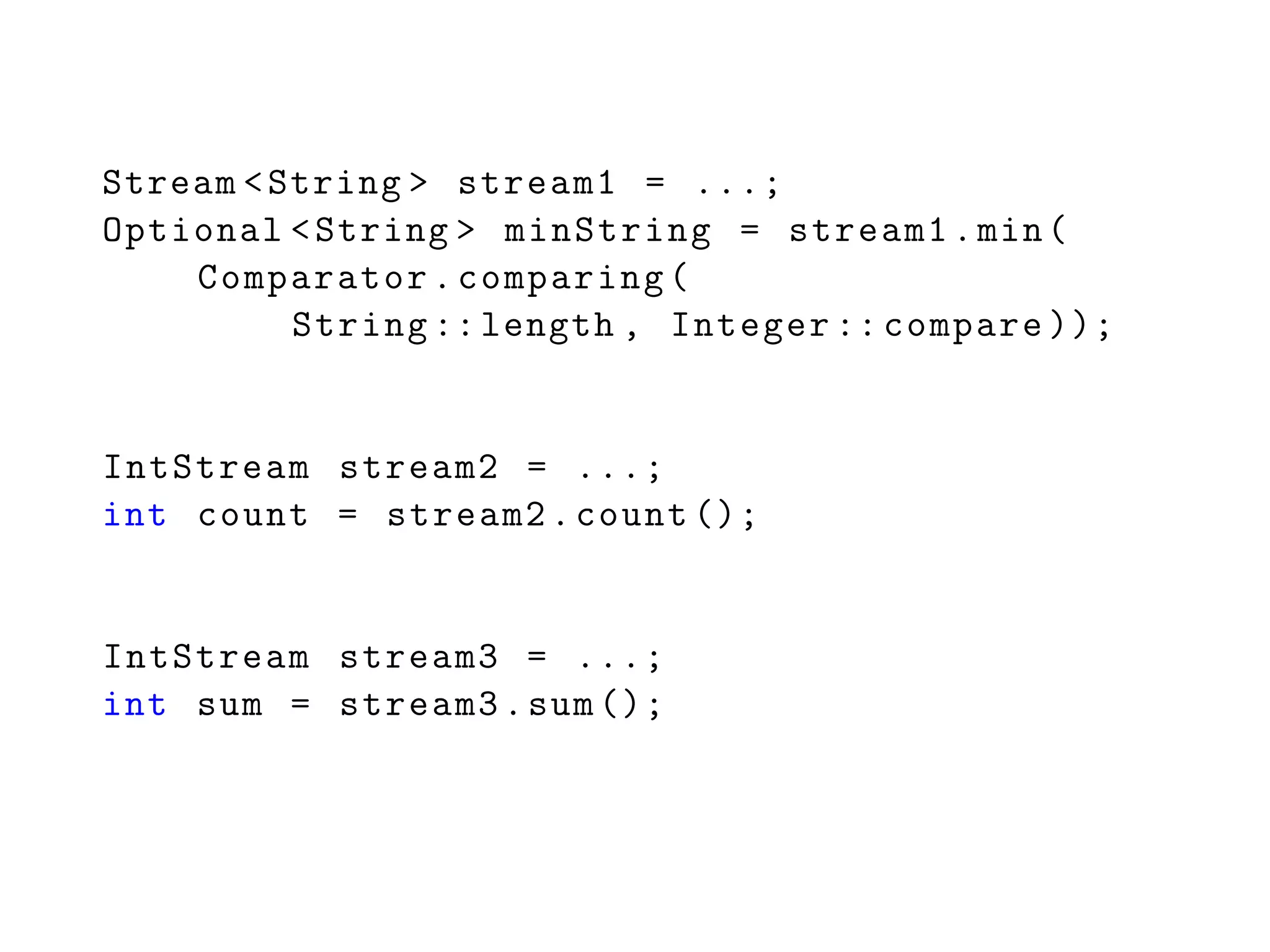
Stream <String > stream1 = ...;
Optional <String > minString = stream1.min(
Comparator.comparing(
String ::length , Integer :: compare ));
IntStream stream2 = ...;
int count = stream2.count ();
IntStream stream3 = ...;
int sum = stream3.sum ();
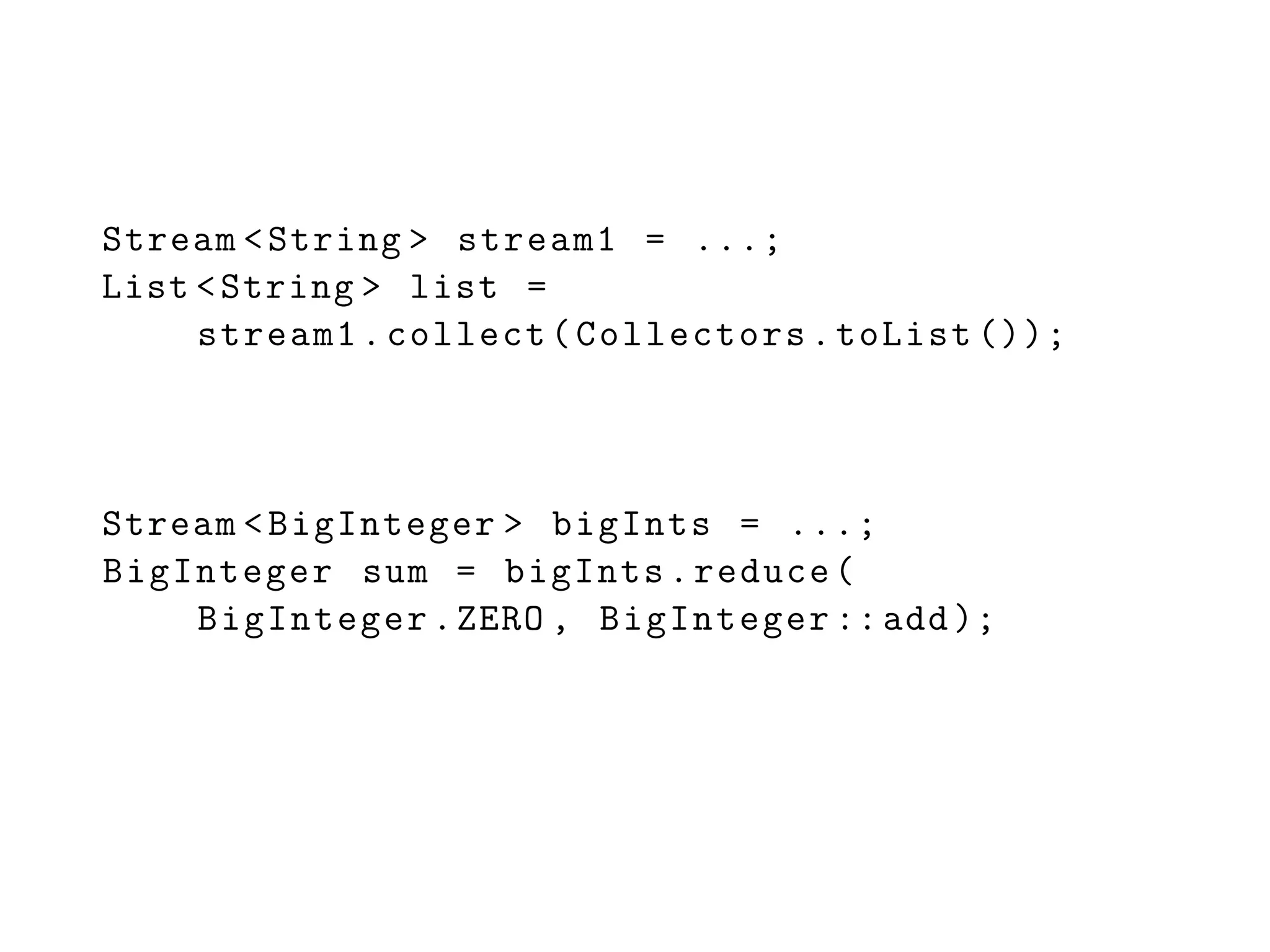
Stream <String > stream1 = ...;
List <String > list =
stream1.collect(Collectors.toList ());
Stream <BigInteger > bigInts = ...;
BigInteger sum = bigInts.reduce(
BigInteger.ZERO , BigInteger ::add);
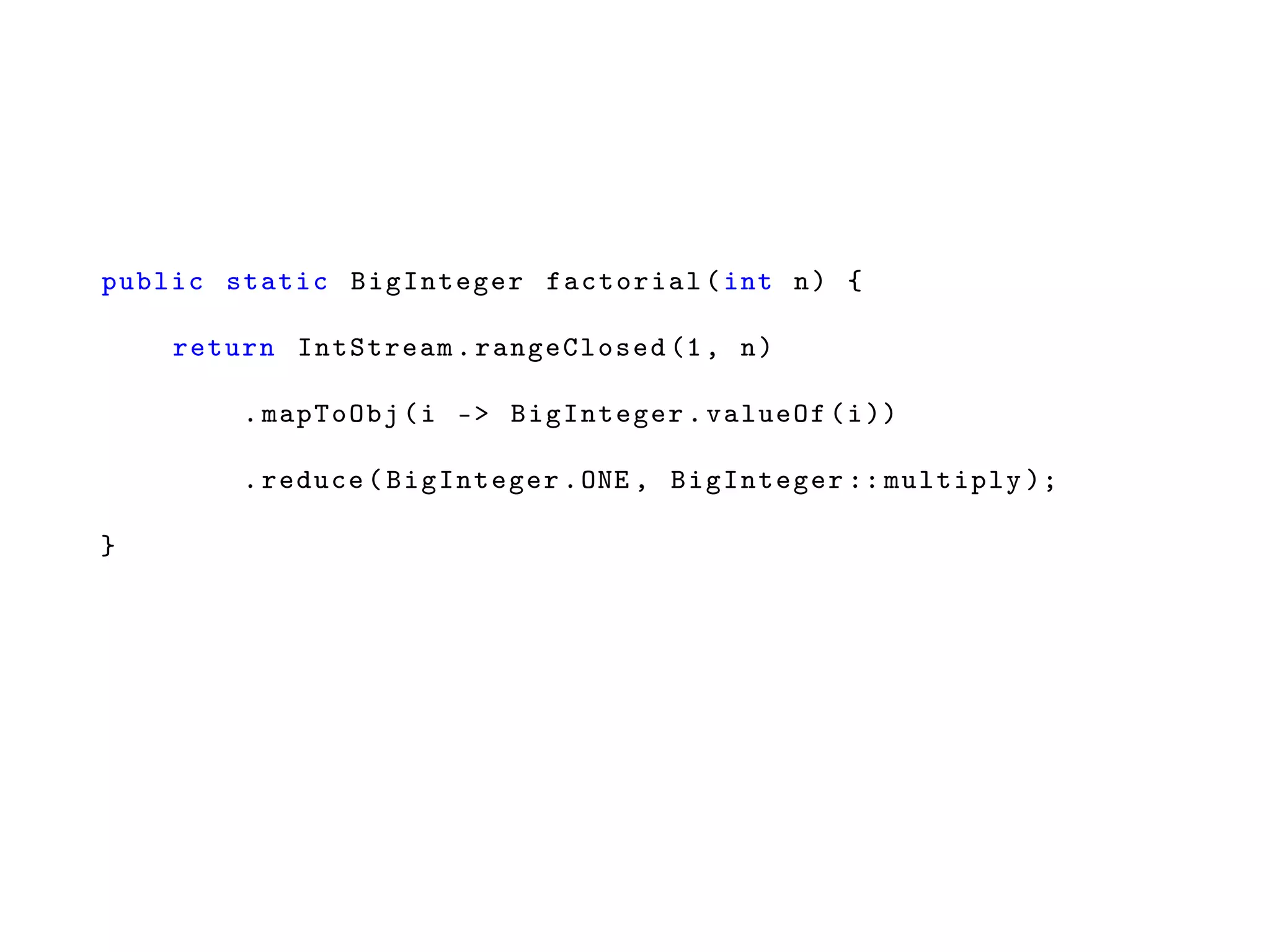
public static BigInteger factorial(int n) {
return IntStream. rangeClosed (1, n)
.mapToObj(i -> BigInteger.valueOf(i))
.reduce(BigInteger.ONE , BigInteger :: multiply );
}
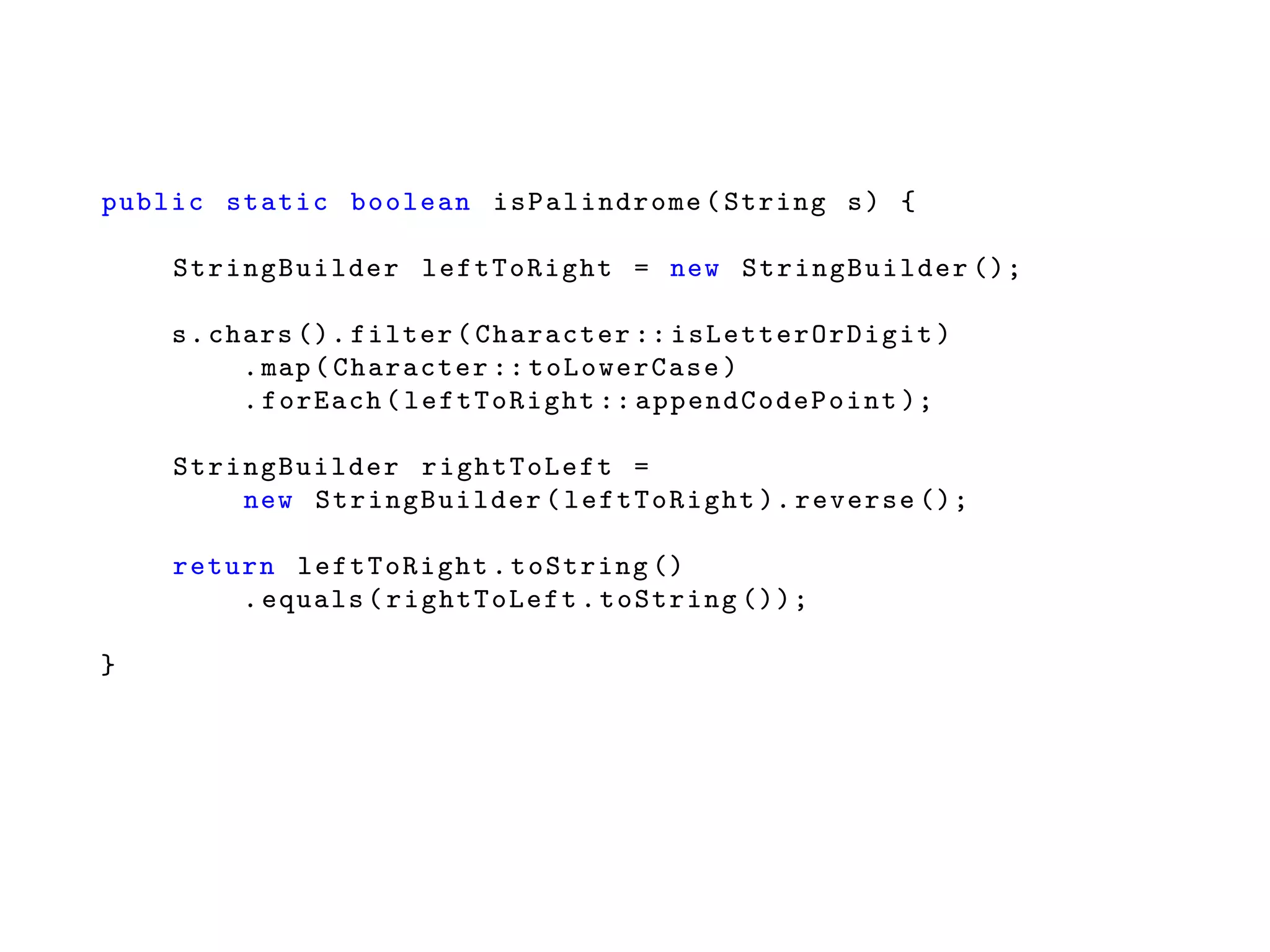
public static boolean isPalindrome (String s) {
StringBuilder leftToRight = new StringBuilder ();
s.chars (). filter(Character :: isLetterOrDigit )
.map(Character :: toLowerCase )
.forEach(leftToRight :: appendCodePoint );
StringBuilder rightToLeft =
new StringBuilder (leftToRight ). reverse ();
return leftToRight .toString ()
.equals(rightToLeft .toString ());
}

6. Generics. Collections. Streams

  • 1.
  • 2.
    public class TreeNode{ String value; TreeNode left; TreeNode right; }
  • 3.
    public static BigDecimalminElement( BigDecimal [] values) { if (values.length == 0) { return null; } BigDecimal min = values [0]; for (int i = 1; i < values.length; i++) { if (min.compareTo(values[i]) > 0) { min = values[i]; } } return min; }
  • 4.
    TreeNode rootNode =new TreeNode (); rootNode.value = "foobar"; // tree manipulation String value = (String) rootNode.value; Object [] arrayOfBigDecimals = {...}; BigDecimal min = (BigDecimal) minElement(arrayOfBigDecimals );
  • 5.
    public static <Textends Comparable <T>> T minElement(T[] values) { if (values.length == 0) { return null; } T min = values [0]; for (int i = 1; i < values.length; i++) { if (min.compareTo(values[i]) > 0) { min = values[i]; } } return min; }
  • 6.
    TreeNode <String >stringNode; TreeNode <Integer > integerNode; TreeNode <int[]> intArrayNode; TreeNode <int > intNode; TreeNode <10> tenNode;
  • 7.
    package java.util; public finalclass Optional <T> { private final T value; private Optional(T value) { this.value = Objects. requireNonNull (value ); } public static <T> Optional <T> of(T value) { return new Optional <>( value ); } public T get () { if (value == null) { throw new NoSuchElementException ("No value present"); } return value; } // ... }
  • 8.
    String text =???; // is null allowed? @Nullable String nullableText = null; @NonNull String nonNullText = "hello!";
  • 9.
    String text ="bar"; Optional <String > optionalText = Optional.of("baz");
  • 10.
    Optional <String >baz = Optional.of("baz"); baz.ifPresent(System.out:: println );
  • 11.
    Optional <String >bar = Optional.empty (); String value = bar.orElse("bar");
  • 12.
    package java.util; public finalclass Optional <T> { private final T value; private Optional(T value) { this.value = Objects. requireNonNull (value ); } public static <T> Optional <T> of(T value) { return new Optional <>( value ); } public T get () { if (value == null) { throw new NoSuchElementException ("No value present"); } return value; } // ... }
  • 13.
    Optional <String >foo = Optional.empty (); Optional <String > bar = Optional.of("bar"); Optional <String > baz = Optional.ofNullable("baz"); Optional <CharSequence > optionalCharSequence = Optional.<CharSequence >ofNullable("baz"); Optional <String > newOptional = new Optional <>("foobar");
  • 14.
    package java.util; public finalclass Optional { private final Object value; private Optional(Object value) { this.value = Objects. requireNonNull (value ); } public static Optional of(Object value) { return new Optional(value ); } public Object get() { if (value == null) { throw new NoSuchElementException ("No value present"); } return value; } // ... }
  • 15.
    Optional <String >optional = Optional.of("foo"); String value1 = optional.orElse("bar"); String value2 = optional.get ();
  • 16.
    Optional optional =Optional.of("foo"); String value1 = (String) optional.orElse("bar"); String value2 = (String) optional.get ();
  • 17.
    T obj =new T(); T[] arr = new T[5]; if (obj instanceof T) {...} T a = (T) b;
  • 18.
    import java.io.IOException ; publicclass Hack { public static void main(String [] args) { throwAsUnchecked (new IOException ()); } private static void throwAsUnchecked (Exception e) { Hack.<RuntimeException > genericThrow (e); } private static <T extends Throwable > void genericThrow (Exception e) throws T { throw (T) e; } }
  • 19.
    Number number =new Integer (1); Number [] numberArray = new Integer [10]; Optional <Integer > optionalInt = Optional.of (1); Optional <Number > optionalNumber = optionalInt; optionalNumber.set(new BigDecimal("3.14"));
  • 20.
    package java.util; public finalclass Optional <T> { private final T value; public void ifPresent(Consumer <T> consumer) { if (value != null) consumer.accept(value ); } public T orElseGet(Supplier <T> other) { return value != null ? value : other.get (); } // ... }
  • 21.
    package java.util; public finalclass Optional <T> { private final T value; public void ifPresent(Consumer <? super T> consumer) { if (value != null) consumer.accept(value ); } public T orElseGet(Supplier <? extends T> other) { return value != null ? value : other.get (); } // ... }
  • 22.
    Optional <?> optional= Optional.of (1); Object value1 = optional.get (); Object value2 = optional.orElse (2);
  • 23.
    int[] oldArray =...; int oldLength = oldArray.length; int newLength = oldLength + 10; int[] newArray = Arrays.copyOf(oldArray , newLength ); newArray[oldLength] = newElement1; newArray[oldLength + 1] = newElement2; // ...
  • 24.
    final int[] array= new int[] {1, 2, 3}; array [0] = 10; array [1] = 11; array [2] = 12;
  • 25.
    package java.util; public interfaceCollection <E> extends Iterable <E> { int size (); boolean isEmpty (); boolean contains(Object o); boolean add(E e); boolean remove(Object o); void clear (); // ... }
  • 26.
    Collection <ComplexNumber >c = ...; c.add(new ComplexNumber (1, 2)); boolean contains = c.contains(new ComplexNumber (1, 2));
  • 27.
    Collection <Integer >collection = ...; Iterator <Integer > it = collection.iterator (); while (it.hasNext ()) { Integer element = it.next (); System.out.println(element ); } for (Integer element : collection) { System.out.println(element ); }
  • 28.
    Collection <Integer >collection = ...; collection.forEach(System.out:: println );
  • 29.
    Collection <Integer >collection = ...; for (Integer number : collection) { if (number > 5) { collection.remove(number ); } } // java.util. ConcurrentModificationException
  • 30.
    package java.util; public interfaceList <E> extends Collection <E> { E get(int index ); E set(int index , E element ); void add(int index , E element ); E remove(int index ); int indexOf(Object o); int lastIndexOf(Object o); List <E> subList(int fromIndex , int toIndex ); }
  • 31.
    List <String >words = ...; words.subList (1, 3). clear (); int indexOfFoo = 10 + words.subList (10, 15). indexOf("foo");
  • 32.
    List <String >list1 = new ArrayList <>(); List <Integer > list2 = new LinkedList <>();
  • 33.
    package java.util; public interfaceQueue <E> extends Collection <E> { boolean add(E e); boolean offer(E e); E remove (); E poll (); E element (); E peek (); }
  • 34.
    package java.util; public interfaceDeque <E> extends Queue <E> { void addFirst(E e); void addLast(E e); boolean offerFirst(E e); boolean offerLast(E e); E removeFirst (); E removeLast (); // ... }
  • 35.
    Deque <Object >deque1 = new ArrayDeque <>(); Deque <Integer > deque2 = new LinkedList <>(); deque2.offerLast (1); deque2.offerLast (2); deque2.offerLast (3); Integer element; while (( element = deque2.pollFirst ()) != null) { System.out.println(element ); }
  • 36.
    package java.util; public interfaceSet <E> extends Collection <E> { // ... }
  • 37.
    Set <ComplexNumber >numbers = new HashSet <>(); numbers.add(new ComplexNumber (3, 3)); numbers.remove(new ComplexNumber (3, 3)); // equals(), hashCode ()
  • 38.
    Set <String >words1 = new HashSet <>(); words1.add (...); Set <String > words2 = new LinkedHashSet <>(); words2.add (...);
  • 39.
    package java.util; public interfaceSortedSet <E> extends Set <E> { SortedSet <E> subSet( E fromElement , E toElement ); SortedSet <E> headSet(E toElement ); SortedSet <E> tailSet(E fromElement ); E first (); E last (); }
  • 40.
    SortedSet <String >words = new TreeSet <>(); words.add("aaa"); words.add("bbb"); words.add("ccc"); words.headSet("bbb"). clear ();
  • 41.
    List <String >list = new ArrayList <>(); list.add("aaa"); list.add("aaa"); list.add("bbb"); list.add("aaa"); Set <String > set = new LinkedHashSet <>(list ); List <String > listWithoutDups = new ArrayList <>(set);
  • 42.
    package java.util; public interfaceMap <K,V> { int size (); boolean isEmpty (); boolean containsKey(Object key); boolean containsValue(Object value ); V get(Object key); V put(K key , V value ); V remove(Object key); void clear (); Set <K> keySet (); Collection <V> values (); Set <Map.Entry <K, V>> entrySet (); }
  • 43.
    Map <A, B>map = new HashMap <>(); for (A key : map.keySet ()) { ... } for (B value : map.values ()) { ... } for (Map.Entry <A, B> entry : map.entrySet ()) { System.out.printf("%s => %sn", entry.getKey (), entry.getValue ()); } map.forEach ((k, v) -> System.out.printf("%s => %sn", k, v));
  • 44.
    Map <String ,String > map1 = new HashMap <>(); map1.put("foo", "bar"); map1.put("bar", "baz"); map1.remove("bar"); SortedMap <String , String > map2 = new TreeMap <>(); map2.put("foo", "bar"); map2.put("bar", "baz"); map2.subMap("bar", "foo"). clear ();
  • 45.
  • 46.
  • 47.
    Set <String >set = Collections.unmodifiableSet(originalSet ); set.remove("abc"); // throws java.lang. UnsupportedOperationException
  • 48.
    List <Integer >list = ...; Object [] array1 = list.toArray (); Integer [] array2 = list.toArray(new Integer[list.size ()]);
  • 49.
    String [] array= {"A", "B", "C"}; Set <String > set1 = new HashSet <>(Arrays.asList(array )); Set <String > set2 = new HashSet <>(); Collections.addAll(set2 , array );
  • 50.
    package java.util; @FunctionalInterface public interfaceComparator <T> { int compare(T o1 , T o2); // any number of default or static methods }
  • 51.
    File directory =...; File [] javaSourceFiles = directory.listFiles( new FileFilter () { @Override public boolean accept(File file) { return file.getName (). endsWith(".java"); } });
  • 52.
    package java.io; @FunctionalInterface public interfaceFileFilter { boolean accept(File pathname ); }
  • 53.
  • 54.
  • 55.
  • 56.
  • 57.
    package java.util.function; @FunctionalInterface public interfaceBiFunction <T, U, R> { R apply(T t, U u); }
  • 58.
    package java.util.function; @FunctionalInterface public interfaceUnaryOperator <T> extends Function <T, T> { // apply is inherited from Function }
  • 59.
    class IntSquare implementsIntUnaryOperator { @Override public int applyAsInt(int operand) { return operand * operand; } }
  • 60.
    IntUnaryOperator square =x -> { return x * x; }; IntConsumer print = x -> System.out.print(x); IntUnaryOperator cube = x -> x * x * x;
  • 61.
    public class Demo{ private int counter; public void foo() { IntUnaryOperator square = x -> x * x; IntSupplier sequence = () -> counter ++; int bonus = 10; IntUnaryOperator bonusAdder = (x) -> x + bonus; } }
  • 62.
    int[] counter =new int[] {0}; IntSupplier sequence = () -> counter [0]++;
  • 63.
    ToIntFunction <String >intParser = Integer :: parseInt; Consumer <Object > printer = System.out:: println; Function <Object , String > objectToString = Object :: toString; IntFunction <String []> arrayAllocator = String []:: new;
  • 64.
    IntPredicate isOdd =x -> x % 2 != 0; IntPredicate isEven = isOdd.negate (); IntPredicate p1 = ..., p2 = ...; IntPredicate p3 = p1.and(p2);
  • 65.
    Consumer <Object >printer = System.out:: println; List <Object > objects = new ArrayList <>(); Consumer <Object > collector = objects ::add; Consumer <Object > combinedConsumer = printer.andThen(collector );
  • 66.
    DoubleUnaryOperator square =x -> x * x; DoubleUnaryOperator sin = Math ::sin; DoubleUnaryOperator complexFunction1 = sin.andThen(square ); DoubleUnaryOperator complexFunction2 = sin.compose(square );
  • 67.
    Comparator <Double >absoluteValueComparator = (a, b) -> Double.compare( Math.abs(a), Math.abs(b)); Comparator <Double > absoluteValueComparator2 = Comparator.comparing( Math ::abs , Double :: compare );
  • 68.
    package java.util.stream; public interfaceStream <T> extends BaseStream <T, Stream <T>> { // MANY methods }
  • 69.
    int sum =IntStream.iterate (1, n -> n + 1) .filter(n -> n % 5 == 0 && n % 2 != 0) .limit (10) .map(n -> n * n) .sum ();
  • 70.
    Set <String >vocabulary = ...; Stream <String > stream1 = vocabulary.stream (); BufferedReader reader = ...; Stream <String > stream2 = reader.lines (); Path path = ...; Stream <Path > stream3 = Files.list(path ); Stream <Path > stream4 = Files.walk(path ); IntStream chars = "hello".chars ();
  • 71.
    DoubleStream randomNumbers = DoubleStream.generate(Math:: random ); IntStream integers = IntStream.iterate (0, n -> n + 1); IntStream smallIntegers = IntStream.range(0, 100); IntStream smallIntegers2 = IntStream.rangeClosed (0, 100);
  • 72.
    IntStream combinedStream = IntStream.concat(stream1, stream2 ); IntStream empty = IntStream.empty (); double [] array = ...; DoubleStream streamFromArray = Arrays.stream(array ); IntStream streamOfElements = IntStream.of(2, 4, 6, 8, 10);
  • 73.
    IntStream stream =...; stream.filter(n -> n > 100) .mapToObj(Integer :: toString) .flatMapToInt(s -> s.chars ()) .distinct () .sorted () .skip (3) .limit (2);
  • 74.
    IntStream stream1 =...; stream1.forEach(System.out:: println ); IntStream stream2 = ...; OptionalInt result = stream2.findFirst (); Stream <String > stream3 = ...; boolean allStringsAreAtLeast10Chars = stream3.allMatch(s -> s.length () > 10);
  • 75.
    Stream <String >stream1 = ...; Optional <String > minString = stream1.min( Comparator.comparing( String ::length , Integer :: compare )); IntStream stream2 = ...; int count = stream2.count (); IntStream stream3 = ...; int sum = stream3.sum ();
  • 76.
    Stream <String >stream1 = ...; List <String > list = stream1.collect(Collectors.toList ()); Stream <BigInteger > bigInts = ...; BigInteger sum = bigInts.reduce( BigInteger.ZERO , BigInteger ::add);
  • 77.
    public static BigIntegerfactorial(int n) { return IntStream. rangeClosed (1, n) .mapToObj(i -> BigInteger.valueOf(i)) .reduce(BigInteger.ONE , BigInteger :: multiply ); }
  • 78.
    public static booleanisPalindrome (String s) { StringBuilder leftToRight = new StringBuilder (); s.chars (). filter(Character :: isLetterOrDigit ) .map(Character :: toLowerCase ) .forEach(leftToRight :: appendCodePoint ); StringBuilder rightToLeft = new StringBuilder (leftToRight ). reverse (); return leftToRight .toString () .equals(rightToLeft .toString ()); }