FAO
TECHNICAL
GUIDELINES FOR
RESPONSIBLE
FISHERIES
5
Suppl. 4
AQUACULTURE DEVELOPMENT
4. Ecosystem approach to aquaculture
ISSN 1020-5292
Cover:
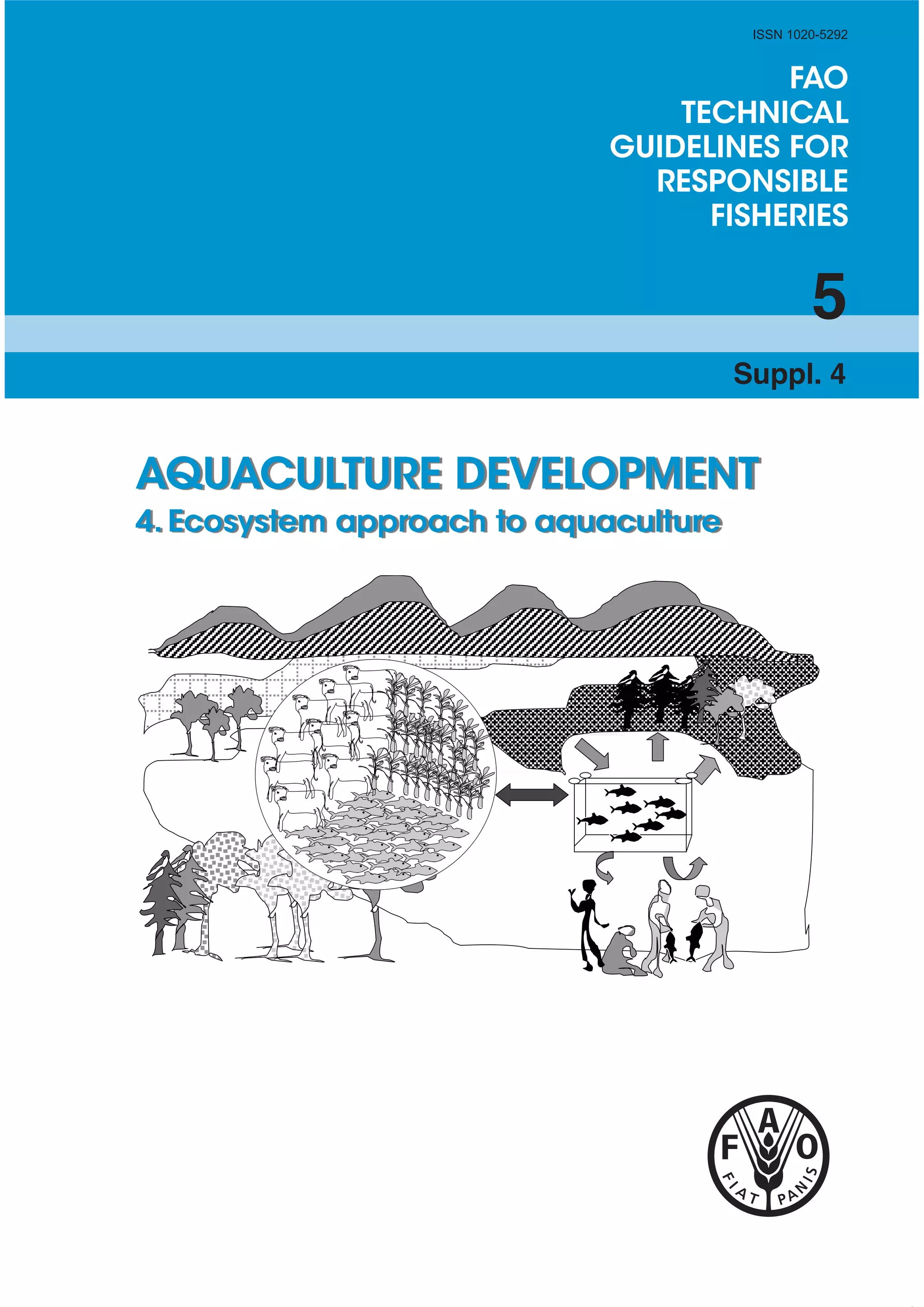
Illustration by Doris Soto.
FAO
TECHNICAL
GUIDELINES FOR
RESPONSIBLE
FISHERIES
5
AQUACULTURE DEVELOPMENT
4. Ecosystem approach to aquaculture
FOOD AND AGRICULTURE ORGANIZATION OF THE UNITED NATIONS
Rome, 2010
Suppl. 4
The designations employed and the presentation of material in this
information product do not imply the expression of any opinion whatsoever
on the part of the Food and Agriculture Organization of the United Nations
(FAO) concerning the legal or development status of any country, territory, city
or area or of its authorities, or concerning the delimitation of its frontiers or
boundaries. The mention of specific companies or products of manufacturers,
whether or not these have been patented, does not imply that these have
been endorsed or recommended by FAO in preference to others of a similar
nature that are not mentioned.
ISBN 978-92-5-106650-8
All rights reserved. FAO encourages reproduction and dissemination of
material in this information product. Non-commercial uses will be authorized
free of charge, upon request. Reproduction for resale or other commercial
purposes, including educational purposes, may incur fees. Applications for
permission to reproduce or disseminate FAO copyright materials, and all
queries concerning rights and licences, should be addressed by e-mail to
copyright@fao.org or to the Chief, Publishing Policy and Support Branch,
Office of Knowledge Exchange, Research and Extension, FAO,
Viale delle Terme di Caracalla, 00153 Rome, Italy.
© FAO 2010
iii
PREPARATION OF THIS DOCUMENT
These technical guidelines have been prepared by the Fisheries and
Aquaculture Department of the Food and Agriculture Organization of the
United Nations (FAO) under the coordination of Doris Soto. Their production
has been supported by the Japanese Trust Fund Project “Towards Sustainable
Aquaculture: Selected Issues and Guidelines” and by the FAO Regular
Programme.
The initial discussions leading to the preparation of these guidelines took
place in the FAO/Universitat de les Illes Balears Expert Workshop on Building
an Ecosystem Approach to Aquaculture convened in Palma de Mallorca,
Spain, from 7–11 May 2007. Another expert group discussed the initial
draft content of the guidelines in the FAO Expert Workshop on Guidelines
for the Implementation of an Ecosystem Approach to Aquaculture (EAA)
that took place in Rome, Italy, from 24–26 November 2008. The experts
participating in these workshops and contributing to the development of the
guidelines were: José Aguilar-Manjarrez, Dror Angel, Conner Bailey, Uwe
Barg, Kenny Black, Malcolm Beveridge, Alex Brown, Thierry Chopin, Barry
Costa Pierce, Sena de Silva, Salud Deudero, Peter Edwards, Shirra Freeman,
Nguyen Song Ha, John Hambrey, Nathanael Hishamunda, Nelly Isyagy,
Yannis Karakassis, Duncan Knowler, Alessandro Lovatelli, Nuria Marba,
Javier Martinez-Cordero, Syndhia Mathe, Miao Weimin, Reinaldo Morales,
Ricardo Norambuena, Bill Silver, Francois Simard, Rohana Subasinghe,
Phutchapol Suvanachai, Paul Tett, Max Troell and Alexandre Wainberg.
The initial drafts of the guidelines were prepared by Patrick White and
Peter Edwards. Additional contributions and comments were provided by
Gabriella Bianchi and James Muir. Cécile Brugère, José Aguilar-Manjarrez
and Nathanael Hishamunda provided technical inputs throughout the process.
Richard Arthur and Françoise Schatto provided editorial assistance.
iv
FAO.
Aquaculture development. 4. Ecosystem approach to aquaculture.
FAO Technical Guidelines for Responsible Fisheries. No. 5, Suppl. 4.
Rome, FAO. 2010. 53p.
ABSTRACT
Social and biophysical dimensions of ecosystems are inextricably related
such that a change in one dimension is highly likely to generate a change
in the other. Although change is a natural consequence of complex
interactions, it must be monitored and even managed if the rate and
direction of change threatens to undermine system resilience.
“An ecosystem approach to aquaculture (EAA) is a strategy for
the integration of the activity within the wider ecosystem such
that it promotes sustainable development, equity, and resilience of
interlinked social-ecological systems.”
Being a strategy, the ecosystem approach to aquaculture (EAA) is not
what is done but rather how it is done. The participation of stakeholders is
at the base of the strategy.
The EAA requires an appropriate policy framework under which the


corresponding implementation process, which includes reinforcing,
                ! # 
are steps informed by the best available knowledge.
Implementing the EAA will require strengthening institutions and
associated management systems so that an integrated approach to
aquaculture development can be implemented and account fully for the
needs and impacts of other sectors. The key will be to develop institutions
capable of integration, especially in terms of agreed upon objectives and
standards.
The widespread adoption of an EAA will require a much tighter coupling
of science, policy and management. It will also require that governments
include the EAA in their aquaculture development policies, strategies and
development plans.
v
CONTENTS
Preparation of this document iii
Abstract iv
Abbreviations and acronyms vii
Background ix
1. INTRODUCTION 1
1.1 The ecosystem approach to aquaculture 1
1.2 Aim 5
1.3 Key principles 5
2. THE EAA IN PRACTICE: PREPARATION AND INITIATION 7
        
planning process and when should it start? 7
2.2 Scoping 8
         
   8
   9
   11
 !   11
           
       11
      12
 #  $%      
      '  ( 
   14
 )(  *       
          '  
  (  16
2.3.4.1 Ecological and socio-economic well-being issues 17
2.3.4.2 Effects of external components on aquaculture 19
2.4 Prioritization of issues 20
 !     !#      !#  
3. IMPLEMENTING THE EAA: THE PLAN 23
3.1 Minimum requirements to support the implementation of
the EAA 24
 + %    $$ ,  
   $  -     ,   
 $  24
vi
  $ ( ,    , 
'       25
3.1.3.1 Zoning 25
3.1.3.2 Cross-integration 26
 + $    $   26
. !      $ $    
      ,$ 27
 $%       
social issues 28
  $,       /
3.2.1.1 Management measures at the farm level 28
3.2.1.2 Management measures at the watershed scale 33
3.2.1.3 Management measures at the global scale 37
  $,     38
 '  (
3.4 Standards for application 40
3.5 Indicators and monitoring impacts 40
. 0          $ 41
.           $ 41
3.6 Tools in support of the approach 43
1 2  $ 43
1   $  43
4. MONITORING AND EVALUATION 45
5. FUTURE DEVELOPMENTS 45
REFERENCES 47
APPENDIX 51
vii
Abbreviations and acronyms
#$%' #$ % '  
ASA American Soybean Association
ASA-IM American Soybean Association International Marketing
(Program)
BMP better management practice
CBA capture-based aquaculture
CCRF Code of Conduct for Responsible Fisheries (of the FAO)
COFI Committee on Fisheries (of the FAO)
COP codes of practice
EA ecosystem approach
EAA ecosystem approach to aquaculture
*#%      
EIA environmental impact assessment
FAO Food and Agriculture Organization of the United Nations
FCR Feed conversion rate
GDP gross domestic product
GIS Geographic Information System
ICZM integrated coastal zone management
ILO International Labour Organization
IMTA integrated multitrophic aquaculture
IWSM integrated watershed management
LME large marine ecosystem
MPA marine protected area
NGO non-governmental organization
OIE World Organisation for Animal Health
PAS partitioned aquaculture system
PCBs polychlorinated biphenyls
SEA strategic environmental assessment
SPS sanitary and phytosanitary
TBT technical barriers to trade
UNCBD United Nations Convention on Biological Diversity
UNCED United Nations Conference on Environment and
Development
WHO World Health Organization
WTO World Trade Organization
ix
BACKGROUND
+ %   9    9       
      9             
for humanity. Ocean productivity seemed particularly unlimited. However,
!   !           
aquaculture, it was realized that living aquatic resources, although renewable,
            9       
nutritional, economic and social well-being of the growing world’s population
was to be sustained.
2. However, for nearly three decades, because of the dramatic increase of
  9    ; !  ! 9    9   
  9            
declining, often at alarming rates.
3. Stock depletion has negative implications for food security and
economic development and reduces social welfare in countries around the
!  9                 
               ;
         9         
sustainable.
=       ;        
and maintenance of the still-healthy ones, through sound management. In this
regard, the adoption of the United Nations Convention on the Law of the Sea,
in 1982 was instrumental. The law provides a new framework for the better
management of marine resources. The new legal regime of the oceans gave
               
resources within the areas of their national jurisdiction, which embrace some 90
   !  @  
Q   9 !           
sectors of the food industry, and many States have striven to take advantage
  !          V   
       !        
     9  ! 9         
sustain an often uncontrolled increase of exploitation. Overexploitation of
    9      9     9
    V
x
6. In light of this situation, while recognizing that the recovery of
depleted stocks is still urgent and avoiding depleting still-healthy stocks as
important, FAO Member States have expressed the need to further develop
aquaculture as the only immediate way to bridge the gap between the dipping
      !      
X   9      9 ;       
and most rapid growth among the food-producing sectors and has developed
into a globally robust and vital industry. However, aquaculture also has been
 !               
socially adverse impacts.
8. Thus, the Nineteenth Session of the FAO Committee on Fisheries
'[%9    +]]+9     !    
and aquaculture management embracing conservation and environmental, as
well as social and economic, considerations were urgently needed. FAO was
                  '  
Conduct to foster its application.
9. Subsequently, the Government of Mexico, in collaboration with FAO,
organized an International Conference on Responsible Fishing in Cancún
in May 1992. The Declaration of Cancún, endorsed at that Conference, was
brought to the attention of the United Nations Conference on Environment and
Development Summit in Rio de Janeiro, Brazil, in June 1992, which supported
the preparation of a Code of Conduct for Responsible Fisheries. The FAO
Technical Consultation on High Seas Fishing, held in September 1992, further
recommended the elaboration of a code to address the issues regarding high
 
10. The One Hundred and Second Session of the FAO Council, held in
November 1992, discussed the elaboration of the Code, recommending that
priority be given to high seas issues and requested that proposals for the Code
be presented to the 1993 session of the Committee on Fisheries.
11. TheTwentiethSessionofCOFI,heldinMarch1993,examinedingeneral
the proposed framework and content for such a Code, including the elaboration
of guidelines, and endorsed a time frame for the further elaboration of the Code.
It also requested FAO to prepare, on a “fast track” basis, as part of the Code,
       V     !      
management measures on the high seas. This resulted in the FAO Conference,
at its Twenty-seventh Session in November 1993, adopting the Agreement
to Promote Compliance with International Conservation and Management
xi
Measures by Fishing Vessels on the High Seas, which, according to FAO
Conference Resolution 15/93, forms an integral part of the Code. It was also
           ;    
and aquaculture sustainability should be addressed in the formulation process
so that these be appropriately covered in the envisaged Code.
12. This implicit recognition of the importance of governance in
aquaculture is underlined in Article 9.1.1 of the Code, which requires states
to “establish, maintain and develop an appropriate legal and administrative
framework to facilitate the development of responsible aquaculture”.
In addition, at the beginning of the new millennium, there is growing
                 !
for mariculture expansion. The outstanding issue in this area is that, unlike in
 9  _           !
and treaty provisions provide little guidance on the conduct of aquaculture
operations in these waters. Yet, experts agree that most of the future
aquaculture expansion will occur in the seas and oceans, certainly further
offshore, perhaps even as far as the high seas. The regulatory vacuum for
aquaculture in the high seas would have to be addressed should aquaculture
operations expand there.
13. TheCodewasformulatedsoastobeinterpretedandappliedinconformity
!          !9  V   +` { +]|}
United Nations Convention on the Law of the Sea. The Code is also in line with
the Agreement for the Implementation of the Provisions of this Law, namely
the 1995 Conservation and Management of Straddling Fish Stocks and Highly
Migratory Fish Stocks. It is equally in line with, inter alia, the 1992 Declaration
of Cancún and the 1992 Rio Declaration on Environment and Development, in
particular Chapter 17 of Agenda 21.
14. The development of the Code was carried out by FAO in consultation
andcollaborationwithrelevantUnitedNationsagenciesandotherinternational
organizations, including non-governmental organizations.
+Q ~ '   '             
   [  €   !    
  9         ; 
developing countries. These introductory articles are followed by an article
on General principles, which precedes the six thematic articles on Fisheries
management, Fishing operations, Aquaculture development, Integration of
     9 $      9
and Fisheries research. As already mentioned, the Agreement to Promote
xii
Compliance with International Conservation and Management Measures by
Fishing Vessels on the High Seas forms an integral part of the Code.
16. The Code is voluntary. However, certain parts of it are based on relevant
     !9  V      '     
!  +`{+]|}9'    
provisions that may be or have already been given binding effect by means of
other obligatory legal instruments among the Parties, such as the Agreement to
Promote Compliance with Conservation and Management Measures by Fishing
Vessels on the High Seas, 1993. In aquaculture, the provisions of the Code
implicitly encourage participatory governance of the sector, which extends
from industry self-regulation, to co-management of the sector by industry
representatives and government regulators and to community partnerships.
Compliance is self or enforced by peer pressure, with industry organizations
having the ability to exclude those who do not comply and governments only
checking periodically.
17. The Twenty-eighth Session of the Conference in Resolution 4/95
adoptedtheCodeofConductforResponsibleFisherieson31October1995.The
same Resolution requested FAO, inter alia, to elaborate appropriate technical
guidelines in support of the implementation of the Code in collaboration with
members and interested relevant organizations.
18. The expanding role and increasing contribution of aquaculture
to economic growth, social welfare as well as global food security was
recognized and reiterated at international levels such as the 1995 FAO/
Japan Conference on the Contribution of Fisheries and Aquaculture to Food
Security, the 1996 World Food Summit, the 1999 Ministerial Meeting on
Fisheries, the 2000 FAO/NACA (Network of Aquaculture Centres in Asia
  $ '   #;    ~   
its Bangkok Declaration and Strategy, and most recently, the 2009 World
Summit on Food Security.
+] ~             ; 
asstrategiesforthedevelopmentofthesectorcontributestotheimplementation
of the provisions of the Code, thereby enforcing the technical, ecological,
economic and social sustainability of the industry.
1
1. INTRODUCTION
These technical guidelines on the ecosystem approach to aquaculture (EEA)
are developed to support mainly Articles 9 and 10 of the FAO Code of
Conduct for Responsible Fisheries (CCRF).
The main objective of the guidelines is to assist countries, institutions and
policy-makers in the development and implementation of a strategy to ensure
the sustainability of the aquaculture sector, integration of aquaculture with
other sectors and its contribution to social and economic development.
1.1 The ecosystem approach to aquaculture
Aquaculture growth worldwide invariably involves (with differences among
regions and economies) the expansion of cultivated areas, larger aquaculture
farms, higher density of farmed individuals and the use of feed resources
often produced outside of the immediate area. Worldwide, aquaculture has
increasing social and economic impact through the production of food,
contribution to livelihoods and generation of income. Other positive effects
on the ecosystem include, for example, the provision of seeds for restocking
of endangered or overexploited aquatic populations. However, when badly
managed, aquaculture can affect ecosystems functions and services, with
negative environmental, social and economic consequences. Aquaculture
usually also faces risks from other human activities such as contamination of
waterways by agriculture and industrial activities.
There have been important advances regarding the formulation of
instruments and codes to facilitate sustainable development of the aquaculture
sector. These include the provisions in Articles 9 and 10 in the CCRF, the
development of technical guidelines expanding on the scope and meaning
of these articles (e.g. FAO, 1997) and other numerous guiding documents.
Countries worldwide are also attempting to implement a diverse array of
aquaculture regulations to control inadequate development of the sector.
Yet some relevant constraints persist, often including:
‚   !         
‚        !       
‚               
      ;     
‚            
 
‚       
    
‚                   
 9 !   
‚
2
To address these issues, the FAO workshop Building an Ecosystem
Approach to Aquaculture (Soto, Aguilar-Manjarrez and Hishamunda, 2008)1
laid the foundations for the development of the present guidelines and
     !  
“An ecosystem approach to aquaculture (EAA) is a strategy for the
integration of the activity within the wider ecosystem such that it
promotes sustainable development, equity and resilience of interlinked
social-ecological systems.”
Being a strategy, the EAA is not what we do but how !   
participation of relevant stakeholders is at the base of the formulation and
implementation of the “strategy”. Figure 1 and Box 1 depict the changing
approach from the conventional to an ecosystem approach to aquaculture
emphasizing “the way we do things”.
The premise of the ecosystem approach (EA) is in the Convention on
ƒ  {  'ƒ{9 +]]„9 !  *#     
the integrated management of land, water and living resources that promotes
conservation and sustainable use in an equitable way.
Indeed, most of the principles and practical steps of EAA are not new.
The EAA builds on the conceptual work carried out to develop the ecosystem
    *#% %#[9 }``„9 }``Q9        
           %#[9 }``|9 
well as initiatives related to integrated natural resource management such
as integrated coastal zone management (ICZM) and integrated watershed
management (IWSM) and the planning and management for sustainable
coastal aquaculture development (e.g. GESAMP, 2001).
The requirements and criteria presented below on the implementation of
an EAA are to be based on, and interpreted in accordance with, the current
suite of agreed international instruments that pertain to aquaculture (Box 2).
The EAAalso echoes the development principles stated in the formulation
of the EAF. Both the EAA and EAF have three main objectives within a
hierarchical tree framework:
+   ! 
}    !  
3. facilitating the achievement of both, i.e. effective governance of the
sector/areas where aquaculture occurs and has potential for development.
The EAA is based on the principles of sustainable development, where
“sustainable” is not restricted to ecological considerations, but includes
economic and social considerations and their interaction with ecological
1
This publication contains extensive background material and case studies related to EAA
(available at www.fao.org/docrep/011/i0339e/i0339e00.htm).
3
ones. Both the social and biophysical or ecological dimensions of ecosystems
are tightly linked, so that disruption in one is likely to cause a disruption or
change in the other.
The present EAA guidelines provide a common, coherent and practical
framework for policy-making and promote a process of enhanced sectoral
management at different scales, taking full account of environmental
limits and the interests of other resource users and stakeholders. Although
the guidelines have a sectoral perspective, which is needed for practical
purposes related to the implementation of the approach, they are congruent
with more general guidelines for integrated natural resources management,
Box 1
The core ideas underlying the ecosystem approach
The ecosystem approach (EA) recognizes that
‚          9    
should be at the center of biodiversity management. This implies the
    9          
issues and further in to “ecosystem” management.
‚               9 
that we need to ensure that we do not threaten the sustained delivery
of these services through damage to ecosystem functions.
‚                _
systems, there is a need for a precautionary and adaptive approach.
‚          ;      
available to society at large and therefore represent a cost that should
be accounted or internalized.
‚ !                
another, thus enhancing productivity and reducing pressure on
ecosystem functions and services.
‚                   9
and we therefore need a “nested” approach with different approaches
to management according to scale.
‚                    9
economic and environmental implications of meeting targets and for
transparency of decision-making in relation to trade-offs between
social, economic and environmental objectives.
    †9 * !   ƒ   }``|
4
Box 2
Principles, instruments, global and national agreements,
regulations and codes of practice related to the sustainable
development of the aquaculture sector
Aquaculture should:
Recognize the sovereign rights of States and comply with all

relevant local, national and international laws and regulations.
Be consistent with relevant international agreements and

conventions, in particular:
‚ ~    '      !   
(UNCLOS, 1982)2
‚ ~ '     ƒ  {  'ƒ{9 +]]„
‚ ~ %#[ '   '     €   % ''€%9
especially Articles 9 and 10 (FAO, 1995)
‚ ~     ‡  ~  [  ‡~[9    
Agreement on the Application of Sanitary and Phytosanitary
(SPS)3
Measures and the Agreement on Technical Barriers to
Trade (TBT)
‚ ~ %#[ˆ‡  †  [  ‡†[ Codex
Alimentarius (FAO/WHO)4
‚ ‡  [    # †  [* #; #
Health Code 12th
edition (OIE, 2009)
‚ ~            [ 
(ILO)
‚ ~ '     ‡       
especially as Waterfowl Habitat (Ramsar Convention)
‚ #  }+ € * 9 +]]}
Be consistent with the following documents

‚ #;     %#[ ~ ‰    
Responsible Fisheries. No. 5 (FAO, 1997)
‚ #;  {   ƒ  }``` ~ ƒ 
Declaration and Strategy (NACA/FAO, 2000)
‚ ~   $    €    %
(FAO/NACA/UNEP/WB/WWF, 2006)
‚ *_            
development in aquaculture (FAO, 2008b)
2
See www.un.org/Depts/los/convention_agreements/texts/unclos/closindx.htm
3
See www.wto.org/english/tratop_e/sps_e/spsagr_e.htm
4
Available at ftp://ftp.fao.org/codex/Publications/understanding/Understanding_EN.pdf
5
integrated watershed and river basin management, and integrated coastal zone
management. Practitioners are encouraged to select, modify and continuously
   !        
1.2 Aim
The prime goal of EAA is to overcome the sectoral and intergovernmental
fragmentation of resources management efforts and to develop institutional
mechanisms for effective coordination among various sectors active in the
ecosystems in which aquaculture operates and between the various levels of
government.
The two outcomes of this should be:
(i) a “truly” sustainable aquaculture sector (environmentally,
   9    
(ii) change in the public’s (understood as broadly as possible) attitude
and perception of aquaculture.
1.3 Key principles
As “the” strategy to ensure aquaculture contributes positively to sustainable
development, the EAA should be guided by three main interlinked
principles:
Principle 1
Aquaculture development and management should take account of the
full range of ecosystem functions and services, and should not threaten
the sustained delivery of these to society.
Developing aquaculture in the context of ecosystem functions and
              
(at least operationally), estimating some assimilative and production
carrying capacities, and adapting farming practices accordingly. The mix
of ecosystem services will depend on wider management practices and
the trade-off among different services must be acknowledged. This is
especially important in the case of ecosystem functions that are unique,
essential or threatened to ensure their preservation.
Principle 2
Aquaculture should improve human well-being and equity for all relevant
stakeholders.
This principle seeks to ensure that aquaculture provides equitable
        ;      ~
includes ensuring that it does not result in any undue detriment for any
groups within society, especially the most vulnerable. Both food security
and safety are to be promoted as key components of well-being.
6
Principle 3
Aquaculture should be developed in the context of other sectors, policies
and goals.
This principle recognizes the interactions between aquaculture and the
 9   9  V       
social environments on aquaculture practices and results. This principle
also acknowledges the opportunity of coupling aquaculture activities with
other production sectors to promote materials and energy recycling and
better use of resources in general.
Principle 3 is a call for the development of multisectoral or integrated
planning and management systems. However, we should make clear that this
principle mostly applies to those aspects that are within the ability of the
aquaculture sector to change or modify.
.
.
Ecosystem
approach
Multiple objectives
Interaction with other sectors
Multiple (nested) scales
Adaptive
Extended knowledge
Incentives
Public/Transparent
Participatory
Top-down
One objective: production
Sectoral
Farm scale (most common)
Predictive
Scientific knowledge
Prescriptions
Corporate
Sectoral
Predictive
Prescriptions
Corporate
Conventional
approach
Figure 1
The transition from a conventional approach to an ecosystems
approach to aquaculture
    %#[ }``Q
7
2. THE EAA IN PRACTICE: PREPARATION AND INITIATION
        
process and when should it start?
The ecosystem approach to aquaculture as a “strategy” should be the means
             ƒ _ „  V   
national, regional and international development goals and agreements.
The agreed policy could state something like “Aquaculture should promote
sustainable development, equity and resilience of interlinked social-ecological
systems” (as described in Section 1.1). Achieving social and economic well-
being through aquaculture may have environmental costs (as does any other
food production system), and it is necessary to consider such trade-offs.
~            9      
of producers’ organizations in achieving these goals.
Astrategy is usually built around practical objective axes of development,
chosen by relevant authorities and stakeholders. These axes usually consist
 Š ‹           ;  
cross-cutting objectives (e.g. related to institutional strengthening, capacity
building, research enhancement, etc.) as deemed appropriate to achieve the
policy goals.
Box 3
Planning and policy concepts
The expert consultation on planning and policy development for
aquaculture proposed that:
– An aquaculture policy consists of a broad vision for the sector,
V   9            
levels including provincial, national, regional and international.
– A strategy represents a road map for the implementation of a policy
     9      
issues which might stimulate or impede the comparative advantage
          ~ *##  
Implementing an EAA can be an objective under a country’s strategy
to achieve a desired (higher level) policy goal (e.g. to develop
environmentally sustainable coastal aquaculture).
– An action plan represents a road map for the implementation of a
strategy, that is, to achieve its objectives and implement strategy
     9      
activities, and details the resources required to achieve them.
Source: FAO, 2008b.
8
To implement the strategy successfully, it is necessary to translate the
relevant policy goals into operational objectives and actions.Two elements are
fundamental throughout the process: (i) to collect and use the best available
              ~  9
steps and potential starting point for EAA are described in Figures 2 and 3.
2.2 Scoping
           
~                !
attempting to implement the EAA. This is a necessary exercise, including the
decision on whether planning and implementation of the strategy will cover
the whole aquaculture sector of a country/region, or (more typically) will
address an aquaculture system or aquaculture area in a country/subregion.
Therefore, there should also be a general objective or purpose to be addressed
    
Theecosystemboundariesaredelineatedongeological,physico-chemical,
biological and ecological grounds, while socio-economic and administrative
Consultation
with
stakeholders
Consultation
with
stakeholders
Best
available
knowledge
Best
available
knowledge
Scoping and definition of the
ecosystem boundary
(spatial, time and political scales )
High-level policy goals
Identify key issues
Prioritize key issues
Develop an implementation
plan
1 -5 year ?
1 to 5 years
Implement and enforce
Monitoring and evaluation
Long-term policy review
Define operational objectives
Figure 2
EAA planning and implementation process
Source: APFIC, 2009.
9
boundaries outline the management area. The closer the correspondence
between the ecosystem limits and management areas, the more likely it is
that there will be a high level of harmonization across planning structures.
However, these boundaries do not usually coincide. For this reason, a clear
              ~   
the ecosystem boundaries is also needed to identify the relevant stakeholders
and to address the different issues (Aguilar-Manjarrez, Kapetsky and Soto,
2010).
2.2.2 Spatial scales
Farm scale
The individual farm is easy to locate and identify, and local effects are often
easy to assess, although in cage aquaculture, especially in open ecosystems
such as open seas, it may be challenging to establish the boundary of potential
effects. Most management practices are developed for this scale and most
top-down regulation measures, such as the environmental impact assessment
(EIA), worldwide apply at this scale. Also better management practices
(BMPs) are implemented and can be assessed at this level.
EAA context
EAA context
Policy
EAA
Action Plan
EAA
Implementation
EAA
Monitoring
and evaluation
Potential
starting point
Potential
starting point
Potential
starting point
Potential
starting point
Figure 3
When should EAA start? This can happen ... at any point
10
Escapees and diseases originating from aquaculture operations can be
prevented/controlled at the farm scale, although their effects usually occur at
the next spatial scale, the watershed.
The farm level is also the focal point for ecosystem impacts on aquaculture.
Cultured species are sensitive to water quality and are vulnerable to damage
V      !  ~9        
 9              
 9     !          
farm level, and protective measures, including pollution regulation, spatial
planning and insurance, are important.
Stakeholders at this scale are usually farm owners, workers, family
members and local inhabitants.
The watershed/aquaculture zone and geographic region
This geographical scale includes a cluster of farms more or less aggregated
(an aquaculture zone) that share a common waterbody and that need a
coordinated management.
While the environmental and social impacts of a single farm might be
marginal, more attention needs to be paid to the potentially cumulative
ecosystem effects of collectives or clusters of farms and their aggregates
at watershed/zone scale, for example, eutrophication as a consequence of
excessive nutrient outputs.
Escape of alien species or alien genotypes takes place at the farm level.
However, relevant impacts on biodiversity often occur throughout entire
!    9            9
but often need control, management and mitigation at the watershed scale.
Similarly, if the direction of pathogen transfer is from the watershed to the
farm, detection and management must include the watershed scale.
              ˆ
!         
      9       
;          
 9           ~  
at which these entities operate will depend on the nature of the issues.
When the watershed boundaries go beyond political boundaries, different
authorities (or, in some cases, even different countries) will need to be
involved. The FAO Regional Fishery Bodies5
can play an important role in
this respect, as they can provide the political platform for the implementation
of the EAA. Examples of large common waterbodies/ecosystems where
5
11
aquaculture is expanding are the Mediterranean Sea, the Mekong Delta in
Asia, the Volta Basin in Africa and the Amazon Basin in South America.
Large marine ecosystems (LMEs) and marine protected areas (MPAs) are
also relevant ecosystem scales.
Global scale
The global scale refers to the global industry for certain commodity products
   9 9             9  
        9    ;   9  9
technological advances, research and education of global relevance, etc. Of
                  
!                 
This means that resources and energy are moving between different regions of
the world with unexpected consequences. The sustainability of these resources
is particularly important for the long-term sustainability of aquaculture.
GlobalissuescanbebettertackledbyorganizationssuchasFAO,theWorld
Organisation for Animal Health (OIE) and the World Trade Organization
(WTO) via seeking action and coordination between governments.
Consumers worldwide are the main stakeholders at this scale.
The most common spatial scales are descibed in Figure 4.
2.2.3 Temporal scales
Aquaculture is affected by external forcing factors or drivers such as population
growth and development, global trade and climate change, and these affect the
interactions of aquaculture and the ecosystem at all the scales and with a temporal
dimension adding to uncertainty. It is therefore necessary to apply a precautionary
approach due to unknown ecosystem threshold or resilience, including the human
components. Therefore, time scales are relevant in strategy and planning.
2.2.4 Political scales
An aquaculture zone or aquaculture regional level is a scale that may go
beyond national boundaries and require transboundary political will to
implement the EAA. The concepts of coastal zone, offshore and open-seas
aquaculture, and watershed management may require creative approaches
and political willingness of different administrative entities where water-
bodies are shared and the physical boundaries do not coincide with the
administrative boundaries within a country or region.
         
     
[         9         
       ~
12
of stakeholders.6
For example, stakeholders related to aquaculture in coastal
mangroveareasmayinclude:localaquaculturefarmersandtheircommunities,
 9   ;   9     
governmental organizations (NGOs), environmental institutions, tourism
agencies and institutions, organizations associated with the use of coastal
infrastructure, research institutions, etc. (see Box 4 for a simple guide).
     
$       ;
(a) involving the relevant stakeholders for the selected system, within the
              
(b) having adequate background information available to all these relevant
  
(c) establishing a facilitation process that includes a “neutral facilitator” or
facilitation system.
6
See www.canari.org/docs/guidelines5.pdf
The farm
The waterbody and its
watershed/aquaculture zone
The regional/global
market-trade scale
Figure 4
Relevant geographical scales for an EAA
13
ƒ _ Q       ;           
issues with stakeholders.
Box 4
         
Criteria for selection of stakeholders:
   !         !    ! 
        
 those who have legal standing and therefore the potential to block a
 
 those who control resources (or property rights) necessary for
      
   !               
 9  !      
 those who hold necessary information. The range of necessary types
of information can be quite broad and complex issues often deal with
phenomena about which data are limited or privately held. Including
parties who may have access to such information may be essential to
developing wise and stable decisions.
According to the above criteria, stakeholders could include:
    ;    
  
 local communities and/or businesses reliant on processing,
9         !  
; 
     9   9   9 


   !
   
 other enterprises directly using the river, lake or reservoir, coast or
    9  9 9 ! 
 other enterprises indirectly using the coast or marine body (urban and
     !9  9  
 food and health authorities.
      }``]
14
2.3.3 Gathering/preparation of complementary information on the socio-
economic context of aquaculture development
Gathering relevant information both from the stakeholders’analysis and from
relevant documents (formal publications, institutional documents, etc.) is
           
~         ;      
        
      !     
(c) those that include a range of environmental and social effects.
Box 5
!     #    
A stakeholder analysis to identify issues in the context of the EAA will
aim at answering questions such as:
 What are the current and future interests of the various stakeholders
in the use and management of the resource (coastal area, freshwater
use, etc.)?
 What are their needs and expectations?
 † !       !      
it?
 What are their past and current power, rights and responsibilities
(both formal and informal)?
 What are the networks and institutions of which they are part?
 What are the social and environmental impacts, both positive and
negative, of their past and current uses of and relationships with the
resource?
 † !             
aquaculture practices?
 How ready and willing are they to participate in and contribute to an
integrated management approach?
 What are the potential areas of agreement and shared interest upon
which consensus and collaboration can be developed?
 ‡   9        
prepared to contribute to an integrated management process?
     '  €   }``=
15
Geographical scale
At the enterprise and farm level, the main contributions to human well-
         ;      9
            !   
9                
the farm’s products. Aquaculture contributes towards the nutritional needs of
a wide cross-section of human populations.
However, in general, the major contributions of aquaculture towards the
improvement of human well-being are found in the wider economy and the
sector as a whole. Here, job creation and investment opportunities involve
ˆ              9
marketing, sales and transport.
Food security
Reliability of supply and product quality gain impetus at the aquaculture zone
scale because the magnitude of operations needed to sustain the upstream
and downstream sectors is beyond the capacity of a single farm. The extent
 !      9          
people (including poor and vulnerable communities) depends on the extent
to which local interests are involved. In general, when investors are not local,
   _  
    
[         ;       
potential to diversify economic activities at the household, community,
national and regional levels. This includes on-farm activities as well as off-
farm employment, e.g. labour on aquaculture farms and non-farm employment
in input supply and marketing chains, processing facilities and management.
Such information must be included.
Small-scale aquaculture involves family labour, allowing for fuller
utilization of available human resources within the household. The impact on
social resilience within a community will depend on whether hired workers
are local residents or outsiders.
Interactions with other sectors and opportunity costs
Interaction of aquaculture with stakeholders from other sectors can be
9    V  %  _ 9     ; 
that pollutes a waterbody imposes costs in terms of human health, restoration
            !   9  ;  
      V9  !    9    ! !
depend on existing local priorities and governance structures.
16
~ *## ;            
       9           
of other alternative activities. An EAA implies looking at the economics of
aquaculture production from a broader social and environmental perspective
                   
society.
2.3.4 Aquaculture issues – effects on the ecosystem and effects of other
ecosystem components and external drivers on aquaculture
It is advisable to distinguish ecological, socio-economic and “ability to
achieve” type of issues (Figure 5). An ecological assessment can provide
information on ecological issues related to the aquaculture process,
considering inputs, resource use and outputs (Figure 6). Often these issues
have a related social problem. This could be a cause or a consequence, and
most of the time affects local communities, although it could also have
   ;  9           
well-being is advisable.
Also in most cases, ecological and socio-economic issues have a root
cause in the “ability to achieve”, which includes governance and institutional
factors. Typical “ability to achieve” or root causes include lack of adequate
 !  9   9     ! 9  
enforcement, problems with user rights, etc. Examples of detailed “tree-
issues”, as shown in Figure 5, can be found for EAF in FAO (2003) and for
EAF/EAA in APFIC (2009).
Aquaculture
Ecological
assessment
Socio-economic well-being
assessment
Ability to achieve
assessment
Inputs and
resource use
Outputs
Local
communities
National
Governance
Impact of
the external
environment
Figure 5
Assessing ecological, socio-economic and “ability to achieve”
issues
17
2.3.4.1 Ecological and socio-economic well-being issues
External forcing factors should also be considered under “ability to achieve”,
for example, catastrophic events, climate change impacts, sudden changes
in international markets, etc. Within the external forcing factors, we include
the effects of other users of aquatic ecosystems on aquaculture, for example,
agriculture and urban pollution of aquatic environments with damaging
effects on aquaculture.
A good approach to identify aquaculture issues is to focus on the different
steps in the production process, including upstream and downstream (such
    9          _ 
above. Aquaculture as a production process may require land/sea area as well
 !   9     9    _ 
such as food and income, together with unwanted outputs such as nutrients
or chemicals. Issues affecting ecological and socio-economic well-being can
be associated with the main parts of the process as shown in Figure 6. As
_   9     !       
boundary.
Ecological and
socio-economic well-being
Inputs Resource use Outputs
Seeds
Feeds
Energy
Water
Land, sea
space
Food
Seeds
Organic matter
Genes
Parasites
Chemicals
Coastal
habitats
Infrastructure
Labour
Income
Escapees
Figure 6
Schematic tree to identify issues of the ecological and
socio-economic nature related to different parts of the
aquaculture production process
18
Negative effects of aquaculture
As summarized in Figure 5, the negative effects of aquaculture often include
   
          ˆ  9     
  ˆ      
 unsustainable demand for wild seed or juveniles for fattening (e.g.
     
 alteration of inland and coastal habitats for the construction of ponds
 ;         
 nutrient and organic enrichment of recipient waters resulting in build-
   _        
     !!9      
          !      
       9    9        !
 negative effects from escaped farmed organisms (often more relevant
! _     
      ˆ       
 unfair distribution of income to small farmers and/or to labourers.
Second-order impacts should also be considered, especially as they can
negatively alter the livelihoods of downstream stakeholders, for example,
when the construction of shrimp ponds alter habitats, thereby modifying the
   !              
 
           9  
impacts can also be relevant and could also have opposing effects. For
example, looking at the inputs and at the “Feeds” box in Figure 6, a common
             ˆ      
freshwater and marine carnivorous species, which could have a negative
impact on the small pelagic stocks (Figure 7a), an ecological issue. However,
              
the price paid for this feed, and so there is a positive livelihood effect when
they do not have other choices (Figure 7b). On the other hand, an indirect
      ;         
!             ~ 9  *## 
consider such events within agreed time scales, particularly at the watershed
scale.
Positive effects of aquaculture
The most important socio-economic positive effects of aquaculture fall into
     9          #  
approach to the sector should ensure that such positive effects are not
overridden by negative impacts in the short, medium and long term.
19
Figures 8 and 9 describe the most common aquaculture issues as impacts
related to the production process and affecting environmental and social
!              ~  _  
a list of the most common aquaculture issues related to inputs, resource use
and outputs at the farm, the waterbody and the global scales.
2.3.4.2 Effects of external components on aquaculture
As explained above, “root causes” and “ability to achieve” issues can be
outside the sector.
Pollution
Aquaculture relies on the productivity of a given waterbody as well as on
    !  ;       ˆ 
feeding, so yields are ultimately determined by environmental conditions as
well as culture techniques. Increasing levels of pollution of aquatic resources
have a negative effect on aquaculture productivity, product safety and
   $             
domestic sewage, agricultural and livestock runoff) leading to eutrophication
and possibly to algal blooms or red tides, heavy metals, polychlorinated
biphenyls (PCBs), etc.
Climate change
Climate change can affect aquaculture production through changes in
seasonality of weather patterns, increasing sea level, warming and increased
extreme events leading to unpredictable production. Most aquaculture is
undertaken either in freshwater or in the marine coastal fringe, both of which
are susceptible to climate change.
Seed
Feeds for
carnivorous fish
(small pelagics
and/or trash fish)
Energy
impacts
on pelagic
wild stocks
- impacts
on pelagic’s
predators
-
Seed
Feeds for
Carnivorous fish
(small pelagics
and/or trash fish)
Energy
impacts
on artisanal
fishermen
+
impacts
on fisheries of
predatory species
-
Seeds
Energy
- -
Seeds
Feeds for
carnivorous fish
(small pelagics
and/or trash fish)
Energy
impacts
on artisanal
fishermen
+
-
Figure 7
Expansion of the box “Feeds” in Figure 6 to explain (a) ecological
and (b) social issues
(a) (b)
Note: Negative (-) and positive (+) effects.
20
Unlike most terrestrial animals, all cultured aquatic species are
poikilothermic, meaning their body temperatures vary with the ambient
temperature. Therefore, climate change-induced temperature variations
will have a much stronger impact on aquaculture activities and on their
productivity and yields than on livestock.
'         !    ! ;  
                  
based aquaculture.
Thus climate change must be considered as a potentially relevant
external element affecting aquaculture sector performance and development
(Cochrane et al9 }``]  9        
be in place.
2.4 Prioritization of issues
#           ;     
varies greatly. Consequently, it is necessary to have some way of prioritizing
them so that those that require imminent management receive more immediate
attention within a plan of action.
Water
Land and
coastal
habitats Seeds Feeds
Excessive water
use in ponds
Land salinization
Habitat
degradation
(e.g. mangroves
Biodiversity
losses
Diminished
water flows
Biodiversity
losses
Productivity
declines
Impacts on
local communities
and other users
Protection
services lost
Impacts on
local communities
and other users
Overfishing of
wild seeds
Bycatch of other
organisms
Biodiversity
losses
Productivity
declines
Impacts on
local communities
and other users
Overfishing of
wild feeds
(e.g. trashfish)
Overfishing of
wild pelagics
for fishmeal
Productivity
declines
Impacts on
local and global
fisheries, local
and global
stakeholders
- -
- -
Fishery of
seeds and
feeds
+
Alternative
livelihoods
Impacts on
local
communities
and other users
- +
Productivity
declines
Most common impacts of aquaculture inputs and
resource use
Figure 8
Examples of common issues and impacts related to aquaculture
inputs and resource use
Note: Positive (+) and negative impacts (-).
21
To determine the priority of issues and therefore the appropriate level
of management response, the process should use some kind of risk analysis
method.
        
            ;  ~ ! 
be a physical agent or event having the potential to cause harm or to
impair the ability to achieve a higher level objective. These often include:
          ;  
 9   9          9  
         _  
               
social risk).
All risk assessment methods work by assessing the probability of not
meeting the developmental objectives (see Section 2.5 below).
Most common impacts of aquaculture Outputs
Food
+
seeds
Alternative to
fishing
+
Excessive
nutrients
Organic matter
Escape of
farmed
organisms
(and parasites)
Restocking
May enhance
fisheries
productivity
Chemicals
Eutrophication
Deterioration
of benthic habitats
Biodiversity
losses
Predation and
competition
with wild fish
and genes
Biodiversity
losses
Productivity
decline
Transmission
of diseases
Food
Security
Impacts on
local
communities
Productivity
decline
Impacts on
local fisheries and
communities
Biodiversity
losses
Productivity
decline
Impacts on
local fisheries
and communities
_ _ _
Income
Livelihoods
development
Impacts on
local fisheries
and communities
+
May enhance
biodiversity
productivity
Impacts on
local
communities
Figure 9
Examples of common issues and impacts related to aquaculture
outputs and resource use
Note: Positive (+) and negative impacts (-).
22
A risk analysis typically seeks answers to four questions:
– What can go wrong?
– How likely is it to go wrong?
– What would be the consequences of its going wrong?
– What can be done to reduce either the likelihood or the consequences
of its going wrong?
Whichever risk assessment method is used, it must include appropriately
              9  9 !9 
Often, when there is not enough information or expertise on risk assessment,
stakeholders’ qualitative local knowledge-based assessments can be used.
This allows other parties who were not part of the process to be able to
see the logic and assumptions behind the decisions that were made. It also
helps when reviewing the issue sometime in the future – unless we know why
we chose the levels, it will be hard to know if anything has changed that may
require a shift in the risk levels and therefore management actions. This also
assists in understanding the knowledge “gap” analyses/uncertainties. Bondad-
Reantaso, Arthur and Subasinghe (2008) and Arthur et al. (2009) provide
extensive information on risk analysis in aquaculture. GESAMP (2008)
also provides good guidance on environmental risk and communication in
aquaculture.
The precautionary principle should be used whenever information is not
available to make a fully informed decision.
$ %     %'      %'
[    9    
(this enables the implementation of the EAA).
The overall objective (= goal) of the EAA is to make the aquaculture sector
more sustainable. The EAA should promote ecologically and socially
responsible planning and management of aquaculture as an integral part of
a community and a region. It should allow integration of aquaculture (and
   V !           ~
means to achieve this should involve a participatory process for planning and
management with local communities and other stakeholders.
Operational objectives will depend on the chosen priorities and will be
 _     † ! 9        
be consistent with the overall objective and should stem from a thorough
understanding of the developmental context and developmental options,
and an exchange of informed opinion between all stakeholders. However,
           ;    Š
choices” (Brugère et al., 2010).
23
It is essential that objectives are achievable, and that progress toward
them is measurable. This implies, for each objective:
 agreed criteria (e.g. nutrient concentration, eutrophication level, new
            
and
         9   9      
      
These targets and standards will serve as the agreed basis for:
 rational and consistent social, economic and environmental assessment
       ; 
             
          9      
Environment Reporting.
Targets would normally include economic indicators (e.g. per capita
     ’‰{$“9     9      
       ’  _“9   9 ;  
           ! ;  
                  
conserved, etc.).
3. IMPLEMENTING THE EAA: THE PLAN
The key steps of the EAAimplementation are adapted from those for the EAF
%#[9 }``X #$%'9 }``]
[               
agreement on the operational objectives, implementation of the EAA can
begin.
{               ~  
should be transparent and participatory, with all stakeholders and local
communities consulted during the formulation of the plan of activities and the
implementation of management measures, etc., that will allow achievement of
the objectives under the umbrella of current aquaculture policy. Developing
clear and realistic timelines and estimates of human resources and budgets
required for the different activities is essential.
The objectives of the EAA should be in line with the contents of the
national aquaculture development policy (and strategy) of the country where
the EAA is to be implemented. The implementation of the EAA may be an
opportunity to revisit or revise an out-of-date aquaculture policy – or to
formulate one if it does not exist.
24
3.1 Minimum requirements to support the implementation of the
EAA
Legal, policy and institutional analysis is an essential part of any new
planning and management initiative, especially where a greater degree of
integration is sought. The legislation and regulations for aquaculture and the
environment or the nature and functioning of institutions and their mode of
decision-making will have major implications for the implementation of an
EAA. Developing human capacity to be better equipped for the requirements
of new approaches such as the EAA is also of crucial importance. All these
requirements are also described in detail in Brugère et.al. (2010).
3.1.1 Create/enhance enabling legal frameworks
Policy development and implementation should be supported by an
appropriate legal framework. It may be necessary to conduct periodic reviews
        9     V  ; 
and other relevant legislation relative to policy goals.
The principles of EAA could be represented to a certain extent in general
policiesandlegislationthatsupportsustainabledevelopmentasenvironmental
consciousness, socio-economic equity and interaction of sectors. One central
question therefore is to analyze the extent to which EAA-relevant issues
are considered in general policies and legislation for industrial activity
(e.g. animal health standards, zoning) or whether they should be handled
    ; 
Comprehensive national aquaculture legislation must cover a variety of
issues, such as siting, EIA, production control, waste management, product
safety and traceability, and diseases and parasites. Thus, many aspects are
covered by different areas of law, such as environmental protection, public
health, trade, property, land use, planning and animal health. Countries with
 ;              
aquaculture than countries where aquaculture is less developed.
3.1.2 Strengthen, modify or create new institutional arrangements
The nature of the existing institutions should be assessed, and new institutions
orframeworksforinstitutionalcollaborationandjointdecision-makingshould
be proposed and, if needed, reformed or established. However, it should be
recognized that this is not easy (see Section 3.1.3), especially if it involves
interdisciplinarity and different sectors. Institutional analysis covers both
formal (e.g. a government agency) and informal institutions (e.g. socially
transmitted conventions and codes of behaviour).
Sectoral agencies responsible for managing activities impacting aquatic
    9       9 !
management organizations, agriculture, forestry, industrial developments)
25
must develop new ways (i.e. institutional arrangements) of interacting to
regularly communicate, cooperate and collaborate. The need for innovative
governance to implement an ecosystem-based approach to aquaculture can be
seen as an obstacle, but it also represents an opportunity to increase the social
                
other sectors.
The key is to strengthen existing institutions (or, in their absence, develop
new ones) capable of integration, especially in terms of shared objectives
and standards. One should, however, be aware that institutional “quick
_‹        _          
         ! ;  
on institutions by new situations.
3.1.3 Integrate aquaculture with other sectors to deal with external and
internal issues
3.1.3.1 Zoning
Zoning or allocation of space is a mechanism for more integrated planning
of aquaculture development, as well as its better regulation (Box 6). It may
be used either in planning to identify potential areas for aquaculture or a
regulatory measure to control the development of aquaculture.
The strength of zoning lies in its simplicity, clarity and potential to
streamline procedures (Aguilar-Manjarrez, Kapetsky and Soto, 2010). Once
            9     
meet the objectives and general conditions for the zone may need no further
assessment, as what is allowed and what is not allowed should be clear and
developers can plan accordingly.
Box 6
Various functions of zoning of land and water for aquaculture
development
‚                 
 !  
‚           

‚            
‚               
‚     !            !
supply/drainage infrastructure to small-scale farmers
    ‰*#$ }``+
26
3.1.3.2 Cross-integration
As aquaculture is mostly relatively new and expanding rapidly, it can result
  V !       $  „   +„ 
essentially a call for more integrated planning and management systems,
as has been advocated for many years through integrated coastal zone
management (ICZM) and integrated watershed management (IWSM).
Aquaculture development affects and is affected by other human activities
  9  9     9  !  
urbanization, so their relative contribution to environmental degradation
needs to be assessed and controlled.
Thus, there is a need for sectoral integration of various types (see Box 7).
Awareness-raising is needed within the aquaculture sector and among
other sectors at the watershed/zone scale. Integration between different
sectors should be facilitated with the ecosystem perspective, especially where
      9   _ 9      
where the freshwater resource is scarce.
3.1.4 Creating and enhancing human capacity
~            V  
needs (e.g. producer, research, management, trade development, regulatory
Box 7
Various types of sectoral integration
‚Policy (institutional) integration – minimizing intersectoral
 V          
         
‚Operational (or enterprise level) integration – ensuring that the
variousactivitiespursuedbyaparticularenterprisearecoordinated
and mutually reinforcing. This may include recycling of wastes.
‚Waterbody integration – promoting a balance between different
activities or sectors within an aquatic system in order to maximize
the reuse of nutrients or other materials, thereby increasing
         
‚Provision of “green infrastructure” – maximizing the delivery of
ecosystem services, including waste assimilation, by ensuring
that areas or corridors of a range of habitat types are conserved or
re-created and managed appropriately.
    †9 * !   ƒ   }``|
27
and associated societal levels). Therefore, it may be necessary to conduct
a capacity needs analysis against allocated roles and objectives in the
implementation process.
It will be also necessary to ensure that capacity development targets
    9               
          
institutions undergo periodic assessment in order to remain robust, relevant
and effective in relation to the objectives of the EAA.
3.1.5 Promote appropriate long-term goal-oriented research and
dissemination of knowledge
Relevant research and knowledge are essential for the development of a
sustainable aquaculture sector. Appropriate research must be guided by
participatory processes and focused on ecosystem functioning/services and
human components of ecosystems.
While it is important to use science and knowledge developed at the
global level, it is often advisable to also consider local knowledge as
well as the need to conduct long-term national research and knowledge
building. Often “imported knowledge” cannot be readily applied to local
conditions.
It is also relevant to promote knowledge sharing and networking for a
           
Box 8
Examples of cross-sector integration
‚ '       ;       
terms of suitability for rice cultivation.
‚ ƒ            
avoid salinization and obstruction of irrigation canals, to conserve
a traditional resource/sector in the face of a lucrative but risky and
possibly short-term activity.
‚ ƒ            ! 
         
‚   ! !         
approach to river basin planning and management.
‚ %      ;    
 V !       !   
‚ $   ;  !        
vice versa).
28
‡         !       
permit a sound decision or where the threat of serious or irreversible damage
to ecosystems exists, the precautionary approach should be widely applied.
† ! 9                
for postponing cost-effective measures to prevent environmental or social
degradation.
3.2 Management measures to deal with environmental and social
issues
Salient aspects of some practical measures facilitating the implementation of
the EAAand leading to achieving “sustainable” aquaculture (environmentally,
economically and socially) at all spatial scales are detailed below (Soto et al.,
2008).
3.2.1 Dealing with environmental issues
~               
effects on ecosystem functions and services. Some of these require voluntary
action by associations of farmers through, for example, better management
 ƒ$  ;   9     
by the government.
3.2.1.1 Management measures at the farm level
Environmental impact assessment (EIA)
EIA is a useful tool at the farm level and should be undertaken for large
;              
      9          
              
 V !        ;  
Small-scale farms or farms with low potential impact on the environment
or ecosystem should be exempt, although the cumulative impacts of clusters
of small farms should be assessed collectively by a programmatic EIA.
EIA may be used as:
                   
 an assessment of the impacts on the environment in terms of extent and
 
 an assessment of the socio-economic impacts of aquaculture on local
     
 a means of developing an environmental management plan that should
          ˆ 
 a means of developing an environmental monitoring plan that should
be undertaken regularly.
29
Most importantly, the EIAshould be based on ecosystem quality objectives
(including environmental and socio-economic aspects) agreed upon by
               9
whenever possible. The EIA must be followed up by regular monitoring
surveys on water quality, sediment quality, key habitats and aquaculture-
sensitive species and sensitive local communities, when appropriate, as
          ~     
should be undertaken by independent specialists.
One of the main outputs of the EIA is an environmental management and
monitoring plan that the farm or the cluster of farms should follow during
and after operation and that would lead to corrective actions and decisions
(an extensive global review, analysis and recommendations on EIA for
aquaculture can be found in FAO/FIMA, 2009).
Better management practices
BMPs and codes of practice (COP) are the most technically practical and
economically feasible methods currently available to reduce the adverse
environmental impacts of aquaculture at the farm level and also at a larger
scale. The BMP “solutions” are considered soft law instruments and most
      ! 9    ;    
from governments in the form of better policy, regulation, planning and
management procedures and from the farmers and the aquaculture industry
through better practices.
BMPs can involve: site selection, pond construction, pond renovation,
V ! V9    V9 !    9   9
    9  9      9 ;     9
disease and aquatic animal health management, mortality removal and
disposal, facility operation and maintenance, processing, transport, consumer
information and marketing. Better practices for aquaculture in cages, pens
and rafts involve most of these aspects as well.
A good example of better practices for shrimp farming can be found in
FAO/NACA/UNEP/WB/WWF (2006) and a full review of environmental
BMPs in Tucker and Hargreaves (2008).
A summary of relevant environmental and aquatic animal health good
practices at the farm level is included below.
Optimizing feeds and feeding strategy
The feeding process should try to optimize feed conversion rates (FCRs) to
           ~
30
Diseases and responsible use of veterinary drugs and chemicals
Biosecurity frameworks should be in place to prevent and control diseases
and potential health risks to the culture species or to the environment. All
veterinary drugs and chemicals used in aquaculture should comply with
national regulations and international guidelines such as those recommended
by the World Organisation for Animal Health (OIE, 2009).
Prevention and control of escapees from the farm and safe movement of living
aquatic organisms
Farm facilities must ensure secure containment and physical safety nets
at all times, including during the normal activities of changing nets, water
V9 9                 
emergency systems to control or mitigate massive escapes. Due notice should
be given to proper authorities in the case of massive escapes, also taking into
consideration existing biosecurity frameworks.
The movement of live aquatic animals should comply with all relevant
health management measures (FAO, 2007) and procedures such as quarantine
(Arthur, Bondad-Reantaso and Subasinghe, 2008) to avoid health-related
risks to farmed individuals and to wild populations and the environment in
general.
          
*V    9  9     !  
  9         ! 9   9
      9 V         
that boosts natural or agricultural productivity.
Where excessive nutrients are a problem, it may be feasible to use the
following:
      
 on-farm or higher level infrastructure for wastewater and sediment
treatment, coupled with recycling of nutrient-rich residues at whatever
      
           ;    
       %'€
          
 increased environmental capacity through development/enhancement
     Š ‹  ˆ 
 site rotation and fallowing (e.g. in cage culture) to reduce local benthic
impacts by allowing time for recovery.
‰   ;          
the ecosystem approach, as optimal solutions depend on context. Guidance
31
  V_      ~          
 9             
Modern recirculation systems that incorporate waste treatment may be
employed. However, some of the principles of traditional aquaculture can
be used to reduce the adverse environmental impact of intensive aquaculture
V *_         V 7
technology, aquaponics,
      9      
      9  |`}` '     ƒ _ ]9 
Box 9
Examples of polyculture and partitioned aquaculture systems
A feed-based system that combines intensive production of high-value
 !    '          
American SoybeanAssociation (ASA). The system is called “80:20 pond
  ‹    |`      !    
one high-value species such as grass carp, Crucian carp or tilapia fed with
pelleted feed, and the other 20 percent comes from a “service species”
        9 !       !9 
       Siniperca chuatsi), which controls wild
      %         ! 
nutritionally complete and high physical quality extruded feed results in
better feed conversion, faster growth, much higher production and higher
           9 !    
less impact on the environment. Based on 17 years’ experience through
trials and demonstrations in China of the American Soybean Association
International Marketing (ASA-IM) Program in conjunction with the
Chinese Extension Service, the ASA-IM has recently expanded its effort
to promote the 80:20 system in countries such as India, Indonesia, the
Philippines and Viet Nam.
A “partitioned aquaculture system” (PAS) has been researched that
             !  
wheels move large volumes of water at low velocities uniformly
      9 !           
 !             
in adjacent raceways.
Source: Hambrey, Edwards and Belton (2008).
7
            !          
            #  $%     
   $  $ !
32
partitioned aquaculture systems. Many examples and case studies can be
found in Hambrey, Edwards and Belton (2008).
Integrated aquaculture can be considered a mitigation approach against
the excess nutrients/organic matter generated by intensive aquaculture
activities (Box 10) and may be relevant in some circumstances. In this
context, integrated multitrophic aquaculture (IMTA) refers to the explicit
incorporation of species from different trophic positions or nutritional levels
in the same system (Chopin and Robinson, 2004).
The FAO Fisheries Glossary (20098
) describes integrated farming systems
as: an output from one subsystem in an integrated farming system, which
otherwise may have been wasted, becomes an input to another subsystem
                 
water area under a farmer’s control.
In aquaculture, integration could be within a sector or across sectors.
Multiple examples and details on freshwater integrated aquaculture can
be found in Little and Edwards (2003) and Halwart and Gupta (2004). A
global review on integrated mariculture can be found in Soto (2009). Rice-
8
   '  *       $
Box 10
Integrated multitrophic aquaculture systems
In recent years, the idea of integrated aquaculture has been often
considered a mitigation approach against the excess nutrients/organic
matter generated by intensive aquaculture activities. A project in Canada
has been working on an integrated system involving Atlantic salmon
raised in cages nearby kelps and blue mussel culture since 2001 with the
integrated multitrophic aquaculture (IMTA) concept. There is about a
50 percent increase in the growth rate of seaweeds and mussels cultured
in proximity to cage farms compared with the growth at a distance, due
              !9
without uptake of the therapeutants used in salmon aquaculture. However,
to increase the incentives for farmers to practice IMTA, it may require
changes in government policy to internalize the cost of waste disposal of
salmon cage farming to account for the environmental services provided
by the extractive species in waste treatment, perhaps through “polluter
‹ _        ˆ  Š     ‹   !
and mussel farming.
Source: Chopin and Robinson (2004).
33
               
;  €                
;  9 !             
of feeding on invertebrates and organic particles that are produced in these
    ~    ;        
        9         ! !
there would be mostly rice. Indirect integration involving the transport of
local agricultural by-products such as brans, oil cakes and feedlot livestock
           
Integrated aquaculture can also be considered as an opportunity in
oligotrophic systems, such as the Mediterranean Sea, while integrated
aquaculture in coastal tropical regions can include many forms of integration,
  ;            9 }``]
Remediation of aquaculture impacts through integrated aquaculture is a
  9     9      9   
               
as additional advantages.
3.2.1.2 Management measures at the watershed scale
A main difference with the management measures at the farm level where the
farmer is a main player is that at this scale there is a need for an institution,
a representative body, an organization, etc., that takes responsibility for the
waterbody, watershed or coastal zone. Often this “watershed institution” has
to take and enforce the actions and measures described below in Box 11.
Box 11
Some examples of “aquaculture area or zone” management
In both Ireland and the United Kingdom of Great Britain and Northern
Ireland, aquaculture management frameworks such as Area Management
Agreements (in the United Kingdom) and Single Bay Management and
Co-ordinated Local Aquaculture Management Systems (in Ireland) have
been initiated. These allow the coordinated management of aquaculture
(particularly in enclosed bays) for harvesting, fallowing and disease
treatments. This can be particularly effective in combating infestations
of sea lice in salmon farming.
The clustering of many small-scale aquaculture producers into
mariculture parks has been encouraged in the Philippines by the
Government to promote further livelihood development in aquaculture
and to be able to target support services (jetty, supply of ice, etc.).
34
Strategic environmental assessment (SEA)
The objective of a strategic environmental assessment (SEA) is to mainstream
environmental and social considerations into programmes, plans and policies,
mitigate negative impacts and maximize potential positive synergies at the
sector watershed/waterbody scale and/or sector scale.
SEA focuses mainly on impact assessment, and its goal is predicting
environmental impacts to establish prevention, mitigation and control
measures to protect the environment in the waterbody of interest.
      
*##   $  +   +„    !     
at which environmental change threatens sustained delivery of ecosystem
   9   _   9   !  
     ~    Š ‹ !   
social and economic conditions and perspectives.
{            9   9
there is no obvious threshold in terms of the characteristics of the system or in
terms of service delivery. There may be very different perspectives as to what
constitutes a suitable “acceptable limit” or an adequate level of “precaution”.
The science may be inadequate to inform these discussions. The watershed
institution mentioned above requires agreeing on absolute or precautionary
limits, and this process should be well informed and participatory to the
extent possible.
   9  ! 9         
straightforward. For example, a certain concentration of nutrients in water
may trigger undesirable or toxic algal blooms. This point may be termed
          
provision.
Maintaining an “agreed” biodiversity
Biodiversity is often associated with ecological resilience. A reduction in
biodiversity may reduce available pathways for natural processes and by
implication, ecosystem resilience. A precautionary approach would seek
                 
     9           
setting limits to change, it is essential that some resilience is retained in
terms of service provision. This implies two things: (i) acceptable limits
              
such as biodiversity and livelihood diversity should be promoted as much
as possible.
35
Providing and enhancing green infrastructure9
Most countries have policies to designate nature reserves or protected areas
to safeguard ecosystem services in the wider environment. Increasingly,
however, the focus on ecosystem services is encouraging a more holistic
approach to biodiversity conservation. Ecosystems and their associated
biodiversity are part of the “green infrastructure” that sustains ecosystem
service delivery.
The nature, amount and pattern or distribution of this green infrastructure
should be a matter of national policy, informed by science and local needs
and perspectives. The decision on the area to be assigned will be more or less
precautionary depending upon the commercial value of land and water, the
wealth of the government and/or the people using that resource, and the level
of experience and awareness of problems associated with environmental
degradation.
Staying within carrying capacity
Understanding and measuring environmental capacity10
allows for the
                
accommodated without threat to an environmental standard. Environmental
capacity measures the resilience of the natural environment in the face of
impact from human activities and must be measured against some established
standard of environmental quality. In setting limits to change, it is essential
that some resilience is retained in terms of service provision.
Environmental carrying capacity
Environmental carrying capacity11
in the context of aquaculture refers to a
   ! 9    9 9       
concerns:
 the rate at which nutrients can be added without triggering
  
     V_     !      
    
 the rate of dissolved oxygen depletion that can be accommodated
without causing mortality of the indigenous biota (GESAMP, 1996)
9
 + !  ,   -          $    
undeveloped land or waterbodies of different types which will increase biodiversity, underpin
many other ecosystem services, and increase the resilience of the whole system.
10
Environmental capacity is a general term for “a property of the environment and its ability
to accommodate a particular activity or rate of an activity...without unacceptable impact”
'=%+?@CFGH
11
 I !?    $ $   $   J  !$   
feeders (e.g. bivalves) in relation to the maximum biomass to be produced given the current
plankton productivity available for their feeding.
36
Aquaculture development should always be within the carrying capacity
of the ecosystem. An ecosystem approach would examine more carefully the
desirability of different nutrient levels in different parts of an agro-ecosystem
from the perspectives of the various users and in terms of the stability of
    !  ~9       V_    
approach to setting water quality standards.
Acceptable water quality standards
The water used for aquaculture should be suitable for the production of food
that is safe for human consumption. Farms should not be sited where there is
a risk of contamination of the water in which animals are reared by chemical
and biological hazards. If wastewater is used, World Health Organization
(WHO) guidelines for the use of wastewater in aquaculture should be
followed (WHO, 2006). Farms should maintain water quality within the
relevant national water quality standards.
The standards used by government usually relate, very loosely, to nutrient
levelsthatmaycausealgalbloomsanddeoxygenationorcompromisedrinking
water quality. These issues, however, need to be examined in relation to a
waterbody or system and the needs and aspirations of the people who depend
on it.
               ! 
appropriate
       !       9
      9        
      !   ;   
offers a great potential for poverty alleviation and food security with minimal
inputs (only the seed) and minimal or no environmental impacts, since there
is neither containment nor external feeding.
Institutional arrangements must be secured to ensure equal access to this
resource to all relevant stakeholders. There is always the danger of those
with greatest capital effectively making the greatest investment and taking
the greatest share.
The main caution in this practice is the careful management and selection
of the seeds in order to avoid negative genetic impacts on natural populations.
Also, the stocking with exotic species should be done with due precaution to
avoid ecosystem impacts from the establishment of alien species that would
damage wild populations. Some form of risk assessment is recommended
as a necessary step before any stocking. For more information on the
precautionary approach to species introductions and about genetic resource
    9  ƒ  et al. (2005) and FAO
(2008d), respectively.
37
Discouraging unsustainable use of wild seed, juveniles and broodstock
All forms of capture-based aquaculture (CBA) need to be evaluated in light
of economic viability, the wise use of natural resources and the environmental
impact as a whole. Appropriate management of wild stock should be in place
according to EAF (FAO, 2005). Greater efforts must be made to produce seeds
in hatcheries, in terms of research, investment and capacity building. However,
          !         
     !         
3.2.1.3 Management measures at the global scale
Assessment of progress towards an EAA at the global level entails evaluation
                 ; 
 9         ;      
resources, and impacts on the broader freshwater and marine ecosystems
and societies’ infrastructure. At the global scale, knowledge enhancement
and dissemination of risk assessment tools, risk communication, life cycle
analysis12
and other similar practices to deal with the management of
uncertainties may be promoted. Developing global agreements on BMPs and
facilitating dissemination of appropriate information to consumers allowing
them to differentiate products according to such practices are also relevant.
       
#;                
                     
a sustainable way.
Impressive gains have been achieved in reducing FCRs for some
                
The volume of omnivorous species production has also raised (e.g. tilapia,
     9        ! 
                
      
‰            9     
             ;     
The culture of omnivorous and herbivorous species should be enhanced,
 !          _  
Trade
~ ;             
the demands of the market and must do so through fair trade, considering
12
Life cycle analysis is a methodological framework used to quantify a wide range of
environmental impacts that occur over the entire life cycle of a product or process.
38
 *##     # ;       
enhance aquaculture production with an ecosystem perspective, taking into
consideration all the above.
3.2.2 Dealing with social issues
~ *##;              
           !  ƒ _ +} ~  ;   
  9     9        
There is a need to improve the well-being of all relevant stakeholders.
Aquaculture development has the potential to reduce the resilience of
human communities. Construction of shrimp ponds in some countries has
decreased social resilience by reducing the availability of mangroves that
provide a wide array of resources to people living in coastal communities
and causing social unrest, although it has led to considerable economic
development and employment along the food chain.
New or reformed institutions (see Section 3.1.2) should encompass “in-
 ‹  V              
  !  V        V     
the key outcomes of the implementation of an EAA.
3.3 Incentives
Incentives, where appropriate, should be used throughout the sector to
enshrine in the legal framework economic and other incentives for good
practices to ensure continuity in the face of political change.
Box 12
Socio-economic issues to be considered at all stages of aquaculture
   *%     *
economic consequences
 Rural communities, producer organizations and farmers are supported
by whom and by what, and are provided a decent living wage.
 Risks to small-scale producers are minimized through training,
_         
 *;       !
 Employment and alternative livelihood opportunities are created for
local community members.
 No negative impacts on the livelihoods of local communities.
Source: FAO, 2008c.
39
   V           
management of operations. Incentives do not suffer from the problems of
evasion and non-compliance as do regulatory approaches and in some cases
can be used to stimulate innovation leading to more environmentally friendly
technologies.
According to the EAF practical manual (FAO, 2005), “incentives provide
  V     !             
and collective decision-making to respond to them” (Box 13).
Incentives work indirectly through affecting those factors that lead to
particular individual or collective choices. Market or social forces can be
                  ! 
collectively set objectives. They may also be necessary to create mechanisms
to internalize externalities through advice, development support and training.
Often an important incentive is to allow for gradual implementation
and compliance of norms, regulations and agreements, including aspects of
economic assistance, for example to bear with initial costs. This needs to go
  !      9   _ 9     
compliance.
~        V      
of aquaculture farms holds considerable promise. Loss of biodiversity can be
addressed through on-farm incentives to minimize the use of chemicals and
through off-farm development of green infrastructure (see Section 3.2.1.2).
Although some positive incentives may be costly, it should be possible to
pay for them with negative incentives (e.g. taxes on undesirable locations,
activities, technologies). However, regulation may nonetheless be necessary
and a balanced approach is required.
Box 13
Different kinds of incentives that can be developed in isolation or
in combination
     !       
   
           9     
 economic incentives (e.g. tax mechanisms and subsidies) such as
special advantageous licences (for example, for integrated aquaculture,
    9      9  
    ;         
and access rights, e.g. aquaculture concessions).
    %#[ }``Q
40
Financial incentives and deterrents
These may also be considered as legal instruments: non-compliance
is “punished” either ex ante (by requiring a payment returnable upon
compliance) or ex post     !      #
variation of this is liability insurance, where polluters are made legally liable
     _ 9       ~ !   
establishment of insurance schemes, the premium of which will be related
to the risks of environmental damage caused by the operator, offering an
incentive for improved design, technology and management.
3.4 Standards for application
# *##              9  
beyond “meeting the regulations” to include not only production but
also environmental and social criteria for product differentiation. These
      !           
not create unnecessary obstacles to trade nor be more trade restrictive than
             *   
made to assist small producers operating sustainable production systems, and
 !             ;    
waterbody scale where farmers are acting in a coordinated way. They should
address social issues, environmental issues, food safety and quality, and
animal health and welfare.
3.5 Indicators and monitoring impacts
The use of indicators is included as part of monitoring programmes, where
the indicator is directly measured and is used as a measure of severity and
extent of social and ecosystem impacts. Indicator thresholds such as in water
quality standards or criteria may be set by environmental authorities but can
also be determined by stakeholders themselves (e.g. tolerance levels). They
may also be set using a participatory process for a watershed or waterbody
where aquaculture and other activities take place.
The impact monitoring survey type and frequency should be proportional
both to the predicted and actual impact. Monitoring programmes and the
use of indicators can be conducted at different levels. Farmers/authorities
can perform simple and inexpensive surveys when impacts are expected
to be minor, whereas more detailed surveys can be performed by specialist
companies or authorities at short intervals when impacts are expected to be
greater (this is especially relevant at the watershed or waterbody scale). The
outputs of the surveys should be an impact mitigation plan to take corrective
actions when some impacts are found to be beyond limits.
41
3.5.1 Environmental indicators and monitoring
The description of the monitoring programme is often an output of the EIA
or EIA statement. The monitoring protocol proposes what type of indicators
should be used to monitor the impact of the farm during the operation and
the acceptable levels of impact. It uses sampling to quantify the extent and
severity to which aquaculture management affects the ecosystem over time,
by comparing current data collected at various locations in time during
operation with data obtained in the EIA, baseline environmental survey or
before development (see recommendations in FAO, 2009).
It is essential to consider monitoring the aquaculture zone, watershed or
waterbody. Often this is more important than monitoring individual farms,
especially when these are individually small, although their cumulative
impact can be large.
Typically, monitoring should include: (i) impacts on water and sediment
; 9           
condition and impacts on sensitive habitats such as mangroves, sea grass beds,
        V        ! 
place in the potentially impacted site, as well as in a reference site in order to
account for impacts of other factors beyond aquaculture.
Monitoring of indicators should provide information relevant to ecosystem
“resilience” or “resistance” to the effects of human-induced or other factors.
In general, ecosystems recover readily from small disturbances, which are,
indeed, part of the natural state of things. The resistance of an ecosystem
indicates the amount of disturbance that it can accept without damage to its
prospects for rapid and full recovery, for example, the ability of the benthic
                 
3.5.2 Socio-economic indicators and monitoring
~                    
  !         V ! 
It should examine the impacts of production on the creation of new direct
and indirect employment and its relation to local employment. Its impacts
  !              
         ;     9  9
transport and diving. Impacts on the local economy, such as income, taxes
and exports, are also a key element.
The socio-economic impacts of well-managed aquaculture are usually
  9       V   #    9  
initiatives can be proposed, such as consultation with the local communities
and other sectors during the planning process and, in general, encouraging a
positive impact on the local economy (through employment, income, taxes,
exports, and transport and harbour infrastructure, Box 14).
42
Box 14
Most commonly used socio-economic indicators
Indicators Examples
Educational
indicators
‚    !      
‚ ”    !      
Employment
indicators
‚    !    9 
and gender)
‚ ~        
(with respect to sector, age and gender)
Family and home
facility indicators
‚ †   9   ! 
housing facility situation, such as sanitary
facilities, water supply facilities, energy supply
facilities, etc.
Economic indicators ‚ ‰     
‚ $ 
‚ €         
‚ *   
‚ €     
‚ *       
‚ '      
Shareholder and
investor indicators
‚ % 
‚ '      
‚ [      
‚ %     
Community
indicators
‚       
‚ †           
        
employment rates
Employee indicators ‚ '     9 !     
and work/life balance
‚ *  ;    
superannuation
Customer indicators ‚ •     
‚ '   
‚    
‚ *     
Supplier indicators ‚ *       9 !
management and packaging)
‚ '     !   
 
Adapted from FAO (2008a).
43
3.6 Tools in support of the approach
3.6.1 Modelling
Modelling plays an important, perhaps essential, role in determining
acceptable limits of aquaculture or any other anthropogenic impacts, since
withoutpredictivemodelswecannotassesswhethertheimpactsareacceptable
until they have occurred and been observed, which is almost always too late
(Silvert and Cromey, 2001).
Sustainable carrying capacity models
Aquaculture production facilities should adjust their production to the
carrying capacity of the local environment or the local social context. Each
ecosystem has a different capacity to absorb and assimilate excess loading
of organic compounds and nutrients. This is particularly important in areas
with low water exchange such as shallow, inshore and sheltered areas. The
social context in any ecosystem also has some limited capacity to resist
impacts.
A breakdown of different sustainable carrying capacities, including social
capacity for bivalve aquaculture, was described by McKindsey et al. (2006)
and is adapted in Box 15.
Ecological models should be used to evaluate quantitative and qualitative
relationshipsbetweenproductionandhabitatattributes(e.g.pollutiongradient,
organic particles in sediments) and sensitive habitats or species. This is based
on the expected production level, the species to be farmed and their faecal
particle properties and assimilation, and the current patterns, information on
which is obtained from the literature and hydrodynamic models.
3.6.2 Spatial planning tools
Essential elements for the implementation of the EAA are spatial planning
tools, including Geographic Information Systems (GIS), remote sensing and
mapping for data management, analysis, modelling and decision-making.
There are a number of key issues in the planning and implementation
cycle of the ecosystem approach that require explicit consideration of spatial
information about ecosystem components and properties. These include:
     ;         9   
    9 *##         ;  
and management (i.e. aquaculture impacts at different scales, aquaculture
                
aquaculture (i.e. transboundary issues, integration issues).
Some of the uses of spatial planning tools for the development and the
implementation of the EAA are:
‚ {     9   !    
use and allocation.
44
‚                
some cases, to zoning. Recent advances in remote sensing have greatly
enhanced our ability to describe and understand natural resources,
facilitate planning of aquaculture development, and support EIA and
monitoring, and the use of GIS has greatly enhanced our ability to
store, analyze and communicate this information.
‚ %          9    _
9    Š  ‹          
the short term.Also the imagery from the earth browsers such as Google
Earth has provided a free and readily available, valuable tool for use
in developing country districts, towns and villages. Here planners who
are allocating water and land space for aquaculture can access a spatial
Box 15
Different sustainable carrying capacities for bivalves
Physical carrying capacity: the total area of farms that can be
           !     V
with other users of water surface area.
Production carrying capacity: the stocking density of production
at which harvests are maximized without undue impact on the
environment.
Ecological carrying capacity: the stocking or farm density above which
there are unacceptable ecological impacts.
Social carrying capacity: the level (intensity, scale, productive system,
etc.) of farm development above which there are unacceptable social
impacts.
'      ! ;   V9 
measurement variables and the environmental consequences depends
on an understanding of physical, chemical and ecological processes
including:
‚           !
‚            !
‚       !      !
    
‚           
‚               
‚             
ecosystem.
Adapted from McKindsey et al. (2006).
45
planning tool for aquaculture in a low-cost and effective way. Remote
sensing and sophisticated GIS are usually more suitable as higher level
planning and management tools, i.e. where their cost can be effectively
spread across sectors and where the mechanisms for their maintenance
can be more easily implemented.
‚ ‰              
;               
activities or mixes of activities, including aquaculture. Aguilar-
Manjarrez, Kapetsky and Soto (2010) provide an extensive overview
on the potential of spatial planning tools to support the ecosystem
approach to aquaculture.
4. MONITORING AND EVALUATION
An EAA requires monitoring and evaluation and a system for review and
adaptation to be built into the process. The review process must address the
achievement of overall objectives and operational objectives (Section 2.5)
           9 !    
in simple indicators. Often there is also the need to review the long term
  % } ~        !     
           !        
intervals to systematically compare the current situation and what has been
    !           # *##
would typically include both continuous monitoring and short-term and long-
term review and evaluation cycles.
5. FUTURE DEVELOPMENTS
Aquaculture continues to grow rapidly and provides an increasing proportion
          #     
aquaculture (EAA) can identify factors contributing to resilience of both
social and biophysical systems and provide a way to plan and manage
aquaculture development in integration with other sectors’ development and
!      
A main challenge for EAA will continue to be the overcoming of sectoral
and intergovernmental fragmentation of resource management efforts and the
development of institutional mechanisms for effective coordination among
the various sectors active in the ecosystems where aquaculture operates and
among the various levels of government guiding and regulating aquaculture
development. However, there is an increasing awareness about the need
for an ecosystem-based management across sectors and, therefore, such
coordination is expected to be easier in the near future.
46
The widespread adoption of an EAA will require a much tighter coupling
of science, policy and management. It will require governments to include the
EAA in their aquaculture development policies, strategies and development
plans.
The present EAA guidelines provide a general framework for
implementation and for the promotion of a process of enhanced sectoral
management at different scales, taking full account of environmental and
social limits and the interests of resource users and stakeholders outside the
aquaculture sector. However, there is a need for further practical guidance
on different implementation aspects, and FAO’s Fisheries and Aquaculture
Department is making efforts to develop such practical implementation aids
and toolboxes. Hence, these guidelines should be considered as a work in
progress, with potential for expansion, alteration and development in the
future.
47
REFERENCES
Aguilar-Manjarrez, J., Kapetsky, J.M.  Soto, D. 2010. The potential of
spatial planning tools to support the ecosystem approach to aquaculture.
Expert Workshop, 19–21 November 2008, Rome, Italy. FAO Fisheries
and Aquaculture Proceedings No. 17. Rome, FAO. 176 p.
APFIC. 2009. APFIC/FAO Regional consultative workshop “Practical
           #  $%
18–22 May 2009, Colombo, Sri Lanka. %#[ €  [   # 
 $9 ƒ 9 ~   €#$ $   }``]ˆ+` ]– 
Arthur, J.R., Bondad-Reantaso, M.G., Campbell, M.L., Hewitt, C.L.,
Phillips, M.J.  Subasinghe, R.P. 2009. Understanding and applying
risk analysis in aquaculture: a manual for decision-makers. FAO Fisheries
and Aquaculture Technical Paper. No. 519/1. Rome, FAO. 113 p.
(Available at www.fao.org/docrep/012/i1136e/i1136e00.htm)
Arthur, J.R., Bondad-Reantaso, M.G.  Subasinghe, R.P. 2008.
Procedures for the quarantine of live aquatic animals: a manual. FAO
Fisheries and Aquaculture Technical Paper. No. 502. Rome, FAO. 74 p.
(Available at www.fao.org/docrep/010/i0095e/i0095e00.htm)
Bartley, D.M., Bhujel, R.C., Funge-Smith, S., Olin, P.G.  Phillips, M.J.
(eds). 2005. International mechanisms for the control and responsible
use of alien species in aquatic ecosystems. Report of an Ad Hoc Expert
Consultation. Xishuangbanna, People’s Republic of China, 27–30 August
2003. Rome, FAO. 195 p.
(Available at www.fao.org/docrep/009/a0113e/a0113e00.htm)
Bondad-Reantaso, M.G., Arthur, J.R.  Subasinghe, R.P. (eds). 2008.
Understanding and applying risk analysis in aquaculture. FAO Fisheries
and Aquaculture Technical Paper. No. 519. Rome, FAO. 304 pp.
(Available at ftp://ftp.fao.org/docrep/fao/011/i0490e/i0490e.pdf)
Brugère, C., Ridler, N., Haylor, G., Macfadyen, G.  Hishamunda, N.
2010. Aquaculture planning: policy formulation and implementation
for sustainable development. FAO Fisheries and Aquaculture Technical
Paper. No. 542. Rome, FAO. 70 p.
Caribbean Natural Resources Institute. 2004. Guidelines for stakeholder
            '       
managers and planners. Guidelines Series Caribbean Natural Resources
Institute No. 5, 28 p. (Available at www.canari.org/Guidelines5.pdf)
Chopin, T.  Robinson, S. }``= {      
and policy framework for the development of integrated multi-trophic
aquaculture practices: introduction to the workshop and positioning of
the issues. Bulletin of the Aquaculture Association of Canada, 104 (3):
4–10.
48
Cochrane, K., De Young, C., Soto, D.  Bahri, T. (eds). 2009. Climate
      #  *+!   
     !* FAO Fisheries and Aquaculture Technical Paper.
No. 530. Rome, FAO. 212 p.
FAO. 1995. Code of Conduct for Responsible Fisheries. Rome, FAO. 41 p.
(Available at ftp://ftp.fao.org/docrep/fao/005/v9878e/v9878e00.pdf)
FAO. 1997. Aquaculture development. FAO Technical Guidelines for
Responsible Fisheries. No. 5. Rome, FAO. 40 p.
(Available at www.fao.org/docrep/003/w4493e/w4493e00.htm)
FAO. 2003. 0     * FAO Technical Guidelines
for Responsible Fisheries. No. 4, Suppl. 2. Rome, FAO. 112 p.
FAO. 2005. 5           . Rome,
FAO. 76 p.
(Available at ftp://ftp.fao.org/docrep/fao/008/a0191e/a0191e00.pdf)
FAO. 2007. Aquaculture development. 2. Health management for responsible
movement of live aquatic animals. FAO Technical Guidelines for
Responsible Fisheries. No. 5, Suppl. 2. Rome, FAO. 31 p.
FAO. 2008a. 6           
overview of context, concepts, tools and methods. FAO FisheriesTechnical
Paper. No. 489, Rome, FAO. 152 p.
FAO. 2008b. Expert Consultation on Improving Planning and Policy
Development in Aquaculture. Rome, 26–29 February 2008, FAO Fisheries
Report. No. 858, Rome, FAO. 18 p.
(Available at ftp://ftp.fao.org/docrep/fao/011/i0205e/i0205e00.pdf)
FAO. 2008c. Report of the expert consultation on the assessment of socio-
economic impacts of aquaculture. Ankara, Turkey, 4–8 February 2008.
FAO Fisheries Report. No. 861, Rome, FAO. 53 p.
FAO. 2008d. Aquaculture development. 3. Genetic resource management.
FAO Technical Guidelines for Responsible Fisheries. No. 5, Suppl. 3.
Rome, FAO. 125 p.
(Available at www.fao.org/docrep/011/i0283e/i0283e00.htm)
FAO. 2009. 07    #  899;. Rome, FAO. 176 p.
(Available at www.fao.org/docrep/011/i0250e/i0250e00.HTM
FAO/FIMA. 2009. Environmental impact assessment and monitoring in
aquaculture. FAO Fisheries and Aquaculture Technical Paper. No. 527,
Rome, FAO. 649 p.
(Available at www.fao.org/docrep/012/i0970e/i0970e00.htm)
FAO/NACA/UNEP/WB/WWF. 2006. International principles for
responsible shrimp farming. Bangkok, Network of Aquaculture Centres
 #$9 }` 
GESAMP. 1986. Environmental capacity. An approach to marine pollution
prevention. Reports and Studies GESAMP No. 30, 49 p.
49
GESAMP. 1996. Monitoring the ecological effects of coastal aquaculture
wastes. Reports and Studies GESAMP No. 57. Rome, FAO. 38 p.
(Available at: www.fao.org/docrep/006/w3242e/w3242e00.htm)
GESAMP. 2001. Planning and management for sustainable coastal
aquaculture development. Reports and Studies GESAMP No. 68. Rome,
FAO, 90 p.
GESAMP. 2008. Assessment and communication of environmental risks in
coastal aquaculture. Reports and Studies GESAMP No. 76. Rome, FAO.
198 p. (Available at www.fao.org/docrep/010/i0035e/i0035e00.htm)
Halwart, M.  Gupta, M.W. (eds). 2004. '    . FAO
  ‡  % '9 |Q  #     !!!!   ˆ
ˆ  ˆ'  % 
Hambrey, J., Edwards, P.  Belton, B. 2008. An ecosystem approach to
freshwater aquaculture: a global review, In D. Soto, J. Aguilar-Manjarrez
 N. Hishamunda, eds. Building an ecosystem approach to aquaculture.
FAO/Universitat de les Illes Balears Expert Workshop. 7–11 May 2007,
Palma de Mallorca, Spain. FAO Fisheries and Aquaculture Proceedings
No. 14. Rome, FAO. 221 p.
(Available at www.fao.org/docrep/011/i0339e/i0339e00.htm)
Little, D.C.  Edwards P. 2003.       .
Rome, FAO. 177 p.
McKindsey,C.W.,Thetmeyer,H.,Landry,T.Silvert,W.2006.Reviewof
recent carrying capacity models for bivalve culture and recommendations
for research and management. Aquaculture. 261(2): 451-462.
NACA/FAO. 2000. =#        8999    
Declaration and Strategy. Conference on Aquaculture in the Third
Millennium, 20–25 February 2000, Bangkok, Thailand. Bangkok, NACA
and Rome, FAO. 27 p.
OIE. 2009. Aquatic animal health code. 12th Edn. Paris, World Organisation
for Animal Health.
(Available at www.oie.int/eng/normes/fcode/A_summry.htm)
Shmueli, D. 2009. Key issue–stakeholder mapping tool for coastal zone
regions. Science and Policy Integration for Coastal Systems Assessment
(SPICOSA), part of Work Package One deliverable, 29 p.
(More information at www.spicosa.eu/index.htm)
Silvert, W.  Cromey, C. 2001. Modeling impacts. In K.D. Black, ed.
Environmental impacts of aquaculture9  +Q=š+|+  9 
Academic Press.
Soto, D. 2009. Integrated mariculture: a global review. FAO Fisheries and
Aquaculture Technical Paper. No. 529. Rome. FAO. 185 p.
50
Soto, D., Aguilar-Manjarrez, J.  Hishamunda, N. (eds). 2008. Building
an ecosystem approach to aquaculture. FAO/Universitat de les Illes
Balears Expert Workshop. 7–11 May 2007, Palma de Mallorca, Spain.
FAO Fisheries and Aquaculture Proceedings. No. 14. Rome, FAO. 221 p.
(Available at www.fao.org/docrep/011/i0339e/i0339e00.htm)
Soto, D., Aguilar-Manjarrez, J., Brugère, C., Angel, D., Bailey, C.,
Black, K., Edwards, P., Costa-Pierce, B., Chopin, T., Deudero, S.,
Freeman, S., Hambrey, J., Hishamunda, N., Knowler, D., Silvert, W.,
Marba, N., Mathe, S., Norambuena, R., Simard, F., Tett, P., Troell,
M.  Wainberg, A. 2008. Applying an ecosystem-based approach
to aquaculture: principles, scales and some management measures.
In D. Soto, J. Aguilar-Manjarrez  N. Hishamunda, eds. Building an
ecosystem approach to aquaculture, pp. 15–35. FAO/Universitat de les
Illes Balears Expert Workshop. 7–11 May 2007, Palma de Mallorca,
Spain. FAO Fisheries and Aquaculture Proceedings. No. 14. Rome, FAO.
(Available at www.fao.org/docrep/011/i0339e/i0339e00.htm)
Tucker, C.  Hargreaves, J.A. (eds). 2008. Environmental best management
practices for aquaculture. Wiley-Blackwell, New York. 592 p.
UNCBD. 1993. The Convention on Biological Diversity.
(Available at www.cbd.int/doc/legal/cbd-un-en.pdf)
WHO. 2006. Volume 3: Wastewater and excreta use in aquaculture. Non-
serial publication. 140 p. (Available at www.who.int/water_sanitation_
health/wastewater/gsuww/en/index.html)
51
APPENDIX
Main potential effects and/or issues related to aquaculture inputs,
resource use and outputs at different spatial scales.
Issues at
different scales
Farm Watershed Global
INPUTS
Collection of seed
from the wild
+ effects on local
communities that rely
  
effects on wild stocks
-
Production of seed + culture-based

+ restocking threatened
species
Collection of feed
 
+ effects on local
communities that live
  
- effects on wild stocks
used as feed (e.g.

Production of feed
(e.g. pellets)
+ livelihoods in
countries that
   
  
- effects on pelagic
stocks used to
   ˆ
oil
Production of
local feeds
+ diminishing
production costs
+ increased integration
to other sectors
+ increased livelihood
opportunities and
  
Labour + livelihoods
and job
opportunities
- unfair wages
+ livelihoods and job
opportunities
- lack of social security
- lack of natural
calamity insurance
52
Issues at
different scales
Farm Watershed Global
Infrastructure - impacts of large
construction in
large farms
+ roads and
communications
development by
private sector
- competition with
   9
port infrastructure
RESOURCE USE
Water - use of water
surface area
- reduces wild
 
- hampers
navigation
- competing with other
sectors for use of
freshwater
Land/coastal
habitats
- conversion
of sensitive
habitats for
aquaculture use
in large farms
(mangroves,
wetlands)
- conversion of
sensitive habitats
for aquaculture
use (mangroves,
wetlands)
- competition for
coastal resources
- conversion of rice
   
agricultural land to
   
Energy - use of energy
for pumping
water and
aerators
- use of fuels for
transport of product
to local market
- use of fuels for cold
chain and transport
of product to local
market
OUTPUTS
Biomass + biomass
production
for hunger
alleviation and
food security
+ biomass production
for hunger alleviation
and food security
+ biomass production
for food security
- negative impact on
  
competition for
common markets
53
Issues at
different scales
Farm Watershed Global
Income + provision of
alternative
livelihoods and
jobs
+ opportunities for
family labour
- unfair
distribution of
incomes
+ provision of
alternative
livelihoods and job
opportunities (direct
and indirect)
+ opportunities for
women and other
minorities
- unfair distribution of
   
Seed + supply to other
on-growing
farms
+ restocking of
waterbodies (culture-
 
Nutrients + extractive
species such as
molluscs and
seaweed reduce
nutrient loading
- anoxic
sediments
below cages and
in ponds
- add to nutrient
loading close
to farm (fed
species)
+ provides additional
nutrients for
increased primary
productivity
- impact on sensitive
habitats (corals,
seagrasses, etc.)
- add to eutrophication
pressures
Escapees - economic loss
to the farm
+ potential for
additional wild

- potential carriers of
disease
- potential to change
genetics of local
strains
- spread of exotic
species
Diseases - economic loss
to the farm
- escapees potential
carriers of disease for
! 
- spread of exotic
diseases
Chemicals - potential to
impact local
  V
The main objective of the guidelines is to assist countries, institutions and policy-makers
in the development and implementation of a strategy to ensure the sustainability of the
aquaculture sector, integration of aquaculture with other sectors and its contribution to
social and economic development.
“An ecosystem approach to aquaculture is a strategy for the integration of the activity
within the wider ecosystem such that it promotes sustainable development, equity
and resilience of interlinked social-ecological systems.” Being a strategy, the
ecosystem approach to aquaculture (EAA) is not what is done, but rather how it is done.
The participation of stakeholders is at the base of the strategy.
The EAA requires an appropriate policy framework under which the strategy develops
through several steps: (i) the scoping and definition of ecosystem boundaries and
stakeholder identification; (ii) identification of the main issues; (iii) prioritization of the
issues; (iv) definition of operational objectives; (v) elaboration of an implementation plan;
(vi) the corresponding implementation process, which includes reinforcing, monitoring and
evaluation; and (vii) a long-term policy review. All these are steps informed by the best
available knowledge.
I1750E/1/09.10
ISBN 978-92-5-106650-8 ISSN 1020-5292
9 7 8 9 2 5 1 0 6 6 5 0 8

5technical guide line ECOSYSTEM APPROACH TO AQUACULTURE FAO.pdf

  • 1.
    FAO TECHNICAL GUIDELINES FOR RESPONSIBLE FISHERIES 5 Suppl. 4 AQUACULTUREDEVELOPMENT 4. Ecosystem approach to aquaculture ISSN 1020-5292
  • 2.
  • 3.
    FAO TECHNICAL GUIDELINES FOR RESPONSIBLE FISHERIES 5 AQUACULTURE DEVELOPMENT 4.Ecosystem approach to aquaculture FOOD AND AGRICULTURE ORGANIZATION OF THE UNITED NATIONS Rome, 2010 Suppl. 4
  • 4.
    The designations employedand the presentation of material in this information product do not imply the expression of any opinion whatsoever on the part of the Food and Agriculture Organization of the United Nations (FAO) concerning the legal or development status of any country, territory, city or area or of its authorities, or concerning the delimitation of its frontiers or boundaries. The mention of specific companies or products of manufacturers, whether or not these have been patented, does not imply that these have been endorsed or recommended by FAO in preference to others of a similar nature that are not mentioned. ISBN 978-92-5-106650-8 All rights reserved. FAO encourages reproduction and dissemination of material in this information product. Non-commercial uses will be authorized free of charge, upon request. Reproduction for resale or other commercial purposes, including educational purposes, may incur fees. Applications for permission to reproduce or disseminate FAO copyright materials, and all queries concerning rights and licences, should be addressed by e-mail to copyright@fao.org or to the Chief, Publishing Policy and Support Branch, Office of Knowledge Exchange, Research and Extension, FAO, Viale delle Terme di Caracalla, 00153 Rome, Italy. © FAO 2010
  • 5.
    iii PREPARATION OF THISDOCUMENT These technical guidelines have been prepared by the Fisheries and Aquaculture Department of the Food and Agriculture Organization of the United Nations (FAO) under the coordination of Doris Soto. Their production has been supported by the Japanese Trust Fund Project “Towards Sustainable Aquaculture: Selected Issues and Guidelines” and by the FAO Regular Programme. The initial discussions leading to the preparation of these guidelines took place in the FAO/Universitat de les Illes Balears Expert Workshop on Building an Ecosystem Approach to Aquaculture convened in Palma de Mallorca, Spain, from 7–11 May 2007. Another expert group discussed the initial draft content of the guidelines in the FAO Expert Workshop on Guidelines for the Implementation of an Ecosystem Approach to Aquaculture (EAA) that took place in Rome, Italy, from 24–26 November 2008. The experts participating in these workshops and contributing to the development of the guidelines were: José Aguilar-Manjarrez, Dror Angel, Conner Bailey, Uwe Barg, Kenny Black, Malcolm Beveridge, Alex Brown, Thierry Chopin, Barry Costa Pierce, Sena de Silva, Salud Deudero, Peter Edwards, Shirra Freeman, Nguyen Song Ha, John Hambrey, Nathanael Hishamunda, Nelly Isyagy, Yannis Karakassis, Duncan Knowler, Alessandro Lovatelli, Nuria Marba, Javier Martinez-Cordero, Syndhia Mathe, Miao Weimin, Reinaldo Morales, Ricardo Norambuena, Bill Silver, Francois Simard, Rohana Subasinghe, Phutchapol Suvanachai, Paul Tett, Max Troell and Alexandre Wainberg. The initial drafts of the guidelines were prepared by Patrick White and Peter Edwards. Additional contributions and comments were provided by Gabriella Bianchi and James Muir. Cécile Brugère, José Aguilar-Manjarrez and Nathanael Hishamunda provided technical inputs throughout the process. Richard Arthur and Françoise Schatto provided editorial assistance.
  • 6.
    iv FAO. Aquaculture development. 4.Ecosystem approach to aquaculture. FAO Technical Guidelines for Responsible Fisheries. No. 5, Suppl. 4. Rome, FAO. 2010. 53p. ABSTRACT Social and biophysical dimensions of ecosystems are inextricably related such that a change in one dimension is highly likely to generate a change in the other. Although change is a natural consequence of complex interactions, it must be monitored and even managed if the rate and direction of change threatens to undermine system resilience. “An ecosystem approach to aquaculture (EAA) is a strategy for the integration of the activity within the wider ecosystem such that it promotes sustainable development, equity, and resilience of interlinked social-ecological systems.” Being a strategy, the ecosystem approach to aquaculture (EAA) is not what is done but rather how it is done. The participation of stakeholders is at the base of the strategy. The EAA requires an appropriate policy framework under which the corresponding implementation process, which includes reinforcing, ! # are steps informed by the best available knowledge. Implementing the EAA will require strengthening institutions and associated management systems so that an integrated approach to aquaculture development can be implemented and account fully for the needs and impacts of other sectors. The key will be to develop institutions capable of integration, especially in terms of agreed upon objectives and standards. The widespread adoption of an EAA will require a much tighter coupling of science, policy and management. It will also require that governments include the EAA in their aquaculture development policies, strategies and development plans.
  • 7.
    v CONTENTS Preparation of thisdocument iii Abstract iv Abbreviations and acronyms vii Background ix 1. INTRODUCTION 1 1.1 The ecosystem approach to aquaculture 1 1.2 Aim 5 1.3 Key principles 5 2. THE EAA IN PRACTICE: PREPARATION AND INITIATION 7 planning process and when should it start? 7 2.2 Scoping 8 8 9 11 ! 11 11 12 # $% ' ( 14 )( * ' ( 16 2.3.4.1 Ecological and socio-economic well-being issues 17 2.3.4.2 Effects of external components on aquaculture 19 2.4 Prioritization of issues 20 ! !# !# 3. IMPLEMENTING THE EAA: THE PLAN 23 3.1 Minimum requirements to support the implementation of the EAA 24 + % $$ , $ - , $ 24
  • 8.
    vi $( , , ' 25 3.1.3.1 Zoning 25 3.1.3.2 Cross-integration 26 + $ $ 26 . ! $ $ ,$ 27 $% social issues 28 $, / 3.2.1.1 Management measures at the farm level 28 3.2.1.2 Management measures at the watershed scale 33 3.2.1.3 Management measures at the global scale 37 $, 38 ' ( 3.4 Standards for application 40 3.5 Indicators and monitoring impacts 40 . 0 $ 41 . $ 41 3.6 Tools in support of the approach 43 1 2 $ 43 1 $ 43 4. MONITORING AND EVALUATION 45 5. FUTURE DEVELOPMENTS 45 REFERENCES 47 APPENDIX 51
  • 9.
    vii Abbreviations and acronyms #$%'#$ % ' ASA American Soybean Association ASA-IM American Soybean Association International Marketing (Program) BMP better management practice CBA capture-based aquaculture CCRF Code of Conduct for Responsible Fisheries (of the FAO) COFI Committee on Fisheries (of the FAO) COP codes of practice EA ecosystem approach EAA ecosystem approach to aquaculture *#% EIA environmental impact assessment FAO Food and Agriculture Organization of the United Nations FCR Feed conversion rate GDP gross domestic product GIS Geographic Information System ICZM integrated coastal zone management ILO International Labour Organization IMTA integrated multitrophic aquaculture IWSM integrated watershed management LME large marine ecosystem MPA marine protected area NGO non-governmental organization OIE World Organisation for Animal Health PAS partitioned aquaculture system PCBs polychlorinated biphenyls SEA strategic environmental assessment SPS sanitary and phytosanitary TBT technical barriers to trade UNCBD United Nations Convention on Biological Diversity UNCED United Nations Conference on Environment and Development WHO World Health Organization WTO World Trade Organization
  • 11.
    ix BACKGROUND + % 9 9 9 for humanity. Ocean productivity seemed particularly unlimited. However, ! ! aquaculture, it was realized that living aquatic resources, although renewable, 9 nutritional, economic and social well-being of the growing world’s population was to be sustained. 2. However, for nearly three decades, because of the dramatic increase of 9 ; ! ! 9 9 9 declining, often at alarming rates. 3. Stock depletion has negative implications for food security and economic development and reduces social welfare in countries around the ! 9 ; 9 sustainable. = ; and maintenance of the still-healthy ones, through sound management. In this regard, the adoption of the United Nations Convention on the Law of the Sea, in 1982 was instrumental. The law provides a new framework for the better management of marine resources. The new legal regime of the oceans gave resources within the areas of their national jurisdiction, which embrace some 90 ! @ Q 9 ! sectors of the food industry, and many States have striven to take advantage ! V ! 9 ! 9 sustain an often uncontrolled increase of exploitation. Overexploitation of 9 9 9 V
  • 12.
    x 6. In lightof this situation, while recognizing that the recovery of depleted stocks is still urgent and avoiding depleting still-healthy stocks as important, FAO Member States have expressed the need to further develop aquaculture as the only immediate way to bridge the gap between the dipping ! X 9 9 ; and most rapid growth among the food-producing sectors and has developed into a globally robust and vital industry. However, aquaculture also has been ! socially adverse impacts. 8. Thus, the Nineteenth Session of the FAO Committee on Fisheries '[%9 +]]+9 ! and aquaculture management embracing conservation and environmental, as well as social and economic, considerations were urgently needed. FAO was ' Conduct to foster its application. 9. Subsequently, the Government of Mexico, in collaboration with FAO, organized an International Conference on Responsible Fishing in Cancún in May 1992. The Declaration of Cancún, endorsed at that Conference, was brought to the attention of the United Nations Conference on Environment and Development Summit in Rio de Janeiro, Brazil, in June 1992, which supported the preparation of a Code of Conduct for Responsible Fisheries. The FAO Technical Consultation on High Seas Fishing, held in September 1992, further recommended the elaboration of a code to address the issues regarding high 10. The One Hundred and Second Session of the FAO Council, held in November 1992, discussed the elaboration of the Code, recommending that priority be given to high seas issues and requested that proposals for the Code be presented to the 1993 session of the Committee on Fisheries. 11. TheTwentiethSessionofCOFI,heldinMarch1993,examinedingeneral the proposed framework and content for such a Code, including the elaboration of guidelines, and endorsed a time frame for the further elaboration of the Code. It also requested FAO to prepare, on a “fast track” basis, as part of the Code, V ! management measures on the high seas. This resulted in the FAO Conference, at its Twenty-seventh Session in November 1993, adopting the Agreement to Promote Compliance with International Conservation and Management
  • 13.
    xi Measures by FishingVessels on the High Seas, which, according to FAO Conference Resolution 15/93, forms an integral part of the Code. It was also ; and aquaculture sustainability should be addressed in the formulation process so that these be appropriately covered in the envisaged Code. 12. This implicit recognition of the importance of governance in aquaculture is underlined in Article 9.1.1 of the Code, which requires states to “establish, maintain and develop an appropriate legal and administrative framework to facilitate the development of responsible aquaculture”. In addition, at the beginning of the new millennium, there is growing ! for mariculture expansion. The outstanding issue in this area is that, unlike in 9 _ ! and treaty provisions provide little guidance on the conduct of aquaculture operations in these waters. Yet, experts agree that most of the future aquaculture expansion will occur in the seas and oceans, certainly further offshore, perhaps even as far as the high seas. The regulatory vacuum for aquaculture in the high seas would have to be addressed should aquaculture operations expand there. 13. TheCodewasformulatedsoastobeinterpretedandappliedinconformity ! !9 V +` { +]|} United Nations Convention on the Law of the Sea. The Code is also in line with the Agreement for the Implementation of the Provisions of this Law, namely the 1995 Conservation and Management of Straddling Fish Stocks and Highly Migratory Fish Stocks. It is equally in line with, inter alia, the 1992 Declaration of Cancún and the 1992 Rio Declaration on Environment and Development, in particular Chapter 17 of Agenda 21. 14. The development of the Code was carried out by FAO in consultation andcollaborationwithrelevantUnitedNationsagenciesandotherinternational organizations, including non-governmental organizations. +Q ~ ' '  [ € ! 9 ; developing countries. These introductory articles are followed by an article on General principles, which precedes the six thematic articles on Fisheries management, Fishing operations, Aquaculture development, Integration of 9 $ 9 and Fisheries research. As already mentioned, the Agreement to Promote
  • 14.
    xii Compliance with InternationalConservation and Management Measures by Fishing Vessels on the High Seas forms an integral part of the Code. 16. The Code is voluntary. However, certain parts of it are based on relevant !9 V   ' ! +`{+]|}9' provisions that may be or have already been given binding effect by means of other obligatory legal instruments among the Parties, such as the Agreement to Promote Compliance with Conservation and Management Measures by Fishing Vessels on the High Seas, 1993. In aquaculture, the provisions of the Code implicitly encourage participatory governance of the sector, which extends from industry self-regulation, to co-management of the sector by industry representatives and government regulators and to community partnerships. Compliance is self or enforced by peer pressure, with industry organizations having the ability to exclude those who do not comply and governments only checking periodically. 17. The Twenty-eighth Session of the Conference in Resolution 4/95 adoptedtheCodeofConductforResponsibleFisherieson31October1995.The same Resolution requested FAO, inter alia, to elaborate appropriate technical guidelines in support of the implementation of the Code in collaboration with members and interested relevant organizations. 18. The expanding role and increasing contribution of aquaculture to economic growth, social welfare as well as global food security was recognized and reiterated at international levels such as the 1995 FAO/ Japan Conference on the Contribution of Fisheries and Aquaculture to Food Security, the 1996 World Food Summit, the 1999 Ministerial Meeting on Fisheries, the 2000 FAO/NACA (Network of Aquaculture Centres in Asia $ ' #; ~ its Bangkok Declaration and Strategy, and most recently, the 2009 World Summit on Food Security. +] ~ ; asstrategiesforthedevelopmentofthesectorcontributestotheimplementation of the provisions of the Code, thereby enforcing the technical, ecological, economic and social sustainability of the industry.
  • 15.
    1 1. INTRODUCTION These technicalguidelines on the ecosystem approach to aquaculture (EEA) are developed to support mainly Articles 9 and 10 of the FAO Code of Conduct for Responsible Fisheries (CCRF). The main objective of the guidelines is to assist countries, institutions and policy-makers in the development and implementation of a strategy to ensure the sustainability of the aquaculture sector, integration of aquaculture with other sectors and its contribution to social and economic development. 1.1 The ecosystem approach to aquaculture Aquaculture growth worldwide invariably involves (with differences among regions and economies) the expansion of cultivated areas, larger aquaculture farms, higher density of farmed individuals and the use of feed resources often produced outside of the immediate area. Worldwide, aquaculture has increasing social and economic impact through the production of food, contribution to livelihoods and generation of income. Other positive effects on the ecosystem include, for example, the provision of seeds for restocking of endangered or overexploited aquatic populations. However, when badly managed, aquaculture can affect ecosystems functions and services, with negative environmental, social and economic consequences. Aquaculture usually also faces risks from other human activities such as contamination of waterways by agriculture and industrial activities. There have been important advances regarding the formulation of instruments and codes to facilitate sustainable development of the aquaculture sector. These include the provisions in Articles 9 and 10 in the CCRF, the development of technical guidelines expanding on the scope and meaning of these articles (e.g. FAO, 1997) and other numerous guiding documents. Countries worldwide are also attempting to implement a diverse array of aquaculture regulations to control inadequate development of the sector. Yet some relevant constraints persist, often including: ‚ ! ‚ ! ‚ ; ‚ ‚ ‚ 9 ! ‚
  • 16.
    2 To address theseissues, the FAO workshop Building an Ecosystem Approach to Aquaculture (Soto, Aguilar-Manjarrez and Hishamunda, 2008)1 laid the foundations for the development of the present guidelines and ! “An ecosystem approach to aquaculture (EAA) is a strategy for the integration of the activity within the wider ecosystem such that it promotes sustainable development, equity and resilience of interlinked social-ecological systems.” Being a strategy, the EAA is not what we do but how ! participation of relevant stakeholders is at the base of the formulation and implementation of the “strategy”. Figure 1 and Box 1 depict the changing approach from the conventional to an ecosystem approach to aquaculture emphasizing “the way we do things”. The premise of the ecosystem approach (EA) is in the Convention on ƒ { 'ƒ{9 +]]„9 ! *# the integrated management of land, water and living resources that promotes conservation and sustainable use in an equitable way. Indeed, most of the principles and practical steps of EAA are not new. The EAA builds on the conceptual work carried out to develop the ecosystem *#% %#[9 }``„9 }``Q9 %#[9 }``|9 well as initiatives related to integrated natural resource management such as integrated coastal zone management (ICZM) and integrated watershed management (IWSM) and the planning and management for sustainable coastal aquaculture development (e.g. GESAMP, 2001). The requirements and criteria presented below on the implementation of an EAA are to be based on, and interpreted in accordance with, the current suite of agreed international instruments that pertain to aquaculture (Box 2). The EAAalso echoes the development principles stated in the formulation of the EAF. Both the EAA and EAF have three main objectives within a hierarchical tree framework: + ! } ! 3. facilitating the achievement of both, i.e. effective governance of the sector/areas where aquaculture occurs and has potential for development. The EAA is based on the principles of sustainable development, where “sustainable” is not restricted to ecological considerations, but includes economic and social considerations and their interaction with ecological 1 This publication contains extensive background material and case studies related to EAA (available at www.fao.org/docrep/011/i0339e/i0339e00.htm).
  • 17.
    3 ones. Both thesocial and biophysical or ecological dimensions of ecosystems are tightly linked, so that disruption in one is likely to cause a disruption or change in the other. The present EAA guidelines provide a common, coherent and practical framework for policy-making and promote a process of enhanced sectoral management at different scales, taking full account of environmental limits and the interests of other resource users and stakeholders. Although the guidelines have a sectoral perspective, which is needed for practical purposes related to the implementation of the approach, they are congruent with more general guidelines for integrated natural resources management, Box 1 The core ideas underlying the ecosystem approach The ecosystem approach (EA) recognizes that ‚ 9 should be at the center of biodiversity management. This implies the 9 issues and further in to “ecosystem” management. ‚ 9 that we need to ensure that we do not threaten the sustained delivery of these services through damage to ecosystem functions. ‚ _ systems, there is a need for a precautionary and adaptive approach. ‚ ; available to society at large and therefore represent a cost that should be accounted or internalized. ‚ ! another, thus enhancing productivity and reducing pressure on ecosystem functions and services. ‚ 9 and we therefore need a “nested” approach with different approaches to management according to scale. ‚ 9 economic and environmental implications of meeting targets and for transparency of decision-making in relation to trade-offs between social, economic and environmental objectives. †9 * ! ƒ }``|
  • 18.
    4 Box 2 Principles, instruments,global and national agreements, regulations and codes of practice related to the sustainable development of the aquaculture sector Aquaculture should: Recognize the sovereign rights of States and comply with all relevant local, national and international laws and regulations. Be consistent with relevant international agreements and conventions, in particular: ‚ ~   ' ! (UNCLOS, 1982)2 ‚ ~ ' ƒ { 'ƒ{9 +]]„ ‚ ~ %#[ ' ' € % ''€%9 especially Articles 9 and 10 (FAO, 1995) ‚ ~ ‡ ~ [ ‡~[9 Agreement on the Application of Sanitary and Phytosanitary (SPS)3 Measures and the Agreement on Technical Barriers to Trade (TBT) ‚ ~ %#[ˆ‡ † [ ‡†[ Codex Alimentarius (FAO/WHO)4 ‚ ‡ [ # † [* #; # Health Code 12th edition (OIE, 2009) ‚ ~ [ (ILO) ‚ ~ ' ‡ especially as Waterfowl Habitat (Ramsar Convention) ‚ # }+ € * 9 +]]} Be consistent with the following documents ‚ #; %#[ ~ ‰ Responsible Fisheries. No. 5 (FAO, 1997) ‚ #; { ƒ }``` ~ ƒ Declaration and Strategy (NACA/FAO, 2000) ‚ ~ $ € % (FAO/NACA/UNEP/WB/WWF, 2006) ‚ *_ development in aquaculture (FAO, 2008b) 2 See www.un.org/Depts/los/convention_agreements/texts/unclos/closindx.htm 3 See www.wto.org/english/tratop_e/sps_e/spsagr_e.htm 4 Available at ftp://ftp.fao.org/codex/Publications/understanding/Understanding_EN.pdf
  • 19.
    5 integrated watershed andriver basin management, and integrated coastal zone management. Practitioners are encouraged to select, modify and continuously ! 1.2 Aim The prime goal of EAA is to overcome the sectoral and intergovernmental fragmentation of resources management efforts and to develop institutional mechanisms for effective coordination among various sectors active in the ecosystems in which aquaculture operates and between the various levels of government. The two outcomes of this should be: (i) a “truly” sustainable aquaculture sector (environmentally, 9 (ii) change in the public’s (understood as broadly as possible) attitude and perception of aquaculture. 1.3 Key principles As “the” strategy to ensure aquaculture contributes positively to sustainable development, the EAA should be guided by three main interlinked principles: Principle 1 Aquaculture development and management should take account of the full range of ecosystem functions and services, and should not threaten the sustained delivery of these to society. Developing aquaculture in the context of ecosystem functions and (at least operationally), estimating some assimilative and production carrying capacities, and adapting farming practices accordingly. The mix of ecosystem services will depend on wider management practices and the trade-off among different services must be acknowledged. This is especially important in the case of ecosystem functions that are unique, essential or threatened to ensure their preservation. Principle 2 Aquaculture should improve human well-being and equity for all relevant stakeholders. This principle seeks to ensure that aquaculture provides equitable ; ~ includes ensuring that it does not result in any undue detriment for any groups within society, especially the most vulnerable. Both food security and safety are to be promoted as key components of well-being.
  • 20.
    6 Principle 3 Aquaculture shouldbe developed in the context of other sectors, policies and goals. This principle recognizes the interactions between aquaculture and the 9 9 V social environments on aquaculture practices and results. This principle also acknowledges the opportunity of coupling aquaculture activities with other production sectors to promote materials and energy recycling and better use of resources in general. Principle 3 is a call for the development of multisectoral or integrated planning and management systems. However, we should make clear that this principle mostly applies to those aspects that are within the ability of the aquaculture sector to change or modify. . . Ecosystem approach Multiple objectives Interaction with other sectors Multiple (nested) scales Adaptive Extended knowledge Incentives Public/Transparent Participatory Top-down One objective: production Sectoral Farm scale (most common) Predictive Scientific knowledge Prescriptions Corporate Sectoral Predictive Prescriptions Corporate Conventional approach Figure 1 The transition from a conventional approach to an ecosystems approach to aquaculture %#[ }``Q
  • 21.
    7 2. THE EAAIN PRACTICE: PREPARATION AND INITIATION process and when should it start? The ecosystem approach to aquaculture as a “strategy” should be the means ƒ _ „ V national, regional and international development goals and agreements. The agreed policy could state something like “Aquaculture should promote sustainable development, equity and resilience of interlinked social-ecological systems” (as described in Section 1.1). Achieving social and economic well- being through aquaculture may have environmental costs (as does any other food production system), and it is necessary to consider such trade-offs. ~ 9 of producers’ organizations in achieving these goals. Astrategy is usually built around practical objective axes of development, chosen by relevant authorities and stakeholders. These axes usually consist Š ‹ ; cross-cutting objectives (e.g. related to institutional strengthening, capacity building, research enhancement, etc.) as deemed appropriate to achieve the policy goals. Box 3 Planning and policy concepts The expert consultation on planning and policy development for aquaculture proposed that: – An aquaculture policy consists of a broad vision for the sector, V 9 levels including provincial, national, regional and international. – A strategy represents a road map for the implementation of a policy 9 issues which might stimulate or impede the comparative advantage ~ *## Implementing an EAA can be an objective under a country’s strategy to achieve a desired (higher level) policy goal (e.g. to develop environmentally sustainable coastal aquaculture). – An action plan represents a road map for the implementation of a strategy, that is, to achieve its objectives and implement strategy 9 activities, and details the resources required to achieve them. Source: FAO, 2008b.
  • 22.
    8 To implement thestrategy successfully, it is necessary to translate the relevant policy goals into operational objectives and actions.Two elements are fundamental throughout the process: (i) to collect and use the best available ~ 9 steps and potential starting point for EAA are described in Figures 2 and 3. 2.2 Scoping ~ ! attempting to implement the EAA. This is a necessary exercise, including the decision on whether planning and implementation of the strategy will cover the whole aquaculture sector of a country/region, or (more typically) will address an aquaculture system or aquaculture area in a country/subregion. Therefore, there should also be a general objective or purpose to be addressed Theecosystemboundariesaredelineatedongeological,physico-chemical, biological and ecological grounds, while socio-economic and administrative Consultation with stakeholders Consultation with stakeholders Best available knowledge Best available knowledge Scoping and definition of the ecosystem boundary (spatial, time and political scales ) High-level policy goals Identify key issues Prioritize key issues Develop an implementation plan 1 -5 year ? 1 to 5 years Implement and enforce Monitoring and evaluation Long-term policy review Define operational objectives Figure 2 EAA planning and implementation process Source: APFIC, 2009.
  • 23.
    9 boundaries outline themanagement area. The closer the correspondence between the ecosystem limits and management areas, the more likely it is that there will be a high level of harmonization across planning structures. However, these boundaries do not usually coincide. For this reason, a clear ~ the ecosystem boundaries is also needed to identify the relevant stakeholders and to address the different issues (Aguilar-Manjarrez, Kapetsky and Soto, 2010). 2.2.2 Spatial scales Farm scale The individual farm is easy to locate and identify, and local effects are often easy to assess, although in cage aquaculture, especially in open ecosystems such as open seas, it may be challenging to establish the boundary of potential effects. Most management practices are developed for this scale and most top-down regulation measures, such as the environmental impact assessment (EIA), worldwide apply at this scale. Also better management practices (BMPs) are implemented and can be assessed at this level. EAA context EAA context Policy EAA Action Plan EAA Implementation EAA Monitoring and evaluation Potential starting point Potential starting point Potential starting point Potential starting point Figure 3 When should EAA start? This can happen ... at any point
  • 24.
    10 Escapees and diseasesoriginating from aquaculture operations can be prevented/controlled at the farm scale, although their effects usually occur at the next spatial scale, the watershed. The farm level is also the focal point for ecosystem impacts on aquaculture. Cultured species are sensitive to water quality and are vulnerable to damage V ! ~9 9 9 ! farm level, and protective measures, including pollution regulation, spatial planning and insurance, are important. Stakeholders at this scale are usually farm owners, workers, family members and local inhabitants. The watershed/aquaculture zone and geographic region This geographical scale includes a cluster of farms more or less aggregated (an aquaculture zone) that share a common waterbody and that need a coordinated management. While the environmental and social impacts of a single farm might be marginal, more attention needs to be paid to the potentially cumulative ecosystem effects of collectives or clusters of farms and their aggregates at watershed/zone scale, for example, eutrophication as a consequence of excessive nutrient outputs. Escape of alien species or alien genotypes takes place at the farm level. However, relevant impacts on biodiversity often occur throughout entire ! 9 9 but often need control, management and mitigation at the watershed scale. Similarly, if the direction of pathogen transfer is from the watershed to the farm, detection and management must include the watershed scale. ˆ ! 9 ; 9 ~ at which these entities operate will depend on the nature of the issues. When the watershed boundaries go beyond political boundaries, different authorities (or, in some cases, even different countries) will need to be involved. The FAO Regional Fishery Bodies5 can play an important role in this respect, as they can provide the political platform for the implementation of the EAA. Examples of large common waterbodies/ecosystems where 5
  • 25.
    11 aquaculture is expandingare the Mediterranean Sea, the Mekong Delta in Asia, the Volta Basin in Africa and the Amazon Basin in South America. Large marine ecosystems (LMEs) and marine protected areas (MPAs) are also relevant ecosystem scales. Global scale The global scale refers to the global industry for certain commodity products 9 9 9 9 ; 9 9 technological advances, research and education of global relevance, etc. Of ! This means that resources and energy are moving between different regions of the world with unexpected consequences. The sustainability of these resources is particularly important for the long-term sustainability of aquaculture. GlobalissuescanbebettertackledbyorganizationssuchasFAO,theWorld Organisation for Animal Health (OIE) and the World Trade Organization (WTO) via seeking action and coordination between governments. Consumers worldwide are the main stakeholders at this scale. The most common spatial scales are descibed in Figure 4. 2.2.3 Temporal scales Aquaculture is affected by external forcing factors or drivers such as population growth and development, global trade and climate change, and these affect the interactions of aquaculture and the ecosystem at all the scales and with a temporal dimension adding to uncertainty. It is therefore necessary to apply a precautionary approach due to unknown ecosystem threshold or resilience, including the human components. Therefore, time scales are relevant in strategy and planning. 2.2.4 Political scales An aquaculture zone or aquaculture regional level is a scale that may go beyond national boundaries and require transboundary political will to implement the EAA. The concepts of coastal zone, offshore and open-seas aquaculture, and watershed management may require creative approaches and political willingness of different administrative entities where water- bodies are shared and the physical boundaries do not coincide with the administrative boundaries within a country or region. [ 9 ~
  • 26.
    12 of stakeholders.6 For example,stakeholders related to aquaculture in coastal mangroveareasmayinclude:localaquaculturefarmersandtheircommunities, 9 ; 9 governmental organizations (NGOs), environmental institutions, tourism agencies and institutions, organizations associated with the use of coastal infrastructure, research institutions, etc. (see Box 4 for a simple guide). $ ; (a) involving the relevant stakeholders for the selected system, within the (b) having adequate background information available to all these relevant (c) establishing a facilitation process that includes a “neutral facilitator” or facilitation system. 6 See www.canari.org/docs/guidelines5.pdf The farm The waterbody and its watershed/aquaculture zone The regional/global market-trade scale Figure 4 Relevant geographical scales for an EAA
  • 27.
    13 ƒ _ Q ; issues with stakeholders. Box 4 Criteria for selection of stakeholders: ! ! ! those who have legal standing and therefore the potential to block a those who control resources (or property rights) necessary for ! 9 ! those who hold necessary information. The range of necessary types of information can be quite broad and complex issues often deal with phenomena about which data are limited or privately held. Including parties who may have access to such information may be essential to developing wise and stable decisions. According to the above criteria, stakeholders could include: ; local communities and/or businesses reliant on processing, 9 ! ; 9 9 9 ! other enterprises directly using the river, lake or reservoir, coast or 9 9 9 ! other enterprises indirectly using the coast or marine body (urban and !9 9 food and health authorities. }``]
  • 28.
    14 2.3.3 Gathering/preparation ofcomplementary information on the socio- economic context of aquaculture development Gathering relevant information both from the stakeholders’analysis and from relevant documents (formal publications, institutional documents, etc.) is ~ ; ! (c) those that include a range of environmental and social effects. Box 5 ! # A stakeholder analysis to identify issues in the context of the EAA will aim at answering questions such as: What are the current and future interests of the various stakeholders in the use and management of the resource (coastal area, freshwater use, etc.)? What are their needs and expectations? † ! ! it? What are their past and current power, rights and responsibilities (both formal and informal)? What are the networks and institutions of which they are part? What are the social and environmental impacts, both positive and negative, of their past and current uses of and relationships with the resource? † ! aquaculture practices? How ready and willing are they to participate in and contribute to an integrated management approach? What are the potential areas of agreement and shared interest upon which consensus and collaboration can be developed? ‡ 9 prepared to contribute to an integrated management process? '  € }``=
  • 29.
    15 Geographical scale At theenterprise and farm level, the main contributions to human well- ; 9 ! 9 the farm’s products. Aquaculture contributes towards the nutritional needs of a wide cross-section of human populations. However, in general, the major contributions of aquaculture towards the improvement of human well-being are found in the wider economy and the sector as a whole. Here, job creation and investment opportunities involve ˆ 9 marketing, sales and transport. Food security Reliability of supply and product quality gain impetus at the aquaculture zone scale because the magnitude of operations needed to sustain the upstream and downstream sectors is beyond the capacity of a single farm. The extent ! 9 people (including poor and vulnerable communities) depends on the extent to which local interests are involved. In general, when investors are not local, _ [ ; potential to diversify economic activities at the household, community, national and regional levels. This includes on-farm activities as well as off- farm employment, e.g. labour on aquaculture farms and non-farm employment in input supply and marketing chains, processing facilities and management. Such information must be included. Small-scale aquaculture involves family labour, allowing for fuller utilization of available human resources within the household. The impact on social resilience within a community will depend on whether hired workers are local residents or outsiders. Interactions with other sectors and opportunity costs Interaction of aquaculture with stakeholders from other sectors can be 9 V % _ 9 ; that pollutes a waterbody imposes costs in terms of human health, restoration ! 9 ; V9 ! 9 ! ! depend on existing local priorities and governance structures.
  • 30.
    16 ~ *## ; 9 of other alternative activities. An EAA implies looking at the economics of aquaculture production from a broader social and environmental perspective society. 2.3.4 Aquaculture issues – effects on the ecosystem and effects of other ecosystem components and external drivers on aquaculture It is advisable to distinguish ecological, socio-economic and “ability to achieve” type of issues (Figure 5). An ecological assessment can provide information on ecological issues related to the aquaculture process, considering inputs, resource use and outputs (Figure 6). Often these issues have a related social problem. This could be a cause or a consequence, and most of the time affects local communities, although it could also have ; 9 well-being is advisable. Also in most cases, ecological and socio-economic issues have a root cause in the “ability to achieve”, which includes governance and institutional factors. Typical “ability to achieve” or root causes include lack of adequate ! 9 9 ! 9 enforcement, problems with user rights, etc. Examples of detailed “tree- issues”, as shown in Figure 5, can be found for EAF in FAO (2003) and for EAF/EAA in APFIC (2009). Aquaculture Ecological assessment Socio-economic well-being assessment Ability to achieve assessment Inputs and resource use Outputs Local communities National Governance Impact of the external environment Figure 5 Assessing ecological, socio-economic and “ability to achieve” issues
  • 31.
    17 2.3.4.1 Ecological andsocio-economic well-being issues External forcing factors should also be considered under “ability to achieve”, for example, catastrophic events, climate change impacts, sudden changes in international markets, etc. Within the external forcing factors, we include the effects of other users of aquatic ecosystems on aquaculture, for example, agriculture and urban pollution of aquatic environments with damaging effects on aquaculture. A good approach to identify aquaculture issues is to focus on the different steps in the production process, including upstream and downstream (such 9 _ above. Aquaculture as a production process may require land/sea area as well ! 9 9 _ such as food and income, together with unwanted outputs such as nutrients or chemicals. Issues affecting ecological and socio-economic well-being can be associated with the main parts of the process as shown in Figure 6. As _ 9 ! boundary. Ecological and socio-economic well-being Inputs Resource use Outputs Seeds Feeds Energy Water Land, sea space Food Seeds Organic matter Genes Parasites Chemicals Coastal habitats Infrastructure Labour Income Escapees Figure 6 Schematic tree to identify issues of the ecological and socio-economic nature related to different parts of the aquaculture production process
  • 32.
    18 Negative effects ofaquaculture As summarized in Figure 5, the negative effects of aquaculture often include ˆ 9 ˆ unsustainable demand for wild seed or juveniles for fattening (e.g. alteration of inland and coastal habitats for the construction of ponds ; nutrient and organic enrichment of recipient waters resulting in build- _ !!9 ! 9 9 ! negative effects from escaped farmed organisms (often more relevant ! _ ˆ unfair distribution of income to small farmers and/or to labourers. Second-order impacts should also be considered, especially as they can negatively alter the livelihoods of downstream stakeholders, for example, when the construction of shrimp ponds alter habitats, thereby modifying the !  9 impacts can also be relevant and could also have opposing effects. For example, looking at the inputs and at the “Feeds” box in Figure 6, a common ˆ freshwater and marine carnivorous species, which could have a negative impact on the small pelagic stocks (Figure 7a), an ecological issue. However, the price paid for this feed, and so there is a positive livelihood effect when they do not have other choices (Figure 7b). On the other hand, an indirect ; ! ~ 9 *## consider such events within agreed time scales, particularly at the watershed scale. Positive effects of aquaculture The most important socio-economic positive effects of aquaculture fall into 9 # approach to the sector should ensure that such positive effects are not overridden by negative impacts in the short, medium and long term.
  • 33.
    19 Figures 8 and9 describe the most common aquaculture issues as impacts related to the production process and affecting environmental and social ! ~ _ a list of the most common aquaculture issues related to inputs, resource use and outputs at the farm, the waterbody and the global scales. 2.3.4.2 Effects of external components on aquaculture As explained above, “root causes” and “ability to achieve” issues can be outside the sector. Pollution Aquaculture relies on the productivity of a given waterbody as well as on ! ; ˆ feeding, so yields are ultimately determined by environmental conditions as well as culture techniques. Increasing levels of pollution of aquatic resources have a negative effect on aquaculture productivity, product safety and $ domestic sewage, agricultural and livestock runoff) leading to eutrophication and possibly to algal blooms or red tides, heavy metals, polychlorinated biphenyls (PCBs), etc. Climate change Climate change can affect aquaculture production through changes in seasonality of weather patterns, increasing sea level, warming and increased extreme events leading to unpredictable production. Most aquaculture is undertaken either in freshwater or in the marine coastal fringe, both of which are susceptible to climate change. Seed Feeds for carnivorous fish (small pelagics and/or trash fish) Energy impacts on pelagic wild stocks - impacts on pelagic’s predators - Seed Feeds for Carnivorous fish (small pelagics and/or trash fish) Energy impacts on artisanal fishermen + impacts on fisheries of predatory species - Seeds Energy - - Seeds Feeds for carnivorous fish (small pelagics and/or trash fish) Energy impacts on artisanal fishermen + - Figure 7 Expansion of the box “Feeds” in Figure 6 to explain (a) ecological and (b) social issues (a) (b) Note: Negative (-) and positive (+) effects.
  • 34.
    20 Unlike most terrestrialanimals, all cultured aquatic species are poikilothermic, meaning their body temperatures vary with the ambient temperature. Therefore, climate change-induced temperature variations will have a much stronger impact on aquaculture activities and on their productivity and yields than on livestock. ' ! ! ; based aquaculture. Thus climate change must be considered as a potentially relevant external element affecting aquaculture sector performance and development (Cochrane et al9 }``] 9 be in place. 2.4 Prioritization of issues # ; varies greatly. Consequently, it is necessary to have some way of prioritizing them so that those that require imminent management receive more immediate attention within a plan of action. Water Land and coastal habitats Seeds Feeds Excessive water use in ponds Land salinization Habitat degradation (e.g. mangroves Biodiversity losses Diminished water flows Biodiversity losses Productivity declines Impacts on local communities and other users Protection services lost Impacts on local communities and other users Overfishing of wild seeds Bycatch of other organisms Biodiversity losses Productivity declines Impacts on local communities and other users Overfishing of wild feeds (e.g. trashfish) Overfishing of wild pelagics for fishmeal Productivity declines Impacts on local and global fisheries, local and global stakeholders - - - - Fishery of seeds and feeds + Alternative livelihoods Impacts on local communities and other users - + Productivity declines Most common impacts of aquaculture inputs and resource use Figure 8 Examples of common issues and impacts related to aquaculture inputs and resource use Note: Positive (+) and negative impacts (-).
  • 35.
    21 To determine thepriority of issues and therefore the appropriate level of management response, the process should use some kind of risk analysis method. ; ~ ! be a physical agent or event having the potential to cause harm or to impair the ability to achieve a higher level objective. These often include: ; 9 9 9 _ social risk). All risk assessment methods work by assessing the probability of not meeting the developmental objectives (see Section 2.5 below). Most common impacts of aquaculture Outputs Food + seeds Alternative to fishing + Excessive nutrients Organic matter Escape of farmed organisms (and parasites) Restocking May enhance fisheries productivity Chemicals Eutrophication Deterioration of benthic habitats Biodiversity losses Predation and competition with wild fish and genes Biodiversity losses Productivity decline Transmission of diseases Food Security Impacts on local communities Productivity decline Impacts on local fisheries and communities Biodiversity losses Productivity decline Impacts on local fisheries and communities _ _ _ Income Livelihoods development Impacts on local fisheries and communities + May enhance biodiversity productivity Impacts on local communities Figure 9 Examples of common issues and impacts related to aquaculture outputs and resource use Note: Positive (+) and negative impacts (-).
  • 36.
    22 A risk analysistypically seeks answers to four questions: – What can go wrong? – How likely is it to go wrong? – What would be the consequences of its going wrong? – What can be done to reduce either the likelihood or the consequences of its going wrong? Whichever risk assessment method is used, it must include appropriately 9 9 !9 Often, when there is not enough information or expertise on risk assessment, stakeholders’ qualitative local knowledge-based assessments can be used. This allows other parties who were not part of the process to be able to see the logic and assumptions behind the decisions that were made. It also helps when reviewing the issue sometime in the future – unless we know why we chose the levels, it will be hard to know if anything has changed that may require a shift in the risk levels and therefore management actions. This also assists in understanding the knowledge “gap” analyses/uncertainties. Bondad- Reantaso, Arthur and Subasinghe (2008) and Arthur et al. (2009) provide extensive information on risk analysis in aquaculture. GESAMP (2008) also provides good guidance on environmental risk and communication in aquaculture. The precautionary principle should be used whenever information is not available to make a fully informed decision. $ % %' %' [ 9 (this enables the implementation of the EAA). The overall objective (= goal) of the EAA is to make the aquaculture sector more sustainable. The EAA should promote ecologically and socially responsible planning and management of aquaculture as an integral part of a community and a region. It should allow integration of aquaculture (and V ! ~ means to achieve this should involve a participatory process for planning and management with local communities and other stakeholders. Operational objectives will depend on the chosen priorities and will be _ † ! 9 be consistent with the overall objective and should stem from a thorough understanding of the developmental context and developmental options, and an exchange of informed opinion between all stakeholders. However, ; Š choices” (Brugère et al., 2010).
  • 37.
    23 It is essentialthat objectives are achievable, and that progress toward them is measurable. This implies, for each objective: agreed criteria (e.g. nutrient concentration, eutrophication level, new and 9 9 These targets and standards will serve as the agreed basis for: rational and consistent social, economic and environmental assessment ; 9 Environment Reporting. Targets would normally include economic indicators (e.g. per capita ’‰{$“9 9 ’ _“9 9 ; ! ; conserved, etc.). 3. IMPLEMENTING THE EAA: THE PLAN The key steps of the EAAimplementation are adapted from those for the EAF %#[9 }``X #$%'9 }``] [ agreement on the operational objectives, implementation of the EAA can begin. { ~ should be transparent and participatory, with all stakeholders and local communities consulted during the formulation of the plan of activities and the implementation of management measures, etc., that will allow achievement of the objectives under the umbrella of current aquaculture policy. Developing clear and realistic timelines and estimates of human resources and budgets required for the different activities is essential. The objectives of the EAA should be in line with the contents of the national aquaculture development policy (and strategy) of the country where the EAA is to be implemented. The implementation of the EAA may be an opportunity to revisit or revise an out-of-date aquaculture policy – or to formulate one if it does not exist.
  • 38.
    24 3.1 Minimum requirementsto support the implementation of the EAA Legal, policy and institutional analysis is an essential part of any new planning and management initiative, especially where a greater degree of integration is sought. The legislation and regulations for aquaculture and the environment or the nature and functioning of institutions and their mode of decision-making will have major implications for the implementation of an EAA. Developing human capacity to be better equipped for the requirements of new approaches such as the EAA is also of crucial importance. All these requirements are also described in detail in Brugère et.al. (2010). 3.1.1 Create/enhance enabling legal frameworks Policy development and implementation should be supported by an appropriate legal framework. It may be necessary to conduct periodic reviews 9 V ; and other relevant legislation relative to policy goals. The principles of EAA could be represented to a certain extent in general policiesandlegislationthatsupportsustainabledevelopmentasenvironmental consciousness, socio-economic equity and interaction of sectors. One central question therefore is to analyze the extent to which EAA-relevant issues are considered in general policies and legislation for industrial activity (e.g. animal health standards, zoning) or whether they should be handled ; Comprehensive national aquaculture legislation must cover a variety of issues, such as siting, EIA, production control, waste management, product safety and traceability, and diseases and parasites. Thus, many aspects are covered by different areas of law, such as environmental protection, public health, trade, property, land use, planning and animal health. Countries with ; aquaculture than countries where aquaculture is less developed. 3.1.2 Strengthen, modify or create new institutional arrangements The nature of the existing institutions should be assessed, and new institutions orframeworksforinstitutionalcollaborationandjointdecision-makingshould be proposed and, if needed, reformed or established. However, it should be recognized that this is not easy (see Section 3.1.3), especially if it involves interdisciplinarity and different sectors. Institutional analysis covers both formal (e.g. a government agency) and informal institutions (e.g. socially transmitted conventions and codes of behaviour). Sectoral agencies responsible for managing activities impacting aquatic 9 9 ! management organizations, agriculture, forestry, industrial developments)
  • 39.
    25 must develop newways (i.e. institutional arrangements) of interacting to regularly communicate, cooperate and collaborate. The need for innovative governance to implement an ecosystem-based approach to aquaculture can be seen as an obstacle, but it also represents an opportunity to increase the social other sectors. The key is to strengthen existing institutions (or, in their absence, develop new ones) capable of integration, especially in terms of shared objectives and standards. One should, however, be aware that institutional “quick _‹ _ ! ; on institutions by new situations. 3.1.3 Integrate aquaculture with other sectors to deal with external and internal issues 3.1.3.1 Zoning Zoning or allocation of space is a mechanism for more integrated planning of aquaculture development, as well as its better regulation (Box 6). It may be used either in planning to identify potential areas for aquaculture or a regulatory measure to control the development of aquaculture. The strength of zoning lies in its simplicity, clarity and potential to streamline procedures (Aguilar-Manjarrez, Kapetsky and Soto, 2010). Once 9 meet the objectives and general conditions for the zone may need no further assessment, as what is allowed and what is not allowed should be clear and developers can plan accordingly. Box 6 Various functions of zoning of land and water for aquaculture development ‚ ! ‚ ‚ ‚ ‚ ! ! supply/drainage infrastructure to small-scale farmers ‰*#$ }``+
  • 40.
    26 3.1.3.2 Cross-integration As aquacultureis mostly relatively new and expanding rapidly, it can result V ! $ „ +„ essentially a call for more integrated planning and management systems, as has been advocated for many years through integrated coastal zone management (ICZM) and integrated watershed management (IWSM). Aquaculture development affects and is affected by other human activities 9 9 9 ! urbanization, so their relative contribution to environmental degradation needs to be assessed and controlled. Thus, there is a need for sectoral integration of various types (see Box 7). Awareness-raising is needed within the aquaculture sector and among other sectors at the watershed/zone scale. Integration between different sectors should be facilitated with the ecosystem perspective, especially where 9 _ 9 where the freshwater resource is scarce. 3.1.4 Creating and enhancing human capacity ~ V needs (e.g. producer, research, management, trade development, regulatory Box 7 Various types of sectoral integration ‚Policy (institutional) integration – minimizing intersectoral V ‚Operational (or enterprise level) integration – ensuring that the variousactivitiespursuedbyaparticularenterprisearecoordinated and mutually reinforcing. This may include recycling of wastes. ‚Waterbody integration – promoting a balance between different activities or sectors within an aquatic system in order to maximize the reuse of nutrients or other materials, thereby increasing ‚Provision of “green infrastructure” – maximizing the delivery of ecosystem services, including waste assimilation, by ensuring that areas or corridors of a range of habitat types are conserved or re-created and managed appropriately. †9 * ! ƒ }``|
  • 41.
    27 and associated societallevels). Therefore, it may be necessary to conduct a capacity needs analysis against allocated roles and objectives in the implementation process. It will be also necessary to ensure that capacity development targets 9 institutions undergo periodic assessment in order to remain robust, relevant and effective in relation to the objectives of the EAA. 3.1.5 Promote appropriate long-term goal-oriented research and dissemination of knowledge Relevant research and knowledge are essential for the development of a sustainable aquaculture sector. Appropriate research must be guided by participatory processes and focused on ecosystem functioning/services and human components of ecosystems. While it is important to use science and knowledge developed at the global level, it is often advisable to also consider local knowledge as well as the need to conduct long-term national research and knowledge building. Often “imported knowledge” cannot be readily applied to local conditions. It is also relevant to promote knowledge sharing and networking for a Box 8 Examples of cross-sector integration ‚ ' ; terms of suitability for rice cultivation. ‚ ƒ avoid salinization and obstruction of irrigation canals, to conserve a traditional resource/sector in the face of a lucrative but risky and possibly short-term activity. ‚ ƒ ! ‚ ! ! approach to river basin planning and management. ‚ % ; V ! ! ‚ $ ; ! vice versa).
  • 42.
    28 ‡ ! permit a sound decision or where the threat of serious or irreversible damage to ecosystems exists, the precautionary approach should be widely applied. † ! 9 for postponing cost-effective measures to prevent environmental or social degradation. 3.2 Management measures to deal with environmental and social issues Salient aspects of some practical measures facilitating the implementation of the EAAand leading to achieving “sustainable” aquaculture (environmentally, economically and socially) at all spatial scales are detailed below (Soto et al., 2008). 3.2.1 Dealing with environmental issues ~ effects on ecosystem functions and services. Some of these require voluntary action by associations of farmers through, for example, better management ƒ$ ; 9 by the government. 3.2.1.1 Management measures at the farm level Environmental impact assessment (EIA) EIA is a useful tool at the farm level and should be undertaken for large ; 9 V ! ; Small-scale farms or farms with low potential impact on the environment or ecosystem should be exempt, although the cumulative impacts of clusters of small farms should be assessed collectively by a programmatic EIA. EIA may be used as: an assessment of the impacts on the environment in terms of extent and an assessment of the socio-economic impacts of aquaculture on local a means of developing an environmental management plan that should ˆ a means of developing an environmental monitoring plan that should be undertaken regularly.
  • 43.
    29 Most importantly, theEIAshould be based on ecosystem quality objectives (including environmental and socio-economic aspects) agreed upon by 9 whenever possible. The EIA must be followed up by regular monitoring surveys on water quality, sediment quality, key habitats and aquaculture- sensitive species and sensitive local communities, when appropriate, as ~ should be undertaken by independent specialists. One of the main outputs of the EIA is an environmental management and monitoring plan that the farm or the cluster of farms should follow during and after operation and that would lead to corrective actions and decisions (an extensive global review, analysis and recommendations on EIA for aquaculture can be found in FAO/FIMA, 2009). Better management practices BMPs and codes of practice (COP) are the most technically practical and economically feasible methods currently available to reduce the adverse environmental impacts of aquaculture at the farm level and also at a larger scale. The BMP “solutions” are considered soft law instruments and most ! 9 ; from governments in the form of better policy, regulation, planning and management procedures and from the farmers and the aquaculture industry through better practices. BMPs can involve: site selection, pond construction, pond renovation, V ! V9 V9 ! 9 9 9 9 9 ; 9 disease and aquatic animal health management, mortality removal and disposal, facility operation and maintenance, processing, transport, consumer information and marketing. Better practices for aquaculture in cages, pens and rafts involve most of these aspects as well. A good example of better practices for shrimp farming can be found in FAO/NACA/UNEP/WB/WWF (2006) and a full review of environmental BMPs in Tucker and Hargreaves (2008). A summary of relevant environmental and aquatic animal health good practices at the farm level is included below. Optimizing feeds and feeding strategy The feeding process should try to optimize feed conversion rates (FCRs) to ~
  • 44.
    30 Diseases and responsibleuse of veterinary drugs and chemicals Biosecurity frameworks should be in place to prevent and control diseases and potential health risks to the culture species or to the environment. All veterinary drugs and chemicals used in aquaculture should comply with national regulations and international guidelines such as those recommended by the World Organisation for Animal Health (OIE, 2009). Prevention and control of escapees from the farm and safe movement of living aquatic organisms Farm facilities must ensure secure containment and physical safety nets at all times, including during the normal activities of changing nets, water V9 9 emergency systems to control or mitigate massive escapes. Due notice should be given to proper authorities in the case of massive escapes, also taking into consideration existing biosecurity frameworks. The movement of live aquatic animals should comply with all relevant health management measures (FAO, 2007) and procedures such as quarantine (Arthur, Bondad-Reantaso and Subasinghe, 2008) to avoid health-related risks to farmed individuals and to wild populations and the environment in general. *V 9 9 ! 9 ! 9 9 9 V that boosts natural or agricultural productivity. Where excessive nutrients are a problem, it may be feasible to use the following: on-farm or higher level infrastructure for wastewater and sediment treatment, coupled with recycling of nutrient-rich residues at whatever ; %'€ increased environmental capacity through development/enhancement Š ‹ ˆ site rotation and fallowing (e.g. in cage culture) to reduce local benthic impacts by allowing time for recovery. ‰ ; the ecosystem approach, as optimal solutions depend on context. Guidance
  • 45.
    31 V_ ~ 9 Modern recirculation systems that incorporate waste treatment may be employed. However, some of the principles of traditional aquaculture can be used to reduce the adverse environmental impact of intensive aquaculture V *_ V 7 technology, aquaponics, 9 9 |`}` ' ƒ _ ]9 Box 9 Examples of polyculture and partitioned aquaculture systems A feed-based system that combines intensive production of high-value ! ' American SoybeanAssociation (ASA). The system is called “80:20 pond ‹ |` ! one high-value species such as grass carp, Crucian carp or tilapia fed with pelleted feed, and the other 20 percent comes from a “service species” 9 ! !9 Siniperca chuatsi), which controls wild % ! nutritionally complete and high physical quality extruded feed results in better feed conversion, faster growth, much higher production and higher 9 ! less impact on the environment. Based on 17 years’ experience through trials and demonstrations in China of the American Soybean Association International Marketing (ASA-IM) Program in conjunction with the Chinese Extension Service, the ASA-IM has recently expanded its effort to promote the 80:20 system in countries such as India, Indonesia, the Philippines and Viet Nam. A “partitioned aquaculture system” (PAS) has been researched that ! wheels move large volumes of water at low velocities uniformly 9 ! ! in adjacent raceways. Source: Hambrey, Edwards and Belton (2008). 7 ! # $% $ $ !
  • 46.
    32 partitioned aquaculture systems.Many examples and case studies can be found in Hambrey, Edwards and Belton (2008). Integrated aquaculture can be considered a mitigation approach against the excess nutrients/organic matter generated by intensive aquaculture activities (Box 10) and may be relevant in some circumstances. In this context, integrated multitrophic aquaculture (IMTA) refers to the explicit incorporation of species from different trophic positions or nutritional levels in the same system (Chopin and Robinson, 2004). The FAO Fisheries Glossary (20098 ) describes integrated farming systems as: an output from one subsystem in an integrated farming system, which otherwise may have been wasted, becomes an input to another subsystem water area under a farmer’s control. In aquaculture, integration could be within a sector or across sectors. Multiple examples and details on freshwater integrated aquaculture can be found in Little and Edwards (2003) and Halwart and Gupta (2004). A global review on integrated mariculture can be found in Soto (2009). Rice- 8 ' * $ Box 10 Integrated multitrophic aquaculture systems In recent years, the idea of integrated aquaculture has been often considered a mitigation approach against the excess nutrients/organic matter generated by intensive aquaculture activities. A project in Canada has been working on an integrated system involving Atlantic salmon raised in cages nearby kelps and blue mussel culture since 2001 with the integrated multitrophic aquaculture (IMTA) concept. There is about a 50 percent increase in the growth rate of seaweeds and mussels cultured in proximity to cage farms compared with the growth at a distance, due !9 without uptake of the therapeutants used in salmon aquaculture. However, to increase the incentives for farmers to practice IMTA, it may require changes in government policy to internalize the cost of waste disposal of salmon cage farming to account for the environmental services provided by the extractive species in waste treatment, perhaps through “polluter ‹ _ ˆ Š ‹ ! and mussel farming. Source: Chopin and Robinson (2004).
  • 47.
    33 ; € ; 9 ! of feeding on invertebrates and organic particles that are produced in these ~ ; 9 ! ! there would be mostly rice. Indirect integration involving the transport of local agricultural by-products such as brans, oil cakes and feedlot livestock Integrated aquaculture can also be considered as an opportunity in oligotrophic systems, such as the Mediterranean Sea, while integrated aquaculture in coastal tropical regions can include many forms of integration, ; 9 }``] Remediation of aquaculture impacts through integrated aquaculture is a 9 9 9 as additional advantages. 3.2.1.2 Management measures at the watershed scale A main difference with the management measures at the farm level where the farmer is a main player is that at this scale there is a need for an institution, a representative body, an organization, etc., that takes responsibility for the waterbody, watershed or coastal zone. Often this “watershed institution” has to take and enforce the actions and measures described below in Box 11. Box 11 Some examples of “aquaculture area or zone” management In both Ireland and the United Kingdom of Great Britain and Northern Ireland, aquaculture management frameworks such as Area Management Agreements (in the United Kingdom) and Single Bay Management and Co-ordinated Local Aquaculture Management Systems (in Ireland) have been initiated. These allow the coordinated management of aquaculture (particularly in enclosed bays) for harvesting, fallowing and disease treatments. This can be particularly effective in combating infestations of sea lice in salmon farming. The clustering of many small-scale aquaculture producers into mariculture parks has been encouraged in the Philippines by the Government to promote further livelihood development in aquaculture and to be able to target support services (jetty, supply of ice, etc.).
  • 48.
    34 Strategic environmental assessment(SEA) The objective of a strategic environmental assessment (SEA) is to mainstream environmental and social considerations into programmes, plans and policies, mitigate negative impacts and maximize potential positive synergies at the sector watershed/waterbody scale and/or sector scale. SEA focuses mainly on impact assessment, and its goal is predicting environmental impacts to establish prevention, mitigation and control measures to protect the environment in the waterbody of interest. *## $ + +„ ! at which environmental change threatens sustained delivery of ecosystem 9 _ 9 ! ~ Š ‹ ! social and economic conditions and perspectives. { 9 9 there is no obvious threshold in terms of the characteristics of the system or in terms of service delivery. There may be very different perspectives as to what constitutes a suitable “acceptable limit” or an adequate level of “precaution”. The science may be inadequate to inform these discussions. The watershed institution mentioned above requires agreeing on absolute or precautionary limits, and this process should be well informed and participatory to the extent possible. 9 ! 9 straightforward. For example, a certain concentration of nutrients in water may trigger undesirable or toxic algal blooms. This point may be termed provision. Maintaining an “agreed” biodiversity Biodiversity is often associated with ecological resilience. A reduction in biodiversity may reduce available pathways for natural processes and by implication, ecosystem resilience. A precautionary approach would seek 9 setting limits to change, it is essential that some resilience is retained in terms of service provision. This implies two things: (i) acceptable limits such as biodiversity and livelihood diversity should be promoted as much as possible.
  • 49.
    35 Providing and enhancinggreen infrastructure9 Most countries have policies to designate nature reserves or protected areas to safeguard ecosystem services in the wider environment. Increasingly, however, the focus on ecosystem services is encouraging a more holistic approach to biodiversity conservation. Ecosystems and their associated biodiversity are part of the “green infrastructure” that sustains ecosystem service delivery. The nature, amount and pattern or distribution of this green infrastructure should be a matter of national policy, informed by science and local needs and perspectives. The decision on the area to be assigned will be more or less precautionary depending upon the commercial value of land and water, the wealth of the government and/or the people using that resource, and the level of experience and awareness of problems associated with environmental degradation. Staying within carrying capacity Understanding and measuring environmental capacity10 allows for the accommodated without threat to an environmental standard. Environmental capacity measures the resilience of the natural environment in the face of impact from human activities and must be measured against some established standard of environmental quality. In setting limits to change, it is essential that some resilience is retained in terms of service provision. Environmental carrying capacity Environmental carrying capacity11 in the context of aquaculture refers to a ! 9 9 9 concerns: the rate at which nutrients can be added without triggering V_ ! the rate of dissolved oxygen depletion that can be accommodated without causing mortality of the indigenous biota (GESAMP, 1996) 9 + ! , - $ undeveloped land or waterbodies of different types which will increase biodiversity, underpin many other ecosystem services, and increase the resilience of the whole system. 10 Environmental capacity is a general term for “a property of the environment and its ability to accommodate a particular activity or rate of an activity...without unacceptable impact” '=%+?@CFGH 11 I !? $ $ $ J !$ feeders (e.g. bivalves) in relation to the maximum biomass to be produced given the current plankton productivity available for their feeding.
  • 50.
    36 Aquaculture development shouldalways be within the carrying capacity of the ecosystem. An ecosystem approach would examine more carefully the desirability of different nutrient levels in different parts of an agro-ecosystem from the perspectives of the various users and in terms of the stability of ! ~9 V_ approach to setting water quality standards. Acceptable water quality standards The water used for aquaculture should be suitable for the production of food that is safe for human consumption. Farms should not be sited where there is a risk of contamination of the water in which animals are reared by chemical and biological hazards. If wastewater is used, World Health Organization (WHO) guidelines for the use of wastewater in aquaculture should be followed (WHO, 2006). Farms should maintain water quality within the relevant national water quality standards. The standards used by government usually relate, very loosely, to nutrient levelsthatmaycausealgalbloomsanddeoxygenationorcompromisedrinking water quality. These issues, however, need to be examined in relation to a waterbody or system and the needs and aspirations of the people who depend on it. ! appropriate ! 9 9 ! ; offers a great potential for poverty alleviation and food security with minimal inputs (only the seed) and minimal or no environmental impacts, since there is neither containment nor external feeding. Institutional arrangements must be secured to ensure equal access to this resource to all relevant stakeholders. There is always the danger of those with greatest capital effectively making the greatest investment and taking the greatest share. The main caution in this practice is the careful management and selection of the seeds in order to avoid negative genetic impacts on natural populations. Also, the stocking with exotic species should be done with due precaution to avoid ecosystem impacts from the establishment of alien species that would damage wild populations. Some form of risk assessment is recommended as a necessary step before any stocking. For more information on the precautionary approach to species introductions and about genetic resource 9 ƒ et al. (2005) and FAO (2008d), respectively.
  • 51.
    37 Discouraging unsustainable useof wild seed, juveniles and broodstock All forms of capture-based aquaculture (CBA) need to be evaluated in light of economic viability, the wise use of natural resources and the environmental impact as a whole. Appropriate management of wild stock should be in place according to EAF (FAO, 2005). Greater efforts must be made to produce seeds in hatcheries, in terms of research, investment and capacity building. However, ! ! 3.2.1.3 Management measures at the global scale Assessment of progress towards an EAA at the global level entails evaluation ; 9 ; resources, and impacts on the broader freshwater and marine ecosystems and societies’ infrastructure. At the global scale, knowledge enhancement and dissemination of risk assessment tools, risk communication, life cycle analysis12 and other similar practices to deal with the management of uncertainties may be promoted. Developing global agreements on BMPs and facilitating dissemination of appropriate information to consumers allowing them to differentiate products according to such practices are also relevant. #; a sustainable way. Impressive gains have been achieved in reducing FCRs for some The volume of omnivorous species production has also raised (e.g. tilapia,  9 ! ‰ 9 ; The culture of omnivorous and herbivorous species should be enhanced, ! _ Trade ~ ; the demands of the market and must do so through fair trade, considering 12 Life cycle analysis is a methodological framework used to quantify a wide range of environmental impacts that occur over the entire life cycle of a product or process.
  • 52.
    38 *## # ; enhance aquaculture production with an ecosystem perspective, taking into consideration all the above. 3.2.2 Dealing with social issues ~ *##; ! ƒ _ +} ~ ; 9 9 There is a need to improve the well-being of all relevant stakeholders. Aquaculture development has the potential to reduce the resilience of human communities. Construction of shrimp ponds in some countries has decreased social resilience by reducing the availability of mangroves that provide a wide array of resources to people living in coastal communities and causing social unrest, although it has led to considerable economic development and employment along the food chain. New or reformed institutions (see Section 3.1.2) should encompass “in- ‹ V ! V V the key outcomes of the implementation of an EAA. 3.3 Incentives Incentives, where appropriate, should be used throughout the sector to enshrine in the legal framework economic and other incentives for good practices to ensure continuity in the face of political change. Box 12 Socio-economic issues to be considered at all stages of aquaculture *% * economic consequences Rural communities, producer organizations and farmers are supported by whom and by what, and are provided a decent living wage. Risks to small-scale producers are minimized through training, _ *; ! Employment and alternative livelihood opportunities are created for local community members. No negative impacts on the livelihoods of local communities. Source: FAO, 2008c.
  • 53.
    39 V management of operations. Incentives do not suffer from the problems of evasion and non-compliance as do regulatory approaches and in some cases can be used to stimulate innovation leading to more environmentally friendly technologies. According to the EAF practical manual (FAO, 2005), “incentives provide V ! and collective decision-making to respond to them” (Box 13). Incentives work indirectly through affecting those factors that lead to particular individual or collective choices. Market or social forces can be ! collectively set objectives. They may also be necessary to create mechanisms to internalize externalities through advice, development support and training. Often an important incentive is to allow for gradual implementation and compliance of norms, regulations and agreements, including aspects of economic assistance, for example to bear with initial costs. This needs to go ! 9 _ 9 compliance. ~ V of aquaculture farms holds considerable promise. Loss of biodiversity can be addressed through on-farm incentives to minimize the use of chemicals and through off-farm development of green infrastructure (see Section 3.2.1.2). Although some positive incentives may be costly, it should be possible to pay for them with negative incentives (e.g. taxes on undesirable locations, activities, technologies). However, regulation may nonetheless be necessary and a balanced approach is required. Box 13 Different kinds of incentives that can be developed in isolation or in combination ! 9 economic incentives (e.g. tax mechanisms and subsidies) such as special advantageous licences (for example, for integrated aquaculture, 9 9 ; and access rights, e.g. aquaculture concessions). %#[ }``Q
  • 54.
    40 Financial incentives anddeterrents These may also be considered as legal instruments: non-compliance is “punished” either ex ante (by requiring a payment returnable upon compliance) or ex post ! # variation of this is liability insurance, where polluters are made legally liable _ 9 ~ ! establishment of insurance schemes, the premium of which will be related to the risks of environmental damage caused by the operator, offering an incentive for improved design, technology and management. 3.4 Standards for application # *## 9 beyond “meeting the regulations” to include not only production but also environmental and social criteria for product differentiation. These ! not create unnecessary obstacles to trade nor be more trade restrictive than * made to assist small producers operating sustainable production systems, and ! ; waterbody scale where farmers are acting in a coordinated way. They should address social issues, environmental issues, food safety and quality, and animal health and welfare. 3.5 Indicators and monitoring impacts The use of indicators is included as part of monitoring programmes, where the indicator is directly measured and is used as a measure of severity and extent of social and ecosystem impacts. Indicator thresholds such as in water quality standards or criteria may be set by environmental authorities but can also be determined by stakeholders themselves (e.g. tolerance levels). They may also be set using a participatory process for a watershed or waterbody where aquaculture and other activities take place. The impact monitoring survey type and frequency should be proportional both to the predicted and actual impact. Monitoring programmes and the use of indicators can be conducted at different levels. Farmers/authorities can perform simple and inexpensive surveys when impacts are expected to be minor, whereas more detailed surveys can be performed by specialist companies or authorities at short intervals when impacts are expected to be greater (this is especially relevant at the watershed or waterbody scale). The outputs of the surveys should be an impact mitigation plan to take corrective actions when some impacts are found to be beyond limits.
  • 55.
    41 3.5.1 Environmental indicatorsand monitoring The description of the monitoring programme is often an output of the EIA or EIA statement. The monitoring protocol proposes what type of indicators should be used to monitor the impact of the farm during the operation and the acceptable levels of impact. It uses sampling to quantify the extent and severity to which aquaculture management affects the ecosystem over time, by comparing current data collected at various locations in time during operation with data obtained in the EIA, baseline environmental survey or before development (see recommendations in FAO, 2009). It is essential to consider monitoring the aquaculture zone, watershed or waterbody. Often this is more important than monitoring individual farms, especially when these are individually small, although their cumulative impact can be large. Typically, monitoring should include: (i) impacts on water and sediment ; 9 condition and impacts on sensitive habitats such as mangroves, sea grass beds, V ! place in the potentially impacted site, as well as in a reference site in order to account for impacts of other factors beyond aquaculture. Monitoring of indicators should provide information relevant to ecosystem “resilience” or “resistance” to the effects of human-induced or other factors. In general, ecosystems recover readily from small disturbances, which are, indeed, part of the natural state of things. The resistance of an ecosystem indicates the amount of disturbance that it can accept without damage to its prospects for rapid and full recovery, for example, the ability of the benthic 3.5.2 Socio-economic indicators and monitoring ~ ! V ! It should examine the impacts of production on the creation of new direct and indirect employment and its relation to local employment. Its impacts ! ; 9 9 transport and diving. Impacts on the local economy, such as income, taxes and exports, are also a key element. The socio-economic impacts of well-managed aquaculture are usually 9 V # 9 initiatives can be proposed, such as consultation with the local communities and other sectors during the planning process and, in general, encouraging a positive impact on the local economy (through employment, income, taxes, exports, and transport and harbour infrastructure, Box 14).
  • 56.
    42 Box 14 Most commonlyused socio-economic indicators Indicators Examples Educational indicators ‚ ! ‚ ” ! Employment indicators ‚  ! 9 and gender) ‚ ~ (with respect to sector, age and gender) Family and home facility indicators ‚ † 9 ! housing facility situation, such as sanitary facilities, water supply facilities, energy supply facilities, etc. Economic indicators ‚ ‰ ‚ $ ‚ € ‚ * ‚ € ‚ * ‚ ' Shareholder and investor indicators ‚ % ‚ ' ‚ [ ‚ % Community indicators ‚ ‚ † employment rates Employee indicators ‚ ' 9 ! and work/life balance ‚ * ; superannuation Customer indicators ‚ • ‚ ' ‚ ‚ * Supplier indicators ‚ * 9 ! management and packaging) ‚ ' ! Adapted from FAO (2008a).
  • 57.
    43 3.6 Tools insupport of the approach 3.6.1 Modelling Modelling plays an important, perhaps essential, role in determining acceptable limits of aquaculture or any other anthropogenic impacts, since withoutpredictivemodelswecannotassesswhethertheimpactsareacceptable until they have occurred and been observed, which is almost always too late (Silvert and Cromey, 2001). Sustainable carrying capacity models Aquaculture production facilities should adjust their production to the carrying capacity of the local environment or the local social context. Each ecosystem has a different capacity to absorb and assimilate excess loading of organic compounds and nutrients. This is particularly important in areas with low water exchange such as shallow, inshore and sheltered areas. The social context in any ecosystem also has some limited capacity to resist impacts. A breakdown of different sustainable carrying capacities, including social capacity for bivalve aquaculture, was described by McKindsey et al. (2006) and is adapted in Box 15. Ecological models should be used to evaluate quantitative and qualitative relationshipsbetweenproductionandhabitatattributes(e.g.pollutiongradient, organic particles in sediments) and sensitive habitats or species. This is based on the expected production level, the species to be farmed and their faecal particle properties and assimilation, and the current patterns, information on which is obtained from the literature and hydrodynamic models. 3.6.2 Spatial planning tools Essential elements for the implementation of the EAA are spatial planning tools, including Geographic Information Systems (GIS), remote sensing and mapping for data management, analysis, modelling and decision-making. There are a number of key issues in the planning and implementation cycle of the ecosystem approach that require explicit consideration of spatial information about ecosystem components and properties. These include: ; 9 9 *## ; and management (i.e. aquaculture impacts at different scales, aquaculture aquaculture (i.e. transboundary issues, integration issues). Some of the uses of spatial planning tools for the development and the implementation of the EAA are: ‚ { 9 ! use and allocation.
  • 58.
    44 ‚ some cases, to zoning. Recent advances in remote sensing have greatly enhanced our ability to describe and understand natural resources, facilitate planning of aquaculture development, and support EIA and monitoring, and the use of GIS has greatly enhanced our ability to store, analyze and communicate this information. ‚ % 9 _ 9 Š ‹ the short term.Also the imagery from the earth browsers such as Google Earth has provided a free and readily available, valuable tool for use in developing country districts, towns and villages. Here planners who are allocating water and land space for aquaculture can access a spatial Box 15 Different sustainable carrying capacities for bivalves Physical carrying capacity: the total area of farms that can be ! V with other users of water surface area. Production carrying capacity: the stocking density of production at which harvests are maximized without undue impact on the environment. Ecological carrying capacity: the stocking or farm density above which there are unacceptable ecological impacts. Social carrying capacity: the level (intensity, scale, productive system, etc.) of farm development above which there are unacceptable social impacts. ' ! ; V9 measurement variables and the environmental consequences depends on an understanding of physical, chemical and ecological processes including: ‚ ! ‚ ! ‚ ! ! ‚ ‚ ‚ ecosystem. Adapted from McKindsey et al. (2006).
  • 59.
    45 planning tool foraquaculture in a low-cost and effective way. Remote sensing and sophisticated GIS are usually more suitable as higher level planning and management tools, i.e. where their cost can be effectively spread across sectors and where the mechanisms for their maintenance can be more easily implemented. ‚ ‰ ; activities or mixes of activities, including aquaculture. Aguilar- Manjarrez, Kapetsky and Soto (2010) provide an extensive overview on the potential of spatial planning tools to support the ecosystem approach to aquaculture. 4. MONITORING AND EVALUATION An EAA requires monitoring and evaluation and a system for review and adaptation to be built into the process. The review process must address the achievement of overall objectives and operational objectives (Section 2.5) 9 ! in simple indicators. Often there is also the need to review the long term % } ~ ! ! intervals to systematically compare the current situation and what has been ! # *## would typically include both continuous monitoring and short-term and long- term review and evaluation cycles. 5. FUTURE DEVELOPMENTS Aquaculture continues to grow rapidly and provides an increasing proportion # aquaculture (EAA) can identify factors contributing to resilience of both social and biophysical systems and provide a way to plan and manage aquaculture development in integration with other sectors’ development and ! A main challenge for EAA will continue to be the overcoming of sectoral and intergovernmental fragmentation of resource management efforts and the development of institutional mechanisms for effective coordination among the various sectors active in the ecosystems where aquaculture operates and among the various levels of government guiding and regulating aquaculture development. However, there is an increasing awareness about the need for an ecosystem-based management across sectors and, therefore, such coordination is expected to be easier in the near future.
  • 60.
    46 The widespread adoptionof an EAA will require a much tighter coupling of science, policy and management. It will require governments to include the EAA in their aquaculture development policies, strategies and development plans. The present EAA guidelines provide a general framework for implementation and for the promotion of a process of enhanced sectoral management at different scales, taking full account of environmental and social limits and the interests of resource users and stakeholders outside the aquaculture sector. However, there is a need for further practical guidance on different implementation aspects, and FAO’s Fisheries and Aquaculture Department is making efforts to develop such practical implementation aids and toolboxes. Hence, these guidelines should be considered as a work in progress, with potential for expansion, alteration and development in the future.
  • 61.
    47 REFERENCES Aguilar-Manjarrez, J., Kapetsky,J.M. Soto, D. 2010. The potential of spatial planning tools to support the ecosystem approach to aquaculture. Expert Workshop, 19–21 November 2008, Rome, Italy. FAO Fisheries and Aquaculture Proceedings No. 17. Rome, FAO. 176 p. APFIC. 2009. APFIC/FAO Regional consultative workshop “Practical # $% 18–22 May 2009, Colombo, Sri Lanka. %#[ € [ # $9 ƒ 9 ~ €#$ $ }``]ˆ+` ]– Arthur, J.R., Bondad-Reantaso, M.G., Campbell, M.L., Hewitt, C.L., Phillips, M.J. Subasinghe, R.P. 2009. Understanding and applying risk analysis in aquaculture: a manual for decision-makers. FAO Fisheries and Aquaculture Technical Paper. No. 519/1. Rome, FAO. 113 p. (Available at www.fao.org/docrep/012/i1136e/i1136e00.htm) Arthur, J.R., Bondad-Reantaso, M.G. Subasinghe, R.P. 2008. Procedures for the quarantine of live aquatic animals: a manual. FAO Fisheries and Aquaculture Technical Paper. No. 502. Rome, FAO. 74 p. (Available at www.fao.org/docrep/010/i0095e/i0095e00.htm) Bartley, D.M., Bhujel, R.C., Funge-Smith, S., Olin, P.G. Phillips, M.J. (eds). 2005. International mechanisms for the control and responsible use of alien species in aquatic ecosystems. Report of an Ad Hoc Expert Consultation. Xishuangbanna, People’s Republic of China, 27–30 August 2003. Rome, FAO. 195 p. (Available at www.fao.org/docrep/009/a0113e/a0113e00.htm) Bondad-Reantaso, M.G., Arthur, J.R. Subasinghe, R.P. (eds). 2008. Understanding and applying risk analysis in aquaculture. FAO Fisheries and Aquaculture Technical Paper. No. 519. Rome, FAO. 304 pp. (Available at ftp://ftp.fao.org/docrep/fao/011/i0490e/i0490e.pdf) Brugère, C., Ridler, N., Haylor, G., Macfadyen, G. Hishamunda, N. 2010. Aquaculture planning: policy formulation and implementation for sustainable development. FAO Fisheries and Aquaculture Technical Paper. No. 542. Rome, FAO. 70 p. Caribbean Natural Resources Institute. 2004. Guidelines for stakeholder ' managers and planners. Guidelines Series Caribbean Natural Resources Institute No. 5, 28 p. (Available at www.canari.org/Guidelines5.pdf) Chopin, T. Robinson, S. }``= { and policy framework for the development of integrated multi-trophic aquaculture practices: introduction to the workshop and positioning of the issues. Bulletin of the Aquaculture Association of Canada, 104 (3): 4–10.
  • 62.
    48 Cochrane, K., DeYoung, C., Soto, D. Bahri, T. (eds). 2009. Climate # *+! !* FAO Fisheries and Aquaculture Technical Paper. No. 530. Rome, FAO. 212 p. FAO. 1995. Code of Conduct for Responsible Fisheries. Rome, FAO. 41 p. (Available at ftp://ftp.fao.org/docrep/fao/005/v9878e/v9878e00.pdf) FAO. 1997. Aquaculture development. FAO Technical Guidelines for Responsible Fisheries. No. 5. Rome, FAO. 40 p. (Available at www.fao.org/docrep/003/w4493e/w4493e00.htm) FAO. 2003. 0 * FAO Technical Guidelines for Responsible Fisheries. No. 4, Suppl. 2. Rome, FAO. 112 p. FAO. 2005. 5 . Rome, FAO. 76 p. (Available at ftp://ftp.fao.org/docrep/fao/008/a0191e/a0191e00.pdf) FAO. 2007. Aquaculture development. 2. Health management for responsible movement of live aquatic animals. FAO Technical Guidelines for Responsible Fisheries. No. 5, Suppl. 2. Rome, FAO. 31 p. FAO. 2008a. 6 overview of context, concepts, tools and methods. FAO FisheriesTechnical Paper. No. 489, Rome, FAO. 152 p. FAO. 2008b. Expert Consultation on Improving Planning and Policy Development in Aquaculture. Rome, 26–29 February 2008, FAO Fisheries Report. No. 858, Rome, FAO. 18 p. (Available at ftp://ftp.fao.org/docrep/fao/011/i0205e/i0205e00.pdf) FAO. 2008c. Report of the expert consultation on the assessment of socio- economic impacts of aquaculture. Ankara, Turkey, 4–8 February 2008. FAO Fisheries Report. No. 861, Rome, FAO. 53 p. FAO. 2008d. Aquaculture development. 3. Genetic resource management. FAO Technical Guidelines for Responsible Fisheries. No. 5, Suppl. 3. Rome, FAO. 125 p. (Available at www.fao.org/docrep/011/i0283e/i0283e00.htm) FAO. 2009. 07 # 899;. Rome, FAO. 176 p. (Available at www.fao.org/docrep/011/i0250e/i0250e00.HTM FAO/FIMA. 2009. Environmental impact assessment and monitoring in aquaculture. FAO Fisheries and Aquaculture Technical Paper. No. 527, Rome, FAO. 649 p. (Available at www.fao.org/docrep/012/i0970e/i0970e00.htm) FAO/NACA/UNEP/WB/WWF. 2006. International principles for responsible shrimp farming. Bangkok, Network of Aquaculture Centres #$9 }` GESAMP. 1986. Environmental capacity. An approach to marine pollution prevention. Reports and Studies GESAMP No. 30, 49 p.
  • 63.
    49 GESAMP. 1996. Monitoringthe ecological effects of coastal aquaculture wastes. Reports and Studies GESAMP No. 57. Rome, FAO. 38 p. (Available at: www.fao.org/docrep/006/w3242e/w3242e00.htm) GESAMP. 2001. Planning and management for sustainable coastal aquaculture development. Reports and Studies GESAMP No. 68. Rome, FAO, 90 p. GESAMP. 2008. Assessment and communication of environmental risks in coastal aquaculture. Reports and Studies GESAMP No. 76. Rome, FAO. 198 p. (Available at www.fao.org/docrep/010/i0035e/i0035e00.htm) Halwart, M. Gupta, M.W. (eds). 2004. ' . FAO ‡ % '9 |Q # !!!! ˆ ˆ ˆ' % Hambrey, J., Edwards, P. Belton, B. 2008. An ecosystem approach to freshwater aquaculture: a global review, In D. Soto, J. Aguilar-Manjarrez N. Hishamunda, eds. Building an ecosystem approach to aquaculture. FAO/Universitat de les Illes Balears Expert Workshop. 7–11 May 2007, Palma de Mallorca, Spain. FAO Fisheries and Aquaculture Proceedings No. 14. Rome, FAO. 221 p. (Available at www.fao.org/docrep/011/i0339e/i0339e00.htm) Little, D.C. Edwards P. 2003. . Rome, FAO. 177 p. McKindsey,C.W.,Thetmeyer,H.,Landry,T.Silvert,W.2006.Reviewof recent carrying capacity models for bivalve culture and recommendations for research and management. Aquaculture. 261(2): 451-462. NACA/FAO. 2000. =# 8999 Declaration and Strategy. Conference on Aquaculture in the Third Millennium, 20–25 February 2000, Bangkok, Thailand. Bangkok, NACA and Rome, FAO. 27 p. OIE. 2009. Aquatic animal health code. 12th Edn. Paris, World Organisation for Animal Health. (Available at www.oie.int/eng/normes/fcode/A_summry.htm) Shmueli, D. 2009. Key issue–stakeholder mapping tool for coastal zone regions. Science and Policy Integration for Coastal Systems Assessment (SPICOSA), part of Work Package One deliverable, 29 p. (More information at www.spicosa.eu/index.htm) Silvert, W. Cromey, C. 2001. Modeling impacts. In K.D. Black, ed. Environmental impacts of aquaculture9 +Q=š+|+ 9 Academic Press. Soto, D. 2009. Integrated mariculture: a global review. FAO Fisheries and Aquaculture Technical Paper. No. 529. Rome. FAO. 185 p.
  • 64.
    50 Soto, D., Aguilar-Manjarrez,J. Hishamunda, N. (eds). 2008. Building an ecosystem approach to aquaculture. FAO/Universitat de les Illes Balears Expert Workshop. 7–11 May 2007, Palma de Mallorca, Spain. FAO Fisheries and Aquaculture Proceedings. No. 14. Rome, FAO. 221 p. (Available at www.fao.org/docrep/011/i0339e/i0339e00.htm) Soto, D., Aguilar-Manjarrez, J., Brugère, C., Angel, D., Bailey, C., Black, K., Edwards, P., Costa-Pierce, B., Chopin, T., Deudero, S., Freeman, S., Hambrey, J., Hishamunda, N., Knowler, D., Silvert, W., Marba, N., Mathe, S., Norambuena, R., Simard, F., Tett, P., Troell, M. Wainberg, A. 2008. Applying an ecosystem-based approach to aquaculture: principles, scales and some management measures. In D. Soto, J. Aguilar-Manjarrez N. Hishamunda, eds. Building an ecosystem approach to aquaculture, pp. 15–35. FAO/Universitat de les Illes Balears Expert Workshop. 7–11 May 2007, Palma de Mallorca, Spain. FAO Fisheries and Aquaculture Proceedings. No. 14. Rome, FAO. (Available at www.fao.org/docrep/011/i0339e/i0339e00.htm) Tucker, C. Hargreaves, J.A. (eds). 2008. Environmental best management practices for aquaculture. Wiley-Blackwell, New York. 592 p. UNCBD. 1993. The Convention on Biological Diversity. (Available at www.cbd.int/doc/legal/cbd-un-en.pdf) WHO. 2006. Volume 3: Wastewater and excreta use in aquaculture. Non- serial publication. 140 p. (Available at www.who.int/water_sanitation_ health/wastewater/gsuww/en/index.html)
  • 65.
    51 APPENDIX Main potential effectsand/or issues related to aquaculture inputs, resource use and outputs at different spatial scales. Issues at different scales Farm Watershed Global INPUTS Collection of seed from the wild + effects on local communities that rely effects on wild stocks - Production of seed + culture-based + restocking threatened species Collection of feed + effects on local communities that live - effects on wild stocks used as feed (e.g. Production of feed (e.g. pellets) + livelihoods in countries that - effects on pelagic stocks used to ˆ oil Production of local feeds + diminishing production costs + increased integration to other sectors + increased livelihood opportunities and Labour + livelihoods and job opportunities - unfair wages + livelihoods and job opportunities - lack of social security - lack of natural calamity insurance
  • 66.
    52 Issues at different scales FarmWatershed Global Infrastructure - impacts of large construction in large farms + roads and communications development by private sector - competition with 9 port infrastructure RESOURCE USE Water - use of water surface area - reduces wild - hampers navigation - competing with other sectors for use of freshwater Land/coastal habitats - conversion of sensitive habitats for aquaculture use in large farms (mangroves, wetlands) - conversion of sensitive habitats for aquaculture use (mangroves, wetlands) - competition for coastal resources - conversion of rice agricultural land to Energy - use of energy for pumping water and aerators - use of fuels for transport of product to local market - use of fuels for cold chain and transport of product to local market OUTPUTS Biomass + biomass production for hunger alleviation and food security + biomass production for hunger alleviation and food security + biomass production for food security - negative impact on competition for common markets
  • 67.
    53 Issues at different scales FarmWatershed Global Income + provision of alternative livelihoods and jobs + opportunities for family labour - unfair distribution of incomes + provision of alternative livelihoods and job opportunities (direct and indirect) + opportunities for women and other minorities - unfair distribution of Seed + supply to other on-growing farms + restocking of waterbodies (culture- Nutrients + extractive species such as molluscs and seaweed reduce nutrient loading - anoxic sediments below cages and in ponds - add to nutrient loading close to farm (fed species) + provides additional nutrients for increased primary productivity - impact on sensitive habitats (corals, seagrasses, etc.) - add to eutrophication pressures Escapees - economic loss to the farm + potential for additional wild - potential carriers of disease - potential to change genetics of local strains - spread of exotic species Diseases - economic loss to the farm - escapees potential carriers of disease for ! - spread of exotic diseases Chemicals - potential to impact local V
  • 68.
    The main objectiveof the guidelines is to assist countries, institutions and policy-makers in the development and implementation of a strategy to ensure the sustainability of the aquaculture sector, integration of aquaculture with other sectors and its contribution to social and economic development. “An ecosystem approach to aquaculture is a strategy for the integration of the activity within the wider ecosystem such that it promotes sustainable development, equity and resilience of interlinked social-ecological systems.” Being a strategy, the ecosystem approach to aquaculture (EAA) is not what is done, but rather how it is done. The participation of stakeholders is at the base of the strategy. The EAA requires an appropriate policy framework under which the strategy develops through several steps: (i) the scoping and definition of ecosystem boundaries and stakeholder identification; (ii) identification of the main issues; (iii) prioritization of the issues; (iv) definition of operational objectives; (v) elaboration of an implementation plan; (vi) the corresponding implementation process, which includes reinforcing, monitoring and evaluation; and (vii) a long-term policy review. All these are steps informed by the best available knowledge. I1750E/1/09.10 ISBN 978-92-5-106650-8 ISSN 1020-5292 9 7 8 9 2 5 1 0 6 6 5 0 8