Data Mining
Session 5 – Main Theme
Characterization
Dr. Jean-Claude Franchitti
New York University
Computer Science Department
Courant Institute of Mathematical Sciences
Adapted from course textbook resources
Data Mining Concepts and Techniques (2nd Edition)
Jiawei Han and Micheline Kamber

1

Agenda
1
1

Session Overview
Session Overview

2
2

Characterization
Characterization

3
3

Summary and Conclusion

2
Characterization in Brief

What is Concept Description?
Data generalization and summarizationbased characterization
Analytical characterization: Analysis of
attribute relevance
Mining class comparisons: Discriminating
between different classes
Mining descriptive statistical measures in
large databases
3

Icons / Metaphors

Information
Common Realization
Knowledge/Competency Pattern
Governance
Alignment
Solution Approach
44
Agenda
1
1

Session Overview
Session Overview

2
2

Characterization
Characterization

3
3

Summary and Conclusion

5

Concept Description: Characterization and Comparison

What is Concept Description?
Data generalization and summarizationbased characterization
Analytical characterization: Analysis of
attribute relevance
Mining class comparisons: Discriminating
between different classes
Mining descriptive statistical measures in
large databases

6
What is Concept Description?

Descriptive vs. predictive data mining
» Descriptive mining: describes concepts or taskrelevant data sets in concise, summarative, informative,
discriminative forms
» Predictive mining: Based on data and analysis,
constructs models for the database, and predicts the
trend and properties of unknown data

Concept description:
» Characterization: provides a concise and succinct
summarization of the given collection of data
» Comparison: provides descriptions comparing two or
more collections of data
7

Concept Description: Characterization and Comparison

What is Concept Description?
Data generalization and summarizationbased characterization
Analytical characterization: Analysis of
attribute relevance
Mining class comparisons: Discriminating
between different classes
Mining descriptive statistical measures in
large databases

8
Data Generalization and Summarization-based Characterization

Data generalization
» A process which abstracts a large set of task-relevant
data in a database from a low conceptual levels to
higher ones.
1
2
3
4
5

Conceptual levels

Approaches:

•Data cube approach(OLAP approach)
•Attribute-oriented induction approach

9

Characterization: Data Cube Approach

Perform computations and store results in data cubes
Strength
» An efficient implementation of data generalization
» Computation of various kinds of measures
• e.g., count( ), sum( ), average( ), max( )

» Generalization and specialization can be performed on a data
cube by roll-up and drill-down

Limitations
» handle only dimensions of simple nonnumeric data and
measures of simple aggregated numeric values.
» Lack of intelligent analysis, can’t tell which dimensions should
be used and what levels should the generalization reach

10
Attribute-Oriented Induction

Proposed in 1989 (KDD ‘89 workshop)
Not confined to categorical data nor particular measures.
How it is done?
» Collect the task-relevant data( initial relation) using a
relational database query
» Perform generalization by attribute removal or attribute
generalization.
» Apply aggregation by merging identical, generalized
tuples and accumulating their respective counts.
» Interactive presentation with users.

11

Basic Principles of Attribute-Oriented Induction

Data focusing: task-relevant data, including dimensions, and the
result is the initial relation.
Attribute-removal: remove attribute A if there is a large set of distinct
values for A but (1) there is no generalization operator on A, or (2) A’s
higher level concepts are expressed in terms of other attributes.
Attribute-generalization: If there is a large set of distinct values for A,
and there exists a set of generalization operators on A, then select an
operator and generalize A.
Attribute-threshold control: typical 2-8, specified/default.
Generalized relation threshold control: control the final relation/rule
size.

12
Example
Describe general characteristics of graduate students in
the Big-University database
use Big_University_DB
mine characteristics as “Science_Students”
in relevance to name, gender, major, birth_place,
birth_date, residence, phone#, gpa
from student
where status in “graduate”
Corresponding SQL statement:
Select name, gender, major, birth_place, birth_date,
residence, phone#, gpa
from student
where status in {“Msc”, “MBA”, “PhD” }
13

Class Characterization: An Example
Name

Gender

Jim
Initial
Woodman
Relation Scott

M

Major

M
F
…

Removed

Retained

Sci,Eng,
Bus

Gender Major
M
F
…

Birth_date

Vancouver,BC, 8-12-76
Canada
CS
Montreal, Que, 28-7-75
Canada
Physics Seattle, WA, USA 25-8-70
…
…
…

Lachance
Laura Lee
…

Prime
Generalized
Relation

Birth-Place

CS

Science
Science
…

Country

Age range

Residence

Phone #

GPA

3511 Main St.,
Richmond
345 1st Ave.,
Richmond

687-4598

3.67

253-9106

3.70

125 Austin Ave.,
Burnaby
…

420-5232
…

3.83
…

City

Removed

Excl,
VG,..

Birth_region

Age_range

Residence

GPA

Canada
Foreign
…

20-25
25-30
…

Richmond
Burnaby
…

Very-good
Excellent
…

Count
16
22
…

Birth_Region
Canada

Foreign

Total

Gender
M

16

14

30

F

10

22

32

Total

26

36

62

14
Concept Description: Characterization and Comparison

What is Concept Description?
Data generalization and summarizationbased characterization
Analytical characterization: Analysis of
attribute relevance
Mining class comparisons: Discriminating
between different classes
Mining descriptive statistical measures in
large databases

15

Characterization vs. OLAP

Similarity:
» Presentation of data summarization at multiple levels of
abstraction.
» Interactive drilling, pivoting, slicing and dicing.

Differences:
» Automated desired level allocation.
» Dimension relevance analysis and ranking when there
are many relevant dimensions.
» Sophisticated typing on dimensions and measures.
» Analytical characterization: data dispersion analysis.
16
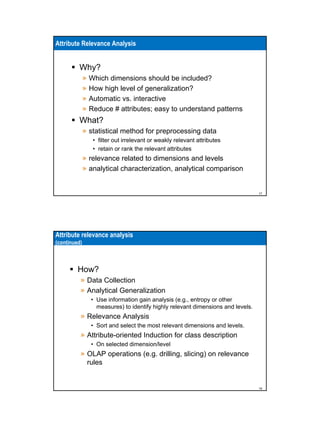
Attribute Relevance Analysis

Why?
» Which dimensions should be included?
» How high level of generalization?
» Automatic vs. interactive
» Reduce # attributes; easy to understand patterns

What?
» statistical method for preprocessing data
• filter out irrelevant or weakly relevant attributes
• retain or rank the relevant attributes

» relevance related to dimensions and levels
» analytical characterization, analytical comparison

17

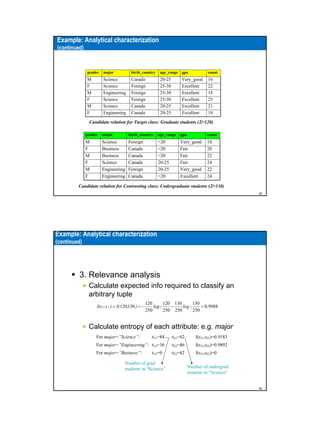
Attribute relevance analysis
(continued)

How?
» Data Collection
» Analytical Generalization
• Use information gain analysis (e.g., entropy or other
measures) to identify highly relevant dimensions and levels.

» Relevance Analysis
• Sort and select the most relevant dimensions and levels.

» Attribute-oriented Induction for class description
• On selected dimension/level

» OLAP operations (e.g. drilling, slicing) on relevance
rules

18
Relevance Measures

Quantitative relevance measure
determines the classifying power of an
attribute within a set of data.
Methods
» information gain (ID3)
» gain ratio (C4.5)
» χ2 contingency table statistics
» uncertainty coefficient

19

Information-Theoretic Approach

Decision tree
» each internal node tests an attribute
» each branch corresponds to attribute value
» each leaf node assigns a classification

ID3 algorithm
» build decision tree based on training objects with
known class labels to classify testing objects
» rank attributes with information gain measure
» minimal height
• the least number of tests to classify an object

20
Top-Down Induction of Decision Tree

Attributes = {Outlook, Temperature, Humidity, Wind}
PlayTennis = {yes, no}

Outlook
sunny
Humidity
high
no

rain

overcast

Wind

yes
normal

weak

strong
no

yes

yes

21

Entropy and Information Gain

S contains si tuples of class Ci for i = {1, …, m}
Information measures info required to classify
any arbitrary tuple
s
s
I( s ,s ,...,s ) = − ∑ log
s
s
m

1

2

m

i

2

i

i =1

Entropy of attribute A with values {a1,a2,…,av}
s1 j + ...+ smj
I ( s1 j ,...,smj )
s
j =1
v

E(A)= ∑

Information gained by branching on attribute A
Gain(A) = I(s 1, s 2 ,..., sm) − E(A)

22
Example: Analytical Characterization

Task
» Mine general characteristics describing graduate
students using analytical characterization

Given
» attributes name, gender, major, birth_place,
birth_date, phone#, and gpa
» Gen(ai) = concept hierarchies on ai
» Ui = attribute analytical thresholds for ai
» Ti = attribute generalization thresholds for ai
» R = attribute statistical relevance threshold

23

Example: Analytical Characterization
(continued)

1. Data collection
» target class: graduate student
» contrasting class: undergraduate student

2. Analytical generalization using Ui
» attribute removal

• remove name and phone#

» attribute generalization
• generalize major, birth_place, birth_date and gpa
• accumulate counts

» candidate relation: gender, major, birth_country,
age_range and gpa

24
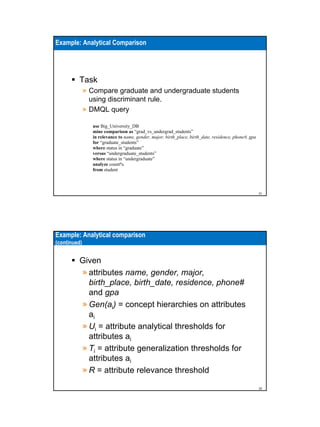
Example: Analytical characterization
(continued)

gender

major

birth_country

age_range

gpa

count

M
F
M
F
M
F

Science
Science
Engineering
Science
Science
Engineering

Canada
Foreign
Foreign
Foreign
Canada
Canada

20-25
25-30
25-30
25-30
20-25
20-25

Very_good
Excellent
Excellent
Excellent
Excellent
Excellent

16
22
18
25
21
18

Candidate relation for Target class: Graduate students (Σ=120)
gender

major

birth_country

age_range

gpa

count

M
F
M
F
M
F

Science
Business
Business
Science
Engineering
Engineering

Foreign
Canada
Canada
Canada
Foreign
Canada

<20
<20
<20
20-25
20-25
<20

Very_good
Fair
Fair
Fair
Very_good
Excellent

18
20
22
24
22
24

Candidate relation for Contrasting class: Undergraduate students (Σ=130)
25

Example: Analytical characterization
(continued)

3. Relevance analysis
» Calculate expected info required to classify an
arbitrary tuple
I(s 1, s 2 ) = I( 120,130 ) = −

120
120 130
130
log 2
−
log 2
= 0.9988
250
250 250
250

» Calculate entropy of each attribute: e.g. major
For major=”Science”:

S11=84

S21=42

I(s11,s21)=0.9183

For major=”Engineering”: S12=36

S22=46

I(s12,s22)=0.9892

For major=”Business”:

S23=42

I(s13,s23)=0

S13=0

Number of grad
students in “Science”

Number of undergrad
students in “Science”

26
Example: Analytical Characterization
(continued)

Calculate expected info required to classify a given
sample if S is partitioned according to the attribute
E(major) =

126
82
42
I ( s11, s 21 ) +
I ( s12 , s 22 ) +
I ( s13, s 23 ) = 0.7873
250
250
250

Calculate information gain for each attribute
Gain(major ) = I(s 1, s 2 ) − E(major) = 0.2115

» Information gain for all attributes
Gain(gender)

= 0.0003

Gain(birth_country)

= 0.0407

Gain(major)
Gain(gpa)

= 0.2115
= 0.4490

Gain(age_range)

= 0.5971
27

Example: Analytical characterization
(continued)

4. Initial working relation derivation
» R = 0.1
» remove irrelevant/weakly relevant attributes from candidate
relation => drop gender, birth_country
» remove contrasting class candidate relation
major
Science
Science
Science
Engineering
Engineering

age_range
20-25
25-30
20-25
20-25
25-30

gpa
Very_good
Excellent
Excellent
Excellent
Excellent

count
16
47
21
18
18

Initial target class working relation: Graduate students

5. Perform attribute-oriented induction
28
Concept Description: Characterization and Comparison

What is Concept Description?
Data generalization and summarizationbased characterization
Analytical characterization: Analysis of
attribute relevance
Mining class comparisons: Discriminating
between different classes
Mining descriptive statistical measures in
large databases

29

Mining Class Comparisons

Comparison: Comparing two or more classes.
Method:

» Partition the set of relevant data into the target class
and the contrasting class(es)
» Generalize both classes to the same high level
concepts
» Compare tuples with the same high level descriptions
» Present for every tuple its description and two
measures:
• support - distribution within single class
• comparison - distribution between classes
» Highlight the tuples with strong discriminant features

Relevance Analysis:

» Find attributes (features) which best distinguish different
classes.
30
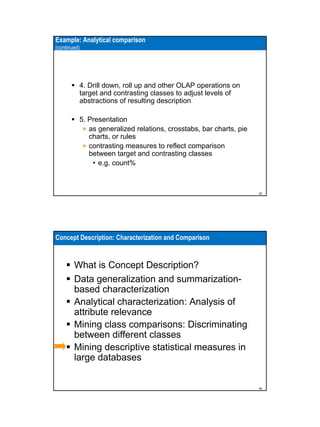
Example: Analytical Comparison

Task
» Compare graduate and undergraduate students
using discriminant rule.
» DMQL query
use Big_University_DB
mine comparison as “grad_vs_undergrad_students”
in relevance to name, gender, major, birth_place, birth_date, residence, phone#, gpa
for “graduate_students”
where status in “graduate”
versus “undergraduate_students”
where status in “undergraduate”
analyze count%
from student

31

Example: Analytical comparison
(continued)

Given
» attributes name, gender, major,
birth_place, birth_date, residence, phone#
and gpa
» Gen(ai) = concept hierarchies on attributes
ai
» Ui = attribute analytical thresholds for
attributes ai
» Ti = attribute generalization thresholds for
attributes ai
» R = attribute relevance threshold
32
Example: Analytical comparison
(continued)

1. Data collection
» target and contrasting classes

2. Attribute relevance analysis
» remove attributes name, gender, major, phone#

3. Synchronous generalization
» controlled by user-specified dimension thresholds
» prime target and contrasting class(es)
relations/cuboids
33

Example: Analytical comparison
(continued)

Birth_country
Canada
Canada
Canada
…
Other

Age_range
20-25
25-30
Over_30
…
Over_30

Gpa
Good
Good
Very_good
…
Excellent

Count%
5.53%
2.32%
5.86%
…
4.68%

Prime generalized relation for the target class: Graduate students

Birth_country
Canada
Canada
…
Canada
…
Other

Age_range
15-20
15-20
…
25-30
…
Over_30

Gpa
Fair
Good
…
Good
…
Excellent

Count%
5.53%
4.53%
…
5.02%
…
0.68%

Prime generalized relation for the contrasting class: Undergraduate students
34
Example: Analytical comparison
(continued)

4. Drill down, roll up and other OLAP operations on
target and contrasting classes to adjust levels of
abstractions of resulting description
5. Presentation
» as generalized relations, crosstabs, bar charts, pie
charts, or rules
» contrasting measures to reflect comparison
between target and contrasting classes
• e.g. count%

35

Concept Description: Characterization and Comparison

What is Concept Description?
Data generalization and summarizationbased characterization
Analytical characterization: Analysis of
attribute relevance
Mining class comparisons: Discriminating
between different classes
Mining descriptive statistical measures in
large databases

36
Mining Data Dispersion Characteristics
Motivation
» To better understand the data: central tendency, variation and
spread

Data dispersion characteristics
» median, max, min, quantiles, outliers, variance, etc.

Numerical dimensions correspond to sorted intervals
» Data dispersion: analyzed with multiple granularities of
precision
» Boxplot or quantile analysis on sorted intervals

Dispersion analysis on computed measures
» Folding measures into numerical dimensions
» Boxplot or quantile analysis on the transformed cube

37

Measuring the Central Tendency

Mean

x =

1
n

n

∑

i =1

xi

n

» Weighted arithmetic mean

Median: A holistic measure

x =

∑

i=1
n

∑

i =1

wixi
wi

» Middle value if odd number of values, or average of the
middle two values otherwise
» estimated by interpolation

median = L1 + (

n / 2 − (∑ f )l
f median

)c

Mode
» Value that occurs most frequently in the data
» Unimodal, bimodal, trimodal
» Empirical formula:

mean − mode = 3 × (mean − median)
38
Measuring the Dispersion of Data

Quartiles, outliers and boxplots
» Quartiles: Q1 (25th percentile), Q3 (75th percentile)
» Inter-quartile range: IQR = Q3 – Q1
» Five number summary: min, Q1, M, Q3, max
» Boxplot: ends of the box are the quartiles, median is marked,
whiskers, and plot outlier individually
» Outlier: usually, a value higher/lower than 1.5 x IQR

Variance and standard deviation
» Variance s2: (algebraic, scalable computation)
» Standard deviation s is the square root of variance s2
s

2

=

1
n − 1

n

∑

i=1

(x

i

− x )

2

=

n
1
[∑ x
n − 1 i=1

2
i

−

n
1
(∑ xi)
n
i=1

2

]

39

Boxplot Analysis

Five-number summary of a distribution:
Minimum, Q1, M, Q3, Maximum
Boxplot
» Data is represented with a box
» The ends of the box are at the first and
third quartiles, i.e., the height of the box is
IRQ
» The median is marked by a line within the
box
» Whiskers: two lines outside the box extend
to Minimum and Maximum
40
A Boxplot

41

Agenda
1
1

Session Overview
Session Overview

2
2

Characterization
Characterization

3
3

Summary and Conclusion

42
Summary

Concept description: characterization and
discrimination
OLAP-based vs. attribute-oriented induction
Efficient implementation of AOI
Analytical characterization and comparison
Mining descriptive statistical measures in large
databases
Discussion
» Incremental and parallel mining of description
» Descriptive mining of complex types of data
43

References
Y. Cai, N. Cercone, and J. Han. Attribute-oriented induction in relational
databases. In G. Piatetsky-Shapiro and W. J. Frawley, editors, Knowledge
Discovery in Databases, pages 213-228. AAAI/MIT Press, 1991.
S. Chaudhuri and U. Dayal. An overview of data warehousing and OLAP
technology. ACM SIGMOD Record, 26:65-74, 1997
C. Carter and H. Hamilton. Efficient attribute-oriented generalization for
knowledge discovery from large databases. IEEE Trans. Knowledge and
Data Engineering, 10:193-208, 1998.
W. Cleveland. Visualizing Data. Hobart Press, Summit NJ, 1993.
J. L. Devore. Probability and Statistics for Engineering and the Science, 4th
ed. Duxbury Press, 1995.
T. G. Dietterich and R. S. Michalski. A comparative review of selected
methods for learning from examples. In Michalski et al., editor, Machine
Learning: An Artificial Intelligence Approach, Vol. 1, pages 41-82. Morgan
Kaufmann, 1983.
J. Gray, S. Chaudhuri, A. Bosworth, A. Layman, D. Reichart, M. Venkatrao,
F. Pellow, and H. Pirahesh. Data cube: A relational aggregation operator
generalizing group-by, cross-tab and sub-totals. Data Mining and
Knowledge Discovery, 1:29-54, 1997.
J. Han, Y. Cai, and N. Cercone. Data-driven discovery of quantitative rules
in relational databases. IEEE Trans. Knowledge and Data Engineering,
5:29-40, 1993.
44
References
(continued)
J. Han and Y. Fu. Exploration of the power of attribute-oriented induction in
data mining. In U.M. Fayyad, G. Piatetsky-Shapiro, P. Smyth, and R.
Uthurusamy, editors, Advances in Knowledge Discovery and Data Mining,
pages 399-421. AAAI/MIT Press, 1996.
R. A. Johnson and D. A. Wichern. Applied Multivariate Statistical Analysis,
3rd ed. Prentice Hall, 1992.
E. Knorr and R. Ng. Algorithms for mining distance-based outliers in large
datasets. VLDB'98, New York, NY, Aug. 1998.
H. Liu and H. Motoda. Feature Selection for Knowledge Discovery and Data
Mining. Kluwer Academic Publishers, 1998.
R. S. Michalski. A theory and methodology of inductive learning. In
Michalski et al., editor, Machine Learning: An Artificial Intelligence
Approach, Vol. 1, Morgan Kaufmann, 1983.
T. M. Mitchell. Version spaces: A candidate elimination approach to rule
learning. IJCAI'97, Cambridge, MA.
T. M. Mitchell. Generalization as search. Artificial Intelligence, 18:203-226,
1982.
T. M. Mitchell. Machine Learning. McGraw Hill, 1997.
J. R. Quinlan. Induction of decision trees. Machine Learning, 1:81-106,
1986.
D. Subramanian and J. Feigenbaum. Factorization in experiment
generation. AAAI'86, Philadelphia, PA, Aug. 1986.

45

Assignments & Readings
Readings
» Chapter 3

Individual Project #1
» Due March 11 2010

46
Next Session: Mining Frequent Patterns, Association, and Correlations

47

Characterization

  • 1.
    Data Mining Session 5– Main Theme Characterization Dr. Jean-Claude Franchitti New York University Computer Science Department Courant Institute of Mathematical Sciences Adapted from course textbook resources Data Mining Concepts and Techniques (2nd Edition) Jiawei Han and Micheline Kamber 1 Agenda 1 1 Session Overview Session Overview 2 2 Characterization Characterization 3 3 Summary and Conclusion Summary and Conclusion 2
  • 2.
    Characterization in Brief Whatis Concept Description? Data generalization and summarizationbased characterization Analytical characterization: Analysis of attribute relevance Mining class comparisons: Discriminating between different classes Mining descriptive statistical measures in large databases 3 Icons / Metaphors Information Common Realization Knowledge/Competency Pattern Governance Alignment Solution Approach 44
  • 3.
    Agenda 1 1 Session Overview Session Overview 2 2 Characterization Characterization 3 3 Summaryand Conclusion Summary and Conclusion 5 Concept Description: Characterization and Comparison What is Concept Description? Data generalization and summarizationbased characterization Analytical characterization: Analysis of attribute relevance Mining class comparisons: Discriminating between different classes Mining descriptive statistical measures in large databases 6
  • 4.
    What is ConceptDescription? Descriptive vs. predictive data mining » Descriptive mining: describes concepts or taskrelevant data sets in concise, summarative, informative, discriminative forms » Predictive mining: Based on data and analysis, constructs models for the database, and predicts the trend and properties of unknown data Concept description: » Characterization: provides a concise and succinct summarization of the given collection of data » Comparison: provides descriptions comparing two or more collections of data 7 Concept Description: Characterization and Comparison What is Concept Description? Data generalization and summarizationbased characterization Analytical characterization: Analysis of attribute relevance Mining class comparisons: Discriminating between different classes Mining descriptive statistical measures in large databases 8
  • 5.
    Data Generalization andSummarization-based Characterization Data generalization » A process which abstracts a large set of task-relevant data in a database from a low conceptual levels to higher ones. 1 2 3 4 5 Conceptual levels Approaches: •Data cube approach(OLAP approach) •Attribute-oriented induction approach 9 Characterization: Data Cube Approach Perform computations and store results in data cubes Strength » An efficient implementation of data generalization » Computation of various kinds of measures • e.g., count( ), sum( ), average( ), max( ) » Generalization and specialization can be performed on a data cube by roll-up and drill-down Limitations » handle only dimensions of simple nonnumeric data and measures of simple aggregated numeric values. » Lack of intelligent analysis, can’t tell which dimensions should be used and what levels should the generalization reach 10
  • 6.
    Attribute-Oriented Induction Proposed in1989 (KDD ‘89 workshop) Not confined to categorical data nor particular measures. How it is done? » Collect the task-relevant data( initial relation) using a relational database query » Perform generalization by attribute removal or attribute generalization. » Apply aggregation by merging identical, generalized tuples and accumulating their respective counts. » Interactive presentation with users. 11 Basic Principles of Attribute-Oriented Induction Data focusing: task-relevant data, including dimensions, and the result is the initial relation. Attribute-removal: remove attribute A if there is a large set of distinct values for A but (1) there is no generalization operator on A, or (2) A’s higher level concepts are expressed in terms of other attributes. Attribute-generalization: If there is a large set of distinct values for A, and there exists a set of generalization operators on A, then select an operator and generalize A. Attribute-threshold control: typical 2-8, specified/default. Generalized relation threshold control: control the final relation/rule size. 12
  • 7.
    Example Describe general characteristicsof graduate students in the Big-University database use Big_University_DB mine characteristics as “Science_Students” in relevance to name, gender, major, birth_place, birth_date, residence, phone#, gpa from student where status in “graduate” Corresponding SQL statement: Select name, gender, major, birth_place, birth_date, residence, phone#, gpa from student where status in {“Msc”, “MBA”, “PhD” } 13 Class Characterization: An Example Name Gender Jim Initial Woodman Relation Scott M Major M F … Removed Retained Sci,Eng, Bus Gender Major M F … Birth_date Vancouver,BC, 8-12-76 Canada CS Montreal, Que, 28-7-75 Canada Physics Seattle, WA, USA 25-8-70 … … … Lachance Laura Lee … Prime Generalized Relation Birth-Place CS Science Science … Country Age range Residence Phone # GPA 3511 Main St., Richmond 345 1st Ave., Richmond 687-4598 3.67 253-9106 3.70 125 Austin Ave., Burnaby … 420-5232 … 3.83 … City Removed Excl, VG,.. Birth_region Age_range Residence GPA Canada Foreign … 20-25 25-30 … Richmond Burnaby … Very-good Excellent … Count 16 22 … Birth_Region Canada Foreign Total Gender M 16 14 30 F 10 22 32 Total 26 36 62 14
  • 8.
    Concept Description: Characterizationand Comparison What is Concept Description? Data generalization and summarizationbased characterization Analytical characterization: Analysis of attribute relevance Mining class comparisons: Discriminating between different classes Mining descriptive statistical measures in large databases 15 Characterization vs. OLAP Similarity: » Presentation of data summarization at multiple levels of abstraction. » Interactive drilling, pivoting, slicing and dicing. Differences: » Automated desired level allocation. » Dimension relevance analysis and ranking when there are many relevant dimensions. » Sophisticated typing on dimensions and measures. » Analytical characterization: data dispersion analysis. 16
  • 9.
    Attribute Relevance Analysis Why? »Which dimensions should be included? » How high level of generalization? » Automatic vs. interactive » Reduce # attributes; easy to understand patterns What? » statistical method for preprocessing data • filter out irrelevant or weakly relevant attributes • retain or rank the relevant attributes » relevance related to dimensions and levels » analytical characterization, analytical comparison 17 Attribute relevance analysis (continued) How? » Data Collection » Analytical Generalization • Use information gain analysis (e.g., entropy or other measures) to identify highly relevant dimensions and levels. » Relevance Analysis • Sort and select the most relevant dimensions and levels. » Attribute-oriented Induction for class description • On selected dimension/level » OLAP operations (e.g. drilling, slicing) on relevance rules 18
  • 10.
    Relevance Measures Quantitative relevancemeasure determines the classifying power of an attribute within a set of data. Methods » information gain (ID3) » gain ratio (C4.5) » χ2 contingency table statistics » uncertainty coefficient 19 Information-Theoretic Approach Decision tree » each internal node tests an attribute » each branch corresponds to attribute value » each leaf node assigns a classification ID3 algorithm » build decision tree based on training objects with known class labels to classify testing objects » rank attributes with information gain measure » minimal height • the least number of tests to classify an object 20
  • 11.
    Top-Down Induction ofDecision Tree Attributes = {Outlook, Temperature, Humidity, Wind} PlayTennis = {yes, no} Outlook sunny Humidity high no rain overcast Wind yes normal weak strong no yes yes 21 Entropy and Information Gain S contains si tuples of class Ci for i = {1, …, m} Information measures info required to classify any arbitrary tuple s s I( s ,s ,...,s ) = − ∑ log s s m 1 2 m i 2 i i =1 Entropy of attribute A with values {a1,a2,…,av} s1 j + ...+ smj I ( s1 j ,...,smj ) s j =1 v E(A)= ∑ Information gained by branching on attribute A Gain(A) = I(s 1, s 2 ,..., sm) − E(A) 22
  • 12.
    Example: Analytical Characterization Task »Mine general characteristics describing graduate students using analytical characterization Given » attributes name, gender, major, birth_place, birth_date, phone#, and gpa » Gen(ai) = concept hierarchies on ai » Ui = attribute analytical thresholds for ai » Ti = attribute generalization thresholds for ai » R = attribute statistical relevance threshold 23 Example: Analytical Characterization (continued) 1. Data collection » target class: graduate student » contrasting class: undergraduate student 2. Analytical generalization using Ui » attribute removal • remove name and phone# » attribute generalization • generalize major, birth_place, birth_date and gpa • accumulate counts » candidate relation: gender, major, birth_country, age_range and gpa 24
  • 13.
    Example: Analytical characterization (continued) gender major birth_country age_range gpa count M F M F M F Science Science Engineering Science Science Engineering Canada Foreign Foreign Foreign Canada Canada 20-25 25-30 25-30 25-30 20-25 20-25 Very_good Excellent Excellent Excellent Excellent Excellent 16 22 18 25 21 18 Candidaterelation for Target class: Graduate students (Σ=120) gender major birth_country age_range gpa count M F M F M F Science Business Business Science Engineering Engineering Foreign Canada Canada Canada Foreign Canada <20 <20 <20 20-25 20-25 <20 Very_good Fair Fair Fair Very_good Excellent 18 20 22 24 22 24 Candidate relation for Contrasting class: Undergraduate students (Σ=130) 25 Example: Analytical characterization (continued) 3. Relevance analysis » Calculate expected info required to classify an arbitrary tuple I(s 1, s 2 ) = I( 120,130 ) = − 120 120 130 130 log 2 − log 2 = 0.9988 250 250 250 250 » Calculate entropy of each attribute: e.g. major For major=”Science”: S11=84 S21=42 I(s11,s21)=0.9183 For major=”Engineering”: S12=36 S22=46 I(s12,s22)=0.9892 For major=”Business”: S23=42 I(s13,s23)=0 S13=0 Number of grad students in “Science” Number of undergrad students in “Science” 26
  • 14.
    Example: Analytical Characterization (continued) Calculateexpected info required to classify a given sample if S is partitioned according to the attribute E(major) = 126 82 42 I ( s11, s 21 ) + I ( s12 , s 22 ) + I ( s13, s 23 ) = 0.7873 250 250 250 Calculate information gain for each attribute Gain(major ) = I(s 1, s 2 ) − E(major) = 0.2115 » Information gain for all attributes Gain(gender) = 0.0003 Gain(birth_country) = 0.0407 Gain(major) Gain(gpa) = 0.2115 = 0.4490 Gain(age_range) = 0.5971 27 Example: Analytical characterization (continued) 4. Initial working relation derivation » R = 0.1 » remove irrelevant/weakly relevant attributes from candidate relation => drop gender, birth_country » remove contrasting class candidate relation major Science Science Science Engineering Engineering age_range 20-25 25-30 20-25 20-25 25-30 gpa Very_good Excellent Excellent Excellent Excellent count 16 47 21 18 18 Initial target class working relation: Graduate students 5. Perform attribute-oriented induction 28
  • 15.
    Concept Description: Characterizationand Comparison What is Concept Description? Data generalization and summarizationbased characterization Analytical characterization: Analysis of attribute relevance Mining class comparisons: Discriminating between different classes Mining descriptive statistical measures in large databases 29 Mining Class Comparisons Comparison: Comparing two or more classes. Method: » Partition the set of relevant data into the target class and the contrasting class(es) » Generalize both classes to the same high level concepts » Compare tuples with the same high level descriptions » Present for every tuple its description and two measures: • support - distribution within single class • comparison - distribution between classes » Highlight the tuples with strong discriminant features Relevance Analysis: » Find attributes (features) which best distinguish different classes. 30
  • 16.
    Example: Analytical Comparison Task »Compare graduate and undergraduate students using discriminant rule. » DMQL query use Big_University_DB mine comparison as “grad_vs_undergrad_students” in relevance to name, gender, major, birth_place, birth_date, residence, phone#, gpa for “graduate_students” where status in “graduate” versus “undergraduate_students” where status in “undergraduate” analyze count% from student 31 Example: Analytical comparison (continued) Given » attributes name, gender, major, birth_place, birth_date, residence, phone# and gpa » Gen(ai) = concept hierarchies on attributes ai » Ui = attribute analytical thresholds for attributes ai » Ti = attribute generalization thresholds for attributes ai » R = attribute relevance threshold 32
  • 17.
    Example: Analytical comparison (continued) 1.Data collection » target and contrasting classes 2. Attribute relevance analysis » remove attributes name, gender, major, phone# 3. Synchronous generalization » controlled by user-specified dimension thresholds » prime target and contrasting class(es) relations/cuboids 33 Example: Analytical comparison (continued) Birth_country Canada Canada Canada … Other Age_range 20-25 25-30 Over_30 … Over_30 Gpa Good Good Very_good … Excellent Count% 5.53% 2.32% 5.86% … 4.68% Prime generalized relation for the target class: Graduate students Birth_country Canada Canada … Canada … Other Age_range 15-20 15-20 … 25-30 … Over_30 Gpa Fair Good … Good … Excellent Count% 5.53% 4.53% … 5.02% … 0.68% Prime generalized relation for the contrasting class: Undergraduate students 34
  • 18.
    Example: Analytical comparison (continued) 4.Drill down, roll up and other OLAP operations on target and contrasting classes to adjust levels of abstractions of resulting description 5. Presentation » as generalized relations, crosstabs, bar charts, pie charts, or rules » contrasting measures to reflect comparison between target and contrasting classes • e.g. count% 35 Concept Description: Characterization and Comparison What is Concept Description? Data generalization and summarizationbased characterization Analytical characterization: Analysis of attribute relevance Mining class comparisons: Discriminating between different classes Mining descriptive statistical measures in large databases 36
  • 19.
    Mining Data DispersionCharacteristics Motivation » To better understand the data: central tendency, variation and spread Data dispersion characteristics » median, max, min, quantiles, outliers, variance, etc. Numerical dimensions correspond to sorted intervals » Data dispersion: analyzed with multiple granularities of precision » Boxplot or quantile analysis on sorted intervals Dispersion analysis on computed measures » Folding measures into numerical dimensions » Boxplot or quantile analysis on the transformed cube 37 Measuring the Central Tendency Mean x = 1 n n ∑ i =1 xi n » Weighted arithmetic mean Median: A holistic measure x = ∑ i=1 n ∑ i =1 wixi wi » Middle value if odd number of values, or average of the middle two values otherwise » estimated by interpolation median = L1 + ( n / 2 − (∑ f )l f median )c Mode » Value that occurs most frequently in the data » Unimodal, bimodal, trimodal » Empirical formula: mean − mode = 3 × (mean − median) 38
  • 20.
    Measuring the Dispersionof Data Quartiles, outliers and boxplots » Quartiles: Q1 (25th percentile), Q3 (75th percentile) » Inter-quartile range: IQR = Q3 – Q1 » Five number summary: min, Q1, M, Q3, max » Boxplot: ends of the box are the quartiles, median is marked, whiskers, and plot outlier individually » Outlier: usually, a value higher/lower than 1.5 x IQR Variance and standard deviation » Variance s2: (algebraic, scalable computation) » Standard deviation s is the square root of variance s2 s 2 = 1 n − 1 n ∑ i=1 (x i − x ) 2 = n 1 [∑ x n − 1 i=1 2 i − n 1 (∑ xi) n i=1 2 ] 39 Boxplot Analysis Five-number summary of a distribution: Minimum, Q1, M, Q3, Maximum Boxplot » Data is represented with a box » The ends of the box are at the first and third quartiles, i.e., the height of the box is IRQ » The median is marked by a line within the box » Whiskers: two lines outside the box extend to Minimum and Maximum 40
  • 21.
    A Boxplot 41 Agenda 1 1 Session Overview SessionOverview 2 2 Characterization Characterization 3 3 Summary and Conclusion Summary and Conclusion 42
  • 22.
    Summary Concept description: characterizationand discrimination OLAP-based vs. attribute-oriented induction Efficient implementation of AOI Analytical characterization and comparison Mining descriptive statistical measures in large databases Discussion » Incremental and parallel mining of description » Descriptive mining of complex types of data 43 References Y. Cai, N. Cercone, and J. Han. Attribute-oriented induction in relational databases. In G. Piatetsky-Shapiro and W. J. Frawley, editors, Knowledge Discovery in Databases, pages 213-228. AAAI/MIT Press, 1991. S. Chaudhuri and U. Dayal. An overview of data warehousing and OLAP technology. ACM SIGMOD Record, 26:65-74, 1997 C. Carter and H. Hamilton. Efficient attribute-oriented generalization for knowledge discovery from large databases. IEEE Trans. Knowledge and Data Engineering, 10:193-208, 1998. W. Cleveland. Visualizing Data. Hobart Press, Summit NJ, 1993. J. L. Devore. Probability and Statistics for Engineering and the Science, 4th ed. Duxbury Press, 1995. T. G. Dietterich and R. S. Michalski. A comparative review of selected methods for learning from examples. In Michalski et al., editor, Machine Learning: An Artificial Intelligence Approach, Vol. 1, pages 41-82. Morgan Kaufmann, 1983. J. Gray, S. Chaudhuri, A. Bosworth, A. Layman, D. Reichart, M. Venkatrao, F. Pellow, and H. Pirahesh. Data cube: A relational aggregation operator generalizing group-by, cross-tab and sub-totals. Data Mining and Knowledge Discovery, 1:29-54, 1997. J. Han, Y. Cai, and N. Cercone. Data-driven discovery of quantitative rules in relational databases. IEEE Trans. Knowledge and Data Engineering, 5:29-40, 1993. 44
  • 23.
    References (continued) J. Han andY. Fu. Exploration of the power of attribute-oriented induction in data mining. In U.M. Fayyad, G. Piatetsky-Shapiro, P. Smyth, and R. Uthurusamy, editors, Advances in Knowledge Discovery and Data Mining, pages 399-421. AAAI/MIT Press, 1996. R. A. Johnson and D. A. Wichern. Applied Multivariate Statistical Analysis, 3rd ed. Prentice Hall, 1992. E. Knorr and R. Ng. Algorithms for mining distance-based outliers in large datasets. VLDB'98, New York, NY, Aug. 1998. H. Liu and H. Motoda. Feature Selection for Knowledge Discovery and Data Mining. Kluwer Academic Publishers, 1998. R. S. Michalski. A theory and methodology of inductive learning. In Michalski et al., editor, Machine Learning: An Artificial Intelligence Approach, Vol. 1, Morgan Kaufmann, 1983. T. M. Mitchell. Version spaces: A candidate elimination approach to rule learning. IJCAI'97, Cambridge, MA. T. M. Mitchell. Generalization as search. Artificial Intelligence, 18:203-226, 1982. T. M. Mitchell. Machine Learning. McGraw Hill, 1997. J. R. Quinlan. Induction of decision trees. Machine Learning, 1:81-106, 1986. D. Subramanian and J. Feigenbaum. Factorization in experiment generation. AAAI'86, Philadelphia, PA, Aug. 1986. 45 Assignments & Readings Readings » Chapter 3 Individual Project #1 » Due March 11 2010 46
  • 24.
    Next Session: MiningFrequent Patterns, Association, and Correlations 47