DISCOVER . LEARN.
EMPOWER
Concept Description
UNIVERSITY INSTITUTE OF ENGINEERING
DEPARTMENT OF COMPUTER SCIENCE AND
ENGG.
Master of Engineering
Business Intelligence and Mining
By: Ravinder Saini (E6199)
1
2.
Chapter 5: ConceptDescription:
Characterization and Comparison
• What is concept description?
• Data generalization and summarization-based characterization
• Analytical characterization: Analysis of attribute relevance
• Mining class comparisons: Discriminating between different classes
• Summary
August 26, 2025 Data Mining: Concepts and Techniques 2
3.
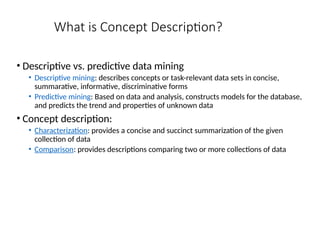
What is ConceptDescription?
• Descriptive vs. predictive data mining
• Descriptive mining: describes concepts or task-relevant data sets in concise,
summarative, informative, discriminative forms
• Predictive mining: Based on data and analysis, constructs models for the database,
and predicts the trend and properties of unknown data
• Concept description:
• Characterization: provides a concise and succinct summarization of the given
collection of data
• Comparison: provides descriptions comparing two or more collections of data
4.
Concept Description
• Whatis concept description?
• Data generalization and summarization-based characterization
• Analytical characterization: Analysis of attribute relevance
• Mining class comparisons: Discriminating between different classes
• Summary
August 26, 2025 Data Mining: Concepts and Techniques 4
5.
Data Generalization andSummarization-
based Characterization
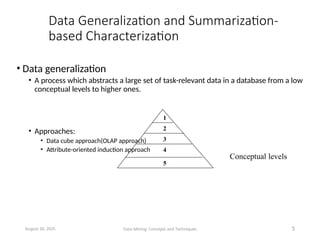
• Data generalization
• A process which abstracts a large set of task-relevant data in a database from a low
conceptual levels to higher ones.
• Approaches:
• Data cube approach(OLAP approach)
• Attribute-oriented induction approach
August 26, 2025 Data Mining: Concepts and Techniques 5
1
2
3
4
5
Conceptual levels
6.
Characterization: Data CubeApproach
(without using AO-Induction)
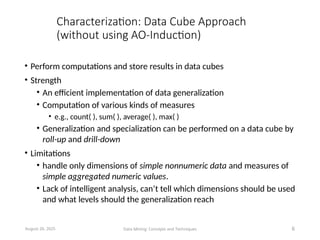
• Perform computations and store results in data cubes
• Strength
• An efficient implementation of data generalization
• Computation of various kinds of measures
• e.g., count( ), sum( ), average( ), max( )
• Generalization and specialization can be performed on a data cube by
roll-up and drill-down
• Limitations
• handle only dimensions of simple nonnumeric data and measures of
simple aggregated numeric values.
• Lack of intelligent analysis, can’t tell which dimensions should be used
and what levels should the generalization reach
August 26, 2025 Data Mining: Concepts and Techniques 6
7.
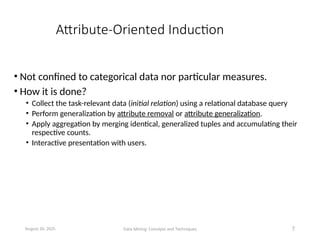
Attribute-Oriented Induction
• Notconfined to categorical data nor particular measures.
• How it is done?
• Collect the task-relevant data (initial relation) using a relational database query
• Perform generalization by attribute removal or attribute generalization.
• Apply aggregation by merging identical, generalized tuples and accumulating their
respective counts.
• Interactive presentation with users.
August 26, 2025 Data Mining: Concepts and Techniques 7
8.
Basic Principles ofAttribute-Oriented
Induction
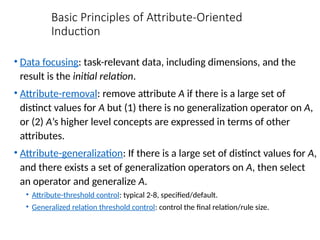
• Data focusing: task-relevant data, including dimensions, and the
result is the initial relation.
• Attribute-removal: remove attribute A if there is a large set of
distinct values for A but (1) there is no generalization operator on A,
or (2) A’s higher level concepts are expressed in terms of other
attributes.
• Attribute-generalization: If there is a large set of distinct values for A,
and there exists a set of generalization operators on A, then select
an operator and generalize A.
• Attribute-threshold control: typical 2-8, specified/default.
• Generalized relation threshold control: control the final relation/rule size.
9.
Basic Algorithm forAttribute-Oriented Induction
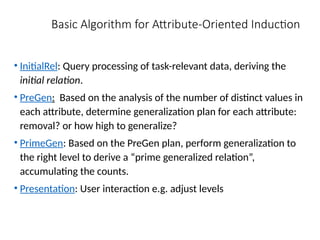
• InitialRel: Query processing of task-relevant data, deriving the
initial relation.
• PreGen: Based on the analysis of the number of distinct values in
each attribute, determine generalization plan for each attribute:
removal? or how high to generalize?
• PrimeGen: Based on the PreGen plan, perform generalization to
the right level to derive a “prime generalized relation”,
accumulating the counts.
• Presentation: User interaction e.g. adjust levels
10.
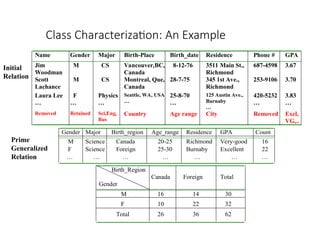
Class Characterization: AnExample
Name Gender Major Birth-Place Birth_date Residence Phone # GPA
Jim
Woodman
M CS Vancouver,BC,
Canada
8-12-76 3511 Main St.,
Richmond
687-4598 3.67
Scott
Lachance
M CS Montreal, Que,
Canada
28-7-75 345 1st Ave.,
Richmond
253-9106 3.70
Laura Lee
…
F
…
Physics
…
Seattle, WA, USA
…
25-8-70
…
125 Austin Ave.,
Burnaby
…
420-5232
…
3.83
…
Removed Retained Sci,Eng,
Bus
Country Age range City Removed Excl,
VG,..
Gender Major Birth_region Age_range Residence GPA Count
M Science Canada 20-25 Richmond Very-good 16
F Science Foreign 25-30 Burnaby Excellent 22
… … … … … … …
Birth_Region
Gender
Canada Foreign Total
M 16 14 30
F 10 22 32
Total 26 36 62
Prime
Generalized
Relation
Initial
Relation
11.
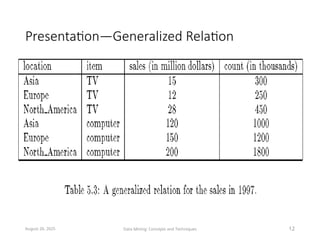
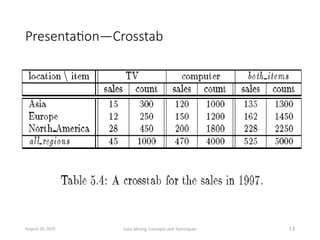
Presentation of GeneralizedResults
• Generalized relation:
• Relations where some or all attributes are generalized, with counts or other
aggregation values accumulated.
• Cross tabulation:
• Mapping results into cross tabulation form (similar to contingency tables).
• Visualization techniques:
• Pie charts, bar charts, curves, cubes, and other visual forms.
• Quantitative characteristic rules:
• Mapping generalized result into characteristic rules with quantitative
information associated with it, e.g.,
.
%]
58
:
[
"
"
)
(
_
%]
42
:
[
"
"
)
(
_
)
(
)
(
t
foreign
x
region
birth
t
Canada
x
region
birth
x
male
x
grad
Concept Description
• Whatis concept description?
• Data generalization and summarization-based characterization
• Analytical characterization: Analysis of attribute relevance
• Mining class comparisons: Discriminating between different classes
• Summary
August 26, 2025 Data Mining: Concepts and Techniques 14
15.
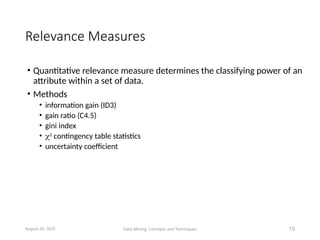
Relevance Measures
• Quantitativerelevance measure determines the classifying power of an
attribute within a set of data.
• Methods
• information gain (ID3)
• gain ratio (C4.5)
• gini index
• 2
contingency table statistics
• uncertainty coefficient
August 26, 2025 Data Mining: Concepts and Techniques 15
16.
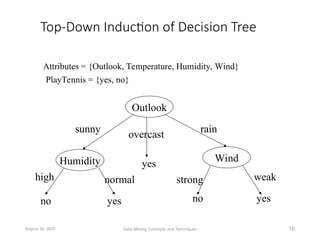
Top-Down Induction ofDecision Tree
August 26, 2025 Data Mining: Concepts and Techniques 16
Attributes = {Outlook, Temperature, Humidity, Wind}
Outlook
Humidity Wind
sunny rain
overcast
yes
no yes
high normal
no
strong weak
yes
PlayTennis = {yes, no}
17.
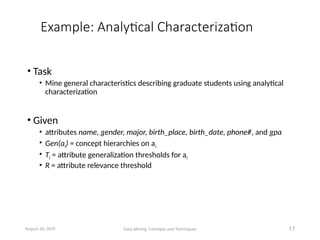
Example: Analytical Characterization
•Task
• Mine general characteristics describing graduate students using analytical
characterization
• Given
• attributes name, gender, major, birth_place, birth_date, phone#, and gpa
• Gen(ai) = concept hierarchies on ai
• Ti = attribute generalization thresholds for ai
• R = attribute relevance threshold
August 26, 2025 Data Mining: Concepts and Techniques 17
18.
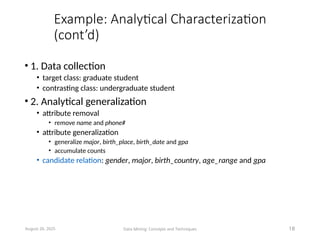
Example: Analytical Characterization
(cont’d)
•1. Data collection
• target class: graduate student
• contrasting class: undergraduate student
• 2. Analytical generalization
• attribute removal
• remove name and phone#
• attribute generalization
• generalize major, birth_place, birth_date and gpa
• accumulate counts
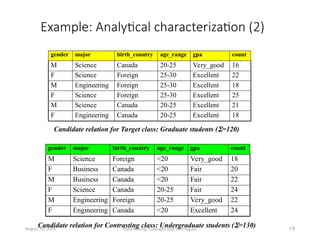
• candidate relation: gender, major, birth_country, age_range and gpa
August 26, 2025 Data Mining: Concepts and Techniques 18
19.
Example: Analytical characterization(2)
August 26, 2025 Data Mining: Concepts and Techniques 19
gender major birth_country age_range gpa count
M Science Canada 20-25 Very_good 16
F Science Foreign 25-30 Excellent 22
M Engineering Foreign 25-30 Excellent 18
F Science Foreign 25-30 Excellent 25
M Science Canada 20-25 Excellent 21
F Engineering Canada 20-25 Excellent 18
Candidate relation for Target class: Graduate students (=120)
gender major birth_country age_range gpa count
M Science Foreign <20 Very_good 18
F Business Canada <20 Fair 20
M Business Canada <20 Fair 22
F Science Canada 20-25 Fair 24
M Engineering Foreign 20-25 Very_good 22
F Engineering Canada <20 Excellent 24
Candidate relation for Contrasting class: Undergraduate students (=130)
20.
Example: Analytical characterization(3)
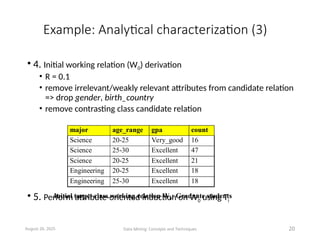
• 4. Initial working relation (W0) derivation
• R = 0.1
• remove irrelevant/weakly relevant attributes from candidate relation
=> drop gender, birth_country
• remove contrasting class candidate relation
• 5. Perform attribute-oriented induction on W0 using Ti
August 26, 2025 Data Mining: Concepts and Techniques 20
major age_range gpa count
Science 20-25 Very_good 16
Science 25-30 Excellent 47
Science 20-25 Excellent 21
Engineering 20-25 Excellent 18
Engineering 25-30 Excellent 18
Initial target class working relation W0: Graduate students
21.
Quantitative Discriminant Rules
•Cj = target class
• qa = a generalized tuple covers some tuples of class
• but can also cover some tuples of contrasting class
• d-weight
• range: [0, 1]
• quantitative discriminant rule form
August 26, 2025 Data Mining: Concepts and Techniques 21
m
i
i
a
j
a
)
C
count(q
)
C
count(q
weight
d
1
d_weight]
:
[d
X)
condition(
ss(X)
target_cla
X,
22.
Example: Quantitative DiscriminantRule
• Quantitative discriminant rule
• where 90/(90+210) = 30%
August 26, 2025 Data Mining: Concepts and Techniques 22
Status Birth_country Age_range Gpa Count
Graduate Canada 25-30 Good 90
Undergraduate Canada 25-30 Good 210
Count distribution between graduate and undergraduate students for a generalized tuple
%]
30
:
[
"
"
)
(
"
30
25
"
)
(
_
"
"
)
(
_
)
(
_
,
d
good
X
gpa
X
range
age
Canada
X
country
birth
X
student
graduate
X
23.
Class Description
• Quantitativecharacteristic rule
• necessary
• Quantitative discriminant rule
• sufficient
• Quantitative description rule
• necessary and sufficient
August 26, 2025 Data Mining: Concepts and Techniques 23
]
w
:
d
,
w
:
[t
...
]
w
:
d
,
w
:
[t n
n
1
1
1
(X)
condition
(X)
condition
ss(X)
target_cla
X,
n
d_weight]
:
[d
X)
condition(
ss(X)
target_cla
X,
t_weight]
:
[t
X)
condition(
ss(X)
target_cla
X,
24.
Example: Quantitative DescriptionRule
• Quantitative description rule for target class Europe
August 26, 2025 Data Mining: Concepts and Techniques 24
Location/item TV Computer Both_items
Count t-wt d-wt Count t-wt d-wt Count t-wt d-wt
Europe 80 25% 40% 240 75% 30% 320 100% 32%
N_Am 120 17.65% 60% 560 82.35% 70% 680 100% 68%
Both_
regions
200 20% 100% 800 80% 100% 1000 100% 100%
Crosstab showing associated t-weight, d-weight values and total number (in thousands) of TVs and
computers sold at AllElectronics in 1998
30%]
:
d
75%,
:
[t
40%]
:
d
25%,
:
[t )
computer"
"
(item(X)
)
TV"
"
(item(X)
Europe(X)
X,
25.
Chapter 5: ConceptDescription:
Characterization and Comparison
• What is concept description?
• Data generalization and summarization-based characterization
• Analytical characterization: Analysis of attribute relevance
• Mining class comparisons: Discriminating between different classes
• Summary
August 26, 2025 Data Mining: Concepts and Techniques 25
26.
Summary
• Concept description:characterization and discrimination
• OLAP-based vs. attribute-oriented induction
• Efficient implementation of AOI
• Analytical characterization
August 26, 2025 Data Mining: Concepts and Techniques 26

![Presentation of Generalized Results
• Generalized relation:
• Relations where some or all attributes are generalized, with counts or other
aggregation values accumulated.
• Cross tabulation:
• Mapping results into cross tabulation form (similar to contingency tables).
• Visualization techniques:
• Pie charts, bar charts, curves, cubes, and other visual forms.
• Quantitative characteristic rules:
• Mapping generalized result into characteristic rules with quantitative
information associated with it, e.g.,
.
%]
58
:
[
"
"
)
(
_
%]
42
:
[
"
"
)
(
_
)
(
)
(
t
foreign
x
region
birth
t
Canada
x
region
birth
x
male
x
grad
](https://image.slidesharecdn.com/generalization-250826091312-19ac8454/85/Generalization-methods-in-data-analytics-ppt-11-320.jpg)
![Quantitative Discriminant Rules
• Cj = target class
• qa = a generalized tuple covers some tuples of class
• but can also cover some tuples of contrasting class
• d-weight
• range: [0, 1]
• quantitative discriminant rule form
August 26, 2025 Data Mining: Concepts and Techniques 21
m
i
i
a
j
a
)
C
count(q
)
C
count(q
weight
d
1
d_weight]
:
[d
X)
condition(
ss(X)
target_cla
X,
](https://image.slidesharecdn.com/generalization-250826091312-19ac8454/85/Generalization-methods-in-data-analytics-ppt-21-320.jpg)
![Example: Quantitative Discriminant Rule
• Quantitative discriminant rule
• where 90/(90+210) = 30%
August 26, 2025 Data Mining: Concepts and Techniques 22
Status Birth_country Age_range Gpa Count
Graduate Canada 25-30 Good 90
Undergraduate Canada 25-30 Good 210
Count distribution between graduate and undergraduate students for a generalized tuple
%]
30
:
[
"
"
)
(
"
30
25
"
)
(
_
"
"
)
(
_
)
(
_
,
d
good
X
gpa
X
range
age
Canada
X
country
birth
X
student
graduate
X
](https://image.slidesharecdn.com/generalization-250826091312-19ac8454/85/Generalization-methods-in-data-analytics-ppt-22-320.jpg)
![Class Description
• Quantitative characteristic rule
• necessary
• Quantitative discriminant rule
• sufficient
• Quantitative description rule
• necessary and sufficient
August 26, 2025 Data Mining: Concepts and Techniques 23
]
w
:
d
,
w
:
[t
...
]
w
:
d
,
w
:
[t n
n
1
1
1
(X)
condition
(X)
condition
ss(X)
target_cla
X,
n
d_weight]
:
[d
X)
condition(
ss(X)
target_cla
X,
t_weight]
:
[t
X)
condition(
ss(X)
target_cla
X,
](https://image.slidesharecdn.com/generalization-250826091312-19ac8454/85/Generalization-methods-in-data-analytics-ppt-23-320.jpg)
![Example: Quantitative Description Rule
• Quantitative description rule for target class Europe
August 26, 2025 Data Mining: Concepts and Techniques 24
Location/item TV Computer Both_items
Count t-wt d-wt Count t-wt d-wt Count t-wt d-wt
Europe 80 25% 40% 240 75% 30% 320 100% 32%
N_Am 120 17.65% 60% 560 82.35% 70% 680 100% 68%
Both_
regions
200 20% 100% 800 80% 100% 1000 100% 100%
Crosstab showing associated t-weight, d-weight values and total number (in thousands) of TVs and
computers sold at AllElectronics in 1998
30%]
:
d
75%,
:
[t
40%]
:
d
25%,
:
[t )
computer"
"
(item(X)
)
TV"
"
(item(X)
Europe(X)
X,
](https://image.slidesharecdn.com/generalization-250826091312-19ac8454/85/Generalization-methods-in-data-analytics-ppt-24-320.jpg)


![[DSC Europe 25] Slobodan Dolinic - Smart and Intelligent Green Region.pptx](https://cdn.slidesharecdn.com/ss_thumbnails/0bribinjsp6ghwtvsvor-2-sigre-slobodan-dolinic-260115093812-c9c10e90-thumbnail.jpg?width=640&height=640&fit=bounds)


