January 20, 2018 Data Mining: Concepts and Techniques1
Data Mining:
Concepts and
Techniques
— Slides for Textbook —
— Chapter 4 —
©Jiawei Han and Micheline Kamber
Intelligent Database Systems Research Lab
School of Computing Science
Simon Fraser University, Canada
http://www.cs.sfu.ca
January 20, 2018 Data Mining: Concepts and Techniques2
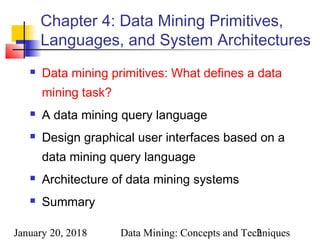
Chapter 4: Data Mining Primitives,
Languages, and System Architectures
 Data mining primitives: What defines a data
mining task?
 A data mining query language
 Design graphical user interfaces based on a
data mining query language
 Architecture of data mining systems
 Summary
January 20, 2018 Data Mining: Concepts and Techniques3
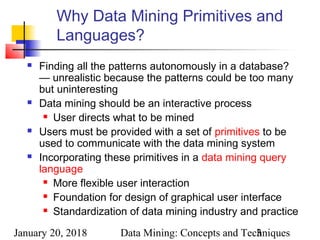
Why Data Mining Primitives and
Languages?
 Finding all the patterns autonomously in a database?
— unrealistic because the patterns could be too many
but uninteresting
 Data mining should be an interactive process
 User directs what to be mined
 Users must be provided with a set of primitives to be
used to communicate with the data mining system
 Incorporating these primitives in a data mining query
language
 More flexible user interaction
 Foundation for design of graphical user interface
 Standardization of data mining industry and practice
January 20, 2018 Data Mining: Concepts and Techniques4
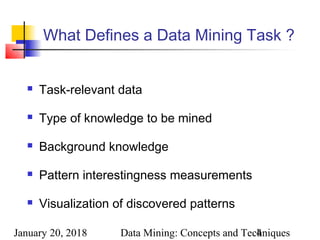
What Defines a Data Mining Task ?
 Task-relevant data
 Type of knowledge to be mined
 Background knowledge
 Pattern interestingness measurements
 Visualization of discovered patterns
January 20, 2018 Data Mining: Concepts and Techniques5
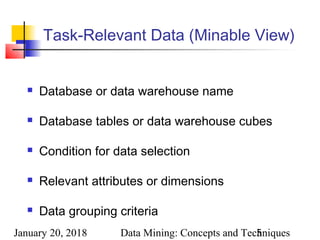
Task-Relevant Data (Minable View)
 Database or data warehouse name
 Database tables or data warehouse cubes
 Condition for data selection
 Relevant attributes or dimensions
 Data grouping criteria
January 20, 2018 Data Mining: Concepts and Techniques6
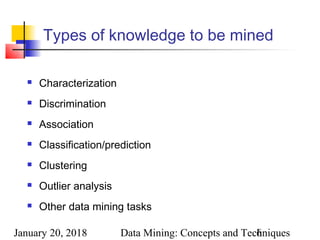
Types of knowledge to be mined
 Characterization
 Discrimination
 Association
 Classification/prediction
 Clustering
 Outlier analysis
 Other data mining tasks
January 20, 2018 Data Mining: Concepts and Techniques7
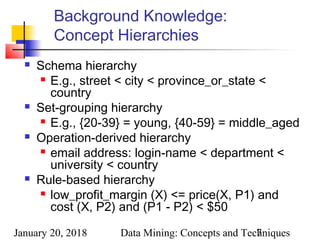
Background Knowledge:
Concept Hierarchies
 Schema hierarchy
 E.g., street < city < province_or_state <
country
 Set-grouping hierarchy
 E.g., {20-39} = young, {40-59} = middle_aged
 Operation-derived hierarchy
 email address: login-name < department <
university < country
 Rule-based hierarchy
 low_profit_margin (X) <= price(X, P1) and
cost (X, P2) and (P1 - P2) < $50
January 20, 2018 Data Mining: Concepts and Techniques8
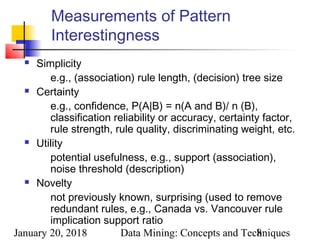
Measurements of Pattern
Interestingness
 Simplicity
e.g., (association) rule length, (decision) tree size
 Certainty
e.g., confidence, P(A|B) = n(A and B)/ n (B),
classification reliability or accuracy, certainty factor,
rule strength, rule quality, discriminating weight, etc.
 Utility
potential usefulness, e.g., support (association),
noise threshold (description)
 Novelty
not previously known, surprising (used to remove
redundant rules, e.g., Canada vs. Vancouver rule
implication support ratio
January 20, 2018 Data Mining: Concepts and Techniques9
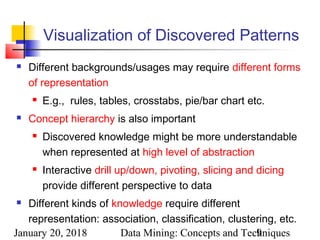
Visualization of Discovered Patterns
 Different backgrounds/usages may require different forms
of representation
 E.g., rules, tables, crosstabs, pie/bar chart etc.
 Concept hierarchy is also important
 Discovered knowledge might be more understandable
when represented at high level of abstraction
 Interactive drill up/down, pivoting, slicing and dicing
provide different perspective to data
 Different kinds of knowledge require different
representation: association, classification, clustering, etc.
January 20, 2018 Data Mining: Concepts and Techniques10
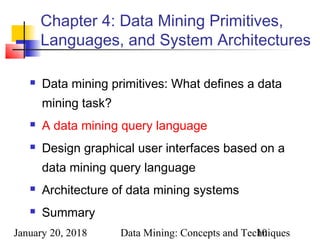
Chapter 4: Data Mining Primitives,
Languages, and System Architectures
 Data mining primitives: What defines a data
mining task?
 A data mining query language
 Design graphical user interfaces based on a
data mining query language
 Architecture of data mining systems
 Summary
January 20, 2018 Data Mining: Concepts and Techniques11
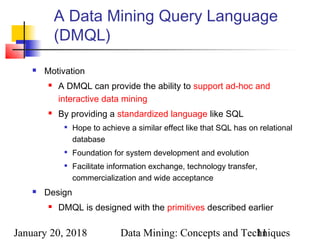
A Data Mining Query Language
(DMQL)
 Motivation
 A DMQL can provide the ability to support ad-hoc and
interactive data mining
 By providing a standardized language like SQL

Hope to achieve a similar effect like that SQL has on relational
database

Foundation for system development and evolution

Facilitate information exchange, technology transfer,
commercialization and wide acceptance
 Design
 DMQL is designed with the primitives described earlier
January 20, 2018 Data Mining: Concepts and Techniques12
Syntax for DMQL
 Syntax for specification of
 task-relevant data
 the kind of knowledge to be mined
 concept hierarchy specification
 interestingness measure
 pattern presentation and visualization
 Putting it all together — a DMQL query
January 20, 2018 Data Mining: Concepts and Techniques13
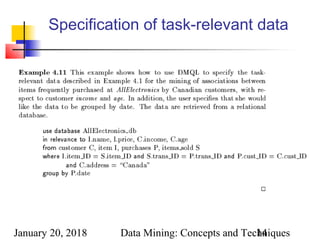
Syntax for task-relevant data
specification
 use database database_name, or use data
warehouse data_warehouse_name
 from relation(s)/cube(s) [where condition]
 in relevance to att_or_dim_list
 order by order_list
 group by grouping_list
 having condition
January 20, 2018 Data Mining: Concepts and Techniques14
Specification of task-relevant data
January 20, 2018 Data Mining: Concepts and Techniques15
Syntax for specifying the kind of
knowledge to be mined
 Characterization
Mine_Knowledge_Specification  ::=
mine characteristics [as pattern_name]
analyze measure(s)
 Discrimination
Mine_Knowledge_Specification  ::=
mine comparison [as pattern_name]
for target_class where target_condition 
{versus contrast_class_i where
contrast_condition_i} 
analyze measure(s)
 Association
Mine_Knowledge_Specification  ::=
mine associations [as pattern_name]
January 20, 2018 Data Mining: Concepts and Techniques16
Syntax for specifying the kind of
knowledge to be mined (cont.)
Classification
Mine_Knowledge_Specification  ::=
mine classification [as pattern_name]
analyze classifying_attribute_or_dimension
Prediction
Mine_Knowledge_Specification  ::=
mine prediction [as pattern_name]
analyze prediction_attribute_or_dimension
{set {attribute_or_dimension_i= value_i}}
January 20, 2018 Data Mining: Concepts and Techniques17
Syntax for concept hierarchy
specification
 To specify what concept hierarchies to use
use hierarchy <hierarchy> for <attribute_or_dimension>
 We use different syntax to define different type of hierarchies
 schema hierarchies
define hierarchy time_hierarchy on date as [date,month
quarter,year]
 set-grouping hierarchies
define hierarchy age_hierarchy for age on customer as
level1: {young, middle_aged, senior} <
level0: all
level2: {20, ..., 39} < level1: young
level2: {40, ..., 59} < level1: middle_aged
level2: {60, ..., 89} < level1: senior
January 20, 2018 Data Mining: Concepts and Techniques18
Syntax for concept hierarchy
specification (Cont.)
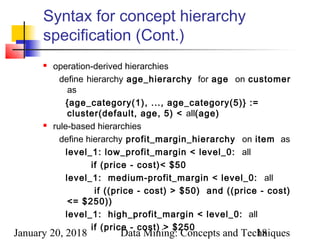
 operation-derived hierarchies
define hierarchy age_hierarchy for age on customer
as
{age_category(1), ..., age_category(5)} :=
cluster(default, age, 5) < all(age)
 rule-based hierarchies
define hierarchy profit_margin_hierarchy on item as
level_1: low_profit_margin < level_0: all
if (price - cost)< $50
level_1: medium-profit_margin < level_0: all
if ((price - cost) > $50) and ((price - cost)
<= $250))
level_1: high_profit_margin < level_0: all
if (price - cost) > $250
January 20, 2018 Data Mining: Concepts and Techniques19
Syntax for interestingness measure
specification
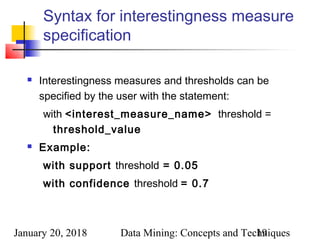
 Interestingness measures and thresholds can be
specified by the user with the statement:
with <interest_measure_name>  threshold =
threshold_value
 Example:
with support threshold = 0.05
with confidence threshold = 0.7 
January 20, 2018 Data Mining: Concepts and Techniques20
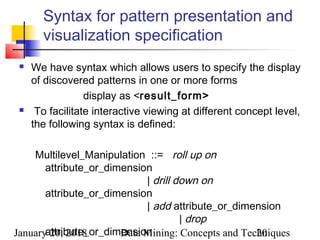
Syntax for pattern presentation and
visualization specification
 We have syntax which allows users to specify the display
of discovered patterns in one or more forms
display as <result_form>
 To facilitate interactive viewing at different concept level,
the following syntax is defined:
Multilevel_Manipulation  ::=   roll up on
attribute_or_dimension
| drill down on
attribute_or_dimension
| add attribute_or_dimension
| drop
attribute_or_dimension
January 20, 2018 Data Mining: Concepts and Techniques21
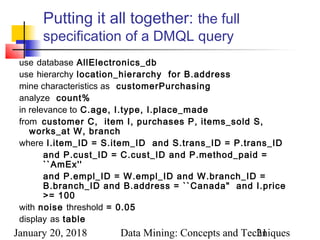
Putting it all together: the full
specification of a DMQL query
use database AllElectronics_db
use hierarchy location_hierarchy for B.address
mine characteristics as customerPurchasing
analyze count%
in relevance to C.age, I.type, I.place_made
from customer C, item I, purchases P, items_sold S,
works_at W, branch
where I.item_ID = S.item_ID and S.trans_ID = P.trans_ID
and P.cust_ID = C.cust_ID and P.method_paid =
``AmEx''
and P.empl_ID = W.empl_ID and W.branch_ID =
B.branch_ID and B.address = ``Canada" and I.price
>= 100
with noise threshold = 0.05
display as table
January 20, 2018 Data Mining: Concepts and Techniques22
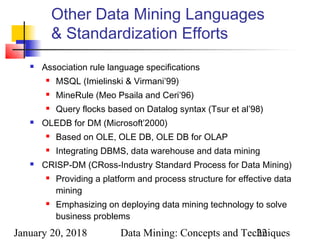
Other Data Mining Languages
& Standardization Efforts
 Association rule language specifications
 MSQL (Imielinski & Virmani’99)
 MineRule (Meo Psaila and Ceri’96)
 Query flocks based on Datalog syntax (Tsur et al’98)
 OLEDB for DM (Microsoft’2000)
 Based on OLE, OLE DB, OLE DB for OLAP
 Integrating DBMS, data warehouse and data mining
 CRISP-DM (CRoss-Industry Standard Process for Data Mining)
 Providing a platform and process structure for effective data
mining
 Emphasizing on deploying data mining technology to solve
business problems
January 20, 2018 Data Mining: Concepts and Techniques23
Chapter 4: Data Mining Primitives,
Languages, and System Architectures
 Data mining primitives: What defines a data
mining task?
 A data mining query language
 Design graphical user interfaces based on a
data mining query language
 Architecture of data mining systems
 Summary
January 20, 2018 Data Mining: Concepts and Techniques24
Designing Graphical User Interfaces
based on a data mining query language
 What tasks should be considered in the design GUIs
based on a data mining query language?
 Data collection and data mining query composition
 Presentation of discovered patterns
 Hierarchy specification and manipulation
 Manipulation of data mining primitives
 Interactive multilevel mining
 Other miscellaneous information
January 20, 2018 Data Mining: Concepts and Techniques25
Chapter 4: Data Mining Primitives,
Languages, and System Architectures
 Data mining primitives: What defines a data
mining task?
 A data mining query language
 Design graphical user interfaces based on a
data mining query language
 Architecture of data mining systems
 Summary
January 20, 2018 Data Mining: Concepts and Techniques26
Data Mining System Architectures
 Coupling data mining system with DB/DW system
 No coupling—flat file processing, not recommended
 Loose coupling

Fetching data from DB/DW
 Semi-tight coupling—enhanced DM performance

Provide efficient implement a few data mining primitives in a
DB/DW system, e.g., sorting, indexing, aggregation, histogram
analysis, multiway join, precomputation of some stat functions
 Tight coupling—A uniform information processing
environment

DM is smoothly integrated into a DB/DW system, mining query
is optimized based on mining query, indexing, query
processing methods, etc.
January 20, 2018 Data Mining: Concepts and Techniques27
Chapter 4: Data Mining Primitives,
Languages, and System Architectures
 Data mining primitives: What defines a data
mining task?
 A data mining query language
 Design graphical user interfaces based on a
data mining query language
 Architecture of data mining systems
 Summary
January 20, 2018 Data Mining: Concepts and Techniques28
Summary
 Five primitives for specification of a data mining task
 task-relevant data
 kind of knowledge to be mined
 background knowledge
 interestingness measures
 knowledge presentation and visualization techniques
to be used for displaying the discovered patterns
 Data mining query languages
 DMQL, MS/OLEDB for DM, etc.
 Data mining system architecture
 No coupling, loose coupling, semi-tight coupling, tight
coupling
January 20, 2018 Data Mining: Concepts and Techniques29
References
 E. Baralis and G. Psaila. Designing templates for mining association rules. Journal of Intelligent
Information Systems, 9:7-32, 1997.
 Microsoft Corp., OLEDB for Data Mining, version 1.0, http://www.microsoft.com/data/oledb/dm,
Aug. 2000.
 J. Han, Y. Fu, W. Wang, K. Koperski, and O. R. Zaiane, “DMQL: A Data Mining Query Language
for Relational Databases”, DMKD'96, Montreal, Canada, June 1996.
 T. Imielinski and A. Virmani. MSQL: A query language for database mining. Data Mining and
Knowledge Discovery, 3:373-408, 1999.
 M. Klemettinen, H. Mannila, P. Ronkainen, H. Toivonen, and A.I. Verkamo. Finding interesting rules
from large sets of discovered association rules. CIKM’94, Gaithersburg, Maryland, Nov. 1994.
 R. Meo, G. Psaila, and S. Ceri. A new SQL-like operator for mining association rules. VLDB'96,
pages 122-133, Bombay, India, Sept. 1996.
 A. Silberschatz and A. Tuzhilin. What makes patterns interesting in knowledge discovery systems.
IEEE Trans. on Knowledge and Data Engineering, 8:970-974, Dec. 1996.
 S. Sarawagi, S. Thomas, and R. Agrawal. Integrating association rule mining with relational
database systems: Alternatives and implications. SIGMOD'98, Seattle, Washington, June 1998.
 D. Tsur, J. D. Ullman, S. Abitboul, C. Clifton, R. Motwani, and S. Nestorov. Query flocks: A
generalization of association-rule mining. SIGMOD'98, Seattle, Washington, June 1998.
January 20, 2018 Data Mining: Concepts and Techniques30
http://www.cs.sfu.ca/~han
Thank you !!!Thank you !!!

4lang

  • 1.
    January 20, 2018Data Mining: Concepts and Techniques1 Data Mining: Concepts and Techniques — Slides for Textbook — — Chapter 4 — ©Jiawei Han and Micheline Kamber Intelligent Database Systems Research Lab School of Computing Science Simon Fraser University, Canada http://www.cs.sfu.ca
  • 2.
    January 20, 2018Data Mining: Concepts and Techniques2 Chapter 4: Data Mining Primitives, Languages, and System Architectures  Data mining primitives: What defines a data mining task?  A data mining query language  Design graphical user interfaces based on a data mining query language  Architecture of data mining systems  Summary
  • 3.
    January 20, 2018Data Mining: Concepts and Techniques3 Why Data Mining Primitives and Languages?  Finding all the patterns autonomously in a database? — unrealistic because the patterns could be too many but uninteresting  Data mining should be an interactive process  User directs what to be mined  Users must be provided with a set of primitives to be used to communicate with the data mining system  Incorporating these primitives in a data mining query language  More flexible user interaction  Foundation for design of graphical user interface  Standardization of data mining industry and practice
  • 4.
    January 20, 2018Data Mining: Concepts and Techniques4 What Defines a Data Mining Task ?  Task-relevant data  Type of knowledge to be mined  Background knowledge  Pattern interestingness measurements  Visualization of discovered patterns
  • 5.
    January 20, 2018Data Mining: Concepts and Techniques5 Task-Relevant Data (Minable View)  Database or data warehouse name  Database tables or data warehouse cubes  Condition for data selection  Relevant attributes or dimensions  Data grouping criteria
  • 6.
    January 20, 2018Data Mining: Concepts and Techniques6 Types of knowledge to be mined  Characterization  Discrimination  Association  Classification/prediction  Clustering  Outlier analysis  Other data mining tasks
  • 7.
    January 20, 2018Data Mining: Concepts and Techniques7 Background Knowledge: Concept Hierarchies  Schema hierarchy  E.g., street < city < province_or_state < country  Set-grouping hierarchy  E.g., {20-39} = young, {40-59} = middle_aged  Operation-derived hierarchy  email address: login-name < department < university < country  Rule-based hierarchy  low_profit_margin (X) <= price(X, P1) and cost (X, P2) and (P1 - P2) < $50
  • 8.
    January 20, 2018Data Mining: Concepts and Techniques8 Measurements of Pattern Interestingness  Simplicity e.g., (association) rule length, (decision) tree size  Certainty e.g., confidence, P(A|B) = n(A and B)/ n (B), classification reliability or accuracy, certainty factor, rule strength, rule quality, discriminating weight, etc.  Utility potential usefulness, e.g., support (association), noise threshold (description)  Novelty not previously known, surprising (used to remove redundant rules, e.g., Canada vs. Vancouver rule implication support ratio
  • 9.
    January 20, 2018Data Mining: Concepts and Techniques9 Visualization of Discovered Patterns  Different backgrounds/usages may require different forms of representation  E.g., rules, tables, crosstabs, pie/bar chart etc.  Concept hierarchy is also important  Discovered knowledge might be more understandable when represented at high level of abstraction  Interactive drill up/down, pivoting, slicing and dicing provide different perspective to data  Different kinds of knowledge require different representation: association, classification, clustering, etc.
  • 10.
    January 20, 2018Data Mining: Concepts and Techniques10 Chapter 4: Data Mining Primitives, Languages, and System Architectures  Data mining primitives: What defines a data mining task?  A data mining query language  Design graphical user interfaces based on a data mining query language  Architecture of data mining systems  Summary
  • 11.
    January 20, 2018Data Mining: Concepts and Techniques11 A Data Mining Query Language (DMQL)  Motivation  A DMQL can provide the ability to support ad-hoc and interactive data mining  By providing a standardized language like SQL  Hope to achieve a similar effect like that SQL has on relational database  Foundation for system development and evolution  Facilitate information exchange, technology transfer, commercialization and wide acceptance  Design  DMQL is designed with the primitives described earlier
  • 12.
    January 20, 2018Data Mining: Concepts and Techniques12 Syntax for DMQL  Syntax for specification of  task-relevant data  the kind of knowledge to be mined  concept hierarchy specification  interestingness measure  pattern presentation and visualization  Putting it all together — a DMQL query
  • 13.
    January 20, 2018Data Mining: Concepts and Techniques13 Syntax for task-relevant data specification  use database database_name, or use data warehouse data_warehouse_name  from relation(s)/cube(s) [where condition]  in relevance to att_or_dim_list  order by order_list  group by grouping_list  having condition
  • 14.
    January 20, 2018Data Mining: Concepts and Techniques14 Specification of task-relevant data
  • 15.
    January 20, 2018Data Mining: Concepts and Techniques15 Syntax for specifying the kind of knowledge to be mined  Characterization Mine_Knowledge_Specification  ::= mine characteristics [as pattern_name] analyze measure(s)  Discrimination Mine_Knowledge_Specification  ::= mine comparison [as pattern_name] for target_class where target_condition  {versus contrast_class_i where contrast_condition_i}  analyze measure(s)  Association Mine_Knowledge_Specification  ::= mine associations [as pattern_name]
  • 16.
    January 20, 2018Data Mining: Concepts and Techniques16 Syntax for specifying the kind of knowledge to be mined (cont.) Classification Mine_Knowledge_Specification  ::= mine classification [as pattern_name] analyze classifying_attribute_or_dimension Prediction Mine_Knowledge_Specification  ::= mine prediction [as pattern_name] analyze prediction_attribute_or_dimension {set {attribute_or_dimension_i= value_i}}
  • 17.
    January 20, 2018Data Mining: Concepts and Techniques17 Syntax for concept hierarchy specification  To specify what concept hierarchies to use use hierarchy <hierarchy> for <attribute_or_dimension>  We use different syntax to define different type of hierarchies  schema hierarchies define hierarchy time_hierarchy on date as [date,month quarter,year]  set-grouping hierarchies define hierarchy age_hierarchy for age on customer as level1: {young, middle_aged, senior} < level0: all level2: {20, ..., 39} < level1: young level2: {40, ..., 59} < level1: middle_aged level2: {60, ..., 89} < level1: senior
  • 18.
    January 20, 2018Data Mining: Concepts and Techniques18 Syntax for concept hierarchy specification (Cont.)  operation-derived hierarchies define hierarchy age_hierarchy for age on customer as {age_category(1), ..., age_category(5)} := cluster(default, age, 5) < all(age)  rule-based hierarchies define hierarchy profit_margin_hierarchy on item as level_1: low_profit_margin < level_0: all if (price - cost)< $50 level_1: medium-profit_margin < level_0: all if ((price - cost) > $50) and ((price - cost) <= $250)) level_1: high_profit_margin < level_0: all if (price - cost) > $250
  • 19.
    January 20, 2018Data Mining: Concepts and Techniques19 Syntax for interestingness measure specification  Interestingness measures and thresholds can be specified by the user with the statement: with <interest_measure_name>  threshold = threshold_value  Example: with support threshold = 0.05 with confidence threshold = 0.7 
  • 20.
    January 20, 2018Data Mining: Concepts and Techniques20 Syntax for pattern presentation and visualization specification  We have syntax which allows users to specify the display of discovered patterns in one or more forms display as <result_form>  To facilitate interactive viewing at different concept level, the following syntax is defined: Multilevel_Manipulation  ::=   roll up on attribute_or_dimension | drill down on attribute_or_dimension | add attribute_or_dimension | drop attribute_or_dimension
  • 21.
    January 20, 2018Data Mining: Concepts and Techniques21 Putting it all together: the full specification of a DMQL query use database AllElectronics_db use hierarchy location_hierarchy for B.address mine characteristics as customerPurchasing analyze count% in relevance to C.age, I.type, I.place_made from customer C, item I, purchases P, items_sold S, works_at W, branch where I.item_ID = S.item_ID and S.trans_ID = P.trans_ID and P.cust_ID = C.cust_ID and P.method_paid = ``AmEx'' and P.empl_ID = W.empl_ID and W.branch_ID = B.branch_ID and B.address = ``Canada" and I.price >= 100 with noise threshold = 0.05 display as table
  • 22.
    January 20, 2018Data Mining: Concepts and Techniques22 Other Data Mining Languages & Standardization Efforts  Association rule language specifications  MSQL (Imielinski & Virmani’99)  MineRule (Meo Psaila and Ceri’96)  Query flocks based on Datalog syntax (Tsur et al’98)  OLEDB for DM (Microsoft’2000)  Based on OLE, OLE DB, OLE DB for OLAP  Integrating DBMS, data warehouse and data mining  CRISP-DM (CRoss-Industry Standard Process for Data Mining)  Providing a platform and process structure for effective data mining  Emphasizing on deploying data mining technology to solve business problems
  • 23.
    January 20, 2018Data Mining: Concepts and Techniques23 Chapter 4: Data Mining Primitives, Languages, and System Architectures  Data mining primitives: What defines a data mining task?  A data mining query language  Design graphical user interfaces based on a data mining query language  Architecture of data mining systems  Summary
  • 24.
    January 20, 2018Data Mining: Concepts and Techniques24 Designing Graphical User Interfaces based on a data mining query language  What tasks should be considered in the design GUIs based on a data mining query language?  Data collection and data mining query composition  Presentation of discovered patterns  Hierarchy specification and manipulation  Manipulation of data mining primitives  Interactive multilevel mining  Other miscellaneous information
  • 25.
    January 20, 2018Data Mining: Concepts and Techniques25 Chapter 4: Data Mining Primitives, Languages, and System Architectures  Data mining primitives: What defines a data mining task?  A data mining query language  Design graphical user interfaces based on a data mining query language  Architecture of data mining systems  Summary
  • 26.
    January 20, 2018Data Mining: Concepts and Techniques26 Data Mining System Architectures  Coupling data mining system with DB/DW system  No coupling—flat file processing, not recommended  Loose coupling  Fetching data from DB/DW  Semi-tight coupling—enhanced DM performance  Provide efficient implement a few data mining primitives in a DB/DW system, e.g., sorting, indexing, aggregation, histogram analysis, multiway join, precomputation of some stat functions  Tight coupling—A uniform information processing environment  DM is smoothly integrated into a DB/DW system, mining query is optimized based on mining query, indexing, query processing methods, etc.
  • 27.
    January 20, 2018Data Mining: Concepts and Techniques27 Chapter 4: Data Mining Primitives, Languages, and System Architectures  Data mining primitives: What defines a data mining task?  A data mining query language  Design graphical user interfaces based on a data mining query language  Architecture of data mining systems  Summary
  • 28.
    January 20, 2018Data Mining: Concepts and Techniques28 Summary  Five primitives for specification of a data mining task  task-relevant data  kind of knowledge to be mined  background knowledge  interestingness measures  knowledge presentation and visualization techniques to be used for displaying the discovered patterns  Data mining query languages  DMQL, MS/OLEDB for DM, etc.  Data mining system architecture  No coupling, loose coupling, semi-tight coupling, tight coupling
  • 29.
    January 20, 2018Data Mining: Concepts and Techniques29 References  E. Baralis and G. Psaila. Designing templates for mining association rules. Journal of Intelligent Information Systems, 9:7-32, 1997.  Microsoft Corp., OLEDB for Data Mining, version 1.0, http://www.microsoft.com/data/oledb/dm, Aug. 2000.  J. Han, Y. Fu, W. Wang, K. Koperski, and O. R. Zaiane, “DMQL: A Data Mining Query Language for Relational Databases”, DMKD'96, Montreal, Canada, June 1996.  T. Imielinski and A. Virmani. MSQL: A query language for database mining. Data Mining and Knowledge Discovery, 3:373-408, 1999.  M. Klemettinen, H. Mannila, P. Ronkainen, H. Toivonen, and A.I. Verkamo. Finding interesting rules from large sets of discovered association rules. CIKM’94, Gaithersburg, Maryland, Nov. 1994.  R. Meo, G. Psaila, and S. Ceri. A new SQL-like operator for mining association rules. VLDB'96, pages 122-133, Bombay, India, Sept. 1996.  A. Silberschatz and A. Tuzhilin. What makes patterns interesting in knowledge discovery systems. IEEE Trans. on Knowledge and Data Engineering, 8:970-974, Dec. 1996.  S. Sarawagi, S. Thomas, and R. Agrawal. Integrating association rule mining with relational database systems: Alternatives and implications. SIGMOD'98, Seattle, Washington, June 1998.  D. Tsur, J. D. Ullman, S. Abitboul, C. Clifton, R. Motwani, and S. Nestorov. Query flocks: A generalization of association-rule mining. SIGMOD'98, Seattle, Washington, June 1998.
  • 30.
    January 20, 2018Data Mining: Concepts and Techniques30 http://www.cs.sfu.ca/~han Thank you !!!Thank you !!!