July 23, 2013
Deborah Loon
Executive Director
NAEH Conference
Shelter and Transitional Housing for 200+
homeless youth per year in Twin Cities, MN.
Four programs:
• Shelter and TLP in North Minneapolis
• GLBT Host Home Program
• Suburban Host Home Program
• Minneapolis Host Home Program
Avenues for Homeless Youth
GLBT Host Home Program
• Created by GLBT community
• Nationally-recognized model
Suburban Host Home Program
• Created by community volunteers and
youth-serving agencies in fall 2011
• Youth from Hennepin County suburbs
Minneapolis Host Home Program
• Launched fall 2012
• Youth from Minneapolis
• Safe & stable transition-like housing
• Cost-effective (50% cost / youth vs. congregate)
• When it works well, it is so much more….
• Long-term relationships critical for success in life
• Changes lives – youth AND hosts
• By extension, changes the community
Why Host HomesWhy Host Homes
• Outside the system
• Recruit, screen and train community volunteers to
provide short-term, supportive housing for
homeless youth
• Program manager supports hosts – regular contact,
monthly meetings, support groups
• Youth referred by many partners – homeless youth
agencies, school and county social workers
• Youth receive ongoing case management
Basic OperationBasic Operation
Community Advisory or Action Council
• Reflects the community, activists
• Not just social service providers
• Key to host recruitment and program promotion
Key FeaturesKey Features
Host screening
• Background checks, 2-3 interviews, reference
checks
Host training
• Video to provide context to homelessness,
trauma and resiliency, gender/transgender,
anti-racism/white privilege, self-reflection
exercises, panels of past hosts and youth
Key FeaturesKey Features
Careful youth referrals
• Case manager needs to work with youth at least
one month
• Youth are voluntary participants…they are never
“placed”
Youth-driven matching process
Consistent support of hosts and youth
Key FeaturesKey Features
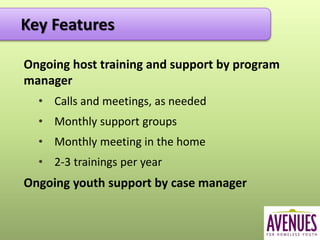
Ongoing host training and support by program
manager
• Calls and meetings, as needed
• Monthly support groups
• Monthly meeting in the home
• 2-3 trainings per year
Ongoing youth support by case manager
Key FeaturesKey Features
Not easy! Leap of faith for participants.
• Manage expectations. Guarantee there will be
conflicts and really difficult times. Hosts can’t
expect youth to be “grateful.” And hosts will
always wish they knew more about the youth.
• Help hosts set clear boundaries.
Communicate, train, support…repeat.
Lessons LearnedLessons Learned
• Must be created and owned by the community.
Can’t be another social service program.
• Bias against government funding – do not want
program to become rules-based.
• Good case management is crucial. But referring
partners often lack capacity to case manage while
in host home.
Lessons LearnedLessons Learned
www.avenuesforyouth.org
612-522-1690
deb@avenuesforyouth.org

Avenues for Homeless Youth

  • 1.
    July 23, 2013 DeborahLoon Executive Director NAEH Conference
  • 2.
    Shelter and TransitionalHousing for 200+ homeless youth per year in Twin Cities, MN. Four programs: • Shelter and TLP in North Minneapolis • GLBT Host Home Program • Suburban Host Home Program • Minneapolis Host Home Program Avenues for Homeless Youth
  • 3.
    GLBT Host HomeProgram • Created by GLBT community • Nationally-recognized model Suburban Host Home Program • Created by community volunteers and youth-serving agencies in fall 2011 • Youth from Hennepin County suburbs Minneapolis Host Home Program • Launched fall 2012 • Youth from Minneapolis
  • 4.
    • Safe &stable transition-like housing • Cost-effective (50% cost / youth vs. congregate) • When it works well, it is so much more…. • Long-term relationships critical for success in life • Changes lives – youth AND hosts • By extension, changes the community Why Host HomesWhy Host Homes
  • 5.
    • Outside thesystem • Recruit, screen and train community volunteers to provide short-term, supportive housing for homeless youth • Program manager supports hosts – regular contact, monthly meetings, support groups • Youth referred by many partners – homeless youth agencies, school and county social workers • Youth receive ongoing case management Basic OperationBasic Operation
  • 6.
    Community Advisory orAction Council • Reflects the community, activists • Not just social service providers • Key to host recruitment and program promotion Key FeaturesKey Features
  • 7.
    Host screening • Backgroundchecks, 2-3 interviews, reference checks Host training • Video to provide context to homelessness, trauma and resiliency, gender/transgender, anti-racism/white privilege, self-reflection exercises, panels of past hosts and youth Key FeaturesKey Features
  • 8.
    Careful youth referrals •Case manager needs to work with youth at least one month • Youth are voluntary participants…they are never “placed” Youth-driven matching process Consistent support of hosts and youth Key FeaturesKey Features
  • 9.
    Ongoing host trainingand support by program manager • Calls and meetings, as needed • Monthly support groups • Monthly meeting in the home • 2-3 trainings per year Ongoing youth support by case manager Key FeaturesKey Features
  • 10.
    Not easy! Leapof faith for participants. • Manage expectations. Guarantee there will be conflicts and really difficult times. Hosts can’t expect youth to be “grateful.” And hosts will always wish they knew more about the youth. • Help hosts set clear boundaries. Communicate, train, support…repeat. Lessons LearnedLessons Learned
  • 11.
    • Must becreated and owned by the community. Can’t be another social service program. • Bias against government funding – do not want program to become rules-based. • Good case management is crucial. But referring partners often lack capacity to case manage while in host home. Lessons LearnedLessons Learned
  • 12.