
Retooling Transitional Housing:
Moving to New Models
National Conference on Ending Family Homelessness
Retooling Transitional Housing:
Moving to New Models
Speakers
Kay Moshier McDivitt, Moderator
National Alliance to End Homelessness
Kimberly Tucker
St. Joseph’s Villa, Richmond Virginia
Andrea Hachey
Columbus House Inc., New Haven Connecticut
Retooling Transitional Housing:
Moving to New Models
Many providers and community leaders are
exploring options for retooling transitional
housing programs to improve their communities’
overall performance. This workshop will identify
the steps programs can take in the retooling
process, and provide examples and tools for
taking those steps. Providers who have retooled
their transitional housing will share their
experiences about making the shift, and cover
topics such as staffing, contracts, and working
with board members. Retooling for single and
family transitional housing models will be
included.
Topics
Assessment, Planning and
Preparation Phase
Choosing a Model
The Implementation Process
Challenges in Implementing a new
model
Outcomes and Evaluation
Why Re-Tool?
Provides opportunity for providers to strategically assess
effectiveness in:
 Meeting HEARTH Goals (reducing Length of Stay)
 Alignment with Federal Plan: Opening Doors
 Community successes with HPRP
Remain responsive to emerging needs for housing and
services in your community
Strengthen performance of your project and your local
Continuum of Care
Why Retool?
Changing models and funding
increase impact on service delivery
Successfully retooling with significant
results
Cost comparisons for PH exits from
different systems
Retooling: Moving to New
Models
Techniques to Start Your Retooling Process
Retooling Checklist: 3 Phases
Phase I: Assessment, Planning and
Preparation (30-60 days)
Phase II: Develop the Implementation
Strategy (4-6 months)
Phase III: Start the Shift
Phase I: Assessment,
Planning and Preparation
(30-60 days)
1. Meet with your local CoC/Coalition
2. Develop the Retooling Committee
4. Assess and Evaluate the Current Program
5. Identify Your New Model
6. Identify Barriers to Retooling
7. Develop a Communication Strategy
8. Final Recommendation and Plan
Key Questions: Planning
 How will you work with your local
Continuum of Care to choose your
model?
 What steps will you you take to assess
your former transitional housing program
to determine what model you wanted to
retool to? Who will be of that planning
process?
Retooling Options
Choosing the New Model
Retooling parts of the program (Repurposing)
 Moving from facility based TH to transition in place TH
 Shorten the length of stay
 Moving to a voluntary services model
 Change in target population
 Change in number of units/person
Retooling to a new model (Reallocation)
 Rapid Rehousing
 Permanent Supportive Housing
Retooling Options
Choosing the New Model
Key Questions: Choosing
your Model
 Why are you choosing this model?
 What is your timeline for implementing
the new model?
 How will the transition to the new model
be communicated to the community?
Identify your new vision and core values
Identify staffing and training needs
Update policies and procedures
Obtain Board Support
Identify outcomes measurements
Develop proposed budget & identify funding issues
Identify spectrum of community partnerships
Develop clear communication plan
Building use
Phase II:
Implementation (4-6 months)
Key Questions: Choosing
your Model
 What is the new vision and core values
for the new model? How will our policies
and procedures change to effectively
administer this change?
 How will the Board be educated and
engaged to support the new model?
 What staff positions will be needed for
the new model? How will we work with
current staff? What training will be
needed?
Challenges in the New
Model Implementation
 Be prepared for external and internal resistance
 Communicating the new model effectively
 Moving out of the comfort zone
 The actual “flipping the switch”
 Realigning funding
 Building Use
Key Questions: Addressing
the Challenges
 How will resistance be addressed?
 How can we get people to move out of
their comfort zone and understand the
effectiveness of the new model?
 When will we begin the conversation
with our funders? Who should be
contacted?
 How will building use be addressed if it
doesn’t fit with the new model? Who
can help in making this decision?
Set a “start date”
Have a contingency plan
Create tools to measure success
Create the “new” success story
Evaluate often
Adjust benchmarks as needed
Tweak new model as needed
Be prepared to continue to change
Model needs to adapt as population needs
change
Phase III: Start the Shift
Key Questions: Outcomes
and Evaluation
 How will you know the program is
working?
 What outcomes will be measured and
what are the tools needed?
 How will you address challenges and
adapt your program model?
 How will building use be addressed if it
doesn’t fit with the new model? Who
can help in making this decision?
Moving to New Models:
Lessons Learned
 What can you learn from others who have
retooled their programs?
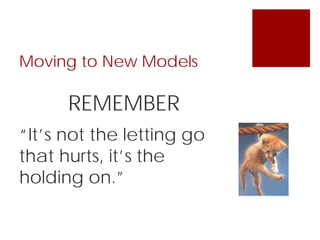
Moving to New Models
REMEMBER
“It’s not the letting go
that hurts, it’s the
holding on.”
Resources
From the Alliance @ www.endhomelessness.org
 Organizational Change; Adopting a Housing First Approach
 Rapid Rehousing: Creating Programs that Work
 Coming Soon: Alliance Retooling Transitional Housing
Toolkit
 Other Websites:
 Technical Assistance Collaborative @ www.tacinc.org
 Corporation for Supportive Housing @ www.csh.org
Questions?
Contact Information
 Andrea Hachey, Middlesex and Transitional Programs Manager,
Columbus House, Inc.
andreah@columbushouse.org
860-347-8686 ext. 4
 Kimberly Tucker, Director of Housing and Homelessness, St. Joseph
Villa
ktucker@sjvmail.net
804-553-3210
Kay Moshier McDivitt, Technical Assistance Specialist, National
Alliance to End Homelessness
kmoshiermcdivitt@naeh.org
202-942-8242 or 202-550-5859

Retooling Transitional Housing: Moving to New Models

  • 1.
    Retooling Transitional Housing: Movingto New Models National Conference on Ending Family Homelessness
  • 2.
    Retooling Transitional Housing: Movingto New Models Speakers Kay Moshier McDivitt, Moderator National Alliance to End Homelessness Kimberly Tucker St. Joseph’s Villa, Richmond Virginia Andrea Hachey Columbus House Inc., New Haven Connecticut
  • 3.
    Retooling Transitional Housing: Movingto New Models Many providers and community leaders are exploring options for retooling transitional housing programs to improve their communities’ overall performance. This workshop will identify the steps programs can take in the retooling process, and provide examples and tools for taking those steps. Providers who have retooled their transitional housing will share their experiences about making the shift, and cover topics such as staffing, contracts, and working with board members. Retooling for single and family transitional housing models will be included.
  • 4.
    Topics Assessment, Planning and PreparationPhase Choosing a Model The Implementation Process Challenges in Implementing a new model Outcomes and Evaluation
  • 5.
    Why Re-Tool? Provides opportunityfor providers to strategically assess effectiveness in:  Meeting HEARTH Goals (reducing Length of Stay)  Alignment with Federal Plan: Opening Doors  Community successes with HPRP Remain responsive to emerging needs for housing and services in your community Strengthen performance of your project and your local Continuum of Care
  • 6.
    Why Retool? Changing modelsand funding increase impact on service delivery Successfully retooling with significant results Cost comparisons for PH exits from different systems
  • 7.
    Retooling: Moving toNew Models Techniques to Start Your Retooling Process Retooling Checklist: 3 Phases Phase I: Assessment, Planning and Preparation (30-60 days) Phase II: Develop the Implementation Strategy (4-6 months) Phase III: Start the Shift
  • 8.
    Phase I: Assessment, Planningand Preparation (30-60 days) 1. Meet with your local CoC/Coalition 2. Develop the Retooling Committee 4. Assess and Evaluate the Current Program 5. Identify Your New Model 6. Identify Barriers to Retooling 7. Develop a Communication Strategy 8. Final Recommendation and Plan
  • 9.
    Key Questions: Planning How will you work with your local Continuum of Care to choose your model?  What steps will you you take to assess your former transitional housing program to determine what model you wanted to retool to? Who will be of that planning process?
  • 10.
    Retooling Options Choosing theNew Model Retooling parts of the program (Repurposing)  Moving from facility based TH to transition in place TH  Shorten the length of stay  Moving to a voluntary services model  Change in target population  Change in number of units/person
  • 11.
    Retooling to anew model (Reallocation)  Rapid Rehousing  Permanent Supportive Housing Retooling Options Choosing the New Model
  • 12.
    Key Questions: Choosing yourModel  Why are you choosing this model?  What is your timeline for implementing the new model?  How will the transition to the new model be communicated to the community?
  • 13.
    Identify your newvision and core values Identify staffing and training needs Update policies and procedures Obtain Board Support Identify outcomes measurements Develop proposed budget & identify funding issues Identify spectrum of community partnerships Develop clear communication plan Building use Phase II: Implementation (4-6 months)
  • 14.
    Key Questions: Choosing yourModel  What is the new vision and core values for the new model? How will our policies and procedures change to effectively administer this change?  How will the Board be educated and engaged to support the new model?  What staff positions will be needed for the new model? How will we work with current staff? What training will be needed?
  • 15.
    Challenges in theNew Model Implementation  Be prepared for external and internal resistance  Communicating the new model effectively  Moving out of the comfort zone  The actual “flipping the switch”  Realigning funding  Building Use
  • 16.
    Key Questions: Addressing theChallenges  How will resistance be addressed?  How can we get people to move out of their comfort zone and understand the effectiveness of the new model?  When will we begin the conversation with our funders? Who should be contacted?  How will building use be addressed if it doesn’t fit with the new model? Who can help in making this decision?
  • 17.
    Set a “startdate” Have a contingency plan Create tools to measure success Create the “new” success story Evaluate often Adjust benchmarks as needed Tweak new model as needed Be prepared to continue to change Model needs to adapt as population needs change Phase III: Start the Shift
  • 18.
    Key Questions: Outcomes andEvaluation  How will you know the program is working?  What outcomes will be measured and what are the tools needed?  How will you address challenges and adapt your program model?  How will building use be addressed if it doesn’t fit with the new model? Who can help in making this decision?
  • 19.
    Moving to NewModels: Lessons Learned  What can you learn from others who have retooled their programs?
  • 20.
    Moving to NewModels REMEMBER “It’s not the letting go that hurts, it’s the holding on.”
  • 21.
    Resources From the Alliance@ www.endhomelessness.org  Organizational Change; Adopting a Housing First Approach  Rapid Rehousing: Creating Programs that Work  Coming Soon: Alliance Retooling Transitional Housing Toolkit  Other Websites:  Technical Assistance Collaborative @ www.tacinc.org  Corporation for Supportive Housing @ www.csh.org
  • 22.
  • 23.
    Contact Information  AndreaHachey, Middlesex and Transitional Programs Manager, Columbus House, Inc. andreah@columbushouse.org 860-347-8686 ext. 4  Kimberly Tucker, Director of Housing and Homelessness, St. Joseph Villa ktucker@sjvmail.net 804-553-3210 Kay Moshier McDivitt, Technical Assistance Specialist, National Alliance to End Homelessness kmoshiermcdivitt@naeh.org 202-942-8242 or 202-550-5859