Literature review Prof. Francisco Guillen Grima
Search Databases  1998-2010 MEDLINE,  Web of Science,  Current Contents Connect PsycINFO Scholar google
Keywords “ family”, “foster home care”, “kinship”, “parenting”, “ education”, “child”, “teen”, “adolescent”, “young”, “drug”, “ alcohol”, “risk”, or “prevention”
Definitions Family members, other than parents, raising children full-time Family members, other than parents, who are primary carers for extended periods.
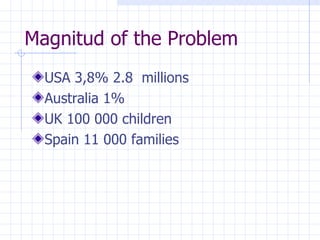
Magnitud of the Problem USA 3,8% 2.8  millions Australia 1% UK 100 000 children Spain 11 000 families
General Findings Minority groups Problems Health Problems Drug related problems Prevalence of Drug abuse in Parents
General Findings Not eligible for the payments and support services available  legal rights are often ambiguous and difficult to enforce
Minority groups grandparent care giving is particularly high in inner cities, estimated  30%- 50%
Problems Kinship Carers Depression social isolation  poverty
Health Problems Women caring for non-ill children 21h/week -  9h/wk  have more risk of coronary heart disease (Lee, 2003)
Health Problems (2) Kinship carers appear to take less care of their own health. Grandmothers raising a grandchild are less likely to report influenza vaccination and cholesterol screening. (Baker 2008)
Drug Problems Parenting a grandchild &  the parenthood of a drug abuser produces stress and distress
Prevalence of drug abuse Australia  52 % of abusive parents were known to misuse substances. USA: 72 % Kinship carers due to maternal substance abuse [Patton, 2003]
Effect parents drug use on children Infants with foetal substance abuse high risk health problems Mothers more punitive affecting kids self-esteem. ↑  risk of abuse Exposure  to hostile environments (drug dealing, prostitution, criminal activities)
KINSHIP CARE PROVIDERS’ NEEDS AND ALCOHOL AND DRUGS PROBLEMS OF THEIR CHILDREN
The Needs of Kinship Carers General needs Health Parental skills
General Needs of Kinship carers Kinship families have less resources, receive less training, services, and support. kinship families are less qualified
Health of Kinship carers Grandmothers who  reported fewer resources, less social support, and poorer physical health  experience higher levels of  psychological distress.  (Kelley SJ,  2000). relationship between burden (family conflict, behaviour management of children, and negative interactions  social services) and emotional  distress.
Parenting Skills older kin families are smaller, lower income, and include adoptive mothers with  less education. would benefit from preadoption  & post-adoption services to assist them grandmothers more difficulties when caring for boys  & white Kinship carers receive less supervision and fewer services  than non-kin carers.
NEEDS OF CHILDREN RAISED IN KINSHIP CARE
The need of children raised in Kinhsip Care. Maltreated Children Behaviour School/Academic functioning Meaning family & care giving: Children in foster care and Kinship Care.
Maltreated Children especially advisable (Geen, 2004; Leos- Urbel and Geen, 2002; Testa, 2001),  no advantage (Lawler, 2008)
Behaviour importance of  children developmental stages younger children living w Grandmothers comparable other children (Pittman and Boswell,  2005). young adolescents living w  custodial grandmothers  more  problematic behaviours;
School/Academic functioning children in  out-of-home care are at risk for short and long term  school failure children in kinship care greater difficulties school  than children in general
Meaning of family and care giving: children in foster care and kinship care studies rarely include  assessment of children’s feelings and thoughts regarding  their foster placements (Berrick, Frasch and Fox, 2000). If kinship carers  & parents have good relations child is more  socially integrated. keeping children within their  extended family reduces stigma and trauma of  separation from   parents. Children  were happy to be in care of   their grandparents and y loved and trustedthem .
Helping Custodial grandparents to raise healthy children
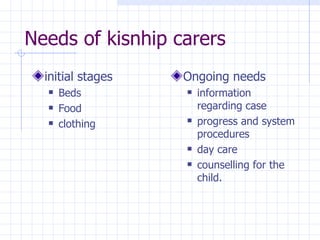
Needs of kisnhip carers initial stages Beds Food clothing Ongoing needs information regarding case progress and system procedures day care counselling for the child.
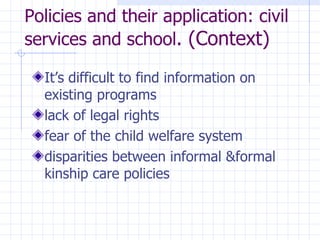
Policies and their application: civil services and school . (Context) It’s difficult to find information on existing programs  lack of legal rights  fear of the child welfare system disparities between informal  &formal kinship care policies
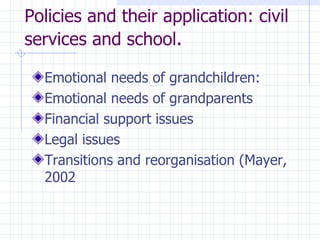
Policies and their application: civil services and school .  Emotional needs of grandchildren: Emotional needs of grandparents Financial support issues Legal issues Transitions and reorganisation (Mayer, 2002
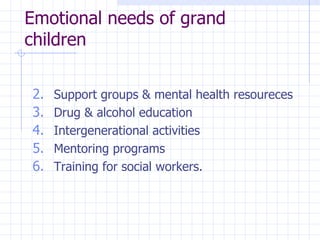
Emotional needs of grand children Support groups & mental health resoureces Drug & alcohol education Intergenerational activities Mentoring programs Training for social workers.
Emotional needs grand parents school psychologists should have  helpful information about the available resources in the community Information on before and after-school activities  on (grand)parenting extra time for grandparent/teacher conferences services &support  to enhance their parental  role
Legal issues care of their grandchildren  informally, formally, through legal custody, guardianship, adoption or by becoming a foster parent.
Financial support issues: Information about financial assistance Many  kinship care families do not know that they  are eligible for it. Information and advice in order to get additional  money
Transitions and reorganisation Parenting classes Encourage  to seek  help &resources beyond  the family unit Counselling first aid in stabilizing  the family system early
Successful strategies (1) Support groups including the school system as one of the ways to improve the kinship care families’ support
Successful strategies (2) intergenerational school-based intervention Carers participate in support groups and case management services children participate in  tutoring, mentoring and counselling, advocacy and  resources procurement
Successful strategies (3) New Technologies  Kinship Support Network (KSN) CD_ROM
Key findings
Key findings (1)     kinship placements.  Advantage achievement permanency & improved well-being. poorer & less educated. receive less supervision & services psychological distress
Key findings (2) pre-adoption and post-adoption services lack of legal rights practical difficulties  (eg. school, medical care). children less mental problems. KC advisable for maltreated children
Key findings (3) KC  protective effect on the early behavioural outcomes for children entering out-of-home care. reduces stigma & trauma of separation from parents. more stable adolescents less mental problem.
Key Findings Children‘s services should separate a carer´s need for support (money and services) from a child´s need for supervision (casework oversight). It`s difficult for  Grandparents finding information on existing programs especially during a family crisis.

Literature

  • 1.
    Literature review Prof.Francisco Guillen Grima
  • 2.
    Search Databases 1998-2010 MEDLINE, Web of Science, Current Contents Connect PsycINFO Scholar google
  • 3.
    Keywords “ family”,“foster home care”, “kinship”, “parenting”, “ education”, “child”, “teen”, “adolescent”, “young”, “drug”, “ alcohol”, “risk”, or “prevention”
  • 4.
    Definitions Family members,other than parents, raising children full-time Family members, other than parents, who are primary carers for extended periods.
  • 5.
    Magnitud of theProblem USA 3,8% 2.8 millions Australia 1% UK 100 000 children Spain 11 000 families
  • 6.
    General Findings Minoritygroups Problems Health Problems Drug related problems Prevalence of Drug abuse in Parents
  • 7.
    General Findings Noteligible for the payments and support services available legal rights are often ambiguous and difficult to enforce
  • 8.
    Minority groups grandparentcare giving is particularly high in inner cities, estimated 30%- 50%
  • 9.
    Problems Kinship CarersDepression social isolation poverty
  • 10.
    Health Problems Womencaring for non-ill children 21h/week - 9h/wk have more risk of coronary heart disease (Lee, 2003)
  • 11.
    Health Problems (2)Kinship carers appear to take less care of their own health. Grandmothers raising a grandchild are less likely to report influenza vaccination and cholesterol screening. (Baker 2008)
  • 12.
    Drug Problems Parentinga grandchild & the parenthood of a drug abuser produces stress and distress
  • 13.
    Prevalence of drugabuse Australia 52 % of abusive parents were known to misuse substances. USA: 72 % Kinship carers due to maternal substance abuse [Patton, 2003]
  • 14.
    Effect parents druguse on children Infants with foetal substance abuse high risk health problems Mothers more punitive affecting kids self-esteem. ↑ risk of abuse Exposure to hostile environments (drug dealing, prostitution, criminal activities)
  • 15.
    KINSHIP CARE PROVIDERS’NEEDS AND ALCOHOL AND DRUGS PROBLEMS OF THEIR CHILDREN
  • 16.
    The Needs ofKinship Carers General needs Health Parental skills
  • 17.
    General Needs ofKinship carers Kinship families have less resources, receive less training, services, and support. kinship families are less qualified
  • 18.
    Health of Kinshipcarers Grandmothers who reported fewer resources, less social support, and poorer physical health experience higher levels of psychological distress. (Kelley SJ, 2000). relationship between burden (family conflict, behaviour management of children, and negative interactions social services) and emotional distress.
  • 19.
    Parenting Skills olderkin families are smaller, lower income, and include adoptive mothers with less education. would benefit from preadoption & post-adoption services to assist them grandmothers more difficulties when caring for boys & white Kinship carers receive less supervision and fewer services than non-kin carers.
  • 20.
    NEEDS OF CHILDRENRAISED IN KINSHIP CARE
  • 21.
    The need ofchildren raised in Kinhsip Care. Maltreated Children Behaviour School/Academic functioning Meaning family & care giving: Children in foster care and Kinship Care.
  • 22.
    Maltreated Children especiallyadvisable (Geen, 2004; Leos- Urbel and Geen, 2002; Testa, 2001), no advantage (Lawler, 2008)
  • 23.
    Behaviour importance of children developmental stages younger children living w Grandmothers comparable other children (Pittman and Boswell, 2005). young adolescents living w custodial grandmothers more problematic behaviours;
  • 24.
    School/Academic functioning childrenin out-of-home care are at risk for short and long term school failure children in kinship care greater difficulties school than children in general
  • 25.
    Meaning of familyand care giving: children in foster care and kinship care studies rarely include assessment of children’s feelings and thoughts regarding their foster placements (Berrick, Frasch and Fox, 2000). If kinship carers & parents have good relations child is more socially integrated. keeping children within their extended family reduces stigma and trauma of separation from parents. Children were happy to be in care of their grandparents and y loved and trustedthem .
  • 26.
    Helping Custodial grandparentsto raise healthy children
  • 27.
    Needs of kisnhipcarers initial stages Beds Food clothing Ongoing needs information regarding case progress and system procedures day care counselling for the child.
  • 28.
    Policies and theirapplication: civil services and school . (Context) It’s difficult to find information on existing programs lack of legal rights fear of the child welfare system disparities between informal &formal kinship care policies
  • 29.
    Policies and theirapplication: civil services and school . Emotional needs of grandchildren: Emotional needs of grandparents Financial support issues Legal issues Transitions and reorganisation (Mayer, 2002
  • 30.
    Emotional needs ofgrand children Support groups & mental health resoureces Drug & alcohol education Intergenerational activities Mentoring programs Training for social workers.
  • 31.
    Emotional needs grandparents school psychologists should have helpful information about the available resources in the community Information on before and after-school activities on (grand)parenting extra time for grandparent/teacher conferences services &support to enhance their parental role
  • 32.
    Legal issues careof their grandchildren informally, formally, through legal custody, guardianship, adoption or by becoming a foster parent.
  • 33.
    Financial support issues:Information about financial assistance Many kinship care families do not know that they are eligible for it. Information and advice in order to get additional money
  • 34.
    Transitions and reorganisationParenting classes Encourage to seek help &resources beyond the family unit Counselling first aid in stabilizing the family system early
  • 35.
    Successful strategies (1)Support groups including the school system as one of the ways to improve the kinship care families’ support
  • 36.
    Successful strategies (2)intergenerational school-based intervention Carers participate in support groups and case management services children participate in tutoring, mentoring and counselling, advocacy and resources procurement
  • 37.
    Successful strategies (3)New Technologies Kinship Support Network (KSN) CD_ROM
  • 38.
  • 39.
    Key findings (1)  kinship placements. Advantage achievement permanency & improved well-being. poorer & less educated. receive less supervision & services psychological distress
  • 40.
    Key findings (2)pre-adoption and post-adoption services lack of legal rights practical difficulties (eg. school, medical care). children less mental problems. KC advisable for maltreated children
  • 41.
    Key findings (3)KC protective effect on the early behavioural outcomes for children entering out-of-home care. reduces stigma & trauma of separation from parents. more stable adolescents less mental problem.
  • 42.
    Key Findings Children‘sservices should separate a carer´s need for support (money and services) from a child´s need for supervision (casework oversight). It`s difficult for Grandparents finding information on existing programs especially during a family crisis.