FAMILY REUNIFICATION
HOUSING PILOT
ALAMEDA COUNTY, CA
6.1 Partnering with Child Welfare Agencies to End Family
Homelessness
National Conference on Ending Homelessness
Washington, DC July 22-24, 2013
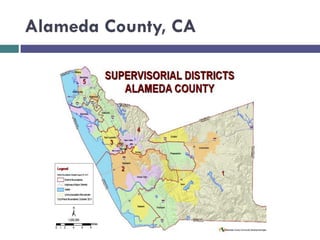
Alameda County, CA
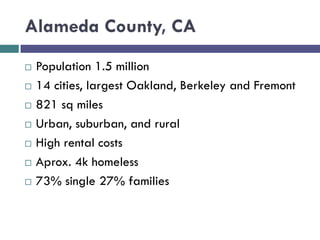
Alameda County, CA
 Population 1.5 million
 14 cities, largest Oakland, Berkeley and Fremont
 821 sq miles
 Urban, suburban, and rural
 High rental costs
 Aprox. 4k homeless
 73% single 27% families
Building Futures with
Women and Children
To build communities with women and children
where they are safely and supportively housed, free
from homelessness and domestic violence.
BFWC Services
 2 emergency homeless shelters for women and children
(55 beds)
 Domestic violence shelter (20 beds)
 52 units of transitional and permanent housing for
formally homeless survivors of domestic violence with
disabilities
 Full range of community domestic violence services
including support groups
 Housing Resource Center that provides homeless
prevention and rapid rehousing services (including
Supportive Services for Veterans Families program and
Family Reunification Housing program)
Program Description: What
Rapid rehousing and homeless prevention program
 Helps homeless parents obtain housing so child can be
returned to their custody
 Helps parents not suitably housed relocate to safe,
stable housing
 Helps families “in care” and at risk of homelessness
maintain permanent housing
 Provides housing search assistance, case management
and rental subsidies
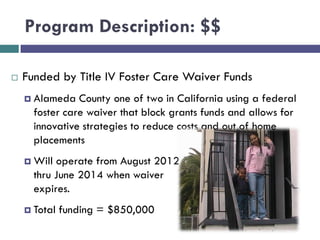
Program Description: $$
 Funded by Title IV Foster Care Waiver Funds
 Alameda County one of two in California using a federal
foster care waiver that block grants funds and allows for
innovative strategies to reduce costs and out of home
placements
 Will operate from August 2012
thru June 2014 when waiver
expires.
 Total funding = $850,000
How Did We Make this Happen?
 Used data
 Demonstrated overlap of foster care and shelter
families
 Demonstrated cost effectiveness of rapid rehousing
 “Our expertise can solve your problem”
 Made the case that stable housing supports successful
family reunification and we know housing
 Focus on housing services and some income supports,
not the clinical or parenting needs of the families
How Did We Make this Happen?
 Negotiated by EveryOne Home, Alameda County’s
CoC, rather than single provider
 Built on existing relationships and success of HPRP
 Program pilots are much easier to say yes to
Program Description: Who
For families in “Reunification” or “Maintenance” with
Child Welfare
 Reunification = children currently in foster care and
parent(s) that Child Welfare is working with to reunite
with kids. Families have a housing need that must be
addressed as part of the reunification process.
 Maintenance = children have been reunified with
parent(s) but the family faces a housing crisis.
 Families who have lost housing due to children being
taken from home.
Program Description: Partners
Abode Services and Building Futures: family and
rehousing providers provide the direct services
 EveryOne Home: takes referrals, developed forms
and procedures, manages reports
 Alameda County Housing and Community
Development: administers sub-contracts
 Alameda County Social Services Agency Child
Welfare: funder and source of referrals
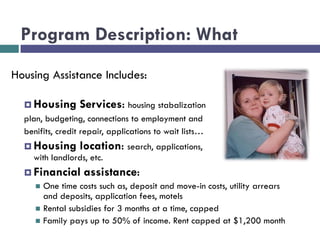
Program Description: What
Housing Assistance Includes:
 Housing Services: housing stabalization
plan, budgeting, connections to employment and
benifits, credit repair, applications to wait lists…
 Housing location: search, applications, negotiating
with landlords, etc.
 Financial assistance:
 One time costs such as, deposit and move-in costs, utility arrears
and deposits, application fees, motels
 Rental subsidies for 3 months at a time, capped
 Family pays up to 50% of income. Rent capped at $1,200 month
What We Are Learning?
 Income makes a difference
 19% of enrolled families have income over $1,000/month as reported at
time of referral
 36% have moved to PH so far compared to 13% of families with incomes
below $1,000/month
 The sample size is small so inconclusive
 A number of families are choosing site-based TH
 Some families in Reunification may benefit from longer
subsidies and more services than rapid rehousing
typically provides.
 A pilot is an excellent opportunity to advocate for
change!
What Are We Learning?
(as of 6/30/13)
 Households referred to program = 88
 Households enrolled = 78
 HUD homeless individuals = 25%
 Number of households into PH = 19
 Number of households into TH = 4
For more information:
Building Futures with Women and Children
San Leandro, CA
Website: www. bfwc.org
Email: lvarela@bfwc.org
Phone: 510-357-0205 x202
Liz Varela, Executive Director
For more information:
EveryOne Home, Alameda County, CA
• Website: www.everyonehome.org
• Email: everyonehome@acgov.org
• Phone: 510-670-9796
Executive Director, Elaine de Coligny
• Email: e.decoligny@acgov.org

Family Reunification Pilot, Alameda County, CA

  • 1.
    FAMILY REUNIFICATION HOUSING PILOT ALAMEDACOUNTY, CA 6.1 Partnering with Child Welfare Agencies to End Family Homelessness National Conference on Ending Homelessness Washington, DC July 22-24, 2013
  • 2.
  • 3.
    Alameda County, CA Population 1.5 million  14 cities, largest Oakland, Berkeley and Fremont  821 sq miles  Urban, suburban, and rural  High rental costs  Aprox. 4k homeless  73% single 27% families
  • 4.
    Building Futures with Womenand Children To build communities with women and children where they are safely and supportively housed, free from homelessness and domestic violence.
  • 5.
    BFWC Services  2emergency homeless shelters for women and children (55 beds)  Domestic violence shelter (20 beds)  52 units of transitional and permanent housing for formally homeless survivors of domestic violence with disabilities  Full range of community domestic violence services including support groups  Housing Resource Center that provides homeless prevention and rapid rehousing services (including Supportive Services for Veterans Families program and Family Reunification Housing program)
  • 6.
    Program Description: What Rapidrehousing and homeless prevention program  Helps homeless parents obtain housing so child can be returned to their custody  Helps parents not suitably housed relocate to safe, stable housing  Helps families “in care” and at risk of homelessness maintain permanent housing  Provides housing search assistance, case management and rental subsidies
  • 7.
    Program Description: $$ Funded by Title IV Foster Care Waiver Funds  Alameda County one of two in California using a federal foster care waiver that block grants funds and allows for innovative strategies to reduce costs and out of home placements  Will operate from August 2012 thru June 2014 when waiver expires.  Total funding = $850,000
  • 8.
    How Did WeMake this Happen?  Used data  Demonstrated overlap of foster care and shelter families  Demonstrated cost effectiveness of rapid rehousing  “Our expertise can solve your problem”  Made the case that stable housing supports successful family reunification and we know housing  Focus on housing services and some income supports, not the clinical or parenting needs of the families
  • 9.
    How Did WeMake this Happen?  Negotiated by EveryOne Home, Alameda County’s CoC, rather than single provider  Built on existing relationships and success of HPRP  Program pilots are much easier to say yes to
  • 10.
    Program Description: Who Forfamilies in “Reunification” or “Maintenance” with Child Welfare  Reunification = children currently in foster care and parent(s) that Child Welfare is working with to reunite with kids. Families have a housing need that must be addressed as part of the reunification process.  Maintenance = children have been reunified with parent(s) but the family faces a housing crisis.  Families who have lost housing due to children being taken from home.
  • 11.
    Program Description: Partners AbodeServices and Building Futures: family and rehousing providers provide the direct services  EveryOne Home: takes referrals, developed forms and procedures, manages reports  Alameda County Housing and Community Development: administers sub-contracts  Alameda County Social Services Agency Child Welfare: funder and source of referrals
  • 12.
    Program Description: What HousingAssistance Includes:  Housing Services: housing stabalization plan, budgeting, connections to employment and benifits, credit repair, applications to wait lists…  Housing location: search, applications, negotiating with landlords, etc.  Financial assistance:  One time costs such as, deposit and move-in costs, utility arrears and deposits, application fees, motels  Rental subsidies for 3 months at a time, capped  Family pays up to 50% of income. Rent capped at $1,200 month
  • 13.
    What We AreLearning?  Income makes a difference  19% of enrolled families have income over $1,000/month as reported at time of referral  36% have moved to PH so far compared to 13% of families with incomes below $1,000/month  The sample size is small so inconclusive  A number of families are choosing site-based TH  Some families in Reunification may benefit from longer subsidies and more services than rapid rehousing typically provides.  A pilot is an excellent opportunity to advocate for change!
  • 14.
    What Are WeLearning? (as of 6/30/13)  Households referred to program = 88  Households enrolled = 78  HUD homeless individuals = 25%  Number of households into PH = 19  Number of households into TH = 4
  • 15.
    For more information: BuildingFutures with Women and Children San Leandro, CA Website: www. bfwc.org Email: lvarela@bfwc.org Phone: 510-357-0205 x202 Liz Varela, Executive Director
  • 16.
    For more information: EveryOneHome, Alameda County, CA • Website: www.everyonehome.org • Email: everyonehome@acgov.org • Phone: 510-670-9796 Executive Director, Elaine de Coligny • Email: e.decoligny@acgov.org