The Future of Mobile Communications


Professor Rolando Carrasco
BSc(Hons), PhD, CEng, FIEE
R.Carrasco@newcastle.ac.uk

                             School of Electrical, Electronic
                             and Computing Engineering


                                                         1
Research Project 1

• The Capacity and Throughput Improvement of Fixed
  Broadband Wireless Access Systems
  Dr. Pei Xiao, Research Fellow (three years)
  Mr. M. K. Khan BEng, MSc, Research Student (2 1/2
  years)

  EPSRC Grant in collaboration with Dr. I. Wassell,
  Cambridge University and Cambridge Broadband Ltd

                                                      2
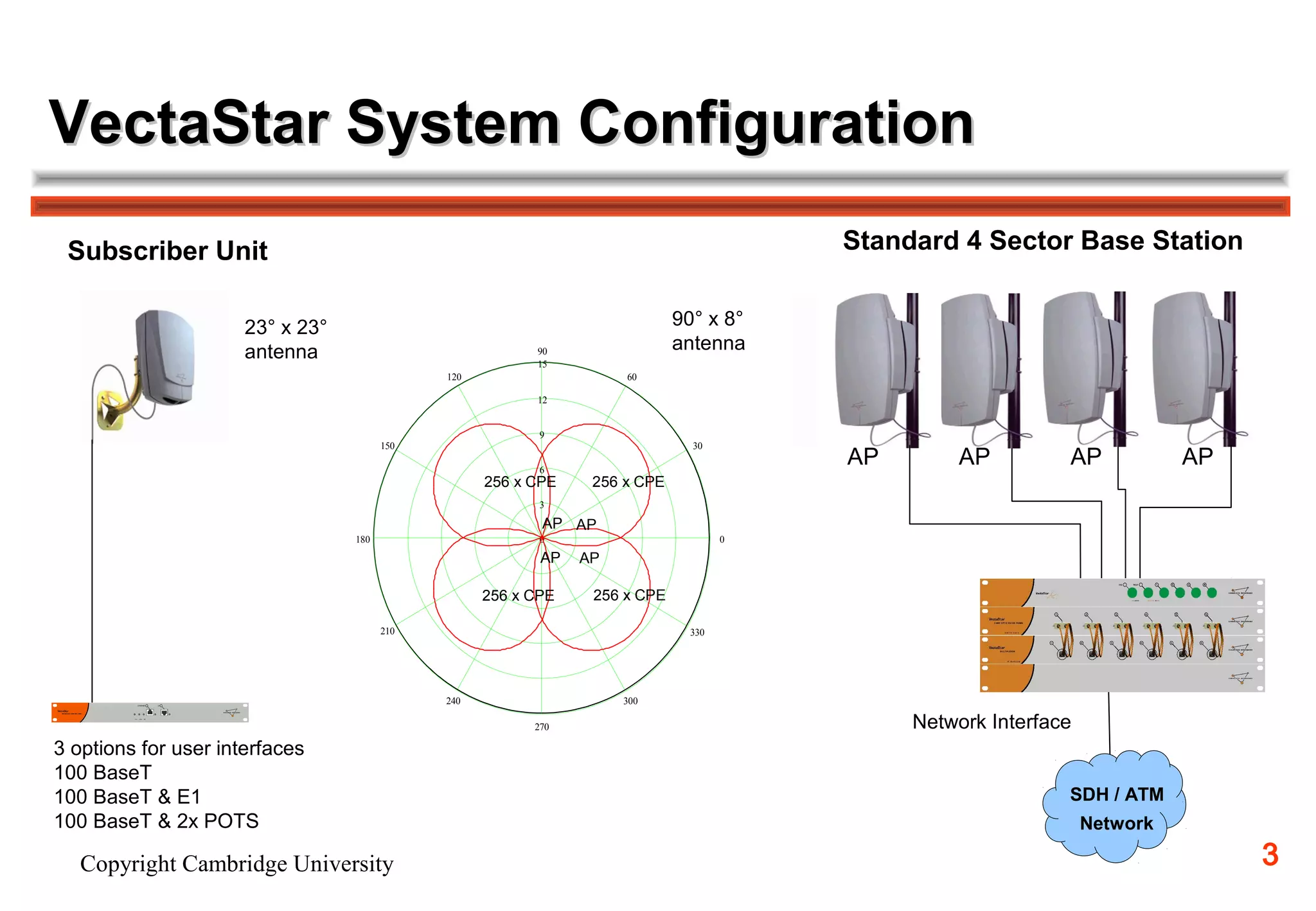
VectaStar System Configuration
 Subscriber Unit                                                                         Standard 4 Sector Base Station

                                                    AP beam patterns          90° x 8°
                      23° x 23°
                      antenna                              90                 antenna
                                                           15
                                              120                      60

                                                           12


                                                            9
                                        150                                     30

                                                            6
                                                                                         AP       AP          AP            AP
                                                     256 x CPE    256 x CPE
                                                            3

                                                            AP AP
                                  180                       0                        0

                                                            AP   AP

                                                     256 x CPE    256 x CPE

                                        210                                    330


                                              240                      300

                                                           270                                Network Interface
3 options for user interfaces
100 BaseT
100 BaseT & E1                                                                                                SDH / ATM
100 BaseT & 2x POTS                                                                                               Network

   Copyright Cambridge University                                                                                                3
Research Project 2

• Space-Time Diversity Coding Combined with
  Equalisation for MIMO Wireless Channels.
  Mr. Cameron B Shaw BEng(Hons), MEng
  (PhD Student), 15 months remaining

 EPSRC grant in collaboration with Lancaster
 University (Professor Honary) and MOD
 (Ministry Of Defence)
                                               4
The world of mobile communications


•Have you ever heard the phrase “the future is
here today”? Well, in the case of mobile
communication technologies, this phrase is true.

•However, it is not yet fully realized.


                                                   5
Contents

• Introduction
• Challenges in the Migration to Future
  Mobile Systems
• 2G, 3G and 4G wireless systems
• Research Challenges:
  – Mobile Stations, Systems, Services
• Conclusion
                                          6
Introduction (2)

 • 2G Mobile Systems
   – GSM, IS-95 and CDMA one carry speech and low bit
     rate data
 • 3G Mobile Systems
   –   Higher data rate
   –   Multi-media systems
   –   GPRS
   –   IMT 2000
   –   Bluetooth
   –   WLAN and HiperLAN
   –   Developing new standards and hardware            7
4G Mobile Systems (2006)


•   Access, handoff
•   Location coordination
•   Resource coordination to add new users
•   Support for multicasting and Quality of Service
•   Wireless security and authentication
•   Network failure and backup
•   Pricing and billing
                                                      8
The world of mobile communications

•Out of a world population of 6.32 billion people,
approximately 1.12 billion, or 1 in 6, have a mobile phone
and 71.6% are GSM customers

•Total Operator revenues for 2006 have been estimated
to be over $100 billion for Western Europe

•China Mobile with over 100 million customers are
connecting 2 million new customers each month

•About 2 billion people in the world have yet to make a
phone call and it is likely that when it happens it will be on   9
a mobile phone rather than a fixed line
What is Wireless Data?

• Paging/short messaging
• Vehicle tracking and dispatch
• Transaction processing
• Warehouse inventory
• Subscriber information services
• Wireless remote access to host
• File transfer to/from laptop,J2ME
• Wireless Internet access and Video
  Teleconferencing
• Browsing on Laptops, PDAs ,Phones
                                         10
• Messaging,E-mail,SMS,Fax,Voice,Pager
Mobile Computing Systems


• Future Mobile Systems
  – Personalised Services providing stable system
    performance and Quality of Service (QoS)
  – Challenges:
    • Mobile Station
    • System(Networks)
    • Service and standards
    Mobile VCE (www.mobilevce.com), MIRAI and DocoMo

     VCE = Virtual Centre of Excellence in Mobile and Personal Communication   11
Mobile Computing Systems


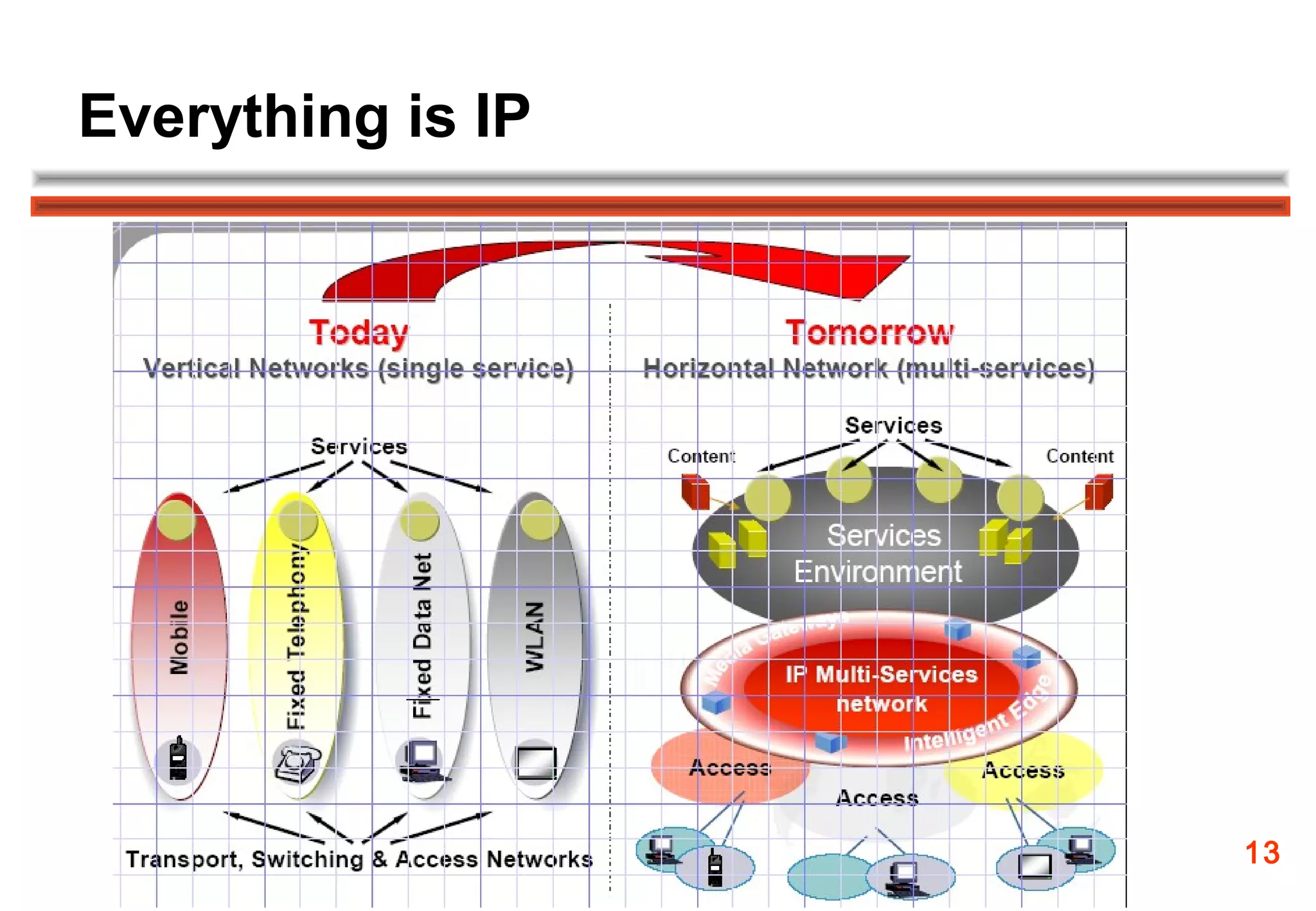
• Some key features of Future Mobile Systems
  – High usability:
     • Anytime, anywhere and with any technology (all-IP
       based heterogeneous networks)
  – Support for Multi-media Services at low
    transmission cost
  – Personalisation(having human characteristics)
  – Integrated Services

                                                           12
Everything is IP


                   13
Research Challenges

 • Mobile Station
   – Multimode user terminals(multi-functional,software upgrades)
   – Wireless system discovery(searching for wireless system)
   – Wireless system selection(suitable technology)
 • System
   –   Terminal Mobility(to locate and update the locations)
   –   Network infrastructure and QoS support
   –   Security, performance and complexity
   –   Fault tolerance and Survivability
 • Service
   – Multi-operators and billing system
   – Personal mobility
   – New Applications                                               14
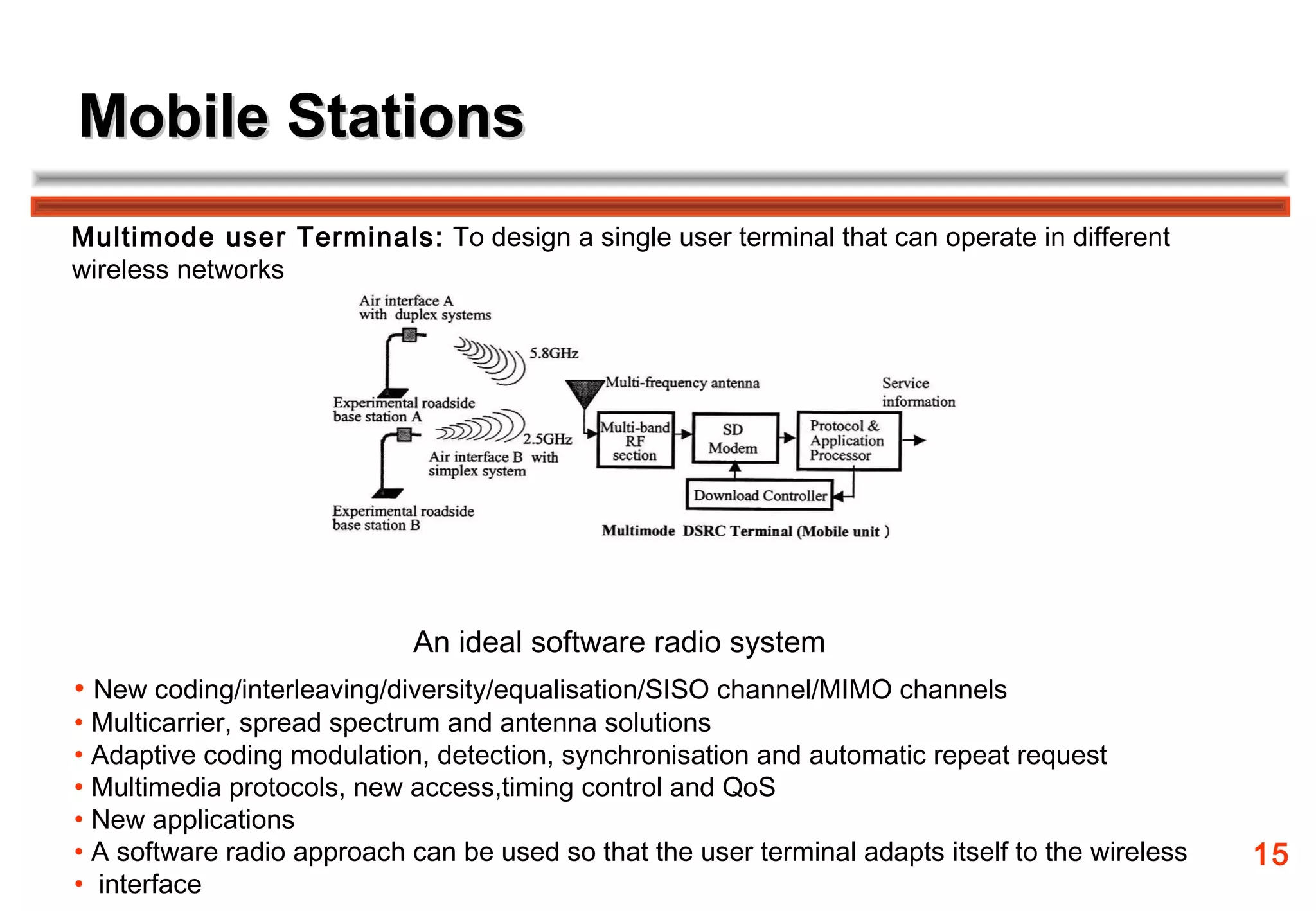
Mobile Stations
Multimode user Terminals: To design a single user terminal that can operate in different
wireless networks


                            An ideal software radio system
• New coding/interleaving/diversity/equalisation/SISO channel/MIMO channels
• Multicarrier, spread spectrum and antenna solutions
• Adaptive coding modulation, detection, synchronisation and automatic repeat request
• Multimedia protocols, new access,timing control and QoS
• New applications
• A software radio approach can be used so that the user terminal adapts itself to the wireless   15
• interface
Technical Challenges


• Low-Power/Low-Cost Implementations
• Scarce Radio Spectrum
• Radio Channel Characteristics
  - Limits on Signal Coverage
  - Limits on Data Rates
• Efficient Network Architectures and Protocols
• Seamless Internetworking
• Authentication and Security                     16
Radio Environment


•   Path Loss
•   Shadow Fading
•   Multipath
•   Interference
•   Infrared Versus Radio
•   Doppler Spread

                            17
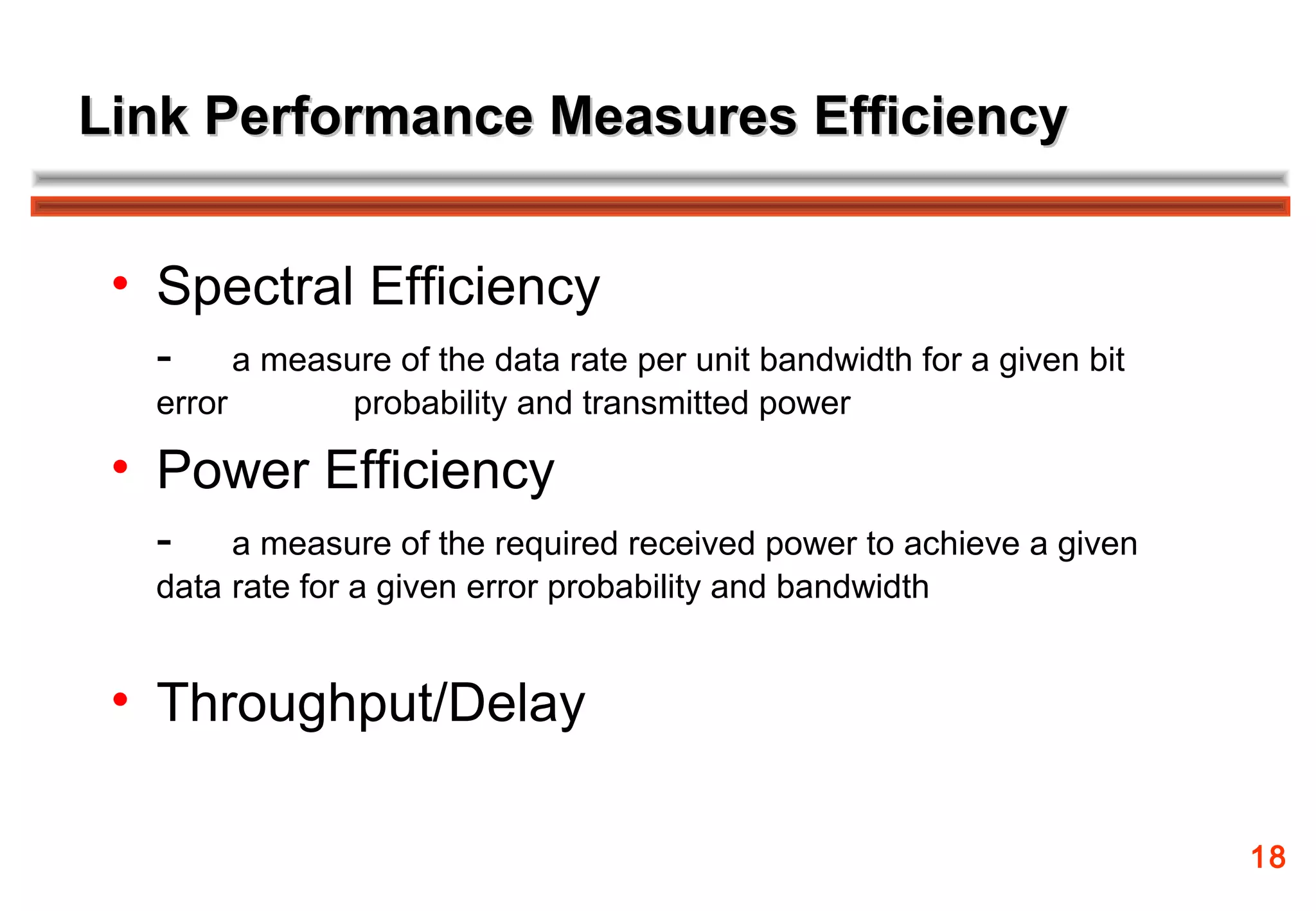
Link Performance Measures Efficiency


 • Spectral Efficiency
  -     a measure of the data rate per unit bandwidth for a given bit
  error        probability and transmitted power

 • Power Efficiency
  -    a measure of the required received power to achieve a given
  data rate for a given error probability and bandwidth


 • Throughput/Delay

                                                                        18
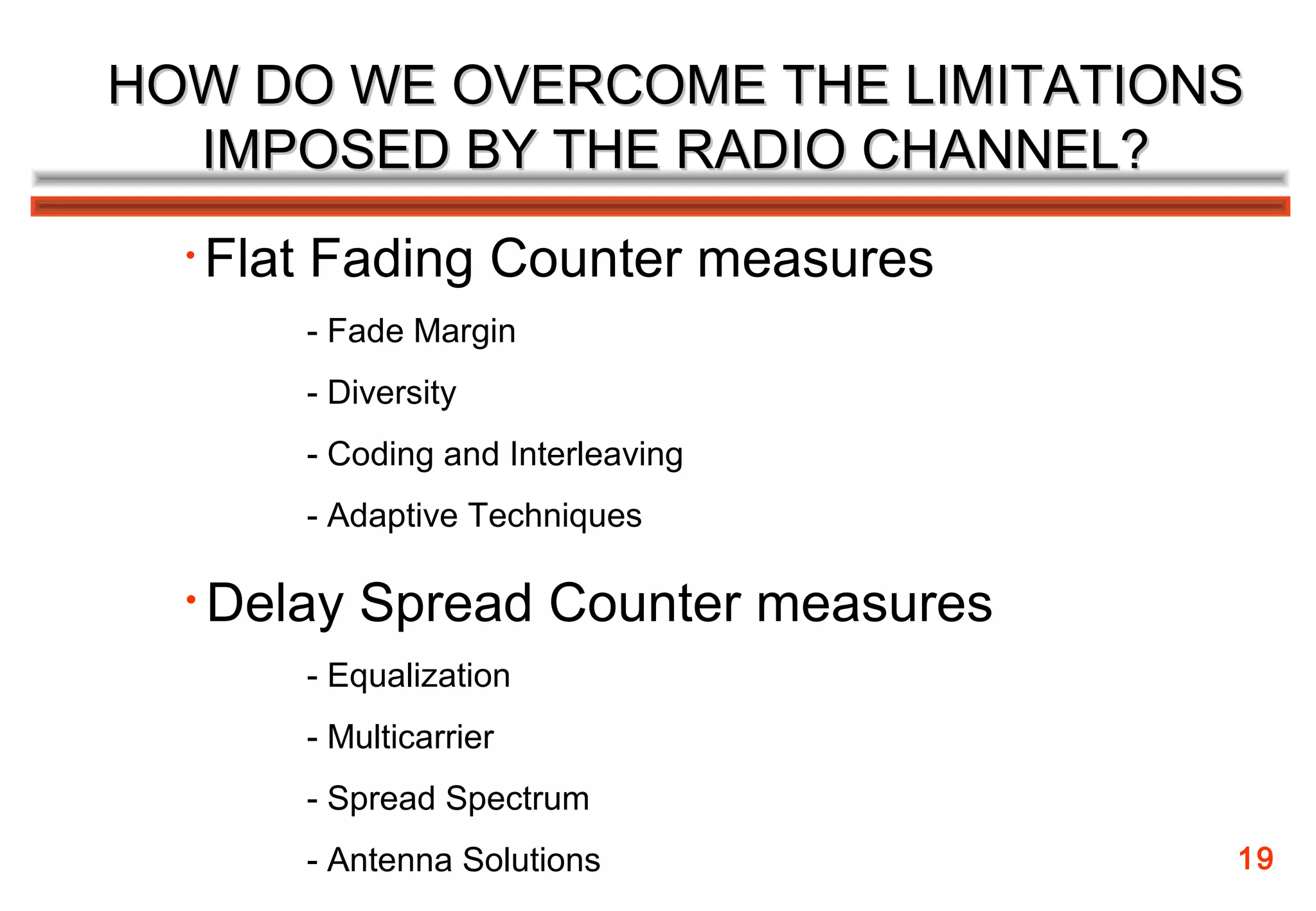
HOW DO WE OVERCOME THE LIMITATIONS
  IMPOSED BY THE RADIO CHANNEL?
  •   Flat Fading Counter measures
         - Fade Margin
         - Diversity
         - Coding and Interleaving
         - Adaptive Techniques

  •   Delay Spread Counter measures
         - Equalization
         - Multicarrier
         - Spread Spectrum
         - Antenna Solutions          19
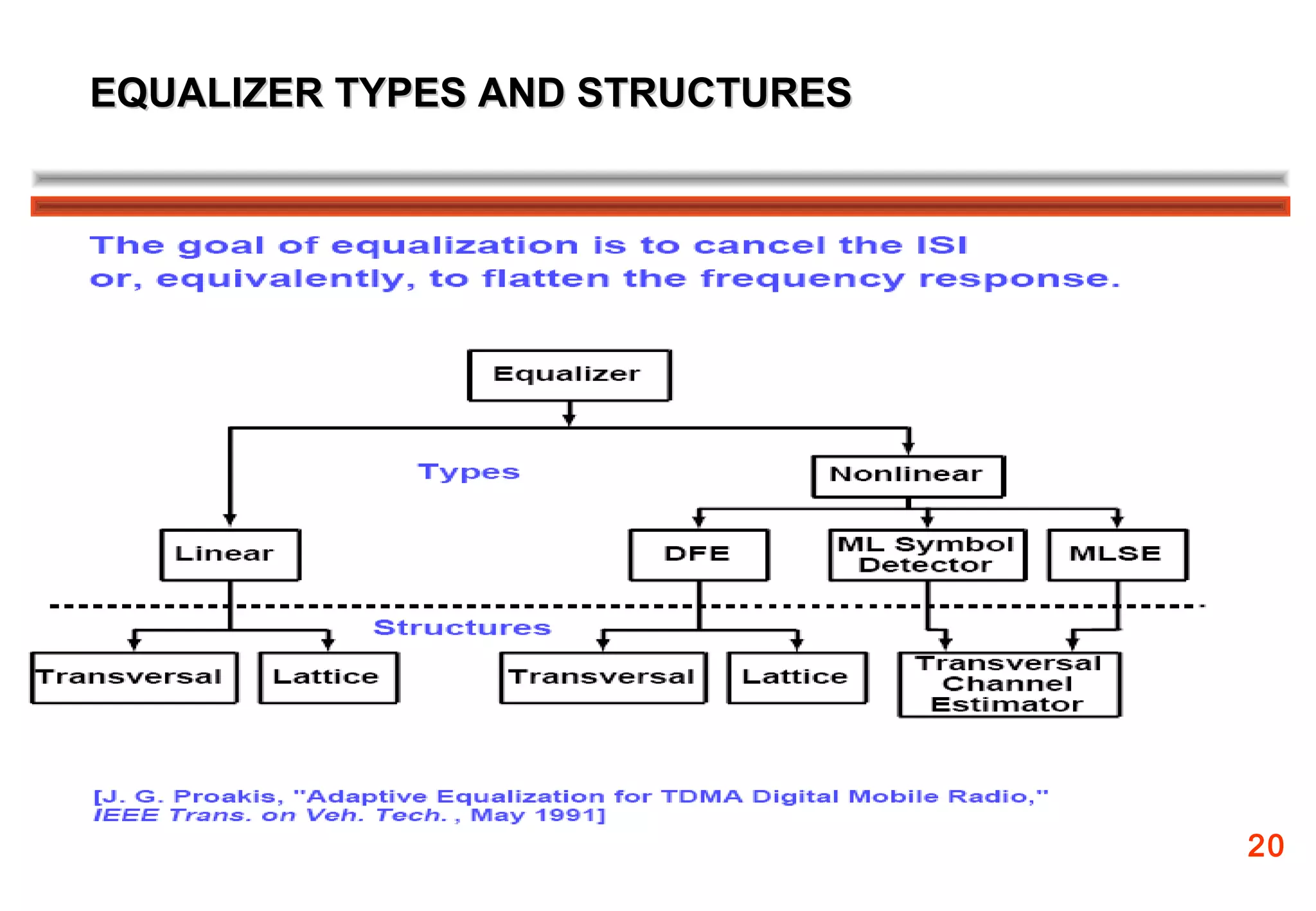
EQUALIZER TYPES AND STRUCTURES


                                 20
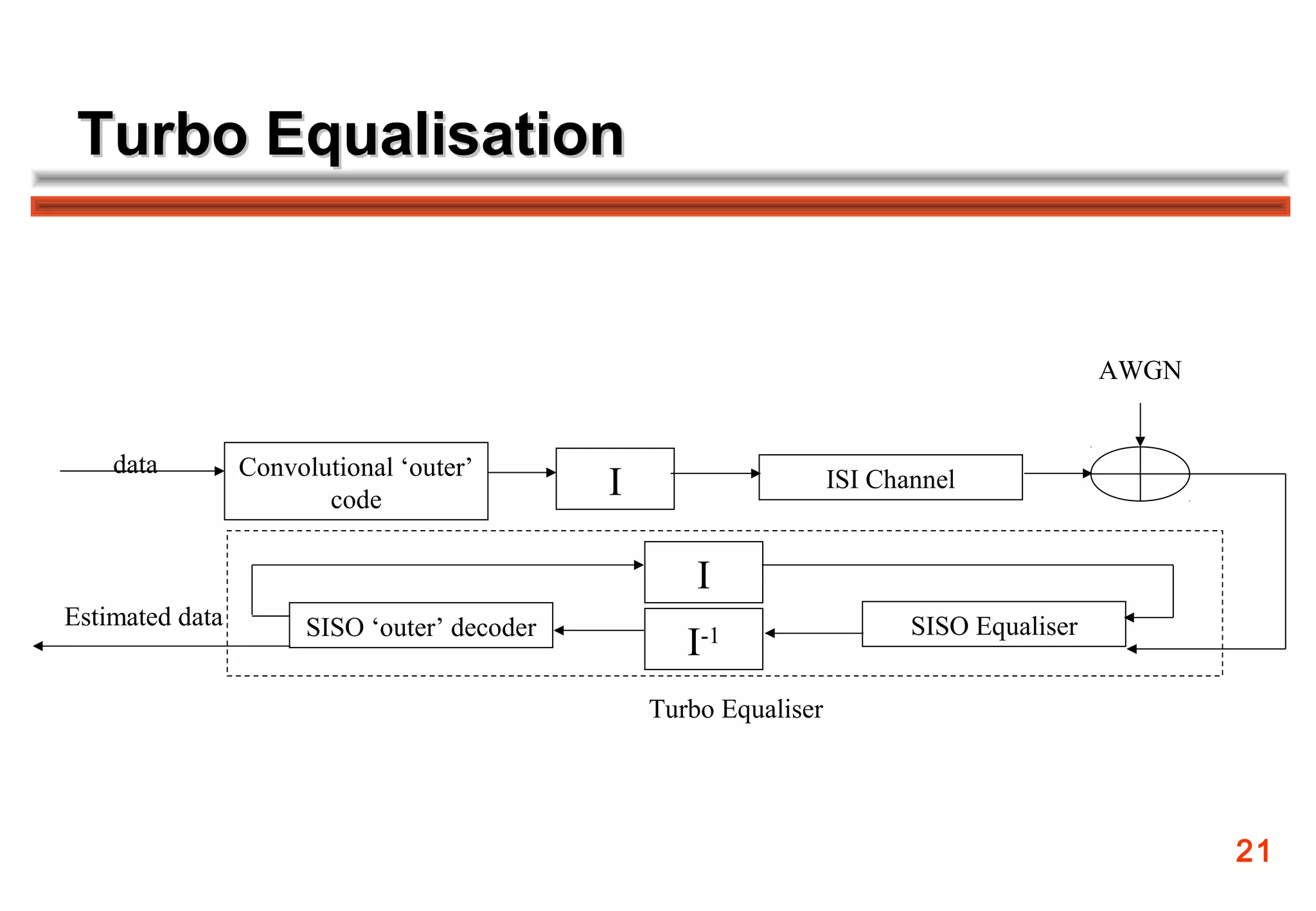
Turbo Equalisation


                                                                                            AWGN


    data         Convolutional ‘outer’
                        code                  I                     ISI Channel


                                                      I
Estimated data         SISO ‘outer’ decoder                                SISO Equaliser
                                                     I-1
                                                  Turbo Equaliser


                                                                                                   21
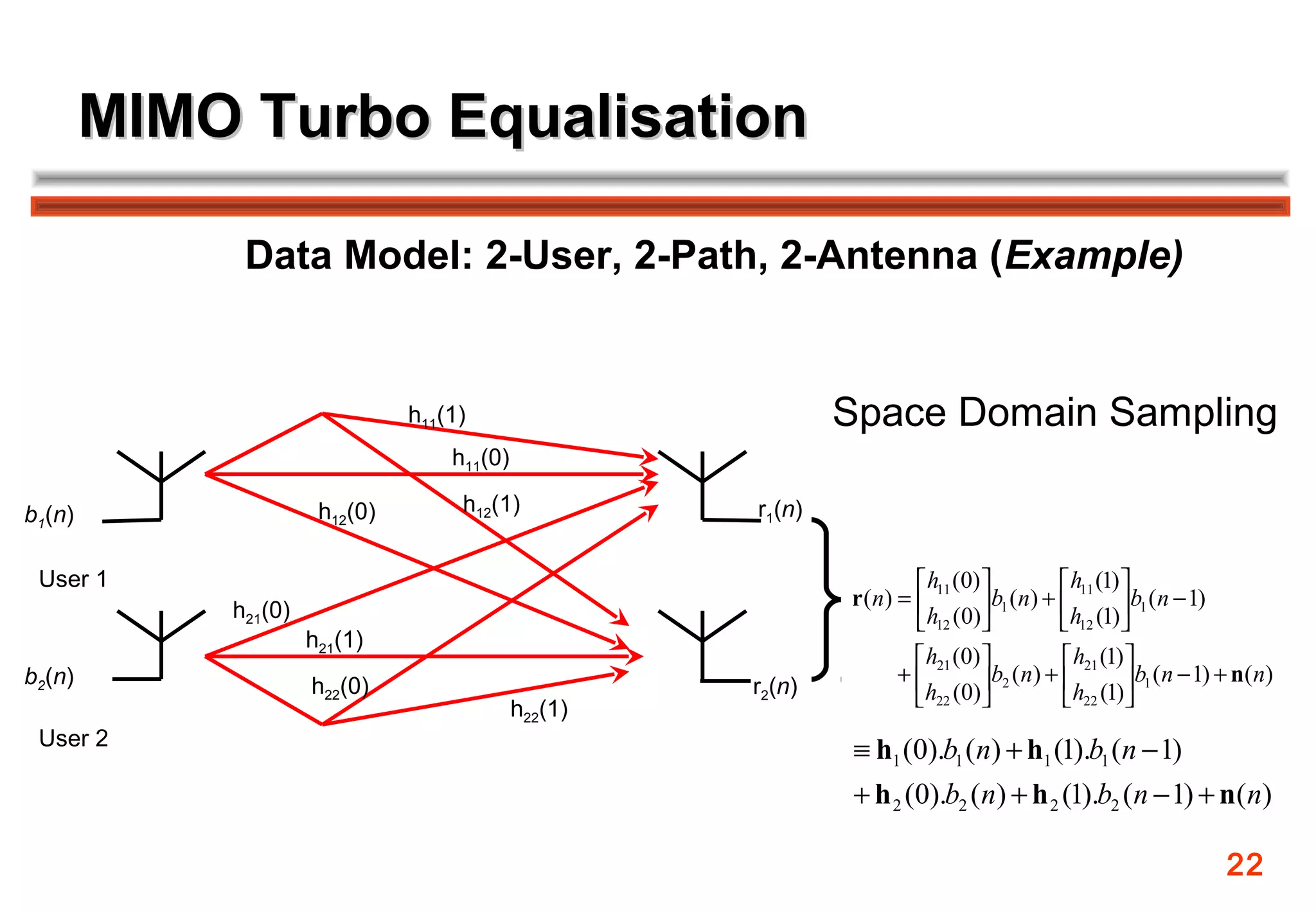
MIMO Turbo Equalisation

             Data Model: 2-User, 2-Path, 2-Antenna (Example)


                               h11(1)                        Space Domain Sampling
                                   h11(0)

b1(n)                 h12(0)        h12(1)           r1(n)

 User 1                                                               h (0)        h (1) 
                                                             r (n) =  11 b1 (n) +  11 b1 (n − 1)
            h21(0)                                                   h12 (0)      h12 (1)
                     h21(1)
                                                                      h ( 0)       h (1) 
b2(n)                                                              +  21 b2 (n) +  21 b1 (n − 1) + n(n)
                     h22(0)                          r2(n)
                                            h22(1)                   h22 (0)      h22 (1)
 User 2
                                                              ≡ h1 (0).b1 (n) + h1 (1).b1 (n − 1)
                                                              + h 2 (0).b2 (n) + h 2 (1).b2 (n − 1) + n(n)

                                                                                                     22
Algebraic-Geometric Codes

•   Algebraic geometry is a powerful tool for constructing codes with good parameters
    e.g. Hamming distance, code rate and large code length.

•   Very long codes can be constructed by choosing curves containing many points.
    Reed Solomon codes are constructed from a line, which has less points, and
    hence they are much shorter than AG codes

•   There is almost no limit to the number of AG codes that can be constructed from a
    variety of different classes of curve. There are not many Reed Solomon codes.
•   AG codes perform better than Reed Solomon codes for high code rates over
    smaller finite fields and are suitable for application in mobile communications and
    storage devices

•   Further investigation is needed into constructing new codes from different classes
    of curves and the development of low complexity decoding algorithms for future
    hardware implementation.
                                                                                          23
Algebraic-Geometric Codes

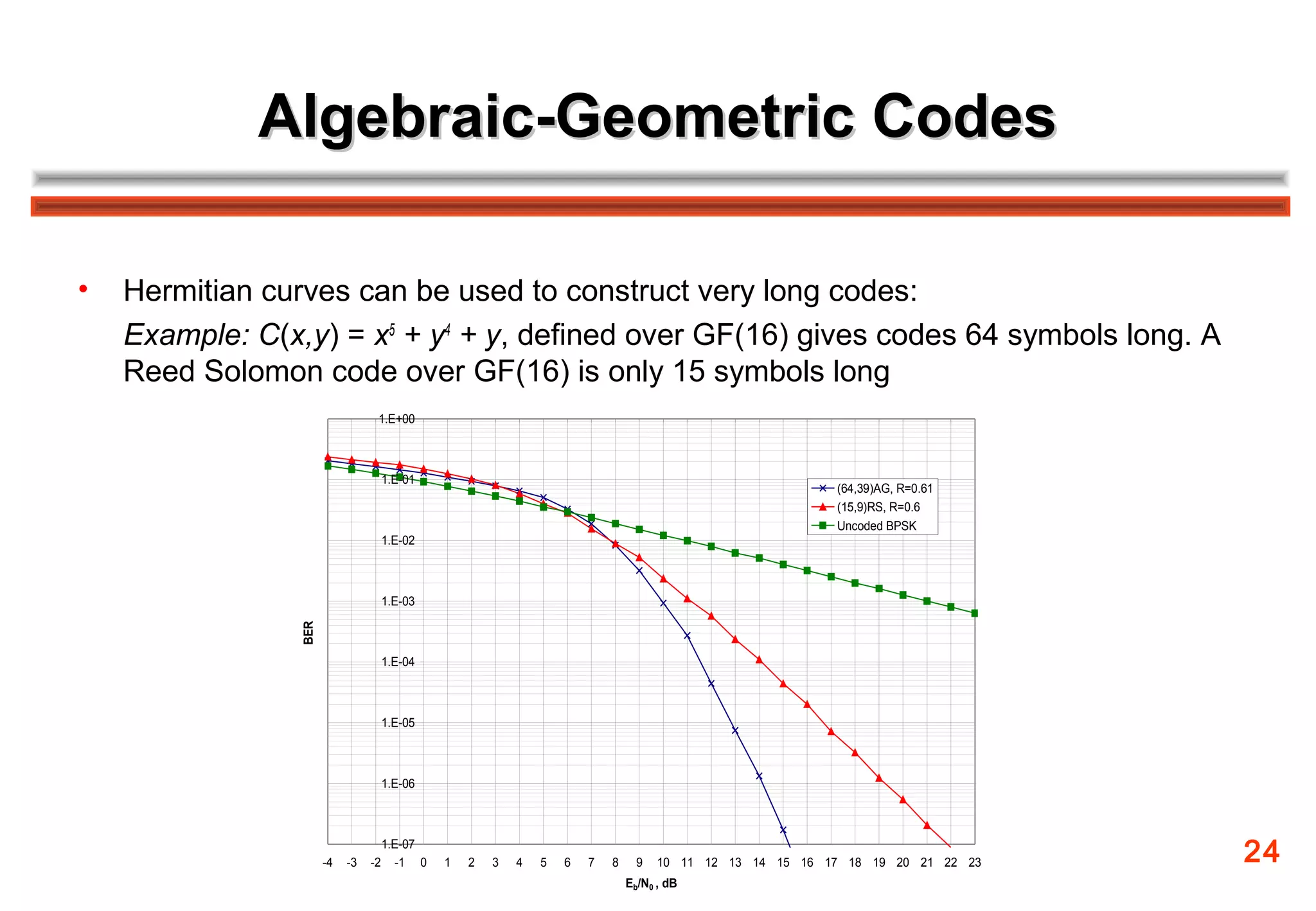
•   Hermitian curves can be used to construct very long codes:
    Example: C(x,y) = x5 + y4 + y, defined over GF(16) gives codes 64 symbols long. A
    Reed Solomon code over GF(16) is only 15 symbols long
                                  1.E+00


                                      1.E-01
                                                                                                           (64,39)AG, R=0.61
                                                                                                           (15,9)RS, R=0.6
                                                                                                           Uncoded BPSK
                                      1.E-02


                                      1.E-03
                 BER


                                      1.E-04


                                      1.E-05


                                      1.E-06


                       -4   -3   -2
                                      1.E-07
                                        -1 0   1   2   3   4   5   6   7   8     9   10 11 12 13 14 15 16 17 18 19 20 21 22 23   24
                                                                               Eb/N0 , dB
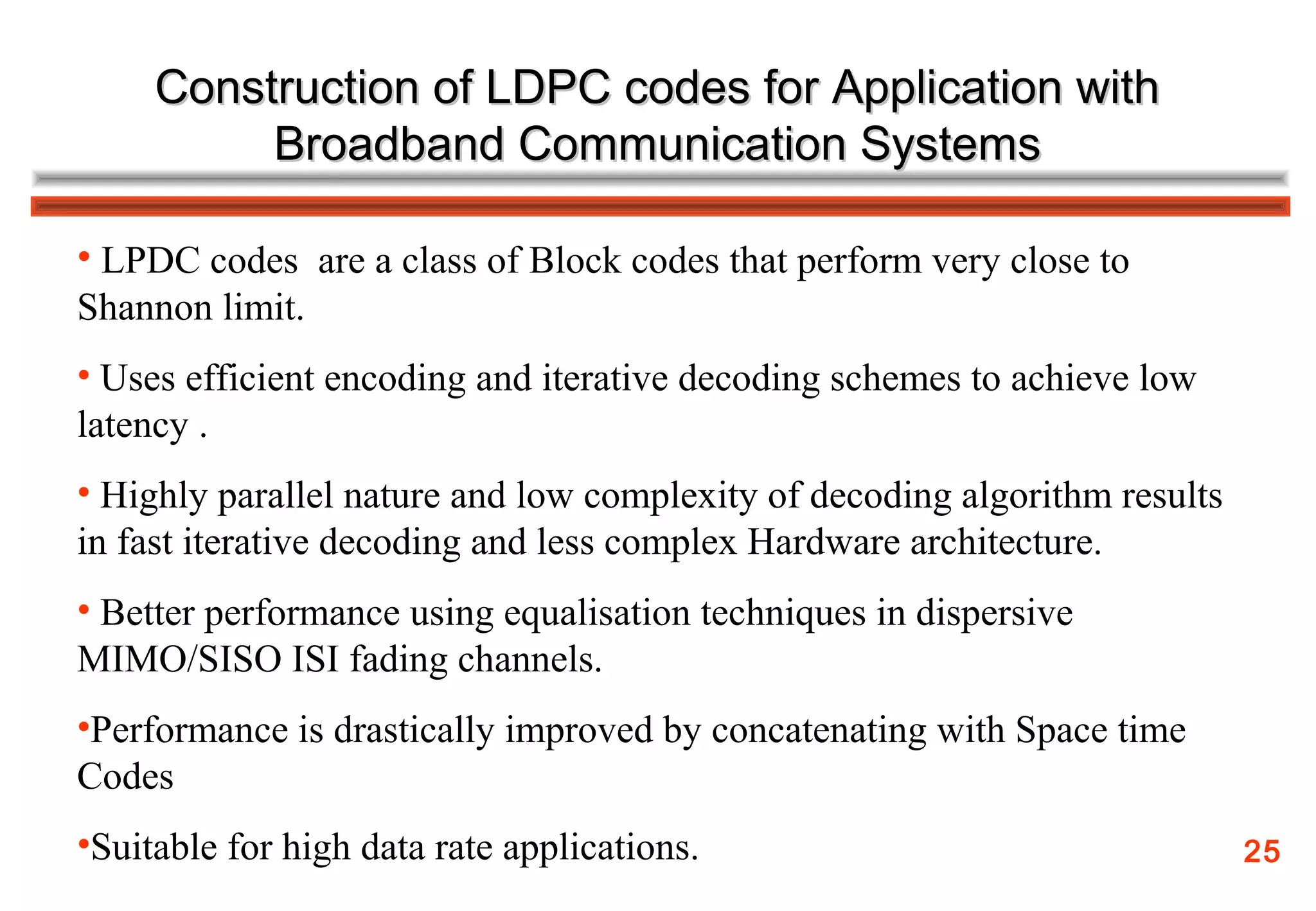
Construction of LDPC codes for Application with
          Broadband Communication Systems

• LPDC codes are a class of Block codes that perform very close to
Shannon limit.
• Uses efficient encoding and iterative decoding schemes to achieve low
latency .
• Highly parallel nature and low complexity of decoding algorithm results
in fast iterative decoding and less complex Hardware architecture.
• Better performance using equalisation techniques in dispersive
MIMO/SISO ISI fading channels.
•Performance is drastically improved by concatenating with Space time
Codes
•Suitable for high data rate applications.                                  25
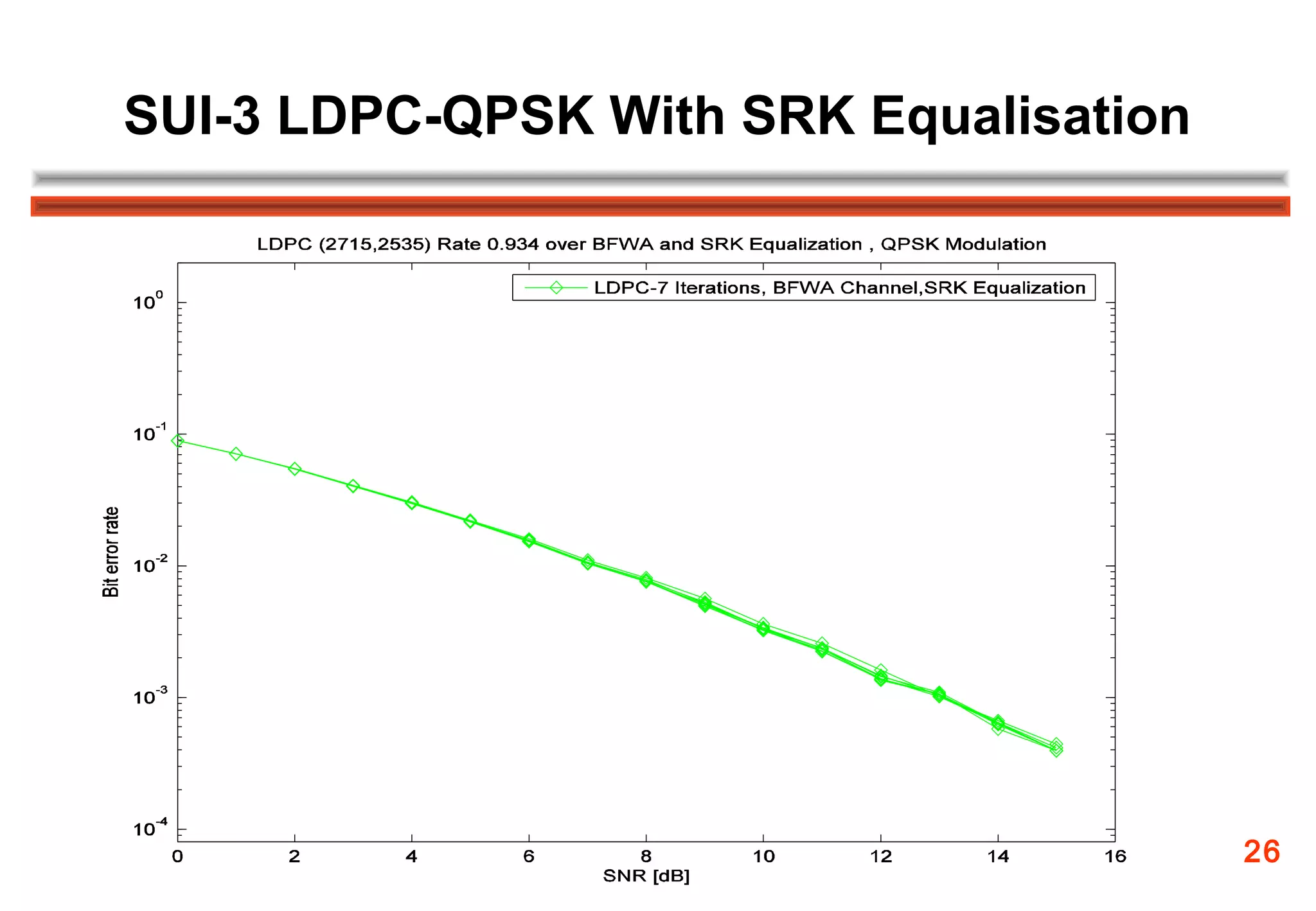
SUI-3 LDPC-QPSK With SRK Equalisation


                                        26
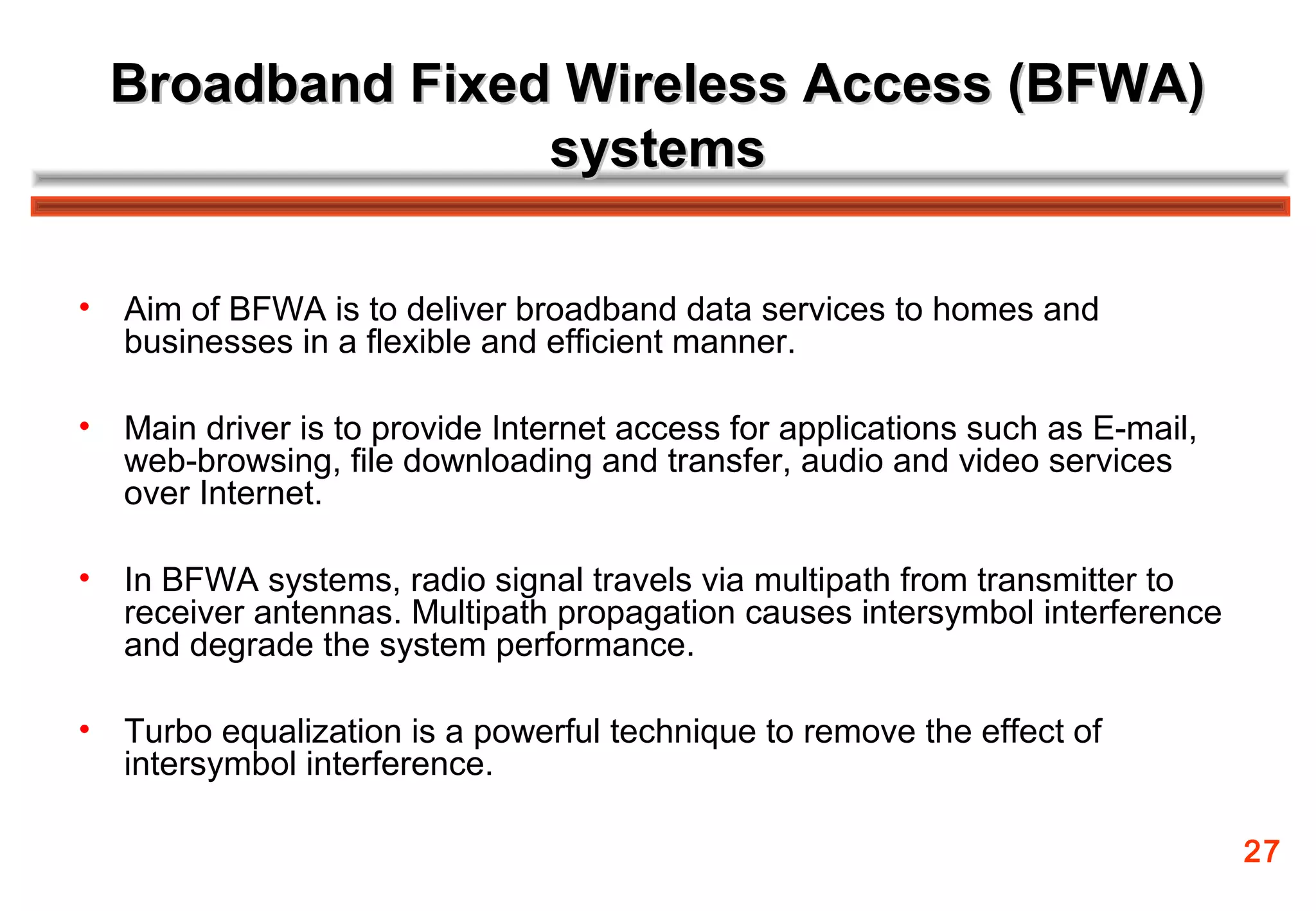
Broadband Fixed Wireless Access (BFWA)
                   systems

•   Aim of BFWA is to deliver broadband data services to homes and
    businesses in a flexible and efficient manner.

•   Main driver is to provide Internet access for applications such as E-mail,
    web-browsing, file downloading and transfer, audio and video services
    over Internet.

•   In BFWA systems, radio signal travels via multipath from transmitter to
    receiver antennas. Multipath propagation causes intersymbol interference
    and degrade the system performance.

•   Turbo equalization is a powerful technique to remove the effect of
    intersymbol interference.

                                                                                 27
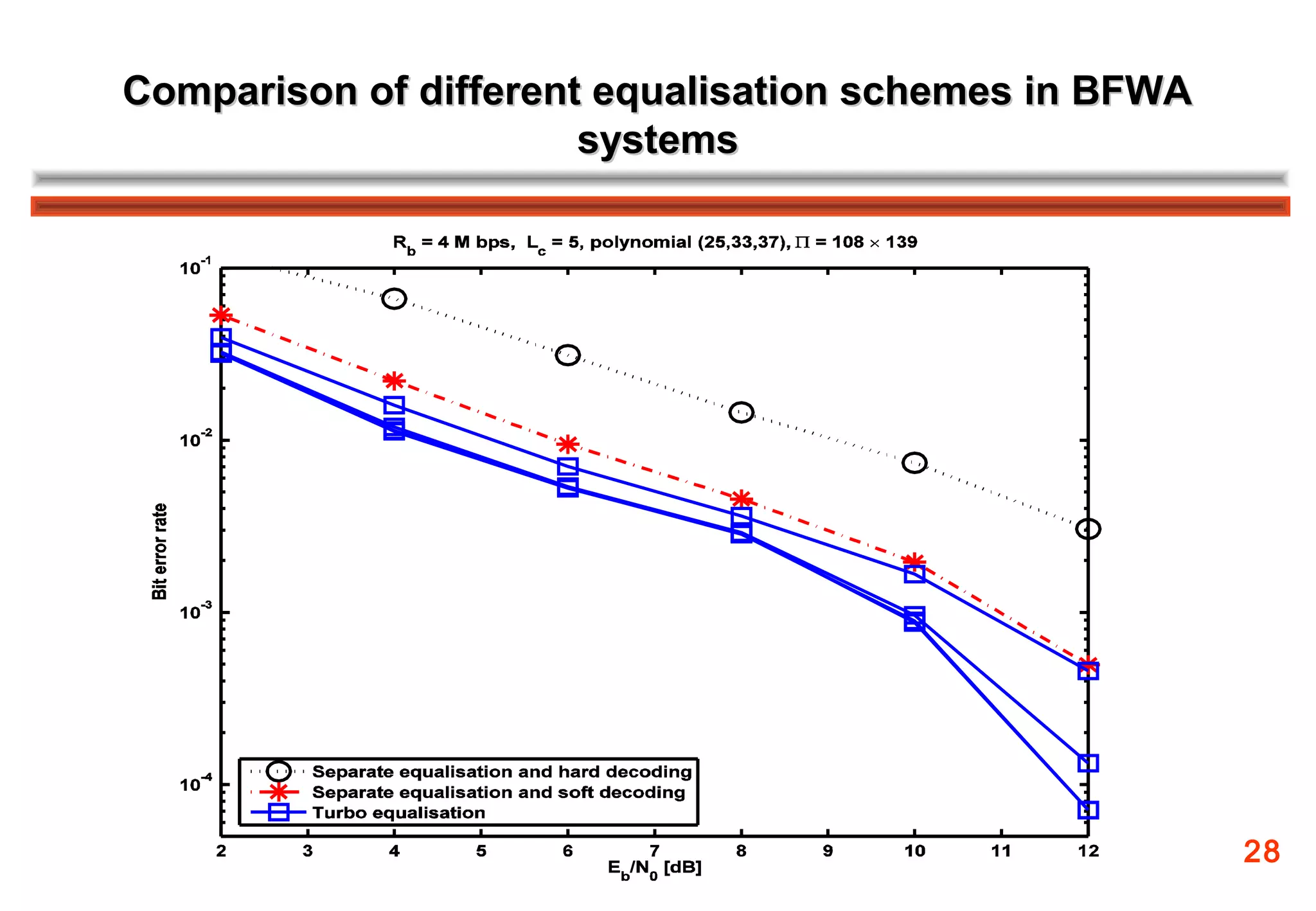
Comparison of different equalisation schemes in BFWA
                       systems


                                                       28
MIMO Channels for BFWA Systems

• Use MIMO space-time coding to increase the capacity of
  BFWA system.
• Signals from different antennas can be separated through
  orthogonal design, such as Alamouti algorithm.
• When used over frequency selective channels, a channel
  equalizer has to be used at the receiver along with the space-
  time decoder.
• STBC can be applied in conjunction with OFDM which
  converts the frequency selective channel into a set of
  independent parallel frequency-flat subchannels. The
  Alamouti scheme is then applied to each subcarrier.

                                                                   29
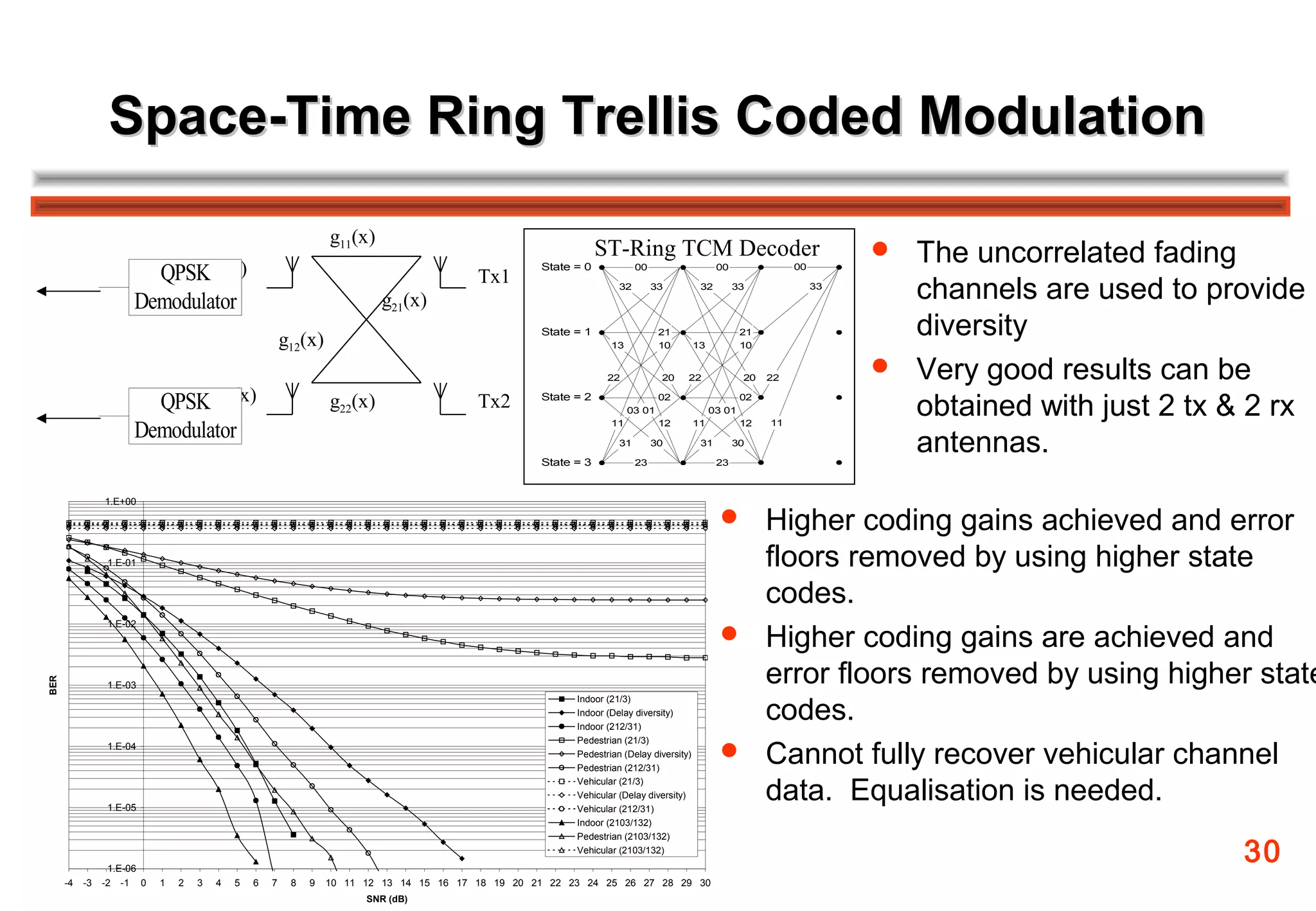
Space-Time Ring Trellis Coded Modulation

                                                               g11(x)
                                                                                                             ST-Ring TCM Decoder                                        The uncorrelated fading
                          QPSKr1(x)                                                    Tx1
                                                                                                 State = 0            00                    00               00


                     Demodulator                                        g21(x)
                                                                                                                 32        33          32        33               33
                                                                                                                                                                         channels are used to provide
                                                      g12(x)
                                                                                                 State = 1
                                                                                                               13
                                                                                                                            21
                                                                                                                            10        13
                                                                                                                                                   21
                                                                                                                                                   10
                                                                                                                                                                         diversity
                                                                                                              22            20    22               20   22
                                                                                                                                                                        Very good results can be
                          QPSK r2(x)                           g22(x)                  Tx2       State = 2
                                                                                                                    03 01
                                                                                                                            02
                                                                                                                                           03 01
                                                                                                                                                   02
                                                                                                                                                                         obtained with just 2 tx & 2 rx
                     Demodulator                                                                               11           12        11           12   11


                                                                                                 State = 3
                                                                                                                 31

                                                                                                                      23
                                                                                                                           30          31

                                                                                                                                            23
                                                                                                                                                 30
                                                                                                                                                                         antennas.
                1.E+00

                                                                                                                                              Higher coding gains achieved and error
                1.E-01                                                                                                                         floors removed by using higher state
                                                                                                                                               codes.
                1.E-02
                                                                                                                                              Higher coding gains are achieved and
                                                                                                                                               error floors removed by using higher state
BER


                1.E-03


                                                                                                                                               codes.
                                                                                                       Indoor (21/3)
                                                                                                       Indoor (Delay diversity)
                                                                                                       Indoor (212/31)
                                                                                                       Pedestrian (21/3)
                1.E-04
                                                                                                       Pedestrian (Delay diversity)           Cannot fully recover vehicular channel
                                                                                                       Pedestrian (212/31)


                                                                                                                                               data. Equalisation is needed.
                                                                                                       Vehicular (21/3)
                                                                                                       Vehicular (Delay diversity)
                1.E-05                                                                                 Vehicular (212/31)
                                                                                                       Indoor (2103/132)


                                                                                                                                                                                                  30
                                                                                                       Pedestrian (2103/132)
                                                                                                       Vehicular (2103/132)
                 1.E-06
      -4   -3   -2 -1 0   1   2   3   4   5   6   7    8   9   10 11 12 13 14 15 16 17 18 19 20 21 22 23 24 25 26 27 28 29 30
                                                                     SNR (dB)
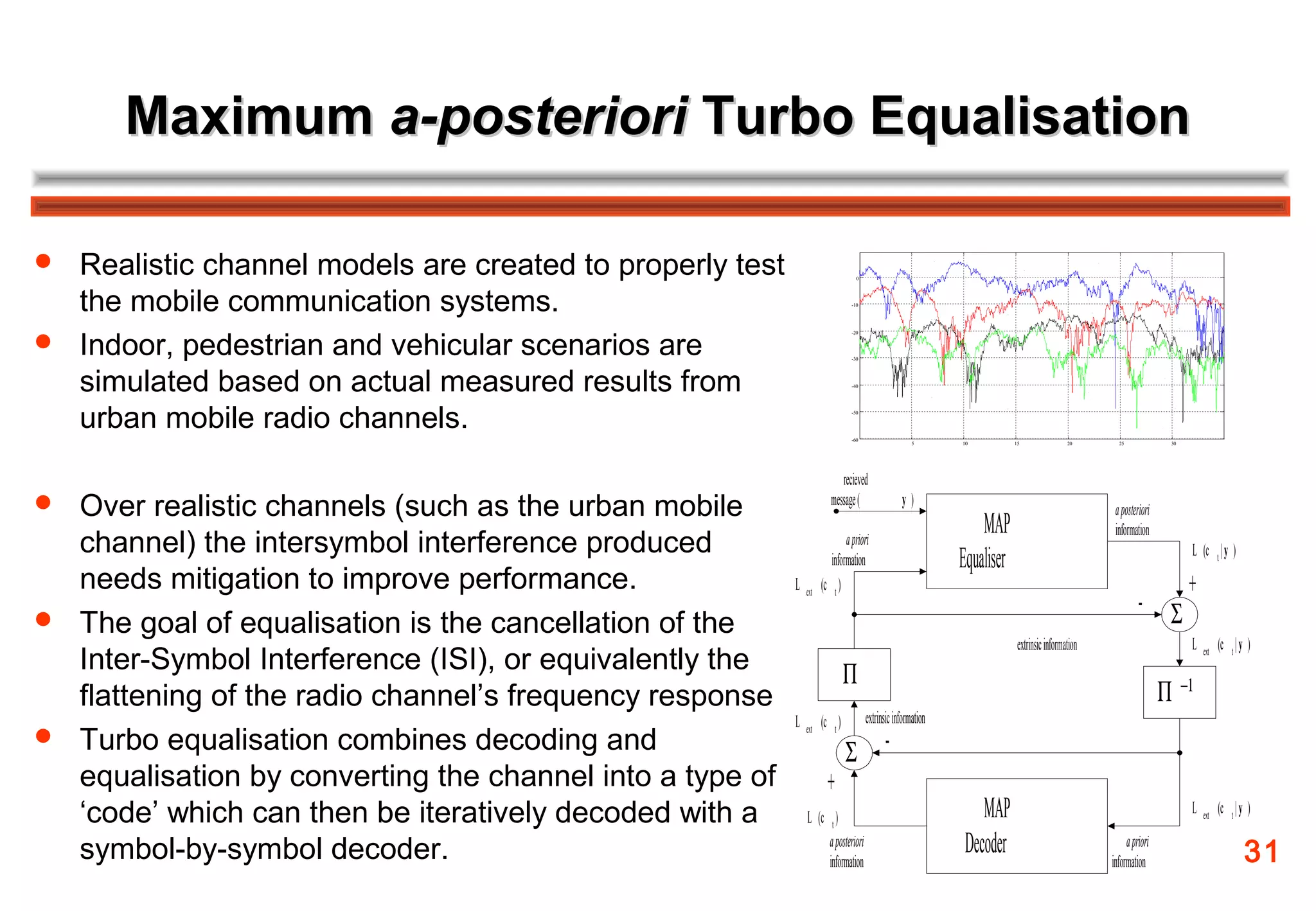
Maximum a-posteriori Turbo Equalisation

 Realistic channel models are created to properly test                         0


  the mobile communication systems.                                           -10


 Indoor, pedestrian and vehicular scenarios are
                                                                              -20


                                                                              -30


  simulated based on actual measured results from                             -40


  urban mobile radio channels.                                                -50


                                                                              -60
                                                                                                    5       10          15                20       25             30


                                                                          recieved
 Over realistic channels (such as the urban mobile                    message (                y)
                                                                                                                                                  a posteriori
                                                                                                                MAP                               information
  channel) the intersymbol interference produced                            a priori
                                                                                                                                                                       L (c t | y )
                                                                       information                          Equaliser
  needs mitigation to improve performance.                L         (c t )                                                                                             +
                                                                                                                                                          - Σ
                                                              ext

 The goal of equalisation is the cancellation of the
                                                                                                                         extrinsic information                         L         (c t | y )
  Inter-Symbol Interference (ISI), or equivalently the                       Π
                                                                                                                                                                           ext


  flattening of the radio channel’s frequency response                                                                                                           Π −1
                                                          L         (c t )          extrinsic information
 Turbo equalisation combines decoding and
                                                                             Σ -
                                                              ext


  equalisation by converting the channel into a type of               +
  ‘code’ which can then be iteratively decoded with a         L (c t )                                          MAP                                                    L   ext
                                                                                                                                                                                 (c t | y )

  symbol-by-symbol decoder.                                        a posteriori
                                                                   information
                                                                                                             Decoder                                  a priori
                                                                                                                                                 information                             31
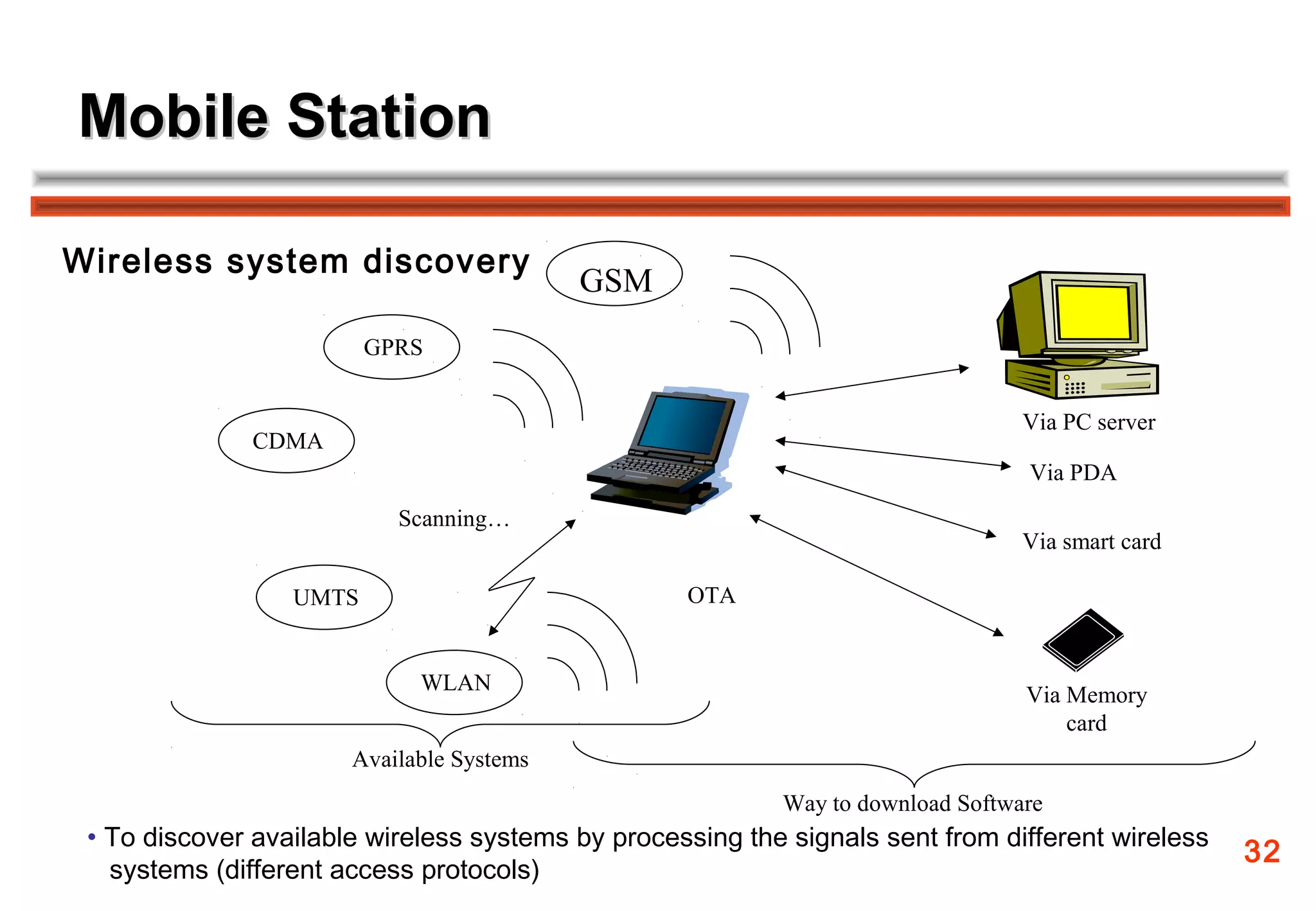
Mobile Station

Wireless system discovery
                                           GSM
                         GPRS


                                                                                 Via PC server
               CDMA
                                                                                 Via PDA
                           Scanning…
                                                                                 Via smart card

                  UMTS                             OTA


                             WLAN
                                                                                 Via Memory
                                                                                     card
                       Available Systems
                                                           Way to download Software
 • To discover available wireless systems by processing the signals sent from different wireless
                                                                                                   32
   systems (different access protocols)
Mobile Station

Wireless System Selection: Selection of the most suitable
 technology for a particular service

• We can choose any available wireless device for each particular
  communication session (fit to user QoS requirements)

• Right network selection can ensure the QoS required by each Session Initiation
  Protocol (SIP) messages.

• Adequate knowledge of each network is required before a selection is made
  Location information of the source mobile nodes, available networks of both
  mobile nodes and user preference are all taken into account in the selection
  when a mobile node makes a call to another mobile node

                                                                                   33
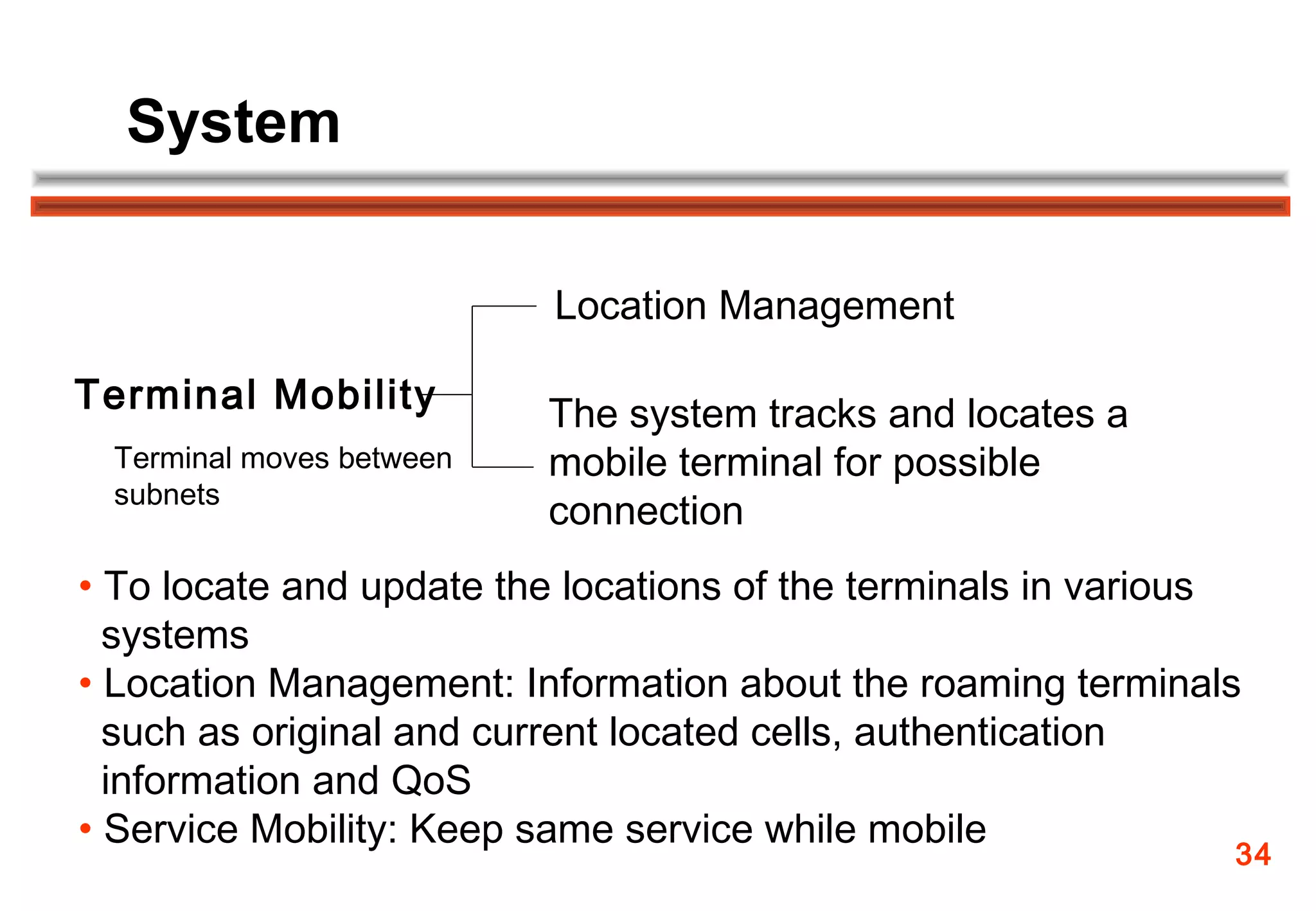
System

                          Location Management

Terminal Mobility         The system tracks and locates a
 Terminal moves between   mobile terminal for possible
 subnets
                          connection
• To locate and update the locations of the terminals in various
  systems
• Location Management: Information about the roaming terminals
  such as original and current located cells, authentication
  information and QoS
• Service Mobility: Keep same service while mobile
                                                               34
System

• Enhanced Mobile IPv6 Schemes

  Figure shows an example of horizontal and vertical handoff


                                                           UMTS coverage


                                                           GSM coverage

           Vertical handoff

           Horizontal handoff                              WLAN coverage


   • Main problems: - handover performance
                    - handover failure due to lack of resources
                                                                           35
                    - authentication of redirection
System

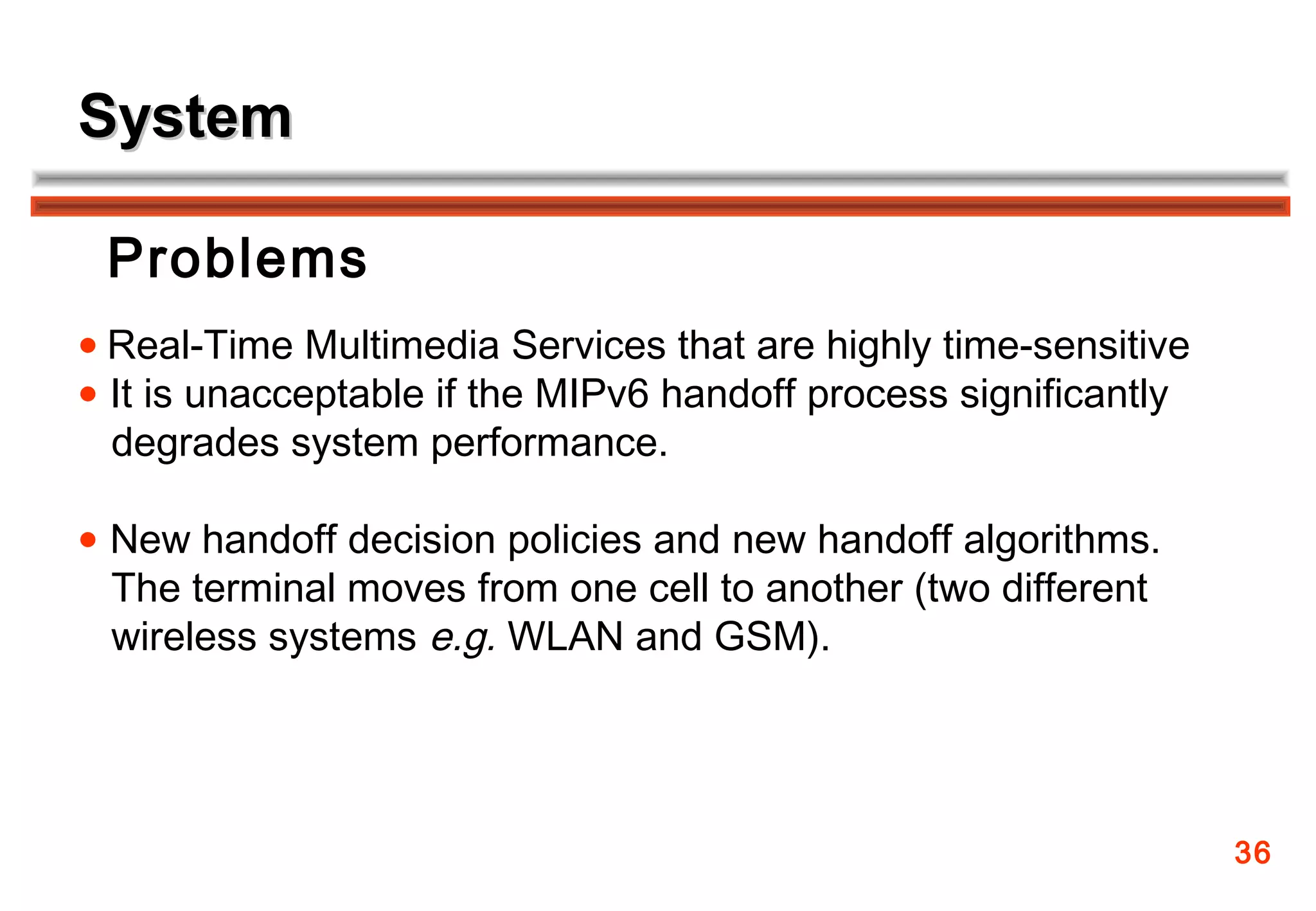
 Problems
• Real-Time Multimedia Services that are highly time-sensitive
• It is unacceptable if the MIPv6 handoff process significantly
 degrades system performance.

• New handoff decision policies and new handoff algorithms.
 The terminal moves from one cell to another (two different
 wireless systems e.g. WLAN and GSM).


                                                                  36
System


Network Infrastructure and QoS Support
  • To integrate the existing non-IP-based and IP-based systems

  • Non-IP-based systems (voice delivery) e.g. GSM, CDMA2000
    and UMTS

  • IP-based systems (data services) e.g. 802.11 WLAN and
    HiperLAN, 802.16/802.20

  Problems: Integration, QoS guarantee for end-to-end
  time-sensitive (3GPP)
                                                                  37
System
Security
• The heterogeneity of wireless networks complicates the security
 issues

• 2G/3G have been widely studied

• The key concern in security designs for 4G networks is flexibility.
  The key sizes and encryption and decryption algorithms of
  existing schemes are also fixed.

• Reconfigurable security mechanisms are needed (Tiny SESAME)

• Modifications in existing security schemes may be applicable to
  heterogeneous systems
                                                                        38
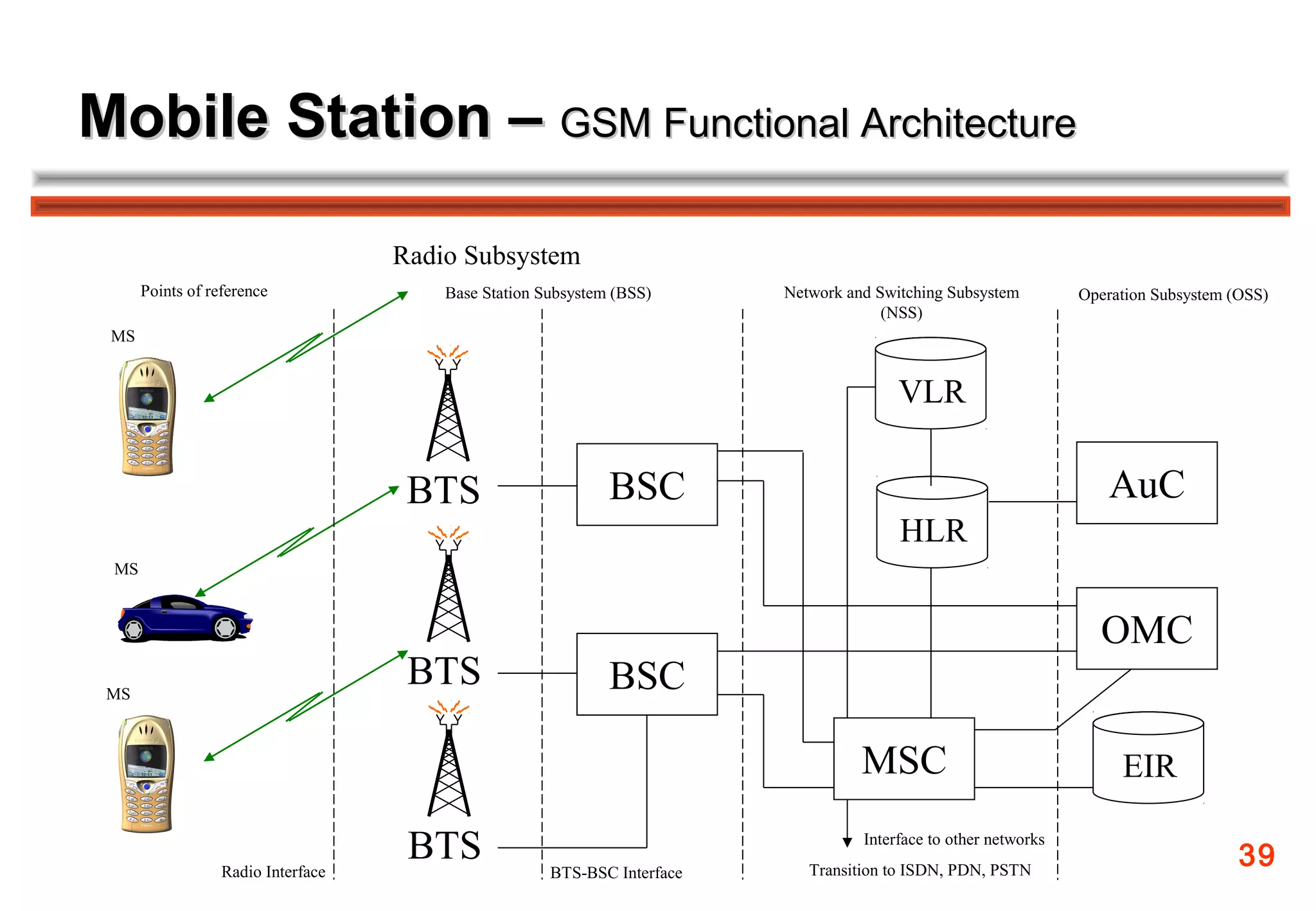
Mobile Station – GSM Functional Architecture

                                    Radio Subsystem
      Points of reference               Base Station Subsystem (BSS)      Network and Switching Subsystem         Operation Subsystem (OSS)
                                                                                       (NSS)
 MS


                                                                                         VLR

                                     BTS                      BSC                                                    AuC
                                                                                         HLR
 MS


                                                                                                                    OMC
 MS
                                     BTS                      BSC

                                                                                    MSC                                EIR

                  Radio Interface
                                     BTS              BTS-BSC Interface
                                                                                    Interface to other networks
                                                                             Transition to ISDN, PDN, PSTN
                                                                                                                                       39
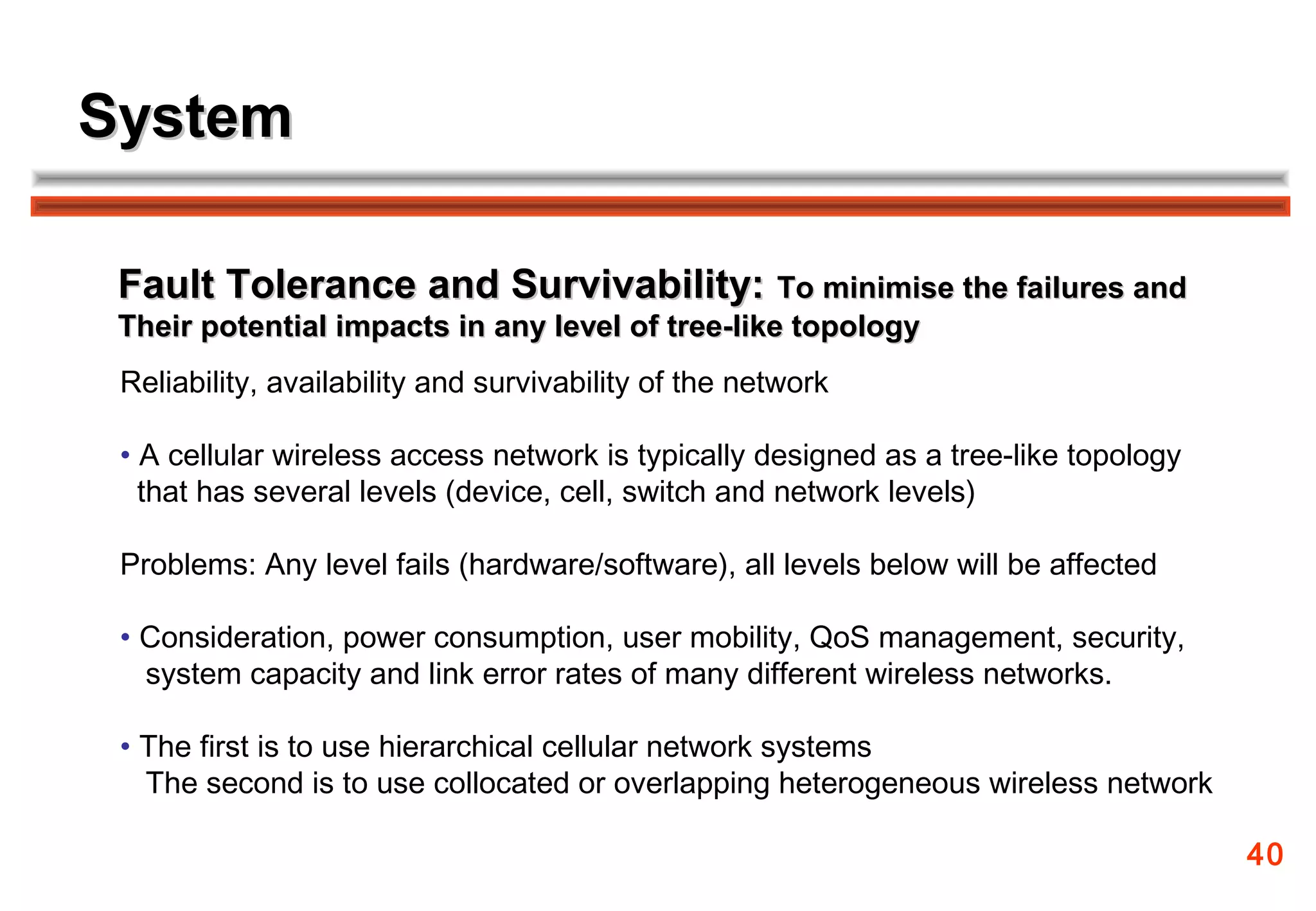
System

 Fault Tolerance and Survivability: To minimise the failures and
 Their potential impacts in any level of tree-like topology
 Reliability, availability and survivability of the network

 • A cellular wireless access network is typically designed as a tree-like topology
   that has several levels (device, cell, switch and network levels)

 Problems: Any level fails (hardware/software), all levels below will be affected

 • Consideration, power consumption, user mobility, QoS management, security,
   system capacity and link error rates of many different wireless networks.

 • The first is to use hierarchical cellular network systems
   The second is to use collocated or overlapping heterogeneous wireless network

                                                                                      40
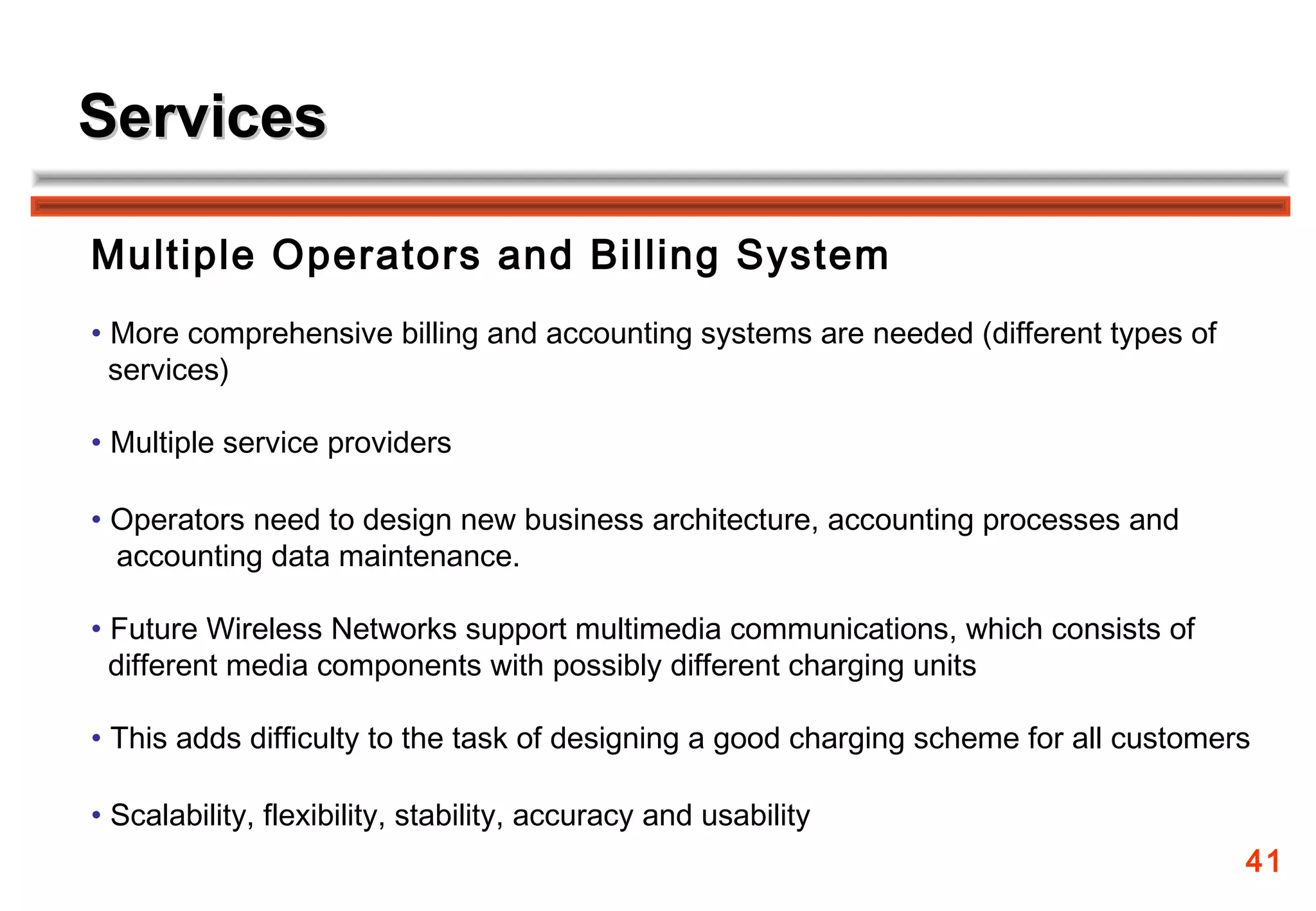
Services

Multiple Operators and Billing System
• More comprehensive billing and accounting systems are needed (different types of
  services)

• Multiple service providers

• Operators need to design new business architecture, accounting processes and
  accounting data maintenance.

• Future Wireless Networks support multimedia communications, which consists of
  different media components with possibly different charging units

• This adds difficulty to the task of designing a good charging scheme for all customers

• Scalability, flexibility, stability, accuracy and usability
                                                                                       41
Services

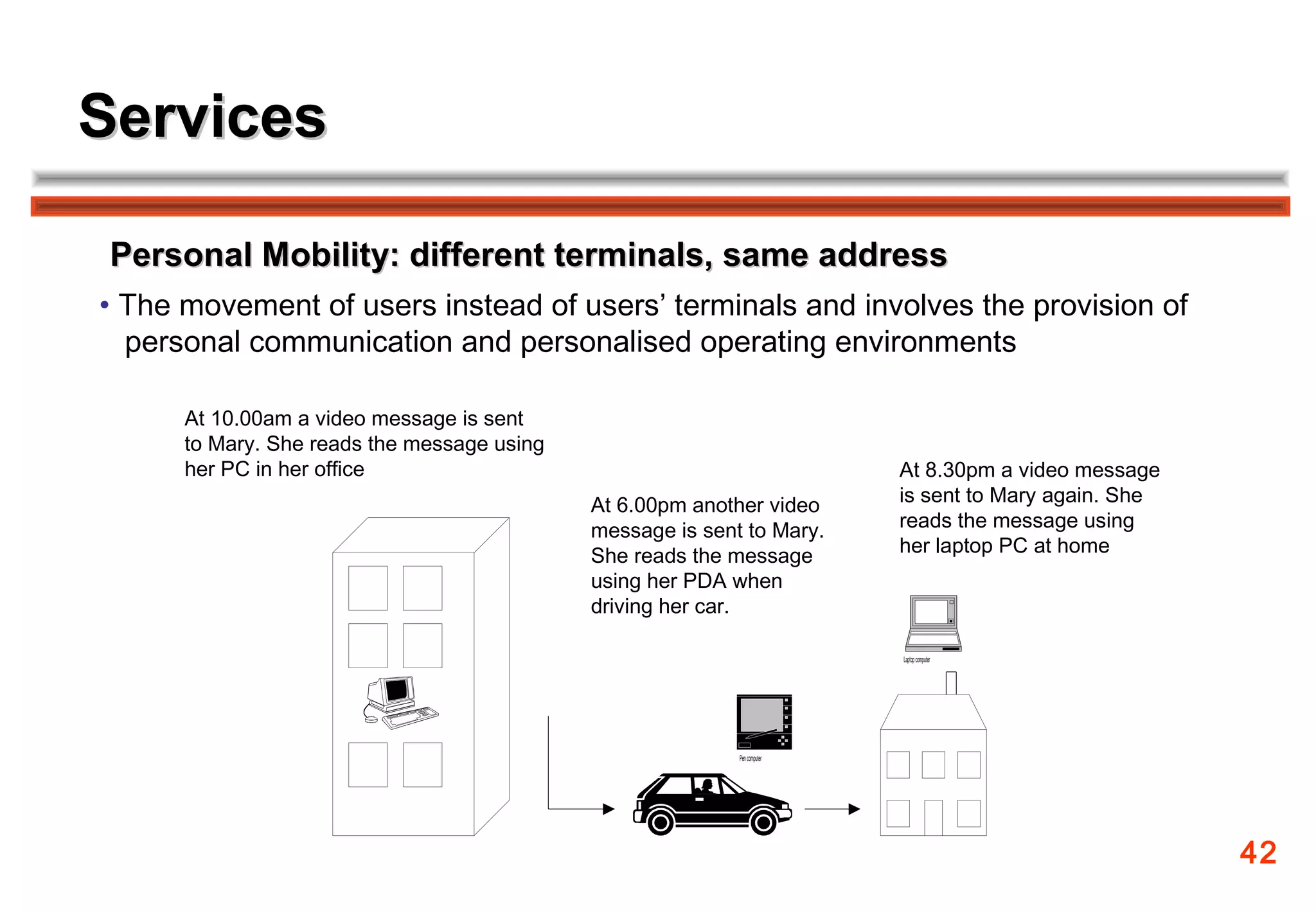
 Personal Mobility: different terminals, same address
• The movement of users instead of users’ terminals and involves the provision of
  personal communication and personalised operating environments

      At 10.00am a video message is sent
      to Mary. She reads the message using
      her PC in her office                                                 At 8.30pm a video message
                                             At 6.00pm another video       is sent to Mary again. She
                                             message is sent to Mary.      reads the message using
                                             She reads the message         her laptop PC at home
                                             using her PDA when
                                             driving her car.

                                                                           Laptop computer


                                                            Pen computer


                                                                                                        42
Services


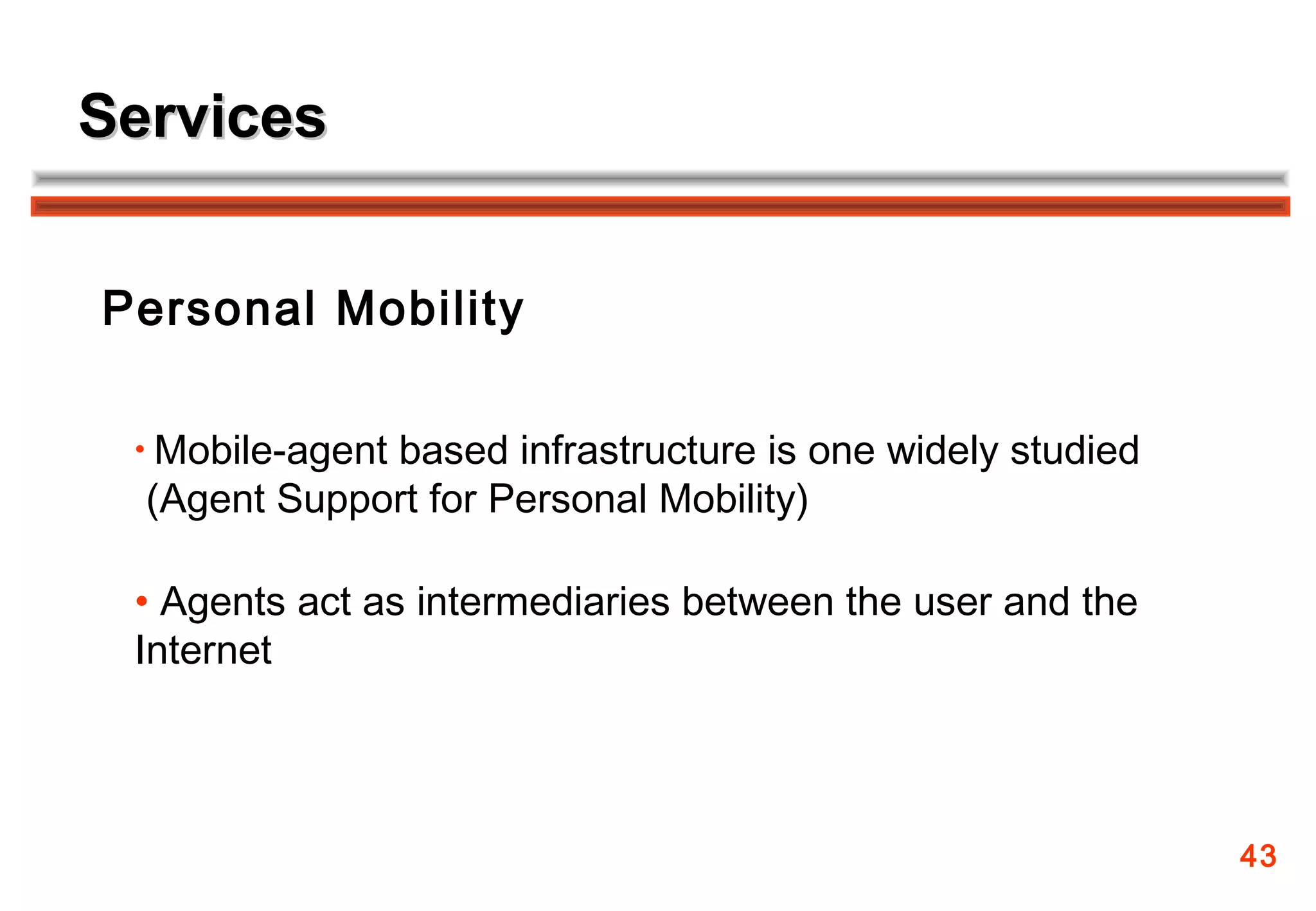
Personal Mobility

 • Mobile-agent
              based infrastructure is one widely studied
  (Agent Support for Personal Mobility)

 • Agents act as intermediaries between the user and the
 Internet


                                                           43
Application

 • Mobile computing in a Fieldwork Environment
   Ecologists, archaeologists, computer scientists
   and engineers
 • Communication and Ad Hoc Networking in the
   field, prevent disaster, reduce crime and terrorism
 • Health and Education
 • E-Commerce, E-Business, E-Government
 • Partnership Universities
 • Entertainment, games, smart home

                                                         44
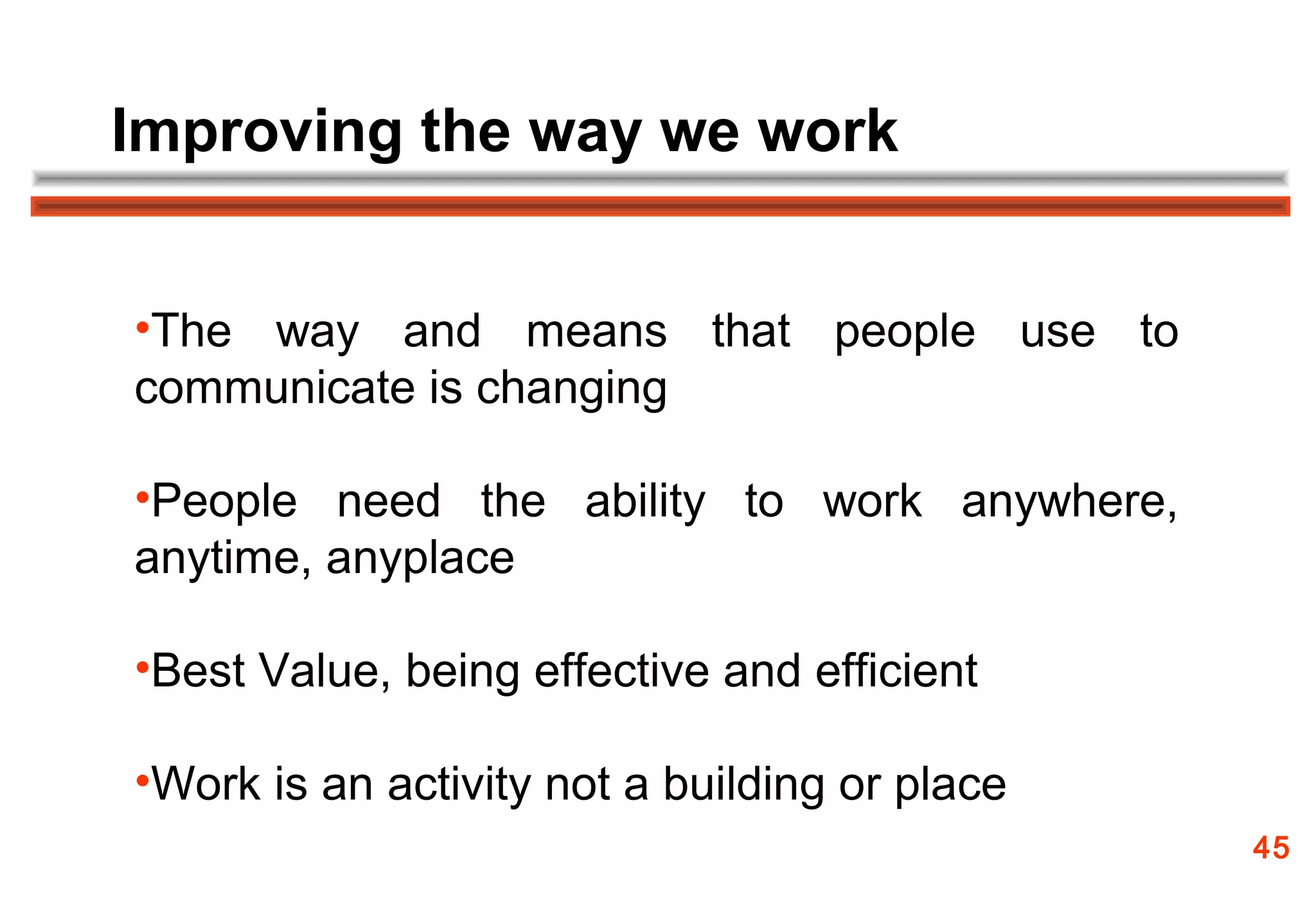
Improving the way we work


•The way and means that people use to
communicate is changing

•People need the ability to work anywhere,
anytime, anyplace

•Best Value, being effective and efficient

•Work is an activity not a building or place
                                               45
Conclusions

• In this presentation research challenges in the
  emigration to future networks are studied and
  described
• The challenges are grouped into three
  aspects: Mobile Station, System and Service
• Wireless technologies used to decrease crime
  and prevent emergency disasters and
  terrorism
                                                    46
Conclusions

• The challenges were identified, such as
  multicarrier user terminals, wireless system
  discovery, terminal mobility, QoS support and
  business opportunities
• Mobile communication impact in urban/rural
  areas
• Project of Innovation for job creation using
  wireless technologies
                                                  47

Future of mobile communications

  • 1.
    The Future ofMobile Communications Professor Rolando Carrasco BSc(Hons), PhD, CEng, FIEE R.Carrasco@newcastle.ac.uk School of Electrical, Electronic and Computing Engineering 1
  • 2.
    Research Project 1 •The Capacity and Throughput Improvement of Fixed Broadband Wireless Access Systems Dr. Pei Xiao, Research Fellow (three years) Mr. M. K. Khan BEng, MSc, Research Student (2 1/2 years) EPSRC Grant in collaboration with Dr. I. Wassell, Cambridge University and Cambridge Broadband Ltd 2
  • 3.
    VectaStar System Configuration Subscriber Unit Standard 4 Sector Base Station AP beam patterns 90° x 8° 23° x 23° antenna 90 antenna 15 120 60 12 9 150 30 6 AP AP AP AP 256 x CPE 256 x CPE 3 AP AP 180 0 0 AP AP 256 x CPE 256 x CPE 210 330 240 300 270 Network Interface 3 options for user interfaces 100 BaseT 100 BaseT & E1 SDH / ATM 100 BaseT & 2x POTS Network Copyright Cambridge University 3
  • 4.
    Research Project 2 •Space-Time Diversity Coding Combined with Equalisation for MIMO Wireless Channels. Mr. Cameron B Shaw BEng(Hons), MEng (PhD Student), 15 months remaining EPSRC grant in collaboration with Lancaster University (Professor Honary) and MOD (Ministry Of Defence) 4
  • 5.
    The world ofmobile communications •Have you ever heard the phrase “the future is here today”? Well, in the case of mobile communication technologies, this phrase is true. •However, it is not yet fully realized. 5
  • 6.
    Contents • Introduction • Challengesin the Migration to Future Mobile Systems • 2G, 3G and 4G wireless systems • Research Challenges: – Mobile Stations, Systems, Services • Conclusion 6
  • 7.
    Introduction (2) •2G Mobile Systems – GSM, IS-95 and CDMA one carry speech and low bit rate data • 3G Mobile Systems – Higher data rate – Multi-media systems – GPRS – IMT 2000 – Bluetooth – WLAN and HiperLAN – Developing new standards and hardware 7
  • 8.
    4G Mobile Systems(2006) • Access, handoff • Location coordination • Resource coordination to add new users • Support for multicasting and Quality of Service • Wireless security and authentication • Network failure and backup • Pricing and billing 8
  • 9.
    The world ofmobile communications •Out of a world population of 6.32 billion people, approximately 1.12 billion, or 1 in 6, have a mobile phone and 71.6% are GSM customers •Total Operator revenues for 2006 have been estimated to be over $100 billion for Western Europe •China Mobile with over 100 million customers are connecting 2 million new customers each month •About 2 billion people in the world have yet to make a phone call and it is likely that when it happens it will be on 9 a mobile phone rather than a fixed line
  • 10.
    What is WirelessData? • Paging/short messaging • Vehicle tracking and dispatch • Transaction processing • Warehouse inventory • Subscriber information services • Wireless remote access to host • File transfer to/from laptop,J2ME • Wireless Internet access and Video Teleconferencing • Browsing on Laptops, PDAs ,Phones 10 • Messaging,E-mail,SMS,Fax,Voice,Pager
  • 11.
    Mobile Computing Systems •Future Mobile Systems – Personalised Services providing stable system performance and Quality of Service (QoS) – Challenges: • Mobile Station • System(Networks) • Service and standards Mobile VCE (www.mobilevce.com), MIRAI and DocoMo VCE = Virtual Centre of Excellence in Mobile and Personal Communication 11
  • 12.
    Mobile Computing Systems •Some key features of Future Mobile Systems – High usability: • Anytime, anywhere and with any technology (all-IP based heterogeneous networks) – Support for Multi-media Services at low transmission cost – Personalisation(having human characteristics) – Integrated Services 12
  • 13.
  • 14.
    Research Challenges •Mobile Station – Multimode user terminals(multi-functional,software upgrades) – Wireless system discovery(searching for wireless system) – Wireless system selection(suitable technology) • System – Terminal Mobility(to locate and update the locations) – Network infrastructure and QoS support – Security, performance and complexity – Fault tolerance and Survivability • Service – Multi-operators and billing system – Personal mobility – New Applications 14
  • 15.
    Mobile Stations Multimode userTerminals: To design a single user terminal that can operate in different wireless networks An ideal software radio system • New coding/interleaving/diversity/equalisation/SISO channel/MIMO channels • Multicarrier, spread spectrum and antenna solutions • Adaptive coding modulation, detection, synchronisation and automatic repeat request • Multimedia protocols, new access,timing control and QoS • New applications • A software radio approach can be used so that the user terminal adapts itself to the wireless 15 • interface
  • 16.
    Technical Challenges • Low-Power/Low-CostImplementations • Scarce Radio Spectrum • Radio Channel Characteristics - Limits on Signal Coverage - Limits on Data Rates • Efficient Network Architectures and Protocols • Seamless Internetworking • Authentication and Security 16
  • 17.
    Radio Environment • Path Loss • Shadow Fading • Multipath • Interference • Infrared Versus Radio • Doppler Spread 17
  • 18.
    Link Performance MeasuresEfficiency • Spectral Efficiency - a measure of the data rate per unit bandwidth for a given bit error probability and transmitted power • Power Efficiency - a measure of the required received power to achieve a given data rate for a given error probability and bandwidth • Throughput/Delay 18
  • 19.
    HOW DO WEOVERCOME THE LIMITATIONS IMPOSED BY THE RADIO CHANNEL? • Flat Fading Counter measures - Fade Margin - Diversity - Coding and Interleaving - Adaptive Techniques • Delay Spread Counter measures - Equalization - Multicarrier - Spread Spectrum - Antenna Solutions 19
  • 20.
    EQUALIZER TYPES ANDSTRUCTURES 20
  • 21.
    Turbo Equalisation AWGN data Convolutional ‘outer’ code I ISI Channel I Estimated data SISO ‘outer’ decoder SISO Equaliser I-1 Turbo Equaliser 21
  • 22.
    MIMO Turbo Equalisation Data Model: 2-User, 2-Path, 2-Antenna (Example) h11(1) Space Domain Sampling h11(0) b1(n) h12(0) h12(1) r1(n) User 1  h (0)   h (1)  r (n) =  11 b1 (n) +  11 b1 (n − 1) h21(0) h12 (0) h12 (1) h21(1)  h ( 0)   h (1)  b2(n) +  21 b2 (n) +  21 b1 (n − 1) + n(n) h22(0) r2(n) h22(1) h22 (0) h22 (1) User 2 ≡ h1 (0).b1 (n) + h1 (1).b1 (n − 1) + h 2 (0).b2 (n) + h 2 (1).b2 (n − 1) + n(n) 22
  • 23.
    Algebraic-Geometric Codes • Algebraic geometry is a powerful tool for constructing codes with good parameters e.g. Hamming distance, code rate and large code length. • Very long codes can be constructed by choosing curves containing many points. Reed Solomon codes are constructed from a line, which has less points, and hence they are much shorter than AG codes • There is almost no limit to the number of AG codes that can be constructed from a variety of different classes of curve. There are not many Reed Solomon codes. • AG codes perform better than Reed Solomon codes for high code rates over smaller finite fields and are suitable for application in mobile communications and storage devices • Further investigation is needed into constructing new codes from different classes of curves and the development of low complexity decoding algorithms for future hardware implementation. 23
  • 24.
    Algebraic-Geometric Codes • Hermitian curves can be used to construct very long codes: Example: C(x,y) = x5 + y4 + y, defined over GF(16) gives codes 64 symbols long. A Reed Solomon code over GF(16) is only 15 symbols long 1.E+00 1.E-01 (64,39)AG, R=0.61 (15,9)RS, R=0.6 Uncoded BPSK 1.E-02 1.E-03 BER 1.E-04 1.E-05 1.E-06 -4 -3 -2 1.E-07 -1 0 1 2 3 4 5 6 7 8 9 10 11 12 13 14 15 16 17 18 19 20 21 22 23 24 Eb/N0 , dB
  • 25.
    Construction of LDPCcodes for Application with Broadband Communication Systems • LPDC codes are a class of Block codes that perform very close to Shannon limit. • Uses efficient encoding and iterative decoding schemes to achieve low latency . • Highly parallel nature and low complexity of decoding algorithm results in fast iterative decoding and less complex Hardware architecture. • Better performance using equalisation techniques in dispersive MIMO/SISO ISI fading channels. •Performance is drastically improved by concatenating with Space time Codes •Suitable for high data rate applications. 25
  • 26.
    SUI-3 LDPC-QPSK WithSRK Equalisation 26
  • 27.
    Broadband Fixed WirelessAccess (BFWA) systems • Aim of BFWA is to deliver broadband data services to homes and businesses in a flexible and efficient manner. • Main driver is to provide Internet access for applications such as E-mail, web-browsing, file downloading and transfer, audio and video services over Internet. • In BFWA systems, radio signal travels via multipath from transmitter to receiver antennas. Multipath propagation causes intersymbol interference and degrade the system performance. • Turbo equalization is a powerful technique to remove the effect of intersymbol interference. 27
  • 28.
    Comparison of differentequalisation schemes in BFWA systems 28
  • 29.
    MIMO Channels forBFWA Systems • Use MIMO space-time coding to increase the capacity of BFWA system. • Signals from different antennas can be separated through orthogonal design, such as Alamouti algorithm. • When used over frequency selective channels, a channel equalizer has to be used at the receiver along with the space- time decoder. • STBC can be applied in conjunction with OFDM which converts the frequency selective channel into a set of independent parallel frequency-flat subchannels. The Alamouti scheme is then applied to each subcarrier. 29
  • 30.
    Space-Time Ring TrellisCoded Modulation g11(x) ST-Ring TCM Decoder  The uncorrelated fading QPSKr1(x) Tx1 State = 0 00 00 00 Demodulator g21(x) 32 33 32 33 33 channels are used to provide g12(x) State = 1 13 21 10 13 21 10 diversity 22 20 22 20 22  Very good results can be QPSK r2(x) g22(x) Tx2 State = 2 03 01 02 03 01 02 obtained with just 2 tx & 2 rx Demodulator 11 12 11 12 11 State = 3 31 23 30 31 23 30 antennas. 1.E+00  Higher coding gains achieved and error 1.E-01 floors removed by using higher state codes. 1.E-02  Higher coding gains are achieved and error floors removed by using higher state BER 1.E-03 codes. Indoor (21/3) Indoor (Delay diversity) Indoor (212/31) Pedestrian (21/3) 1.E-04 Pedestrian (Delay diversity)  Cannot fully recover vehicular channel Pedestrian (212/31) data. Equalisation is needed. Vehicular (21/3) Vehicular (Delay diversity) 1.E-05 Vehicular (212/31) Indoor (2103/132) 30 Pedestrian (2103/132) Vehicular (2103/132) 1.E-06 -4 -3 -2 -1 0 1 2 3 4 5 6 7 8 9 10 11 12 13 14 15 16 17 18 19 20 21 22 23 24 25 26 27 28 29 30 SNR (dB)
  • 31.
    Maximum a-posteriori TurboEqualisation  Realistic channel models are created to properly test 0 the mobile communication systems. -10  Indoor, pedestrian and vehicular scenarios are -20 -30 simulated based on actual measured results from -40 urban mobile radio channels. -50 -60 5 10 15 20 25 30 recieved  Over realistic channels (such as the urban mobile message ( y) a posteriori MAP information channel) the intersymbol interference produced a priori L (c t | y ) information Equaliser needs mitigation to improve performance. L (c t ) + - Σ ext  The goal of equalisation is the cancellation of the extrinsic information L (c t | y ) Inter-Symbol Interference (ISI), or equivalently the Π ext flattening of the radio channel’s frequency response Π −1 L (c t ) extrinsic information  Turbo equalisation combines decoding and Σ - ext equalisation by converting the channel into a type of + ‘code’ which can then be iteratively decoded with a L (c t ) MAP L ext (c t | y ) symbol-by-symbol decoder. a posteriori information Decoder a priori information 31
  • 32.
    Mobile Station Wireless systemdiscovery GSM GPRS Via PC server CDMA Via PDA Scanning… Via smart card UMTS OTA WLAN Via Memory card Available Systems Way to download Software • To discover available wireless systems by processing the signals sent from different wireless 32 systems (different access protocols)
  • 33.
    Mobile Station Wireless SystemSelection: Selection of the most suitable technology for a particular service • We can choose any available wireless device for each particular communication session (fit to user QoS requirements) • Right network selection can ensure the QoS required by each Session Initiation Protocol (SIP) messages. • Adequate knowledge of each network is required before a selection is made Location information of the source mobile nodes, available networks of both mobile nodes and user preference are all taken into account in the selection when a mobile node makes a call to another mobile node 33
  • 34.
    System Location Management Terminal Mobility The system tracks and locates a Terminal moves between mobile terminal for possible subnets connection • To locate and update the locations of the terminals in various systems • Location Management: Information about the roaming terminals such as original and current located cells, authentication information and QoS • Service Mobility: Keep same service while mobile 34
  • 35.
    System • Enhanced MobileIPv6 Schemes Figure shows an example of horizontal and vertical handoff UMTS coverage GSM coverage Vertical handoff Horizontal handoff WLAN coverage • Main problems: - handover performance - handover failure due to lack of resources 35 - authentication of redirection
  • 36.
    System Problems • Real-TimeMultimedia Services that are highly time-sensitive • It is unacceptable if the MIPv6 handoff process significantly degrades system performance. • New handoff decision policies and new handoff algorithms. The terminal moves from one cell to another (two different wireless systems e.g. WLAN and GSM). 36
  • 37.
    System Network Infrastructure andQoS Support • To integrate the existing non-IP-based and IP-based systems • Non-IP-based systems (voice delivery) e.g. GSM, CDMA2000 and UMTS • IP-based systems (data services) e.g. 802.11 WLAN and HiperLAN, 802.16/802.20 Problems: Integration, QoS guarantee for end-to-end time-sensitive (3GPP) 37
  • 38.
    System Security • The heterogeneityof wireless networks complicates the security issues • 2G/3G have been widely studied • The key concern in security designs for 4G networks is flexibility. The key sizes and encryption and decryption algorithms of existing schemes are also fixed. • Reconfigurable security mechanisms are needed (Tiny SESAME) • Modifications in existing security schemes may be applicable to heterogeneous systems 38
  • 39.
    Mobile Station –GSM Functional Architecture Radio Subsystem Points of reference Base Station Subsystem (BSS) Network and Switching Subsystem Operation Subsystem (OSS) (NSS) MS VLR BTS BSC AuC HLR MS OMC MS BTS BSC MSC EIR Radio Interface BTS BTS-BSC Interface Interface to other networks Transition to ISDN, PDN, PSTN 39
  • 40.
    System Fault Toleranceand Survivability: To minimise the failures and Their potential impacts in any level of tree-like topology Reliability, availability and survivability of the network • A cellular wireless access network is typically designed as a tree-like topology that has several levels (device, cell, switch and network levels) Problems: Any level fails (hardware/software), all levels below will be affected • Consideration, power consumption, user mobility, QoS management, security, system capacity and link error rates of many different wireless networks. • The first is to use hierarchical cellular network systems The second is to use collocated or overlapping heterogeneous wireless network 40
  • 41.
    Services Multiple Operators andBilling System • More comprehensive billing and accounting systems are needed (different types of services) • Multiple service providers • Operators need to design new business architecture, accounting processes and accounting data maintenance. • Future Wireless Networks support multimedia communications, which consists of different media components with possibly different charging units • This adds difficulty to the task of designing a good charging scheme for all customers • Scalability, flexibility, stability, accuracy and usability 41
  • 42.
    Services Personal Mobility:different terminals, same address • The movement of users instead of users’ terminals and involves the provision of personal communication and personalised operating environments At 10.00am a video message is sent to Mary. She reads the message using her PC in her office At 8.30pm a video message At 6.00pm another video is sent to Mary again. She message is sent to Mary. reads the message using She reads the message her laptop PC at home using her PDA when driving her car. Laptop computer Pen computer 42
  • 43.
    Services Personal Mobility •Mobile-agent based infrastructure is one widely studied (Agent Support for Personal Mobility) • Agents act as intermediaries between the user and the Internet 43
  • 44.
    Application • Mobilecomputing in a Fieldwork Environment Ecologists, archaeologists, computer scientists and engineers • Communication and Ad Hoc Networking in the field, prevent disaster, reduce crime and terrorism • Health and Education • E-Commerce, E-Business, E-Government • Partnership Universities • Entertainment, games, smart home 44
  • 45.
    Improving the waywe work •The way and means that people use to communicate is changing •People need the ability to work anywhere, anytime, anyplace •Best Value, being effective and efficient •Work is an activity not a building or place 45
  • 46.
    Conclusions • In thispresentation research challenges in the emigration to future networks are studied and described • The challenges are grouped into three aspects: Mobile Station, System and Service • Wireless technologies used to decrease crime and prevent emergency disasters and terrorism 46
  • 47.
    Conclusions • The challengeswere identified, such as multicarrier user terminals, wireless system discovery, terminal mobility, QoS support and business opportunities • Mobile communication impact in urban/rural areas • Project of Innovation for job creation using wireless technologies 47

Editor's Notes

  • #6 Well, in the case of mobile communication technologies, this phrase is true. Our society currently has in place technology that will allow you to communicate with anyone anytime in most major metropolitan areas. Think about it: if you have the need for people to be able to reach you at anytime, then you either buy a cellular phone with 1-800 service or a beeper with coverage for the entire U.S. You can even receive e-mail on your beeper. Additionally, if you have a notebook computer or a personal data assistant (PDA), you can receive e-mail or communicate over networks using built-in modems with cellular capability. however, it is not yet fully realized. While a person can receive e-mail on their beeper or voice data on their cellular phone, they can’t yet send or receive pictures or video. These are the limitations of today’s communication conduits. The limitation isn’t so much about technology as it is about standardization and integration. The transmission of voice and e-mail requires agreement among many parties, including the cellular provider, the phone or beeper manufacturer, the FCC, and probably several others. Since pictures and video are much more resource intensive than e-mail or voice, it is somewhat more difficult to settle on standards for this type of communication. Because of the tremendous profit potential, you can bet that standards will be agreed upon in the near future.