

YOU’VE WON A CONTRACT,……NOW WHATDennis caseyColorado PTAC Procurement Counselor
OverviewUnderstanding the ContractPost Award DebriefPeople to Know – The TeamHow to ProceedCommon PitfallsContract RemediesGetting Paid
Learn the LanguageQuando mi sono trasferita a Italia ho dovuto imparare la lingua
The Rule BookFederal Acquisition Regulation (FAR)Provides policies and procedures for acquisitions by executive agencies of the federal government (http://farsite.hill.af.mil/)Based on United States Code, laws written by CongressMany supplements written by individual agenciesStates have their own purchasing rules
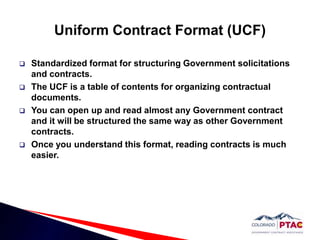
Uniform Contract Format (UCF)Standardized format for structuring Government solicitations and contracts.  The UCF is a table of contents for organizing contractual documents.You can open up and read almost any Government contract and it will be structured the same way as other Government contracts.  Once you understand this format, reading contracts is much easier.
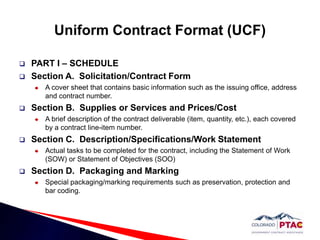
Uniform Contract Format (UCF)PART I – SCHEDULESection A.  Solicitation/Contract FormA cover sheet that contains basic information such as the issuing office, address and contract number.Section B.  Supplies or Services and Prices/CostA brief description of the contract deliverable (item, quantity, etc.), each covered by a contract line-item number.Section C.  Description/Specifications/Work StatementActual tasks to be completed for the contract, including the Statement of Work (SOW) or Statement of Objectives (SOO)Section D.  Packaging and MarkingSpecial packaging/marking requirements such as preservation, protection and bar coding.
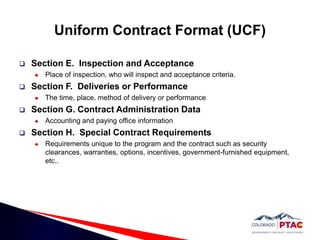
Uniform Contract Format (UCF)Section E.  Inspection and AcceptancePlace of inspection, who will inspect and acceptance criteria.Section F.  Deliveries or PerformanceThe time, place, method of delivery or performanceSection G. Contract Administration DataAccounting and paying office informationSection H.  Special Contract RequirementsRequirements unique to the program and the contract such as security clearances, warranties, options, incentives, government-furnished equipment, etc..
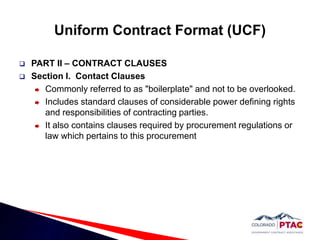
Uniform Contract Format (UCF)PART II – CONTRACT CLAUSESSection I.  Contact ClausesCommonly referred to as "boilerplate" and not to be overlooked.  Includes standard clauses of considerable power defining rights and responsibilities of contracting parties.  It also contains clauses required by procurement regulations or law which pertains to this procurement
Uniform Contract Format (UCF)PART III – LIST OF COMMENTS, EXHIBITS AND OTHER ATTACHMENTSSection J.  List of AttachmentsA list of all attached forms and specifications, including:Security Form Data Orders CDRL SOW Specifications Financial Data
How Good Was Our Winning Proposal?The Post-Award Debriefing Done in accordance with FAR 15.506Provide a written request to the Contracting Officer within 3 days of awardDebriefing within 5 days of receipt of request Conducted in person, via phone or e-mail
Post-award DebriefingWhat you’re entitled to be told Significant weaknesses or deficiencies Overall evaluated price (including unit prices) and technical ratingPast Performance informationSummary of the rationale for the award
Post-award DebriefingWhat you’re not going to be toldPoint-by-point comparisons of your proposal with those of the other biddersCommercial and financial information that is privileged or confidentialNames of the individuals that provided information about your company’s past performance
Questions to AskHow did the presentation and appearance of my proposal stack up against the competition?Was my proposal easy to score and to navigate?What separated my proposal from the competition?Did it contain any fluff or content that should have been substantiated better?Improvement recommendations?
Kick-Off MeetingYou are One of Several CompetitorsIntroduce Your TeamDiscuss Your Approach and ScheduleAsk for Feedback i.e. Base ExercisesLogistical Concerns
Who’s in Charge?Key Government PlayersContracting Officer Has the authority to commit the governmentAwards contracts based on customer defined requirementsCOTRThe end customer, has money and technical knowledgeCan advise CO but cannot commit the governmentDFASPays proper invoice after approval of CO and COTR
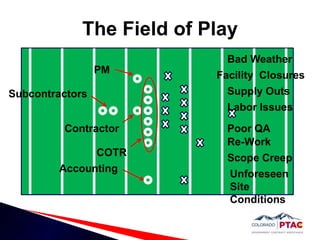
The Field of PlayBad WeatherFacility  ClosuresSupply OutsLabor IssuesContractorAccountingPMSubcontractorsCOTRPoor QARe-WorkScope CreepUnforeseen Site Conditions
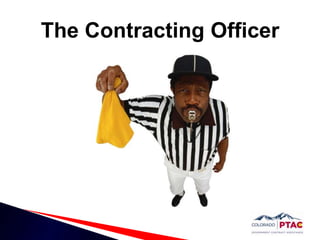
The Contracting Officer
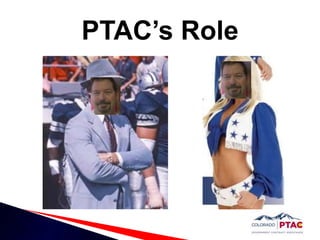
PTAC’s Role
Issues and Problems are Going to OccurUnderstand your rights and obligationsAssertively approach difficult situations and resolve problemsResolution must be to the mutual benefit of both parties
The Big One - Managing Contract Change (Scope Creep)Sometimes InevitableFailure to properly manage can result inLegally unenforceable agreementsClaimsDisputesSignificant damage to past performance record
Stay Ahead of Scope CreepConstantly communicate with your customerWhen in doubt about direction that is given by the COTR, contact the Contracting OfficerKeep costs, schedule and performance as your primary focus
The 6 Rules to Control Scope CreepKnow – The contract value and its ceiling amountKnow – The incurred cost to date and commitmentsKnow – The scope of work (what you’re supposed to be doing under the contract) and whether or not your current efforts are supporting it or some other objectives.
The 6 Rules to Control Scope CreepKnow – The estimated cost at completion based on where you are at todayKnow – Your customer and who among the customer population is prone to direct added work that’s not stipulated in the contractKnow – When to say “No” to scope creep and say it officially, in writing, to the CO for your contract
Inspection Inspection of ServicesContractor must provide an inspection systemGovernment has right to inspect and test all servicesIf services aren’t within contract requirementsContractor must perform again at no increase to contract price
If cannot be corrected by re-performance, contractor must take action to ensure future performance conforms to contract’s requirements
Contract price can be reduced to reflect reduced value of the services performedBad Things the Government Can DoCure NoticeLiquidated Damages (FAR 52.211-11) – Failure to deliver supplies or services, results in payment of liquidated damages of $_____ per day.Stop Work Order (FAR 52.242-15) – Contracting Officer can require the contractor to stop work for a period of 90 days
Bad Things the Government Can DoThe Government may terminate performance in whole or in part if it’s in the Government’s interestTermination for Convenience (Fixed Price 52.249-2) (Cost-Reimbursement 52.249-6)	Termination for Default (52.249-8) – Government may terminate contract if contractor fails toDeliver supplies or services within time specified in the contractProgress “so as to endanger performance of the contract”
Getting PaidPrompt Payment (FAR 52.232-25) – Payment is due on the 30th day after receipt of a “proper” invoiceIf payment not made by the due date, payment office will pay an interest penalty without request from the contractorMost Contracts are Invoiced Using WAWF
More Common Government Contract DefinitionsContractor - A gambler who never gets to shuffle, cut or deal. Bid Opening - A poker game in which the losing hand wins. Bid - A wild guess carried out to two decimal places. Low Bidder - A contractor who is wondering what they left out. Government Estimate - The cost of a project in heaven. Project Manager - The conductor of an orchestra in which every musician is in a different union. Critical Path Method - A management technique for losing your shirt under perfect control. OSHA - A protective coating made by half-baking a mixture of fine print, red tape, split hairs and baloney--usually applied at random with a shotgun. Strike - An effort to increase egg production by strangling the chicken. Delayed Payment - A tourniquet applied at the pockets. Completion Date - The point at which liquidated damages begin. Liquidated Damages - A penalty for failing to achieve the impossible. Auditor - Person who goes in after the war is lost and bayonets the wounded. Lawyer - Person who goes in after the auditors to strip the bodies. Found posted in the Physical Planning Office at Indiana University Author unknown
The Most Important Tip I Can Leave You WithCOMMUNICATE

ptac -_you_won_a_contract...now_what

  • 1.
    YOU’VE WON ACONTRACT,……NOW WHATDennis caseyColorado PTAC Procurement Counselor
  • 2.
    OverviewUnderstanding the ContractPostAward DebriefPeople to Know – The TeamHow to ProceedCommon PitfallsContract RemediesGetting Paid
  • 3.
    Learn the LanguageQuandomi sono trasferita a Italia ho dovuto imparare la lingua
  • 4.
    The Rule BookFederalAcquisition Regulation (FAR)Provides policies and procedures for acquisitions by executive agencies of the federal government (http://farsite.hill.af.mil/)Based on United States Code, laws written by CongressMany supplements written by individual agenciesStates have their own purchasing rules
  • 5.
    Uniform Contract Format(UCF)Standardized format for structuring Government solicitations and contracts.  The UCF is a table of contents for organizing contractual documents.You can open up and read almost any Government contract and it will be structured the same way as other Government contracts.  Once you understand this format, reading contracts is much easier.
  • 6.
    Uniform Contract Format(UCF)PART I – SCHEDULESection A.  Solicitation/Contract FormA cover sheet that contains basic information such as the issuing office, address and contract number.Section B.  Supplies or Services and Prices/CostA brief description of the contract deliverable (item, quantity, etc.), each covered by a contract line-item number.Section C.  Description/Specifications/Work StatementActual tasks to be completed for the contract, including the Statement of Work (SOW) or Statement of Objectives (SOO)Section D.  Packaging and MarkingSpecial packaging/marking requirements such as preservation, protection and bar coding.
  • 7.
    Uniform Contract Format(UCF)Section E.  Inspection and AcceptancePlace of inspection, who will inspect and acceptance criteria.Section F.  Deliveries or PerformanceThe time, place, method of delivery or performanceSection G. Contract Administration DataAccounting and paying office informationSection H.  Special Contract RequirementsRequirements unique to the program and the contract such as security clearances, warranties, options, incentives, government-furnished equipment, etc..
  • 8.
    Uniform Contract Format(UCF)PART II – CONTRACT CLAUSESSection I.  Contact ClausesCommonly referred to as "boilerplate" and not to be overlooked.  Includes standard clauses of considerable power defining rights and responsibilities of contracting parties.  It also contains clauses required by procurement regulations or law which pertains to this procurement
  • 9.
    Uniform Contract Format(UCF)PART III – LIST OF COMMENTS, EXHIBITS AND OTHER ATTACHMENTSSection J.  List of AttachmentsA list of all attached forms and specifications, including:Security Form Data Orders CDRL SOW Specifications Financial Data
  • 10.
    How Good WasOur Winning Proposal?The Post-Award Debriefing Done in accordance with FAR 15.506Provide a written request to the Contracting Officer within 3 days of awardDebriefing within 5 days of receipt of request Conducted in person, via phone or e-mail
  • 11.
    Post-award DebriefingWhat you’reentitled to be told Significant weaknesses or deficiencies Overall evaluated price (including unit prices) and technical ratingPast Performance informationSummary of the rationale for the award
  • 12.
    Post-award DebriefingWhat you’renot going to be toldPoint-by-point comparisons of your proposal with those of the other biddersCommercial and financial information that is privileged or confidentialNames of the individuals that provided information about your company’s past performance
  • 13.
    Questions to AskHowdid the presentation and appearance of my proposal stack up against the competition?Was my proposal easy to score and to navigate?What separated my proposal from the competition?Did it contain any fluff or content that should have been substantiated better?Improvement recommendations?
  • 14.
    Kick-Off MeetingYou areOne of Several CompetitorsIntroduce Your TeamDiscuss Your Approach and ScheduleAsk for Feedback i.e. Base ExercisesLogistical Concerns
  • 15.
    Who’s in Charge?KeyGovernment PlayersContracting Officer Has the authority to commit the governmentAwards contracts based on customer defined requirementsCOTRThe end customer, has money and technical knowledgeCan advise CO but cannot commit the governmentDFASPays proper invoice after approval of CO and COTR
  • 16.
    The Field ofPlayBad WeatherFacility ClosuresSupply OutsLabor IssuesContractorAccountingPMSubcontractorsCOTRPoor QARe-WorkScope CreepUnforeseen Site Conditions
  • 17.
  • 18.
  • 19.
    Issues and Problemsare Going to OccurUnderstand your rights and obligationsAssertively approach difficult situations and resolve problemsResolution must be to the mutual benefit of both parties
  • 20.
    The Big One- Managing Contract Change (Scope Creep)Sometimes InevitableFailure to properly manage can result inLegally unenforceable agreementsClaimsDisputesSignificant damage to past performance record
  • 21.
    Stay Ahead ofScope CreepConstantly communicate with your customerWhen in doubt about direction that is given by the COTR, contact the Contracting OfficerKeep costs, schedule and performance as your primary focus
  • 22.
    The 6 Rulesto Control Scope CreepKnow – The contract value and its ceiling amountKnow – The incurred cost to date and commitmentsKnow – The scope of work (what you’re supposed to be doing under the contract) and whether or not your current efforts are supporting it or some other objectives.
  • 23.
    The 6 Rulesto Control Scope CreepKnow – The estimated cost at completion based on where you are at todayKnow – Your customer and who among the customer population is prone to direct added work that’s not stipulated in the contractKnow – When to say “No” to scope creep and say it officially, in writing, to the CO for your contract
  • 24.
    Inspection Inspection ofServicesContractor must provide an inspection systemGovernment has right to inspect and test all servicesIf services aren’t within contract requirementsContractor must perform again at no increase to contract price
  • 25.
    If cannot becorrected by re-performance, contractor must take action to ensure future performance conforms to contract’s requirements
  • 26.
    Contract price canbe reduced to reflect reduced value of the services performedBad Things the Government Can DoCure NoticeLiquidated Damages (FAR 52.211-11) – Failure to deliver supplies or services, results in payment of liquidated damages of $_____ per day.Stop Work Order (FAR 52.242-15) – Contracting Officer can require the contractor to stop work for a period of 90 days
  • 27.
    Bad Things theGovernment Can DoThe Government may terminate performance in whole or in part if it’s in the Government’s interestTermination for Convenience (Fixed Price 52.249-2) (Cost-Reimbursement 52.249-6) Termination for Default (52.249-8) – Government may terminate contract if contractor fails toDeliver supplies or services within time specified in the contractProgress “so as to endanger performance of the contract”
  • 28.
    Getting PaidPrompt Payment(FAR 52.232-25) – Payment is due on the 30th day after receipt of a “proper” invoiceIf payment not made by the due date, payment office will pay an interest penalty without request from the contractorMost Contracts are Invoiced Using WAWF
  • 29.
    More Common GovernmentContract DefinitionsContractor - A gambler who never gets to shuffle, cut or deal. Bid Opening - A poker game in which the losing hand wins. Bid - A wild guess carried out to two decimal places. Low Bidder - A contractor who is wondering what they left out. Government Estimate - The cost of a project in heaven. Project Manager - The conductor of an orchestra in which every musician is in a different union. Critical Path Method - A management technique for losing your shirt under perfect control. OSHA - A protective coating made by half-baking a mixture of fine print, red tape, split hairs and baloney--usually applied at random with a shotgun. Strike - An effort to increase egg production by strangling the chicken. Delayed Payment - A tourniquet applied at the pockets. Completion Date - The point at which liquidated damages begin. Liquidated Damages - A penalty for failing to achieve the impossible. Auditor - Person who goes in after the war is lost and bayonets the wounded. Lawyer - Person who goes in after the auditors to strip the bodies. Found posted in the Physical Planning Office at Indiana University Author unknown
  • 30.
    The Most ImportantTip I Can Leave You WithCOMMUNICATE

Editor's Notes

  • #5 Some sections of the FAR that are a must read before you begin work for the federal government. You don’t have to read this cover to cover. No one does. You do need to be knowledgeable of the rules of the road though before you start to work. Many of the contract clauses in a federal government contract are in listed by clause name only and are not in full text. Those clauses are in effect and it’s the contractor job to abide by them.
  • #11 You’ll receive a summary of the rationale for award; eval of significant weaknesses/deficiencies in your prop; overall ranking of all bidders; overall eval price and tech rating and past performance info. Not getting point by point comparisons; trade secrets; confidential financial info such as indirect rates, profit, cost breakdowns
  • #13 Cost breakdowns, profit or indirect rates (overhead & G&A), manufacturing processes and techniques
  • #14 This is a great opportunity to ask specific questions about your proposal so the next one will be even better and will blow the competition away.
  • #15 Contracting officer has authority to authorize changes to the contract, add or deduct funding, issue modifications, etc. This is the person you want to work with when there are issues or problems that will affect workload, payment, proposed changes to the contract.
  • #16 Contracting officer has authority to authorize changes to the contract, add or deduct funding, issue modifications, etc. This is the person you want to work with when there are issues or problems that will affect workload, payment, proposed changes to the contract.
  • #21 You must constantly keep in mind who has the authority to make changes to the contract.
  • #23 Everyone working on the contract must know the technical proposal and the contract. To say such things as “I didn’t work on the proposal or I’ve never seen the proposal” is inexcusable. Once the contract is awarded, the customer expects the contractor to perform everything stated in their proposal and in the contract. Also, have you slowly taken on more work, that’s not in the contract?
  • #24 Added work is a judgment call. You’ll know it when you see it. Car rental story.
  • #25 FAR 52.246-5 is the one for Cost reimbursement contracts. Fee reduced on cost-reimbursable ones.
  • #26 Government has substantial rights to monitor performance and to take appropriate steps when performance is unsatisfactory. These are just a few. Should never reach this point.
  • #28 Make sure the I’s are dotted and the t’s are crossed and yes, that interest penalty will automatically be paid. If not, contact CO.