Diabetes Mellitus
Prepared By:
ISHWAR TIMILSINA
Diabetes mellitus
• Definition: Diabetes mellitus,(often simply
referred to as diabetes) is a group of metabolic
disorders in which a person has high blood sugar,
either because the body does not produce
enough insulin, or because cells do not respond
to the insulin that is produced.
• Diabetes = Hyperglycemia, which is defined as:
--fasting plasma glucose above 126
mg/dl
--oral glucose tolerance test (OGTT)
above 200 mg/dl.
Diabetes Mellitus
• Type 1 diabetes: results from the body's failure to produce
insulin, and presently requires the person to inject insulin.
• (Also referred to as insulin-dependent diabetes
mellitus, IDDM for short, and juvenile diabetes.)
• Type 2 diabetes: results from insulin resistance, a condition
in which cells fail to use insulin properly, sometimes
combined with an absolute insulin deficiency.
• (Formerly referred to as non-insulin-dependent diabetes
mellitus, NIDDM for short, and adult-onset diabetes.)
• Gestational diabetes: is when pregnant women, who have
never had diabetes before, have a high blood glucose level
during pregnancy. It may precede development of type 2
DM.
Type 1 diabetes
• Type 1 diabetes (previously known as insulin-
dependent, juvenile or childhood-onset) is
characterized by deficient insulin production
and requires daily administration of insulin.
The cause of type 1 diabetes is not known and
it is not preventable with current knowledge.
• Symptoms include excessive excretion of urine
(polyuria), thirst (polydipsia), constant hunger,
weight loss, vision changes, and fatigue. These
symptoms may occur suddenly.
Type 2 diabetes
• Type 2 diabetes (formerly called non-insulin-
dependent, or adult-onset) results from the body’s
ineffective use of insulin. Type 2 diabetes comprises
the majority of people with diabetes around the
world, and is largely the result of excess body weight
and physical inactivity.
• Symptoms may be similar to those of type 1
diabetes, but are often less marked. As a result, the
disease may be diagnosed several years after onset,
once complications have already arisen.
• Until recently, this type of diabetes was seen only in
adults but it is now also occurring increasingly
frequently in children.
Gestational diabetes
• Gestational diabetes is caused by excess counter-
insulin hormones of pregnancy, which lead to
insulin resistance. The resulting maternal
hyperglycemia is transmitted to the fetus, causing
fetal pancreatic hypertrophy.
• The baby will be large and fat, with neonatal
complications.
• Women with gestational diabetes are at an increased
risk of complications during pregnancy and at
delivery. They and their children are also at increased
risk of type 2 diabetes in the future.
What are the symptoms of diabetes?
• Symptoms of diabetes include
• increased thirst and urination
• increased hunger
• fatigue
• blurred vision
• numbness or tingling in the feet or hands
• sores that do not heal
• unexplained weight loss
What causes type 1 diabetes?
• Type 1 diabetes occurs when your immune
system, the body’s system for fighting
infection, attacks and destroys the insulin-
producing beta cells of the pancreas. Scientists
think type 1 diabetes is caused by genes and
environmental factors, such as viruses, that
might trigger the disease. Studies such
as TrialNet are working to pinpoint causes of
type 1 diabetes and possible ways to prevent
or slow the disease.
What causes type 2 diabetes?
• The most common form of diabetes—is
caused by several factors, including lifestyle
factors and genes.
• Overweight, obesity, and physical inactivity
• You are more likely to develop type 2 diabetes
if you are not physically active and
are overweight or obese. Extra weight
sometimes causes insulin resistance and is
common in people with type 2 diabetes. The
location of body fat also makes a difference.
Cont…….
• Extra belly fat is linked to insulin resistance,
type 2 diabetes, and heart and blood vessel
disease. To see if your weight puts you at risk
for type 2 diabetes.
What causes gestational diabetes?
• Scientists believe gestational diabetes, a type
of diabetes that develops during pregnancy, is
caused by the hormonal changes of pregnancy
along with genetic and lifestyle factors.
How can I prevent or delay getting diabetes?
• Losing weight and keeping it off. Weight control is an important part of diabetes prevention.
You may be able to prevent or delay diabetes by losing 5 to 10 percent of your current
weight. For example, if you weigh 200 pounds, your goal would be to lose between 10 to 20
pounds. And once you lose the weight, it is important that you don't gain it back.
• Following a healthy eating plan. It is important to reduce the amount of calories you eat and
drink each day, so you can lose weight and keep it off. To do that, your diet should include
smaller portions and less fat and sugar. You should also eat a variety of foods from each food
group, including plenty of whole grains, fruits, and vegetables. It's also a good idea to limit
red meat, and avoid processed meats.
• Get regular exercise. Exercise has many health benefits, including helping you to lose weight
and lower your blood sugar levels. These both lower your risk of type 2 diabetes. Try to get at
least 30 minutes of physical activity 5 days a week. If you have not been active, talk with your
health care professional to figure out which types of exercise are best for you. You can start
slowly and work up to your goal.
• Don't smoke. Smoking can contribute to insulin resistance, which can lead to type 2 diabetes.
If you already smoke, try to quit.
• Talk to your health care provider to see whether there is anything else you can do to delay
or to prevent type 2 diabetes. If you are at high risk, your provider may suggest that you take
one of a few types of diabetes medicines.
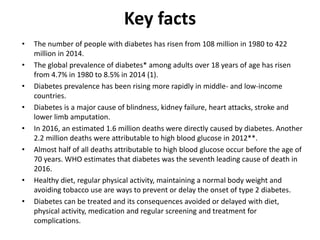
Key facts
• The number of people with diabetes has risen from 108 million in 1980 to 422
million in 2014.
• The global prevalence of diabetes* among adults over 18 years of age has risen
from 4.7% in 1980 to 8.5% in 2014 (1).
• Diabetes prevalence has been rising more rapidly in middle- and low-income
countries.
• Diabetes is a major cause of blindness, kidney failure, heart attacks, stroke and
lower limb amputation.
• In 2016, an estimated 1.6 million deaths were directly caused by diabetes. Another
2.2 million deaths were attributable to high blood glucose in 2012**.
• Almost half of all deaths attributable to high blood glucose occur before the age of
70 years. WHO estimates that diabetes was the seventh leading cause of death in
2016.
• Healthy diet, regular physical activity, maintaining a normal body weight and
avoiding tobacco use are ways to prevent or delay the onset of type 2 diabetes.
• Diabetes can be treated and its consequences avoided or delayed with diet,
physical activity, medication and regular screening and treatment for
complications.
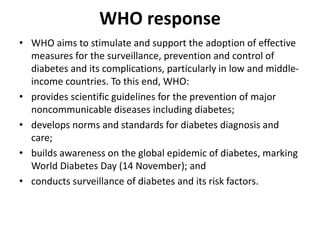
WHO response
• WHO aims to stimulate and support the adoption of effective
measures for the surveillance, prevention and control of
diabetes and its complications, particularly in low and middle-
income countries. To this end, WHO:
• provides scientific guidelines for the prevention of major
noncommunicable diseases including diabetes;
• develops norms and standards for diabetes diagnosis and
care;
• builds awareness on the global epidemic of diabetes, marking
World Diabetes Day (14 November); and
• conducts surveillance of diabetes and its risk factors.
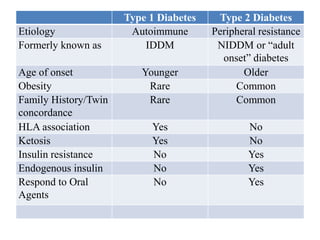
Type 1 Diabetes Type 2 Diabetes
Etiology Autoimmune Peripheral resistance
Formerly known as IDDM NIDDM or “adult
onset” diabetes
Age of onset Younger Older
Obesity Rare Common
Family History/Twin
concordance
Rare Common
HLA association Yes No
Ketosis Yes No
Insulin resistance No Yes
Endogenous insulin No Yes
Respond to Oral
Agents
No Yes
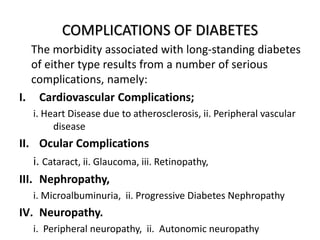
COMPLICATIONS OF DIABETES
The morbidity associated with long-standing diabetes
of either type results from a number of serious
complications, namely:
I. Cardiovascular Complications;
i. Heart Disease due to atherosclerosis, ii. Peripheral vascular
disease
II. Ocular Complications
i. Cataract, ii. Glaucoma, iii. Retinopathy,
III. Nephropathy,
i. Microalbuminuria, ii. Progressive Diabetes Nephropathy
IV. Neuropathy.
i. Peripheral neuropathy, ii. Autonomic neuropathy
Be Prepared! During Disaster
• During natural disasters, emergencies, and hazards people
with diabetes face particular challenges to their health care. If
you are an evacuee or are in an emergency situation, it is of
prime importance to identify yourself as a person with
diabetes and any related conditions, so you can obtain
appropriate care. It is also important to prevent dehydration
by drinking enough fluids, which can be difficult when
drinking water is in short supply. In addition, it is helpful to
keep something containing sugar with you at all times, in case
you develop hypoglycemia (low blood glucose). To prevent
infections, which people with diabetes are more vulnerable
to, pay careful attention to the health of your feet, and get
medical treatment for any wounds.
Cont……
• The CDC has compiled many natural disaster
and emergency resources in English, Spanish,
and several other languages. Below are
additional links which may be especially useful
for people with diabetes. Some of the
following documents are available in Portable
Document Format.
Emergency Preparedness
• Insulin, Drug, and Equipment Advice
• Information Regarding Insulin Storage and
Switching Between Products in an Emergency
Patients should try to keep their insulin as cool as
possible, avoiding direct heat and direct sunlight as
well as freezing if placed on ice. Although a physician
should supervise when switching insulin products,
here are recommendations for emergency situations.
• Blood Glucose Meters and Hurricane Disasters
• Heat and humidity can damage blood glucose meters
and test strips. If you use a blood glucose meter,
check the meter and test strip package insert for
information on use during unusual heat and
humidity.
• Keep Water Safe after a Natural Disaster
• Hand Hygiene in Emergency Situations
• Diabetes Disaster Preparedness
• Dialysis treatment may not be available during
an emergency, but these critically important
steps can help safeguard your health. For
immediate assistance, call the National Kidney
Foundation help line at 1-888-33KIDNEY.
• Emergency Wound Care After a Natural
Disaster
•THANK YOU

5 diabetes mellitus ishwar

  • 1.
  • 2.
    Diabetes mellitus • Definition:Diabetes mellitus,(often simply referred to as diabetes) is a group of metabolic disorders in which a person has high blood sugar, either because the body does not produce enough insulin, or because cells do not respond to the insulin that is produced. • Diabetes = Hyperglycemia, which is defined as: --fasting plasma glucose above 126 mg/dl --oral glucose tolerance test (OGTT) above 200 mg/dl.
  • 3.
    Diabetes Mellitus • Type1 diabetes: results from the body's failure to produce insulin, and presently requires the person to inject insulin. • (Also referred to as insulin-dependent diabetes mellitus, IDDM for short, and juvenile diabetes.) • Type 2 diabetes: results from insulin resistance, a condition in which cells fail to use insulin properly, sometimes combined with an absolute insulin deficiency. • (Formerly referred to as non-insulin-dependent diabetes mellitus, NIDDM for short, and adult-onset diabetes.) • Gestational diabetes: is when pregnant women, who have never had diabetes before, have a high blood glucose level during pregnancy. It may precede development of type 2 DM.
  • 4.
    Type 1 diabetes •Type 1 diabetes (previously known as insulin- dependent, juvenile or childhood-onset) is characterized by deficient insulin production and requires daily administration of insulin. The cause of type 1 diabetes is not known and it is not preventable with current knowledge. • Symptoms include excessive excretion of urine (polyuria), thirst (polydipsia), constant hunger, weight loss, vision changes, and fatigue. These symptoms may occur suddenly.
  • 5.
    Type 2 diabetes •Type 2 diabetes (formerly called non-insulin- dependent, or adult-onset) results from the body’s ineffective use of insulin. Type 2 diabetes comprises the majority of people with diabetes around the world, and is largely the result of excess body weight and physical inactivity. • Symptoms may be similar to those of type 1 diabetes, but are often less marked. As a result, the disease may be diagnosed several years after onset, once complications have already arisen. • Until recently, this type of diabetes was seen only in adults but it is now also occurring increasingly frequently in children.
  • 6.
    Gestational diabetes • Gestationaldiabetes is caused by excess counter- insulin hormones of pregnancy, which lead to insulin resistance. The resulting maternal hyperglycemia is transmitted to the fetus, causing fetal pancreatic hypertrophy. • The baby will be large and fat, with neonatal complications. • Women with gestational diabetes are at an increased risk of complications during pregnancy and at delivery. They and their children are also at increased risk of type 2 diabetes in the future.
  • 7.
    What are thesymptoms of diabetes? • Symptoms of diabetes include • increased thirst and urination • increased hunger • fatigue • blurred vision • numbness or tingling in the feet or hands • sores that do not heal • unexplained weight loss
  • 8.
    What causes type1 diabetes? • Type 1 diabetes occurs when your immune system, the body’s system for fighting infection, attacks and destroys the insulin- producing beta cells of the pancreas. Scientists think type 1 diabetes is caused by genes and environmental factors, such as viruses, that might trigger the disease. Studies such as TrialNet are working to pinpoint causes of type 1 diabetes and possible ways to prevent or slow the disease.
  • 9.
    What causes type2 diabetes? • The most common form of diabetes—is caused by several factors, including lifestyle factors and genes. • Overweight, obesity, and physical inactivity • You are more likely to develop type 2 diabetes if you are not physically active and are overweight or obese. Extra weight sometimes causes insulin resistance and is common in people with type 2 diabetes. The location of body fat also makes a difference.
  • 10.
    Cont……. • Extra bellyfat is linked to insulin resistance, type 2 diabetes, and heart and blood vessel disease. To see if your weight puts you at risk for type 2 diabetes.
  • 11.
    What causes gestationaldiabetes? • Scientists believe gestational diabetes, a type of diabetes that develops during pregnancy, is caused by the hormonal changes of pregnancy along with genetic and lifestyle factors.
  • 12.
    How can Iprevent or delay getting diabetes? • Losing weight and keeping it off. Weight control is an important part of diabetes prevention. You may be able to prevent or delay diabetes by losing 5 to 10 percent of your current weight. For example, if you weigh 200 pounds, your goal would be to lose between 10 to 20 pounds. And once you lose the weight, it is important that you don't gain it back. • Following a healthy eating plan. It is important to reduce the amount of calories you eat and drink each day, so you can lose weight and keep it off. To do that, your diet should include smaller portions and less fat and sugar. You should also eat a variety of foods from each food group, including plenty of whole grains, fruits, and vegetables. It's also a good idea to limit red meat, and avoid processed meats. • Get regular exercise. Exercise has many health benefits, including helping you to lose weight and lower your blood sugar levels. These both lower your risk of type 2 diabetes. Try to get at least 30 minutes of physical activity 5 days a week. If you have not been active, talk with your health care professional to figure out which types of exercise are best for you. You can start slowly and work up to your goal. • Don't smoke. Smoking can contribute to insulin resistance, which can lead to type 2 diabetes. If you already smoke, try to quit. • Talk to your health care provider to see whether there is anything else you can do to delay or to prevent type 2 diabetes. If you are at high risk, your provider may suggest that you take one of a few types of diabetes medicines.
  • 13.
    Key facts • Thenumber of people with diabetes has risen from 108 million in 1980 to 422 million in 2014. • The global prevalence of diabetes* among adults over 18 years of age has risen from 4.7% in 1980 to 8.5% in 2014 (1). • Diabetes prevalence has been rising more rapidly in middle- and low-income countries. • Diabetes is a major cause of blindness, kidney failure, heart attacks, stroke and lower limb amputation. • In 2016, an estimated 1.6 million deaths were directly caused by diabetes. Another 2.2 million deaths were attributable to high blood glucose in 2012**. • Almost half of all deaths attributable to high blood glucose occur before the age of 70 years. WHO estimates that diabetes was the seventh leading cause of death in 2016. • Healthy diet, regular physical activity, maintaining a normal body weight and avoiding tobacco use are ways to prevent or delay the onset of type 2 diabetes. • Diabetes can be treated and its consequences avoided or delayed with diet, physical activity, medication and regular screening and treatment for complications.
  • 14.
    WHO response • WHOaims to stimulate and support the adoption of effective measures for the surveillance, prevention and control of diabetes and its complications, particularly in low and middle- income countries. To this end, WHO: • provides scientific guidelines for the prevention of major noncommunicable diseases including diabetes; • develops norms and standards for diabetes diagnosis and care; • builds awareness on the global epidemic of diabetes, marking World Diabetes Day (14 November); and • conducts surveillance of diabetes and its risk factors.
  • 15.
    Type 1 DiabetesType 2 Diabetes Etiology Autoimmune Peripheral resistance Formerly known as IDDM NIDDM or “adult onset” diabetes Age of onset Younger Older Obesity Rare Common Family History/Twin concordance Rare Common HLA association Yes No Ketosis Yes No Insulin resistance No Yes Endogenous insulin No Yes Respond to Oral Agents No Yes
  • 16.
    COMPLICATIONS OF DIABETES Themorbidity associated with long-standing diabetes of either type results from a number of serious complications, namely: I. Cardiovascular Complications; i. Heart Disease due to atherosclerosis, ii. Peripheral vascular disease II. Ocular Complications i. Cataract, ii. Glaucoma, iii. Retinopathy, III. Nephropathy, i. Microalbuminuria, ii. Progressive Diabetes Nephropathy IV. Neuropathy. i. Peripheral neuropathy, ii. Autonomic neuropathy
  • 17.
    Be Prepared! DuringDisaster • During natural disasters, emergencies, and hazards people with diabetes face particular challenges to their health care. If you are an evacuee or are in an emergency situation, it is of prime importance to identify yourself as a person with diabetes and any related conditions, so you can obtain appropriate care. It is also important to prevent dehydration by drinking enough fluids, which can be difficult when drinking water is in short supply. In addition, it is helpful to keep something containing sugar with you at all times, in case you develop hypoglycemia (low blood glucose). To prevent infections, which people with diabetes are more vulnerable to, pay careful attention to the health of your feet, and get medical treatment for any wounds.
  • 18.
    Cont…… • The CDChas compiled many natural disaster and emergency resources in English, Spanish, and several other languages. Below are additional links which may be especially useful for people with diabetes. Some of the following documents are available in Portable Document Format.
  • 19.
    Emergency Preparedness • Insulin,Drug, and Equipment Advice • Information Regarding Insulin Storage and Switching Between Products in an Emergency Patients should try to keep their insulin as cool as possible, avoiding direct heat and direct sunlight as well as freezing if placed on ice. Although a physician should supervise when switching insulin products, here are recommendations for emergency situations.
  • 20.
    • Blood GlucoseMeters and Hurricane Disasters • Heat and humidity can damage blood glucose meters and test strips. If you use a blood glucose meter, check the meter and test strip package insert for information on use during unusual heat and humidity. • Keep Water Safe after a Natural Disaster • Hand Hygiene in Emergency Situations
  • 21.
    • Diabetes DisasterPreparedness • Dialysis treatment may not be available during an emergency, but these critically important steps can help safeguard your health. For immediate assistance, call the National Kidney Foundation help line at 1-888-33KIDNEY. • Emergency Wound Care After a Natural Disaster
  • 22.