DIABETES
MELLITUS
THACIN AHMED PRANNTO
B.PHARM, M.PHARM, MPH(UK)
DIABETES
• Diabetes is a chronic (long-lasting) disease that occurs when your blood glucose, also
known as blood sugar, is too high. It happens when the body doesn't produce enough
insulin, or when the body can't effectively use the insulin it does produce. Insulin is a
hormone that helps glucose get into your cells to be used for energy.
• The total number of adults living with type 1 or type 2 diabetes in the world has surpassed 800
million, according to new Imperial-led research.
• Published in the Lancet, the study reveals that the global rate of diabetes (type 1 and 2
combined) in adults doubled from approximately 7% to about 14% between 1990 to 2022.
TYPES OF
DIABETES
The different types of diabetes below:
• Type 1 diabetes
• Type 2 diabetes
• Gestational diabetes
• Maturity onset diabetes of the young (MODY)
• Neonatal diabetes
• Wolfram Syndrome
• Latent Autoimmune diabetes in Adults (LADA)
• Type 3c diabetes
• Steroid-induced diabetes
• Cystic fibrosis diabetes
TYPE 1
DIABETES Type 1 diabetes is where your blood glucose (sugar) level is too high because your
body can’t make a hormone called insulin.
This happens because your body attacks the cells in your pancreas that make the
insulin, meaning you can’t produce any at all.
We all need insulin to live. It does an essential job. It allows the glucose in our blood
to enter our cells and fuel our bodies.
When you have type 1 diabetes, your body still breaks down the carbohydrate from
food and drink and turns it into glucose. But when the glucose enters your
bloodstream, there’s no insulin to allow it into your body’s cells. More and more
glucose then builds up in your bloodstream, leading to high blood sugar levels.
TYPE 2 DIABETES
• In type 2 diabetes, the insulin your pancreas makes
can’t work properly, or your pancreas can’t make
enough insulin. This means your blood glucose
(sugar) levels keep rising.
• It is a serious condition and can be lifelong.
• Having type 2 diabetes without treatment means
that high sugar levels in your blood can seriously
damage parts of your body, including your eyes,
heart and feet. These are called the complications of
diabetes. But with the right treatment and care, you
can live well with type 2 diabetes and reduce your
risk of developing them.
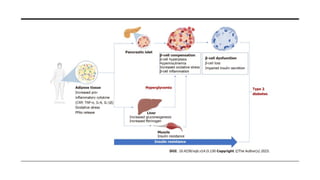
PATHOPHYSIOLOGY INSULIN RESISTANCE
• Insulin resistance is identified as the impaired biologic response of target tissues to insulin
stimulation. All tissues with insulin receptors can become insulin resistant, but the tissues that
primarily drive insulin resistance are the liver, skeletal muscle, and adipose tissue. Insulin resistance
impairs glucose disposal, resulting in a compensatory increase in beta-cell insulin production and
hyperinsulinemia.
GESTATIONAL
DIABETES
• Gestational diabetes is diabetes that can
develop during pregnancy. It affects
women who haven't been affected by
diabetes before. It means you have high
blood sugar and need to take extra care
of yourself and your bump. This will
include eating well and keeping active.
• It usually goes away again after giving
birth. It is usually diagnosed from a
blood test 24 to 28 weeks into
pregnancy.
TYPE 3C DIABETES
• Type 3c diabetes is a type of diabetes that develops when another disease causes damage to the
pancreas. The conditions related to type 3c are pancreatic cancer, pancreatitis, cystic fibrosis
or haemochromatosis. You can also develop type 3c if you have part or all of your pancreas
removed because of other damage.
• Recent studies have debated whether hyperinsulinemia precedes insulin resistance, as
hyperinsulinemia itself is a driver of insulin resistance. This concept may be clinically valuable,
suggesting that hyperinsulinemia associated with excess caloric intake may drive the metabolic
dysfunction associated with insulin resistance.
ACQUIRED
ETIOLOGIE
S OF
INSULIN
RESISTANC
E
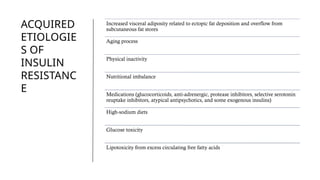
Increased visceral adiposity related to ectopic fat deposition and overflow from
subcutaneous fat stores
Aging process
Physical inactivity
Nutritional imbalance
Medications (glucocorticoids, anti-adrenergic, protease inhibitors, selective serotonin
reuptake inhibitors, atypical antipsychotics, and some exogenous insulins)
High-sodium diets
Glucose toxicity
Lipotoxicity from excess circulating free fatty acids
GENETIC
ETIOLOGIES
OF INSULIN
RESISTANCE
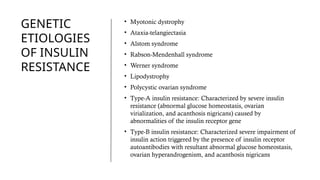
• Myotonic dystrophy
• Ataxia-telangiectasia
• Alstom syndrome
• Rabson-Mendenhall syndrome
• Werner syndrome
• Lipodystrophy
• Polycystic ovarian syndrome
• Type-A insulin resistance: Characterized by severe insulin
resistance (abnormal glucose homeostasis, ovarian
virialization, and acanthosis nigricans) caused by
abnormalities of the insulin receptor gene
• Type-B insulin resistance: Characterized severe impairment of
insulin action triggered by the presence of insulin receptor
autoantibodies with resultant abnormal glucose homeostasis,
ovarian hyperandrogenism, and acanthosis nigricans
PANCREATIC Β-CELL DYSFUNCTION IN T2D
• The pancreatic -
β cells have the important function of producing and secreting insulin, a vital
hormone that is necessary for the regulation of metabolism. Indeed, insulin is critical for the
metabolic regulation of key energy substrates such as carbohydrates, lipids, and proteins. Insulin is
required for the absorption of glucose from the bloodstream into different cells, including cells
from adipose tissue, skeletal muscle, and the liver. Thus, exploring the role of insulin in a broad
spectrum of physiological processes, including its production and regulation, has relevance in
understanding the development of T2D.
• Notably, disturbances in insulin signaling through the inhibition of the insulin receptor substrate
protein, phosphoinositide-3-kinase, and protein kinase B (AKT) leads to insulin resistance.
• Abnormal adipose tissue expansion causes elevated circulating levels of non-esterified fatty acids,
glycerol, markers of oxidative stress, and pro-inflammatory cytokines, subsequently leading to the
development of insulin resistance in individuals with obesity.
• Subsequently, -
β cell dysfunction arises from insufficient glucose sensing to stimulate insulin
secretion, hence increased glucose levels persist. This process leads to the development of insulin
resistance, increased glucose concentrations beyond the physiological state, thereby resulting in
the manifestation of hyperglycemia. As a result, -
β cells compensate for insulin resistance by
hypersecretion of insulin, ultimately leading to -
β cell failure
RISK FACTORS OF T2D
Obesity and inactivity:
People who are overweight or obese (especially with central obesity) and/or have inactive lifestyles are
at increased risk for developing type 2 diabetes, as overeating and inactivity can exacerbate insulin
resistance. Obesity accounts for 80–85% of the overall risk for developing type 2 diabetes.
Family history:
People with a family history of diabetes are 2–6 times more likely to have diabetes than people without
a family history. The risk of developing type 2 diabetes is about 15% if one parent has type 2 diabetes,
and 75% if both parents have type 2 diabetes.
• Ethnicity:
People of Asian, African, and Afro-Caribbean ethnicity are 2–4 times more likely to
develop type 2 diabetes than white people.
• History of gestational diabetes
Women with a history of gestational diabetes have a sevenfold increased risk of
developing type 2 diabetes later in life. Children born to mothers with gestational
diabetes have a sixfold increased risk of developing type 2 diabetes.
• Diet
A low-fibre, high glycaemic index (GI) diet may increase the risk of being overweight or
obese. High-GI foods contain carbohydrates that are broken down quickly and cause a
rapid increase in blood glucose levels, such as sugary foods and drinks, white rice, white
bread, and potatoes.
• Drug treatments
Statins, corticosteroids, and combined treatment with a thiazide diuretic plus a beta-
blocker, can increase the risk for developing hyperglycaemia and type 2 diabetes.
• Polycystic ovary syndrome
This increases the risk of non-diabetic hyperglycaemia and type 2 diabetes.
• Metabolic syndrome
Insulin resistance is commonly associated with the metabolic syndrome, defined as a
combination of raised blood pressure, dyslipidaemia, fatty liver disease, central obesity,
and a tendency to develop thrombosis
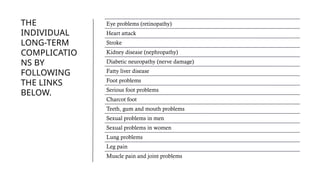
THE
INDIVIDUAL
LONG-TERM
COMPLICATIO
NS BY
FOLLOWING
THE LINKS
BELOW.
Eye problems (retinopathy)
Heart attack
Stroke
Kidney disease (nephropathy)
Diabetic neuropathy (nerve damage)
Fatty liver disease
Foot problems
Serious foot problems
Charcot foot
Teeth, gum and mouth problems
Sexual problems in men
Sexual problems in women
Lung problems
Leg pain
Muscle pain and joint problems
THREE WAYS TO PREVENT TYPE 2 DIABETES?
• Eating well
• Moving more
• Losing weight if you are living with obesity or overweight or have an unhealthy waist size
1. LOSE EXTRA WEIGHT
• Losing weight lowers the risk of diabetes. The American Diabetes Association recommends
that people with prediabetes lose at least 5% to 7% of their body weight to prevent
diabetes. More weight loss can turn into even greater benefits.
• People in one large study lowered their risk of developing type 2 diabetes by almost 60%
over three years. In this study, they lost about 7% of their body weight with changes in
physical activity and diet.
2. BE MORE PHYSICALLY ACTIVE
• You can gain many benefits from getting regular physical activity, such as:
• Losing weight.
• Lowering your blood sugar.
• Boosting your sensitivity to insulin — which helps keep your blood sugar within a typical
range.
• Increasing your aerobic fitness.
3. EAT HEALTHY PLANT
FOODS
• Plants in your diet give you vitamins, minerals and carbohydrates. Carbohydrates include sugars
and starches — the energy sources for your body — and fiber. Dietary fiber, also called roughage
or bulk, is the part of plant foods your body can't digest or absorb.
• Fiber-rich foods promote weight loss and lower the risk of diabetes. Eat a variety of healthy, fiber-
rich foods, which include:
• Fruits, such as tomatoes, peppers and fruit from trees.
• Nonstarchy vegetables, such as leafy greens, broccoli and cauliflower.
• Legumes, such as beans, chickpeas and lentils.
• Whole grains, such as whole-wheat pasta and bread, whole-grain rice, whole oats, and quinoa
Fiber benefits include:
• Slowing the absorption of sugars and lowering blood sugar levels.
• Interfering with the absorption of dietary fat and cholesterol.
• Managing other risk factors that affect heart health, such as blood pressure and inflammation.
• Helping you eat less because fiber-rich foods are more filling and energy rich.
Diabetes Mellitus – Causes, Types, Risks & Prevention

Diabetes Mellitus – Causes, Types, Risks & Prevention

  • 1.
  • 2.
  • 3.
    DIABETES • Diabetes isa chronic (long-lasting) disease that occurs when your blood glucose, also known as blood sugar, is too high. It happens when the body doesn't produce enough insulin, or when the body can't effectively use the insulin it does produce. Insulin is a hormone that helps glucose get into your cells to be used for energy. • The total number of adults living with type 1 or type 2 diabetes in the world has surpassed 800 million, according to new Imperial-led research. • Published in the Lancet, the study reveals that the global rate of diabetes (type 1 and 2 combined) in adults doubled from approximately 7% to about 14% between 1990 to 2022.
  • 4.
    TYPES OF DIABETES The differenttypes of diabetes below: • Type 1 diabetes • Type 2 diabetes • Gestational diabetes • Maturity onset diabetes of the young (MODY) • Neonatal diabetes • Wolfram Syndrome • Latent Autoimmune diabetes in Adults (LADA) • Type 3c diabetes • Steroid-induced diabetes • Cystic fibrosis diabetes
  • 5.
    TYPE 1 DIABETES Type1 diabetes is where your blood glucose (sugar) level is too high because your body can’t make a hormone called insulin. This happens because your body attacks the cells in your pancreas that make the insulin, meaning you can’t produce any at all. We all need insulin to live. It does an essential job. It allows the glucose in our blood to enter our cells and fuel our bodies. When you have type 1 diabetes, your body still breaks down the carbohydrate from food and drink and turns it into glucose. But when the glucose enters your bloodstream, there’s no insulin to allow it into your body’s cells. More and more glucose then builds up in your bloodstream, leading to high blood sugar levels.
  • 6.
    TYPE 2 DIABETES •In type 2 diabetes, the insulin your pancreas makes can’t work properly, or your pancreas can’t make enough insulin. This means your blood glucose (sugar) levels keep rising. • It is a serious condition and can be lifelong. • Having type 2 diabetes without treatment means that high sugar levels in your blood can seriously damage parts of your body, including your eyes, heart and feet. These are called the complications of diabetes. But with the right treatment and care, you can live well with type 2 diabetes and reduce your risk of developing them.
  • 7.
    PATHOPHYSIOLOGY INSULIN RESISTANCE •Insulin resistance is identified as the impaired biologic response of target tissues to insulin stimulation. All tissues with insulin receptors can become insulin resistant, but the tissues that primarily drive insulin resistance are the liver, skeletal muscle, and adipose tissue. Insulin resistance impairs glucose disposal, resulting in a compensatory increase in beta-cell insulin production and hyperinsulinemia.
  • 8.
    GESTATIONAL DIABETES • Gestational diabetesis diabetes that can develop during pregnancy. It affects women who haven't been affected by diabetes before. It means you have high blood sugar and need to take extra care of yourself and your bump. This will include eating well and keeping active. • It usually goes away again after giving birth. It is usually diagnosed from a blood test 24 to 28 weeks into pregnancy.
  • 9.
    TYPE 3C DIABETES •Type 3c diabetes is a type of diabetes that develops when another disease causes damage to the pancreas. The conditions related to type 3c are pancreatic cancer, pancreatitis, cystic fibrosis or haemochromatosis. You can also develop type 3c if you have part or all of your pancreas removed because of other damage. • Recent studies have debated whether hyperinsulinemia precedes insulin resistance, as hyperinsulinemia itself is a driver of insulin resistance. This concept may be clinically valuable, suggesting that hyperinsulinemia associated with excess caloric intake may drive the metabolic dysfunction associated with insulin resistance.
  • 10.
    ACQUIRED ETIOLOGIE S OF INSULIN RESISTANC E Increased visceraladiposity related to ectopic fat deposition and overflow from subcutaneous fat stores Aging process Physical inactivity Nutritional imbalance Medications (glucocorticoids, anti-adrenergic, protease inhibitors, selective serotonin reuptake inhibitors, atypical antipsychotics, and some exogenous insulins) High-sodium diets Glucose toxicity Lipotoxicity from excess circulating free fatty acids
  • 11.
    GENETIC ETIOLOGIES OF INSULIN RESISTANCE • Myotonicdystrophy • Ataxia-telangiectasia • Alstom syndrome • Rabson-Mendenhall syndrome • Werner syndrome • Lipodystrophy • Polycystic ovarian syndrome • Type-A insulin resistance: Characterized by severe insulin resistance (abnormal glucose homeostasis, ovarian virialization, and acanthosis nigricans) caused by abnormalities of the insulin receptor gene • Type-B insulin resistance: Characterized severe impairment of insulin action triggered by the presence of insulin receptor autoantibodies with resultant abnormal glucose homeostasis, ovarian hyperandrogenism, and acanthosis nigricans
  • 12.
    PANCREATIC Β-CELL DYSFUNCTIONIN T2D • The pancreatic - β cells have the important function of producing and secreting insulin, a vital hormone that is necessary for the regulation of metabolism. Indeed, insulin is critical for the metabolic regulation of key energy substrates such as carbohydrates, lipids, and proteins. Insulin is required for the absorption of glucose from the bloodstream into different cells, including cells from adipose tissue, skeletal muscle, and the liver. Thus, exploring the role of insulin in a broad spectrum of physiological processes, including its production and regulation, has relevance in understanding the development of T2D.
  • 13.
    • Notably, disturbancesin insulin signaling through the inhibition of the insulin receptor substrate protein, phosphoinositide-3-kinase, and protein kinase B (AKT) leads to insulin resistance. • Abnormal adipose tissue expansion causes elevated circulating levels of non-esterified fatty acids, glycerol, markers of oxidative stress, and pro-inflammatory cytokines, subsequently leading to the development of insulin resistance in individuals with obesity. • Subsequently, - β cell dysfunction arises from insufficient glucose sensing to stimulate insulin secretion, hence increased glucose levels persist. This process leads to the development of insulin resistance, increased glucose concentrations beyond the physiological state, thereby resulting in the manifestation of hyperglycemia. As a result, - β cells compensate for insulin resistance by hypersecretion of insulin, ultimately leading to - β cell failure
  • 15.
    RISK FACTORS OFT2D Obesity and inactivity: People who are overweight or obese (especially with central obesity) and/or have inactive lifestyles are at increased risk for developing type 2 diabetes, as overeating and inactivity can exacerbate insulin resistance. Obesity accounts for 80–85% of the overall risk for developing type 2 diabetes. Family history: People with a family history of diabetes are 2–6 times more likely to have diabetes than people without a family history. The risk of developing type 2 diabetes is about 15% if one parent has type 2 diabetes, and 75% if both parents have type 2 diabetes.
  • 16.
    • Ethnicity: People ofAsian, African, and Afro-Caribbean ethnicity are 2–4 times more likely to develop type 2 diabetes than white people. • History of gestational diabetes Women with a history of gestational diabetes have a sevenfold increased risk of developing type 2 diabetes later in life. Children born to mothers with gestational diabetes have a sixfold increased risk of developing type 2 diabetes. • Diet A low-fibre, high glycaemic index (GI) diet may increase the risk of being overweight or obese. High-GI foods contain carbohydrates that are broken down quickly and cause a rapid increase in blood glucose levels, such as sugary foods and drinks, white rice, white bread, and potatoes.
  • 17.
    • Drug treatments Statins,corticosteroids, and combined treatment with a thiazide diuretic plus a beta- blocker, can increase the risk for developing hyperglycaemia and type 2 diabetes. • Polycystic ovary syndrome This increases the risk of non-diabetic hyperglycaemia and type 2 diabetes. • Metabolic syndrome Insulin resistance is commonly associated with the metabolic syndrome, defined as a combination of raised blood pressure, dyslipidaemia, fatty liver disease, central obesity, and a tendency to develop thrombosis
  • 18.
    THE INDIVIDUAL LONG-TERM COMPLICATIO NS BY FOLLOWING THE LINKS BELOW. Eyeproblems (retinopathy) Heart attack Stroke Kidney disease (nephropathy) Diabetic neuropathy (nerve damage) Fatty liver disease Foot problems Serious foot problems Charcot foot Teeth, gum and mouth problems Sexual problems in men Sexual problems in women Lung problems Leg pain Muscle pain and joint problems
  • 19.
    THREE WAYS TOPREVENT TYPE 2 DIABETES? • Eating well • Moving more • Losing weight if you are living with obesity or overweight or have an unhealthy waist size
  • 20.
    1. LOSE EXTRAWEIGHT • Losing weight lowers the risk of diabetes. The American Diabetes Association recommends that people with prediabetes lose at least 5% to 7% of their body weight to prevent diabetes. More weight loss can turn into even greater benefits. • People in one large study lowered their risk of developing type 2 diabetes by almost 60% over three years. In this study, they lost about 7% of their body weight with changes in physical activity and diet.
  • 21.
    2. BE MOREPHYSICALLY ACTIVE • You can gain many benefits from getting regular physical activity, such as: • Losing weight. • Lowering your blood sugar. • Boosting your sensitivity to insulin — which helps keep your blood sugar within a typical range. • Increasing your aerobic fitness.
  • 22.
    3. EAT HEALTHYPLANT FOODS • Plants in your diet give you vitamins, minerals and carbohydrates. Carbohydrates include sugars and starches — the energy sources for your body — and fiber. Dietary fiber, also called roughage or bulk, is the part of plant foods your body can't digest or absorb. • Fiber-rich foods promote weight loss and lower the risk of diabetes. Eat a variety of healthy, fiber- rich foods, which include: • Fruits, such as tomatoes, peppers and fruit from trees. • Nonstarchy vegetables, such as leafy greens, broccoli and cauliflower. • Legumes, such as beans, chickpeas and lentils. • Whole grains, such as whole-wheat pasta and bread, whole-grain rice, whole oats, and quinoa Fiber benefits include: • Slowing the absorption of sugars and lowering blood sugar levels. • Interfering with the absorption of dietary fat and cholesterol. • Managing other risk factors that affect heart health, such as blood pressure and inflammation. • Helping you eat less because fiber-rich foods are more filling and energy rich.