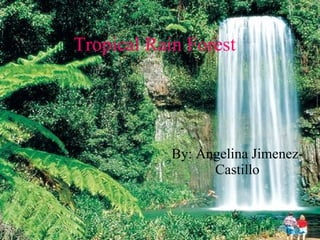
Tropical Rain Forest By: Angelina Jimenez-Castillo
Climate The climate in tropical rain forests is humid due to the large amounts of precipitation that occurs in the biome. In fact, the rainfall averages to about 250cm. each year. Tropical rain forests receives  so much rainfall because they  are located on or near the  equator where the water cycle  is constantly repeating itself  due to the heat.
Plants in a Tropical Rain Forest Biome The tropical rain forest consists of many types of plants with certain adaptations among these are types like  Buttresses  (have the adaptation of  huge ridges at their base that rise up to about 30 ft. before blending into the trunk that provide more stability for the plant because the roots of tropical rain forest trees are not as deep as those of temperate zone trees(top left),   Fungus  (has adapted to growing in dark, warm places in the forest’s understory and canopy(middle left) and  Strangler Figs  (has adapted to growing seeds on host trees which have to be carried to the host tree by birds and small animals that have been eating the fruit of the fig because otherwise the seeds would fall to the ground and die in the infertile soil of the tropical rain forest floor(bottom left)
Animals in a Tropical Rain Forest Biome The tropical rainforest biome is home to all sorts of herbivores such as the  Toucan  (top left), the  Sloth   (middle left) and the  Fruit Bat  (bottom left) This biome is also home to many carnivores such as the  Jaguar  (top right), the  Tiger  (middle right) and the  Viper  (bottom right)
Adaptations The tropical rain forest biome is home to more species of animals than all of the biomes combined, therefore it is no surprise that the animals that call this biome home have had to go through some changes or adaptations in order to survive in their environment. Some examples of this are: The Toucan: their large beaks help them eat the large fruits that are part of their diet such as papayas  The Sloth: their long stretched claw like toes are perfect for life in the trees The Fruit Bat: their teeth are perfectly adapted to get through tough skinned fruits The Jaguar: their short stocky limb structure is perfect for climbing trees, swimming and crawling The Tiger: their powerful jaws and extremely sharp canines are perfect for biting right through their pray with a quick snap  The Viper: their slit shaped pupils, that can either open wide enough to almost cover the entire eye or come close to closing completely, help them see in a wide range of light levels
Food Chain  We all eventually fall prey to those evil decomposers Producer Primary Consumer Secondary Consumer Tertiary Consumer
Biome Map
Human Impact on the Tropical Rain Forest Biome Humans have impacted or, more liked harmed every biome so far. The human impact on the tropical rain forest isn’t so pretty. We have harmed many, already, rare and exotic species such as sloths, tigers, jaguars, and many other species by poaching and destroying their environments to suit our own needs without thinking about, or, even in some cases  ignoring  the consequences that will follow our harsh and cruel actions. Tropical rain forest sizes have taken a brutal beating. They are shrinking through the years and although many organizations are trying to preserve our rain forests, they won’t be able to keep it up forever unless we do more to stop the destruction. In fact, about thirty to  one hundred  species go extinct  every day !
Credits/Sources http://wikis.lib.ncsu.edu/index.php/Amazon_Rainforest:_Outlook_for_the_Future http://hertfordtravel.net/index.php?%20pageid=68 http://www.blueplanetbiomes.org/rnfrst_climate_page.htm http://www.mbgnet.net/sets/rforest/index.htm http://www.cotf.edu/ete/modules/msese/earthsysflr/rforest.html http://www.strayreality.com/toucans2.htm http://animals.nationalgeographic.com/animals/mammals/two-toed-sloth.html http://www.oregonzoo.org/Cards/Rainforest/bat.fruit.straw.colored.htm http://ambergriscaye.com/photogallery/071011.html http://www.greendiary.com/entry/predator-gets-predated-upon-as-more-bengal-tigers-are-poached-then-ever-before/ http://www.art.com/products/p13810451-sa/eyelash_viper_snake_costa_rica.htm http://www.photographersdirect.com/buyers/stockphoto.asp?imageid=254653 http://www.planetware.com/picture/seattle-olympic-national-park-hoh-rain-forest-us-wa258.htm http://timlaman.com/contents/PHOTO%20GALLERIES/BORNEO%20RAIN%20FOREST/image-ngs20_0107/ http://schools.woboe.org/TeachLearn/WebQuests/RainforestExplorers http://ecolibrary.org/page/DP134 http://www.intercol.co.uk/acatalog/Panama.html http://sciencegradefour.blogspot.com/2009/10/producer-consumers-and-decomposers.html http://www.engadget.com/entry/1234000537036189/

4th Period Rainforest

  • 1.
    Tropical Rain ForestBy: Angelina Jimenez-Castillo
  • 2.
    Climate The climatein tropical rain forests is humid due to the large amounts of precipitation that occurs in the biome. In fact, the rainfall averages to about 250cm. each year. Tropical rain forests receives so much rainfall because they are located on or near the equator where the water cycle is constantly repeating itself due to the heat.
  • 3.
    Plants in aTropical Rain Forest Biome The tropical rain forest consists of many types of plants with certain adaptations among these are types like Buttresses (have the adaptation of huge ridges at their base that rise up to about 30 ft. before blending into the trunk that provide more stability for the plant because the roots of tropical rain forest trees are not as deep as those of temperate zone trees(top left), Fungus (has adapted to growing in dark, warm places in the forest’s understory and canopy(middle left) and Strangler Figs (has adapted to growing seeds on host trees which have to be carried to the host tree by birds and small animals that have been eating the fruit of the fig because otherwise the seeds would fall to the ground and die in the infertile soil of the tropical rain forest floor(bottom left)
  • 4.
    Animals in aTropical Rain Forest Biome The tropical rainforest biome is home to all sorts of herbivores such as the Toucan (top left), the Sloth (middle left) and the Fruit Bat (bottom left) This biome is also home to many carnivores such as the Jaguar (top right), the Tiger (middle right) and the Viper (bottom right)
  • 5.
    Adaptations The tropicalrain forest biome is home to more species of animals than all of the biomes combined, therefore it is no surprise that the animals that call this biome home have had to go through some changes or adaptations in order to survive in their environment. Some examples of this are: The Toucan: their large beaks help them eat the large fruits that are part of their diet such as papayas The Sloth: their long stretched claw like toes are perfect for life in the trees The Fruit Bat: their teeth are perfectly adapted to get through tough skinned fruits The Jaguar: their short stocky limb structure is perfect for climbing trees, swimming and crawling The Tiger: their powerful jaws and extremely sharp canines are perfect for biting right through their pray with a quick snap The Viper: their slit shaped pupils, that can either open wide enough to almost cover the entire eye or come close to closing completely, help them see in a wide range of light levels
  • 6.
    Food Chain We all eventually fall prey to those evil decomposers Producer Primary Consumer Secondary Consumer Tertiary Consumer
  • 7.
  • 8.
    Human Impact onthe Tropical Rain Forest Biome Humans have impacted or, more liked harmed every biome so far. The human impact on the tropical rain forest isn’t so pretty. We have harmed many, already, rare and exotic species such as sloths, tigers, jaguars, and many other species by poaching and destroying their environments to suit our own needs without thinking about, or, even in some cases ignoring the consequences that will follow our harsh and cruel actions. Tropical rain forest sizes have taken a brutal beating. They are shrinking through the years and although many organizations are trying to preserve our rain forests, they won’t be able to keep it up forever unless we do more to stop the destruction. In fact, about thirty to one hundred species go extinct every day !
  • 9.
    Credits/Sources http://wikis.lib.ncsu.edu/index.php/Amazon_Rainforest:_Outlook_for_the_Future http://hertfordtravel.net/index.php?%20pageid=68http://www.blueplanetbiomes.org/rnfrst_climate_page.htm http://www.mbgnet.net/sets/rforest/index.htm http://www.cotf.edu/ete/modules/msese/earthsysflr/rforest.html http://www.strayreality.com/toucans2.htm http://animals.nationalgeographic.com/animals/mammals/two-toed-sloth.html http://www.oregonzoo.org/Cards/Rainforest/bat.fruit.straw.colored.htm http://ambergriscaye.com/photogallery/071011.html http://www.greendiary.com/entry/predator-gets-predated-upon-as-more-bengal-tigers-are-poached-then-ever-before/ http://www.art.com/products/p13810451-sa/eyelash_viper_snake_costa_rica.htm http://www.photographersdirect.com/buyers/stockphoto.asp?imageid=254653 http://www.planetware.com/picture/seattle-olympic-national-park-hoh-rain-forest-us-wa258.htm http://timlaman.com/contents/PHOTO%20GALLERIES/BORNEO%20RAIN%20FOREST/image-ngs20_0107/ http://schools.woboe.org/TeachLearn/WebQuests/RainforestExplorers http://ecolibrary.org/page/DP134 http://www.intercol.co.uk/acatalog/Panama.html http://sciencegradefour.blogspot.com/2009/10/producer-consumers-and-decomposers.html http://www.engadget.com/entry/1234000537036189/