Test Preparation
    Academic Success Center’s
     guide to help you succeed
           on your tests!


Academic Success Center
   Kent State University
        MSC 207
“Make preparations in advance.
 You never have trouble if you
     are prepared for it.”
       ~ Theodore Roosevelt
Coping with Test Anxiety
What Causes Test Anxiety?
Lack of preparation as indicated by:
–   cramming the night before the exam.
–   poor time management.
–   failure to organize text information.
–   poor study habits.
Worrying about the following:
– past performance on exams.
– how friends and other students are doing.
– the negative consequences of failure.

                       Source:
                       http://ub-counseling.buffalo.edu/stresstestanxiety.shtml
Coping with Test Anxiety
Confronting and Handling Test Anxiety
 –   Don't think about fear; just think about what you have to do.
 –   Stay relevant.
 –   Relax; you're in control.
 –   Take a slow, deep breath.
 –   You should expect some anxiety; it's a reminder not to panic and to relax and cope steadily with the
     situation.
 –   Tenseness can be an ally, a friend; it's a cue to cope.
Coping with the Feeling of Being Overwhelmed ・
 –   When the fear comes, just pause.
 –   Keep the focus on the present; what is it you have to do?
 –   You should expect your fear to rise some.
 –   Don't try to eliminate fear totally; just keep it manageable.
 –   You can convince yourself to do it. You can reason your fear away.
 –   It's not the worst thing that can happen.
 –   Do something that will prevent you from thinking about fear.
 –   Describe what is around you. That way you won't think about worrying.

                                  Source:
                                  http://ub-counseling.buffalo.edu/stresstestanxiety.shtml
Planning a Study Strategy


 “Failing to plan is
  planning to fail.”
                 ~Alan Lakein
Tips for Test Taking
Long Term Prep:
– Review old tests
– Review notes daily after class
– Keep up with the reading
– Join a study group
Tips for Test Taking
Short Term Prep:
– One week before the test:
   • Prepare a study schedule
   • Put the material into a useful study tool
– Day Before:
   • Have a brief review session
   • Get eight hours of sleep
– Morning of:
   • Eat a well-balanced breakfast (Stay away from caffeine
     and sugar)
Know the Test
What format will the test be?
– Multiple choice, essay, or fill in the blank
What will the test cover?
Use a study guide
Cumulative Exam Preparation
Tips on how to study for cumulative exams:
 – Get copies of old exams. These can act as “study
   guides” and help you to plan a review strategy.
 – Consult the syllabus to refresh your memory with
   what was covered over the semester.
 – Consult your textbook’s table of contents to draw
   up a comprehensive list of the materials that
   should be reviewed.
Preparing for Tests
Find a study place without distractions
Restructure your notes:
 – Outlines or lists
 – Concept maps (focus on main concepts)
 – Flashcards (good for memorization)
Form study groups
 – Explain the material to someone else
 – Ask questions
 – Compare notes
Restructuring Notes
Examples:


                                                   QuickTime™ and a
                                        TIFF (Uncompressed) decompressor
              QuickTime™ and a             are needed to see this picture.

   TIFF (Uncompressed) decompressor
      are needed to see this picture.


    Concept Map                          Outline
Tips for Test Taking
Taking the Test:
– Arrive early for tests and be prepared.
– Read the directions carefully
– Answer questions in a strategic order
   • First easy questions
   • Then difficult questions
– Review your test before turning it in.
Multiple Choice Test
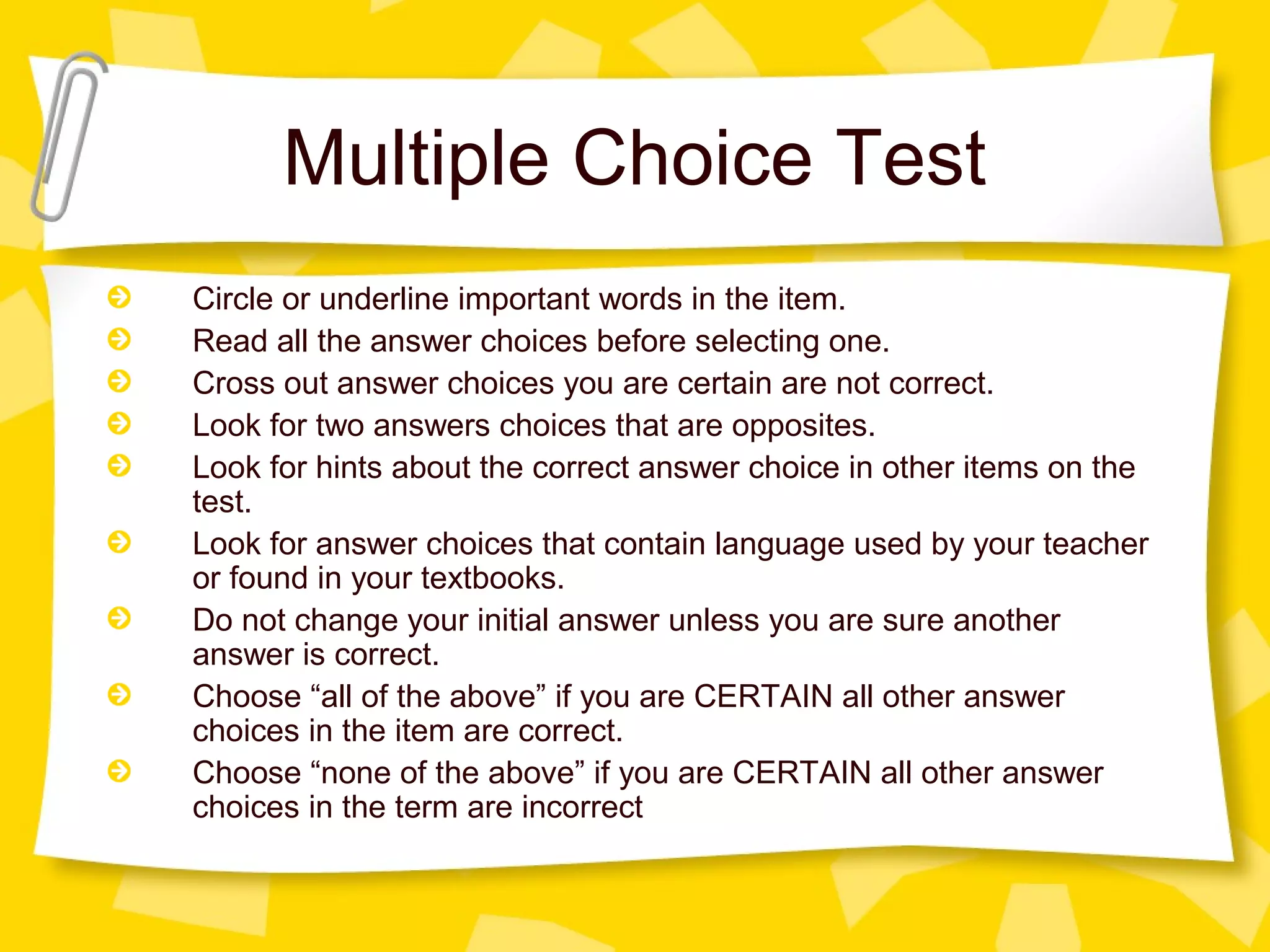
Circle or underline important words in the item.
Read all the answer choices before selecting one.
Cross out answer choices you are certain are not correct.
Look for two answers choices that are opposites.
Look for hints about the correct answer choice in other items on the
test.
Look for answer choices that contain language used by your teacher
or found in your textbooks.
Do not change your initial answer unless you are sure another
answer is correct.
Choose “all of the above” if you are CERTAIN all other answer
choices in the item are correct.
Choose “none of the above” if you are CERTAIN all other answer
choices in the term are incorrect
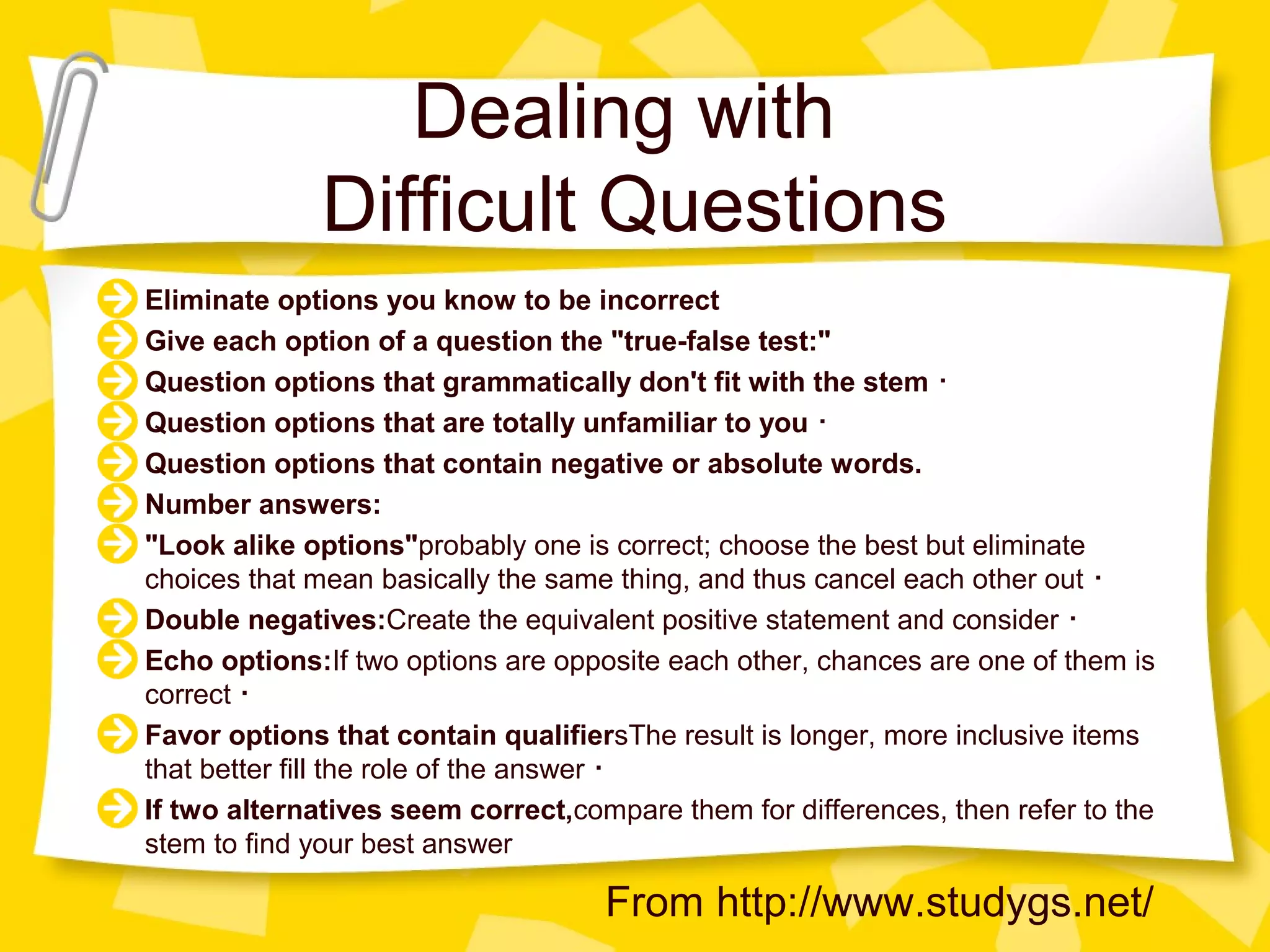
Dealing with
              Difficult Questions
Eliminate options you know to be incorrect
Give each option of a question the "true-false test:"
Question options that grammatically don't fit with the stem ・
Question options that are totally unfamiliar to you ・
Question options that contain negative or absolute words.
Number answers:
"Look alike options"probably one is correct; choose the best but eliminate
choices that mean basically the same thing, and thus cancel each other out ・
Double negatives:Create the equivalent positive statement and consider ・
Echo options:If two options are opposite each other, chances are one of them is
correct ・
Favor options that contain qualifiersThe result is longer, more inclusive items
that better fill the role of the answer ・
If two alternatives seem correct,compare them for differences, then refer to the
stem to find your best answer

                                    From http://www.studygs.net/
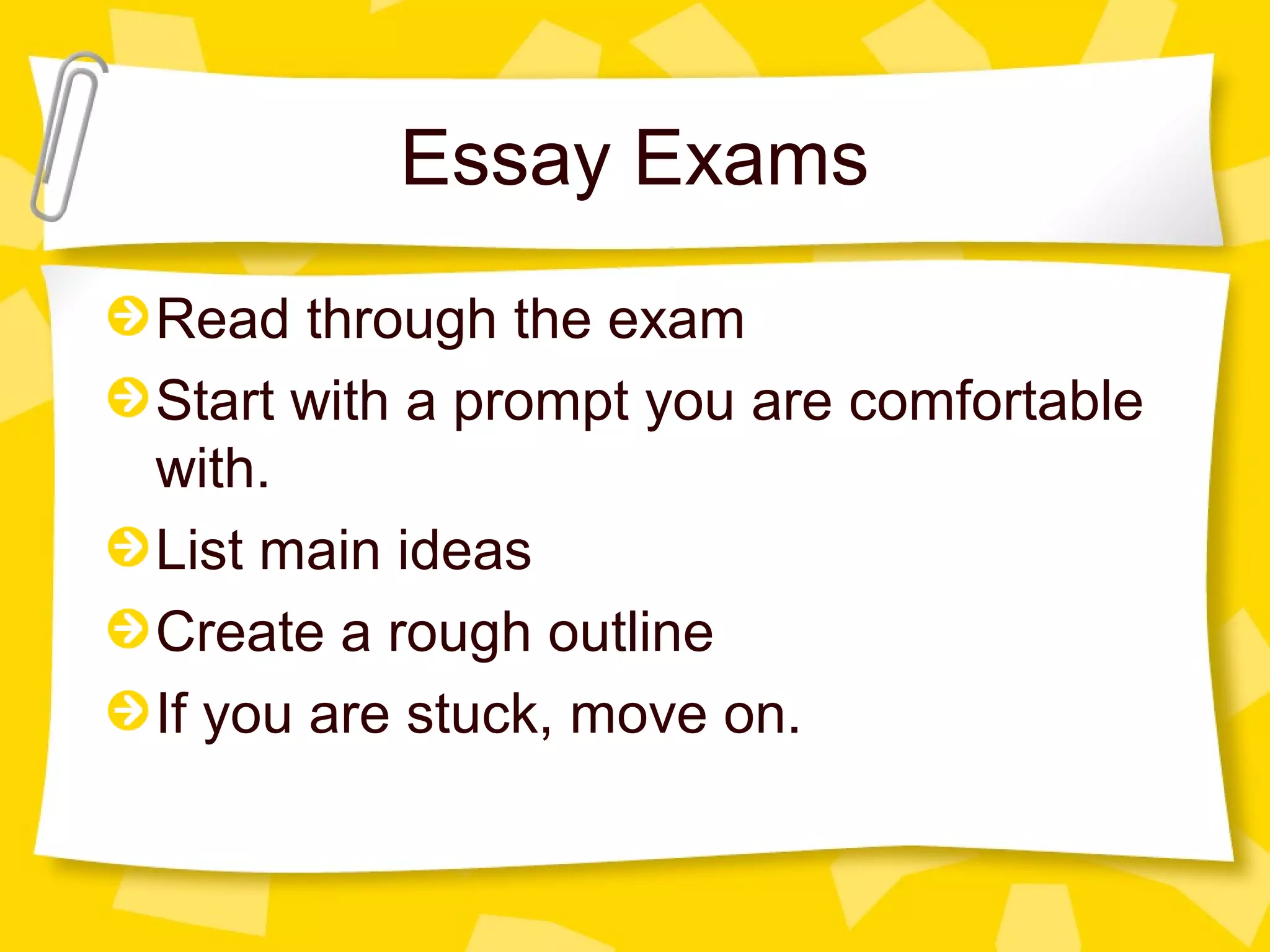
Essay Exams
Read through the exam
Start with a prompt you are comfortable
with.
List main ideas
Create a rough outline
If you are stuck, move on.
GOOD LUCK!

Test taking-prep

  • 1.
    Test Preparation Academic Success Center’s guide to help you succeed on your tests! Academic Success Center Kent State University MSC 207
  • 2.
    “Make preparations inadvance. You never have trouble if you are prepared for it.” ~ Theodore Roosevelt
  • 3.
    Coping with TestAnxiety What Causes Test Anxiety? Lack of preparation as indicated by: – cramming the night before the exam. – poor time management. – failure to organize text information. – poor study habits. Worrying about the following: – past performance on exams. – how friends and other students are doing. – the negative consequences of failure. Source: http://ub-counseling.buffalo.edu/stresstestanxiety.shtml
  • 4.
    Coping with TestAnxiety Confronting and Handling Test Anxiety – Don't think about fear; just think about what you have to do. – Stay relevant. – Relax; you're in control. – Take a slow, deep breath. – You should expect some anxiety; it's a reminder not to panic and to relax and cope steadily with the situation. – Tenseness can be an ally, a friend; it's a cue to cope. Coping with the Feeling of Being Overwhelmed ・ – When the fear comes, just pause. – Keep the focus on the present; what is it you have to do? – You should expect your fear to rise some. – Don't try to eliminate fear totally; just keep it manageable. – You can convince yourself to do it. You can reason your fear away. – It's not the worst thing that can happen. – Do something that will prevent you from thinking about fear. – Describe what is around you. That way you won't think about worrying. Source: http://ub-counseling.buffalo.edu/stresstestanxiety.shtml
  • 5.
    Planning a StudyStrategy “Failing to plan is planning to fail.” ~Alan Lakein
  • 6.
    Tips for TestTaking Long Term Prep: – Review old tests – Review notes daily after class – Keep up with the reading – Join a study group
  • 7.
    Tips for TestTaking Short Term Prep: – One week before the test: • Prepare a study schedule • Put the material into a useful study tool – Day Before: • Have a brief review session • Get eight hours of sleep – Morning of: • Eat a well-balanced breakfast (Stay away from caffeine and sugar)
  • 8.
    Know the Test Whatformat will the test be? – Multiple choice, essay, or fill in the blank What will the test cover? Use a study guide
  • 9.
    Cumulative Exam Preparation Tipson how to study for cumulative exams: – Get copies of old exams. These can act as “study guides” and help you to plan a review strategy. – Consult the syllabus to refresh your memory with what was covered over the semester. – Consult your textbook’s table of contents to draw up a comprehensive list of the materials that should be reviewed.
  • 10.
    Preparing for Tests Finda study place without distractions Restructure your notes: – Outlines or lists – Concept maps (focus on main concepts) – Flashcards (good for memorization) Form study groups – Explain the material to someone else – Ask questions – Compare notes
  • 11.
    Restructuring Notes Examples: QuickTime™ and a TIFF (Uncompressed) decompressor QuickTime™ and a are needed to see this picture. TIFF (Uncompressed) decompressor are needed to see this picture. Concept Map Outline
  • 12.
    Tips for TestTaking Taking the Test: – Arrive early for tests and be prepared. – Read the directions carefully – Answer questions in a strategic order • First easy questions • Then difficult questions – Review your test before turning it in.
  • 13.
    Multiple Choice Test Circleor underline important words in the item. Read all the answer choices before selecting one. Cross out answer choices you are certain are not correct. Look for two answers choices that are opposites. Look for hints about the correct answer choice in other items on the test. Look for answer choices that contain language used by your teacher or found in your textbooks. Do not change your initial answer unless you are sure another answer is correct. Choose “all of the above” if you are CERTAIN all other answer choices in the item are correct. Choose “none of the above” if you are CERTAIN all other answer choices in the term are incorrect
  • 14.
    Dealing with Difficult Questions Eliminate options you know to be incorrect Give each option of a question the "true-false test:" Question options that grammatically don't fit with the stem ・ Question options that are totally unfamiliar to you ・ Question options that contain negative or absolute words. Number answers: "Look alike options"probably one is correct; choose the best but eliminate choices that mean basically the same thing, and thus cancel each other out ・ Double negatives:Create the equivalent positive statement and consider ・ Echo options:If two options are opposite each other, chances are one of them is correct ・ Favor options that contain qualifiersThe result is longer, more inclusive items that better fill the role of the answer ・ If two alternatives seem correct,compare them for differences, then refer to the stem to find your best answer From http://www.studygs.net/
  • 15.
    Essay Exams Read throughthe exam Start with a prompt you are comfortable with. List main ideas Create a rough outline If you are stuck, move on.
  • 16.