Canada on The Home
Front
• Because of how severe the Great Depression was, Canada was very
unconcerned with other countries during the 1930s
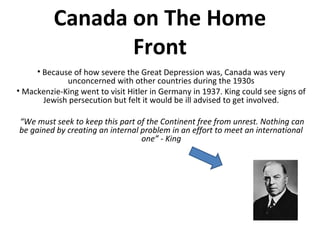
• Mackenzie-King went to visit Hitler in Germany in 1937. King could see signs
of Jewish persecution but felt it would be ill advised to get involved.
“We must seek to keep this part of the Continent free from unrest. Nothing can
be gained by creating an internal problem in an effort to meet an international
one” - King
Canada Declares War
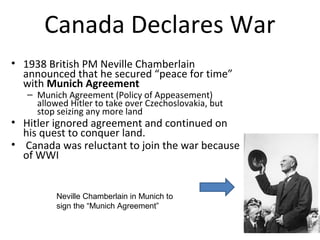
• 1938 British PM at the start of WWII Neville
Chamberlain announced that he secured
“peace for our time” with Munich Agreement
– Munich Agreement (Policy of Appeasement)
allowed Hitler to take over Czechoslovakia, but
stop seizing any more land

• Hitler ignored agreement and continued on
his quest to conquer land.
• Canada was reluctant to join the war because
of WWI

Neville Chamberlain in Munich to
sign the “Munich Agreement”
Mobilizing Canada’s Resources
• At the beginning of WWII
Canada’s Army was very small
and not well equipped

– 4500 troops
– few dozen anti-tank
guns
– 16 tanks
– no modern artillery

• Canada’s Air force and navy were
outdated
• By September there were over 58
330 volunteers for the armed
forces

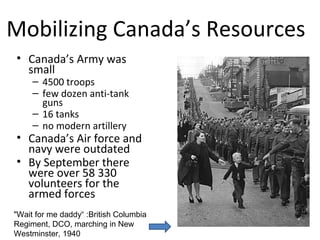
"Wait for me daddy“ :British Columbia Regiment,
DCO, marching in New Westminster, 1940
Civilians and the War Effort
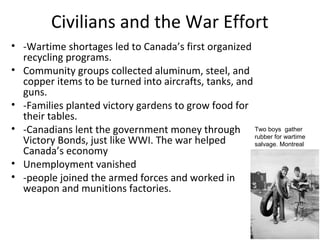
• -Wartime shortages led to Canada’s first organized
recycling programs.
• Community groups collected aluminum, steel, and
copper items to be turned into aircrafts, tanks, and
guns.
• -Families dug up their lawns and planted victory
gardens to grow food for their tables.
• -Canadians lent the government money through Two boys gather
rubber for wartime
Victory Bonds, just like WWI. The war helped
salvage. Montreal
Canada’s economy
• Unemployment vanished
• -people joined the armed forces and worked in
weapon and munitions factories.
Problems with Civilians on the Home
Front
• -Canadians remembered the WWI shortages and therefore
rushed to the stores to stock up on items they feared might
soon vanish from the shelves
• -The result of this panic was inflation
• -Faced with shortages and rising prices, the Canadian
government began to take control of the country’s economy.
• The Wartime Prices and Trade Board under the authority of
the War Measures Act, becomes responsible for price
controls and inflation control.
• laws regulated wages and limited price increases on goods
and services. Things like rent, iron and steel, lumber, sugar,
and milk were all rationed.
•

1941 – laws froze most prices and wages, and rationing was
introduced.
The War at Home:
The Conscription Crisis
• Prime Minister Mackenzie King had promised that there
would be no conscription, However, as the fighting grew
heavier, there were demands to send more soldiers overseas
• King’s government developed the National Resources
Mobilization Act (NRMA)
• This act gave the government special emergency powers to
mobilize all the resources in the nation to defeat the enemy.
• The hiring of men in many positions in civilian employment
was effectively banned through measures taken under the
National Resources Mobilization Act.
• The first Unemployment Insurance program
was introduced in Canada in 1940
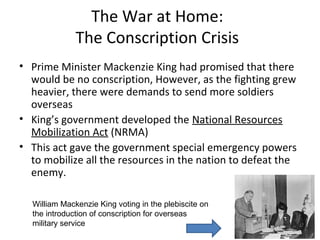
William Mackenzie King voting in the plebiscite on
the introduction of conscription for overseas
military service
Conscription Crisis
•
•

•
•

•
•

•
•
•
•

Prime Minister King had promised that there would be no conscription, But as the
fighting grew heavier, there were demands to send more soldiers overseas.
In 1942 a national system of employment control under the National Selective
Service Act, passed regulations stating no-one could seek a new job without
possessing a permit to do so
No employer could advertise for workers without permission
No-one was allowed to be out of work for more than seven days, and anyone
could be required to apply for any available full-time suitable work of high or very
high labour priority and to accept any such work offered to him.
This did not lead to sufficient volunteers for the military so in addition to the
Selective Services Act
In 1942, King held a referendum on the issue of conscription.
Referendum or plebiscite - submitting an issue to the direct vote of the
people.
80% of Québec said no, 80% of the rest of Canada voted yes.
King then decided not to send conscripts unless he was forced to.
The issue of conscription divided the country as it did in WWI, however, the
situation was not as severe as it had been in 1917.
Think/ Pair/Share: How might the introduction of conscription affect
French/English relations?
The War at Home:
The Conscription Crisis (cont.)
• King made the government stance “Not
necessarily conscription but conscription if
necessary”
• By 1944, losses were so high, King reluctantly
passed conscription and sent 12,000 soldiers
overseas.
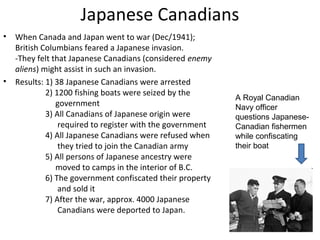
Japanese Canadians
•

•

When Canada and Japan went to war (Dec/1941);
British Columbians feared a Japanese invasion.
They felt that Japanese Canadians (considered enemy
aliens) might assist in such an invasion.
Results: 1) 38 Japanese Canadians were arrested
2) 1200 fishing boats were seized by the
government
3) All Canadians of Japanese origin were
required to register with the government
4) All Japanese Canadians were refused when
they tried to join the Canadian army
5) All persons of Japanese ancestry were
moved to camps in the interior of B.C.
6) The government confiscated their property
and sold it
7) After the war, approx. 4000 Japanese
Canadians were deported to Japan.

A Royal Canadian
Navy officer
questions JapaneseCanadian fishermen
while confiscating
their boat
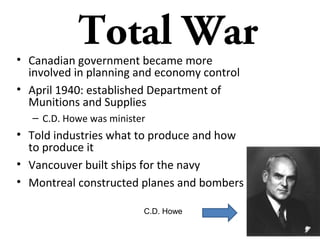
Total War

• Canadian government became more
involved in planning and economy control
• April 1940: established Department of
Munitions and Supplies
– C.D. Howe was minister

• Told industries what to produce and how
to produce it
• Vancouver built ships for the navy
• Montreal constructed planes and bombers
C.D. Howe
Total War

• C.D. Howe created crown corporations: State-owned
corporations established by law, owned by the sovereign and
overseen by parliament and cabinet.
• Examples of federal Crown corporations include the Canadian
Broadcasting Corporation, Canada Post, Canadian National,
and Via Rail.
• Ministers of the Crown often control the shares in such public
corporations, while parliament both sets out the laws that
create and bind Crown corporations.
• Farmers were told to produce more wheat, beef, dairy, and
other foods

• The Government ran telephone companies, refined fuel, stockpiled
silk for parachutes, mined uranium and controlled food production.
• Policy of total war – Anything to destroy the enemy and achieve
victory.
Royal Canadian Air Force
•
•
•

•

At the end of the1930s the RCAF was not considered a major military
force.
Like all of Canada’s military at the onset of WWII, it was small and not
very well equipped.
With the implementation of the British Commonwealth Air Training Plan
during the Second World War, the RCAF was significantly expanded to
become the fourth largest allied air force.
During the war the RCAF was involved in operations in Great Britain,
northwest Europe, the north Atlantic, Egypt, Italy, Sicily, Malta, Ceylon,
India, Burma, and with home defence.
British Commonwealth Air
Training Plan (BCATP)
• PM King hoped contribution would remain at
home
• December 1939: Canada agreed to host and
administer a training plan where British
instructors would train pilots and other flight
personnel from all over the Commonwealth in
Canada this was the British Commonwealth Air
Training Plan known as the BCATP.
BCATP (cont.)
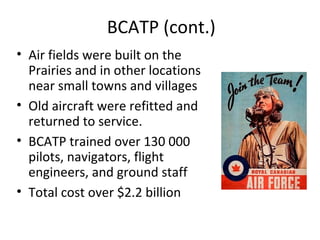
• Air fields were built on the
Prairies and in other locations
near small towns and villages
• Old aircraft were refitted and
returned to service.
• The BCATP trained over 130
000 pilots, navigators, flight
engineers, and ground staff
• The total cost was over $2.2
billion
Women in the War
•
•
•
•
•
•
•
•
•

-Before WWII started, few women in Canada worked outside
the home.
-In 1940, 876 000 women over 18 years of age were
employed outside the home.
-By 1943, 1 000 000 women were in the paid workforce and
another 800,000 doing farm work.
-Women built ships, airplanes, and weapons, knitted socks
and sweaters.
-The government provided incentives for women such as tax
exemptions and childcare facilities.
These incentives would end after the war.
-Women were accepted into the armed services for the first
time.
Eg. Radio operators, nurses, and ambulance drivers.
-At the end of the war, many women gave up their jobs to
returning soldiers.

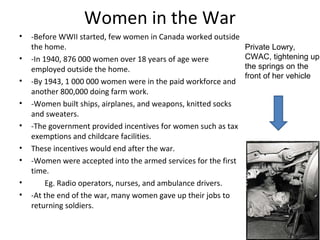
Private Lowry,
CWAC, tightening up
the springs on the
front of her vehicle
Propaganda and other Government programs at Home

•

•

•

•
•
•
•

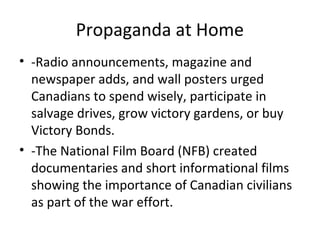
-Government sponsored radio announcements, magazine, newspaper
adds, and wall posters urged Canadians to spend wisely, participate in
salvage drives, grow victory gardens, or buy victory Bonds.
-The National Film Board (NFB) created documentaries and short
informational films showing the importance of Canadian civilians as part
of the war effort.
Introduced William Lyon Mackenzie King’s Liberals in 1944, family
allowances were to be paid by monthly cheque directly to mothers of
children under 16 beginning in 1945.
Unlike other national social security measures such as health and
unemployment insurance, they did not fall under provincial jurisdiction.
During the Second World War, many families suffered because their
wages had not matched wartime inflation.
By introducing family allowances, the government improved both the
purchasing power of families with children and their standard of living.
The family allowance program gave many Canadian families their first
experience of the benefits of government policies designed to generate
social progress.
No Protection For Jews
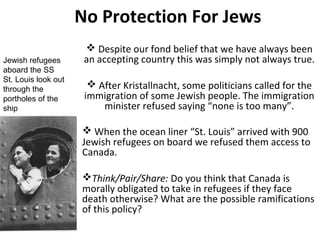
Jewish refugees
aboard the SS
St. Louis look out
through the
portholes of the
ship

 Despite our fond belief that we have always been
an accepting country this was simply not always true.
 After Kristallnacht, some politicians called for the
immigration of some Jewish people. The immigration
minister refused saying “none is too many”.
 When the ocean liner “St. Louis” arrived with 900
Jewish refugees on board we refused them access to
Canada.
Think/Pair/Share: Do you think that Canada is
morally obligated to take in refugees if they face
death otherwise? What are the possible
ramifications of this policy?

4.3 war at home_wwii_can_website

  • 1.
    Canada on TheHome Front • Because of how severe the Great Depression was, Canada was very unconcerned with other countries during the 1930s • Mackenzie-King went to visit Hitler in Germany in 1937. King could see signs of Jewish persecution but felt it would be ill advised to get involved. “We must seek to keep this part of the Continent free from unrest. Nothing can be gained by creating an internal problem in an effort to meet an international one” - King
  • 2.
    Canada Declares War •1938 British PM at the start of WWII Neville Chamberlain announced that he secured “peace for our time” with Munich Agreement – Munich Agreement (Policy of Appeasement) allowed Hitler to take over Czechoslovakia, but stop seizing any more land • Hitler ignored agreement and continued on his quest to conquer land. • Canada was reluctant to join the war because of WWI Neville Chamberlain in Munich to sign the “Munich Agreement”
  • 3.
    Mobilizing Canada’s Resources •At the beginning of WWII Canada’s Army was very small and not well equipped – 4500 troops – few dozen anti-tank guns – 16 tanks – no modern artillery • Canada’s Air force and navy were outdated • By September there were over 58 330 volunteers for the armed forces "Wait for me daddy“ :British Columbia Regiment, DCO, marching in New Westminster, 1940
  • 4.
    Civilians and theWar Effort • -Wartime shortages led to Canada’s first organized recycling programs. • Community groups collected aluminum, steel, and copper items to be turned into aircrafts, tanks, and guns. • -Families dug up their lawns and planted victory gardens to grow food for their tables. • -Canadians lent the government money through Two boys gather rubber for wartime Victory Bonds, just like WWI. The war helped salvage. Montreal Canada’s economy • Unemployment vanished • -people joined the armed forces and worked in weapon and munitions factories.
  • 5.
    Problems with Civilianson the Home Front • -Canadians remembered the WWI shortages and therefore rushed to the stores to stock up on items they feared might soon vanish from the shelves • -The result of this panic was inflation • -Faced with shortages and rising prices, the Canadian government began to take control of the country’s economy. • The Wartime Prices and Trade Board under the authority of the War Measures Act, becomes responsible for price controls and inflation control. • laws regulated wages and limited price increases on goods and services. Things like rent, iron and steel, lumber, sugar, and milk were all rationed. • 1941 – laws froze most prices and wages, and rationing was introduced.
  • 6.
    The War atHome: The Conscription Crisis • Prime Minister Mackenzie King had promised that there would be no conscription, However, as the fighting grew heavier, there were demands to send more soldiers overseas • King’s government developed the National Resources Mobilization Act (NRMA) • This act gave the government special emergency powers to mobilize all the resources in the nation to defeat the enemy. • The hiring of men in many positions in civilian employment was effectively banned through measures taken under the National Resources Mobilization Act. • The first Unemployment Insurance program was introduced in Canada in 1940 William Mackenzie King voting in the plebiscite on the introduction of conscription for overseas military service
  • 7.
    Conscription Crisis • • • • • • • • • • Prime MinisterKing had promised that there would be no conscription, But as the fighting grew heavier, there were demands to send more soldiers overseas. In 1942 a national system of employment control under the National Selective Service Act, passed regulations stating no-one could seek a new job without possessing a permit to do so No employer could advertise for workers without permission No-one was allowed to be out of work for more than seven days, and anyone could be required to apply for any available full-time suitable work of high or very high labour priority and to accept any such work offered to him. This did not lead to sufficient volunteers for the military so in addition to the Selective Services Act In 1942, King held a referendum on the issue of conscription. Referendum or plebiscite - submitting an issue to the direct vote of the people. 80% of Québec said no, 80% of the rest of Canada voted yes. King then decided not to send conscripts unless he was forced to. The issue of conscription divided the country as it did in WWI, however, the situation was not as severe as it had been in 1917. Think/ Pair/Share: How might the introduction of conscription affect French/English relations?
  • 8.
    The War atHome: The Conscription Crisis (cont.) • King made the government stance “Not necessarily conscription but conscription if necessary” • By 1944, losses were so high, King reluctantly passed conscription and sent 12,000 soldiers overseas.
  • 9.
    Japanese Canadians • • When Canadaand Japan went to war (Dec/1941); British Columbians feared a Japanese invasion. They felt that Japanese Canadians (considered enemy aliens) might assist in such an invasion. Results: 1) 38 Japanese Canadians were arrested 2) 1200 fishing boats were seized by the government 3) All Canadians of Japanese origin were required to register with the government 4) All Japanese Canadians were refused when they tried to join the Canadian army 5) All persons of Japanese ancestry were moved to camps in the interior of B.C. 6) The government confiscated their property and sold it 7) After the war, approx. 4000 Japanese Canadians were deported to Japan. A Royal Canadian Navy officer questions JapaneseCanadian fishermen while confiscating their boat
  • 10.
    Total War • Canadiangovernment became more involved in planning and economy control • April 1940: established Department of Munitions and Supplies – C.D. Howe was minister • Told industries what to produce and how to produce it • Vancouver built ships for the navy • Montreal constructed planes and bombers C.D. Howe
  • 11.
    Total War • C.D.Howe created crown corporations: State-owned corporations established by law, owned by the sovereign and overseen by parliament and cabinet. • Examples of federal Crown corporations include the Canadian Broadcasting Corporation, Canada Post, Canadian National, and Via Rail. • Ministers of the Crown often control the shares in such public corporations, while parliament both sets out the laws that create and bind Crown corporations. • Farmers were told to produce more wheat, beef, dairy, and other foods • The Government ran telephone companies, refined fuel, stockpiled silk for parachutes, mined uranium and controlled food production. • Policy of total war – Anything to destroy the enemy and achieve victory.
  • 12.
    Royal Canadian AirForce • • • • At the end of the1930s the RCAF was not considered a major military force. Like all of Canada’s military at the onset of WWII, it was small and not very well equipped. With the implementation of the British Commonwealth Air Training Plan during the Second World War, the RCAF was significantly expanded to become the fourth largest allied air force. During the war the RCAF was involved in operations in Great Britain, northwest Europe, the north Atlantic, Egypt, Italy, Sicily, Malta, Ceylon, India, Burma, and with home defence.
  • 13.
    British Commonwealth Air TrainingPlan (BCATP) • PM King hoped contribution would remain at home • December 1939: Canada agreed to host and administer a training plan where British instructors would train pilots and other flight personnel from all over the Commonwealth in Canada this was the British Commonwealth Air Training Plan known as the BCATP.
  • 14.
    BCATP (cont.) • Airfields were built on the Prairies and in other locations near small towns and villages • Old aircraft were refitted and returned to service. • The BCATP trained over 130 000 pilots, navigators, flight engineers, and ground staff • The total cost was over $2.2 billion
  • 15.
    Women in theWar • • • • • • • • • -Before WWII started, few women in Canada worked outside the home. -In 1940, 876 000 women over 18 years of age were employed outside the home. -By 1943, 1 000 000 women were in the paid workforce and another 800,000 doing farm work. -Women built ships, airplanes, and weapons, knitted socks and sweaters. -The government provided incentives for women such as tax exemptions and childcare facilities. These incentives would end after the war. -Women were accepted into the armed services for the first time. Eg. Radio operators, nurses, and ambulance drivers. -At the end of the war, many women gave up their jobs to returning soldiers. Private Lowry, CWAC, tightening up the springs on the front of her vehicle
  • 16.
    Propaganda and otherGovernment programs at Home • • • • • • • -Government sponsored radio announcements, magazine, newspaper adds, and wall posters urged Canadians to spend wisely, participate in salvage drives, grow victory gardens, or buy victory Bonds. -The National Film Board (NFB) created documentaries and short informational films showing the importance of Canadian civilians as part of the war effort. Introduced William Lyon Mackenzie King’s Liberals in 1944, family allowances were to be paid by monthly cheque directly to mothers of children under 16 beginning in 1945. Unlike other national social security measures such as health and unemployment insurance, they did not fall under provincial jurisdiction. During the Second World War, many families suffered because their wages had not matched wartime inflation. By introducing family allowances, the government improved both the purchasing power of families with children and their standard of living. The family allowance program gave many Canadian families their first experience of the benefits of government policies designed to generate social progress.
  • 17.
    No Protection ForJews Jewish refugees aboard the SS St. Louis look out through the portholes of the ship  Despite our fond belief that we have always been an accepting country this was simply not always true.  After Kristallnacht, some politicians called for the immigration of some Jewish people. The immigration minister refused saying “none is too many”.  When the ocean liner “St. Louis” arrived with 900 Jewish refugees on board we refused them access to Canada. Think/Pair/Share: Do you think that Canada is morally obligated to take in refugees if they face death otherwise? What are the possible ramifications of this policy?