Canada’s Independence From
Britain and the Development of
A Canadian Identity
Alaska Panhandle Dispute
•The Alaska boundary dispute, took place between
Canada and the US over the boundary of the Alaska
Panhandle.
•In 1897 the gold rush magnified the issue.
•A joint high commission of Canadian (2), American (3)
and British (1) men got together. The British sided
with the Americans leaving us out to dry.
•PM Laurier noted that because Canada lacked treaty
making power it was impossible for us to maintain our
rights internationally.
The Boer War
•This was the first time Canada sent troops overseas to
fight in a war (1899-1902).
•7,000 Canadians served in South Africa to help Britain,
all volunteers.
•As the war progressed many people noted how unjust
and disgraceful the war was to the British dominion.
•French Canadians fought against our participation as did
many other Canadians after realizing how unrelated the
whole conflict was to Canada.
Boer women and children in a British
concentration camp
Lzzie van Zyl who died in the Bloemfontein
concentration camp
World War One
•When we came into the war it was as British subjects.
Many Canadians (especially the French) were upset that
we should not be able to decide on our own.
•As the war progressed Canadians made a name for
themselves as some of the bravest and smartest soldiers.
•The conscription Crisis almost split our nation in two.
There were riots that resulted in deaths in Quebec.
•Most conscripted forces never saw the battle field.
•However the crisis both deepened the divide between
French and English speaking Canadians, and moved
Canada toward more independence from Britain.
Henri Bourassa and the
Conscription Crisis
• Henri Bourassa was a Quebec
politician who actively promoted
Francophone interests in Canada.
He was opposed to conscription in
Both World War One and Two.
• He fought for French language
rights in schools and was active in
the Bloc populaire, an anticonscription party established
during WWII.
The Chanak Crisis
• In 1922 the British became involved in a territorial
dispute with Turkey.
• The British threatened Turkey with war, with both
Britain and the dominion countries.
• PM King said no that we would vote on whether or
not we would go to war in the Canadian House of
Commons.
• Canada would never again automatically go to war
when Britain went to war. Chanak Crisis
Halibut Treaty 1923
• The first treaty Canada signed without the
approval of the British was the Halibut Treaty
• This treaty was with the US.
• As the 20th Century progressed Canada would
become less influenced by British policy and
culture and more influenced by the policy and
culture of the United States.
Balfour Report
•In 1926 former British PM Lord Balfour created this report
presented at the Imperial Conference of 1926.
•It stated, among a number of other historically important
things the following:
•“Britain and its Dominions… are autonomous communities
within the British Empire, equal in status, in no way
subordinate one to another in any aspect of their domestic or
external affairs, though united by a common allegiance to the
Crown, and freely associated as members of the British
Commonwealth of Nations."
Balfour Report : What does it mean?
• The Balfour Report says that Canada was an
independent nation in the way it dealt with other
nations.
• However it leaves Canadian political autonomy very
ill-defined.
The King-Byng Affair
•The King-Byng Affair was a political crisis in 1926
involving Prime Minister Mackenzie King and Governor
General Byng.
•Byng refused a request to dissolve parliament.
•The tradition of not having Imperial interference in
Canadian politics had been violated.
The Group of Seven
• Franklin Carmichael, Lawren Harris, A. Y. Jackson,
Frank Johnston, Arthur Lismer, J. E. H. MacDonald,
and Frederick Varley.
• Tom Thomson and Emily Carr are two well
recognized Canadian artists also associated with the
group of seven.
• These artists created a unique and identifiable
Canadian style of art
Statute of Westminster
•Until 1931 the British Commonwealth countries
had very ill-defined authority.
•The Statute of Westminster 1931 gives Canada
the right to be an autonomous nation. This
autonomy did not extend to the BNA act which
acted as the Constitution of Canada until 1982.
Canada in WWII
• When Canada entered WWII their was a vote in the
House of Commons.
• Unlike WWI, PM King did not want whole sale
Canadian involvement in WWII. He initially promised
no conscription and limited involvement.
• Unlike WWI Canadians were hesitant to enter a war
in Europe on the behalf of Britain.
• After the raid catastrophic loss of Canadian lives at
Dieppe ,many Canadians were angered by what they
perceived as a failure on the part of the British
commanders.
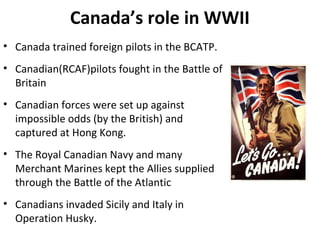
Canada’s role in WWII
• Canada trained foreign pilots in the BCATP.
• Canadian(RCAF)pilots fought in the Battle of
Britain
• Canadian forces were set up against
impossible odds (by the British) and
captured at Hong Kong.
• The Royal Canadian Navy and many
Merchant Marines kept the Allies supplied
through the Battle of the Atlantic
• Canadians invaded Sicily and Italy in
Operation Husky.
Still more Canada in WWII
• On D-Day Canadian soldiers achieved their
objective of Juno Beach.
• Canadian soldiers liberated the Netherlands
• Canadian uranium went in to the nuclear
program during WWII.
• The National Film Board of Canada was
established, partially to develop propaganda for
WWII, it later goes on to promote Canadian
identity.
The Massey Commission 1951
• The Massey commission was a Royal Commission
on National Development in the Arts, Letters and
Sciences
• Also known as the Massey–Lévesque
Commission
• It found that Canada was culturally threatened,
by the US .
• The Massey Report recommended the creation
of cultural institutions like the Canada Council
and the National Library of Canada.
Suez Crisis 1956
• Lester B. Person came up with the solution to
the political crisis that developed in Egypt
over control of the Suez Canal
• This solution, achieved by using the United
Nations as an international governing body,
cemented Canada’s role as a middle power on
the global political stage.
• It was with the Suez Crisis that Canada first
gained international recognition as
peacekeepers.
Patriation of the Constitution
1982
• In 1982 Pierre Elliot Trudeau the Prime Minister of Canada
changed the constitutional relationship between Canada and
Britain.
• Up until this point if there was a constitutional disagreement
about a point in the BNA the highest court of appeal was the
British Privy Council in London.
• The Charter of Rights was not entrenched in the BNA act
• After this the highest court of appeal in Canada was the
Supreme Court of Canada.
• The Charter of Rights and Freedoms was incorporated into
the Canadian Constitution.

7.2 canada independence from_britain

  • 1.
    Canada’s Independence From Britainand the Development of A Canadian Identity
  • 2.
    Alaska Panhandle Dispute •TheAlaska boundary dispute, took place between Canada and the US over the boundary of the Alaska Panhandle. •In 1897 the gold rush magnified the issue. •A joint high commission of Canadian (2), American (3) and British (1) men got together. The British sided with the Americans leaving us out to dry. •PM Laurier noted that because Canada lacked treaty making power it was impossible for us to maintain our rights internationally.
  • 3.
    The Boer War •Thiswas the first time Canada sent troops overseas to fight in a war (1899-1902). •7,000 Canadians served in South Africa to help Britain, all volunteers. •As the war progressed many people noted how unjust and disgraceful the war was to the British dominion. •French Canadians fought against our participation as did many other Canadians after realizing how unrelated the whole conflict was to Canada.
  • 4.
    Boer women andchildren in a British concentration camp
  • 5.
    Lzzie van Zylwho died in the Bloemfontein concentration camp
  • 6.
    World War One •Whenwe came into the war it was as British subjects. Many Canadians (especially the French) were upset that we should not be able to decide on our own. •As the war progressed Canadians made a name for themselves as some of the bravest and smartest soldiers. •The conscription Crisis almost split our nation in two. There were riots that resulted in deaths in Quebec. •Most conscripted forces never saw the battle field. •However the crisis both deepened the divide between French and English speaking Canadians, and moved Canada toward more independence from Britain.
  • 7.
    Henri Bourassa andthe Conscription Crisis • Henri Bourassa was a Quebec politician who actively promoted Francophone interests in Canada. He was opposed to conscription in Both World War One and Two. • He fought for French language rights in schools and was active in the Bloc populaire, an anticonscription party established during WWII.
  • 8.
    The Chanak Crisis •In 1922 the British became involved in a territorial dispute with Turkey. • The British threatened Turkey with war, with both Britain and the dominion countries. • PM King said no that we would vote on whether or not we would go to war in the Canadian House of Commons. • Canada would never again automatically go to war when Britain went to war. Chanak Crisis
  • 9.
    Halibut Treaty 1923 •The first treaty Canada signed without the approval of the British was the Halibut Treaty • This treaty was with the US. • As the 20th Century progressed Canada would become less influenced by British policy and culture and more influenced by the policy and culture of the United States.
  • 10.
    Balfour Report •In 1926former British PM Lord Balfour created this report presented at the Imperial Conference of 1926. •It stated, among a number of other historically important things the following: •“Britain and its Dominions… are autonomous communities within the British Empire, equal in status, in no way subordinate one to another in any aspect of their domestic or external affairs, though united by a common allegiance to the Crown, and freely associated as members of the British Commonwealth of Nations."
  • 11.
    Balfour Report :What does it mean? • The Balfour Report says that Canada was an independent nation in the way it dealt with other nations. • However it leaves Canadian political autonomy very ill-defined.
  • 12.
    The King-Byng Affair •TheKing-Byng Affair was a political crisis in 1926 involving Prime Minister Mackenzie King and Governor General Byng. •Byng refused a request to dissolve parliament. •The tradition of not having Imperial interference in Canadian politics had been violated.
  • 13.
    The Group ofSeven • Franklin Carmichael, Lawren Harris, A. Y. Jackson, Frank Johnston, Arthur Lismer, J. E. H. MacDonald, and Frederick Varley. • Tom Thomson and Emily Carr are two well recognized Canadian artists also associated with the group of seven. • These artists created a unique and identifiable Canadian style of art
  • 15.
    Statute of Westminster •Until1931 the British Commonwealth countries had very ill-defined authority. •The Statute of Westminster 1931 gives Canada the right to be an autonomous nation. This autonomy did not extend to the BNA act which acted as the Constitution of Canada until 1982.
  • 16.
    Canada in WWII •When Canada entered WWII their was a vote in the House of Commons. • Unlike WWI, PM King did not want whole sale Canadian involvement in WWII. He initially promised no conscription and limited involvement. • Unlike WWI Canadians were hesitant to enter a war in Europe on the behalf of Britain. • After the raid catastrophic loss of Canadian lives at Dieppe ,many Canadians were angered by what they perceived as a failure on the part of the British commanders.
  • 17.
    Canada’s role inWWII • Canada trained foreign pilots in the BCATP. • Canadian(RCAF)pilots fought in the Battle of Britain • Canadian forces were set up against impossible odds (by the British) and captured at Hong Kong. • The Royal Canadian Navy and many Merchant Marines kept the Allies supplied through the Battle of the Atlantic • Canadians invaded Sicily and Italy in Operation Husky.
  • 18.
    Still more Canadain WWII • On D-Day Canadian soldiers achieved their objective of Juno Beach. • Canadian soldiers liberated the Netherlands • Canadian uranium went in to the nuclear program during WWII. • The National Film Board of Canada was established, partially to develop propaganda for WWII, it later goes on to promote Canadian identity.
  • 19.
    The Massey Commission1951 • The Massey commission was a Royal Commission on National Development in the Arts, Letters and Sciences • Also known as the Massey–Lévesque Commission • It found that Canada was culturally threatened, by the US . • The Massey Report recommended the creation of cultural institutions like the Canada Council and the National Library of Canada.
  • 20.
    Suez Crisis 1956 •Lester B. Person came up with the solution to the political crisis that developed in Egypt over control of the Suez Canal • This solution, achieved by using the United Nations as an international governing body, cemented Canada’s role as a middle power on the global political stage. • It was with the Suez Crisis that Canada first gained international recognition as peacekeepers.
  • 21.
    Patriation of theConstitution 1982 • In 1982 Pierre Elliot Trudeau the Prime Minister of Canada changed the constitutional relationship between Canada and Britain. • Up until this point if there was a constitutional disagreement about a point in the BNA the highest court of appeal was the British Privy Council in London. • The Charter of Rights was not entrenched in the BNA act • After this the highest court of appeal in Canada was the Supreme Court of Canada. • The Charter of Rights and Freedoms was incorporated into the Canadian Constitution.