M
.A.N.I.A.
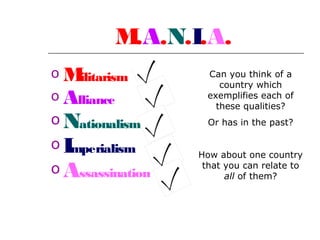
oM
ilitarism
o Alliance

o Nationalism
oI
mperialism

o Assassination

Can you think of a
country which
exemplifies each of
these qualities?
Or has in the past?
How about one country
that you can relate to
all of them?
Militarism
o

The belief in and dependence on a strong military in
order to defend and expand the borders of a country
The Dreadnought
The Dreadnought and the Naval
Arms Race









The first of the kind, the British Royal Navy's
Dreadnought, made such a strong impression on people's
minds when it was launched in 1906 that similar
battleships built after were referred to generically as
"dreadnoughts,"
Earlier battleships became known as pre-dreadnoughts.
The Dreadnought's design had two revolutionary features:
an "all-big-gun" armament scheme, with an
unprecedented number of heavy-calibre guns, and steam
turbine propulsion.
As dreadnoughts became a crucial symbol of national
power, the arrival of these new warships renewed the
naval arms race between the United Kingdom and
Germany.
Ultimately this would affect the balance of power in
Europe and on the international stage
Militarism & Nationalism






There was a huge arms race in
Europe in the early 1900’s
Britain and Germany were going
head to head to see who could
create the larger navy
All European countries expanded
their armies to try and maintain a
balance of power
AL IANCE
L
o

Alliance: signed treaties in which each nation involved
pledges to defend one another if attacked by an
aggressor
NAT
IONAL
ISM
o

Nationalism: pride and
patriotism in one’ s nation; in
terms of WWI, nationalism
became aggressive and
subsequently a major cause of
international tension
Hitler
IM E
P RIAL
ISM
o

Imperialism: domination by one country of the
political, economic, or cultural life of another
country or region; due to the Industrial
Revolution of the 1800s, some European
nations had a large portion of the world under
their control
Imperialism


Many countries of Europe were still trying to
assert their imperialist powers



By the late 1800’s the race to claim territories
in Africa, which was rich in diamonds and
gold, became fierce



European countries often challenged each
other on these issues (ex. Boer War)
ASSASSINAT
ION
o

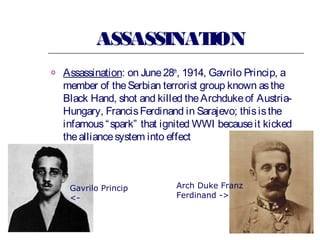
Assassination: on June 28th, 1914, Gavrilo Princip, a
member of the Serbian terrorist group known as the
Black Hand, shot and killed the Archduke of AustriaHungary, Francis Ferdinand in Sarajevo; this is the
infamous “ spark” that ignited WWI because it kicked
the alliance system into effect

Gavrilo Princip
<-

Arch Duke Franz
Ferdinand ->
Questions on M.A.N.I.A


1. Give 2 examples of the rise of Militarism pre
WWI. How did these examples contribute to the
outbreak of the War? (3)



2. How did the Alliance system contribute to the
outbreak of WWI? (2)



3. Give 2 examples of imperialism pre WWI. How
did imperialism affect Canada during this period?
Give at least 2 examples. (4)

2.2 mania website

  • 1.
    M .A.N.I.A. oM ilitarism o Alliance o Nationalism oI mperialism oAssassination Can you think of a country which exemplifies each of these qualities? Or has in the past? How about one country that you can relate to all of them?
  • 2.
    Militarism o The belief inand dependence on a strong military in order to defend and expand the borders of a country
  • 3.
  • 4.
    The Dreadnought andthe Naval Arms Race      The first of the kind, the British Royal Navy's Dreadnought, made such a strong impression on people's minds when it was launched in 1906 that similar battleships built after were referred to generically as "dreadnoughts," Earlier battleships became known as pre-dreadnoughts. The Dreadnought's design had two revolutionary features: an "all-big-gun" armament scheme, with an unprecedented number of heavy-calibre guns, and steam turbine propulsion. As dreadnoughts became a crucial symbol of national power, the arrival of these new warships renewed the naval arms race between the United Kingdom and Germany. Ultimately this would affect the balance of power in Europe and on the international stage
  • 5.
    Militarism & Nationalism    Therewas a huge arms race in Europe in the early 1900’s Britain and Germany were going head to head to see who could create the larger navy All European countries expanded their armies to try and maintain a balance of power
  • 6.
    AL IANCE L o Alliance: signedtreaties in which each nation involved pledges to defend one another if attacked by an aggressor
  • 7.
    NAT IONAL ISM o Nationalism: pride and patriotismin one’ s nation; in terms of WWI, nationalism became aggressive and subsequently a major cause of international tension Hitler
  • 8.
    IM E P RIAL ISM o Imperialism:domination by one country of the political, economic, or cultural life of another country or region; due to the Industrial Revolution of the 1800s, some European nations had a large portion of the world under their control
  • 9.
    Imperialism  Many countries ofEurope were still trying to assert their imperialist powers  By the late 1800’s the race to claim territories in Africa, which was rich in diamonds and gold, became fierce  European countries often challenged each other on these issues (ex. Boer War)
  • 10.
    ASSASSINAT ION o Assassination: on June28th, 1914, Gavrilo Princip, a member of the Serbian terrorist group known as the Black Hand, shot and killed the Archduke of AustriaHungary, Francis Ferdinand in Sarajevo; this is the infamous “ spark” that ignited WWI because it kicked the alliance system into effect Gavrilo Princip <- Arch Duke Franz Ferdinand ->
  • 11.
    Questions on M.A.N.I.A  1.Give 2 examples of the rise of Militarism pre WWI. How did these examples contribute to the outbreak of the War? (3)  2. How did the Alliance system contribute to the outbreak of WWI? (2)  3. Give 2 examples of imperialism pre WWI. How did imperialism affect Canada during this period? Give at least 2 examples. (4)