The Civil War
Title: The Civil War
Keywords:
• Pro-treaty
• Anti-treaty
• Rory O’Connor
• Liam Lynch
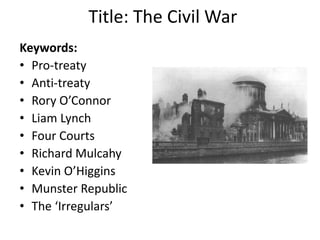
• Four Courts
• Richard Mulcahy
• Kevin O’Higgins
• Munster Republic
• The ‘Irregulars’
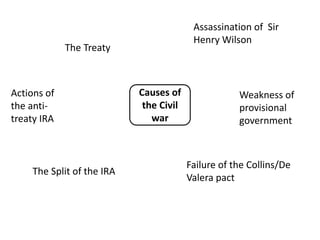
Causes of
the Civil
war
The Treaty
The Split of the IRA
Failure of the Collins/De
Valera pact
Assassination of Sir
Henry Wilson
Weakness of
provisional
government
Actions of
the anti-
treaty IRA
Civil war documentary
https://www.youtube.com/watch?v=gl66ixAXm_A
The Treaty
• The main cause of the Civil War
• Those opposed believed it was a betrayal of the republic
• Those supporting argued that it was a “stepping stone
to freedom” or “the freedom to achieve freedom”.
• Split the Dáil cabinet - Collins, Griffith, Barton and
Cosgrave in favour - DeValera, Brugha and Stack against
• The Dáil had voted 64 votes to 57 votes in favour
• DeValera resigned as President of the Dáil
• Mulcahy wanted the IRA to form the basis of national
army for the Free State
• IRA commanders disagreed Treaty
• Opposition was particularly strong in Munster
• An IRA Army Convention in March 1922 rejected the
authority of the Dáil
• This causes a split in the IRA
The split in the IRA
Divisions
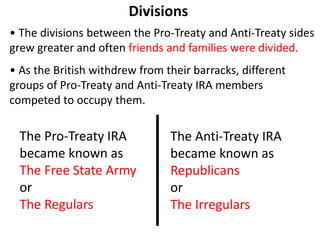
• The divisions between the Pro-Treaty and Anti-Treaty sides
grew greater and often friends and families were divided.
• As the British withdrew from their barracks, different
groups of Pro-Treaty and Anti-Treaty IRA members
competed to occupy them.
The Anti-Treaty IRA
became known as
Republicans
or
The Irregulars
The Pro-Treaty IRA
became known as
The Free State Army
or
The Regulars
Weakness of provisional government
• It was only temporary, not permanent
• There was to be a 12-month period of gradual transfer
of power from British
• The provisional government had no constitution or
status and the Dáil government was still in existence
• This added to the impression of confusion and chaos of
who was actually in charge
• The Free State government finally came into existence
on 6th December 1922
The Slide to Civil War
• A group of Republicans or Irregulars took over the Four
Courts in Dublin
• They issued a declaration refusing to recognise the
Provisional Government.
• They declared the Four Courts to be the headquarters of
the Republican government.
• Collins was reluctant to take direct action against them
• The new government was to be put under pressure by the
British to deal with the anti-treaty forces
Actions of the anti-treaty IRA
• The anti-treaty IRA made it clear that they had no
intention of losing the initiative.
• They disputed the takeover of RIC and British army
barracks by attacking the barracks.
• In April 1922 under the leadership of Rory O’Connor,
they seized the Four Courts and other strongholds in
Dublin
• The anti-treaty forces were able to get considerable
supplies of arms from RIC and British barracks.
1922 Election
• Supporters and opponents of the treaty agreed to a pact
to not run against each other in the election
• All candidates to stand as Sinn Féin candidates with the
aim of forming a coalition government in which the anti-
treaty members would get positions on the National
Executive.
• Collins rejected the pact just before the election.
• In the June 1922 election the pro-treaty side won 58
seats to the anti-treaty 36 seats.
• Some argue an election earlier in the year would have
calmed the situation down
• The election showed a majority in favour of the Treaty
and this strengthened the government’s legitimacy
• The out break of hostilities came with the assassination
of Sir Henry Wilson in London
• Wilson was blamed for attacks on Catholics in the North.
• The British government informed Collins that they could
no longer tolerate the situation in the Four Courts
• The British believed that the commanders in the Four
Courts had ordered the assassination
• Collins took the decision to attack the Four Courts on
28th June.
• The immediate effect was to polarise the conflict and the
Civil war had begun.
Assassination of Sir Henry Wilson

The civil war

  • 1.
  • 2.
    Title: The CivilWar Keywords: • Pro-treaty • Anti-treaty • Rory O’Connor • Liam Lynch • Four Courts • Richard Mulcahy • Kevin O’Higgins • Munster Republic • The ‘Irregulars’
  • 3.
    Causes of the Civil war TheTreaty The Split of the IRA Failure of the Collins/De Valera pact Assassination of Sir Henry Wilson Weakness of provisional government Actions of the anti- treaty IRA
  • 4.
  • 5.
    The Treaty • Themain cause of the Civil War • Those opposed believed it was a betrayal of the republic • Those supporting argued that it was a “stepping stone to freedom” or “the freedom to achieve freedom”. • Split the Dáil cabinet - Collins, Griffith, Barton and Cosgrave in favour - DeValera, Brugha and Stack against • The Dáil had voted 64 votes to 57 votes in favour • DeValera resigned as President of the Dáil
  • 6.
    • Mulcahy wantedthe IRA to form the basis of national army for the Free State • IRA commanders disagreed Treaty • Opposition was particularly strong in Munster • An IRA Army Convention in March 1922 rejected the authority of the Dáil • This causes a split in the IRA The split in the IRA
  • 7.
    Divisions • The divisionsbetween the Pro-Treaty and Anti-Treaty sides grew greater and often friends and families were divided. • As the British withdrew from their barracks, different groups of Pro-Treaty and Anti-Treaty IRA members competed to occupy them. The Anti-Treaty IRA became known as Republicans or The Irregulars The Pro-Treaty IRA became known as The Free State Army or The Regulars
  • 8.
    Weakness of provisionalgovernment • It was only temporary, not permanent • There was to be a 12-month period of gradual transfer of power from British • The provisional government had no constitution or status and the Dáil government was still in existence • This added to the impression of confusion and chaos of who was actually in charge • The Free State government finally came into existence on 6th December 1922
  • 9.
    The Slide toCivil War • A group of Republicans or Irregulars took over the Four Courts in Dublin • They issued a declaration refusing to recognise the Provisional Government. • They declared the Four Courts to be the headquarters of the Republican government. • Collins was reluctant to take direct action against them • The new government was to be put under pressure by the British to deal with the anti-treaty forces
  • 10.
    Actions of theanti-treaty IRA • The anti-treaty IRA made it clear that they had no intention of losing the initiative. • They disputed the takeover of RIC and British army barracks by attacking the barracks. • In April 1922 under the leadership of Rory O’Connor, they seized the Four Courts and other strongholds in Dublin • The anti-treaty forces were able to get considerable supplies of arms from RIC and British barracks.
  • 11.
    1922 Election • Supportersand opponents of the treaty agreed to a pact to not run against each other in the election • All candidates to stand as Sinn Féin candidates with the aim of forming a coalition government in which the anti- treaty members would get positions on the National Executive. • Collins rejected the pact just before the election. • In the June 1922 election the pro-treaty side won 58 seats to the anti-treaty 36 seats. • Some argue an election earlier in the year would have calmed the situation down • The election showed a majority in favour of the Treaty and this strengthened the government’s legitimacy
  • 12.
    • The outbreak of hostilities came with the assassination of Sir Henry Wilson in London • Wilson was blamed for attacks on Catholics in the North. • The British government informed Collins that they could no longer tolerate the situation in the Four Courts • The British believed that the commanders in the Four Courts had ordered the assassination • Collins took the decision to attack the Four Courts on 28th June. • The immediate effect was to polarise the conflict and the Civil war had begun. Assassination of Sir Henry Wilson