4.13 - Estimate the Margin of Error for a Given Measurement
Objective: At the end of this lesson you will be able to estimate the
margin of error for a given measurement.
To measure different quantities, we use instruments such as
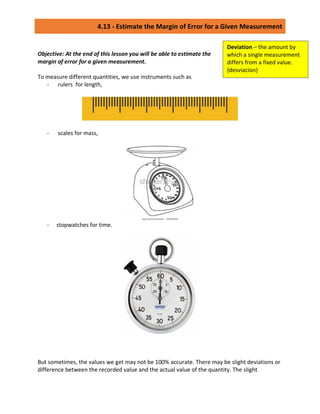
- rulers for length,
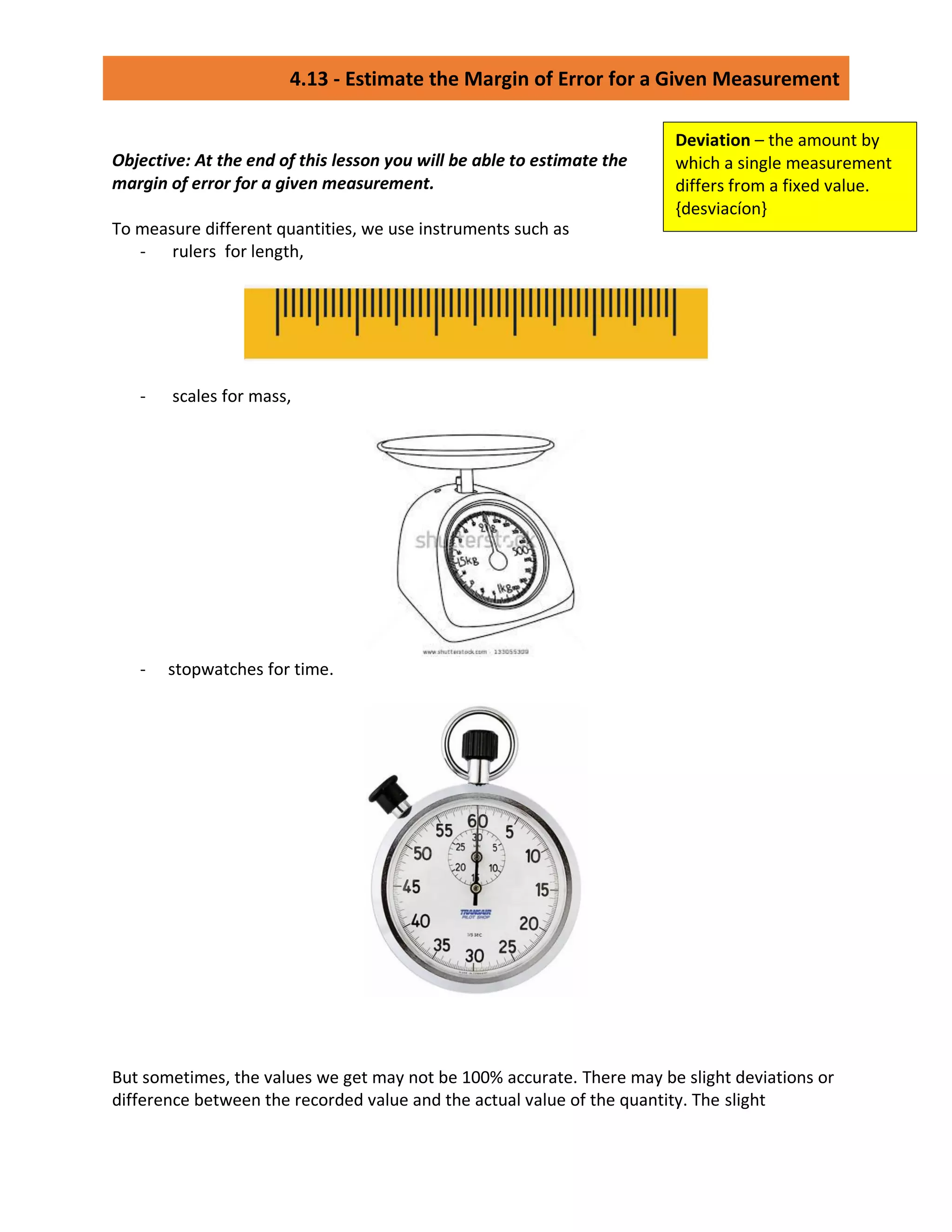
- scales for mass,
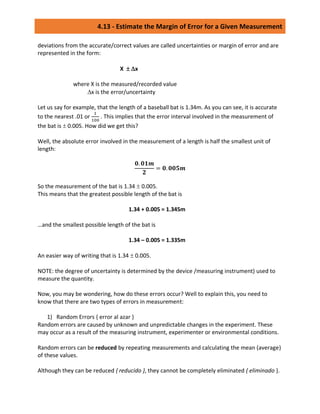
- stopwatches for time.
But sometimes, the values we get may not be 100% accurate. There may be slight deviations or
difference between the recorded value and the actual value of the quantity. The slight
Deviation – the amount by
which a single measurement
differs from a fixed value.
{desviacíon}
4.13 - Estimate the Margin of Error for a Given Measurement
deviations from the accurate/correct values are called uncertainties or margin of error and are
represented in the form:
X  x
where X is the measured/recorded value
x is the error/uncertainty
Let us say for example, that the length of a baseball bat is 1.34m. As you can see, it is accurate
to the nearest .01 or
1
100
. This implies that the error interval involved in the measurement of
the bat is  0.005. How did we get this?
Well, the absolute error involved in the measurement of a length is half the smallest unit of
length:
𝟎. 𝟎𝟏𝒎
𝟐
= 𝟎. 𝟎𝟎𝟓𝒎
So the measurement of the bat is 1.34  0.005.
This means that the greatest possible length of the bat is
1.34 + 0.005 = 1.345m
…and the smallest possible length of the bat is
1.34 – 0.005 = 1.335m
An easier way of writing that is 1.34  0.005.
NOTE: the degree of uncertainty is determined by the device /measuring instrument) used to
measure the quantity.
Now, you may be wondering, how do these errors occur? Well to explain this, you need to
know that there are two types of errors in measurement:
1) Random Errors { error al azar }
Random errors are caused by unknown and unpredictable changes in the experiment. These
may occur as a result of the measuring instrument, experimenter or environmental conditions.
Random errors can be reduced by repeating measurements and calculating the mean (average)
of these values.
Although they can be reduced { reducido }, they cannot be completely eliminated { eliminado }.
4.13 - Estimate the Margin of Error for a Given Measurement
2) Systematic Errors { error sistematico }
Systematic errors usually occur as a result of the measuring instrument. They may occur
because
- There is something wrong with the instrument or its data handling system
- Because the instrument is used incorrectly by the experimenter
- Zero error in the instrument. This means that the instrument gives a reading when the
physical quantity is not present. This error can be eliminated by zeroeing the
instrument, if possible, before performing the experiment
- An incorrectly calibrated instrument
- Improper techniques being used by the experimenter to measure the quantities. An
example of this is taking readings at eye level as seen in the diagram below:
https://images.slideplayer.com/32/10041512/slides/slide_15.jpg
Systematic errors can be eliminated.

4.13 pdf

  • 1.
    4.13 - Estimatethe Margin of Error for a Given Measurement Objective: At the end of this lesson you will be able to estimate the margin of error for a given measurement. To measure different quantities, we use instruments such as - rulers for length, - scales for mass, - stopwatches for time. But sometimes, the values we get may not be 100% accurate. There may be slight deviations or difference between the recorded value and the actual value of the quantity. The slight Deviation – the amount by which a single measurement differs from a fixed value. {desviacíon}
  • 2.
    4.13 - Estimatethe Margin of Error for a Given Measurement deviations from the accurate/correct values are called uncertainties or margin of error and are represented in the form: X  x where X is the measured/recorded value x is the error/uncertainty Let us say for example, that the length of a baseball bat is 1.34m. As you can see, it is accurate to the nearest .01 or 1 100 . This implies that the error interval involved in the measurement of the bat is  0.005. How did we get this? Well, the absolute error involved in the measurement of a length is half the smallest unit of length: 𝟎. 𝟎𝟏𝒎 𝟐 = 𝟎. 𝟎𝟎𝟓𝒎 So the measurement of the bat is 1.34  0.005. This means that the greatest possible length of the bat is 1.34 + 0.005 = 1.345m …and the smallest possible length of the bat is 1.34 – 0.005 = 1.335m An easier way of writing that is 1.34  0.005. NOTE: the degree of uncertainty is determined by the device /measuring instrument) used to measure the quantity. Now, you may be wondering, how do these errors occur? Well to explain this, you need to know that there are two types of errors in measurement: 1) Random Errors { error al azar } Random errors are caused by unknown and unpredictable changes in the experiment. These may occur as a result of the measuring instrument, experimenter or environmental conditions. Random errors can be reduced by repeating measurements and calculating the mean (average) of these values. Although they can be reduced { reducido }, they cannot be completely eliminated { eliminado }.
  • 3.
    4.13 - Estimatethe Margin of Error for a Given Measurement 2) Systematic Errors { error sistematico } Systematic errors usually occur as a result of the measuring instrument. They may occur because - There is something wrong with the instrument or its data handling system - Because the instrument is used incorrectly by the experimenter - Zero error in the instrument. This means that the instrument gives a reading when the physical quantity is not present. This error can be eliminated by zeroeing the instrument, if possible, before performing the experiment - An incorrectly calibrated instrument - Improper techniques being used by the experimenter to measure the quantities. An example of this is taking readings at eye level as seen in the diagram below: https://images.slideplayer.com/32/10041512/slides/slide_15.jpg Systematic errors can be eliminated.