09/04/2016
4. Biological molecules
Syllabus statements
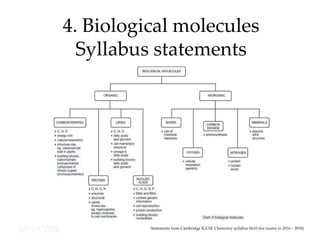
Statements from Cambridge IGCSE Chemistry syllabus 0610 (for exams in 2016 – 2018)
Biological molecules
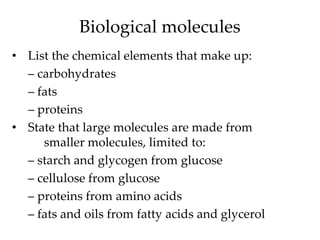
• List the chemical elements that make up:
– carbohydrates
– fats
– proteins
• State that large molecules are made from
smaller molecules, limited to:
– starch and glycogen from glucose
– cellulose from glucose
– proteins from amino acids
– fats and oils from fatty acids and glycerol
Biological molecules
• Describe the use of:
– iodine solution to test for starch
– Benedict’s solution to test for reducing sugars
– biuret test for proteins
– ethanol emulsion test for fats and oils
– DCPIP test for vitamin C
Biological molecules
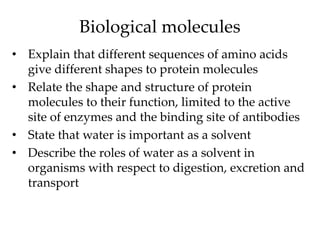
• Explain that different sequences of amino acids
give different shapes to protein molecules
• Relate the shape and structure of protein
molecules to their function, limited to the active
site of enzymes and the binding site of antibodies
• State that water is important as a solvent
• Describe the roles of water as a solvent in
organisms with respect to digestion, excretion and
transport
Biological molecules
• Describe the structure of DNA as:
– two strands coiled together to form a double
helix
– each strand contains chemicals called bases
– cross-links between the strands are formed by
pairs of bases
– the bases always pair up in the same way: A with
T, and C with G (full names are not required)
09/04/2016
4. Biological molecules
Syllabus statements
Statements from Cambridge IGCSE Chemistry syllabus 0610 (for exams in 2016 – 2018)

4 syllabus statements

  • 1.
    09/04/2016 4. Biological molecules Syllabusstatements Statements from Cambridge IGCSE Chemistry syllabus 0610 (for exams in 2016 – 2018)
  • 2.
    Biological molecules • Listthe chemical elements that make up: – carbohydrates – fats – proteins • State that large molecules are made from smaller molecules, limited to: – starch and glycogen from glucose – cellulose from glucose – proteins from amino acids – fats and oils from fatty acids and glycerol
  • 3.
    Biological molecules • Describethe use of: – iodine solution to test for starch – Benedict’s solution to test for reducing sugars – biuret test for proteins – ethanol emulsion test for fats and oils – DCPIP test for vitamin C
  • 4.
    Biological molecules • Explainthat different sequences of amino acids give different shapes to protein molecules • Relate the shape and structure of protein molecules to their function, limited to the active site of enzymes and the binding site of antibodies • State that water is important as a solvent • Describe the roles of water as a solvent in organisms with respect to digestion, excretion and transport
  • 5.
    Biological molecules • Describethe structure of DNA as: – two strands coiled together to form a double helix – each strand contains chemicals called bases – cross-links between the strands are formed by pairs of bases – the bases always pair up in the same way: A with T, and C with G (full names are not required)
  • 6.
    09/04/2016 4. Biological molecules Syllabusstatements Statements from Cambridge IGCSE Chemistry syllabus 0610 (for exams in 2016 – 2018)