How to revise!
Remember! Different strategies work for different people Learning styles:  visual,  auditory,  kinaesthetic (practical) You need to use a range of strategies!
What strategies can you use? Flash cards Practice questions Internet Revising with / testing friends Labelled diagrams Writing notes Writing lists Underlining in notes Star diagrams Mind maps Mnemonics
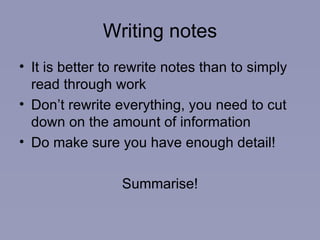
Writing notes It is better to rewrite notes than to simply read through work Don’t rewrite everything, you need to cut down on the amount of information Do make sure you have enough detail! Summarise!
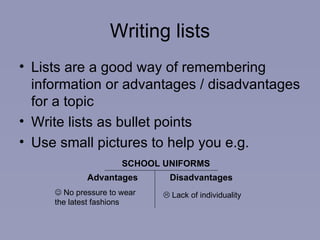
Writing lists Lists are a good way of remembering information or advantages / disadvantages for a topic Write lists as bullet points  Use small pictures to help you e.g. SCHOOL UNIFORMS Advantages  Disadvantages   No pressure to wear  the latest fashions   Lack of individuality
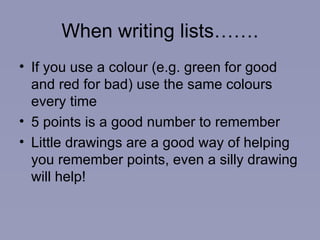
When writing lists……. If you use a colour (e.g. green for good and red for bad) use the same colours every time 5 points is a good number to remember Little drawings are a good way of helping you remember points, even a silly drawing will help!
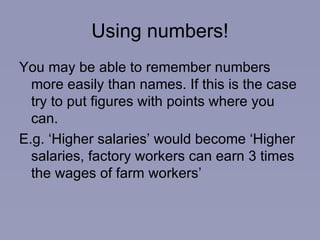
Using numbers! You may be able to remember numbers more easily than names. If this is the case try to put figures with points where you can. E.g. ‘Higher salaries’ would become ‘Higher salaries, factory workers can earn 3 times the wages of farm workers’
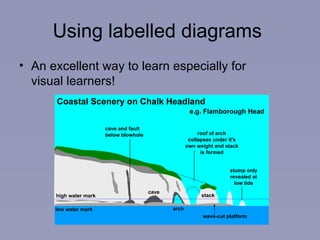
Using labelled diagrams  An excellent way to learn especially for visual learners!
Underlining in notes Its difficult to remember a page of notes if they are all the same font and colour Use colour / different sizes for heading / key points Underline key points or draw borders round them  like this! Use diagrams, lists and pictures to break up pages of notes
Mind maps Like a star / spider diagram but contains much more detail and demonstrates links between material more clearly Can have whole topic on A3 page World cup example
Revising with friends ADVANTAGES: can talk about the work can test each other easier to remember facts if spoken out loud DISADVANTAGES Too easy to talk about something more interesting instead!
Exam questions Use past questions as you revise to make sure you have the notes / case studies necessary to get full marks Test yourself under exam conditions
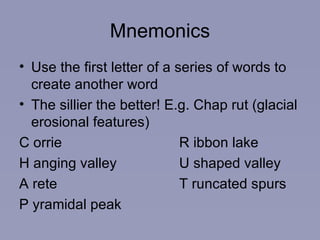
Mnemonics Use the first letter of a series of words to create another word The sillier the better! E.g. Chap rut (glacial erosional features) C orrie R ibbon lake H anging valley U shaped valley A rete T runcated spurs P yramidal peak
Revision cards Put separate topic / case study on each card Keep topics together Don’t try to put too much information on each card
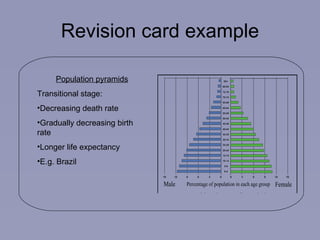
Revision card example Population pyramids Transitional stage: Decreasing death rate Gradually decreasing birth rate Longer life expectancy E.g. Brazil
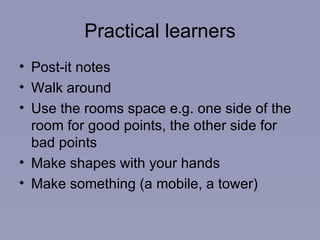
Practical learners Post-it notes Walk around Use the rooms space e.g. one side of the room for good points, the other side for bad points Make shapes with your hands Make something (a mobile, a tower)
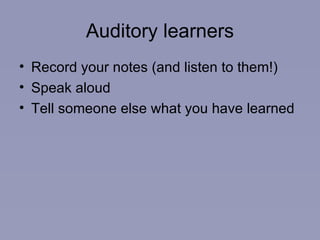
Auditory learners Record your notes (and listen to them!) Speak aloud Tell someone else what you have learned
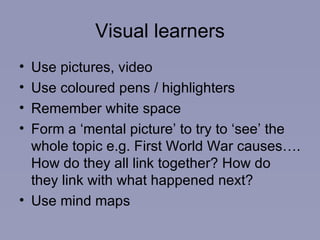
Visual learners Use pictures, video Use coloured pens / highlighters Remember white space Form a ‘mental picture’ to try to ‘see’ the whole topic e.g. First World War causes…. How do they all link together? How do they link with what happened next? Use mind maps
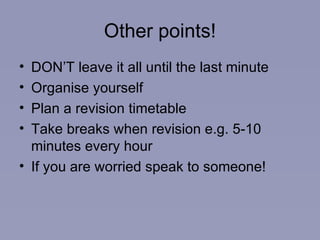
Other points! DON’T leave it all until the last minute Organise yourself Plan a revision timetable Take breaks when revision e.g. 5-10 minutes every hour If you are worried speak to someone!
Task! Take the newspaper article and summarise the information using one of the methods outlined in this presentation.

How to revise

  • 1.
  • 2.
    Remember! Different strategieswork for different people Learning styles: visual, auditory, kinaesthetic (practical) You need to use a range of strategies!
  • 3.
    What strategies canyou use? Flash cards Practice questions Internet Revising with / testing friends Labelled diagrams Writing notes Writing lists Underlining in notes Star diagrams Mind maps Mnemonics
  • 4.
    Writing notes Itis better to rewrite notes than to simply read through work Don’t rewrite everything, you need to cut down on the amount of information Do make sure you have enough detail! Summarise!
  • 5.
    Writing lists Listsare a good way of remembering information or advantages / disadvantages for a topic Write lists as bullet points Use small pictures to help you e.g. SCHOOL UNIFORMS Advantages Disadvantages  No pressure to wear the latest fashions  Lack of individuality
  • 6.
    When writing lists…….If you use a colour (e.g. green for good and red for bad) use the same colours every time 5 points is a good number to remember Little drawings are a good way of helping you remember points, even a silly drawing will help!
  • 7.
    Using numbers! Youmay be able to remember numbers more easily than names. If this is the case try to put figures with points where you can. E.g. ‘Higher salaries’ would become ‘Higher salaries, factory workers can earn 3 times the wages of farm workers’
  • 8.
    Using labelled diagrams An excellent way to learn especially for visual learners!
  • 9.
    Underlining in notesIts difficult to remember a page of notes if they are all the same font and colour Use colour / different sizes for heading / key points Underline key points or draw borders round them like this! Use diagrams, lists and pictures to break up pages of notes
  • 10.
    Mind maps Likea star / spider diagram but contains much more detail and demonstrates links between material more clearly Can have whole topic on A3 page World cup example
  • 11.
    Revising with friendsADVANTAGES: can talk about the work can test each other easier to remember facts if spoken out loud DISADVANTAGES Too easy to talk about something more interesting instead!
  • 12.
    Exam questions Usepast questions as you revise to make sure you have the notes / case studies necessary to get full marks Test yourself under exam conditions
  • 13.
    Mnemonics Use thefirst letter of a series of words to create another word The sillier the better! E.g. Chap rut (glacial erosional features) C orrie R ibbon lake H anging valley U shaped valley A rete T runcated spurs P yramidal peak
  • 14.
    Revision cards Putseparate topic / case study on each card Keep topics together Don’t try to put too much information on each card
  • 15.
    Revision card examplePopulation pyramids Transitional stage: Decreasing death rate Gradually decreasing birth rate Longer life expectancy E.g. Brazil
  • 16.
    Practical learners Post-itnotes Walk around Use the rooms space e.g. one side of the room for good points, the other side for bad points Make shapes with your hands Make something (a mobile, a tower)
  • 17.
    Auditory learners Recordyour notes (and listen to them!) Speak aloud Tell someone else what you have learned
  • 18.
    Visual learners Usepictures, video Use coloured pens / highlighters Remember white space Form a ‘mental picture’ to try to ‘see’ the whole topic e.g. First World War causes…. How do they all link together? How do they link with what happened next? Use mind maps
  • 19.
    Other points! DON’Tleave it all until the last minute Organise yourself Plan a revision timetable Take breaks when revision e.g. 5-10 minutes every hour If you are worried speak to someone!
  • 20.
    Task! Take thenewspaper article and summarise the information using one of the methods outlined in this presentation.