Vulnerability Inheritance in PLCs 
K. Reid Wightman 
Director, Digital Bond Labs
About Digital Bond Labs 
• New division of Digital Bond 
• Focused on working with vendors 
– Finding new vulns in products 
– Fixing bugs before they’re an issue 
– We find the kinds of bugs shown here 
• I am biased 
– Strong advocate of Red Teaming products 
– …but honestly, hire any outside team (or build your 
own)
Outline 
• Vulnerabilities: What are they? 
• Inheritance - 3rd party libraries 
• Specific example – Deep Dive 
• Affected Japanese Vendor #1 
• Affected Japanese Vendor #2 
• Conclusion
Vulnerability 
• Any mechanism which allows unauthorized 
changes to configuration or control 
• Includes traditional bugs 
– Authentication bypass 
– Parsing error 
• Includes ‘insecure by design’
Outline 
• Vulnerabilities: What are they? 
• 3rd party libraries 
• Specific example – Deep Dive 
• Affected Japanese Vendor #1 
• Affected Japanese Vendor #2 
• Conclusion
3rd Party Libraries 
• Any OS (vxWorks, GNU/Linux, Windows CE) 
• Common embedded servers (e.g. GoAhead 
Webserver) 
• CoDeSys
3rd Party Libraries 
• Ownership is the issue 
• You ‘own’ any problems with 3rd party software 
– If Vendor software depends upon library, end user 
must have Vendor assurance that patch will work 
– For embedded, end user needs Vendor to produce 
patch 
• Ex: Windows CE may have bugs 
– Will vendor keep track of the bugs? 
– Will vendor produce a patch to firmware? 
– Will vendor inform customers of the patch?
Outline 
• Vulnerabilities: What are they? 
• 3rd party libraries 
• ICS-Specific example – Deep Dive 
• Affected Japanese Vendor #1 
• Affected Japanese Vendor #2 
• Conclusion
CoDeSys 
• Programmable Logic Controller (PLC) Runtime 
and Engineering Software 
• Used by hundreds of ICS vendors 
• Primarily used in Europe, though some inroads 
into USA, Japan
CoDeSys 
Basic Components 
• Engineering Workstation (EWS) Software 
– Common GUI for programming PLCs 
– Supports LAD, STL, FBD, etc. 
– Communicates with PLC via plugins 
• PLC Ladder Logic Runtime 
– Runs on vxWorks, WinCE, Linux, Nucleus, and others 
– Executes ladder logic 
– Service for sending status and receiving commands 
• OPC Server 
• Gateway (Optional) between EWS and PLC
CoDeSys Deep Dive 
• CoDeSys V2 protocol analysis and tools released 
in 2012 
• CoDeSys V3 protocol analysis done by DB Labs 
September 2014, internal tools developed 
– The protocol changed a bit from V2 (more complex) 
– Identical vulnerabilities as V2
CoDeSys V2 – Flaws 
• Unauthorized ladder logic upload 
• ‘Secret’ command line 
• Start/Stop process control 
• Directory traversal 
• Upload/Download arbitrary files 
• Rootkit deployment possible 
• Many systems internet-connected (see joint 
paper with Eireann Leverett)
CoDeSys V3 – Flaws 
• Unauthorized ladder logic upload 
• ‘Secret’ command line 
• Start/Stop process control 
• Directory traversal quite likely 
• Upload/Download arbitrary files 
• Rootkit deployment possible 
• Internet scan underway
CoDeSys Flaws Summary 
• No Security 
• Original vendor (3S-Software) may have 
assumed that no-one would learn protocol 
• Original vendor (3S-Software) likely never had a 
Red Team look at components
Red Team 
• If Internal, best if they are dedicated to security 
work (not the developers) 
• Focus on looking for design problems early in 
development 
• Focus on looking for implementation problems as 
development progresses 
• Red Team should have spotted CoDeSys 
problems 
• Likely that affected vendors have no Red Team
CoDeSys V2 
• Simple Protocol: Start bytes (usually 0xbbbb or 
0xcccc), length field, function code, arguments 
• Uses TCP/1200 (some systems use TCP/2455 or 
custom port) 
• Determined how protocol works through protocol 
analysis (quite easy)
CoDeSys V2 
• 3S Software included “password protection” in 
V2 
– Password protection was not enforced by PLC initially 
– 3S Software provided patch for PLC to fix that 
– To date, 0 vendors have applied patch to PLCs 
• “PLC-enforced password protection interferes 
with 3S OPC Server” (heard from anonymous 
friend) 
• ‘Patching’ insecure-by-design is too late in 
Development Lifecycle – Requires changing too 
much other software
CoDeSys V2 Lessons to Learn 
• Apply Security Development Lifecycle to products 
– Have Red Team review components 
– Look at the design early and the implementation often 
– Decide: Will we live with these vulnerabilities, will we 
fix them, or will we stop using the component? 
– Determine how you will monitor and patch future 
problems 
• Catching this problem early saved the two 
vendors who fixed it a lot of trouble
CoDeSys V2 Lessons to Learn 
• Component DESIGN problems are contamination 
– One component’s insecure-by-design causes add-ons 
to expect that behavior 
– Now instead of one fix, you need at least two 
– The problem gets worse as more components 
communicate 
• Fixing a design problem late is often impossible 
Great example: Modbus 
• It could have security added via reserved function code 
• …but then every system on Earth would have to be changed
CoDeSys V3 
• Protocol differs from v2 
• Can use UDP or TCP 
– UDP limits attack surface somewhat, although we can 
get around this 
– TCP has not been thoroughly tested on live PLCs, only 
our simulator…
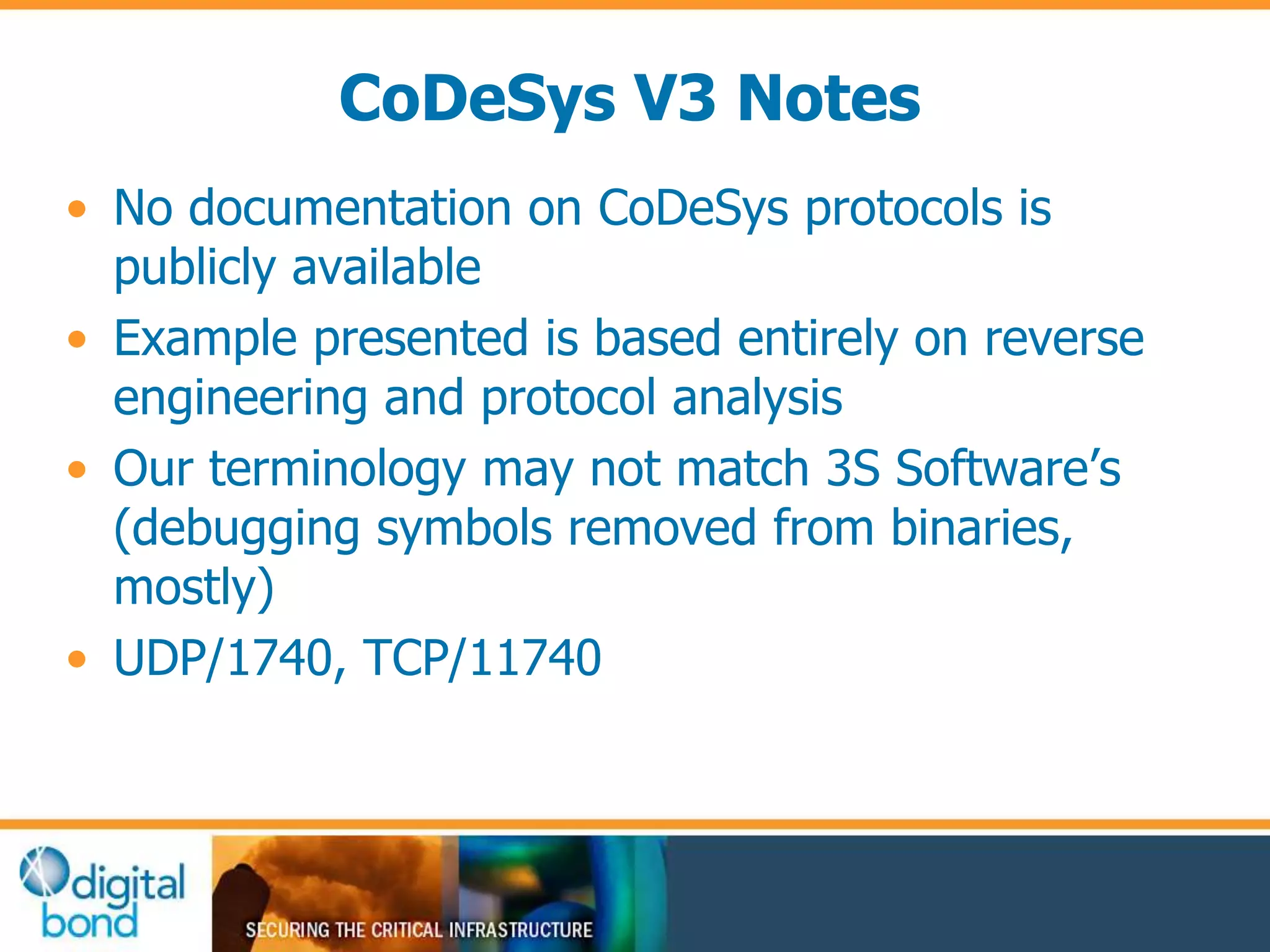
CoDeSys V3 Notes 
• No documentation on CoDeSys protocols is 
publicly available 
• Example presented is based entirely on reverse 
engineering and protocol analysis 
• Our terminology may not match 3S Software’s 
(debugging symbols removed from binaries, 
mostly) 
• UDP/1740, TCP/11740
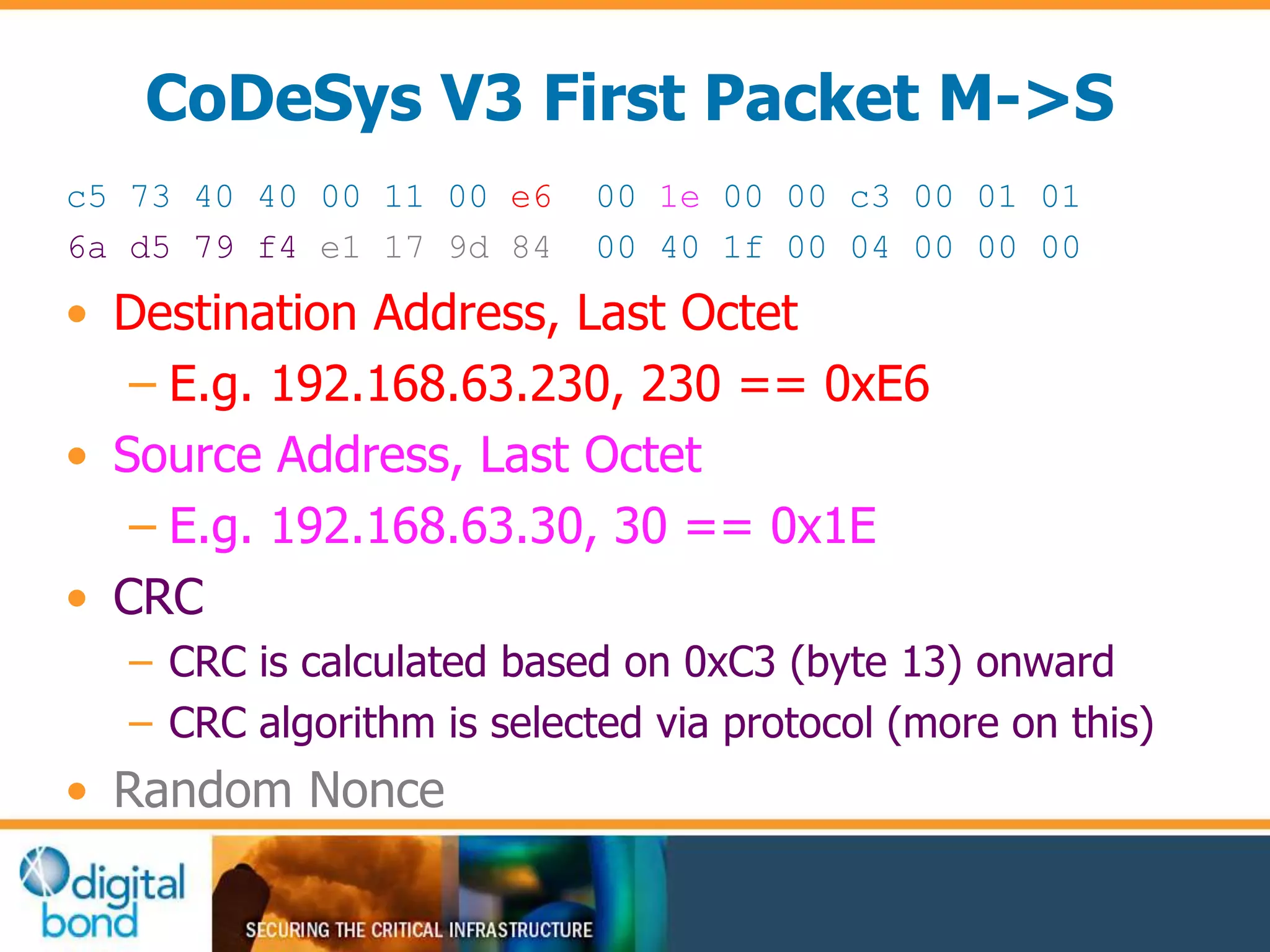
CoDeSys V3 First Packet M->S 
c5 73 40 40 00 11 00 e6 00 1e 00 00 c3 00 01 01 
6a d5 79 f4 e1 17 9d 84 00 40 1f 00 04 00 00 00 
• Destination Address, Last Octet 
– E.g. 192.168.63.230, 230 == 0xE6 
• Source Address, Last Octet 
– E.g. 192.168.63.30, 30 == 0x1E 
• CRC 
– CRC is calculated based on 0xC3 (byte 13) onward 
– CRC algorithm is selected via protocol (more on this) 
• Random Nonce
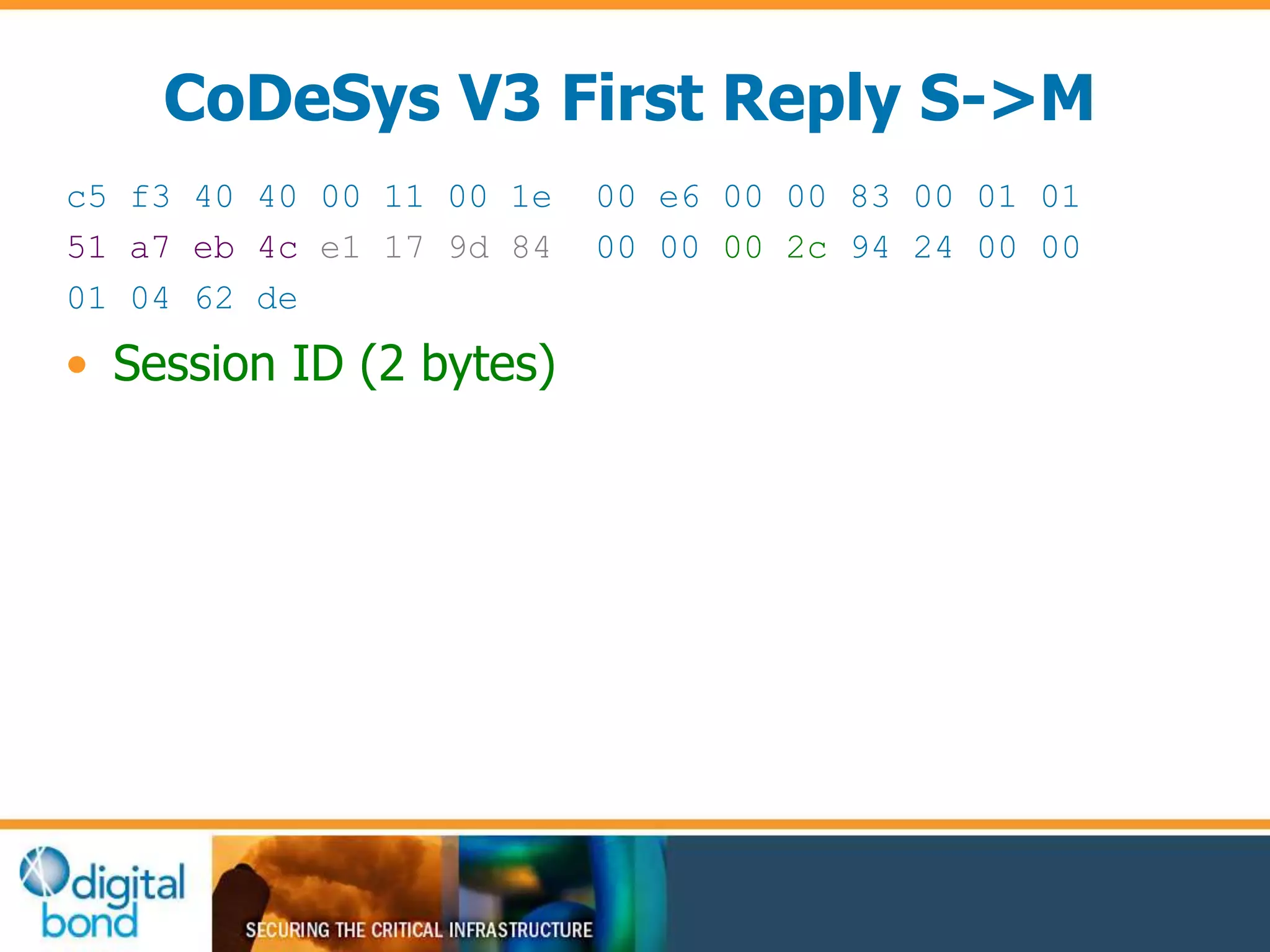
CoDeSys V3 First Reply S->M 
c5 f3 40 40 00 11 00 1e 00 e6 00 00 83 00 01 01 
51 a7 eb 4c e1 17 9d 84 00 00 00 2c 94 24 00 00 
01 04 62 de 
• Session ID (2 bytes)
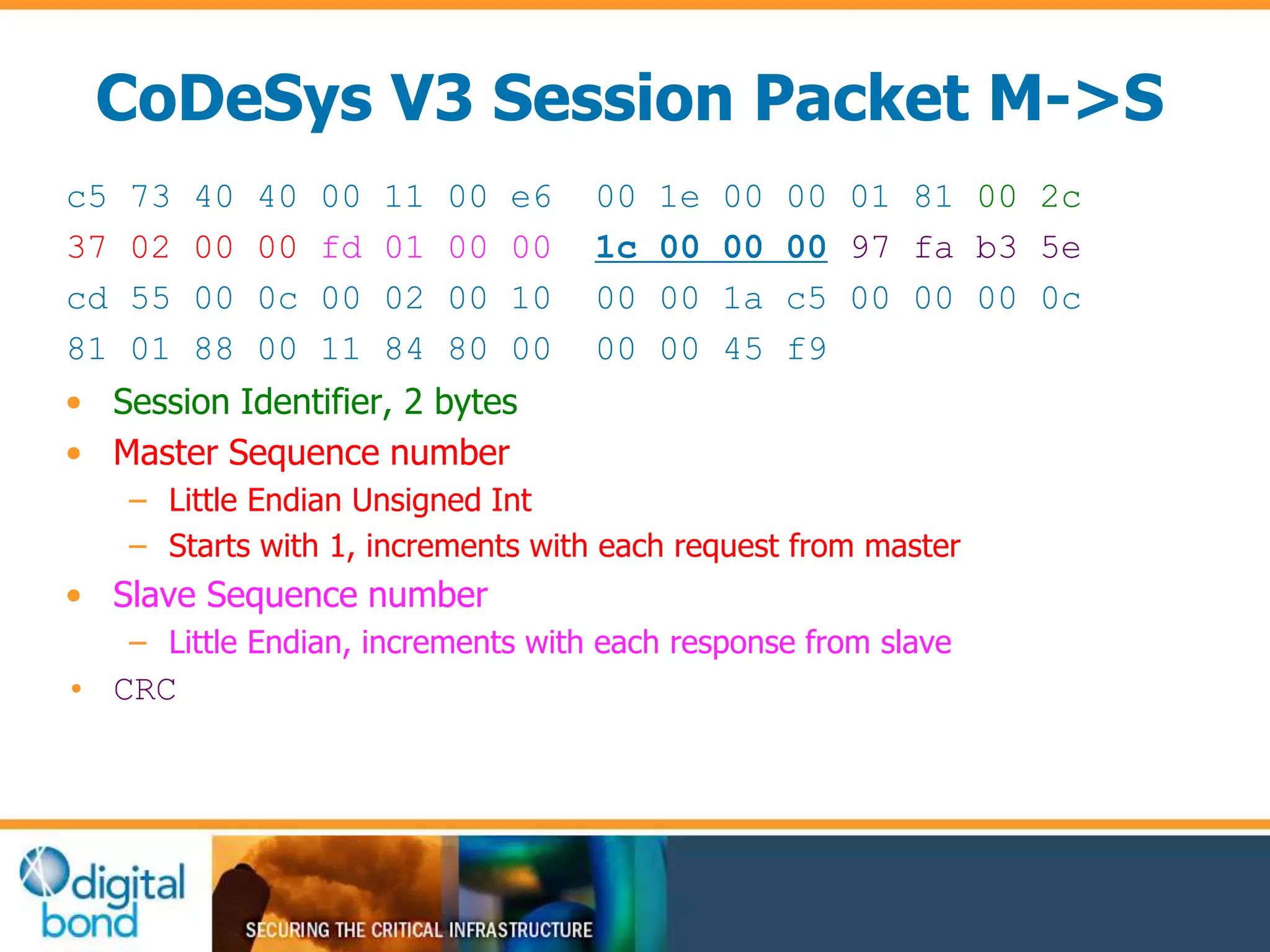
CoDeSys V3 Session Packet M->S 
c5 73 40 40 00 11 00 e6 00 1e 00 00 01 81 00 2c 
37 02 00 00 fd 01 00 00 1c 00 00 00 97 fa b3 5e 
cd 55 00 0c 00 02 00 10 00 00 1a c5 00 00 00 0c 
81 01 88 00 11 84 80 00 00 00 45 f9 
• Session Identifier, 2 bytes 
• Master Sequence number 
– Little Endian Unsigned Int 
– Starts with 1, increments with each request from master 
• Slave Sequence number 
– Little Endian, increments with each response from slave 
• CRC
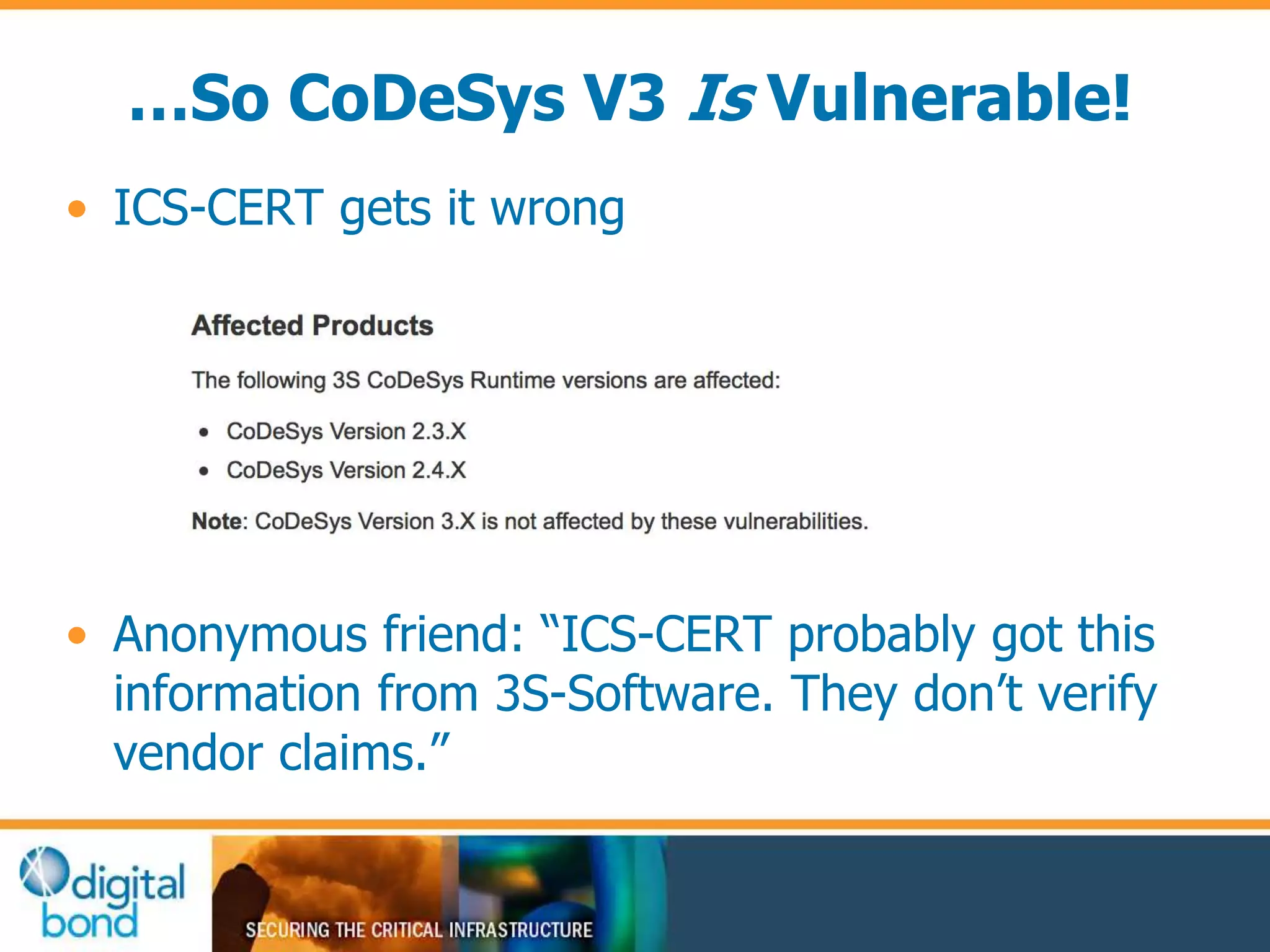
…So CoDeSys V3 Is Vulnerable! 
• ICS-CERT gets it wrong 
• Anonymous friend: “ICS-CERT probably got this 
information from 3S-Software. They don’t verify 
vendor claims.”
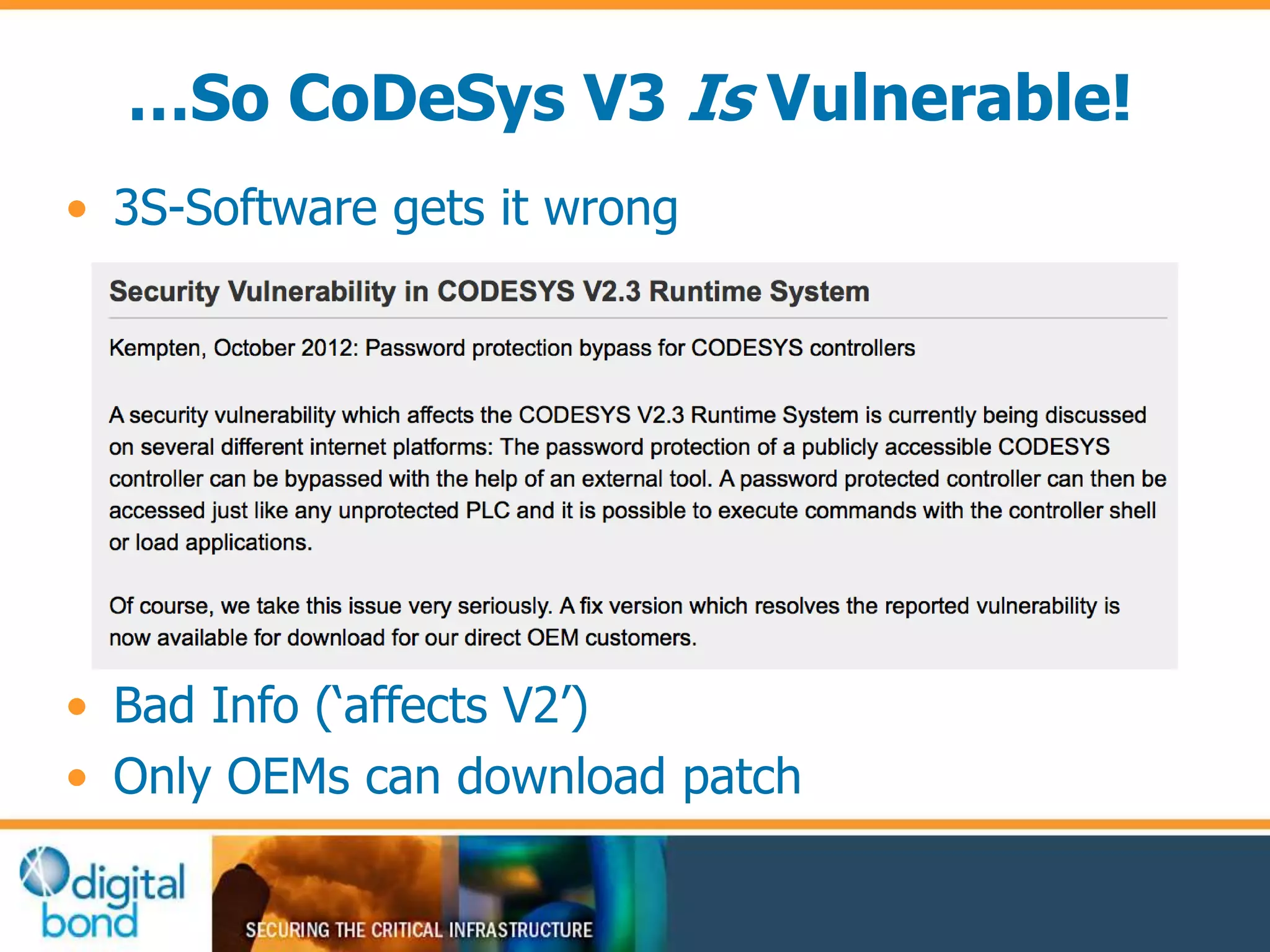
…So CoDeSys V3 Is Vulnerable! 
• 3S-Software gets it wrong 
• Bad Info (‘affects V2’) 
• Only OEMs can download patch
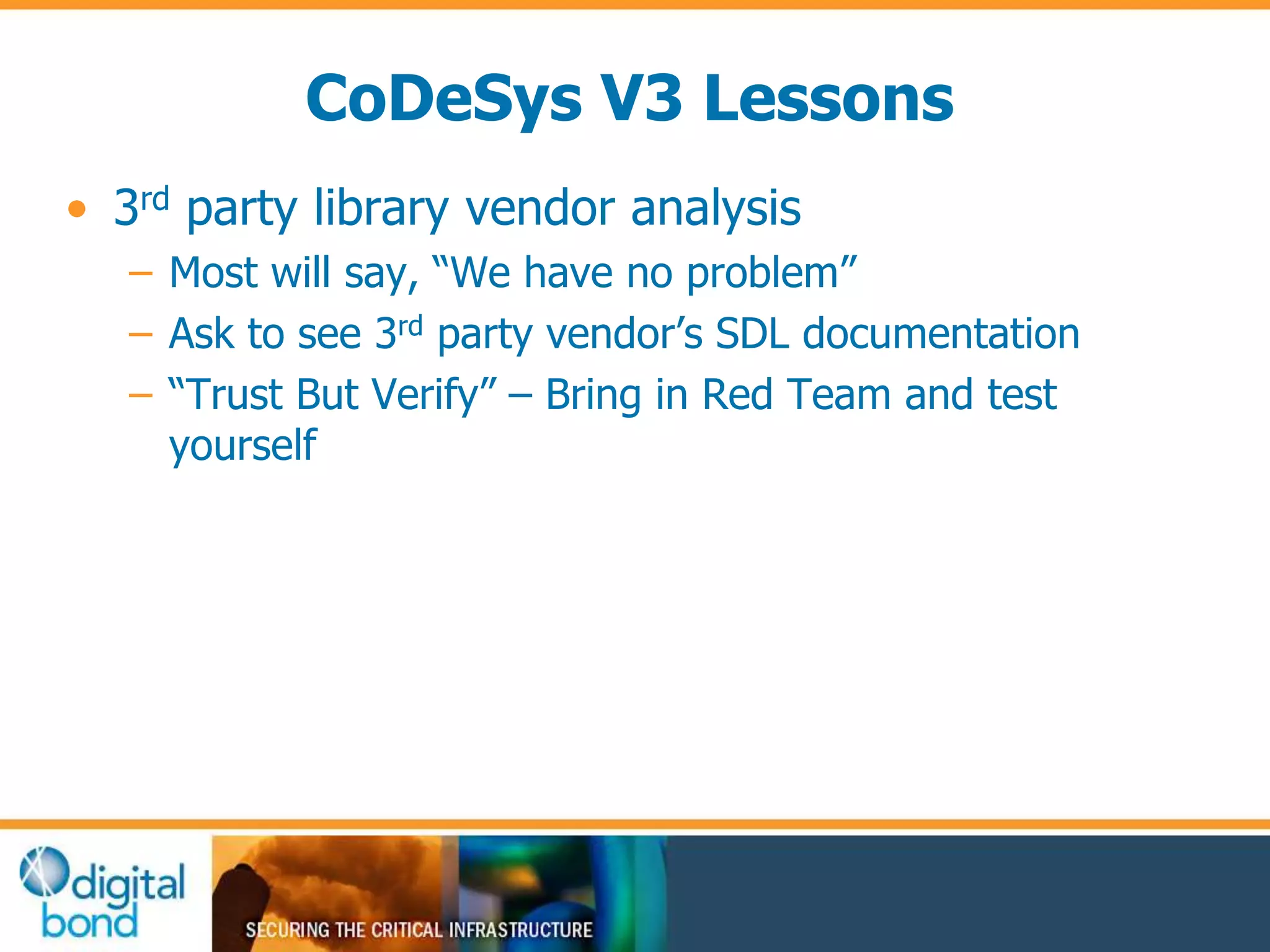
CoDeSys V3 Lessons 
• 3rd party library vendor analysis 
– Most will say, “We have no problem” 
– Ask to see 3rd party vendor’s SDL documentation 
– “Trust But Verify” – Bring in Red Team and test 
yourself
Outline 
• Vulnerabilities: What are they? 
• 3rd party libraries 
• Specific example – Deep Dive 
• Affected Japanese Vendor #1 
• Affected Japanese Vendor #2 
• Conclusion
Vulnerable Vendor Highlight 
Hitachi EHV+ Line 
– CoDeSys V3
Hitachi EHV+ Line: CoDeSys V3 
• EHV-CPU 1025 tested 
• UDP only* 
• Command line disabled* 
* These features might be enabled via updating 
config.cfg file on the PLC. No success yet.
Hitachi EHV+ Line: What They Did 
Right 
Hitachi deserves some credit 
– EHV+ has no open TCP ports by default 
– …Only one open UDP port that we could tell (CoDeSys 
V3) 
– This is much smaller attack surface than most vendors
Hitachi EHV+ Line 
• No mechanism seen for applying a patch 
• (Have not reverse engineered firmware, though, 
so maybe there is a way)
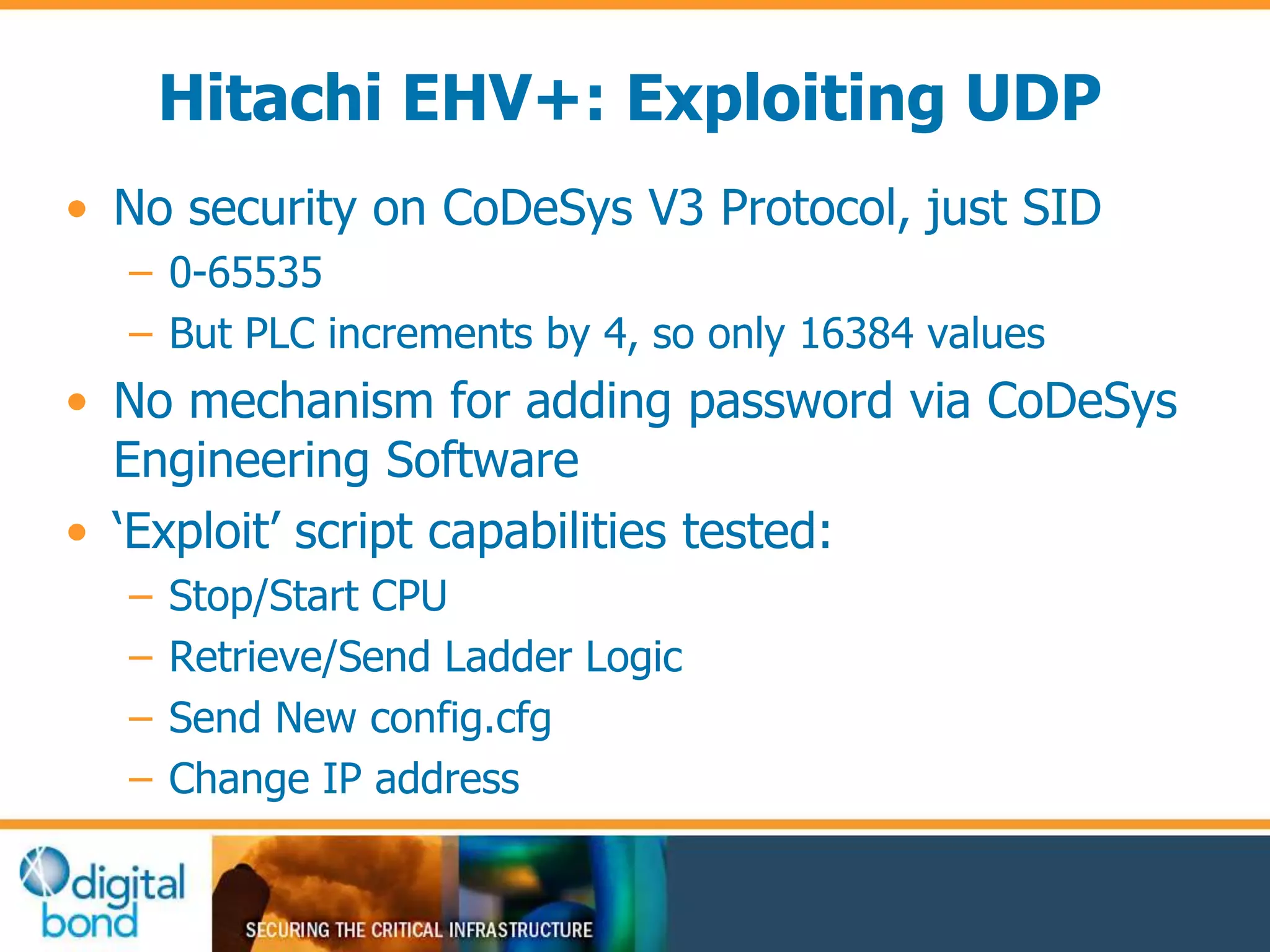
Hitachi EHV+: Exploiting UDP 
• No security on CoDeSys V3 Protocol, just SID 
– 0-65535 
– But PLC increments by 4, so only 16384 values 
• No mechanism for adding password via CoDeSys 
Engineering Software 
• ‘Exploit’ script capabilities tested: 
– Stop/Start CPU 
– Retrieve/Send Ladder Logic 
– Send New config.cfg 
– Change IP address
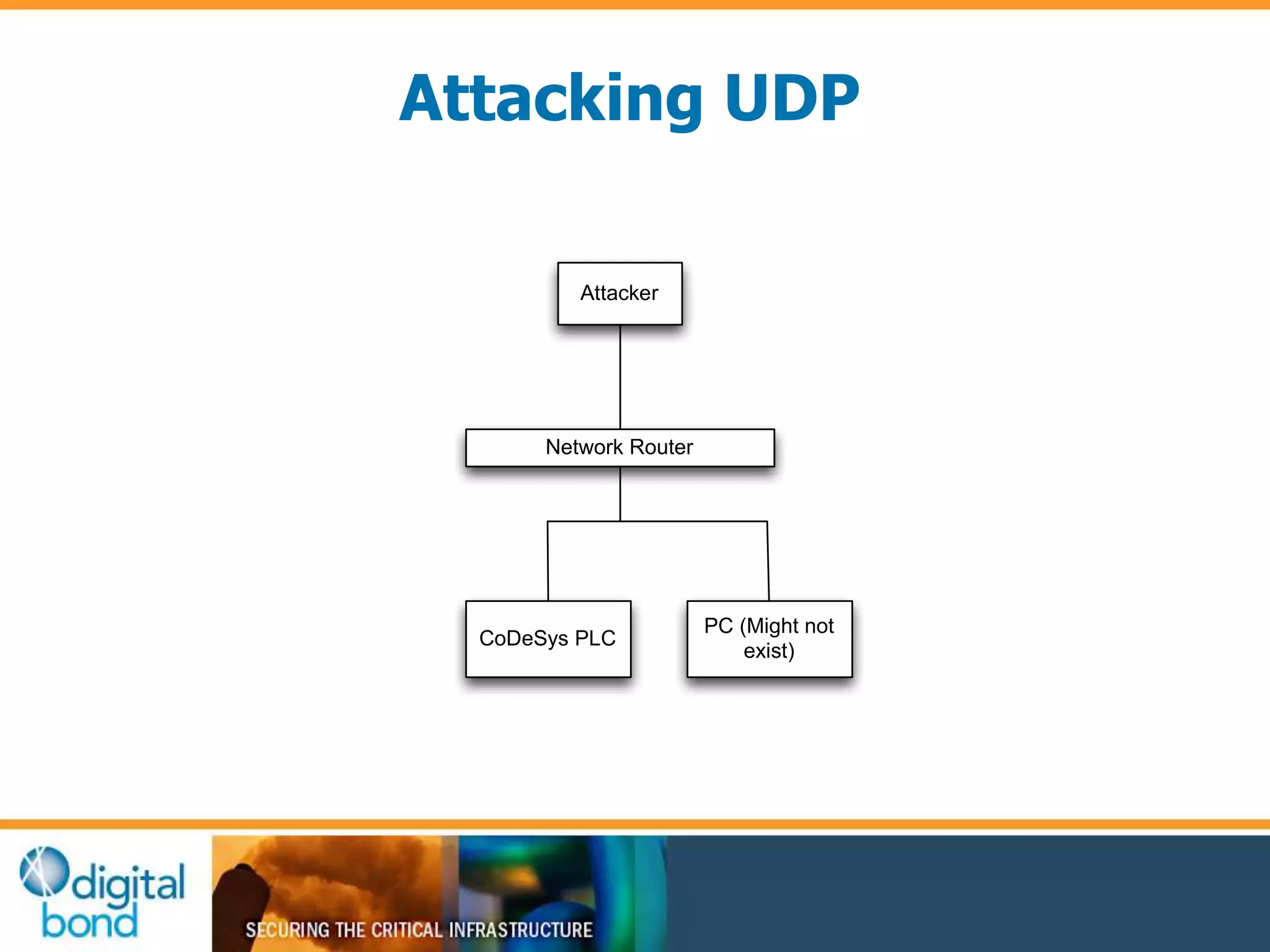
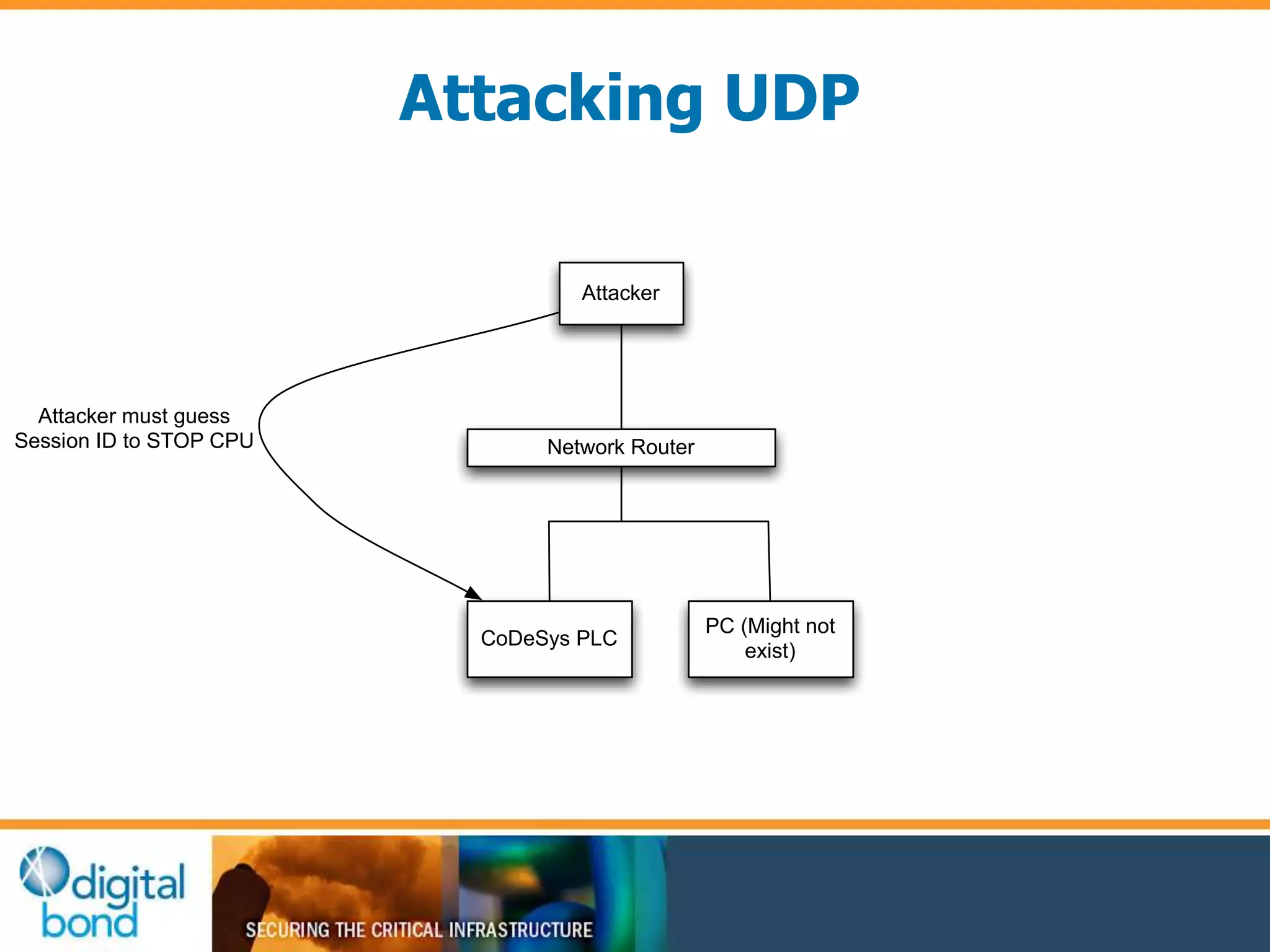
Attacking UDP 
Network Router 
CoDeSys PLC 
PC (Might not 
exist) 
Attacker
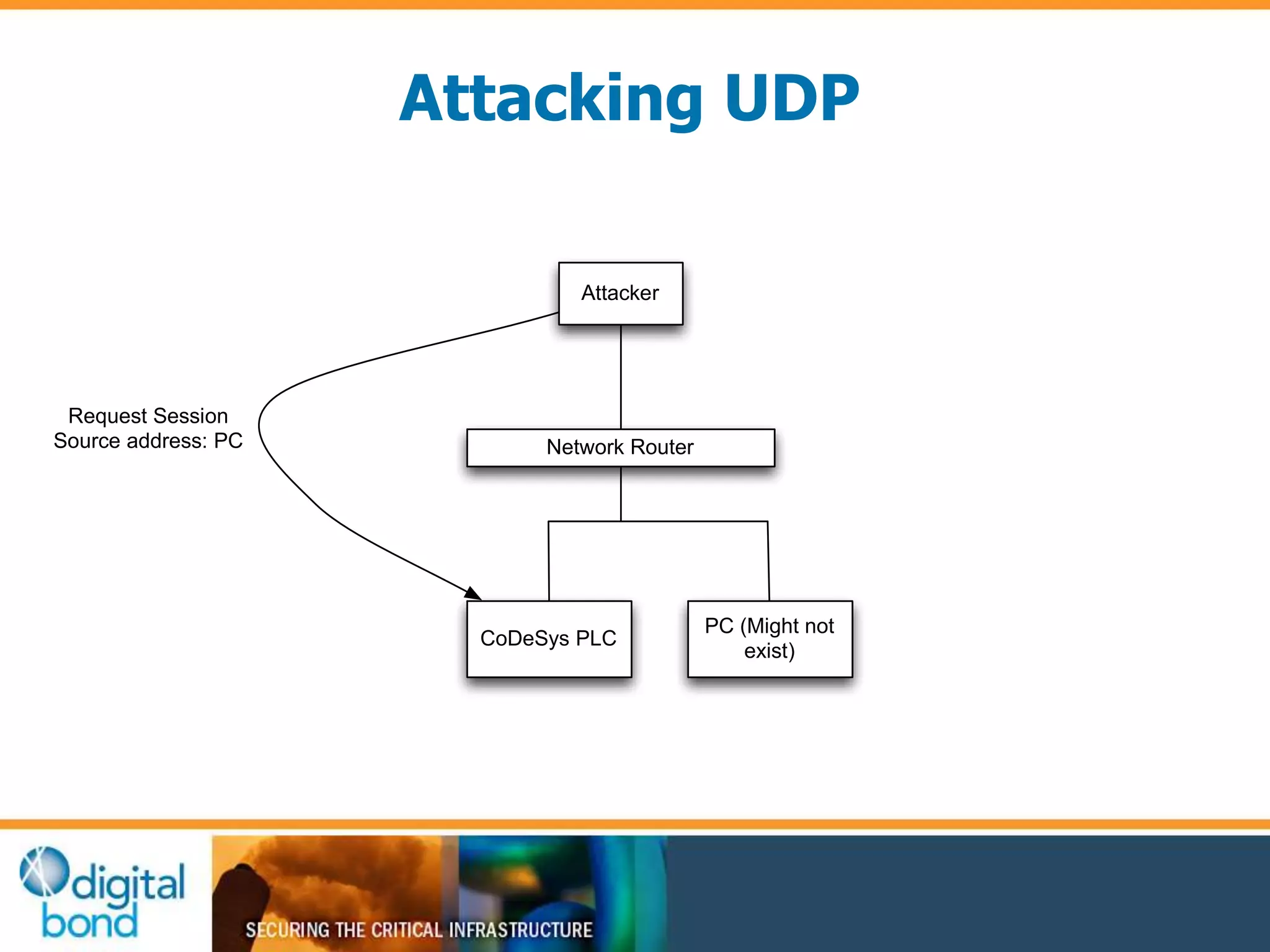
Attacking UDP 
Network Router 
CoDeSys PLC 
PC (Might not 
exist) 
Attacker 
Request Session 
Source address: PC
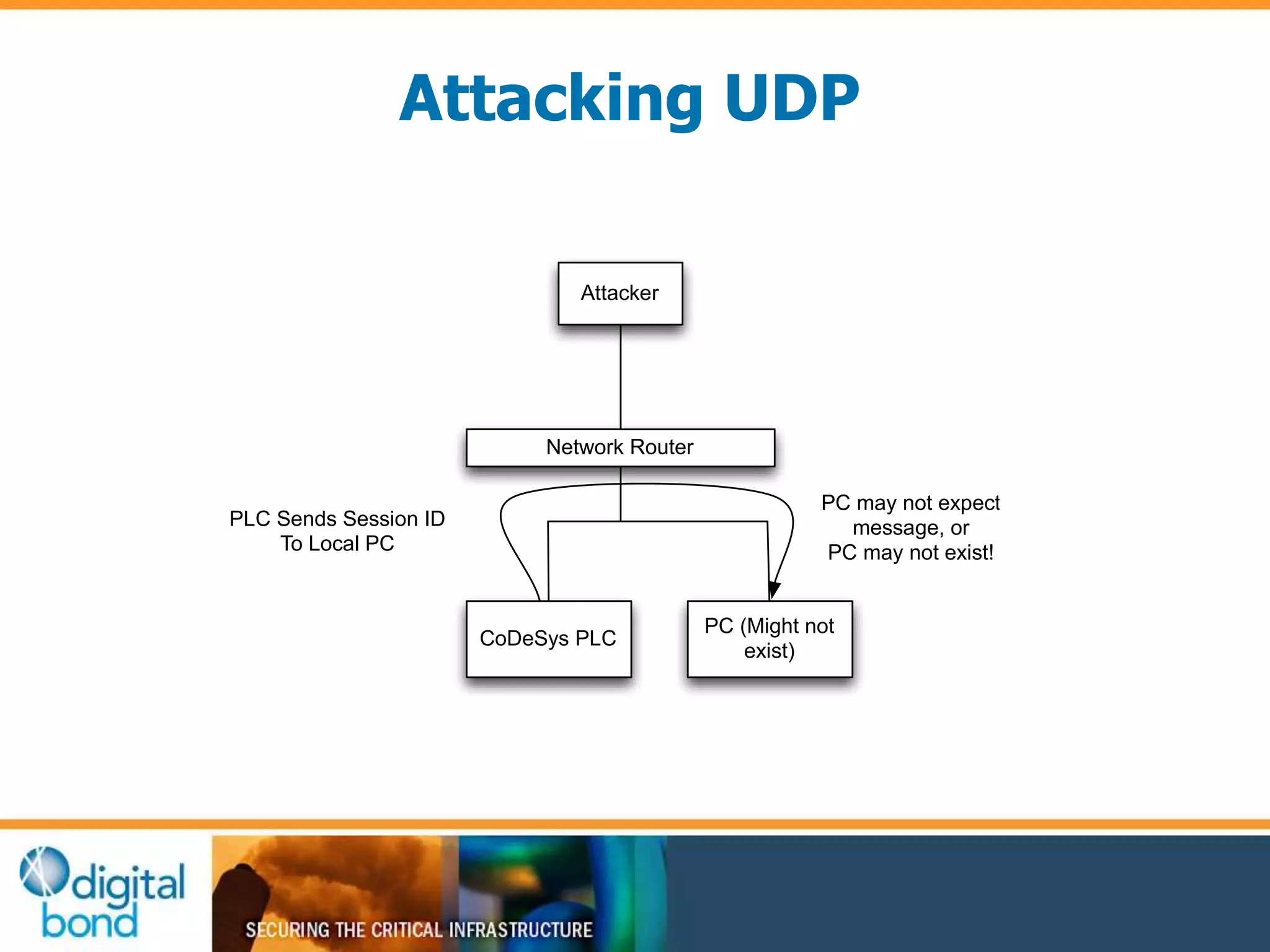
Attacking UDP 
Network Router 
CoDeSys PLC 
PC (Might not 
exist) 
Attacker 
PLC Sends Session ID 
To Local PC 
PC may not expect 
message, or 
PC may not exist!
Attacking UDP 
Network Router 
CoDeSys PLC 
PC (Might not 
exist) 
Attacker 
Attacker must guess 
Session ID to STOP CPU
Outline 
• Vulnerabilities: What are they? 
• 3rd party libraries 
• Specific example – Deep Dive 
• Affected Japanese Vendor #1 
• Affected Japanese Vendor #2 
• Conclusion
Vulnerable Vendor Highlight 
Sanyo-Denki SanMotion C 
– CoDeSys V2 
– vxWorks debugger service 
– Backdoor accounts (FTP)
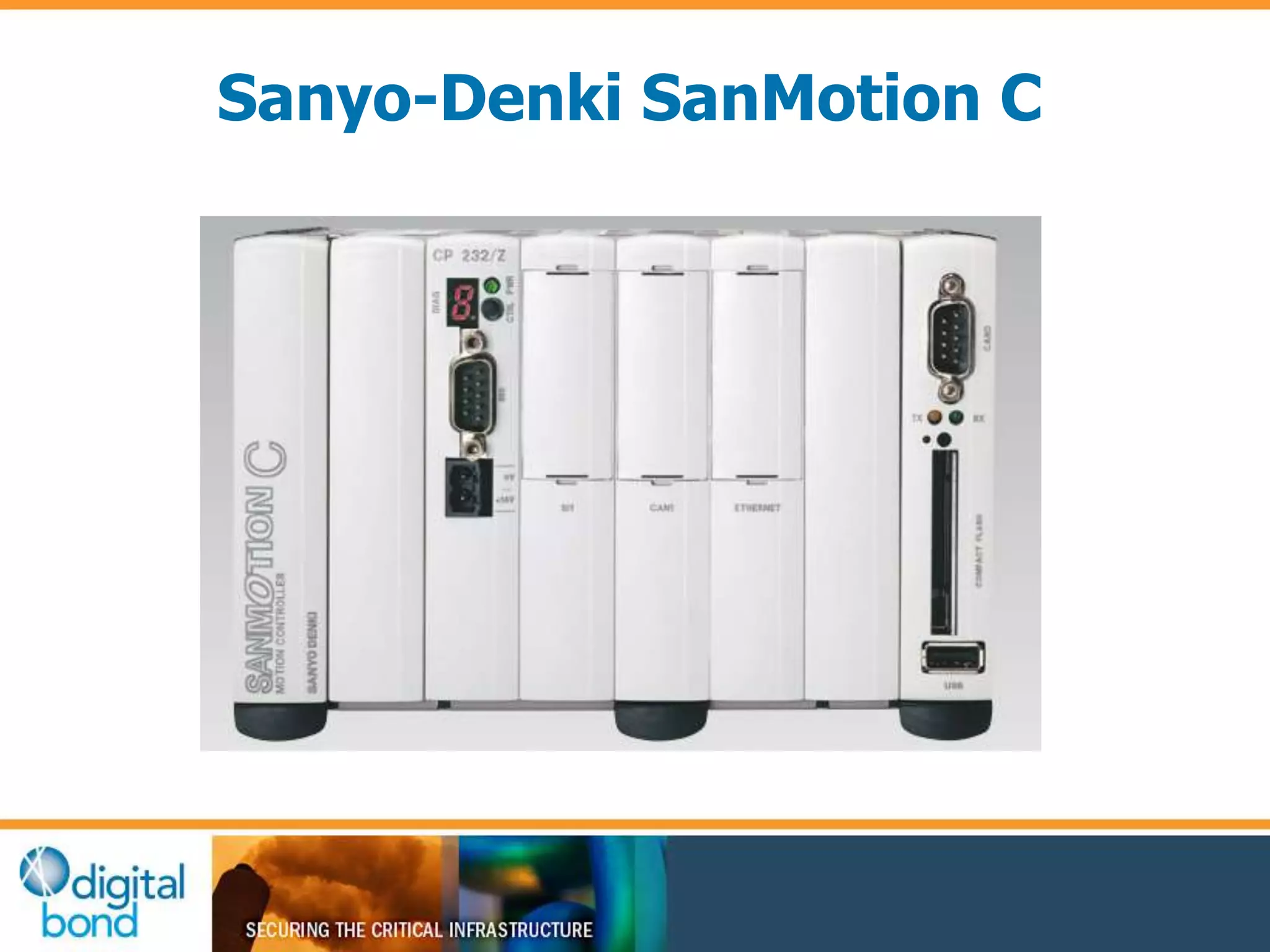
Sanyo-Denki SanMotion C
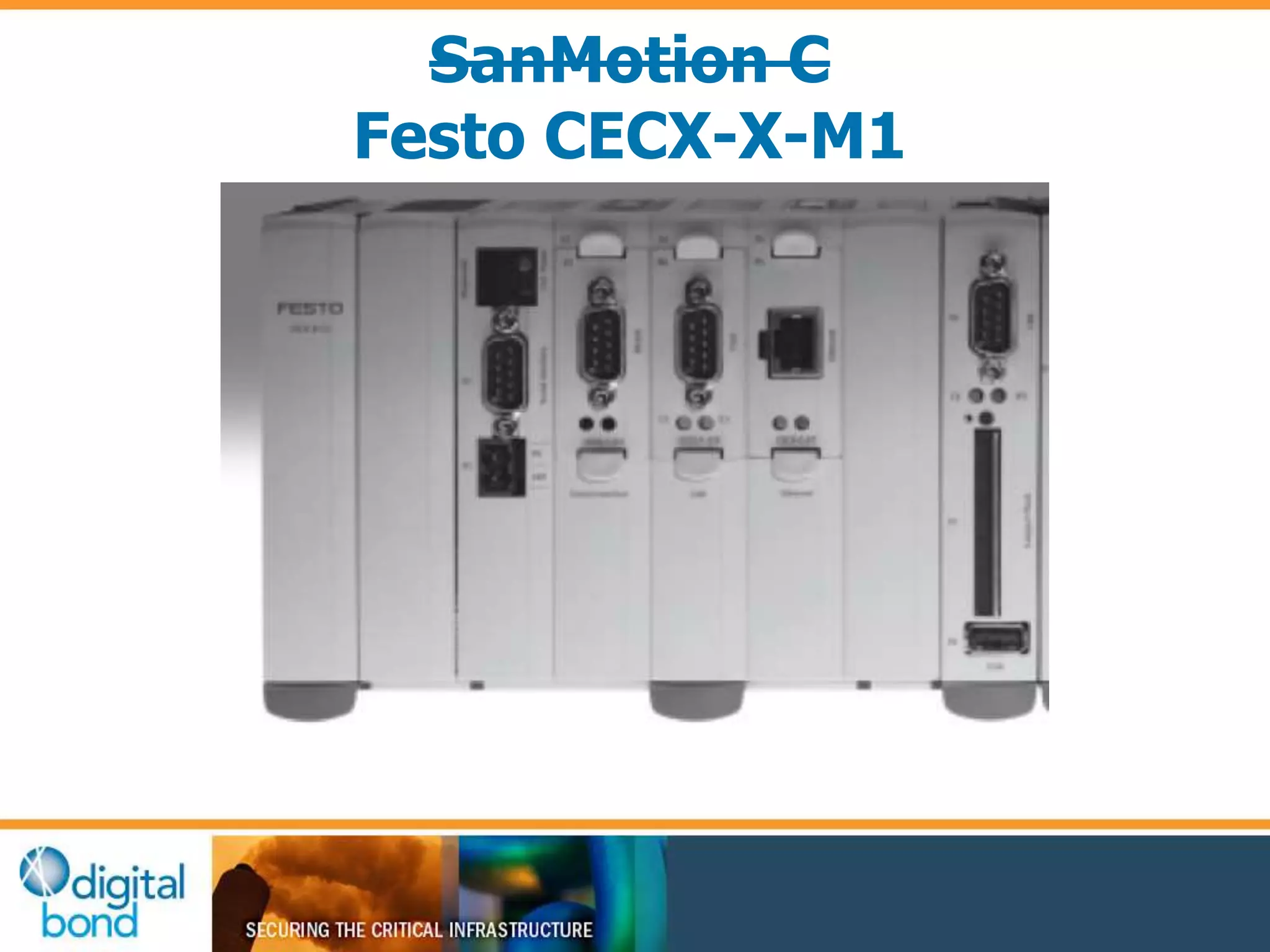
SanMotion C 
Festo CECX-X-M1
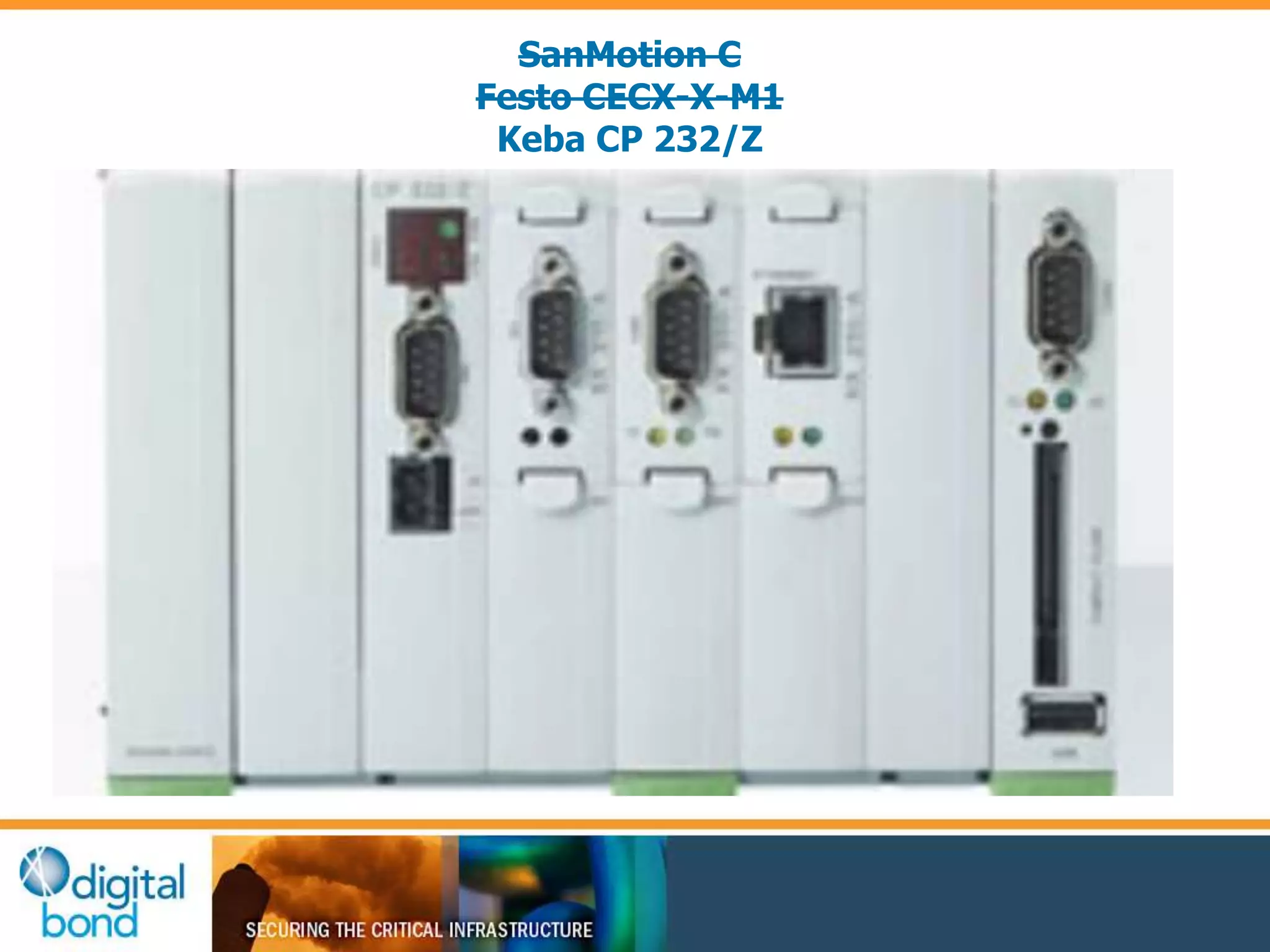
SanMotion C 
Festo CECX-X-M1 
Keba CP 232/Z
Festo/Sanyo/OEM? 
• Festo and Sanyo seem to use same OEM 
• Identical firmware on all systems 
– Also in use by Keba, Kuka, Trumpf, Haitian, Buehler, 
Duerr, Engel, and other vendors 
– OEM probably Keba Automation CP 232/Z (Austria) 
• Tons of software components in system 
– vxWorks 
– CoDeSys 
– CANOpen protocol stack 
– Etc
Festo/Sanyo/Etc Vulnerabilities 
• CoDeSys V2 
– All V2 problems exist 
– First contacted Festo via ICS-CERT in early 2013 
– See ICS-CERT advisory ICSA-14-084-01, Festo refused 
to fix any problems 
• vxWorks Debugging Backdoor CVE-2005-3804 
– Unauthenticated read/write to all memory 
– Vulnerability was 5 years old at product release 
• Backdoor FTP account 
• CANBus debugging protocol ports
Festo/Sanyo/Etc Vulnerabilities 
• Of the 9 total companies affected, none of them 
spotted the security problems 
• Likely that none of these companies do internal 
or external red teaming 
• Unknown if any of these companies share 
vulnerability information (what about hardware 
defect information?)
Outline 
• Vulnerabilities: What are they? 
• 3rd party libraries 
• Specific example – Deep Dive 
• Affected Japanese Vendor #1 
• Affected Japanese Vendor #2 
• Conclusion
Conclusions 
• Identify security issues before product release 
• Vendors should build list of 3rd party products 
and monitor them for vulnerabilities 
• In Sanyo-Denki example, controller released April 
2010 (5 years after vxWorks vulnerability widely 
known) 
• In Hitachi example, EHV+ line released before v2 
vulnerability was public, ~June-September 2010. 
Should have been noticed during internal 
security analysis
Conclusions 2 
• “Plan to Patch” 
– Design an update mechanism 
– Secure by design (functional/interface security) 
– Genuine bugs are then easy to patch 
• Design problems major problem for ICS 
– Ex: Schneider patches webserver directory traversal 
quickly, but years later design problems persist 
– Ex: 3S Software patched directory traversal bugs 
(Aaron Portnoy) quickly, took >1 year to patch 
CoDeSys design problem. Still 0 adoption of that 
patch!
Questions? 
Reid Wightman 
wightman@digitalbond.com 
@ReverseICS – Twitter

Vulnerability Inheritance in ICS (English)

  • 1.
    Vulnerability Inheritance inPLCs K. Reid Wightman Director, Digital Bond Labs
  • 2.
    About Digital BondLabs • New division of Digital Bond • Focused on working with vendors – Finding new vulns in products – Fixing bugs before they’re an issue – We find the kinds of bugs shown here • I am biased – Strong advocate of Red Teaming products – …but honestly, hire any outside team (or build your own)
  • 3.
    Outline • Vulnerabilities:What are they? • Inheritance - 3rd party libraries • Specific example – Deep Dive • Affected Japanese Vendor #1 • Affected Japanese Vendor #2 • Conclusion
  • 4.
    Vulnerability • Anymechanism which allows unauthorized changes to configuration or control • Includes traditional bugs – Authentication bypass – Parsing error • Includes ‘insecure by design’
  • 5.
    Outline • Vulnerabilities:What are they? • 3rd party libraries • Specific example – Deep Dive • Affected Japanese Vendor #1 • Affected Japanese Vendor #2 • Conclusion
  • 6.
    3rd Party Libraries • Any OS (vxWorks, GNU/Linux, Windows CE) • Common embedded servers (e.g. GoAhead Webserver) • CoDeSys
  • 7.
    3rd Party Libraries • Ownership is the issue • You ‘own’ any problems with 3rd party software – If Vendor software depends upon library, end user must have Vendor assurance that patch will work – For embedded, end user needs Vendor to produce patch • Ex: Windows CE may have bugs – Will vendor keep track of the bugs? – Will vendor produce a patch to firmware? – Will vendor inform customers of the patch?
  • 8.
    Outline • Vulnerabilities:What are they? • 3rd party libraries • ICS-Specific example – Deep Dive • Affected Japanese Vendor #1 • Affected Japanese Vendor #2 • Conclusion
  • 9.
    CoDeSys • ProgrammableLogic Controller (PLC) Runtime and Engineering Software • Used by hundreds of ICS vendors • Primarily used in Europe, though some inroads into USA, Japan
  • 10.
    CoDeSys Basic Components • Engineering Workstation (EWS) Software – Common GUI for programming PLCs – Supports LAD, STL, FBD, etc. – Communicates with PLC via plugins • PLC Ladder Logic Runtime – Runs on vxWorks, WinCE, Linux, Nucleus, and others – Executes ladder logic – Service for sending status and receiving commands • OPC Server • Gateway (Optional) between EWS and PLC
  • 11.
    CoDeSys Deep Dive • CoDeSys V2 protocol analysis and tools released in 2012 • CoDeSys V3 protocol analysis done by DB Labs September 2014, internal tools developed – The protocol changed a bit from V2 (more complex) – Identical vulnerabilities as V2
  • 12.
    CoDeSys V2 –Flaws • Unauthorized ladder logic upload • ‘Secret’ command line • Start/Stop process control • Directory traversal • Upload/Download arbitrary files • Rootkit deployment possible • Many systems internet-connected (see joint paper with Eireann Leverett)
  • 13.
    CoDeSys V3 –Flaws • Unauthorized ladder logic upload • ‘Secret’ command line • Start/Stop process control • Directory traversal quite likely • Upload/Download arbitrary files • Rootkit deployment possible • Internet scan underway
  • 14.
    CoDeSys Flaws Summary • No Security • Original vendor (3S-Software) may have assumed that no-one would learn protocol • Original vendor (3S-Software) likely never had a Red Team look at components
  • 15.
    Red Team •If Internal, best if they are dedicated to security work (not the developers) • Focus on looking for design problems early in development • Focus on looking for implementation problems as development progresses • Red Team should have spotted CoDeSys problems • Likely that affected vendors have no Red Team
  • 16.
    CoDeSys V2 •Simple Protocol: Start bytes (usually 0xbbbb or 0xcccc), length field, function code, arguments • Uses TCP/1200 (some systems use TCP/2455 or custom port) • Determined how protocol works through protocol analysis (quite easy)
  • 17.
    CoDeSys V2 •3S Software included “password protection” in V2 – Password protection was not enforced by PLC initially – 3S Software provided patch for PLC to fix that – To date, 0 vendors have applied patch to PLCs • “PLC-enforced password protection interferes with 3S OPC Server” (heard from anonymous friend) • ‘Patching’ insecure-by-design is too late in Development Lifecycle – Requires changing too much other software
  • 18.
    CoDeSys V2 Lessonsto Learn • Apply Security Development Lifecycle to products – Have Red Team review components – Look at the design early and the implementation often – Decide: Will we live with these vulnerabilities, will we fix them, or will we stop using the component? – Determine how you will monitor and patch future problems • Catching this problem early saved the two vendors who fixed it a lot of trouble
  • 19.
    CoDeSys V2 Lessonsto Learn • Component DESIGN problems are contamination – One component’s insecure-by-design causes add-ons to expect that behavior – Now instead of one fix, you need at least two – The problem gets worse as more components communicate • Fixing a design problem late is often impossible Great example: Modbus • It could have security added via reserved function code • …but then every system on Earth would have to be changed
  • 20.
    CoDeSys V3 •Protocol differs from v2 • Can use UDP or TCP – UDP limits attack surface somewhat, although we can get around this – TCP has not been thoroughly tested on live PLCs, only our simulator…
  • 21.
    CoDeSys V3 Notes • No documentation on CoDeSys protocols is publicly available • Example presented is based entirely on reverse engineering and protocol analysis • Our terminology may not match 3S Software’s (debugging symbols removed from binaries, mostly) • UDP/1740, TCP/11740
  • 22.
    CoDeSys V3 FirstPacket M->S c5 73 40 40 00 11 00 e6 00 1e 00 00 c3 00 01 01 6a d5 79 f4 e1 17 9d 84 00 40 1f 00 04 00 00 00 • Destination Address, Last Octet – E.g. 192.168.63.230, 230 == 0xE6 • Source Address, Last Octet – E.g. 192.168.63.30, 30 == 0x1E • CRC – CRC is calculated based on 0xC3 (byte 13) onward – CRC algorithm is selected via protocol (more on this) • Random Nonce
  • 23.
    CoDeSys V3 FirstReply S->M c5 f3 40 40 00 11 00 1e 00 e6 00 00 83 00 01 01 51 a7 eb 4c e1 17 9d 84 00 00 00 2c 94 24 00 00 01 04 62 de • Session ID (2 bytes)
  • 24.
    CoDeSys V3 SessionPacket M->S c5 73 40 40 00 11 00 e6 00 1e 00 00 01 81 00 2c 37 02 00 00 fd 01 00 00 1c 00 00 00 97 fa b3 5e cd 55 00 0c 00 02 00 10 00 00 1a c5 00 00 00 0c 81 01 88 00 11 84 80 00 00 00 45 f9 • Session Identifier, 2 bytes • Master Sequence number – Little Endian Unsigned Int – Starts with 1, increments with each request from master • Slave Sequence number – Little Endian, increments with each response from slave • CRC
  • 25.
    …So CoDeSys V3Is Vulnerable! • ICS-CERT gets it wrong • Anonymous friend: “ICS-CERT probably got this information from 3S-Software. They don’t verify vendor claims.”
  • 26.
    …So CoDeSys V3Is Vulnerable! • 3S-Software gets it wrong • Bad Info (‘affects V2’) • Only OEMs can download patch
  • 27.
    CoDeSys V3 Lessons • 3rd party library vendor analysis – Most will say, “We have no problem” – Ask to see 3rd party vendor’s SDL documentation – “Trust But Verify” – Bring in Red Team and test yourself
  • 28.
    Outline • Vulnerabilities:What are they? • 3rd party libraries • Specific example – Deep Dive • Affected Japanese Vendor #1 • Affected Japanese Vendor #2 • Conclusion
  • 29.
    Vulnerable Vendor Highlight Hitachi EHV+ Line – CoDeSys V3
  • 30.
    Hitachi EHV+ Line:CoDeSys V3 • EHV-CPU 1025 tested • UDP only* • Command line disabled* * These features might be enabled via updating config.cfg file on the PLC. No success yet.
  • 31.
    Hitachi EHV+ Line:What They Did Right Hitachi deserves some credit – EHV+ has no open TCP ports by default – …Only one open UDP port that we could tell (CoDeSys V3) – This is much smaller attack surface than most vendors
  • 32.
    Hitachi EHV+ Line • No mechanism seen for applying a patch • (Have not reverse engineered firmware, though, so maybe there is a way)
  • 33.
    Hitachi EHV+: ExploitingUDP • No security on CoDeSys V3 Protocol, just SID – 0-65535 – But PLC increments by 4, so only 16384 values • No mechanism for adding password via CoDeSys Engineering Software • ‘Exploit’ script capabilities tested: – Stop/Start CPU – Retrieve/Send Ladder Logic – Send New config.cfg – Change IP address
  • 34.
    Attacking UDP NetworkRouter CoDeSys PLC PC (Might not exist) Attacker
  • 35.
    Attacking UDP NetworkRouter CoDeSys PLC PC (Might not exist) Attacker Request Session Source address: PC
  • 36.
    Attacking UDP NetworkRouter CoDeSys PLC PC (Might not exist) Attacker PLC Sends Session ID To Local PC PC may not expect message, or PC may not exist!
  • 37.
    Attacking UDP NetworkRouter CoDeSys PLC PC (Might not exist) Attacker Attacker must guess Session ID to STOP CPU
  • 38.
    Outline • Vulnerabilities:What are they? • 3rd party libraries • Specific example – Deep Dive • Affected Japanese Vendor #1 • Affected Japanese Vendor #2 • Conclusion
  • 39.
    Vulnerable Vendor Highlight Sanyo-Denki SanMotion C – CoDeSys V2 – vxWorks debugger service – Backdoor accounts (FTP)
  • 40.
  • 41.
  • 42.
    SanMotion C FestoCECX-X-M1 Keba CP 232/Z
  • 43.
    Festo/Sanyo/OEM? • Festoand Sanyo seem to use same OEM • Identical firmware on all systems – Also in use by Keba, Kuka, Trumpf, Haitian, Buehler, Duerr, Engel, and other vendors – OEM probably Keba Automation CP 232/Z (Austria) • Tons of software components in system – vxWorks – CoDeSys – CANOpen protocol stack – Etc
  • 44.
    Festo/Sanyo/Etc Vulnerabilities •CoDeSys V2 – All V2 problems exist – First contacted Festo via ICS-CERT in early 2013 – See ICS-CERT advisory ICSA-14-084-01, Festo refused to fix any problems • vxWorks Debugging Backdoor CVE-2005-3804 – Unauthenticated read/write to all memory – Vulnerability was 5 years old at product release • Backdoor FTP account • CANBus debugging protocol ports
  • 45.
    Festo/Sanyo/Etc Vulnerabilities •Of the 9 total companies affected, none of them spotted the security problems • Likely that none of these companies do internal or external red teaming • Unknown if any of these companies share vulnerability information (what about hardware defect information?)
  • 46.
    Outline • Vulnerabilities:What are they? • 3rd party libraries • Specific example – Deep Dive • Affected Japanese Vendor #1 • Affected Japanese Vendor #2 • Conclusion
  • 47.
    Conclusions • Identifysecurity issues before product release • Vendors should build list of 3rd party products and monitor them for vulnerabilities • In Sanyo-Denki example, controller released April 2010 (5 years after vxWorks vulnerability widely known) • In Hitachi example, EHV+ line released before v2 vulnerability was public, ~June-September 2010. Should have been noticed during internal security analysis
  • 48.
    Conclusions 2 •“Plan to Patch” – Design an update mechanism – Secure by design (functional/interface security) – Genuine bugs are then easy to patch • Design problems major problem for ICS – Ex: Schneider patches webserver directory traversal quickly, but years later design problems persist – Ex: 3S Software patched directory traversal bugs (Aaron Portnoy) quickly, took >1 year to patch CoDeSys design problem. Still 0 adoption of that patch!
  • 49.
    Questions? Reid Wightman wightman@digitalbond.com @ReverseICS – Twitter