eDocumentation™ Process
Change Phase


         Knowledge Process, Inc.
         www.DocumentationProcess.com
         www.KCGGroup.com
Table of Contents – Change


                                                    Table of Contents – Change

Table of Contents – Change .................................................................................................................. 2 

eDocumentation™ Process Flow .......................................................................................................... 3 
  eDocumentation™ Process phases....................................................................................................................... 3 
  eDocumentation™ Process phase ........................................................................................................................ 5 


Documentation Maintenance ................................................................................................................. 6 
  Maintenance factors ............................................................................................................................................... 6 
  Legacy documentation ........................................................................................................................................... 7 
  eDocumentation™ Process phase ........................................................................................................................ 7 


Knowledge Process, Inc......................................................................................................................... 8 
  About Knowledge Process ..................................................................................................................................... 8 
  Copyright ................................................................................................................................................................ 8 


Version 1.0                                              eDocumentation™ Change Phase                                                                         Page 2 of 8
eDocumentation™ Process Flow


                               eDocumentation™ Process Flow
The eDocumentation™ Process is a set of guidelines, not decrees, that guide the Documentation developer
through the research, development, and implementation of Policies, Processes, and Procedures. The objective is
to create and produce Policies, Processes, and Procedures that are clear, concise, complete, and correct™.
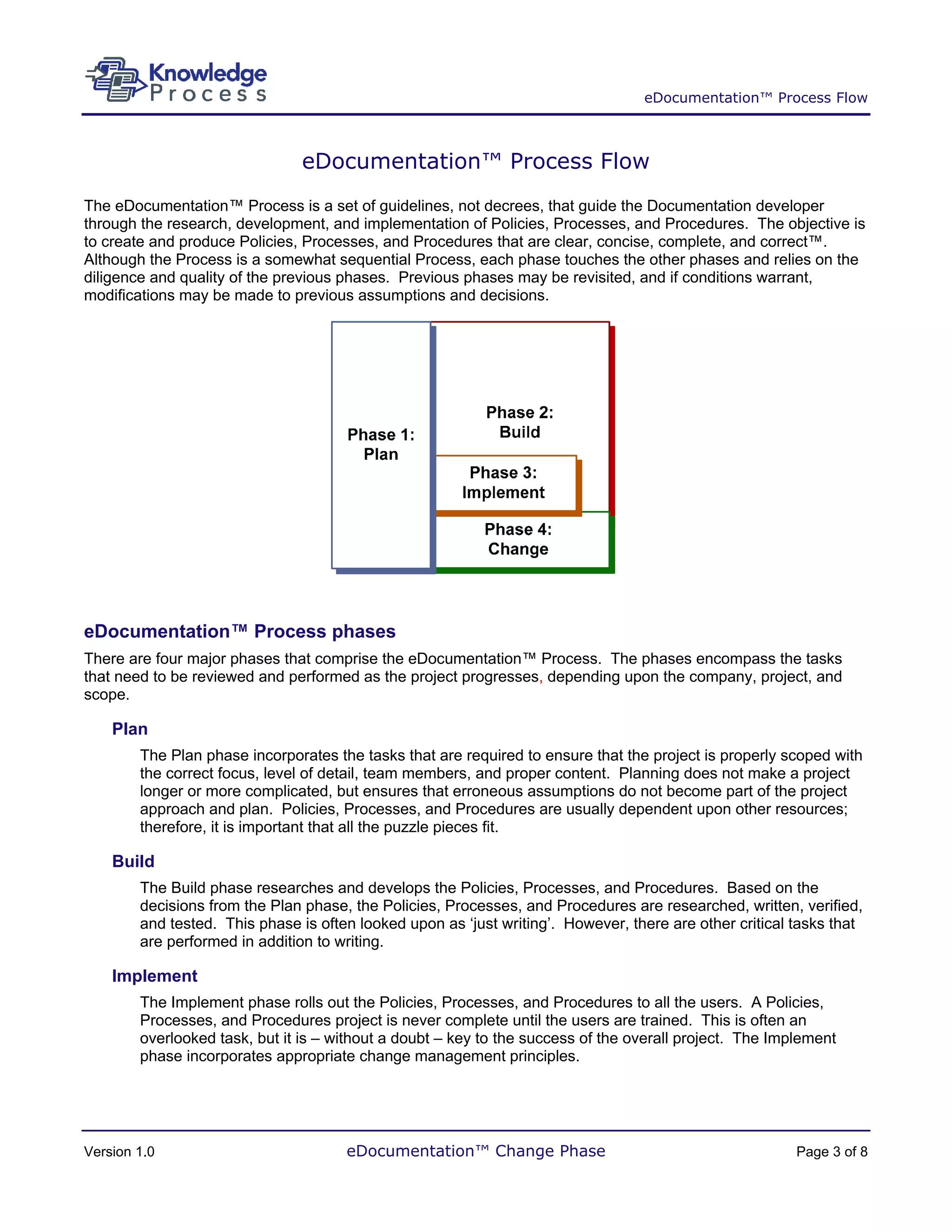
Although the Process is a somewhat sequential Process, each phase touches the other phases and relies on the
diligence and quality of the previous phases. Previous phases may be revisited, and if conditions warrant,
modifications may be made to previous assumptions and decisions.


eDocumentation™ Process phases
There are four major phases that comprise the eDocumentation™ Process. The phases encompass the tasks
that need to be reviewed and performed as the project progresses, depending upon the company, project, and
scope.

    Plan
        The Plan phase incorporates the tasks that are required to ensure that the project is properly scoped with
        the correct focus, level of detail, team members, and proper content. Planning does not make a project
        longer or more complicated, but ensures that erroneous assumptions do not become part of the project
        approach and plan. Policies, Processes, and Procedures are usually dependent upon other resources;
        therefore, it is important that all the puzzle pieces fit.

    Build
        The Build phase researches and develops the Policies, Processes, and Procedures. Based on the
        decisions from the Plan phase, the Policies, Processes, and Procedures are researched, written, verified,
        and tested. This phase is often looked upon as ‘just writing’. However, there are other critical tasks that
        are performed in addition to writing.

    Implement
        The Implement phase rolls out the Policies, Processes, and Procedures to all the users. A Policies,
        Processes, and Procedures project is never complete until the users are trained. This is often an
        overlooked task, but it is – without a doubt – key to the success of the overall project. The Implement
        phase incorporates appropriate change management principles.


Version 1.0                           eDocumentation™ Change Phase                                       Page 3 of 8
eDocumentation™ Process Flow


    Change
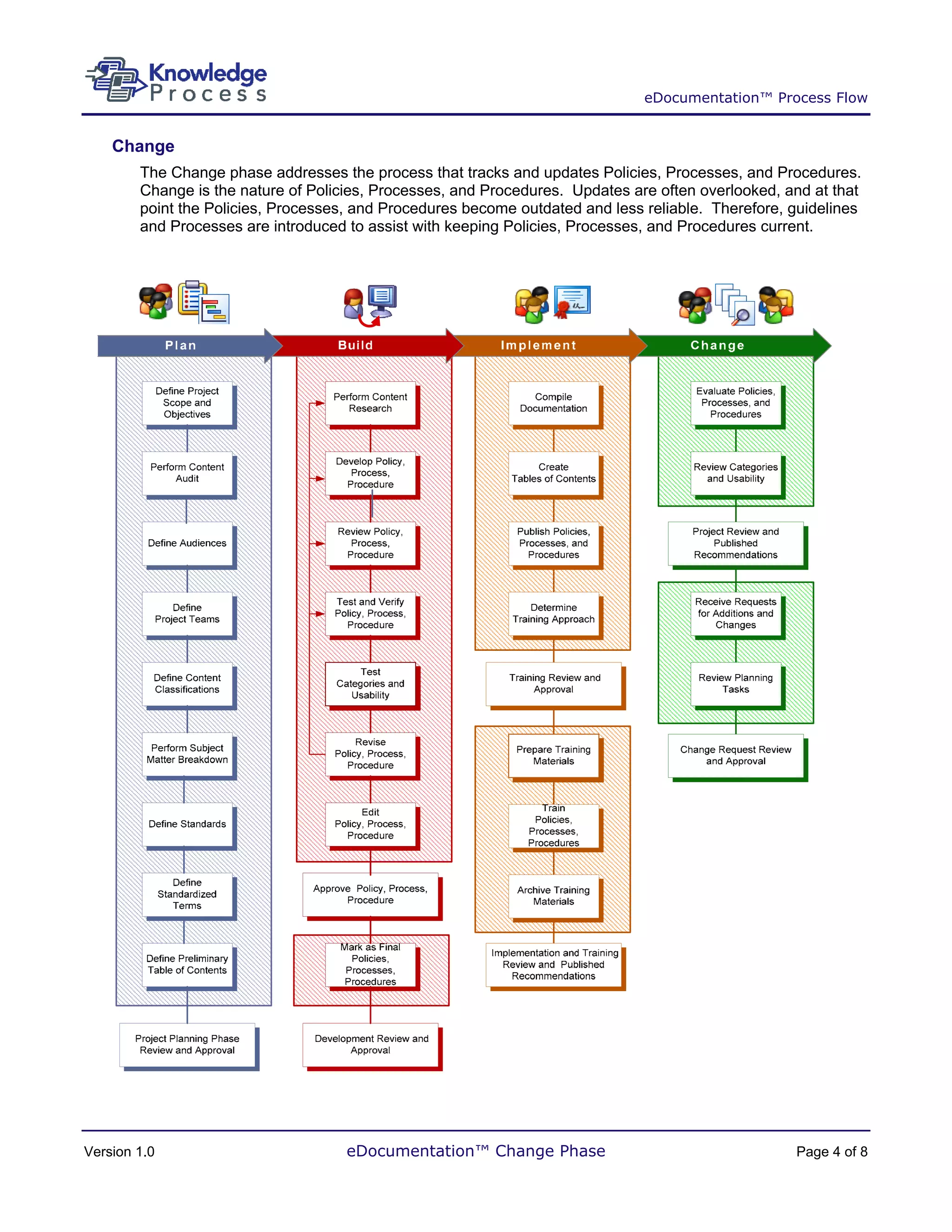
        The Change phase addresses the process that tracks and updates Policies, Processes, and Procedures.
        Change is the nature of Policies, Processes, and Procedures. Updates are often overlooked, and at that
        point the Policies, Processes, and Procedures become outdated and less reliable. Therefore, guidelines
        and Processes are introduced to assist with keeping Policies, Processes, and Procedures current.


Version 1.0                          eDocumentation™ Change Phase                                   Page 4 of 8
eDocumentation™ Process Flow


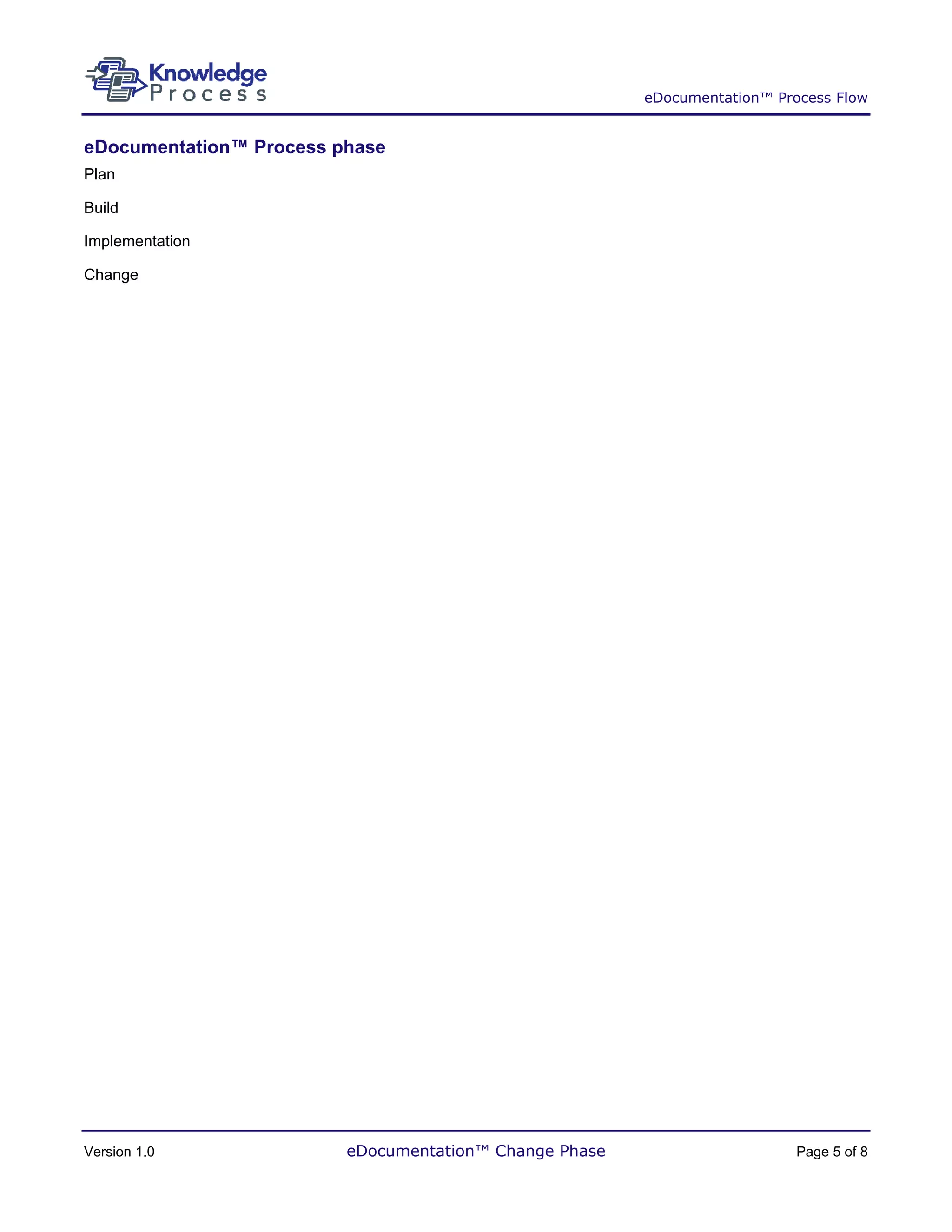
eDocumentation™ Process phase
Plan

Build

Implementation

Change


Version 1.0              eDocumentation™ Change Phase                      Page 5 of 8
Documentation Maintenance


                                 Documentation Maintenance
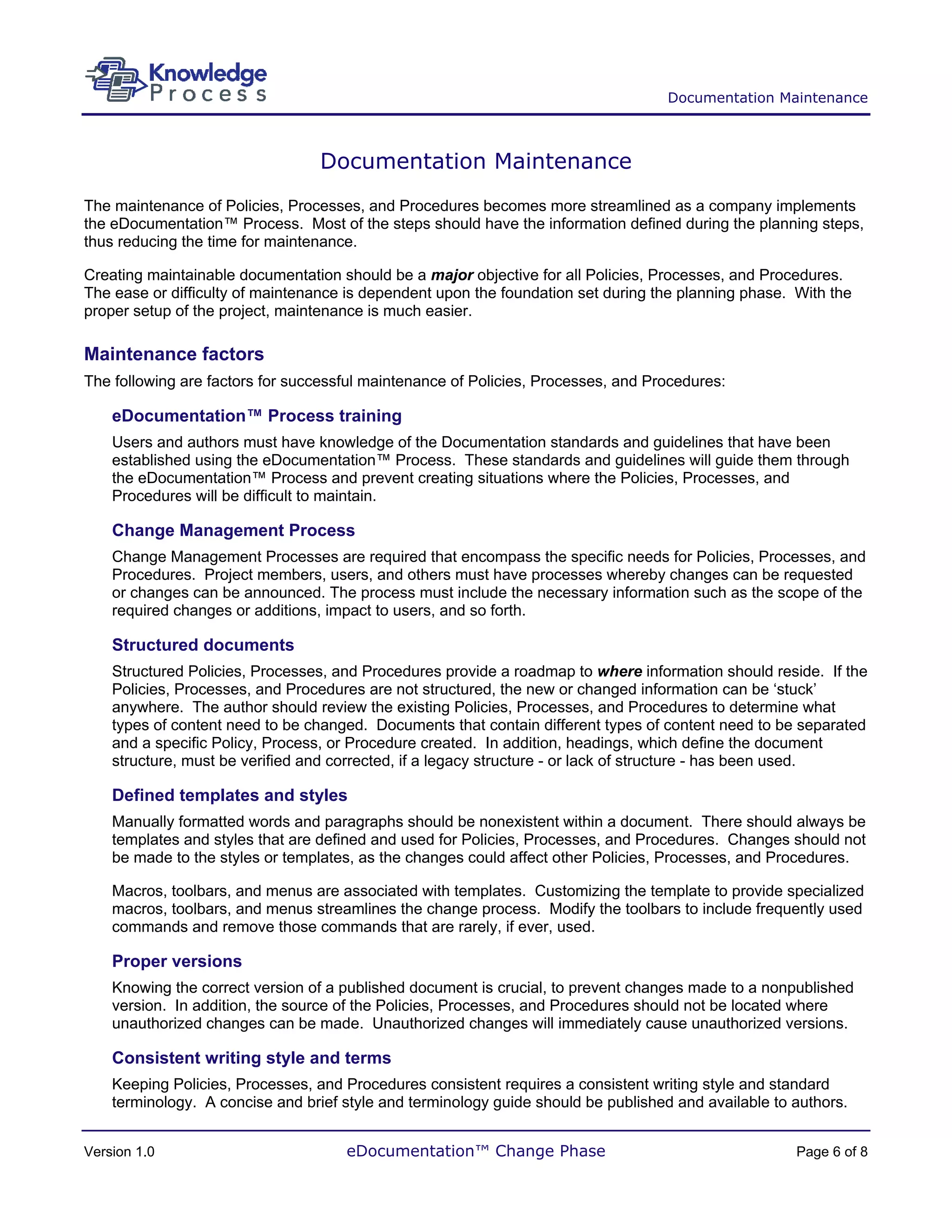
The maintenance of Policies, Processes, and Procedures becomes more streamlined as a company implements
the eDocumentation™ Process. Most of the steps should have the information defined during the planning steps,
thus reducing the time for maintenance.

Creating maintainable documentation should be a major objective for all Policies, Processes, and Procedures.
The ease or difficulty of maintenance is dependent upon the foundation set during the planning phase. With the
proper setup of the project, maintenance is much easier.

Maintenance factors
The following are factors for successful maintenance of Policies, Processes, and Procedures:

    eDocumentation™ Process training
    Users and authors must have knowledge of the Documentation standards and guidelines that have been
    established using the eDocumentation™ Process. These standards and guidelines will guide them through
    the eDocumentation™ Process and prevent creating situations where the Policies, Processes, and
    Procedures will be difficult to maintain.

    Change Management Process
    Change Management Processes are required that encompass the specific needs for Policies, Processes, and
    Procedures. Project members, users, and others must have processes whereby changes can be requested
    or changes can be announced. The process must include the necessary information such as the scope of the
    required changes or additions, impact to users, and so forth.

    Structured documents
    Structured Policies, Processes, and Procedures provide a roadmap to where information should reside. If the
    Policies, Processes, and Procedures are not structured, the new or changed information can be ‘stuck’
    anywhere. The author should review the existing Policies, Processes, and Procedures to determine what
    types of content need to be changed. Documents that contain different types of content need to be separated
    and a specific Policy, Process, or Procedure created. In addition, headings, which define the document
    structure, must be verified and corrected, if a legacy structure - or lack of structure - has been used.

    Defined templates and styles
    Manually formatted words and paragraphs should be nonexistent within a document. There should always be
    templates and styles that are defined and used for Policies, Processes, and Procedures. Changes should not
    be made to the styles or templates, as the changes could affect other Policies, Processes, and Procedures.

    Macros, toolbars, and menus are associated with templates. Customizing the template to provide specialized
    macros, toolbars, and menus streamlines the change process. Modify the toolbars to include frequently used
    commands and remove those commands that are rarely, if ever, used.

    Proper versions
    Knowing the correct version of a published document is crucial, to prevent changes made to a nonpublished
    version. In addition, the source of the Policies, Processes, and Procedures should not be located where
    unauthorized changes can be made. Unauthorized changes will immediately cause unauthorized versions.

    Consistent writing style and terms
    Keeping Policies, Processes, and Procedures consistent requires a consistent writing style and standard
    terminology. A concise and brief style and terminology guide should be published and available to authors.


Version 1.0                          eDocumentation™ Change Phase                                     Page 6 of 8
Documentation Maintenance


    Subject matter experts directory
    A simple change to a system, business processes, or department procedure may affect other Policies,
    Processes, and Procedures. Therefore, a directory of subject matter experts and their expertise is a tool used
    to direct the authors to the proper expert, who can discuss possible changes to Policies, Processes, and
    Procedures.

    Style guide
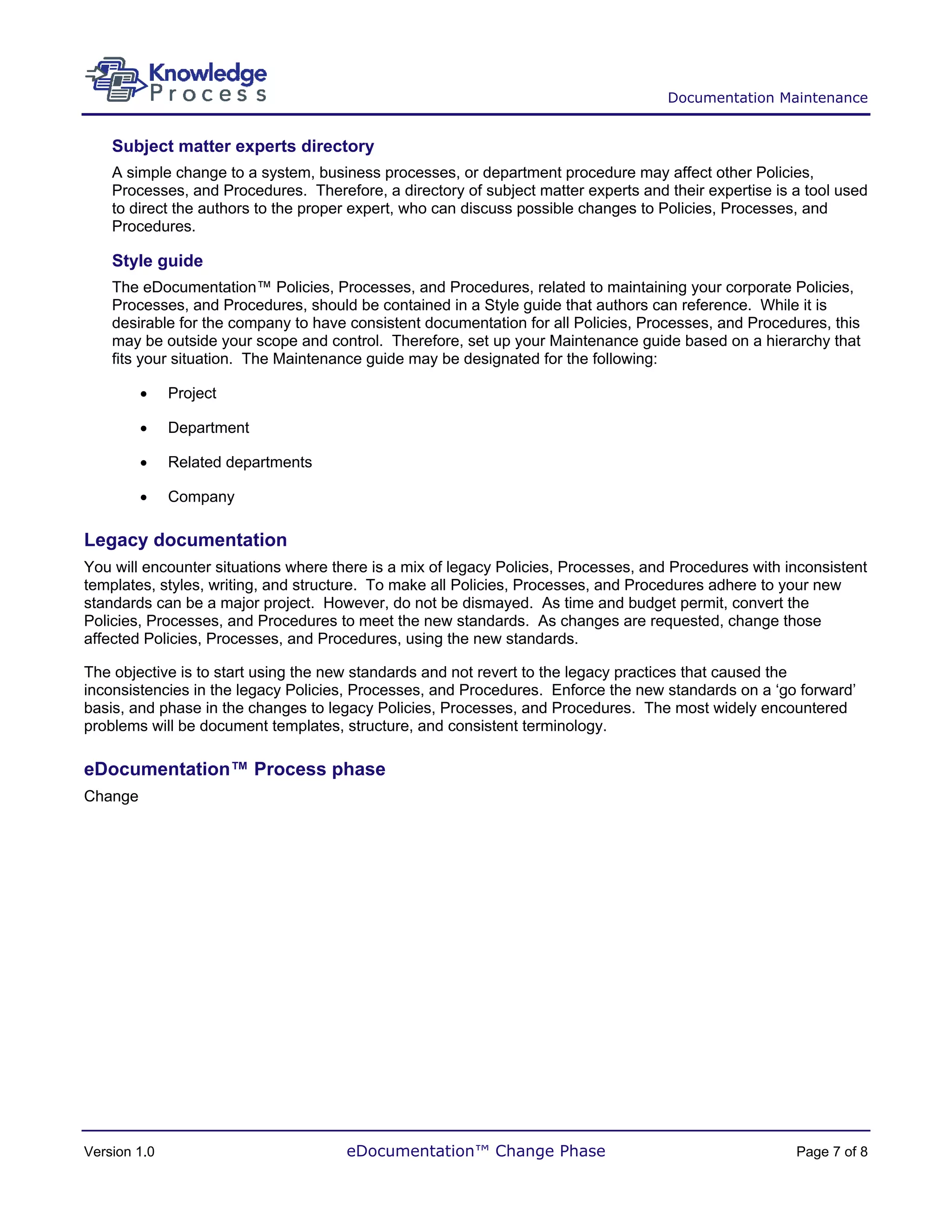
    The eDocumentation™ Policies, Processes, and Procedures, related to maintaining your corporate Policies,
    Processes, and Procedures, should be contained in a Style guide that authors can reference. While it is
    desirable for the company to have consistent documentation for all Policies, Processes, and Procedures, this
    may be outside your scope and control. Therefore, set up your Maintenance guide based on a hierarchy that
    fits your situation. The Maintenance guide may be designated for the following:

         •    Project

         •    Department

         •    Related departments

         •    Company

Legacy documentation
You will encounter situations where there is a mix of legacy Policies, Processes, and Procedures with inconsistent
templates, styles, writing, and structure. To make all Policies, Processes, and Procedures adhere to your new
standards can be a major project. However, do not be dismayed. As time and budget permit, convert the
Policies, Processes, and Procedures to meet the new standards. As changes are requested, change those
affected Policies, Processes, and Procedures, using the new standards.

The objective is to start using the new standards and not revert to the legacy practices that caused the
inconsistencies in the legacy Policies, Processes, and Procedures. Enforce the new standards on a ‘go forward’
basis, and phase in the changes to legacy Policies, Processes, and Procedures. The most widely encountered
problems will be document templates, structure, and consistent terminology.

eDocumentation™ Process phase
Change


Version 1.0                           eDocumentation™ Change Phase                                     Page 7 of 8
Knowledge Process, Inc.


                                     Knowledge Process, Inc.

About Knowledge Process
Knowledge Process provides services and expertise for the research, development, and validation of Content and
Documentation for Policies, Processes, and Procedures. For more information, contact:

                Knowledge Process
                Web: http://www.DocumentationProcess.com


Copyright
                          ©2009-2012 by Knowledge Process, Inc. All rights reserved

       Use of this site/document indicates approval and acceptance of our Terms of Use and Privacy Policy


Version 1.0                          eDocumentation™ Change Phase                                    Page 8 of 8

4. eDocumentation Process Change Phase

  • 1.
    eDocumentation™ Process Change Phase Knowledge Process, Inc. www.DocumentationProcess.com www.KCGGroup.com
  • 2.
    Table of Contents– Change Table of Contents – Change Table of Contents – Change .................................................................................................................. 2  eDocumentation™ Process Flow .......................................................................................................... 3  eDocumentation™ Process phases....................................................................................................................... 3  eDocumentation™ Process phase ........................................................................................................................ 5  Documentation Maintenance ................................................................................................................. 6  Maintenance factors ............................................................................................................................................... 6  Legacy documentation ........................................................................................................................................... 7  eDocumentation™ Process phase ........................................................................................................................ 7  Knowledge Process, Inc......................................................................................................................... 8  About Knowledge Process ..................................................................................................................................... 8  Copyright ................................................................................................................................................................ 8  Version 1.0 eDocumentation™ Change Phase Page 2 of 8
  • 3.
    eDocumentation™ Process Flow eDocumentation™ Process Flow The eDocumentation™ Process is a set of guidelines, not decrees, that guide the Documentation developer through the research, development, and implementation of Policies, Processes, and Procedures. The objective is to create and produce Policies, Processes, and Procedures that are clear, concise, complete, and correct™. Although the Process is a somewhat sequential Process, each phase touches the other phases and relies on the diligence and quality of the previous phases. Previous phases may be revisited, and if conditions warrant, modifications may be made to previous assumptions and decisions. eDocumentation™ Process phases There are four major phases that comprise the eDocumentation™ Process. The phases encompass the tasks that need to be reviewed and performed as the project progresses, depending upon the company, project, and scope. Plan The Plan phase incorporates the tasks that are required to ensure that the project is properly scoped with the correct focus, level of detail, team members, and proper content. Planning does not make a project longer or more complicated, but ensures that erroneous assumptions do not become part of the project approach and plan. Policies, Processes, and Procedures are usually dependent upon other resources; therefore, it is important that all the puzzle pieces fit. Build The Build phase researches and develops the Policies, Processes, and Procedures. Based on the decisions from the Plan phase, the Policies, Processes, and Procedures are researched, written, verified, and tested. This phase is often looked upon as ‘just writing’. However, there are other critical tasks that are performed in addition to writing. Implement The Implement phase rolls out the Policies, Processes, and Procedures to all the users. A Policies, Processes, and Procedures project is never complete until the users are trained. This is often an overlooked task, but it is – without a doubt – key to the success of the overall project. The Implement phase incorporates appropriate change management principles. Version 1.0 eDocumentation™ Change Phase Page 3 of 8
  • 4.
    eDocumentation™ Process Flow Change The Change phase addresses the process that tracks and updates Policies, Processes, and Procedures. Change is the nature of Policies, Processes, and Procedures. Updates are often overlooked, and at that point the Policies, Processes, and Procedures become outdated and less reliable. Therefore, guidelines and Processes are introduced to assist with keeping Policies, Processes, and Procedures current. Version 1.0 eDocumentation™ Change Phase Page 4 of 8
  • 5.
    eDocumentation™ Process Flow eDocumentation™Process phase Plan Build Implementation Change Version 1.0 eDocumentation™ Change Phase Page 5 of 8
  • 6.
    Documentation Maintenance Documentation Maintenance The maintenance of Policies, Processes, and Procedures becomes more streamlined as a company implements the eDocumentation™ Process. Most of the steps should have the information defined during the planning steps, thus reducing the time for maintenance. Creating maintainable documentation should be a major objective for all Policies, Processes, and Procedures. The ease or difficulty of maintenance is dependent upon the foundation set during the planning phase. With the proper setup of the project, maintenance is much easier. Maintenance factors The following are factors for successful maintenance of Policies, Processes, and Procedures: eDocumentation™ Process training Users and authors must have knowledge of the Documentation standards and guidelines that have been established using the eDocumentation™ Process. These standards and guidelines will guide them through the eDocumentation™ Process and prevent creating situations where the Policies, Processes, and Procedures will be difficult to maintain. Change Management Process Change Management Processes are required that encompass the specific needs for Policies, Processes, and Procedures. Project members, users, and others must have processes whereby changes can be requested or changes can be announced. The process must include the necessary information such as the scope of the required changes or additions, impact to users, and so forth. Structured documents Structured Policies, Processes, and Procedures provide a roadmap to where information should reside. If the Policies, Processes, and Procedures are not structured, the new or changed information can be ‘stuck’ anywhere. The author should review the existing Policies, Processes, and Procedures to determine what types of content need to be changed. Documents that contain different types of content need to be separated and a specific Policy, Process, or Procedure created. In addition, headings, which define the document structure, must be verified and corrected, if a legacy structure - or lack of structure - has been used. Defined templates and styles Manually formatted words and paragraphs should be nonexistent within a document. There should always be templates and styles that are defined and used for Policies, Processes, and Procedures. Changes should not be made to the styles or templates, as the changes could affect other Policies, Processes, and Procedures. Macros, toolbars, and menus are associated with templates. Customizing the template to provide specialized macros, toolbars, and menus streamlines the change process. Modify the toolbars to include frequently used commands and remove those commands that are rarely, if ever, used. Proper versions Knowing the correct version of a published document is crucial, to prevent changes made to a nonpublished version. In addition, the source of the Policies, Processes, and Procedures should not be located where unauthorized changes can be made. Unauthorized changes will immediately cause unauthorized versions. Consistent writing style and terms Keeping Policies, Processes, and Procedures consistent requires a consistent writing style and standard terminology. A concise and brief style and terminology guide should be published and available to authors. Version 1.0 eDocumentation™ Change Phase Page 6 of 8
  • 7.
    Documentation Maintenance Subject matter experts directory A simple change to a system, business processes, or department procedure may affect other Policies, Processes, and Procedures. Therefore, a directory of subject matter experts and their expertise is a tool used to direct the authors to the proper expert, who can discuss possible changes to Policies, Processes, and Procedures. Style guide The eDocumentation™ Policies, Processes, and Procedures, related to maintaining your corporate Policies, Processes, and Procedures, should be contained in a Style guide that authors can reference. While it is desirable for the company to have consistent documentation for all Policies, Processes, and Procedures, this may be outside your scope and control. Therefore, set up your Maintenance guide based on a hierarchy that fits your situation. The Maintenance guide may be designated for the following: • Project • Department • Related departments • Company Legacy documentation You will encounter situations where there is a mix of legacy Policies, Processes, and Procedures with inconsistent templates, styles, writing, and structure. To make all Policies, Processes, and Procedures adhere to your new standards can be a major project. However, do not be dismayed. As time and budget permit, convert the Policies, Processes, and Procedures to meet the new standards. As changes are requested, change those affected Policies, Processes, and Procedures, using the new standards. The objective is to start using the new standards and not revert to the legacy practices that caused the inconsistencies in the legacy Policies, Processes, and Procedures. Enforce the new standards on a ‘go forward’ basis, and phase in the changes to legacy Policies, Processes, and Procedures. The most widely encountered problems will be document templates, structure, and consistent terminology. eDocumentation™ Process phase Change Version 1.0 eDocumentation™ Change Phase Page 7 of 8
  • 8.
    Knowledge Process, Inc. Knowledge Process, Inc. About Knowledge Process Knowledge Process provides services and expertise for the research, development, and validation of Content and Documentation for Policies, Processes, and Procedures. For more information, contact: Knowledge Process Web: http://www.DocumentationProcess.com Copyright ©2009-2012 by Knowledge Process, Inc. All rights reserved Use of this site/document indicates approval and acceptance of our Terms of Use and Privacy Policy Version 1.0 eDocumentation™ Change Phase Page 8 of 8