Kerrie Anne Christian
UOW - 2012
1
Document Control KAC 2012
2
•DOCUMENT CONTROL SYSTEMS -
OVERVIEW
•TYPICAL SYSTEM STRUCTURES –
•DOCUMENT SYSTEM - CONTROLS IN PLACE
• DIVISIONAL
• DEPARTMENT
•PROCEDURES FOR DOCUMENT CONTROL
Document Control KAC 2012
3
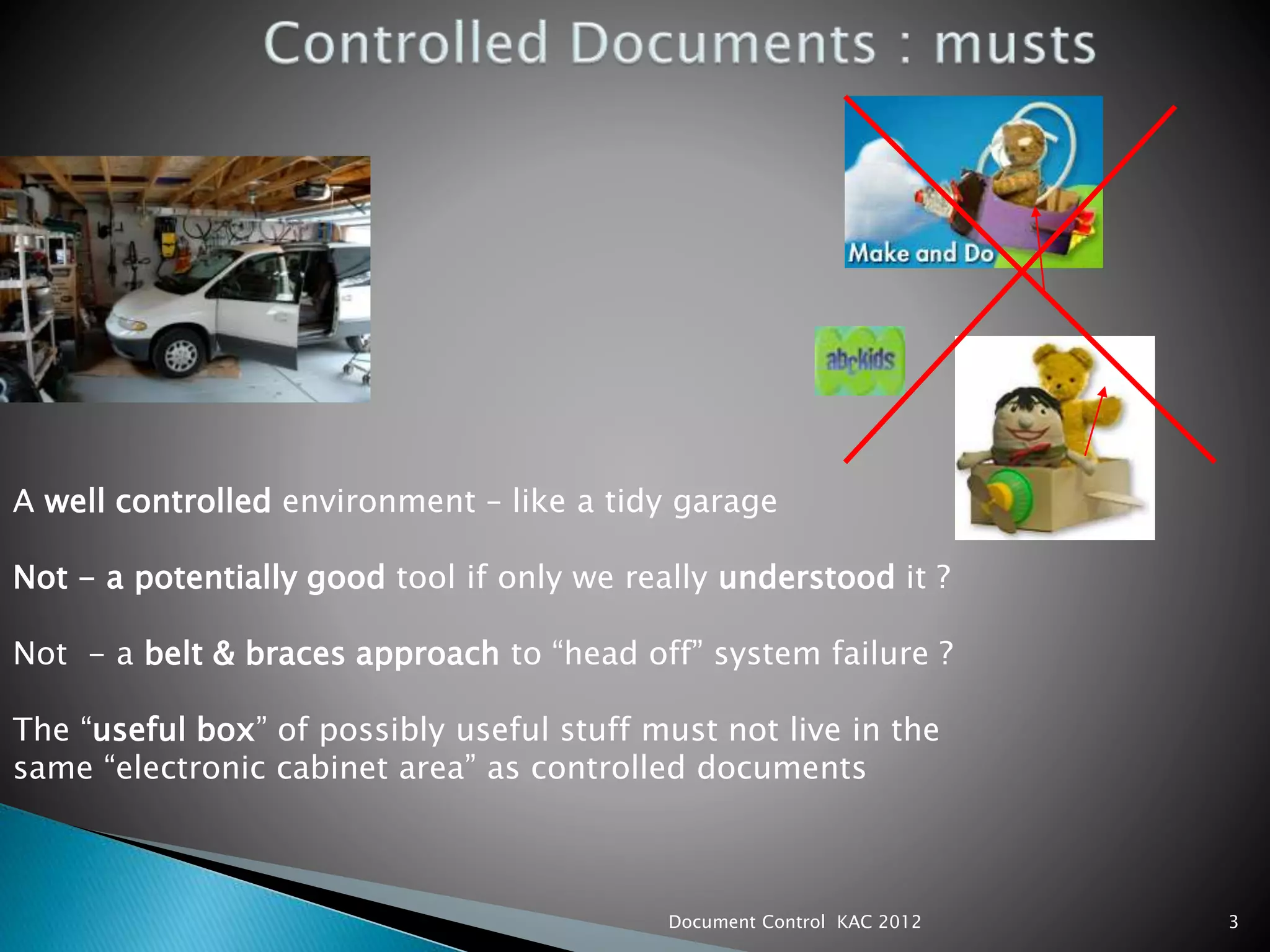
A well controlled environment – like a tidy garage
Not - a potentially good tool if only we really understood it ?
Not - a belt & braces approach to “head off” system failure ?
The “useful box” of possibly useful stuff must not live in the
same “electronic cabinet area” as controlled documents
Document Control KAC 2012
 Hard Copy Files - traditional
 PC Databases eg Access
 Document Management Systems eg SAP, Sharepoint,
Documentum or Wikis
 If use “workflow” - must not become a “black box”
 Needs to be accessible by those who need to use it
 Doesn’t have to stymie innovation & change
 Overload risk ? No need for new version, if document checked but
not changed – just make sure it’s clear doc has been reviewed
 Does EBMS affect auditing style ?
4
Document Control KAC 2012
5
THE DOCUMENT CONTROL SYSTEM IS PART OF AN
INTEGRATED MANAGEMENT SYSTEM COVERING ALL
KEY ACTIVITIES INCLUDING:
 manufacture of products;
 provision of support services;
 occupational health and safety;
 environmental management;
 technical safety; and
 access control.
And remember : it’s not just ticking the boxes ...
its because you need to satisfy your customer
and / or regulator
Document Control KAC 2012
 Who created it?
 Who signed off on it?
 Who changed it?
 When was it issued – changed ?
 Is everyone working with the same version of the
information?
 Missing or inaccurate documentation ?
 Where do I find it ?
 How many copies of a document can/should I find ?
 What’s controlled and what’s not?
 How do I stop unauthorised copies on the EBMS?
6
Document Control KAC 2012
7
Certification is a business decision
Certification is a decision to be taken for
business reasons:
• if it is a contractual, regulatory, or market
requirement,
•Quality, OHS, Environment, Food, IT, Risk
• If it meets customer preferences
• It is part of a risk management programme,
or
• If it will motivate staff by setting a clear
goal.
MANAGEMENT SYSTEMS & CERTIFICATION
Document Control KAC 2012
A combination of some or all of the following criteria are
considered when selecting a supplier:
 Reputation and past performance of supplier/producer
 Quality of product supplied previously
 ISO 9001Certification of supplier/producer
 Ability to meet required material, chemical, size and
packaging specifications
 Ability to meet required shipment and/or arrival times

 Ability to negotiate mutually acceptable payment terms
 Offer price and validity
 Delivery and contract terms and conditions
 Market price and short/medium term market expectations
 Local market conditions
 Domestic and international prices
 Stock levels and usage forecasts
8
ISO 9001 –Why do Certification ?
Customers’ Supplier Evaluation Perspectives
Document Control KAC 2012
2.1 Criminal offence
 It is, in some instances, unlawful to prematurely destroy
documents.
 For example, the Crimes (Document Destruction) Act 2006 (Vic)
makes it an offence for a person to knowingly destroy or conceal a
document or render a document illegible, undecipherable or
incapable of identification that is, or is likely to be required in
evidence in legal proceedings. Anyone who commits an act with
the intention of preventing a document from being used in
evidence in a legal proceeding may be guilty of an indictable
offence and may be liable to imprisonment, a fine or both.
 An adverse inference may be drawn by a judge if documents which
were in the possession of a party to the proceedings are not
available or have been destroyed.
 If an employee of the Group contravenes the Crimes (Document
Destruction) Act 2006 (Vic), proceedings may also be commenced
against the Group. In such a proceeding, it is a defence to the
charge for the company to prove that it exercised due diligence to
prevent the contravention by the employee. One of the factors
that the court may consider when assessing whether there has
been a contravention is whether the Group had a corporate culture
that directed, encourage, tolerated or lead to the destruction of
documents.
9
Document Control KAC 2012
10
DOCUMENT CONTROL SYSTEMS IN PLACE
• There is a Divisional Document Control Officer who is
responsible for site level documents and provides alignment
of document control systems – what happens during annual
leave periods ?
• Each department has a nominated Document Control Officer
who is responsible for department level documents.
• Each DCO has documents that defines how they maintain
their specific document control processes. These are
consistent with the requirements outlined in a Divisional
procedure.
Document Control KAC 2012
11
Legible
Dated ( with revision dates)
Identifiable by Number and or Title
Maintained in Hard and or Electronic copy
Locatable by users
Periodically reviewed & revised as required
Current approved versions available
Obsolete documents removed from users
Archival documents retained for defined
periods
Changes are recorded and communicated
to users
Master document lists are maintained
Document Control procedures in all areas ensure that docume
Document Control KAC 2012
Removal and Archival of Obsolete Documents
All departments/sites shall document a system
for the control of obsolete documents.
This shall include the removal of such
documents from circulation and the
maintenance of archived copies.
12
Document Control KAC 2012
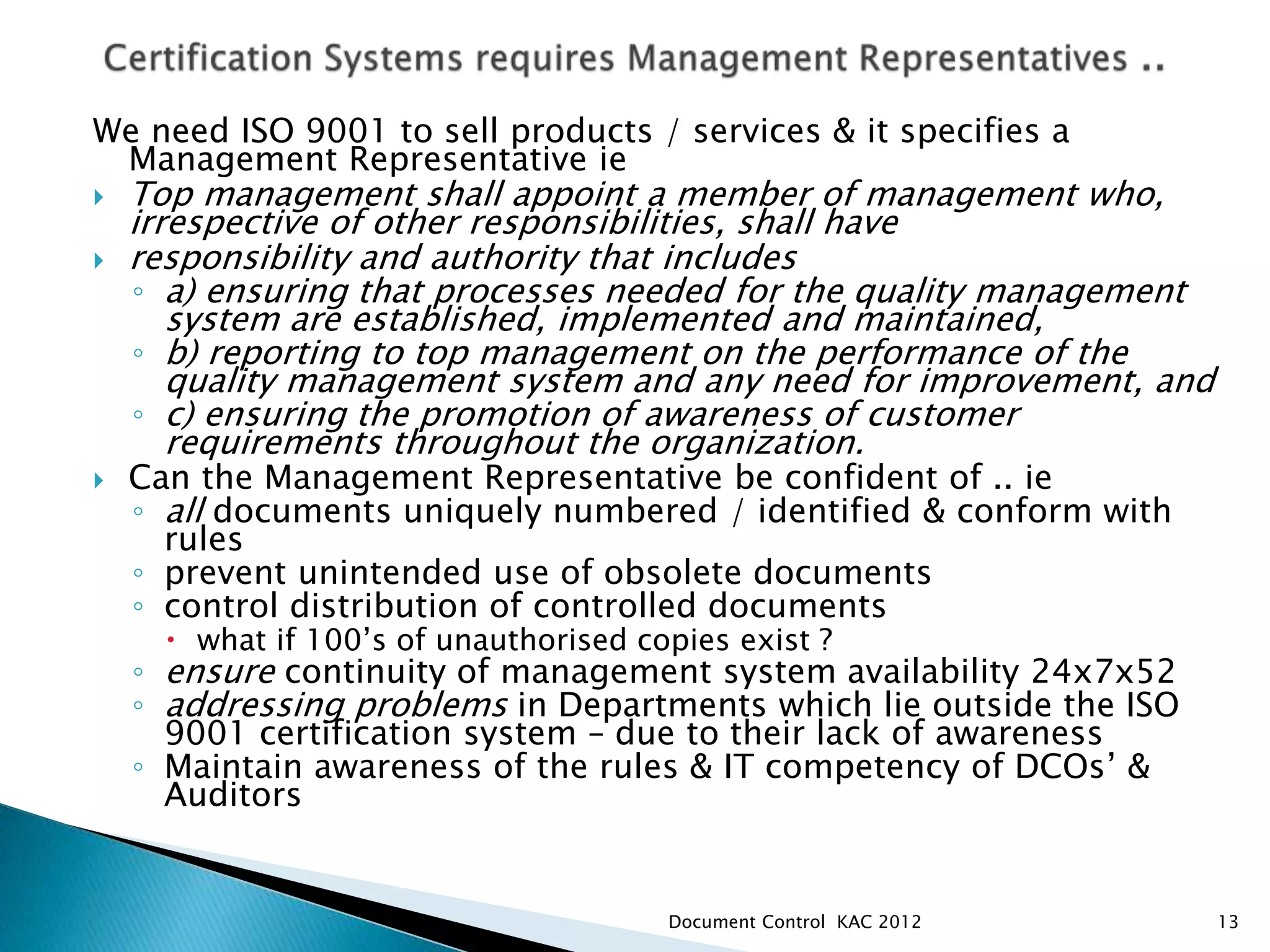
We need ISO 9001 to sell products / services & it specifies a
Management Representative ie
 Top management shall appoint a member of management who,
irrespective of other responsibilities, shall have
 responsibility and authority that includes
◦ a) ensuring that processes needed for the quality management
system are established, implemented and maintained,
◦ b) reporting to top management on the performance of the
quality management system and any need for improvement, and
◦ c) ensuring the promotion of awareness of customer
requirements throughout the organization.
 Can the Management Representative be confident of .. ie
◦ all documents uniquely numbered / identified & conform with
rules
◦ prevent unintended use of obsolete documents
◦ control distribution of controlled documents
 what if 100’s of unauthorised copies exist ?
◦ ensure continuity of management system availability 24x7x52
◦ addressing problems in Departments which lie outside the ISO
9001 certification system – due to their lack of awareness
◦ Maintain awareness of the rules & IT competency of DCOs’ &
Auditors
13
Document Control KAC 2012
14
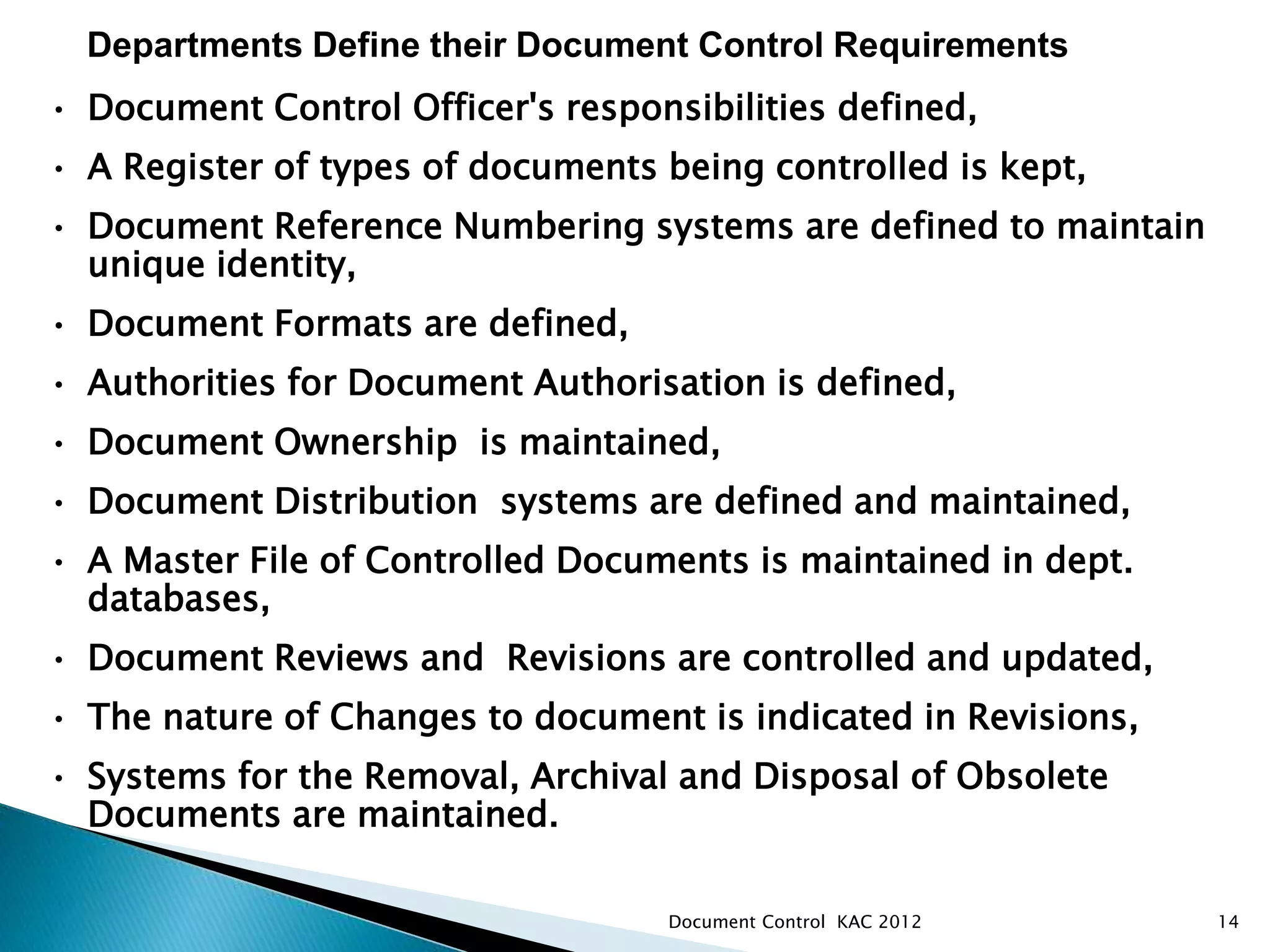
• Document Control Officer's responsibilities defined,
• A Register of types of documents being controlled is kept,
• Document Reference Numbering systems are defined to maintain
unique identity,
• Document Formats are defined,
• Authorities for Document Authorisation is defined,
• Document Ownership is maintained,
• Document Distribution systems are defined and maintained,
• A Master File of Controlled Documents is maintained in dept.
databases,
• Document Reviews and Revisions are controlled and updated,
• The nature of Changes to document is indicated in Revisions,
• Systems for the Removal, Archival and Disposal of Obsolete
Documents are maintained.
Departments Define their Document Control Requirements
Document Control KAC 2012
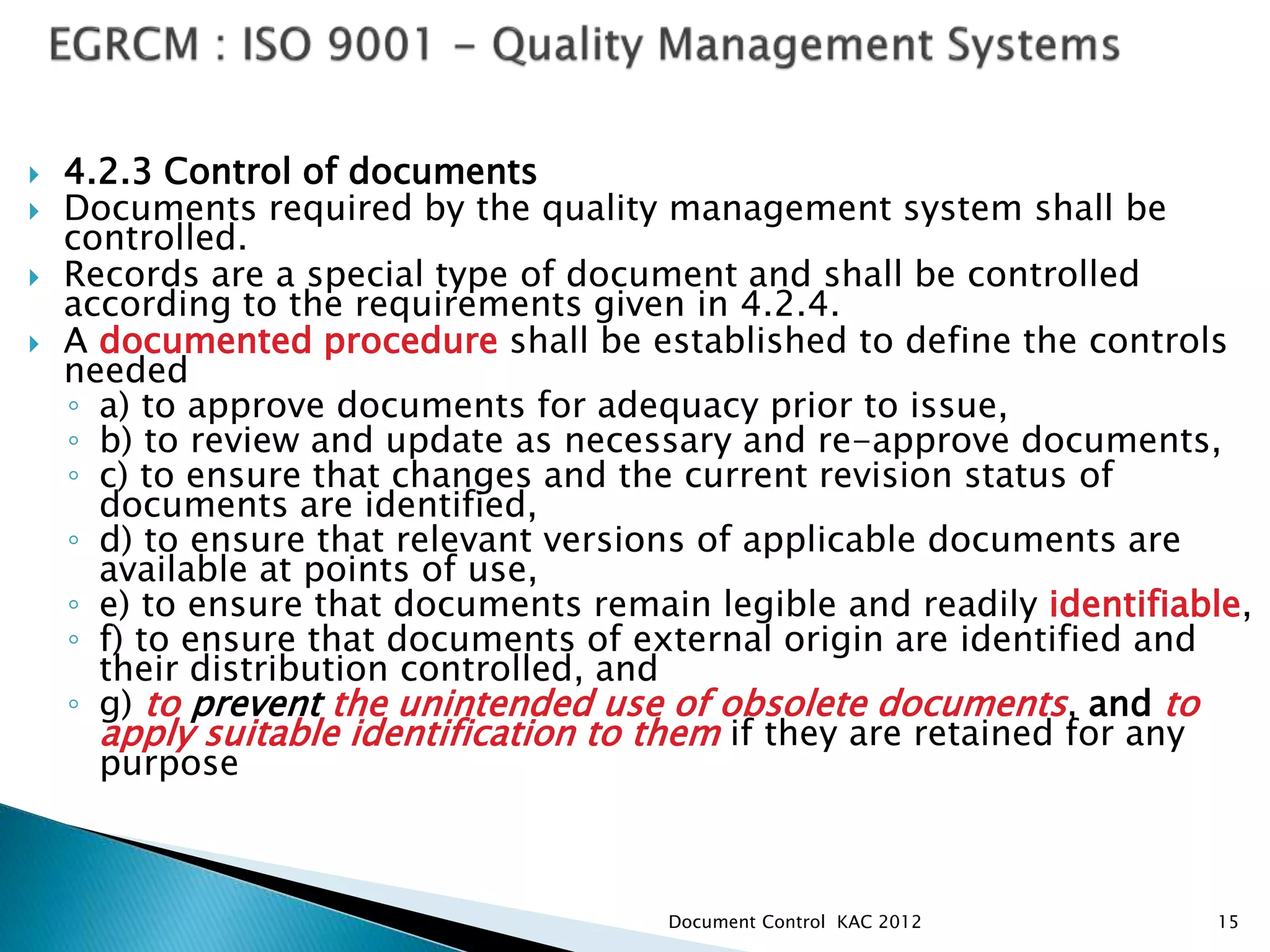
 4.2.3 Control of documents
 Documents required by the quality management system shall be
controlled.
 Records are a special type of document and shall be controlled
according to the requirements given in 4.2.4.
 A documented procedure shall be established to define the controls
needed
◦ a) to approve documents for adequacy prior to issue,
◦ b) to review and update as necessary and re-approve documents,
◦ c) to ensure that changes and the current revision status of
documents are identified,
◦ d) to ensure that relevant versions of applicable documents are
available at points of use,
◦ e) to ensure that documents remain legible and readily identifiable,
◦ f) to ensure that documents of external origin are identified and
their distribution controlled, and
◦ g) to prevent the unintended use of obsolete documents, and to
apply suitable identification to them if they are retained for any
purpose
15
Document Control KAC 2012
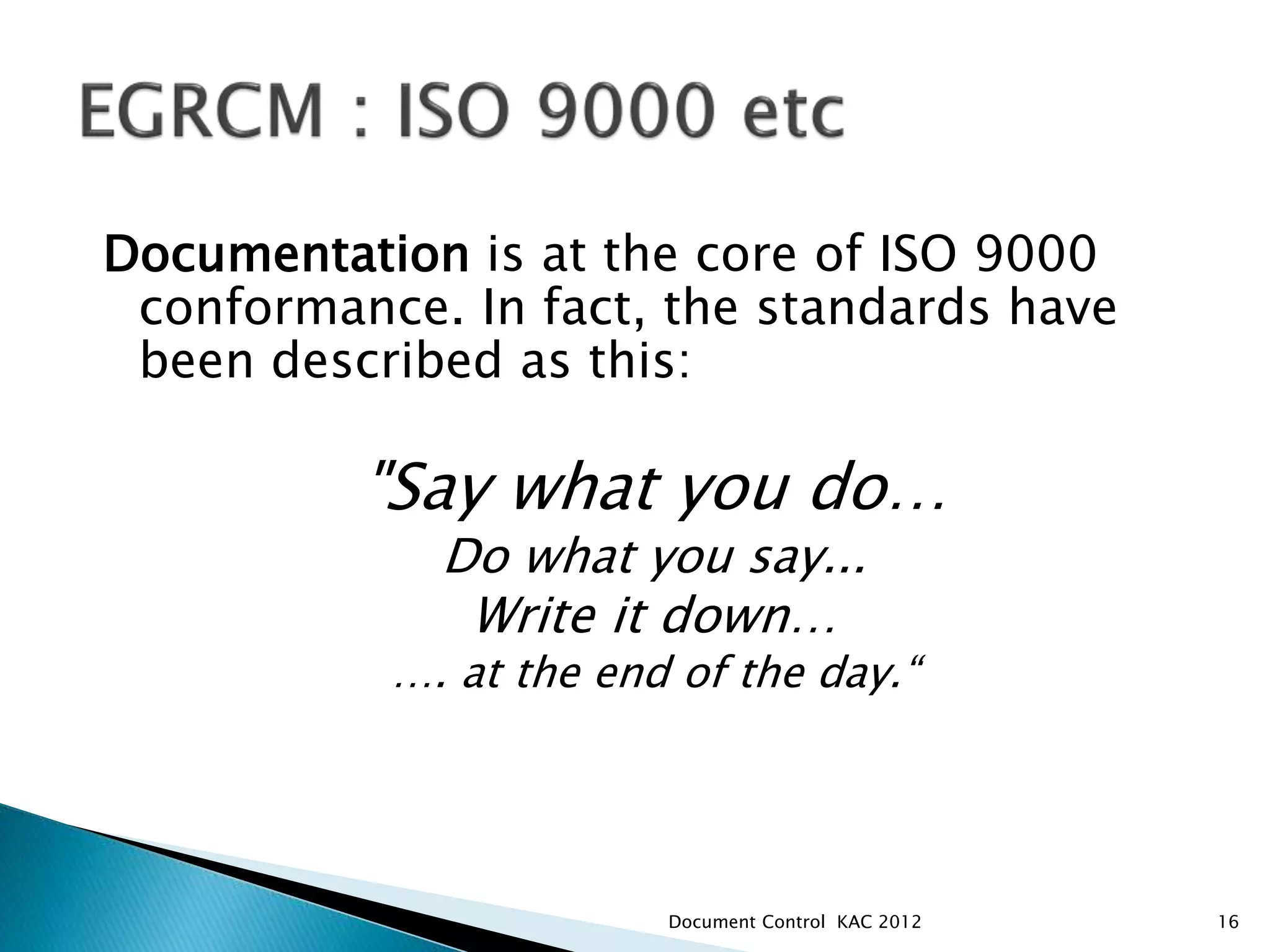
Documentation is at the core of ISO 9000
conformance. In fact, the standards have
been described as this:
"Say what you do…
Do what you say...
Write it down…
…. at the end of the day.“
16
Document Control KAC 2012
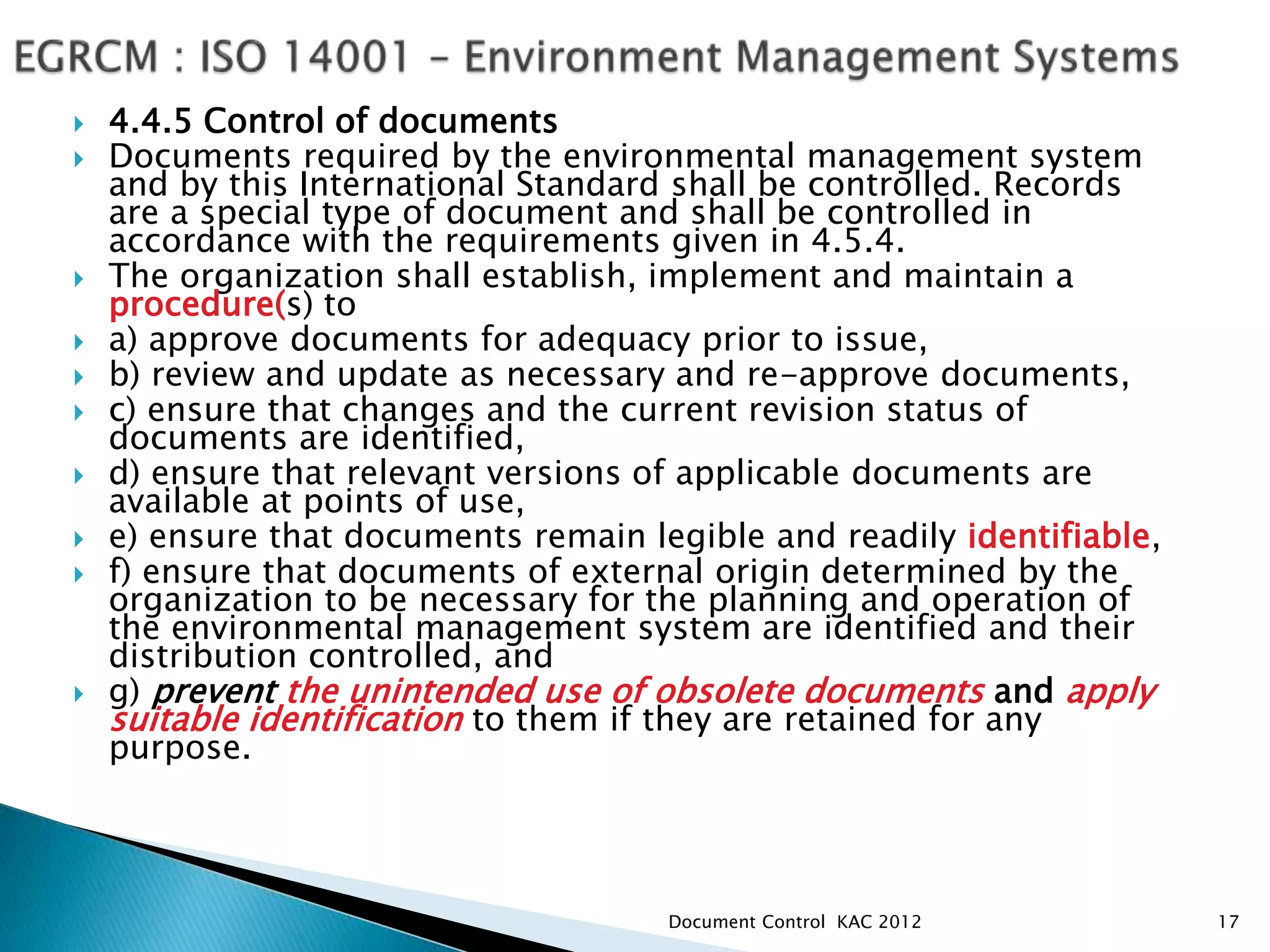
 4.4.5 Control of documents
 Documents required by the environmental management system
and by this International Standard shall be controlled. Records
are a special type of document and shall be controlled in
accordance with the requirements given in 4.5.4.
 The organization shall establish, implement and maintain a
procedure(s) to
 a) approve documents for adequacy prior to issue,
 b) review and update as necessary and re-approve documents,
 c) ensure that changes and the current revision status of
documents are identified,
 d) ensure that relevant versions of applicable documents are
available at points of use,
 e) ensure that documents remain legible and readily identifiable,
 f) ensure that documents of external origin determined by the
organization to be necessary for the planning and operation of
the environmental management system are identified and their
distribution controlled, and
 g) prevent the unintended use of obsolete documents and apply
suitable identification to them if they are retained for any
purpose.
17
Document Control KAC 2012
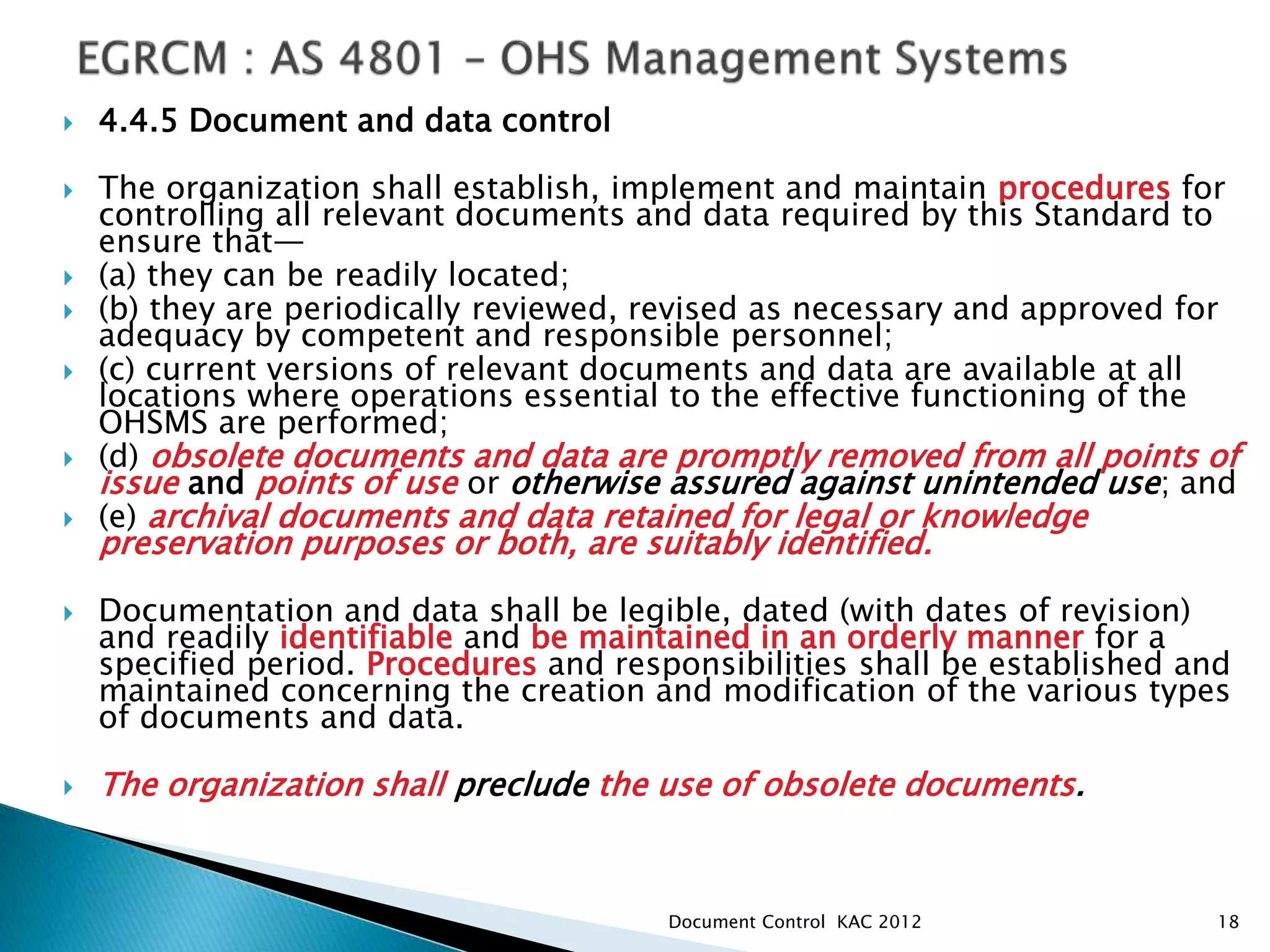
 4.4.5 Document and data control
 The organization shall establish, implement and maintain procedures for
controlling all relevant documents and data required by this Standard to
ensure that—
 (a) they can be readily located;
 (b) they are periodically reviewed, revised as necessary and approved for
adequacy by competent and responsible personnel;
 (c) current versions of relevant documents and data are available at all
locations where operations essential to the effective functioning of the
OHSMS are performed;
 (d) obsolete documents and data are promptly removed from all points of
issue and points of use or otherwise assured against unintended use; and
 (e) archival documents and data retained for legal or knowledge
preservation purposes or both, are suitably identified.
 Documentation and data shall be legible, dated (with dates of revision)
and readily identifiable and be maintained in an orderly manner for a
specified period. Procedures and responsibilities shall be established and
maintained concerning the creation and modification of the various types
of documents and data.
 The organization shall preclude the use of obsolete documents.
18
Document Control KAC 2012
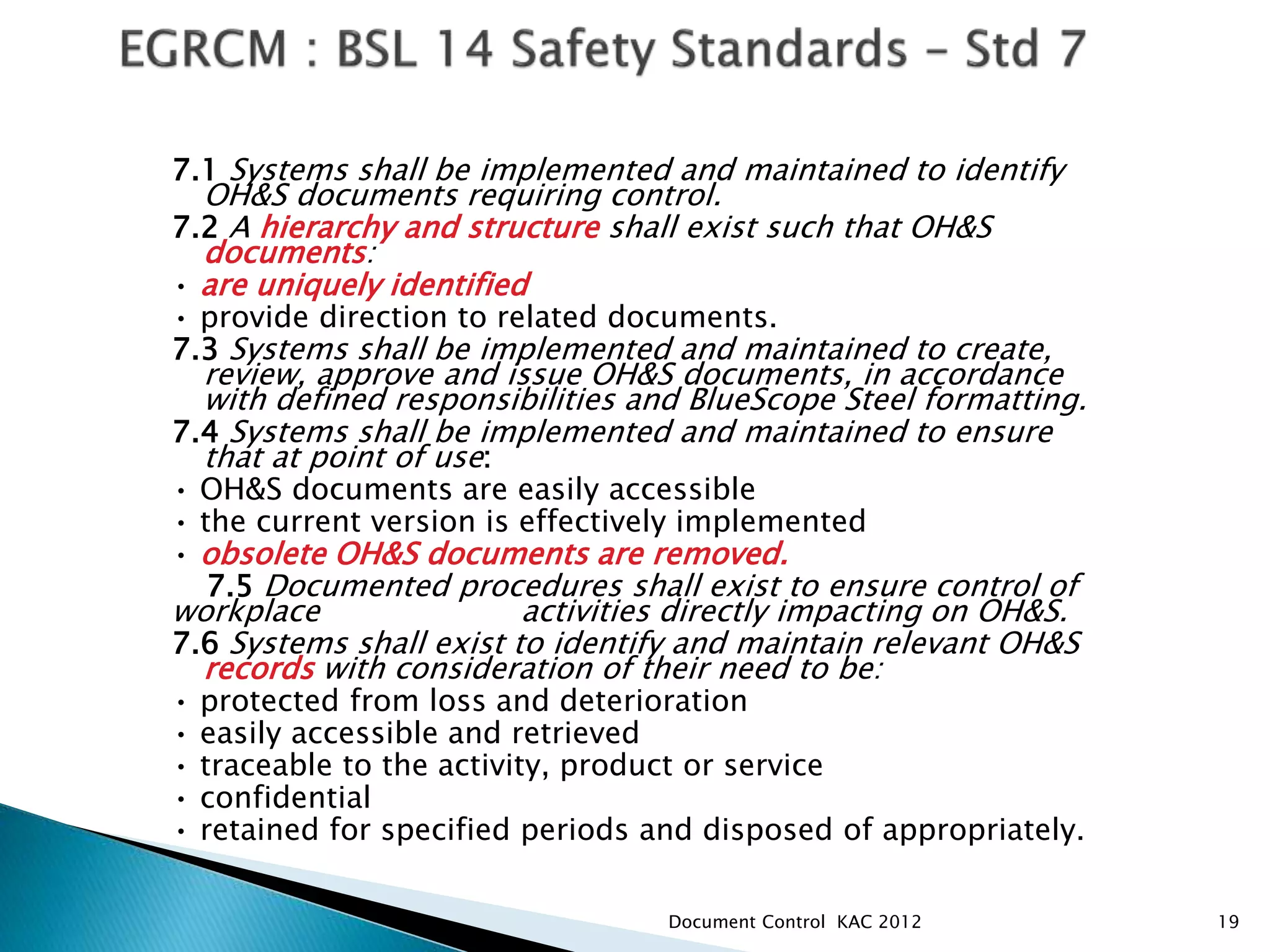
7.1 Systems shall be implemented and maintained to identify
OH&S documents requiring control.
7.2 A hierarchy and structure shall exist such that OH&S
documents:
• are uniquely identified
• provide direction to related documents.
7.3 Systems shall be implemented and maintained to create,
review, approve and issue OH&S documents, in accordance
with defined responsibilities and BlueScope Steel formatting.
7.4 Systems shall be implemented and maintained to ensure
that at point of use:
• OH&S documents are easily accessible
• the current version is effectively implemented
• obsolete OH&S documents are removed.
7.5 Documented procedures shall exist to ensure control of
workplace activities directly impacting on OH&S.
7.6 Systems shall exist to identify and maintain relevant OH&S
records with consideration of their need to be:
• protected from loss and deterioration
• easily accessible and retrieved
• traceable to the activity, product or service
• confidential
• retained for specified periods and disposed of appropriately.
19
Document Control KAC 2012
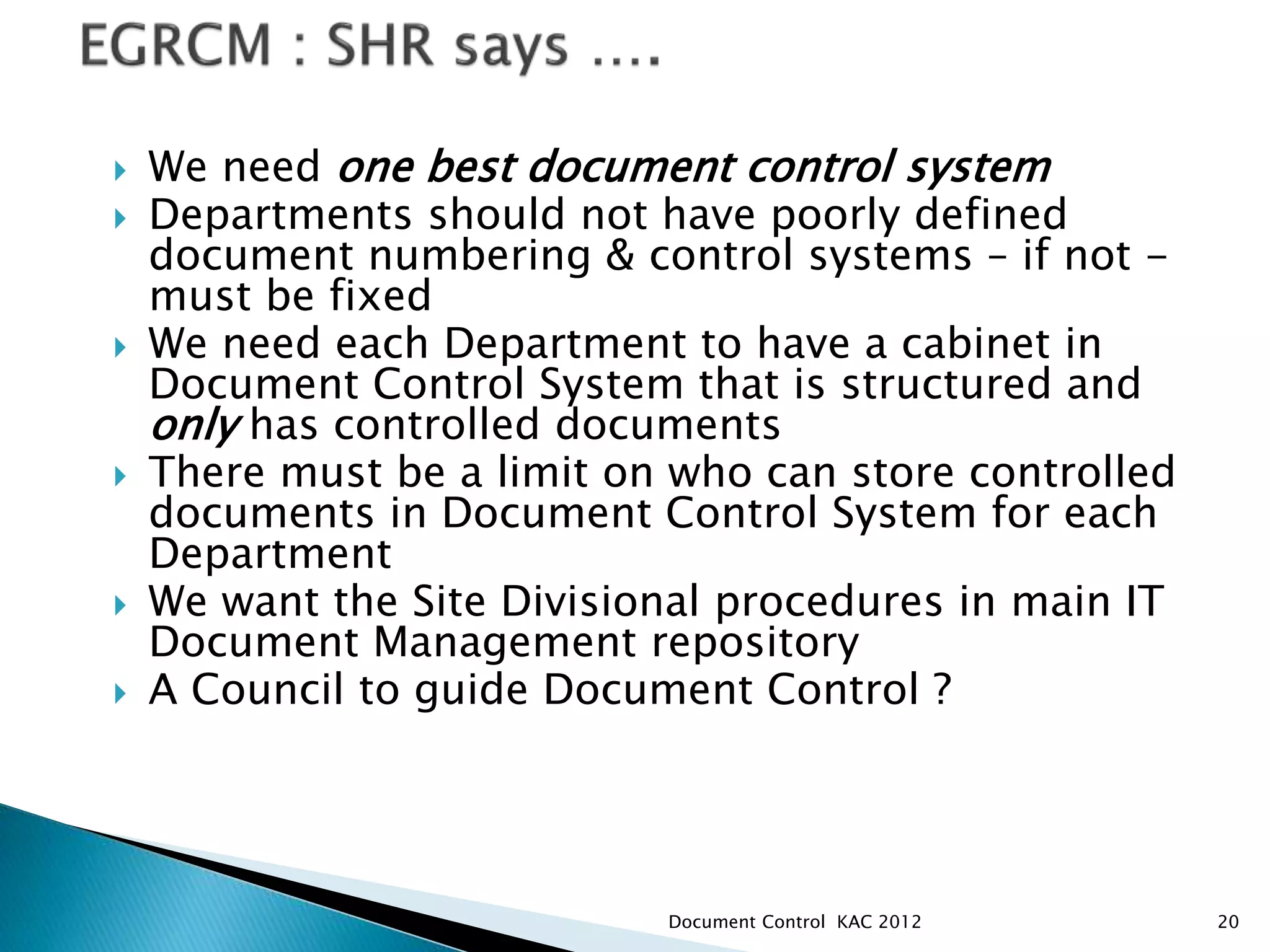
 We need one best document control system
 Departments should not have poorly defined
document numbering & control systems – if not -
must be fixed
 We need each Department to have a cabinet in
Document Control System that is structured and
only has controlled documents
 There must be a limit on who can store controlled
documents in Document Control System for each
Department
 We want the Site Divisional procedures in main IT
Document Management repository
 A Council to guide Document Control ?
20
Document Control KAC 2012
21
Verification of Document Control Systems
• Audits of both Department and Divisional Document Control
Systems shall be conducted routinely & systematically
• in accordance with documented procedures, by
independent auditors.
Document Control KAC 2012
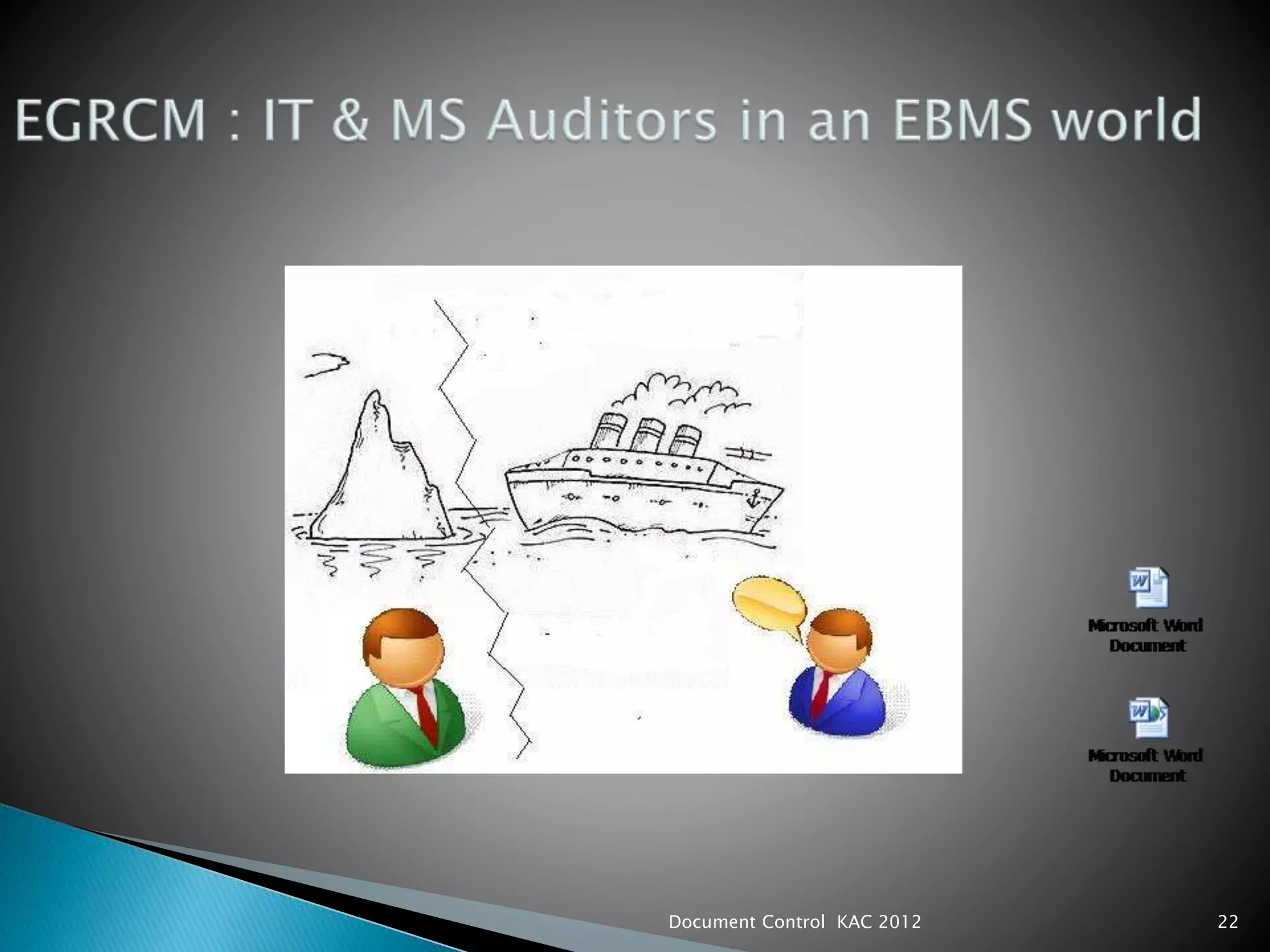
22
Document Control KAC 2012
 Controlled documents live in their own structured space – not a
“Useful Box” – want DIV-QA –xx-xx rules obeyed
 EBMS file names are always the same as their document number
 Documents in a controlled document space only have file names
compliant with divisional numbering system
 Able to verify if documents are controlled master document or linked
document or an unauthorised copy
 DCO’s able to set separate permissions for linking or copying of
documents
 DCO’s able to set permissions at the folder level – eg obsolete docs
 DCO’s have Digital document approval
 Only the current revision of a document can be seen
 Obsolete documents cannot be accessed at all by anyone except
DCO & review team – not even by link or search
 IT ensure Service Level Agreements for system outages/backups
23
Document Control KAC 2012
24
PKSW MANAGEMENT SYSTEMS &
CERTIFICATION
Case Study PKSW - Independently Certified Management
Systems since 1988 – Integrated Document Control.
QUALITY –Standard is ISO 9001
Certification Authority is SAI Global Assurance Services
Certified since September 1991
ENVIRONMENT –Standard is ISO 14001
Certification Authority is Lloyd’ Register Quality
Assurance
Certified since December 2002
OCCUPATIONAL HEALTH & SAFETY – AS4801 – Self Insurer
Audited by the NSW State Government Workcover Authority
since 1994
- Legal Compliance issues
All OF THESE CALL FOR EFFECTIVE DOCUMENT CONTROL SYSTEMS
Document Control KAC 2012
25
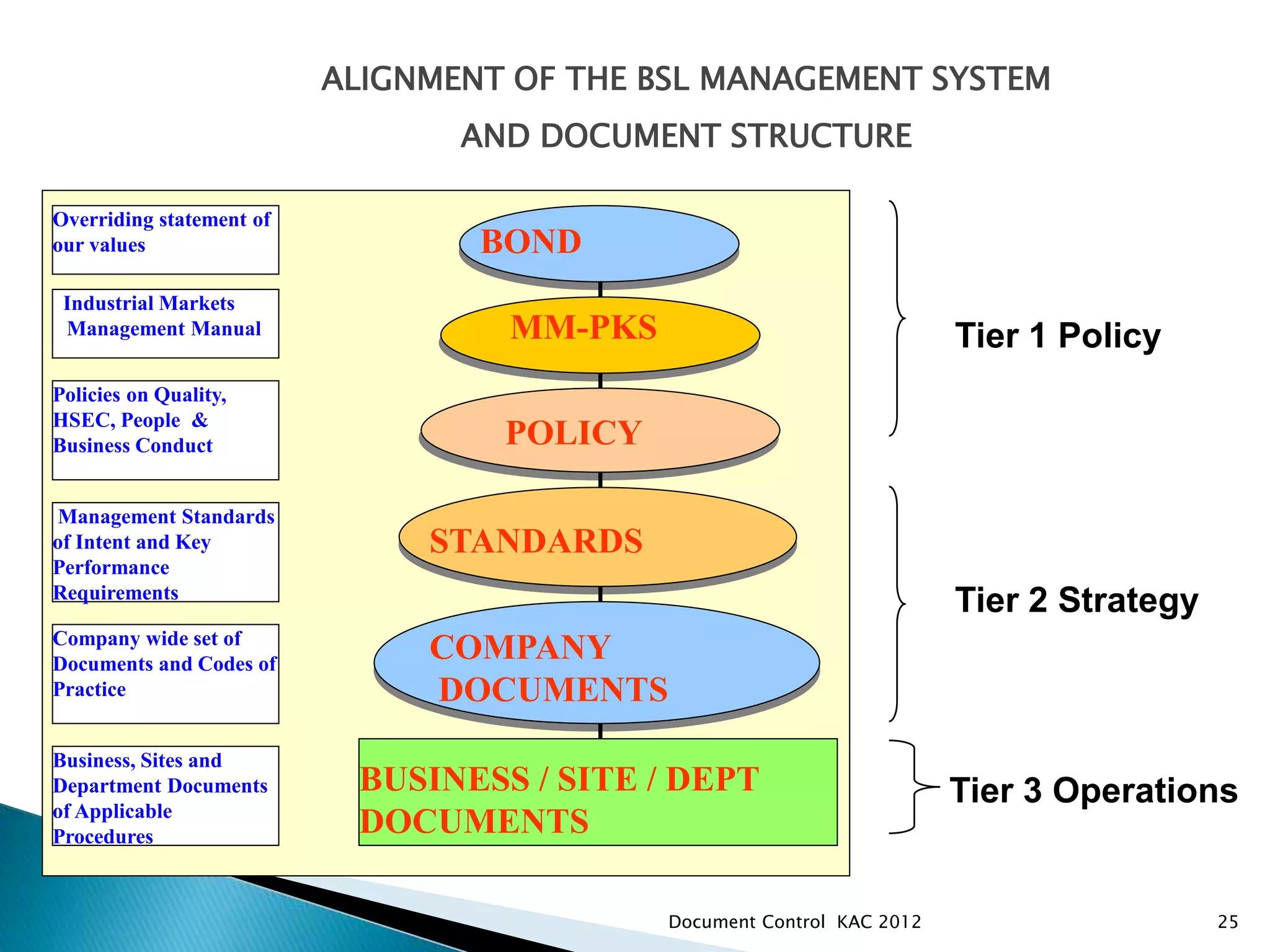
BOND
POLICY
MM-PKS
STANDARDS
COMPANY
DOCUMENTS
BUSINESS / SITE / DEPT
DOCUMENTS
Overriding statement of
our values
Policies on Quality,
HSEC, People &
Business Conduct
Industrial Markets
Management Manual
Management Standards
of Intent and Key
Performance
Requirements
Company wide set of
Documents and Codes of
Practice
Business, Sites and
Department Documents
of Applicable
Procedures
Tier 1 Policy
Tier 2 Strategy
Tier 3 Operations
ALIGNMENT OF THE BSL MANAGEMENT SYSTEM
AND DOCUMENT STRUCTURE
Document Control KAC 2012
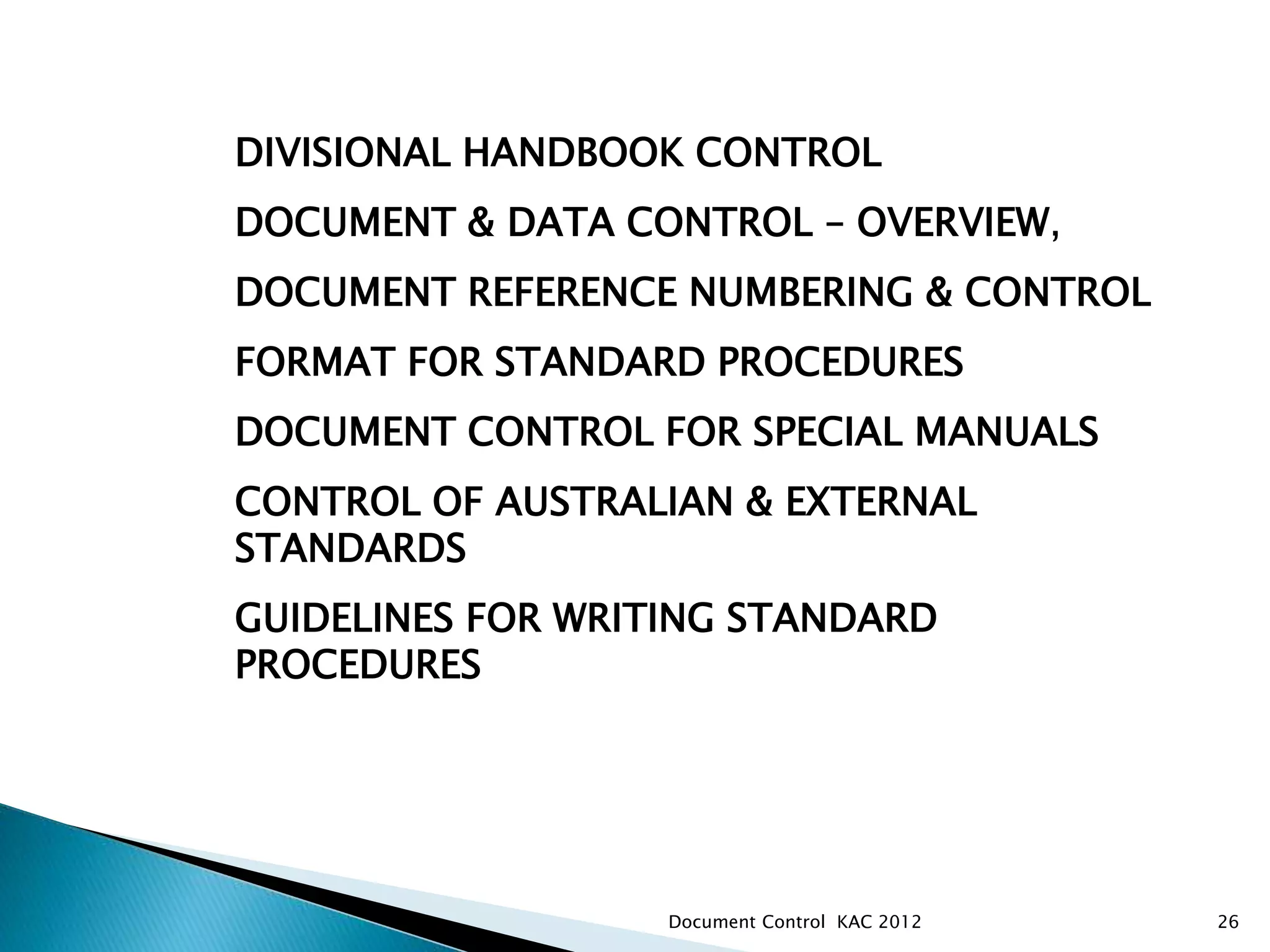
DIVISIONAL HANDBOOK CONTROL
DOCUMENT & DATA CONTROL – OVERVIEW,
DOCUMENT REFERENCE NUMBERING & CONTROL
FORMAT FOR STANDARD PROCEDURES
DOCUMENT CONTROL FOR SPECIAL MANUALS
CONTROL OF AUSTRALIAN & EXTERNAL
STANDARDS
GUIDELINES FOR WRITING STANDARD
PROCEDURES
ANZIM – PKSW DIVISIONAL DOCUMENT CONTROL
26
Document Control KAC 2012
Document Control KAC 2012 27
Document Control in non Manufacturing
eg IT – Health …
why we need it …. some examples
Document Control KAC 2012 28
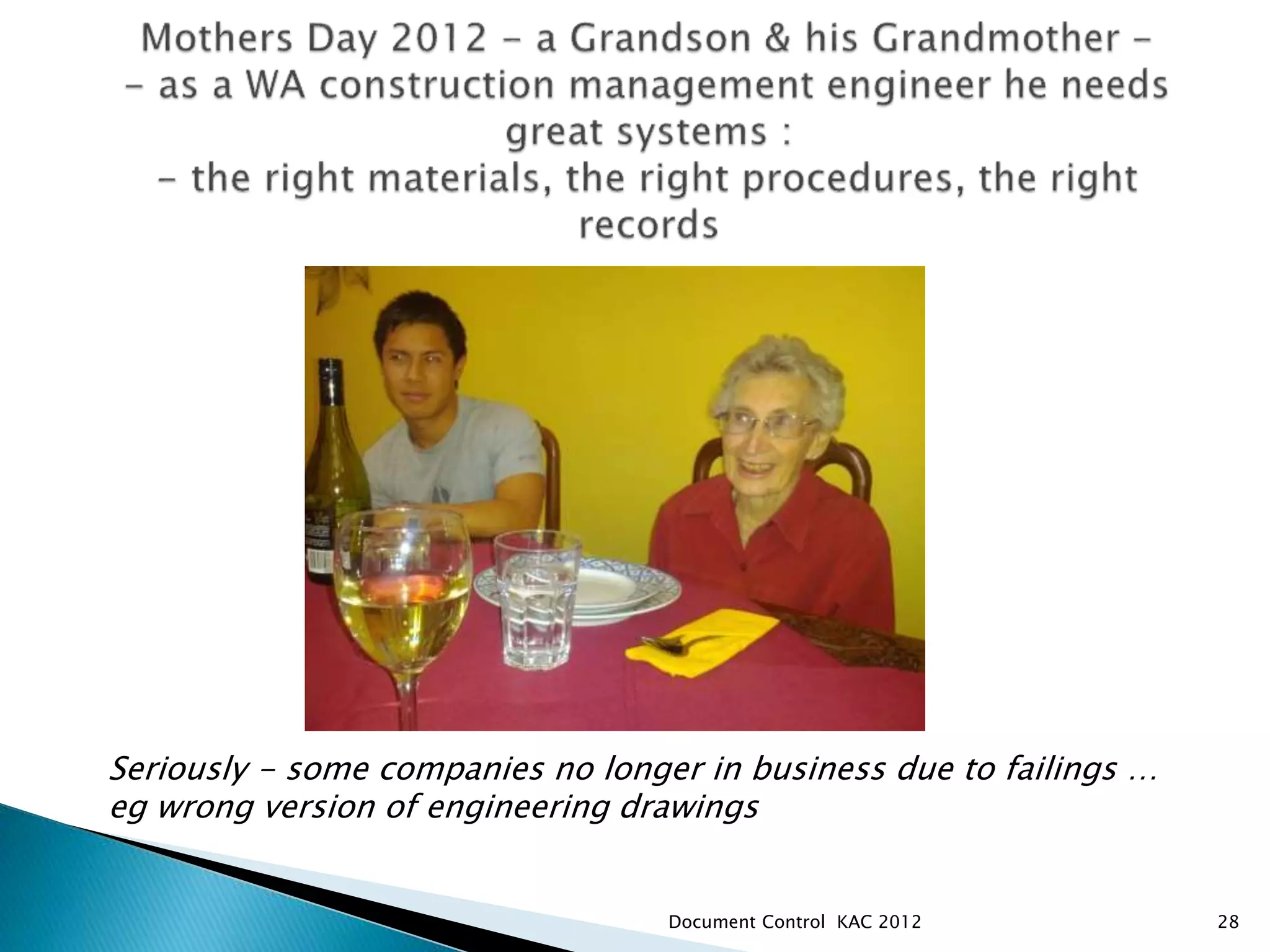
Seriously - some companies no longer in business due to failings …
eg wrong version of engineering drawings
Document Control KAC 2012 29
 We are under cost pressures – a major driver
 So cost issues mean that complicated Service
Level Agreements would create headaches for us
 We have our own IT rules that we follow
 Departments should use Workflow not
MS.Access DB’s
 Document control is just another user issue
 We need one system - for the controlled
document repository
 We don’t know detail of “the musts” for your
EGRCM QMS / EMS/ OHSMS / RMS – does it
matter ?
 Do you really need 24x7x52 systems ? For all of
the documents ? Which ones ?
 Do we need a user council or reference group ?
30
Document Control KAC 2012
 UOW College 2013 applications closing date –
◦ UOW College Web site – 2 pages said 11/01/2013
◦ But – when I rang Uniadvice Hotline this morning –
they said applications actually close on 9/01/2013
…. Oops !!
UOW IT now working on a fix …. Document control issue ?
Document Control KAC 2012 31
32
Document Control KAC 2012
33
QUESTIONS
Document Control KAC 2012
Document Control KAC 2012 34
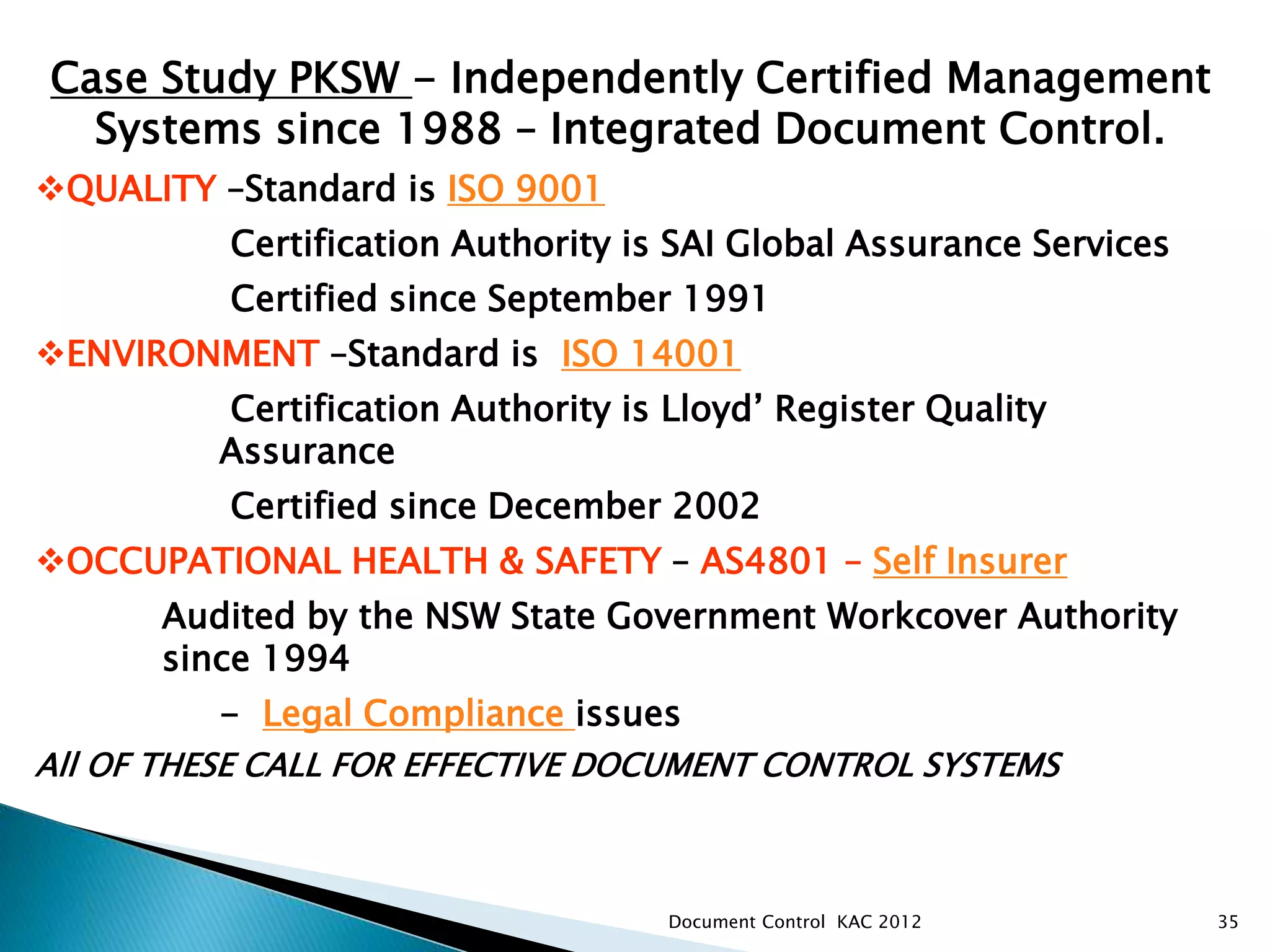
35
PKSW MANAGEMENT SYSTEMS &
CERTIFICATION
Case Study PKSW - Independently Certified Management
Systems since 1988 – Integrated Document Control.
QUALITY –Standard is ISO 9001
Certification Authority is SAI Global Assurance Services
Certified since September 1991
ENVIRONMENT –Standard is ISO 14001
Certification Authority is Lloyd’ Register Quality
Assurance
Certified since December 2002
OCCUPATIONAL HEALTH & SAFETY – AS4801 – Self Insurer
Audited by the NSW State Government Workcover Authority
since 1994
- Legal Compliance issues
All OF THESE CALL FOR EFFECTIVE DOCUMENT CONTROL SYSTEMS
Document Control KAC 2012
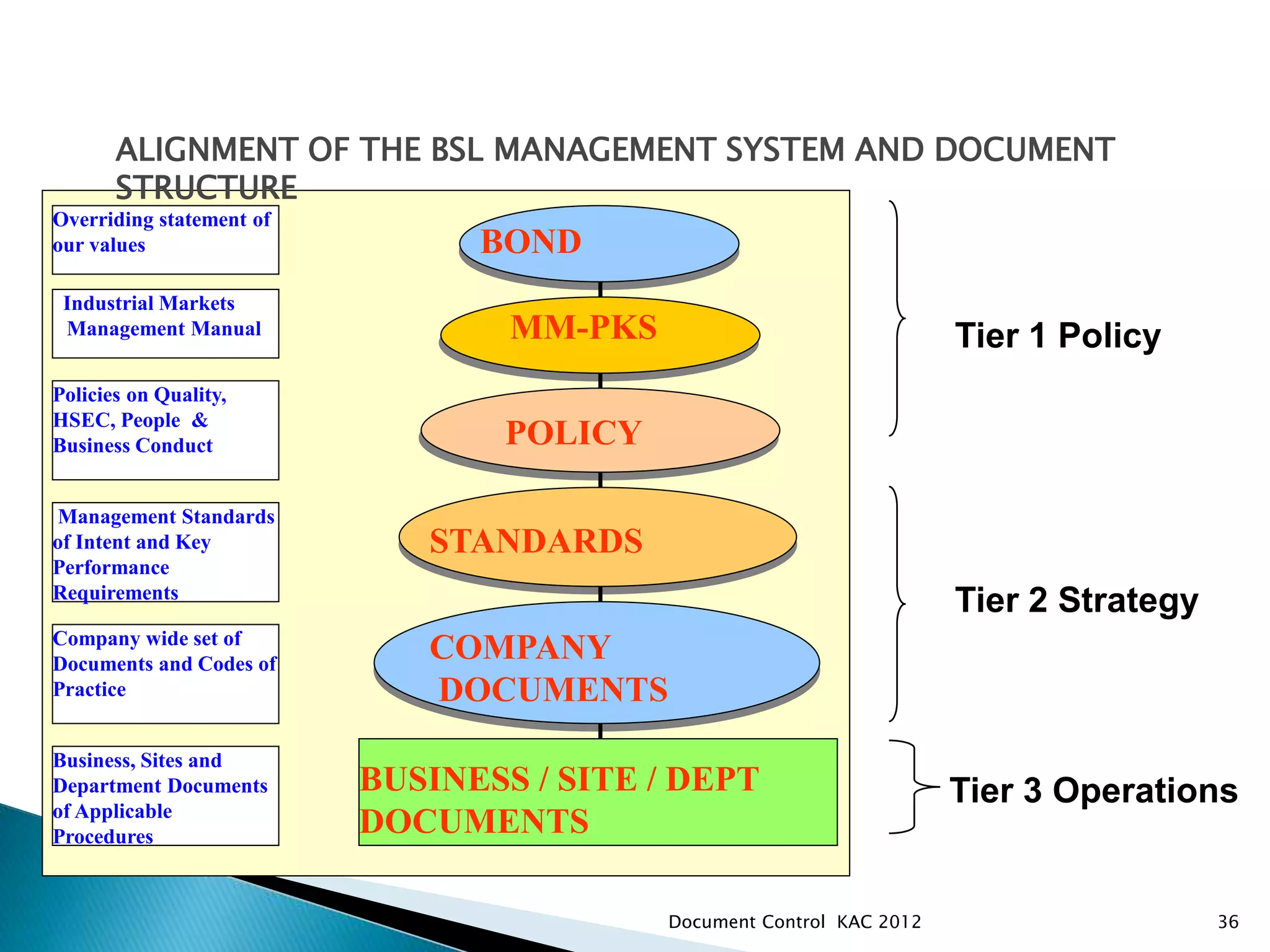
36
BOND
POLICY
MM-PKS
STANDARDS
COMPANY
DOCUMENTS
BUSINESS / SITE / DEPT
DOCUMENTS
Overriding statement of
our values
Policies on Quality,
HSEC, People &
Business Conduct
Industrial Markets
Management Manual
Management Standards
of Intent and Key
Performance
Requirements
Company wide set of
Documents and Codes of
Practice
Business, Sites and
Department Documents
of Applicable
Procedures
Tier 1 Policy
Tier 2 Strategy
Tier 3 Operations
ALIGNMENT OF THE BSL MANAGEMENT SYSTEM AND DOCUMENT
STRUCTURE
Document Control KAC 2012
DIVISIONAL HANDBOOK CONTROL
DOCUMENT & DATA CONTROL – OVERVIEW,
DOCUMENT REFERENCE NUMBERING & CONTROL
FORMAT FOR STANDARD PROCEDURES
DOCUMENT CONTROL FOR SPECIAL MANUALS
CONTROL OF AUSTRALIAN & EXTERNAL
STANDARDS
GUIDELINES FOR WRITING STANDARD
PROCEDURES
ANZIM – PKSW DIVISIONAL DOCUMENT CONTROL
37
Document Control KAC 2012
38
TIER 1 - POLICY DOCUMENTS
BLUESCOPE STEEL / INDUSTRIAL MARKETS - POLICIES AND
PROCEDURES
• BLUESCOPE Steel Bond
•IM – Management Manual – PKSW
• Quality Policy – Industrial Markets
• Health Safety, Environment & Community Policy
• Code of Business Conduct
Document Control KAC 2012
39
Tier 2 provides guidance and approaches for the
implementation of Tier 1 policies and requirements.
• Divisional Handbook
The ‘Handbook’ consists of detailed systems policies and
procedures prepared by functional discipline departments
for common application across the Site.
• Department Handbooks
These contain department specific policy and procedures
for application within their respective departments. Where
appropriate, they provide reference to other manuals, and
handbooks in tier 2 and to the documents contained in tier
3.
TIER 2 - STRATEGY DOCUMENTS
Document Control KAC 2012
40
TIER 3 - OPERATIONAL DOCUMENTS
Tier 3 contains the detailed information that is required to operate
and maintain processes and produce outputs. Some document
types included at this level are:
• Standard Procedures or Work Instructions, Forms, Data
Sheets & Charts
• Manuals
• Logistic Production Plans
• Orders and Schedules
• Product Specifications
• Customer Supplier Agreements
• User Manuals
• Equipment Specifications
• Drawings
Document Control KAC 2012
5.2.7 Master File
The department document control officer
shall maintain an indexed file of all
authorised controlled documents issued
under their control.
The list shall identify the current revision
status of documents and be readily
accessible to users to verify a document’s
status
41
Document Control KAC 2012
 Individual departments and sites shall have a written
procedure(s) for the control of the Controlled Documents that
they issue or use.
 This procedure(s) shall address the specific issues of:
◦ who shall be the department document control officer
◦ document control officer's responsibilities,register of types
of documents being controlled
◦ reference numbering
◦ document formats
◦ document authorisation
◦ document distribution (including identifying where
documents are needed)
◦ maintenance of a master file of controlled documents
◦ document review/revision
◦ identification of the nature of the revision ,
◦ removal and archival of obsolete documents ,
◦ disposal of documents archived for required period
42
Document Control KAC 2012
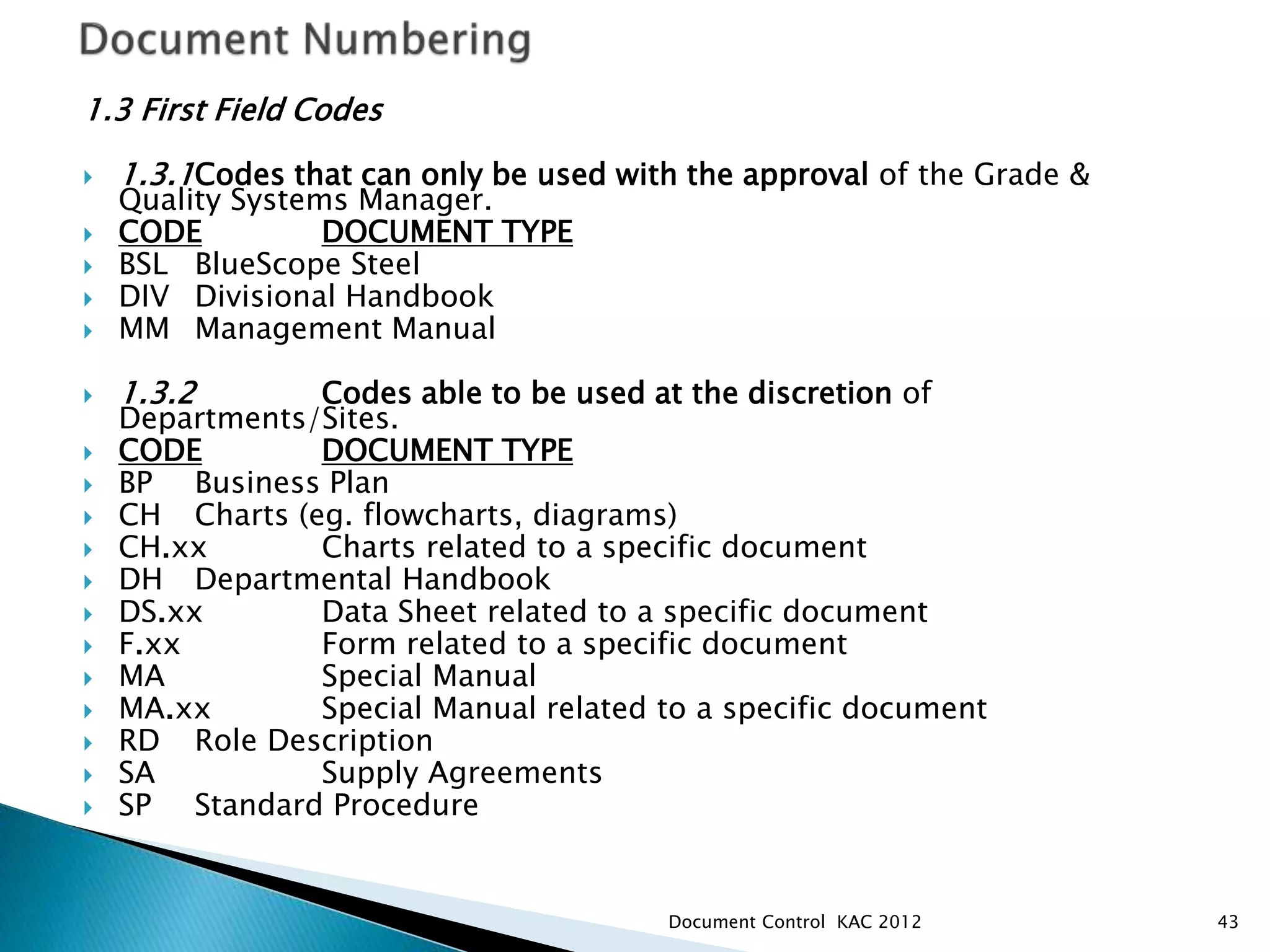
1.3 First Field Codes
 1.3.1Codes that can only be used with the approval of the Grade &
Quality Systems Manager.
 CODE DOCUMENT TYPE
 BSL BlueScope Steel
 DIV Divisional Handbook
 MM Management Manual
 1.3.2 Codes able to be used at the discretion of
Departments/Sites.
 CODE DOCUMENT TYPE
 BP Business Plan
 CH Charts (eg. flowcharts, diagrams)
 CH.xx Charts related to a specific document
 DH Departmental Handbook
 DS.xx Data Sheet related to a specific document
 F.xx Form related to a specific document
 MA Special Manual
 MA.xx Special Manual related to a specific document
 RD Role Description
 SA Supply Agreements
 SP Standard Procedure
43
Document Control KAC 2012
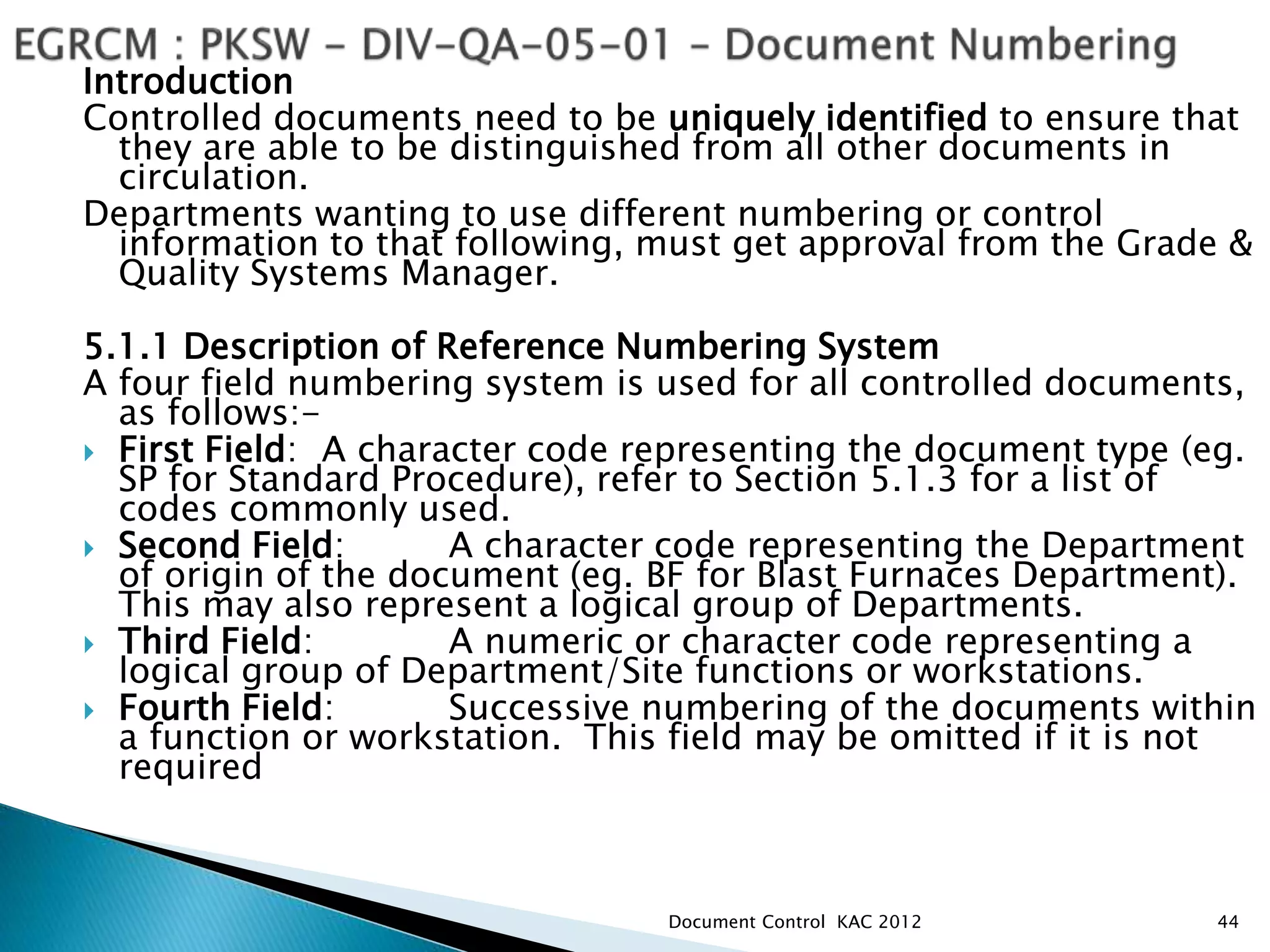
Introduction
Controlled documents need to be uniquely identified to ensure that
they are able to be distinguished from all other documents in
circulation.
Departments wanting to use different numbering or control
information to that following, must get approval from the Grade &
Quality Systems Manager.
5.1.1 Description of Reference Numbering System
A four field numbering system is used for all controlled documents,
as follows:-
 First Field: A character code representing the document type (eg.
SP for Standard Procedure), refer to Section 5.1.3 for a list of
codes commonly used.
 Second Field: A character code representing the Department
of origin of the document (eg. BF for Blast Furnaces Department).
This may also represent a logical group of Departments.
 Third Field: A numeric or character code representing a
logical group of Department/Site functions or workstations.
 Fourth Field: Successive numbering of the documents within
a function or workstation. This field may be omitted if it is not
required
44
Document Control KAC 2012
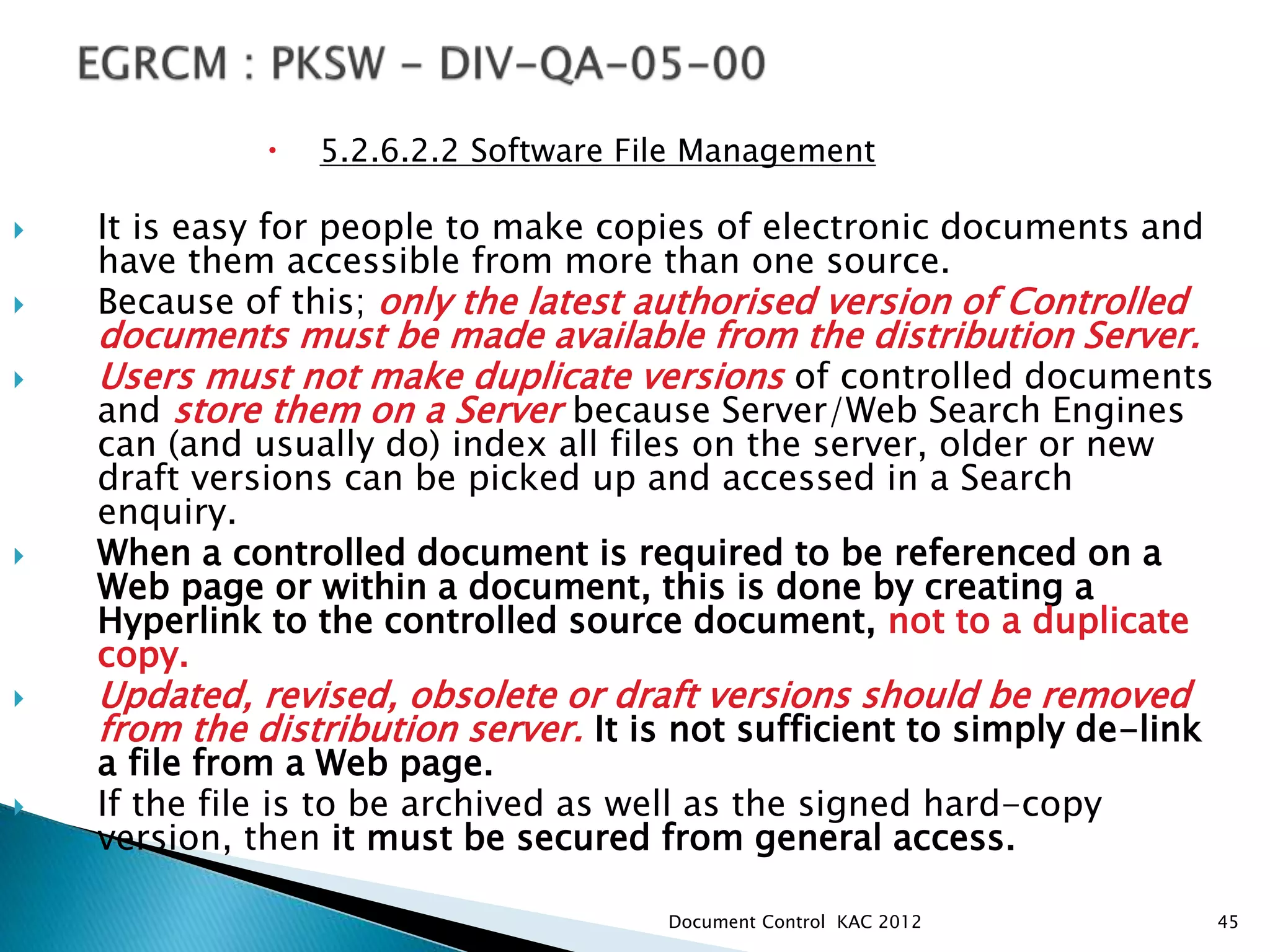
 5.2.6.2.2 Software File Management
 It is easy for people to make copies of electronic documents and
have them accessible from more than one source.
 Because of this; only the latest authorised version of Controlled
documents must be made available from the distribution Server.
 Users must not make duplicate versions of controlled documents
and store them on a Server because Server/Web Search Engines
can (and usually do) index all files on the server, older or new
draft versions can be picked up and accessed in a Search
enquiry.
 When a controlled document is required to be referenced on a
Web page or within a document, this is done by creating a
Hyperlink to the controlled source document, not to a duplicate
copy.
 Updated, revised, obsolete or draft versions should be removed
from the distribution server. It is not sufficient to simply de-link
a file from a Web page.
 If the file is to be archived as well as the signed hard-copy
version, then it must be secured from general access.
45
Document Control KAC 2012
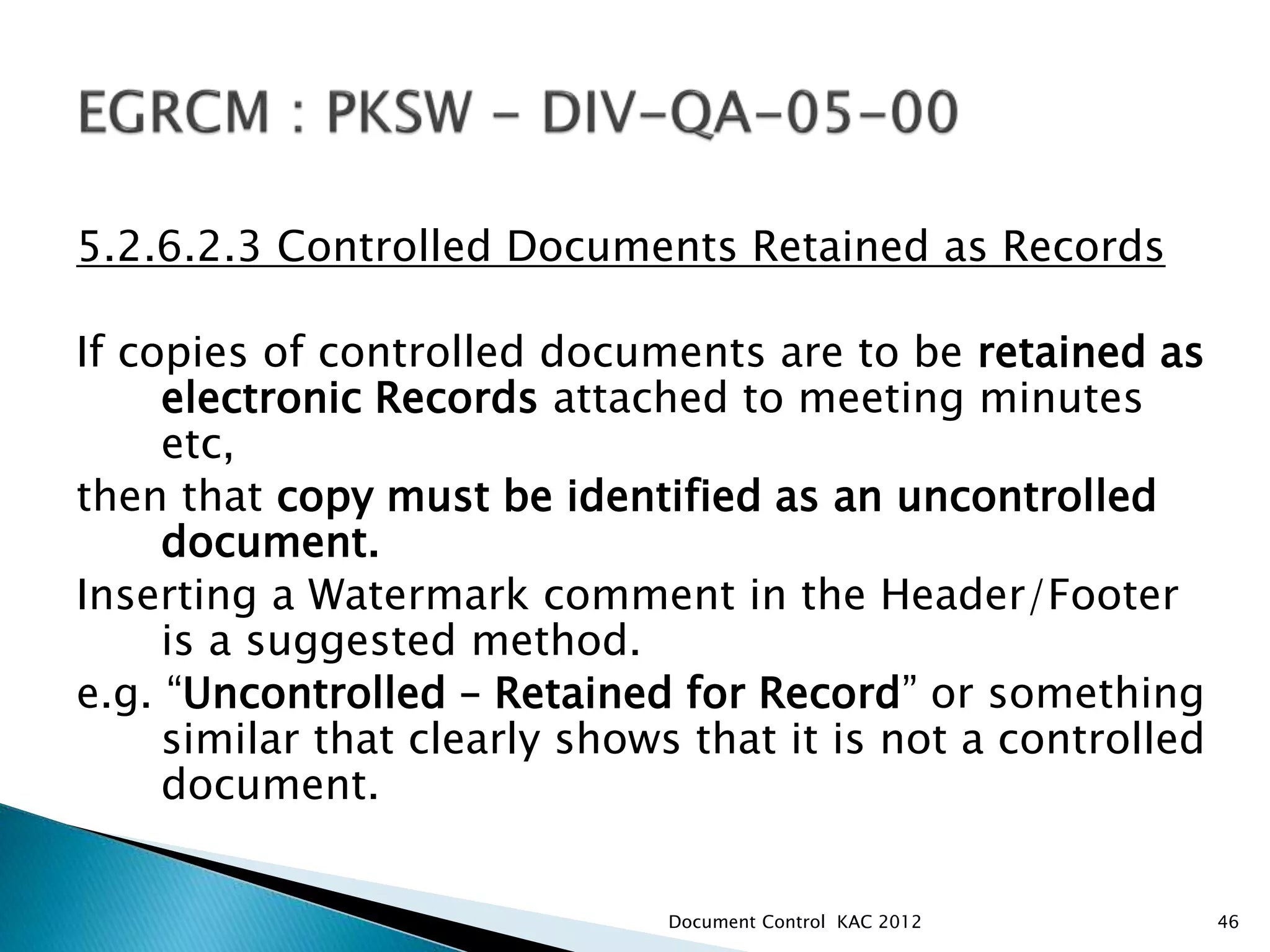
5.2.6.2.3 Controlled Documents Retained as Records
If copies of controlled documents are to be retained as
electronic Records attached to meeting minutes
etc,
then that copy must be identified as an uncontrolled
document.
Inserting a Watermark comment in the Header/Footer
is a suggested method.
e.g. “Uncontrolled – Retained for Record” or something
similar that clearly shows that it is not a controlled
document.
46
Document Control KAC 2012
 The ISO 9000 standards are quite explicit on one
point.
 Your organization must document what you do.
Why is that so important?
 A recent study by The Gartner Group revealed that
75% of all business information is in document
form.
 Today, more and more senior managers realize
that information is their most important asset.
 And how they manage that information - in the
form of documents - is critical to their success.
 For ISO 9000, documentation is the medium that
the communication about the quality of your
organization must take.
 And conversely, poor documentation systems is
one of the main reasons that companies fail.
47
Document Control KAC 2012
 Given the increased capacity to modify, update,
reformat and otherwise improve documents within an
electronic-based management system, auditors should
….
◦ pay particular attention to control elements such as
document identification and document revision level.
 As electronic media facilitates an increased rate of
document modifications, auditors should ….
◦ verify that the controls being employed for the
management of obsolete documents are considered
within the organizations’ document control policies
and procedures.
◦ “Point-of-use” requirements associated with the
applicable management system standards
48
Document Control KAC 2012
 Key factor - ability of auditors to understand the trends in IT as organizations
rely increasingly on software for monitoring and controlling their operations.
 Auditing Organizations should ensure provision of training, to address
◦ IT trends that may impact operation of management systems
◦ Specific considerations for each audit undertaken
◦ As the innovations in the IT sector are relatively rapid as compared to
changes in Audit Criteria, auditors and auditing organizations are
challenged with the need to have a practical understanding of the
associated trends & how they may be applicable & utilized within an
EBMS.
◦ In light of the innovations that influence the functioning of an EBMS,
Auditing Organizations should determine if the experience needed in order
to be effective for a given audit is possessed by the audit team itself or
whether the assistance of a technical expert would required.
49
Document Control KAC 2012
 Organizations need to employ suitable and effective
methods within the electronic environment for ensuring
the adequate review, approval, publication and
distribution of its management system documentation.
 These should be consistent with the methods for the
development and modification of electronic documents.
 In many cases these document control measures may
also be standard features of software applications used
for their creation.
 Therefore auditors should understand these
application-specific controls to the degree that these
are utilized as a basis for conformance to the applicable
management system standard.
 Auditors may conduct part or all of the document
review off-site; either on-line or by downloading
electronic documentation
50
Document Control KAC 2012
When Intranets, Email, and Instant Messaging are utilized
for satisfying the requirements of the EBMS, auditors
should verify
 that policies and procedures address the circumstances
under which these means would be employed.
◦ Additionally, if the results of internal electronic communication
are to be used to satisfy the audit criteria, then auditors should
verify that policies and procedures for the control of records
are being applied.
 that the methodology, policies and procedures for these
communications and associated transactions are
formally addressed within the EBMS.
◦ Eg specially when the organization relies on its IT
infrastructure for electronic communications with its
customers (e.g. for e-commerce), suppliers (e-procurement),
external sites and other interested parties
51
Document Control KAC 2012
 an organization's system maintenance policies and
procedures for its IT platform.
 how the organization addresses system downtime
incidents, as these will impact the normal functioning
of the EBMS.
 whether or not the organization has formal backup
systems, and whether or not these are periodically
reviewed and tested for adequacy.
 if the organization’s controls take into account
aspects such as facility maintenance, temperature,
humidity, etc, to the extent that these bear upon the
operation of the EBMS.
52
Document Control KAC 2012
 the different networking means employed by the
organization to the extent that it is necessary for
ascertaining if the EBMS meets with the audit criteria
 whether the controls over a multi-site management
system are appropriately addressed and established
within the organization's policies and procedures.
Note
◦ Organizations that operate through multiple sites (or from a
central location to satellite sites) usually maintain
communications and share policies, procedures and process
data with their various locations via electronic means, such as
the internet, extranets, e-mail and instant messaging.
 when the IT platform and its associated software
applications are used to share information that is
pertinent to the Audit Criteria
53
Document Control KAC 2012
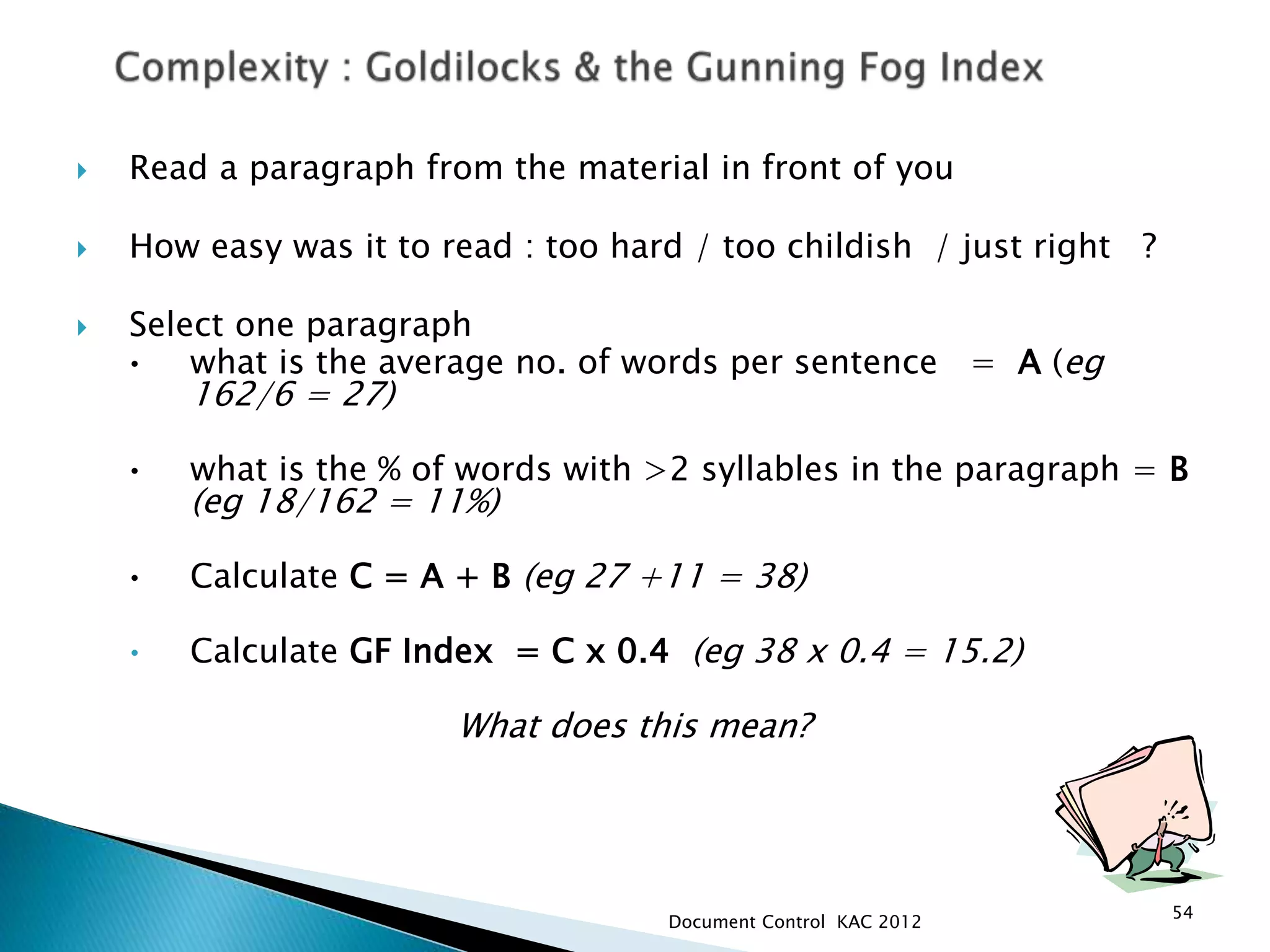
 Read a paragraph from the material in front of you
 How easy was it to read : too hard / too childish / just right ?
 Select one paragraph
• what is the average no. of words per sentence = A (eg
162/6 = 27)
• what is the % of words with >2 syllables in the paragraph = B
(eg 18/162 = 11%)
• Calculate C = A + B (eg 27 +11 = 38)
• Calculate GF Index = C x 0.4 (eg 38 x 0.4 = 15.2)
What does this mean?
54
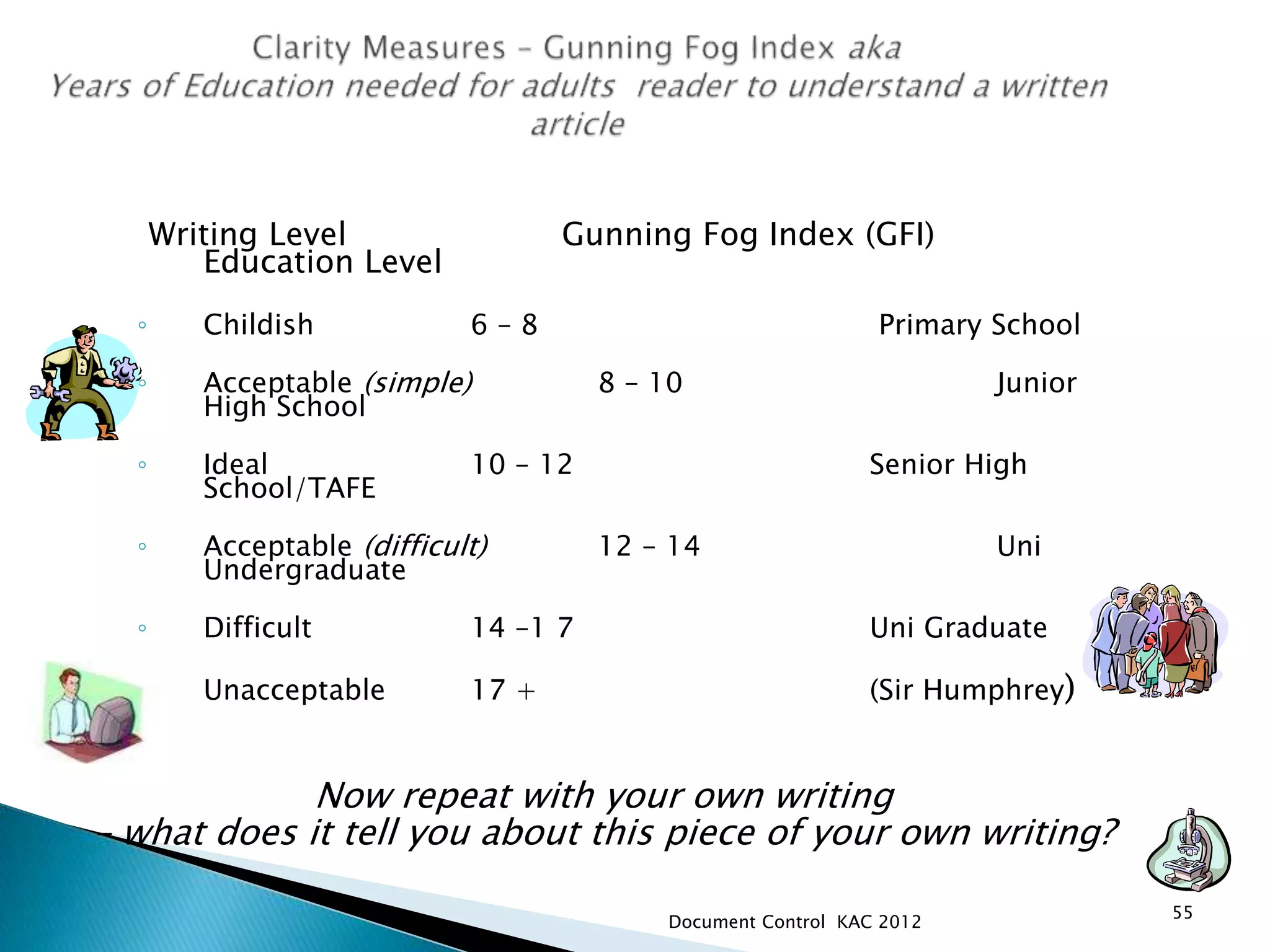
Document Control KAC 2012
Writing Level Gunning Fog Index (GFI)
Education Level
◦ Childish 6 – 8 Primary School
◦ Acceptable (simple) 8 – 10 Junior
High School
◦ Ideal 10 – 12 Senior High
School/TAFE
◦ Acceptable (difficult) 12 – 14 Uni
Undergraduate
◦ Difficult 14 –1 7 Uni Graduate
◦ Unacceptable 17 + (Sir Humphrey)
Now repeat with your own writing
– what does it tell you about this piece of your own writing?
55
Document Control KAC 2012
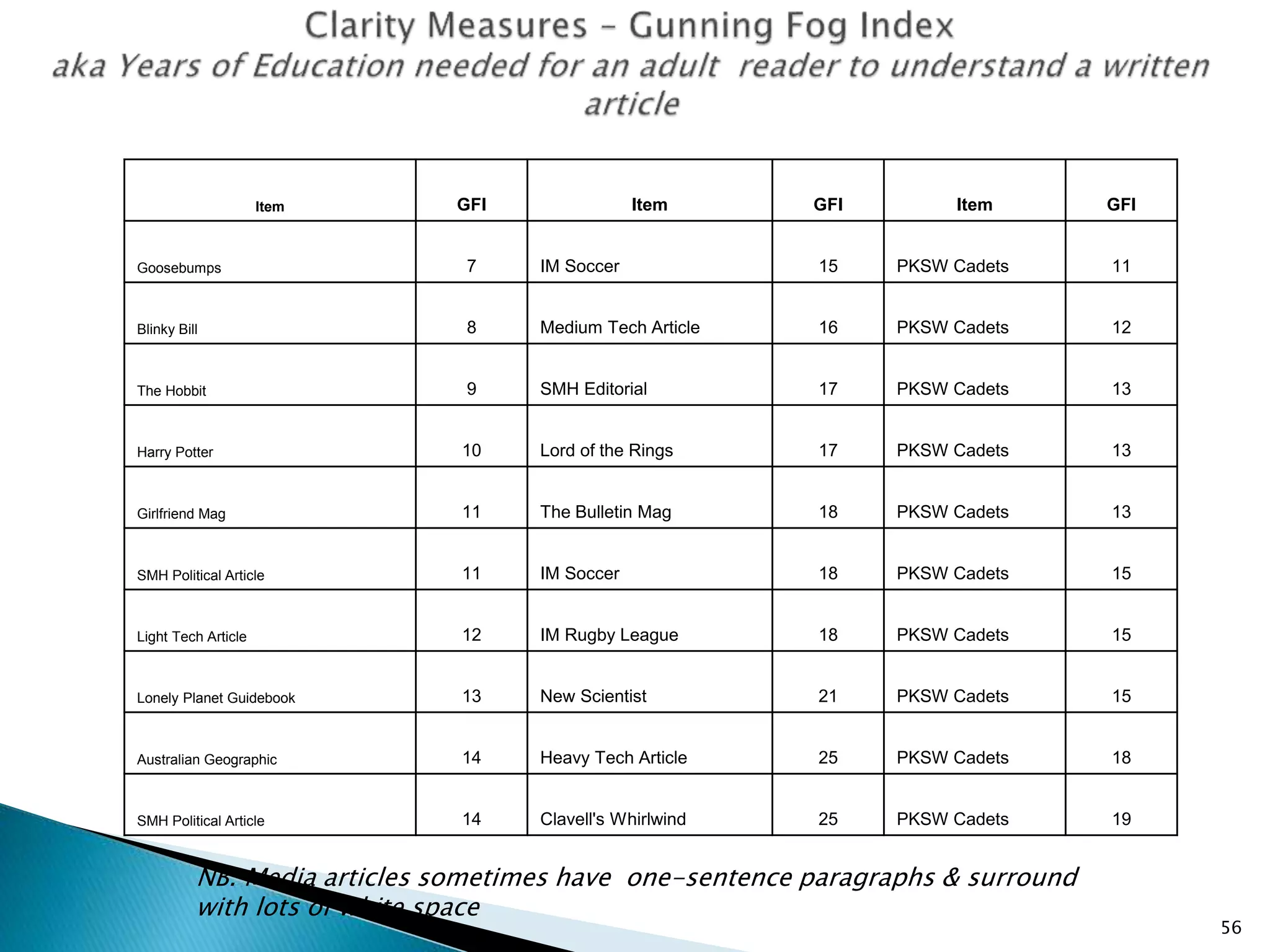
Item GFI Item GFI Item GFI
Goosebumps 7 IM Soccer 15 PKSW Cadets 11
Blinky Bill 8 Medium Tech Article 16 PKSW Cadets 12
The Hobbit 9 SMH Editorial 17 PKSW Cadets 13
Harry Potter 10 Lord of the Rings 17 PKSW Cadets 13
Girlfriend Mag 11 The Bulletin Mag 18 PKSW Cadets 13
SMH Political Article 11 IM Soccer 18 PKSW Cadets 15
Light Tech Article 12 IM Rugby League 18 PKSW Cadets 15
Lonely Planet Guidebook 13 New Scientist 21 PKSW Cadets 15
Australian Geographic 14 Heavy Tech Article 25 PKSW Cadets 18
SMH Political Article 14 Clavell's Whirlwind 25 PKSW Cadets 19
56
NB. Media articles sometimes have one-sentence paragraphs & surround
with lots of white space

Document Control for UOW Biz Studies Sept 2012

  • 1.
    Kerrie Anne Christian UOW- 2012 1 Document Control KAC 2012
  • 2.
    2 •DOCUMENT CONTROL SYSTEMS- OVERVIEW •TYPICAL SYSTEM STRUCTURES – •DOCUMENT SYSTEM - CONTROLS IN PLACE • DIVISIONAL • DEPARTMENT •PROCEDURES FOR DOCUMENT CONTROL Document Control KAC 2012
  • 3.
    3 A well controlledenvironment – like a tidy garage Not - a potentially good tool if only we really understood it ? Not - a belt & braces approach to “head off” system failure ? The “useful box” of possibly useful stuff must not live in the same “electronic cabinet area” as controlled documents Document Control KAC 2012
  • 4.
     Hard CopyFiles - traditional  PC Databases eg Access  Document Management Systems eg SAP, Sharepoint, Documentum or Wikis  If use “workflow” - must not become a “black box”  Needs to be accessible by those who need to use it  Doesn’t have to stymie innovation & change  Overload risk ? No need for new version, if document checked but not changed – just make sure it’s clear doc has been reviewed  Does EBMS affect auditing style ? 4 Document Control KAC 2012
  • 5.
    5 THE DOCUMENT CONTROLSYSTEM IS PART OF AN INTEGRATED MANAGEMENT SYSTEM COVERING ALL KEY ACTIVITIES INCLUDING:  manufacture of products;  provision of support services;  occupational health and safety;  environmental management;  technical safety; and  access control. And remember : it’s not just ticking the boxes ... its because you need to satisfy your customer and / or regulator Document Control KAC 2012
  • 6.
     Who createdit?  Who signed off on it?  Who changed it?  When was it issued – changed ?  Is everyone working with the same version of the information?  Missing or inaccurate documentation ?  Where do I find it ?  How many copies of a document can/should I find ?  What’s controlled and what’s not?  How do I stop unauthorised copies on the EBMS? 6 Document Control KAC 2012
  • 7.
    7 Certification is abusiness decision Certification is a decision to be taken for business reasons: • if it is a contractual, regulatory, or market requirement, •Quality, OHS, Environment, Food, IT, Risk • If it meets customer preferences • It is part of a risk management programme, or • If it will motivate staff by setting a clear goal. MANAGEMENT SYSTEMS & CERTIFICATION Document Control KAC 2012
  • 8.
    A combination ofsome or all of the following criteria are considered when selecting a supplier:  Reputation and past performance of supplier/producer  Quality of product supplied previously  ISO 9001Certification of supplier/producer  Ability to meet required material, chemical, size and packaging specifications  Ability to meet required shipment and/or arrival times  Ability to negotiate mutually acceptable payment terms  Offer price and validity  Delivery and contract terms and conditions  Market price and short/medium term market expectations  Local market conditions  Domestic and international prices  Stock levels and usage forecasts 8 ISO 9001 –Why do Certification ? Customers’ Supplier Evaluation Perspectives Document Control KAC 2012
  • 9.
    2.1 Criminal offence It is, in some instances, unlawful to prematurely destroy documents.  For example, the Crimes (Document Destruction) Act 2006 (Vic) makes it an offence for a person to knowingly destroy or conceal a document or render a document illegible, undecipherable or incapable of identification that is, or is likely to be required in evidence in legal proceedings. Anyone who commits an act with the intention of preventing a document from being used in evidence in a legal proceeding may be guilty of an indictable offence and may be liable to imprisonment, a fine or both.  An adverse inference may be drawn by a judge if documents which were in the possession of a party to the proceedings are not available or have been destroyed.  If an employee of the Group contravenes the Crimes (Document Destruction) Act 2006 (Vic), proceedings may also be commenced against the Group. In such a proceeding, it is a defence to the charge for the company to prove that it exercised due diligence to prevent the contravention by the employee. One of the factors that the court may consider when assessing whether there has been a contravention is whether the Group had a corporate culture that directed, encourage, tolerated or lead to the destruction of documents. 9 Document Control KAC 2012
  • 10.
    10 DOCUMENT CONTROL SYSTEMSIN PLACE • There is a Divisional Document Control Officer who is responsible for site level documents and provides alignment of document control systems – what happens during annual leave periods ? • Each department has a nominated Document Control Officer who is responsible for department level documents. • Each DCO has documents that defines how they maintain their specific document control processes. These are consistent with the requirements outlined in a Divisional procedure. Document Control KAC 2012
  • 11.
    11 Legible Dated ( withrevision dates) Identifiable by Number and or Title Maintained in Hard and or Electronic copy Locatable by users Periodically reviewed & revised as required Current approved versions available Obsolete documents removed from users Archival documents retained for defined periods Changes are recorded and communicated to users Master document lists are maintained Document Control procedures in all areas ensure that docume Document Control KAC 2012
  • 12.
    Removal and Archivalof Obsolete Documents All departments/sites shall document a system for the control of obsolete documents. This shall include the removal of such documents from circulation and the maintenance of archived copies. 12 Document Control KAC 2012
  • 13.
    We need ISO9001 to sell products / services & it specifies a Management Representative ie  Top management shall appoint a member of management who, irrespective of other responsibilities, shall have  responsibility and authority that includes ◦ a) ensuring that processes needed for the quality management system are established, implemented and maintained, ◦ b) reporting to top management on the performance of the quality management system and any need for improvement, and ◦ c) ensuring the promotion of awareness of customer requirements throughout the organization.  Can the Management Representative be confident of .. ie ◦ all documents uniquely numbered / identified & conform with rules ◦ prevent unintended use of obsolete documents ◦ control distribution of controlled documents  what if 100’s of unauthorised copies exist ? ◦ ensure continuity of management system availability 24x7x52 ◦ addressing problems in Departments which lie outside the ISO 9001 certification system – due to their lack of awareness ◦ Maintain awareness of the rules & IT competency of DCOs’ & Auditors 13 Document Control KAC 2012
  • 14.
    14 • Document ControlOfficer's responsibilities defined, • A Register of types of documents being controlled is kept, • Document Reference Numbering systems are defined to maintain unique identity, • Document Formats are defined, • Authorities for Document Authorisation is defined, • Document Ownership is maintained, • Document Distribution systems are defined and maintained, • A Master File of Controlled Documents is maintained in dept. databases, • Document Reviews and Revisions are controlled and updated, • The nature of Changes to document is indicated in Revisions, • Systems for the Removal, Archival and Disposal of Obsolete Documents are maintained. Departments Define their Document Control Requirements Document Control KAC 2012
  • 15.
     4.2.3 Controlof documents  Documents required by the quality management system shall be controlled.  Records are a special type of document and shall be controlled according to the requirements given in 4.2.4.  A documented procedure shall be established to define the controls needed ◦ a) to approve documents for adequacy prior to issue, ◦ b) to review and update as necessary and re-approve documents, ◦ c) to ensure that changes and the current revision status of documents are identified, ◦ d) to ensure that relevant versions of applicable documents are available at points of use, ◦ e) to ensure that documents remain legible and readily identifiable, ◦ f) to ensure that documents of external origin are identified and their distribution controlled, and ◦ g) to prevent the unintended use of obsolete documents, and to apply suitable identification to them if they are retained for any purpose 15 Document Control KAC 2012
  • 16.
    Documentation is atthe core of ISO 9000 conformance. In fact, the standards have been described as this: "Say what you do… Do what you say... Write it down… …. at the end of the day.“ 16 Document Control KAC 2012
  • 17.
     4.4.5 Controlof documents  Documents required by the environmental management system and by this International Standard shall be controlled. Records are a special type of document and shall be controlled in accordance with the requirements given in 4.5.4.  The organization shall establish, implement and maintain a procedure(s) to  a) approve documents for adequacy prior to issue,  b) review and update as necessary and re-approve documents,  c) ensure that changes and the current revision status of documents are identified,  d) ensure that relevant versions of applicable documents are available at points of use,  e) ensure that documents remain legible and readily identifiable,  f) ensure that documents of external origin determined by the organization to be necessary for the planning and operation of the environmental management system are identified and their distribution controlled, and  g) prevent the unintended use of obsolete documents and apply suitable identification to them if they are retained for any purpose. 17 Document Control KAC 2012
  • 18.
     4.4.5 Documentand data control  The organization shall establish, implement and maintain procedures for controlling all relevant documents and data required by this Standard to ensure that—  (a) they can be readily located;  (b) they are periodically reviewed, revised as necessary and approved for adequacy by competent and responsible personnel;  (c) current versions of relevant documents and data are available at all locations where operations essential to the effective functioning of the OHSMS are performed;  (d) obsolete documents and data are promptly removed from all points of issue and points of use or otherwise assured against unintended use; and  (e) archival documents and data retained for legal or knowledge preservation purposes or both, are suitably identified.  Documentation and data shall be legible, dated (with dates of revision) and readily identifiable and be maintained in an orderly manner for a specified period. Procedures and responsibilities shall be established and maintained concerning the creation and modification of the various types of documents and data.  The organization shall preclude the use of obsolete documents. 18 Document Control KAC 2012
  • 19.
    7.1 Systems shallbe implemented and maintained to identify OH&S documents requiring control. 7.2 A hierarchy and structure shall exist such that OH&S documents: • are uniquely identified • provide direction to related documents. 7.3 Systems shall be implemented and maintained to create, review, approve and issue OH&S documents, in accordance with defined responsibilities and BlueScope Steel formatting. 7.4 Systems shall be implemented and maintained to ensure that at point of use: • OH&S documents are easily accessible • the current version is effectively implemented • obsolete OH&S documents are removed. 7.5 Documented procedures shall exist to ensure control of workplace activities directly impacting on OH&S. 7.6 Systems shall exist to identify and maintain relevant OH&S records with consideration of their need to be: • protected from loss and deterioration • easily accessible and retrieved • traceable to the activity, product or service • confidential • retained for specified periods and disposed of appropriately. 19 Document Control KAC 2012
  • 20.
     We needone best document control system  Departments should not have poorly defined document numbering & control systems – if not - must be fixed  We need each Department to have a cabinet in Document Control System that is structured and only has controlled documents  There must be a limit on who can store controlled documents in Document Control System for each Department  We want the Site Divisional procedures in main IT Document Management repository  A Council to guide Document Control ? 20 Document Control KAC 2012
  • 21.
    21 Verification of DocumentControl Systems • Audits of both Department and Divisional Document Control Systems shall be conducted routinely & systematically • in accordance with documented procedures, by independent auditors. Document Control KAC 2012
  • 22.
  • 23.
     Controlled documentslive in their own structured space – not a “Useful Box” – want DIV-QA –xx-xx rules obeyed  EBMS file names are always the same as their document number  Documents in a controlled document space only have file names compliant with divisional numbering system  Able to verify if documents are controlled master document or linked document or an unauthorised copy  DCO’s able to set separate permissions for linking or copying of documents  DCO’s able to set permissions at the folder level – eg obsolete docs  DCO’s have Digital document approval  Only the current revision of a document can be seen  Obsolete documents cannot be accessed at all by anyone except DCO & review team – not even by link or search  IT ensure Service Level Agreements for system outages/backups 23 Document Control KAC 2012
  • 24.
    24 PKSW MANAGEMENT SYSTEMS& CERTIFICATION Case Study PKSW - Independently Certified Management Systems since 1988 – Integrated Document Control. QUALITY –Standard is ISO 9001 Certification Authority is SAI Global Assurance Services Certified since September 1991 ENVIRONMENT –Standard is ISO 14001 Certification Authority is Lloyd’ Register Quality Assurance Certified since December 2002 OCCUPATIONAL HEALTH & SAFETY – AS4801 – Self Insurer Audited by the NSW State Government Workcover Authority since 1994 - Legal Compliance issues All OF THESE CALL FOR EFFECTIVE DOCUMENT CONTROL SYSTEMS Document Control KAC 2012
  • 25.
    25 BOND POLICY MM-PKS STANDARDS COMPANY DOCUMENTS BUSINESS / SITE/ DEPT DOCUMENTS Overriding statement of our values Policies on Quality, HSEC, People & Business Conduct Industrial Markets Management Manual Management Standards of Intent and Key Performance Requirements Company wide set of Documents and Codes of Practice Business, Sites and Department Documents of Applicable Procedures Tier 1 Policy Tier 2 Strategy Tier 3 Operations ALIGNMENT OF THE BSL MANAGEMENT SYSTEM AND DOCUMENT STRUCTURE Document Control KAC 2012
  • 26.
    DIVISIONAL HANDBOOK CONTROL DOCUMENT& DATA CONTROL – OVERVIEW, DOCUMENT REFERENCE NUMBERING & CONTROL FORMAT FOR STANDARD PROCEDURES DOCUMENT CONTROL FOR SPECIAL MANUALS CONTROL OF AUSTRALIAN & EXTERNAL STANDARDS GUIDELINES FOR WRITING STANDARD PROCEDURES ANZIM – PKSW DIVISIONAL DOCUMENT CONTROL 26 Document Control KAC 2012
  • 27.
    Document Control KAC2012 27 Document Control in non Manufacturing eg IT – Health … why we need it …. some examples
  • 28.
    Document Control KAC2012 28 Seriously - some companies no longer in business due to failings … eg wrong version of engineering drawings
  • 29.
  • 30.
     We areunder cost pressures – a major driver  So cost issues mean that complicated Service Level Agreements would create headaches for us  We have our own IT rules that we follow  Departments should use Workflow not MS.Access DB’s  Document control is just another user issue  We need one system - for the controlled document repository  We don’t know detail of “the musts” for your EGRCM QMS / EMS/ OHSMS / RMS – does it matter ?  Do you really need 24x7x52 systems ? For all of the documents ? Which ones ?  Do we need a user council or reference group ? 30 Document Control KAC 2012
  • 31.
     UOW College2013 applications closing date – ◦ UOW College Web site – 2 pages said 11/01/2013 ◦ But – when I rang Uniadvice Hotline this morning – they said applications actually close on 9/01/2013 …. Oops !! UOW IT now working on a fix …. Document control issue ? Document Control KAC 2012 31
  • 32.
  • 33.
  • 34.
  • 35.
    35 PKSW MANAGEMENT SYSTEMS& CERTIFICATION Case Study PKSW - Independently Certified Management Systems since 1988 – Integrated Document Control. QUALITY –Standard is ISO 9001 Certification Authority is SAI Global Assurance Services Certified since September 1991 ENVIRONMENT –Standard is ISO 14001 Certification Authority is Lloyd’ Register Quality Assurance Certified since December 2002 OCCUPATIONAL HEALTH & SAFETY – AS4801 – Self Insurer Audited by the NSW State Government Workcover Authority since 1994 - Legal Compliance issues All OF THESE CALL FOR EFFECTIVE DOCUMENT CONTROL SYSTEMS Document Control KAC 2012
  • 36.
    36 BOND POLICY MM-PKS STANDARDS COMPANY DOCUMENTS BUSINESS / SITE/ DEPT DOCUMENTS Overriding statement of our values Policies on Quality, HSEC, People & Business Conduct Industrial Markets Management Manual Management Standards of Intent and Key Performance Requirements Company wide set of Documents and Codes of Practice Business, Sites and Department Documents of Applicable Procedures Tier 1 Policy Tier 2 Strategy Tier 3 Operations ALIGNMENT OF THE BSL MANAGEMENT SYSTEM AND DOCUMENT STRUCTURE Document Control KAC 2012
  • 37.
    DIVISIONAL HANDBOOK CONTROL DOCUMENT& DATA CONTROL – OVERVIEW, DOCUMENT REFERENCE NUMBERING & CONTROL FORMAT FOR STANDARD PROCEDURES DOCUMENT CONTROL FOR SPECIAL MANUALS CONTROL OF AUSTRALIAN & EXTERNAL STANDARDS GUIDELINES FOR WRITING STANDARD PROCEDURES ANZIM – PKSW DIVISIONAL DOCUMENT CONTROL 37 Document Control KAC 2012
  • 38.
    38 TIER 1 -POLICY DOCUMENTS BLUESCOPE STEEL / INDUSTRIAL MARKETS - POLICIES AND PROCEDURES • BLUESCOPE Steel Bond •IM – Management Manual – PKSW • Quality Policy – Industrial Markets • Health Safety, Environment & Community Policy • Code of Business Conduct Document Control KAC 2012
  • 39.
    39 Tier 2 providesguidance and approaches for the implementation of Tier 1 policies and requirements. • Divisional Handbook The ‘Handbook’ consists of detailed systems policies and procedures prepared by functional discipline departments for common application across the Site. • Department Handbooks These contain department specific policy and procedures for application within their respective departments. Where appropriate, they provide reference to other manuals, and handbooks in tier 2 and to the documents contained in tier 3. TIER 2 - STRATEGY DOCUMENTS Document Control KAC 2012
  • 40.
    40 TIER 3 -OPERATIONAL DOCUMENTS Tier 3 contains the detailed information that is required to operate and maintain processes and produce outputs. Some document types included at this level are: • Standard Procedures or Work Instructions, Forms, Data Sheets & Charts • Manuals • Logistic Production Plans • Orders and Schedules • Product Specifications • Customer Supplier Agreements • User Manuals • Equipment Specifications • Drawings Document Control KAC 2012
  • 41.
    5.2.7 Master File Thedepartment document control officer shall maintain an indexed file of all authorised controlled documents issued under their control. The list shall identify the current revision status of documents and be readily accessible to users to verify a document’s status 41 Document Control KAC 2012
  • 42.
     Individual departmentsand sites shall have a written procedure(s) for the control of the Controlled Documents that they issue or use.  This procedure(s) shall address the specific issues of: ◦ who shall be the department document control officer ◦ document control officer's responsibilities,register of types of documents being controlled ◦ reference numbering ◦ document formats ◦ document authorisation ◦ document distribution (including identifying where documents are needed) ◦ maintenance of a master file of controlled documents ◦ document review/revision ◦ identification of the nature of the revision , ◦ removal and archival of obsolete documents , ◦ disposal of documents archived for required period 42 Document Control KAC 2012
  • 43.
    1.3 First FieldCodes  1.3.1Codes that can only be used with the approval of the Grade & Quality Systems Manager.  CODE DOCUMENT TYPE  BSL BlueScope Steel  DIV Divisional Handbook  MM Management Manual  1.3.2 Codes able to be used at the discretion of Departments/Sites.  CODE DOCUMENT TYPE  BP Business Plan  CH Charts (eg. flowcharts, diagrams)  CH.xx Charts related to a specific document  DH Departmental Handbook  DS.xx Data Sheet related to a specific document  F.xx Form related to a specific document  MA Special Manual  MA.xx Special Manual related to a specific document  RD Role Description  SA Supply Agreements  SP Standard Procedure 43 Document Control KAC 2012
  • 44.
    Introduction Controlled documents needto be uniquely identified to ensure that they are able to be distinguished from all other documents in circulation. Departments wanting to use different numbering or control information to that following, must get approval from the Grade & Quality Systems Manager. 5.1.1 Description of Reference Numbering System A four field numbering system is used for all controlled documents, as follows:-  First Field: A character code representing the document type (eg. SP for Standard Procedure), refer to Section 5.1.3 for a list of codes commonly used.  Second Field: A character code representing the Department of origin of the document (eg. BF for Blast Furnaces Department). This may also represent a logical group of Departments.  Third Field: A numeric or character code representing a logical group of Department/Site functions or workstations.  Fourth Field: Successive numbering of the documents within a function or workstation. This field may be omitted if it is not required 44 Document Control KAC 2012
  • 45.
     5.2.6.2.2 SoftwareFile Management  It is easy for people to make copies of electronic documents and have them accessible from more than one source.  Because of this; only the latest authorised version of Controlled documents must be made available from the distribution Server.  Users must not make duplicate versions of controlled documents and store them on a Server because Server/Web Search Engines can (and usually do) index all files on the server, older or new draft versions can be picked up and accessed in a Search enquiry.  When a controlled document is required to be referenced on a Web page or within a document, this is done by creating a Hyperlink to the controlled source document, not to a duplicate copy.  Updated, revised, obsolete or draft versions should be removed from the distribution server. It is not sufficient to simply de-link a file from a Web page.  If the file is to be archived as well as the signed hard-copy version, then it must be secured from general access. 45 Document Control KAC 2012
  • 46.
    5.2.6.2.3 Controlled DocumentsRetained as Records If copies of controlled documents are to be retained as electronic Records attached to meeting minutes etc, then that copy must be identified as an uncontrolled document. Inserting a Watermark comment in the Header/Footer is a suggested method. e.g. “Uncontrolled – Retained for Record” or something similar that clearly shows that it is not a controlled document. 46 Document Control KAC 2012
  • 47.
     The ISO9000 standards are quite explicit on one point.  Your organization must document what you do. Why is that so important?  A recent study by The Gartner Group revealed that 75% of all business information is in document form.  Today, more and more senior managers realize that information is their most important asset.  And how they manage that information - in the form of documents - is critical to their success.  For ISO 9000, documentation is the medium that the communication about the quality of your organization must take.  And conversely, poor documentation systems is one of the main reasons that companies fail. 47 Document Control KAC 2012
  • 48.
     Given theincreased capacity to modify, update, reformat and otherwise improve documents within an electronic-based management system, auditors should …. ◦ pay particular attention to control elements such as document identification and document revision level.  As electronic media facilitates an increased rate of document modifications, auditors should …. ◦ verify that the controls being employed for the management of obsolete documents are considered within the organizations’ document control policies and procedures. ◦ “Point-of-use” requirements associated with the applicable management system standards 48 Document Control KAC 2012
  • 49.
     Key factor- ability of auditors to understand the trends in IT as organizations rely increasingly on software for monitoring and controlling their operations.  Auditing Organizations should ensure provision of training, to address ◦ IT trends that may impact operation of management systems ◦ Specific considerations for each audit undertaken ◦ As the innovations in the IT sector are relatively rapid as compared to changes in Audit Criteria, auditors and auditing organizations are challenged with the need to have a practical understanding of the associated trends & how they may be applicable & utilized within an EBMS. ◦ In light of the innovations that influence the functioning of an EBMS, Auditing Organizations should determine if the experience needed in order to be effective for a given audit is possessed by the audit team itself or whether the assistance of a technical expert would required. 49 Document Control KAC 2012
  • 50.
     Organizations needto employ suitable and effective methods within the electronic environment for ensuring the adequate review, approval, publication and distribution of its management system documentation.  These should be consistent with the methods for the development and modification of electronic documents.  In many cases these document control measures may also be standard features of software applications used for their creation.  Therefore auditors should understand these application-specific controls to the degree that these are utilized as a basis for conformance to the applicable management system standard.  Auditors may conduct part or all of the document review off-site; either on-line or by downloading electronic documentation 50 Document Control KAC 2012
  • 51.
    When Intranets, Email,and Instant Messaging are utilized for satisfying the requirements of the EBMS, auditors should verify  that policies and procedures address the circumstances under which these means would be employed. ◦ Additionally, if the results of internal electronic communication are to be used to satisfy the audit criteria, then auditors should verify that policies and procedures for the control of records are being applied.  that the methodology, policies and procedures for these communications and associated transactions are formally addressed within the EBMS. ◦ Eg specially when the organization relies on its IT infrastructure for electronic communications with its customers (e.g. for e-commerce), suppliers (e-procurement), external sites and other interested parties 51 Document Control KAC 2012
  • 52.
     an organization'ssystem maintenance policies and procedures for its IT platform.  how the organization addresses system downtime incidents, as these will impact the normal functioning of the EBMS.  whether or not the organization has formal backup systems, and whether or not these are periodically reviewed and tested for adequacy.  if the organization’s controls take into account aspects such as facility maintenance, temperature, humidity, etc, to the extent that these bear upon the operation of the EBMS. 52 Document Control KAC 2012
  • 53.
     the differentnetworking means employed by the organization to the extent that it is necessary for ascertaining if the EBMS meets with the audit criteria  whether the controls over a multi-site management system are appropriately addressed and established within the organization's policies and procedures. Note ◦ Organizations that operate through multiple sites (or from a central location to satellite sites) usually maintain communications and share policies, procedures and process data with their various locations via electronic means, such as the internet, extranets, e-mail and instant messaging.  when the IT platform and its associated software applications are used to share information that is pertinent to the Audit Criteria 53 Document Control KAC 2012
  • 54.
     Read aparagraph from the material in front of you  How easy was it to read : too hard / too childish / just right ?  Select one paragraph • what is the average no. of words per sentence = A (eg 162/6 = 27) • what is the % of words with >2 syllables in the paragraph = B (eg 18/162 = 11%) • Calculate C = A + B (eg 27 +11 = 38) • Calculate GF Index = C x 0.4 (eg 38 x 0.4 = 15.2) What does this mean? 54 Document Control KAC 2012
  • 55.
    Writing Level GunningFog Index (GFI) Education Level ◦ Childish 6 – 8 Primary School ◦ Acceptable (simple) 8 – 10 Junior High School ◦ Ideal 10 – 12 Senior High School/TAFE ◦ Acceptable (difficult) 12 – 14 Uni Undergraduate ◦ Difficult 14 –1 7 Uni Graduate ◦ Unacceptable 17 + (Sir Humphrey) Now repeat with your own writing – what does it tell you about this piece of your own writing? 55 Document Control KAC 2012
  • 56.
    Item GFI ItemGFI Item GFI Goosebumps 7 IM Soccer 15 PKSW Cadets 11 Blinky Bill 8 Medium Tech Article 16 PKSW Cadets 12 The Hobbit 9 SMH Editorial 17 PKSW Cadets 13 Harry Potter 10 Lord of the Rings 17 PKSW Cadets 13 Girlfriend Mag 11 The Bulletin Mag 18 PKSW Cadets 13 SMH Political Article 11 IM Soccer 18 PKSW Cadets 15 Light Tech Article 12 IM Rugby League 18 PKSW Cadets 15 Lonely Planet Guidebook 13 New Scientist 21 PKSW Cadets 15 Australian Geographic 14 Heavy Tech Article 25 PKSW Cadets 18 SMH Political Article 14 Clavell's Whirlwind 25 PKSW Cadets 19 56 NB. Media articles sometimes have one-sentence paragraphs & surround with lots of white space