Dr. Haji Bahadar
Assistant Professor, KMU-IPMS
Introduction
 What are xenobiotics?
We inhale air containg hydrocorbons chemicals (both
good and bad), and drugs (both good and bad). These
substances are called xenobiotics. Examples;
Environmental pollutants, Agrochemicals etc.
 Once inside the body, they are transported to the liver,
where enzymes start the process of breaking them down
and finally disposed of.
 Def;:a chemical compound (as a drug, pesticide, or carcinogen) that is
foreign to a living organism.
Definition of biotransformation
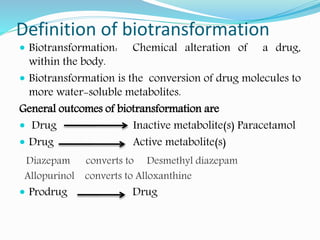
 Biotransformation: Chemical alteration of a drug,
within the body.
 Biotransformation is the conversion of drug molecules to
more water-soluble metabolites.
General outcomes of biotransformation are
 Drug Inactive metabolite(s) Paracetamol
 Drug Active metabolite(s)
Diazepam converts to Desmethyl diazepam
Allopurinol converts to Alloxanthine
 Prodrug Drug
Prodrug???
A prodrug means a compound that, after
administration, is metabolized (i.e., converted within
the body) into a pharmacologically active drug.
Example: Levodopa is converted to the active dopamine
by DOPA decarboxylase
Enalapril is bioactivated by esterase to the active
enalaprilat
The sites of biotransformation
 Predominantly, the liver
 Biotransformation is a major mechanism for drug
elimination from the body
 During metabolism metabolites that are more polar
than the parent drug are produced.
 Metabolism usually terminates the pharmacologic
action of the parent drug .
Note:
The kidneys cannot efficiently excrete highly fat-
soluble drugs that readily cross cell membranes
because they are reabsorbed in the last stages of
filtration. These compounds must first be
metabolized in the liver to more water-soluble
compounds and then removed.
Biotransformation Classification
 There are two broad types of biotransformation, called
phase I and phase II reactions.
1. Phase I reactions: In phase I reactions
modification of the drug molecule occurs via
oxidation, reduction, or hydrolysis.
Oxidation: addition of oxygen or removal of
hydrogen.
RNH2 O RNHOH
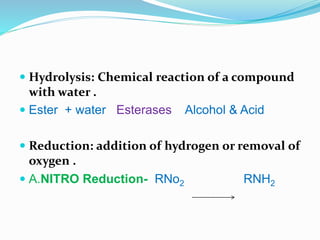
 Hydrolysis: Chemical reaction of a compound
with water .
 Ester + water Esterases Alcohol & Acid
 Reduction: addition of hydrogen or removal of
oxygen .
 A.NITRO Reduction- RNo2 RNH2
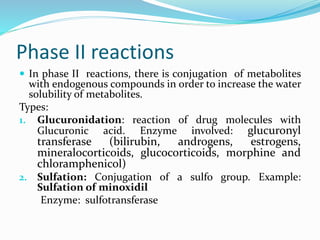
Phase II reactions
 In phase II reactions, there is conjugation of metabolites
with endogenous compounds in order to increase the water
solubility of metabolites.
Types:
1. Glucuronidation: reaction of drug molecules with
Glucuronic acid. Enzyme involved: glucuronyl
transferase (bilirubin, androgens, estrogens,
mineralocorticoids, glucocorticoids, morphine and
chloramphenicol)
2. Sulfation: Conjugation of a sulfo group. Example:
Sulfation of minoxidil
Enzyme: sulfotransferase
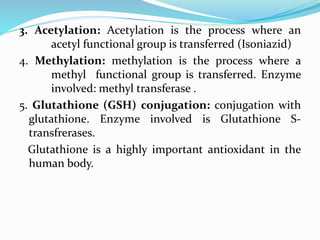
3. Acetylation: Acetylation is the process where an
acetyl functional group is transferred (Isoniazid)
4. Methylation: methylation is the process where a
methyl functional group is transferred. Enzyme
involved: methyl transferase .
5. Glutathione (GSH) conjugation: conjugation with
glutathione. Enzyme involved is Glutathione S-
transfrerases.
Glutathione is a highly important antioxidant in the
human body.
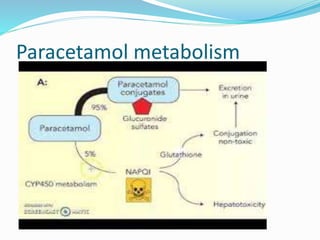
Paracetamol metabolism
Advantages of biotransformation
 Termination of drug action - (↓ Toxicity)
 Reduced lipophilicity.
 Renal / biliary excretion ↑ - (↓Renal
reabsorption)
ELIMINATION
 Removal of the drug from the body is called
elimination. The major modes of drug elimination are:
● Biotransformation to inactive metabolites
● Excretion via the kidney

4. drug metabolism

  • 1.
    Dr. Haji Bahadar AssistantProfessor, KMU-IPMS
  • 2.
    Introduction  What arexenobiotics? We inhale air containg hydrocorbons chemicals (both good and bad), and drugs (both good and bad). These substances are called xenobiotics. Examples; Environmental pollutants, Agrochemicals etc.  Once inside the body, they are transported to the liver, where enzymes start the process of breaking them down and finally disposed of.  Def;:a chemical compound (as a drug, pesticide, or carcinogen) that is foreign to a living organism.
  • 3.
    Definition of biotransformation Biotransformation: Chemical alteration of a drug, within the body.  Biotransformation is the conversion of drug molecules to more water-soluble metabolites. General outcomes of biotransformation are  Drug Inactive metabolite(s) Paracetamol  Drug Active metabolite(s) Diazepam converts to Desmethyl diazepam Allopurinol converts to Alloxanthine  Prodrug Drug
  • 4.
    Prodrug??? A prodrug meansa compound that, after administration, is metabolized (i.e., converted within the body) into a pharmacologically active drug. Example: Levodopa is converted to the active dopamine by DOPA decarboxylase Enalapril is bioactivated by esterase to the active enalaprilat
  • 5.
    The sites ofbiotransformation  Predominantly, the liver
  • 6.
     Biotransformation isa major mechanism for drug elimination from the body  During metabolism metabolites that are more polar than the parent drug are produced.  Metabolism usually terminates the pharmacologic action of the parent drug . Note: The kidneys cannot efficiently excrete highly fat- soluble drugs that readily cross cell membranes because they are reabsorbed in the last stages of filtration. These compounds must first be metabolized in the liver to more water-soluble compounds and then removed.
  • 7.
    Biotransformation Classification  Thereare two broad types of biotransformation, called phase I and phase II reactions. 1. Phase I reactions: In phase I reactions modification of the drug molecule occurs via oxidation, reduction, or hydrolysis. Oxidation: addition of oxygen or removal of hydrogen. RNH2 O RNHOH
  • 8.
     Hydrolysis: Chemicalreaction of a compound with water .  Ester + water Esterases Alcohol & Acid  Reduction: addition of hydrogen or removal of oxygen .  A.NITRO Reduction- RNo2 RNH2
  • 9.
    Phase II reactions In phase II reactions, there is conjugation of metabolites with endogenous compounds in order to increase the water solubility of metabolites. Types: 1. Glucuronidation: reaction of drug molecules with Glucuronic acid. Enzyme involved: glucuronyl transferase (bilirubin, androgens, estrogens, mineralocorticoids, glucocorticoids, morphine and chloramphenicol) 2. Sulfation: Conjugation of a sulfo group. Example: Sulfation of minoxidil Enzyme: sulfotransferase
  • 10.
    3. Acetylation: Acetylationis the process where an acetyl functional group is transferred (Isoniazid) 4. Methylation: methylation is the process where a methyl functional group is transferred. Enzyme involved: methyl transferase . 5. Glutathione (GSH) conjugation: conjugation with glutathione. Enzyme involved is Glutathione S- transfrerases. Glutathione is a highly important antioxidant in the human body.
  • 11.
  • 12.
    Advantages of biotransformation Termination of drug action - (↓ Toxicity)  Reduced lipophilicity.  Renal / biliary excretion ↑ - (↓Renal reabsorption)
  • 13.
    ELIMINATION  Removal ofthe drug from the body is called elimination. The major modes of drug elimination are: ● Biotransformation to inactive metabolites ● Excretion via the kidney