Presented By: Group 4 | Section C
Amitabh Gautam (13P123)
Asmita Sinha (13P133)
Shreyas Desai (13P138)
Pranjal Goel (13P156)
Armaan Sarkar (13P174)
Devasheesh Mathur (13FRM91)
CSR Presentation on:
“The Path to Corporate Responsibility”
Executive Summary
• CSR is not an overnight activity but a tangible and continued learning process
• 2 types of learning: a) Organizational Learning b) Societal Learning
• There are 5 stages of Organizational Learning
- Defensive Stage
- Compliant Stage
- Managerial Stage
- Strategic Stage
- Civil Stage
• Societal learning characterized by 4 stages of issue maturity
- Latent
- Emerging
- Consolidating
- Institutionalized
• The Civil Learning Tool tells us that we need to move towards the higher
opportunity green zone while avoiding the risky red zone
• Nike, the leader in the apparel industry showed us how to apply the stages of
organizational learning to help grow their business in the long-term
CSR: Overnight Activity or Continued Learning?
“Companies don’t become model citizens overnight. Nike’s metamorphosis from
the poster child for irresponsibility to a leader in progressive practices reveals
the five stages of organizational growth”
The CSR Learning Curve
Implication for the present
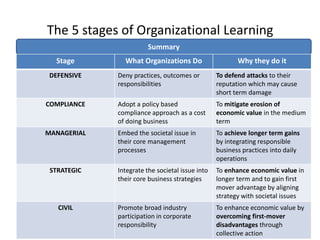
The 5 stages of Organizational Learning
Summary
Stage What Organizations Do Why they do it
DEFENSIVE Deny practices, outcomes or
responsibilities
To defend attacks to their
reputation which may cause
short term damage
COMPLIANCE Adopt a policy based
compliance approach as a cost
of doing business
To mitigate erosion of
economic value in the medium
term
MANAGERIAL Embed the societal issue in
their core management
processes
To achieve longer term gains
by integrating responsible
business practices into daily
operations
STRATEGIC Integrate the societal issue into
their core business strategies
To enhance economic value in
longer term and to gain first
mover advantage by aligning
strategy with societal issues
CIVIL Promote broad industry
participation in corporate
responsibility
To enhance economic value by
overcoming first-mover
disadvantages through
collective action
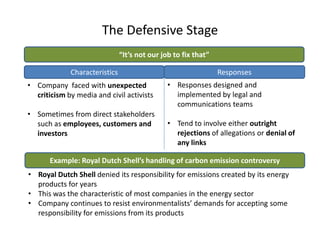
The Defensive Stage
Example: Royal Dutch Shell’s handling of carbon emission controversy
“It’s not our job to fix that”
Characteristics Responses
• Company faced with unexpected
criticism by media and civil activists
• Sometimes from direct stakeholders
such as employees, customers and
investors
• Responses designed and
implemented by legal and
communications teams
• Tend to involve either outright
rejections of allegations or denial of
any links
• Royal Dutch Shell denied its responsibility for emissions created by its energy
products for years
• This was the characteristic of most companies in the energy sector
• Company continues to resist environmentalists’ demands for accepting some
responsibility for emissions from its products
The Compliance Stage
“We’ll do just as much as we have to”
Characteristics Implications
• Corporate policy must be established
and observed
• Usually done in ways such that it can
be made visible to the critics of the
company
• Creates value by protecting the
company’s reputation and reducing
the risk of litigation
• Aim is to just be compliant while
stakeholders need a far greater
commitment from the company
• Activists blamed Nestle for its infant food formula as mother’s in developing
countries would end up mixing powder with contaminated water
• Nestle’s response for many years was to shift its marketing policies to make this
hazard known to new mothers
• Instead, they could have educated them generally about ways to ensure their
babies’ overall nutrition
Example: Nestle and the other food companies
The Managerial Stage
Example: Nike and the apparel industry
“It’s the business, stupid”
Characteristics Solutions
• Realization by company that it’s
facing a long term problem
• Cannot be swatted away with
attempts at compliance or a public
relations strategy
• Need to empower managers more
• Managers need to be identified
according to their core business
responsibilities and solutions given
to them
• Nike and the other players in the apparel and footwear industry were faced with
charges of bad labour standards
• They understood that they needed to change for being compliant in agreed-
upon standards in global supply chains
• Needed to change procurement incentives, forecasting sales methods and
inventory management methods
The Strategic Stage
“It gives us a competitive edge”
Characteristics Implications
• Realization that to go ahead in the
industry, radical changes are required
• Rather than setting targets, entire
strategies need to be realigned
towards CSR
• Need to address and promote
responsible business practices
• Can give the company a leg up on the
competition and contribute to it’s
long-term success
• Automobile companies know that their future depends on their ability to
develop environmentally safer forms of mobility
• Food companies struggling to develop a different consciousness about how
products after their consumers’ health
• Pharma companies exploring how to integrate health maintenance into their
business models while treating illnesses
Example: The Automobile Industry, The Food Industry
The Civil Stage
“We need to make sure everybody does it”
Characteristics Implications
• Companies promote collective action
to address society’s concerns
• Sometimes could be linked directly
to their strategy and helping create a
good name among stakeholders not
just for the present but the future
• Promotes an overall attitude towards
CSR in the industry
• Can even guard against any
allegations by being the first mover in
that respect
• Diageo and other alcohol companies promote responsible drinking to drive the
whole sector towards such practices so that restrictive legislation doesn’t cause
their downfall
• Energy companies supporting the UK’s Extractive Industries Transparency
Initiative, which urges governments to report their aggregate revenues they
derive from resource extraction
Example: Alcohol Companies, Energy Companies
Societal Learning
The Four Stages of Issue Maturity
Stage
Pharma company Novo Nordisk created a scale to measure the maturity of societal
issues and public’s expectations around those issues. Can be used by companies
facing societal issues
Characteristics
Latent • Activists aware of the societal issue
• Weak scientific or other hard evidence
• Issue largely ignored by business community
Emerging • Political and media awareness of societal issue
• Emerging body of research, but data still weak
• Businesses experiment with approaches to deal with issues
Consolidating • Emerging body of business practices present around issue
• Sectorwide and issue-based voluntary initiatives established
• Increasing view of need for legislation
• Voluntary standards are developed, collective action occurs
Institutionalized • Legislation or business norms are established
• Embedded practices become a normal part of a business- excellence
model
Examples of Societal Learning
• Companies need to be able to predict and credibly respond to society’s
changing awareness of particular issues
• For eg: The belief that pharma companies should sell life saving drugs to
the poor at reduced prices, since the company can afford to do so
• Once leading companies adopt certain commitments, laggards must
follow suit or risk consequences
- Levi Strauss publicly launched its “terms of engagement” in 1991 which
defined labour standards for Levi’s business partners
- Body Shop adopted human rights policies in the mid 1990s, making most
companies deeming its practices unfeasible
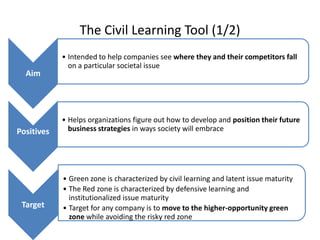
The Civil Learning Tool (1/2)
Aim
• Intended to help companies see where they and their competitors fall
on a particular societal issue
Positives
• Helps organizations figure out how to develop and position their future
business strategies in ways society will embrace
Target
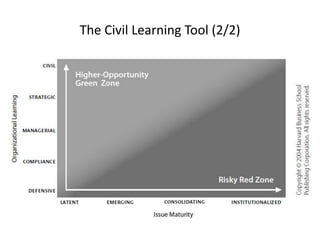
• Green zone is characterized by civil learning and latent issue maturity
• The Red zone is characterized by defensive learning and
institutionalized issue maturity
• Target for any company is to move to the higher-opportunity green
zone while avoiding the risky red zone
The Civil Learning Tool (2/2)
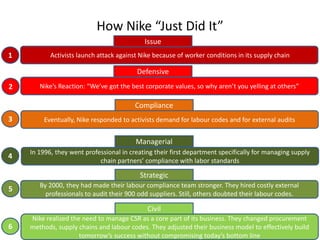
How Nike “Just Did It”
Activists launch attack against Nike because of worker conditions in its supply chain1
Nike’s Reaction: “We’ve got the best corporate values, so why aren’t you yelling at others”2
By 2000, they had made their labour compliance team stronger. They hired costly external
professionals to audit their 900 odd suppliers. Still, others doubted their labour codes.
5
Nike realized the need to manage CSR as a core part of its business. They changed procurement
methods, supply chains and labour codes. They adjusted their business model to effectively build
tomorrow’s success without compromising today’s bottom line
6
Civil
Strategic
Eventually, Nike responded to activists demand for labour codes and for external audits3
In 1996, they went professional in creating their first department specifically for managing supply
chain partners’ compliance with labor standards
4
Managerial
Compliance
Defensive
Issue
Implications for Businesses Today
• The talked-up benefits of corporate responsibility are, at best, hard-
won and in the short term are non existent
• Easier for companies to focus on the low hanging fruit of employee
morale or being defensive when accusations arise
• Need to make business logic out of a deeper sense of CSR
• Industries need to move towards lean manufacturing – shifting
away from top-down approach to greater worker self management
• Will help in delivering greater productivity and better worker
conditions and happier stakeholders over time
4 civil learning tool

4 civil learning tool

  • 1.
    Presented By: Group4 | Section C Amitabh Gautam (13P123) Asmita Sinha (13P133) Shreyas Desai (13P138) Pranjal Goel (13P156) Armaan Sarkar (13P174) Devasheesh Mathur (13FRM91) CSR Presentation on: “The Path to Corporate Responsibility”
  • 2.
    Executive Summary • CSRis not an overnight activity but a tangible and continued learning process • 2 types of learning: a) Organizational Learning b) Societal Learning • There are 5 stages of Organizational Learning - Defensive Stage - Compliant Stage - Managerial Stage - Strategic Stage - Civil Stage • Societal learning characterized by 4 stages of issue maturity - Latent - Emerging - Consolidating - Institutionalized • The Civil Learning Tool tells us that we need to move towards the higher opportunity green zone while avoiding the risky red zone • Nike, the leader in the apparel industry showed us how to apply the stages of organizational learning to help grow their business in the long-term
  • 3.
    CSR: Overnight Activityor Continued Learning? “Companies don’t become model citizens overnight. Nike’s metamorphosis from the poster child for irresponsibility to a leader in progressive practices reveals the five stages of organizational growth” The CSR Learning Curve Implication for the present
  • 4.
    The 5 stagesof Organizational Learning Summary Stage What Organizations Do Why they do it DEFENSIVE Deny practices, outcomes or responsibilities To defend attacks to their reputation which may cause short term damage COMPLIANCE Adopt a policy based compliance approach as a cost of doing business To mitigate erosion of economic value in the medium term MANAGERIAL Embed the societal issue in their core management processes To achieve longer term gains by integrating responsible business practices into daily operations STRATEGIC Integrate the societal issue into their core business strategies To enhance economic value in longer term and to gain first mover advantage by aligning strategy with societal issues CIVIL Promote broad industry participation in corporate responsibility To enhance economic value by overcoming first-mover disadvantages through collective action
  • 5.
    The Defensive Stage Example:Royal Dutch Shell’s handling of carbon emission controversy “It’s not our job to fix that” Characteristics Responses • Company faced with unexpected criticism by media and civil activists • Sometimes from direct stakeholders such as employees, customers and investors • Responses designed and implemented by legal and communications teams • Tend to involve either outright rejections of allegations or denial of any links • Royal Dutch Shell denied its responsibility for emissions created by its energy products for years • This was the characteristic of most companies in the energy sector • Company continues to resist environmentalists’ demands for accepting some responsibility for emissions from its products
  • 6.
    The Compliance Stage “We’lldo just as much as we have to” Characteristics Implications • Corporate policy must be established and observed • Usually done in ways such that it can be made visible to the critics of the company • Creates value by protecting the company’s reputation and reducing the risk of litigation • Aim is to just be compliant while stakeholders need a far greater commitment from the company • Activists blamed Nestle for its infant food formula as mother’s in developing countries would end up mixing powder with contaminated water • Nestle’s response for many years was to shift its marketing policies to make this hazard known to new mothers • Instead, they could have educated them generally about ways to ensure their babies’ overall nutrition Example: Nestle and the other food companies
  • 7.
    The Managerial Stage Example:Nike and the apparel industry “It’s the business, stupid” Characteristics Solutions • Realization by company that it’s facing a long term problem • Cannot be swatted away with attempts at compliance or a public relations strategy • Need to empower managers more • Managers need to be identified according to their core business responsibilities and solutions given to them • Nike and the other players in the apparel and footwear industry were faced with charges of bad labour standards • They understood that they needed to change for being compliant in agreed- upon standards in global supply chains • Needed to change procurement incentives, forecasting sales methods and inventory management methods
  • 8.
    The Strategic Stage “Itgives us a competitive edge” Characteristics Implications • Realization that to go ahead in the industry, radical changes are required • Rather than setting targets, entire strategies need to be realigned towards CSR • Need to address and promote responsible business practices • Can give the company a leg up on the competition and contribute to it’s long-term success • Automobile companies know that their future depends on their ability to develop environmentally safer forms of mobility • Food companies struggling to develop a different consciousness about how products after their consumers’ health • Pharma companies exploring how to integrate health maintenance into their business models while treating illnesses Example: The Automobile Industry, The Food Industry
  • 9.
    The Civil Stage “Weneed to make sure everybody does it” Characteristics Implications • Companies promote collective action to address society’s concerns • Sometimes could be linked directly to their strategy and helping create a good name among stakeholders not just for the present but the future • Promotes an overall attitude towards CSR in the industry • Can even guard against any allegations by being the first mover in that respect • Diageo and other alcohol companies promote responsible drinking to drive the whole sector towards such practices so that restrictive legislation doesn’t cause their downfall • Energy companies supporting the UK’s Extractive Industries Transparency Initiative, which urges governments to report their aggregate revenues they derive from resource extraction Example: Alcohol Companies, Energy Companies
  • 10.
    Societal Learning The FourStages of Issue Maturity Stage Pharma company Novo Nordisk created a scale to measure the maturity of societal issues and public’s expectations around those issues. Can be used by companies facing societal issues Characteristics Latent • Activists aware of the societal issue • Weak scientific or other hard evidence • Issue largely ignored by business community Emerging • Political and media awareness of societal issue • Emerging body of research, but data still weak • Businesses experiment with approaches to deal with issues Consolidating • Emerging body of business practices present around issue • Sectorwide and issue-based voluntary initiatives established • Increasing view of need for legislation • Voluntary standards are developed, collective action occurs Institutionalized • Legislation or business norms are established • Embedded practices become a normal part of a business- excellence model
  • 11.
    Examples of SocietalLearning • Companies need to be able to predict and credibly respond to society’s changing awareness of particular issues • For eg: The belief that pharma companies should sell life saving drugs to the poor at reduced prices, since the company can afford to do so • Once leading companies adopt certain commitments, laggards must follow suit or risk consequences - Levi Strauss publicly launched its “terms of engagement” in 1991 which defined labour standards for Levi’s business partners - Body Shop adopted human rights policies in the mid 1990s, making most companies deeming its practices unfeasible
  • 12.
    The Civil LearningTool (1/2) Aim • Intended to help companies see where they and their competitors fall on a particular societal issue Positives • Helps organizations figure out how to develop and position their future business strategies in ways society will embrace Target • Green zone is characterized by civil learning and latent issue maturity • The Red zone is characterized by defensive learning and institutionalized issue maturity • Target for any company is to move to the higher-opportunity green zone while avoiding the risky red zone
  • 13.
  • 14.
    How Nike “JustDid It” Activists launch attack against Nike because of worker conditions in its supply chain1 Nike’s Reaction: “We’ve got the best corporate values, so why aren’t you yelling at others”2 By 2000, they had made their labour compliance team stronger. They hired costly external professionals to audit their 900 odd suppliers. Still, others doubted their labour codes. 5 Nike realized the need to manage CSR as a core part of its business. They changed procurement methods, supply chains and labour codes. They adjusted their business model to effectively build tomorrow’s success without compromising today’s bottom line 6 Civil Strategic Eventually, Nike responded to activists demand for labour codes and for external audits3 In 1996, they went professional in creating their first department specifically for managing supply chain partners’ compliance with labor standards 4 Managerial Compliance Defensive Issue
  • 15.
    Implications for BusinessesToday • The talked-up benefits of corporate responsibility are, at best, hard- won and in the short term are non existent • Easier for companies to focus on the low hanging fruit of employee morale or being defensive when accusations arise • Need to make business logic out of a deeper sense of CSR • Industries need to move towards lean manufacturing – shifting away from top-down approach to greater worker self management • Will help in delivering greater productivity and better worker conditions and happier stakeholders over time