Breeding for MLN tolerance
CIMMYT Africa
Biswanath Das, Yoseph Beyene, Stephen Mugo, Manje Gowde,
Dan Makumbi, Mike Olsen and BM Prasanna
MLN Diagnostic Workshop, Naivasha 17th to 19th March 2015
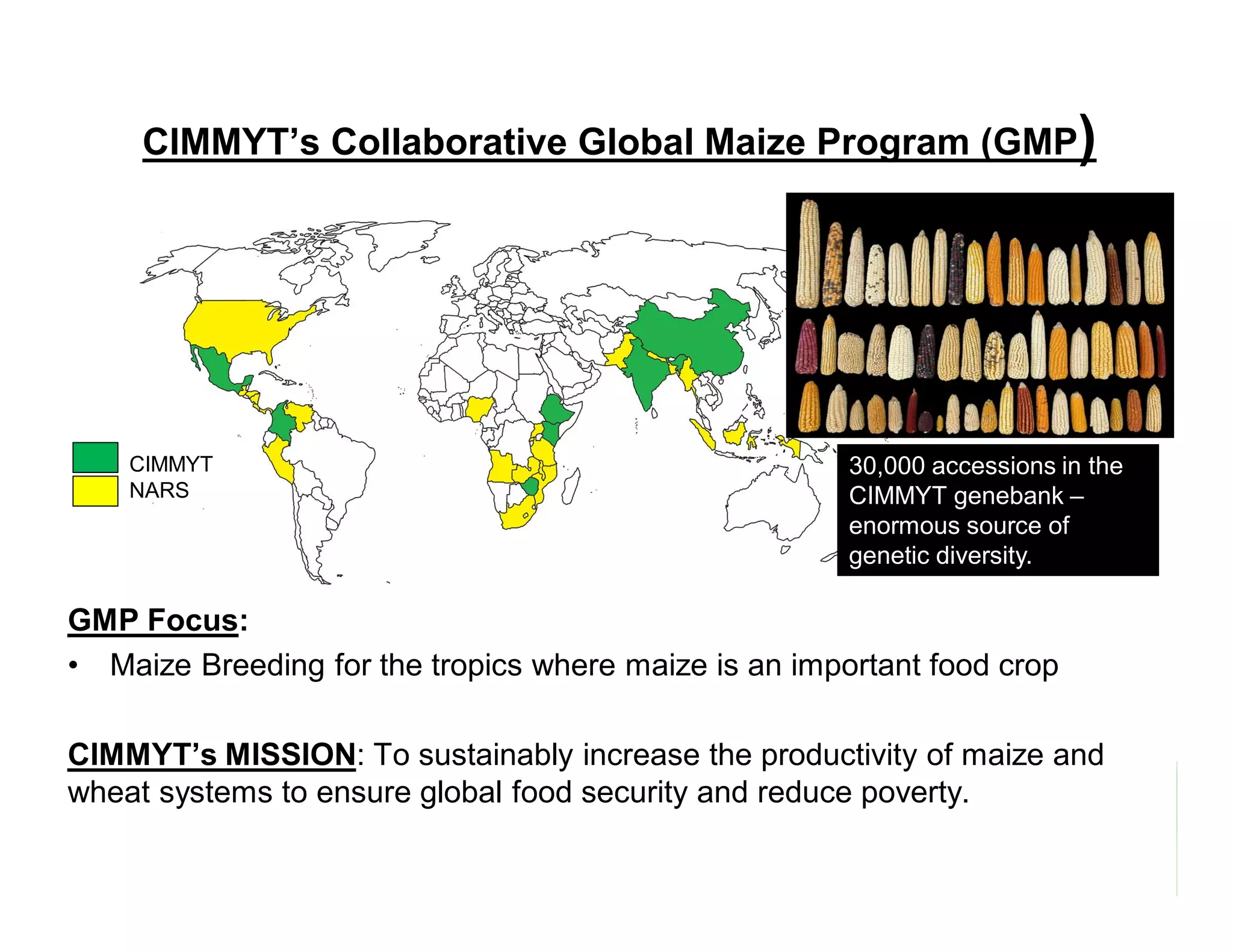
CIMMYT’s Collaborative Global Maize Program (GMP)
GMP Focus:
• Maize Breeding for the tropics where maize is an important food crop
CIMMYT’s MISSION: To sustainably increase the productivity of maize and
wheat systems to ensure global food security and reduce poverty.
30,000 accessions in the
CIMMYT genebank –
enormous source of
genetic diversity.
CIMMYT
NARS
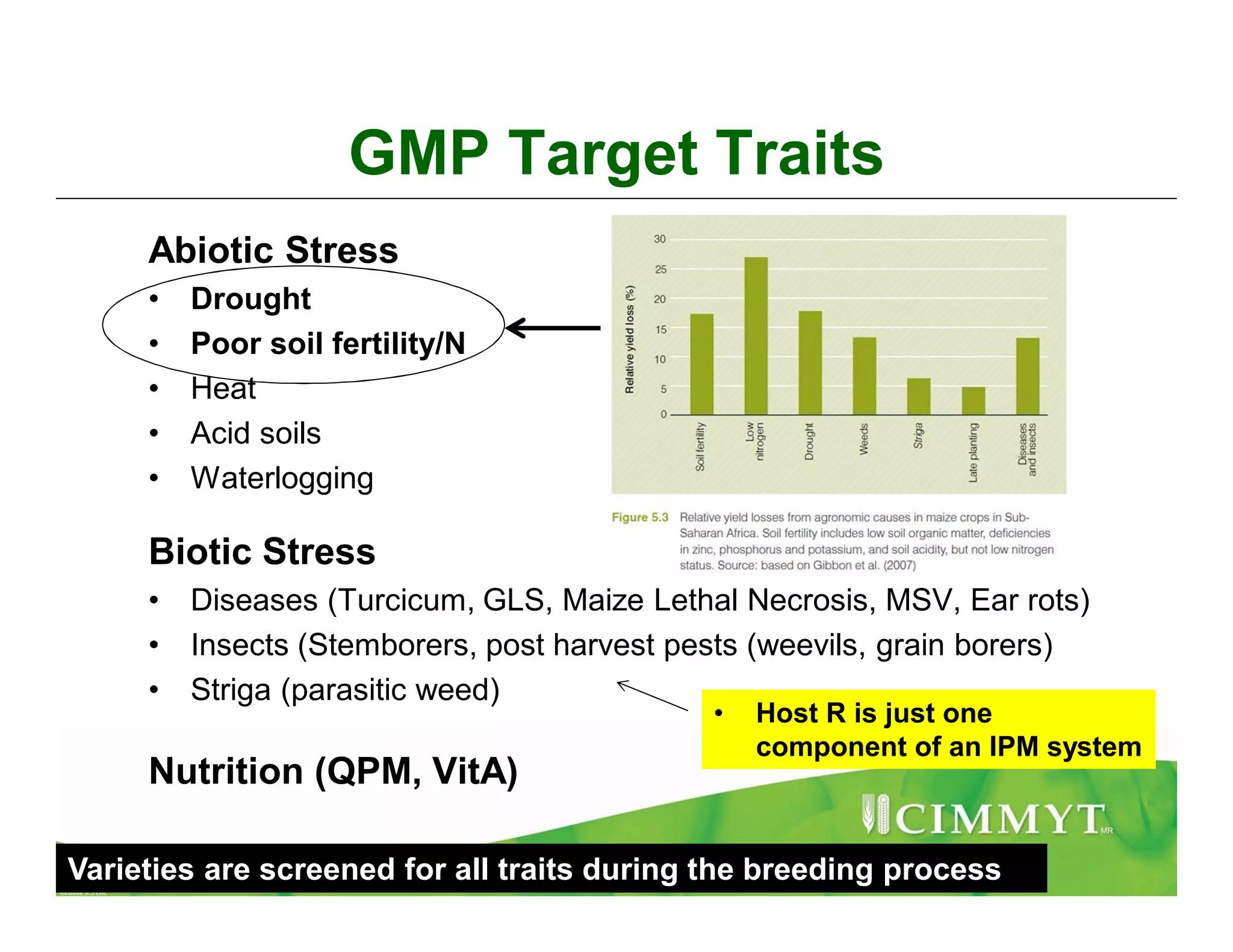
GMP Target Traits
Abiotic Stress
• Drought
• Poor soil fertility/N
• Heat
• Acid soils
• Waterlogging
Biotic Stress
• Diseases (Turcicum, GLS, Maize Lethal Necrosis, MSV, Ear rots)
• Insects (Stemborers, post harvest pests (weevils, grain borers)
• Striga (parasitic weed)
Nutrition (QPM, VitA)
• Host R is just one
component of an IPM system
Varieties are screened for all traits during the breeding process
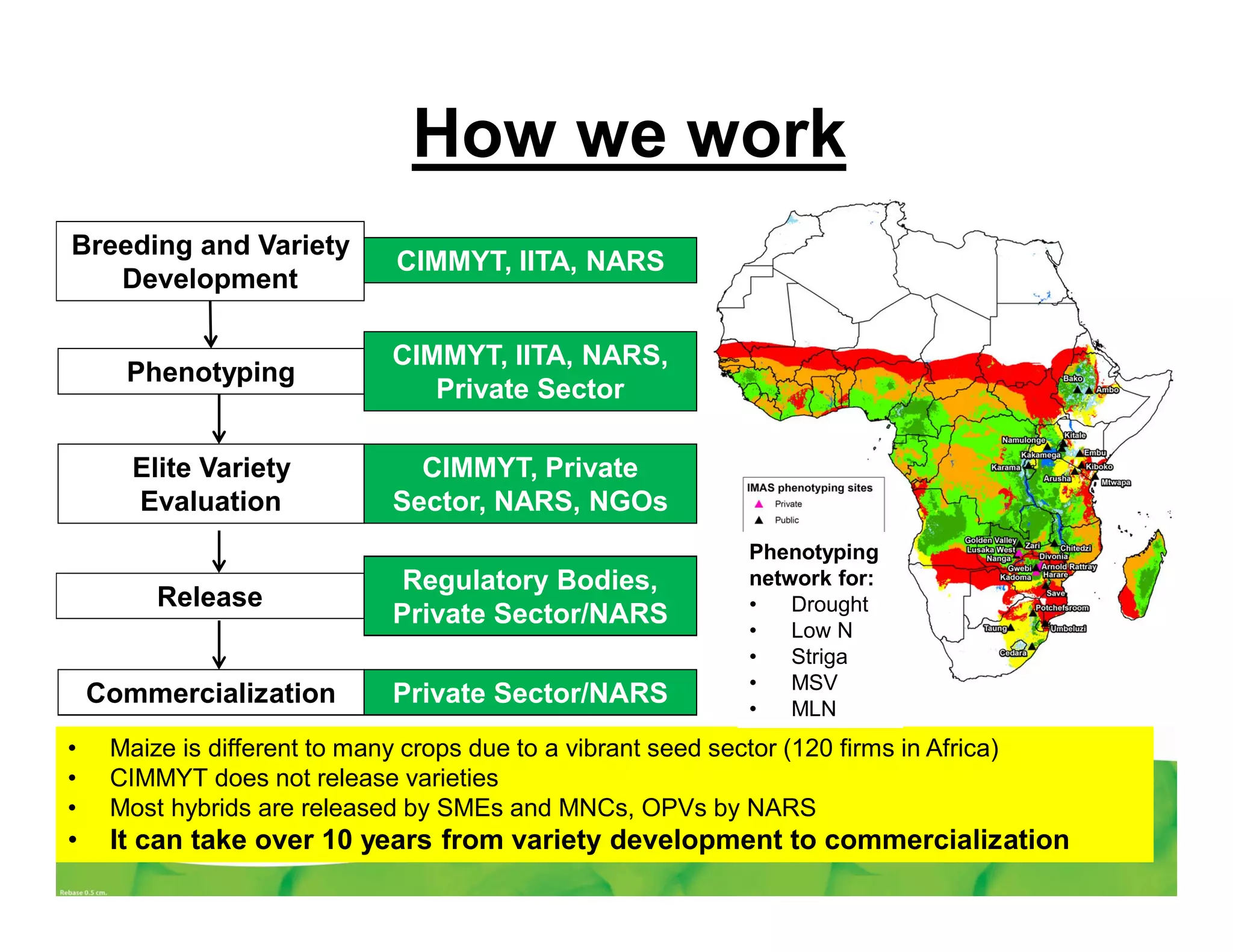
Breeding and Variety
Development
Phenotyping
Elite Variety
Evaluation
Commercialization
Release
How we work
CIMMYT, IITA, NARS
CIMMYT, IITA, NARS,
Private Sector
CIMMYT, Private
Sector, NARS, NGOs
Regulatory Bodies,
Private Sector/NARS
Private Sector/NARS
• Maize is different to many crops due to a vibrant seed sector (120 firms in Africa)
• CIMMYT does not release varieties
• Most hybrids are released by SMEs and MNCs, OPVs by NARS
• It can take over 10 years from variety development to commercialization
Phenotyping
network for:
• Drought
• Low N
• Striga
• MSV
• MLN
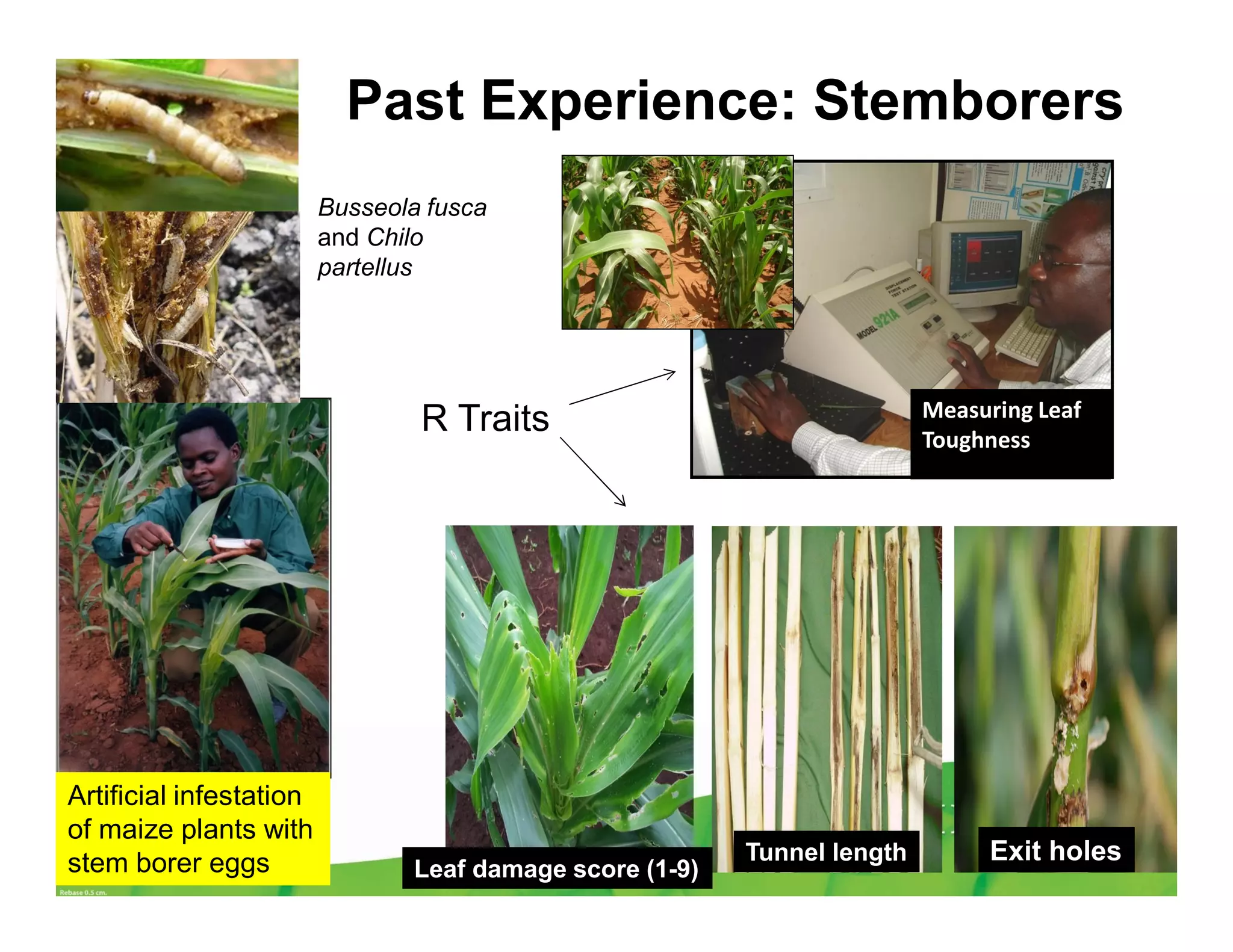
Artificial infestation
of maize plants with
stem borer eggs
Past Experience: Stemborers
Measuring Leaf
Toughness
R Traits
Leaf damage score (1-9)
Tunnel length Exit holes
Busseola fusca
and Chilo
partellus
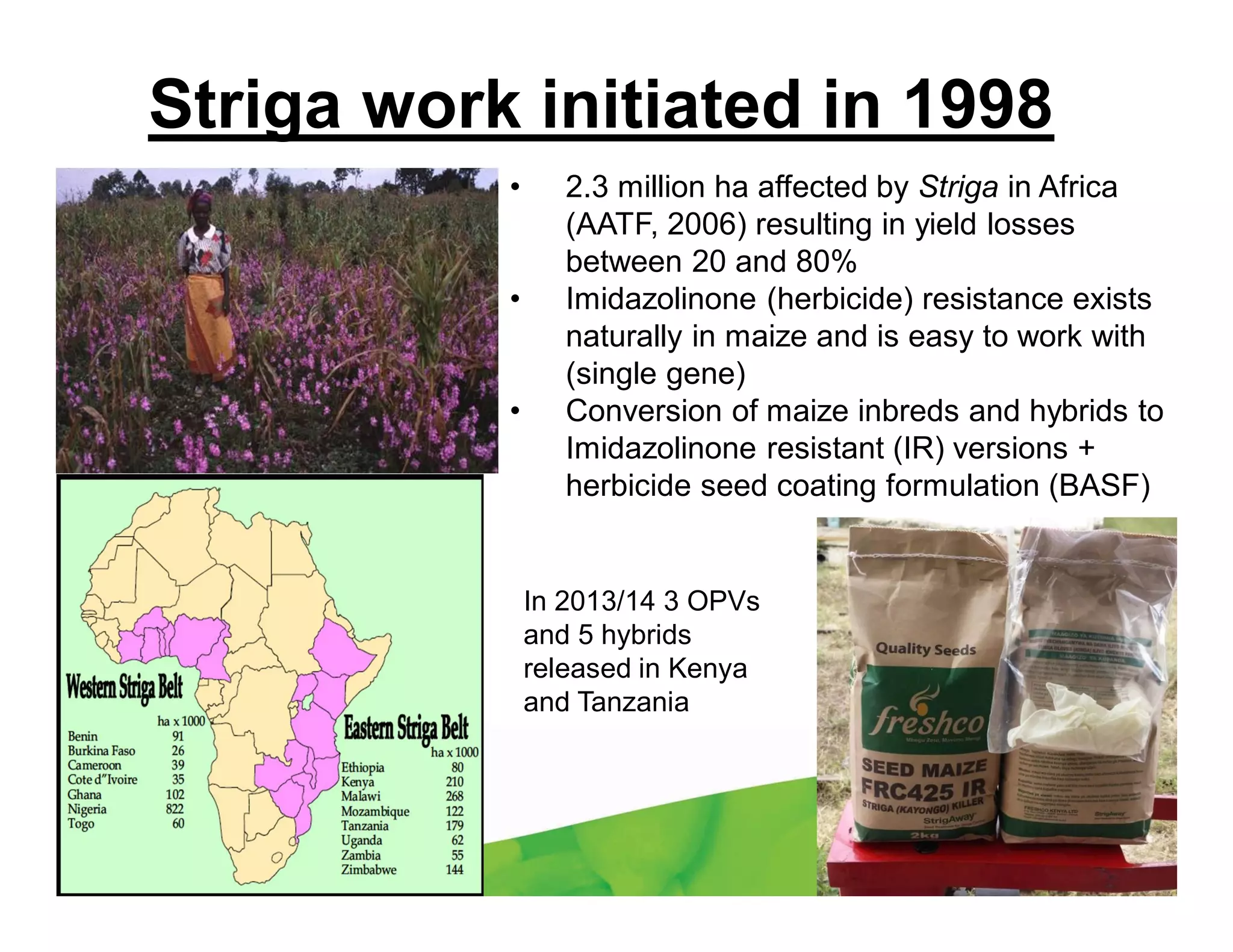
Striga work initiated in 1998
• 2.3 million ha affected by Striga in Africa
(AATF, 2006) resulting in yield losses
between 20 and 80%
• Imidazolinone (herbicide) resistance exists
naturally in maize and is easy to work with
(single gene)
• Conversion of maize inbreds and hybrids to
Imidazolinone resistant (IR) versions +
herbicide seed coating formulation (BASF)
In 2013/14 3 OPVs
and 5 hybrids
released in Kenya
and Tanzania
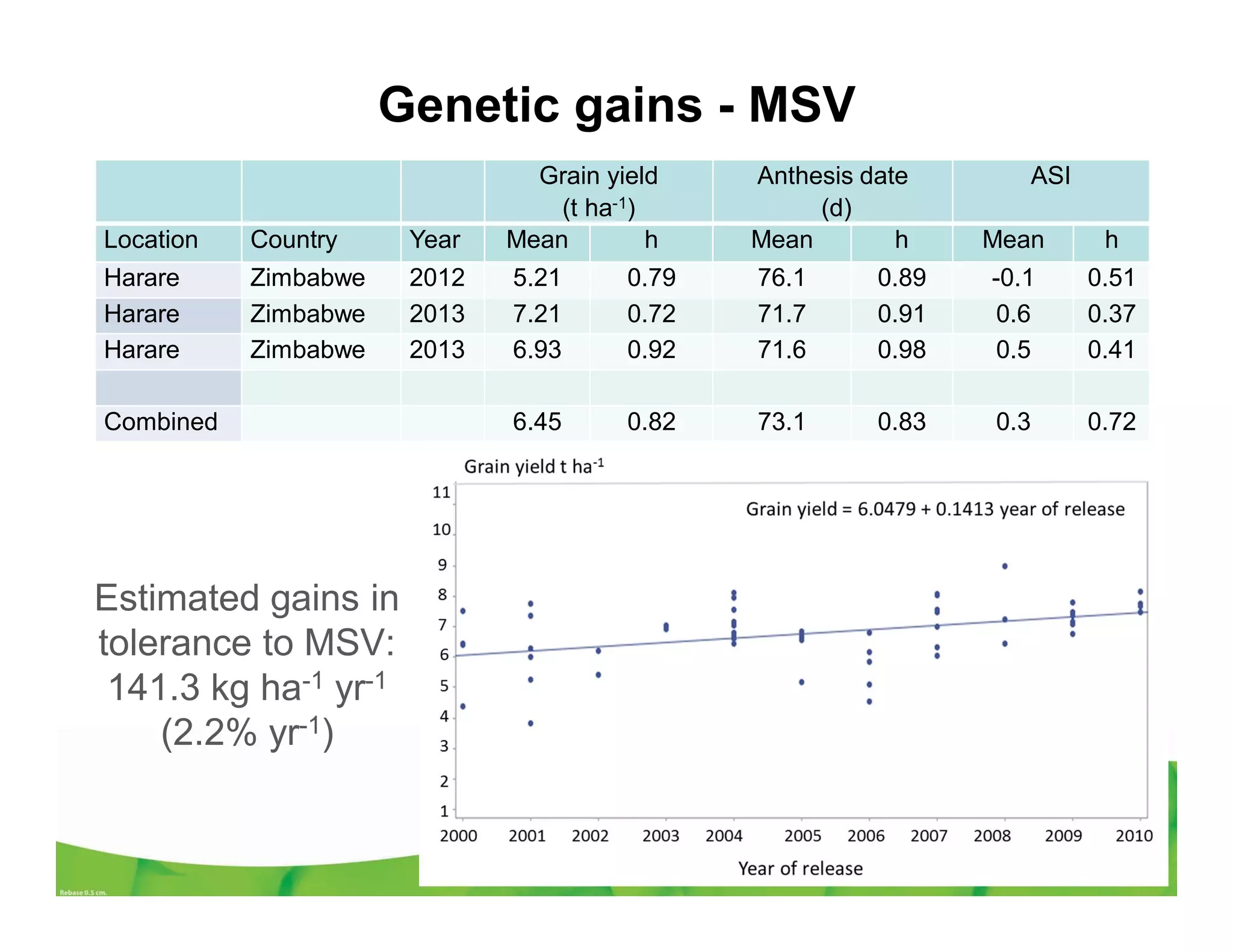
Genetic gains - MSV
Grain yield
(t ha-1)
Anthesis date
(d)
ASI
Location Country Year Mean h Mean h Mean h
Harare Zimbabwe 2012 5.21 0.79 76.1 0.89 -0.1 0.51
Harare Zimbabwe 2013 7.21 0.72 71.7 0.91 0.6 0.37
Harare Zimbabwe 2013 6.93 0.92 71.6 0.98 0.5 0.41
Combined 6.45 0.82 73.1 0.83 0.3 0.72
Estimated gains in
tolerance to MSV:
141.3 kg ha-1 yr-1
(2.2% yr-1)
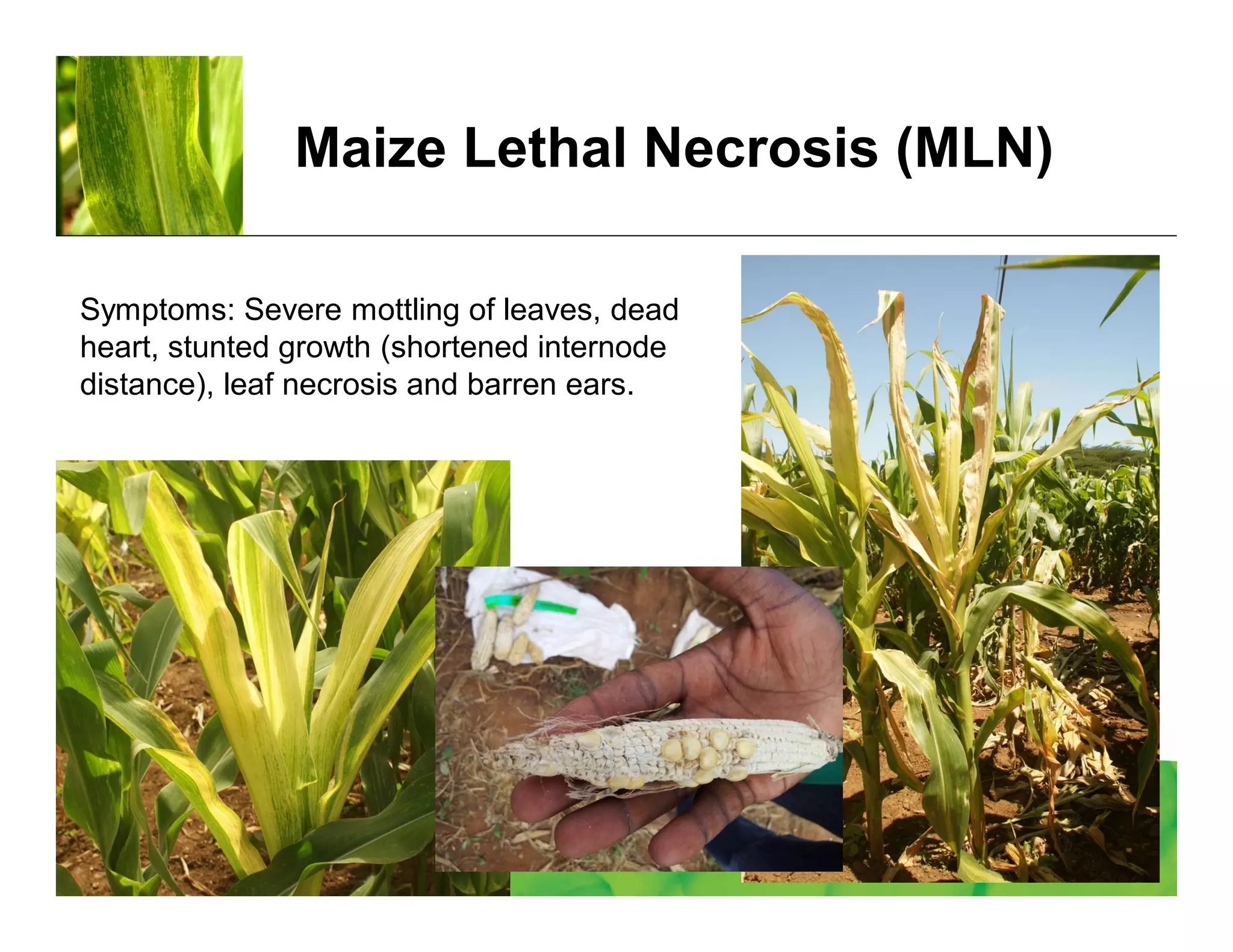
Maize Lethal Necrosis (MLN)
Symptoms: Severe mottling of leaves, dead
heart, stunted growth (shortened internode
distance), leaf necrosis and barren ears.
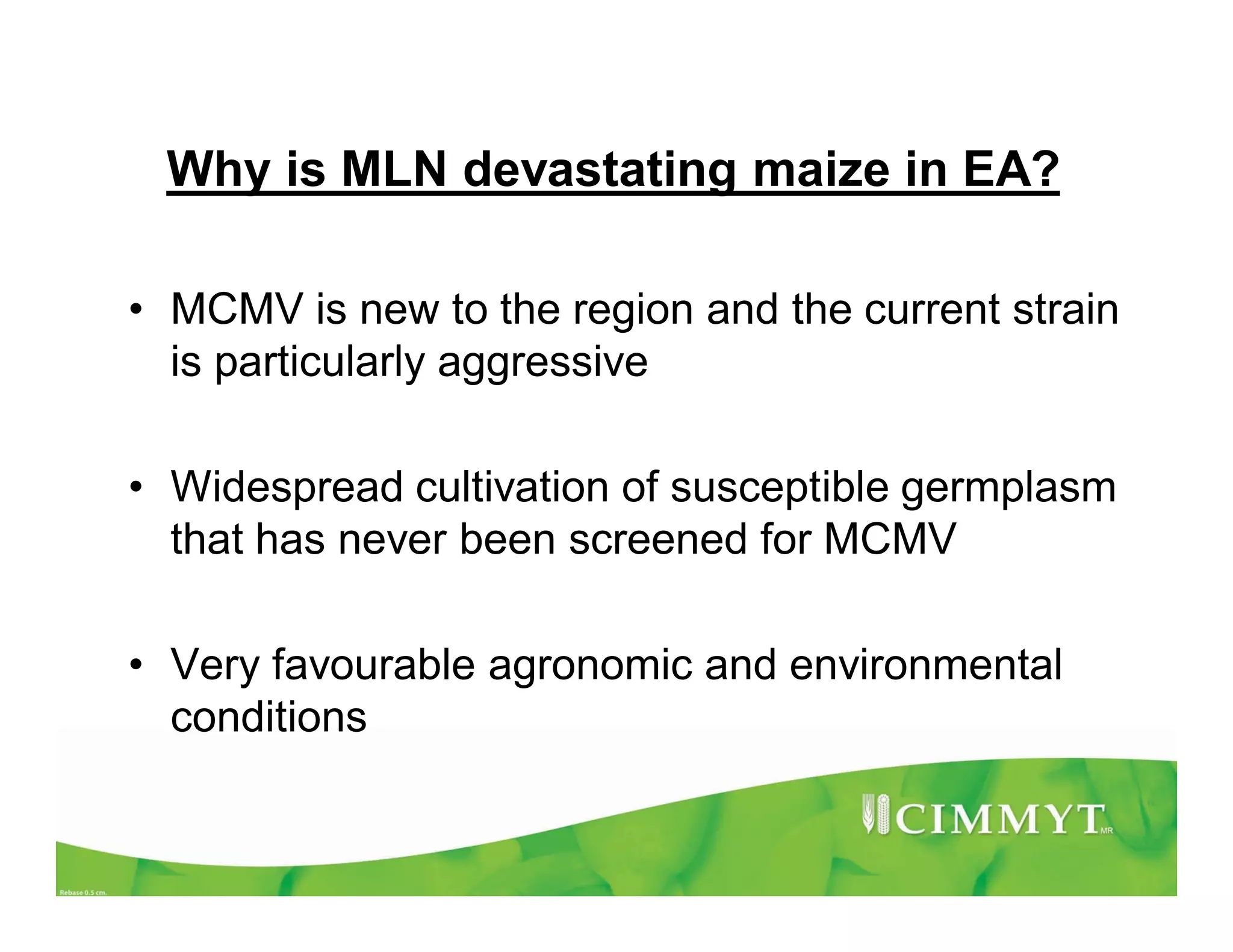
Why is MLN devastating maize in EA?
• MCMV is new to the region and the current strain
is particularly aggressive
• Widespread cultivation of susceptible germplasm
that has never been screened for MCMV
• Very favourable agronomic and environmental
conditions
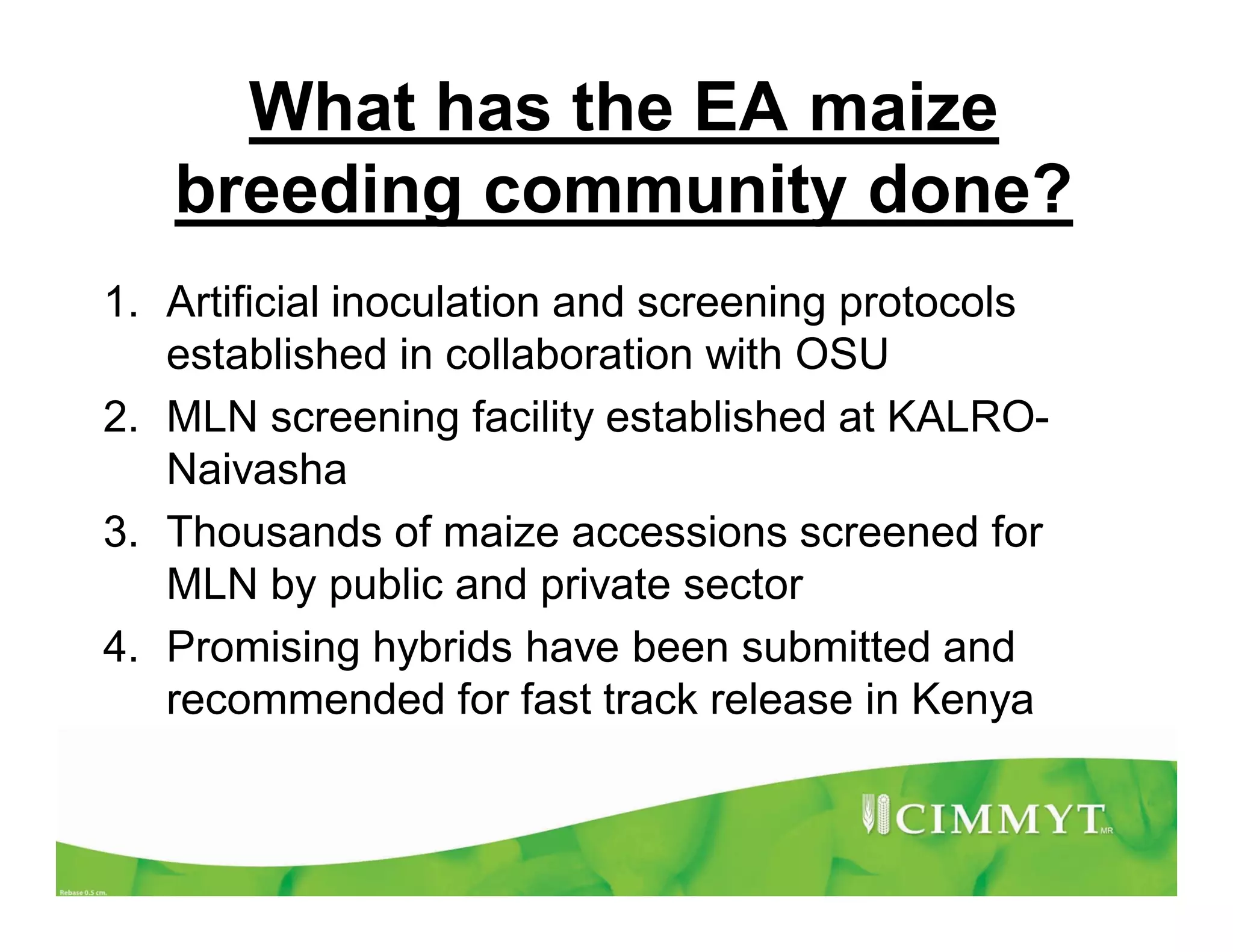
What has the EA maize
breeding community done?
1. Artificial inoculation and screening protocols
established in collaboration with OSU
2. MLN screening facility established at KALRO-
Naivasha
3. Thousands of maize accessions screened for
MLN by public and private sector
4. Promising hybrids have been submitted and
recommended for fast track release in Kenya
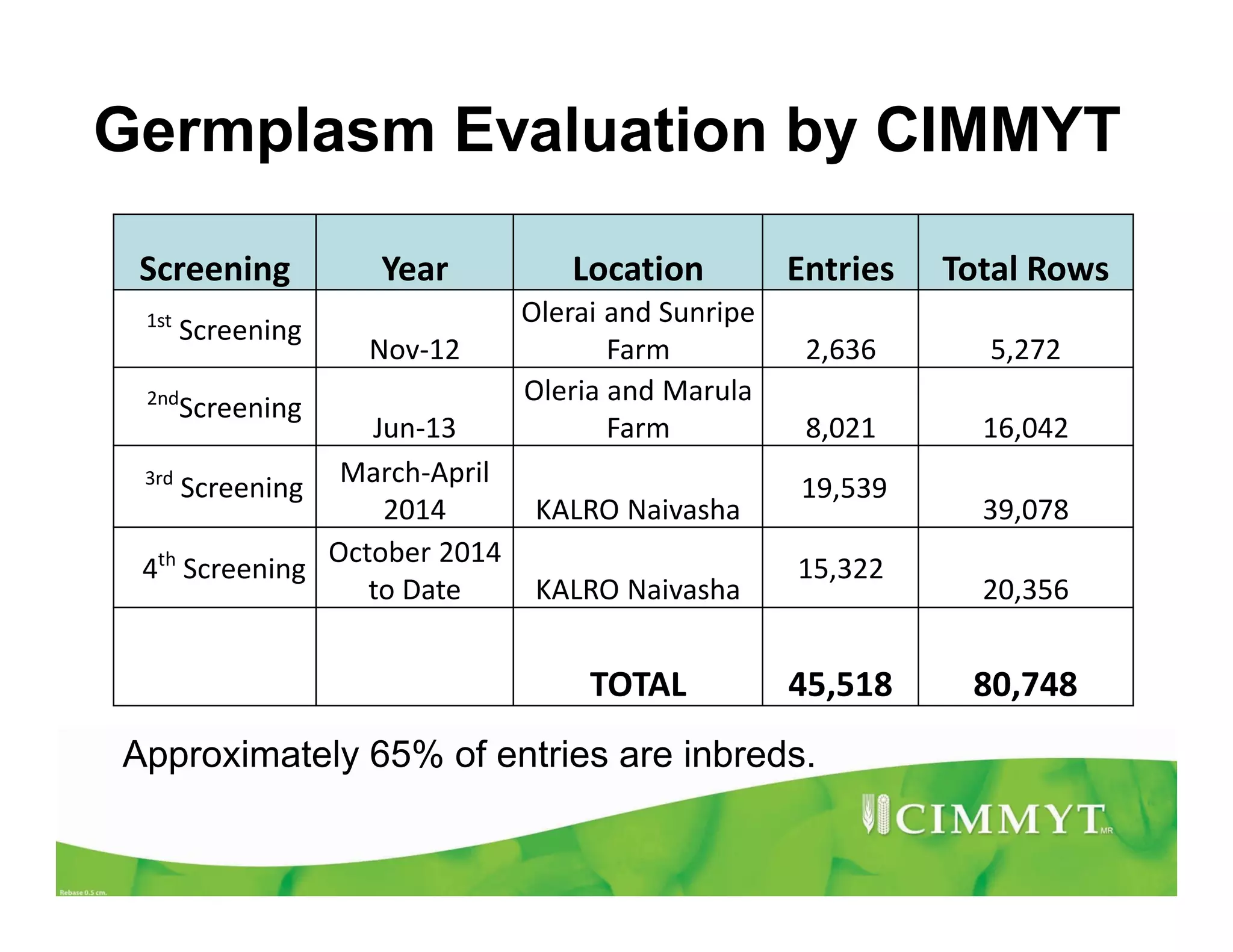
Germplasm Evaluation by CIMMYT
Screening Year Location Entries Total Rows
1st
Screening
Nov-12
Olerai and Sunripe
Farm 2,636 5,272
2nd
Screening
Jun-13
Oleria and Marula
Farm 8,021 16,042
3rd
Screening March-April
2014 KALRO Naivasha
19,539
39,078
4th
Screening
October 2014
to Date KALRO Naivasha
15,322
20,356
TOTAL 45,518 80,748
Approximately 65% of entries are inbreds.
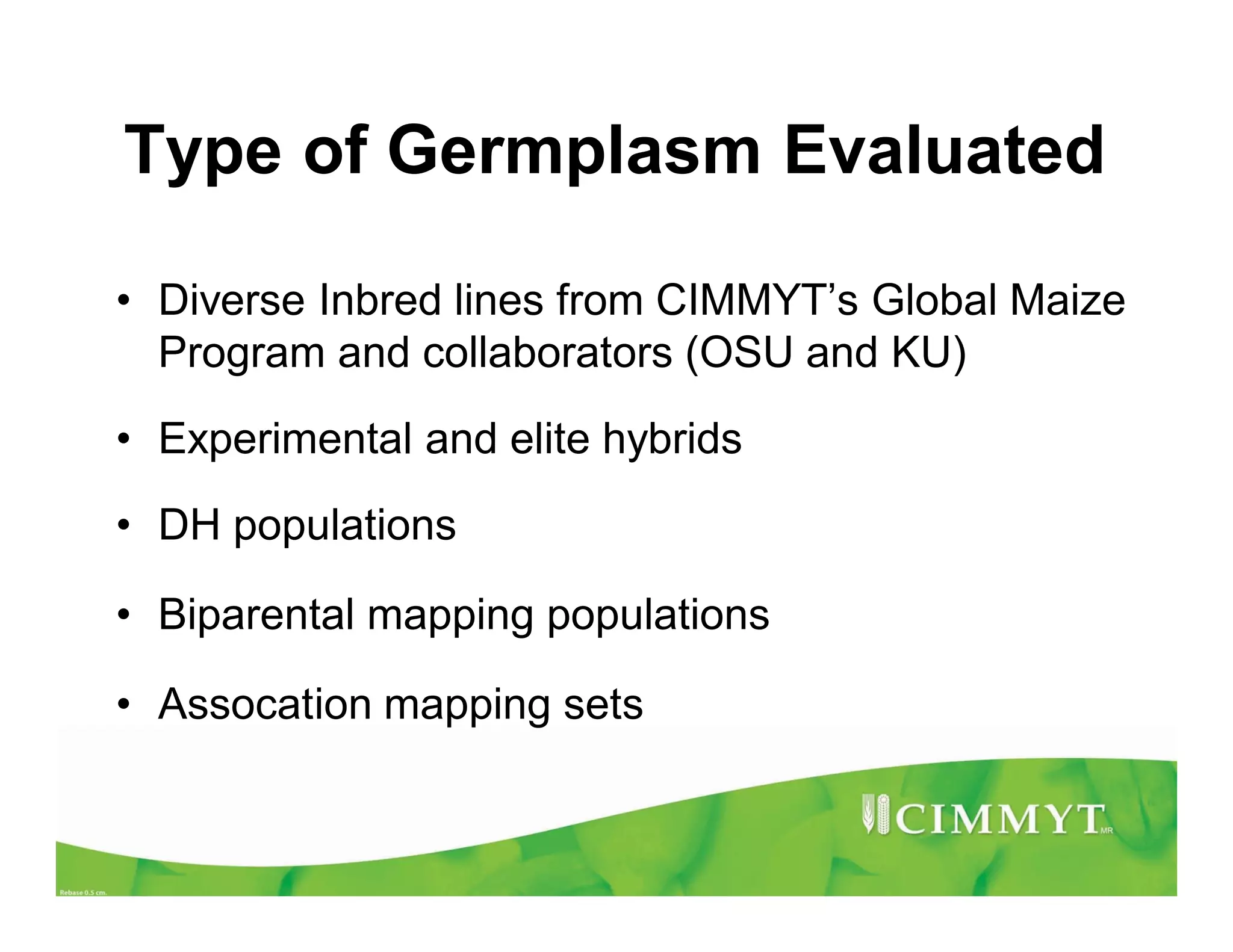
Type of Germplasm Evaluated
• Diverse Inbred lines from CIMMYT’s Global Maize
Program and collaborators (OSU and KU)
• Experimental and elite hybrids
• DH populations
• Biparental mapping populations
• Assocation mapping sets
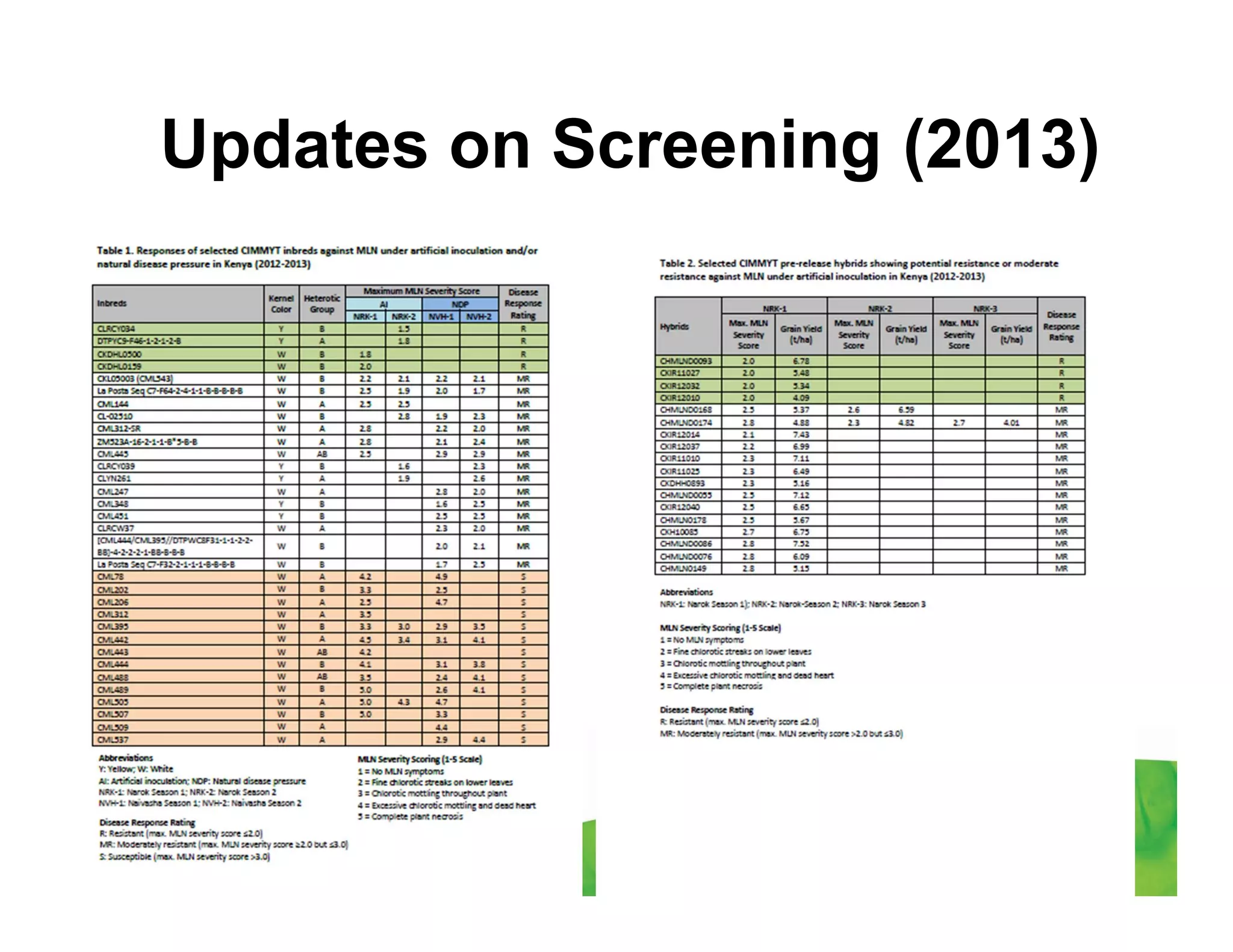
Updates on Screening (2013)
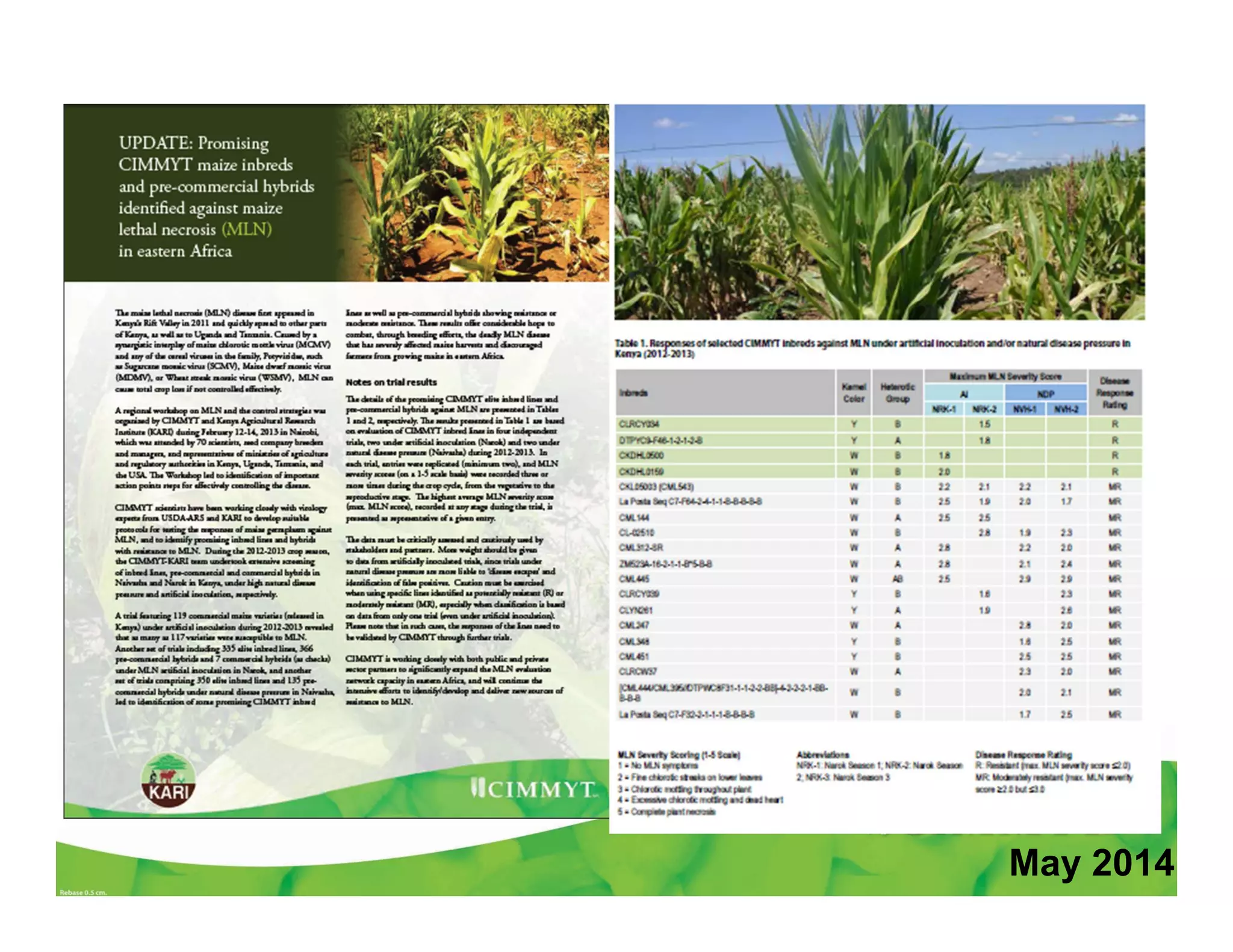
May 2014
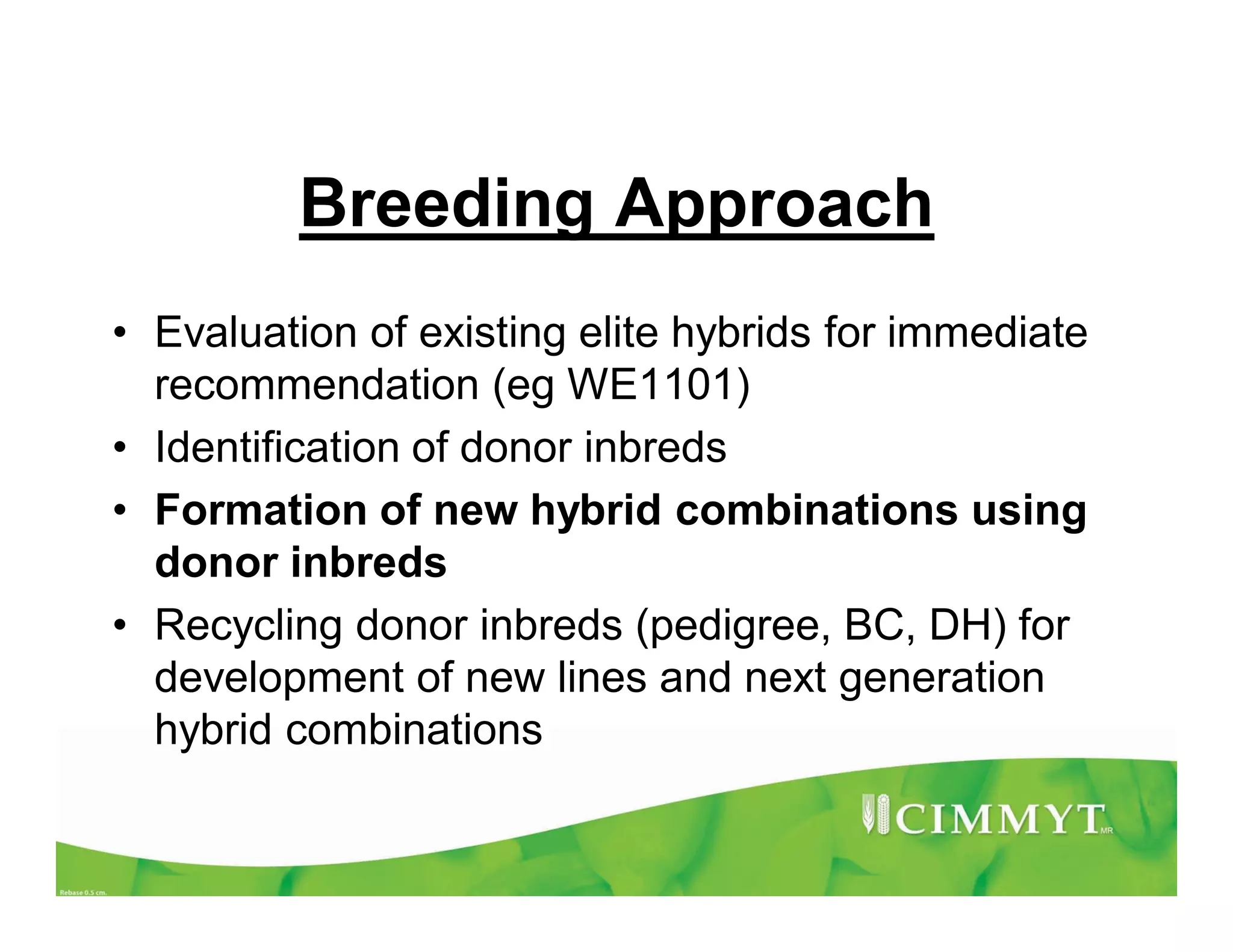
Breeding Approach
• Evaluation of existing elite hybrids for immediate
recommendation (eg WE1101)
• Identification of donor inbreds
• Formation of new hybrid combinations using
donor inbreds
• Recycling donor inbreds (pedigree, BC, DH) for
development of new lines and next generation
hybrid combinations
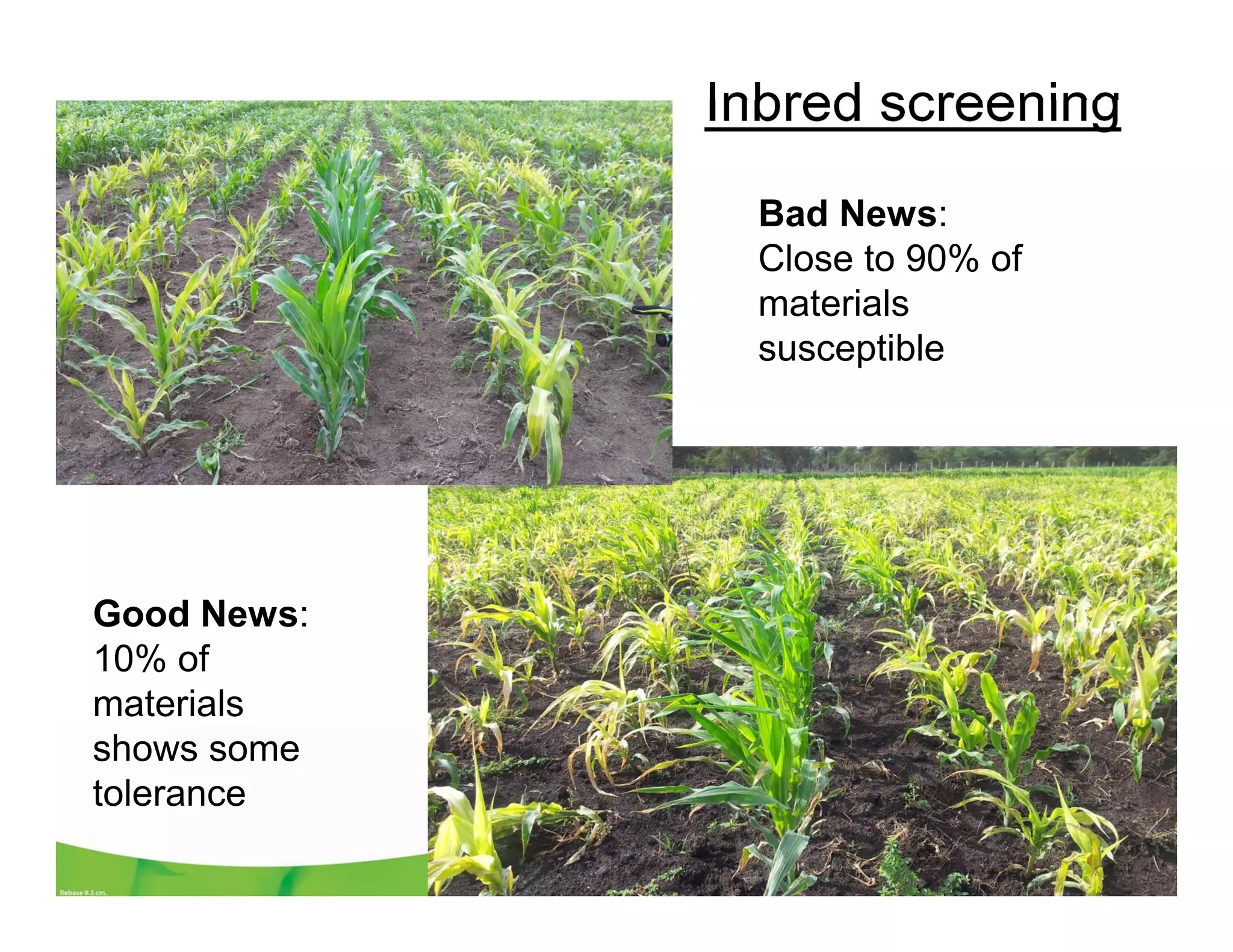
Inbred screening
Bad News:
Close to 90% of
materials
susceptible
Good News:
10% of
materials
shows some
tolerance
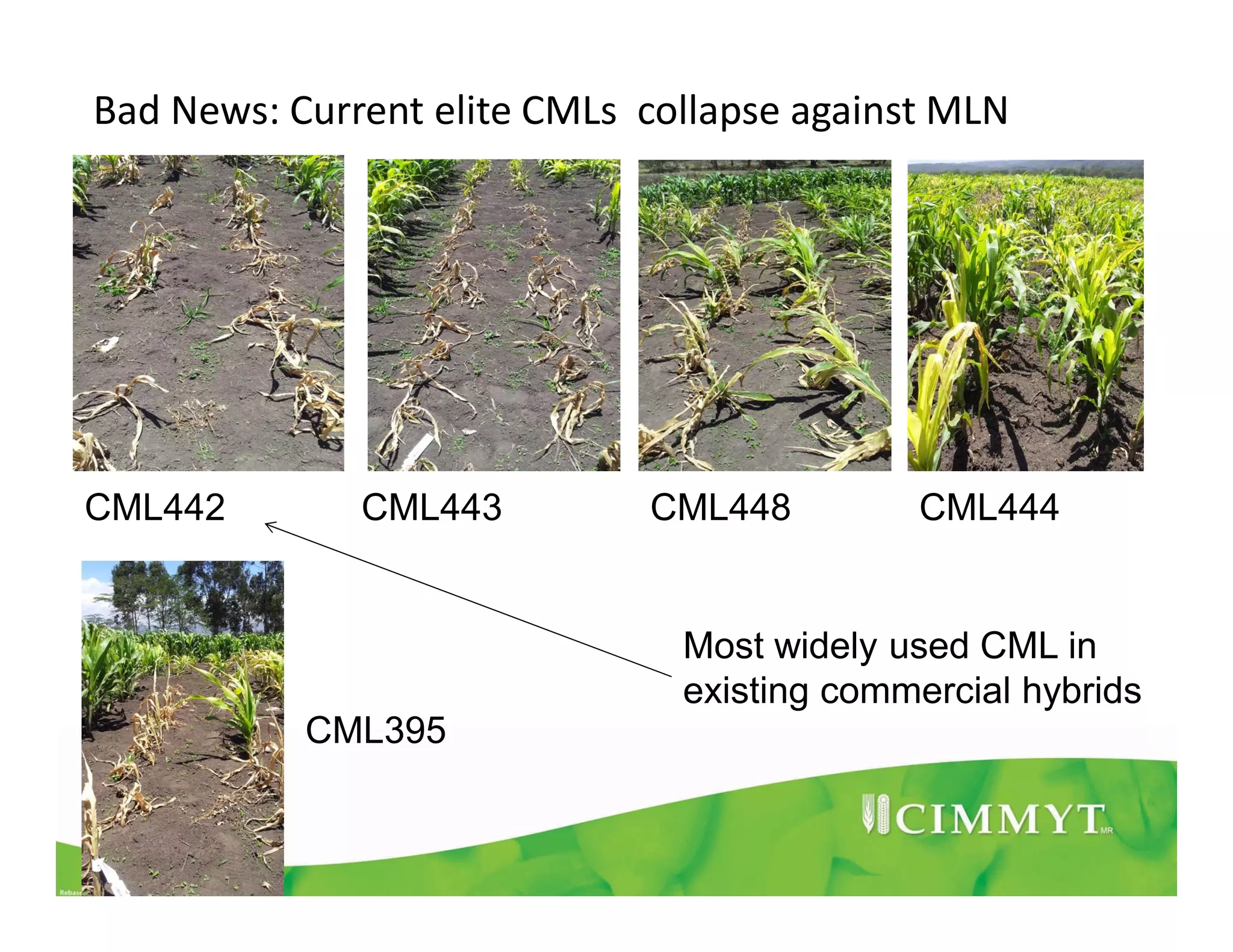
Bad News: Current elite CMLs collapse against MLN
CML442 CML443 CML448 CML444
CML395
Most widely used CML in
existing commercial hybrids
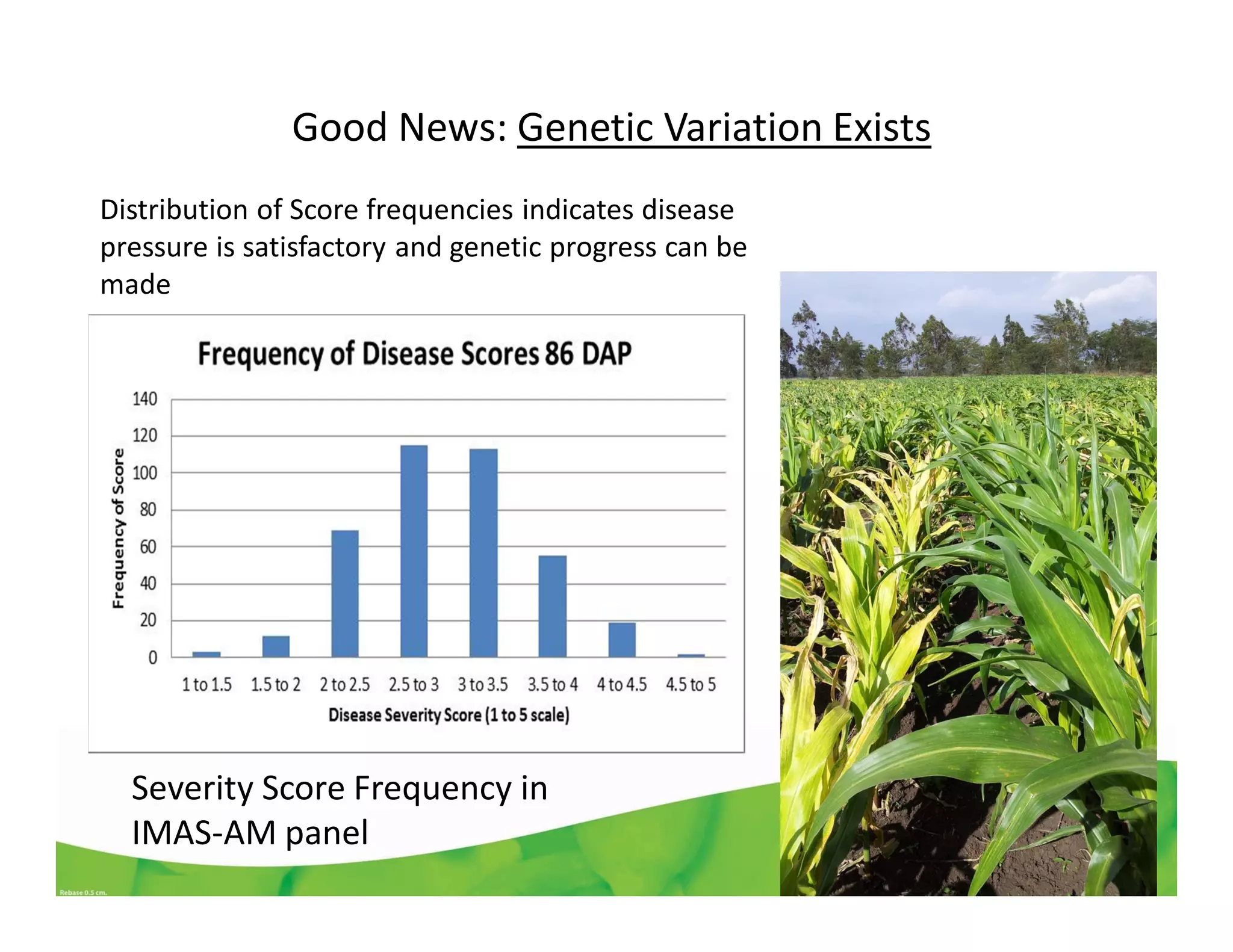
Good News: Genetic Variation Exists
Severity Score Frequency in
IMAS-AM panel
Distribution of Score frequencies indicates disease
pressure is satisfactory and genetic progress can be
made
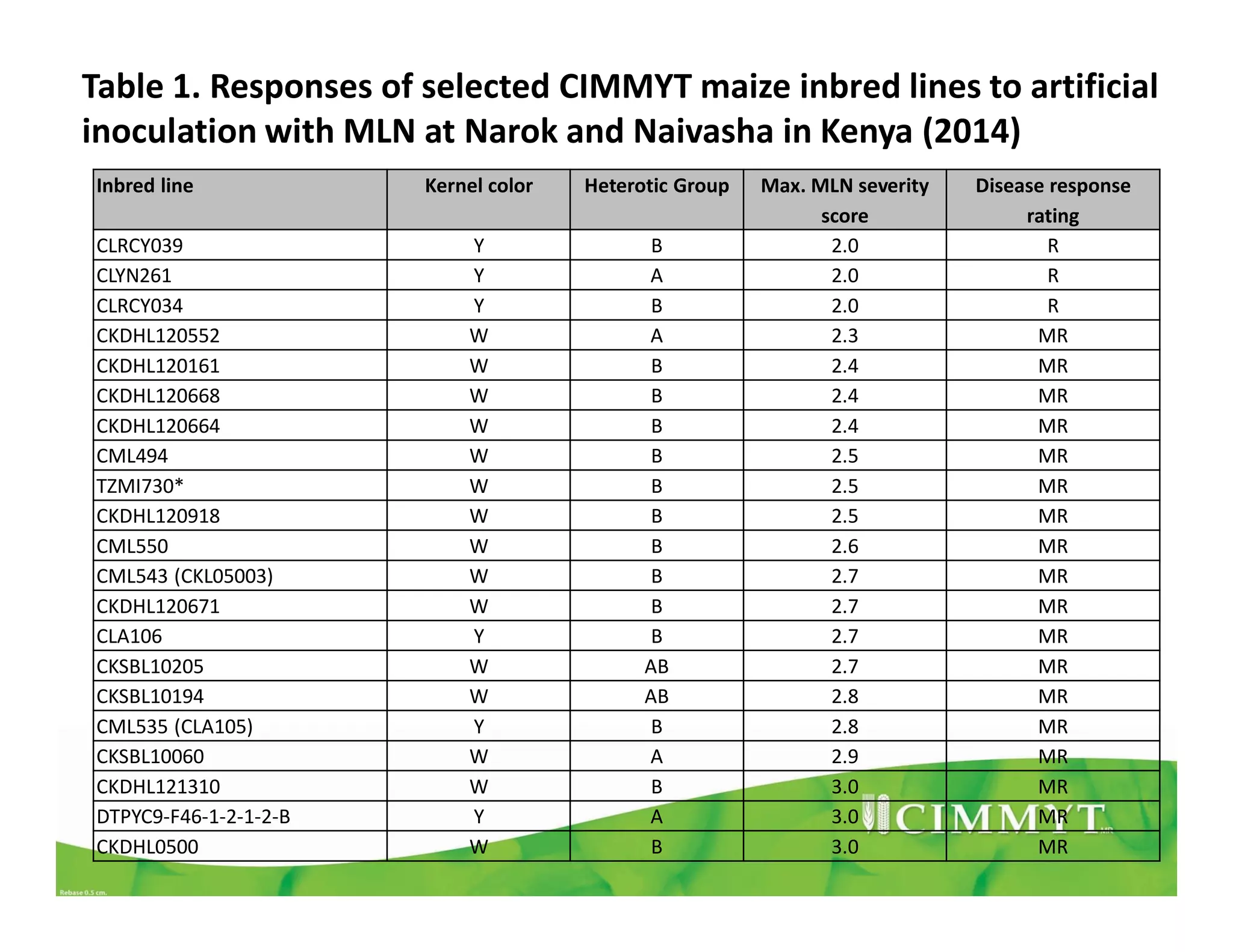
Inbred line Kernel color Heterotic Group Max. MLN severity
score
Disease response
rating
CLRCY039 Y B 2.0 R
CLYN261 Y A 2.0 R
CLRCY034 Y B 2.0 R
CKDHL120552 W A 2.3 MR
CKDHL120161 W B 2.4 MR
CKDHL120668 W B 2.4 MR
CKDHL120664 W B 2.4 MR
CML494 W B 2.5 MR
TZMI730* W B 2.5 MR
CKDHL120918 W B 2.5 MR
CML550 W B 2.6 MR
CML543 (CKL05003) W B 2.7 MR
CKDHL120671 W B 2.7 MR
CLA106 Y B 2.7 MR
CKSBL10205 W AB 2.7 MR
CKSBL10194 W AB 2.8 MR
CML535 (CLA105) Y B 2.8 MR
CKSBL10060 W A 2.9 MR
CKDHL121310 W B 3.0 MR
DTPYC9-F46-1-2-1-2-B Y A 3.0 MR
CKDHL0500 W B 3.0 MR
Table 1. Responses of selected CIMMYT maize inbred lines to artificial
inoculation with MLN at Narok and Naivasha in Kenya (2014)
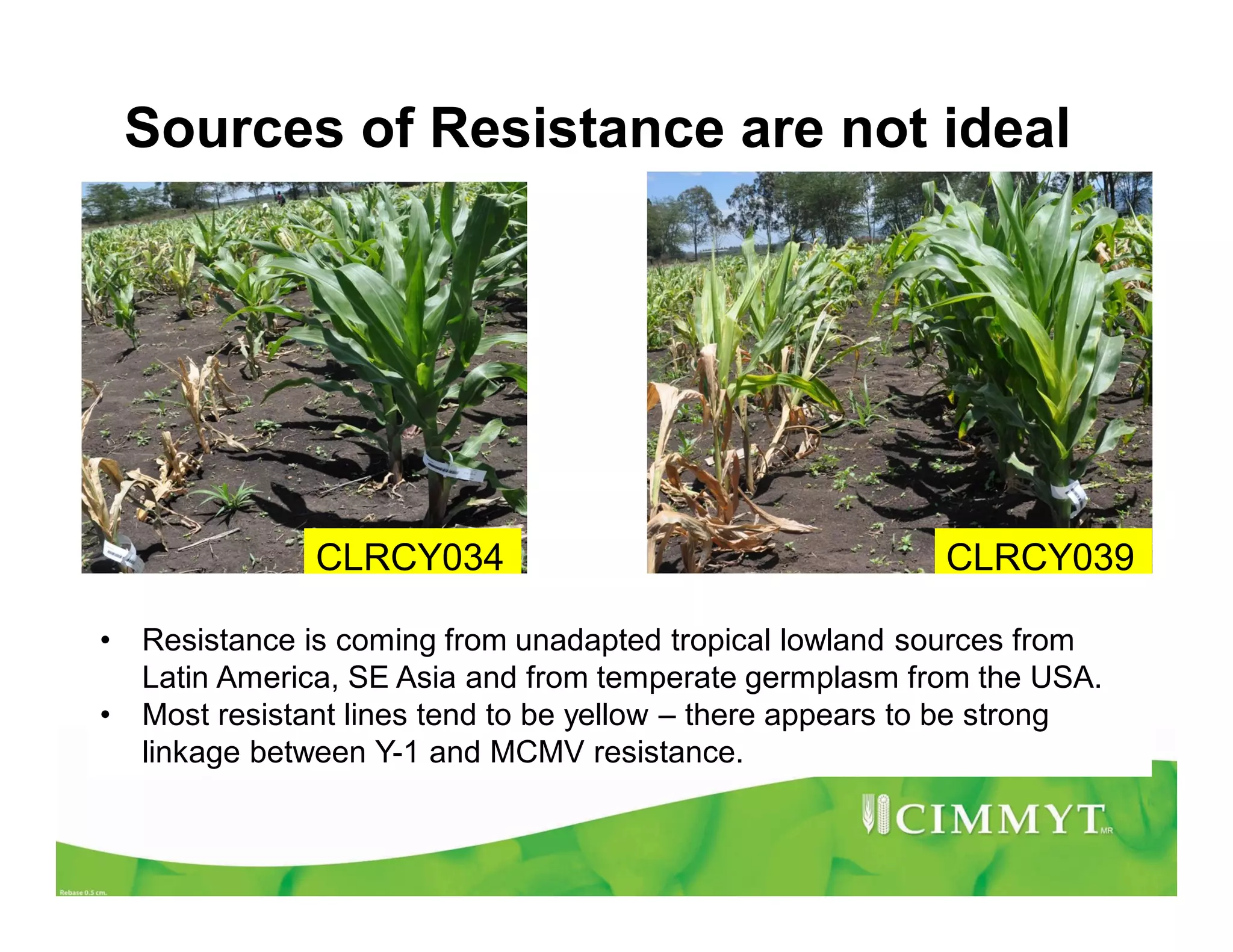
Sources of Resistance are not ideal
CLRCY039CLRCY034
• Resistance is coming from unadapted tropical lowland sources from
Latin America, SE Asia and from temperate germplasm from the USA.
• Most resistant lines tend to be yellow – there appears to be strong
linkage between Y-1 and MCMV resistance.
Line Development Strategy
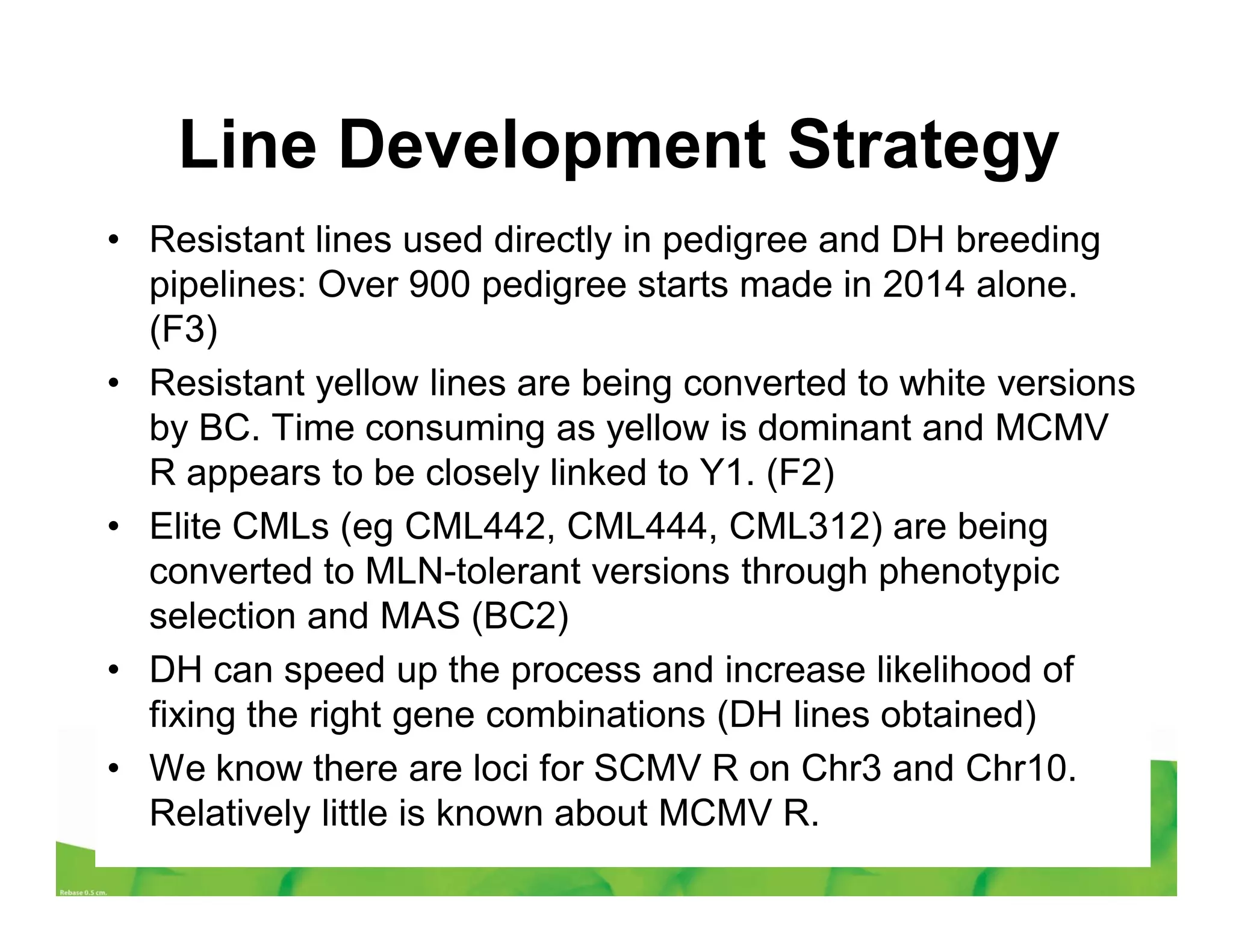
• Resistant lines used directly in pedigree and DH breeding
pipelines: Over 900 pedigree starts made in 2014 alone.
(F3)
• Resistant yellow lines are being converted to white versions
by BC. Time consuming as yellow is dominant and MCMV
R appears to be closely linked to Y1. (F2)
• Elite CMLs (eg CML442, CML444, CML312) are being
converted to MLN-tolerant versions through phenotypic
selection and MAS (BC2)
• DH can speed up the process and increase likelihood of
fixing the right gene combinations (DH lines obtained)
• We know there are loci for SCMV R on Chr3 and Chr10.
Relatively little is known about MCMV R.
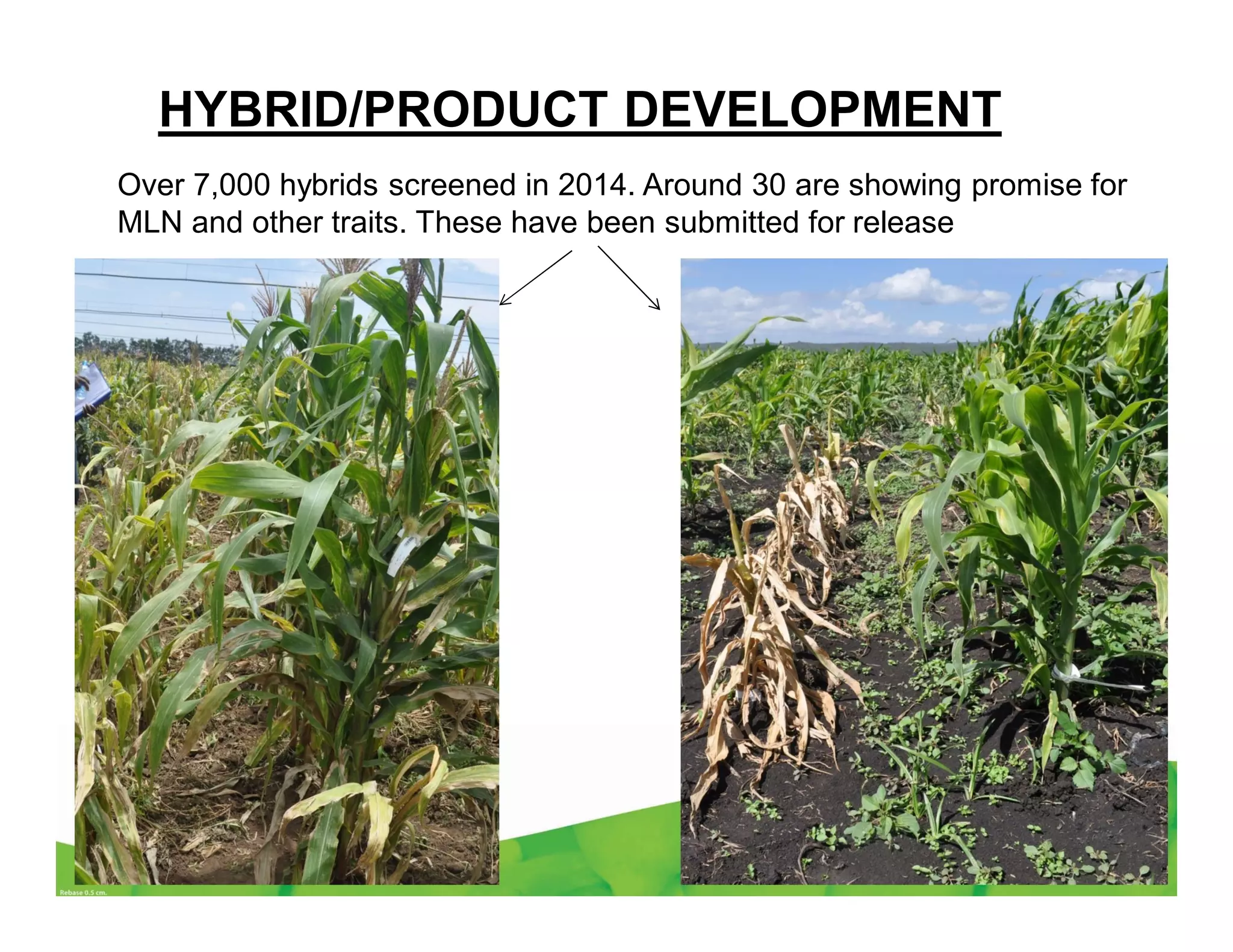
Over 7,000 hybrids screened in 2014. Around 30 are showing promise for
MLN and other traits. These have been submitted for release
HYBRID/PRODUCT DEVELOPMENT
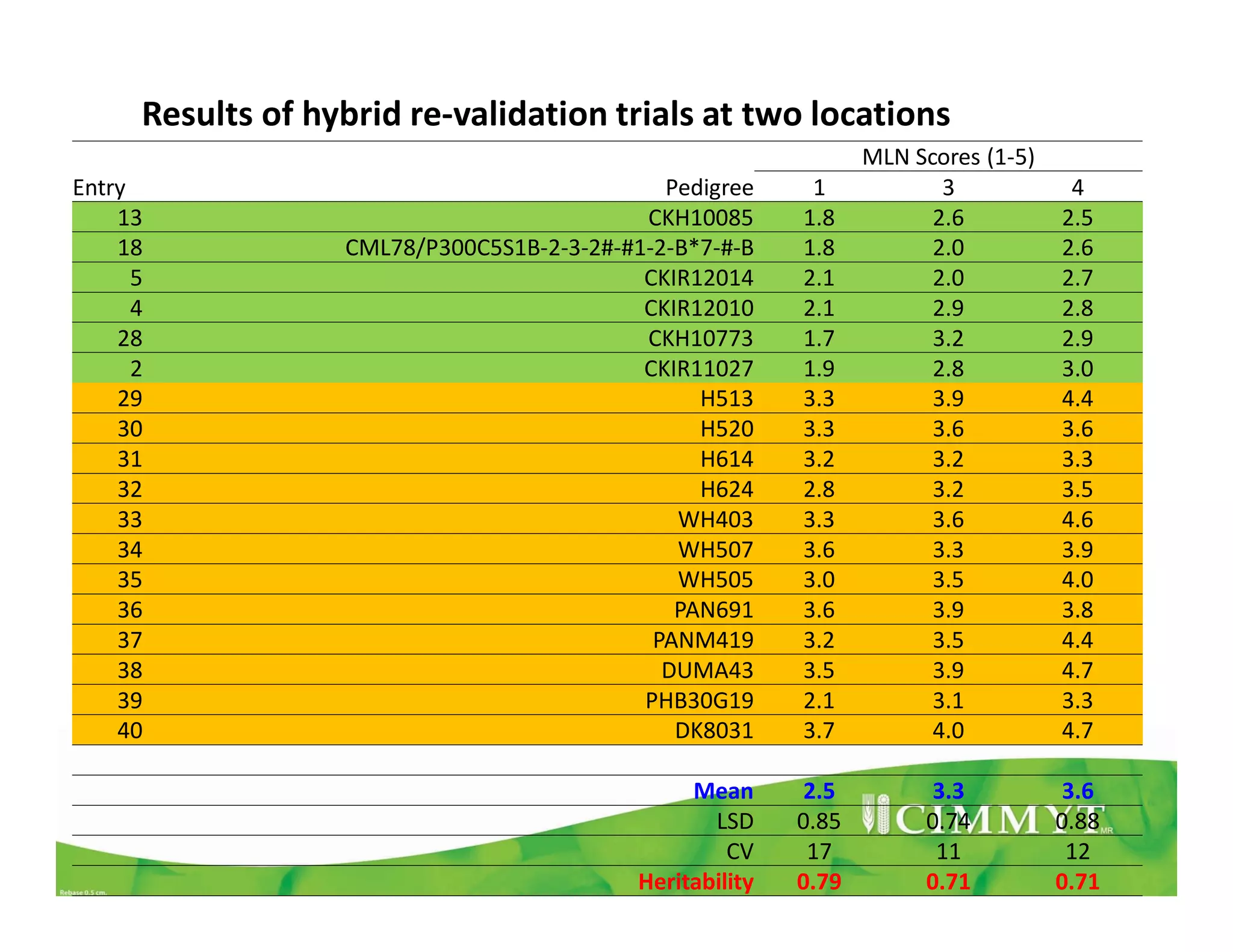
MLN Scores (1-5)
Entry Pedigree 1 3 4
13 CKH10085 1.8 2.6 2.5
18 CML78/P300C5S1B-2-3-2#-#1-2-B*7-#-B 1.8 2.0 2.6
5 CKIR12014 2.1 2.0 2.7
4 CKIR12010 2.1 2.9 2.8
28 CKH10773 1.7 3.2 2.9
2 CKIR11027 1.9 2.8 3.0
29 H513 3.3 3.9 4.4
30 H520 3.3 3.6 3.6
31 H614 3.2 3.2 3.3
32 H624 2.8 3.2 3.5
33 WH403 3.3 3.6 4.6
34 WH507 3.6 3.3 3.9
35 WH505 3.0 3.5 4.0
36 PAN691 3.6 3.9 3.8
37 PANM419 3.2 3.5 4.4
38 DUMA43 3.5 3.9 4.7
39 PHB30G19 2.1 3.1 3.3
40 DK8031 3.7 4.0 4.7
Mean 2.5 3.3 3.6
LSD 0.85 0.74 0.88
CV 17 11 12
Heritability 0.79 0.71 0.71
Results of hybrid re-validation trials at two locations
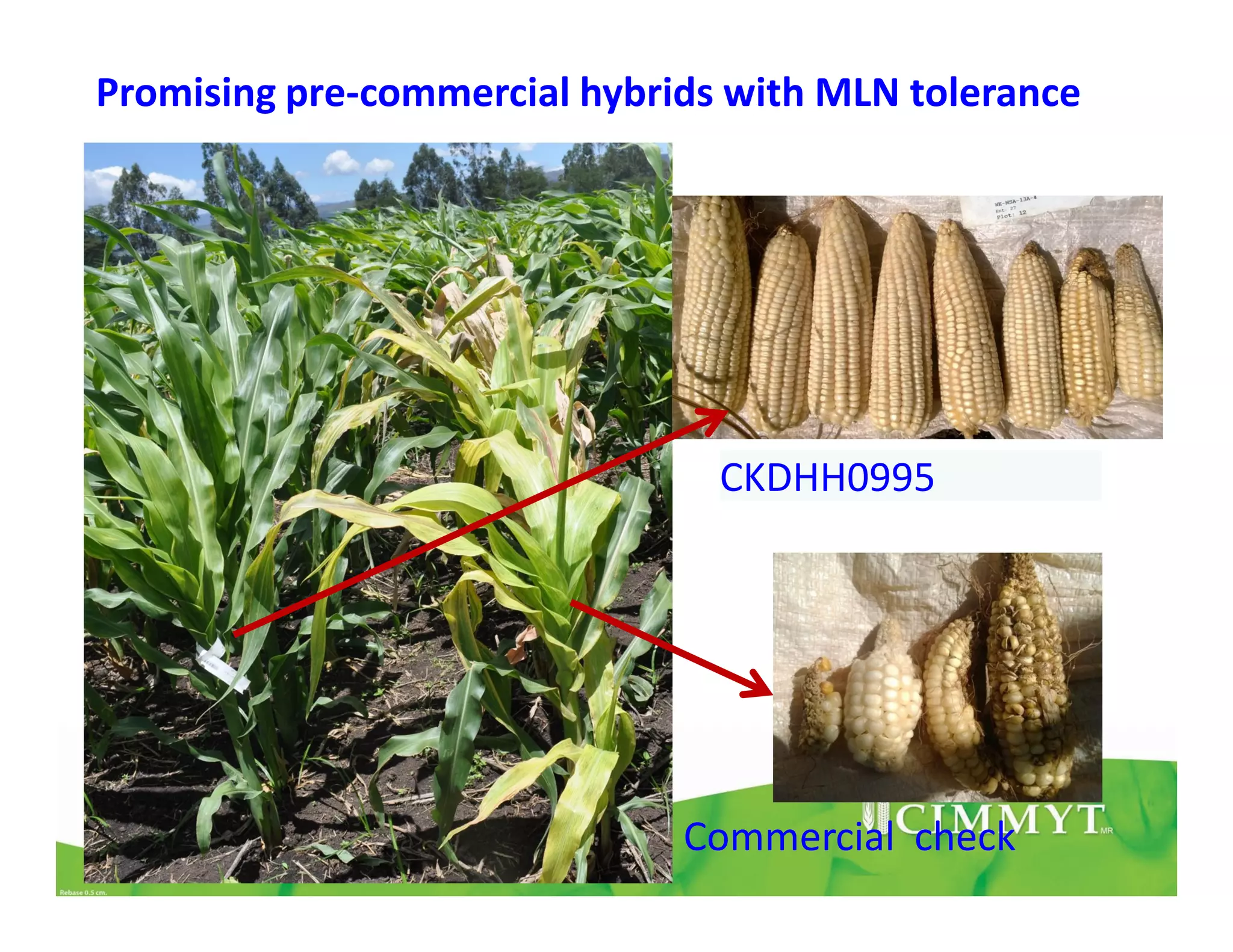
Commercial check
CKDHH0995
Promising pre-commercial hybrids with MLN tolerance
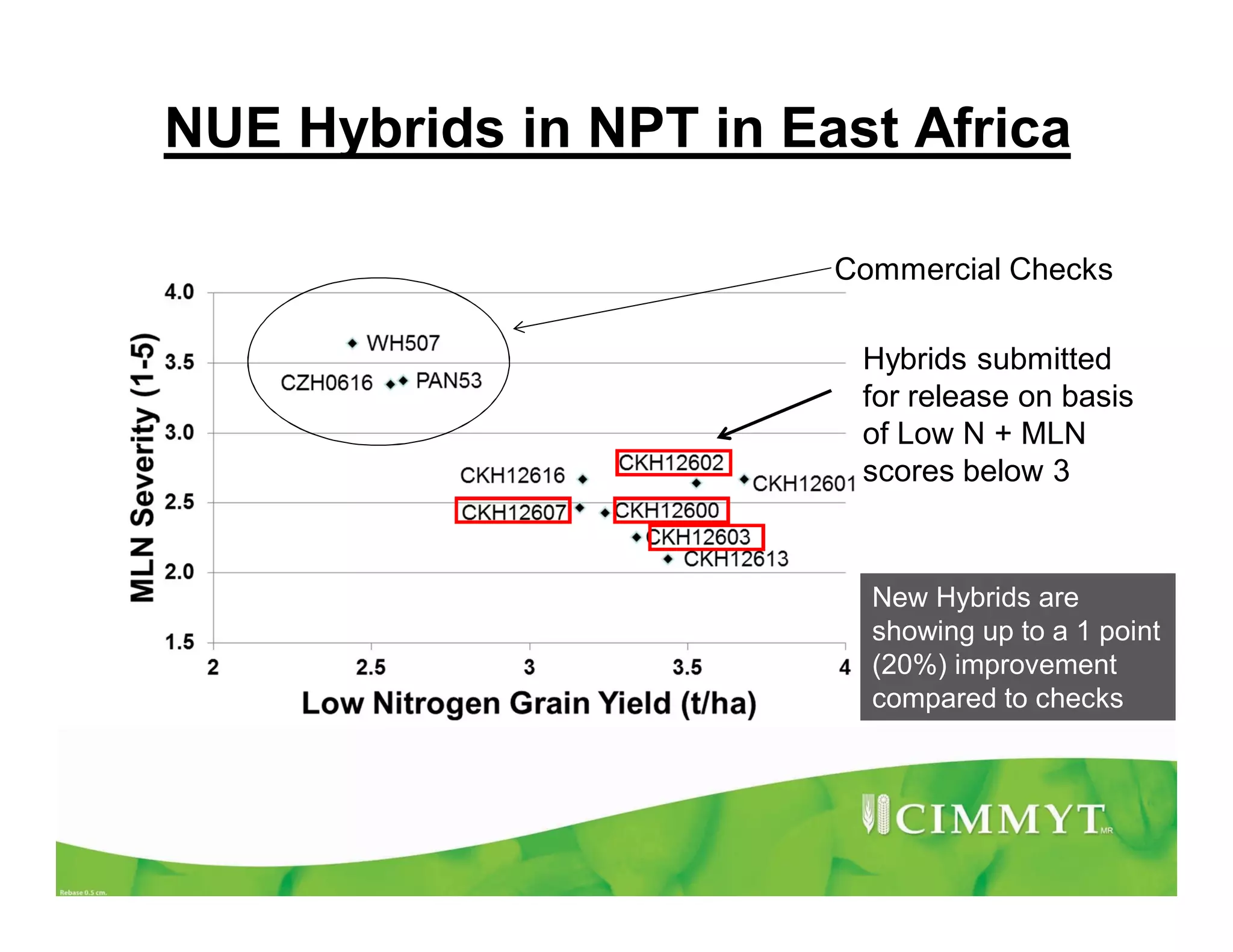
NUE Hybrids in NPT in East Africa
Hybrids submitted
for release on basis
of Low N + MLN
scores below 3
Commercial Checks
New Hybrids are
showing up to a 1 point
(20%) improvement
compared to checks
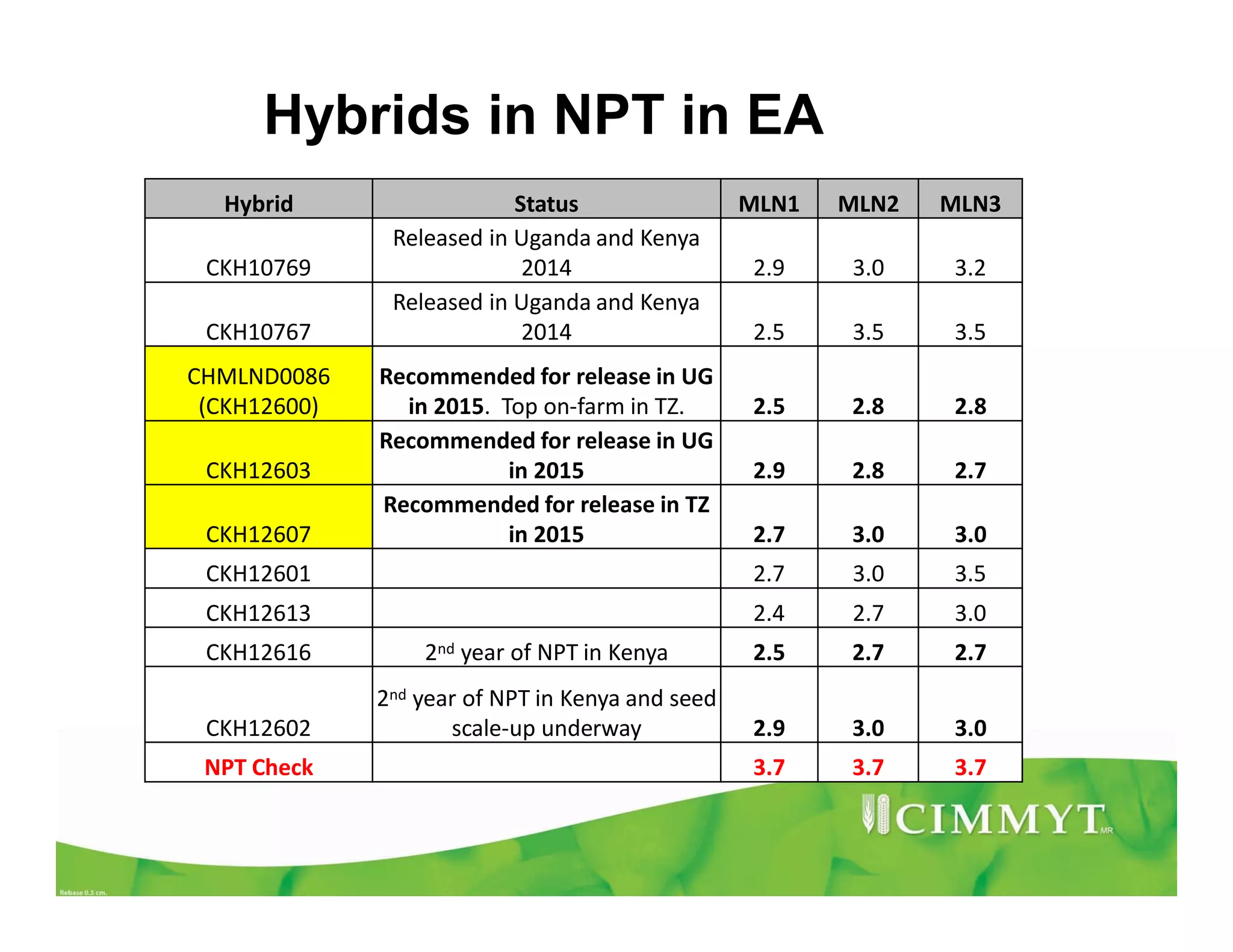
Hybrid Status MLN1 MLN2 MLN3
CKH10769
Released in Uganda and Kenya
2014 2.9 3.0 3.2
CKH10767
Released in Uganda and Kenya
2014 2.5 3.5 3.5
CHMLND0086
(CKH12600)
Recommended for release in UG
in 2015. Top on-farm in TZ. 2.5 2.8 2.8
CKH12603
Recommended for release in UG
in 2015 2.9 2.8 2.7
CKH12607
Recommended for release in TZ
in 2015 2.7 3.0 3.0
CKH12601 2.7 3.0 3.5
CKH12613 2.4 2.7 3.0
CKH12616 2nd year of NPT in Kenya 2.5 2.7 2.7
CKH12602
2nd year of NPT in Kenya and seed
scale-up underway 2.9 3.0 3.0
NPT Check 3.7 3.7 3.7
Hybrids in NPT in EA
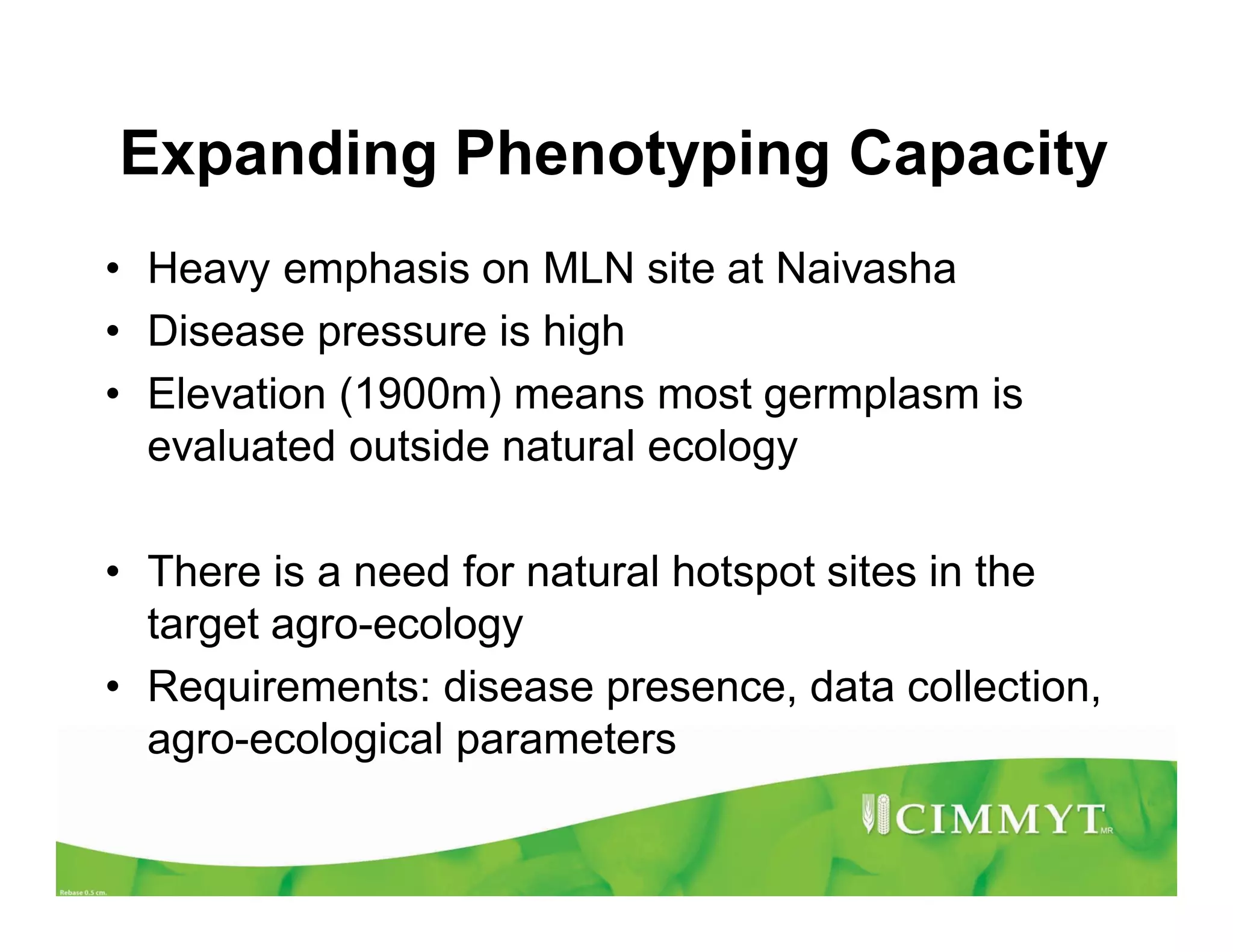
Expanding Phenotyping Capacity
• Heavy emphasis on MLN site at Naivasha
• Disease pressure is high
• Elevation (1900m) means most germplasm is
evaluated outside natural ecology
• There is a need for natural hotspot sites in the
target agro-ecology
• Requirements: disease presence, data collection,
agro-ecological parameters
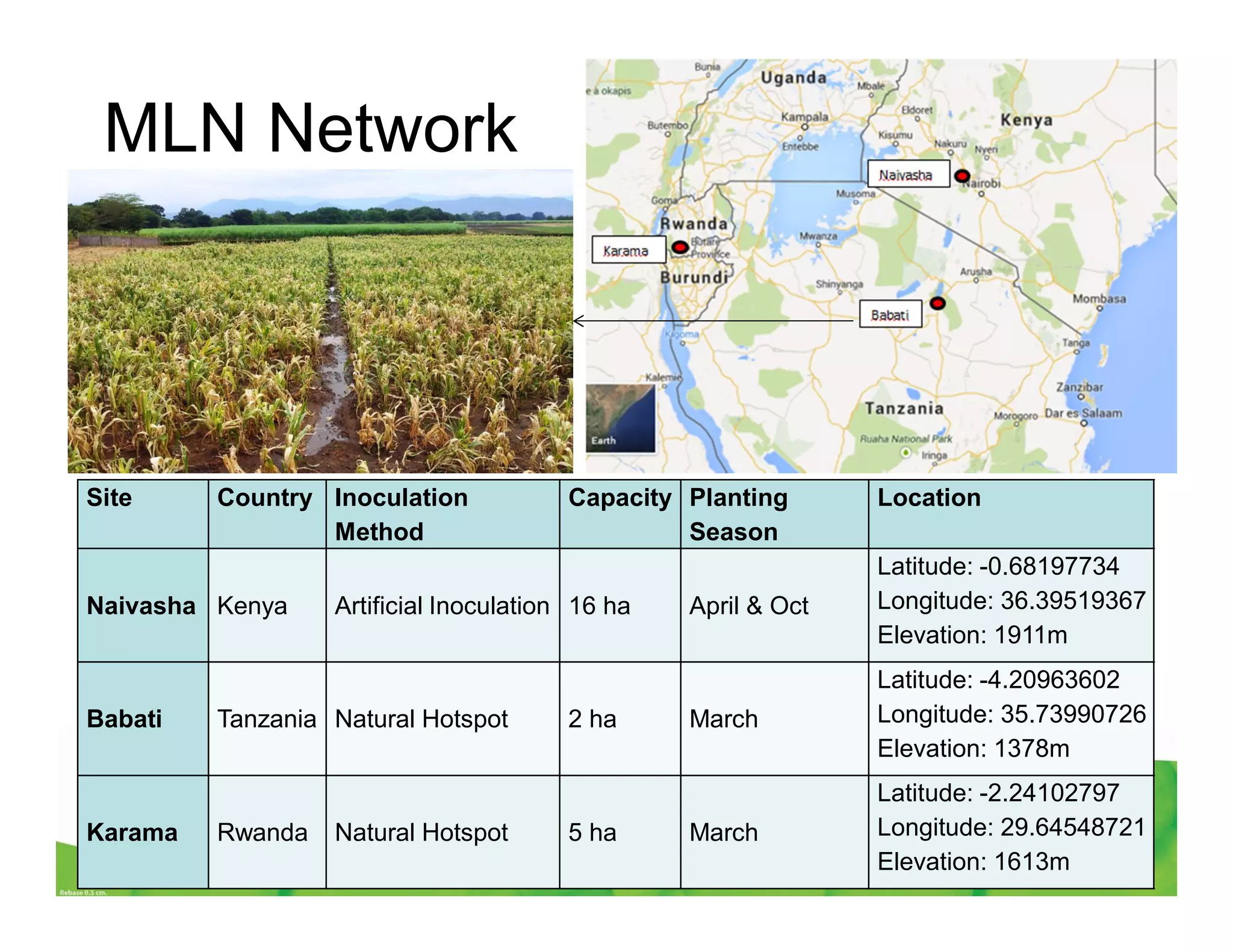
MLN Network
Site Country Inoculation
Method
Capacity Planting
Season
Location
Naivasha Kenya Artificial Inoculation 16 ha April & Oct
Latitude: -0.68197734
Longitude: 36.39519367
Elevation: 1911m
Babati Tanzania Natural Hotspot 2 ha March
Latitude: -4.20963602
Longitude: 35.73990726
Elevation: 1378m
Karama Rwanda Natural Hotspot 5 ha March
Latitude: -2.24102797
Longitude: 29.64548721
Elevation: 1613m
Thank You

MLN Workshop: Breeding for maize lethal necrosis -- B Das

  • 1.
    Breeding for MLNtolerance CIMMYT Africa Biswanath Das, Yoseph Beyene, Stephen Mugo, Manje Gowde, Dan Makumbi, Mike Olsen and BM Prasanna MLN Diagnostic Workshop, Naivasha 17th to 19th March 2015
  • 2.
    CIMMYT’s Collaborative GlobalMaize Program (GMP) GMP Focus: • Maize Breeding for the tropics where maize is an important food crop CIMMYT’s MISSION: To sustainably increase the productivity of maize and wheat systems to ensure global food security and reduce poverty. 30,000 accessions in the CIMMYT genebank – enormous source of genetic diversity. CIMMYT NARS
  • 3.
    GMP Target Traits AbioticStress • Drought • Poor soil fertility/N • Heat • Acid soils • Waterlogging Biotic Stress • Diseases (Turcicum, GLS, Maize Lethal Necrosis, MSV, Ear rots) • Insects (Stemborers, post harvest pests (weevils, grain borers) • Striga (parasitic weed) Nutrition (QPM, VitA) • Host R is just one component of an IPM system Varieties are screened for all traits during the breeding process
  • 4.
    Breeding and Variety Development Phenotyping EliteVariety Evaluation Commercialization Release How we work CIMMYT, IITA, NARS CIMMYT, IITA, NARS, Private Sector CIMMYT, Private Sector, NARS, NGOs Regulatory Bodies, Private Sector/NARS Private Sector/NARS • Maize is different to many crops due to a vibrant seed sector (120 firms in Africa) • CIMMYT does not release varieties • Most hybrids are released by SMEs and MNCs, OPVs by NARS • It can take over 10 years from variety development to commercialization Phenotyping network for: • Drought • Low N • Striga • MSV • MLN
  • 5.
    Artificial infestation of maizeplants with stem borer eggs Past Experience: Stemborers Measuring Leaf Toughness R Traits Leaf damage score (1-9) Tunnel length Exit holes Busseola fusca and Chilo partellus
  • 6.
    Striga work initiatedin 1998 • 2.3 million ha affected by Striga in Africa (AATF, 2006) resulting in yield losses between 20 and 80% • Imidazolinone (herbicide) resistance exists naturally in maize and is easy to work with (single gene) • Conversion of maize inbreds and hybrids to Imidazolinone resistant (IR) versions + herbicide seed coating formulation (BASF) In 2013/14 3 OPVs and 5 hybrids released in Kenya and Tanzania
  • 7.
    Genetic gains -MSV Grain yield (t ha-1) Anthesis date (d) ASI Location Country Year Mean h Mean h Mean h Harare Zimbabwe 2012 5.21 0.79 76.1 0.89 -0.1 0.51 Harare Zimbabwe 2013 7.21 0.72 71.7 0.91 0.6 0.37 Harare Zimbabwe 2013 6.93 0.92 71.6 0.98 0.5 0.41 Combined 6.45 0.82 73.1 0.83 0.3 0.72 Estimated gains in tolerance to MSV: 141.3 kg ha-1 yr-1 (2.2% yr-1)
  • 8.
    Maize Lethal Necrosis(MLN) Symptoms: Severe mottling of leaves, dead heart, stunted growth (shortened internode distance), leaf necrosis and barren ears.
  • 9.
    Why is MLNdevastating maize in EA? • MCMV is new to the region and the current strain is particularly aggressive • Widespread cultivation of susceptible germplasm that has never been screened for MCMV • Very favourable agronomic and environmental conditions
  • 10.
    What has theEA maize breeding community done? 1. Artificial inoculation and screening protocols established in collaboration with OSU 2. MLN screening facility established at KALRO- Naivasha 3. Thousands of maize accessions screened for MLN by public and private sector 4. Promising hybrids have been submitted and recommended for fast track release in Kenya
  • 11.
    Germplasm Evaluation byCIMMYT Screening Year Location Entries Total Rows 1st Screening Nov-12 Olerai and Sunripe Farm 2,636 5,272 2nd Screening Jun-13 Oleria and Marula Farm 8,021 16,042 3rd Screening March-April 2014 KALRO Naivasha 19,539 39,078 4th Screening October 2014 to Date KALRO Naivasha 15,322 20,356 TOTAL 45,518 80,748 Approximately 65% of entries are inbreds.
  • 12.
    Type of GermplasmEvaluated • Diverse Inbred lines from CIMMYT’s Global Maize Program and collaborators (OSU and KU) • Experimental and elite hybrids • DH populations • Biparental mapping populations • Assocation mapping sets
  • 13.
  • 14.
  • 15.
    Breeding Approach • Evaluationof existing elite hybrids for immediate recommendation (eg WE1101) • Identification of donor inbreds • Formation of new hybrid combinations using donor inbreds • Recycling donor inbreds (pedigree, BC, DH) for development of new lines and next generation hybrid combinations
  • 16.
    Inbred screening Bad News: Closeto 90% of materials susceptible Good News: 10% of materials shows some tolerance
  • 17.
    Bad News: Currentelite CMLs collapse against MLN CML442 CML443 CML448 CML444 CML395 Most widely used CML in existing commercial hybrids
  • 18.
    Good News: GeneticVariation Exists Severity Score Frequency in IMAS-AM panel Distribution of Score frequencies indicates disease pressure is satisfactory and genetic progress can be made
  • 19.
    Inbred line Kernelcolor Heterotic Group Max. MLN severity score Disease response rating CLRCY039 Y B 2.0 R CLYN261 Y A 2.0 R CLRCY034 Y B 2.0 R CKDHL120552 W A 2.3 MR CKDHL120161 W B 2.4 MR CKDHL120668 W B 2.4 MR CKDHL120664 W B 2.4 MR CML494 W B 2.5 MR TZMI730* W B 2.5 MR CKDHL120918 W B 2.5 MR CML550 W B 2.6 MR CML543 (CKL05003) W B 2.7 MR CKDHL120671 W B 2.7 MR CLA106 Y B 2.7 MR CKSBL10205 W AB 2.7 MR CKSBL10194 W AB 2.8 MR CML535 (CLA105) Y B 2.8 MR CKSBL10060 W A 2.9 MR CKDHL121310 W B 3.0 MR DTPYC9-F46-1-2-1-2-B Y A 3.0 MR CKDHL0500 W B 3.0 MR Table 1. Responses of selected CIMMYT maize inbred lines to artificial inoculation with MLN at Narok and Naivasha in Kenya (2014)
  • 20.
    Sources of Resistanceare not ideal CLRCY039CLRCY034 • Resistance is coming from unadapted tropical lowland sources from Latin America, SE Asia and from temperate germplasm from the USA. • Most resistant lines tend to be yellow – there appears to be strong linkage between Y-1 and MCMV resistance.
  • 21.
    Line Development Strategy •Resistant lines used directly in pedigree and DH breeding pipelines: Over 900 pedigree starts made in 2014 alone. (F3) • Resistant yellow lines are being converted to white versions by BC. Time consuming as yellow is dominant and MCMV R appears to be closely linked to Y1. (F2) • Elite CMLs (eg CML442, CML444, CML312) are being converted to MLN-tolerant versions through phenotypic selection and MAS (BC2) • DH can speed up the process and increase likelihood of fixing the right gene combinations (DH lines obtained) • We know there are loci for SCMV R on Chr3 and Chr10. Relatively little is known about MCMV R.
  • 22.
    Over 7,000 hybridsscreened in 2014. Around 30 are showing promise for MLN and other traits. These have been submitted for release HYBRID/PRODUCT DEVELOPMENT
  • 23.
    MLN Scores (1-5) EntryPedigree 1 3 4 13 CKH10085 1.8 2.6 2.5 18 CML78/P300C5S1B-2-3-2#-#1-2-B*7-#-B 1.8 2.0 2.6 5 CKIR12014 2.1 2.0 2.7 4 CKIR12010 2.1 2.9 2.8 28 CKH10773 1.7 3.2 2.9 2 CKIR11027 1.9 2.8 3.0 29 H513 3.3 3.9 4.4 30 H520 3.3 3.6 3.6 31 H614 3.2 3.2 3.3 32 H624 2.8 3.2 3.5 33 WH403 3.3 3.6 4.6 34 WH507 3.6 3.3 3.9 35 WH505 3.0 3.5 4.0 36 PAN691 3.6 3.9 3.8 37 PANM419 3.2 3.5 4.4 38 DUMA43 3.5 3.9 4.7 39 PHB30G19 2.1 3.1 3.3 40 DK8031 3.7 4.0 4.7 Mean 2.5 3.3 3.6 LSD 0.85 0.74 0.88 CV 17 11 12 Heritability 0.79 0.71 0.71 Results of hybrid re-validation trials at two locations
  • 24.
  • 25.
    NUE Hybrids inNPT in East Africa Hybrids submitted for release on basis of Low N + MLN scores below 3 Commercial Checks New Hybrids are showing up to a 1 point (20%) improvement compared to checks
  • 26.
    Hybrid Status MLN1MLN2 MLN3 CKH10769 Released in Uganda and Kenya 2014 2.9 3.0 3.2 CKH10767 Released in Uganda and Kenya 2014 2.5 3.5 3.5 CHMLND0086 (CKH12600) Recommended for release in UG in 2015. Top on-farm in TZ. 2.5 2.8 2.8 CKH12603 Recommended for release in UG in 2015 2.9 2.8 2.7 CKH12607 Recommended for release in TZ in 2015 2.7 3.0 3.0 CKH12601 2.7 3.0 3.5 CKH12613 2.4 2.7 3.0 CKH12616 2nd year of NPT in Kenya 2.5 2.7 2.7 CKH12602 2nd year of NPT in Kenya and seed scale-up underway 2.9 3.0 3.0 NPT Check 3.7 3.7 3.7 Hybrids in NPT in EA
  • 27.
    Expanding Phenotyping Capacity •Heavy emphasis on MLN site at Naivasha • Disease pressure is high • Elevation (1900m) means most germplasm is evaluated outside natural ecology • There is a need for natural hotspot sites in the target agro-ecology • Requirements: disease presence, data collection, agro-ecological parameters
  • 28.
    MLN Network Site CountryInoculation Method Capacity Planting Season Location Naivasha Kenya Artificial Inoculation 16 ha April & Oct Latitude: -0.68197734 Longitude: 36.39519367 Elevation: 1911m Babati Tanzania Natural Hotspot 2 ha March Latitude: -4.20963602 Longitude: 35.73990726 Elevation: 1378m Karama Rwanda Natural Hotspot 5 ha March Latitude: -2.24102797 Longitude: 29.64548721 Elevation: 1613m
  • 29.