WEL COME
Strategies to Identify the Quantitative Trait Loci
(QTLs)- Trait Introgression
• Mahesh R Hampannavar
• Ph.D II, PGS16AGR697818/11/2018 Mahesh R Hampannavar (mahi5295@gmail.com)
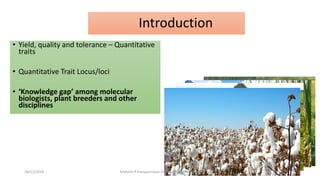
Introduction
• Yield, quality and tolerance – Quantitative
traits
• Quantitative Trait Locus/loci
• ‘Knowledge gap’ among molecular
biologists, plant breeders and other
disciplines
18/11/2018 Mahesh R Hampannavar (mahi5295@gmail.com)
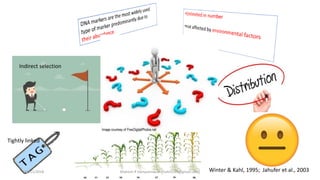
Genetic markers
•
Indirect selection
Tightly linked
Winter & Kahl, 1995; Jahufer et al., 200318/11/2018 Mahesh R Hampannavar (mahi5295@gmail.com)
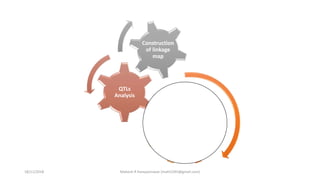
Marker Assisted
Selection
QTLs
Analysis
Construction
of linkage
map
18/11/2018 Mahesh R Hampannavar (mahi5295@gmail.com)
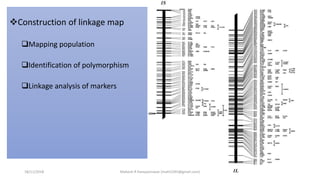
Construction of linkage map
Mapping population
Identification of polymorphism
Linkage analysis of markers
18/11/2018 Mahesh R Hampannavar (mahi5295@gmail.com)
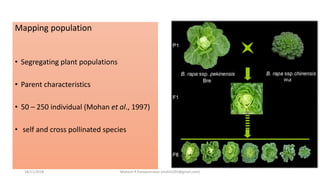
Mapping population
• Segregating plant populations
• Parent characteristics
• 50 – 250 individual (Mohan et al., 1997)
• self and cross pollinated species
18/11/2018 Mahesh R Hampannavar (mahi5295@gmail.com)
What population size should be used?’
• Theoretically, population size can be estimated based on the
statistical power (), hypothetical recombination fraction () and
significance level being used ().
• to estimate without any assumption.
18/11/2018 Mahesh R Hampannavar (mahi5295@gmail.com)
Beavis showed that the average
estimates of phenotypic variances
associated with correctly identified
QTL were greatly overestimated if
only 100 progeny were evaluated,
slightly overestimated if 500 progeny
were evaluated, and fairly close to
the actual magnitude when 1000
progeny were evaluated. This
phenomenon has subsequently been
called the Beavis effect.
•Maximum number of
recombinants
•In practice, population sizes
are still difficult.
•Double edge sword
18/11/2018 Mahesh R Hampannavar (mahi5295@gmail.com)
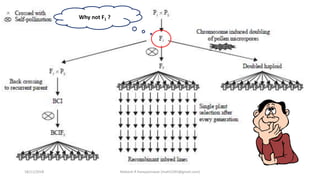
Why not F1 ?
18/11/2018 Mahesh R Hampannavar (mahi5295@gmail.com)
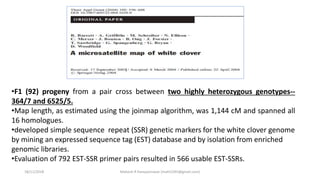
•F1 (92) progeny from a pair cross between two highly heterozygous genotypes--
364/7 and 6525/5.
•Map length, as estimated using the joinmap algorithm, was 1,144 cM and spanned all
16 homologues.
•developed simple sequence repeat (SSR) genetic markers for the white clover genome
by mining an expressed sequence tag (EST) database and by isolation from enriched
genomic libraries.
•Evaluation of 792 EST-SSR primer pairs resulted in 566 usable EST-SSRs.
18/11/2018 Mahesh R Hampannavar (mahi5295@gmail.com)
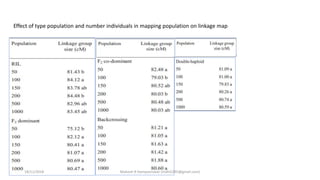
• A hypothetical genome map (one chromosome with nine equidistant molecular
markers) was generated for the following population types:
• F2 with dominant and co-dominant markers, backcrossing, recombinant inbred
lines (RIL) and double-haploid.
• The population sizes were 50, 100, 150, 200, 500 and 1000 individuals and 100
simulations were made for each population.
18/11/2018 Mahesh R Hampannavar (mahi5295@gmail.com)
Effect of type population and number individuals in mapping population on linkage map
18/11/2018 Mahesh R Hampannavar (mahi5295@gmail.com)
.
18/11/2018 Mahesh R Hampannavar (mahi5295@gmail.com)
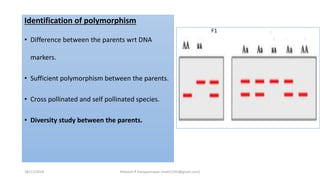
Identification of polymorphism
• Difference between the parents wrt DNA
markers.
• Sufficient polymorphism between the parents.
• Cross pollinated and self pollinated species.
• Diversity study between the parents.
F1
18/11/2018 Mahesh R Hampannavar (mahi5295@gmail.com)
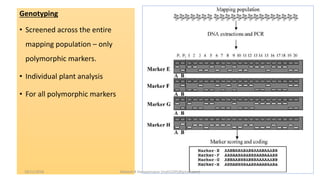
Genotyping
• Screened across the entire
mapping population – only
polymorphic markers.
• Individual plant analysis
• For all polymorphic markers
18/11/2018 Mahesh R Hampannavar (mahi5295@gmail.com)
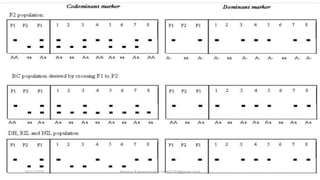
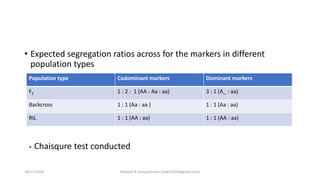
• Expected segregation ratios across for the markers in different
population types
Population type Codominant markers Dominant markers
F2 1 : 2 : 1 (AA : Aa : aa) 3 : 1 (A_ : aa)
Backcross 1 : 1 (Aa : aa ) 1 : 1 (Aa : aa)
RIL 1 : 1 (AA : aa) 1 : 1 (AA : aa)
• Chaisqure test conducted
18/11/2018 Mahesh R Hampannavar (mahi5295@gmail.com)
• higher distorted segregation in the
recombinant inbred line population, it
may mainly result from genetic drift.
statistical bias, genotyping and
scoring errors
(Plomion et al., 1995)
•Biological reasons like chromosome loss, competition among
gametes for preferential fertilization, gametocidal or pollen-killer
genes (abortion of male or female gametes).
•Incompatibility genes.
•chromosome arrangements or nonhomologous.
(Lefebvre et al., 1995)
The distorted segregation may have a gametophyte
selection, genetic drift, cytological attributes, or
biological reason
(Shappley et al. 1998a; Lacape et al. 2003)
Segregation distortion can occur due to different reasons:
18/11/2018 Mahesh R Hampannavar (mahi5295@gmail.com)
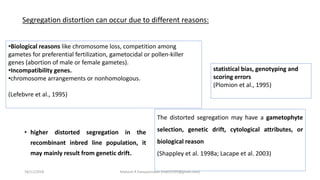
Linkage map
• Linkage and crossing over
• Map distance and order
• Recombination and non recombination
• Linkage between the markers
• r = number of recombinant progeny/total number of progeny
18/11/2018 Mahesh R Hampannavar (mahi5295@gmail.com)
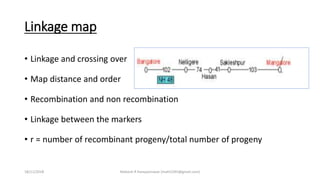
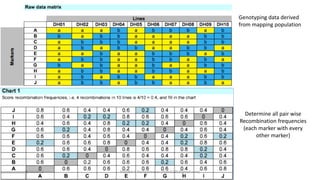
Genotyping data derived
from mapping population
Determine all pair wise
Recombination frequencies
(each marker with every
other marker)
18/11/2018 Mahesh R Hampannavar (mahi5295@gmail.com)
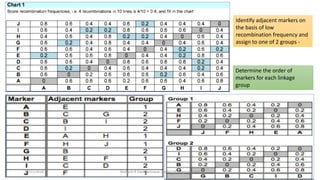
Identify adjacent markers on
the basis of low
recombination frequency and
assign to one of 2 groups -
Determine the order of
markers for each linkage
group
18/11/2018 Mahesh R Hampannavar (mahi5295@gmail.com)
• Population permits the visualization of F1 gametes – test cross, BC and
double haploids
• F2 and F2:3 – maximum like methods, Importance Sampling Methods
and Genealogy Methods
• RILs first calculate the R r = R/[2(1-r)]
18/11/2018 Mahesh R Hampannavar (mahi5295@gmail.com)
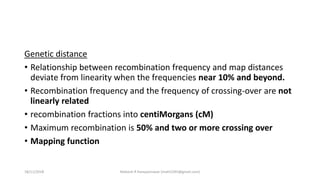
Genetic distance
• Relationship between recombination frequency and map distances
deviate from linearity when the frequencies near 10% and beyond.
• Recombination frequency and the frequency of crossing-over are not
linearly related
• recombination fractions into centiMorgans (cM)
• Maximum recombination is 50% and two or more crossing over
• Mapping function
18/11/2018 Mahesh R Hampannavar (mahi5295@gmail.com)
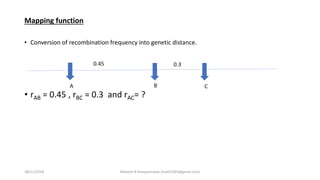
Mapping function
• Conversion of recombination frequency into genetic distance.
• rAB = 0.45 , rBC = 0.3 and rAC= ?
0.45 0.3
A B C
18/11/2018 Mahesh R Hampannavar (mahi5295@gmail.com)
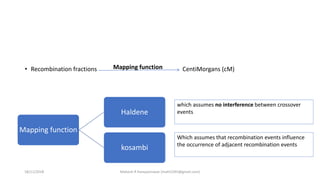
• Recombination fractions CentiMorgans (cM)Mapping function
Mapping function
Haldene
kosambi
which assumes no interference between crossover
events
Which assumes that recombination events influence
the occurrence of adjacent recombination events
18/11/2018 Mahesh R Hampannavar (mahi5295@gmail.com)
The Haldane Distance
• rAC = rAB + rBC
• But multiple crossing over
tend to reduce the
recombination rate between
the genes.
• rAC = rAB + rBC – 2rAB*rBC
• m = -50ln(1-2r)
Kosambi Mapping function
• rAC = rAB + rBC
• multiple crossing over tend to
reduce the recombination rate
between the genes.
• Interference
• Coincidence (denoted by ‘c’)
• rAC = rAB + rBC – 2crAB*rBC
• mk= 25ln[(1+2r)/(1-2r)]
18/11/2018 Mahesh R Hampannavar (mahi5295@gmail.com)
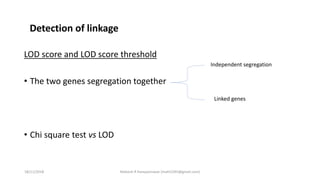
LOD score and LOD score threshold
• The two genes segregation together
• Chi square test vs LOD
Independent segregation
Linked genes
Detection of linkage
18/11/2018 Mahesh R Hampannavar (mahi5295@gmail.com)
AABB X aabb
AaBb X aabb
AaBb, Aabb, aaBb, aabb
9 : 1 : 1 : 9
LOD score (z) = log10 [r(1- )n-r/0.5 n ]
LOD SCORE CALCULATION
18/11/2018 Mahesh R Hampannavar (mahi5295@gmail.com)
• The critical LOD scores used to establish linkage groups and calculate
map distances are called ‘linklod’ and ‘maplod’, respectively.
• Higher critical LOD values will result in more number of fragmented
linkage groups, each with smaller number of markers while small LOD
values will tend to create few linkage groups with large number of
markers per group.
(Stam, 1993b; Ortiz et al., 2001).18/11/2018 Mahesh R Hampannavar (mahi5295@gmail.com)
• Notice that a conservative threshold of the LOD score may lead to
more linkage groups than the haploid chromosome number.
• When constructing a linkage map from scratch (with a set of markers
that have not previously been assigned to linkage groups or
chromosomes) it is always wise to stay ‘at the safe side’ by using a
conservative (= high) LOD threshold.
• This will prevent that groups of markers on different chromosomes
are incorrectly assigned to a single linkage group.
18/11/2018 Mahesh R Hampannavar (mahi5295@gmail.com)
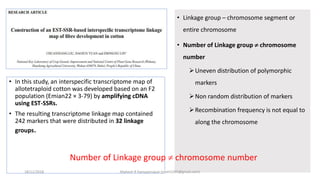
• In this study, an interspecific transcriptome map of
allotetraploid cotton was developed based on an F2
population (Emian22 × 3-79) by amplifying cDNA
using EST-SSRs.
• The resulting transcriptome linkage map contained
242 markers that were distributed in 32 linkage
groups.
• Linkage group – chromosome segment or
entire chromosome
• Number of Linkage group  chromosome
number
Uneven distribution of polymorphic
markers
Non random distribution of markers
Recombination frequency is not equal to
along the chromosome
Number of Linkage group  chromosome number
18/11/2018 Mahesh R Hampannavar (mahi5295@gmail.com)
Linkage map is not directly related to physical
distance of DNA between markers
•Genome size of plants
•This relation varies along the chromosome
•Recombination Hot spot and cold spot
Commonly used Software programs include
• Map-maker/EXP
• MapManager
• JoinMap
18/11/2018 Mahesh R Hampannavar (mahi5295@gmail.com)
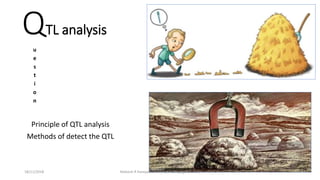
QTL analysis
Principle of QTL analysis
Methods of detect the QTL
u
e
s
t
i
o
n
18/11/2018 Mahesh R Hampannavar (mahi5295@gmail.com)
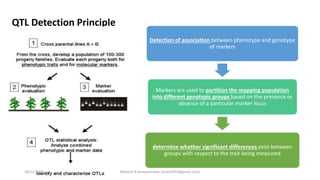
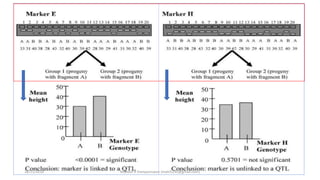
Detection of association between phenotype and genotype
of markers
Markers are used to partition the mapping population
into different genotypic groups based on the presence or
absence of a particular marker locus
determine whether significant differences exist between
groups with respect to the trait being measured
QTL Detection Principle
18/11/2018 Mahesh R Hampannavar (mahi5295@gmail.com)
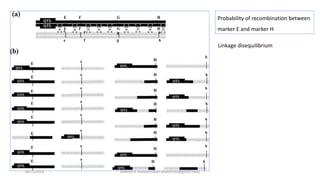
Probability of recombination between
marker E and marker H
Linkage disequilibrium
18/11/2018 Mahesh R Hampannavar (mahi5295@gmail.com)
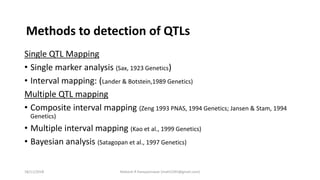
Single QTL Mapping
• Single marker analysis (Sax, 1923 Genetics)
• Interval mapping: (Lander & Botstein,1989 Genetics)
Multiple QTL mapping
• Composite interval mapping (Zeng 1993 PNAS, 1994 Genetics; Jansen & Stam, 1994
Genetics)
• Multiple interval mapping (Kao et al., 1999 Genetics)
• Bayesian analysis (Satagopan et al., 1997 Genetics)
Methods to detection of QTLs
18/11/2018 Mahesh R Hampannavar (mahi5295@gmail.com)
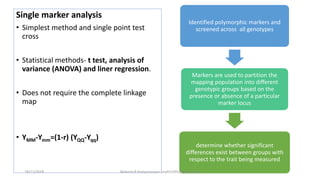
Single marker analysis
• Simplest method and single point test
cross
• Statistical methods- t test, analysis of
variance (ANOVA) and liner regression.
• Does not require the complete linkage
map
• YMM-Ymm=(1-r) (YQQ-Yqq)
Identified polymorphic markers and
screened across all genotypes
Markers are used to partition the
mapping population into different
genotypic groups based on the
presence or absence of a particular
marker locus
determine whether significant
differences exist between groups with
respect to the trait being measured
18/11/2018 Mahesh R Hampannavar (mahi5295@gmail.com)
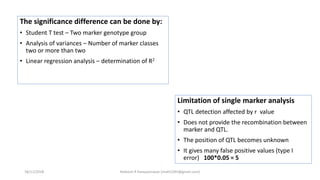
The significance difference can be done by:
• Student T test – Two marker genotype group
• Analysis of variances – Number of marker classes
two or more than two
• Linear regression analysis – determination of R2
Limitation of single marker analysis
• QTL detection affected by r value
• Does not provide the recombination between
marker and QTL.
• The position of QTL becomes unknown
• It gives many false positive values (type I
error) 100*0.05 = 5
18/11/2018 Mahesh R Hampannavar (mahi5295@gmail.com)
• single marker analysis
18/11/2018 Mahesh R Hampannavar (mahi5295@gmail.com)
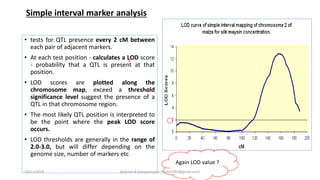
• tests for QTL presence every 2 cM between
each pair of adjacent markers.
• At each test position - calculates a LOD score
- probability that a QTL is present at that
position.
• LOD scores are plotted along the
chromosome map, exceed a threshold
significance level suggest the presence of a
QTL in that chromosome region.
• The most likely QTL position is interpreted to
be the point where the peak LOD score
occurs.
• LOD thresholds are generally in the range of
2.0-3.0, but will differ depending on the
genome size, number of markers etc
Simple interval marker analysis
Again LOD value ?
18/11/2018 Mahesh R Hampannavar (mahi5295@gmail.com)
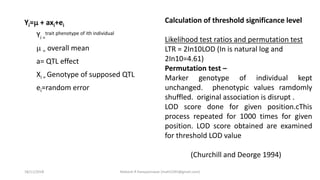
Yi= + axi+ei
Yi =
trait phenotype of ith individual
 = overall mean
a= QTL effect
Xi = Genotype of supposed QTL
ei=random error
Calculation of threshold significance level
Likelihood test ratios and permutation test
LTR = 2In10LOD (In is natural log and
2In10=4.61)
Permutation test –
Marker genotype of individual kept
unchanged. phenotypic values ramdomly
shuffled. original association is disrupt .
LOD score done for given position.cThis
process repeated for 1000 times for given
position. LOD score obtained are examined
for threshold LOD value
(Churchill and Deorge 1994)
18/11/2018 Mahesh R Hampannavar (mahi5295@gmail.com)
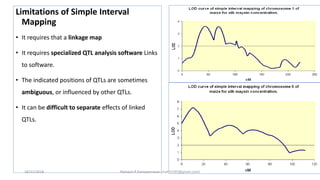
Limitations of Simple Interval
Mapping
• It requires that a linkage map
• It requires specialized QTL analysis software Links
to software.
• The indicated positions of QTLs are sometimes
ambiguous, or influenced by other QTLs.
• It can be difficult to separate effects of linked
QTLs.
18/11/2018 Mahesh R Hampannavar (mahi5295@gmail.com)
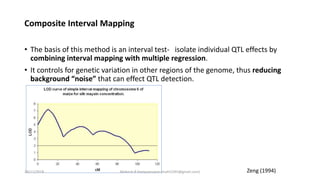
Composite Interval Mapping
• The basis of this method is an interval test- isolate individual QTL effects by
combining interval mapping with multiple regression.
• It controls for genetic variation in other regions of the genome, thus reducing
background “noise” that can effect QTL detection.
Zeng (1994)18/11/2018 Mahesh R Hampannavar (mahi5295@gmail.com)
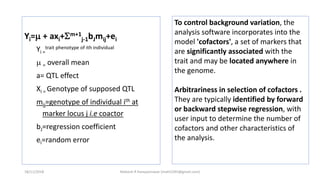
Yi= + axi+m+1
j-1bJmij+ei
Yi =
trait phenotype of ith individual
 = overall mean
a= QTL effect
Xi = Genotype of supposed QTL
mij=genotype of individual ith at
marker locus j i.e coactor
bJ=regression coefficient
ei=random error
To control background variation, the
analysis software incorporates into the
model 'cofactors', a set of markers that
are significantly associated with the
trait and may be located anywhere in
the genome.
Arbitrariness in selection of cofactors .
They are typically identified by forward
or backward stepwise regression, with
user input to determine the number of
cofactors and other characteristics of
the analysis.
18/11/2018 Mahesh R Hampannavar (mahi5295@gmail.com)
Limitation of CIM
• Arbitrariness in the selection of cofactors
of QTL.
• Unable to detect the interacting the QTL i.e
epistasis QTLs.
•CIM is relatively easy method.
•Most widely used method in biparental
mapping population
18/11/2018 Mahesh R Hampannavar (mahi5295@gmail.com)
• Modification of CIM
Inclusive CIM – removing the arbitrariness in selection of cofactors.
Joint Inclusive CIM - it used in the multiple parents that have one common
parent i.e Nested association mapping.
18/11/2018 Mahesh R Hampannavar (mahi5295@gmail.com)
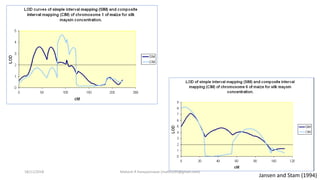
Jansen and Stam (1994)
18/11/2018 Mahesh R Hampannavar (mahi5295@gmail.com)
Results Obtained from SIM and CIM
• Measure of statistical significance: LOD score or likelihood ratio
• Percent variance explained (%R2)
• Source of desirable alleles (Parent A or Parent B)
• Estimates of additive and dominance effects
18/11/2018 Mahesh R Hampannavar (mahi5295@gmail.com)
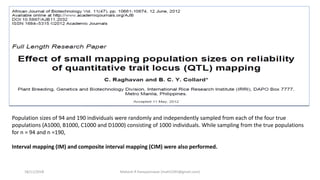
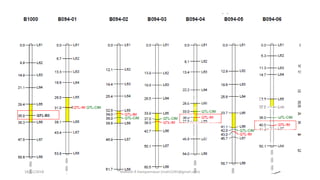
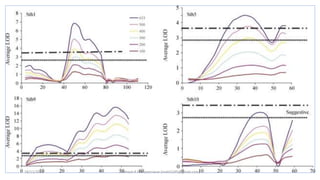
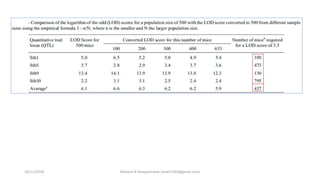
Population sizes of 94 and 190 individuals were randomly and independently sampled from each of the four true
populations (A1000, B1000, C1000 and D1000) consisting of 1000 individuals. While sampling from the true populations
for n = 94 and n =190,
Interval mapping (IM) and composite interval mapping (CIM) were also performed.
18/11/2018 Mahesh R Hampannavar (mahi5295@gmail.com)
More
importantly,
R2 values
were
overestimated
or
underestimate
d.
More
importantly,
R2 values
were
overestimated
or
underestimate
d.
18/11/2018 Mahesh R Hampannavar (mahi5295@gmail.com)
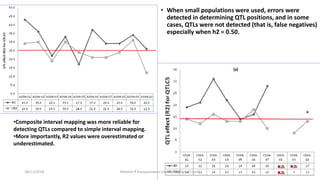
•Composite interval mapping was more reliable for
detecting QTLs compared to simple interval mapping.
•More importantly, R2 values were overestimated or
underestimated.
• When small populations were used, errors were
detected in determining QTL positions, and in some
cases, QTLs were not detected (that is, false negatives)
especially when h2 = 0.50.
18/11/2018 Mahesh R Hampannavar (mahi5295@gmail.com)
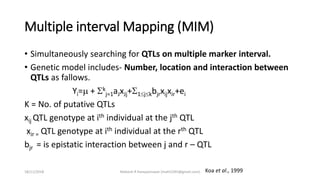
Multiple interval Mapping (MIM)
• Simultaneously searching for QTLs on multiple marker interval.
• Genetic model includes- Number, location and interaction between
QTLs as fallows.
Yi= + k
j=1aJxJj+1jkbjrxijxir+ei
K = No. of putative QTLs
xij QTL genotype at ith individual at the jth QTL
xir = QTL genotype at ith individual at the rth QTL
bjr = is epistatic interaction between j and r – QTL
Koa et al., 199918/11/2018 Mahesh R Hampannavar (mahi5295@gmail.com)
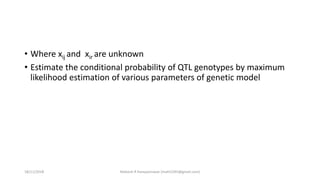
• Where xij and xir are unknown
• Estimate the conditional probability of QTL genotypes by maximum
likelihood estimation of various parameters of genetic model
18/11/2018 Mahesh R Hampannavar (mahi5295@gmail.com)
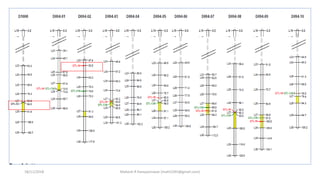
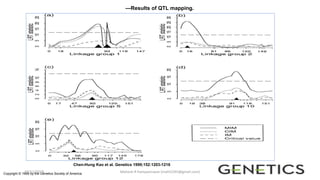
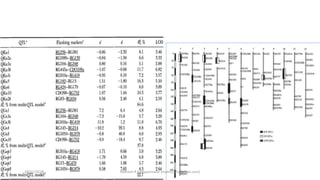
—Results of QTL mapping.
Chen-Hung Kao et al. Genetics 1999;152:1203-1216
Copyright © 1999 by the Genetics Society of America
18/11/2018 Mahesh R Hampannavar (mahi5295@gmail.com)
Limitation of MIM
• As the number of QTL included in the model is increased as a result
MIM computationally intensive.
• Selection appropriate model is difficult.
18/11/2018 Mahesh R Hampannavar (mahi5295@gmail.com)
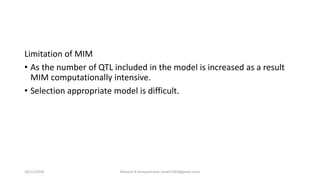
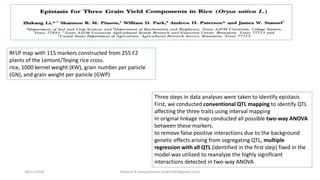
RFLP map with 115 markers constructed from 255 F2
plants of the Lemont/Teqing rice cross.
rice, 1000 kernel weight (KW), grain number per panicle
(GN), and grain weight per panicle (GWP)
Three steps in data analyses were taken to identify epistasis
First, we conducted conventional QTL mapping to identify QTL
affecting the three traits using interval mapping
In original linkage map conducted all possible two-way ANOVA
between these markers.
to remove false positive interactions due to the background
genetic effects arising from segregating QTL, multiple
regression with all QTL (identified in the first step) fixed in the
model was utilized to reanalyze the highly significant
interactions detected in two-way ANOVA
18/11/2018 Mahesh R Hampannavar (mahi5295@gmail.com)
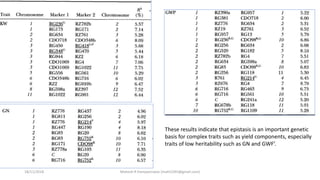
These results indicate that epistasis is an important genetic
basis for complex traits such as yield components, especially
traits of low heritability such as GN and GWF’.
18/11/2018 Mahesh R Hampannavar (mahi5295@gmail.com)
Bayesian Multiple QTL Mapping
• Both CIM and Bayesian mapping uses the maximum likelihood
function.
• When high density map are available and the genotypic data nearly
completed.
• The prior distribution is selected from which posterior distribution is
derived.
• In case of biparental mapping when population is less than hundred
• Null hypothesis is – QTL present in the marker interval.
18/11/2018 Mahesh R Hampannavar (mahi5295@gmail.com)
Disadvantages of Bayesian Multiple mapping
• Difficulty in choosing the prior distribution.
• computation of posterior distribution is difficult.
• Lack of user friendly software.
18/11/2018 Mahesh R Hampannavar (mahi5295@gmail.com)
Software analysis for QTL mapping
• mapMaker/QTL
• PLABQTL
• QTL Cartographer
• MapManagerQT/QTX
• R/QTL
• R/QTLBIM
• QTL Express
• FlexQTL
• INTERQTL
• MCQTL
• Qgene
• QTLICIMapping
18/11/2018 Mahesh R Hampannavar (mahi5295@gmail.com)
•Conclusions
18/11/2018 Mahesh R Hampannavar (mahi5295@gmail.com)
•Thank you
18/11/2018 Mahesh R Hampannavar (mahi5295@gmail.com)

Quantitative Trait LOci (QTLs) Mapping: Basics procedure, principle and Methods

  • 1.
  • 2.
    Strategies to Identifythe Quantitative Trait Loci (QTLs)- Trait Introgression • Mahesh R Hampannavar • Ph.D II, PGS16AGR697818/11/2018 Mahesh R Hampannavar (mahi5295@gmail.com)
  • 3.
    Introduction • Yield, qualityand tolerance – Quantitative traits • Quantitative Trait Locus/loci • ‘Knowledge gap’ among molecular biologists, plant breeders and other disciplines 18/11/2018 Mahesh R Hampannavar (mahi5295@gmail.com)
  • 4.
    18/11/2018 Mahesh RHampannavar (mahi5295@gmail.com)
  • 5.
    Genetic markers • Indirect selection Tightlylinked Winter & Kahl, 1995; Jahufer et al., 200318/11/2018 Mahesh R Hampannavar (mahi5295@gmail.com)
  • 6.
  • 7.
    Construction of linkagemap Mapping population Identification of polymorphism Linkage analysis of markers 18/11/2018 Mahesh R Hampannavar (mahi5295@gmail.com)
  • 8.
    Mapping population • Segregatingplant populations • Parent characteristics • 50 – 250 individual (Mohan et al., 1997) • self and cross pollinated species 18/11/2018 Mahesh R Hampannavar (mahi5295@gmail.com)
  • 9.
    What population sizeshould be used?’ • Theoretically, population size can be estimated based on the statistical power (), hypothetical recombination fraction () and significance level being used (). • to estimate without any assumption. 18/11/2018 Mahesh R Hampannavar (mahi5295@gmail.com)
  • 10.
    Beavis showed thatthe average estimates of phenotypic variances associated with correctly identified QTL were greatly overestimated if only 100 progeny were evaluated, slightly overestimated if 500 progeny were evaluated, and fairly close to the actual magnitude when 1000 progeny were evaluated. This phenomenon has subsequently been called the Beavis effect. •Maximum number of recombinants •In practice, population sizes are still difficult. •Double edge sword 18/11/2018 Mahesh R Hampannavar (mahi5295@gmail.com)
  • 11.
    Why not F1? 18/11/2018 Mahesh R Hampannavar (mahi5295@gmail.com)
  • 12.
    •F1 (92) progenyfrom a pair cross between two highly heterozygous genotypes-- 364/7 and 6525/5. •Map length, as estimated using the joinmap algorithm, was 1,144 cM and spanned all 16 homologues. •developed simple sequence repeat (SSR) genetic markers for the white clover genome by mining an expressed sequence tag (EST) database and by isolation from enriched genomic libraries. •Evaluation of 792 EST-SSR primer pairs resulted in 566 usable EST-SSRs. 18/11/2018 Mahesh R Hampannavar (mahi5295@gmail.com)
  • 13.
    • A hypotheticalgenome map (one chromosome with nine equidistant molecular markers) was generated for the following population types: • F2 with dominant and co-dominant markers, backcrossing, recombinant inbred lines (RIL) and double-haploid. • The population sizes were 50, 100, 150, 200, 500 and 1000 individuals and 100 simulations were made for each population. 18/11/2018 Mahesh R Hampannavar (mahi5295@gmail.com)
  • 14.
    Effect of typepopulation and number individuals in mapping population on linkage map 18/11/2018 Mahesh R Hampannavar (mahi5295@gmail.com)
  • 15.
    . 18/11/2018 Mahesh RHampannavar (mahi5295@gmail.com)
  • 16.
    18/11/2018 Mahesh RHampannavar (mahi5295@gmail.com)
  • 17.
    18/11/2018 Mahesh RHampannavar (mahi5295@gmail.com)
  • 18.
    Identification of polymorphism •Difference between the parents wrt DNA markers. • Sufficient polymorphism between the parents. • Cross pollinated and self pollinated species. • Diversity study between the parents. F1 18/11/2018 Mahesh R Hampannavar (mahi5295@gmail.com)
  • 19.
    Genotyping • Screened acrossthe entire mapping population – only polymorphic markers. • Individual plant analysis • For all polymorphic markers 18/11/2018 Mahesh R Hampannavar (mahi5295@gmail.com)
  • 20.
    18/11/2018 Mahesh RHampannavar (mahi5295@gmail.com)
  • 21.
    • Expected segregationratios across for the markers in different population types Population type Codominant markers Dominant markers F2 1 : 2 : 1 (AA : Aa : aa) 3 : 1 (A_ : aa) Backcross 1 : 1 (Aa : aa ) 1 : 1 (Aa : aa) RIL 1 : 1 (AA : aa) 1 : 1 (AA : aa) • Chaisqure test conducted 18/11/2018 Mahesh R Hampannavar (mahi5295@gmail.com)
  • 22.
    • higher distortedsegregation in the recombinant inbred line population, it may mainly result from genetic drift. statistical bias, genotyping and scoring errors (Plomion et al., 1995) •Biological reasons like chromosome loss, competition among gametes for preferential fertilization, gametocidal or pollen-killer genes (abortion of male or female gametes). •Incompatibility genes. •chromosome arrangements or nonhomologous. (Lefebvre et al., 1995) The distorted segregation may have a gametophyte selection, genetic drift, cytological attributes, or biological reason (Shappley et al. 1998a; Lacape et al. 2003) Segregation distortion can occur due to different reasons: 18/11/2018 Mahesh R Hampannavar (mahi5295@gmail.com)
  • 23.
    Linkage map • Linkageand crossing over • Map distance and order • Recombination and non recombination • Linkage between the markers • r = number of recombinant progeny/total number of progeny 18/11/2018 Mahesh R Hampannavar (mahi5295@gmail.com)
  • 24.
    Genotyping data derived frommapping population Determine all pair wise Recombination frequencies (each marker with every other marker) 18/11/2018 Mahesh R Hampannavar (mahi5295@gmail.com)
  • 25.
    Identify adjacent markerson the basis of low recombination frequency and assign to one of 2 groups - Determine the order of markers for each linkage group 18/11/2018 Mahesh R Hampannavar (mahi5295@gmail.com)
  • 26.
    • Population permitsthe visualization of F1 gametes – test cross, BC and double haploids • F2 and F2:3 – maximum like methods, Importance Sampling Methods and Genealogy Methods • RILs first calculate the R r = R/[2(1-r)] 18/11/2018 Mahesh R Hampannavar (mahi5295@gmail.com)
  • 27.
    Genetic distance • Relationshipbetween recombination frequency and map distances deviate from linearity when the frequencies near 10% and beyond. • Recombination frequency and the frequency of crossing-over are not linearly related • recombination fractions into centiMorgans (cM) • Maximum recombination is 50% and two or more crossing over • Mapping function 18/11/2018 Mahesh R Hampannavar (mahi5295@gmail.com)
  • 28.
    Mapping function • Conversionof recombination frequency into genetic distance. • rAB = 0.45 , rBC = 0.3 and rAC= ? 0.45 0.3 A B C 18/11/2018 Mahesh R Hampannavar (mahi5295@gmail.com)
  • 29.
    • Recombination fractionsCentiMorgans (cM)Mapping function Mapping function Haldene kosambi which assumes no interference between crossover events Which assumes that recombination events influence the occurrence of adjacent recombination events 18/11/2018 Mahesh R Hampannavar (mahi5295@gmail.com)
  • 30.
    The Haldane Distance •rAC = rAB + rBC • But multiple crossing over tend to reduce the recombination rate between the genes. • rAC = rAB + rBC – 2rAB*rBC • m = -50ln(1-2r) Kosambi Mapping function • rAC = rAB + rBC • multiple crossing over tend to reduce the recombination rate between the genes. • Interference • Coincidence (denoted by ‘c’) • rAC = rAB + rBC – 2crAB*rBC • mk= 25ln[(1+2r)/(1-2r)] 18/11/2018 Mahesh R Hampannavar (mahi5295@gmail.com)
  • 31.
    LOD score andLOD score threshold • The two genes segregation together • Chi square test vs LOD Independent segregation Linked genes Detection of linkage 18/11/2018 Mahesh R Hampannavar (mahi5295@gmail.com)
  • 32.
    AABB X aabb AaBbX aabb AaBb, Aabb, aaBb, aabb 9 : 1 : 1 : 9 LOD score (z) = log10 [r(1- )n-r/0.5 n ] LOD SCORE CALCULATION 18/11/2018 Mahesh R Hampannavar (mahi5295@gmail.com)
  • 33.
    • The criticalLOD scores used to establish linkage groups and calculate map distances are called ‘linklod’ and ‘maplod’, respectively. • Higher critical LOD values will result in more number of fragmented linkage groups, each with smaller number of markers while small LOD values will tend to create few linkage groups with large number of markers per group. (Stam, 1993b; Ortiz et al., 2001).18/11/2018 Mahesh R Hampannavar (mahi5295@gmail.com)
  • 34.
    • Notice thata conservative threshold of the LOD score may lead to more linkage groups than the haploid chromosome number. • When constructing a linkage map from scratch (with a set of markers that have not previously been assigned to linkage groups or chromosomes) it is always wise to stay ‘at the safe side’ by using a conservative (= high) LOD threshold. • This will prevent that groups of markers on different chromosomes are incorrectly assigned to a single linkage group. 18/11/2018 Mahesh R Hampannavar (mahi5295@gmail.com)
  • 35.
    • In thisstudy, an interspecific transcriptome map of allotetraploid cotton was developed based on an F2 population (Emian22 × 3-79) by amplifying cDNA using EST-SSRs. • The resulting transcriptome linkage map contained 242 markers that were distributed in 32 linkage groups. • Linkage group – chromosome segment or entire chromosome • Number of Linkage group  chromosome number Uneven distribution of polymorphic markers Non random distribution of markers Recombination frequency is not equal to along the chromosome Number of Linkage group  chromosome number 18/11/2018 Mahesh R Hampannavar (mahi5295@gmail.com)
  • 36.
    Linkage map isnot directly related to physical distance of DNA between markers •Genome size of plants •This relation varies along the chromosome •Recombination Hot spot and cold spot Commonly used Software programs include • Map-maker/EXP • MapManager • JoinMap 18/11/2018 Mahesh R Hampannavar (mahi5295@gmail.com)
  • 37.
    QTL analysis Principle ofQTL analysis Methods of detect the QTL u e s t i o n 18/11/2018 Mahesh R Hampannavar (mahi5295@gmail.com)
  • 38.
    Detection of associationbetween phenotype and genotype of markers Markers are used to partition the mapping population into different genotypic groups based on the presence or absence of a particular marker locus determine whether significant differences exist between groups with respect to the trait being measured QTL Detection Principle 18/11/2018 Mahesh R Hampannavar (mahi5295@gmail.com)
  • 39.
    18/11/2018 Mahesh RHampannavar (mahi5295@gmail.com)
  • 40.
    Probability of recombinationbetween marker E and marker H Linkage disequilibrium 18/11/2018 Mahesh R Hampannavar (mahi5295@gmail.com)
  • 41.
    Single QTL Mapping •Single marker analysis (Sax, 1923 Genetics) • Interval mapping: (Lander & Botstein,1989 Genetics) Multiple QTL mapping • Composite interval mapping (Zeng 1993 PNAS, 1994 Genetics; Jansen & Stam, 1994 Genetics) • Multiple interval mapping (Kao et al., 1999 Genetics) • Bayesian analysis (Satagopan et al., 1997 Genetics) Methods to detection of QTLs 18/11/2018 Mahesh R Hampannavar (mahi5295@gmail.com)
  • 42.
    Single marker analysis •Simplest method and single point test cross • Statistical methods- t test, analysis of variance (ANOVA) and liner regression. • Does not require the complete linkage map • YMM-Ymm=(1-r) (YQQ-Yqq) Identified polymorphic markers and screened across all genotypes Markers are used to partition the mapping population into different genotypic groups based on the presence or absence of a particular marker locus determine whether significant differences exist between groups with respect to the trait being measured 18/11/2018 Mahesh R Hampannavar (mahi5295@gmail.com)
  • 43.
    The significance differencecan be done by: • Student T test – Two marker genotype group • Analysis of variances – Number of marker classes two or more than two • Linear regression analysis – determination of R2 Limitation of single marker analysis • QTL detection affected by r value • Does not provide the recombination between marker and QTL. • The position of QTL becomes unknown • It gives many false positive values (type I error) 100*0.05 = 5 18/11/2018 Mahesh R Hampannavar (mahi5295@gmail.com)
  • 44.
    • single markeranalysis 18/11/2018 Mahesh R Hampannavar (mahi5295@gmail.com)
  • 45.
    • tests forQTL presence every 2 cM between each pair of adjacent markers. • At each test position - calculates a LOD score - probability that a QTL is present at that position. • LOD scores are plotted along the chromosome map, exceed a threshold significance level suggest the presence of a QTL in that chromosome region. • The most likely QTL position is interpreted to be the point where the peak LOD score occurs. • LOD thresholds are generally in the range of 2.0-3.0, but will differ depending on the genome size, number of markers etc Simple interval marker analysis Again LOD value ? 18/11/2018 Mahesh R Hampannavar (mahi5295@gmail.com)
  • 46.
    Yi= + axi+ei Yi= trait phenotype of ith individual  = overall mean a= QTL effect Xi = Genotype of supposed QTL ei=random error Calculation of threshold significance level Likelihood test ratios and permutation test LTR = 2In10LOD (In is natural log and 2In10=4.61) Permutation test – Marker genotype of individual kept unchanged. phenotypic values ramdomly shuffled. original association is disrupt . LOD score done for given position.cThis process repeated for 1000 times for given position. LOD score obtained are examined for threshold LOD value (Churchill and Deorge 1994) 18/11/2018 Mahesh R Hampannavar (mahi5295@gmail.com)
  • 47.
    Limitations of SimpleInterval Mapping • It requires that a linkage map • It requires specialized QTL analysis software Links to software. • The indicated positions of QTLs are sometimes ambiguous, or influenced by other QTLs. • It can be difficult to separate effects of linked QTLs. 18/11/2018 Mahesh R Hampannavar (mahi5295@gmail.com)
  • 48.
    Composite Interval Mapping •The basis of this method is an interval test- isolate individual QTL effects by combining interval mapping with multiple regression. • It controls for genetic variation in other regions of the genome, thus reducing background “noise” that can effect QTL detection. Zeng (1994)18/11/2018 Mahesh R Hampannavar (mahi5295@gmail.com)
  • 49.
    Yi= + axi+m+1 j-1bJmij+ei Yi= trait phenotype of ith individual  = overall mean a= QTL effect Xi = Genotype of supposed QTL mij=genotype of individual ith at marker locus j i.e coactor bJ=regression coefficient ei=random error To control background variation, the analysis software incorporates into the model 'cofactors', a set of markers that are significantly associated with the trait and may be located anywhere in the genome. Arbitrariness in selection of cofactors . They are typically identified by forward or backward stepwise regression, with user input to determine the number of cofactors and other characteristics of the analysis. 18/11/2018 Mahesh R Hampannavar (mahi5295@gmail.com)
  • 50.
    Limitation of CIM •Arbitrariness in the selection of cofactors of QTL. • Unable to detect the interacting the QTL i.e epistasis QTLs. •CIM is relatively easy method. •Most widely used method in biparental mapping population 18/11/2018 Mahesh R Hampannavar (mahi5295@gmail.com)
  • 51.
    • Modification ofCIM Inclusive CIM – removing the arbitrariness in selection of cofactors. Joint Inclusive CIM - it used in the multiple parents that have one common parent i.e Nested association mapping. 18/11/2018 Mahesh R Hampannavar (mahi5295@gmail.com)
  • 52.
    Jansen and Stam(1994) 18/11/2018 Mahesh R Hampannavar (mahi5295@gmail.com)
  • 53.
    Results Obtained fromSIM and CIM • Measure of statistical significance: LOD score or likelihood ratio • Percent variance explained (%R2) • Source of desirable alleles (Parent A or Parent B) • Estimates of additive and dominance effects 18/11/2018 Mahesh R Hampannavar (mahi5295@gmail.com)
  • 54.
    Population sizes of94 and 190 individuals were randomly and independently sampled from each of the four true populations (A1000, B1000, C1000 and D1000) consisting of 1000 individuals. While sampling from the true populations for n = 94 and n =190, Interval mapping (IM) and composite interval mapping (CIM) were also performed. 18/11/2018 Mahesh R Hampannavar (mahi5295@gmail.com)
  • 55.
  • 56.
    18/11/2018 Mahesh RHampannavar (mahi5295@gmail.com)
  • 57.
    •Composite interval mappingwas more reliable for detecting QTLs compared to simple interval mapping. •More importantly, R2 values were overestimated or underestimated. • When small populations were used, errors were detected in determining QTL positions, and in some cases, QTLs were not detected (that is, false negatives) especially when h2 = 0.50. 18/11/2018 Mahesh R Hampannavar (mahi5295@gmail.com)
  • 58.
    Multiple interval Mapping(MIM) • Simultaneously searching for QTLs on multiple marker interval. • Genetic model includes- Number, location and interaction between QTLs as fallows. Yi= + k j=1aJxJj+1jkbjrxijxir+ei K = No. of putative QTLs xij QTL genotype at ith individual at the jth QTL xir = QTL genotype at ith individual at the rth QTL bjr = is epistatic interaction between j and r – QTL Koa et al., 199918/11/2018 Mahesh R Hampannavar (mahi5295@gmail.com)
  • 59.
    • Where xijand xir are unknown • Estimate the conditional probability of QTL genotypes by maximum likelihood estimation of various parameters of genetic model 18/11/2018 Mahesh R Hampannavar (mahi5295@gmail.com)
  • 60.
    —Results of QTLmapping. Chen-Hung Kao et al. Genetics 1999;152:1203-1216 Copyright © 1999 by the Genetics Society of America 18/11/2018 Mahesh R Hampannavar (mahi5295@gmail.com)
  • 61.
    Limitation of MIM •As the number of QTL included in the model is increased as a result MIM computationally intensive. • Selection appropriate model is difficult. 18/11/2018 Mahesh R Hampannavar (mahi5295@gmail.com)
  • 62.
    RFLP map with115 markers constructed from 255 F2 plants of the Lemont/Teqing rice cross. rice, 1000 kernel weight (KW), grain number per panicle (GN), and grain weight per panicle (GWP) Three steps in data analyses were taken to identify epistasis First, we conducted conventional QTL mapping to identify QTL affecting the three traits using interval mapping In original linkage map conducted all possible two-way ANOVA between these markers. to remove false positive interactions due to the background genetic effects arising from segregating QTL, multiple regression with all QTL (identified in the first step) fixed in the model was utilized to reanalyze the highly significant interactions detected in two-way ANOVA 18/11/2018 Mahesh R Hampannavar (mahi5295@gmail.com)
  • 63.
    18/11/2018 Mahesh RHampannavar (mahi5295@gmail.com)
  • 64.
    These results indicatethat epistasis is an important genetic basis for complex traits such as yield components, especially traits of low heritability such as GN and GWF’. 18/11/2018 Mahesh R Hampannavar (mahi5295@gmail.com)
  • 65.
    Bayesian Multiple QTLMapping • Both CIM and Bayesian mapping uses the maximum likelihood function. • When high density map are available and the genotypic data nearly completed. • The prior distribution is selected from which posterior distribution is derived. • In case of biparental mapping when population is less than hundred • Null hypothesis is – QTL present in the marker interval. 18/11/2018 Mahesh R Hampannavar (mahi5295@gmail.com)
  • 66.
    Disadvantages of BayesianMultiple mapping • Difficulty in choosing the prior distribution. • computation of posterior distribution is difficult. • Lack of user friendly software. 18/11/2018 Mahesh R Hampannavar (mahi5295@gmail.com)
  • 67.
    Software analysis forQTL mapping • mapMaker/QTL • PLABQTL • QTL Cartographer • MapManagerQT/QTX • R/QTL • R/QTLBIM • QTL Express • FlexQTL • INTERQTL • MCQTL • Qgene • QTLICIMapping 18/11/2018 Mahesh R Hampannavar (mahi5295@gmail.com)
  • 68.
    •Conclusions 18/11/2018 Mahesh RHampannavar (mahi5295@gmail.com)
  • 69.
    •Thank you 18/11/2018 MaheshR Hampannavar (mahi5295@gmail.com)

Editor's Notes

  • #4 Many agriculturally important traits such as yield, quality and some forms of disease resistance are controlled by many genes and are knownas quantitative traits. The regions within genomes that contain genes associated with a particular quantitative trait are known as quantitative trait loci (QTLs). The process of constructing linkage maps and conducting QTL analysis–to identify genomic regions associated with traits–is known as QTL mapping
  • #6 Generally, they do not represent the target genes themselves but act as ‘signs’ or ‘flags’. Genetic markers that are located in close proximity to genes (i.e. tightly linked) may be referred to as gene ‘tags’. All genetic markers occupy specific genomic positions within chromosomes (like genes) called ‘loci’ (singular ‘locus’).
  • #15 Notes: For each population the same letter in the same column indicates that there was no statistically significant difference between the averages by the Tukey test at p = 5%. cM = centimorgans.
  • #62 —Results of QTL mapping. (a–e) The solid triangles denote the QTL positions localized by MIM. The size of triangle reflects the size of QTL effect.