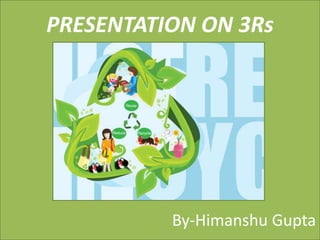
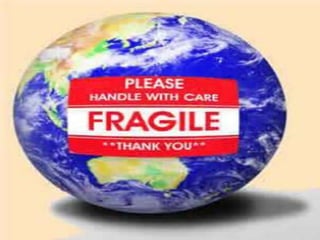
PRESENTATION ON 3Rs
By-Himanshu Gupta
Outline
1.The Context
2.Waste Hierarchy
3.Significant Achievements and
Future Vision
4.Conclusions and
Recommendations
3Rs
•India attaches great importance to environmental
protection
conservation and development. Its constitution enjoins upon
the State to protect environment.
•Environmental governance by the Centre and the states
(federal structure) –
..Central list
..State List
..Concurrent list
•World’s fifth largest economy with about 62% of
population
which depends directly on Agriculture and Industry.
•Industry, Manufacturing and Services Sector account for
POLICY STATEMENT
ON
ABATEMENT OF POLLUTION -1992
The main objective is to integrate environmental
considerations in the decision making process by
•Pollution Prevention at source
•Protect highly polluted areas
•Involve public in decision making
NATIONAL ENVIRONMENT
POLICY -2006
NEP lays stress on
•Adoption of clean technology
•Encourage reuse and recycling
•Strengthening informal sector
•Establish system for collection and recycling
of materials
•Environmental safe disposal
WASTE HIERARCHY
•3Rs classify waste
management strategies
according to their
desirability –
1.Reduce
2.Reuse
3.Recycle
SIGNIFICANT ACHIEVEMENTS
& FUTURE VISION
Together with the Salient Features of select programmes
CHARTER ON CORPORATE RESPONSIBILITY FOR
ENVIRONMENT PROTECTION (CREP)
The Government of India and the industry has entered into a
partnership, breaking new ground for environmental protection.
It was finalized at a national seminar of more than 300
representatives of the Central and State Governments, pollution
control boards and 17 major polluting categories of industries held in
New Delhi on March 13, 2003.
•The charter is a mutually agreed document between the Government
and industrial
houses, incorporating voluntary initiatives by 17 identified categories
Conclusions &
Recommendations
The Performance Audit Report on Management of Waste in India
submitted by the office of the Comptroller and Auditor General (CAG) in
September 2008, surmised that the waste management hierarchy needs
to be emphasized in our policies and summarized its observations on
the current waste management situation in the country into seven
important requirements for improvement.
•assessing the quantum of waste being generated and its impact onenvironment and
health,
•formulating policies and strategies towards prioritizing waste reduction and
minimization rather than mere disposal,
•promulgating legislations specifically dealing with disposal ofeach kind of waste
incorporating penalty for violation,
In addition to specific legislations, strict enforcement
is being ensured with the following provisions
through the state authorities :
•A manifest system to track the waste from the point
of generation to disposal.
•A need for seeking authorization for handling of
There are several ways in which government can
attempt to overcome the above mentioned barriers
and actively encourage industrial waste minimization
activities.
These include
•the provision of technical assistance programs,
•the creation and enforcement of pollution control regulations,
•the dissemination of information about waste minimization programs
and opportunities,
•the establishment of financial incentives,
•the foundation of award programs recognizing significant
achievements in waste minimization.
A wide range of activities could be supported in an information
The success of a '3R' initiative will largely
depend on the right mix of policies and
programmes implemented at the local level.
Much of this will also depend on developing an
integrated framework bringing together the
above points with other issues, including
•Investment policies and practices, such as greener
procurement , subsidies and ecotaxes etc;
•Production policies and practices, such as integrated product
policy, life
cycle assessment, extended producer responsibility,
“THE EARTH PROVIDES ENOUGH TO
SATISFY EVERYMAN’S NEED BUT
NOT FOR EVERY MAN’S GREED”
–Mahatma Gandhi.
3rs presentation

3rs presentation

  • 1.
  • 2.
    Outline 1.The Context 2.Waste Hierarchy 3.SignificantAchievements and Future Vision 4.Conclusions and Recommendations
  • 3.
    3Rs •India attaches greatimportance to environmental protection conservation and development. Its constitution enjoins upon the State to protect environment. •Environmental governance by the Centre and the states (federal structure) – ..Central list ..State List ..Concurrent list •World’s fifth largest economy with about 62% of population which depends directly on Agriculture and Industry. •Industry, Manufacturing and Services Sector account for
  • 4.
    POLICY STATEMENT ON ABATEMENT OFPOLLUTION -1992 The main objective is to integrate environmental considerations in the decision making process by •Pollution Prevention at source •Protect highly polluted areas •Involve public in decision making
  • 5.
    NATIONAL ENVIRONMENT POLICY -2006 NEPlays stress on •Adoption of clean technology •Encourage reuse and recycling •Strengthening informal sector •Establish system for collection and recycling of materials •Environmental safe disposal
  • 6.
    WASTE HIERARCHY •3Rs classifywaste management strategies according to their desirability – 1.Reduce 2.Reuse 3.Recycle
  • 7.
    SIGNIFICANT ACHIEVEMENTS & FUTUREVISION Together with the Salient Features of select programmes
  • 8.
    CHARTER ON CORPORATERESPONSIBILITY FOR ENVIRONMENT PROTECTION (CREP) The Government of India and the industry has entered into a partnership, breaking new ground for environmental protection. It was finalized at a national seminar of more than 300 representatives of the Central and State Governments, pollution control boards and 17 major polluting categories of industries held in New Delhi on March 13, 2003. •The charter is a mutually agreed document between the Government and industrial houses, incorporating voluntary initiatives by 17 identified categories
  • 9.
  • 10.
    The Performance AuditReport on Management of Waste in India submitted by the office of the Comptroller and Auditor General (CAG) in September 2008, surmised that the waste management hierarchy needs to be emphasized in our policies and summarized its observations on the current waste management situation in the country into seven important requirements for improvement. •assessing the quantum of waste being generated and its impact onenvironment and health, •formulating policies and strategies towards prioritizing waste reduction and minimization rather than mere disposal, •promulgating legislations specifically dealing with disposal ofeach kind of waste incorporating penalty for violation,
  • 11.
    In addition tospecific legislations, strict enforcement is being ensured with the following provisions through the state authorities : •A manifest system to track the waste from the point of generation to disposal. •A need for seeking authorization for handling of
  • 12.
    There are severalways in which government can attempt to overcome the above mentioned barriers and actively encourage industrial waste minimization activities. These include •the provision of technical assistance programs, •the creation and enforcement of pollution control regulations, •the dissemination of information about waste minimization programs and opportunities, •the establishment of financial incentives, •the foundation of award programs recognizing significant achievements in waste minimization. A wide range of activities could be supported in an information
  • 13.
    The success ofa '3R' initiative will largely depend on the right mix of policies and programmes implemented at the local level. Much of this will also depend on developing an integrated framework bringing together the above points with other issues, including •Investment policies and practices, such as greener procurement , subsidies and ecotaxes etc; •Production policies and practices, such as integrated product policy, life cycle assessment, extended producer responsibility,
  • 14.
    “THE EARTH PROVIDESENOUGH TO SATISFY EVERYMAN’S NEED BUT NOT FOR EVERY MAN’S GREED” –Mahatma Gandhi.