ISyE 6338 Supply Chain Strategies
• Anish Gupta
• Zhaowei Li
• Yingjia Tao
• Mukul Raghav
• Tanguy Passini
• Lingxiao Zhang
3PL Industry (Broadly Asset Light)
• Introduction
• Industry Statistics
• Comparison of two firms based
on SC strategy
• Sources of Innovation
• Best Practices & Adjacent
Industries
• Key challenges
• Summary
CONTENTS
2
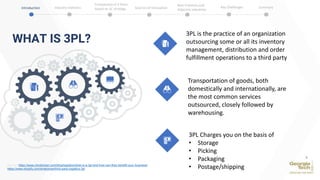
WHAT IS 3PL?
3
WHAT IS 3PL?
Source: https://www.chrobinson.com/blog/logistics/what-is-a-3pl-and-how-can-they-benefit-your-business/
https://www.shopify.com/enterprise/third-party-logistics-3pl
3PL is the practice of an organization
outsourcing some or all its inventory
management, distribution and order
fulfillment operations to a third party
Transportation of goods, both
domestically and internationally, are
the most common services
outsourced, closely followed by
warehousing.
3PL Charges you on the basis of
• Storage
• Picking
• Packaging
• Postage/shipping
Introduction Industry Statistics Sources of Innovation
Comparison of 2 firms
based on SC strategy
Best Practices and
Adjacent Industries
Key Challenges Summary
4
5
3PL’s have a back office staff that have SOP’s in
place to help the carrier vetting process, work
with carriers on invoice variances through
auditing services, and manage the entire freight
claims process
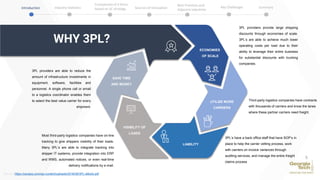
3PL providers provide large shipping
discounts through economies of scale.
3PL’s are able to achieve much lower
operating costs per load due to their
ability to leverage their entire business
for substantial discounts with trucking
companies.
Third-party logistics companies have contracts
with thousands of carriers and know the lanes
where these partner carriers need freight.
WHY 3PL?
3PL providers are able to reduce the
amount of infrastructure investments in
equipment, software, facilities and
personnel. A single phone call or email
to a logistics coordinator enables them
to select the best value carrier for every
shipment.
Most third-party logistics companies have on-line
tracking to give shippers visibility of their loads.
Many 3PL’s are able to integrate tracking into
shipper IT systems, provide integration into ERP
and WMS, automated notices, or even real-time
delivery notifications by e-mail.
LIABILITY
ECONOMIES
OF SCALE
VISIBILITY OF
LOADS
SAVE TIME
AND MONEY
UTILIZE MORE
CARRIERS
Source: https://cerasis.com/wp-content/uploads/2016/09/3PL-eBook.pdf
Introduction Industry Statistics Sources of Innovation
Comparison of 2 firms
based on SC strategy
Best Practices and
Adjacent Industries
Key Challenges Summary
OKAY THAT MAKES SENSE..
BUT WHAT IS ASSET LIGHT INDUSTRY ?
6
Source: https://gofreighthub.io/asset-lite-vs-asset-based-3pls/
https://www.business2community.com/strategy/advantages-of-using-a-non-asset-based-logistics-provider-0550287
Low or no
Assets
Dovetailing
with the need
Bringing
more Value to
the Table
Focused
Service
01
02
03
04
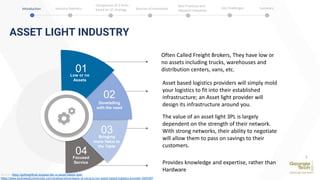
ASSET LIGHT INDUSTRY
7
Often Called Freight Brokers, They have low or
no assets including trucks, warehouses and
distribution centers, vans, etc.
Asset based logistics providers will simply mold
your logistics to fit into their established
infrastructure; an Asset light provider will
design its infrastructure around you.
Provides knowledge and expertise, rather than
Hardware
The value of an asset light 3PL is largely
dependent on the strength of their network.
With strong networks, their ability to negotiate
will allow them to pass on savings to their
customers.
Introduction Industry Statistics Sources of Innovation
Comparison of 2 firms
based on SC strategy
Best Practices and
Adjacent Industries
Key Challenges Summary
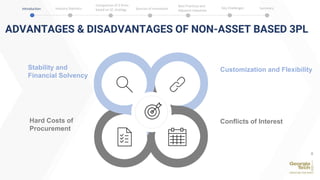
ADVANTAGES & DISADVANTAGES OF NON-ASSET BASED 3PL
8
Customization and Flexibility
Conflicts of InterestHard Costs of
Procurement
Stability and
Financial Solvency
Introduction Industry Statistics Sources of Innovation
Comparison of 2 firms
based on SC strategy
Best Practices and
Adjacent Industries
Key Challenges Summary
9
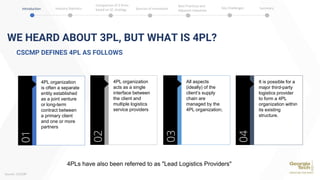
4PL organization
is often a separate
entity established
as a joint venture
or long-term
contract between
a primary client
and one or more
partners
01
4PL organization
acts as a single
interface between
the client and
multiple logistics
service providers
02
All aspects
(ideally) of the
client’s supply
chain are
managed by the
4PL organization;
03
It is possible for a
major third-party
logistics provider
to form a 4PL
organization within
its existing
structure.
04
CSCMP DEFINES 4PL AS FOLLOWS
4PLs have also been referred to as "Lead Logistics Providers"
WE HEARD ABOUT 3PL, BUT WHAT IS 4PL?
Source: CSCMP
Introduction Industry Statistics Sources of Innovation
Comparison of 2 firms
based on SC strategy
Best Practices and
Adjacent Industries
Key Challenges Summary
Source: https://cerasis.com/wp-content/uploads/2016/09/3PL-eBook.pdfLAYERS OF LOGISTICS
11
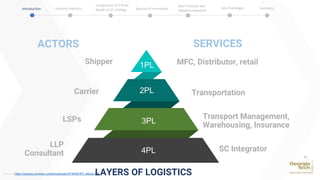
1PL
2PL
3PL
4PL
Shipper
Carrier
LSPs
LLP
Consultant
MFC, Distributor, retail
Transportation
Transport Management,
Warehousing, Insurance
SC Integrator
SERVICESACTORS
Introduction Industry Statistics Sources of Innovation
Comparison of 2 firms
based on SC strategy
Best Practices and
Adjacent Industries
Key Challenges Summary
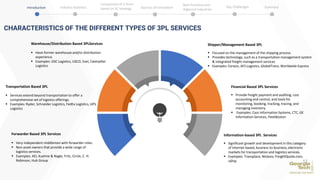
CHARACTERISTICS OF THE DIFFERENT TYPES OF 3PL SERVICES
12
Forwarder Based 3PL Services
 Very independent middlemen with forwarder roles.
 Non-asset owners that provide a wide range of
logistics services.
 Examples: AEI, Kuehne & Nagle, Fritz, Circle, C. H.
Robinson, Hub Group
Warehouse/Distribution Based 3PLServices
 Have former warehouse and/or distribution
experience.
 Examples: DSC Logistics, USCO, Exel, Caterpillar
Logistics
Transportation Based 3PL
 Services extend beyond transportation to offer a
comprehensive set of logistics offerings.
 Examples: Ryder, Schneider Logistics, FedEx Logistics, UPS
Logistics
Information-based 3PL Services
 Significant growth and development in this category
of Internet-based, business to-business, electronic
markets for transportation and logistics services.
 Examples: Transplace, Nistevo, FreightQuote.com,
uShip
Financial Based 3PL Services
 Provide freight payment and auditing, cost
accounting and control, and tools for
monitoring, booking, tracking, tracing, and
managing inventory.
 Examples: Cass Information Systems, CTC, GE
Information Services, FleetBoston
Shipper/Management Based 3PL
 Focused on the management of the shipping process
 Provides technology, such as a transportation management system
& integrated freight management services
 Examples: Cerasis, AFS Logistics, GlobalTranz, Worldwide Express
Introduction Industry Statistics Sources of Innovation
Comparison of 2 firms
based on SC strategy
Best Practices and
Adjacent Industries
Key Challenges Summary
13
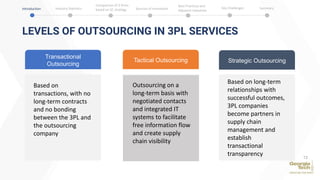
Transactional
Outsourcing
Tactical Outsourcing Strategic Outsourcing
Based on
transactions, with no
long-term contracts
and no bonding
between the 3PL and
the outsourcing
company
Outsourcing on a
long-term basis with
negotiated contacts
and integrated IT
systems to facilitate
free information flow
and create supply
chain visibility
Based on long-term
relationships with
successful outcomes,
3PL companies
become partners in
supply chain
management and
establish
transactional
transparency
LEVELS OF OUTSOURCING IN 3PL SERVICES
Introduction Industry Statistics Sources of Innovation
Comparison of 2 firms
based on SC strategy
Best Practices and
Adjacent Industries
Key Challenges Summary
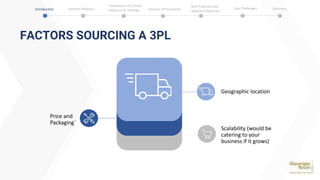
Price and
Packaging`
Geographic location
Scalability (would be
catering to your
business if it grows)
FACTORS SOURCING A 3PL
Introduction Industry Statistics Sources of Innovation
Comparison of 2 firms
based on SC strategy
Best Practices and
Adjacent Industries
Key Challenges Summary
Industry Statistics
15
16
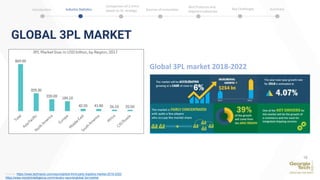
GLOBAL 3PL MARKET
Source: https://www.technavio.com/report/global-third-party-logistics-market-2018-2022
https://www.mordorintelligence.com/industry-reports/global-3pl-market
Global 3PL market 2018-2022
Introduction Industry Statistics Sources of Innovation
Comparison of 2 firms
based on SC strategy
Best Practices and
Adjacent Industries
Key Challenges Summary
17
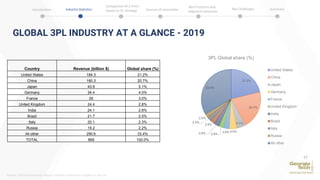
GLOBAL 3PL INDUSTRY AT A GLANCE - 2019
Source: IBISWorld Industry Report OD5504 Third-Party Logistics in the US
Country Revenue (billion $) Global share (%)
United States 184.3 21.2%
China 180.3 20.7%
Japan 43.9 5.1%
Germany 34.4 4.0%
France 26 3.0%
United Kingdom 24.4 2.8%
India 24.1 2.8%
Brazil 21.7 2.5%
Italy 20.1 2.3%
Russia 19.2 2.2%
All other 290.6 33.4%
TOTAL 869 100.0%
21.2%
20.7%
5.1%
4.0%3.0%
2.8%2.8%
2.5%
2.3%
2.2%
33.4%
3PL Global share (%)
United States
China
Japan
Germany
France
United Kingdom
India
Brazil
Italy
Russia
All other
Introduction Industry Statistics Sources of Innovation
Comparison of 2 firms
based on SC strategy
Best Practices and
Adjacent Industries
Key Challenges Summary
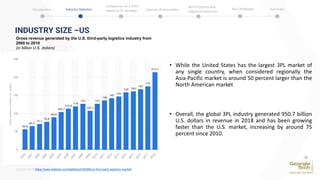
INDUSTRY SIZE –US
• While the United States has the largest 3PL market of
any single country, when considered regionally the
Asia-Pacific market is around 50 percent larger than the
North American market
• Overall, the global 3PL industry generated 950.7 billion
U.S. dollars in revenue in 2018 and has been growing
faster than the U.S. market, increasing by around 75
percent since 2010.
Gross revenue generated by the U.S. third-party logistics industry from
2000 to 2018
(in billion U.S. dollars)
18
Source: 2016 https://www.statista.com/statistics/638368/us-third-party-logistics-market/
Introduction Industry Statistics Sources of Innovation
Comparison of 2 firms
based on SC strategy
Best Practices and
Adjacent Industries
Key Challenges Summary
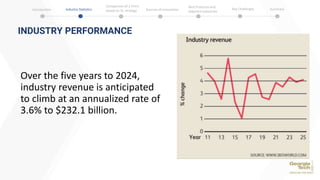
INDUSTRY PERFORMANCE
19
Over the five years to 2024,
industry revenue is anticipated
to climb at an annualized rate of
3.6% to $232.1 billion.
Introduction Industry Statistics Sources of Innovation
Comparison of 2 firms
based on SC strategy
Best Practices and
Adjacent Industries
Key Challenges Summary
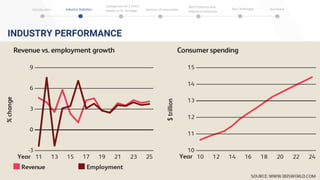
INDUSTRY PERFORMANCE
20
Introduction Industry Statistics Sources of Innovation
Comparison of 2 firms
based on SC strategy
Best Practices and
Adjacent Industries
Key Challenges Summary
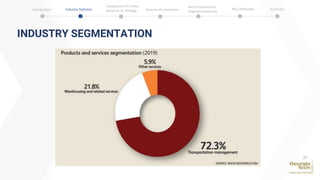
INDUSTRY SEGMENTATION
21
Introduction Industry Statistics Sources of Innovation
Comparison of 2 firms
based on SC strategy
Best Practices and
Adjacent Industries
Key Challenges Summary
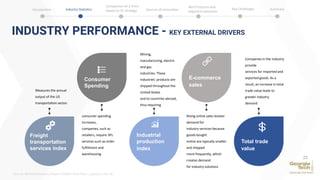
INDUSTRY PERFORMANCE - KEY EXTERNAL DRIVERS
22
Industrial
production
index
Total trade
value
Consumer
Spending
E-commerce
sales
Measures the annual
output of the US
transportation sector.
Mining,
manufacturing, electric
and gas
industries. These
industries’ products are
shipped throughout the
United States
and to countries abroad,
thus requiring
Companies in the industry
provide
services for imported and
exported goods. As a
result, an increase in total
trade value leads to
greater industry
demand
consumer spending
increases,
companies, such as
retailers, require 3PL
services such as order
fulfillment and
warehousing
Rising online sales bolster
demand for
industry services because
goods bought
online are typically smaller
and shipped
more frequently, which
creates demand
for industry solutions
Freight
transportation
services index
Source: IBISWorld Industry Report OD5504 Third-Party Logistics in the US
Introduction Industry Statistics Sources of Innovation
Comparison of 2 firms
based on SC strategy
Best Practices and
Adjacent Industries
Key Challenges Summary
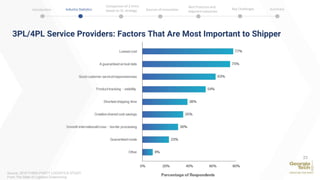
3PL/4PL Service Providers: Factors That Are Most Important to Shipper
23
Source: 2019 THIRD-PARTY LOGISTICS STUDY
From The State of Logistics Outsourcing
Introduction Industry Statistics Sources of Innovation
Comparison of 2 firms
based on SC strategy
Best Practices and
Adjacent Industries
Key Challenges Summary
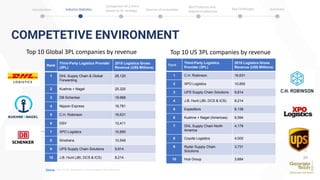
COMPETETIVE ENVIRONMENT
Top 10 Global 3PL companies by revenue
Source: https://www.3plogistics.com/3pl-market-info-resources/3pl-market-information/
Top 10 US 3PL companies by revenue
Rank
Third-Party Logistics Provider
(3PL)
2018 Logistics Gross
Revenue (US$ Millions)
1 DHL Supply Chain & Global
Forwarding
28,120
2 Kuehne + Nagel 25,320
3 DB Schenker 19,968
4 Nippon Express 18,781
5 C.H. Robinson 16,631
6 DSV 12,411
7 XPO Logistics 10,850
8 Sinotrans 10,549
9 UPS Supply Chain Solutions 9,814
10 J.B. Hunt (JBI, DCS & ICS) 8,214
Rank
Third-Party Logistics
Provider (3PL)
2018 Logistics Gross
Revenue (US$ Millions)
1 C.H. Robinson 16,631
2 XPO Logistics 10,850
3 UPS Supply Chain Solutions 9,814
4 J.B. Hunt (JBI, DCS & ICS) 8,214
5 Expeditors 8,138
6 Kuehne + Nagel (Americas) 6,594
7 DHL Supply Chain North
America
4,178
8 Coyote Logistics 4,000
9 Ryder Supply Chain
Solutions
3,731
10 Hub Group 3,684 24
Source: https://www.3plogistics.com/3pl-market-info-resources/
Introduction Industry Statistics Sources of Innovation
Comparison of 2 firms
based on SC strategy
Best Practices and
Adjacent Industries
Key Challenges Summary
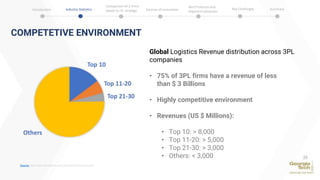
• 75% of 3PL firms have a revenue of less
than $ 3 Billions
• Highly competitive environment
• Revenues (US $ Millions):
• Top 10: > 8,000
• Top 11-20: > 5,000
• Top 21-30: > 3,000
• Others: < 3,000
Global Logistics Revenue distribution across 3PL
companies
COMPETETIVE ENVIRONMENT
25
Source:https://www.3plogistics.com/3pl-market-info-resources/
Introduction Industry Statistics Sources of Innovation
Comparison of 2 firms
based on SC strategy
Best Practices and
Adjacent Industries
Key Challenges Summary
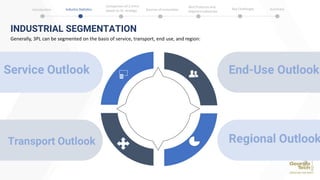
INDUSTRIAL SEGMENTATION
Generally, 3PL can be segmented on the basis of service, transport, end use, and region:
26
Introduction Industry Statistics Sources of Innovation
Comparison of 2 firms
based on SC strategy
Best Practices and
Adjacent Industries
Key Challenges Summary
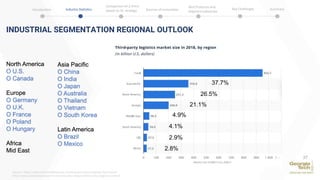
INDUSTRIAL SEGMENTATION REGIONAL OUTLOOK
Source: https://www.mordorintelligence.com/industry-reports/global-3pl-market
https://www.grandviewresearch.com/industry-analysis/third-party-logistics-market
27
North America
O U.S.
O Canada
Europe
O Germany
O U.K.
O France
O Poland
O Hungary
Africa
Mid East
Asia Pacific
O China
O India
O Japan
O Australia
O Thailand
O Vietnam
O South Korea
Latin America
O Brazil
O Mexico
37.7%
26.5%
21.1%
4.9%
4.1%
2.9%
2.8%
Introduction Industry Statistics Sources of Innovation
Comparison of 2 firms
based on SC strategy
Best Practices and
Adjacent Industries
Key Challenges Summary
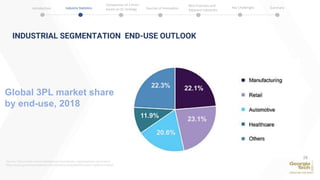
INDUSTRIAL SEGMENTATION END-USE OUTLOOK
Global 3PL market share
by end-use, 2018
22.3% 22.1%
23.1%
20.6%
11.9%
Source: https://www.mordorintelligence.com/industry-reports/global-3pl-market
https://www.grandviewresearch.com/industry-analysis/third-party-logistics-market
28
Introduction Industry Statistics Sources of Innovation
Comparison of 2 firms
based on SC strategy
Best Practices and
Adjacent Industries
Key Challenges Summary
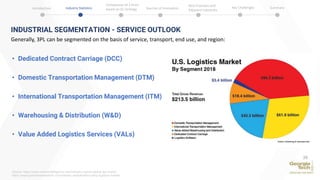
INDUSTRIAL SEGMENTATION - SERVICE OUTLOOK
Generally, 3PL can be segmented on the basis of service, transport, end use, and region:
• Dedicated Contract Carriage (DCC)
• Domestic Transportation Management (DTM)
• International Transportation Management (ITM)
• Warehousing & Distribution (W&D)
• Value Added Logistics Services (VALs)
Source: https://www.mordorintelligence.com/industry-reports/global-3pl-market
https://www.grandviewresearch.com/industry-analysis/third-party-logistics-market
ITM
W&D
29
Introduction Industry Statistics Sources of Innovation
Comparison of 2 firms
based on SC strategy
Best Practices and
Adjacent Industries
Key Challenges Summary
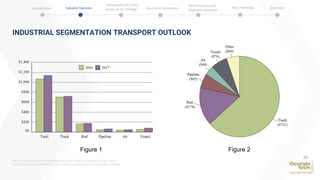
INDUSTRIAL SEGMENTATION TRANSPORT OUTLOOK
Source: https://www.mordorintelligence.com/industry-reports/global-3pl-market
https://www.grandviewresearch.com/industry-analysis/third-party-logistics-market
30
Figure 1 Figure 2
Introduction Industry Statistics Sources of Innovation
Comparison of 2 firms
based on SC strategy
Best Practices and
Adjacent Industries
Key Challenges Summary
REGULATORY ENVIRONMENT
31
Source https://www.licenselogix.com/business-case-studies/third-party-logistics-license
License regimes
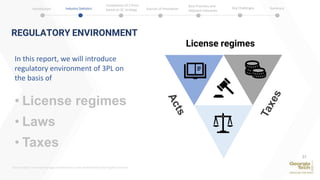
In this report, we will introduce
regulatory environment of 3PL on
the basis of
• License regimes
• Laws
• Taxes
Introduction Industry Statistics Sources of Innovation
Comparison of 2 firms
based on SC strategy
Best Practices and
Adjacent Industries
Key Challenges Summary
32
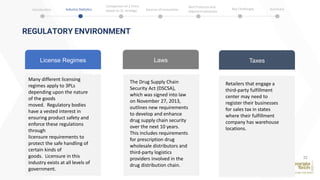
License Regimes Laws Taxes
Many different licensing
regimes apply to 3PLs
depending upon the nature
of the goods
moved. Regulatory bodies
have a vested interest in
ensuring product safety and
enforce these regulations
through
licensure requirements to
protect the safe handling of
certain kinds of
goods. Licensure in this
industry exists at all levels of
government.
The Drug Supply Chain
Security Act (DSCSA),
which was signed into law
on November 27, 2013,
outlines new requirements
to develop and enhance
drug supply chain security
over the next 10 years.
This includes requirements
for prescription drug
wholesale distributors and
third-party logistics
providers involved in the
drug distribution chain.
Retailers that engage a
third-party fulfillment
center may need to
register their businesses
for sales tax in states
where their fulfillment
company has warehouse
locations.
REGULATORY ENVIRONMENT
Introduction Industry Statistics Sources of Innovation
Comparison of 2 firms
based on SC strategy
Best Practices and
Adjacent Industries
Key Challenges Summary
LABOR ENVIRONMENT-OVERVIEW
33
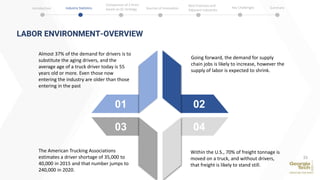
Almost 37% of the demand for drivers is to
substitute the aging drivers, and the
average age of a truck driver today is 55
years old or more. Even those now
entering the industry are older than those
entering in the past
Within the U.S., 70% of freight tonnage is
moved on a truck, and without drivers,
that freight is likely to stand still.
The American Trucking Associations
estimates a driver shortage of 35,000 to
40,000 in 2015 and that number jumps to
240,000 in 2020.
Going forward, the demand for supply
chain jobs is likely to increase, however the
supply of labor is expected to shrink.
01 02
03 04
Introduction Industry Statistics Sources of Innovation
Comparison of 2 firms
based on SC strategy
Best Practices and
Adjacent Industries
Key Challenges Summary
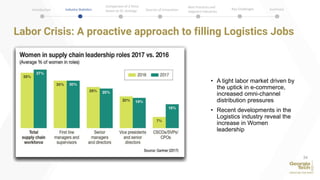
Labor Crisis: A proactive approach to filling Logistics Jobs
• A tight labor market driven by
the uptick in e-commerce,
increased omni-channel
distribution pressures
• Recent developments in the
Logistics industry reveal the
increase in Women
leadership
34
Introduction Industry Statistics Sources of Innovation
Comparison of 2 firms
based on SC strategy
Best Practices and
Adjacent Industries
Key Challenges Summary
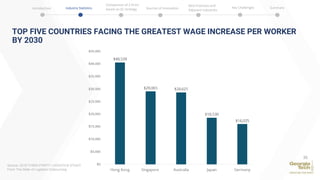
TOP FIVE COUNTRIES FACING THE GREATEST WAGE INCREASE PER WORKER
BY 2030
35
Source: 2019 THIRD-PARTY LOGISTICS STUDY
From The State of Logistics Outsourcing
Introduction Industry Statistics Sources of Innovation
Comparison of 2 firms
based on SC strategy
Best Practices and
Adjacent Industries
Key Challenges Summary
Comparison of firms in the
Industry
36
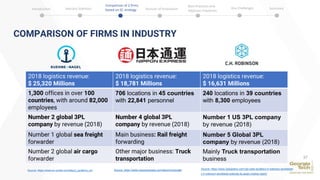
COMPARISON OF FIRMS IN INDUSTRY
Source: https://www.kn-portal.com/about_us/about_us/ Source: https://www.nipponexpress.com/about/corporate/
37
2018 logistics revenue:
$ 25,320 Millions
2018 logistics revenue:
$ 18,781 Millions
2018 logistics revenue:
$ 16,631 Millions
1,300 offices in over 100
countries, with around 82,000
employees
706 locations in 45 countries
with 22,841 personnel
240 locations in 39 countries
with 8,300 employees
Number 2 global 3PL
company by revenue (2018)
Number 4 global 3PL
company by revenue (2018)
Number 1 US 3PL company
by revenue (2018)
Number 1 global sea freight
forwarder
Main business: Rail freight
forwarding
Number 5 Global 3PL
company by revenue (2018)
Number 2 global air cargo
forwarder
Other major business: Truck
transportation
Mainly Truck transportation
business
Source: https://www.3plogistics.com/3pl-case-studies/c-h-robinson-worldwide/
c-h-robinson-worldwide-extends-its-asian-market-reach/
Introduction Industry Statistics Sources of Innovation
Comparison of 2 firms
based on SC strategy
Best Practices and
Adjacent Industries
Key Challenges Summary
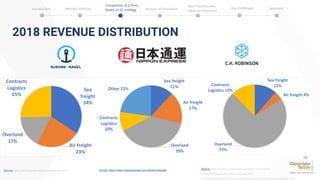
2018 REVENUE DISTRIBUTION
Source: https://2018-annual-report.kuehne-nagel.com/ Source: https://www.nipponexpress.com/about/corporate/
38
Sea
freight
34%
Air freight
23%
Overland
17%
Contracts
Logistics
25%
Sea freight
11%
Air freight
17%
Overland
39%
Contracts
Logistics
10%
Other 22%
Sea freight
12%
Air freight 4%
Overland
72%
Contracts
Logistics 12%
Source:https://investor.chrobinson.com/News-and-Events/
Press-Releases/press-release-details/2019/
CH-Robinson-Reports-2018-Fourth-Quarter-and-Full-Year-Results/default.aspx
Introduction Industry Statistics Sources of Innovation
Comparison of 2 firms
based on SC strategy
Best Practices and
Adjacent Industries
Key Challenges Summary
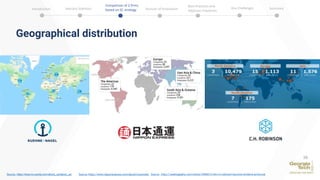
Geographical distribution
39
Source: https://www.kn-portal.com/about_us/about_us/ Source: https://www.nipponexpress.com/about/corporate/ Source: https://seekingalpha.com/article/3986615-will-c-h-robinson-become-dividend-aristocrat
Introduction Industry Statistics Sources of Innovation
Comparison of 2 firms
based on SC strategy
Best Practices and
Adjacent Industries
Key Challenges Summary
Sources of Innovation
40
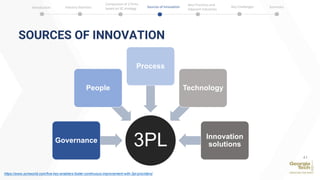
SOURCES OF INNOVATION
3PLGovernance
People
Process
Technology
Innovation
solutions
41
https://www.scmworld.com/five-key-enablers-foster-continuous-improvement-with-3pl-providers/
Introduction Industry Statistics Sources of Innovation
Comparison of 2 firms
based on SC strategy
Best Practices and
Adjacent Industries
Key Challenges Summary
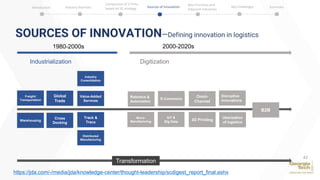
SOURCES OF INNOVATION—Defining innovation in logistics
42
2000-2020s
DigitizationIndustrialization
Distributed
Manufacturing
Robotics &
Automation
E-Commerce
Omni-
Channel
Disruptive
Innovations
Micro-
Manufacturing
IoT &
Big Data 3D Printing
Uberization
of logistics
B2B
Transformation
1980-2000s
Freight/
Transportation
Industry
Consolidation
Value-Added
Services
Global
Trade
Warehousing
Cross
Docking
Track &
Trace
https://jda.com/-/media/jda/knowledge-center/thought-leadership/scdigest_report_final.ashx
Introduction Industry Statistics Sources of Innovation
Comparison of 2 firms
based on SC strategy
Best Practices and
Adjacent Industries
Key Challenges Summary
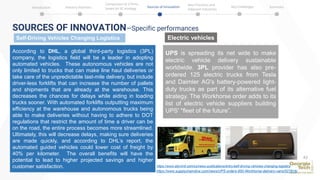
SOURCES OF INNOVATION—Specific performances
Self-Driving Vehicles Changing Logistics Electric vehicles
UPS is spreading its net wide to make
electric vehicle delivery sustainable
worldwide. 3PL provider has also pre-
ordered 125 electric trucks from Tesla
and Daimler AG's battery-powered light-
duty trucks as part of its alternative fuel
strategy. The Workhorse order adds to its
list of electric vehicle suppliers building
UPS' "fleet of the future”.
According to DHL, a global third-party logistics (3PL)
company, the logistics field will be a leader in adopting
automated vehicles. These autonomous vehicles are not
only limited to trucks that can make line haul deliveries or
take care of the unpredictable last-mile delivery, but include
driver-less forklifts that can increase the number of pallets
and shipments that are already at the warehouse. This
decreases the chances for delays while aiding in loading
trucks sooner. With automated forklifts outputting maximum
efficiency at the warehouse and autonomous trucks being
able to make deliveries without having to adhere to DOT
regulations that restrict the amount of time a driver can be
on the road, the entire process becomes more streamlined.
Ultimately, this will decrease delays, making sure deliveries
are made quickly, and according to DHL’s report, the
automated guided vehicles could lower cost of freight by
40% per kilometer. The overall benefits will have the
potential to lead to higher projected savings and higher
customer satisfaction.
43
https://www.allynintl.com/cs/news-publications/entry/self-driving-vehicles-changing-logistics
https://www.supplychaindive.com/news/UPS-orders-950-Workhorse-delivery-vans/527816/
Introduction Industry Statistics Sources of Innovation
Comparison of 2 firms
based on SC strategy
Best Practices and
Adjacent Industries
Key Challenges Summary
Best Practices &
Adjacent Industry
44
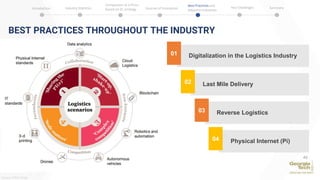
BEST PRACTICES THROUGHOUT THE INDUSTRY
45
Source: PWC Study
Digitalization in the Logistics Industry01
Last Mile Delivery02
Reverse Logistics03
Physical Internet (Pi)04
Introduction Industry Statistics Sources of Innovation
Comparison of 2 firms
based on SC strategy
Best Practices and
Adjacent Industries
Key Challenges Summary
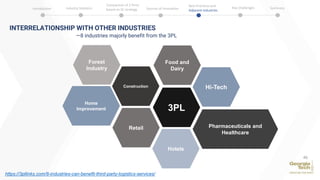
INTERRELATIONSHIP WITH OTHER INDUSTRIES
—8 industries majorly benefit from the 3PL
Home
Improvement
Retail
Hotels
Construction
Pharmaceuticals and
Healthcare
3PL
Hi-Tech
Food and
Dairy
46
https://3pllinks.com/8-industries-can-benefit-third-party-logistics-services/
Forest
Industry
Introduction Industry Statistics Sources of Innovation
Comparison of 2 firms
based on SC strategy
Best Practices and
Adjacent Industries
Key Challenges Summary
INTERELATIONSHIP WITH OTHER INDUSTRIES
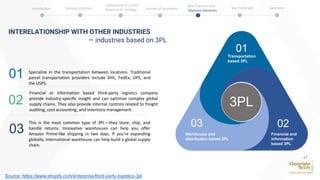
— industries based on 3PL
47
02
03
01 Specialize in the transportation between locations. Traditional
parcel transportation providers include DHL, FedEx, UPS, and
the USPS.
Financial or information based third-party logistics company
provide industry-specific insight and can optimize complex global
supply chains. They also provide internal controls related to freight
auditing, cost accounting, and inventory management.
This is the most common type of 3PL—they store, ship, and
handle returns. Innovative warehouses can help you offer
Amazon Prime-like shipping in two days. If you’re expanding
globally, international warehouse can help build a global supply
chain.
Transportation
based 3PL
01
Financial and
information
based 3PL
.
02
Warehouse and
distribution based 3PL
03
3PL
Source: https://www.shopify.com/enterprise/third-party-logistics-3pl
Introduction Industry Statistics Sources of Innovation
Comparison of 2 firms
based on SC strategy
Best Practices and
Adjacent Industries
Key Challenges Summary
INTERELATIONSHIP WITH OTHER INDUSTRIES
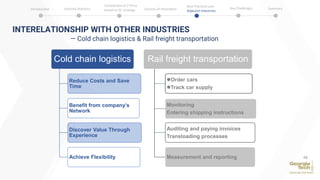
— Cold chain logistics & Rail freight transportation
Cold chain logistics
Reduce Costs and Save
Time
Benefit from company’s
Network
Discover Value Through
Experience
Achieve Flexibility
Rail freight transportation
Order cars
Track car supply
Monitoring
Entering shipping instructions
Auditing and paying invoices
Transloading processes
Measurement and reporting 48
Introduction Industry Statistics Sources of Innovation
Comparison of 2 firms
based on SC strategy
Best Practices and
Adjacent Industries
Key Challenges Summary
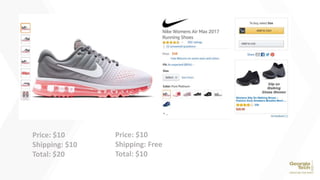
$10
Price: $10
Shipping: $10
Total: $20
Price: $10
Shipping: Free
Total: $10
Key Challenges
50
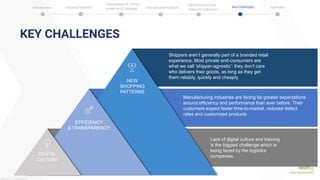
KEY CHALLENGES
51
Manufacturing industries are facing far greater expectations
around efficiency and performance than ever before. Their
customers expect faster time-to-market, reduced defect
rates and customized products
DIGITAL
CULTURE
NEW
SHOPPING
PATTERNS
EFFICIENCY
& TRANSPARENCY
Shippers aren’t generally part of a branded retail
experience. Most private end-consumers are
what we call ‘shipper-agnostic’: they don’t care
who delivers their goods, as long as they get
them reliably, quickly and cheaply.
Lack of digital culture and training
is the biggest challenge which is
being faced by the logistics
companies.
Source: PWC Study
Introduction Industry Statistics Sources of Innovation
Comparison of 2 firms
based on SC strategy
Best Practices and
Adjacent Industries
Key Challenges Summary
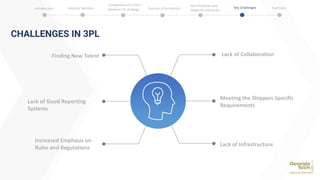
Finding New Talent
Lack of Good Reporting
Systems
Increased Emphasis on
Rules and Regulations
Lack of Collaboration
Meeting the Shippers Specific
Requirements
Lack of Infrastructure
CHALLENGES IN 3PL
Introduction Industry Statistics Sources of Innovation
Comparison of 2 firms
based on SC strategy
Best Practices and
Adjacent Industries
Key Challenges Summary
SWOT Analysis
S
• Good Management
• People
• Technology (IT, Tracking etc.)
• Market presence
• Low Costs
• Economies of Scale
T
• Geographic scope
• Industry
• Competition
• Trade issues and barriers
• Political and economical stability
W
O
• Varying market demand
• Rising fuel prices
• Labor shortage
• Unskilled Labor (Lack of digital
training)
• Communication Problem
• New Trends in Technology
• Regional Coverage
• Collaboration
• Hyper connected networks (PI)
• M&A
• Growth of 3PL market
Source: https://www.ltdmgmt.com/082003.php
Introduction Industry Statistics Sources of Innovation
Comparison of 2 firms
based on SC strategy
Best Practices and
Adjacent Industries
Key Challenges Summary
54
Questions?

Global 3PL Industry

  • 1.
    ISyE 6338 SupplyChain Strategies • Anish Gupta • Zhaowei Li • Yingjia Tao • Mukul Raghav • Tanguy Passini • Lingxiao Zhang 3PL Industry (Broadly Asset Light)
  • 2.
    • Introduction • IndustryStatistics • Comparison of two firms based on SC strategy • Sources of Innovation • Best Practices & Adjacent Industries • Key challenges • Summary CONTENTS 2
  • 3.
  • 4.
    WHAT IS 3PL? Source:https://www.chrobinson.com/blog/logistics/what-is-a-3pl-and-how-can-they-benefit-your-business/ https://www.shopify.com/enterprise/third-party-logistics-3pl 3PL is the practice of an organization outsourcing some or all its inventory management, distribution and order fulfillment operations to a third party Transportation of goods, both domestically and internationally, are the most common services outsourced, closely followed by warehousing. 3PL Charges you on the basis of • Storage • Picking • Packaging • Postage/shipping Introduction Industry Statistics Sources of Innovation Comparison of 2 firms based on SC strategy Best Practices and Adjacent Industries Key Challenges Summary 4
  • 5.
    5 3PL’s have aback office staff that have SOP’s in place to help the carrier vetting process, work with carriers on invoice variances through auditing services, and manage the entire freight claims process 3PL providers provide large shipping discounts through economies of scale. 3PL’s are able to achieve much lower operating costs per load due to their ability to leverage their entire business for substantial discounts with trucking companies. Third-party logistics companies have contracts with thousands of carriers and know the lanes where these partner carriers need freight. WHY 3PL? 3PL providers are able to reduce the amount of infrastructure investments in equipment, software, facilities and personnel. A single phone call or email to a logistics coordinator enables them to select the best value carrier for every shipment. Most third-party logistics companies have on-line tracking to give shippers visibility of their loads. Many 3PL’s are able to integrate tracking into shipper IT systems, provide integration into ERP and WMS, automated notices, or even real-time delivery notifications by e-mail. LIABILITY ECONOMIES OF SCALE VISIBILITY OF LOADS SAVE TIME AND MONEY UTILIZE MORE CARRIERS Source: https://cerasis.com/wp-content/uploads/2016/09/3PL-eBook.pdf Introduction Industry Statistics Sources of Innovation Comparison of 2 firms based on SC strategy Best Practices and Adjacent Industries Key Challenges Summary
  • 6.
    OKAY THAT MAKESSENSE.. BUT WHAT IS ASSET LIGHT INDUSTRY ? 6
  • 7.
    Source: https://gofreighthub.io/asset-lite-vs-asset-based-3pls/ https://www.business2community.com/strategy/advantages-of-using-a-non-asset-based-logistics-provider-0550287 Low orno Assets Dovetailing with the need Bringing more Value to the Table Focused Service 01 02 03 04 ASSET LIGHT INDUSTRY 7 Often Called Freight Brokers, They have low or no assets including trucks, warehouses and distribution centers, vans, etc. Asset based logistics providers will simply mold your logistics to fit into their established infrastructure; an Asset light provider will design its infrastructure around you. Provides knowledge and expertise, rather than Hardware The value of an asset light 3PL is largely dependent on the strength of their network. With strong networks, their ability to negotiate will allow them to pass on savings to their customers. Introduction Industry Statistics Sources of Innovation Comparison of 2 firms based on SC strategy Best Practices and Adjacent Industries Key Challenges Summary
  • 8.
    ADVANTAGES & DISADVANTAGESOF NON-ASSET BASED 3PL 8 Customization and Flexibility Conflicts of InterestHard Costs of Procurement Stability and Financial Solvency Introduction Industry Statistics Sources of Innovation Comparison of 2 firms based on SC strategy Best Practices and Adjacent Industries Key Challenges Summary
  • 9.
  • 10.
    4PL organization is oftena separate entity established as a joint venture or long-term contract between a primary client and one or more partners 01 4PL organization acts as a single interface between the client and multiple logistics service providers 02 All aspects (ideally) of the client’s supply chain are managed by the 4PL organization; 03 It is possible for a major third-party logistics provider to form a 4PL organization within its existing structure. 04 CSCMP DEFINES 4PL AS FOLLOWS 4PLs have also been referred to as "Lead Logistics Providers" WE HEARD ABOUT 3PL, BUT WHAT IS 4PL? Source: CSCMP Introduction Industry Statistics Sources of Innovation Comparison of 2 firms based on SC strategy Best Practices and Adjacent Industries Key Challenges Summary
  • 11.
    Source: https://cerasis.com/wp-content/uploads/2016/09/3PL-eBook.pdfLAYERS OFLOGISTICS 11 1PL 2PL 3PL 4PL Shipper Carrier LSPs LLP Consultant MFC, Distributor, retail Transportation Transport Management, Warehousing, Insurance SC Integrator SERVICESACTORS Introduction Industry Statistics Sources of Innovation Comparison of 2 firms based on SC strategy Best Practices and Adjacent Industries Key Challenges Summary
  • 12.
    CHARACTERISTICS OF THEDIFFERENT TYPES OF 3PL SERVICES 12 Forwarder Based 3PL Services  Very independent middlemen with forwarder roles.  Non-asset owners that provide a wide range of logistics services.  Examples: AEI, Kuehne & Nagle, Fritz, Circle, C. H. Robinson, Hub Group Warehouse/Distribution Based 3PLServices  Have former warehouse and/or distribution experience.  Examples: DSC Logistics, USCO, Exel, Caterpillar Logistics Transportation Based 3PL  Services extend beyond transportation to offer a comprehensive set of logistics offerings.  Examples: Ryder, Schneider Logistics, FedEx Logistics, UPS Logistics Information-based 3PL Services  Significant growth and development in this category of Internet-based, business to-business, electronic markets for transportation and logistics services.  Examples: Transplace, Nistevo, FreightQuote.com, uShip Financial Based 3PL Services  Provide freight payment and auditing, cost accounting and control, and tools for monitoring, booking, tracking, tracing, and managing inventory.  Examples: Cass Information Systems, CTC, GE Information Services, FleetBoston Shipper/Management Based 3PL  Focused on the management of the shipping process  Provides technology, such as a transportation management system & integrated freight management services  Examples: Cerasis, AFS Logistics, GlobalTranz, Worldwide Express Introduction Industry Statistics Sources of Innovation Comparison of 2 firms based on SC strategy Best Practices and Adjacent Industries Key Challenges Summary
  • 13.
    13 Transactional Outsourcing Tactical Outsourcing StrategicOutsourcing Based on transactions, with no long-term contracts and no bonding between the 3PL and the outsourcing company Outsourcing on a long-term basis with negotiated contacts and integrated IT systems to facilitate free information flow and create supply chain visibility Based on long-term relationships with successful outcomes, 3PL companies become partners in supply chain management and establish transactional transparency LEVELS OF OUTSOURCING IN 3PL SERVICES Introduction Industry Statistics Sources of Innovation Comparison of 2 firms based on SC strategy Best Practices and Adjacent Industries Key Challenges Summary
  • 14.
    Price and Packaging` Geographic location Scalability(would be catering to your business if it grows) FACTORS SOURCING A 3PL Introduction Industry Statistics Sources of Innovation Comparison of 2 firms based on SC strategy Best Practices and Adjacent Industries Key Challenges Summary
  • 15.
  • 16.
    16 GLOBAL 3PL MARKET Source:https://www.technavio.com/report/global-third-party-logistics-market-2018-2022 https://www.mordorintelligence.com/industry-reports/global-3pl-market Global 3PL market 2018-2022 Introduction Industry Statistics Sources of Innovation Comparison of 2 firms based on SC strategy Best Practices and Adjacent Industries Key Challenges Summary
  • 17.
    17 GLOBAL 3PL INDUSTRYAT A GLANCE - 2019 Source: IBISWorld Industry Report OD5504 Third-Party Logistics in the US Country Revenue (billion $) Global share (%) United States 184.3 21.2% China 180.3 20.7% Japan 43.9 5.1% Germany 34.4 4.0% France 26 3.0% United Kingdom 24.4 2.8% India 24.1 2.8% Brazil 21.7 2.5% Italy 20.1 2.3% Russia 19.2 2.2% All other 290.6 33.4% TOTAL 869 100.0% 21.2% 20.7% 5.1% 4.0%3.0% 2.8%2.8% 2.5% 2.3% 2.2% 33.4% 3PL Global share (%) United States China Japan Germany France United Kingdom India Brazil Italy Russia All other Introduction Industry Statistics Sources of Innovation Comparison of 2 firms based on SC strategy Best Practices and Adjacent Industries Key Challenges Summary
  • 18.
    INDUSTRY SIZE –US •While the United States has the largest 3PL market of any single country, when considered regionally the Asia-Pacific market is around 50 percent larger than the North American market • Overall, the global 3PL industry generated 950.7 billion U.S. dollars in revenue in 2018 and has been growing faster than the U.S. market, increasing by around 75 percent since 2010. Gross revenue generated by the U.S. third-party logistics industry from 2000 to 2018 (in billion U.S. dollars) 18 Source: 2016 https://www.statista.com/statistics/638368/us-third-party-logistics-market/ Introduction Industry Statistics Sources of Innovation Comparison of 2 firms based on SC strategy Best Practices and Adjacent Industries Key Challenges Summary
  • 19.
    INDUSTRY PERFORMANCE 19 Over thefive years to 2024, industry revenue is anticipated to climb at an annualized rate of 3.6% to $232.1 billion. Introduction Industry Statistics Sources of Innovation Comparison of 2 firms based on SC strategy Best Practices and Adjacent Industries Key Challenges Summary
  • 20.
    INDUSTRY PERFORMANCE 20 Introduction IndustryStatistics Sources of Innovation Comparison of 2 firms based on SC strategy Best Practices and Adjacent Industries Key Challenges Summary
  • 21.
    INDUSTRY SEGMENTATION 21 Introduction IndustryStatistics Sources of Innovation Comparison of 2 firms based on SC strategy Best Practices and Adjacent Industries Key Challenges Summary
  • 22.
    INDUSTRY PERFORMANCE -KEY EXTERNAL DRIVERS 22 Industrial production index Total trade value Consumer Spending E-commerce sales Measures the annual output of the US transportation sector. Mining, manufacturing, electric and gas industries. These industries’ products are shipped throughout the United States and to countries abroad, thus requiring Companies in the industry provide services for imported and exported goods. As a result, an increase in total trade value leads to greater industry demand consumer spending increases, companies, such as retailers, require 3PL services such as order fulfillment and warehousing Rising online sales bolster demand for industry services because goods bought online are typically smaller and shipped more frequently, which creates demand for industry solutions Freight transportation services index Source: IBISWorld Industry Report OD5504 Third-Party Logistics in the US Introduction Industry Statistics Sources of Innovation Comparison of 2 firms based on SC strategy Best Practices and Adjacent Industries Key Challenges Summary
  • 23.
    3PL/4PL Service Providers:Factors That Are Most Important to Shipper 23 Source: 2019 THIRD-PARTY LOGISTICS STUDY From The State of Logistics Outsourcing Introduction Industry Statistics Sources of Innovation Comparison of 2 firms based on SC strategy Best Practices and Adjacent Industries Key Challenges Summary
  • 24.
    COMPETETIVE ENVIRONMENT Top 10Global 3PL companies by revenue Source: https://www.3plogistics.com/3pl-market-info-resources/3pl-market-information/ Top 10 US 3PL companies by revenue Rank Third-Party Logistics Provider (3PL) 2018 Logistics Gross Revenue (US$ Millions) 1 DHL Supply Chain & Global Forwarding 28,120 2 Kuehne + Nagel 25,320 3 DB Schenker 19,968 4 Nippon Express 18,781 5 C.H. Robinson 16,631 6 DSV 12,411 7 XPO Logistics 10,850 8 Sinotrans 10,549 9 UPS Supply Chain Solutions 9,814 10 J.B. Hunt (JBI, DCS & ICS) 8,214 Rank Third-Party Logistics Provider (3PL) 2018 Logistics Gross Revenue (US$ Millions) 1 C.H. Robinson 16,631 2 XPO Logistics 10,850 3 UPS Supply Chain Solutions 9,814 4 J.B. Hunt (JBI, DCS & ICS) 8,214 5 Expeditors 8,138 6 Kuehne + Nagel (Americas) 6,594 7 DHL Supply Chain North America 4,178 8 Coyote Logistics 4,000 9 Ryder Supply Chain Solutions 3,731 10 Hub Group 3,684 24 Source: https://www.3plogistics.com/3pl-market-info-resources/ Introduction Industry Statistics Sources of Innovation Comparison of 2 firms based on SC strategy Best Practices and Adjacent Industries Key Challenges Summary
  • 25.
    • 75% of3PL firms have a revenue of less than $ 3 Billions • Highly competitive environment • Revenues (US $ Millions): • Top 10: > 8,000 • Top 11-20: > 5,000 • Top 21-30: > 3,000 • Others: < 3,000 Global Logistics Revenue distribution across 3PL companies COMPETETIVE ENVIRONMENT 25 Source:https://www.3plogistics.com/3pl-market-info-resources/ Introduction Industry Statistics Sources of Innovation Comparison of 2 firms based on SC strategy Best Practices and Adjacent Industries Key Challenges Summary
  • 26.
    INDUSTRIAL SEGMENTATION Generally, 3PLcan be segmented on the basis of service, transport, end use, and region: 26 Introduction Industry Statistics Sources of Innovation Comparison of 2 firms based on SC strategy Best Practices and Adjacent Industries Key Challenges Summary
  • 27.
    INDUSTRIAL SEGMENTATION REGIONALOUTLOOK Source: https://www.mordorintelligence.com/industry-reports/global-3pl-market https://www.grandviewresearch.com/industry-analysis/third-party-logistics-market 27 North America O U.S. O Canada Europe O Germany O U.K. O France O Poland O Hungary Africa Mid East Asia Pacific O China O India O Japan O Australia O Thailand O Vietnam O South Korea Latin America O Brazil O Mexico 37.7% 26.5% 21.1% 4.9% 4.1% 2.9% 2.8% Introduction Industry Statistics Sources of Innovation Comparison of 2 firms based on SC strategy Best Practices and Adjacent Industries Key Challenges Summary
  • 28.
    INDUSTRIAL SEGMENTATION END-USEOUTLOOK Global 3PL market share by end-use, 2018 22.3% 22.1% 23.1% 20.6% 11.9% Source: https://www.mordorintelligence.com/industry-reports/global-3pl-market https://www.grandviewresearch.com/industry-analysis/third-party-logistics-market 28 Introduction Industry Statistics Sources of Innovation Comparison of 2 firms based on SC strategy Best Practices and Adjacent Industries Key Challenges Summary
  • 29.
    INDUSTRIAL SEGMENTATION -SERVICE OUTLOOK Generally, 3PL can be segmented on the basis of service, transport, end use, and region: • Dedicated Contract Carriage (DCC) • Domestic Transportation Management (DTM) • International Transportation Management (ITM) • Warehousing & Distribution (W&D) • Value Added Logistics Services (VALs) Source: https://www.mordorintelligence.com/industry-reports/global-3pl-market https://www.grandviewresearch.com/industry-analysis/third-party-logistics-market ITM W&D 29 Introduction Industry Statistics Sources of Innovation Comparison of 2 firms based on SC strategy Best Practices and Adjacent Industries Key Challenges Summary
  • 30.
    INDUSTRIAL SEGMENTATION TRANSPORTOUTLOOK Source: https://www.mordorintelligence.com/industry-reports/global-3pl-market https://www.grandviewresearch.com/industry-analysis/third-party-logistics-market 30 Figure 1 Figure 2 Introduction Industry Statistics Sources of Innovation Comparison of 2 firms based on SC strategy Best Practices and Adjacent Industries Key Challenges Summary
  • 31.
    REGULATORY ENVIRONMENT 31 Source https://www.licenselogix.com/business-case-studies/third-party-logistics-license Licenseregimes In this report, we will introduce regulatory environment of 3PL on the basis of • License regimes • Laws • Taxes Introduction Industry Statistics Sources of Innovation Comparison of 2 firms based on SC strategy Best Practices and Adjacent Industries Key Challenges Summary
  • 32.
    32 License Regimes LawsTaxes Many different licensing regimes apply to 3PLs depending upon the nature of the goods moved. Regulatory bodies have a vested interest in ensuring product safety and enforce these regulations through licensure requirements to protect the safe handling of certain kinds of goods. Licensure in this industry exists at all levels of government. The Drug Supply Chain Security Act (DSCSA), which was signed into law on November 27, 2013, outlines new requirements to develop and enhance drug supply chain security over the next 10 years. This includes requirements for prescription drug wholesale distributors and third-party logistics providers involved in the drug distribution chain. Retailers that engage a third-party fulfillment center may need to register their businesses for sales tax in states where their fulfillment company has warehouse locations. REGULATORY ENVIRONMENT Introduction Industry Statistics Sources of Innovation Comparison of 2 firms based on SC strategy Best Practices and Adjacent Industries Key Challenges Summary
  • 33.
    LABOR ENVIRONMENT-OVERVIEW 33 Almost 37%of the demand for drivers is to substitute the aging drivers, and the average age of a truck driver today is 55 years old or more. Even those now entering the industry are older than those entering in the past Within the U.S., 70% of freight tonnage is moved on a truck, and without drivers, that freight is likely to stand still. The American Trucking Associations estimates a driver shortage of 35,000 to 40,000 in 2015 and that number jumps to 240,000 in 2020. Going forward, the demand for supply chain jobs is likely to increase, however the supply of labor is expected to shrink. 01 02 03 04 Introduction Industry Statistics Sources of Innovation Comparison of 2 firms based on SC strategy Best Practices and Adjacent Industries Key Challenges Summary
  • 34.
    Labor Crisis: Aproactive approach to filling Logistics Jobs • A tight labor market driven by the uptick in e-commerce, increased omni-channel distribution pressures • Recent developments in the Logistics industry reveal the increase in Women leadership 34 Introduction Industry Statistics Sources of Innovation Comparison of 2 firms based on SC strategy Best Practices and Adjacent Industries Key Challenges Summary
  • 35.
    TOP FIVE COUNTRIESFACING THE GREATEST WAGE INCREASE PER WORKER BY 2030 35 Source: 2019 THIRD-PARTY LOGISTICS STUDY From The State of Logistics Outsourcing Introduction Industry Statistics Sources of Innovation Comparison of 2 firms based on SC strategy Best Practices and Adjacent Industries Key Challenges Summary
  • 36.
    Comparison of firmsin the Industry 36
  • 37.
    COMPARISON OF FIRMSIN INDUSTRY Source: https://www.kn-portal.com/about_us/about_us/ Source: https://www.nipponexpress.com/about/corporate/ 37 2018 logistics revenue: $ 25,320 Millions 2018 logistics revenue: $ 18,781 Millions 2018 logistics revenue: $ 16,631 Millions 1,300 offices in over 100 countries, with around 82,000 employees 706 locations in 45 countries with 22,841 personnel 240 locations in 39 countries with 8,300 employees Number 2 global 3PL company by revenue (2018) Number 4 global 3PL company by revenue (2018) Number 1 US 3PL company by revenue (2018) Number 1 global sea freight forwarder Main business: Rail freight forwarding Number 5 Global 3PL company by revenue (2018) Number 2 global air cargo forwarder Other major business: Truck transportation Mainly Truck transportation business Source: https://www.3plogistics.com/3pl-case-studies/c-h-robinson-worldwide/ c-h-robinson-worldwide-extends-its-asian-market-reach/ Introduction Industry Statistics Sources of Innovation Comparison of 2 firms based on SC strategy Best Practices and Adjacent Industries Key Challenges Summary
  • 38.
    2018 REVENUE DISTRIBUTION Source:https://2018-annual-report.kuehne-nagel.com/ Source: https://www.nipponexpress.com/about/corporate/ 38 Sea freight 34% Air freight 23% Overland 17% Contracts Logistics 25% Sea freight 11% Air freight 17% Overland 39% Contracts Logistics 10% Other 22% Sea freight 12% Air freight 4% Overland 72% Contracts Logistics 12% Source:https://investor.chrobinson.com/News-and-Events/ Press-Releases/press-release-details/2019/ CH-Robinson-Reports-2018-Fourth-Quarter-and-Full-Year-Results/default.aspx Introduction Industry Statistics Sources of Innovation Comparison of 2 firms based on SC strategy Best Practices and Adjacent Industries Key Challenges Summary
  • 39.
    Geographical distribution 39 Source: https://www.kn-portal.com/about_us/about_us/Source: https://www.nipponexpress.com/about/corporate/ Source: https://seekingalpha.com/article/3986615-will-c-h-robinson-become-dividend-aristocrat Introduction Industry Statistics Sources of Innovation Comparison of 2 firms based on SC strategy Best Practices and Adjacent Industries Key Challenges Summary
  • 40.
  • 41.
    SOURCES OF INNOVATION 3PLGovernance People Process Technology Innovation solutions 41 https://www.scmworld.com/five-key-enablers-foster-continuous-improvement-with-3pl-providers/ IntroductionIndustry Statistics Sources of Innovation Comparison of 2 firms based on SC strategy Best Practices and Adjacent Industries Key Challenges Summary
  • 42.
    SOURCES OF INNOVATION—Defininginnovation in logistics 42 2000-2020s DigitizationIndustrialization Distributed Manufacturing Robotics & Automation E-Commerce Omni- Channel Disruptive Innovations Micro- Manufacturing IoT & Big Data 3D Printing Uberization of logistics B2B Transformation 1980-2000s Freight/ Transportation Industry Consolidation Value-Added Services Global Trade Warehousing Cross Docking Track & Trace https://jda.com/-/media/jda/knowledge-center/thought-leadership/scdigest_report_final.ashx Introduction Industry Statistics Sources of Innovation Comparison of 2 firms based on SC strategy Best Practices and Adjacent Industries Key Challenges Summary
  • 43.
    SOURCES OF INNOVATION—Specificperformances Self-Driving Vehicles Changing Logistics Electric vehicles UPS is spreading its net wide to make electric vehicle delivery sustainable worldwide. 3PL provider has also pre- ordered 125 electric trucks from Tesla and Daimler AG's battery-powered light- duty trucks as part of its alternative fuel strategy. The Workhorse order adds to its list of electric vehicle suppliers building UPS' "fleet of the future”. According to DHL, a global third-party logistics (3PL) company, the logistics field will be a leader in adopting automated vehicles. These autonomous vehicles are not only limited to trucks that can make line haul deliveries or take care of the unpredictable last-mile delivery, but include driver-less forklifts that can increase the number of pallets and shipments that are already at the warehouse. This decreases the chances for delays while aiding in loading trucks sooner. With automated forklifts outputting maximum efficiency at the warehouse and autonomous trucks being able to make deliveries without having to adhere to DOT regulations that restrict the amount of time a driver can be on the road, the entire process becomes more streamlined. Ultimately, this will decrease delays, making sure deliveries are made quickly, and according to DHL’s report, the automated guided vehicles could lower cost of freight by 40% per kilometer. The overall benefits will have the potential to lead to higher projected savings and higher customer satisfaction. 43 https://www.allynintl.com/cs/news-publications/entry/self-driving-vehicles-changing-logistics https://www.supplychaindive.com/news/UPS-orders-950-Workhorse-delivery-vans/527816/ Introduction Industry Statistics Sources of Innovation Comparison of 2 firms based on SC strategy Best Practices and Adjacent Industries Key Challenges Summary
  • 44.
  • 45.
    BEST PRACTICES THROUGHOUTTHE INDUSTRY 45 Source: PWC Study Digitalization in the Logistics Industry01 Last Mile Delivery02 Reverse Logistics03 Physical Internet (Pi)04 Introduction Industry Statistics Sources of Innovation Comparison of 2 firms based on SC strategy Best Practices and Adjacent Industries Key Challenges Summary
  • 46.
    INTERRELATIONSHIP WITH OTHERINDUSTRIES —8 industries majorly benefit from the 3PL Home Improvement Retail Hotels Construction Pharmaceuticals and Healthcare 3PL Hi-Tech Food and Dairy 46 https://3pllinks.com/8-industries-can-benefit-third-party-logistics-services/ Forest Industry Introduction Industry Statistics Sources of Innovation Comparison of 2 firms based on SC strategy Best Practices and Adjacent Industries Key Challenges Summary
  • 47.
    INTERELATIONSHIP WITH OTHERINDUSTRIES — industries based on 3PL 47 02 03 01 Specialize in the transportation between locations. Traditional parcel transportation providers include DHL, FedEx, UPS, and the USPS. Financial or information based third-party logistics company provide industry-specific insight and can optimize complex global supply chains. They also provide internal controls related to freight auditing, cost accounting, and inventory management. This is the most common type of 3PL—they store, ship, and handle returns. Innovative warehouses can help you offer Amazon Prime-like shipping in two days. If you’re expanding globally, international warehouse can help build a global supply chain. Transportation based 3PL 01 Financial and information based 3PL . 02 Warehouse and distribution based 3PL 03 3PL Source: https://www.shopify.com/enterprise/third-party-logistics-3pl Introduction Industry Statistics Sources of Innovation Comparison of 2 firms based on SC strategy Best Practices and Adjacent Industries Key Challenges Summary
  • 48.
    INTERELATIONSHIP WITH OTHERINDUSTRIES — Cold chain logistics & Rail freight transportation Cold chain logistics Reduce Costs and Save Time Benefit from company’s Network Discover Value Through Experience Achieve Flexibility Rail freight transportation Order cars Track car supply Monitoring Entering shipping instructions Auditing and paying invoices Transloading processes Measurement and reporting 48 Introduction Industry Statistics Sources of Innovation Comparison of 2 firms based on SC strategy Best Practices and Adjacent Industries Key Challenges Summary
  • 49.
    $10 Price: $10 Shipping: $10 Total:$20 Price: $10 Shipping: Free Total: $10
  • 50.
  • 51.
    KEY CHALLENGES 51 Manufacturing industriesare facing far greater expectations around efficiency and performance than ever before. Their customers expect faster time-to-market, reduced defect rates and customized products DIGITAL CULTURE NEW SHOPPING PATTERNS EFFICIENCY & TRANSPARENCY Shippers aren’t generally part of a branded retail experience. Most private end-consumers are what we call ‘shipper-agnostic’: they don’t care who delivers their goods, as long as they get them reliably, quickly and cheaply. Lack of digital culture and training is the biggest challenge which is being faced by the logistics companies. Source: PWC Study Introduction Industry Statistics Sources of Innovation Comparison of 2 firms based on SC strategy Best Practices and Adjacent Industries Key Challenges Summary
  • 52.
    Finding New Talent Lackof Good Reporting Systems Increased Emphasis on Rules and Regulations Lack of Collaboration Meeting the Shippers Specific Requirements Lack of Infrastructure CHALLENGES IN 3PL Introduction Industry Statistics Sources of Innovation Comparison of 2 firms based on SC strategy Best Practices and Adjacent Industries Key Challenges Summary
  • 53.
    SWOT Analysis S • GoodManagement • People • Technology (IT, Tracking etc.) • Market presence • Low Costs • Economies of Scale T • Geographic scope • Industry • Competition • Trade issues and barriers • Political and economical stability W O • Varying market demand • Rising fuel prices • Labor shortage • Unskilled Labor (Lack of digital training) • Communication Problem • New Trends in Technology • Regional Coverage • Collaboration • Hyper connected networks (PI) • M&A • Growth of 3PL market Source: https://www.ltdmgmt.com/082003.php Introduction Industry Statistics Sources of Innovation Comparison of 2 firms based on SC strategy Best Practices and Adjacent Industries Key Challenges Summary
  • 54.