Submitted to : Gurjeet Juggal
Submitted by : Josna, Bhuvan
WHAT IS PLAN ?
 A plan spells out how the resources of
a nation should be put to use.
 It should have some general goals as
well as specific objectives which are to
be achieved with in a specified period
of time.
 In India plans are of five year duration
and are called FIVE YEAR PLAN.
Why to Plan ???
After independence, India was in dire conditions and
needed to start acting soon
Some of the problems necessitated need for an immediate plan:
 Vicious circle of poverty
 Foreign Trade
 Need for Rapid industrialization
 Population pressure
 Development of Natural resources
 Capital Deficiency & Market imperfections
OBJECTIVES OF PLANNING –
Economic growth.
Self- Reliance.
Removal of Unemployment.
Reduction in income inequalities.
Elimination of poverty.
PLANNING COMMISSION
 The PLANNING COMMISSION is an institution in the
Government of India, which formulates India’s Five year
plan.
 Planning commission was set up on 15 MARCH 1950,
with Prime minister JAWAHARLAL NEHRU as the
chairman.
Plan Target Actual
First Plan (1951-56) 2.9% 3.6%
Second Plan (1955-61) 4.5% 4.3%
Third Plan (1961-66) 5.6% 2.8%
Plan Holiday
Fourth Plan (1969-1974) 5.7% 3.3%
Fifth Plan (1974-79) 4.4% 4.8%
Sixth Plan (1980-85) 5.2% 6.0%
Seventh Plan (1985-90) 5.0% 6.0%
Eighth Plan (1992-97) 5.6% 6.8%
Ninth Plan (1997-2002) 6.5% 5.4%
Tenth Plan (2002-2007) 8.0% --
Introduced by the then PM Pt. J. Nehru between
the period 1951-56
The one responsible – Planning Commission
Objectives:
 Improve living standards of the people in India which was
possible by making judicious use of Natural Resources.
 Total outlay of this plan – A massive Rs. ‘2069 Cr
The segregation –
Industrial sector
Energy, irrigation
Transport , Communications
Land Rehabilitations
Social serves
Development of Agri & community
7 AREAS COVERED:
• Agriculture as well as community development.
• Energy as well as irrigation.
• Communication and transportation.
• Land rehabilitation.
• Social services.
• Miscellaneous.
• Industrial sector.
ACHIEVEMENTS:
 HYDROELECTRIC POWER PROJECTS.
 More railway lines were added.
 ATOMIC ENERGY COMMISSION was formed.
 5 STEEL plants at BHILAI, DURGAPUR and ROURKILA
were established.
 Total outlay – RS. 4800 Core.
 Followed by – MAHALANOBIS MODEL.
 Target growth – To inc. NATIONAL INCOME by 25%.
CONCERN AREAS:
 To make country more industrialized.
 Focus was mainly on heavy industries.
 To increase employment opportunities.
 To determine optimum allocation of investment between
productive sectors.
ACHIEVEMENTS:
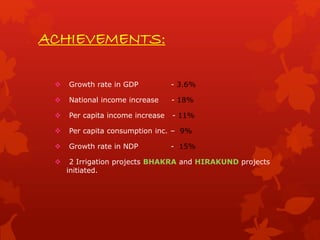
 Growth rate in GDP - 3.6%
 National income increase - 18%
 Per capita income increase - 11%
 Per capita consumption inc. – 9%
 Growth rate in NDP - 15%
 2 Irrigation projects BHAKRA and HIRAKUND projects
initiated.
This plan got a MODERNATE
SUCCESS, due to-
 UNFAVOURABLE MONSOON in 1957-58, 1959-60.
 SUIZ CRISES which blocked international trading and increase
the commodity prices.
 High TARIFFS.
OBJECTIVES:
 More stress to agriculture.
 Subsidies.
 Sufficient help.
 To increase the national income by 5% per annum
 Making India self sufficient in food grains by increasing agricultural production
 Minimizing rate of unemployment
 To establish equality among all the people of the country
AGMARKNET:
 To establish EQUITY among all the people of country.
 To achieve 4.5% growth rate of GDP
ACHIEVEMENTS:
≈ The Panchayat Organization was formed
≈ Many primary schools were started in rural aresa
≈ State electricity boards and state secondary education
boards were formed
≈ State road transportation corporations were formed
≈ Many cement and fertilizer plants were also built
Problems faced:
Sino-Indian War of 1962 exposed weaknesses in the
economy and shifted the focus towards the Defense
industry. In 1965-1966, India fought a war with
Pakistan. The war led to inflation and the priority was
shifted to price stabilization. GDP rate during this
duration was lower at 2.7%.
 FROM 1966 To 1969.
 In 1965-1966, India fought a [Indo-Pak] War with
Pakistan.
 Due to this war, there was a severe drought in
1965.
 The war led to inflation and the priority was shifted
to price stabilization.
 The construction of dams continued.
At this time Indira Gandhi was the Prime
Minister.
The Govt. nationalized 19 major Indian
banks.
OBJECTIVES:
To achieve stability and progress towards SELF –
RELIANCE.
To achieve an overall rate of growth 5.7 percent
annually.
To raise exports at the rate of 7 percent annually.
To reform and restructure government expenditure
agenda { DEFENSE became one major expense }
ACHIEVEMENTS:
14 Banks were NATIONALIZED.
Food grain production increase.
Served as a stepping stone for economic
growth.
great advancement has been made with regard to
India’s national income.
Considered as one of the EMERGING POWER.
Problems faced:
→ India was attacked in 1962 followed by
another one in 1965.
→A gap was created between the people of
rural areas and those of the urban areas.
 To reduce social, regional, and economic disparities
 Reduce poverty and to attain self sufficiency in agriculture and
defense
 Reducing rate of Unemployment both in Urban & Rural sectors
 Encourage Self-employment
 Encourage growth of Small scale industries
 Prevent over population
ACHIEVEMENTS:
Food grain production was above 118 million tons
due to the improvement of INFRASTRUCTUAL
FACILITIES.
BOMBAY HIGH had shot up the commercial
production of oil in India
The INDIAN NATIONAL HIGHWAY SYSTEM was
introduced for the first time.
PROBLEMS FACED:
― The INTERNATIONAL ECONOMY was in trouble.
― FOOD, OIL and FERTILIZERS where prices Sky –
Rocketed.
― Several Inflationary pressures.
― (Electricity supply act was enacted in 1975)
6th Five Year Plan -- Known as Janata Govt. Plan
It’s Existence – Tourism industry increased, I.T sector develops!!!!!
The issues – Rajiv Gandhi being the PM, & hence emphasized on Industrial
Development
Some agreed, but the communist groups protested
OBJECTIVES:
 To initiate FAMILY PLANNING.
 To improve PRODUCTIVITY LEVEL.
 To initiate modernization for achieving ECONOMIC and
TECHNOLOGICAL SELF – RELIANCE.
 To develop indigenous energy sources and efficient energy usage.
 To promote improved quality of life of citizens.
ACHIEVEMENTS:
 Speedy industrial development.
 Government investments in the Indian HEALTHCARE
CENTRE.
 Emphasis on the INFORMATION TECHNOLOGY SECTOR.
 Science and technology also made a significant
advance.
PROBLEMS FACED:
During this time RAGIV GANDHI was the PRIME
MINISTER and hence industrial development was the
emphasis of this plan, some opposed it specially the
communist groups, this slowed down the pace of
progress.
Congress comes into power
OBJECTIVES:
 To upgrade the industrial sector
 To generate more scope of employment
 Improved facilities for Education to girls
 Increase productivity of small and large scale farmers
Achievements:
 Using modern technology
 Full supply of food, clothing, and shelter
 Making India an Independent Economy
 Anti-poverty programs
PROBLEMS FACED:
 1989-91 was a period of POLITICAL INSTABILITY in
India and hence no Five Year Plan was implemented.
 In 1991, India faced a crisis in FOREIGN EXCHANGE
RESERVES.
A long term strategy was developed
 ANNUAL PLAN-1990 TO 1991.
 ANNUAL PLAN-1991 TO 1992.
This plan can also be called as RAO AND
MANMOHAN MODEL OF ECONOMIC
DEVELOPMENT.
OBJECTIVES:
 Prioritize the specific sectors which requires immediate
investment.
 To generate full scale employment.
 Universalization of elementary education.
 To place greater emphasis on role of private initiative in
the development of the industrial sector.
Something about Agriculture during this
period:
 Agriculture happens to be the largest contributor to the
GDP of India. In fact two third of the work force was
dependent on Agriculture. Industries made good use of
Agricultural produce in their production process.
 Self sufficiency in agricultural production was a top
priority during this plan.
 Reason: The whole of India depends on it.
ACHIEVEMENTS:
 Production of food increased from 51 million to 176.22 million
 GDP shoots up to a whooping 6.3% ……………… the target was
1.6%
 The plan was more successful than the 7th year plan
 24.4% domestic savings, it contributed 10.1% to the GDP in
regards to Export Earnings
 Was a plan that was more successful in meeting its objectives
as compared to other plans?
By Planning Commission
General:
 Target 6.5%!!!
 Achieved 5.35% 
OBJECTIVES:
 To prioritize rural development.
 To generate adequate employment opportunity
 To stabilize the prices
 To ensure food & nutritional security
Objectives: (cont…)
 To provide for basic infrastructural facilities
 Education
 Water
 Health
 Transport
 Energy
 Encourage Women improvement
 To create a liberal market for Private investment
Achievements:
Yes!! India managed to bring together the giant
power, support & effort of public, private & all
level of Govt.
OBJECTIVES:
 All children to be in school by 2003 and all
children to complete 5 year of schooling by 2007.
 Reduction in Poverty ratio from 26% to 21%.
 Decadal population growth to reduce from 21.3% in
1991-2001 to 16.2% by 2001-11.
Main objectives of the tenth plan are:
→ Rate of growth of national income
→ Growth rate of per capita income
→ Improvement in Quality of life
→ Reduction in poverty
→ Provision of gainful employment
→ Provision of universal education
→ Reduction in gender gaps
→ Reduction in growth of population
→ Increase in Literacy Rate
→ Reduction in Infant Mortality Ratio (MMR)
→ Environment Protection
→ Provision of Drinking Water
→ Growth, Euity and Sustainability
→ Balanced Developed in all States
The objective of 8% growth rate of Tenth Plan is based on
the following assumptions:
I. Incremental capital output ratio will be 4:1.
II. Rate of investment will be 32%.
III.There will be improvement in efficiency development.
IV. Sufficient political support will be mobilized to ensure
progress in critical areas.
V. The Rate of Domestic Savings will be 29.8% and of
foreign savings will be 2.8%.
VI. The Fiscal Deficit will be 2.6 per cent.
VII.The revenue receipts of the central government will be
10.2 percent and revenue expenditure will be 10.7 per
cent of the gross domestic product.
ACHIEVEMENTS:
 NSTFDC – NATIONAL SCHEDULED TRIBES
FINANCIAL AND DEVELOPMENT CORPORATION, has
been set up.
 Overall growth rate of GDP – 7 Percent.
This plan is titled with “ Towards Faster and
More Inclusive Growth”.
OBJECTIVES:
 Infrastructure
 Roads
 Ports
 Airports
 Railways
 Power
 Irrigation
 Telecom/IT
 Education
 Youth affairs
 Sports and Physical Education
 Health
 Women and Children
 Income and Poverty
 Environment
Strategy of 11th Plan:
 The main elements of strategy of 11th Plan are:
1. Rapid Growth
2. Inclusive Growth
3. Main Priority Areas
4. Main Focus on Private Sector
Main Areas of 11th Plan:
Main areas of 11th plan are as follows:
1. Agriculture
2. Infrastructure
 Highways
 Airports
 Railways
 Power Generation
3. Rural Infrastructure: Specific Targets of
Bharat Nirman Programme for the Period
(2005-2009)
 Irrigation
 Rural Roads
 Rural Housing
 Rural Water
 Rural electrification
 Rural telephone
4. Industry
5. Employment
6. Education
7. Health
8. Social Sector
Achievements:
1. Increase in National Income
2. Increase in Per Capita Income
3. Increase in the Rate of Capital Formation
4. Development of Agriculture
5. Industrial Development
6. Infrastructure Development
7. Generation of Employment
8. Development of Social Services
 Life Expectancy
 Death Rate
 Education
 Health
9. Self-Reliance
10. Structure and Institutional Changes
Failures:
The major failures of economic planning are as follows:
1. No Substantial Increase in the Standard of Living
2. Increase in Unemployment
3. Inequality in Distribution of Income and Wealth
4. More Ambitious
5. Paradox of Saving and Investment
6. Predominance of Welfare Considerations
7. Less Growth in Productive Sector
 The government on 4th October approved the 12th five
year plan (2012-17) that set average growth target at
8.2 percent.
 The theme of the Approach Paper is
 “Faster, Sustainable and more inclusive growth”.
Objectives:
 Basic objective: Faster, More Ickusive, and
Sustainable Growth.
 Could aim at 9.0 to 9.5 percent
 For growth to be more inclusive we need: Better
performance in agriculture
 Faster creation of jobs, especially in manufacturing
 Stronger efforts at health, education and Infrastructure.
 Special plans for disadvantaged/backward regions
Strategic Challenges:
Based on an intensive process within the Commission,
following “Twelve Strategy Challenges” have been identified
1. Enhancing the Capacity for Growth
2. Enhancing Skills and Faster Generation of Employment
3. Managing the Environment
4. Markets for Efficiency and Inclusion
5. Decentralization, Empowerment and Information
6. Technology and Innovation
7. Securing the Energy Future for India
8. Accelerated Development of Transport Infrastructure
9. Rural Transformation and Sustained Growth of
Agriculture
10.Managing Urbanization
11.Improved Access to Quality Education
12.Better Preventive and Curative Health Care
Any Question …
Just Ask !

Five Year Plan

  • 1.
    Submitted to :Gurjeet Juggal Submitted by : Josna, Bhuvan
  • 2.
    WHAT IS PLAN?  A plan spells out how the resources of a nation should be put to use.  It should have some general goals as well as specific objectives which are to be achieved with in a specified period of time.  In India plans are of five year duration and are called FIVE YEAR PLAN.
  • 3.
    Why to Plan??? After independence, India was in dire conditions and needed to start acting soon Some of the problems necessitated need for an immediate plan:  Vicious circle of poverty  Foreign Trade  Need for Rapid industrialization  Population pressure  Development of Natural resources  Capital Deficiency & Market imperfections
  • 4.
    OBJECTIVES OF PLANNING– Economic growth. Self- Reliance. Removal of Unemployment. Reduction in income inequalities. Elimination of poverty.
  • 5.
    PLANNING COMMISSION  ThePLANNING COMMISSION is an institution in the Government of India, which formulates India’s Five year plan.  Planning commission was set up on 15 MARCH 1950, with Prime minister JAWAHARLAL NEHRU as the chairman.
  • 6.
    Plan Target Actual FirstPlan (1951-56) 2.9% 3.6% Second Plan (1955-61) 4.5% 4.3% Third Plan (1961-66) 5.6% 2.8% Plan Holiday Fourth Plan (1969-1974) 5.7% 3.3% Fifth Plan (1974-79) 4.4% 4.8% Sixth Plan (1980-85) 5.2% 6.0% Seventh Plan (1985-90) 5.0% 6.0% Eighth Plan (1992-97) 5.6% 6.8% Ninth Plan (1997-2002) 6.5% 5.4% Tenth Plan (2002-2007) 8.0% --
  • 7.
    Introduced by thethen PM Pt. J. Nehru between the period 1951-56 The one responsible – Planning Commission
  • 8.
    Objectives:  Improve livingstandards of the people in India which was possible by making judicious use of Natural Resources.  Total outlay of this plan – A massive Rs. ‘2069 Cr The segregation – Industrial sector Energy, irrigation Transport , Communications Land Rehabilitations Social serves Development of Agri & community
  • 9.
    7 AREAS COVERED: •Agriculture as well as community development. • Energy as well as irrigation. • Communication and transportation. • Land rehabilitation. • Social services. • Miscellaneous. • Industrial sector.
  • 10.
    ACHIEVEMENTS:  HYDROELECTRIC POWERPROJECTS.  More railway lines were added.  ATOMIC ENERGY COMMISSION was formed.  5 STEEL plants at BHILAI, DURGAPUR and ROURKILA were established.
  • 11.
     Total outlay– RS. 4800 Core.  Followed by – MAHALANOBIS MODEL.  Target growth – To inc. NATIONAL INCOME by 25%.
  • 12.
    CONCERN AREAS:  Tomake country more industrialized.  Focus was mainly on heavy industries.  To increase employment opportunities.  To determine optimum allocation of investment between productive sectors.
  • 13.
    ACHIEVEMENTS:  Growth ratein GDP - 3.6%  National income increase - 18%  Per capita income increase - 11%  Per capita consumption inc. – 9%  Growth rate in NDP - 15%  2 Irrigation projects BHAKRA and HIRAKUND projects initiated.
  • 15.
    This plan gota MODERNATE SUCCESS, due to-  UNFAVOURABLE MONSOON in 1957-58, 1959-60.  SUIZ CRISES which blocked international trading and increase the commodity prices.  High TARIFFS.
  • 16.
    OBJECTIVES:  More stressto agriculture.  Subsidies.  Sufficient help.  To increase the national income by 5% per annum  Making India self sufficient in food grains by increasing agricultural production  Minimizing rate of unemployment  To establish equality among all the people of the country
  • 17.
    AGMARKNET:  To establishEQUITY among all the people of country.  To achieve 4.5% growth rate of GDP
  • 18.
    ACHIEVEMENTS: ≈ The PanchayatOrganization was formed ≈ Many primary schools were started in rural aresa ≈ State electricity boards and state secondary education boards were formed ≈ State road transportation corporations were formed ≈ Many cement and fertilizer plants were also built
  • 19.
    Problems faced: Sino-Indian Warof 1962 exposed weaknesses in the economy and shifted the focus towards the Defense industry. In 1965-1966, India fought a war with Pakistan. The war led to inflation and the priority was shifted to price stabilization. GDP rate during this duration was lower at 2.7%.
  • 20.
     FROM 1966To 1969.
  • 21.
     In 1965-1966,India fought a [Indo-Pak] War with Pakistan.  Due to this war, there was a severe drought in 1965.  The war led to inflation and the priority was shifted to price stabilization.  The construction of dams continued.
  • 22.
    At this timeIndira Gandhi was the Prime Minister. The Govt. nationalized 19 major Indian banks.
  • 23.
    OBJECTIVES: To achieve stabilityand progress towards SELF – RELIANCE. To achieve an overall rate of growth 5.7 percent annually. To raise exports at the rate of 7 percent annually. To reform and restructure government expenditure agenda { DEFENSE became one major expense }
  • 24.
    ACHIEVEMENTS: 14 Banks wereNATIONALIZED. Food grain production increase. Served as a stepping stone for economic growth. great advancement has been made with regard to India’s national income. Considered as one of the EMERGING POWER.
  • 25.
    Problems faced: → Indiawas attacked in 1962 followed by another one in 1965. →A gap was created between the people of rural areas and those of the urban areas.
  • 26.
     To reducesocial, regional, and economic disparities  Reduce poverty and to attain self sufficiency in agriculture and defense  Reducing rate of Unemployment both in Urban & Rural sectors  Encourage Self-employment  Encourage growth of Small scale industries  Prevent over population
  • 27.
    ACHIEVEMENTS: Food grain productionwas above 118 million tons due to the improvement of INFRASTRUCTUAL FACILITIES. BOMBAY HIGH had shot up the commercial production of oil in India The INDIAN NATIONAL HIGHWAY SYSTEM was introduced for the first time.
  • 28.
    PROBLEMS FACED: ― TheINTERNATIONAL ECONOMY was in trouble. ― FOOD, OIL and FERTILIZERS where prices Sky – Rocketed. ― Several Inflationary pressures. ― (Electricity supply act was enacted in 1975)
  • 29.
    6th Five YearPlan -- Known as Janata Govt. Plan It’s Existence – Tourism industry increased, I.T sector develops!!!!! The issues – Rajiv Gandhi being the PM, & hence emphasized on Industrial Development Some agreed, but the communist groups protested
  • 30.
    OBJECTIVES:  To initiateFAMILY PLANNING.  To improve PRODUCTIVITY LEVEL.  To initiate modernization for achieving ECONOMIC and TECHNOLOGICAL SELF – RELIANCE.  To develop indigenous energy sources and efficient energy usage.  To promote improved quality of life of citizens.
  • 31.
    ACHIEVEMENTS:  Speedy industrialdevelopment.  Government investments in the Indian HEALTHCARE CENTRE.  Emphasis on the INFORMATION TECHNOLOGY SECTOR.  Science and technology also made a significant advance.
  • 32.
    PROBLEMS FACED: During thistime RAGIV GANDHI was the PRIME MINISTER and hence industrial development was the emphasis of this plan, some opposed it specially the communist groups, this slowed down the pace of progress.
  • 33.
    Congress comes intopower OBJECTIVES:  To upgrade the industrial sector  To generate more scope of employment  Improved facilities for Education to girls  Increase productivity of small and large scale farmers
  • 34.
    Achievements:  Using moderntechnology  Full supply of food, clothing, and shelter  Making India an Independent Economy  Anti-poverty programs
  • 35.
    PROBLEMS FACED:  1989-91was a period of POLITICAL INSTABILITY in India and hence no Five Year Plan was implemented.  In 1991, India faced a crisis in FOREIGN EXCHANGE RESERVES.
  • 36.
    A long termstrategy was developed  ANNUAL PLAN-1990 TO 1991.  ANNUAL PLAN-1991 TO 1992.
  • 37.
    This plan canalso be called as RAO AND MANMOHAN MODEL OF ECONOMIC DEVELOPMENT.
  • 38.
    OBJECTIVES:  Prioritize thespecific sectors which requires immediate investment.  To generate full scale employment.  Universalization of elementary education.  To place greater emphasis on role of private initiative in the development of the industrial sector.
  • 39.
    Something about Agricultureduring this period:  Agriculture happens to be the largest contributor to the GDP of India. In fact two third of the work force was dependent on Agriculture. Industries made good use of Agricultural produce in their production process.  Self sufficiency in agricultural production was a top priority during this plan.  Reason: The whole of India depends on it.
  • 40.
    ACHIEVEMENTS:  Production offood increased from 51 million to 176.22 million  GDP shoots up to a whooping 6.3% ……………… the target was 1.6%  The plan was more successful than the 7th year plan  24.4% domestic savings, it contributed 10.1% to the GDP in regards to Export Earnings  Was a plan that was more successful in meeting its objectives as compared to other plans?
  • 41.
    By Planning Commission General: Target 6.5%!!!  Achieved 5.35%  OBJECTIVES:  To prioritize rural development.  To generate adequate employment opportunity  To stabilize the prices  To ensure food & nutritional security
  • 42.
    Objectives: (cont…)  Toprovide for basic infrastructural facilities  Education  Water  Health  Transport  Energy  Encourage Women improvement  To create a liberal market for Private investment Achievements: Yes!! India managed to bring together the giant power, support & effort of public, private & all level of Govt.
  • 43.
    OBJECTIVES:  All childrento be in school by 2003 and all children to complete 5 year of schooling by 2007.  Reduction in Poverty ratio from 26% to 21%.  Decadal population growth to reduce from 21.3% in 1991-2001 to 16.2% by 2001-11.
  • 44.
    Main objectives ofthe tenth plan are: → Rate of growth of national income → Growth rate of per capita income → Improvement in Quality of life → Reduction in poverty → Provision of gainful employment → Provision of universal education → Reduction in gender gaps → Reduction in growth of population → Increase in Literacy Rate → Reduction in Infant Mortality Ratio (MMR) → Environment Protection → Provision of Drinking Water → Growth, Euity and Sustainability → Balanced Developed in all States
  • 45.
    The objective of8% growth rate of Tenth Plan is based on the following assumptions: I. Incremental capital output ratio will be 4:1. II. Rate of investment will be 32%. III.There will be improvement in efficiency development. IV. Sufficient political support will be mobilized to ensure progress in critical areas. V. The Rate of Domestic Savings will be 29.8% and of foreign savings will be 2.8%. VI. The Fiscal Deficit will be 2.6 per cent. VII.The revenue receipts of the central government will be 10.2 percent and revenue expenditure will be 10.7 per cent of the gross domestic product.
  • 46.
    ACHIEVEMENTS:  NSTFDC –NATIONAL SCHEDULED TRIBES FINANCIAL AND DEVELOPMENT CORPORATION, has been set up.  Overall growth rate of GDP – 7 Percent.
  • 47.
    This plan istitled with “ Towards Faster and More Inclusive Growth”.
  • 48.
    OBJECTIVES:  Infrastructure  Roads Ports  Airports  Railways  Power  Irrigation  Telecom/IT  Education  Youth affairs  Sports and Physical Education  Health  Women and Children  Income and Poverty  Environment
  • 49.
    Strategy of 11thPlan:  The main elements of strategy of 11th Plan are: 1. Rapid Growth 2. Inclusive Growth 3. Main Priority Areas 4. Main Focus on Private Sector
  • 50.
    Main Areas of11th Plan: Main areas of 11th plan are as follows: 1. Agriculture 2. Infrastructure  Highways  Airports  Railways  Power Generation 3. Rural Infrastructure: Specific Targets of Bharat Nirman Programme for the Period (2005-2009)  Irrigation  Rural Roads  Rural Housing  Rural Water  Rural electrification  Rural telephone 4. Industry 5. Employment 6. Education 7. Health 8. Social Sector
  • 51.
    Achievements: 1. Increase inNational Income 2. Increase in Per Capita Income 3. Increase in the Rate of Capital Formation 4. Development of Agriculture 5. Industrial Development 6. Infrastructure Development 7. Generation of Employment 8. Development of Social Services  Life Expectancy  Death Rate  Education  Health 9. Self-Reliance 10. Structure and Institutional Changes
  • 52.
    Failures: The major failuresof economic planning are as follows: 1. No Substantial Increase in the Standard of Living 2. Increase in Unemployment 3. Inequality in Distribution of Income and Wealth 4. More Ambitious 5. Paradox of Saving and Investment 6. Predominance of Welfare Considerations 7. Less Growth in Productive Sector
  • 53.
     The governmenton 4th October approved the 12th five year plan (2012-17) that set average growth target at 8.2 percent.  The theme of the Approach Paper is  “Faster, Sustainable and more inclusive growth”.
  • 54.
    Objectives:  Basic objective:Faster, More Ickusive, and Sustainable Growth.  Could aim at 9.0 to 9.5 percent  For growth to be more inclusive we need: Better performance in agriculture  Faster creation of jobs, especially in manufacturing  Stronger efforts at health, education and Infrastructure.  Special plans for disadvantaged/backward regions
  • 55.
    Strategic Challenges: Based onan intensive process within the Commission, following “Twelve Strategy Challenges” have been identified 1. Enhancing the Capacity for Growth 2. Enhancing Skills and Faster Generation of Employment 3. Managing the Environment 4. Markets for Efficiency and Inclusion 5. Decentralization, Empowerment and Information 6. Technology and Innovation 7. Securing the Energy Future for India 8. Accelerated Development of Transport Infrastructure 9. Rural Transformation and Sustained Growth of Agriculture 10.Managing Urbanization 11.Improved Access to Quality Education 12.Better Preventive and Curative Health Care
  • 56.