WELCOME…….
3D PRINTED TABLETS
3D PRINTED TABLETS
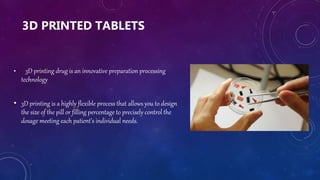
• 3D printing drug is an innovative preparation processing
technology
• 3D printing is a highly flexible process that allows you to design
the size of the pill or filling percentage to precisely control the
dosage meeting each patient’s individual needs.
• Making tablets using a 3D printer enables patients to be provided with medication that is
personalised to their needs as precisely as possible.
• In 2015, Aprecia Pharmaceuticals’ Spritam levetiracetam for seizures became the first 3D-
printed drug approved by the FDA. The firm, of which Lang was a board member, makes
Spritam using its proprietary ZipDose technology.
• Triastek is a global leader in pharmaceutical 3D printing, with 41 patents that account for
more than 20% of global 3D printing pharmaceuticals applications. Using their proprietary
MED 3D printing technology, Triastek develops their own in-house drugs and partners with
others to provide drug development solutions.
MECHANISM
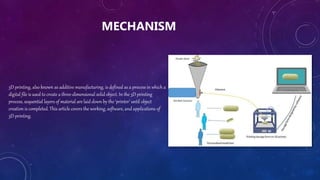
3D printing, also known as additive manufacturing, is defined as a process in which a
digital file is used to create a three-dimensional solid object. In the 3D printing
process, sequential layers of material are laid down by the ‘printer’ until object
creation is completed. This article covers the working, software, and applications of
3D printing.
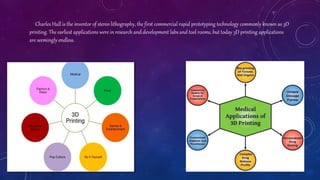
Charles Hull is the inventor of stereo lithography, the first commercial rapid prototyping technology commonly known as 3D
printing. The earliest applications were in research and development labs and tool rooms, but today 3D printing applications
are seemingly endless.
SPRITAM FIRST 3D PRINTED TABLETS
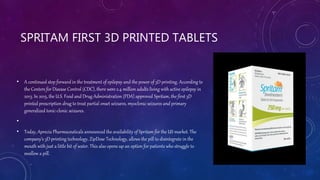
• A continued step forward in the treatment of epilepsy and the power of 3D printing. According to
the Centers for Disease Control (CDC), there were 2.4 million adults living with active epilepsy in
2013. In 2015, the U.S. Food and Drug Administration (FDA) approved Spritam, the first 3D
printed prescription drug to treat partial onset seizures, myoclonic seizures and primary
generalized tonic-clonic seizures.
•
• Today, Aprecia Pharmaceuticals announced the availability of Spritam for the US market. The
company’s 3D printing technology, ZipDose Technology, allows the pill to disintegrate in the
mouth with just a little bit of water. This also opens up an option for patients who struggle to
swallow a pill.
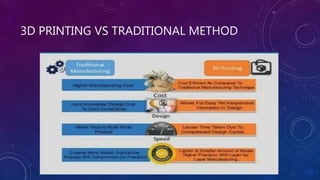
3D PRINTING VS TRADITIONAL METHOD
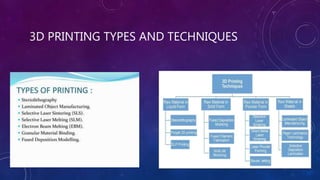
3D PRINTING TYPES AND TECHNIQUES
APPLICATION OF 3D PRINTED TABLETS
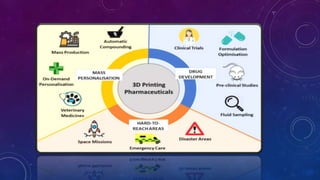
• Three-dimensional (3D) printing is causing a shift away from traditional mass production towards personalized medicines;
• 3D printing could be integrated into various healthcare and resource-constrained settings;
• The technology can be used to create medicines that are tailored to a patient’s therapeutic requirements (e.g. dosage, drug combination and drug
release profiles) and personal preferences (e.g. shape, size, texture and flavor);
• 3D printing offers numerous benefits to both clinical practice and the pharmaceutical industry alike, including decreased costs and expedited
development time;
• Buy-in from healthcare professionals, including pharmacists, is vital to the integration of 3D printing into clinical settings.
THE USES AND PROSPECTS FOR 3D PRINTING IN
PHARMACOLOGY
Three-dimensional (3D) technology is considered one of the promising areas of medicine. The world has already seen printed
anatomical prostheses, hearing aids, heart valves, biological tissues and many others. Therefore, innovative 3D scanning and printing
systems have the potential to open up new opportunities that are difficult to overestimate.
The benefits of 3D technology in compounding pharmacies
include:
•The ability to create tablets of any shape and size.
•The ability to set the dosage individually for each patient.
•The ability to regulate the number of active substances in the Composition of the tablet,
remove or replace individual components. •This will help many people take medicine even if
there are contraindications to a single substance.
•The ability to replace a large number of drugs with one tablet, which also reduces the
frequency of medication.