ISSN: 2278 – 1323
                              International Journal of Advanced Research in Computer Engineering & Technology
                                                                                  Volume 1, Issue 4, June 2012


   Refuse of Sensor’s Energy Consumption in Wireless
       Sensor Networks Using Routing Protocols
N.Sandeep Krishna,                                                C.Rajendra,
M.Tech Student, Department of CSE,                                Professor, Department of CSE,
Audisankara College of engineering                                Audisankara College of Engineering
and Technology, Gudur.                                            and Technology, Gudur.

Abstract— A collection of huge number of a smaller                Sensor Networks (WSN), sensor nodes are deployed
amount of cost, a smaller amount of power as well as              to sense various actions or ecological phenomena
multifunctional small intelligent sensors is called as a          through sensing, processing and also by forward the
Wireless Sensor Network(WSN). In these Wireless                   data to a fascinated person or user.
Sensor Networks, sensor nodes are have an extremely                               The main aim of an energy-aware
limited power supply. The main aim of this power                  routing protocol is very critical for these type of
routing procedure is dangerous for these Wireless                 Wireless Sensor Networks. Since, the majority of the
Sensor Networks, because the majority of the sensor’s             sensor's power is utilized by the communication
power is utilized at the time of sending the data from a
                                                                  procedure at the time of transmitting or sending
sensor node to the sink or Base Station (BS). In this
                                                                  some data or information from a sensor node to the
paper, we will introduce a new routing protocol called
as MIN-RC, which is mainly based on LEACH-C
                                                                  sink or Base Station(BS). A low power utilization
protocol to stabilize the power utilization of a variety of       routing protocol will prolong the Wireless Sensor
sensor nodes to solve the excess power utilization                Network life time [1, 2, 3]. In order to prolong the
problem. LEACH-C is a centralized clustering                      life time of WSN many routing protocols have been
algorithm, which is based on LEACH[5].                            designed to minimize the energy consumed by
                         The LEACH protocol is mainly             routing operations [1].
used for the purpose of HIERARCHICAL routing. To
solve the difficulty of power utilization between various
                                                                  Clustering based routing protocols:
sensor nodes, MIN-RC uses an adaptive round control
                                                                              Clustering is the procedure, in this the
method to balance the power utilizations by allowing
present position of the network, cluster dimension, and
                                                                  sensor nodes are ordered in a set about the Cluster
the location of cluster head. To estimate and contrast            Head by the task of an observance position and also
MIN-RC with LEACH-C, we will use ns-2 simulator.                  inter cluster comparison occupied in the data
The simulation work completes when the number of                  processing. In hierarchical (cluster-based) routing
nodes are active is less than or equal to the number of           protocols, these sensor nodes are categorized into a
clusters.                                                         practical hierarchy method to structure a many-hops
                                                                  communication representation. The main objective to
Keywords-Wireless Sensor Networks (WSN) routing;                  use this particular method is to decrease the power
LEACH-C; MIN_RC; power utilization.                               utilization which will be used to transmit the data to
                                                                  the sink or Base Station (BS), and it will be achieve
                                                                  through decreasing the different number of messages
              I.    INTRODUCTION                                  sent to the Base Station (BS) during data aggregation
              Modern     researches   in    wireless              and also synthesis.
communications contains the growth of low-priced,
less-power as well as multifunctional a very little               Merits of Clustering:
intelligent sensors These sensors have the ability to
sense, process data and communicate with each other                       It is useful to achieve Scalability.
via a wireless connection.[1, 2]. A group of a huge                       It provides Bandwidth reuse.
number of these little sensors is also called as a                        It provides an improved resource sharing.
Wireless Sensor Network(WSN). In these Wireless                           It decrease communication transparency.


                                                                                                                   358
                                             All Rights Reserved © 2012 IJARCET
ISSN: 2278 – 1323
                                    International Journal of Advanced Research in Computer Engineering & Technology
                                                                                        Volume 1, Issue 4, June 2012


                                                                    account, the smallest amount of cluster dimension to
                                                                    manage the round time, and at all times it will reduce
                                                                    the round time with respect to the present position of
                                                                    the network.

                                                                                II. ASSOCIATED WORK

                                                                                     The Low Energy Adaptive
                                                                    Clustering Hierarchy (LEACH) routing protocol is
                                                                    one of the majority of ordinary routing protocols
       Fig: Hierarchy of Cluster model
                                                                    which is used for hierarchical routing. This
                   Distribution of power utilization                LEACH protocol is introduced to stabilize the
among these nodes can also extend the network life                  power utilized in these Wireless Sensor Networks
time and also increase the effectiveness of the                     (WSN) by means of selecting various sensor nodes
Wireless Sensor Network. Manipulation of a cluster-                 to perform as cluster heads. These sensor nodes
based routing protocol need to thought of the cluster               gather the data from the remaining nodes, and then
arrangement, cluster head selection, data aggregation,              aggregate the gathered data, after that transfer this
and also inter and intra- cluster communications [1,                aggregated data straightly to the sink or Base
2]. The routing protocol LEACH [4, 5] uses a scheme                 Station (BS). The LEACH protocol functionality is
where the cluster head is randomly rotated to                       shown in the following figure:
distribute energy consumption among sensor nodes
and many researchers attempt to enhance this
protocol.
         PEGASIS [3, 6] forms a set of chains of
closed neighbours with a leader for each chain,
each neighbour sends data to its closest neighbour
until all the data which is sent by the members is
aggregated at the chain leader. At that time, the
chain leader transmits or sends an aggregated
                                                                       Fig: Functionality of LEACH protocol
information to the Base Station (BS) as a
representative of the additional chain members. In
                                                                                    This LEACH algorithm partition
TEEN [7] and APTEEN [8] threshold values are
                                                                    the Sensor’s Network life time into different
used to control data transmission. HEED [9] selects
                                                                    rounds, and each and every round is having two
a set of nodes as cluster heads depending on the
                                                                    stages:
residual-energy of the node and on a secondary
                                                                        1. Setup stage (Cluster’s arrangement)
parameter intra-cluster communication cost for
                                                                        2.steady stage(working stage)
cluster head selection.
            In this paper, we will explain the difficulty
                                                                    Ti(t) = k/(N-k*(r mod(N/k))) if Ci(t)=1
of overload power utilization in the cluster based
Wireless Sensor Networks(WSN), and introduce
                                                                    Ti(t) = 0                     if Ci(t)=0
MIN-RC, which is a routing protocol and it is based
                                                                                                      →(1)
on the existing LEACH-C protocol that reduces the
difference of power utilization caused through                            In the 1st stage that is., in Setup stage, the
uneven clustering. The proposed MIN-RC routing                      clusters are arranged through the set of nodes by
protocol use a changeable round time instead of a                   itself using the above equation (1),
permanent round time which is present as in existing                           where
LEACH-C protocol, and we will also take into                                            N is the number of nodes,


                                                                                                                           359
                                               All Rights Reserved © 2012 IJARCET
ISSN: 2278 – 1323
                             International Journal of Advanced Research in Computer Engineering & Technology
                                                                                 Volume 1, Issue 4, June 2012


                k is the number of clusters,                           Distributed algorithms
                r is the present or current round                      Local based algorithms
number,
            and Ci is the function which is to be              Design constraints for routing in WSNs:
determined.                                                            With respective to the decreased computing,
         If the sensor node i is to be chosen as a             battery assets of various sensors, the routing
cluster head in the current round (r mod( N/k)), where         protocols in Wireless Sensor Networks are
each and every node will choose an arbitrary number            predictable    to    accomplish     the   following
between 0 and 1, if this particular arbitrary number is        requirements[16]:
larger than the threshold value T then the sensor node               Autonomy
is to be preferred as a cluster head and transmit an                 Energy efficiency
announcement message which contains its                              Scalability
Identification. Remaining nodes (non-cluster head)                   Mobile adaptability
make a decision to connect a cluster based on the
signal power of the acknowledged announcements,                                   The purpose specific protocol meant
then these nodes transfer a Join-Request message to            for the Cluster Head choice, LEACH-Centralized
the chosen Cluster Head CH. After that, the Cluster            occupy centralized clustering algorithm and it is an
Head CH collect the combination of messages from               enhancement of the LEACH protocol. LEACH-C[5]
remaining nodes which will be determined to connect            is a centralized clustering algorithm which based on
this particular cluster; then the Cluster Head CH              LEACH. In an existing LEACH-C routing protocol,
generate a TDMA (Time division multiple Access)                the sink or Base Station (BS) choose a very few
program and transmits this particular program to the           nodes to perform as cluster heads by taking the
all of the cluster members which are present in the            residual power and also the position of each and
cluster. Then this TDMA program is having a time               every node.
period for each and every node to exchange                                             In the setup stage, in an
information with a Cluster Head CH.                            existing LEACH-C protocol, all the nodes transmit or
                   In the second stage, that is., in the       send their positions and also their present power
steady stage, it will be divided into a various number         altitude to the sink or Base Station (BS). After getting
of frames; in each and every frame the sensor node             all of these nodes information, this sink or Base
transmits its data to a Cluster Head CH by using its           Station (BS) will select different nodes to perform as
time period in the particular TDMA program. After              cluster heads for the subsequent round. The nodes
this it will change its particular position to the sleep       which are having the highest energy than the average
mode. When the Cluster Head CH node collect the                energy of all the sensor nodes are suitable to
data from its cluster members, then the Cluster Head           employed as cluster heads.
CH combines the received data and transfers this                                   Then, this particular Base Station
combined data straightly to the sink or Base Station           (BS) performs an annealing algorithm to form k
(BS). This procedure is continues upto the                     clusters, where k is a predetermined optimal number
completion of the round, after the finishing of each           of clusters[5], by means of the finish of this stage,
and every round, sensor nodes goes through the setup           the sink or Base Station (BS) transmits or sends the
stage another time to choose a latest set of cluster           cluster data or information message which contains
heads which will be used for the subsequent round.             the cluster head Identifier id, for each and every
                                                               sensor node. When the sensor node will collect the
Algorithm paradigms for WSN:                                   cluster’s data or information message , then the
        Applications of Sensors        requires the            sensor node compare its Identifier id with one of the
communication of various sensor nodes to perform               Base Station’s message.
different actions or algorithms. In reality, three                                If the cluster head Identifier id
different types of algorithms are be implemented on            which is present in the information is matched with
Wireless Sensor Networks (WSN).                                the message which is present in Base Station’s
      Centralized algorithms                                  message, then that particular node will considered as


                                                                                                                  360
                                          All Rights Reserved © 2012 IJARCET
ISSN: 2278 – 1323
                             International Journal of Advanced Research in Computer Engineering & Technology
                                                                                 Volume 1, Issue 4, June 2012


cluster head. If not, it will decide its time period and
it also entering into the sleep mode. The steady stage
which is present in the existing LEACH-C protocol is
also same as the LEACH protocol steady stage.
                   In [10] the round time T is
determined by the energy level of the CH and non-
CH members and percentage of the nodes alive in the
round.
                  VR-LEACH         (Variable     Round-
LEACH)[11], which is an improvement for the
LEACH protocol changes the round time according
                                                               Fig: Various protocols in Wireless Sensor Network model
to the residual energy of the cluster head at the
beginning of the round, the energy cost in every               Each sensor node is prepared with position
frame and the constants λ. In this VR-LEACH                    recognition nature for example in Global Positioning
protocol, a stable value for λ as well as the frame            System (GPS), sensor nodes know how to manage
time µ are calculated for each and every round time,           their broadcast power to send straightly to the sink or
here these calculated values of λ, and µ are                   Base Station (BS). All these nodes begins with the
mentioned with an experimental results.                        similar power altitude and the Base Station (BS) is
                    In[10, 11] no mention is made as to        having unrestricted power supply, sensor nodes are
how the round time T could be distributed among                having the data at every time to transmit to the Base
clusters, because all clusters must finish the round at        Station (BS). Great data combination, where this
the same time and start the next setup phase to form           particular Cluster Head CH combines the grouped
new clusters for the next round.                               data messages expressed into a distinct message.

                                                                           We will use a straightforward power
III.     PROBLEM STATEMENT                                     representation as in LEACH protocol, with power
                                                               dispersion 50nJ/bit for transmitter electronics ETx-elec
A.MODEL OF A WIRELESS SENSOR NETWORK                           and receiver ERx-elec electronic
               We will think about a Wireless Sensor
Network (WSN) model, where the number of various
sensor nodes N are arbitrarily organize in excess of                   ETx-elec= ERx-elec= Eelec                     (2)
the sensing area in a consistent way. These sensor
nodes observe ecological phenomena and transmit                             Power utilization is 100pJ/bit/m2 for a
their data or information to the sink or Base Station          transmitter amplifier ( amp). To transmit the (l-bit)
(BS). We are having several preface assumptions for            message in excess of a distance d, then the power
the Wireless Sensor Network (WSN) model. These                 utilized by the radio is
sensor nodes and the Base Station (BS) are
motionless after the exploitation and this Base                     ETx (l, d )  ETx − elec (l)  ETx −
Station (BS) is to be placed far away from all these
                                                                    amp   (l)
sensors, and all of these sensor nodes are consistent
and they all are having the similar competencies
                                                                                lE      lε fs d
where each sensor node has a distinctive identifier                             elec             2
                                                                                                              d  d0       (3)
(Id). The protocols present in Wireless Sensor                                                  4
Network are shown in figure:                                                    lE      lε mp
                                                                                elec d                        d  d0

                                                               Where d0 is the threshold distance.


                                                                                                                           361
                                          All Rights Reserved © 2012 IJARCET
ISSN: 2278 – 1323
                                      International Journal of Advanced Research in Computer Engineering & Technology
                                                                                          Volume 1, Issue 4, June 2012


                   In the standardized division of N                         nodes in each and every cluster, or the space to the
sensor nodes into k different clusters, then the                             sink or Base Station (BS) while structuring the
average cluster size is N/k, and the Base Station (BS)                       clusters, therefore the Cluster Head CH would be
is far away from any of the cluster head (distance to                        placed at any position in the sensing ground, and any
BS dtoBS > d0), and the d4 power failure is used, for                        of the cluster can be assembled with the help of
that reason the energy or power ECH is utilized by the                       various number of sensor nodes.
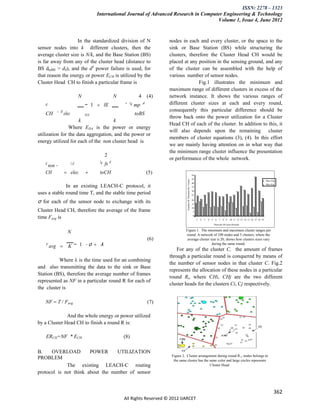
Cluster Head CH to finish a particular frame is                                             Fig.1 illustrates the minimum and
                                                                             maximum range of different clusters in excess of the
                              N                    N           4       (4)   network instance. It shows the various ranges of
                                                        lε
   E                              − 1  lE                    mp   d         different cluster sizes at each and every round,
            lE                                                              consequently this particular difference should be
   CH             elec  DA                     toBS
                                                                             throw back onto the power utilization for a Cluster
                     k                k
                                                                             Head CH of each of the cluster. In addition to this, it
                Where EDA is the power or energy
                                                                             will also depends upon the remaining cluster
utilization for the data aggregation, and the power or
                                                                             members of cluster equations (3), (4). In this effort
energy utilized for each of the non cluster head is
                                                                             we are mainly having attention on in what way that
                                                                             the minimum range cluster influence the presentation
                                            2
                                                                             or performance of the whole network.
                                       lε
   E
    non –                lE                 fs d
   CH              elec              toCH                            (5)                                               50
                                                                                                                         45


                                                                                        Number Of Elements Per Cluster
                                                                                                                                                                                                 Max-Size
                                                                                                                         40
                                                                                                                                                                                                 Min-Size
              In an existing LEACH-C protocol, it                                                                        35
                                                                                                                         30
uses a stable round time T, and the stable time period                                                                   25


σ for each of the sensor node to exchange with its                                                                       20
                                                                                                                         15
                                                                                                                         10
Cluster Head CH, therefore the average of the frame                                                                       5
                                                                                                                          0
time Favg is                                                                                                                  1   2   3   4   5    6   7   8 9   10 11 12 13 14 15 16 17 18 19

                                                                                                                                                  Network life time (Round)

                                                                                       Figure 1. The minimum and maximum cluster ranges per
                    N                                                                  round. A network of 100 nodes and 5 clusters, where the
                                                                       (6)              average cluster size is 20, shows how clusters sizes vary

        avg  K − 1 ⋅ σ λ
    F                                                                                                    during the same round.
                                                                                 For any of the cluster C, the amount of frames
                                                                             through a particular round is conquered by means of
          Where λ is the time used for an combining
                                                                             the number of sensor nodes in that cluster C. Fig.2
and also transmitting the data to the sink or Base
                                                                             represents the allocation of these nodes in a particular
Station (BS), therefore the average number of frames
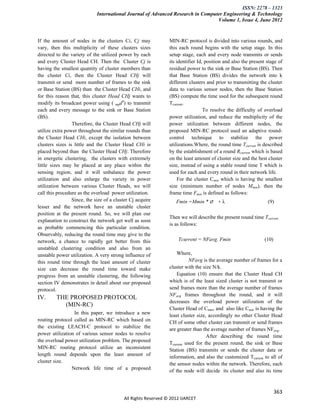
                                                                             round Rt, where CHi, CHj are the two different
represented as NF in a particular round R for each of
                                                                             cluster heads for the clusters Ci, Cj respectively.
the cluster is

   NF  T / Favg                                                       (7)

              And the whole energy or power utilized
by a Cluster Head CH to finish a round R is:

   ERCH=NF * ECH                                       (8)

B.    OVERLOAD         POWER      UTILIZATION
                                                                              Figure 2. Cluster arrangement during round R t, nodes belongs to
PROBLEM                                                                        the same cluster has the same color and large circles represents
             The existing LEACH-C routing                                                               Cluster Head.

protocol is not think about the number of sensor


                                                                                                                                                                                                        362
                                                       All Rights Reserved © 2012 IJARCET
ISSN: 2278 – 1323
                             International Journal of Advanced Research in Computer Engineering & Technology
                                                                                 Volume 1, Issue 4, June 2012


If the amount of nodes in the clusters Ci, Cj may              MIN-RC protocol is divided into various rounds, and
vary, then this multiplicity of these clusters sizes           this each round begins with the setup stage. In this
directed to the variety of the utilized power by each          setup stage, each and every node transmits or sends
and every Cluster Head CH. Then the Cluster Cj is              its identifier Id, position and also the present stage of
having the smallest quantity of cluster members than           residual power to the sink or Base Station (BS). Then
the cluster Ci, then the Cluster Head CHj will                 that Base Station (BS) divides the network into k
transmit or send more number of frames to the sink             different clusters and prior to transmitting the cluster
or Base Station (BS) than the Cluster Head CHi, and            data to various sensor nodes, then the Base Station
for this reason that, this cluster Head CHj wants to           (BS) compute the time used for the subsequent round
modify its broadcast power using ( mpd4) to transmit           Tcurrent.
each and every message to the sink or Base Station                               To resolve the difficulty of overload
(BS).                                                          power utilization, and reduce the multiplicity of the
                 Therefore, the Cluster Head CHj will          power utilization between different nodes, the
utilize extra power throughout the similar rounds than         proposed MIN-RC protocol used an adaptive round-
the Cluster Head CHi, except the isolation between             control technique to stabilize the power
clusters sizes is little and the Cluster Head CHi is           utilizations.Where, the round time Tcurrent is described
placed beyond than the Cluster Head CHj. Therefore             by the establishment of a round Rcurrent which is based
in energetic clustering, the clusters with extremely           on the least amount of cluster size and the best cluster
little sizes may be placed at any place within the             size, instead of using a stable round time T which is
sensing region, and it will unbalance the power                used for each and every round in their network life.
utilization and also enlarge the variety in power                  For the cluster Cmin which is having the smallest
utilization between various Cluster Heads, we will             size (minimum number of nodes Mmin), then the
call this procedure as the overload power utilization.         frame time Fmin is defined as follows:
                 Since, the size of a cluster Cj acquire          Fmin =Mmin * σ       +λ                       (9)
lesser and the network have an unstable cluster
position at the present round. So, we will plan our
                                                               Then we will describe the present round time Tcurrent
explanation to construct the network get well as soon
                                                               is as follows:
as probable commencing this particular condition.
Observably, reducing the round time may give to the
network, a chance to rapidly get better from this                  Tcurrent = NFavg. Fmin                      (10)
unstabled clustering condition and also from an
unstable power utilization. A very strong influence of             Where,
this round time through the least amount of cluster                       NFavg is the average number of frames for a
size can decrease the round time toward make                   cluster with the size N/k.
progress from an unstable clustering, the following                Equation (10) ensure that the Cluster Head CH
section IV demonstrates in detail about our proposed           which is of the least sized cluster is not transmit or
protocol.                                                      send frames more than the average number of frames
                                                               NFavg frames throughout the round, and it will
IV.      THE PROPOSED PROTOCOL
                                                               decreases the overload power utilization of the
           (MIN-RC)
                                                               Cluster Head of Cmin, and also like Cmin is having the
                 In this paper, we introduce a new             least cluster size, accordingly no other Cluster Head
routing protocol called as MIN-RC which based on               CH of some other cluster can transmit or send frames
the existing LEACH-C protocol to stabilize the                 are greater than the average number of frames NFavg.
power utilization of various sensor nodes to resolve                              After describing the round time
the overload power utilization problem. The proposed           Tcurrent used for the present round, the sink or Base
MIN-RC routing protocol utilize an inconsistent                Station (BS) transmits or sends the cluster data or
length round depends upon the least amount of                  information, and also the customized Tcurrent to all of
cluster size.                                                  the sensor nodes within the network. Therefore, each
                Network life time of a proposed                of the node will decide its cluster and also its time


                                                                                                                      363
                                          All Rights Reserved © 2012 IJARCET
ISSN: 2278 – 1323
                               International Journal of Advanced Research in Computer Engineering & Technology
                                                                                   Volume 1, Issue 4, June 2012


period in the particular TDMA program, and it will                    existing LEACH-C protocol.
begins the steady state stage. The steady state stage
of the proposed MIN-RC protocol is similar to the                                                    100                                                            MIN-RC
                                                                                                                                                                    LEACH-C
steady state stage which is present in the existing                                                         80                                                      LEACH


                                                                              Number Of Nods Alive
LEACH-C protocol.
                                                                                                            60

            V.       SIMULATION WORK                                                                        40

                 To analyze and contrast the
                                                                                                            20
proposed MIN -RC protocol with the existing
LEACH-C protocol, we will use an ns2 simulator                                                                      0
                                                                                                                          0     100    200     300     400   500     600
[12] with ns-extension by Heinzelman [13].                                                                                                   Time(s)

                   TABLE: PARAMETERS TABLE                                                                Figure 3. The number of nodes alive during the
                                                                                                                          simulation time
            Parameter                      Value
                                                                      Fig. 4 represents average of the utilized power to
    Sensing area               100 x 100                              transmit or send the data signal beginning from any
    Network size               100 nodes                              of the sensor node to the sink or Base Station (BS).
    Location of BS             50,175
                                                                      The proposed protocol MIN-RC utilizes minimum
                                                                      power than the existing LEACH-C protocol, it is
    Data message               500 bytes
                                                                      because of the proposed MIN-RC protocol can be
    Packet header.             any packet type 25 bytes
                                                                      able to very rapidly get better from the position of an
    Initial Energy             2J
                                                                      unstabilized clustering. Therefore, it will avoid
    Eelec                      50 pJ/bit
                                           2
                                                                      additional power utilization caused by means of an
      Fs                       10pJ/bit/m
                                             4                        uneven clustering. It will indicating         that the
      Mp                       0.0013pJ/bit/m
                                                                      proposed MIN-RC protocol is very much better than
    Number of cluster          k=5.
                                                                      the LEACH-C protocol in terms of power utilization.
                                                                                                                          5 x 10⁻³ J
                 In our research, the network which is                                                                                                         4.354677
                                                                                    Aerage Of e Enegy Consumed Per Sage


having 100 sensor nodes are arbitrarily arranged                                                                          4
within the sensing region between (0, 0) and                                                                                     2.872313
                                                                                                                                                3.1066408
                                                                                                                          3
(100,100). We will assume that all of these sensor
nodes are motionless, and any of the sensor node will
                                                                                                                          2
transmit or send straightly to the sink or Base Station
(BS). Table I. represents the system activities for our
                                                                                              Th


                                                                                                                          1

simulation work, which are related to those used in                                                                       0
the LEACH [5] protocol. The simulation work                                                                                      MIN-RC          LEACH-C           LEACH
completes while the number of sensor nodes are
                                                                                         Figure4. The average of the energy consumed per data
present in the network are smaller than or equivalent                                       message received at the BS, shows that MIN-RC
to the quantity or amount of clusters.                                                          consumed less energy than LEACH-C
The simulation outcomes define and represent that                                         The proposed MIN-RC protocol
the proposed MIN-RC protocol is more competent                        controls the round time focus to the least cluster size.
than the existing LEACH-C protocol and it can also                    Therefore, the proposed MIN -RC protocol is having
convey extra information or data than the existing                    some extra rounds when compared to the existing
LEACH-C protocol.                                                     LEACH-C protocol, and also some extra setup stage
            Fig. 3 shows the various number of                        messages. However, we will see in Fig. 6, that the
sensor nodes are active over simulation time. Nodes                   additional setup transparency is not having a serious
which are present in the existing LEACH-C protocol                    cause on the entire network performance presentation
are having very great life time than the proposed                     as the MIN-RC protocol still having an enhanced
MIN-RC protocol; but the nodes in our network                         power utilization.
model transmit or send some extra data than the


                                                                                                                                                                             364
                                                 All Rights Reserved © 2012 IJARCET
ISSN: 2278 – 1323
                                  International Journal of Advanced Research in Computer Engineering & Technology
                                                                                      Volume 1, Issue 4, June 2012


              VI.      CONCLUSION                                          1125 - 3-1130.
                                                                       [7] M. Arati, "TEEN: A Routing Protocol for Enhanced
                                                                           Efficiency in Wireless Sensor Networks", Parallel and
In this paper, we will illustrate the proposed MIN-RC                      Distributed Processing Symposium, Proceedings 15th
protocol, which is an improvement of the existing                          International In Parallel and Distributed Processing

LEACH-C protocol, and it is an adaptive round-                              Symposium., Proceedings 15th International ,2001, pp. 2009-
control method to better utilization of the power                           2015.
utilized throughout the round time of a Wireless                       [8] A. Manjeshwar, and D. P. Agrawal, "APTEEN: a hybrid
Sensor Network (WSN) communication protocol.                                protocol for efficient routing and comprehensive information
                                                                            retrieval in wireless sensor networks", in Parallel and
Our proposed or planned technique allows the size                           Distributed      Processing      Symposium.,    Proceedings
(number of nodes) of the cluster in every round and                         International, IPDPS 2002, Abstracts and CD-ROM. 2002,
also the best number of frames to describe the time-                        pp. 195-202.
span of the present round, and our models also                         [9] O. Younis, and S. Fahmy, "HEED: a hybrid, energy-efficient,
                                                                            distributed clustering approach for ad hoc sensor networks",
overcomes the overload problem of an existing                               Mobile Computing, IEEE Transactions,Vol.3 No.4 2004, pp.
LEACH-C protocol, which will improves the                                   366-379.
network effectiveness (the number of data messages
received at the BS) by means of about 8%. However,                     [10] G. Xiaojin, and C. Lanlan, "A Variable Round Mechanism for
                                                                            Routing      Protocols    Based     on    LEACH",Wireless
when we establish the least amount of cluster size in                       Communications, Networking and Mobile Computing, 2008.
our proposed system and it is having an additional set                      WiCOM '08, 4th International Conference on. 2008, pp.1-4.
of connections transparency.
    It is the piece of our effort to seek to describe the              [11] P.Zhiyong, and L. Xiaojuan, “The improvement and
                                                                            simulation of LEACH protocol for WSNs”, Software
best possible value used for the round time, with                           Engineering and Service Sciences (ICSESS), 2010
respect to the present position of the network, taking                      IEEEInternational Conference, 2010, pp.500-503.
into the concern, the cluster size as well as the                      [12] “The Network Simulator – ns-2”. Available from:
position of the cluster head.                                               http://www.isi.edu/nsnam/ns.
                                                                       [13] W. Heinzelman, “MIT uAMPS LEACH ns Extensions”
                                                                            Available from:
                          REFERENCES                                        http://www.ece.rochester.edu/research/wcng/code/index.html
[1] J. N. Al-Karaki, and A. E. Kamal, "Routing techniques in           [14] “Qualitative analysis between cluster and tree based routing
    wireless networks: a survey", Wireless Communications,                  schemes and enhancement in ECDGP on WSN” April-2012,
    IEEE, Vol.11, No.6, 2004, pp 6-28.                                      vol-1, Issue-2 Article #01.
                                                                       [15] “Adaptive cluster management for energy efficient sensor
[2]   K. Akkaya, and M. Younis, "A survey on routing protocols              networks”
                                                                       [16] L.Villaba, A.S.Orozco, A.Cabrera and C.J.Barenco Abbas
       for wireless sensor networks. Ad Hoc Networks, Vol.3, No.3,        “Routing protocols in Wireless Sensor Networks”.
       2005, pp. 325-349.                                              [17] “A Review of power efficient hierarchical routing protocols in
[3] I. Akyildiz, W. Su, Y. Sankarasubramaniam, and E. Cayirci, "A           Wireless Sensor Networks” Sanjay, Pallavi vol.2, Issue
       survey on sensor networks", Communications Magazine,                 2,Mar-Apr 2012, pp.1096-1102.
       IEEE, Vol.40, No.8, 200, pp 102-114.                            [18] “Research and analysis on routing protocols for Wireless
                                                                            Sensor Networks” S.dai, Xiaorong Jing, lemin Li.
[4] W. R. Heinzelman, A. Chandrakasan, and H. Balakrishnan ,
     "Energy-Efficient Communication Protocol for Wireless
     Microsensor Networks", in Proceedings of the 33rd Hawaii
     International Conference on System Sciences-Volume
     8(HICSS '00) - IEEE Computer Society, Vol.8, 2000 p. 8020-
     -.

[5] W. B.. Heinzelman, A.P. Chandrakasan, and H. Balakrishnan,
     "An application-specific protocol architecture for wireless
     microsensor networks. Wireless Communications", IEEE
     Transactions, Vol.1, No.4, 2002,

    pp. 660-670.
[6] S. Lindsey, and C. S. Raghavendra, "PEGASIS: Power-
    efficient gathering in sensor information systems", in
    Aerospace Conference Proceedings,IEEE ,Vol.3 2002,pp. 3-


                                                                                                                                    365
                                                  All Rights Reserved © 2012 IJARCET

358 365

  • 1.
    ISSN: 2278 –1323 International Journal of Advanced Research in Computer Engineering & Technology Volume 1, Issue 4, June 2012 Refuse of Sensor’s Energy Consumption in Wireless Sensor Networks Using Routing Protocols N.Sandeep Krishna, C.Rajendra, M.Tech Student, Department of CSE, Professor, Department of CSE, Audisankara College of engineering Audisankara College of Engineering and Technology, Gudur. and Technology, Gudur. Abstract— A collection of huge number of a smaller Sensor Networks (WSN), sensor nodes are deployed amount of cost, a smaller amount of power as well as to sense various actions or ecological phenomena multifunctional small intelligent sensors is called as a through sensing, processing and also by forward the Wireless Sensor Network(WSN). In these Wireless data to a fascinated person or user. Sensor Networks, sensor nodes are have an extremely The main aim of an energy-aware limited power supply. The main aim of this power routing protocol is very critical for these type of routing procedure is dangerous for these Wireless Wireless Sensor Networks. Since, the majority of the Sensor Networks, because the majority of the sensor’s sensor's power is utilized by the communication power is utilized at the time of sending the data from a procedure at the time of transmitting or sending sensor node to the sink or Base Station (BS). In this some data or information from a sensor node to the paper, we will introduce a new routing protocol called as MIN-RC, which is mainly based on LEACH-C sink or Base Station(BS). A low power utilization protocol to stabilize the power utilization of a variety of routing protocol will prolong the Wireless Sensor sensor nodes to solve the excess power utilization Network life time [1, 2, 3]. In order to prolong the problem. LEACH-C is a centralized clustering life time of WSN many routing protocols have been algorithm, which is based on LEACH[5]. designed to minimize the energy consumed by The LEACH protocol is mainly routing operations [1]. used for the purpose of HIERARCHICAL routing. To solve the difficulty of power utilization between various Clustering based routing protocols: sensor nodes, MIN-RC uses an adaptive round control Clustering is the procedure, in this the method to balance the power utilizations by allowing present position of the network, cluster dimension, and sensor nodes are ordered in a set about the Cluster the location of cluster head. To estimate and contrast Head by the task of an observance position and also MIN-RC with LEACH-C, we will use ns-2 simulator. inter cluster comparison occupied in the data The simulation work completes when the number of processing. In hierarchical (cluster-based) routing nodes are active is less than or equal to the number of protocols, these sensor nodes are categorized into a clusters. practical hierarchy method to structure a many-hops communication representation. The main objective to Keywords-Wireless Sensor Networks (WSN) routing; use this particular method is to decrease the power LEACH-C; MIN_RC; power utilization. utilization which will be used to transmit the data to the sink or Base Station (BS), and it will be achieve through decreasing the different number of messages I. INTRODUCTION sent to the Base Station (BS) during data aggregation Modern researches in wireless and also synthesis. communications contains the growth of low-priced, less-power as well as multifunctional a very little Merits of Clustering: intelligent sensors These sensors have the ability to sense, process data and communicate with each other  It is useful to achieve Scalability. via a wireless connection.[1, 2]. A group of a huge  It provides Bandwidth reuse. number of these little sensors is also called as a  It provides an improved resource sharing. Wireless Sensor Network(WSN). In these Wireless  It decrease communication transparency. 358 All Rights Reserved © 2012 IJARCET
  • 2.
    ISSN: 2278 –1323 International Journal of Advanced Research in Computer Engineering & Technology Volume 1, Issue 4, June 2012 account, the smallest amount of cluster dimension to manage the round time, and at all times it will reduce the round time with respect to the present position of the network. II. ASSOCIATED WORK The Low Energy Adaptive Clustering Hierarchy (LEACH) routing protocol is one of the majority of ordinary routing protocols Fig: Hierarchy of Cluster model which is used for hierarchical routing. This Distribution of power utilization LEACH protocol is introduced to stabilize the among these nodes can also extend the network life power utilized in these Wireless Sensor Networks time and also increase the effectiveness of the (WSN) by means of selecting various sensor nodes Wireless Sensor Network. Manipulation of a cluster- to perform as cluster heads. These sensor nodes based routing protocol need to thought of the cluster gather the data from the remaining nodes, and then arrangement, cluster head selection, data aggregation, aggregate the gathered data, after that transfer this and also inter and intra- cluster communications [1, aggregated data straightly to the sink or Base 2]. The routing protocol LEACH [4, 5] uses a scheme Station (BS). The LEACH protocol functionality is where the cluster head is randomly rotated to shown in the following figure: distribute energy consumption among sensor nodes and many researchers attempt to enhance this protocol. PEGASIS [3, 6] forms a set of chains of closed neighbours with a leader for each chain, each neighbour sends data to its closest neighbour until all the data which is sent by the members is aggregated at the chain leader. At that time, the chain leader transmits or sends an aggregated Fig: Functionality of LEACH protocol information to the Base Station (BS) as a representative of the additional chain members. In This LEACH algorithm partition TEEN [7] and APTEEN [8] threshold values are the Sensor’s Network life time into different used to control data transmission. HEED [9] selects rounds, and each and every round is having two a set of nodes as cluster heads depending on the stages: residual-energy of the node and on a secondary 1. Setup stage (Cluster’s arrangement) parameter intra-cluster communication cost for 2.steady stage(working stage) cluster head selection. In this paper, we will explain the difficulty Ti(t) = k/(N-k*(r mod(N/k))) if Ci(t)=1 of overload power utilization in the cluster based Wireless Sensor Networks(WSN), and introduce Ti(t) = 0 if Ci(t)=0 MIN-RC, which is a routing protocol and it is based →(1) on the existing LEACH-C protocol that reduces the difference of power utilization caused through In the 1st stage that is., in Setup stage, the uneven clustering. The proposed MIN-RC routing clusters are arranged through the set of nodes by protocol use a changeable round time instead of a itself using the above equation (1), permanent round time which is present as in existing where LEACH-C protocol, and we will also take into N is the number of nodes, 359 All Rights Reserved © 2012 IJARCET
  • 3.
    ISSN: 2278 –1323 International Journal of Advanced Research in Computer Engineering & Technology Volume 1, Issue 4, June 2012 k is the number of clusters,  Distributed algorithms r is the present or current round  Local based algorithms number, and Ci is the function which is to be Design constraints for routing in WSNs: determined. With respective to the decreased computing, If the sensor node i is to be chosen as a battery assets of various sensors, the routing cluster head in the current round (r mod( N/k)), where protocols in Wireless Sensor Networks are each and every node will choose an arbitrary number predictable to accomplish the following between 0 and 1, if this particular arbitrary number is requirements[16]: larger than the threshold value T then the sensor node  Autonomy is to be preferred as a cluster head and transmit an  Energy efficiency announcement message which contains its  Scalability Identification. Remaining nodes (non-cluster head)  Mobile adaptability make a decision to connect a cluster based on the signal power of the acknowledged announcements, The purpose specific protocol meant then these nodes transfer a Join-Request message to for the Cluster Head choice, LEACH-Centralized the chosen Cluster Head CH. After that, the Cluster occupy centralized clustering algorithm and it is an Head CH collect the combination of messages from enhancement of the LEACH protocol. LEACH-C[5] remaining nodes which will be determined to connect is a centralized clustering algorithm which based on this particular cluster; then the Cluster Head CH LEACH. In an existing LEACH-C routing protocol, generate a TDMA (Time division multiple Access) the sink or Base Station (BS) choose a very few program and transmits this particular program to the nodes to perform as cluster heads by taking the all of the cluster members which are present in the residual power and also the position of each and cluster. Then this TDMA program is having a time every node. period for each and every node to exchange In the setup stage, in an information with a Cluster Head CH. existing LEACH-C protocol, all the nodes transmit or In the second stage, that is., in the send their positions and also their present power steady stage, it will be divided into a various number altitude to the sink or Base Station (BS). After getting of frames; in each and every frame the sensor node all of these nodes information, this sink or Base transmits its data to a Cluster Head CH by using its Station (BS) will select different nodes to perform as time period in the particular TDMA program. After cluster heads for the subsequent round. The nodes this it will change its particular position to the sleep which are having the highest energy than the average mode. When the Cluster Head CH node collect the energy of all the sensor nodes are suitable to data from its cluster members, then the Cluster Head employed as cluster heads. CH combines the received data and transfers this Then, this particular Base Station combined data straightly to the sink or Base Station (BS) performs an annealing algorithm to form k (BS). This procedure is continues upto the clusters, where k is a predetermined optimal number completion of the round, after the finishing of each of clusters[5], by means of the finish of this stage, and every round, sensor nodes goes through the setup the sink or Base Station (BS) transmits or sends the stage another time to choose a latest set of cluster cluster data or information message which contains heads which will be used for the subsequent round. the cluster head Identifier id, for each and every sensor node. When the sensor node will collect the Algorithm paradigms for WSN: cluster’s data or information message , then the Applications of Sensors requires the sensor node compare its Identifier id with one of the communication of various sensor nodes to perform Base Station’s message. different actions or algorithms. In reality, three If the cluster head Identifier id different types of algorithms are be implemented on which is present in the information is matched with Wireless Sensor Networks (WSN). the message which is present in Base Station’s  Centralized algorithms message, then that particular node will considered as 360 All Rights Reserved © 2012 IJARCET
  • 4.
    ISSN: 2278 –1323 International Journal of Advanced Research in Computer Engineering & Technology Volume 1, Issue 4, June 2012 cluster head. If not, it will decide its time period and it also entering into the sleep mode. The steady stage which is present in the existing LEACH-C protocol is also same as the LEACH protocol steady stage. In [10] the round time T is determined by the energy level of the CH and non- CH members and percentage of the nodes alive in the round. VR-LEACH (Variable Round- LEACH)[11], which is an improvement for the LEACH protocol changes the round time according Fig: Various protocols in Wireless Sensor Network model to the residual energy of the cluster head at the beginning of the round, the energy cost in every Each sensor node is prepared with position frame and the constants λ. In this VR-LEACH recognition nature for example in Global Positioning protocol, a stable value for λ as well as the frame System (GPS), sensor nodes know how to manage time µ are calculated for each and every round time, their broadcast power to send straightly to the sink or here these calculated values of λ, and µ are Base Station (BS). All these nodes begins with the mentioned with an experimental results. similar power altitude and the Base Station (BS) is In[10, 11] no mention is made as to having unrestricted power supply, sensor nodes are how the round time T could be distributed among having the data at every time to transmit to the Base clusters, because all clusters must finish the round at Station (BS). Great data combination, where this the same time and start the next setup phase to form particular Cluster Head CH combines the grouped new clusters for the next round. data messages expressed into a distinct message. We will use a straightforward power III. PROBLEM STATEMENT representation as in LEACH protocol, with power dispersion 50nJ/bit for transmitter electronics ETx-elec A.MODEL OF A WIRELESS SENSOR NETWORK and receiver ERx-elec electronic We will think about a Wireless Sensor Network (WSN) model, where the number of various sensor nodes N are arbitrarily organize in excess of ETx-elec= ERx-elec= Eelec (2) the sensing area in a consistent way. These sensor nodes observe ecological phenomena and transmit Power utilization is 100pJ/bit/m2 for a their data or information to the sink or Base Station transmitter amplifier ( amp). To transmit the (l-bit) (BS). We are having several preface assumptions for message in excess of a distance d, then the power the Wireless Sensor Network (WSN) model. These utilized by the radio is sensor nodes and the Base Station (BS) are motionless after the exploitation and this Base ETx (l, d )  ETx − elec (l)  ETx − Station (BS) is to be placed far away from all these amp (l) sensors, and all of these sensor nodes are consistent and they all are having the similar competencies lE  lε fs d where each sensor node has a distinctive identifier elec 2 d  d0 (3) (Id). The protocols present in Wireless Sensor  4 Network are shown in figure: lE  lε mp elec d d  d0 Where d0 is the threshold distance. 361 All Rights Reserved © 2012 IJARCET
  • 5.
    ISSN: 2278 –1323 International Journal of Advanced Research in Computer Engineering & Technology Volume 1, Issue 4, June 2012 In the standardized division of N nodes in each and every cluster, or the space to the sensor nodes into k different clusters, then the sink or Base Station (BS) while structuring the average cluster size is N/k, and the Base Station (BS) clusters, therefore the Cluster Head CH would be is far away from any of the cluster head (distance to placed at any position in the sensing ground, and any BS dtoBS > d0), and the d4 power failure is used, for of the cluster can be assembled with the help of that reason the energy or power ECH is utilized by the various number of sensor nodes. Cluster Head CH to finish a particular frame is Fig.1 illustrates the minimum and maximum range of different clusters in excess of the N N 4 (4) network instance. It shows the various ranges of  lε E − 1  lE mp d different cluster sizes at each and every round,  lE consequently this particular difference should be CH elec DA toBS throw back onto the power utilization for a Cluster k k Head CH of each of the cluster. In addition to this, it Where EDA is the power or energy will also depends upon the remaining cluster utilization for the data aggregation, and the power or members of cluster equations (3), (4). In this effort energy utilized for each of the non cluster head is we are mainly having attention on in what way that the minimum range cluster influence the presentation 2 or performance of the whole network. lε E non – lE fs d CH  elec  toCH (5) 50 45 Number Of Elements Per Cluster Max-Size 40 Min-Size In an existing LEACH-C protocol, it 35 30 uses a stable round time T, and the stable time period 25 σ for each of the sensor node to exchange with its 20 15 10 Cluster Head CH, therefore the average of the frame 5 0 time Favg is 1 2 3 4 5 6 7 8 9 10 11 12 13 14 15 16 17 18 19 Network life time (Round) Figure 1. The minimum and maximum cluster ranges per N round. A network of 100 nodes and 5 clusters, where the (6) average cluster size is 20, shows how clusters sizes vary avg  K − 1 ⋅ σ λ F during the same round. For any of the cluster C, the amount of frames through a particular round is conquered by means of Where λ is the time used for an combining the number of sensor nodes in that cluster C. Fig.2 and also transmitting the data to the sink or Base represents the allocation of these nodes in a particular Station (BS), therefore the average number of frames round Rt, where CHi, CHj are the two different represented as NF in a particular round R for each of cluster heads for the clusters Ci, Cj respectively. the cluster is NF  T / Favg (7) And the whole energy or power utilized by a Cluster Head CH to finish a round R is: ERCH=NF * ECH (8) B. OVERLOAD POWER UTILIZATION Figure 2. Cluster arrangement during round R t, nodes belongs to PROBLEM the same cluster has the same color and large circles represents The existing LEACH-C routing Cluster Head. protocol is not think about the number of sensor 362 All Rights Reserved © 2012 IJARCET
  • 6.
    ISSN: 2278 –1323 International Journal of Advanced Research in Computer Engineering & Technology Volume 1, Issue 4, June 2012 If the amount of nodes in the clusters Ci, Cj may MIN-RC protocol is divided into various rounds, and vary, then this multiplicity of these clusters sizes this each round begins with the setup stage. In this directed to the variety of the utilized power by each setup stage, each and every node transmits or sends and every Cluster Head CH. Then the Cluster Cj is its identifier Id, position and also the present stage of having the smallest quantity of cluster members than residual power to the sink or Base Station (BS). Then the cluster Ci, then the Cluster Head CHj will that Base Station (BS) divides the network into k transmit or send more number of frames to the sink different clusters and prior to transmitting the cluster or Base Station (BS) than the Cluster Head CHi, and data to various sensor nodes, then the Base Station for this reason that, this cluster Head CHj wants to (BS) compute the time used for the subsequent round modify its broadcast power using ( mpd4) to transmit Tcurrent. each and every message to the sink or Base Station To resolve the difficulty of overload (BS). power utilization, and reduce the multiplicity of the Therefore, the Cluster Head CHj will power utilization between different nodes, the utilize extra power throughout the similar rounds than proposed MIN-RC protocol used an adaptive round- the Cluster Head CHi, except the isolation between control technique to stabilize the power clusters sizes is little and the Cluster Head CHi is utilizations.Where, the round time Tcurrent is described placed beyond than the Cluster Head CHj. Therefore by the establishment of a round Rcurrent which is based in energetic clustering, the clusters with extremely on the least amount of cluster size and the best cluster little sizes may be placed at any place within the size, instead of using a stable round time T which is sensing region, and it will unbalance the power used for each and every round in their network life. utilization and also enlarge the variety in power For the cluster Cmin which is having the smallest utilization between various Cluster Heads, we will size (minimum number of nodes Mmin), then the call this procedure as the overload power utilization. frame time Fmin is defined as follows: Since, the size of a cluster Cj acquire Fmin =Mmin * σ +λ (9) lesser and the network have an unstable cluster position at the present round. So, we will plan our Then we will describe the present round time Tcurrent explanation to construct the network get well as soon is as follows: as probable commencing this particular condition. Observably, reducing the round time may give to the network, a chance to rapidly get better from this Tcurrent = NFavg. Fmin (10) unstabled clustering condition and also from an unstable power utilization. A very strong influence of Where, this round time through the least amount of cluster NFavg is the average number of frames for a size can decrease the round time toward make cluster with the size N/k. progress from an unstable clustering, the following Equation (10) ensure that the Cluster Head CH section IV demonstrates in detail about our proposed which is of the least sized cluster is not transmit or protocol. send frames more than the average number of frames NFavg frames throughout the round, and it will IV. THE PROPOSED PROTOCOL decreases the overload power utilization of the (MIN-RC) Cluster Head of Cmin, and also like Cmin is having the In this paper, we introduce a new least cluster size, accordingly no other Cluster Head routing protocol called as MIN-RC which based on CH of some other cluster can transmit or send frames the existing LEACH-C protocol to stabilize the are greater than the average number of frames NFavg. power utilization of various sensor nodes to resolve After describing the round time the overload power utilization problem. The proposed Tcurrent used for the present round, the sink or Base MIN-RC routing protocol utilize an inconsistent Station (BS) transmits or sends the cluster data or length round depends upon the least amount of information, and also the customized Tcurrent to all of cluster size. the sensor nodes within the network. Therefore, each Network life time of a proposed of the node will decide its cluster and also its time 363 All Rights Reserved © 2012 IJARCET
  • 7.
    ISSN: 2278 –1323 International Journal of Advanced Research in Computer Engineering & Technology Volume 1, Issue 4, June 2012 period in the particular TDMA program, and it will existing LEACH-C protocol. begins the steady state stage. The steady state stage of the proposed MIN-RC protocol is similar to the 100 MIN-RC LEACH-C steady state stage which is present in the existing 80 LEACH Number Of Nods Alive LEACH-C protocol. 60 V. SIMULATION WORK 40 To analyze and contrast the 20 proposed MIN -RC protocol with the existing LEACH-C protocol, we will use an ns2 simulator 0 0 100 200 300 400 500 600 [12] with ns-extension by Heinzelman [13]. Time(s) TABLE: PARAMETERS TABLE Figure 3. The number of nodes alive during the simulation time Parameter Value Fig. 4 represents average of the utilized power to Sensing area 100 x 100 transmit or send the data signal beginning from any Network size 100 nodes of the sensor node to the sink or Base Station (BS). Location of BS 50,175 The proposed protocol MIN-RC utilizes minimum power than the existing LEACH-C protocol, it is Data message 500 bytes because of the proposed MIN-RC protocol can be Packet header. any packet type 25 bytes able to very rapidly get better from the position of an Initial Energy 2J unstabilized clustering. Therefore, it will avoid Eelec 50 pJ/bit 2 additional power utilization caused by means of an Fs 10pJ/bit/m 4 uneven clustering. It will indicating that the Mp 0.0013pJ/bit/m proposed MIN-RC protocol is very much better than Number of cluster k=5. the LEACH-C protocol in terms of power utilization. 5 x 10⁻³ J In our research, the network which is 4.354677 Aerage Of e Enegy Consumed Per Sage having 100 sensor nodes are arbitrarily arranged 4 within the sensing region between (0, 0) and 2.872313 3.1066408 3 (100,100). We will assume that all of these sensor nodes are motionless, and any of the sensor node will 2 transmit or send straightly to the sink or Base Station (BS). Table I. represents the system activities for our Th 1 simulation work, which are related to those used in 0 the LEACH [5] protocol. The simulation work MIN-RC LEACH-C LEACH completes while the number of sensor nodes are Figure4. The average of the energy consumed per data present in the network are smaller than or equivalent message received at the BS, shows that MIN-RC to the quantity or amount of clusters. consumed less energy than LEACH-C The simulation outcomes define and represent that The proposed MIN-RC protocol the proposed MIN-RC protocol is more competent controls the round time focus to the least cluster size. than the existing LEACH-C protocol and it can also Therefore, the proposed MIN -RC protocol is having convey extra information or data than the existing some extra rounds when compared to the existing LEACH-C protocol. LEACH-C protocol, and also some extra setup stage Fig. 3 shows the various number of messages. However, we will see in Fig. 6, that the sensor nodes are active over simulation time. Nodes additional setup transparency is not having a serious which are present in the existing LEACH-C protocol cause on the entire network performance presentation are having very great life time than the proposed as the MIN-RC protocol still having an enhanced MIN-RC protocol; but the nodes in our network power utilization. model transmit or send some extra data than the 364 All Rights Reserved © 2012 IJARCET
  • 8.
    ISSN: 2278 –1323 International Journal of Advanced Research in Computer Engineering & Technology Volume 1, Issue 4, June 2012 VI. CONCLUSION 1125 - 3-1130. [7] M. Arati, "TEEN: A Routing Protocol for Enhanced Efficiency in Wireless Sensor Networks", Parallel and In this paper, we will illustrate the proposed MIN-RC Distributed Processing Symposium, Proceedings 15th protocol, which is an improvement of the existing International In Parallel and Distributed Processing LEACH-C protocol, and it is an adaptive round- Symposium., Proceedings 15th International ,2001, pp. 2009- control method to better utilization of the power 2015. utilized throughout the round time of a Wireless [8] A. Manjeshwar, and D. P. Agrawal, "APTEEN: a hybrid Sensor Network (WSN) communication protocol. protocol for efficient routing and comprehensive information retrieval in wireless sensor networks", in Parallel and Our proposed or planned technique allows the size Distributed Processing Symposium., Proceedings (number of nodes) of the cluster in every round and International, IPDPS 2002, Abstracts and CD-ROM. 2002, also the best number of frames to describe the time- pp. 195-202. span of the present round, and our models also [9] O. Younis, and S. Fahmy, "HEED: a hybrid, energy-efficient, distributed clustering approach for ad hoc sensor networks", overcomes the overload problem of an existing Mobile Computing, IEEE Transactions,Vol.3 No.4 2004, pp. LEACH-C protocol, which will improves the 366-379. network effectiveness (the number of data messages received at the BS) by means of about 8%. However, [10] G. Xiaojin, and C. Lanlan, "A Variable Round Mechanism for Routing Protocols Based on LEACH",Wireless when we establish the least amount of cluster size in Communications, Networking and Mobile Computing, 2008. our proposed system and it is having an additional set WiCOM '08, 4th International Conference on. 2008, pp.1-4. of connections transparency. It is the piece of our effort to seek to describe the [11] P.Zhiyong, and L. Xiaojuan, “The improvement and simulation of LEACH protocol for WSNs”, Software best possible value used for the round time, with Engineering and Service Sciences (ICSESS), 2010 respect to the present position of the network, taking IEEEInternational Conference, 2010, pp.500-503. into the concern, the cluster size as well as the [12] “The Network Simulator – ns-2”. Available from: position of the cluster head. http://www.isi.edu/nsnam/ns. [13] W. Heinzelman, “MIT uAMPS LEACH ns Extensions” Available from: REFERENCES http://www.ece.rochester.edu/research/wcng/code/index.html [1] J. N. Al-Karaki, and A. E. Kamal, "Routing techniques in [14] “Qualitative analysis between cluster and tree based routing wireless networks: a survey", Wireless Communications, schemes and enhancement in ECDGP on WSN” April-2012, IEEE, Vol.11, No.6, 2004, pp 6-28. vol-1, Issue-2 Article #01. [15] “Adaptive cluster management for energy efficient sensor [2] K. Akkaya, and M. Younis, "A survey on routing protocols networks” [16] L.Villaba, A.S.Orozco, A.Cabrera and C.J.Barenco Abbas for wireless sensor networks. Ad Hoc Networks, Vol.3, No.3, “Routing protocols in Wireless Sensor Networks”. 2005, pp. 325-349. [17] “A Review of power efficient hierarchical routing protocols in [3] I. Akyildiz, W. Su, Y. Sankarasubramaniam, and E. Cayirci, "A Wireless Sensor Networks” Sanjay, Pallavi vol.2, Issue survey on sensor networks", Communications Magazine, 2,Mar-Apr 2012, pp.1096-1102. IEEE, Vol.40, No.8, 200, pp 102-114. [18] “Research and analysis on routing protocols for Wireless Sensor Networks” S.dai, Xiaorong Jing, lemin Li. [4] W. R. Heinzelman, A. Chandrakasan, and H. Balakrishnan , "Energy-Efficient Communication Protocol for Wireless Microsensor Networks", in Proceedings of the 33rd Hawaii International Conference on System Sciences-Volume 8(HICSS '00) - IEEE Computer Society, Vol.8, 2000 p. 8020- -. [5] W. B.. Heinzelman, A.P. Chandrakasan, and H. Balakrishnan, "An application-specific protocol architecture for wireless microsensor networks. Wireless Communications", IEEE Transactions, Vol.1, No.4, 2002, pp. 660-670. [6] S. Lindsey, and C. S. Raghavendra, "PEGASIS: Power- efficient gathering in sensor information systems", in Aerospace Conference Proceedings,IEEE ,Vol.3 2002,pp. 3- 365 All Rights Reserved © 2012 IJARCET