Conventional modes
of ventilation
SIMV
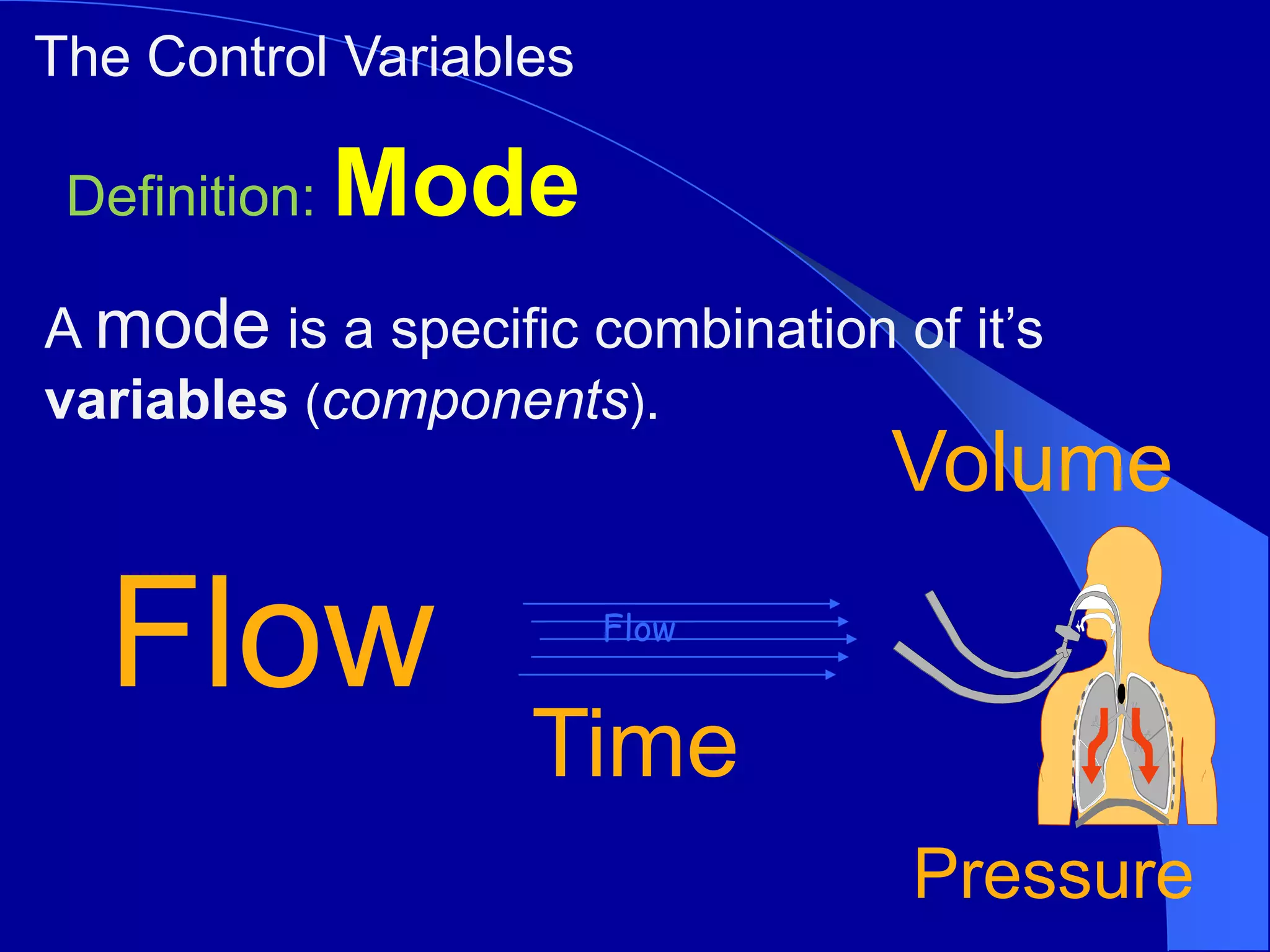
Definition: Mode
A mode is a specific combination of it’s
variables (components).
Flow
Volume
Pressure
Time
The Control Variables
Flow
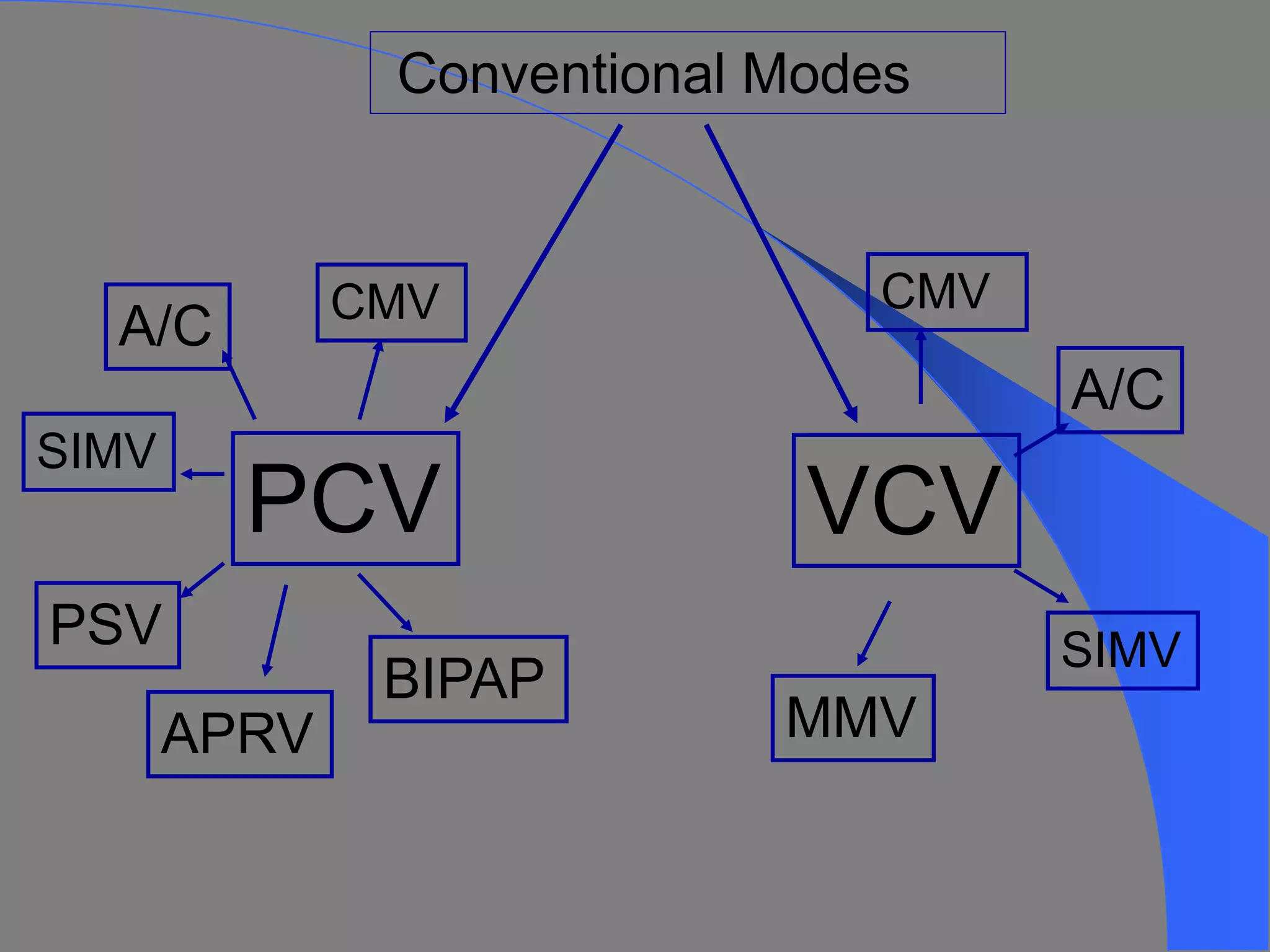
Conventional Modes
VCV
PCV
SIMV
SIMV
PSV
A/C
A/C
APRV
BIPAP
MMV
CMV
CMV
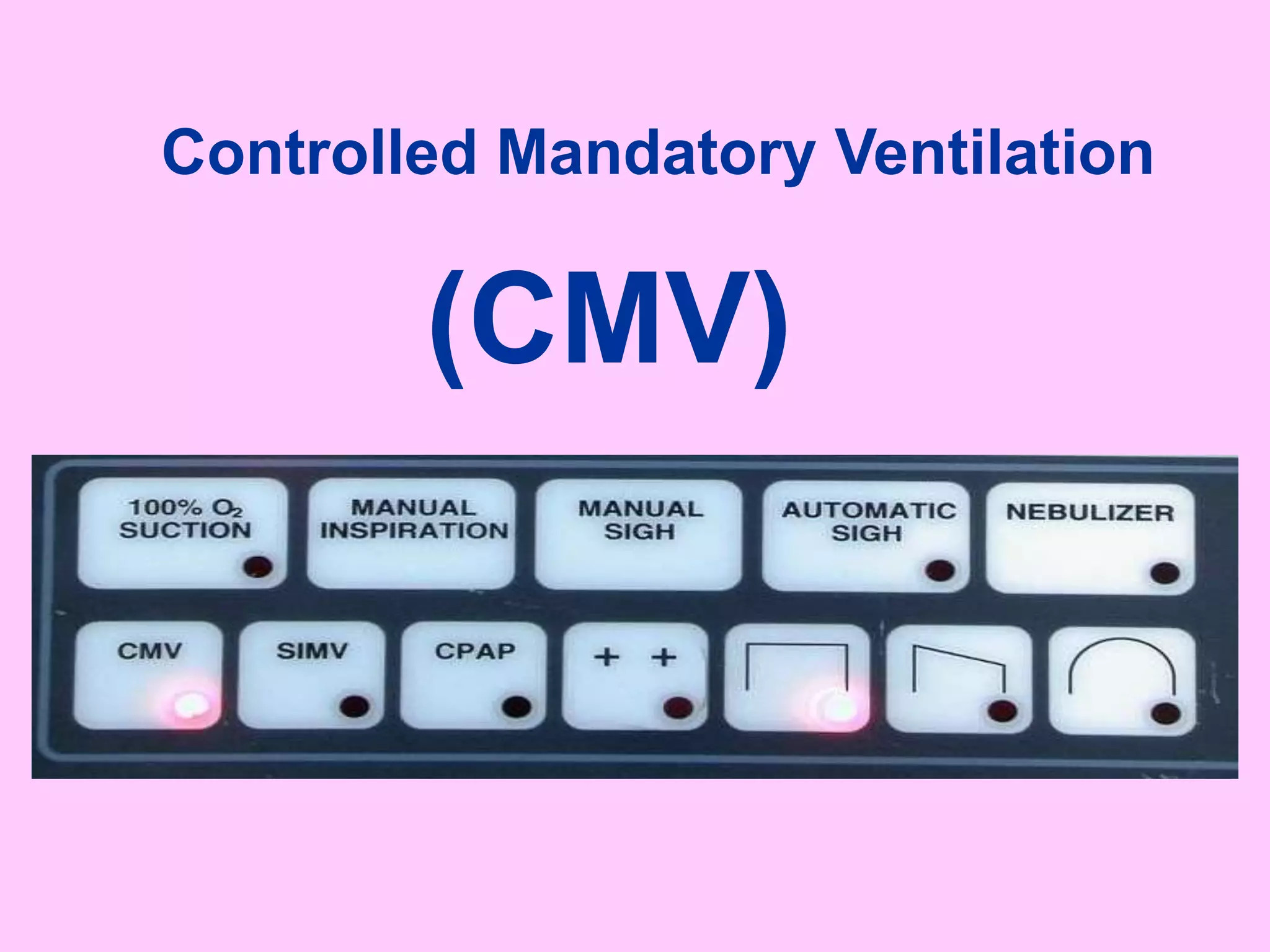
Controlled Mandatory Ventilation
(CMV)
Continuous Mechanical Ventilation
Controlled Mechanical Ventilation
CMV
Terminology = IPPV
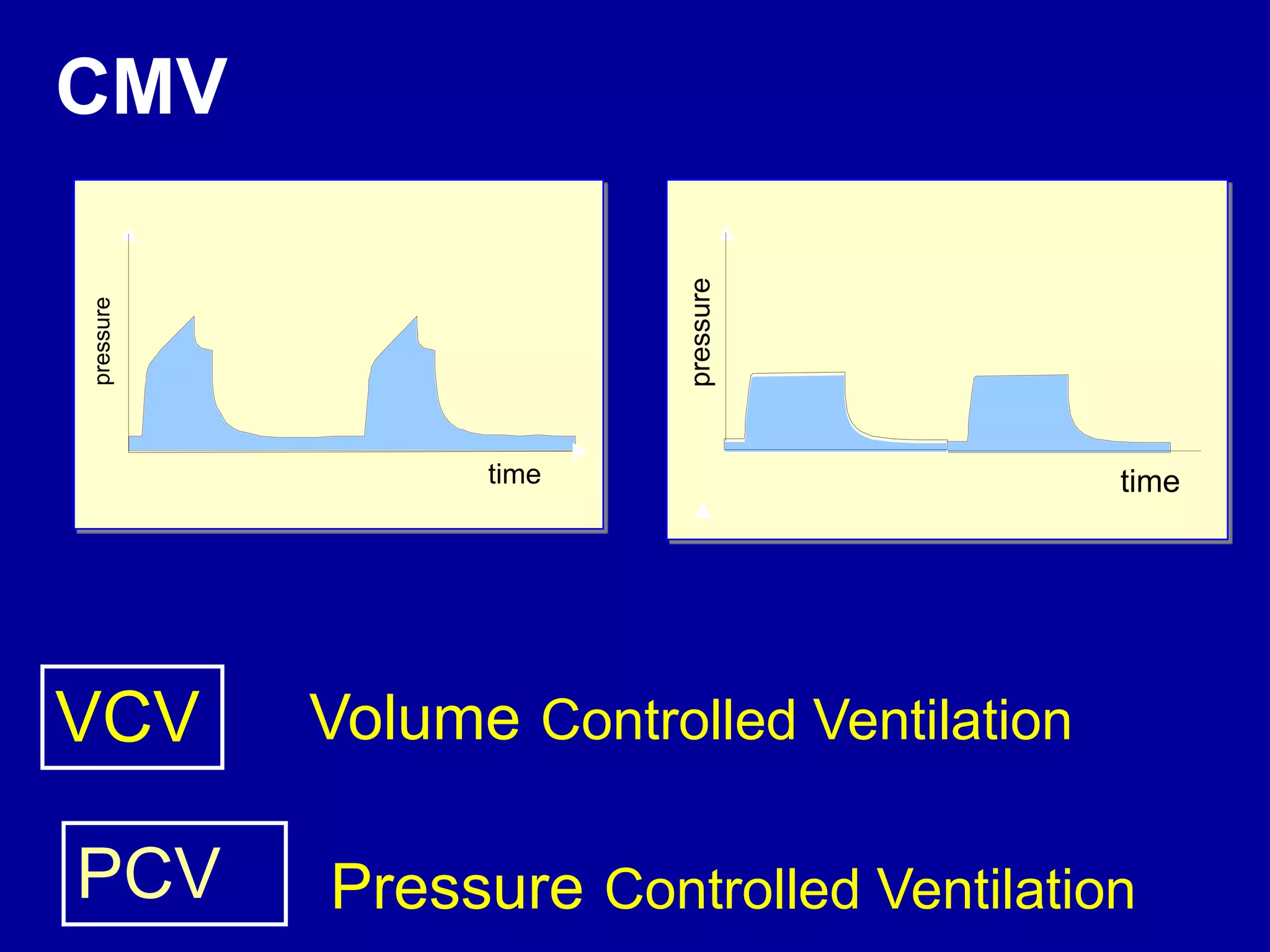
Volume Controlled Ventilation
PCV
VCV
Pressure Controlled Ventilation
pressure
time
pressure
time
CMV
CMV
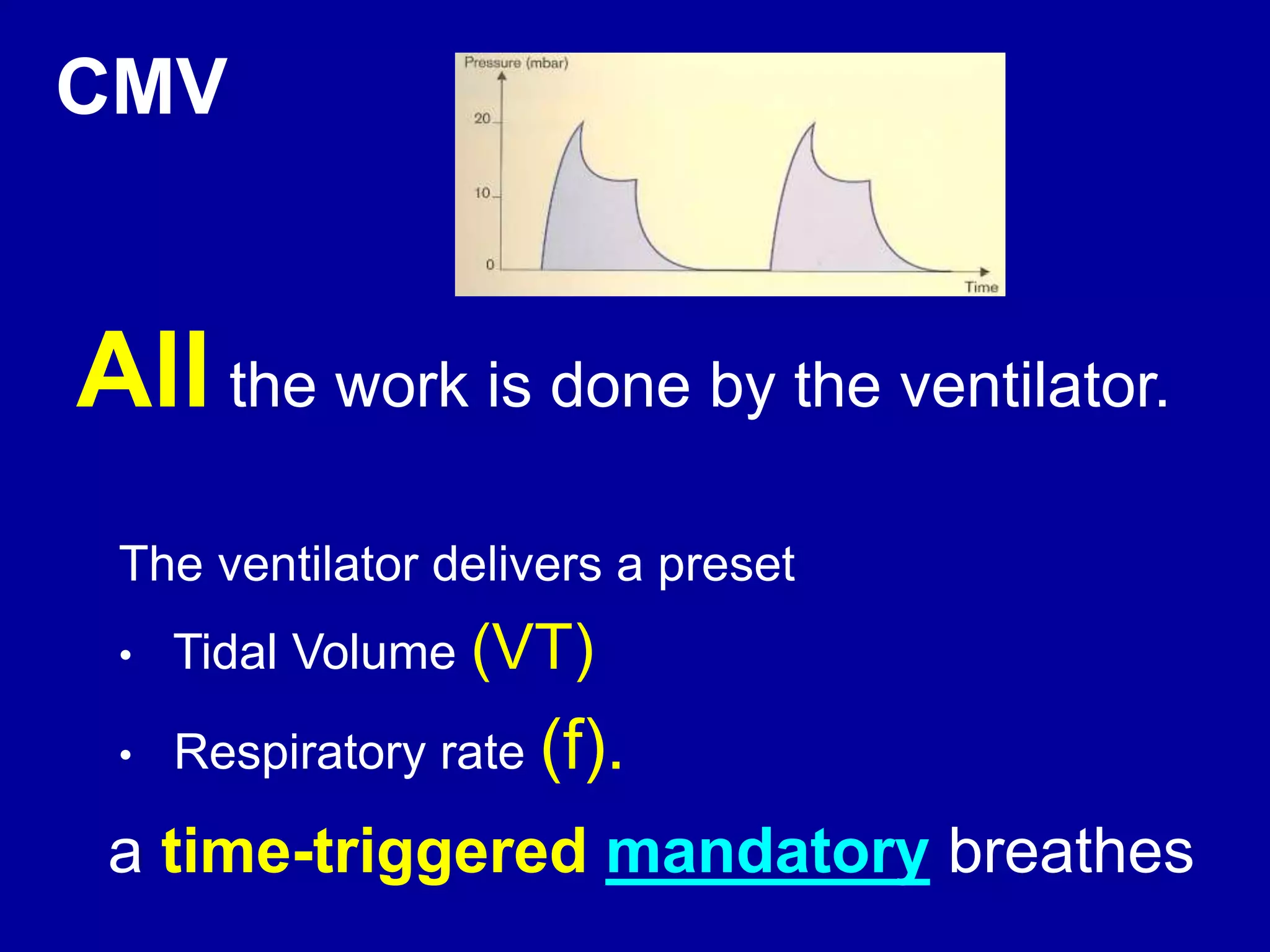
All the work is done by the ventilator.
The ventilator delivers a preset
• Tidal Volume (VT)
• Respiratory rate (f).
a time-triggered mandatory breathes
CMV
In CMV the patient can not breath
Spontaneously.
No gas flow is delivered between
the mandatory breathes.
CMV
INDICATIONS
? ? ? ?
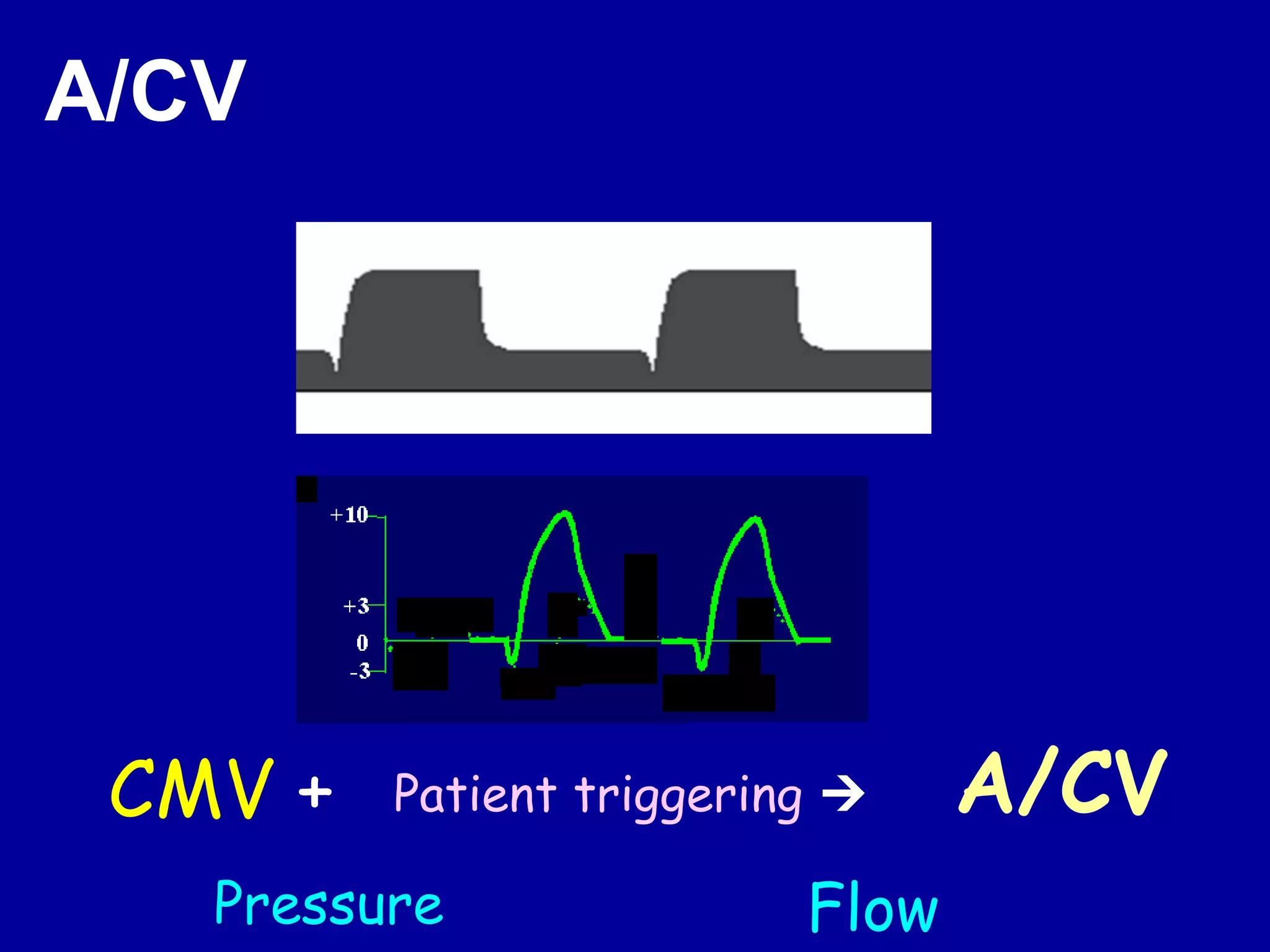
Assist Control Ventilation
A/CV
Patient triggering 
CMV + A/CV
Pressure Flow
A/CV
The A/C mode does Not allow the pt to
breath Spontaneously in his own Vt.
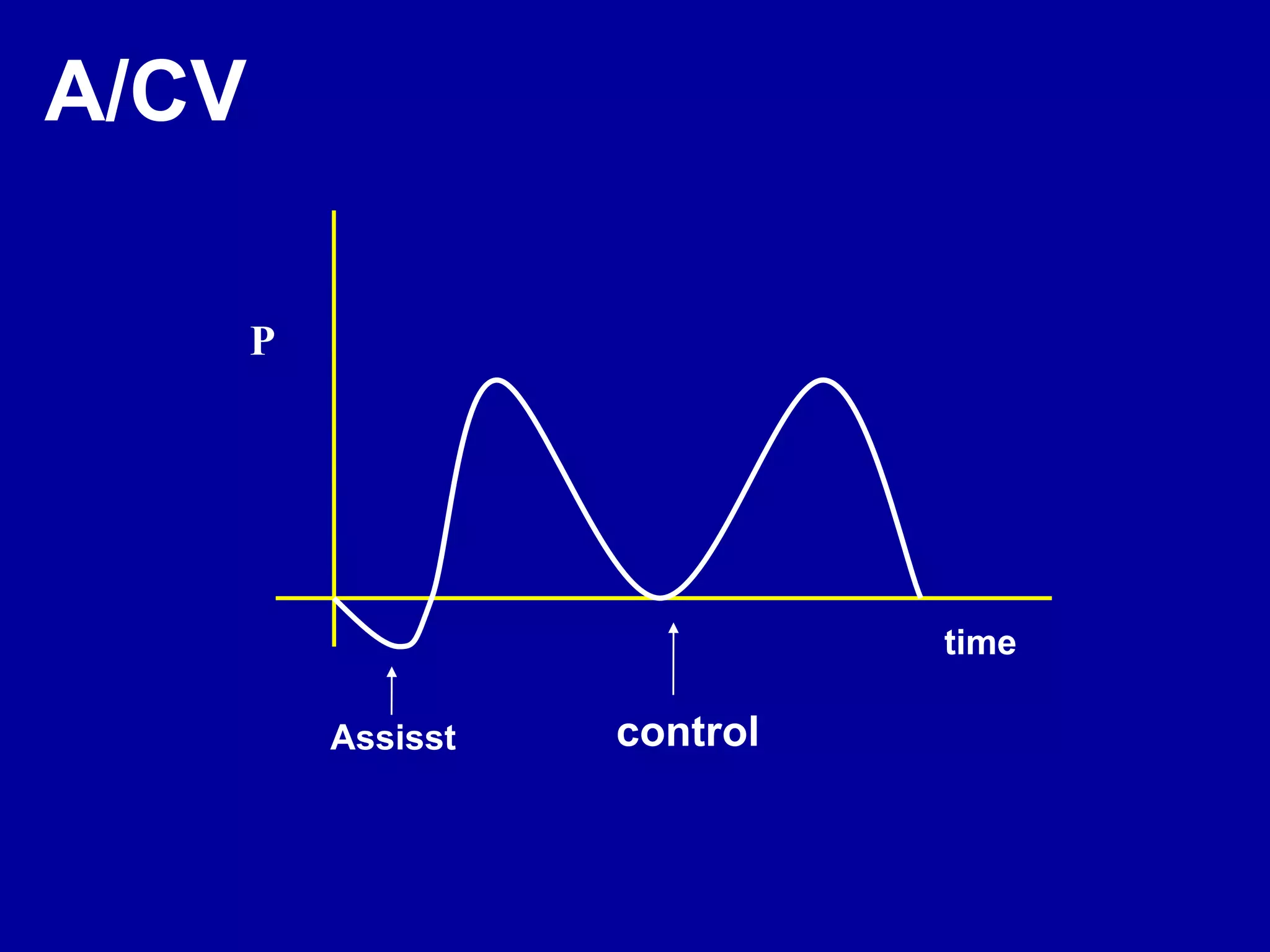
In A/C the pt may increase the R.R. (assist)
in addition to the preset mechanical R.R. (control).
Each assist breath provides the pt with
the same preset VT.
A/CV
P
time
Assisst control
A/CV
A/CV
INDICATIONS
Used to provide full ventilatory support for
the patients without fighting the ventilator as in
CMV
Rapid breathing leads to Respiratory Alkalosis.
A/CV
Adverse effects:
reduced Te leads to hyperinflation & auto PEEP
IMV
Intermittent Mandatory Ventilation

IMV mode was originally introduced as a
technique for weaning from IPPV.
IMV
IMV system allows “spontaneous” breathing
between “mandatory” tidal volumes
delivered by the ventilator.
IMV
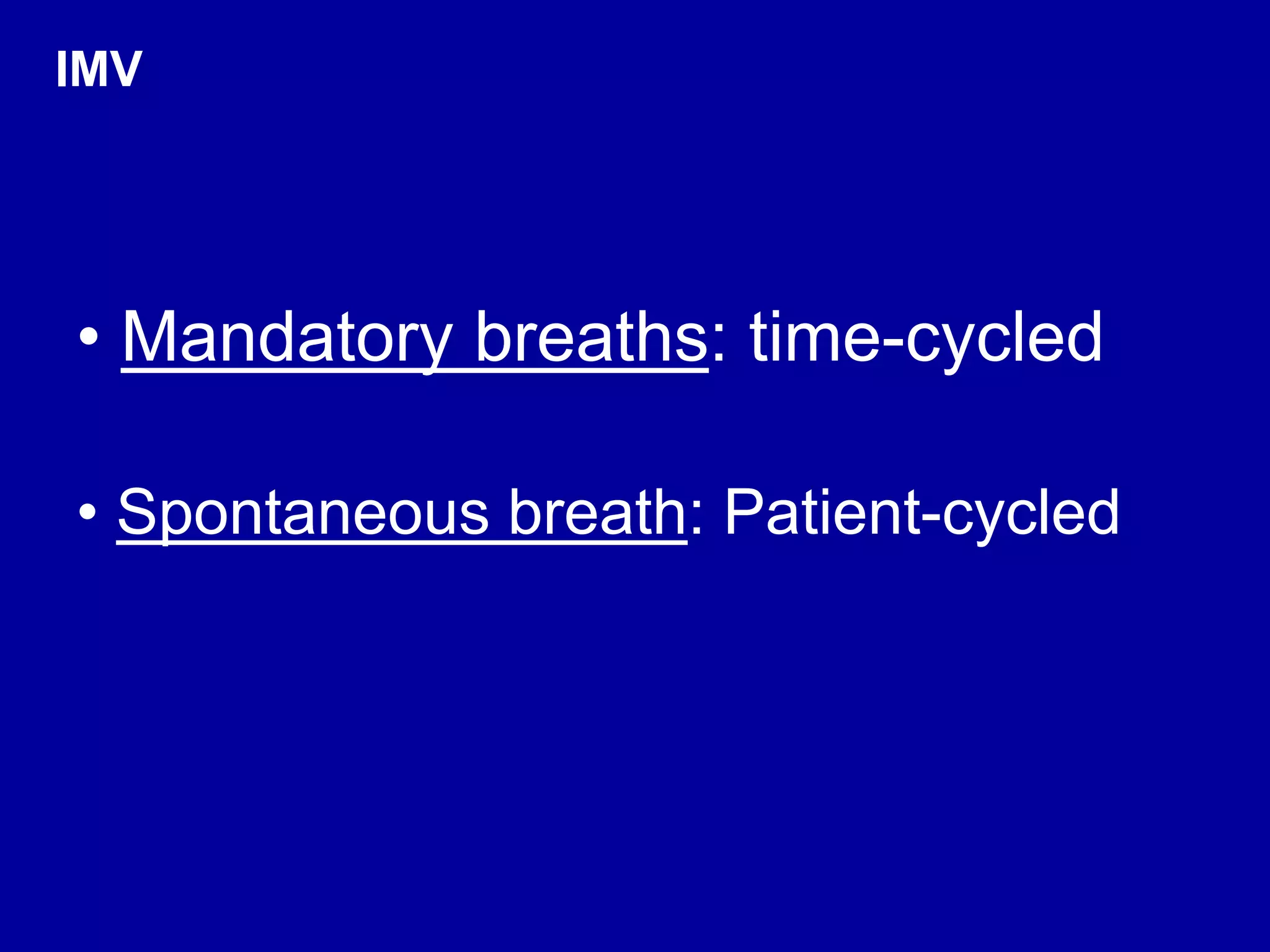
• Mandatory breaths: time-cycled
• Spontaneous breath: Patient-cycled
IMV
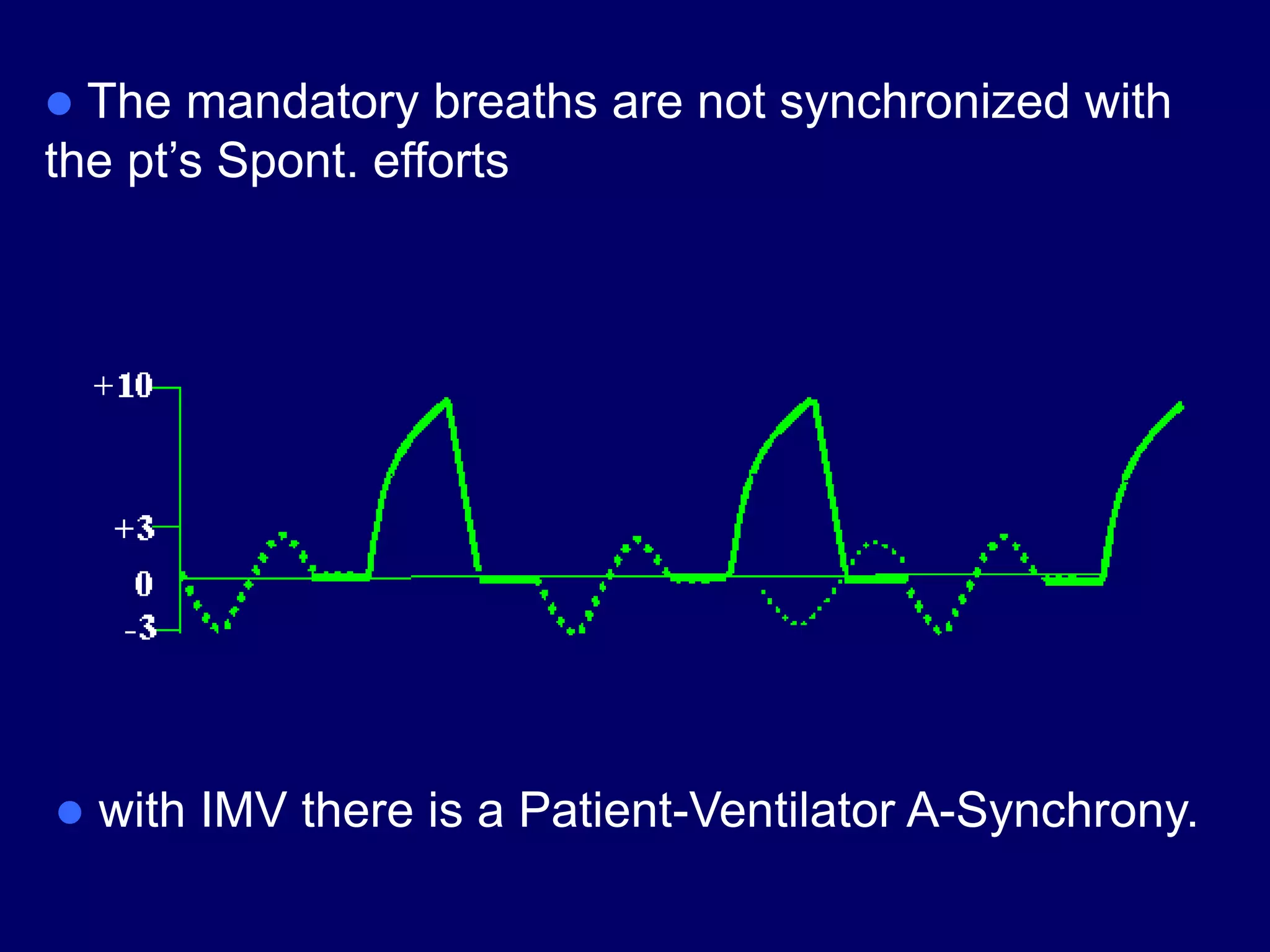
 with IMV there is a Patient-Ventilator A-Synchrony.
 The mandatory breaths are not synchronized with
the pt’s Spont. efforts
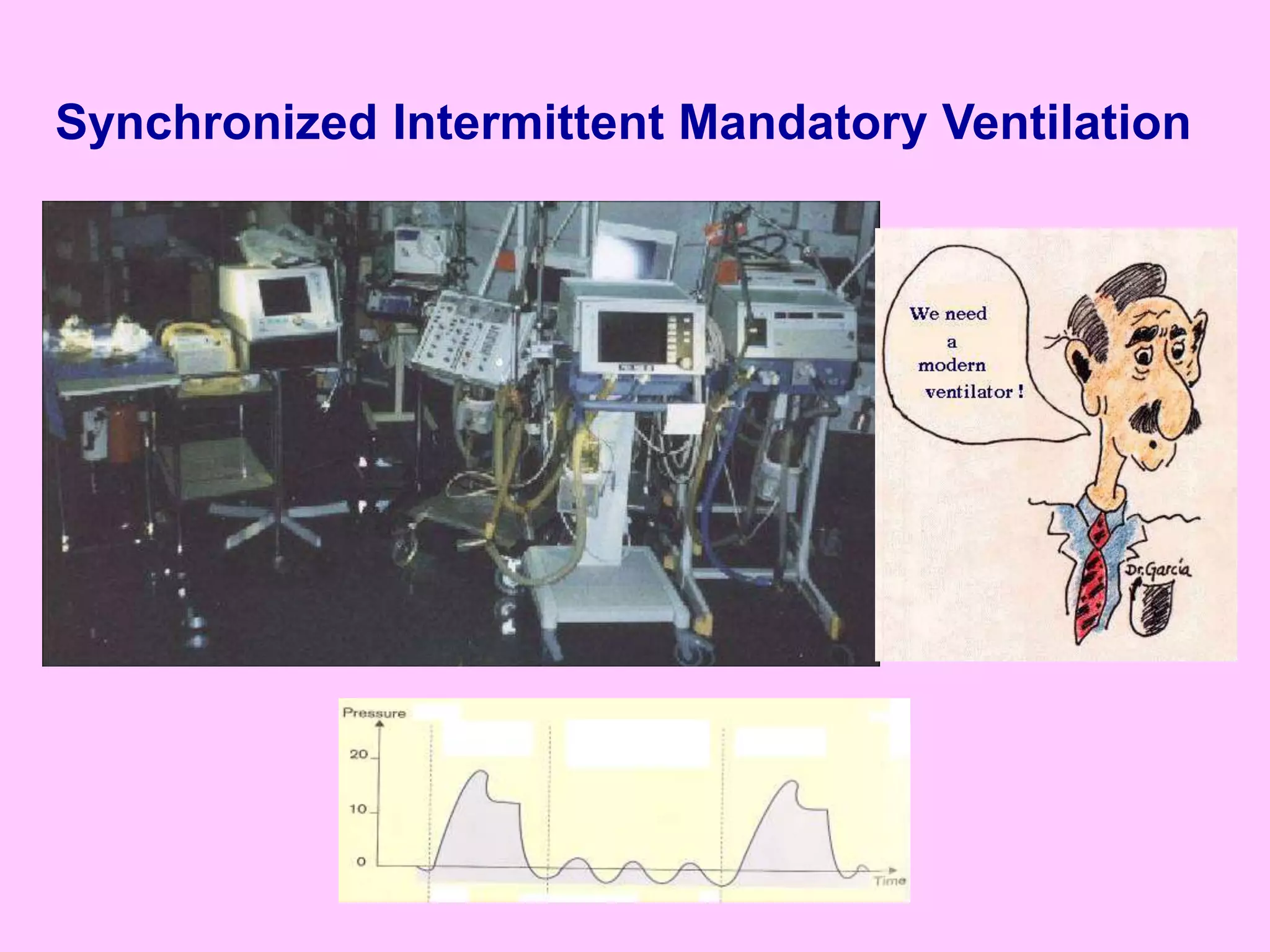
Synchronized Intermittent Mandatory Ventilation
SIMV
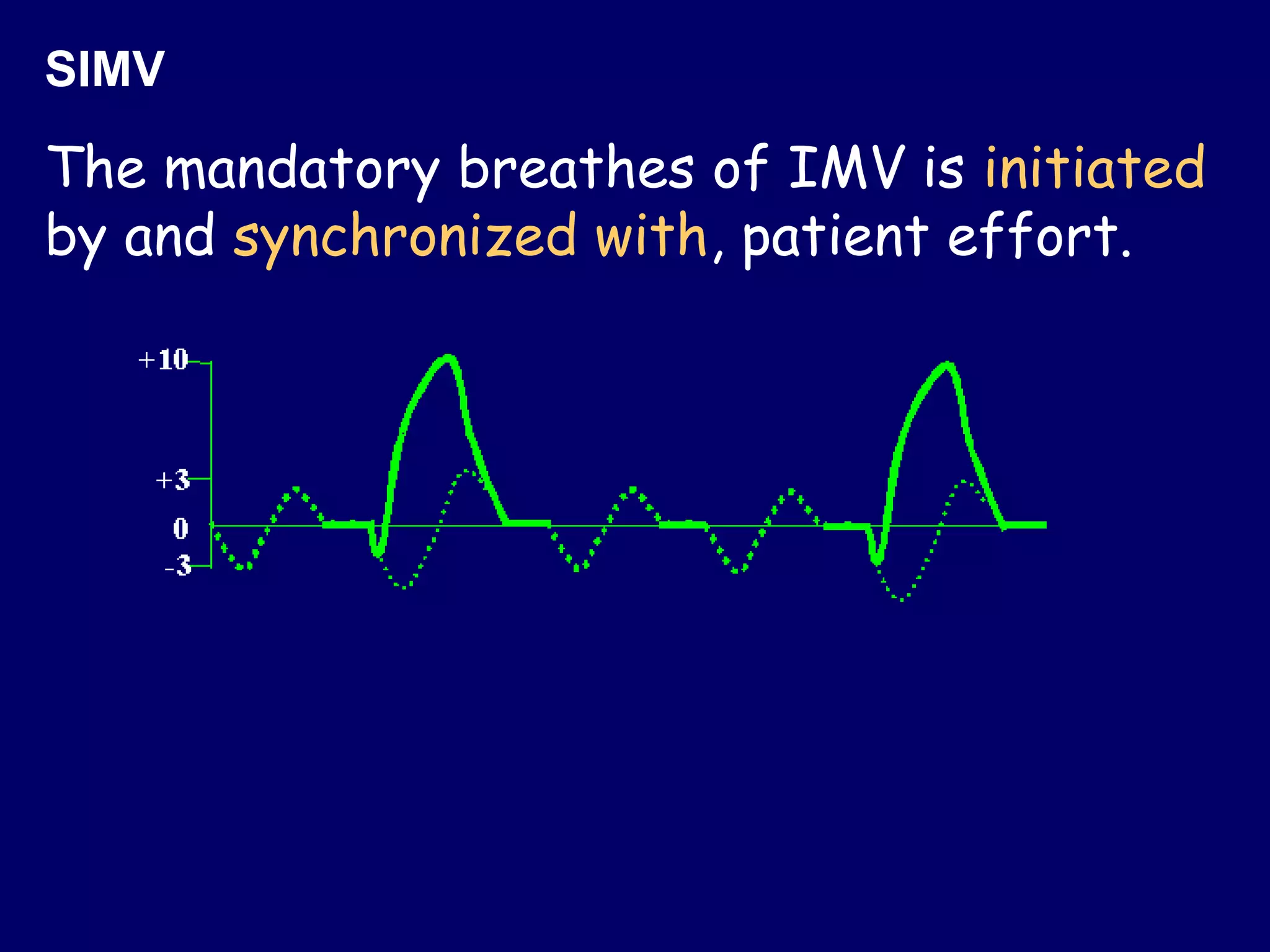
The mandatory breathes of IMV is initiated
by and synchronized with, patient effort.
SIMV
 It can provide partial ventilatory support.
SIMV
SIMV is now used as an alternative to
conventional CMV A/C.
 It can provide complete ventilatory support.
SIMV is weaning mode
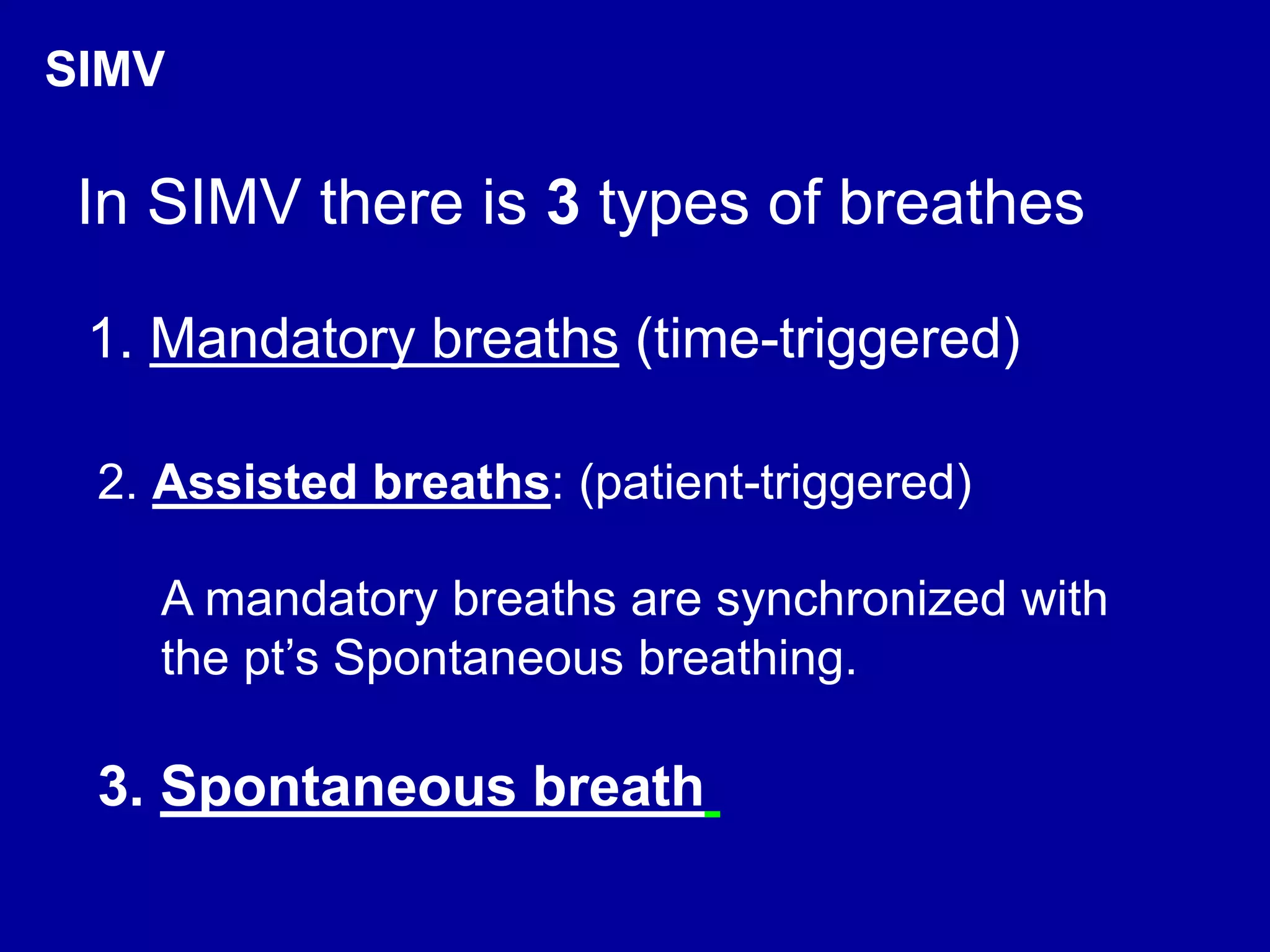
A mandatory breaths are synchronized with
the pt’s Spontaneous breathing.
3. Spontaneous breath
2. Assisted breaths: (patient-triggered)
SIMV
In SIMV there is 3 types of breathes
1. Mandatory breaths (time-triggered)
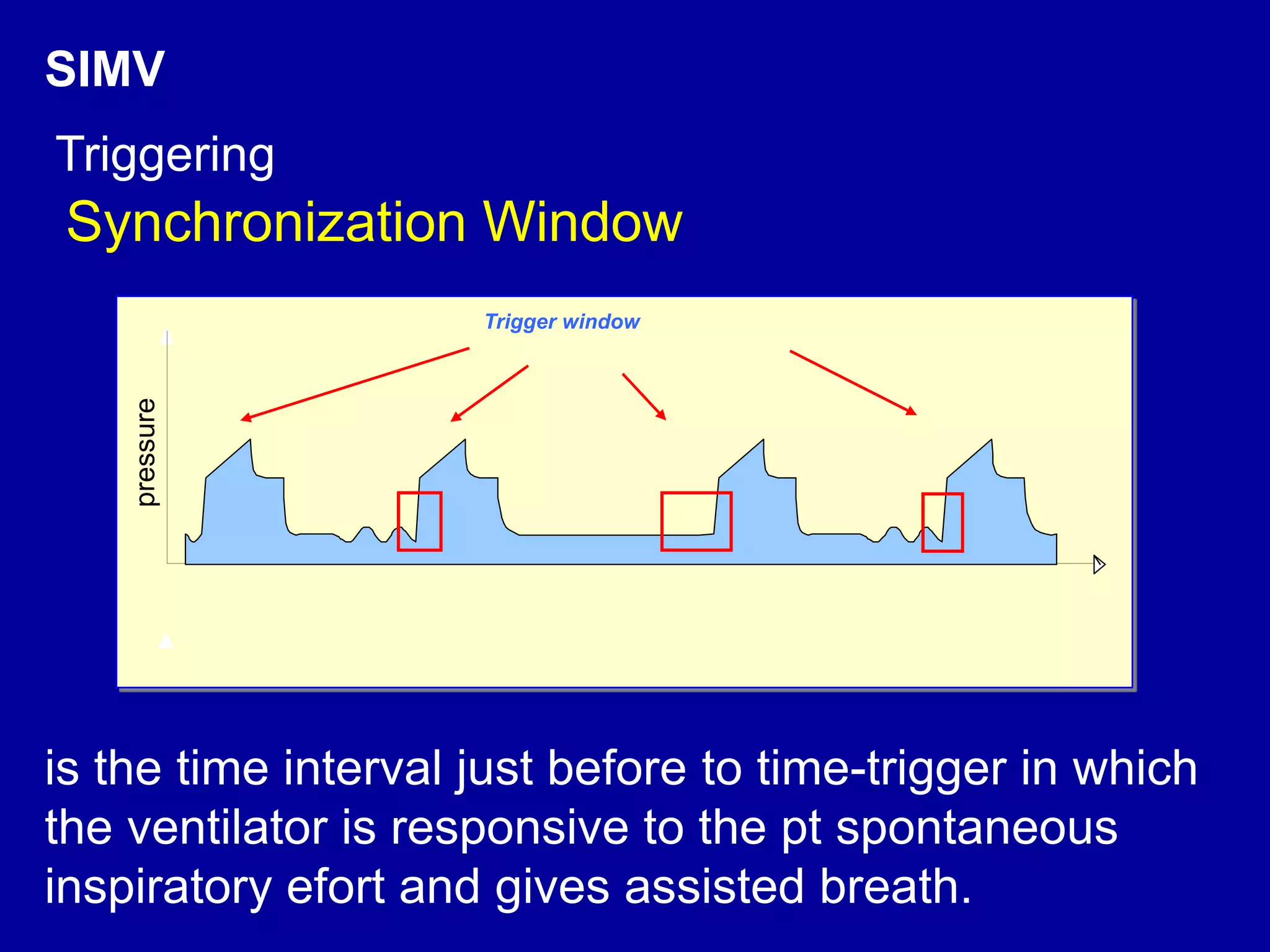
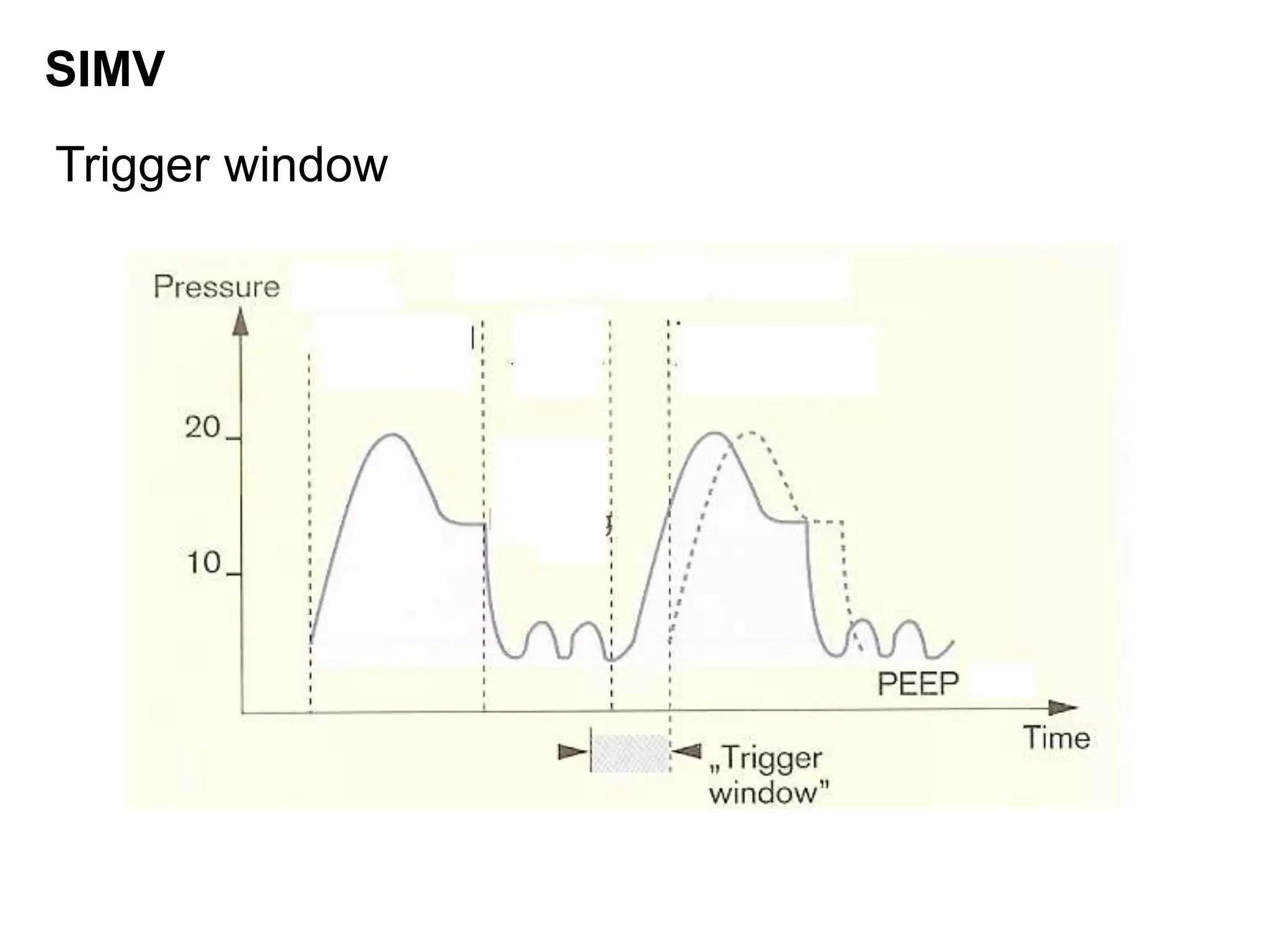
Trigger window
pressure
SIMV
is the time interval just before to time-trigger in which
the ventilator is responsive to the pt spontaneous
inspiratory efort and gives assisted breath.
Synchronization Window
Triggering
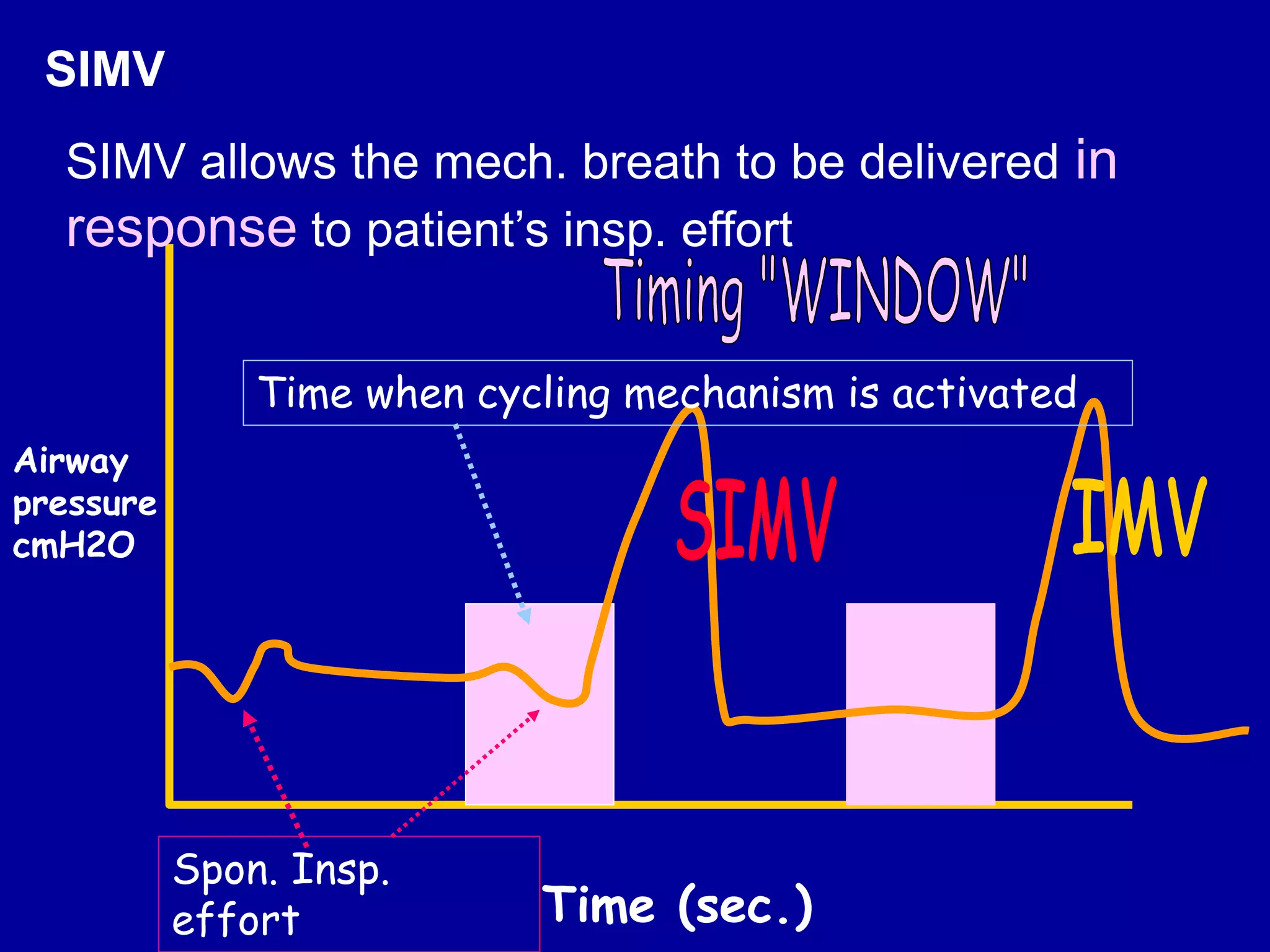
SIMV allows the mech. breath to be delivered in
response to patient’s insp. effort
Time when cycling mechanism is activated
Airway
pressure
cmH2O
Time (sec.)
Spon. Insp.
effort
SIMV
Trigger window
SIMV
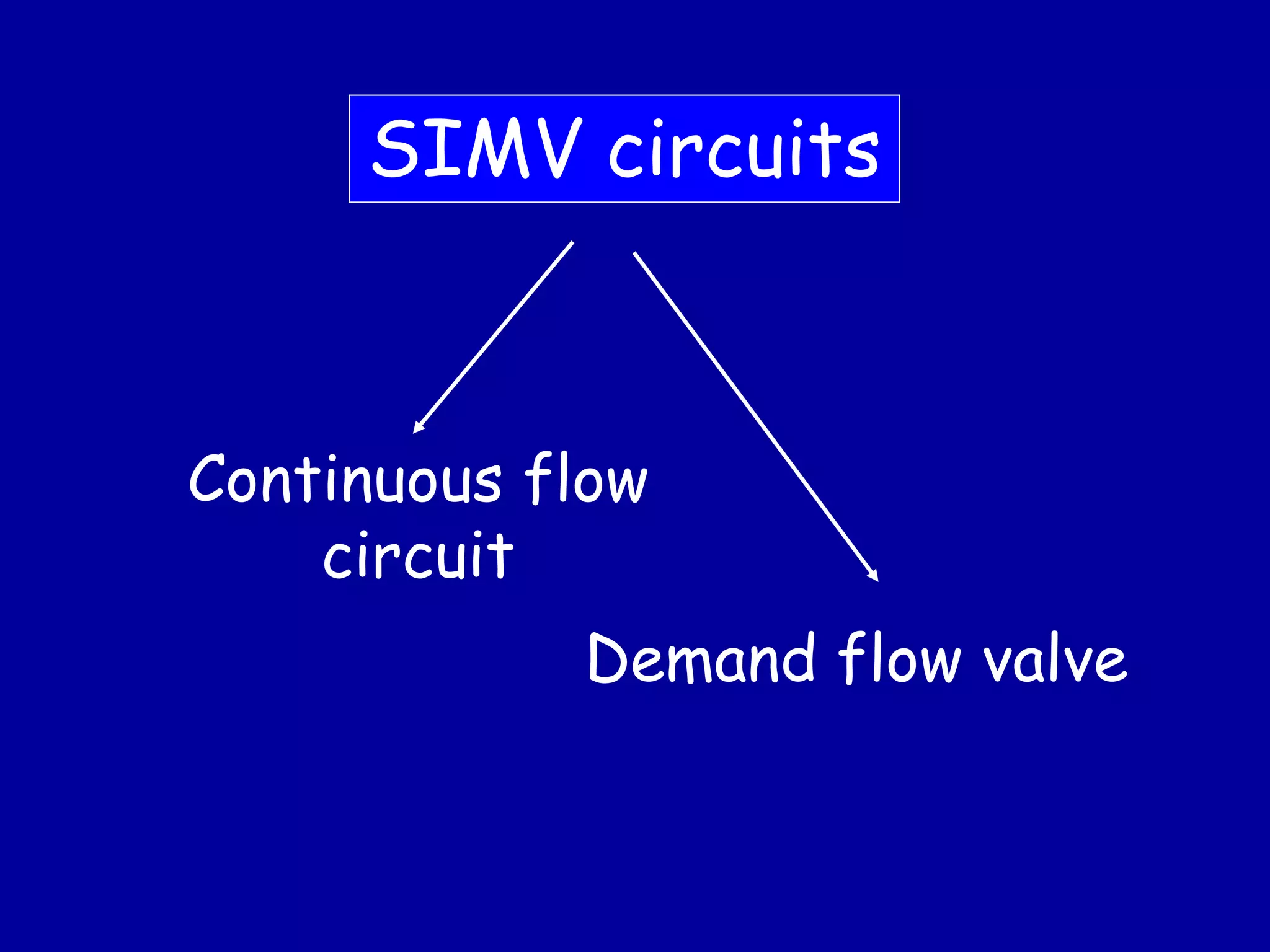
SIMV circuits
Continuous flow
circuit
Demand flow valve
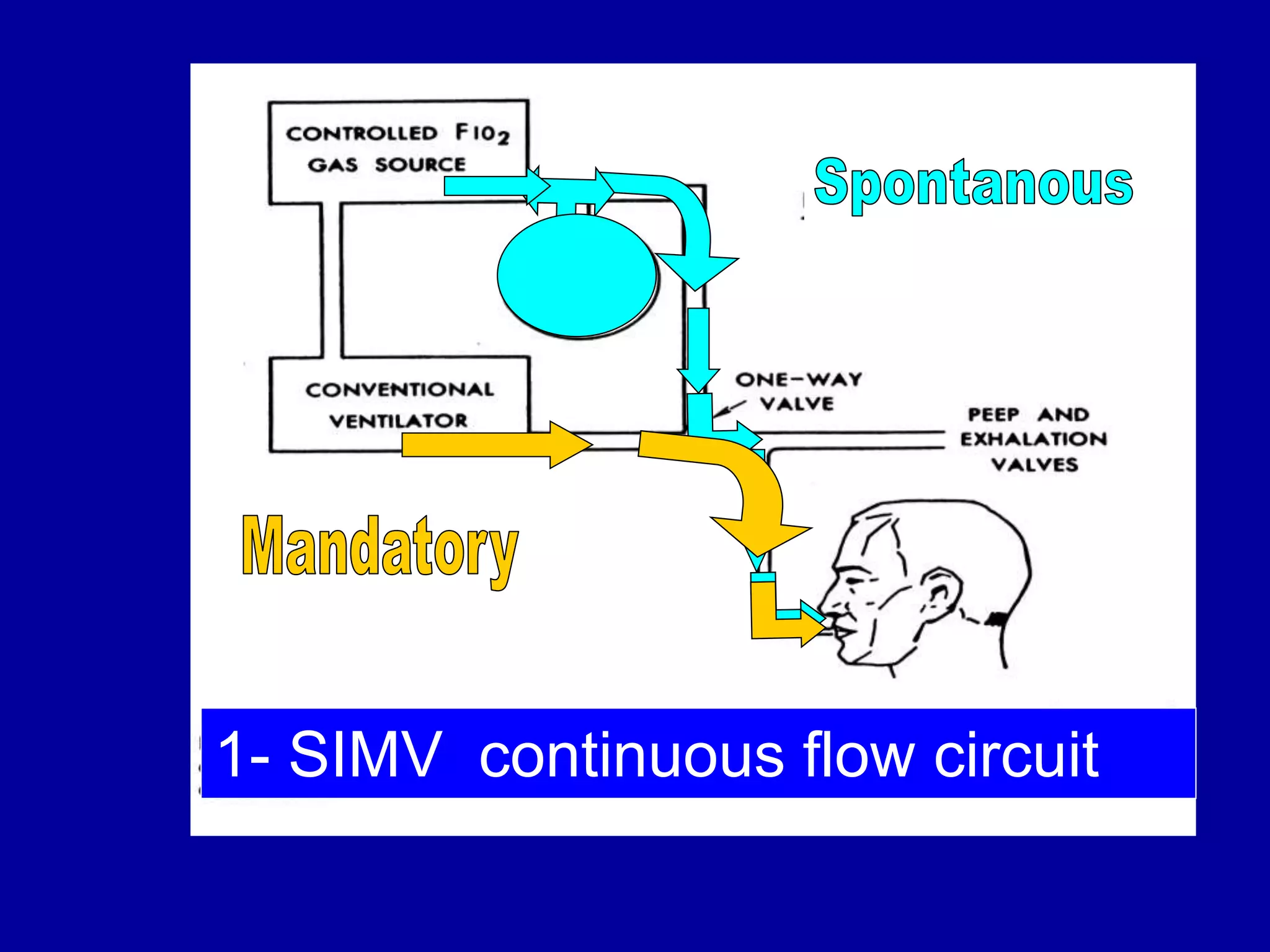
1- SIMV continuous flow circuit
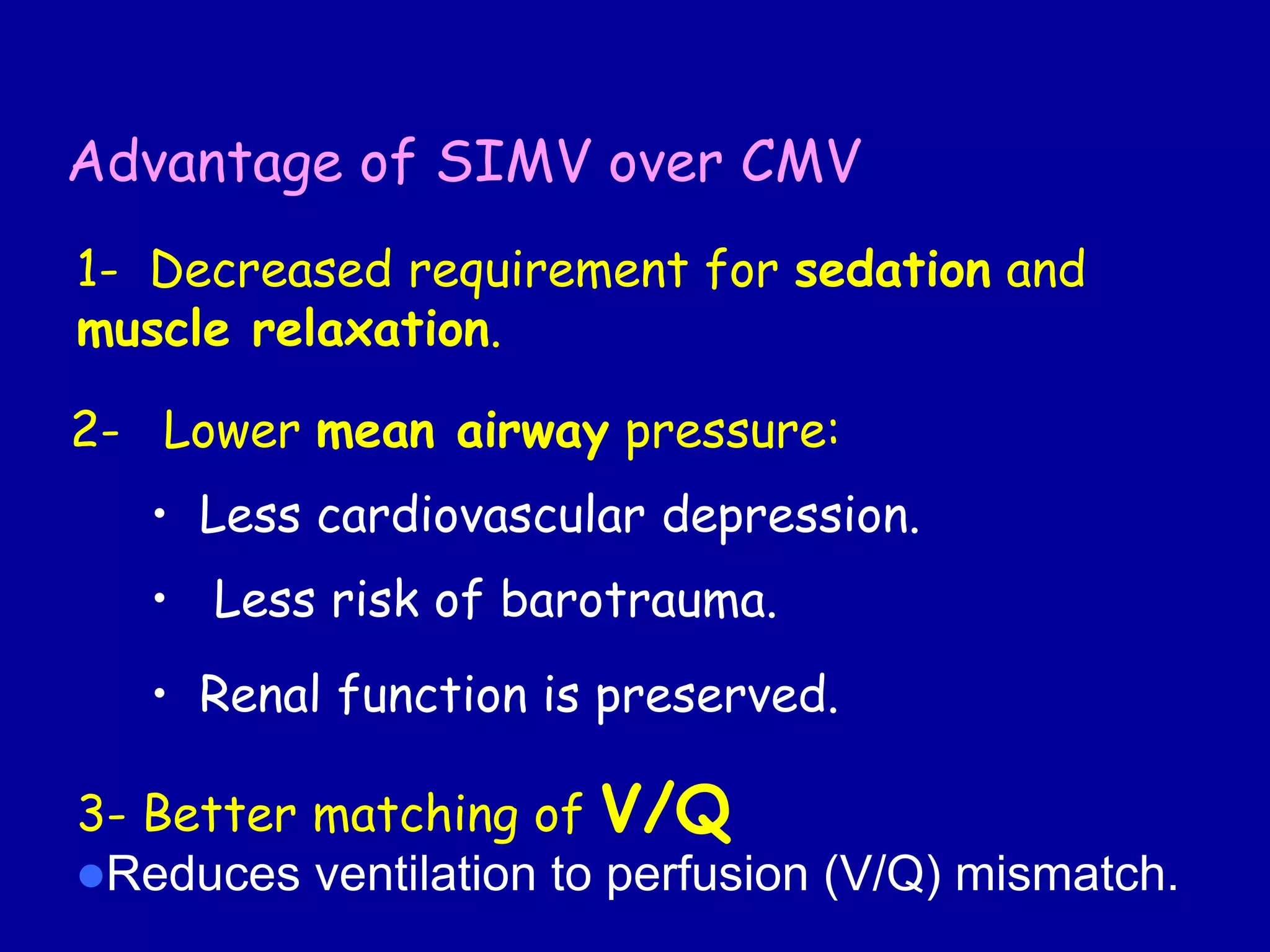
Advantage of SIMV over CMV
1- Decreased requirement for sedation and
muscle relaxation.
2- Lower mean airway pressure:
• Less cardiovascular depression.
• Less risk of barotrauma.
• Renal function is preserved.
3- Better matching of V/Q
Reduces ventilation to perfusion (V/Q) mismatch.
4- Easier weaning due to :
• Prevention of respiratory muscle
atrophy / discoordination.
• No respiratory alkalosis.
During weaning, the mandatory
ventilation is further decrease in
number as the patient’s ability to
increase his own spontaneous minute
ventilation.
3.4.Conventional modes SIMV PSV PEEP, CPAP, IRV.ppt

3.4.Conventional modes SIMV PSV PEEP, CPAP, IRV.ppt