
GUIDE FOR APPLICANTS


           Information and Communication Technologies
                                       ICT

                   Funding scheme: Collaborative projects
               Large-scale integrating projects (IP)


                           FP7-ICT-2013-11


Further copies of this Guide, together with all information related to this Call for
                       Proposals, can be downloaded via
          http://ec.europa.eu/research/participants/portal/page/home
Information and Communications Technologies                            Call FP7-ICT-2013-11
Guide for Applicants                                    Large-scale integrating projects (IP)


                                     About this Guide

This is version number 11 of the FP7 ICT Guide for Applicants for calls using
single-stage submission procedures.


This Guide is based on the rules and conditions contained in the legal
documents relating to FP7 (in particular the Seventh Framework Programme,
Specific Programmes, Rules for Participation, and the ICT Work programme),
all of which can be consulted via the FP7 Participant Portal. The Guide does
not in itself have legal value, and thus does not supersede those documents.


                                              ii                    18th September 2012 v1
Information and Communications Technologies                                                                                                Call FP7-ICT-2013-11
Guide for Applicants                                                                                                        Large-scale integrating projects (IP)


                                                                                Contents


1.       GETTING STARTED ............................................................................................................................................. 4

2.       ABOUT THE FUNDING SCHEME ...................................................................................................................... 4
     2.1 GENERAL................................................................................................................................................................... 4
     2.2 LARGE SCALE INTEGRATING PROJECTS (IPS) ............................................................................................................. 5
3.       HOW TO APPLY .................................................................................................................................................... 6
     3.1. TURNING YOUR IDEA INTO AN EFFECTIVE PROPOSAL ................................................................................................ 6
     3.2 PROPOSAL SUBMISSION ........................................................................................................................................... 10
4.       CHECK LIST ......................................................................................................................................................... 17
     4.1. PREPARING YOUR PROPOSAL .................................................................................................................................. 17
     4.2. FINAL CHECKS BEFORE SUBMISSION ....................................................................................................................... 17
     4.3. THE DEADLINE: VERY IMPORTANT! ........................................................................................................................ 18
     4.4 FOLLOWING SUBMISSION......................................................................................................................................... 18
5.       WHAT HAPPENS NEXT ..................................................................................................................................... 18
     GLOSSARY .................................................................................................................................................................... 22
     ANNEXES ...................................................................................................................................................................... 29
       Annex 1: Timetable and specific information for this call ....................................................................................... 30
       Annex 2: Evaluation criteria and procedures to be applied to IP proposals in this call ......................................... 32
       Annex 3: Instructions for completing Part A of the proposal .................................................................................. 38
       Annex 4: Instructions for drafting Part B of the proposal ....................................................................................... 47
       Annex 5: Ethical Guidelines for undertaking ICT research in FP7 ......................................................................... 58
       Annex 6: Pre-proposal check form .......................................................................................................................... 61


                                                                                         iii                                                   18th September 2012 v1
Information and Communications Technologies                                        Call FP7-ICT-2013-11
Guide for Applicants                                                Large-scale integrating projects (IP)


1.     Getting started
Funding decisions in the Seventh Framework Programme (FP7) are made on the basis of
proposals. Proposals describe planned activities, information on who will carry them out, and how
much they will cost. The Commission evaluates all eligible proposals in order to identify those
whose quality is sufficiently high for possible funding. This evaluation is a peer-review carried out
by independent experts.

The Commission then negotiates with some or all of those whose proposals have successfully
passed the evaluation stage, depending on the budget available. If negotiations are successfully
concluded, grant agreements providing for an EU financial contribution are established with the
participants.

This Guide for Applicants contains the essential information to guide you through the mechanics of
preparing and submitting a proposal. It is important that you have the correct Guide ! Not only are
there different Guides for different calls, there are different Guides for the other funding schemes
within the same call.

You must also refer to the current ICT Workprogramme. This provides a detailed description of
the objectives and topics which are open for proposals, and will describe the wider context of
research activities in this area. Work programmes are revised regularly, so make sure you refer to
the latest version before preparing your proposal.

                  Please check that this is the right guide for you by consulting the work
                  programme and the call fiche (both documents posted on the Participant Portal
                  websites), and the description of the funding scheme in the next section.

This Guide and the work programme are essential reading. However, you may also wish to consult
other reference and background documents, particular those relating to negotiation and the grant
agreements, which are made available on the Commission’s CORDIS web site (see annex 1 of this
guide) and on the Participant Portal: http://ec.europa.eu/research/participants/portal.

All research activities supported by the Seventh Framework Programme should respect
fundamental ethical principles.


2.     About the funding scheme
2.1 General
A number of funding schemes are available to implement projects in FP7, but only certain ones
may be available for the topics covered by this call. These are indicated in the call fiche.

This Guide covers the funding scheme for Large-scale Integrating projects (IPs), and a description
of these is given in this section. Please note that additional conditions may apply on a call-by-call
basis. These will always be set out in the work programme (which includes the call fiche).

Note: Your proposal will be evaluated according to the funding scheme which you select. The
Commission services will not re-examine or re-assign it on your behalf.


                                                 4                              18th September 2012 v1
Information and Communications Technologies                                            Call FP7-ICT-2013-11
Guide for Applicants                                                    Large-scale integrating projects (IP)


2.2 Large scale integrating projects (IPs)
Purpose
Large scale integrating collaborative projects (IPs) are objective-driven research projects, which
aim at generating new knowledge, including new technology, or common resources for research in
order to improve European competitiveness, or to address major societal needs. They have clearly
defined scientific and technological objectives directed at obtaining specific results, which could be
applicable in terms of development or improvement of products, processes, services or policy. As
such, they may also be targeted to special groups, such as SMEs.

Large scale integrating projects have a comprehensive “programme” approach: including a
coherent integrated set of activities dealing with a range of aspects and tackling multiple issues
and aimed at specific deliverables; there will be a large degree of autonomy to adapt content and
partnership (all types of stakeholders) and update the work plan, where/as appropriate.

Size and resources
There must be at least three legal entities established in different EU Member States or Associated
countries (the countries concerned are listed in section 3 of this Guide). The entities must be
independent of each other.

A higher number may be specified on a call-by-call basis: check the call fiche.

The size, scope and internal organisation of collaborative projects can vary from research theme to
research theme and from topic to topic. Typically the number of participants in IPs for the ICT
Theme varies between 10–20 and the total EU contribution is between 4 and 25 M€, with an
average around 10 M€.

Duration
IPs are expected to last typically three to five years. However, there is no formal minimum or
maximum duration.

Activities
The activities to be carried out in the context of an IP can include:

      research and technological development activities, reflecting the core activities of the
       project, aimed at a significant advance beyond the established state-of-the-art

      demonstration activities, designed to prove the viability of new technologies that offer a
       potential economic advantage, but which cannot be commercialised directly (e.g. testing of
       product-like prototypes)

      activities to disseminate research results and to prepare for their take-up and use, including
       knowledge management and IPR protection

      management activities, over and above the technical management of individual work
       packages, linking together all the project components and maintaining communications with
       the Commission

      training of researchers and key staff, including research managers and industrial executives
       (in particular for SMEs and any potential users of the knowledge generated by the project).
       The training should aim to improve the professional development of the personnel
       concerned

      other activities if required


                                                   5                                18th September 2012 v1
Information and Communications Technologies                                            Call FP7-ICT-2013-11
Guide for Applicants                                                    Large-scale integrating projects (IP)


Financial Regime
Reimbursement will be based on eligible costs (based on maximum rates of reimbursement
specified in the grant agreement for different types of activities within the project). In some cases
the reimbursement of indirect costs is based on a flat rate.

The work programmes shall specify if other forms of reimbursement are to be used in the actions
concerned. Participants in International Cooperation Partner countries (see Annex 1 of the work
programme) may opt for a lump sum.

If so provided in the call fiche, it is possible to claim subsistence and accommodation costs (related
to travel as part of the implementation of a project) on the basis of flat rates. These rates, which do
not cover travel costs, are in the form of a daily allowance for every country. The use of these rates
is optional, but you may wish to use them when calculating your proposal budget. The rates
themselves, and the detailed rules for their use, are given at this address:
http://cordis.europa.eu/fp7/find-doc_en.html


Specific Characteristics
    A sequence of updates of the description of work (annex 1 of the grant agreement) may be
        provided for in the grant agreement.
    Enlargement of partnership, within the initial budget, is possible.


3.     How to apply
3.1. Turning your idea into an effective proposal
The coordinator
For a given proposal, the coordinator acts as the single point of contact between the participants
and the Commission. The coordinator is generally responsible for the overall planning of the
proposal and for building up the consortium that will do the work.

Focusing your planned work
The work you set out in your proposal must correspond to one or more of the topics, and
associated funding scheme(s), indicated in this call for proposals. Proposals that fail to do so will
be regarded as ineligible.

                   Multidisciplinary proposals addressing several topics may be submitted,
                   provided that the ‘centre of gravity’ lies in a topic or topics open in the call in
                   question.

Refer to the annex 2 of this Guide, and the work programme, to check the eligibility criteria and any
other additional conditions that apply. Refer also in those documents to the evaluation criteria
against which your proposal will be assessed. Keep these in mind as you develop your proposal.

Who can participate ?
In principle, a legal entity may participate in a proposal no matter where it is established.

                   A legal entity can be a so-called "natural person" (e.g. Mme Dupont) or a "legal person"
                   (e.g. National Institute for Research).

However, there are certain minimum conditions that have to be met relating to participation from
the EU and Associated countries. These conditions vary between funding schemes (see section 2),
and may also vary from call to call. See the call fiche for the conditions applicable to this call.

                                                    6                               18th September 2012 v1
Information and Communications Technologies                                            Call FP7-ICT-2013-11
Guide for Applicants                                                    Large-scale integrating projects (IP)


                  The EU Member States are:

                  Austria, Belgium, Bulgaria, Cyprus, Czech Republic, Denmark, Estonia, Finland, France,
                  Germany, Greece, Hungary, Ireland, Italy, Latvia, Lithuania, Luxembourg, Malta,
                  Netherlands, Poland, Portugal, Romania, Slovakia, Slovenia, Spain, Sweden, United
                  Kingdom.


                  The Associated Countries are:

                  Albania, Bosnia and Herzegovina, Croatia, Faroe Islands, FYR Macedonia, Iceland,
                  Israel, Liechtenstein, Moldova, Montenegro, Norway, Serbia, Switzerland, Turkey.

                  Other countries may become associated during the course of FP7. The latest news will
                  be posted on the CORDIS and Participant Portal web sites.

The following may receive EU funding in an FP7 project:
 Any legal entity established in a Member State or an Associated country (including the
   European Commission’s Joint Research Centre), or created under Community law (e.g. a
   European Economic Interest Grouping),
 Any international European interest organisation (see Glossary),
 Any legal entity established in an FP7 International Cooperation Partner Country (ICPC). The
   list of ICPC can be found on the CORDIS web-site, and is given in annex 1 of the work
   programme.
 Any other legal entity, under the conditions indicated below:
        In the case of a participating international organisation, other than an international
        European interest organisation, or a legal entity established in a non-EU country other than
        an Associated country or ICPC, a Community financial contribution may be granted
        provided that at least one of the following conditions is satisfied:
        a) Provision is made to that effect in the specific programmes or in the relevant work
        programme,
        b) It is essential for carrying out the indirect action,
        c) Such funding is provided for in a bilateral scientific and technological agreement or any
        other arrangement between the Community and the country in which the legal entity is
        established.

                  Before the signature of a grant agreement, the Commission has to verify the existence
                  and legal status of all participants. This verification is made only once for each
                  organisation at the time of its first participation in FP7. The details of all validated
                  organisations are stored in a Unique Registration Facility (URF). These organisations
                  are allocated a unique code, the so-called Participant Identification Code (PIC). In any
                  further participation in other proposals, the organisations already validated use the PIC
                  for their identification with the Commission.

                  For the confirmation and maintenance of the data stored in the URF, the Commission
                  asks each organisation to nominate one privileged contact person, the so-called Legal
                  Entity Appointed Representative (LEAR). The LEAR is usually a person working in the
                  central administration of the organisation and he/she must be appointed by the top
                  management of the entity. The LEARs can view their organisations' legal and financial
                  data online and ask for corrections and changes to the data of their legal entity via the
                  Web interface of the Unique Registration Facility.


                                                   7                                18th September 2012 v1
Information and Communications Technologies                                           Call FP7-ICT-2013-11
Guide for Applicants                                                   Large-scale integrating projects (IP)


Cooperation with other countries
The Commission attaches great importance to international cooperation in research, and FP7 has
been designed to ensure that such activities can be integrated across the programme. In addition
to the opportunities mentioned above, which are generally applicable, calls may include:
 Topics of mutual interest defined in the work programmes where international cooperation is
    particularly encouraged.
 Specific international cooperation actions (SICA), also on topics of mutual interest. Here
    special minimum conditions apply.

Please check the work programme to see if these possibilities apply to this call.

More detailed practical advice on cooperation with third country participants in FP7 can be found
here: ftp://ftp.cordis.europa.eu/pub/fp7/docs/guideline-third-country-participants_en.pdf

National Contact Points
A network of National Contact Points (NCPs) has been established to provide advice and support
to organisations which are preparing proposals. You are highly recommended to get in touch with
your NCP at an early stage (see annex 1 of this Guide).

Please note that the Commission will give the NCPs statistics and information on the outcome of
the call (in particular, details of participants, but not proposal abstracts or funding details) and the
outcome of the evaluation for each proposal. This information is supplied to support the NCPs in
their service role, and is given under strict conditions of confidentiality.

Other sources of help
Annex 1 of this Guide gives references to these further sources of help for this call. In particular:

   The Commission’s general enquiry service on any aspect of FP7. Questions can be sent to a
    single e-mail address and will be directed to the most appropriate department for reply.
   The ICT information Desk
   A dedicated help desk has been set up to deal with questions related to research ethics issues
   A dedicated help desk has been set up to deal with technical questions related to the
    Participant Portal Submission Service.
   A further help desk providing assistance on intellectual property matters.
   Other services, including partner search facilities

Proposal language
Proposals may be prepared in any official language of the European Union. If your proposal is not
in English, a translation of the full proposal would be of assistance to the experts. An English
translation of the abstract must be included in Part B of the proposal.

Presenting your proposal
A proposal has two parts.

Part A will contain the administrative information about the proposal and the participants. The
information requested includes a brief description of the work, contact details and characteristics of
the participants, and information related to the funding requested (see Annex 3 of this Guide). This
information will be encoded in a structured database for further computer processing to produce,
for example, statistics and evaluation reports. This information will also support the experts and
Commission staff during the evaluation process.

The information in Part A is entered through a set of on-line forms using the Participant Portal
Submission Service described in the next section.


                                                   8                               18th September 2012 v1
Information and Communications Technologies                                                                Call FP7-ICT-2013-11
Guide for Applicants                                                                        Large-scale integrating projects (IP)

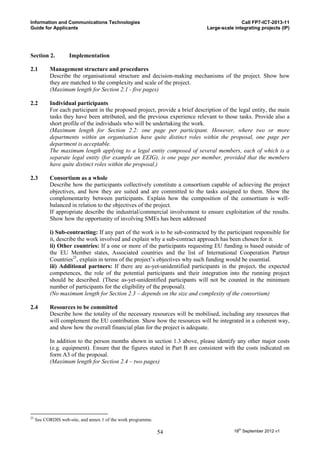
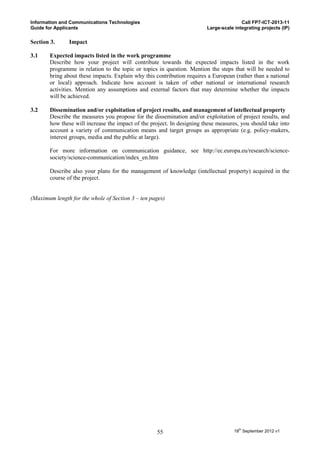
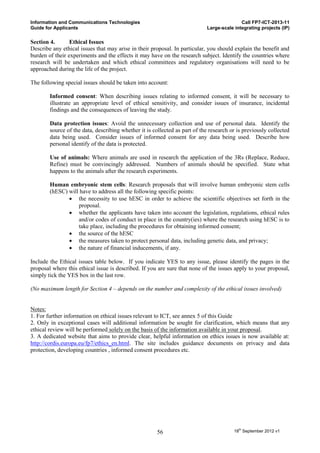
Part B is a "template", or list of headings, rather than an administrative form (see Annex 4 of this
Guide). You should follow this structure when presenting the scientific and technical content of
your proposal. The template is designed to highlight those aspects that will be assessed against
the evaluation criteria. It covers, among other things, the nature of the proposed work, the
participants and their roles in the proposed project, and the impacts that might be expected to arise
from the proposed work.

Only black and white copies of Part B are used for evaluation and you are strongly recommended
therefore not to use colour in your document. Do not insert hypertext links, only the text of your
Part B will be read, not any documents linked to it.

Part B of the proposal is uploaded by the applicant into the Participant Portal Submission
Service

                         A maximum length may be specified for the different sections of Part B, or for
                         Part B as a whole (see annex 4 of this Guide). You should keep your proposal
                         within these limits. Information given on excess pages may1 be disregarded.

                         Even where no maximum page limits are given, it is in your interest to keep your
                         text concise since over-long proposals are rarely viewed in a positive light by the
                         evaluating experts.

Ethical Principles
Please remember that research activities in FP7 should respect fundamental ethical principles,
including those reflected in the Charter of Fundamental Rights of the European Union. Ethical
principles include the need to ensure the freedom of research and the need to protect the physical
and moral integrity of individuals and the welfare of animals. For this reason the European
Commission carries out an ethical review of proposals when appropriate.

The following fields of research shall not be financed under this Framework Programme:
    research activity aiming at human cloning for reproductive purposes;
    research activity intended to modify the genetic heritage of human beings which could
        make such changes heritable2;
    research activities intended to create human embryos solely for the purpose of research or
        for the purpose of stem cell procurement, including by means of somatic cell nuclear
        transfer.

As regards human embryonic stem cell research, the Commission will maintain the practice of the
Sixth Framework Programme, which excludes from Community financial support research activities
destroying human embryos, including for the procurement of stem cells. The exclusion of funding
of this step of research will not prevent Community funding of subsequent steps involving human
embryonic stem cells.


1
  The Commission does not impose upon itself the duty to edit proposals for length, but reserves the right to instruct the evaluators to
disregard excess pages.
2
  Research relating to cancer treatment of the gonads can be financed.


                                                                   9                                      18th September 2012 v1
Information and Communications Technologies                                                                 Call FP7-ICT-2013-11
Guide for Applicants                                                                         Large-scale integrating projects (IP)


3.2 Proposal submission

About the Electronic Submission Services of the Commission

Proposals must be submitted electronically, using the Commission's Electronic Submission
Services which are to be found on the Participant Portal. Proposals arriving by any other means
are regarded as ‘not submitted’, and will not be evaluated3. All the data that the proposal
coordinator uploads is securely stored on a server to which the proposal coordinator and the other
participants in the proposal have access until after the call deadline.

The Electronic Submission Services can be accessed from the relevant call page on the
Participant Portal.

As this is a web application, an Internet connection is required. An Internet browser and version 9
(or above) of the Adobe reader are needed. To check the requirements, click on
https://ec.europa.eu/research/participants/submission/manage/diagnostics.

Full instructions are found in the “10 Minute guide to the Electronic Submission”, available from the
submission service website (click on "Starter Manual" to download the user guide).


Obtaining a mandatory Participant Identification Code (PIC):

Before starting the process of submitting the proposal, each participant in your proposal must
be identified with a Participant Identification Code (PIC). Failure to do so will block the
submission of your proposal! The Participant Identification Code (PIC) is a unique 9 digit
number that helps the Commission/Agency 4 identify a participant organisation. It is used in all
grant-related interactions between the organisation and the Commission/Agency. The use of PICs
will lead to more efficient processing of your proposal.

If your organisation has already participated in a 7th Framework Programme proposal, it is likely
that you already have a PIC number. You can check this on the Participant Portal:
http://ec.europa.eu/research/participants/portal/page/myorganisations or in the search provided in
the proposal submission system.

                           If your organisation already has a PIC, it is likely that it has also appointed a Legal Entity
                           Authorised Representative (LEAR) (see section 3.1.). The names of LEARs are however
                           not available online; you have to enquire within the administration of your own
                           organisation.

If a PIC is not yet available for an organisation, it can be obtained by registering the organisation in
the Participant Portal under the 'Register' sub-tab of the 'My Organisations' tab
(http://ec.europa.eu/research/participants/portal/page/myorganisations). After filling in the data for
the entity, a PIC number is given, which can then be used in the Electronic Submission Services.
You are encouraged to proceed with this well before the call deadline to avoid potential last minute
troubles.

3
  In exceptional cases, when a proposal co-ordinator has absolutely no means of accessing the Participant Portal Submission Service,
and when it is impossible to arrange for another member of the consortium to do so, an applicant may request permission from the
Commission to submit on paper. A request should be sent via the FP7 enquiry service (see annex 1), indicating in the subject line
"Paper submission request". (You can telephone the enquiry service if web access is not possible: 00 800 6 7 8 9 10 11 from Europe;
or 32 2 299 96 96 from anywhere in the world. A postal or e-mail address will then be given to you). Such a request, which must clearly
explain the circumstances of the case, must be received by the Commission no later than one month before the call deadline. The
Commission will reply within five working days of receipt. Only if a derogation is granted, a proposal on paper may be submitted by mail,
courier or hand delivery. The delivery address will be given in the derogation letter.

4
    Evaluations may be carried out with the logistical support of the Commission's Research Executive Agency (REA)

                                                                  10                                       18th September 2012 v1
Information and Communications Technologies                                          Call FP7-ICT-2013-11
Guide for Applicants                                                  Large-scale integrating projects (IP)


All participants already possessing a PIC should use it to identify themselves in the Electronic
Submission Service. After entering the PIC, sections of their A forms are filled in automatically.

If, after entering your PIC, the data which appears for your organisation is incorrect, you should
contact the LEAR of your organisation to correct it through the Participant Portal. You can also
change yourself the data prefilled from the PIC in your A forms, but these changes will remain local
to the Electronic Submission Services for this proposal only. The original data, which is stored in
the Commission's database, will always re-appear whenever the PIC is used, until the new data
from your LEAR is validated.

Get started

As a first step, the coordinator starts creating the proposal by accessing the electronic submission
service system from the call page.

Proposal coordinator's actions:

Step one: getting a European Commission Authentication Service (ECAS) user ID..

Getting a personal user ID with the European Commission Authentication Service (ECAS) is
mandatory in order to login to the Participant Portal and to be able to use the different functions of
the Portal, including the proposal submission. This will allow editing the proposal data in the
electronic proposal submission system, completing the information requested or – for coordinators
- submitting the proposal. The system will request a login by every partner. The same user ID will
be used for all later interactions with the Commission/Agency in the field of Research. Further
details on the ID are available under: https://webgate.ec.europa.eu/cas/eim/external/help.cgi.

Step two: choosing a funding scheme

For each call, a list of available funding schemes or objectives as activity codes will be presented
by the Electronic Submission Services. The proposal coordinator must choose the appropriate one
for the proposal. Refer to the call fiche and work programme for the various conditions applicable
to each funding scheme.

Step three: creating a draft proposal

Once the coordinating organisation is identified with its PIC number, the coordinator fills in the pre-
registration data for the proposal: acronym, short summary, activity code, and at the next step, the
list of participants. These details can be used by the Commission/Agency services in order to plan
the evaluation. In general, the following details are requested:

      The proposal acronym. This is the short name of the proposal and it will be used throughout
       the lifetime of the project, if funded. No more than 20 characters are allowed (standard
       alphabet and numbers only; no symbols or special characters, except underscore, space,
       hyphen or dot).
      The proposal short summary, which describes briefly the purpose of the proposal with a
       maximum of 2,000 characters. Entering at least keywords will help the services in preparing
       the evaluations (e.g. choosing the experts for the evaluations). Coordinators may choose to
       enter 'xxx' at this stage should they prefer not disclosing any data.
      Activity code, the objective addressed by the proposal.


Step four: adding other participants to the proposal


                                                  11                              18th September 2012 v1
Information and Communications Technologies                                            Call FP7-ICT-2013-11
Guide for Applicants                                                    Large-scale integrating projects (IP)

At this step the proposal coordinator sets up the consortium. The proposal coordinator can:

      Add other participants to the proposal.
       - The coordinator adds the partners using the nine-digit identifier, the PIC number. A search
       function is provided to help the coordinator finding the PIC number of the partners.
       - Once the coordinator has added the entities to the consortium, the coordinator has to
       insert the contact persons' details for each participant. The main identifier is the e-mail
       address of a person.
       - Once the coordinator saves this page, an automatic invitation is sent to all contacts' e-mail
       address. The invited persons can access the proposal after logging in to the Participant
       Portal - with the ECAS account linked to the given e-mail address - under the 'My
       Proposals' tab.
      Delete a participant.
      Reorder the participants. The order of the participants in the administrative forms will be
       adjusted.

The proposal coordinator however cannot be deleted, and is always the first participant.

Step five: forms, files and submission

This step is the core of the process, as, from this step, the proposal coordinator can:

      Fill in the administrative forms, part A of the proposal (see Annex 3 of this Guide)
      Forms are completed using a PDF reader (e.g. Adobe Reader, see above "What is needed"
       for minimum requirements). The proposal coordinator can complete all the forms, including
       the budget table and the administrative details of the coordinator and of all participants.
       Proposal partners can only complete their own administrative details (form A2).
      Download the template of the part B of the proposal and other information files (see Annex
       4 of this Guide)
      Upload the file that will be the part B of the proposal.
      Submit the proposal package.

                   Only the coordinator can upload the part B of the proposal and submit the
                   proposal. Therefore, only the coordinator should be logged into the Electronic
                   Submission Service when the submission attempt is made.

For the proposal Part B you must use exclusively PDF (“portable document format”, compatible
with Adobe version 3 or higher, with embedded fonts). Other file formats will not be accepted by
the system. Irrespective of any page limits specified in annex 4 to this Guide, there is an overall
limit of 10 Mbytes to the size of proposal file Part B. It is advised to limit the size of the proposal to
2 Mbytes.

There are also restrictions to the name given to the Part B file: use only alphanumeric characters;
special characters and spaces must be avoided.

                   You are advised to clean your document before converting it to PDF (e.g. accept
                   all tracked changes, delete notes).

                   Check that your conversion software has successfully converted all the pages of
                   your original document (e.g. there is no problem with page limits).

                   Check that your conversion software has not cut down landscape format pages
                   to fit them into portrait format. Check that captions and labels have not been lost
                   from your diagrams


                                                   12                               18th September 2012 v1
Information and Communications Technologies                                          Call FP7-ICT-2013-11
Guide for Applicants                                                  Large-scale integrating projects (IP)

                   Please note that the Commission prints out proposals in black and white on
                   plain A4 paper. The printable zone on the print engine is bounded by 1.5 cm
                   right, left, top bottom. No scaling is applied to make the page "fit" the window.
                   Printing is done at 300 dots per inch.


Completing the Part A forms in the Electronic Submission Services and uploading a Part B does
not yet mean that the proposal is submitted. Once there is a consolidated version of the proposal,
the "SUBMIT" button must be pressed. Only the coordinator is authorised to submit the
proposal.

At this point the service performs a limited automatic validation of the proposal. A list of discovered
problems, such as missing data, is given on the last page of the proposal submission forms. In
some cases users are allowed to submit incomplete administrative information but for significant
omissions, proposal submission will be blocked until the problems are corrected. Therefore
you are strongly advised, when preparing your proposal, to regularly click on 'validate' at the
bottom of any page of the Part A to obtain updated validation messages and to review them on the
last page of the proposal submission forms.

When errors or omissions are corrected, the coordinator must then repeat the above step to finally
achieve the proposal submission.


                   If the submission sequence described above is not followed,
             the Commission/Agency considers that no proposal has been submitted.


When the proposal has been successfully submitted, the service will proceed to Step 6 where the
coordinator sees a message that indicates that the proposal has been received.
(This automatic message is not the official acknowledgement of receipt - see Section 5).

Step six: proposal status page

Reaching this step means that the proposal is submitted (i.e. sent to the Commission/Agency
services for evaluation). It does not mean that the proposal is valid, complete, eligible in all
respects or that it will be funded.


In Step six you can:
     Download the proposal. It is advised to download the proposal once submitted to check that
       it has been correctly sent. The downloaded proposal will be digitally signed and time
       stamped.
     Re-edit the proposal, going back to step 5. After re-editing the proposal (any data in the
       forms or a modified attachment), modifications have to be resubmitted. The coordinator
       may continue to modify the proposal and submit revised versions overwriting the previous
       one right up until the deadline.
     Withdraw the proposal. If the proposal is withdrawn, it will not be considered for evaluation.
       A reason for the withdrawal will be requested by the service.
       (Note: Your proposal draft is not deleted from the server and this withdrawal action can be
       reversed, but only before the deadline, by simply submitting it again).


Use of the system by the other participants


                                                  13                              18th September 2012 v1
Information and Communications Technologies                                          Call FP7-ICT-2013-11
Guide for Applicants                                                  Large-scale integrating projects (IP)

In order to access the proposals, all contacts need to have an ECAS ID that is necessary for the
login of the Participant Portal.
Those contacts, who have been invited by the coordinator, can access the proposal via the 'My
Proposals' tab after login.

In the proposal submission system, participants can
     complete their own entity's administrative details and budget forms (A2 and A3.1);
     download the document template for writing Part B of the proposal, in order to assist the
        coordinator in preparing it, however, only the coordinator can upload the finished version;
     view the whole proposal.

About the deadline

Proposals must be submitted on or before the deadline specified in the call fiche. It is your
responsibility to ensure the timely submission of your proposal.

The Electronic Submission Services of the Commission will be closed for this call at the call
deadline. Please note that the deadline established in the call refers to the exact time, no extra
seconds allowed (for example, call deadline at 17.00 means at 17.00.00). After this moment, the
submitted proposal can no longer be modified. It is however visible in a read-only version.

Do not wait until the last moment before submitting your proposal!
Call deadlines are absolutely firm and are strictly enforced.

Please note that successive drafts of the proposal can be submitted with the Electronic Submission
Services. Each successive submission overwrites the previous version. It is a good idea to submit
a draft well before the deadline.

                   Do not wait until the last moment to attempt the submission of the proposal.
                   Internet access issues and proposal verification issues must be detected well
                   before the submission deadline if help is to be requested from the service desk.
                   Such issues are never accepted as extenuating circumstances for failure to
                   submit in time.

                   Submission is deemed to occur at the moment when the proposal coordinator
                   completes the submission sequence described above. It is not the point at which
                   the upload of the part B is started. If you wait until too near to the close of the
                   call to start uploading your proposal, there is a serious risk that you will not be
                   able to submit in time.

                   If you have submitted your proposal in error to another call which closes after
                   this call, the Commission/agency will not be aware of it until it is discovered
                   among the downloaded proposals for the later call. It will therefore be classified
                   as ineligible because of late arrival.

                   The submission of a proposal requires some knowledge of the Electronic
                   Submission Services, a detailed knowledge of the contents of the proposal and
                   the authority to make last-minute decisions on behalf of the consortium if
                   problems arise. You are advised not to delegate the job of submitting your
                   proposal!

In the unlikely event of a failure of the Electronic Submission Services due to breakdown of the
Commission server during the last 24 hours of this call, the deadline will be extended by a further
24 hours. This will be notified by e-mail to all proposal coordinators who had registered for this call
by the time of the original deadline, and also by a notice on the Call pages on the Participant
Portal. Such a failure is a rare and exceptional event; therefore do not assume that there will be an

                                                  14                              18th September 2012 v1
Information and Communications Technologies                                         Call FP7-ICT-2013-11
Guide for Applicants                                                 Large-scale integrating projects (IP)

extension to this call. If you have difficulty in submitting your proposal, you should not assume that
it is because of a problem with the Commission servers, as this is rarely the case. Contact the
Electronic Submission Services help desk if in doubt (see the address given in annex 1 of this
Guide).

Please note that the Commission/Agency will not extend deadlines for system failures that are not
its own responsibility. In all circumstances, you should aim to submit your proposal well before the
deadline to have time to solve any problems.

                   A small number of calls operate a continuous submission procedure. These
                   calls are open for an extended period, during which proposals will be evaluated
                   in batches after fixed cut-off dates. The call fiche will show whether intermediate
                   cut-off dates apply to his call.


Correcting or revising your proposal
Errors discovered in proposals submitted can be rectified by simply submitting a corrected version
before the submission deadline; the new proposal package (part A and B) will overwrite the old
one.

Once the deadline has passed, however, the Commission/Agency can accept no further additions,
corrections or re-submissions.


The last version of your proposal submitted before the deadline is the one which will be
taken into consideration; no later version can be substituted and no earlier version can be
recovered.


Ancillary material
Only a single PDF file comprising the complete Part B can be uploaded. Unless specified in the
call, any hyperlinks to other documents, embedded material, and any other documents (company
brochures, supporting documentation, reports, audio, video, multimedia etc.) sent electronically or
by post will be disregarded.


Withdrawing a proposal
You may withdraw a proposal before the call deadline by simply submitting a revised version with
an empty Part B section, and with the following text in the abstract field of form A1:
"The applicants wish to withdraw this proposal. It should not be evaluated by the Commission".

You may also withdraw a proposal, either before or after the call deadline, by accessing the 'My
Proposals' tab when you log in to the participant portal. With the action 'view submitted' the
coordinator will move to Step 6, where the proposal can be withdrawn.

A withdrawn proposal will not be subsequently considered by the Commission.


Registration of legal entities in the Commission's Early Warning System (EWS) and Central
Exclusion Database (CED).

To protect the EU's financial interests, the Commission/Agency uses an internal information tool,
the Early Warning System (EWS) to flag identified risks related to beneficiaries of centrally
managed contracts and grants. Through systematic registration of financial and other risks the


                                                 15                              18th September 2012 v1
Information and Communications Technologies                                                            Call FP7-ICT-2013-11
Guide for Applicants                                                                    Large-scale integrating projects (IP)

EWS enables the Commission services to take the necessary precautionary measures to ensure
sound financial management5.

EWS registrations are not publicly disclosed. However, registrations will be transferred to the
Central Exclusion Database (CED) if they relate to entities that have been excluded from EU
funding because they are insolvent or have been convicted of serious professional misconduct or a
criminal offence detrimental to EU financial interests. The data in CED are available to all public
authorities implementing EU funds, i.e. European institutions, national agencies or authorities in
Member States, and, subject to conditions for personal data protection, to third countries and
international organisations.

The work programme informs you that the details of your organisation (or those of a person who
has powers of representation, decision-making or control over it) may be registered in the EWS
and the CED and be shared with public authorities as described in the relevant legal texts6.

More information on the EWS and CED can be found here:
http://ec.europa.eu/budget/explained/management/protecting/protect_en.cfm


Data protection

Proposals are archived under secure conditions at all times. The data contained in the proposal
are treated in accordance with Regulation 45/2001 on the protection of individuals with regard to
the processing of personal data by the Community institutions and bodies and on the free
movement of such data7. After completion of the evaluation and at any subsequent negotiation, all
copies are destroyed other than those required for archiving and/or auditing purposes.


5
  The EWS covers situations such as significantly overdue recovery orders, judicial proceedings pending for serious administrative
errors/fraud, findings of serious administrative errors/fraud, legal situations which exclude the beneficiary from funding.
6
  The basis of registrations in EWS and CED is laid out in: - the Commission Decision of 16.12.2008 on the Early Warning System
(EWS) for the use of authorising officers of the Commission and the executive agencies (OJ, L 344, 20.12.2008, p. 125), and- the
Commission Regulation of 17.12.2008 on the Central Exclusion Database – CED (OJ L 344, 20.12.2008, p. 12).

7
    (OJ L 8, 12.1.2001).

                                                               16                                     18th September 2012 v1
Information and Communications Technologies                                                                    Call FP7-ICT-2013-11
Guide for Applicants                                                                            Large-scale integrating projects (IP)


4.        Check list
4.1. Preparing your proposal
    Does your planned work fit with the call for proposals? Check that your proposed work
     does indeed address one of the topics open in this call. (See the current version of the work
     programme).

    Are you applying for the right call and funding scheme? Check that you have applied for
     the right call and one of the funding schemes open for your chosen topic (see the work
     programme)8.

    Is your proposal eligible? The eligibility criteria are given in the work programme. See also
     annex 2 of this Guide. In particular, make sure that you satisfy the minimum requirements for
     the makeup of your consortium. Have any additional eligibility criteria been set for this call?
     Check that you comply with any budgetary limits that may have been fixed on the requested
     EU contribution. Any proposal not meeting the eligibility requirements will be considered
     ineligible and will not be evaluated.

    Is your proposal complete? Proposals must comprise a Part A, containing the administrative
     information including participant and project cost details on standard forms; and a Part B
     containing the scientific and technical description of your proposal as described in this Guide. A
     proposal that does not contain both parts will be considered ineligible and will not be evaluated.

    Does your proposal follow the required structure? Proposals should be precise and
     concise, and must follow exactly the proposal structure described in this document (see annex
     4 of this Guide), which is designed to correspond to the evaluation criteria which will be
     applied. Omitting requested information will almost certainly lead to lower scores and possible
     rejection.

    Does your proposed work raise ethical issues? Clearly indicate any potential ethical, safety
     or regulatory aspects of the proposed research and the way these will be dealt with prior and
     during the implementation of the proposed project. A preliminary ethics control will take place
     during the evaluation and, if needed, an ethics screening and/or review will take place for those
     proposals raising ethics issues. Proposals may be rejected on ethical grounds if such issues
     are not dealt with satisfactorily.

    Have you maximised your chances? There will be strong competition. Therefore, edit your
     proposal tightly, strengthen or eliminate weak points. Put yourself in the place of an expert
     evaluator; refer to the evaluation criteria given in annex 2 of this Guide. Arrange for your draft
     to be evaluated by experienced colleagues; use their advice to improve it before submission.

    Do you need further advice and support? You are strongly advised to inform your National
     Contact Point of your intention to submit a proposal (see address in annex 1 of this Guide).
     Remember also the Enquiry service listed in annex 1 of this Guide.


4.2. Final checks before submission
    Do you have the agreement of all the members of the consortium to submit this proposal on
     their behalf?

8
  If you have in error registered for the wrong call or funding scheme, discard that registration (usernames and passwords) and register
again before the call deadline. If, after the close of the call, you discover that you have submitted your proposal to the wrong call, notify
the Participant Portal Submission Service Helpdesk.

                                                                    17                                        18th September 2012 v1
Information and Communications Technologies                                            Call FP7-ICT-2013-11
Guide for Applicants                                                    Large-scale integrating projects (IP)


    Is your Part B in portable document format (PDF), including no material in other formats?
    Is your Part B filename made up only of the letters A to Z and numbers 0 to 9 without special
     characters or spaces?
    Have you printed out your Part B, to check that it really is the file you intend to submit, and that
     it is complete, printable and readable? After the call deadline it will not be possible to replace
     your Part B file
    Have you respected the font size (11 point) and the page limitations for the different sections?
    Is your Part B file within the size limit of 10 Mbytes?
    Have you virus-checked your computer? The Participant Portal Submission Service will
     automatically block the submission of any file containing a virus.


4.3. The deadline: very important!
    Have you made yourself familiar with the Participant Portal Submission Service in good time?

    Have you allowed time to submit a draft version of your proposal well in advance of the
     deadline (at least several days before), and then to continue to improve it with regular
     resubmissions?
    Have you completed the Participant Portal submission process for your final version?


4.4 Following submission
    Proposals submitted to the Participant Portal can still be reviewed by the applicant.
    It is highly recommended that after uploading and submitting your final version, you then review
     what you have uploaded
    Do this while there is still time to submit a corrected version if necessary


5.      What happens next
Shortly after the call deadline (or batch date in the case of continuously open calls), the
Commission will send an Acknowledgement of receipt to the e-mail address of the proposal
coordinator given in the submitted proposal. This is assumed to be the individual named as
“person in charge” on the A2 form of participant no. 1. Please note that the message received on
reaching step 6 within the Participant Portal Submission Service after each submission is not the
official Acknowledgement of receipt.

The sending of an acknowledgement of receipt does not imply that a proposal has been accepted
as eligible for evaluation.

                    If you have not received an Acknowledgement of receipt within 12 working days
                    after the call deadline (or cut-off date, in the case of a continuously open call),
                    you should contact the FP7 Enquiry Service (see annex 1 of this Guide).
                    However, first please check that you are the person named in the proposal as
                    contact person for partner no. 1, check the email address which you gave for
                    yourself, and check the junk mail box of your email system for a few days
                    following the close of call for any mail originating from FP7Aor@ess-fp7.org.

The Commission will check that your proposal meets the eligibility criteria that apply to this call
and funding scheme (see the work programme and annex 2 of this Guide).


                                                    18                              18th September 2012 v1
Information and Communications Technologies                                            Call FP7-ICT-2013-11
Guide for Applicants                                                    Large-scale integrating projects (IP)

All eligible proposals will be evaluated by independent experts. The evaluation criteria and
procedure are described in annex 2 of this Guide.

If hearings are planned in this call (see annex 2 of this Guide), you will receive an invitation if your
proposal is highly rated in the initial stages of the evaluation. In this case, you will be asked by the
evaluation panel to provide further details on the proposal. The letter of invitation will specify the
date and time and the particular arrangements. It may also list a number of specific questions
concerning the proposal, which you should be prepared to respond to at the hearing. The letter will
explain how to reply if you cannot attend in person.

Soon after the completion of the evaluation, the results will be finalised and all coordinators will
receive a letter containing initial information on the results of the evaluation, including the
Evaluation Summary Report giving the opinion of the experts on their proposal. However, even if
the experts viewed your proposal favourably, the Commission cannot at this stage indicate if there
is a possibility of EU funding.

                   If you have not received your ESR by the date referred to in annex I of this
                   Guide, please contact the Commission via the FP7 enquiry service.

The letter will also give the relevant contact details and the steps to follow if you consider that there
has been a shortcoming in the conduct of the evaluation process ("redress procedure").

The Commission also informs the relevant programme committee, consisting of delegates
representing the governments of the Member states and Associated countries.

Based on the results of the evaluation by experts, the Commission draws up the final list of
proposals for possible funding, taking account of the available budget.

Official letters are then sent to the applicants. If all has gone well, this letter will mark the beginning
of a negotiation phase. Due to budget constraints, it is also possible that your proposal will be
placed on a reserve list. In this case, negotiations will only begin if funds become available. In
other cases, the letter will explain the reasons why the proposal cannot be funded on this occasion.

Negotiations between the applicants and the Commission aim to conclude a grant agreement
which provides for EU funding of the proposed work. They cover both the scientific/technological,
and the administrative and financial aspects of the project. The officials conducting these
negotiations on behalf of the Commission will be working within a predetermined budget envelope.
They will refer to any recommendations which the experts may have made concerning
modifications to the work presented in the proposal, as well as any recommendations arising from
an ethical review of the proposal if one was carried out. The negotiations will also deal with gender
equality actions, and, if applicable to the project, with gender aspects in the conduct of the planned
work, as well as the relevant principles contained in the European Charter for researchers and the
Code of Conduct for their recruitment. Where relevant, security aspects shall be considered also.

A description of the negotiation process is provided in the "FP7 Negotiation guidance notes"
(available on CORDIS). Members of the proposal consortium may be invited to Brussels or
Luxembourg to facilitate the negotiation.

For participants in negotiated proposals not yet having a Participant Identification Code (PIC) - i.e.
not yet registered and validated in the Commission's Unique Registration Facility (URF) - their
existence as legal entities and their legal status will have to be validated before any grant
agreement can be signed.

Applicants are reminded that the Commission's Research DGs have adopted a new and reinforced
audit strategy aimed at detecting and correcting errors in cost claims submitted in projects on the
basis of professional auditing standards. As a result the number of audits and participants audited


                                                    19                              18th September 2012 v1
Information and Communications Technologies                                       Call FP7-ICT-2013-11
Guide for Applicants                                               Large-scale integrating projects (IP)

will increase significantly and the Commission's services will assure appropriate mutual exchange
of information within its relevant internal departments in order to fully coordinate any corrective
actions to be taken in a consistent way. More information can be found here:
http://cordis.europa.eu/audit-certification/home_en.html


Risk sharing finance facility
The Risk-sharing Finance Facility (RSFF) provides project financial support in addition to the FP7
grant. This innovative debt-based facility, designed by the European Commission and the
European Investment Bank, creates an additional capacity of up to €10 billion for financing higher
risk research, technological development, demonstration and innovation activities.

The EIB will implement RSFF in close collaboration with all major EU national and regional banks
within Member states and Associated countries to FP7, which are providing support to the
development of European companies.

Financing through the RSFF can be sought either in addition to, or instead of FP7 grants.

For additional information on RSFF see:

http://www.eib.org/products/loans/special/rsff/index
http://ec.europa.eu/invest-in-research/funding/funding02_en.htm


                                                  20                           18th September 2012 v1
Information and Communications Technologies                                             Call FP7-ICT-2013-11
Guide for Applicants                                                     Large-scale integrating projects (IP)


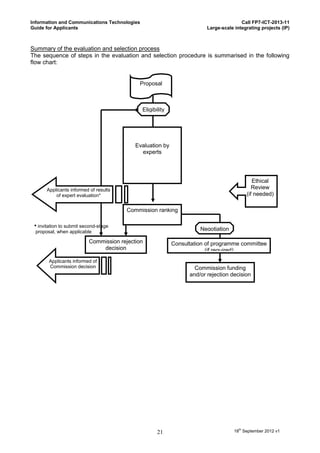
Summary of the evaluation and selection process
The sequence of steps in the evaluation and selection procedure is summarised in the following
flow chart:


                                            Proposal


                                              Eligibility


                                           Evaluation by
                                             experts


                                                                                              Ethical
      Applicants informed of results                                                          Review
          of expert evaluation*                                                            (if needed)

                                        Commission ranking

 • invitation to submit second-stage                                  Negotiation
 proposal, when applicable

                          Commission rejection              Consultation of programme committee
                              decision                                   (if required)
       Applicants informed of
       Commission decision                                          Commission funding
                                                                  and/or rejection decision


                                                     21                              18th September 2012 v1
Information and Communications Technologies                                                 Call FP7-ICT-2013-11
Guide for Applicants                                                         Large-scale integrating projects (IP)


Glossary


The following explanations are provided for clarity and easy-reference. They have no legal
authority, and do not replace any official definitions set out in the Council decisions.

 A
Acknowledgement of receipt :

Applicants are informed by email shortly after the deadline that a proposal has been successfully submitted
(but not that it is necessarily eligible). Contact the FP7 Enquiry service urgently if you do not receive such an
acknowledgement within a few days of the close of call (or batch, for continuous submission calls).

Applicant

The term used generally in this guide for a person or entity applying to a call for proposals. The term
‘participant’ is used in the more limited sense of a member of a proposal or project consortium (see below).

Associated countries

Non-EU countries which are party to an international agreement with the Community, under the terms or on
the basis of which it makes a financial contribution to all or part of the Seventh Framework Programme. In
the context of proposal consortia, organisations from these countries are treated on the same footing as
those in the EU. The list of associated countries is given in the body of this guide.


 C
Call fiche

The part of the work programme giving the basic data for a call for proposals (e.g. topics covered, budget,
deadline etc). It is posted as a separate document on the Participant Portal web pages devoted to a
particular call.

Call for proposals (or "call")

An announcement is published, usually in the Official Journal, inviting proposals for research activities in a
certain theme. Full information on the call can be found on the Participant Portal web-sites.

Consensus meeting

The stage, in the proposal evaluation process, when experts come together to establish a common view on a
particular proposal.

Consortium

Most funding schemes require proposals from a number of participants (usually at least three) who agree to
work together in a consortium.

Continuous submission

Some calls are open for an extended period, during which proposals may be submitted at any moment. In
these cases, proposals are evaluated in batches after fixed cut-off dates.

Coordinator

The coordinator leads and represents the applicants. He or she acts as the point of contact with the
Commission.

                                                       22                                18th September 2012 v1
Information and Communications Technologies                                                  Call FP7-ICT-2013-11
Guide for Applicants                                                          Large-scale integrating projects (IP)


CORDIS service

A web service providing access to all the documentation related to FP7. (See also Participant Portal).

Cut-off date

An intermediate date in the context of a call operating a continuous submission procedure. Proposals are
evaluated in batches after each cut-off date.

 D
Deadline

For a particular call, the moment after which proposals cannot be submitted to the Commission, and when
the Participant Portal Submission Service closes for that call. Deadlines are strictly enforced.

Deliverable

A deliverable represents a verifiable output of the project. Normally, each workpackage will produce one or
more deliverables during its lifetime. Deliverables are often written reports but can also take another form, for
example the completion of a prototype etc.

Direct costs

Direct costs are all eligible costs which can be attributed directly to the project and are identified by the
participant as such, in accordance with its accounting principles and its usual internal rules.

 E
Early Warning System (EWS)

An internal information tool of the Commission to flag identified financial risks related to beneficiaries.

Eligibility committee

An internal committee which examines in detail cases of proposals whose eligibility for inclusion in an
evaluation is in question

Eligibility criteria

The minimum conditions which a proposal must fulfil, if it is to be retained for evaluation. The eligibility
criteria are generally the same for all proposals throughout FP7, and relate to submission before the
deadline, minimum participation, completeness and scope. However, additional eligibility criteria may apply
to certain calls, and applicants should check the work programme, and annex 2 to this Guide.


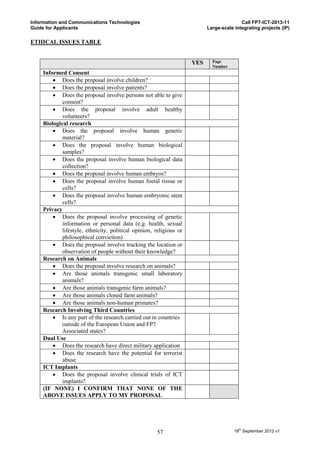
Ethical issues table

Research activities supported by the Framework Programme should respect fundamental ethical principles.
The main issues which might arise in a project are summarised in tabular form in a checklist included in the
proposal

Evaluation criteria

The criteria, against which eligible proposals are assessed by independent experts. The evaluation criteria
are generally the same for all proposals throughout FP7, and relate to S/T quality, impact and
implementation. Relevance is also considered. However, additional evaluation criteria may apply to certain
calls, and applicants should check the work programme, and annex 2 to this Guide.


                                                        23                                18th September 2012 v1
Information and Communications Technologies                                               Call FP7-ICT-2013-11
Guide for Applicants                                                       Large-scale integrating projects (IP)

Evaluation Summary Report (ESR)

The assessment of a particular proposal following the evaluation by independent experts is provided in an
Evaluation Summary Report. It normally contains both comments and scores for each evaluation criterion.

 F
FP7 enquiry service

A general information service on all aspects of FP7. Contact details are given in annex 1 to this Guide.

Funding scheme

The mechanisms for the Community funding of research projects. The funding schemes have different
objectives, and are implemented through grant agreements.


 G
Grant Agreement (GA)

The legal instrument that provides for Commission funding of projects.


 H
Hearing

Applicants whose proposals have been evaluated are sometimes invited to provide explanations and
clarifications to any specific questions raised by the experts. These questions are transmitted to the
applicants in advance.


 I
Indirect costs

Indirect costs, (sometimes called overheads), are all those eligible costs which cannot be identified by the
participant as being directly attributed to the project, but which can be identified and justified by its
accounting system as being incurred in direct relationship with the eligible direct costs attributed to the
project.

Individual evaluation

The stage in the evaluation process, when experts assess the merits of a particular proposal before
discussion with their peers.

Information Days

Open events organised by the Commission to explain the characteristics of specific calls, and often as well, a
chance for potential applicants to meet and discuss proposal ideas and collaborations.

Initial information letter

The letter sent by the Commission to applicants shortly after the evaluation by experts, which includes the
report from the experts on the proposal in question (the Evaluation Summary Report).

International Cooperation Partner Countries (ICPC)


                                                      24                               18th September 2012 v1
Information and Communications Technologies                                                Call FP7-ICT-2013-11
Guide for Applicants                                                        Large-scale integrating projects (IP)

A list of low-income, lower-middle income and upper-middle-income countries, given in annex 1 to the work
programme. Organisations from these countries can participate and receive funding in FP7, providing that
certain minimum conditions are met.

International European Interest Organisation

International organisations, the majority of whose members are European Union Member states or
Associated countries, and whose principal objective is to promote scientific and technological co-operation in
Europe.


 J
Joint Research Centre (JRC)

The Commission’s own research institutes.


 L
LEAR (Legal Entity Authorised Representative)

The LEAR is a person nominated in each legal entity participating in FP7. This person is the contact for the
Commission related to all questions on legal status. He/she has access to the online database of legal
entities with a possibility to view the data stored on his/her entity and to initiate updates and corrections to
these data. The LEAR receives a Participant Identification Code (PIC) from the Commission (see below),
and distributes this number within his/her organisation.

Lump sum

Lump sums do not require the submission of financial justifications (statements), as they are "fixed". ICPC
participants when participating in an FP7 grant agreement have the choice between being reimbursed on the
basis of eligible costs or on the basis of lump-sums. This choice can be made up to the moment of the
signature of the grant agreement (whatever the final option chosen, the maximum EU contribution for the
project remains unchanged). Once made, it will apply during the whole duration of the agreement without the
possibility of changing it. ICPC participants may opt for a lump sum in a given project and for reimbursement
of costs in another.


 M
Milestones

Control points where decisions are needed with regard to the next stage of the project.


 N
National Contact Points (NCP)

Official representatives nominated by the national authorities to provide tailored information and advice on
each theme of FP7, in the national language(s).

Negotiation

The process of establishing a grant agreement between the Commission and an applicant whose proposal
has been favourably evaluated, and when funds are available.

Non-profit


                                                      25                                18th September 2012 v1
Information and Communications Technologies                                                 Call FP7-ICT-2013-11
Guide for Applicants                                                         Large-scale integrating projects (IP)


A legal entity is qualified as "non-profit" when considered as such by national or international law.


 P
Part A

The part of a proposal dealing with administrative data. This part is completed using the web-based
Participant Portal Submission Service.

Part B

The part of a proposal explaining the work to be carried out, and the roles and aptitudes of the participants in
the consortium. This part is uploaded to the Participant Portal as a pdf file

Part B template

A document in PDF format supplied by the Participant Portal Submission Service, consisting of a template of
all chapter headings, forms and tables required to prepare a proposal Part B. The template format is
illustrated in Annex 4 to this Guide.

Participants

The members of a consortium in a proposal or project. These are legal entities, and have rights and
obligations with regard to the Community.

Participant Identification Code (PIC)

Organisations participating in FP7 will progressively be assigned Participant Identification Codes (PIC).
Possession of a PIC will enable organisations to take advantage of the Unique Registration Facility (see
below), and to identify themselves in all transactions related to FP7 proposals and grants.

Participant Portal

The single entry point for interaction with the research Directorates-General of the European Commission. It
hosts a full range of services that facilitate the monitoring and the management of proposals and projects
throughout their lifecycle, including calls for proposals, and access to the Participant Portal Submission
Service.

Participant Portal Submission Service

A web-based service, which must be used to submit proposals to the Commission. Access is given through
the Participant Portal.

Participant Portal Submission Service Helpdesk

A telephone / email service to assist applicants who have difficulty in submitting their proposal via the
Participant Portal Submission Service :
tel: +32 2 29 92222 email DIGIT-EFP7-SEP-SUPPORT@ec.europa.eu

Programme committee

A group of official national representatives who assist the Commission in implementing the Framework
Programme.

Proposal

A description of the planned research activities, information on who will carry them out, how much they will
cost, and how much funding is requested


                                                       26                                18th September 2012 v1
Information and Communications Technologies                                                 Call FP7-ICT-2013-11
Guide for Applicants                                                         Large-scale integrating projects (IP)


Public body

Public body means any legal entity established as such by national law, and international organisations.


 R

Redress procedure

The initial information letter will indicate an address if an applicant wishes to submit a request for redress, if
he or she believes that there have been shortcomings in the handling of the proposal in question, and that
these shortcomings would jeopardise the outcome of the evaluation process. An internal evaluation review
committee ("redress committee") will examine all such complaints. This committee does not itself evaluate
the proposal. It is possible that the committee will recommend a re-evaluation of all or part of the proposal.

Research organisation

A legal entity established as a non-profit organisation which carries out research or technological
development as one of its main objectives.

Reserve list

Due to budgetary constraints it may not be possible to support all proposals that have been evaluated
positively. In such conditions, proposals on a reserve list will only be financed if funds become available
following the negotiation of proposals on the main list.

Risk-Sharing Finance Facility (RSFF)

A new mechanism to foster private sector investment in research by increasing the capacity of the EIB and
its financial partners to provide loans for European RTD projects.

RTD

Research and Technological Development.

 S
SME

SMEs are micro, small and medium-sized enterprises. SMEs are defined in Recommendation 2003/361/EC
of 6 May 2003.

Specific flat rate (60%)

A 60% flat rate of the total direct costs applicable under certain conditions to non-profit public bodies,
secondary and higher education establishments, research organisations and SMEs. This rate is available for
the entire duration of FP7.

Specific International Cooperation Actions (SICA)

In some calls on topics of mutual interest, special conditions apply to promote research collaborations
between European organisations and those based in the International Cooperation Partner Countries
(ICPC). This usually entails a minimum of two participants from EU or Associated countries, and two from
ICPC.


                                                       27                                18th September 2012 v1
Information and Communications Technologies                                                   Call FP7-ICT-2013-11
Guide for Applicants                                                           Large-scale integrating projects (IP)


 T
Thresholds

For a proposal to be considered for funding, the evaluation scores for individual criteria must exceed certain
thresholds. There is also an overall threshold for the sum of the scores.

Two-stage submission

Some calls require proposals to be submitted in two stages. In this case, applicants initially present their idea
in a brief outline proposal. This is evaluated against evaluation criteria, or sub-criteria for this stage set out in
the call. Applicants successful in the first stage will be invited to submit a full proposal at the second stage,
which will be evaluated against criteria for this second stage set out in the call. The first stage criteria, as set
out in the work programme, are usually a limited set of those applying at the second stage.

Two-step evaluation

An evaluation procedure in which a proposal is evaluated first on a limited number of evaluation criteria
(usually, just one), and only those proposals which achieve the threshold on this are subject to a full
evaluation on the remaining criteria.


 U
Unique Registration Facility (URF)

A system that will allow organisations who intend to submit on several occasions to register their details once
and for all, obviating the need to provide the same information with each submission. The Web interface of
the URF is found at http://ec.europa.eu/research/participants/urf. On this website you will also find a search
tool to check if your organisation is already registered or not.


 W
Weightings

The scores for certain evaluation criteria may be multiplied by a weighting factor before the total score is
calculated. Generally, weightings are set to one; but there may be exceptions and applicants should check
the details in annex 2 to this Guide.

Work Package

A work package is a major sub-division of the proposed project with a verifiable end-point – normally a
deliverable or a milestone in the overall project.

Work Programme

A formal document of the Commission for the implementation of a specific programme, that sets out the
research objectives and topics to be addressed. It also contains information that is set out further in this
Guide, including the schedule and details of the calls for proposals, indicative budgets, and the evaluation
procedure.


                                                         28                                18th September 2012 v1
Information and Communications Technologies                           Call FP7-ICT-2013-11
Guide for Applicants                                   Large-scale integrating projects (IP)


Annexes


Annex 1        Timetable and specific information for this call
Annex 2        Evaluation criteria and procedure
Annex 3        Instructions for completing Part A of the proposal
Annex 4        Instructions for drafting Part B of the proposal
Annex 5        Ethical Guidelines for undertaking ICT research in FP7
Annex 6        Pre-proposal check form


                                              29                   18th September 2012 v1
Information and Communications Technologies                                         Call FP7-ICT-2013-11
Guide for Applicants                                                 Large-scale integrating projects (IP)


Annex 1: Timetable and specific information for this call


   The ICT Work programme provides the essential information for submitting a proposal to this
    call. It describes the content of the topics to be addressed, and details on how it will be
    implemented. The work programme is available on the call page in the Participant Portal. The
    part giving the basic data on implementation (deadline, budget, additional conditions etc.) is
    also available as a separate document ("call fiche") on the call page in the Participant Portal.
    You must consult these documents.

   Indicative timetable

             ICT Call 11 closes at 17h Brussels time on 16th April 2013

                No hearings will be applied to IP proposals in this call.
        Publication of call                                18th September 2012
        Deadline for submission of proposals               16th April 2013
        Evaluation of proposals                            May-June 2013
        Evaluation Summary Reports sent to all End June 2013
        proposal coordinators
        Invitation letter to successful applicants to Early July 2013
        launch negotiations with Commission services
        Letters to unsuccessful applicants                 August 2013
        Signature of first grant agreements                October 2013

   Further information and help

Call information
Participant Portal                            http://ec.europa.eu/research/participants/portal/
                                                                              (select tab "FP7 calls")

General sources of help
National Contact Points                       http://cordis.europa.eu/fp7/ncp_en.html
FP7 Research enquiries service                http://ec.europa.eu/research/enquiries
Participant Portal Submission Service         Help desk       tel: +32 2 299 2222
                                              email DIGIT-EFP7-SEP-SUPPORT@ec.europa.eu
Ethics Help desk                              http://cordis.europa.eu/fp7/get-support_en.html
                                          (information under "Ethics Help Desk for all FP7 projects")
Risk sharing financing facility               http://www.eib.org/rsff
(European Investment Bank)

FP7/ICT Support projects
Idealist partner search project               http://www.ideal-ist.eu/
IPR helpdesk                                  http://www.ipr-helpdesk.eu/

Legal documents generally applicable
Decision on the Framework Programme
Rules for Participation
Specific Programmes


                                                  30                             18th September 2012 v1
Information and Communications Technologies                                         Call FP7-ICT-2013-11
Guide for Applicants                                                 Large-scale integrating projects (IP)

Rules for proposal submission, evaluation selection and award

Contractual information
Consortium agreement checklist
Negotiation guidance notes
Financial guidelines
Model Grant agreement

All the above at                      http://cordis.europa.eu/fp7/find-doc_en.html


 Pre-proposal check
The Commission offers a facility to allow a proposer to check on the appropriateness of their
proposed action and the eligibility of the proposal consortium.

A form to request this check on your proposal is supplied as annex 6 of this Guide. This may be
submitted at any time up to four weeks before the close of call, but it is wisest of course make this
check as early as you can in your proposal preparation process.

The advice given by the Commission is strictly informal and non-binding. Only one pre-proposal
check will be carried out per proposal. The advice provided through the pre-proposal check does
not in any way engage the Commission with respect to acceptance or rejection of the proposal
when it is formally submitted at a later stage. The evaluators who later evaluate your proposal will
not be informed of the results of the pre-proposal check, nor even that a pre-proposal check was
carried out. The pre-proposal service is not intended to assist with the identification of possible
partners for your consortium.

Although this pre-proposal assessment service is entirely optional it is highly recommended to use
this facility. Any proposal can always be submitted directly to the call without a pre-proposal check.


 Address for pre-proposal check
Please email your pre-proposal check form for this call to the address given on the "Contacts"
document available on the call page on the Participant Portal.


                                                 31                              18th September 2012 v1
Information and Communications Technologies                                                                Call FP7-ICT-2013-11
Guide for Applicants                                                                        Large-scale integrating projects (IP)


Annex 2: Evaluation criteria and procedures to be applied to IP proposals in this
call

1. General
All eligible proposals will be evaluated by independent experts.

      Commission staff ensures that the process is fair, and in line with the principles contained in
       the Commission's rules9.

      Experts perform evaluations on a personal basis, not as representatives of their employer, their
       country or any other entity. They are expected to be independent, impartial and objective, and
       to behave throughout in a professional manner. They sign an appointment letter, including a
       confidentiality and conflict of interest declaration before beginning their work. Confidentiality
       rules must be adhered to at all times, before, during and after the evaluation.

In addition, an independent expert or experts may be appointed by the Commission to observe the
evaluation process from the point of view of its working and execution. The role of the observer(s)
is to give independent advice to the Commission on the conduct and fairness of the evaluation
sessions, on the way in which the experts apply the evaluation criteria, and on ways in which the
procedures could be improved. The observer(s) will not express views on the proposals under
examination or the experts’ opinions on the proposals.

2. Before the evaluation
On receipt by the Commission, proposals are registered and acknowledged and their contents
entered into a database to support the evaluation process. Eligibility criteria for each proposal are
also checked by Commission staff before the evaluation begins. Proposals which do not fulfil these
criteria will not be included in the evaluation.

For this call a proposal will only be considered eligible if it meets all of the following conditions:

      It is received by the Commission via the Participant Portal Submission Service before the
       deadline given in the call fiche
      It involves at least the minimum number of participants given in the call fiche
      It is complete (i.e. both the requested administrative forms and the proposal description are
       present)
      The content of the proposal relates to the topics and funding schemes, including any special
       conditions, set out in the relevant parts of the work programme

Proposal in which the Part B pdf file has been password-protected or for which printing has been
disabled will be considered as failing the eligibility conditions under the third bullet point.

The Commission establishes a list of experts capable of evaluating the proposals that have been
received. The list is drawn up to ensure:

      A high level of expertise;
      An appropriate range of competencies;

Provided that the above conditions can be satisfied, other factors are also taken into consideration:

      An appropriate balance between academic and industrial expertise and users;
      A reasonable gender balance;
      A reasonable distribution of geographical origins;

9
    Rules on submission of proposals, and the related evaluation, selection and award procedures [available on CORDIS]


                                                                  32                                     18th September 2012 v1
Information and Communications Technologies                                                     Call FP7-ICT-2013-11
Guide for Applicants                                                             Large-scale integrating projects (IP)


   Regular rotation of experts

In constituting the lists of experts, the Commission also takes account of their abilities to appreciate
the industrial and/or societal dimension of the proposed work. Experts must also have the
appropriate language skills required for the proposals to be evaluated.

Commission staff allocates proposals to individual experts, taking account of the fields of expertise
of the experts, and avoiding conflicts of interest.

3. Evaluation of proposals
At the beginning of the evaluation, experts will be briefed on the evaluation procedure, the experts’
responsibilities, the issues involved in the particular area/objective, and other relevant material
(including the integration of the international cooperation dimension).

The proposal will be evaluated against pre-determined evaluation criteria.

                        Evaluation criteria applicable to
                  Collaborative project proposals (IP or STREP)
1. S/T QUALITY                         2. IMPLEMENTATION                     3. IMPACT

“Scientific and/or                     “Quality and efficiency of the        “Potential impact through the
technological excellence               implementation and the                development, dissemination
(relevant to the topics addressed      management”                           and use of project results”
by the call)”

   Soundness of concept, and             Appropriateness of the               Contribution, at the European
    quality of objectives                  management structure and              and/or international level, to the
                                           procedures                            expected impacts listed in the
   Progress beyond the state-of-                                                work programme under
    the-art                               Quality and relevant                  relevant topic/activity
                                           experience of the individual
   Quality and effectiveness of the       participants                         Appropriateness of measures
    S/T methodology and                                                          for the dissemination and/or
    associated work plan                  Quality of the consortium as a        exploitation of project results,
                                           whole (including                      and management of intellectual
                                           complementarity, balance)             property.

                                          Appropriateness of the
                                           allocation and justification of
                                           the resources to be committed
                                           (staff, equipment…)


Evaluation scores will be awarded for each of the three criteria, not for the sub-criteria (bullet
points). These sub-criteria are issues which the expert should consider in the assessment of that
criterion. They also act as reminders of issues to raise later during the discussions of the proposal.

The relevance of a proposal will be considered in relation to the topic(s) of the work programme
open in a given call, and to the objectives of a call. These aspects will be integrated in the
application of the criterion "S/T quality", and the first sub-criterion under "Impact" respectively.
When a proposal is partially relevant because it only marginally addresses the topic(s) of the call,
or if only part of the proposal addresses the topic(s), this condition will be reflected in the scoring of
the first criterion. Proposals that are clearly not relevant to a call ("out of scope") will be rejected
on eligibility grounds.

Each criterion will be scored out of 5. Half marks can be given.


                                                           33                                 18th September 2012 v1
Information and Communications Technologies                                         Call FP7-ICT-2013-11
Guide for Applicants                                                 Large-scale integrating projects (IP)

The scores indicate the following with respect to the criterion under examination:


 0-       The proposal fails to address the criterion under examination or cannot be judged due to
          missing or incomplete information
 1-        Poor. The criterion is addressed in an inadequate manner, or there are serious inherent
          weaknesses.
 2-        Fair. While the proposal broadly addresses the criterion, there are significant
           weaknesses.
 3-        Good. The proposal addresses the criterion well, although improvements would be
          necessary.
 4-        Very good. The proposal addresses the criterion very well, although certain
          improvements are still possible.
 5-        Excellent. The proposal successfully addresses all relevant aspects of the criterion in
          question. Any shortcomings are minor.


No weightings will be applied.

Thresholds will be applied to the scores. The threshold for individual criteria will be 3. The overall
threshold, applying to the sum of the three individual scores, will be 10.

Conflicts of interest: Under the terms of their appointment letter, experts must declare beforehand
any known conflicts of interest, and must immediately inform a Commission staff member if one
becomes apparent during the course of the evaluation. The Commission will take whatever action
is necessary to remove any conflict.

Confidentiality: The appointment letter also requires experts to maintain strict confidentiality with
respect to the whole evaluation process. They must follow any instruction given by the Commission
to ensure this. Under no circumstance may an expert attempt to contact an applicant on his own
account, either during the evaluation or afterwards.

4. Individual evaluation
The first stage (individual evaluation) will be carried out on the premises of the experts concerned
("remotely").

Each proposal will first be assessed independently by five or more experts, chosen by the
Commission from the pool of experts taking part in this evaluation. At this first step the experts are
acting individually; they do not discuss the proposal with each other, nor with any third party. The
experts record their individual opinions in an Individual Evaluation Report (IER), giving scores
and also comments against the evaluation criteria.

When scoring proposals, experts must only apply the above evaluation criteria.

Experts will assess and mark the proposal exactly as it is described and presented. They do not
make any assumptions or interpretations about the project in addition to what is in the proposal.

Concise but explicit justifications will be given for each score. Recommendations for improvements
to be discussed as part of a possible negotiation phase will be given, if needed.

The experts will also indicate whether, in their view, the proposal deals with sensitive ethical
issues,

Signature of the IER also entails a declaration that the expert has no conflict of interest in
evaluating the particular proposal.

                                                 34                              18th September 2012 v1
Information and Communications Technologies                                          Call FP7-ICT-2013-11
Guide for Applicants                                                  Large-scale integrating projects (IP)


Scope of the call: It is possible that a proposal is found to be out of scope of the call during the
course of the individual evaluation, and therefore not relevant. If an expert suspects that this may
be the case, a Commission staff member will be informed immediately, and the views of the other
experts will be sought. If the general view is that the main part of the proposal is not relevant to the
topics of the call, the proposal will be withdrawn from the evaluation, and the proposal will be
deemed ineligible.

5. Consensus meeting
Once all the experts to whom a proposal has been assigned have completed their IER, the
evaluation progresses to a consensus assessment, representing their common views.

This entails a consensus meeting to discuss the scores awarded and to prepare comments.

The consensus discussion is moderated by a representative of the Commission. The role of the
moderator is to seek to arrive at a consensus between the individual views of experts without any
prejudice for or against particular proposals or the organisations involved, and to ensure a
confidential, fair and equitable evaluation of each proposal according to the required evaluation
criteria.

The moderator for the group may designate an expert to be responsible for drafting the consensus
report ("rapporteur"). The experts attempt to agree on a consensus score for each of the criteria
that have been evaluated and suitable comments to justify the scores. Comments should be
suitable for feedback to the proposal coordinator. Scores and comments are set out in a
consensus report. They also come to a common view on the questions of scope if necessary

If during the consensus discussion it is found to be impossible to bring all the experts to a common
point of view on any particular aspect of the proposal, the Commission may ask up to three
additional experts to examine the proposal.

Outcome of consensus: The outcome of the consensus step is the Consensus Report (CR). This
will be signed (either on paper, or electronically) by all experts, or as a minimum, by the rapporteur
and the moderator. The moderator is responsible for ensuring that the consensus report reflects
the consensus reached, expressed in scores and comments. In the case that it is impossible to
reach a consensus, the report sets out the majority view of the experts but also records any
dissenting views.

Ethical issues (above threshold proposals): If one10 or more experts have noted that there are
ethical issues touched on by the proposal, and the proposal is considered to be above threshold,
the relevant box on the consensus report (CR) will be ticked and an Ethical Issues Report (EIR)
completed, stating the nature of the ethical issues. The EIR will be signed by the Commission
moderator and one member of the consensus group (normally, the proposal rapporteur).

The Commission will take the necessary steps to assure the quality of the consensus reports, with
particular attention given to clarity, consistency, and appropriate level of detail. If important
changes are necessary, the reports will be referred back to the experts concerned.

The signing of the consensus report completes the consensus step.

Evaluation of a resubmitted proposal: In the case of proposals that have been submitted previously
to the Commission in FP7, the moderator may give the experts the previous evaluation summary
report (see below) following the consensus stage. If necessary, the experts will be required to
provide a clear justification for their scores and comments should these differ markedly from those
awarded to the earlier proposal.

10
     Exceptionally for this issue, no consensus is required.

                                                               35                 18th September 2012 v1
Information and Communications Technologies                                            Call FP7-ICT-2013-11
Guide for Applicants                                                    Large-scale integrating projects (IP)


6. Panel review
This is the final step involving the independent experts. It allows them to formulate their
recommendations to the Commission having had an overview of the results of the consensus step.
The panel comprises experts involved at the consensus step with the experts who reviewed the
other proposals in the area.

The main task of the panel is to examine and compare the consensus reports in a given area, to
check on the consistency of the marks applied during the consensus discussions and, where
necessary, propose a new set of scores.

The tasks of the panel will also include:
    resolving cases where a minority view was recorded in the consensus report
    recommending a priority order for proposals with the same score
    making recommendations on possible clustering or combination of proposals.

The panel is chaired by the Commission. The Commission will ensure fair and equal treatment of
the proposals in the panel discussions. A panel rapporteur will be appointed to draft the panel’s
advice. A ranked list will be drawn up for every indicative budget as shown in the call fiche. The
panel can deal with one or more ranked lists for the proposals under evaluation, following the
scoring systems indicated above.

Priority order for proposals with the same score
As part of the evaluation by independent experts, a panel review will recommend one or more
ranked lists for the proposals under evaluation, following the scoring systems indicated above. A
ranked list will be drawn up for every indicative budget shown in the call fiche.

If necessary, the panel will determine a priority order for proposals which have been awarded the
same score within a ranked list. Whether or not such a prioritisation is carried out will depend on
the available budget or other conditions set out in the call fiche. The following approach11 will be
applied successively for every group of ex aequo proposals requiring prioritisation, starting with the
highest scored group, and continuing in descending order:

           (i) Proposals that address relevant topics not otherwise covered by more highly-rated
           proposals will be considered to have the highest priority.

           (ii) These proposals will themselves be prioritised according to the scores they have been
           awarded for the criterion impact. When these scores are equal, priority will be based on
           scores for the criterion scientific and/or technological excellence. If necessary, any further
           prioritisation will be based on other appropriate characteristics, to be decided by the panel,
           related to the contribution of the proposal to the European Research Area and/or general
           objectives mentioned in the work programme (e.g. presence of SMEs, international co-
           operation, public engagement).

(iii) The method described in (ii) will then be applied to the remaining ex aequos in the group.

The outcome of the panel meeting is a report recording, principally:
    An Evaluation Summary Report (ESR) for each proposal, including, where relevant, a
       report of any ethical issues raised;
    A list of proposals passing all thresholds, along with a final score for each proposal passing
       the thresholds and the panel recommendations for priority order;
    A list of evaluated proposals having failed one or more thresholds;
    A list of any proposals having been found ineligible;
    A summary of the deliberations of the panel.
11
     unless stated otherwise on the call fiche

                                                     36                             18th September 2012 v1
Information and Communications Technologies                                        Call FP7-ICT-2013-11
Guide for Applicants                                                Large-scale integrating projects (IP)


If the panel has considered proposals submitted to various parts of a call (e.g. different funding
schemes, or different topics that have been allocated distinct indicative budgets in the work
programme), the report may accordingly contain multiple priority lists.

The panel report is signed by at least three panel experts and the Commission chairperson.

A copy of the Evaluation Summary Report will be sent to each proposal coordinator.

7. Ethics Review of project proposals
An ethics review of above-threshold proposals may be organised by the Commission. The Ethics
Review is carried out by independent experts with a special expertise on ethics. Reviewing
research projects on ethical grounds at the EU level is a legal requirement under FP7. The Review
evaluates aspects of the design and methodology of the proposed research such as intervention
on humans, use of animals, data protection issues, terms of participation of children and vulnerable
populations groups.

The Panel drafts an Ethics Review Report that summarises its opinion on the ethical soundness of
the project proposal under consideration. The requirements put forward by the Panel are taken into
account in any subsequent negotiations on the grant agreement, and may lead to obligatory
provisions in the conduct of the research.

For additional information on the Ethics Review procedure see:
http://ec.europa.eu/research/science-society/index.cfm?fuseaction=public.topic&id=73


                                                37                              18th September 2012 v1
Information and Communications Technologies                                       Call FP7-ICT-2013-11
Guide for Applicants                                               Large-scale integrating projects (IP)


Annex 3: Instructions for completing Part A of the proposal
Proposals in this call must be submitted electronically, using the Participant Portal Submission
Service. The procedure is summarised in section 3 of this guide.

In Part A you are asked for certain administrative details that will be used in the evaluation and
further processing of your proposal. Section A1 gives a snapshot of your proposal, section A2
concerns the participants in the consortium, while section A3 deals with money matters. Details of
the work you intend to carry out will be described in Part B (see annex 4 of this guide).

Please note:

   The coordinator fills in the sections A1 and A3.
   Participants already identified at the time of proposal submission (including the coordinator)
    each fill in their respective section A2.
   Subcontractors, if any, do not fill in a section A2 and are not listed separately in section A3
    (They are described in Part B)
   The estimated budget planned for any future participants, not yet identified at the time of the
    proposal, is not shown separately in form A3 but must be added to the coordinator’s budget.
    (Their role, profile and tasks are described in Part B)

When you complete section A3, please make sure that:

   Numbers are always rounded to the nearest whole number
   You have inserted zeros ("0") where there are no costs or funding figures. Leaving cells empty
    will block the submission of your proposal
   All costs are given in Euros (not thousands of Euros)
   Costs do not include Value Added Tax

The following notes are for information only. They should assist you in completing the A-part of
your proposal. On-line guidance will also be available. The precise questions and options
presented on Participant Portal Submission Service may differ slightly from these below.


                                                38                             18th September 2012 v1
Information and Communications Technologies                                                              Call FP7-ICT-2013-11
Guide for Applicants                                                                      Large-scale integrating projects (IP)


LARGE SCALE INTEGRATING PROJECTS


Section A1: Summary

                The short title or acronym will be used to identify your proposal efficiently in this call. It should be of no more than 20
  Proposal
                characters (use standard alphabet and numbers only; no symbols or special characters please).
  Acronym
                The same acronym should appear on each page of Part B of your proposal.


                For each type of Collaborative Projects, please refer to the work programme.
Collaborative
  Projects


                The title should be no longer than 200 characters and should be understandable to the non-specialist in your field.
  Proposal
    Title

                Insert the estimated duration of the project in full months.
 Duration in
  months


                The call identifier is the reference number given in the call or part of the call you are addressing, as indicated in the
 Call (part)
                publication of the call in the Official Journal of the European Union, and on the Participant Portal call page.
 identifier
                [The call identifier is pre-filled in the forms from the Participant Portal Submission Service.
                If you do not have the correct identifier on your forms, you have registered for the wrong call. Discard this
                registration and register again].


Topic code(s)
                Please refer to the topic codes /objectives listed in the work programme call fiche.
most relevant
   to your      All activities and topics of FP7 have been assigned unique codes, which are used in the processing of data on
  proposal      proposals and subsequent contracts. The codes are organised hierarchically.

                The choice of the first topic code will be limited in the drop-down menu to one of the topics open in this call. Select
                the code corresponding to the topic most relevant to your proposal.

                The choice for the second code is also limited to topics open in the call in question. Enter a second code if your
                proposal also addresses another of these. Select ‘none’ if this is not the case.

                Select a third code if your proposal is also relevant to another theme. This time, the available codes will simply
                correspond to broad themes. Select ‘none’ if this is not the case.


                Please enter a number of keywords that you consider sufficient to characterise the scope of your proposal.
   Free
 Keywords       There is a limit of 100 characters.


                The abstract should, at a glance, provide the reader with a clear understanding of the objectives of the proposal, how
  Abstract
                they will be achieved, and their relevance to the Work Programme. This summary will be used as the short
                description of the proposal in the evaluation process and in communications to the programme management
                committees and other interested parties. It must therefore be short and precise and should not contain confidential
                information. Please use plain typed text, avoiding formulae and other special characters. If the proposal is written in
                a language other than English, please include an English version of the proposal abstract in Part B.

                There is a limit of 2000 characters. Exceeding this limit may block the submission of your proposal !


                A ‘similar’ proposal or contract is one that differs from the current one in only minor ways, and in which some of the
   Similar
                present consortium members are involved.
proposals or
   signed
 contracts


                                                               39                                        18th September 2012 v1
Information and Communications Technologies                                                              Call FP7-ICT-2013-11
Guide for Applicants                                                                      Large-scale integrating projects (IP)


Section A2/ Participants

                  The number allocated by the consortium to the participant for this proposal. The co-ordinator of a proposal is
  Participant
                  always number one.
   number


                  The Participant Identification Code (PIC) enables organisations to take advantage of the Participant Portal.
  Participant
                  Organisations who have received a PIC from the Commission are encouraged to use it when submitting proposals.
 Identification   By entering a PIC, parts of section A2 will be filled in automatically. An online tool to search for existing PICs and
     Code         the related organisations is available at http://ec.europa.eu/research/participants/portal/page/searchorganisations
                  Organisations not yet having a PIC are strongly encouraged to register before submitting the proposal and insert in
                  section A2 the temporary PIC received at the end of the registration process.

                  For Public Law Body, it is the name under which your organisation is registered in the Resolution text, Law,
 Legal name
                  Decree/Decision establishing the Public Entity, or in any other document established at the constitution of the
                  Public Law Body;

                  For Private Law Body, it is the name under which your organisation is registered in the national Official Journal
                  (or equivalent) or in the national company register.

                  For a natural person, it is for e.g. Mr Adam JOHNSON, Mrs Anna KUZARA, and Ms Alicia DUPONT.


 Organisation
                  Choose an abbreviation of your Organisation Legal Name, only for use in this proposal and in all relating
 Short Name       documents.

                  This short name should not be more than 20 characters exclusive of special characters (./;…), for e.g. CNRS and
                  not C.N.R.S. It should be preferably the one as commonly used, for e.g. IBM and not Int.Bus.Mac.


                  For Public and Private Law Bodies, it is the address of the entity’s Head Office.
Legal address
                  For Individuals it is the Official Address.

                  If your address is specified by an indicator of location other than a street name and number, please insert this
                  instead under the "street name" field and "N/A" under the "number" field.


                  Non-profit organisation is a legal entity qualified as such when it is recognised by national or, international law.
  Non-profit
 organisation


                  Public body means any legal entity established as such by national law, and international organisations.
 Public body


                  Research organisation means a legal entity established as a non-profit organisation which carries out research or
  Research
                  technological development as one of its main objectives.
 organisation


                  NACE means " Nomenclature des Activités économiques dans la Communauté Européenne".
 NACE code
                  Please select one activity from the list that best describes your professional and economic ventures. If you are
                  involved in more than one economic activity, please select the one activity that is most relevant in the context of
                  your contribution to the proposed project. For more information on the methodology, structure and full content of
                  NACE (rev. 1.1) classification please consult EUROSTAT at:

                  http://ec.europa.eu/eurostat/ramon/nomenclatures/index.cfm?TargetUrl=LST
                  _CLS_DLD&StrNom=NACE_1_1&StrLanguageCode=EN&StrLayoutCode=
                  HIERARCHIC .


                                                                40                                        18th September 2012 v1
Information and Communications Technologies                                                                Call FP7-ICT-2013-11
Guide for Applicants                                                                        Large-scale integrating projects (IP)


                  SMEs are micro, small and medium-sized enterprises within the meaning of Recommendation 2003/361/EC in the
  Small and
                  version of 6 May 2003. The full definition and a guidance booklet can be found at
Medium-Sized      http://ec.europa.eu/enterprise/enterprise_policy/sme_definition/index_en.htm
 Enterprises
                  To find out if your organisation corresponds to the definition of an SME you can use the on-line tool at
   (SMEs)         http://ec.europa.eu/research/sme-techweb/index_en.cfm


                  Two participants (legal entities) are dependent on each other where there is a controlling relationship between
Dependencies
                  them:
with (an) other
participant(s)                   A legal entity is under the same direct or indirect control as another legal entity (SG);
                             or
                                  A legal entity directly or indirectly controls another legal entity (CLS);
                             or
                                 A legal entity is directly or indirectly controlled by another legal entity (CLB).
                  Control:
                  Legal entity A controls legal entity B if:

                                 A, directly or indirectly, holds more than 50% of the nominal value of the issued share capital or a
                                  majority of the voting rights of the shareholders or associates of B,
                             or
                                 A, directly or indirectly, holds in fact or in law the decision-making powers in B.

                  The following relationships between legal entities shall not in themselves be deemed to constitute controlling
                  relationships:

                             (a) the same public investment corporation, institutional investor or venture-capital company has a direct
                             or indirect holding of more than 50 % of the nominal value of the issued share capital or a majority of
                             voting rights of the shareholders or associates;
                             (b) the legal entities concerned are owned or supervised by the same public body.


                  According to the explanation above mentioned, please insert the appropriate abbreviation according to the list
 Character of
                  below to characterise the relation between your organisation and the other participant(s) you are related with:
 dependence
                            SG: Same group: if your organisation and the other participant are controlled by the same third party;
                            CLS: Controls: if your organisation controls the other participant;
                            CLB: Controlled by: if your organisation is controlled by the other participant.


                  It is the main scientist or team leader in charge of the proposal for the participant. For participant number 1 (the
Contact point
                  coordinator), this will be the person the Commission will contact concerning this proposal (e.g. for additional
                  information, invitation to hearings, sending of evaluation results, convocation to negotiations).


                  Please choose one of the following: Prof., Dr., Mr., Mrs, Ms.
     Title


                  This information is required for statistical and mailing purposes. Indicate F or M as appropriate.
     Sex


                  Please insert the full numbers including country and city/area code. Example +32-2-2991111.
Phone and fax
  numbers


                                                                41                                         18th September 2012 v1
Information and Communications Technologies                                                               Call FP7-ICT-2013-11
Guide for Applicants                                                                       Large-scale integrating projects (IP)


Section A3/Budget


Indirect Costs   Indirect costs are all those eligible costs which cannot be identified by the participant as being directly attributed to
                 the project but which can be identified and justified by its accounting system as being incurred in direct relationship
                 with the eligible direct costs attributed to the project. They may not include any eligible direct costs.


  Method of      Summary description
  calculating
                 Participants who have an analytical accounting system that can identify and group their indirect costs in
indirect costs   accordance with the eligibility criteria (e.g. exclude non-eligible costs) must report their actual indirect costs (or
                 choose the 20% flat rate option referred to below).

                 For the purpose of calculating the actual indirect costs, a participant is allowed to use a simplified method of
                 calculation of its full indirect eligible costs.

                 Optionally, participants may opt for a flat rate for indirect costs of 20% of the direct costs (minus subcontracting
                 and third party costs not incurred on the premises of the participant.

                 A specific flat rate of 60% of the direct costs is foreseen for non-profit public bodies, secondary and higher
                 education establishments, research organisations and SMEs which are unable to identify with certainty their real
                 indirect costs for the project.

                 For Coordination and Support actions, whichever method is used, the reimbursement of indirect eligible costs
                 may not exceed 7% of the direct eligible costs, excluding the direct eligible costs for subcontracting and the costs
                 of reimbursement of resources made available by third parties which are not used on the premises of the
                 participant.

                 Further guidance

                 In FP7 all departments, faculties or institutes which are part of the same legal entity must use the same system of
                 cost calculation (unless a special clause foreseeing a derogation for a particular department/institute is included in
                 the grant agreement). Under FP7, there are no cost reporting models.

                 1. Participants which have an analytical accounting system that can identify and group their indirect costs (pool of
                 costs) in accordance with the eligibility criteria (e.g. exclude non-eligible costs) must report their actual indirect
                 costs (or choose the 20% flat rate option under 2. below). This method is the same as the "full cost" model used in
                 previous Framework Programmes.

                 For the purpose of calculating the actual indirect costs, a participant is allowed to use a simplified method of
                 calculation of its full indirect eligible costs. The simplified method is a way of declaring indirect costs which applies
                 to organisations which do not aggregate their indirect costs at a detailed level (centre, department), but can
                 aggregate their indirect costs at the level of the legal entity.

                 The simplified method can be used if the organisation does not have an accounting system with a detailed cost
                 allocation. The method has to be in accordance with their usual accounting and management principles and
                 practices; it does not involve necessarily the introduction of a new method just for FP7 purposes. Participants are
                 allowed to use it, provided this simplified approach is based on actual costs derived from the financial accounts of
                 the last closed accounting year.

                 There is no "standard model"; each legal entity will use its own system. The minimum requirements for it to be
                 considered a simplified method for FP7 purposes are the following:

                 - the system must allow the participant to identify and remove its direct ineligible costs (VAT, etc.);
                 - it must at least allow for the allocation of the overheads at the level of the legal entity to the individual projects by
                 using a fair "driver" (e.g. total productive hours);
                 - the system applied and the costs declared according to it should follow the normal accounting principles and
                 practices of the participant. Therefore, if the system used by a participant is more "refined" than the "minimum"
                 requirements mentioned here, it is that system which should be used when declaring costs.

                 Example: if a participant's accounting system distinguishes between different overheads rates according to the
                 type of activity (research, teaching...), then the overheads declared in an FP7 grant agreement should follow this
                 practice and refer only to the concerned activities (research, demonstration...)

                 The simplified method does not require previous registration or certification by the Commission.

                 2. Optionally, participants may opt to declare their actual direct costs plus a flat rate for indirect costs of 20% of the


                                                               42                                         18th September 2012 v1
Information and Communications Technologies                                                              Call FP7-ICT-2013-11
Guide for Applicants                                                                      Large-scale integrating projects (IP)

                 direct costs (minus subcontracting and third party costs not incurred on the premises of the participant). This flat
                 rate is open to any participant whatever the accounting system it uses. Accordingly, when this option is chosen,
                 there is no need for certification of the indirect costs, only of the direct ones.

                 3. Also, a specific flat rate is foreseen for certain types of organisations.

                 The use of this flat rate is subject to three cumulative conditions :

                 (i) Status of the organisation
                 The flat rate is reserved to:
                 - non-profit public bodies
                 - secondary and higher education establishments
                 - research organisations
                 - SMEs

                 (ii) Accounting system of the organisation
                 The flat rate is foreseen for the organisations which are unable to identify with certainty their real indirect costs for
                 the project. How will it be proved that an organisation is unable to identify with certainty their real indirect costs for
                 the project? The participant (for example, an SME) does not have to change its accounting
                 system or its usual accounting principles. If its accounting system can identify overall overheads but does not
                 allocate them to project costs, then the participant can use this flat rate if the other conditions are fulfilled.
                 Example:
                 A University, which in FP6 has used the "additional cost" basis because its accounting system did not allow for the
                 share of their direct and indirect costs to the project to be distinguished may under FP7:
                 - either opt for the 60% flat rate, or
                 - introduce a cost accounting system "simplified method" by which a basic allocation per project of the overhead
                 costs of the legal entity will be established, or
                 - introduce a full analytical accounting system.

                 Following this, an organisation which used the "full cost" model under the Sixth Framework Programme is
                 presumed to be in a situation to be able to identify the real indirect costs and allocate them to the projects.
                 Accordingly, this organisation would not in principle be able to opt for the 60% flat rate for FP7.

                 An organisation which can identify the real indirect costs but does not have a system to allocate these indirect
                 costs can opt for this 60% flat rate. The choice of this specific flat rate lies within the responsibility of the
                 participant. If a subsequent audit shows that the above-mentioned cumulative conditions are not fulfilled, all
                 projects where this participant is involved might be reviewed.

                 (iii) Type of funding scheme
                 The flat rate is reserved to funding schemes which include research and technological development and
                 demonstration activities: Network of Excellence and Collaborative projects (including research for the benefit of
                 specific groups – in particular SMEs). The basis for the calculation of the flat rate excludes the costs for
                 subcontracting and the costs of resources made available by third parties which are not used on the premises of
                 the participant because in these two cases, the indirect costs are not incurred by the participant but by the
                 subcontractor or the third party. When a participant opts for the specific flat rate of 60 % for its first participation
                 under FP7 it can opt afterwards for the actual indirect costs system for subsequent participations. This change
                 does not affect previous grant agreement. After this change, this organisation cannot opt again for a flat rate
                 system (either 60% or 20% flat rate).


                                                              43                                         18th September 2012 v1
Information and Communications Technologies                                                                      Call FP7-ICT-2013-11
Guide for Applicants                                                                              Large-scale integrating projects (IP)


                                                              Indirect Costs - Decision Tree


                 Do either of these conditions apply? (1) your organisation possesses an analytical accounting system, or (2) you will declare
                 overhead rates using a simplified method


                                           YES                                                                      No


                  Real indirect costs or costs calculated using a simplified
                                           method


                                             or


                                                                  20% of total direct eligible costs (1)


                                                                                                                         or


                                                                                            60% of total direct eligible costs (1), for :


                                                                                          - Non-profit public bodies, secondary and higher education
                                                                                          establishments, research organisations and SMEs

                                                                                          - When participating in funding schemes which include
                                                                                          research and technological development


                                                              Coordination and support actions :
                                                       In any case Maximum 7% of the direct eligible costs (1)


                 (1) excluding direct eligible costs for subcontracting and the costs of reimbursement of resources made available
                 by third parties which are not used on the premises of the beneficiary


                 International Cooperation Partner Country means a third country which the Commission classifies as a low-
 International
                 income, lower-middle income or upper-middle-income country and which is identified as such in Annex I to the
 Cooperation     work programmes.
    Partner
Country (ICPC)

  Lump sum
   funding       Legal entities established in an ICPC may opt for lump sums. In that case the contribution is based on the amounts
                 shown below, multiplied by the total number of person-years for the project requested by the ICPC legal entity.
   method
                           Low-income ICPC: 8,000 Euro/researcher/year
                           Lower middle income ICPC: 9,800 Euro/researcher/year
                           Upper middle income ICPC 20,700 Euro/researcher/year

                 The maximum EU contribution is calculated by applying the normal upper funding limits shown under "requested
                 EU contribution". This amount is all inclusive, covering support towards both the direct and the indirect costs.

                 More information on ICPC lump sums can be found in the section II.18 of the "Guide to financial issues"
                 http://cordis.europa.eu/fp7/find-doc_en.html


                                                                  44                                               18th September 2012 v1
Information and Communications Technologies                                                             Call FP7-ICT-2013-11
Guide for Applicants                                                                     Large-scale integrating projects (IP)


   Type of        RTD activities means activities directly aimed at creating new knowledge, new technology, and products
                   including scientific coordination.
   Activity
                  Demonstration activities means activities designed to prove the viability of new technologies that offer a
                   potential economic advantage, but which cannot be commercialised directly (e.g. testing of product like
                   prototypes).

                  Other activities means any specific activities not covered by the above mentioned types of activity such as
                   training, coordination, networking and dissemination (including publications). These activities should be
                   specified in the proposal Part B.
                    Management activities include the maintenance of the consortium agreement, if it is obligatory, the overall
                    legal, ethical, financial and administrative management including for each of the participants obtaining the
                    certificates on the financial statements or on the methodology, the implementation of competitive calls by the
                    consortium for the participation of new participants and, any other management activities foreseen in the
                    proposal except coordination of research and technological development activities.


  Personnel
    costs        Personnel costs are only the costs of the actual hours worked by the persons directly carrying out work under the
                 project and shall reflect the total remuneration: salaries plus social security charges (holiday pay, pension
                 contribution, health insurance, etc.) and other statutory costs included in the remuneration. Such persons must:
                 – be directly hired by the participant in accordance with its national legislation,

                 – be working under the sole technical supervision and responsibility of the latter, and

                 – be remunerated in accordance with the normal practices of the participant.

                 Participants may opt to declare average personnel costs if certified in accordance with a methodology approved by
                 the Commission and consistent with the management principles and usual accounting practices of the participant.
                 Average personnel costs charged by a participant having provided a certification on the methodology are deemed
                 not to significantly differ from actual personnel costs.


Sub-
contracting      A subcontractor is a third party which has entered into an agreement on business conditions with one or more
                 participants, in order to carry out part of the work of the project without the direct supervision of the participant and
                 without a relationship of subordination.

                 Where it is necessary for the participants to subcontract certain elements of the work to be carried out, the
                 following conditions must be fulfilled:

                         -    subcontracts may only cover the execution of a limited part of the project;

                         -    recourse to the award of subcontracts must be duly justified in Part B of the proposal having regard to
                              the nature of the project and what is necessary for its implementation;

                         -    recourse to the award of subcontract by a participant may not affect the rights and obligations of the
                              participants regarding background and foreground;

                         -    Part B of the proposal must indicate the task to be subcontracted and an estimation of the costs;

                 Any subcontract, the costs of which are to be claimed as an eligible cost, must be awarded according to the
                 principles of best value for money (best price-quality ratio), transparency and equal treatment. Framework
                 contracts between a participant and a subcontractor, entered into prior to the beginning of the project that are
                 according to the participant's usual management principles may also be accepted.

                 Participants may use external support services for assistance with minor tasks that do not represent per se project
                 tasks as identified in Part B of the proposal.

                 If applicable, actual direct costs and real overhead costs of third parties that make available to the proposal
                 resources otherwise unavailable within the consortium, can also be included under the category of subcontracting
                 costs (provided that these costs are not related to proposal's core tasks).


 Other direct
    costs        Means direct costs not covered by the above mentioned categories of costs.


                                                              45                                        18th September 2012 v1
Information and Communications Technologies                                                                  Call FP7-ICT-2013-11
Guide for Applicants                                                                          Large-scale integrating projects (IP)


 Total Budget
                   A sum of all the eligible costs, under the respective types of activity.
Please note: The
term "Total
Budget" does not
mean your
requested EU
contribution


Requested EU
 contribution      The requested EU contribution shall be determined by applying the upper funding limits indicated below, per
                   activity and per participant to the costs accepted by the Commission, or to the flat rates or lump sums.


                   Maximum reimbursement rates of eligible costs

                       Research and technological development = 50% or 75%*
                       Demonstration activities = 50%
                       Other activities (including management) = 100%

                   (*) For participants that are non profit public bodies, secondary and higher education establishments, research
                   organisations and SMEs.


                   Receipts of the project may arise from:
Total Receipts
Please note: The           a) Financial transfers or contributions in kind free of charge to the participant from third parties:
term "Total
Receipts" does                            i.   shall be considered a receipt of the project if they have been contributed by the third
not mean your                                  party specifically to be used on the project.
requested EU
contribution                             ii.   shall not be considered a receipt of the project if their use is at the management
                                               discretion of the participant.

                           b) Income generated by the project:

                               i.   shall be considered receipts for the participant when generated by actions undertaken in carrying
                                    out the project and from the sale of assets purchased under the grant agreement up to the value of
                                    the cost initially charged to the project by the participant;

                              ii.   shall not be considered a receipt for the participant when generated from the use of foreground
                                    resulting from the project.

                   The Community financial contribution may not have the purpose or effect of producing a profit for the participants.
                   For this reason, the total requested EU funding plus receipts cannot exceed the total eligible costs.


                                                                46                                          18th September 2012 v1
Information and Communications Technologies                                                Call FP7-ICT-2013-11
Guide for Applicants                                                        Large-scale integrating projects (IP)


Annex 4: Instructions for drafting Part B of the proposal


                            Large-scale integrating projects (IP)


A description of this funding scheme is given in section 2 of this Guide for Applicants. Please
examine this carefully before preparing your proposal.

This annex provides a template to help you structure your proposal. An electronic version of this
template is obtained via the Participant Portal Submission Service. It will help you present
important aspects of your planned work in a way that will enable the experts to make an effective
assessment against the evaluation criteria (see annex 2). Sections 1, 2 and 3 each correspond to
an evaluation criterion. The sub-sections (1.1, 1.2 etc.) correspond to the sub-criteria.

Remember, please keep to maximum page lengths where these are specified. Information given
on excess pages may be disregarded. The minimum font size allowed is 11 points. All margins
(top, bottom, left, right) should be at least 15 mm (not including any footers or headers).

Even where no page limits are given, it is in your interest to keep your text concise, since over-long
proposals are rarely viewed in a positive light by the experts.


Title Page

Proposal full title
Proposal acronym
Type of funding scheme:
        In this case - Large-scale integrating project (IP)
Work programme objective addressed
        (if more than one, indicate their order of importance to the project)
Name of the coordinating person

List of participants:

Participant no. *       Participant organisation name            Part. short           Country
                                                                   name
1 (Coordinator)
2
3

    * Please use the same participant numbering as that used in Proposal submission forms A2

Proposal abstract
(copied from Part A, if not in English include an English translation)

Table of Contents


                                                      47                                18th September 2012 v1
Information and Communications Technologies                                                    Call FP7-ICT-2013-11
Guide for Applicants                                                            Large-scale integrating projects (IP)

Proposal

Section 1: Scientific and/or technical quality, relevant to the topics addressed by the call

1.1     Concept and objectives
        Explain the concept of your project. What are the main ideas that led you to propose this work?
        Describe in detail the S&T objectives. Show how they relate to the topics addressed by the call,
        which you should explicitly identify. The objectives should be those achievable within the project,
        not through subsequent development. They should be stated in a measurable and verifiable form,
        including through the milestones that will be indicated under section 1.3 below.

1.2     Progress beyond the state-of-the-art
        Describe the state-of-the-art in the area concerned, and the advance that the proposed project would
        bring about. If applicable, refer to the results of any patent search you might have carried out.

1.3     S/T methodology and associated work plan
        A detailed work plan should be presented, broken down into work packages12 (WPs) which should
        follow the logical phases of the implementation of the project, and include consortium management
        and assessment of progress and results. (Please note that your overall approach to management will
        be described later, in section 2).

        Please present your plans as follows:
        i)      Describe the overall strategy of the work plan (Maximum length – one page)
        ii)     Show the timing of the different WPs and their components (Gantt chart or similar).
        iii)    Provide a detailed work description broken down into work packages:
                     Work package list (please use table 1.3a);
                     Deliverables list (please use table 1.3b);
                     List of milestones (please use table 1.3c)
                     Description of each work package (please use table 1.3d)
                     Summary effort table (1.3e)
        iv)     Provide a graphical presentation of the components showing their interdependencies (Pert
                diagram or similar)
        v)      Describe any significant risks, and associated contingency plans

        Note: The number of work packages used must be appropriate to the complexity of the work and the
        overall value of the proposed project. The planning should be sufficiently detailed to justify the
        proposed effort and allow progress monitoring by the Commission.


(Maximum length for the whole of Section 1 – twenty pages. This limit does not include the Gantt chart, Pert
diagram or tables 1.3a-e)


12
   A work package is a major sub-division of the proposed project with a verifiable end-point - normally a deliverable
or a milestone in the overall project.


                                                         48                                 18th September 2012 v1
Information and Communications Technologies                                                        Call FP7-ICT-2013-11
Guide for Applicants                                                                Large-scale integrating projects (IP)


Table 1.3a: Template - Work package list

                                                Work package list


 Work                 Work package title              Type of     Lead         Lead       Person-       Start      End
package                                              activity14   partic      partic.     months       month17    month17
  No13                                                             no.15    short name       16


             TOTAL


13
          Workpackage number: WP 1 – WP n.
14
          Please indicate one activity (main or only activity) per work package:
          RTD = Research and technological development; DEM = Demonstration; MGT = Management of the
          consortium; OTHER = Other specific activities if applicable in this call, including any activities to prepare for
          the dissemination and/or exploitation of project results and coordination activities.
15
          Number of the participant leading the work in this work package.
16
          The total number of person-months allocated to each work package.
17
          Measured in months from the project start date (month 1).

                                                             49                                   18th September 2012 v1
Information and Communications Technologies                                                 Call FP7-ICT-2013-11
Guide for Applicants                                                         Large-scale integrating projects (IP)


Table 1.3b: Template - Deliverables List

                                              List of Deliverables

     Del. no.     Deliverable name                   WP no.       Nature19          Dissemi-    Delivery
     18
                                                                                    nation      date21
                                                                                    level
                                                                                    20          (proj.
                                                                                                month)


18
         Deliverable numbers in order of delivery dates. Please use the numbering convention <WP number>.<number
of deliverable within that WP>. For example, deliverable 4.2 would be the second deliverable from work package 4.
19
         Please indicate the nature of the deliverable using one of the following codes:
         R = Report, P = Prototype, D = Demonstrator, O = Other
20
         Please indicate the dissemination level using one of the following codes:
         PU = Public
         PP = Restricted to other programme participants (including the Commission Services).
         RE = Restricted to a group specified by the consortium (including the Commission Services).
         CO = Confidential, only for members of the consortium (including the Commission Services).
21
          Measured in months from the project start date (month 1).

                                                           50                            18th September 2012 v1
Information and Communications Technologies                                                   Call FP7-ICT-2013-11
Guide for Applicants                                                           Large-scale integrating projects (IP)


Table 1.3c Template - List of milestones

                                             List of Milestones
Milestones are control points where decisions are needed with regard to the next stage of the
project. For example, a milestone may occur when a major result has been achieved, if its
successful attainment is a required for the next phase of work. Another example would be a point
when the consortium must decide which of several technologies to adopt for further development.


Milestone       Milestone           Work package(s)              Expected date 22                Means of
number           name                  involved                                                verification23


22
  Measured in months from the project start date (month 1).
23
   Show how you will confirm that the milestone has been attained. Refer to indicators if appropriate. For example: a
laboratory prototype completed and running flawlessly; software released and validated by a user group; field survey
complete and data quality validated.

                                                         51                                18th September 2012 v1
Information and Communications Technologies                                                     Call FP7-ICT-2013-11
Guide for Applicants                                                             Large-scale integrating projects (IP)


Table 1.3d: Template - Work package description

                                        Work package description


Work package number                              Start date or starting event:
Work package title
Activity type24
Participant number
Participant short name
Person-months        per
participant


Objectives


Description of work (possibly broken down into tasks) and role of partners


Deliverables (brief description) and month of delivery


24
   Please indicate one activity (main or only activity) per work package:
RTD = Research and technological development; DEM = Demonstration; MGT = Management of the consortium;
OTHER = Other specific activities, if applicable in this call, including any activities to prepare for the dissemination
and/or exploitation of project results, and coordination activities.

                                                          52                                  18th September 2012 v1
Information and Communications Technologies                                           Call FP7-ICT-2013-11
Guide for Applicants                                                   Large-scale integrating projects (IP)


Table 1.3e Summary of effort

                                            Summary of effort
       A summary of the effort is useful for the evaluators. Please indicate in the table number of person
       months over the whole duration of the planned work, for each work package by each participant.
       Identify the work-package leader for each WP by showing the relevant person-month figure in bold.


          Partic.   Partic. short          WP1           WP2           WP3            …            Total
           no.      name                                                                          person
                                                                                                  months
            1
            2
            3
           etc
          Total


                                                   53                              18th September 2012 v1
Information and Communications Technologies                                                  Call FP7-ICT-2013-11
Guide for Applicants                                                          Large-scale integrating projects (IP)


Section 2.           Implementation

2.1        Management structure and procedures
           Describe the organisational structure and decision-making mechanisms of the project. Show how
           they are matched to the complexity and scale of the project.
           (Maximum length for Section 2.1 - five pages)

2.2        Individual participants
           For each participant in the proposed project, provide a brief description of the legal entity, the main
           tasks they have been attributed, and the previous experience relevant to those tasks. Provide also a
           short profile of the individuals who will be undertaking the work.
           (Maximum length for Section 2.2: one page per participant. However, where two or more
           departments within an organisation have quite distinct roles within the proposal, one page per
           department is acceptable.
           The maximum length applying to a legal entity composed of several members, each of which is a
           separate legal entity (for example an EEIG), is one page per member, provided that the members
           have quite distinct roles within the proposal.)

2.3        Consortium as a whole
           Describe how the participants collectively constitute a consortium capable of achieving the project
           objectives, and how they are suited and are committed to the tasks assigned to them. Show the
           complementarity between participants. Explain how the composition of the consortium is well-
           balanced in relation to the objectives of the project.
           If appropriate describe the industrial/commercial involvement to ensure exploitation of the results.
           Show how the opportunity of involving SMEs has been addressed

           i) Sub-contracting: If any part of the work is to be sub-contracted by the participant responsible for
           it, describe the work involved and explain why a sub-contract approach has been chosen for it.
           ii) Other countries: If a one or more of the participants requesting EU funding is based outside of
           the EU Member states, Associated countries and the list of International Cooperation Partner
           Countries25, explain in terms of the project’s objectives why such funding would be essential.
           iii) Additional partners: If there are as-yet-unidentified participants in the project, the expected
           competences, the role of the potential participants and their integration into the running project
           should be described. (These as-yet-unidentified participants will not be counted in the minimum
           number of participants for the eligibility of the proposal).
           (No maximum length for Section 2.3 – depends on the size and complexity of the consortium)

2.4        Resources to be committed
           Describe how the totality of the necessary resources will be mobilised, including any resources that
           will complement the EU contribution. Show how the resources will be integrated in a coherent way,
           and show how the overall financial plan for the project is adequate.

           In addition to the person months shown in section 1.3 above, please identify any other major costs
           (e.g. equipment). Ensure that the figures stated in Part B are consistent with the costs indicated on
           form A3 of the proposal.
           (Maximum length for Section 2.4 – two pages)


25
     See CORDIS web-site, and annex 1 of the work programme.

                                                               54                         18th September 2012 v1
Information and Communications Technologies                                            Call FP7-ICT-2013-11
Guide for Applicants                                                    Large-scale integrating projects (IP)

Section 3.     Impact

3.1    Expected impacts listed in the work programme
       Describe how your project will contribute towards the expected impacts listed in the work
       programme in relation to the topic or topics in question. Mention the steps that will be needed to
       bring about these impacts. Explain why this contribution requires a European (rather than a national
       or local) approach. Indicate how account is taken of other national or international research
       activities. Mention any assumptions and external factors that may determine whether the impacts
       will be achieved.

3.2    Dissemination and/or exploitation of project results, and management of intellectual property
       Describe the measures you propose for the dissemination and/or exploitation of project results, and
       how these will increase the impact of the project. In designing these measures, you should take into
       account a variety of communication means and target groups as appropriate (e.g. policy-makers,
       interest groups, media and the public at large).

       For more information on communication guidance, see http://ec.europa.eu/research/science-
       society/science-communication/index_en.htm

       Describe also your plans for the management of knowledge (intellectual property) acquired in the
       course of the project.


(Maximum length for the whole of Section 3 – ten pages)


                                                   55                               18th September 2012 v1
Information and Communications Technologies                                                Call FP7-ICT-2013-11
Guide for Applicants                                                        Large-scale integrating projects (IP)

Section 4.       Ethical Issues
Describe any ethical issues that may arise in their proposal. In particular, you should explain the benefit and
burden of their experiments and the effects it may have on the research subject. Identify the countries where
research will be undertaken and which ethical committees and regulatory organisations will need to be
approached during the life of the project.

The following special issues should be taken into account:

        Informed consent: When describing issues relating to informed consent, it will be necessary to
        illustrate an appropriate level of ethical sensitivity, and consider issues of insurance, incidental
        findings and the consequences of leaving the study.

        Data protection issues: Avoid the unnecessary collection and use of personal data. Identify the
        source of the data, describing whether it is collected as part of the research or is previously collected
        data being used. Consider issues of informed consent for any data being used. Describe how
        personal identify of the data is protected.

        Use of animals: Where animals are used in research the application of the 3Rs (Replace, Reduce,
        Refine) must be convincingly addressed. Numbers of animals should be specified. State what
        happens to the animals after the research experiments.

        Human embryonic stem cells: Research proposals that will involve human embryonic stem cells
        (hESC) will have to address all the following specific points:
                the necessity to use hESC in order to achieve the scientific objectives set forth in the
                   proposal.
                whether the applicants have taken into account the legislation, regulations, ethical rules
                   and/or codes of conduct in place in the country(ies) where the research using hESC is to
                   take place, including the procedures for obtaining informed consent;
                the source of the hESC
                the measures taken to protect personal data, including genetic data, and privacy;
                the nature of financial inducements, if any.

Include the Ethical issues table below. If you indicate YES to any issue, please identify the pages in the
proposal where this ethical issue is described. If you are sure that none of the issues apply to your proposal,
simply tick the YES box in the last row.

(No maximum length for Section 4 – depends on the number and complexity of the ethical issues involved)


Notes:
1. For further information on ethical issues relevant to ICT, see annex 5 of this Guide
2. Only in exceptional cases will additional information be sought for clarification, which means that any
ethical review will be performed solely on the basis of the information available in your proposal.
3. A dedicated website that aims to provide clear, helpful information on ethics issues is now available at:
http://cordis.europa.eu/fp7/ethics_en.html. The site includes guidance documents on privacy and data
protection, developing countries , informed consent procedures etc.


                                                      56                                18th September 2012 v1
Information and Communications Technologies                                              Call FP7-ICT-2013-11
Guide for Applicants                                                      Large-scale integrating projects (IP)

ETHICAL ISSUES TABLE


                                                                    YES     Page
                                                                            Number
    Informed Consent
         Does the proposal involve children?
         Does the proposal involve patients?
         Does the proposal involve persons not able to give
            consent?
         Does the proposal involve adult healthy
            volunteers?
    Biological research
         Does the proposal involve human genetic
            material?
         Does the proposal involve human biological
            samples?
         Does the proposal involve human biological data
            collection?
         Does the proposal involve human embryos?
         Does the proposal involve human foetal tissue or
            cells?
         Does the proposal involve human embryonic stem
            cells?
    Privacy
         Does the proposal involve processing of genetic
            information or personal data (e.g. health, sexual
            lifestyle, ethnicity, political opinion, religious or
            philosophical conviction)
         Does the proposal involve tracking the location or
            observation of people without their knowledge?
    Research on Animals
         Does the proposal involve research on animals?
         Are those animals transgenic small laboratory
            animals?
         Are those animals transgenic farm animals?
         Are those animals cloned farm animals?
         Are those animals non-human primates?
    Research Involving Third Countries
         Is any part of the research carried out in countries
            outside of the European Union and FP7
            Associated states?
    Dual Use
         Does the research have direct military application
         Does the research have the potential for terrorist
            abuse
    ICT Implants
         Does the proposal involve clinical trials of ICT
            implants?
    (IF NONE) I CONFIRM THAT NONE OF THE
    ABOVE ISSUES APPLY TO MY PROPOSAL


                                                     57                               18th September 2012 v1
Information and Communications Technologies                                                              Call FP7-ICT-2013-11
Guide for Applicants                                                                      Large-scale integrating projects (IP)


Annex 5: Ethical Guidelines for undertaking ICT research in FP7

1. Introduction
In recent years there has been an increase in the importance of ethical issues related to ICT research and
technological developments.
                                                                                             26
The decision of the European Parliament and the Council concerning FP7 states that research activities
supported by the Framework Programme should respect fundamental ethical principles, including those
                                                                     27
reflected in the Charter of Fundamental Rights of the European Union and take into account opinions of the
                                                                   28
European Group on Ethics in Science and New Technologies (EGE) .
                                                           29
Article 15 of the FP7 draft rules of participation states that any proposal which contravenes fundamental
ethical principles or which does not fulfil the conditions set out in the specific programme, the
workprogramme or in the call for proposals shall not be selected and may be excluded from the evaluation,
selection and award procedures at any time.

Applications for EU-funded research activities may, if appropriate, include specific tasks or a specific work
package that explicitly addresses ethical concerns (in terms of the research, its conduct and outcomes) and
outlines how ethical issues raised by the proposed research will be handled.

The purpose of this guidance is to assist proposers in identifying potential ethical issues arising from the
proposed ICT research.


2. Conduct of ICT Research
All research areas within ICT of FP7 may raise ethical issues of varying seriousness. Some proposals will be
more sensitive than others. It is likely that new, sensitive applications will come to the fore during the term of
FP7.

2.1 A responsible approach
                                                                                                       30
It is likely that most of the principles of the Charter of Fundamental Rights of the European Union will be
relevant to the approach adopted by ICT researchers. These principles cover dignity, freedom, equality,
solidarity, citizens’ rights and justice. Proposals must comply with Article 8 of the European Human Rights
              31
Convention . In particular, given the pervasive and ubiquitous nature of ICT and the many opportunities it
                                                                                                              32
offers, researchers should consider the sensitive implications of their proposals for privacy and autonomy.
However, researchers should recognise that new dangers associated with the process of ICT research can
exist. They should carry out a prior assessment of risk and identification of precautionary actions proportional
                             33
to the potential risk/harm.

Researchers have a duty to alert public authorities to the ethical and practical implications of the ICT
                                                                                              7
research outcomes, as and when particular issues become apparent within the research process.

Researchers should comply with national legislation, European Union legislation, respect international
conventions and declarations and take into account the Opinions of the European Group on Ethics.
However, consideration of ethical issues goes beyond simple compliance with current regulations and laws.

2.2 Privacy and informed consent
                                                               34
The right to privacy and data protection is a fundamental right and therefore applicable to ICT research.


26
   Decision 1982/2006/EC: Official Journal L412 of 18/12/06
27
   http://www.europarl.europa.eu/charter/default_en.htm
28
   The EGE is an independent, multidisciplinary body, appointed by the Commission to examine ethical questions arising from science
and new technologies and on this basis to issue Opinions - http://ec.europa.eu/european_group_ethics/index_en.htm
29
   Official Journal L391 of 30/12/06
30
   The Charter of Fundamental Rights of the European Union - http://www.europarl.europa.eu/charter/pdf/text_en.pdf
31
   http://conventions.coe.int/treaty/en/Treaties/Html/005.htm
32
   Opinion 10 of EGE - The Ethical Aspects of the 5th Framework Programme ,
http://ec.europa.eu/european_group_ethics/docs/opinion10_en.pdf
33
   Opinion 20 of EGE – Ethical Aspects of ICT Implants in the Human Body -
http://ec.europa.eu/european_group_ethics/docs/avis20_en.pdf
34
   The Charter of Fundamental Rights of the European Union - http://www.europarl.europa.eu/charter/pdf/text_en.pdf

                                                                 58                                     18th September 2012 v1
Information and Communications Technologies                                                                  Call FP7-ICT-2013-11
Guide for Applicants                                                                          Large-scale integrating projects (IP)

                                                          35                                                  36
Researchers must be aware that volunteers have the right to remain anonymous . Researchers must
                                          37
comply with Data Protection legislation in the Member State where the research will be carried out
regarding ICT research data that relates to volunteers.

Informed consent is required whenever ICT research involves volunteers in interviews, behavioural
observation, invasive and non-invasive experimentation, and accessing personal data records. The purpose
of informed consent is to empower the individual to make a voluntary informed decision about whether or not
to participate in the research based on knowledge of the purpose, procedures and outcomes of the research.

Before consent is sought, information must be given specifying the alternatives, risks, and benefits for those
involved in a way they understand. When such information has been given, free and informed consent must
be obtained. Depending on the nature of the research, different consent procedures may be used. Special
                                                                                         3
consideration must be given when volunteers have reduced autonomy or are vulnerable .

The majority of European citizens view personal privacy as an important issue. Research, for example, on
     38                      39
RFID and ICT for healthcare , is likely to raise privacy issues. Therefore, researchers must ensure that the
manner in which research outcomes are reported does not contravene the right to privacy and data
protection. Furthermore, researchers must carefully evaluate and report the personal privacy implications of
the intended use or potential use of the research outcomes. Wherever possible, they must ensure that
research outcomes do not contravene these fundamental rights.

2.3 Use of animals in ICT research
In accordance with the Amsterdam protocol on animal protection and welfare, animal experiments must be
replaced with alternatives wherever possible. Suffering by animals must be avoided or kept to a minimum.
                                                                                                      40
This particularly applies to animal experiments involving species which are closest to human beings . Thus
ICT research involving animals should conform to the ethical principles of replacement, reduction, refinement
                              3
and minimisation of suffering .

Proposers must carefully justify animal experiments in cross-science proposals for non-medical objectives.
Furthermore, they should identify the scientific areas which would benefit from knowledge gained through
animal experiments. Proposers must be aware that Member States may have differing and possibly
conflicting interpretations of animal welfare in research, and the research must meet regulations in the
country in which it will be carried out.


3 Specific guidance in some currently sensitive areas
                  41
3.1 ICT implants and wearable computing
 ICT implants should only be developed if the objective cannot be achieved by less-invasive methods such
  as wearable computing devices and RFID tags.
 To the extent that an individual, via an ICT implant or wearable computing device, becomes part of an ICT
  network, the operation of this whole network will need to respect privacy and data protection requirements.
 ICT implants in healthcare are, in general, acceptable when the objective is saving lives, restoring health,
                                                                                                         42
  or improving the quality of life. They should be treated in the same way as drugs and medical devices.
 ICT implants to enhance human capabilities should only be developed: to bring individuals into the
  “normal” range for the population, if they so wish and give their informed consent; or to improve health
  prospects such as enhancing the immune system. Their use should be based on need, rather than
  economic resources or social position.

35
   “Volunteers” is used to describe all those who are the subjects of research observations, experiments, tests etc.
36
   Opinion 10 of EGE - The Ethical Aspects of the 5th Framework Programme ,
http://ec.europa.eu/european_group_ethics/docs/opinion10_en.pdf
37
   National legislation transposing Directive 95/46/EC -
http://ec.europa.eu/justice_home/fsj/privacy/docs/95-46-ce/dir1995-46_part1_en.pdf
38
   RFID Technology - Results of the Public Consultation on Article 29 Working Document 105 on Data
Protection Issues Related to RFID Technology Adopted on 28 September 2005
http://europa.eu.int/comm/justice_home/fsj/privacy/workinggroup/consultations/rfid_en.htm
39
   Opinion 13 of EGE - Ethical Issues of Healthcare in The Information Society.-
http://ec.europa.eu/european_group_ethics/docs/avis13_en.pdf
40
   Council Directive on Protection of Animals used for Experimental and other Scientific Purposes
http://europa.eu.int/comm/food/fs/aw/aw_legislation/scientific/86-609-eec_en.pdf
41
   Opinion 20 of EGE – Ethical Aspects of ICT Implants in the Human Body -
http://ec.europa.eu/european_group_ethics/docs/avis20_en.pdf
42
   Such research is partly covered by Council Directive 90/385/EEC relating to active implantable medical devices-
http://europa.eu.int/eur-lex/en/consleg/pdf/1990/en_1990L0385_do_001.pdf

                                                                   59                                       18th September 2012 v1
Information and Communications Technologies                                                         Call FP7-ICT-2013-11
Guide for Applicants                                                                 Large-scale integrating projects (IP)

 ICT implants or wearable computing devices must not: allow individuals to be located on a permanent
  and/or occasional basis, without the individual’s prior knowledge and consent; allow information to be
  changed remotely without the individual’s prior knowledge and consent; be used to support any kind of
  discrimination; be used to manipulate mental functions or change personal identity, memory, self-
  perception, perception of others; be used to enhance capabilities in order to dominate others, or enable
  remote control over the will of other people.
 ICT implants should not be developed to influence future generations, either biologically or culturally.
 ICT implants should be developed to be removed easily.
              43
3.2 eHealth and genetics
                                                                     44.
Personal health data must be treated as ‘sensitive personal data’ ICT researchers using it have a duty of
confidentiality equivalent to the professional duty of medical secrecy. Therefore:

 The use of personal health data in ICT research for the purposes from which society as a whole benefits
  must be justified in the context of the personal rights.
 The security of ICT in healthcare is an ethical imperative to ensure the respect for human rights and
  freedoms of the individual, in particular the confidentiality of data and the reliability of ICT systems used in
  medical care.
 Proposers should be particularly aware when ICT is linked to sensitive medical areas such as the use of
                   1
  genetic material .
 Proposers should access established general medical and genetics ethical guidance when formulating
  their proposals.

3.3 ICT and Bio/Nano-electronics
ICT-bio/nano-electronics has a strong potential for mis-use. Consequently, proposers should pay particular
                                                     45
attention to the guidelines in Section 2 in this area .

 Researchers involved in ICT-bio/nano-electronics research proposals should be aware that certain
  applications, e.g. miniaturised sensors, may have specific implications for the protection of privacy and
                4
  personal data .
 ICT-bio/nano-electronics research may overlap with other scientific disciplines such as biology. In these
  situations proposers should draw upon the ethical guidance of that discipline.


43
   Opinion 13 of EGE - Ethical Issues of Healthcare in The Information Society.-
http://ec.europa.eu/european_group_ethics/docs/avis13_en.pdf
44
   Directive 95/46/EC -
http://ec.europa.eu/justice_home/fsj/privacy/docs/95-46-ce/dir1995-46_part1_en.pdf
45
   COM (2004) 338 final - http://ec.europa.eu/prelex/rech_simple.cfm?CL=en

                                                                 60                              18th September 2012 v1
Information and Communications Technologies                                                          Call FP7-ICT-2013-11
Guide for Applicants                                                                  Large-scale integrating projects (IP)


Annex 6: Pre-proposal check form
Pre-proposal check form: ICT Call 11
This form may be submitted at any time up to four weeks before the close of call, to the email
address given on the "Contacts" document available on the call page on the Participant Portal.
Only one pre-proposal check is offered per proposal.

First Name __________________            Surname ____________________________________                   Gender        M/F
Organisation name ______________________________________________________________________________
Country              _______________________________


E-mail       ______________________________                     Telephone number       _________________________


Proposal acronym

Proposal full name
Call                                              ICT Call 11
Objective (as named in the call
fiche)
Funding scheme(please indicate               IP         STREP    CA    SA   ERANET+         CP-CSA for PCP
one only)
Approximate total cost (optional                    €
information)


If this proposal is a revised version of earlier ICT proposal, please give the following details of the earlier version -

Prop. Acronym:                                             Prop. No.                          ICT call no:


List of participants (proposal coordinator first)
Name of organisation                                                                                Country


                                                                 61                                18th September 2012 v1
Information and Communications Technologies                                                   Call FP7-ICT-2013-11
Guide for Applicants                                                           Large-scale integrating projects (IP)

Proposal summary
PLEASE DO NOT EXCEED 1 PAGE


The Commission services will reply by electronic mail giving a brief assessment of this pre-proposal. The assessment
does not constitute in any respect a pre-evaluation of the proposal in terms of scientific and technical quality. The
advice given by the Commission is strictly informal and non-binding. The advice provided does not in any way engage
the Commission with regard to acceptance or rejection of the proposal when it is finally submitted.


                                                         62                                18th September 2012 v1

33138 gf a ip v1-en

  • 1.
    GUIDE FOR APPLICANTS Information and Communication Technologies ICT Funding scheme: Collaborative projects Large-scale integrating projects (IP) FP7-ICT-2013-11 Further copies of this Guide, together with all information related to this Call for Proposals, can be downloaded via http://ec.europa.eu/research/participants/portal/page/home
  • 2.
    Information and CommunicationsTechnologies Call FP7-ICT-2013-11 Guide for Applicants Large-scale integrating projects (IP) About this Guide This is version number 11 of the FP7 ICT Guide for Applicants for calls using single-stage submission procedures. This Guide is based on the rules and conditions contained in the legal documents relating to FP7 (in particular the Seventh Framework Programme, Specific Programmes, Rules for Participation, and the ICT Work programme), all of which can be consulted via the FP7 Participant Portal. The Guide does not in itself have legal value, and thus does not supersede those documents. ii 18th September 2012 v1
  • 3.
    Information and CommunicationsTechnologies Call FP7-ICT-2013-11 Guide for Applicants Large-scale integrating projects (IP) Contents 1. GETTING STARTED ............................................................................................................................................. 4 2. ABOUT THE FUNDING SCHEME ...................................................................................................................... 4 2.1 GENERAL................................................................................................................................................................... 4 2.2 LARGE SCALE INTEGRATING PROJECTS (IPS) ............................................................................................................. 5 3. HOW TO APPLY .................................................................................................................................................... 6 3.1. TURNING YOUR IDEA INTO AN EFFECTIVE PROPOSAL ................................................................................................ 6 3.2 PROPOSAL SUBMISSION ........................................................................................................................................... 10 4. CHECK LIST ......................................................................................................................................................... 17 4.1. PREPARING YOUR PROPOSAL .................................................................................................................................. 17 4.2. FINAL CHECKS BEFORE SUBMISSION ....................................................................................................................... 17 4.3. THE DEADLINE: VERY IMPORTANT! ........................................................................................................................ 18 4.4 FOLLOWING SUBMISSION......................................................................................................................................... 18 5. WHAT HAPPENS NEXT ..................................................................................................................................... 18 GLOSSARY .................................................................................................................................................................... 22 ANNEXES ...................................................................................................................................................................... 29 Annex 1: Timetable and specific information for this call ....................................................................................... 30 Annex 2: Evaluation criteria and procedures to be applied to IP proposals in this call ......................................... 32 Annex 3: Instructions for completing Part A of the proposal .................................................................................. 38 Annex 4: Instructions for drafting Part B of the proposal ....................................................................................... 47 Annex 5: Ethical Guidelines for undertaking ICT research in FP7 ......................................................................... 58 Annex 6: Pre-proposal check form .......................................................................................................................... 61 iii 18th September 2012 v1
  • 4.
    Information and CommunicationsTechnologies Call FP7-ICT-2013-11 Guide for Applicants Large-scale integrating projects (IP) 1. Getting started Funding decisions in the Seventh Framework Programme (FP7) are made on the basis of proposals. Proposals describe planned activities, information on who will carry them out, and how much they will cost. The Commission evaluates all eligible proposals in order to identify those whose quality is sufficiently high for possible funding. This evaluation is a peer-review carried out by independent experts. The Commission then negotiates with some or all of those whose proposals have successfully passed the evaluation stage, depending on the budget available. If negotiations are successfully concluded, grant agreements providing for an EU financial contribution are established with the participants. This Guide for Applicants contains the essential information to guide you through the mechanics of preparing and submitting a proposal. It is important that you have the correct Guide ! Not only are there different Guides for different calls, there are different Guides for the other funding schemes within the same call. You must also refer to the current ICT Workprogramme. This provides a detailed description of the objectives and topics which are open for proposals, and will describe the wider context of research activities in this area. Work programmes are revised regularly, so make sure you refer to the latest version before preparing your proposal. Please check that this is the right guide for you by consulting the work programme and the call fiche (both documents posted on the Participant Portal websites), and the description of the funding scheme in the next section. This Guide and the work programme are essential reading. However, you may also wish to consult other reference and background documents, particular those relating to negotiation and the grant agreements, which are made available on the Commission’s CORDIS web site (see annex 1 of this guide) and on the Participant Portal: http://ec.europa.eu/research/participants/portal. All research activities supported by the Seventh Framework Programme should respect fundamental ethical principles. 2. About the funding scheme 2.1 General A number of funding schemes are available to implement projects in FP7, but only certain ones may be available for the topics covered by this call. These are indicated in the call fiche. This Guide covers the funding scheme for Large-scale Integrating projects (IPs), and a description of these is given in this section. Please note that additional conditions may apply on a call-by-call basis. These will always be set out in the work programme (which includes the call fiche). Note: Your proposal will be evaluated according to the funding scheme which you select. The Commission services will not re-examine or re-assign it on your behalf. 4 18th September 2012 v1
  • 5.
    Information and CommunicationsTechnologies Call FP7-ICT-2013-11 Guide for Applicants Large-scale integrating projects (IP) 2.2 Large scale integrating projects (IPs) Purpose Large scale integrating collaborative projects (IPs) are objective-driven research projects, which aim at generating new knowledge, including new technology, or common resources for research in order to improve European competitiveness, or to address major societal needs. They have clearly defined scientific and technological objectives directed at obtaining specific results, which could be applicable in terms of development or improvement of products, processes, services or policy. As such, they may also be targeted to special groups, such as SMEs. Large scale integrating projects have a comprehensive “programme” approach: including a coherent integrated set of activities dealing with a range of aspects and tackling multiple issues and aimed at specific deliverables; there will be a large degree of autonomy to adapt content and partnership (all types of stakeholders) and update the work plan, where/as appropriate. Size and resources There must be at least three legal entities established in different EU Member States or Associated countries (the countries concerned are listed in section 3 of this Guide). The entities must be independent of each other. A higher number may be specified on a call-by-call basis: check the call fiche. The size, scope and internal organisation of collaborative projects can vary from research theme to research theme and from topic to topic. Typically the number of participants in IPs for the ICT Theme varies between 10–20 and the total EU contribution is between 4 and 25 M€, with an average around 10 M€. Duration IPs are expected to last typically three to five years. However, there is no formal minimum or maximum duration. Activities The activities to be carried out in the context of an IP can include:  research and technological development activities, reflecting the core activities of the project, aimed at a significant advance beyond the established state-of-the-art  demonstration activities, designed to prove the viability of new technologies that offer a potential economic advantage, but which cannot be commercialised directly (e.g. testing of product-like prototypes)  activities to disseminate research results and to prepare for their take-up and use, including knowledge management and IPR protection  management activities, over and above the technical management of individual work packages, linking together all the project components and maintaining communications with the Commission  training of researchers and key staff, including research managers and industrial executives (in particular for SMEs and any potential users of the knowledge generated by the project). The training should aim to improve the professional development of the personnel concerned  other activities if required 5 18th September 2012 v1
  • 6.
    Information and CommunicationsTechnologies Call FP7-ICT-2013-11 Guide for Applicants Large-scale integrating projects (IP) Financial Regime Reimbursement will be based on eligible costs (based on maximum rates of reimbursement specified in the grant agreement for different types of activities within the project). In some cases the reimbursement of indirect costs is based on a flat rate. The work programmes shall specify if other forms of reimbursement are to be used in the actions concerned. Participants in International Cooperation Partner countries (see Annex 1 of the work programme) may opt for a lump sum. If so provided in the call fiche, it is possible to claim subsistence and accommodation costs (related to travel as part of the implementation of a project) on the basis of flat rates. These rates, which do not cover travel costs, are in the form of a daily allowance for every country. The use of these rates is optional, but you may wish to use them when calculating your proposal budget. The rates themselves, and the detailed rules for their use, are given at this address: http://cordis.europa.eu/fp7/find-doc_en.html Specific Characteristics  A sequence of updates of the description of work (annex 1 of the grant agreement) may be provided for in the grant agreement.  Enlargement of partnership, within the initial budget, is possible. 3. How to apply 3.1. Turning your idea into an effective proposal The coordinator For a given proposal, the coordinator acts as the single point of contact between the participants and the Commission. The coordinator is generally responsible for the overall planning of the proposal and for building up the consortium that will do the work. Focusing your planned work The work you set out in your proposal must correspond to one or more of the topics, and associated funding scheme(s), indicated in this call for proposals. Proposals that fail to do so will be regarded as ineligible. Multidisciplinary proposals addressing several topics may be submitted, provided that the ‘centre of gravity’ lies in a topic or topics open in the call in question. Refer to the annex 2 of this Guide, and the work programme, to check the eligibility criteria and any other additional conditions that apply. Refer also in those documents to the evaluation criteria against which your proposal will be assessed. Keep these in mind as you develop your proposal. Who can participate ? In principle, a legal entity may participate in a proposal no matter where it is established. A legal entity can be a so-called "natural person" (e.g. Mme Dupont) or a "legal person" (e.g. National Institute for Research). However, there are certain minimum conditions that have to be met relating to participation from the EU and Associated countries. These conditions vary between funding schemes (see section 2), and may also vary from call to call. See the call fiche for the conditions applicable to this call. 6 18th September 2012 v1
  • 7.
    Information and CommunicationsTechnologies Call FP7-ICT-2013-11 Guide for Applicants Large-scale integrating projects (IP) The EU Member States are: Austria, Belgium, Bulgaria, Cyprus, Czech Republic, Denmark, Estonia, Finland, France, Germany, Greece, Hungary, Ireland, Italy, Latvia, Lithuania, Luxembourg, Malta, Netherlands, Poland, Portugal, Romania, Slovakia, Slovenia, Spain, Sweden, United Kingdom. The Associated Countries are: Albania, Bosnia and Herzegovina, Croatia, Faroe Islands, FYR Macedonia, Iceland, Israel, Liechtenstein, Moldova, Montenegro, Norway, Serbia, Switzerland, Turkey. Other countries may become associated during the course of FP7. The latest news will be posted on the CORDIS and Participant Portal web sites. The following may receive EU funding in an FP7 project:  Any legal entity established in a Member State or an Associated country (including the European Commission’s Joint Research Centre), or created under Community law (e.g. a European Economic Interest Grouping),  Any international European interest organisation (see Glossary),  Any legal entity established in an FP7 International Cooperation Partner Country (ICPC). The list of ICPC can be found on the CORDIS web-site, and is given in annex 1 of the work programme.  Any other legal entity, under the conditions indicated below: In the case of a participating international organisation, other than an international European interest organisation, or a legal entity established in a non-EU country other than an Associated country or ICPC, a Community financial contribution may be granted provided that at least one of the following conditions is satisfied: a) Provision is made to that effect in the specific programmes or in the relevant work programme, b) It is essential for carrying out the indirect action, c) Such funding is provided for in a bilateral scientific and technological agreement or any other arrangement between the Community and the country in which the legal entity is established. Before the signature of a grant agreement, the Commission has to verify the existence and legal status of all participants. This verification is made only once for each organisation at the time of its first participation in FP7. The details of all validated organisations are stored in a Unique Registration Facility (URF). These organisations are allocated a unique code, the so-called Participant Identification Code (PIC). In any further participation in other proposals, the organisations already validated use the PIC for their identification with the Commission. For the confirmation and maintenance of the data stored in the URF, the Commission asks each organisation to nominate one privileged contact person, the so-called Legal Entity Appointed Representative (LEAR). The LEAR is usually a person working in the central administration of the organisation and he/she must be appointed by the top management of the entity. The LEARs can view their organisations' legal and financial data online and ask for corrections and changes to the data of their legal entity via the Web interface of the Unique Registration Facility. 7 18th September 2012 v1
  • 8.
    Information and CommunicationsTechnologies Call FP7-ICT-2013-11 Guide for Applicants Large-scale integrating projects (IP) Cooperation with other countries The Commission attaches great importance to international cooperation in research, and FP7 has been designed to ensure that such activities can be integrated across the programme. In addition to the opportunities mentioned above, which are generally applicable, calls may include:  Topics of mutual interest defined in the work programmes where international cooperation is particularly encouraged.  Specific international cooperation actions (SICA), also on topics of mutual interest. Here special minimum conditions apply. Please check the work programme to see if these possibilities apply to this call. More detailed practical advice on cooperation with third country participants in FP7 can be found here: ftp://ftp.cordis.europa.eu/pub/fp7/docs/guideline-third-country-participants_en.pdf National Contact Points A network of National Contact Points (NCPs) has been established to provide advice and support to organisations which are preparing proposals. You are highly recommended to get in touch with your NCP at an early stage (see annex 1 of this Guide). Please note that the Commission will give the NCPs statistics and information on the outcome of the call (in particular, details of participants, but not proposal abstracts or funding details) and the outcome of the evaluation for each proposal. This information is supplied to support the NCPs in their service role, and is given under strict conditions of confidentiality. Other sources of help Annex 1 of this Guide gives references to these further sources of help for this call. In particular:  The Commission’s general enquiry service on any aspect of FP7. Questions can be sent to a single e-mail address and will be directed to the most appropriate department for reply.  The ICT information Desk  A dedicated help desk has been set up to deal with questions related to research ethics issues  A dedicated help desk has been set up to deal with technical questions related to the Participant Portal Submission Service.  A further help desk providing assistance on intellectual property matters.  Other services, including partner search facilities Proposal language Proposals may be prepared in any official language of the European Union. If your proposal is not in English, a translation of the full proposal would be of assistance to the experts. An English translation of the abstract must be included in Part B of the proposal. Presenting your proposal A proposal has two parts. Part A will contain the administrative information about the proposal and the participants. The information requested includes a brief description of the work, contact details and characteristics of the participants, and information related to the funding requested (see Annex 3 of this Guide). This information will be encoded in a structured database for further computer processing to produce, for example, statistics and evaluation reports. This information will also support the experts and Commission staff during the evaluation process. The information in Part A is entered through a set of on-line forms using the Participant Portal Submission Service described in the next section. 8 18th September 2012 v1
  • 9.
    Information and CommunicationsTechnologies Call FP7-ICT-2013-11 Guide for Applicants Large-scale integrating projects (IP) Part B is a "template", or list of headings, rather than an administrative form (see Annex 4 of this Guide). You should follow this structure when presenting the scientific and technical content of your proposal. The template is designed to highlight those aspects that will be assessed against the evaluation criteria. It covers, among other things, the nature of the proposed work, the participants and their roles in the proposed project, and the impacts that might be expected to arise from the proposed work. Only black and white copies of Part B are used for evaluation and you are strongly recommended therefore not to use colour in your document. Do not insert hypertext links, only the text of your Part B will be read, not any documents linked to it. Part B of the proposal is uploaded by the applicant into the Participant Portal Submission Service A maximum length may be specified for the different sections of Part B, or for Part B as a whole (see annex 4 of this Guide). You should keep your proposal within these limits. Information given on excess pages may1 be disregarded. Even where no maximum page limits are given, it is in your interest to keep your text concise since over-long proposals are rarely viewed in a positive light by the evaluating experts. Ethical Principles Please remember that research activities in FP7 should respect fundamental ethical principles, including those reflected in the Charter of Fundamental Rights of the European Union. Ethical principles include the need to ensure the freedom of research and the need to protect the physical and moral integrity of individuals and the welfare of animals. For this reason the European Commission carries out an ethical review of proposals when appropriate. The following fields of research shall not be financed under this Framework Programme:  research activity aiming at human cloning for reproductive purposes;  research activity intended to modify the genetic heritage of human beings which could make such changes heritable2;  research activities intended to create human embryos solely for the purpose of research or for the purpose of stem cell procurement, including by means of somatic cell nuclear transfer. As regards human embryonic stem cell research, the Commission will maintain the practice of the Sixth Framework Programme, which excludes from Community financial support research activities destroying human embryos, including for the procurement of stem cells. The exclusion of funding of this step of research will not prevent Community funding of subsequent steps involving human embryonic stem cells. 1 The Commission does not impose upon itself the duty to edit proposals for length, but reserves the right to instruct the evaluators to disregard excess pages. 2 Research relating to cancer treatment of the gonads can be financed. 9 18th September 2012 v1
  • 10.
    Information and CommunicationsTechnologies Call FP7-ICT-2013-11 Guide for Applicants Large-scale integrating projects (IP) 3.2 Proposal submission About the Electronic Submission Services of the Commission Proposals must be submitted electronically, using the Commission's Electronic Submission Services which are to be found on the Participant Portal. Proposals arriving by any other means are regarded as ‘not submitted’, and will not be evaluated3. All the data that the proposal coordinator uploads is securely stored on a server to which the proposal coordinator and the other participants in the proposal have access until after the call deadline. The Electronic Submission Services can be accessed from the relevant call page on the Participant Portal. As this is a web application, an Internet connection is required. An Internet browser and version 9 (or above) of the Adobe reader are needed. To check the requirements, click on https://ec.europa.eu/research/participants/submission/manage/diagnostics. Full instructions are found in the “10 Minute guide to the Electronic Submission”, available from the submission service website (click on "Starter Manual" to download the user guide). Obtaining a mandatory Participant Identification Code (PIC): Before starting the process of submitting the proposal, each participant in your proposal must be identified with a Participant Identification Code (PIC). Failure to do so will block the submission of your proposal! The Participant Identification Code (PIC) is a unique 9 digit number that helps the Commission/Agency 4 identify a participant organisation. It is used in all grant-related interactions between the organisation and the Commission/Agency. The use of PICs will lead to more efficient processing of your proposal. If your organisation has already participated in a 7th Framework Programme proposal, it is likely that you already have a PIC number. You can check this on the Participant Portal: http://ec.europa.eu/research/participants/portal/page/myorganisations or in the search provided in the proposal submission system. If your organisation already has a PIC, it is likely that it has also appointed a Legal Entity Authorised Representative (LEAR) (see section 3.1.). The names of LEARs are however not available online; you have to enquire within the administration of your own organisation. If a PIC is not yet available for an organisation, it can be obtained by registering the organisation in the Participant Portal under the 'Register' sub-tab of the 'My Organisations' tab (http://ec.europa.eu/research/participants/portal/page/myorganisations). After filling in the data for the entity, a PIC number is given, which can then be used in the Electronic Submission Services. You are encouraged to proceed with this well before the call deadline to avoid potential last minute troubles. 3 In exceptional cases, when a proposal co-ordinator has absolutely no means of accessing the Participant Portal Submission Service, and when it is impossible to arrange for another member of the consortium to do so, an applicant may request permission from the Commission to submit on paper. A request should be sent via the FP7 enquiry service (see annex 1), indicating in the subject line "Paper submission request". (You can telephone the enquiry service if web access is not possible: 00 800 6 7 8 9 10 11 from Europe; or 32 2 299 96 96 from anywhere in the world. A postal or e-mail address will then be given to you). Such a request, which must clearly explain the circumstances of the case, must be received by the Commission no later than one month before the call deadline. The Commission will reply within five working days of receipt. Only if a derogation is granted, a proposal on paper may be submitted by mail, courier or hand delivery. The delivery address will be given in the derogation letter. 4 Evaluations may be carried out with the logistical support of the Commission's Research Executive Agency (REA) 10 18th September 2012 v1
  • 11.
    Information and CommunicationsTechnologies Call FP7-ICT-2013-11 Guide for Applicants Large-scale integrating projects (IP) All participants already possessing a PIC should use it to identify themselves in the Electronic Submission Service. After entering the PIC, sections of their A forms are filled in automatically. If, after entering your PIC, the data which appears for your organisation is incorrect, you should contact the LEAR of your organisation to correct it through the Participant Portal. You can also change yourself the data prefilled from the PIC in your A forms, but these changes will remain local to the Electronic Submission Services for this proposal only. The original data, which is stored in the Commission's database, will always re-appear whenever the PIC is used, until the new data from your LEAR is validated. Get started As a first step, the coordinator starts creating the proposal by accessing the electronic submission service system from the call page. Proposal coordinator's actions: Step one: getting a European Commission Authentication Service (ECAS) user ID.. Getting a personal user ID with the European Commission Authentication Service (ECAS) is mandatory in order to login to the Participant Portal and to be able to use the different functions of the Portal, including the proposal submission. This will allow editing the proposal data in the electronic proposal submission system, completing the information requested or – for coordinators - submitting the proposal. The system will request a login by every partner. The same user ID will be used for all later interactions with the Commission/Agency in the field of Research. Further details on the ID are available under: https://webgate.ec.europa.eu/cas/eim/external/help.cgi. Step two: choosing a funding scheme For each call, a list of available funding schemes or objectives as activity codes will be presented by the Electronic Submission Services. The proposal coordinator must choose the appropriate one for the proposal. Refer to the call fiche and work programme for the various conditions applicable to each funding scheme. Step three: creating a draft proposal Once the coordinating organisation is identified with its PIC number, the coordinator fills in the pre- registration data for the proposal: acronym, short summary, activity code, and at the next step, the list of participants. These details can be used by the Commission/Agency services in order to plan the evaluation. In general, the following details are requested:  The proposal acronym. This is the short name of the proposal and it will be used throughout the lifetime of the project, if funded. No more than 20 characters are allowed (standard alphabet and numbers only; no symbols or special characters, except underscore, space, hyphen or dot).  The proposal short summary, which describes briefly the purpose of the proposal with a maximum of 2,000 characters. Entering at least keywords will help the services in preparing the evaluations (e.g. choosing the experts for the evaluations). Coordinators may choose to enter 'xxx' at this stage should they prefer not disclosing any data.  Activity code, the objective addressed by the proposal. Step four: adding other participants to the proposal 11 18th September 2012 v1
  • 12.
    Information and CommunicationsTechnologies Call FP7-ICT-2013-11 Guide for Applicants Large-scale integrating projects (IP) At this step the proposal coordinator sets up the consortium. The proposal coordinator can:  Add other participants to the proposal. - The coordinator adds the partners using the nine-digit identifier, the PIC number. A search function is provided to help the coordinator finding the PIC number of the partners. - Once the coordinator has added the entities to the consortium, the coordinator has to insert the contact persons' details for each participant. The main identifier is the e-mail address of a person. - Once the coordinator saves this page, an automatic invitation is sent to all contacts' e-mail address. The invited persons can access the proposal after logging in to the Participant Portal - with the ECAS account linked to the given e-mail address - under the 'My Proposals' tab.  Delete a participant.  Reorder the participants. The order of the participants in the administrative forms will be adjusted. The proposal coordinator however cannot be deleted, and is always the first participant. Step five: forms, files and submission This step is the core of the process, as, from this step, the proposal coordinator can:  Fill in the administrative forms, part A of the proposal (see Annex 3 of this Guide)  Forms are completed using a PDF reader (e.g. Adobe Reader, see above "What is needed" for minimum requirements). The proposal coordinator can complete all the forms, including the budget table and the administrative details of the coordinator and of all participants. Proposal partners can only complete their own administrative details (form A2).  Download the template of the part B of the proposal and other information files (see Annex 4 of this Guide)  Upload the file that will be the part B of the proposal.  Submit the proposal package. Only the coordinator can upload the part B of the proposal and submit the proposal. Therefore, only the coordinator should be logged into the Electronic Submission Service when the submission attempt is made. For the proposal Part B you must use exclusively PDF (“portable document format”, compatible with Adobe version 3 or higher, with embedded fonts). Other file formats will not be accepted by the system. Irrespective of any page limits specified in annex 4 to this Guide, there is an overall limit of 10 Mbytes to the size of proposal file Part B. It is advised to limit the size of the proposal to 2 Mbytes. There are also restrictions to the name given to the Part B file: use only alphanumeric characters; special characters and spaces must be avoided. You are advised to clean your document before converting it to PDF (e.g. accept all tracked changes, delete notes). Check that your conversion software has successfully converted all the pages of your original document (e.g. there is no problem with page limits). Check that your conversion software has not cut down landscape format pages to fit them into portrait format. Check that captions and labels have not been lost from your diagrams 12 18th September 2012 v1
  • 13.
    Information and CommunicationsTechnologies Call FP7-ICT-2013-11 Guide for Applicants Large-scale integrating projects (IP) Please note that the Commission prints out proposals in black and white on plain A4 paper. The printable zone on the print engine is bounded by 1.5 cm right, left, top bottom. No scaling is applied to make the page "fit" the window. Printing is done at 300 dots per inch. Completing the Part A forms in the Electronic Submission Services and uploading a Part B does not yet mean that the proposal is submitted. Once there is a consolidated version of the proposal, the "SUBMIT" button must be pressed. Only the coordinator is authorised to submit the proposal. At this point the service performs a limited automatic validation of the proposal. A list of discovered problems, such as missing data, is given on the last page of the proposal submission forms. In some cases users are allowed to submit incomplete administrative information but for significant omissions, proposal submission will be blocked until the problems are corrected. Therefore you are strongly advised, when preparing your proposal, to regularly click on 'validate' at the bottom of any page of the Part A to obtain updated validation messages and to review them on the last page of the proposal submission forms. When errors or omissions are corrected, the coordinator must then repeat the above step to finally achieve the proposal submission. If the submission sequence described above is not followed, the Commission/Agency considers that no proposal has been submitted. When the proposal has been successfully submitted, the service will proceed to Step 6 where the coordinator sees a message that indicates that the proposal has been received. (This automatic message is not the official acknowledgement of receipt - see Section 5). Step six: proposal status page Reaching this step means that the proposal is submitted (i.e. sent to the Commission/Agency services for evaluation). It does not mean that the proposal is valid, complete, eligible in all respects or that it will be funded. In Step six you can:  Download the proposal. It is advised to download the proposal once submitted to check that it has been correctly sent. The downloaded proposal will be digitally signed and time stamped.  Re-edit the proposal, going back to step 5. After re-editing the proposal (any data in the forms or a modified attachment), modifications have to be resubmitted. The coordinator may continue to modify the proposal and submit revised versions overwriting the previous one right up until the deadline.  Withdraw the proposal. If the proposal is withdrawn, it will not be considered for evaluation. A reason for the withdrawal will be requested by the service. (Note: Your proposal draft is not deleted from the server and this withdrawal action can be reversed, but only before the deadline, by simply submitting it again). Use of the system by the other participants 13 18th September 2012 v1
  • 14.
    Information and CommunicationsTechnologies Call FP7-ICT-2013-11 Guide for Applicants Large-scale integrating projects (IP) In order to access the proposals, all contacts need to have an ECAS ID that is necessary for the login of the Participant Portal. Those contacts, who have been invited by the coordinator, can access the proposal via the 'My Proposals' tab after login. In the proposal submission system, participants can  complete their own entity's administrative details and budget forms (A2 and A3.1);  download the document template for writing Part B of the proposal, in order to assist the coordinator in preparing it, however, only the coordinator can upload the finished version;  view the whole proposal. About the deadline Proposals must be submitted on or before the deadline specified in the call fiche. It is your responsibility to ensure the timely submission of your proposal. The Electronic Submission Services of the Commission will be closed for this call at the call deadline. Please note that the deadline established in the call refers to the exact time, no extra seconds allowed (for example, call deadline at 17.00 means at 17.00.00). After this moment, the submitted proposal can no longer be modified. It is however visible in a read-only version. Do not wait until the last moment before submitting your proposal! Call deadlines are absolutely firm and are strictly enforced. Please note that successive drafts of the proposal can be submitted with the Electronic Submission Services. Each successive submission overwrites the previous version. It is a good idea to submit a draft well before the deadline. Do not wait until the last moment to attempt the submission of the proposal. Internet access issues and proposal verification issues must be detected well before the submission deadline if help is to be requested from the service desk. Such issues are never accepted as extenuating circumstances for failure to submit in time. Submission is deemed to occur at the moment when the proposal coordinator completes the submission sequence described above. It is not the point at which the upload of the part B is started. If you wait until too near to the close of the call to start uploading your proposal, there is a serious risk that you will not be able to submit in time. If you have submitted your proposal in error to another call which closes after this call, the Commission/agency will not be aware of it until it is discovered among the downloaded proposals for the later call. It will therefore be classified as ineligible because of late arrival. The submission of a proposal requires some knowledge of the Electronic Submission Services, a detailed knowledge of the contents of the proposal and the authority to make last-minute decisions on behalf of the consortium if problems arise. You are advised not to delegate the job of submitting your proposal! In the unlikely event of a failure of the Electronic Submission Services due to breakdown of the Commission server during the last 24 hours of this call, the deadline will be extended by a further 24 hours. This will be notified by e-mail to all proposal coordinators who had registered for this call by the time of the original deadline, and also by a notice on the Call pages on the Participant Portal. Such a failure is a rare and exceptional event; therefore do not assume that there will be an 14 18th September 2012 v1
  • 15.
    Information and CommunicationsTechnologies Call FP7-ICT-2013-11 Guide for Applicants Large-scale integrating projects (IP) extension to this call. If you have difficulty in submitting your proposal, you should not assume that it is because of a problem with the Commission servers, as this is rarely the case. Contact the Electronic Submission Services help desk if in doubt (see the address given in annex 1 of this Guide). Please note that the Commission/Agency will not extend deadlines for system failures that are not its own responsibility. In all circumstances, you should aim to submit your proposal well before the deadline to have time to solve any problems. A small number of calls operate a continuous submission procedure. These calls are open for an extended period, during which proposals will be evaluated in batches after fixed cut-off dates. The call fiche will show whether intermediate cut-off dates apply to his call. Correcting or revising your proposal Errors discovered in proposals submitted can be rectified by simply submitting a corrected version before the submission deadline; the new proposal package (part A and B) will overwrite the old one. Once the deadline has passed, however, the Commission/Agency can accept no further additions, corrections or re-submissions. The last version of your proposal submitted before the deadline is the one which will be taken into consideration; no later version can be substituted and no earlier version can be recovered. Ancillary material Only a single PDF file comprising the complete Part B can be uploaded. Unless specified in the call, any hyperlinks to other documents, embedded material, and any other documents (company brochures, supporting documentation, reports, audio, video, multimedia etc.) sent electronically or by post will be disregarded. Withdrawing a proposal You may withdraw a proposal before the call deadline by simply submitting a revised version with an empty Part B section, and with the following text in the abstract field of form A1: "The applicants wish to withdraw this proposal. It should not be evaluated by the Commission". You may also withdraw a proposal, either before or after the call deadline, by accessing the 'My Proposals' tab when you log in to the participant portal. With the action 'view submitted' the coordinator will move to Step 6, where the proposal can be withdrawn. A withdrawn proposal will not be subsequently considered by the Commission. Registration of legal entities in the Commission's Early Warning System (EWS) and Central Exclusion Database (CED). To protect the EU's financial interests, the Commission/Agency uses an internal information tool, the Early Warning System (EWS) to flag identified risks related to beneficiaries of centrally managed contracts and grants. Through systematic registration of financial and other risks the 15 18th September 2012 v1
  • 16.
    Information and CommunicationsTechnologies Call FP7-ICT-2013-11 Guide for Applicants Large-scale integrating projects (IP) EWS enables the Commission services to take the necessary precautionary measures to ensure sound financial management5. EWS registrations are not publicly disclosed. However, registrations will be transferred to the Central Exclusion Database (CED) if they relate to entities that have been excluded from EU funding because they are insolvent or have been convicted of serious professional misconduct or a criminal offence detrimental to EU financial interests. The data in CED are available to all public authorities implementing EU funds, i.e. European institutions, national agencies or authorities in Member States, and, subject to conditions for personal data protection, to third countries and international organisations. The work programme informs you that the details of your organisation (or those of a person who has powers of representation, decision-making or control over it) may be registered in the EWS and the CED and be shared with public authorities as described in the relevant legal texts6. More information on the EWS and CED can be found here: http://ec.europa.eu/budget/explained/management/protecting/protect_en.cfm Data protection Proposals are archived under secure conditions at all times. The data contained in the proposal are treated in accordance with Regulation 45/2001 on the protection of individuals with regard to the processing of personal data by the Community institutions and bodies and on the free movement of such data7. After completion of the evaluation and at any subsequent negotiation, all copies are destroyed other than those required for archiving and/or auditing purposes. 5 The EWS covers situations such as significantly overdue recovery orders, judicial proceedings pending for serious administrative errors/fraud, findings of serious administrative errors/fraud, legal situations which exclude the beneficiary from funding. 6 The basis of registrations in EWS and CED is laid out in: - the Commission Decision of 16.12.2008 on the Early Warning System (EWS) for the use of authorising officers of the Commission and the executive agencies (OJ, L 344, 20.12.2008, p. 125), and- the Commission Regulation of 17.12.2008 on the Central Exclusion Database – CED (OJ L 344, 20.12.2008, p. 12). 7 (OJ L 8, 12.1.2001). 16 18th September 2012 v1
  • 17.
    Information and CommunicationsTechnologies Call FP7-ICT-2013-11 Guide for Applicants Large-scale integrating projects (IP) 4. Check list 4.1. Preparing your proposal  Does your planned work fit with the call for proposals? Check that your proposed work does indeed address one of the topics open in this call. (See the current version of the work programme).  Are you applying for the right call and funding scheme? Check that you have applied for the right call and one of the funding schemes open for your chosen topic (see the work programme)8.  Is your proposal eligible? The eligibility criteria are given in the work programme. See also annex 2 of this Guide. In particular, make sure that you satisfy the minimum requirements for the makeup of your consortium. Have any additional eligibility criteria been set for this call? Check that you comply with any budgetary limits that may have been fixed on the requested EU contribution. Any proposal not meeting the eligibility requirements will be considered ineligible and will not be evaluated.  Is your proposal complete? Proposals must comprise a Part A, containing the administrative information including participant and project cost details on standard forms; and a Part B containing the scientific and technical description of your proposal as described in this Guide. A proposal that does not contain both parts will be considered ineligible and will not be evaluated.  Does your proposal follow the required structure? Proposals should be precise and concise, and must follow exactly the proposal structure described in this document (see annex 4 of this Guide), which is designed to correspond to the evaluation criteria which will be applied. Omitting requested information will almost certainly lead to lower scores and possible rejection.  Does your proposed work raise ethical issues? Clearly indicate any potential ethical, safety or regulatory aspects of the proposed research and the way these will be dealt with prior and during the implementation of the proposed project. A preliminary ethics control will take place during the evaluation and, if needed, an ethics screening and/or review will take place for those proposals raising ethics issues. Proposals may be rejected on ethical grounds if such issues are not dealt with satisfactorily.  Have you maximised your chances? There will be strong competition. Therefore, edit your proposal tightly, strengthen or eliminate weak points. Put yourself in the place of an expert evaluator; refer to the evaluation criteria given in annex 2 of this Guide. Arrange for your draft to be evaluated by experienced colleagues; use their advice to improve it before submission.  Do you need further advice and support? You are strongly advised to inform your National Contact Point of your intention to submit a proposal (see address in annex 1 of this Guide). Remember also the Enquiry service listed in annex 1 of this Guide. 4.2. Final checks before submission  Do you have the agreement of all the members of the consortium to submit this proposal on their behalf? 8 If you have in error registered for the wrong call or funding scheme, discard that registration (usernames and passwords) and register again before the call deadline. If, after the close of the call, you discover that you have submitted your proposal to the wrong call, notify the Participant Portal Submission Service Helpdesk. 17 18th September 2012 v1
  • 18.
    Information and CommunicationsTechnologies Call FP7-ICT-2013-11 Guide for Applicants Large-scale integrating projects (IP)  Is your Part B in portable document format (PDF), including no material in other formats?  Is your Part B filename made up only of the letters A to Z and numbers 0 to 9 without special characters or spaces?  Have you printed out your Part B, to check that it really is the file you intend to submit, and that it is complete, printable and readable? After the call deadline it will not be possible to replace your Part B file  Have you respected the font size (11 point) and the page limitations for the different sections?  Is your Part B file within the size limit of 10 Mbytes?  Have you virus-checked your computer? The Participant Portal Submission Service will automatically block the submission of any file containing a virus. 4.3. The deadline: very important!  Have you made yourself familiar with the Participant Portal Submission Service in good time?  Have you allowed time to submit a draft version of your proposal well in advance of the deadline (at least several days before), and then to continue to improve it with regular resubmissions?  Have you completed the Participant Portal submission process for your final version? 4.4 Following submission  Proposals submitted to the Participant Portal can still be reviewed by the applicant.  It is highly recommended that after uploading and submitting your final version, you then review what you have uploaded  Do this while there is still time to submit a corrected version if necessary 5. What happens next Shortly after the call deadline (or batch date in the case of continuously open calls), the Commission will send an Acknowledgement of receipt to the e-mail address of the proposal coordinator given in the submitted proposal. This is assumed to be the individual named as “person in charge” on the A2 form of participant no. 1. Please note that the message received on reaching step 6 within the Participant Portal Submission Service after each submission is not the official Acknowledgement of receipt. The sending of an acknowledgement of receipt does not imply that a proposal has been accepted as eligible for evaluation. If you have not received an Acknowledgement of receipt within 12 working days after the call deadline (or cut-off date, in the case of a continuously open call), you should contact the FP7 Enquiry Service (see annex 1 of this Guide). However, first please check that you are the person named in the proposal as contact person for partner no. 1, check the email address which you gave for yourself, and check the junk mail box of your email system for a few days following the close of call for any mail originating from FP7Aor@ess-fp7.org. The Commission will check that your proposal meets the eligibility criteria that apply to this call and funding scheme (see the work programme and annex 2 of this Guide). 18 18th September 2012 v1
  • 19.
    Information and CommunicationsTechnologies Call FP7-ICT-2013-11 Guide for Applicants Large-scale integrating projects (IP) All eligible proposals will be evaluated by independent experts. The evaluation criteria and procedure are described in annex 2 of this Guide. If hearings are planned in this call (see annex 2 of this Guide), you will receive an invitation if your proposal is highly rated in the initial stages of the evaluation. In this case, you will be asked by the evaluation panel to provide further details on the proposal. The letter of invitation will specify the date and time and the particular arrangements. It may also list a number of specific questions concerning the proposal, which you should be prepared to respond to at the hearing. The letter will explain how to reply if you cannot attend in person. Soon after the completion of the evaluation, the results will be finalised and all coordinators will receive a letter containing initial information on the results of the evaluation, including the Evaluation Summary Report giving the opinion of the experts on their proposal. However, even if the experts viewed your proposal favourably, the Commission cannot at this stage indicate if there is a possibility of EU funding. If you have not received your ESR by the date referred to in annex I of this Guide, please contact the Commission via the FP7 enquiry service. The letter will also give the relevant contact details and the steps to follow if you consider that there has been a shortcoming in the conduct of the evaluation process ("redress procedure"). The Commission also informs the relevant programme committee, consisting of delegates representing the governments of the Member states and Associated countries. Based on the results of the evaluation by experts, the Commission draws up the final list of proposals for possible funding, taking account of the available budget. Official letters are then sent to the applicants. If all has gone well, this letter will mark the beginning of a negotiation phase. Due to budget constraints, it is also possible that your proposal will be placed on a reserve list. In this case, negotiations will only begin if funds become available. In other cases, the letter will explain the reasons why the proposal cannot be funded on this occasion. Negotiations between the applicants and the Commission aim to conclude a grant agreement which provides for EU funding of the proposed work. They cover both the scientific/technological, and the administrative and financial aspects of the project. The officials conducting these negotiations on behalf of the Commission will be working within a predetermined budget envelope. They will refer to any recommendations which the experts may have made concerning modifications to the work presented in the proposal, as well as any recommendations arising from an ethical review of the proposal if one was carried out. The negotiations will also deal with gender equality actions, and, if applicable to the project, with gender aspects in the conduct of the planned work, as well as the relevant principles contained in the European Charter for researchers and the Code of Conduct for their recruitment. Where relevant, security aspects shall be considered also. A description of the negotiation process is provided in the "FP7 Negotiation guidance notes" (available on CORDIS). Members of the proposal consortium may be invited to Brussels or Luxembourg to facilitate the negotiation. For participants in negotiated proposals not yet having a Participant Identification Code (PIC) - i.e. not yet registered and validated in the Commission's Unique Registration Facility (URF) - their existence as legal entities and their legal status will have to be validated before any grant agreement can be signed. Applicants are reminded that the Commission's Research DGs have adopted a new and reinforced audit strategy aimed at detecting and correcting errors in cost claims submitted in projects on the basis of professional auditing standards. As a result the number of audits and participants audited 19 18th September 2012 v1
  • 20.
    Information and CommunicationsTechnologies Call FP7-ICT-2013-11 Guide for Applicants Large-scale integrating projects (IP) will increase significantly and the Commission's services will assure appropriate mutual exchange of information within its relevant internal departments in order to fully coordinate any corrective actions to be taken in a consistent way. More information can be found here: http://cordis.europa.eu/audit-certification/home_en.html Risk sharing finance facility The Risk-sharing Finance Facility (RSFF) provides project financial support in addition to the FP7 grant. This innovative debt-based facility, designed by the European Commission and the European Investment Bank, creates an additional capacity of up to €10 billion for financing higher risk research, technological development, demonstration and innovation activities. The EIB will implement RSFF in close collaboration with all major EU national and regional banks within Member states and Associated countries to FP7, which are providing support to the development of European companies. Financing through the RSFF can be sought either in addition to, or instead of FP7 grants. For additional information on RSFF see: http://www.eib.org/products/loans/special/rsff/index http://ec.europa.eu/invest-in-research/funding/funding02_en.htm 20 18th September 2012 v1
  • 21.
    Information and CommunicationsTechnologies Call FP7-ICT-2013-11 Guide for Applicants Large-scale integrating projects (IP) Summary of the evaluation and selection process The sequence of steps in the evaluation and selection procedure is summarised in the following flow chart: Proposal Eligibility Evaluation by experts Ethical Applicants informed of results Review of expert evaluation* (if needed) Commission ranking • invitation to submit second-stage Negotiation proposal, when applicable Commission rejection Consultation of programme committee decision (if required) Applicants informed of Commission decision Commission funding and/or rejection decision 21 18th September 2012 v1
  • 22.
    Information and CommunicationsTechnologies Call FP7-ICT-2013-11 Guide for Applicants Large-scale integrating projects (IP) Glossary The following explanations are provided for clarity and easy-reference. They have no legal authority, and do not replace any official definitions set out in the Council decisions. A Acknowledgement of receipt : Applicants are informed by email shortly after the deadline that a proposal has been successfully submitted (but not that it is necessarily eligible). Contact the FP7 Enquiry service urgently if you do not receive such an acknowledgement within a few days of the close of call (or batch, for continuous submission calls). Applicant The term used generally in this guide for a person or entity applying to a call for proposals. The term ‘participant’ is used in the more limited sense of a member of a proposal or project consortium (see below). Associated countries Non-EU countries which are party to an international agreement with the Community, under the terms or on the basis of which it makes a financial contribution to all or part of the Seventh Framework Programme. In the context of proposal consortia, organisations from these countries are treated on the same footing as those in the EU. The list of associated countries is given in the body of this guide. C Call fiche The part of the work programme giving the basic data for a call for proposals (e.g. topics covered, budget, deadline etc). It is posted as a separate document on the Participant Portal web pages devoted to a particular call. Call for proposals (or "call") An announcement is published, usually in the Official Journal, inviting proposals for research activities in a certain theme. Full information on the call can be found on the Participant Portal web-sites. Consensus meeting The stage, in the proposal evaluation process, when experts come together to establish a common view on a particular proposal. Consortium Most funding schemes require proposals from a number of participants (usually at least three) who agree to work together in a consortium. Continuous submission Some calls are open for an extended period, during which proposals may be submitted at any moment. In these cases, proposals are evaluated in batches after fixed cut-off dates. Coordinator The coordinator leads and represents the applicants. He or she acts as the point of contact with the Commission. 22 18th September 2012 v1
  • 23.
    Information and CommunicationsTechnologies Call FP7-ICT-2013-11 Guide for Applicants Large-scale integrating projects (IP) CORDIS service A web service providing access to all the documentation related to FP7. (See also Participant Portal). Cut-off date An intermediate date in the context of a call operating a continuous submission procedure. Proposals are evaluated in batches after each cut-off date. D Deadline For a particular call, the moment after which proposals cannot be submitted to the Commission, and when the Participant Portal Submission Service closes for that call. Deadlines are strictly enforced. Deliverable A deliverable represents a verifiable output of the project. Normally, each workpackage will produce one or more deliverables during its lifetime. Deliverables are often written reports but can also take another form, for example the completion of a prototype etc. Direct costs Direct costs are all eligible costs which can be attributed directly to the project and are identified by the participant as such, in accordance with its accounting principles and its usual internal rules. E Early Warning System (EWS) An internal information tool of the Commission to flag identified financial risks related to beneficiaries. Eligibility committee An internal committee which examines in detail cases of proposals whose eligibility for inclusion in an evaluation is in question Eligibility criteria The minimum conditions which a proposal must fulfil, if it is to be retained for evaluation. The eligibility criteria are generally the same for all proposals throughout FP7, and relate to submission before the deadline, minimum participation, completeness and scope. However, additional eligibility criteria may apply to certain calls, and applicants should check the work programme, and annex 2 to this Guide. Ethical issues table Research activities supported by the Framework Programme should respect fundamental ethical principles. The main issues which might arise in a project are summarised in tabular form in a checklist included in the proposal Evaluation criteria The criteria, against which eligible proposals are assessed by independent experts. The evaluation criteria are generally the same for all proposals throughout FP7, and relate to S/T quality, impact and implementation. Relevance is also considered. However, additional evaluation criteria may apply to certain calls, and applicants should check the work programme, and annex 2 to this Guide. 23 18th September 2012 v1
  • 24.
    Information and CommunicationsTechnologies Call FP7-ICT-2013-11 Guide for Applicants Large-scale integrating projects (IP) Evaluation Summary Report (ESR) The assessment of a particular proposal following the evaluation by independent experts is provided in an Evaluation Summary Report. It normally contains both comments and scores for each evaluation criterion. F FP7 enquiry service A general information service on all aspects of FP7. Contact details are given in annex 1 to this Guide. Funding scheme The mechanisms for the Community funding of research projects. The funding schemes have different objectives, and are implemented through grant agreements. G Grant Agreement (GA) The legal instrument that provides for Commission funding of projects. H Hearing Applicants whose proposals have been evaluated are sometimes invited to provide explanations and clarifications to any specific questions raised by the experts. These questions are transmitted to the applicants in advance. I Indirect costs Indirect costs, (sometimes called overheads), are all those eligible costs which cannot be identified by the participant as being directly attributed to the project, but which can be identified and justified by its accounting system as being incurred in direct relationship with the eligible direct costs attributed to the project. Individual evaluation The stage in the evaluation process, when experts assess the merits of a particular proposal before discussion with their peers. Information Days Open events organised by the Commission to explain the characteristics of specific calls, and often as well, a chance for potential applicants to meet and discuss proposal ideas and collaborations. Initial information letter The letter sent by the Commission to applicants shortly after the evaluation by experts, which includes the report from the experts on the proposal in question (the Evaluation Summary Report). International Cooperation Partner Countries (ICPC) 24 18th September 2012 v1
  • 25.
    Information and CommunicationsTechnologies Call FP7-ICT-2013-11 Guide for Applicants Large-scale integrating projects (IP) A list of low-income, lower-middle income and upper-middle-income countries, given in annex 1 to the work programme. Organisations from these countries can participate and receive funding in FP7, providing that certain minimum conditions are met. International European Interest Organisation International organisations, the majority of whose members are European Union Member states or Associated countries, and whose principal objective is to promote scientific and technological co-operation in Europe. J Joint Research Centre (JRC) The Commission’s own research institutes. L LEAR (Legal Entity Authorised Representative) The LEAR is a person nominated in each legal entity participating in FP7. This person is the contact for the Commission related to all questions on legal status. He/she has access to the online database of legal entities with a possibility to view the data stored on his/her entity and to initiate updates and corrections to these data. The LEAR receives a Participant Identification Code (PIC) from the Commission (see below), and distributes this number within his/her organisation. Lump sum Lump sums do not require the submission of financial justifications (statements), as they are "fixed". ICPC participants when participating in an FP7 grant agreement have the choice between being reimbursed on the basis of eligible costs or on the basis of lump-sums. This choice can be made up to the moment of the signature of the grant agreement (whatever the final option chosen, the maximum EU contribution for the project remains unchanged). Once made, it will apply during the whole duration of the agreement without the possibility of changing it. ICPC participants may opt for a lump sum in a given project and for reimbursement of costs in another. M Milestones Control points where decisions are needed with regard to the next stage of the project. N National Contact Points (NCP) Official representatives nominated by the national authorities to provide tailored information and advice on each theme of FP7, in the national language(s). Negotiation The process of establishing a grant agreement between the Commission and an applicant whose proposal has been favourably evaluated, and when funds are available. Non-profit 25 18th September 2012 v1
  • 26.
    Information and CommunicationsTechnologies Call FP7-ICT-2013-11 Guide for Applicants Large-scale integrating projects (IP) A legal entity is qualified as "non-profit" when considered as such by national or international law. P Part A The part of a proposal dealing with administrative data. This part is completed using the web-based Participant Portal Submission Service. Part B The part of a proposal explaining the work to be carried out, and the roles and aptitudes of the participants in the consortium. This part is uploaded to the Participant Portal as a pdf file Part B template A document in PDF format supplied by the Participant Portal Submission Service, consisting of a template of all chapter headings, forms and tables required to prepare a proposal Part B. The template format is illustrated in Annex 4 to this Guide. Participants The members of a consortium in a proposal or project. These are legal entities, and have rights and obligations with regard to the Community. Participant Identification Code (PIC) Organisations participating in FP7 will progressively be assigned Participant Identification Codes (PIC). Possession of a PIC will enable organisations to take advantage of the Unique Registration Facility (see below), and to identify themselves in all transactions related to FP7 proposals and grants. Participant Portal The single entry point for interaction with the research Directorates-General of the European Commission. It hosts a full range of services that facilitate the monitoring and the management of proposals and projects throughout their lifecycle, including calls for proposals, and access to the Participant Portal Submission Service. Participant Portal Submission Service A web-based service, which must be used to submit proposals to the Commission. Access is given through the Participant Portal. Participant Portal Submission Service Helpdesk A telephone / email service to assist applicants who have difficulty in submitting their proposal via the Participant Portal Submission Service : tel: +32 2 29 92222 email DIGIT-EFP7-SEP-SUPPORT@ec.europa.eu Programme committee A group of official national representatives who assist the Commission in implementing the Framework Programme. Proposal A description of the planned research activities, information on who will carry them out, how much they will cost, and how much funding is requested 26 18th September 2012 v1
  • 27.
    Information and CommunicationsTechnologies Call FP7-ICT-2013-11 Guide for Applicants Large-scale integrating projects (IP) Public body Public body means any legal entity established as such by national law, and international organisations. R Redress procedure The initial information letter will indicate an address if an applicant wishes to submit a request for redress, if he or she believes that there have been shortcomings in the handling of the proposal in question, and that these shortcomings would jeopardise the outcome of the evaluation process. An internal evaluation review committee ("redress committee") will examine all such complaints. This committee does not itself evaluate the proposal. It is possible that the committee will recommend a re-evaluation of all or part of the proposal. Research organisation A legal entity established as a non-profit organisation which carries out research or technological development as one of its main objectives. Reserve list Due to budgetary constraints it may not be possible to support all proposals that have been evaluated positively. In such conditions, proposals on a reserve list will only be financed if funds become available following the negotiation of proposals on the main list. Risk-Sharing Finance Facility (RSFF) A new mechanism to foster private sector investment in research by increasing the capacity of the EIB and its financial partners to provide loans for European RTD projects. RTD Research and Technological Development. S SME SMEs are micro, small and medium-sized enterprises. SMEs are defined in Recommendation 2003/361/EC of 6 May 2003. Specific flat rate (60%) A 60% flat rate of the total direct costs applicable under certain conditions to non-profit public bodies, secondary and higher education establishments, research organisations and SMEs. This rate is available for the entire duration of FP7. Specific International Cooperation Actions (SICA) In some calls on topics of mutual interest, special conditions apply to promote research collaborations between European organisations and those based in the International Cooperation Partner Countries (ICPC). This usually entails a minimum of two participants from EU or Associated countries, and two from ICPC. 27 18th September 2012 v1
  • 28.
    Information and CommunicationsTechnologies Call FP7-ICT-2013-11 Guide for Applicants Large-scale integrating projects (IP) T Thresholds For a proposal to be considered for funding, the evaluation scores for individual criteria must exceed certain thresholds. There is also an overall threshold for the sum of the scores. Two-stage submission Some calls require proposals to be submitted in two stages. In this case, applicants initially present their idea in a brief outline proposal. This is evaluated against evaluation criteria, or sub-criteria for this stage set out in the call. Applicants successful in the first stage will be invited to submit a full proposal at the second stage, which will be evaluated against criteria for this second stage set out in the call. The first stage criteria, as set out in the work programme, are usually a limited set of those applying at the second stage. Two-step evaluation An evaluation procedure in which a proposal is evaluated first on a limited number of evaluation criteria (usually, just one), and only those proposals which achieve the threshold on this are subject to a full evaluation on the remaining criteria. U Unique Registration Facility (URF) A system that will allow organisations who intend to submit on several occasions to register their details once and for all, obviating the need to provide the same information with each submission. The Web interface of the URF is found at http://ec.europa.eu/research/participants/urf. On this website you will also find a search tool to check if your organisation is already registered or not. W Weightings The scores for certain evaluation criteria may be multiplied by a weighting factor before the total score is calculated. Generally, weightings are set to one; but there may be exceptions and applicants should check the details in annex 2 to this Guide. Work Package A work package is a major sub-division of the proposed project with a verifiable end-point – normally a deliverable or a milestone in the overall project. Work Programme A formal document of the Commission for the implementation of a specific programme, that sets out the research objectives and topics to be addressed. It also contains information that is set out further in this Guide, including the schedule and details of the calls for proposals, indicative budgets, and the evaluation procedure. 28 18th September 2012 v1
  • 29.
    Information and CommunicationsTechnologies Call FP7-ICT-2013-11 Guide for Applicants Large-scale integrating projects (IP) Annexes Annex 1 Timetable and specific information for this call Annex 2 Evaluation criteria and procedure Annex 3 Instructions for completing Part A of the proposal Annex 4 Instructions for drafting Part B of the proposal Annex 5 Ethical Guidelines for undertaking ICT research in FP7 Annex 6 Pre-proposal check form 29 18th September 2012 v1
  • 30.
    Information and CommunicationsTechnologies Call FP7-ICT-2013-11 Guide for Applicants Large-scale integrating projects (IP) Annex 1: Timetable and specific information for this call  The ICT Work programme provides the essential information for submitting a proposal to this call. It describes the content of the topics to be addressed, and details on how it will be implemented. The work programme is available on the call page in the Participant Portal. The part giving the basic data on implementation (deadline, budget, additional conditions etc.) is also available as a separate document ("call fiche") on the call page in the Participant Portal. You must consult these documents.  Indicative timetable ICT Call 11 closes at 17h Brussels time on 16th April 2013 No hearings will be applied to IP proposals in this call. Publication of call 18th September 2012 Deadline for submission of proposals 16th April 2013 Evaluation of proposals May-June 2013 Evaluation Summary Reports sent to all End June 2013 proposal coordinators Invitation letter to successful applicants to Early July 2013 launch negotiations with Commission services Letters to unsuccessful applicants August 2013 Signature of first grant agreements October 2013  Further information and help Call information Participant Portal http://ec.europa.eu/research/participants/portal/ (select tab "FP7 calls") General sources of help National Contact Points http://cordis.europa.eu/fp7/ncp_en.html FP7 Research enquiries service http://ec.europa.eu/research/enquiries Participant Portal Submission Service Help desk tel: +32 2 299 2222 email DIGIT-EFP7-SEP-SUPPORT@ec.europa.eu Ethics Help desk http://cordis.europa.eu/fp7/get-support_en.html (information under "Ethics Help Desk for all FP7 projects") Risk sharing financing facility http://www.eib.org/rsff (European Investment Bank) FP7/ICT Support projects Idealist partner search project http://www.ideal-ist.eu/ IPR helpdesk http://www.ipr-helpdesk.eu/ Legal documents generally applicable Decision on the Framework Programme Rules for Participation Specific Programmes 30 18th September 2012 v1
  • 31.
    Information and CommunicationsTechnologies Call FP7-ICT-2013-11 Guide for Applicants Large-scale integrating projects (IP) Rules for proposal submission, evaluation selection and award Contractual information Consortium agreement checklist Negotiation guidance notes Financial guidelines Model Grant agreement All the above at http://cordis.europa.eu/fp7/find-doc_en.html  Pre-proposal check The Commission offers a facility to allow a proposer to check on the appropriateness of their proposed action and the eligibility of the proposal consortium. A form to request this check on your proposal is supplied as annex 6 of this Guide. This may be submitted at any time up to four weeks before the close of call, but it is wisest of course make this check as early as you can in your proposal preparation process. The advice given by the Commission is strictly informal and non-binding. Only one pre-proposal check will be carried out per proposal. The advice provided through the pre-proposal check does not in any way engage the Commission with respect to acceptance or rejection of the proposal when it is formally submitted at a later stage. The evaluators who later evaluate your proposal will not be informed of the results of the pre-proposal check, nor even that a pre-proposal check was carried out. The pre-proposal service is not intended to assist with the identification of possible partners for your consortium. Although this pre-proposal assessment service is entirely optional it is highly recommended to use this facility. Any proposal can always be submitted directly to the call without a pre-proposal check.  Address for pre-proposal check Please email your pre-proposal check form for this call to the address given on the "Contacts" document available on the call page on the Participant Portal. 31 18th September 2012 v1
  • 32.
    Information and CommunicationsTechnologies Call FP7-ICT-2013-11 Guide for Applicants Large-scale integrating projects (IP) Annex 2: Evaluation criteria and procedures to be applied to IP proposals in this call 1. General All eligible proposals will be evaluated by independent experts.  Commission staff ensures that the process is fair, and in line with the principles contained in the Commission's rules9.  Experts perform evaluations on a personal basis, not as representatives of their employer, their country or any other entity. They are expected to be independent, impartial and objective, and to behave throughout in a professional manner. They sign an appointment letter, including a confidentiality and conflict of interest declaration before beginning their work. Confidentiality rules must be adhered to at all times, before, during and after the evaluation. In addition, an independent expert or experts may be appointed by the Commission to observe the evaluation process from the point of view of its working and execution. The role of the observer(s) is to give independent advice to the Commission on the conduct and fairness of the evaluation sessions, on the way in which the experts apply the evaluation criteria, and on ways in which the procedures could be improved. The observer(s) will not express views on the proposals under examination or the experts’ opinions on the proposals. 2. Before the evaluation On receipt by the Commission, proposals are registered and acknowledged and their contents entered into a database to support the evaluation process. Eligibility criteria for each proposal are also checked by Commission staff before the evaluation begins. Proposals which do not fulfil these criteria will not be included in the evaluation. For this call a proposal will only be considered eligible if it meets all of the following conditions:  It is received by the Commission via the Participant Portal Submission Service before the deadline given in the call fiche  It involves at least the minimum number of participants given in the call fiche  It is complete (i.e. both the requested administrative forms and the proposal description are present)  The content of the proposal relates to the topics and funding schemes, including any special conditions, set out in the relevant parts of the work programme Proposal in which the Part B pdf file has been password-protected or for which printing has been disabled will be considered as failing the eligibility conditions under the third bullet point. The Commission establishes a list of experts capable of evaluating the proposals that have been received. The list is drawn up to ensure:  A high level of expertise;  An appropriate range of competencies; Provided that the above conditions can be satisfied, other factors are also taken into consideration:  An appropriate balance between academic and industrial expertise and users;  A reasonable gender balance;  A reasonable distribution of geographical origins; 9 Rules on submission of proposals, and the related evaluation, selection and award procedures [available on CORDIS] 32 18th September 2012 v1
  • 33.
    Information and CommunicationsTechnologies Call FP7-ICT-2013-11 Guide for Applicants Large-scale integrating projects (IP)  Regular rotation of experts In constituting the lists of experts, the Commission also takes account of their abilities to appreciate the industrial and/or societal dimension of the proposed work. Experts must also have the appropriate language skills required for the proposals to be evaluated. Commission staff allocates proposals to individual experts, taking account of the fields of expertise of the experts, and avoiding conflicts of interest. 3. Evaluation of proposals At the beginning of the evaluation, experts will be briefed on the evaluation procedure, the experts’ responsibilities, the issues involved in the particular area/objective, and other relevant material (including the integration of the international cooperation dimension). The proposal will be evaluated against pre-determined evaluation criteria. Evaluation criteria applicable to Collaborative project proposals (IP or STREP) 1. S/T QUALITY 2. IMPLEMENTATION 3. IMPACT “Scientific and/or “Quality and efficiency of the “Potential impact through the technological excellence implementation and the development, dissemination (relevant to the topics addressed management” and use of project results” by the call)”  Soundness of concept, and  Appropriateness of the  Contribution, at the European quality of objectives management structure and and/or international level, to the procedures expected impacts listed in the  Progress beyond the state-of- work programme under the-art  Quality and relevant relevant topic/activity experience of the individual  Quality and effectiveness of the participants  Appropriateness of measures S/T methodology and for the dissemination and/or associated work plan  Quality of the consortium as a exploitation of project results, whole (including and management of intellectual complementarity, balance) property.  Appropriateness of the allocation and justification of the resources to be committed (staff, equipment…) Evaluation scores will be awarded for each of the three criteria, not for the sub-criteria (bullet points). These sub-criteria are issues which the expert should consider in the assessment of that criterion. They also act as reminders of issues to raise later during the discussions of the proposal. The relevance of a proposal will be considered in relation to the topic(s) of the work programme open in a given call, and to the objectives of a call. These aspects will be integrated in the application of the criterion "S/T quality", and the first sub-criterion under "Impact" respectively. When a proposal is partially relevant because it only marginally addresses the topic(s) of the call, or if only part of the proposal addresses the topic(s), this condition will be reflected in the scoring of the first criterion. Proposals that are clearly not relevant to a call ("out of scope") will be rejected on eligibility grounds. Each criterion will be scored out of 5. Half marks can be given. 33 18th September 2012 v1
  • 34.
    Information and CommunicationsTechnologies Call FP7-ICT-2013-11 Guide for Applicants Large-scale integrating projects (IP) The scores indicate the following with respect to the criterion under examination: 0- The proposal fails to address the criterion under examination or cannot be judged due to missing or incomplete information 1- Poor. The criterion is addressed in an inadequate manner, or there are serious inherent weaknesses. 2- Fair. While the proposal broadly addresses the criterion, there are significant weaknesses. 3- Good. The proposal addresses the criterion well, although improvements would be necessary. 4- Very good. The proposal addresses the criterion very well, although certain improvements are still possible. 5- Excellent. The proposal successfully addresses all relevant aspects of the criterion in question. Any shortcomings are minor. No weightings will be applied. Thresholds will be applied to the scores. The threshold for individual criteria will be 3. The overall threshold, applying to the sum of the three individual scores, will be 10. Conflicts of interest: Under the terms of their appointment letter, experts must declare beforehand any known conflicts of interest, and must immediately inform a Commission staff member if one becomes apparent during the course of the evaluation. The Commission will take whatever action is necessary to remove any conflict. Confidentiality: The appointment letter also requires experts to maintain strict confidentiality with respect to the whole evaluation process. They must follow any instruction given by the Commission to ensure this. Under no circumstance may an expert attempt to contact an applicant on his own account, either during the evaluation or afterwards. 4. Individual evaluation The first stage (individual evaluation) will be carried out on the premises of the experts concerned ("remotely"). Each proposal will first be assessed independently by five or more experts, chosen by the Commission from the pool of experts taking part in this evaluation. At this first step the experts are acting individually; they do not discuss the proposal with each other, nor with any third party. The experts record their individual opinions in an Individual Evaluation Report (IER), giving scores and also comments against the evaluation criteria. When scoring proposals, experts must only apply the above evaluation criteria. Experts will assess and mark the proposal exactly as it is described and presented. They do not make any assumptions or interpretations about the project in addition to what is in the proposal. Concise but explicit justifications will be given for each score. Recommendations for improvements to be discussed as part of a possible negotiation phase will be given, if needed. The experts will also indicate whether, in their view, the proposal deals with sensitive ethical issues, Signature of the IER also entails a declaration that the expert has no conflict of interest in evaluating the particular proposal. 34 18th September 2012 v1
  • 35.
    Information and CommunicationsTechnologies Call FP7-ICT-2013-11 Guide for Applicants Large-scale integrating projects (IP) Scope of the call: It is possible that a proposal is found to be out of scope of the call during the course of the individual evaluation, and therefore not relevant. If an expert suspects that this may be the case, a Commission staff member will be informed immediately, and the views of the other experts will be sought. If the general view is that the main part of the proposal is not relevant to the topics of the call, the proposal will be withdrawn from the evaluation, and the proposal will be deemed ineligible. 5. Consensus meeting Once all the experts to whom a proposal has been assigned have completed their IER, the evaluation progresses to a consensus assessment, representing their common views. This entails a consensus meeting to discuss the scores awarded and to prepare comments. The consensus discussion is moderated by a representative of the Commission. The role of the moderator is to seek to arrive at a consensus between the individual views of experts without any prejudice for or against particular proposals or the organisations involved, and to ensure a confidential, fair and equitable evaluation of each proposal according to the required evaluation criteria. The moderator for the group may designate an expert to be responsible for drafting the consensus report ("rapporteur"). The experts attempt to agree on a consensus score for each of the criteria that have been evaluated and suitable comments to justify the scores. Comments should be suitable for feedback to the proposal coordinator. Scores and comments are set out in a consensus report. They also come to a common view on the questions of scope if necessary If during the consensus discussion it is found to be impossible to bring all the experts to a common point of view on any particular aspect of the proposal, the Commission may ask up to three additional experts to examine the proposal. Outcome of consensus: The outcome of the consensus step is the Consensus Report (CR). This will be signed (either on paper, or electronically) by all experts, or as a minimum, by the rapporteur and the moderator. The moderator is responsible for ensuring that the consensus report reflects the consensus reached, expressed in scores and comments. In the case that it is impossible to reach a consensus, the report sets out the majority view of the experts but also records any dissenting views. Ethical issues (above threshold proposals): If one10 or more experts have noted that there are ethical issues touched on by the proposal, and the proposal is considered to be above threshold, the relevant box on the consensus report (CR) will be ticked and an Ethical Issues Report (EIR) completed, stating the nature of the ethical issues. The EIR will be signed by the Commission moderator and one member of the consensus group (normally, the proposal rapporteur). The Commission will take the necessary steps to assure the quality of the consensus reports, with particular attention given to clarity, consistency, and appropriate level of detail. If important changes are necessary, the reports will be referred back to the experts concerned. The signing of the consensus report completes the consensus step. Evaluation of a resubmitted proposal: In the case of proposals that have been submitted previously to the Commission in FP7, the moderator may give the experts the previous evaluation summary report (see below) following the consensus stage. If necessary, the experts will be required to provide a clear justification for their scores and comments should these differ markedly from those awarded to the earlier proposal. 10 Exceptionally for this issue, no consensus is required. 35 18th September 2012 v1
  • 36.
    Information and CommunicationsTechnologies Call FP7-ICT-2013-11 Guide for Applicants Large-scale integrating projects (IP) 6. Panel review This is the final step involving the independent experts. It allows them to formulate their recommendations to the Commission having had an overview of the results of the consensus step. The panel comprises experts involved at the consensus step with the experts who reviewed the other proposals in the area. The main task of the panel is to examine and compare the consensus reports in a given area, to check on the consistency of the marks applied during the consensus discussions and, where necessary, propose a new set of scores. The tasks of the panel will also include:  resolving cases where a minority view was recorded in the consensus report  recommending a priority order for proposals with the same score  making recommendations on possible clustering or combination of proposals. The panel is chaired by the Commission. The Commission will ensure fair and equal treatment of the proposals in the panel discussions. A panel rapporteur will be appointed to draft the panel’s advice. A ranked list will be drawn up for every indicative budget as shown in the call fiche. The panel can deal with one or more ranked lists for the proposals under evaluation, following the scoring systems indicated above. Priority order for proposals with the same score As part of the evaluation by independent experts, a panel review will recommend one or more ranked lists for the proposals under evaluation, following the scoring systems indicated above. A ranked list will be drawn up for every indicative budget shown in the call fiche. If necessary, the panel will determine a priority order for proposals which have been awarded the same score within a ranked list. Whether or not such a prioritisation is carried out will depend on the available budget or other conditions set out in the call fiche. The following approach11 will be applied successively for every group of ex aequo proposals requiring prioritisation, starting with the highest scored group, and continuing in descending order: (i) Proposals that address relevant topics not otherwise covered by more highly-rated proposals will be considered to have the highest priority. (ii) These proposals will themselves be prioritised according to the scores they have been awarded for the criterion impact. When these scores are equal, priority will be based on scores for the criterion scientific and/or technological excellence. If necessary, any further prioritisation will be based on other appropriate characteristics, to be decided by the panel, related to the contribution of the proposal to the European Research Area and/or general objectives mentioned in the work programme (e.g. presence of SMEs, international co- operation, public engagement). (iii) The method described in (ii) will then be applied to the remaining ex aequos in the group. The outcome of the panel meeting is a report recording, principally:  An Evaluation Summary Report (ESR) for each proposal, including, where relevant, a report of any ethical issues raised;  A list of proposals passing all thresholds, along with a final score for each proposal passing the thresholds and the panel recommendations for priority order;  A list of evaluated proposals having failed one or more thresholds;  A list of any proposals having been found ineligible;  A summary of the deliberations of the panel. 11 unless stated otherwise on the call fiche 36 18th September 2012 v1
  • 37.
    Information and CommunicationsTechnologies Call FP7-ICT-2013-11 Guide for Applicants Large-scale integrating projects (IP) If the panel has considered proposals submitted to various parts of a call (e.g. different funding schemes, or different topics that have been allocated distinct indicative budgets in the work programme), the report may accordingly contain multiple priority lists. The panel report is signed by at least three panel experts and the Commission chairperson. A copy of the Evaluation Summary Report will be sent to each proposal coordinator. 7. Ethics Review of project proposals An ethics review of above-threshold proposals may be organised by the Commission. The Ethics Review is carried out by independent experts with a special expertise on ethics. Reviewing research projects on ethical grounds at the EU level is a legal requirement under FP7. The Review evaluates aspects of the design and methodology of the proposed research such as intervention on humans, use of animals, data protection issues, terms of participation of children and vulnerable populations groups. The Panel drafts an Ethics Review Report that summarises its opinion on the ethical soundness of the project proposal under consideration. The requirements put forward by the Panel are taken into account in any subsequent negotiations on the grant agreement, and may lead to obligatory provisions in the conduct of the research. For additional information on the Ethics Review procedure see: http://ec.europa.eu/research/science-society/index.cfm?fuseaction=public.topic&id=73 37 18th September 2012 v1
  • 38.
    Information and CommunicationsTechnologies Call FP7-ICT-2013-11 Guide for Applicants Large-scale integrating projects (IP) Annex 3: Instructions for completing Part A of the proposal Proposals in this call must be submitted electronically, using the Participant Portal Submission Service. The procedure is summarised in section 3 of this guide. In Part A you are asked for certain administrative details that will be used in the evaluation and further processing of your proposal. Section A1 gives a snapshot of your proposal, section A2 concerns the participants in the consortium, while section A3 deals with money matters. Details of the work you intend to carry out will be described in Part B (see annex 4 of this guide). Please note:  The coordinator fills in the sections A1 and A3.  Participants already identified at the time of proposal submission (including the coordinator) each fill in their respective section A2.  Subcontractors, if any, do not fill in a section A2 and are not listed separately in section A3 (They are described in Part B)  The estimated budget planned for any future participants, not yet identified at the time of the proposal, is not shown separately in form A3 but must be added to the coordinator’s budget. (Their role, profile and tasks are described in Part B) When you complete section A3, please make sure that:  Numbers are always rounded to the nearest whole number  You have inserted zeros ("0") where there are no costs or funding figures. Leaving cells empty will block the submission of your proposal  All costs are given in Euros (not thousands of Euros)  Costs do not include Value Added Tax The following notes are for information only. They should assist you in completing the A-part of your proposal. On-line guidance will also be available. The precise questions and options presented on Participant Portal Submission Service may differ slightly from these below. 38 18th September 2012 v1
  • 39.
    Information and CommunicationsTechnologies Call FP7-ICT-2013-11 Guide for Applicants Large-scale integrating projects (IP) LARGE SCALE INTEGRATING PROJECTS Section A1: Summary The short title or acronym will be used to identify your proposal efficiently in this call. It should be of no more than 20 Proposal characters (use standard alphabet and numbers only; no symbols or special characters please). Acronym The same acronym should appear on each page of Part B of your proposal. For each type of Collaborative Projects, please refer to the work programme. Collaborative Projects The title should be no longer than 200 characters and should be understandable to the non-specialist in your field. Proposal Title Insert the estimated duration of the project in full months. Duration in months The call identifier is the reference number given in the call or part of the call you are addressing, as indicated in the Call (part) publication of the call in the Official Journal of the European Union, and on the Participant Portal call page. identifier [The call identifier is pre-filled in the forms from the Participant Portal Submission Service. If you do not have the correct identifier on your forms, you have registered for the wrong call. Discard this registration and register again]. Topic code(s) Please refer to the topic codes /objectives listed in the work programme call fiche. most relevant to your All activities and topics of FP7 have been assigned unique codes, which are used in the processing of data on proposal proposals and subsequent contracts. The codes are organised hierarchically. The choice of the first topic code will be limited in the drop-down menu to one of the topics open in this call. Select the code corresponding to the topic most relevant to your proposal. The choice for the second code is also limited to topics open in the call in question. Enter a second code if your proposal also addresses another of these. Select ‘none’ if this is not the case. Select a third code if your proposal is also relevant to another theme. This time, the available codes will simply correspond to broad themes. Select ‘none’ if this is not the case. Please enter a number of keywords that you consider sufficient to characterise the scope of your proposal. Free Keywords There is a limit of 100 characters. The abstract should, at a glance, provide the reader with a clear understanding of the objectives of the proposal, how Abstract they will be achieved, and their relevance to the Work Programme. This summary will be used as the short description of the proposal in the evaluation process and in communications to the programme management committees and other interested parties. It must therefore be short and precise and should not contain confidential information. Please use plain typed text, avoiding formulae and other special characters. If the proposal is written in a language other than English, please include an English version of the proposal abstract in Part B. There is a limit of 2000 characters. Exceeding this limit may block the submission of your proposal ! A ‘similar’ proposal or contract is one that differs from the current one in only minor ways, and in which some of the Similar present consortium members are involved. proposals or signed contracts 39 18th September 2012 v1
  • 40.
    Information and CommunicationsTechnologies Call FP7-ICT-2013-11 Guide for Applicants Large-scale integrating projects (IP) Section A2/ Participants The number allocated by the consortium to the participant for this proposal. The co-ordinator of a proposal is Participant always number one. number The Participant Identification Code (PIC) enables organisations to take advantage of the Participant Portal. Participant Organisations who have received a PIC from the Commission are encouraged to use it when submitting proposals. Identification By entering a PIC, parts of section A2 will be filled in automatically. An online tool to search for existing PICs and Code the related organisations is available at http://ec.europa.eu/research/participants/portal/page/searchorganisations Organisations not yet having a PIC are strongly encouraged to register before submitting the proposal and insert in section A2 the temporary PIC received at the end of the registration process. For Public Law Body, it is the name under which your organisation is registered in the Resolution text, Law, Legal name Decree/Decision establishing the Public Entity, or in any other document established at the constitution of the Public Law Body; For Private Law Body, it is the name under which your organisation is registered in the national Official Journal (or equivalent) or in the national company register. For a natural person, it is for e.g. Mr Adam JOHNSON, Mrs Anna KUZARA, and Ms Alicia DUPONT. Organisation Choose an abbreviation of your Organisation Legal Name, only for use in this proposal and in all relating Short Name documents. This short name should not be more than 20 characters exclusive of special characters (./;…), for e.g. CNRS and not C.N.R.S. It should be preferably the one as commonly used, for e.g. IBM and not Int.Bus.Mac. For Public and Private Law Bodies, it is the address of the entity’s Head Office. Legal address For Individuals it is the Official Address. If your address is specified by an indicator of location other than a street name and number, please insert this instead under the "street name" field and "N/A" under the "number" field. Non-profit organisation is a legal entity qualified as such when it is recognised by national or, international law. Non-profit organisation Public body means any legal entity established as such by national law, and international organisations. Public body Research organisation means a legal entity established as a non-profit organisation which carries out research or Research technological development as one of its main objectives. organisation NACE means " Nomenclature des Activités économiques dans la Communauté Européenne". NACE code Please select one activity from the list that best describes your professional and economic ventures. If you are involved in more than one economic activity, please select the one activity that is most relevant in the context of your contribution to the proposed project. For more information on the methodology, structure and full content of NACE (rev. 1.1) classification please consult EUROSTAT at: http://ec.europa.eu/eurostat/ramon/nomenclatures/index.cfm?TargetUrl=LST _CLS_DLD&StrNom=NACE_1_1&StrLanguageCode=EN&StrLayoutCode= HIERARCHIC . 40 18th September 2012 v1
  • 41.
    Information and CommunicationsTechnologies Call FP7-ICT-2013-11 Guide for Applicants Large-scale integrating projects (IP) SMEs are micro, small and medium-sized enterprises within the meaning of Recommendation 2003/361/EC in the Small and version of 6 May 2003. The full definition and a guidance booklet can be found at Medium-Sized http://ec.europa.eu/enterprise/enterprise_policy/sme_definition/index_en.htm Enterprises To find out if your organisation corresponds to the definition of an SME you can use the on-line tool at (SMEs) http://ec.europa.eu/research/sme-techweb/index_en.cfm Two participants (legal entities) are dependent on each other where there is a controlling relationship between Dependencies them: with (an) other participant(s)  A legal entity is under the same direct or indirect control as another legal entity (SG); or  A legal entity directly or indirectly controls another legal entity (CLS); or  A legal entity is directly or indirectly controlled by another legal entity (CLB). Control: Legal entity A controls legal entity B if:  A, directly or indirectly, holds more than 50% of the nominal value of the issued share capital or a majority of the voting rights of the shareholders or associates of B, or  A, directly or indirectly, holds in fact or in law the decision-making powers in B. The following relationships between legal entities shall not in themselves be deemed to constitute controlling relationships: (a) the same public investment corporation, institutional investor or venture-capital company has a direct or indirect holding of more than 50 % of the nominal value of the issued share capital or a majority of voting rights of the shareholders or associates; (b) the legal entities concerned are owned or supervised by the same public body. According to the explanation above mentioned, please insert the appropriate abbreviation according to the list Character of below to characterise the relation between your organisation and the other participant(s) you are related with: dependence  SG: Same group: if your organisation and the other participant are controlled by the same third party;  CLS: Controls: if your organisation controls the other participant;  CLB: Controlled by: if your organisation is controlled by the other participant. It is the main scientist or team leader in charge of the proposal for the participant. For participant number 1 (the Contact point coordinator), this will be the person the Commission will contact concerning this proposal (e.g. for additional information, invitation to hearings, sending of evaluation results, convocation to negotiations). Please choose one of the following: Prof., Dr., Mr., Mrs, Ms. Title This information is required for statistical and mailing purposes. Indicate F or M as appropriate. Sex Please insert the full numbers including country and city/area code. Example +32-2-2991111. Phone and fax numbers 41 18th September 2012 v1
  • 42.
    Information and CommunicationsTechnologies Call FP7-ICT-2013-11 Guide for Applicants Large-scale integrating projects (IP) Section A3/Budget Indirect Costs Indirect costs are all those eligible costs which cannot be identified by the participant as being directly attributed to the project but which can be identified and justified by its accounting system as being incurred in direct relationship with the eligible direct costs attributed to the project. They may not include any eligible direct costs. Method of Summary description calculating Participants who have an analytical accounting system that can identify and group their indirect costs in indirect costs accordance with the eligibility criteria (e.g. exclude non-eligible costs) must report their actual indirect costs (or choose the 20% flat rate option referred to below). For the purpose of calculating the actual indirect costs, a participant is allowed to use a simplified method of calculation of its full indirect eligible costs. Optionally, participants may opt for a flat rate for indirect costs of 20% of the direct costs (minus subcontracting and third party costs not incurred on the premises of the participant. A specific flat rate of 60% of the direct costs is foreseen for non-profit public bodies, secondary and higher education establishments, research organisations and SMEs which are unable to identify with certainty their real indirect costs for the project. For Coordination and Support actions, whichever method is used, the reimbursement of indirect eligible costs may not exceed 7% of the direct eligible costs, excluding the direct eligible costs for subcontracting and the costs of reimbursement of resources made available by third parties which are not used on the premises of the participant. Further guidance In FP7 all departments, faculties or institutes which are part of the same legal entity must use the same system of cost calculation (unless a special clause foreseeing a derogation for a particular department/institute is included in the grant agreement). Under FP7, there are no cost reporting models. 1. Participants which have an analytical accounting system that can identify and group their indirect costs (pool of costs) in accordance with the eligibility criteria (e.g. exclude non-eligible costs) must report their actual indirect costs (or choose the 20% flat rate option under 2. below). This method is the same as the "full cost" model used in previous Framework Programmes. For the purpose of calculating the actual indirect costs, a participant is allowed to use a simplified method of calculation of its full indirect eligible costs. The simplified method is a way of declaring indirect costs which applies to organisations which do not aggregate their indirect costs at a detailed level (centre, department), but can aggregate their indirect costs at the level of the legal entity. The simplified method can be used if the organisation does not have an accounting system with a detailed cost allocation. The method has to be in accordance with their usual accounting and management principles and practices; it does not involve necessarily the introduction of a new method just for FP7 purposes. Participants are allowed to use it, provided this simplified approach is based on actual costs derived from the financial accounts of the last closed accounting year. There is no "standard model"; each legal entity will use its own system. The minimum requirements for it to be considered a simplified method for FP7 purposes are the following: - the system must allow the participant to identify and remove its direct ineligible costs (VAT, etc.); - it must at least allow for the allocation of the overheads at the level of the legal entity to the individual projects by using a fair "driver" (e.g. total productive hours); - the system applied and the costs declared according to it should follow the normal accounting principles and practices of the participant. Therefore, if the system used by a participant is more "refined" than the "minimum" requirements mentioned here, it is that system which should be used when declaring costs. Example: if a participant's accounting system distinguishes between different overheads rates according to the type of activity (research, teaching...), then the overheads declared in an FP7 grant agreement should follow this practice and refer only to the concerned activities (research, demonstration...) The simplified method does not require previous registration or certification by the Commission. 2. Optionally, participants may opt to declare their actual direct costs plus a flat rate for indirect costs of 20% of the 42 18th September 2012 v1
  • 43.
    Information and CommunicationsTechnologies Call FP7-ICT-2013-11 Guide for Applicants Large-scale integrating projects (IP) direct costs (minus subcontracting and third party costs not incurred on the premises of the participant). This flat rate is open to any participant whatever the accounting system it uses. Accordingly, when this option is chosen, there is no need for certification of the indirect costs, only of the direct ones. 3. Also, a specific flat rate is foreseen for certain types of organisations. The use of this flat rate is subject to three cumulative conditions : (i) Status of the organisation The flat rate is reserved to: - non-profit public bodies - secondary and higher education establishments - research organisations - SMEs (ii) Accounting system of the organisation The flat rate is foreseen for the organisations which are unable to identify with certainty their real indirect costs for the project. How will it be proved that an organisation is unable to identify with certainty their real indirect costs for the project? The participant (for example, an SME) does not have to change its accounting system or its usual accounting principles. If its accounting system can identify overall overheads but does not allocate them to project costs, then the participant can use this flat rate if the other conditions are fulfilled. Example: A University, which in FP6 has used the "additional cost" basis because its accounting system did not allow for the share of their direct and indirect costs to the project to be distinguished may under FP7: - either opt for the 60% flat rate, or - introduce a cost accounting system "simplified method" by which a basic allocation per project of the overhead costs of the legal entity will be established, or - introduce a full analytical accounting system. Following this, an organisation which used the "full cost" model under the Sixth Framework Programme is presumed to be in a situation to be able to identify the real indirect costs and allocate them to the projects. Accordingly, this organisation would not in principle be able to opt for the 60% flat rate for FP7. An organisation which can identify the real indirect costs but does not have a system to allocate these indirect costs can opt for this 60% flat rate. The choice of this specific flat rate lies within the responsibility of the participant. If a subsequent audit shows that the above-mentioned cumulative conditions are not fulfilled, all projects where this participant is involved might be reviewed. (iii) Type of funding scheme The flat rate is reserved to funding schemes which include research and technological development and demonstration activities: Network of Excellence and Collaborative projects (including research for the benefit of specific groups – in particular SMEs). The basis for the calculation of the flat rate excludes the costs for subcontracting and the costs of resources made available by third parties which are not used on the premises of the participant because in these two cases, the indirect costs are not incurred by the participant but by the subcontractor or the third party. When a participant opts for the specific flat rate of 60 % for its first participation under FP7 it can opt afterwards for the actual indirect costs system for subsequent participations. This change does not affect previous grant agreement. After this change, this organisation cannot opt again for a flat rate system (either 60% or 20% flat rate). 43 18th September 2012 v1
  • 44.
    Information and CommunicationsTechnologies Call FP7-ICT-2013-11 Guide for Applicants Large-scale integrating projects (IP) Indirect Costs - Decision Tree Do either of these conditions apply? (1) your organisation possesses an analytical accounting system, or (2) you will declare overhead rates using a simplified method YES No Real indirect costs or costs calculated using a simplified method or 20% of total direct eligible costs (1) or 60% of total direct eligible costs (1), for : - Non-profit public bodies, secondary and higher education establishments, research organisations and SMEs - When participating in funding schemes which include research and technological development Coordination and support actions : In any case Maximum 7% of the direct eligible costs (1) (1) excluding direct eligible costs for subcontracting and the costs of reimbursement of resources made available by third parties which are not used on the premises of the beneficiary International Cooperation Partner Country means a third country which the Commission classifies as a low- International income, lower-middle income or upper-middle-income country and which is identified as such in Annex I to the Cooperation work programmes. Partner Country (ICPC) Lump sum funding Legal entities established in an ICPC may opt for lump sums. In that case the contribution is based on the amounts shown below, multiplied by the total number of person-years for the project requested by the ICPC legal entity. method  Low-income ICPC: 8,000 Euro/researcher/year  Lower middle income ICPC: 9,800 Euro/researcher/year  Upper middle income ICPC 20,700 Euro/researcher/year The maximum EU contribution is calculated by applying the normal upper funding limits shown under "requested EU contribution". This amount is all inclusive, covering support towards both the direct and the indirect costs. More information on ICPC lump sums can be found in the section II.18 of the "Guide to financial issues" http://cordis.europa.eu/fp7/find-doc_en.html 44 18th September 2012 v1
  • 45.
    Information and CommunicationsTechnologies Call FP7-ICT-2013-11 Guide for Applicants Large-scale integrating projects (IP) Type of  RTD activities means activities directly aimed at creating new knowledge, new technology, and products including scientific coordination. Activity  Demonstration activities means activities designed to prove the viability of new technologies that offer a potential economic advantage, but which cannot be commercialised directly (e.g. testing of product like prototypes).  Other activities means any specific activities not covered by the above mentioned types of activity such as training, coordination, networking and dissemination (including publications). These activities should be specified in the proposal Part B. Management activities include the maintenance of the consortium agreement, if it is obligatory, the overall legal, ethical, financial and administrative management including for each of the participants obtaining the certificates on the financial statements or on the methodology, the implementation of competitive calls by the consortium for the participation of new participants and, any other management activities foreseen in the proposal except coordination of research and technological development activities. Personnel costs Personnel costs are only the costs of the actual hours worked by the persons directly carrying out work under the project and shall reflect the total remuneration: salaries plus social security charges (holiday pay, pension contribution, health insurance, etc.) and other statutory costs included in the remuneration. Such persons must: – be directly hired by the participant in accordance with its national legislation, – be working under the sole technical supervision and responsibility of the latter, and – be remunerated in accordance with the normal practices of the participant. Participants may opt to declare average personnel costs if certified in accordance with a methodology approved by the Commission and consistent with the management principles and usual accounting practices of the participant. Average personnel costs charged by a participant having provided a certification on the methodology are deemed not to significantly differ from actual personnel costs. Sub- contracting A subcontractor is a third party which has entered into an agreement on business conditions with one or more participants, in order to carry out part of the work of the project without the direct supervision of the participant and without a relationship of subordination. Where it is necessary for the participants to subcontract certain elements of the work to be carried out, the following conditions must be fulfilled: - subcontracts may only cover the execution of a limited part of the project; - recourse to the award of subcontracts must be duly justified in Part B of the proposal having regard to the nature of the project and what is necessary for its implementation; - recourse to the award of subcontract by a participant may not affect the rights and obligations of the participants regarding background and foreground; - Part B of the proposal must indicate the task to be subcontracted and an estimation of the costs; Any subcontract, the costs of which are to be claimed as an eligible cost, must be awarded according to the principles of best value for money (best price-quality ratio), transparency and equal treatment. Framework contracts between a participant and a subcontractor, entered into prior to the beginning of the project that are according to the participant's usual management principles may also be accepted. Participants may use external support services for assistance with minor tasks that do not represent per se project tasks as identified in Part B of the proposal. If applicable, actual direct costs and real overhead costs of third parties that make available to the proposal resources otherwise unavailable within the consortium, can also be included under the category of subcontracting costs (provided that these costs are not related to proposal's core tasks). Other direct costs Means direct costs not covered by the above mentioned categories of costs. 45 18th September 2012 v1
  • 46.
    Information and CommunicationsTechnologies Call FP7-ICT-2013-11 Guide for Applicants Large-scale integrating projects (IP) Total Budget A sum of all the eligible costs, under the respective types of activity. Please note: The term "Total Budget" does not mean your requested EU contribution Requested EU contribution The requested EU contribution shall be determined by applying the upper funding limits indicated below, per activity and per participant to the costs accepted by the Commission, or to the flat rates or lump sums. Maximum reimbursement rates of eligible costs  Research and technological development = 50% or 75%*  Demonstration activities = 50%  Other activities (including management) = 100% (*) For participants that are non profit public bodies, secondary and higher education establishments, research organisations and SMEs. Receipts of the project may arise from: Total Receipts Please note: The a) Financial transfers or contributions in kind free of charge to the participant from third parties: term "Total Receipts" does i. shall be considered a receipt of the project if they have been contributed by the third not mean your party specifically to be used on the project. requested EU contribution ii. shall not be considered a receipt of the project if their use is at the management discretion of the participant. b) Income generated by the project: i. shall be considered receipts for the participant when generated by actions undertaken in carrying out the project and from the sale of assets purchased under the grant agreement up to the value of the cost initially charged to the project by the participant; ii. shall not be considered a receipt for the participant when generated from the use of foreground resulting from the project. The Community financial contribution may not have the purpose or effect of producing a profit for the participants. For this reason, the total requested EU funding plus receipts cannot exceed the total eligible costs. 46 18th September 2012 v1
  • 47.
    Information and CommunicationsTechnologies Call FP7-ICT-2013-11 Guide for Applicants Large-scale integrating projects (IP) Annex 4: Instructions for drafting Part B of the proposal Large-scale integrating projects (IP) A description of this funding scheme is given in section 2 of this Guide for Applicants. Please examine this carefully before preparing your proposal. This annex provides a template to help you structure your proposal. An electronic version of this template is obtained via the Participant Portal Submission Service. It will help you present important aspects of your planned work in a way that will enable the experts to make an effective assessment against the evaluation criteria (see annex 2). Sections 1, 2 and 3 each correspond to an evaluation criterion. The sub-sections (1.1, 1.2 etc.) correspond to the sub-criteria. Remember, please keep to maximum page lengths where these are specified. Information given on excess pages may be disregarded. The minimum font size allowed is 11 points. All margins (top, bottom, left, right) should be at least 15 mm (not including any footers or headers). Even where no page limits are given, it is in your interest to keep your text concise, since over-long proposals are rarely viewed in a positive light by the experts. Title Page Proposal full title Proposal acronym Type of funding scheme: In this case - Large-scale integrating project (IP) Work programme objective addressed (if more than one, indicate their order of importance to the project) Name of the coordinating person List of participants: Participant no. * Participant organisation name Part. short Country name 1 (Coordinator) 2 3 * Please use the same participant numbering as that used in Proposal submission forms A2 Proposal abstract (copied from Part A, if not in English include an English translation) Table of Contents 47 18th September 2012 v1
  • 48.
    Information and CommunicationsTechnologies Call FP7-ICT-2013-11 Guide for Applicants Large-scale integrating projects (IP) Proposal Section 1: Scientific and/or technical quality, relevant to the topics addressed by the call 1.1 Concept and objectives Explain the concept of your project. What are the main ideas that led you to propose this work? Describe in detail the S&T objectives. Show how they relate to the topics addressed by the call, which you should explicitly identify. The objectives should be those achievable within the project, not through subsequent development. They should be stated in a measurable and verifiable form, including through the milestones that will be indicated under section 1.3 below. 1.2 Progress beyond the state-of-the-art Describe the state-of-the-art in the area concerned, and the advance that the proposed project would bring about. If applicable, refer to the results of any patent search you might have carried out. 1.3 S/T methodology and associated work plan A detailed work plan should be presented, broken down into work packages12 (WPs) which should follow the logical phases of the implementation of the project, and include consortium management and assessment of progress and results. (Please note that your overall approach to management will be described later, in section 2). Please present your plans as follows: i) Describe the overall strategy of the work plan (Maximum length – one page) ii) Show the timing of the different WPs and their components (Gantt chart or similar). iii) Provide a detailed work description broken down into work packages:  Work package list (please use table 1.3a);  Deliverables list (please use table 1.3b);  List of milestones (please use table 1.3c)  Description of each work package (please use table 1.3d)  Summary effort table (1.3e) iv) Provide a graphical presentation of the components showing their interdependencies (Pert diagram or similar) v) Describe any significant risks, and associated contingency plans Note: The number of work packages used must be appropriate to the complexity of the work and the overall value of the proposed project. The planning should be sufficiently detailed to justify the proposed effort and allow progress monitoring by the Commission. (Maximum length for the whole of Section 1 – twenty pages. This limit does not include the Gantt chart, Pert diagram or tables 1.3a-e) 12 A work package is a major sub-division of the proposed project with a verifiable end-point - normally a deliverable or a milestone in the overall project. 48 18th September 2012 v1
  • 49.
    Information and CommunicationsTechnologies Call FP7-ICT-2013-11 Guide for Applicants Large-scale integrating projects (IP) Table 1.3a: Template - Work package list Work package list Work Work package title Type of Lead Lead Person- Start End package activity14 partic partic. months month17 month17 No13 no.15 short name 16 TOTAL 13 Workpackage number: WP 1 – WP n. 14 Please indicate one activity (main or only activity) per work package: RTD = Research and technological development; DEM = Demonstration; MGT = Management of the consortium; OTHER = Other specific activities if applicable in this call, including any activities to prepare for the dissemination and/or exploitation of project results and coordination activities. 15 Number of the participant leading the work in this work package. 16 The total number of person-months allocated to each work package. 17 Measured in months from the project start date (month 1). 49 18th September 2012 v1
  • 50.
    Information and CommunicationsTechnologies Call FP7-ICT-2013-11 Guide for Applicants Large-scale integrating projects (IP) Table 1.3b: Template - Deliverables List List of Deliverables Del. no. Deliverable name WP no. Nature19 Dissemi- Delivery 18 nation date21 level 20 (proj. month) 18 Deliverable numbers in order of delivery dates. Please use the numbering convention <WP number>.<number of deliverable within that WP>. For example, deliverable 4.2 would be the second deliverable from work package 4. 19 Please indicate the nature of the deliverable using one of the following codes: R = Report, P = Prototype, D = Demonstrator, O = Other 20 Please indicate the dissemination level using one of the following codes: PU = Public PP = Restricted to other programme participants (including the Commission Services). RE = Restricted to a group specified by the consortium (including the Commission Services). CO = Confidential, only for members of the consortium (including the Commission Services). 21 Measured in months from the project start date (month 1). 50 18th September 2012 v1
  • 51.
    Information and CommunicationsTechnologies Call FP7-ICT-2013-11 Guide for Applicants Large-scale integrating projects (IP) Table 1.3c Template - List of milestones List of Milestones Milestones are control points where decisions are needed with regard to the next stage of the project. For example, a milestone may occur when a major result has been achieved, if its successful attainment is a required for the next phase of work. Another example would be a point when the consortium must decide which of several technologies to adopt for further development. Milestone Milestone Work package(s) Expected date 22 Means of number name involved verification23 22 Measured in months from the project start date (month 1). 23 Show how you will confirm that the milestone has been attained. Refer to indicators if appropriate. For example: a laboratory prototype completed and running flawlessly; software released and validated by a user group; field survey complete and data quality validated. 51 18th September 2012 v1
  • 52.
    Information and CommunicationsTechnologies Call FP7-ICT-2013-11 Guide for Applicants Large-scale integrating projects (IP) Table 1.3d: Template - Work package description Work package description Work package number Start date or starting event: Work package title Activity type24 Participant number Participant short name Person-months per participant Objectives Description of work (possibly broken down into tasks) and role of partners Deliverables (brief description) and month of delivery 24 Please indicate one activity (main or only activity) per work package: RTD = Research and technological development; DEM = Demonstration; MGT = Management of the consortium; OTHER = Other specific activities, if applicable in this call, including any activities to prepare for the dissemination and/or exploitation of project results, and coordination activities. 52 18th September 2012 v1
  • 53.
    Information and CommunicationsTechnologies Call FP7-ICT-2013-11 Guide for Applicants Large-scale integrating projects (IP) Table 1.3e Summary of effort Summary of effort A summary of the effort is useful for the evaluators. Please indicate in the table number of person months over the whole duration of the planned work, for each work package by each participant. Identify the work-package leader for each WP by showing the relevant person-month figure in bold. Partic. Partic. short WP1 WP2 WP3 … Total no. name person months 1 2 3 etc Total 53 18th September 2012 v1
  • 54.
    Information and CommunicationsTechnologies Call FP7-ICT-2013-11 Guide for Applicants Large-scale integrating projects (IP) Section 2. Implementation 2.1 Management structure and procedures Describe the organisational structure and decision-making mechanisms of the project. Show how they are matched to the complexity and scale of the project. (Maximum length for Section 2.1 - five pages) 2.2 Individual participants For each participant in the proposed project, provide a brief description of the legal entity, the main tasks they have been attributed, and the previous experience relevant to those tasks. Provide also a short profile of the individuals who will be undertaking the work. (Maximum length for Section 2.2: one page per participant. However, where two or more departments within an organisation have quite distinct roles within the proposal, one page per department is acceptable. The maximum length applying to a legal entity composed of several members, each of which is a separate legal entity (for example an EEIG), is one page per member, provided that the members have quite distinct roles within the proposal.) 2.3 Consortium as a whole Describe how the participants collectively constitute a consortium capable of achieving the project objectives, and how they are suited and are committed to the tasks assigned to them. Show the complementarity between participants. Explain how the composition of the consortium is well- balanced in relation to the objectives of the project. If appropriate describe the industrial/commercial involvement to ensure exploitation of the results. Show how the opportunity of involving SMEs has been addressed i) Sub-contracting: If any part of the work is to be sub-contracted by the participant responsible for it, describe the work involved and explain why a sub-contract approach has been chosen for it. ii) Other countries: If a one or more of the participants requesting EU funding is based outside of the EU Member states, Associated countries and the list of International Cooperation Partner Countries25, explain in terms of the project’s objectives why such funding would be essential. iii) Additional partners: If there are as-yet-unidentified participants in the project, the expected competences, the role of the potential participants and their integration into the running project should be described. (These as-yet-unidentified participants will not be counted in the minimum number of participants for the eligibility of the proposal). (No maximum length for Section 2.3 – depends on the size and complexity of the consortium) 2.4 Resources to be committed Describe how the totality of the necessary resources will be mobilised, including any resources that will complement the EU contribution. Show how the resources will be integrated in a coherent way, and show how the overall financial plan for the project is adequate. In addition to the person months shown in section 1.3 above, please identify any other major costs (e.g. equipment). Ensure that the figures stated in Part B are consistent with the costs indicated on form A3 of the proposal. (Maximum length for Section 2.4 – two pages) 25 See CORDIS web-site, and annex 1 of the work programme. 54 18th September 2012 v1
  • 55.
    Information and CommunicationsTechnologies Call FP7-ICT-2013-11 Guide for Applicants Large-scale integrating projects (IP) Section 3. Impact 3.1 Expected impacts listed in the work programme Describe how your project will contribute towards the expected impacts listed in the work programme in relation to the topic or topics in question. Mention the steps that will be needed to bring about these impacts. Explain why this contribution requires a European (rather than a national or local) approach. Indicate how account is taken of other national or international research activities. Mention any assumptions and external factors that may determine whether the impacts will be achieved. 3.2 Dissemination and/or exploitation of project results, and management of intellectual property Describe the measures you propose for the dissemination and/or exploitation of project results, and how these will increase the impact of the project. In designing these measures, you should take into account a variety of communication means and target groups as appropriate (e.g. policy-makers, interest groups, media and the public at large). For more information on communication guidance, see http://ec.europa.eu/research/science- society/science-communication/index_en.htm Describe also your plans for the management of knowledge (intellectual property) acquired in the course of the project. (Maximum length for the whole of Section 3 – ten pages) 55 18th September 2012 v1
  • 56.
    Information and CommunicationsTechnologies Call FP7-ICT-2013-11 Guide for Applicants Large-scale integrating projects (IP) Section 4. Ethical Issues Describe any ethical issues that may arise in their proposal. In particular, you should explain the benefit and burden of their experiments and the effects it may have on the research subject. Identify the countries where research will be undertaken and which ethical committees and regulatory organisations will need to be approached during the life of the project. The following special issues should be taken into account: Informed consent: When describing issues relating to informed consent, it will be necessary to illustrate an appropriate level of ethical sensitivity, and consider issues of insurance, incidental findings and the consequences of leaving the study. Data protection issues: Avoid the unnecessary collection and use of personal data. Identify the source of the data, describing whether it is collected as part of the research or is previously collected data being used. Consider issues of informed consent for any data being used. Describe how personal identify of the data is protected. Use of animals: Where animals are used in research the application of the 3Rs (Replace, Reduce, Refine) must be convincingly addressed. Numbers of animals should be specified. State what happens to the animals after the research experiments. Human embryonic stem cells: Research proposals that will involve human embryonic stem cells (hESC) will have to address all the following specific points:  the necessity to use hESC in order to achieve the scientific objectives set forth in the proposal.  whether the applicants have taken into account the legislation, regulations, ethical rules and/or codes of conduct in place in the country(ies) where the research using hESC is to take place, including the procedures for obtaining informed consent;  the source of the hESC  the measures taken to protect personal data, including genetic data, and privacy;  the nature of financial inducements, if any. Include the Ethical issues table below. If you indicate YES to any issue, please identify the pages in the proposal where this ethical issue is described. If you are sure that none of the issues apply to your proposal, simply tick the YES box in the last row. (No maximum length for Section 4 – depends on the number and complexity of the ethical issues involved) Notes: 1. For further information on ethical issues relevant to ICT, see annex 5 of this Guide 2. Only in exceptional cases will additional information be sought for clarification, which means that any ethical review will be performed solely on the basis of the information available in your proposal. 3. A dedicated website that aims to provide clear, helpful information on ethics issues is now available at: http://cordis.europa.eu/fp7/ethics_en.html. The site includes guidance documents on privacy and data protection, developing countries , informed consent procedures etc. 56 18th September 2012 v1
  • 57.
    Information and CommunicationsTechnologies Call FP7-ICT-2013-11 Guide for Applicants Large-scale integrating projects (IP) ETHICAL ISSUES TABLE YES Page Number Informed Consent  Does the proposal involve children?  Does the proposal involve patients?  Does the proposal involve persons not able to give consent?  Does the proposal involve adult healthy volunteers? Biological research  Does the proposal involve human genetic material?  Does the proposal involve human biological samples?  Does the proposal involve human biological data collection?  Does the proposal involve human embryos?  Does the proposal involve human foetal tissue or cells?  Does the proposal involve human embryonic stem cells? Privacy  Does the proposal involve processing of genetic information or personal data (e.g. health, sexual lifestyle, ethnicity, political opinion, religious or philosophical conviction)  Does the proposal involve tracking the location or observation of people without their knowledge? Research on Animals  Does the proposal involve research on animals?  Are those animals transgenic small laboratory animals?  Are those animals transgenic farm animals?  Are those animals cloned farm animals?  Are those animals non-human primates? Research Involving Third Countries  Is any part of the research carried out in countries outside of the European Union and FP7 Associated states? Dual Use  Does the research have direct military application  Does the research have the potential for terrorist abuse ICT Implants  Does the proposal involve clinical trials of ICT implants? (IF NONE) I CONFIRM THAT NONE OF THE ABOVE ISSUES APPLY TO MY PROPOSAL 57 18th September 2012 v1
  • 58.
    Information and CommunicationsTechnologies Call FP7-ICT-2013-11 Guide for Applicants Large-scale integrating projects (IP) Annex 5: Ethical Guidelines for undertaking ICT research in FP7 1. Introduction In recent years there has been an increase in the importance of ethical issues related to ICT research and technological developments. 26 The decision of the European Parliament and the Council concerning FP7 states that research activities supported by the Framework Programme should respect fundamental ethical principles, including those 27 reflected in the Charter of Fundamental Rights of the European Union and take into account opinions of the 28 European Group on Ethics in Science and New Technologies (EGE) . 29 Article 15 of the FP7 draft rules of participation states that any proposal which contravenes fundamental ethical principles or which does not fulfil the conditions set out in the specific programme, the workprogramme or in the call for proposals shall not be selected and may be excluded from the evaluation, selection and award procedures at any time. Applications for EU-funded research activities may, if appropriate, include specific tasks or a specific work package that explicitly addresses ethical concerns (in terms of the research, its conduct and outcomes) and outlines how ethical issues raised by the proposed research will be handled. The purpose of this guidance is to assist proposers in identifying potential ethical issues arising from the proposed ICT research. 2. Conduct of ICT Research All research areas within ICT of FP7 may raise ethical issues of varying seriousness. Some proposals will be more sensitive than others. It is likely that new, sensitive applications will come to the fore during the term of FP7. 2.1 A responsible approach 30 It is likely that most of the principles of the Charter of Fundamental Rights of the European Union will be relevant to the approach adopted by ICT researchers. These principles cover dignity, freedom, equality, solidarity, citizens’ rights and justice. Proposals must comply with Article 8 of the European Human Rights 31 Convention . In particular, given the pervasive and ubiquitous nature of ICT and the many opportunities it 32 offers, researchers should consider the sensitive implications of their proposals for privacy and autonomy. However, researchers should recognise that new dangers associated with the process of ICT research can exist. They should carry out a prior assessment of risk and identification of precautionary actions proportional 33 to the potential risk/harm. Researchers have a duty to alert public authorities to the ethical and practical implications of the ICT 7 research outcomes, as and when particular issues become apparent within the research process. Researchers should comply with national legislation, European Union legislation, respect international conventions and declarations and take into account the Opinions of the European Group on Ethics. However, consideration of ethical issues goes beyond simple compliance with current regulations and laws. 2.2 Privacy and informed consent 34 The right to privacy and data protection is a fundamental right and therefore applicable to ICT research. 26 Decision 1982/2006/EC: Official Journal L412 of 18/12/06 27 http://www.europarl.europa.eu/charter/default_en.htm 28 The EGE is an independent, multidisciplinary body, appointed by the Commission to examine ethical questions arising from science and new technologies and on this basis to issue Opinions - http://ec.europa.eu/european_group_ethics/index_en.htm 29 Official Journal L391 of 30/12/06 30 The Charter of Fundamental Rights of the European Union - http://www.europarl.europa.eu/charter/pdf/text_en.pdf 31 http://conventions.coe.int/treaty/en/Treaties/Html/005.htm 32 Opinion 10 of EGE - The Ethical Aspects of the 5th Framework Programme , http://ec.europa.eu/european_group_ethics/docs/opinion10_en.pdf 33 Opinion 20 of EGE – Ethical Aspects of ICT Implants in the Human Body - http://ec.europa.eu/european_group_ethics/docs/avis20_en.pdf 34 The Charter of Fundamental Rights of the European Union - http://www.europarl.europa.eu/charter/pdf/text_en.pdf 58 18th September 2012 v1
  • 59.
    Information and CommunicationsTechnologies Call FP7-ICT-2013-11 Guide for Applicants Large-scale integrating projects (IP) 35 36 Researchers must be aware that volunteers have the right to remain anonymous . Researchers must 37 comply with Data Protection legislation in the Member State where the research will be carried out regarding ICT research data that relates to volunteers. Informed consent is required whenever ICT research involves volunteers in interviews, behavioural observation, invasive and non-invasive experimentation, and accessing personal data records. The purpose of informed consent is to empower the individual to make a voluntary informed decision about whether or not to participate in the research based on knowledge of the purpose, procedures and outcomes of the research. Before consent is sought, information must be given specifying the alternatives, risks, and benefits for those involved in a way they understand. When such information has been given, free and informed consent must be obtained. Depending on the nature of the research, different consent procedures may be used. Special 3 consideration must be given when volunteers have reduced autonomy or are vulnerable . The majority of European citizens view personal privacy as an important issue. Research, for example, on 38 39 RFID and ICT for healthcare , is likely to raise privacy issues. Therefore, researchers must ensure that the manner in which research outcomes are reported does not contravene the right to privacy and data protection. Furthermore, researchers must carefully evaluate and report the personal privacy implications of the intended use or potential use of the research outcomes. Wherever possible, they must ensure that research outcomes do not contravene these fundamental rights. 2.3 Use of animals in ICT research In accordance with the Amsterdam protocol on animal protection and welfare, animal experiments must be replaced with alternatives wherever possible. Suffering by animals must be avoided or kept to a minimum. 40 This particularly applies to animal experiments involving species which are closest to human beings . Thus ICT research involving animals should conform to the ethical principles of replacement, reduction, refinement 3 and minimisation of suffering . Proposers must carefully justify animal experiments in cross-science proposals for non-medical objectives. Furthermore, they should identify the scientific areas which would benefit from knowledge gained through animal experiments. Proposers must be aware that Member States may have differing and possibly conflicting interpretations of animal welfare in research, and the research must meet regulations in the country in which it will be carried out. 3 Specific guidance in some currently sensitive areas 41 3.1 ICT implants and wearable computing  ICT implants should only be developed if the objective cannot be achieved by less-invasive methods such as wearable computing devices and RFID tags.  To the extent that an individual, via an ICT implant or wearable computing device, becomes part of an ICT network, the operation of this whole network will need to respect privacy and data protection requirements.  ICT implants in healthcare are, in general, acceptable when the objective is saving lives, restoring health, 42 or improving the quality of life. They should be treated in the same way as drugs and medical devices.  ICT implants to enhance human capabilities should only be developed: to bring individuals into the “normal” range for the population, if they so wish and give their informed consent; or to improve health prospects such as enhancing the immune system. Their use should be based on need, rather than economic resources or social position. 35 “Volunteers” is used to describe all those who are the subjects of research observations, experiments, tests etc. 36 Opinion 10 of EGE - The Ethical Aspects of the 5th Framework Programme , http://ec.europa.eu/european_group_ethics/docs/opinion10_en.pdf 37 National legislation transposing Directive 95/46/EC - http://ec.europa.eu/justice_home/fsj/privacy/docs/95-46-ce/dir1995-46_part1_en.pdf 38 RFID Technology - Results of the Public Consultation on Article 29 Working Document 105 on Data Protection Issues Related to RFID Technology Adopted on 28 September 2005 http://europa.eu.int/comm/justice_home/fsj/privacy/workinggroup/consultations/rfid_en.htm 39 Opinion 13 of EGE - Ethical Issues of Healthcare in The Information Society.- http://ec.europa.eu/european_group_ethics/docs/avis13_en.pdf 40 Council Directive on Protection of Animals used for Experimental and other Scientific Purposes http://europa.eu.int/comm/food/fs/aw/aw_legislation/scientific/86-609-eec_en.pdf 41 Opinion 20 of EGE – Ethical Aspects of ICT Implants in the Human Body - http://ec.europa.eu/european_group_ethics/docs/avis20_en.pdf 42 Such research is partly covered by Council Directive 90/385/EEC relating to active implantable medical devices- http://europa.eu.int/eur-lex/en/consleg/pdf/1990/en_1990L0385_do_001.pdf 59 18th September 2012 v1
  • 60.
    Information and CommunicationsTechnologies Call FP7-ICT-2013-11 Guide for Applicants Large-scale integrating projects (IP)  ICT implants or wearable computing devices must not: allow individuals to be located on a permanent and/or occasional basis, without the individual’s prior knowledge and consent; allow information to be changed remotely without the individual’s prior knowledge and consent; be used to support any kind of discrimination; be used to manipulate mental functions or change personal identity, memory, self- perception, perception of others; be used to enhance capabilities in order to dominate others, or enable remote control over the will of other people.  ICT implants should not be developed to influence future generations, either biologically or culturally.  ICT implants should be developed to be removed easily. 43 3.2 eHealth and genetics 44. Personal health data must be treated as ‘sensitive personal data’ ICT researchers using it have a duty of confidentiality equivalent to the professional duty of medical secrecy. Therefore:  The use of personal health data in ICT research for the purposes from which society as a whole benefits must be justified in the context of the personal rights.  The security of ICT in healthcare is an ethical imperative to ensure the respect for human rights and freedoms of the individual, in particular the confidentiality of data and the reliability of ICT systems used in medical care.  Proposers should be particularly aware when ICT is linked to sensitive medical areas such as the use of 1 genetic material .  Proposers should access established general medical and genetics ethical guidance when formulating their proposals. 3.3 ICT and Bio/Nano-electronics ICT-bio/nano-electronics has a strong potential for mis-use. Consequently, proposers should pay particular 45 attention to the guidelines in Section 2 in this area .  Researchers involved in ICT-bio/nano-electronics research proposals should be aware that certain applications, e.g. miniaturised sensors, may have specific implications for the protection of privacy and 4 personal data .  ICT-bio/nano-electronics research may overlap with other scientific disciplines such as biology. In these situations proposers should draw upon the ethical guidance of that discipline. 43 Opinion 13 of EGE - Ethical Issues of Healthcare in The Information Society.- http://ec.europa.eu/european_group_ethics/docs/avis13_en.pdf 44 Directive 95/46/EC - http://ec.europa.eu/justice_home/fsj/privacy/docs/95-46-ce/dir1995-46_part1_en.pdf 45 COM (2004) 338 final - http://ec.europa.eu/prelex/rech_simple.cfm?CL=en 60 18th September 2012 v1
  • 61.
    Information and CommunicationsTechnologies Call FP7-ICT-2013-11 Guide for Applicants Large-scale integrating projects (IP) Annex 6: Pre-proposal check form Pre-proposal check form: ICT Call 11 This form may be submitted at any time up to four weeks before the close of call, to the email address given on the "Contacts" document available on the call page on the Participant Portal. Only one pre-proposal check is offered per proposal. First Name __________________ Surname ____________________________________ Gender M/F Organisation name ______________________________________________________________________________ Country _______________________________ E-mail ______________________________ Telephone number _________________________ Proposal acronym Proposal full name Call ICT Call 11 Objective (as named in the call fiche) Funding scheme(please indicate IP STREP CA SA ERANET+ CP-CSA for PCP one only) Approximate total cost (optional € information) If this proposal is a revised version of earlier ICT proposal, please give the following details of the earlier version - Prop. Acronym: Prop. No. ICT call no: List of participants (proposal coordinator first) Name of organisation Country 61 18th September 2012 v1
  • 62.
    Information and CommunicationsTechnologies Call FP7-ICT-2013-11 Guide for Applicants Large-scale integrating projects (IP) Proposal summary PLEASE DO NOT EXCEED 1 PAGE The Commission services will reply by electronic mail giving a brief assessment of this pre-proposal. The assessment does not constitute in any respect a pre-evaluation of the proposal in terms of scientific and technical quality. The advice given by the Commission is strictly informal and non-binding. The advice provided does not in any way engage the Commission with regard to acceptance or rejection of the proposal when it is finally submitted. 62 18th September 2012 v1