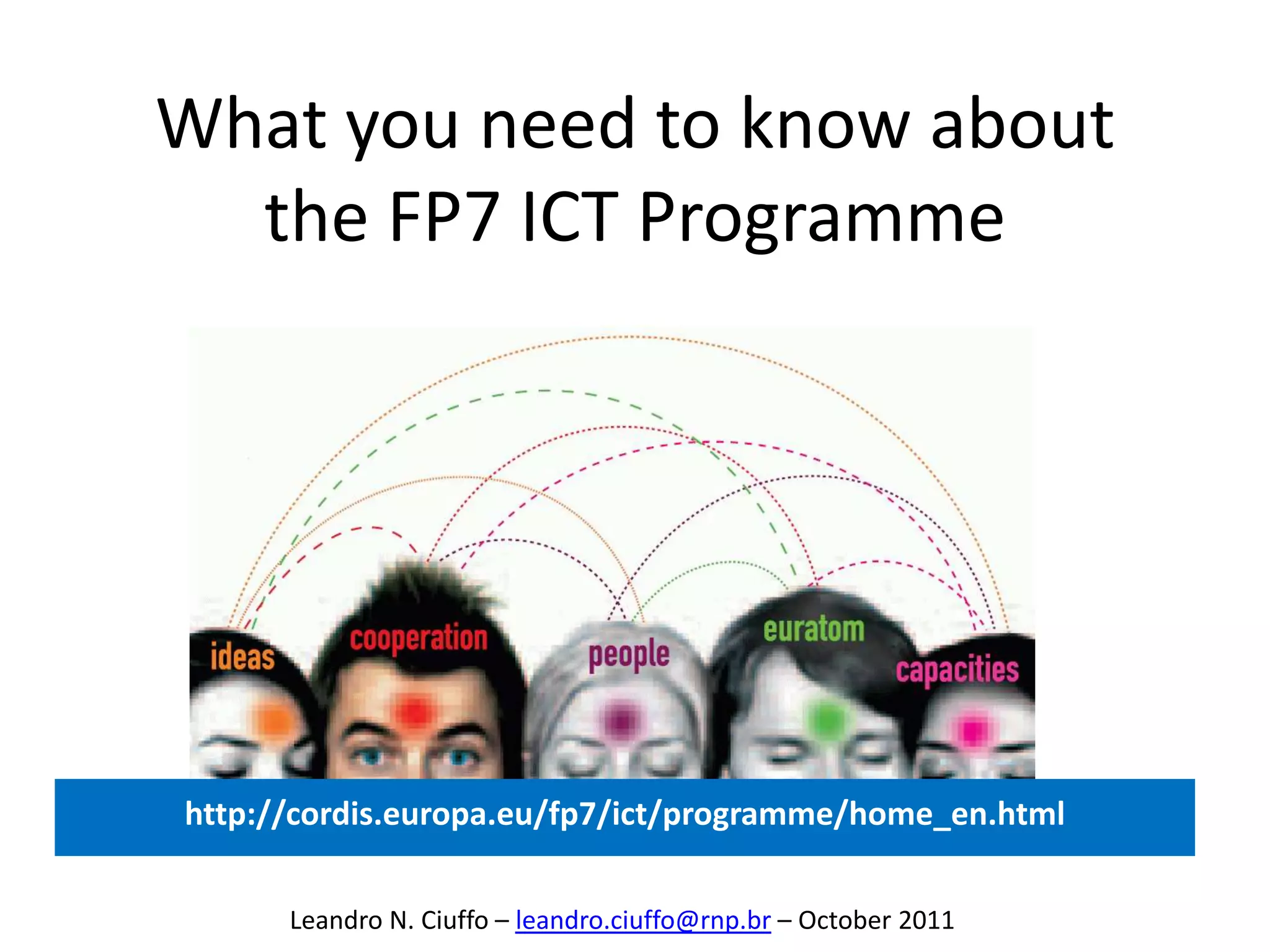
What you need to know about
  the FP7 ICT Programme


http://cordis.europa.eu/fp7/ict/programme/home_en.html

      Leandro N. Ciuffo – leandro.ciuffo@rnp.br – October 2011
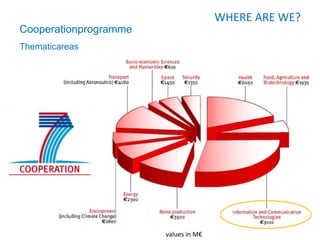
WHERE ARE WE?
Cooperationprogramme
Thematicareas


                       values in M€
WHO CAN APPLY?

• Eligible countries
    – All EU member states
    – Associated countries (ftp://ftp.cordis.europa.eu/pub/fp7/docs/third-country-agreements_en.doc)
    – Third countries (which includes Latin American countries)
        ftp://ftp.cordis.europa.eu/pub/fp7/docs/wp/cooperation/cooperation-general-annexes201101_en.pdf

    – Note: International Cooperation Partner Countriesenjoy similar rights and are subject to
      the same obligations as the EU partners of the consortium.


• General conditions
    – Research institutions, Universities, SMEs, companies and
      organizations, legally established in any country, may participate in a
      collaborative project.
    – Rules for participation:
        ftp://ftp.cordis.europa.eu/pub/fp7/docs/calls/ecrules_en.pdf
    – Note: Not all participants elegibles for FP7 are elegibles for FP7-Cooperation ICT (e.g.
      Individual participants). Project partners in the ICT programme can only be legal entities.
FINDING A CALL

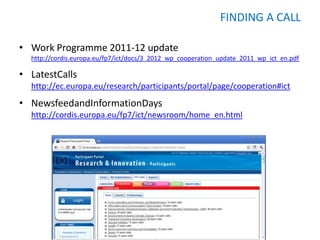
• Work Programme 2011-12 update
  http://cordis.europa.eu/fp7/ict/docs/3_2012_wp_cooperation_update_2011_wp_ict_en.pdf

• LatestCalls
  http://ec.europa.eu/research/participants/portal/page/cooperation#ict
• NewsfeedandInformationDays
  http://cordis.europa.eu/fp7/ict/newsroom/home_en.html
•
•
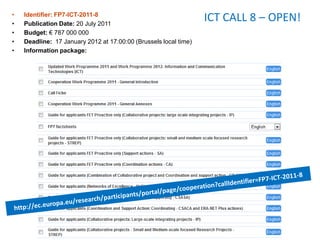
    Identifier: FP7-ICT-2011-8
    Publication Date: 20 July 2011
                                                                  ICT CALL 8 – OPEN!
•   Budget: € 787 000 000
•   Deadline: 17 January 2012 at 17:00:00 (Brussels local time)
•   Information package:
FUNDING SCHEMES (1/2)

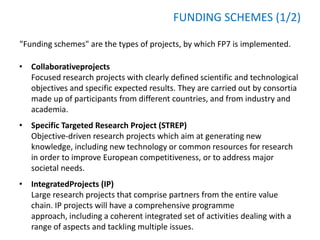
"Funding schemes" are the types of projects, by which FP7 is implemented.

• Collaborativeprojects
  Focused research projects with clearly defined scientific and technological
  objectives and specific expected results. They are carried out by consortia
  made up of participants from different countries, and from industry and
  academia.
• Specific Targeted Research Project (STREP)
  Objective-driven research projects which aim at generating new
  knowledge, including new technology or common resources for research
  in order to improve European competitiveness, or to address major
  societal needs.
• IntegratedProjects (IP)
  Large research projects that comprise partners from the entire value
  chain. IP projects will have a comprehensive programme
  approach, including a coherent integrated set of activities dealing with a
  range of aspects and tackling multiple issues.
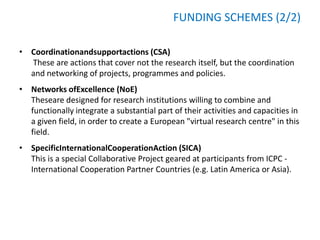
FUNDING SCHEMES (2/2)

• Coordinationandsupportactions (CSA)
  These are actions that cover not the research itself, but the coordination
  and networking of projects, programmes and policies.
• Networks ofExcellence (NoE)
  Theseare designed for research institutions willing to combine and
  functionally integrate a substantial part of their activities and capacities in
  a given field, in order to create a European "virtual research centre" in this
  field.
• SpecificInternationalCooperationAction (SICA)
  This is a special Collaborative Project geared at participants from ICPC -
  International Cooperation Partner Countries (e.g. Latin America or Asia).
FINDING PARTNERS

• Ideal-ist
  http://www.ideal-ist.net
• CORDIS
  http://cordis.europa.eu/partners-service/home_en.html
• e-Match
  http://www.ematch.eu
• Network of National Contact Points (NCPs)
  http://cordis.europa.eu/fp7/ncp_en.html
• RedCLARA’s “Busco Socios”
  http://www.redclara.net/index.php?option=com_content&view=article&id=623&Itemid=480&lang=es
HOW TO WRITE A PARTNER PROFILE
Presentingyourorganisation

• 1. What is my institution’s work experience so far?
  This description must include for example products developed, services
  rendered and ideally, include a client’s list and a list of successful project in
  which the organisation participated. These projects can be commercial
  (e.g. development projects) or research projects etc.
• 2. What is the experience of the main personnel?
  List 1-3 key persons in your organisation that will be involved or will
  support the project proposals.
• 3. Where is my company today?
  This explains in which market (geographical and domain) the
  organisation is currently acting and what are its competitors.
  Describe what is its asset in comparison to competitors.
SUBMITTING A PROPOSAL

• Proposals may be submitted at any time after a Call opens, until the
  deadline.
• A Guide for Applicants is distributed in the Information Package of each
  Call.
• A Web-based electronic online tool called EPSS ('Electronic Proposal
  Submission Service') is the obligatory channel for submission of proposals.
   https://www.epss-fp7.org/epss/
• All organisations participating in a proposal must have a Participant
  Identification Code (PIC) http://cordis.europa.eu/fp7/pp-pic_en.html
• After the deadline for the Call, all the proposals submitted are evaluated by a
  panel of independent evaluators. The panel will check the proposals against
  a published set of criteria to see if the quality of research proposed is worthy
  of funding. The key criteria used for this evaluation are explained in the
  Guide for Applicants.
FURTHER INFORMATION


• Understand FP7
  http://cordis.europa.eu/fp7/understand_en.html


• Pro-IDEALcoachingcourse
  http://www.pro-ideal.eu/training


• B.Bice - Brazilian Bureau for Enhancing the International
  Cooperation with the European Union
  http://bbice.ibict.br/index/conteudo/cod/261/lan/br/Curso+sobre+o+FP7


                             “FP8″ willbecalled...
     Horizon 2020 – the Framework Programme for Research and Innovation
CONTACT


                                                            Leandro N. Ciuffo
                                                          leandro.ciuffo@rnp.br


This presentation was created as a result of the Pro-Ideal “Projec Angels” training.
                    http://www.pro-ideal.eu/project_angels

FP7-ICT Programme

  • 1.
    What you needto know about the FP7 ICT Programme http://cordis.europa.eu/fp7/ict/programme/home_en.html Leandro N. Ciuffo – leandro.ciuffo@rnp.br – October 2011
  • 2.
  • 3.
    WHO CAN APPLY? •Eligible countries – All EU member states – Associated countries (ftp://ftp.cordis.europa.eu/pub/fp7/docs/third-country-agreements_en.doc) – Third countries (which includes Latin American countries) ftp://ftp.cordis.europa.eu/pub/fp7/docs/wp/cooperation/cooperation-general-annexes201101_en.pdf – Note: International Cooperation Partner Countriesenjoy similar rights and are subject to the same obligations as the EU partners of the consortium. • General conditions – Research institutions, Universities, SMEs, companies and organizations, legally established in any country, may participate in a collaborative project. – Rules for participation: ftp://ftp.cordis.europa.eu/pub/fp7/docs/calls/ecrules_en.pdf – Note: Not all participants elegibles for FP7 are elegibles for FP7-Cooperation ICT (e.g. Individual participants). Project partners in the ICT programme can only be legal entities.
  • 4.
    FINDING A CALL •Work Programme 2011-12 update http://cordis.europa.eu/fp7/ict/docs/3_2012_wp_cooperation_update_2011_wp_ict_en.pdf • LatestCalls http://ec.europa.eu/research/participants/portal/page/cooperation#ict • NewsfeedandInformationDays http://cordis.europa.eu/fp7/ict/newsroom/home_en.html
  • 5.
    • • Identifier: FP7-ICT-2011-8 Publication Date: 20 July 2011 ICT CALL 8 – OPEN! • Budget: € 787 000 000 • Deadline: 17 January 2012 at 17:00:00 (Brussels local time) • Information package:
  • 6.
    FUNDING SCHEMES (1/2) "Fundingschemes" are the types of projects, by which FP7 is implemented. • Collaborativeprojects Focused research projects with clearly defined scientific and technological objectives and specific expected results. They are carried out by consortia made up of participants from different countries, and from industry and academia. • Specific Targeted Research Project (STREP) Objective-driven research projects which aim at generating new knowledge, including new technology or common resources for research in order to improve European competitiveness, or to address major societal needs. • IntegratedProjects (IP) Large research projects that comprise partners from the entire value chain. IP projects will have a comprehensive programme approach, including a coherent integrated set of activities dealing with a range of aspects and tackling multiple issues.
  • 7.
    FUNDING SCHEMES (2/2) •Coordinationandsupportactions (CSA) These are actions that cover not the research itself, but the coordination and networking of projects, programmes and policies. • Networks ofExcellence (NoE) Theseare designed for research institutions willing to combine and functionally integrate a substantial part of their activities and capacities in a given field, in order to create a European "virtual research centre" in this field. • SpecificInternationalCooperationAction (SICA) This is a special Collaborative Project geared at participants from ICPC - International Cooperation Partner Countries (e.g. Latin America or Asia).
  • 8.
    FINDING PARTNERS • Ideal-ist http://www.ideal-ist.net • CORDIS http://cordis.europa.eu/partners-service/home_en.html • e-Match http://www.ematch.eu • Network of National Contact Points (NCPs) http://cordis.europa.eu/fp7/ncp_en.html • RedCLARA’s “Busco Socios” http://www.redclara.net/index.php?option=com_content&view=article&id=623&Itemid=480&lang=es
  • 9.
    HOW TO WRITEA PARTNER PROFILE Presentingyourorganisation • 1. What is my institution’s work experience so far? This description must include for example products developed, services rendered and ideally, include a client’s list and a list of successful project in which the organisation participated. These projects can be commercial (e.g. development projects) or research projects etc. • 2. What is the experience of the main personnel? List 1-3 key persons in your organisation that will be involved or will support the project proposals. • 3. Where is my company today? This explains in which market (geographical and domain) the organisation is currently acting and what are its competitors. Describe what is its asset in comparison to competitors.
  • 10.
    SUBMITTING A PROPOSAL •Proposals may be submitted at any time after a Call opens, until the deadline. • A Guide for Applicants is distributed in the Information Package of each Call. • A Web-based electronic online tool called EPSS ('Electronic Proposal Submission Service') is the obligatory channel for submission of proposals. https://www.epss-fp7.org/epss/ • All organisations participating in a proposal must have a Participant Identification Code (PIC) http://cordis.europa.eu/fp7/pp-pic_en.html • After the deadline for the Call, all the proposals submitted are evaluated by a panel of independent evaluators. The panel will check the proposals against a published set of criteria to see if the quality of research proposed is worthy of funding. The key criteria used for this evaluation are explained in the Guide for Applicants.
  • 11.
    FURTHER INFORMATION • UnderstandFP7 http://cordis.europa.eu/fp7/understand_en.html • Pro-IDEALcoachingcourse http://www.pro-ideal.eu/training • B.Bice - Brazilian Bureau for Enhancing the International Cooperation with the European Union http://bbice.ibict.br/index/conteudo/cod/261/lan/br/Curso+sobre+o+FP7 “FP8″ willbecalled... Horizon 2020 – the Framework Programme for Research and Innovation
  • 12.
    CONTACT Leandro N. Ciuffo leandro.ciuffo@rnp.br This presentation was created as a result of the Pro-Ideal “Projec Angels” training. http://www.pro-ideal.eu/project_angels