GLOBALISATION OF
TECHNOLOGY
Sunitha . B.K
Jain University
Sunitha.B.K
Definition
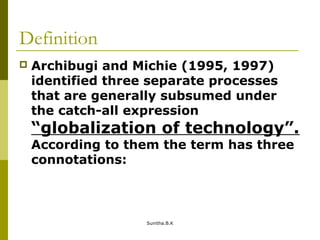
 Archibugi and Michie (1995, 1997)
identified three separate processes
that are generally subsumed under
the catch-all expression
“globalization of technology”.
According to them the term has three
connotations:
Sunitha.B.K
Definition
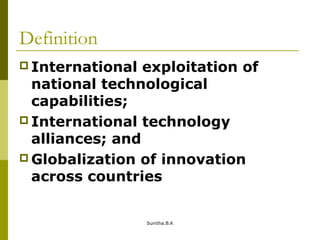
 International exploitation of
national technological
capabilities;
 International technology
alliances; and
 Globalization of innovation
across countries
Sunitha.B.K
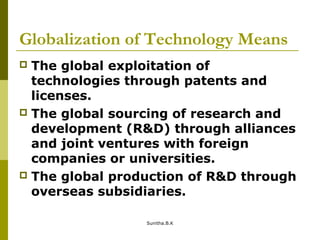
Globalization of Technology Means
 The global exploitation of
technologies through patents and
licenses.
 The global sourcing of research and
development (R&D) through alliances
and joint ventures with foreign
companies or universities.
 The global production of R&D through
overseas subsidiaries.
Sunitha.B.K
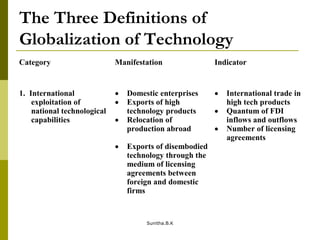
The Three Definitions of
Globalization of Technology
Category Manifestation Indicator
1. International
exploitation of
national technological
capabilities
• Domestic enterprises
• Exports of high
technology products
• Relocation of
production abroad
• Exports of disembodied
technology through the
medium of licensing
agreements between
foreign and domestic
firms
• International trade in
high tech products
• Quantum of FDI
inflows and outflows
• Number of licensing
agreements
Sunitha.B.K
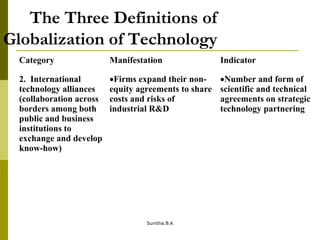
The Three Definitions of
Globalization of Technology
Category Manifestation Indicator
2. International
technology alliances
(collaboration across
borders among both
public and business
institutions to
exchange and develop
know-how)
•Firms expand their non-
equity agreements to share
costs and risks of
industrial R&D
•Number and form of
scientific and technical
agreements on strategic
technology partnering
Sunitha.B.K
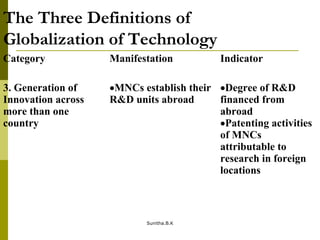
The Three Definitions of
Globalization of Technology
Category Manifestation Indicator
3. Generation of
Innovation across
more than one
country
•MNCs establish their
R&D units abroad
•Degree of R&D
financed from
abroad
•Patenting activities
of MNCs
attributable to
research in foreign
locations
Sunitha.B.K
International Technology Alliances
 Industrial firms increasingly have sought
global research partnerships as a means of
strengthening their core competencies and
expanding into technology fields considered
critical for maintaining market share.
 Technological complementarily and
reduction of the innovation period are
primary catalysts for entering into a core
technology alliance; market entry and
production-related factors are more relevant
in technologically less advanced or mature
markets.
Sunitha.B.K
International Technology Alliances
 Though difficult to define in very precise terms, there
is widespread consensus that:
 strategic alliances are not primarily direct
investments but not arm’s-length relationships either
and;
 the notion of alliances assumes the existence of
distinctive or relatively independent agents. Their
growth of alliances was very fast during the 1980s
but involved predominantly companies from the US,
Western Europe and Japan.
 These new forms of agreements are not replacing but
actually complementing and expanding traditional
foreign direct investment (FDI).
Sunitha.B.K
Globalization of Innovation is on the
Increase:
 Share of foreign affiliates in domestic
manufacturing R&D
 Share of domestic industrial R&D
financed from foreign sources
 Cross-border ownership of
innovations
Sunitha.B.K
Cross-border Ownership of Innovations
 Cross-border ownership of patents reflects
the inventive activity of foreign affiliates of
MNCs. On average, 8% of inventions made
were owned by a foreign resident in the
mid-1990s, against 6% in the mid- 1980s.
For almost all countries, both ownership of
invention abroad and foreign control of
domestic inventions have increased.
 Ownership of inventions made abroad is
high in small open countries such as the
Netherlands and Switzerland. These two
countries and the United States are the
largest owners of patents covering foreign
inventions
Sunitha.B.K
MARKETS FOR TECHNOLOGY
 Implicit in the "globalization”
argument is another one, namely that
markets for technologies exist and
that with globalization the barriers to
entry into this market are being
lowered, leading to increased
competition among the so- called
technology suppliers.
Sunitha.B.K
MARKETS FOR TECHNOLOGY
 This state of affairs of increased
competition is said to be beneficial to
developing countries as they are
supposed to be able not only to
benefit from increased access to, say,
state-of-the-art technology but also
to obtain it in terms of better terms
and conditions
Sunitha.B.K
Technology Transactions
 "technology transactions can take
different forms, from pure licensing of
well defined intellectual property, to
complicated collaborative agreements
which may well include the further
development of the technology, or its
realization from scratch". Though
transactions in technology can also
occur through mergers and
acquisitions and through the mobility
of people.
Sunitha.B.K
Technology Transactions
 It is seen that non-market forms of
technology transfer are on the
increase. This means that increasingly
technologies are being transferred
through the intra-firm route.
 To illustrate, parent companies are
selling technologies more to their
affiliates and conversely less to
unaffiliated firms. Recent data clearly
substantiates this point
Sunitha.B.K
Technology Transactions
 . Both Korea and India have traditionally
used the medium of purchasing technology
through the market by means of licensing
agreements. Of late the number of cases of
licensing agreements that are approved has
come down in both of these countries while
the relative share of technical collaboration
agreements involving equity participation by
the collaborator (no-market forms) is clearly
on the increase in both countries.
Sunitha.B.K
Technology Transactions
 United States is the world's largest
net seller of technologies to the rest
of the world (as indicated by its
consistent positive technology
Sunitha.B.K

Globalisation of technology

  • 1.
    GLOBALISATION OF TECHNOLOGY Sunitha .B.K Jain University Sunitha.B.K
  • 2.
    Definition  Archibugi andMichie (1995, 1997) identified three separate processes that are generally subsumed under the catch-all expression “globalization of technology”. According to them the term has three connotations: Sunitha.B.K
  • 3.
    Definition  International exploitationof national technological capabilities;  International technology alliances; and  Globalization of innovation across countries Sunitha.B.K
  • 4.
    Globalization of TechnologyMeans  The global exploitation of technologies through patents and licenses.  The global sourcing of research and development (R&D) through alliances and joint ventures with foreign companies or universities.  The global production of R&D through overseas subsidiaries. Sunitha.B.K
  • 5.
    The Three Definitionsof Globalization of Technology Category Manifestation Indicator 1. International exploitation of national technological capabilities • Domestic enterprises • Exports of high technology products • Relocation of production abroad • Exports of disembodied technology through the medium of licensing agreements between foreign and domestic firms • International trade in high tech products • Quantum of FDI inflows and outflows • Number of licensing agreements Sunitha.B.K
  • 6.
    The Three Definitionsof Globalization of Technology Category Manifestation Indicator 2. International technology alliances (collaboration across borders among both public and business institutions to exchange and develop know-how) •Firms expand their non- equity agreements to share costs and risks of industrial R&D •Number and form of scientific and technical agreements on strategic technology partnering Sunitha.B.K
  • 7.
    The Three Definitionsof Globalization of Technology Category Manifestation Indicator 3. Generation of Innovation across more than one country •MNCs establish their R&D units abroad •Degree of R&D financed from abroad •Patenting activities of MNCs attributable to research in foreign locations Sunitha.B.K
  • 8.
    International Technology Alliances Industrial firms increasingly have sought global research partnerships as a means of strengthening their core competencies and expanding into technology fields considered critical for maintaining market share.  Technological complementarily and reduction of the innovation period are primary catalysts for entering into a core technology alliance; market entry and production-related factors are more relevant in technologically less advanced or mature markets. Sunitha.B.K
  • 9.
    International Technology Alliances Though difficult to define in very precise terms, there is widespread consensus that:  strategic alliances are not primarily direct investments but not arm’s-length relationships either and;  the notion of alliances assumes the existence of distinctive or relatively independent agents. Their growth of alliances was very fast during the 1980s but involved predominantly companies from the US, Western Europe and Japan.  These new forms of agreements are not replacing but actually complementing and expanding traditional foreign direct investment (FDI). Sunitha.B.K
  • 10.
    Globalization of Innovationis on the Increase:  Share of foreign affiliates in domestic manufacturing R&D  Share of domestic industrial R&D financed from foreign sources  Cross-border ownership of innovations Sunitha.B.K
  • 11.
    Cross-border Ownership ofInnovations  Cross-border ownership of patents reflects the inventive activity of foreign affiliates of MNCs. On average, 8% of inventions made were owned by a foreign resident in the mid-1990s, against 6% in the mid- 1980s. For almost all countries, both ownership of invention abroad and foreign control of domestic inventions have increased.  Ownership of inventions made abroad is high in small open countries such as the Netherlands and Switzerland. These two countries and the United States are the largest owners of patents covering foreign inventions Sunitha.B.K
  • 12.
    MARKETS FOR TECHNOLOGY Implicit in the "globalization” argument is another one, namely that markets for technologies exist and that with globalization the barriers to entry into this market are being lowered, leading to increased competition among the so- called technology suppliers. Sunitha.B.K
  • 13.
    MARKETS FOR TECHNOLOGY This state of affairs of increased competition is said to be beneficial to developing countries as they are supposed to be able not only to benefit from increased access to, say, state-of-the-art technology but also to obtain it in terms of better terms and conditions Sunitha.B.K
  • 14.
    Technology Transactions  "technologytransactions can take different forms, from pure licensing of well defined intellectual property, to complicated collaborative agreements which may well include the further development of the technology, or its realization from scratch". Though transactions in technology can also occur through mergers and acquisitions and through the mobility of people. Sunitha.B.K
  • 15.
    Technology Transactions  Itis seen that non-market forms of technology transfer are on the increase. This means that increasingly technologies are being transferred through the intra-firm route.  To illustrate, parent companies are selling technologies more to their affiliates and conversely less to unaffiliated firms. Recent data clearly substantiates this point Sunitha.B.K
  • 16.
    Technology Transactions  .Both Korea and India have traditionally used the medium of purchasing technology through the market by means of licensing agreements. Of late the number of cases of licensing agreements that are approved has come down in both of these countries while the relative share of technical collaboration agreements involving equity participation by the collaborator (no-market forms) is clearly on the increase in both countries. Sunitha.B.K
  • 17.
    Technology Transactions  UnitedStates is the world's largest net seller of technologies to the rest of the world (as indicated by its consistent positive technology Sunitha.B.K