International Journal of Mechanical Engineering and Technology (IJMET), ISSN 0976 – 6340(Print),
ISSN 0976 – 6359(Online), Volume 5, Issue 6, June (2014), pp. 14-27 © IAEME
14
ANALYSIS AND MODELING OF SINGLE POINT CUTTING
(HSS MATERIAL) TOOL WITH HELP OF ANSYS FOR OPTIMIZATION OF
(TRANSIENT) VIBRATION PARAMETERS
Prabhat Kumar Sinha, Rajneesh Pandey*, Vijay Kumar yadav
Department of Mechanical Engineering, Shepherd School of Engineering & Technology, Allahabad
ABSTRACT
The purpose of this article is to study the change of vibration on lathe machine by the change
of tool material. Industrial vibration on analysis is a measurement tool used to identify, predict and
prevent failure in any rotating machinery. By the vibration analysis on any mechanical component
will improve the reliability of machine and lead to better machine efficiency and reduce down time
for eliminating electrical and mechanical failure. Machining and measuring operations are invariably
accompanied by relative vibration between work piece and tool. The main cause of vibration is as
follows: Unbalance forces in the machine: these forces are produced from within itself. Dry friction
between the two mating surfaces: this produces what are known as self excited vibration. The effect
of vibration is excessive stresses, undesirable noise, looseness of part and partial or complete failure
of parts. in spite of these harmful effects the vibration phenomena does have some uses also , e.g in
musical instrument ,vibrating screens , shakers stress reliving.
Keywords: Lathe Machine, hss Tool, Mild Steel Work Material, Ansys, Vibration Parameter
(Temperature, Pressure).
INTRODUCTION
Machining and vibration measuring are invariably accompanied by relative vibration between
work piece and tool. These vibrations are due to one or more of the following causes:
(1) In homogeneities in the work piece material;
(2) Variation of chip cross section;
(3) Disturbances in the work piece or tool drives;
(4) Dynamic loads generated by acceleration/deceleration of massive moving components;
INTERNATIONAL JOURNAL OF MECHANICAL ENGINEERING
AND TECHNOLOGY (IJMET)
ISSN 0976 – 6340 (Print)
ISSN 0976 – 6359 (Online)
Volume 5, Issue 6, June (2014), pp. 14-27
© IAEME: www.iaeme.com/ijmet.asp
Journal Impact Factor (2014): 7.5377 (Calculated by GISI)
www.jifactor.com
IJMET
© I A E M E
International Journal of Mechanical Engineering and Technology (IJMET), ISSN 0976 – 6340(Print),
ISSN 0976 – 6359(Online), Volume 5, Issue 6, June (2014), pp. 14-27 © IAEME
15
(5) Vibration transmitted from the environment;
(6) Self-excited vibration generated by the cutting process or by friction (machine-tool chatter).
The tolerable level of relative vibration between tool and work piece, i.e., the maximum
amplitude and to some extent the frequency is determined by the required surface finish and
machining accuracy as well as by detrimental effects of the vibration on tool life and by the noise
which is frequently generated.
ANALYSIS OF MACHINE TOOL VIBRATION BY ANASYS METHOD
Trainsents Vibrations can be analyzed by developing software’s. In this paper we design tool
of hss material has comparatively better resistance to heat and wear, and work piece used of mild
steel all the data are taken from standard researches paper the and input values are used analysis
vibration through ansys method . we know that vibration is directly factor of temperature so in this
analysis we find transient analysis, geometric analysis ,mesh analysis on different vibration
producing parameters like pressure and temperature and by taking analysis on different pressures all
are shown given below.
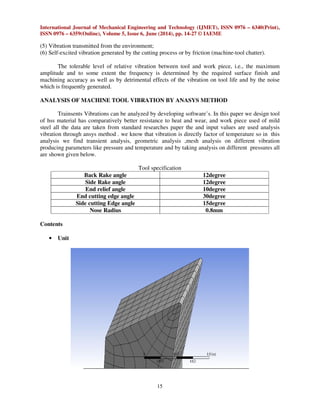
Tool specification
Back Rake angle 12degree
Side Rake angle 12degree
End relief angle 10degree
End cutting edge angle 30degree
Side cutting Edge angle 15degree
Nose Radius 0.8mm
Contents
• Unit
International Journal of Mechanical Engineering and Technology (IJMET), ISSN 0976 – 6340(Print),
ISSN 0976 – 6359(Online), Volume 5, Issue 6, June (2014), pp. 14-27 © IAEME
16
• Model (A4)
o Geometry
Part 1
o Coordinate Systems
o Mesh
o Transient Analysis (A5)
Analysis Settings
Loads
Solution (A6)
Solution Information
Results
Stress Tool
Safety Factor
Stress Tool 2
Safety Factor
Minimum Principal Elastic Strain
• Material Data
o High speed Steell
Units
TABLE 1
Unit System Metric (m, kg, N, s, V, A) Degrees rad/s Celsius
Angle Degrees
Rotational Velocity rad/s
Temperature Celsius
Model (A4)
Geometry
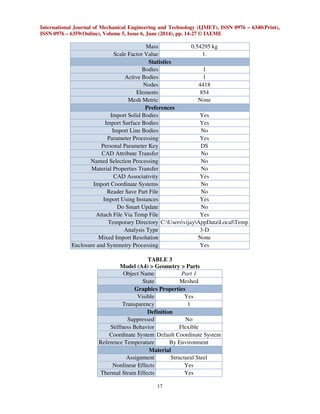
TABLE 2
Model (A4) > Geometry
Object Name Geometry
State Fully Defined
Definition
Source C:UsersvijayDesktoptool.igs
Type Iges
Length Unit Meters
Element Control Program Controlled
Display Style Part Color
Bounding Box
Length X 3.0001e-002 m
Length Y 8.6052e-002 m
Length Z 3.7476e-002 m
Properties
Volume 6.9165e-005 m³
International Journal of Mechanical Engineering and Technology (IJMET), ISSN 0976 – 6340(Print),
ISSN 0976 – 6359(Online), Volume 5, Issue 6, June (2014), pp. 14-27 © IAEME
17
Mass 0.54295 kg
Scale Factor Value 1.
Statistics
Bodies 1
Active Bodies 1
Nodes 4418
Elements 854
Mesh Metric None
Preferences
Import Solid Bodies Yes
Import Surface Bodies Yes
Import Line Bodies No
Parameter Processing Yes
Personal Parameter Key DS
CAD Attribute Transfer No
Named Selection Processing No
Material Properties Transfer No
CAD Associativity Yes
Import Coordinate Systems No
Reader Save Part File No
Import Using Instances Yes
Do Smart Update No
Attach File Via Temp File Yes
Temporary Directory C:UsersvijayAppDataLocalTemp
Analysis Type 3-D
Mixed Import Resolution None
Enclosure and Symmetry Processing Yes
TABLE 3
Model (A4) > Geometry > Parts
Object Name Part 1
State Meshed
Graphics Properties
Visible Yes
Transparency 1
Definition
Suppressed No
Stiffness Behavior Flexible
Coordinate System Default Coordinate System
Reference Temperature By Environment
Material
Assignment Structural Steel
Nonlinear Effects Yes
Thermal Strain Effects Yes
International Journal of Mechanical Engineering and Technology (IJMET), ISSN 0976 – 6340(Print),
ISSN 0976 – 6359(Online), Volume 5, Issue 6, June (2014), pp. 14-27 © IAEME
18
Bounding Box
Length X 3.0001e-002 m
Length Y 8.6052e-002 m
Length Z 3.7476e-002 m
Properties
Volume 6.9165e-005 m³
Mass 0.54295 kg
Centroid X 1.4936e-002 m
Centroid Y 2.6577e-002 m
Centroid Z 1.6318e-002 m
Moment of Inertia Ip1 3.1446e-004 kg·m²
Moment of Inertia Ip2 8.3141e-005 kg·m²
Moment of Inertia Ip3 3.1255e-004 kg·m²
Statistics
Nodes 4418
Elements 854
Mesh Metric None
Coordinate Systems
TABLE 4
Model (A4) > Coordinate Systems > Coordinate System
Object Name Global Coordinate System
State Fully Defined
Definition
Type Cartesian
Ansys System Number 0.
Origin
Origin X 0. m
Origin Y 0. m
Origin Z 0. m
Directional Vectors
X Axis Data [ 1. 0. 0. ]
Y Axis Data [ 0. 1. 0. ]
Z Axis Data [ 0. 0. 1. ]
Mesh
TABLE 5
Model (A4) > Mesh
Object Name Mesh
State Solved
Defaults
Physics Preference Mechanical
Relevance 0
Sizing
International Journal of Mechanical Engineering and Technology (IJMET), ISSN 0976 – 6340(Print),
ISSN 0976 – 6359(Online), Volume 5, Issue 6, June (2014), pp. 14-27 © IAEME
19
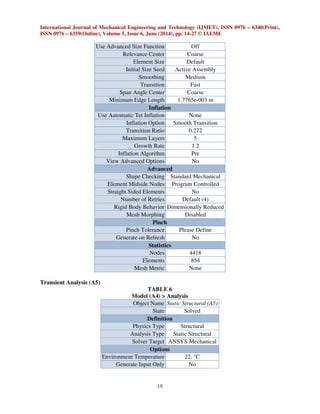
Use Advanced Size Function Off
Relevance Center Coarse
Element Size Default
Initial Size Seed Active Assembly
Smoothing Medium
Transition Fast
Span Angle Center Coarse
Minimum Edge Length 1.7765e-003 m
Inflation
Use Automatic Tet Inflation None
Inflation Option Smooth Transition
Transition Ratio 0.272
Maximum Layers 5
Growth Rate 1.2
Inflation Algorithm Pre
View Advanced Options No
Advanced
Shape Checking Standard Mechanical
Element Midside Nodes Program Controlled
Straight Sided Elements No
Number of Retries Default (4)
Rigid Body Behavior Dimensionally Reduced
Mesh Morphing Disabled
Pinch
Pinch Tolerance Please Define
Generate on Refresh No
Statistics
Nodes 4418
Elements 854
Mesh Metric None
Transient Analysis (A5)
TABLE 6
Model (A4) > Analysis
Object Name Static Structural (A5)
State Solved
Definition
Physics Type Structural
Analysis Type Static Structural
Solver Target ANSYS Mechanical
Options
Environment Temperature 22. °C
Generate Input Only No
International Journal of Mechanical Engineering and Technology (IJMET), ISSN 0976 – 6340(Print),
ISSN 0976 – 6359(Online), Volume 5, Issue 6, June (2014), pp. 14-27 © IAEME
20
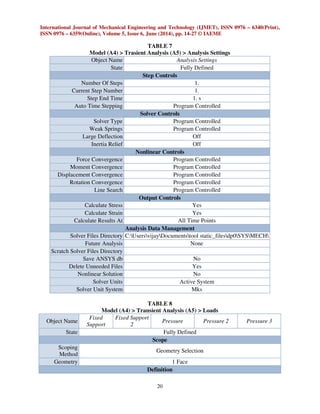
TABLE 7
Model (A4) > Trasient Analysis (A5) > Analysis Settings
Object Name Analysis Settings
State Fully Defined
Step Controls
Number Of Steps 1.
Current Step Number 1.
Step End Time 1. s
Auto Time Stepping Program Controlled
Solver Controls
Solver Type Program Controlled
Weak Springs Program Controlled
Large Deflection Off
Inertia Relief Off
Nonlinear Controls
Force Convergence Program Controlled
Moment Convergence Program Controlled
Displacement Convergence Program Controlled
Rotation Convergence Program Controlled
Line Search Program Controlled
Output Controls
Calculate Stress Yes
Calculate Strain Yes
Calculate Results At All Time Points
Analysis Data Management
Solver Files Directory C:UsersvijayDocumentstool static_filesdp0SYSMECH
Future Analysis None
Scratch Solver Files Directory
Save ANSYS db No
Delete Unneeded Files Yes
Nonlinear Solution No
Solver Units Active System
Solver Unit System Mks
TABLE 8
Model (A4) > Transient Analysis (A5) > Loads
Object Name
Fixed
Support
Fixed Support
2
Pressure Pressure 2 Pressure 3
State Fully Defined
Scope
Scoping
Method
Geometry Selection
Geometry 1 Face
Definition
International Journal of Mechanical Engineering and Technology (IJMET), ISSN 0976 – 6340(Print),
ISSN 0976 – 6359(Online), Volume 5, Issue 6, June (2014), pp. 14-27 © IAEME
21
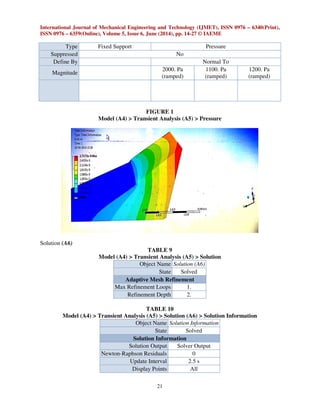
Type Fixed Support Pressure
Suppressed No
Define By Normal To
Magnitude
2000. Pa
(ramped)
1100. Pa
(ramped)
1200. Pa
(ramped)
FIGURE 1
Model (A4) > Transient Analysis (A5) > Pressure
Solution (A6)
TABLE 9
Model (A4) > Transient Analysis (A5) > Solution
Object Name Solution (A6)
State Solved
Adaptive Mesh Refinement
Max Refinement Loops 1.
Refinement Depth 2.
TABLE 10
Model (A4) > Transient Analysis (A5) > Solution (A6) > Solution Information
Object Name Solution Information
State Solved
Solution Information
Solution Output Solver Output
Newton-Raphson Residuals 0
Update Interval 2.5 s
Display Points All
International Journal of Mechanical Engineering and Technology (IJMET), ISSN 0976 – 6340(Print),
ISSN 0976 – 6359(Online), Volume 5, Issue 6, June (2014), pp. 14-27 © IAEME
22
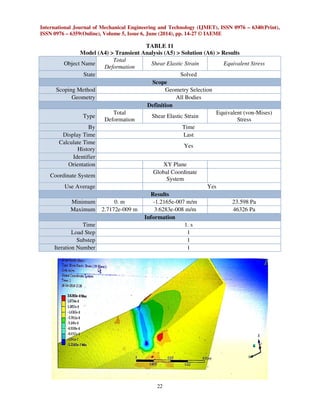
TABLE 11
Model (A4) > Transient Analysis (A5) > Solution (A6) > Results
Object Name
Total
Deformation
Shear Elastic Strain Equivalent Stress
State Solved
Scope
Scoping Method Geometry Selection
Geometry All Bodies
Definition
Type
Total
Deformation
Shear Elastic Strain
Equivalent (von-Mises)
Stress
By Time
Display Time Last
Calculate Time
History
Yes
Identifier
Orientation XY Plane
Coordinate System
Global Coordinate
System
Use Average Yes
Results
Minimum 0. m -1.2165e-007 m/m 23.598 Pa
Maximum 2.7172e-009 m 3.6283e-008 m/m 46326 Pa
Information
Time 1. s
Load Step 1
Substep 1
Iteration Number 1
International Journal of Mechanical Engineering and Technology (IJMET), ISSN 0976 – 6340(Print),
ISSN 0976 – 6359(Online), Volume 5, Issue 6, June (2014), pp. 14-27 © IAEME
23
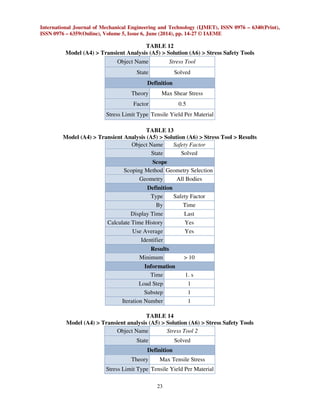
TABLE 12
Model (A4) > Transient Analysis (A5) > Solution (A6) > Stress Safety Tools
Object Name Stress Tool
State Solved
Definition
Theory Max Shear Stress
Factor 0.5
Stress Limit Type Tensile Yield Per Material
TABLE 13
Model (A4) > Transient Analysis (A5) > Solution (A6) > Stress Tool > Results
Object Name Safety Factor
State Solved
Scope
Scoping Method Geometry Selection
Geometry All Bodies
Definition
Type Safety Factor
By Time
Display Time Last
Calculate Time History Yes
Use Average Yes
Identifier
Results
Minimum > 10
Information
Time 1. s
Load Step 1
Substep 1
Iteration Number 1
TABLE 14
Model (A4) > Transient analysis (A5) > Solution (A6) > Stress Safety Tools
Object Name Stress Tool 2
State Solved
Definition
Theory Max Tensile Stress
Stress Limit Type Tensile Yield Per Material
International Journal of Mechanical Engineering and Technology (IJMET), ISSN 0976 – 6340(Print),
ISSN 0976 – 6359(Online), Volume 5, Issue 6, June (2014), pp. 14-27 © IAEME
24
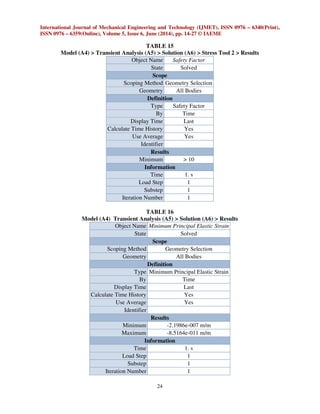
TABLE 15
Model (A4) > Transient Analysis (A5) > Solution (A6) > Stress Tool 2 > Results
Object Name Safety Factor
State Solved
Scope
Scoping Method Geometry Selection
Geometry All Bodies
Definition
Type Safety Factor
By Time
Display Time Last
Calculate Time History Yes
Use Average Yes
Identifier
Results
Minimum > 10
Information
Time 1. s
Load Step 1
Substep 1
Iteration Number 1
TABLE 16
Model (A4) Transient Analysis (A5) > Solution (A6) > Results
Object Name Minimum Principal Elastic Strain
State Solved
Scope
Scoping Method Geometry Selection
Geometry All Bodies
Definition
Type Minimum Principal Elastic Strain
By Time
Display Time Last
Calculate Time History Yes
Use Average Yes
Identifier
Results
Minimum -2.1986e-007 m/m
Maximum -8.5164e-011 m/m
Information
Time 1. s
Load Step 1
Substep 1
Iteration Number 1
International Journal of Mechanical Engineering and Technology (IJMET), ISSN 0976 – 6340(Print),
ISSN 0976 – 6359(Online), Volume 5, Issue 6, June (2014), pp. 14-27 © IAEME
25
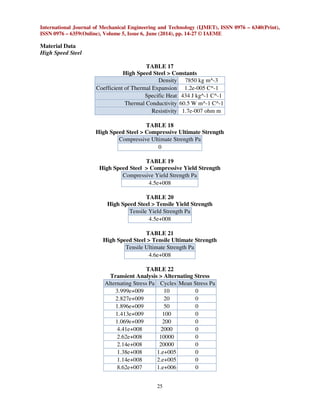
Material Data
High Speed Steel
TABLE 17
High Speed Steel > Constants
Density 7850 kg m^-3
Coefficient of Thermal Expansion 1.2e-005 C^-1
Specific Heat 434 J kg^-1 C^-1
Thermal Conductivity 60.5 W m^-1 C^-1
Resistivity 1.7e-007 ohm m
TABLE 18
High Speed Steel > Compressive Ultimate Strength
Compressive Ultimate Strength Pa
0
TABLE 19
High Speed Steel > Compressive Yield Strength
Compressive Yield Strength Pa
4.5e+008
TABLE 20
High Speed Steel > Tensile Yield Strength
Tensile Yield Strength Pa
4.5e+008
TABLE 21
High Speed Steel > Tensile Ultimate Strength
Tensile Ultimate Strength Pa
4.6e+008
TABLE 22
Transient Analysis > Alternating Stress
Alternating Stress Pa Cycles Mean Stress Pa
3.999e+009 10 0
2.827e+009 20 0
1.896e+009 50 0
1.413e+009 100 0
1.069e+009 200 0
4.41e+008 2000 0
2.62e+008 10000 0
2.14e+008 20000 0
1.38e+008 1.e+005 0
1.14e+008 2.e+005 0
8.62e+007 1.e+006 0
International Journal of Mechanical Engineering and Technology (IJMET), ISSN 0976 – 6340(Print),
ISSN 0976 – 6359(Online), Volume 5, Issue 6, June (2014), pp. 14-27 © IAEME
26
TABLE 23
High Speed Steel > Strain-Life Parameters
Strength
Coefficient Pa
Strength
Exponent
Ductility
Coefficient
Ductility
Exponent
Cyclic Strength
Coefficient Pa
Cyclic Strain
Hardening
Exponent
9.2e+008 -0.106 0.213 -0.47 1.e+009 0.2
TABLE 24
High Speed Steel > Relative Permeability
Relative Permeability
10000
TABLE 25
High Speed Steel > Isotropic Elasticity
Temperature C Young's Modulus Pa Poisson's Ratio
2.e+011 0.3
7. CONCLUSION
Thus we have seen the various aspects of machine tools vibrations and their effects. It has
been seen that the effect of vibrations can be disastrous. It may lead to undesirable results on the
work piece. Hence to minimize the vibrations in the tools a lot of research and study has been done.
This has drastically changed the machine efficiency and also minimized the harmful effects of
vibrations on the workers. With the advent of technology, software’s and highly precision
instruments have been developed to measure and analyze the vibrations caused in tools and to bring
up solutions quickly. It has become easier to evaluate the unwanted motions at different parts of a
machine and to rectify it. Hence it may be concluded that a machine tool should be designed keeping
all kinds of errors in mind.
8. REFERENCES
8.1 BOOKS
[1] Harris' Shock and Vibration Handbook 6th.Ed.(2009)
[2] James L. Taylor, The Vibration Analysis Handbook
[3] E.I. Rivin, Machine Tool Vibration
[4] MECHANICAL VIBRATION BY G.K. GROVER 8TH
EDITION
[5] Mechanical vibration by vp Singh.
8.2 JOURNALS AND TECHNICAL PAPERS
[6] Eiji Nabata, Yuji Terasaka Jig Rigidity Evaluation Technology by Vibration Analysis, VOL.
52, 2006.
[7] S. Braun Adaptronic Vibration Damping for Machine Tools.
[8] S.Y. Lin, Y.C. Fang, C.W. Huang, Improvement strategy for machine tool vibration induced
from the movement of a counterweight during machining process, February 2008.
International Journal of Mechanical Engineering and Technology (IJMET), ISSN 0976 – 6340(Print),
ISSN 0976 – 6359(Online), Volume 5, Issue 6, June (2014), pp. 14-27 © IAEME
27
[9] Kourosh Tatar, Per Gren, Measurement of milling tool vibrations during cutting using laser
vibrometry.
[10] John G .Cherng, Mahmut Eksioglu, Kemal Kızılaslan, Vibration reduction of pneumatic
percussive rivet tools: Mechanical and ergonomic re-design approaches.
[11] Effect of cutting parameters on surface roughness and cutting forces in turning mild steel by
research journal of recents sciences vol.1(10), 19-26, October (2012) for standard design
parameters for tool design.
[12] Optimization of cutting parameters on mild steel with hss & cemented carbide tipped tools
using Ann by Proff A.V.N .L SHARMA(2006).
[13] Shaw metal cutting principle, Oxford University press (2006).
[14] Basic machining refrenance handbook, industrial press (2001).
[15] Analysis of cutting force during milling with regards to dependency on the penetration angle
(2009).
[16] Patel K. Batish and Bhattacharya A optimization of t surface roughness in an end milling
operation using nested experimental design (2009).
[17] Mile j.R-square, Adjusted R-squared, Encyclopedia of stastican Behavioral science, john
Wiley and son’s ltd (2005).
[18] Ricci L and Martinez R, Adjusted R2 –Type measure for tweedy model, computational
statics and data analysis.(2008)
[19] Sharma V.S,, Sharma S.K, and Sharma A.K, cutting wear estimation for turning, journal of
intelligent manufacturing (2007)
[20] Montgomery, D.C, Design and Analysis of experiment, John Wiley and sons (2001)
[21] Das M.N and Girl N.C, Design and analysis of experiment second New age international
p. ltd New Delhi(1999)
[22] Rodrigues L.I.R, Kantharaj B, and Murthy B.R.N Effect of cutting Parameters on surface
roughness and cutting forces in turning mild steel (2012).
[23] Prabhat Kumar Sinha, Rakesh Kumar Maurya, Rajneeshpandey and Vijay Kumar Yadav,
“Analysis of Residual Stresses and Distortions in Tig-Welded Stainless Steel Pipe”,
International Journal of Mechanical Engineering & Technology (IJMET), Volume 5, Issue 5,
2014, pp. 13 - 27, ISSN Print: 0976 – 6340, ISSN Online: 0976 – 6359.
[24] Prabhat Kumar Sinha, Rakesh Kumar Maurya, Rajneeshpandey and Vijay Kumar Yadav,
“Analysis for Free Vibration of Laminated Composite & Sandwich Plates with the Help of
Euler-Lagrange Equation Based on First Order Shear Deformation Theory, Formulations and
Solution to the Natural Frequency & Compare to Obtained Results”, International Journal of
Mechanical Engineering & Technology (IJMET), Volume 5, Issue 5, 2014, pp. 45 - 53,
ISSN Print: 0976 – 6340, ISSN Online: 0976 – 6359.
[25] Ganesan.H and Mohankumar.G, “Study on Optimization of Machining Parameters in
Turning Process using Evolutionary Algorithm with Experimental Verification”,
International Journal of Mechanical Engineering & Technology (IJMET), Volume 2, Issue 1,
2011, pp. 10 - 21, ISSN Print: 0976 – 6340, ISSN Online: 0976 – 6359.
[26] Pravin Kumar.S, Venkatakrishnan.R and Vignesh Babu.S, “Process Failure Mode and Effect
Analysis on End Milling Process- A Critical Study”, International Journal of Mechanical
Engineering & Technology (IJMET), Volume 4, Issue 5, 2013, pp. 191 - 199, ISSN Print:
0976 – 6340, ISSN Online: 0976 – 6359.
[27] R S Rajpurohit and R S Prasad, “Analysis of Mechanical Structure Under Vibration using
Vibration Measuring System”, International Journal of Mechanical Engineering &
Technology (IJMET), Volume 4, Issue 1, 2013, pp. 134 - 141, ISSN Print: 0976 – 6340,
ISSN Online: 0976 – 6359.

30120140506002

  • 1.
    International Journal ofMechanical Engineering and Technology (IJMET), ISSN 0976 – 6340(Print), ISSN 0976 – 6359(Online), Volume 5, Issue 6, June (2014), pp. 14-27 © IAEME 14 ANALYSIS AND MODELING OF SINGLE POINT CUTTING (HSS MATERIAL) TOOL WITH HELP OF ANSYS FOR OPTIMIZATION OF (TRANSIENT) VIBRATION PARAMETERS Prabhat Kumar Sinha, Rajneesh Pandey*, Vijay Kumar yadav Department of Mechanical Engineering, Shepherd School of Engineering & Technology, Allahabad ABSTRACT The purpose of this article is to study the change of vibration on lathe machine by the change of tool material. Industrial vibration on analysis is a measurement tool used to identify, predict and prevent failure in any rotating machinery. By the vibration analysis on any mechanical component will improve the reliability of machine and lead to better machine efficiency and reduce down time for eliminating electrical and mechanical failure. Machining and measuring operations are invariably accompanied by relative vibration between work piece and tool. The main cause of vibration is as follows: Unbalance forces in the machine: these forces are produced from within itself. Dry friction between the two mating surfaces: this produces what are known as self excited vibration. The effect of vibration is excessive stresses, undesirable noise, looseness of part and partial or complete failure of parts. in spite of these harmful effects the vibration phenomena does have some uses also , e.g in musical instrument ,vibrating screens , shakers stress reliving. Keywords: Lathe Machine, hss Tool, Mild Steel Work Material, Ansys, Vibration Parameter (Temperature, Pressure). INTRODUCTION Machining and vibration measuring are invariably accompanied by relative vibration between work piece and tool. These vibrations are due to one or more of the following causes: (1) In homogeneities in the work piece material; (2) Variation of chip cross section; (3) Disturbances in the work piece or tool drives; (4) Dynamic loads generated by acceleration/deceleration of massive moving components; INTERNATIONAL JOURNAL OF MECHANICAL ENGINEERING AND TECHNOLOGY (IJMET) ISSN 0976 – 6340 (Print) ISSN 0976 – 6359 (Online) Volume 5, Issue 6, June (2014), pp. 14-27 © IAEME: www.iaeme.com/ijmet.asp Journal Impact Factor (2014): 7.5377 (Calculated by GISI) www.jifactor.com IJMET © I A E M E
  • 2.
    International Journal ofMechanical Engineering and Technology (IJMET), ISSN 0976 – 6340(Print), ISSN 0976 – 6359(Online), Volume 5, Issue 6, June (2014), pp. 14-27 © IAEME 15 (5) Vibration transmitted from the environment; (6) Self-excited vibration generated by the cutting process or by friction (machine-tool chatter). The tolerable level of relative vibration between tool and work piece, i.e., the maximum amplitude and to some extent the frequency is determined by the required surface finish and machining accuracy as well as by detrimental effects of the vibration on tool life and by the noise which is frequently generated. ANALYSIS OF MACHINE TOOL VIBRATION BY ANASYS METHOD Trainsents Vibrations can be analyzed by developing software’s. In this paper we design tool of hss material has comparatively better resistance to heat and wear, and work piece used of mild steel all the data are taken from standard researches paper the and input values are used analysis vibration through ansys method . we know that vibration is directly factor of temperature so in this analysis we find transient analysis, geometric analysis ,mesh analysis on different vibration producing parameters like pressure and temperature and by taking analysis on different pressures all are shown given below. Tool specification Back Rake angle 12degree Side Rake angle 12degree End relief angle 10degree End cutting edge angle 30degree Side cutting Edge angle 15degree Nose Radius 0.8mm Contents • Unit
  • 3.
    International Journal ofMechanical Engineering and Technology (IJMET), ISSN 0976 – 6340(Print), ISSN 0976 – 6359(Online), Volume 5, Issue 6, June (2014), pp. 14-27 © IAEME 16 • Model (A4) o Geometry Part 1 o Coordinate Systems o Mesh o Transient Analysis (A5) Analysis Settings Loads Solution (A6) Solution Information Results Stress Tool Safety Factor Stress Tool 2 Safety Factor Minimum Principal Elastic Strain • Material Data o High speed Steell Units TABLE 1 Unit System Metric (m, kg, N, s, V, A) Degrees rad/s Celsius Angle Degrees Rotational Velocity rad/s Temperature Celsius Model (A4) Geometry TABLE 2 Model (A4) > Geometry Object Name Geometry State Fully Defined Definition Source C:UsersvijayDesktoptool.igs Type Iges Length Unit Meters Element Control Program Controlled Display Style Part Color Bounding Box Length X 3.0001e-002 m Length Y 8.6052e-002 m Length Z 3.7476e-002 m Properties Volume 6.9165e-005 m³
  • 4.
    International Journal ofMechanical Engineering and Technology (IJMET), ISSN 0976 – 6340(Print), ISSN 0976 – 6359(Online), Volume 5, Issue 6, June (2014), pp. 14-27 © IAEME 17 Mass 0.54295 kg Scale Factor Value 1. Statistics Bodies 1 Active Bodies 1 Nodes 4418 Elements 854 Mesh Metric None Preferences Import Solid Bodies Yes Import Surface Bodies Yes Import Line Bodies No Parameter Processing Yes Personal Parameter Key DS CAD Attribute Transfer No Named Selection Processing No Material Properties Transfer No CAD Associativity Yes Import Coordinate Systems No Reader Save Part File No Import Using Instances Yes Do Smart Update No Attach File Via Temp File Yes Temporary Directory C:UsersvijayAppDataLocalTemp Analysis Type 3-D Mixed Import Resolution None Enclosure and Symmetry Processing Yes TABLE 3 Model (A4) > Geometry > Parts Object Name Part 1 State Meshed Graphics Properties Visible Yes Transparency 1 Definition Suppressed No Stiffness Behavior Flexible Coordinate System Default Coordinate System Reference Temperature By Environment Material Assignment Structural Steel Nonlinear Effects Yes Thermal Strain Effects Yes
  • 5.
    International Journal ofMechanical Engineering and Technology (IJMET), ISSN 0976 – 6340(Print), ISSN 0976 – 6359(Online), Volume 5, Issue 6, June (2014), pp. 14-27 © IAEME 18 Bounding Box Length X 3.0001e-002 m Length Y 8.6052e-002 m Length Z 3.7476e-002 m Properties Volume 6.9165e-005 m³ Mass 0.54295 kg Centroid X 1.4936e-002 m Centroid Y 2.6577e-002 m Centroid Z 1.6318e-002 m Moment of Inertia Ip1 3.1446e-004 kg·m² Moment of Inertia Ip2 8.3141e-005 kg·m² Moment of Inertia Ip3 3.1255e-004 kg·m² Statistics Nodes 4418 Elements 854 Mesh Metric None Coordinate Systems TABLE 4 Model (A4) > Coordinate Systems > Coordinate System Object Name Global Coordinate System State Fully Defined Definition Type Cartesian Ansys System Number 0. Origin Origin X 0. m Origin Y 0. m Origin Z 0. m Directional Vectors X Axis Data [ 1. 0. 0. ] Y Axis Data [ 0. 1. 0. ] Z Axis Data [ 0. 0. 1. ] Mesh TABLE 5 Model (A4) > Mesh Object Name Mesh State Solved Defaults Physics Preference Mechanical Relevance 0 Sizing
  • 6.
    International Journal ofMechanical Engineering and Technology (IJMET), ISSN 0976 – 6340(Print), ISSN 0976 – 6359(Online), Volume 5, Issue 6, June (2014), pp. 14-27 © IAEME 19 Use Advanced Size Function Off Relevance Center Coarse Element Size Default Initial Size Seed Active Assembly Smoothing Medium Transition Fast Span Angle Center Coarse Minimum Edge Length 1.7765e-003 m Inflation Use Automatic Tet Inflation None Inflation Option Smooth Transition Transition Ratio 0.272 Maximum Layers 5 Growth Rate 1.2 Inflation Algorithm Pre View Advanced Options No Advanced Shape Checking Standard Mechanical Element Midside Nodes Program Controlled Straight Sided Elements No Number of Retries Default (4) Rigid Body Behavior Dimensionally Reduced Mesh Morphing Disabled Pinch Pinch Tolerance Please Define Generate on Refresh No Statistics Nodes 4418 Elements 854 Mesh Metric None Transient Analysis (A5) TABLE 6 Model (A4) > Analysis Object Name Static Structural (A5) State Solved Definition Physics Type Structural Analysis Type Static Structural Solver Target ANSYS Mechanical Options Environment Temperature 22. °C Generate Input Only No
  • 7.
    International Journal ofMechanical Engineering and Technology (IJMET), ISSN 0976 – 6340(Print), ISSN 0976 – 6359(Online), Volume 5, Issue 6, June (2014), pp. 14-27 © IAEME 20 TABLE 7 Model (A4) > Trasient Analysis (A5) > Analysis Settings Object Name Analysis Settings State Fully Defined Step Controls Number Of Steps 1. Current Step Number 1. Step End Time 1. s Auto Time Stepping Program Controlled Solver Controls Solver Type Program Controlled Weak Springs Program Controlled Large Deflection Off Inertia Relief Off Nonlinear Controls Force Convergence Program Controlled Moment Convergence Program Controlled Displacement Convergence Program Controlled Rotation Convergence Program Controlled Line Search Program Controlled Output Controls Calculate Stress Yes Calculate Strain Yes Calculate Results At All Time Points Analysis Data Management Solver Files Directory C:UsersvijayDocumentstool static_filesdp0SYSMECH Future Analysis None Scratch Solver Files Directory Save ANSYS db No Delete Unneeded Files Yes Nonlinear Solution No Solver Units Active System Solver Unit System Mks TABLE 8 Model (A4) > Transient Analysis (A5) > Loads Object Name Fixed Support Fixed Support 2 Pressure Pressure 2 Pressure 3 State Fully Defined Scope Scoping Method Geometry Selection Geometry 1 Face Definition
  • 8.
    International Journal ofMechanical Engineering and Technology (IJMET), ISSN 0976 – 6340(Print), ISSN 0976 – 6359(Online), Volume 5, Issue 6, June (2014), pp. 14-27 © IAEME 21 Type Fixed Support Pressure Suppressed No Define By Normal To Magnitude 2000. Pa (ramped) 1100. Pa (ramped) 1200. Pa (ramped) FIGURE 1 Model (A4) > Transient Analysis (A5) > Pressure Solution (A6) TABLE 9 Model (A4) > Transient Analysis (A5) > Solution Object Name Solution (A6) State Solved Adaptive Mesh Refinement Max Refinement Loops 1. Refinement Depth 2. TABLE 10 Model (A4) > Transient Analysis (A5) > Solution (A6) > Solution Information Object Name Solution Information State Solved Solution Information Solution Output Solver Output Newton-Raphson Residuals 0 Update Interval 2.5 s Display Points All
  • 9.
    International Journal ofMechanical Engineering and Technology (IJMET), ISSN 0976 – 6340(Print), ISSN 0976 – 6359(Online), Volume 5, Issue 6, June (2014), pp. 14-27 © IAEME 22 TABLE 11 Model (A4) > Transient Analysis (A5) > Solution (A6) > Results Object Name Total Deformation Shear Elastic Strain Equivalent Stress State Solved Scope Scoping Method Geometry Selection Geometry All Bodies Definition Type Total Deformation Shear Elastic Strain Equivalent (von-Mises) Stress By Time Display Time Last Calculate Time History Yes Identifier Orientation XY Plane Coordinate System Global Coordinate System Use Average Yes Results Minimum 0. m -1.2165e-007 m/m 23.598 Pa Maximum 2.7172e-009 m 3.6283e-008 m/m 46326 Pa Information Time 1. s Load Step 1 Substep 1 Iteration Number 1
  • 10.
    International Journal ofMechanical Engineering and Technology (IJMET), ISSN 0976 – 6340(Print), ISSN 0976 – 6359(Online), Volume 5, Issue 6, June (2014), pp. 14-27 © IAEME 23 TABLE 12 Model (A4) > Transient Analysis (A5) > Solution (A6) > Stress Safety Tools Object Name Stress Tool State Solved Definition Theory Max Shear Stress Factor 0.5 Stress Limit Type Tensile Yield Per Material TABLE 13 Model (A4) > Transient Analysis (A5) > Solution (A6) > Stress Tool > Results Object Name Safety Factor State Solved Scope Scoping Method Geometry Selection Geometry All Bodies Definition Type Safety Factor By Time Display Time Last Calculate Time History Yes Use Average Yes Identifier Results Minimum > 10 Information Time 1. s Load Step 1 Substep 1 Iteration Number 1 TABLE 14 Model (A4) > Transient analysis (A5) > Solution (A6) > Stress Safety Tools Object Name Stress Tool 2 State Solved Definition Theory Max Tensile Stress Stress Limit Type Tensile Yield Per Material
  • 11.
    International Journal ofMechanical Engineering and Technology (IJMET), ISSN 0976 – 6340(Print), ISSN 0976 – 6359(Online), Volume 5, Issue 6, June (2014), pp. 14-27 © IAEME 24 TABLE 15 Model (A4) > Transient Analysis (A5) > Solution (A6) > Stress Tool 2 > Results Object Name Safety Factor State Solved Scope Scoping Method Geometry Selection Geometry All Bodies Definition Type Safety Factor By Time Display Time Last Calculate Time History Yes Use Average Yes Identifier Results Minimum > 10 Information Time 1. s Load Step 1 Substep 1 Iteration Number 1 TABLE 16 Model (A4) Transient Analysis (A5) > Solution (A6) > Results Object Name Minimum Principal Elastic Strain State Solved Scope Scoping Method Geometry Selection Geometry All Bodies Definition Type Minimum Principal Elastic Strain By Time Display Time Last Calculate Time History Yes Use Average Yes Identifier Results Minimum -2.1986e-007 m/m Maximum -8.5164e-011 m/m Information Time 1. s Load Step 1 Substep 1 Iteration Number 1
  • 12.
    International Journal ofMechanical Engineering and Technology (IJMET), ISSN 0976 – 6340(Print), ISSN 0976 – 6359(Online), Volume 5, Issue 6, June (2014), pp. 14-27 © IAEME 25 Material Data High Speed Steel TABLE 17 High Speed Steel > Constants Density 7850 kg m^-3 Coefficient of Thermal Expansion 1.2e-005 C^-1 Specific Heat 434 J kg^-1 C^-1 Thermal Conductivity 60.5 W m^-1 C^-1 Resistivity 1.7e-007 ohm m TABLE 18 High Speed Steel > Compressive Ultimate Strength Compressive Ultimate Strength Pa 0 TABLE 19 High Speed Steel > Compressive Yield Strength Compressive Yield Strength Pa 4.5e+008 TABLE 20 High Speed Steel > Tensile Yield Strength Tensile Yield Strength Pa 4.5e+008 TABLE 21 High Speed Steel > Tensile Ultimate Strength Tensile Ultimate Strength Pa 4.6e+008 TABLE 22 Transient Analysis > Alternating Stress Alternating Stress Pa Cycles Mean Stress Pa 3.999e+009 10 0 2.827e+009 20 0 1.896e+009 50 0 1.413e+009 100 0 1.069e+009 200 0 4.41e+008 2000 0 2.62e+008 10000 0 2.14e+008 20000 0 1.38e+008 1.e+005 0 1.14e+008 2.e+005 0 8.62e+007 1.e+006 0
  • 13.
    International Journal ofMechanical Engineering and Technology (IJMET), ISSN 0976 – 6340(Print), ISSN 0976 – 6359(Online), Volume 5, Issue 6, June (2014), pp. 14-27 © IAEME 26 TABLE 23 High Speed Steel > Strain-Life Parameters Strength Coefficient Pa Strength Exponent Ductility Coefficient Ductility Exponent Cyclic Strength Coefficient Pa Cyclic Strain Hardening Exponent 9.2e+008 -0.106 0.213 -0.47 1.e+009 0.2 TABLE 24 High Speed Steel > Relative Permeability Relative Permeability 10000 TABLE 25 High Speed Steel > Isotropic Elasticity Temperature C Young's Modulus Pa Poisson's Ratio 2.e+011 0.3 7. CONCLUSION Thus we have seen the various aspects of machine tools vibrations and their effects. It has been seen that the effect of vibrations can be disastrous. It may lead to undesirable results on the work piece. Hence to minimize the vibrations in the tools a lot of research and study has been done. This has drastically changed the machine efficiency and also minimized the harmful effects of vibrations on the workers. With the advent of technology, software’s and highly precision instruments have been developed to measure and analyze the vibrations caused in tools and to bring up solutions quickly. It has become easier to evaluate the unwanted motions at different parts of a machine and to rectify it. Hence it may be concluded that a machine tool should be designed keeping all kinds of errors in mind. 8. REFERENCES 8.1 BOOKS [1] Harris' Shock and Vibration Handbook 6th.Ed.(2009) [2] James L. Taylor, The Vibration Analysis Handbook [3] E.I. Rivin, Machine Tool Vibration [4] MECHANICAL VIBRATION BY G.K. GROVER 8TH EDITION [5] Mechanical vibration by vp Singh. 8.2 JOURNALS AND TECHNICAL PAPERS [6] Eiji Nabata, Yuji Terasaka Jig Rigidity Evaluation Technology by Vibration Analysis, VOL. 52, 2006. [7] S. Braun Adaptronic Vibration Damping for Machine Tools. [8] S.Y. Lin, Y.C. Fang, C.W. Huang, Improvement strategy for machine tool vibration induced from the movement of a counterweight during machining process, February 2008.
  • 14.
    International Journal ofMechanical Engineering and Technology (IJMET), ISSN 0976 – 6340(Print), ISSN 0976 – 6359(Online), Volume 5, Issue 6, June (2014), pp. 14-27 © IAEME 27 [9] Kourosh Tatar, Per Gren, Measurement of milling tool vibrations during cutting using laser vibrometry. [10] John G .Cherng, Mahmut Eksioglu, Kemal Kızılaslan, Vibration reduction of pneumatic percussive rivet tools: Mechanical and ergonomic re-design approaches. [11] Effect of cutting parameters on surface roughness and cutting forces in turning mild steel by research journal of recents sciences vol.1(10), 19-26, October (2012) for standard design parameters for tool design. [12] Optimization of cutting parameters on mild steel with hss & cemented carbide tipped tools using Ann by Proff A.V.N .L SHARMA(2006). [13] Shaw metal cutting principle, Oxford University press (2006). [14] Basic machining refrenance handbook, industrial press (2001). [15] Analysis of cutting force during milling with regards to dependency on the penetration angle (2009). [16] Patel K. Batish and Bhattacharya A optimization of t surface roughness in an end milling operation using nested experimental design (2009). [17] Mile j.R-square, Adjusted R-squared, Encyclopedia of stastican Behavioral science, john Wiley and son’s ltd (2005). [18] Ricci L and Martinez R, Adjusted R2 –Type measure for tweedy model, computational statics and data analysis.(2008) [19] Sharma V.S,, Sharma S.K, and Sharma A.K, cutting wear estimation for turning, journal of intelligent manufacturing (2007) [20] Montgomery, D.C, Design and Analysis of experiment, John Wiley and sons (2001) [21] Das M.N and Girl N.C, Design and analysis of experiment second New age international p. ltd New Delhi(1999) [22] Rodrigues L.I.R, Kantharaj B, and Murthy B.R.N Effect of cutting Parameters on surface roughness and cutting forces in turning mild steel (2012). [23] Prabhat Kumar Sinha, Rakesh Kumar Maurya, Rajneeshpandey and Vijay Kumar Yadav, “Analysis of Residual Stresses and Distortions in Tig-Welded Stainless Steel Pipe”, International Journal of Mechanical Engineering & Technology (IJMET), Volume 5, Issue 5, 2014, pp. 13 - 27, ISSN Print: 0976 – 6340, ISSN Online: 0976 – 6359. [24] Prabhat Kumar Sinha, Rakesh Kumar Maurya, Rajneeshpandey and Vijay Kumar Yadav, “Analysis for Free Vibration of Laminated Composite & Sandwich Plates with the Help of Euler-Lagrange Equation Based on First Order Shear Deformation Theory, Formulations and Solution to the Natural Frequency & Compare to Obtained Results”, International Journal of Mechanical Engineering & Technology (IJMET), Volume 5, Issue 5, 2014, pp. 45 - 53, ISSN Print: 0976 – 6340, ISSN Online: 0976 – 6359. [25] Ganesan.H and Mohankumar.G, “Study on Optimization of Machining Parameters in Turning Process using Evolutionary Algorithm with Experimental Verification”, International Journal of Mechanical Engineering & Technology (IJMET), Volume 2, Issue 1, 2011, pp. 10 - 21, ISSN Print: 0976 – 6340, ISSN Online: 0976 – 6359. [26] Pravin Kumar.S, Venkatakrishnan.R and Vignesh Babu.S, “Process Failure Mode and Effect Analysis on End Milling Process- A Critical Study”, International Journal of Mechanical Engineering & Technology (IJMET), Volume 4, Issue 5, 2013, pp. 191 - 199, ISSN Print: 0976 – 6340, ISSN Online: 0976 – 6359. [27] R S Rajpurohit and R S Prasad, “Analysis of Mechanical Structure Under Vibration using Vibration Measuring System”, International Journal of Mechanical Engineering & Technology (IJMET), Volume 4, Issue 1, 2013, pp. 134 - 141, ISSN Print: 0976 – 6340, ISSN Online: 0976 – 6359.