2017
Stopping Elderly Accidents,
Deaths & Injuries2017
Centers for Disease
Control and Prevention
National Center for Injury
Prevention and Control
ASSESSMENT
Purpose: To test leg strength and endurance
Equipment: A chair with a straight back without
arm rests (seat 17” high), and a stopwatch.
1 Instruct the patient:
2 On the word “Go,” begin timing.
If the patient must use his/her arms to stand, stop the test.
Record “0” for the number and score.
3 Count the number of times the patient comes
to a full standing position in 30 seconds.
If the patient is over halfway to a standing position when
30 seconds have elapsed, count it as a stand.
4 Record the number of times the patient stands
in 30 seconds.
30-Second
Chair Stand
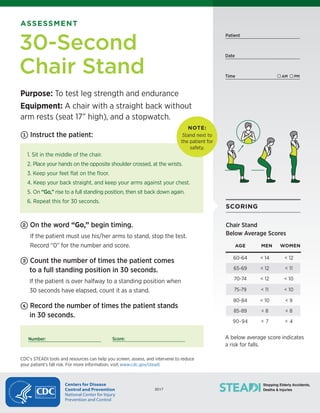
1. Sit in the middle of the chair.
2. Place your hands on the opposite shoulder crossed, at the wrists.
3. Keep your feet flat on the floor.
4. Keep your back straight, and keep your arms against your chest.
5. On “Go,” rise to a full standing position, then sit back down again.
6. Repeat this for 30 seconds.
Number: Score:
NOTE:
Stand next to
the patient for
safety.
A below average score indicates
a risk for falls.
Patient
Date
Time  AM  PM
CDC’s STEADI tools and resources can help you screen, assess, and intervene to reduce
your patient’s fall risk. For more information, visit www.cdc.gov/steadi
Chair Stand
Below Average Scores
SCORING
60-64 < 14 < 12
65-69 < 12 < 11
70-74 < 12 < 10
75-79 < 11 < 10
80-84 < 10 < 9
85-89 < 8 < 8
90-94 < 7 < 4
	 AGE	 MEN	WOMEN

30 second chair_stand_test-a (1)

  • 1.
    2017 Stopping Elderly Accidents, Deaths& Injuries2017 Centers for Disease Control and Prevention National Center for Injury Prevention and Control ASSESSMENT Purpose: To test leg strength and endurance Equipment: A chair with a straight back without arm rests (seat 17” high), and a stopwatch. 1 Instruct the patient: 2 On the word “Go,” begin timing. If the patient must use his/her arms to stand, stop the test. Record “0” for the number and score. 3 Count the number of times the patient comes to a full standing position in 30 seconds. If the patient is over halfway to a standing position when 30 seconds have elapsed, count it as a stand. 4 Record the number of times the patient stands in 30 seconds. 30-Second Chair Stand 1. Sit in the middle of the chair. 2. Place your hands on the opposite shoulder crossed, at the wrists. 3. Keep your feet flat on the floor. 4. Keep your back straight, and keep your arms against your chest. 5. On “Go,” rise to a full standing position, then sit back down again. 6. Repeat this for 30 seconds. Number: Score: NOTE: Stand next to the patient for safety. A below average score indicates a risk for falls. Patient Date Time  AM  PM CDC’s STEADI tools and resources can help you screen, assess, and intervene to reduce your patient’s fall risk. For more information, visit www.cdc.gov/steadi Chair Stand Below Average Scores SCORING 60-64 < 14 < 12 65-69 < 12 < 11 70-74 < 12 < 10 75-79 < 11 < 10 80-84 < 10 < 9 85-89 < 8 < 8 90-94 < 7 < 4 AGE MEN WOMEN