2017
Stopping Elderly Accidents,
Deaths & Injuries2017
Centers for Disease
Control and Prevention
National Center for Injury
Prevention and Control
ASSESSMENT
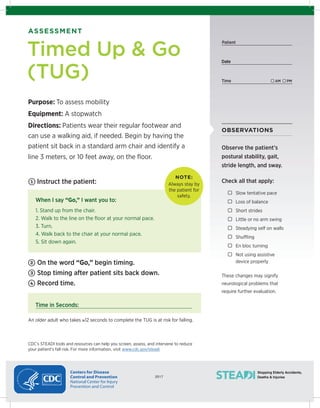
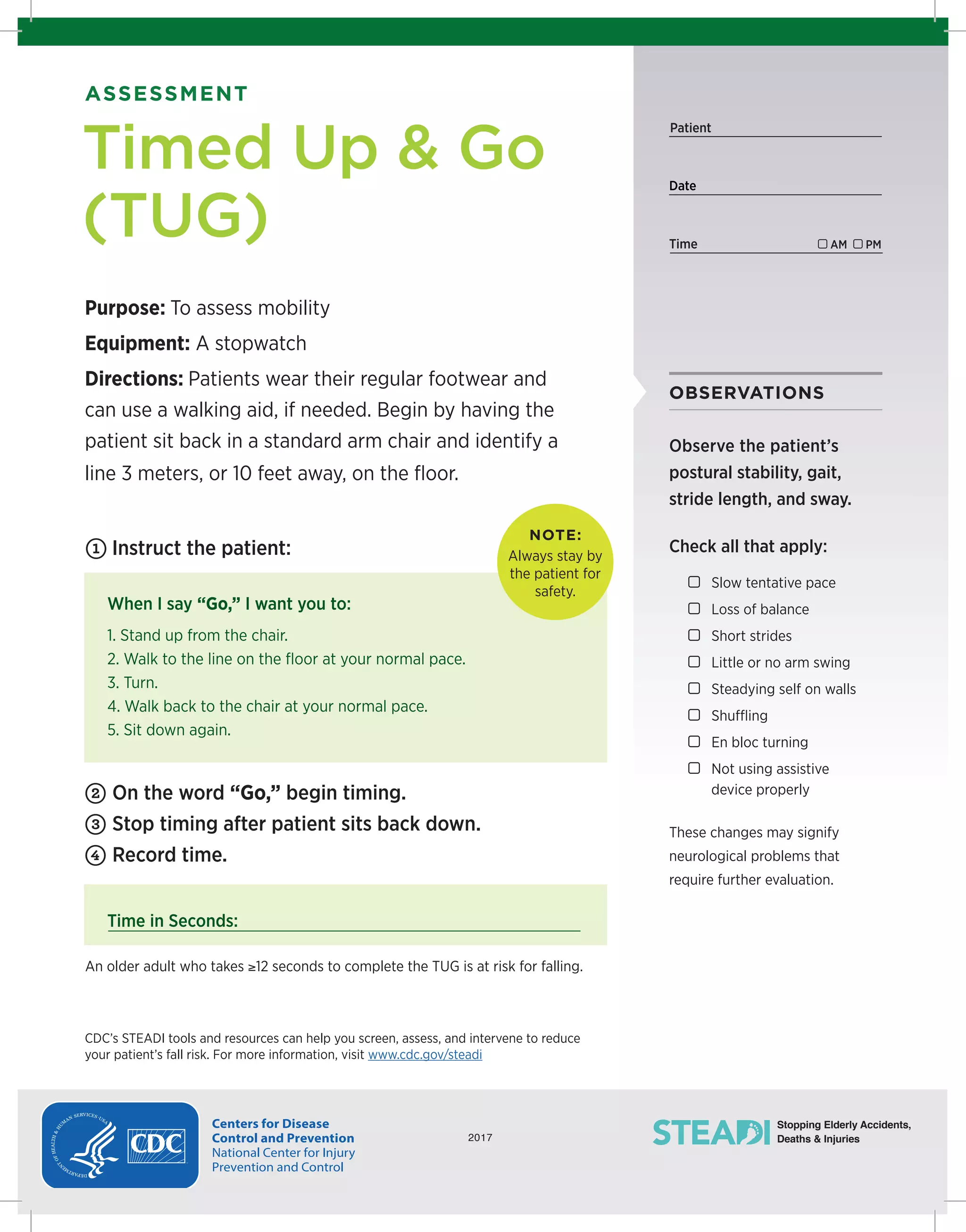
Purpose: To assess mobility
Equipment: A stopwatch
Directions: Patients wear their regular footwear and
can use a walking aid, if needed. Begin by having the
patient sit back in a standard arm chair and identify a
line 3 meters, or 10 feet away, on the floor.
2 On the word “Go,” begin timing.
3 Stop timing after patient sits back down.
4 Record time.
Observe the patient’s
postural stability, gait,
stride length, and sway.
Check all that apply:
 Slow tentative pace
 Loss of balance
 Short strides
 Little or no arm swing
 Steadying self on walls
 Shuffling
 En bloc turning
 Not using assistive
device properly
These changes may signify
neurological problems that
require further evaluation.
Timed Up & Go
(TUG)
When I say “Go,” I want you to:
1. Stand up from the chair.
2. Walk to the line on the floor at your normal pace.
3. Turn.
4. Walk back to the chair at your normal pace.
5. Sit down again.
OBSERVATIONS
1 Instruct the patient:
An older adult who takes ≥12 seconds to complete the TUG is at risk for falling.
NOTE:
Always stay by
the patient for
safety.
Time in Seconds:
 AM  PM
CDC’s STEADI tools and resources can help you screen, assess, and intervene to reduce
your patient’s fall risk. For more information, visit www.cdc.gov/steadi
Patient
Date
Time

Tug test print

  • 1.
    2017 Stopping Elderly Accidents, Deaths& Injuries2017 Centers for Disease Control and Prevention National Center for Injury Prevention and Control ASSESSMENT Purpose: To assess mobility Equipment: A stopwatch Directions: Patients wear their regular footwear and can use a walking aid, if needed. Begin by having the patient sit back in a standard arm chair and identify a line 3 meters, or 10 feet away, on the floor. 2 On the word “Go,” begin timing. 3 Stop timing after patient sits back down. 4 Record time. Observe the patient’s postural stability, gait, stride length, and sway. Check all that apply:  Slow tentative pace  Loss of balance  Short strides  Little or no arm swing  Steadying self on walls  Shuffling  En bloc turning  Not using assistive device properly These changes may signify neurological problems that require further evaluation. Timed Up & Go (TUG) When I say “Go,” I want you to: 1. Stand up from the chair. 2. Walk to the line on the floor at your normal pace. 3. Turn. 4. Walk back to the chair at your normal pace. 5. Sit down again. OBSERVATIONS 1 Instruct the patient: An older adult who takes ≥12 seconds to complete the TUG is at risk for falling. NOTE: Always stay by the patient for safety. Time in Seconds:  AM  PM CDC’s STEADI tools and resources can help you screen, assess, and intervene to reduce your patient’s fall risk. For more information, visit www.cdc.gov/steadi Patient Date Time