 It is often convenient to describe the motion of a particle in terms
of its x, y, z or rectangular components, relative to a fixed frame
of reference.
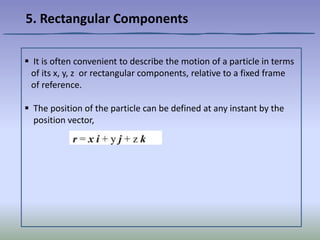
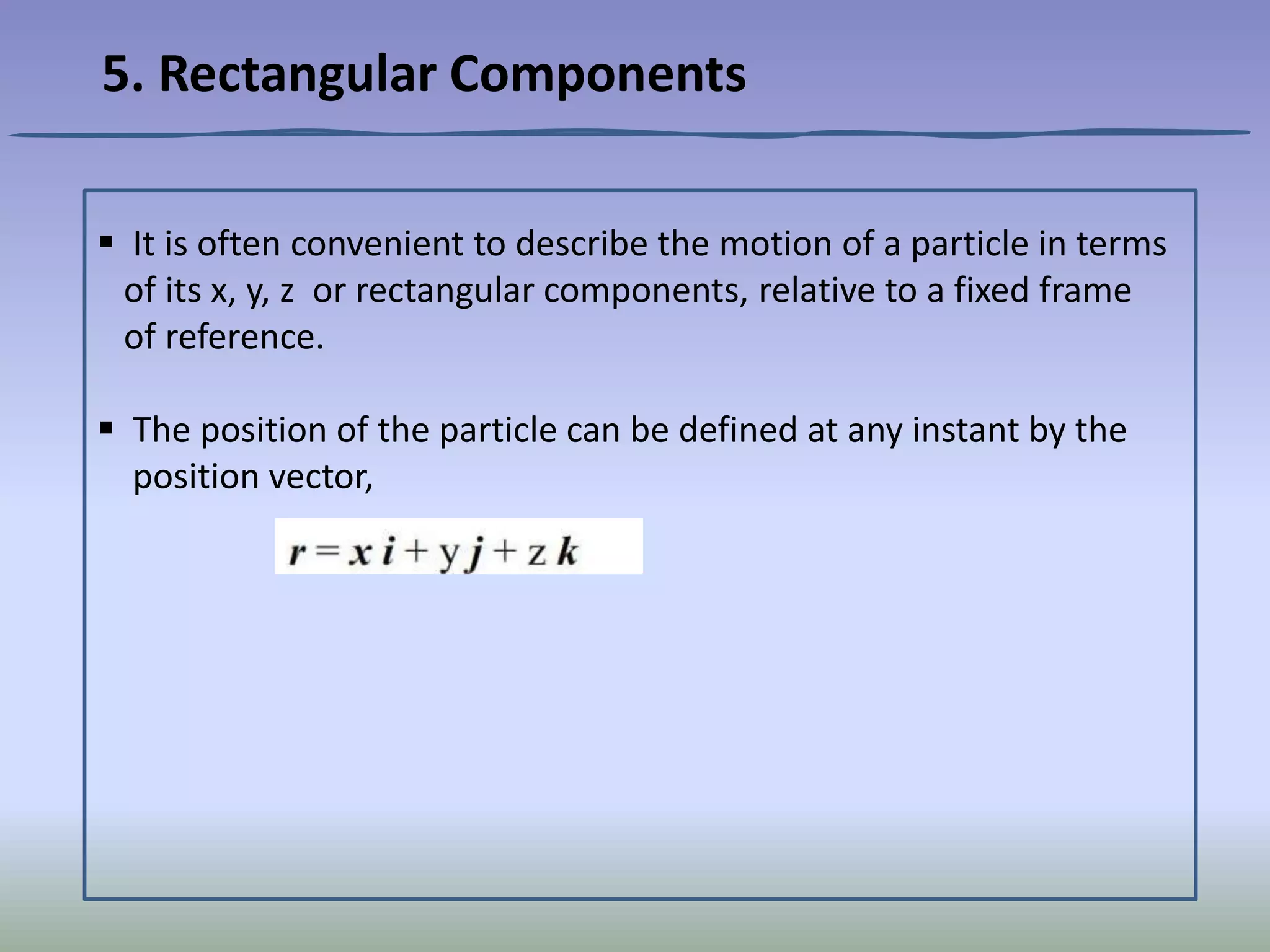
 The position of the particle can be defined at any instant by the
position vector,
5. Rectangular Components
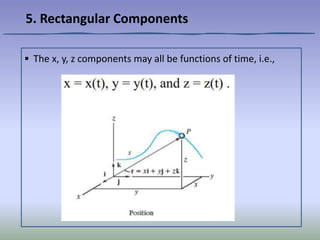
 The x, y, z components may all be functions of time, i.e.,
5. Rectangular Components
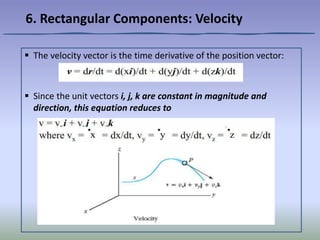
 The velocity vector is the time derivative of the position vector:
 Since the unit vectors i, j, k are constant in magnitude and
direction, this equation reduces to
6. Rectangular Components: Velocity
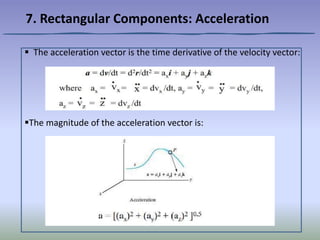
 The acceleration vector is the time derivative of the velocity vector:
The magnitude of the acceleration vector is:
7. Rectangular Components: Acceleration
CURVILINEAR MOTION
Example
Given:
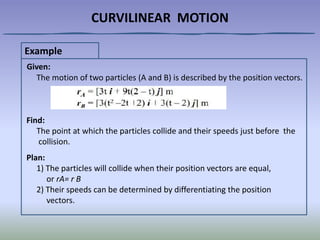
The motion of two particles (A and B) is described by the position vectors.
Find:
The point at which the particles collide and their speeds just before the
collision.
Plan:
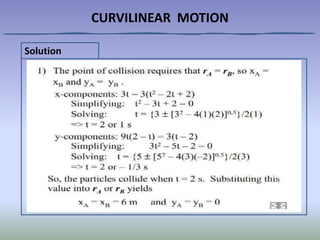
1) The particles will collide when their position vectors are equal,
or rA= r B
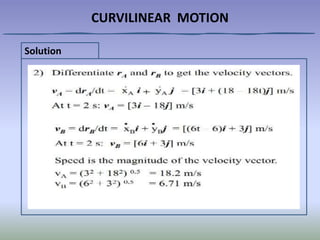
2) Their speeds can be determined by differentiating the position
vectors.
CURVILINEAR MOTION
Solution
CURVILINEAR MOTION
Solution

3 rectangular

  • 1.
     It isoften convenient to describe the motion of a particle in terms of its x, y, z or rectangular components, relative to a fixed frame of reference.  The position of the particle can be defined at any instant by the position vector, 5. Rectangular Components
  • 2.
     The x,y, z components may all be functions of time, i.e., 5. Rectangular Components
  • 3.
     The velocityvector is the time derivative of the position vector:  Since the unit vectors i, j, k are constant in magnitude and direction, this equation reduces to 6. Rectangular Components: Velocity
  • 4.
     The accelerationvector is the time derivative of the velocity vector: The magnitude of the acceleration vector is: 7. Rectangular Components: Acceleration
  • 5.
    CURVILINEAR MOTION Example Given: The motionof two particles (A and B) is described by the position vectors. Find: The point at which the particles collide and their speeds just before the collision. Plan: 1) The particles will collide when their position vectors are equal, or rA= r B 2) Their speeds can be determined by differentiating the position vectors.
  • 6.
  • 7.