ENGINEERING DYNAMICS
Dr. THABIT SALIM NASSOR
Kinematics of Particles
Contents
• Rectilinear motion; Derivation of motion
equations for velocity and acceleration.
• Curvilinear motion in a single plane
• Rectangular coordinates for motion of particle
• Polar coordinates for motion of particle
• Space curvilinear motion in 3D (Velocity and
acceleration)
Kinematics of Particles
ME101 - Division III Kaustubh Dasgupta 3
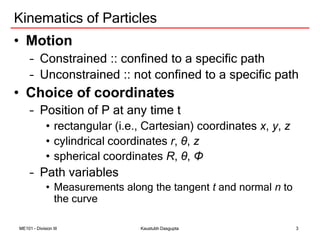
• Motion
– Constrained :: confined to a specific path
– Unconstrained :: not confined to a specific path
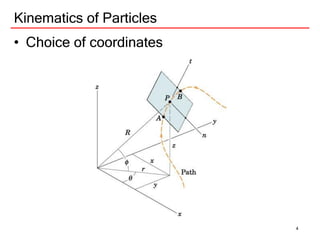
• Choice of coordinates
– Position of P at any time t
• rectangular (i.e., Cartesian) coordinates x, y, z
• cylindrical coordinates r, θ, z
• spherical coordinates R, θ, Φ
– Path variables
• Measurements along the tangent t and normal n to
the curve
Kinematics of Particles
• Choice of coordinates
4
Kinematics of Particles
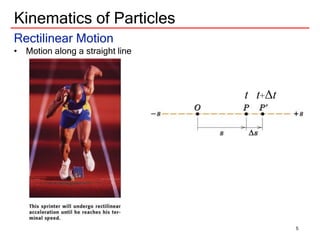
Rectilinear Motion
• Motion along a straight line
t t+Δt
5
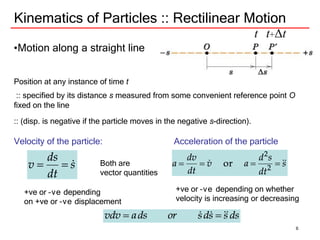
•Motion along a straight line
Position at any instance of time t
:: specified by its distance s measured from some convenient reference point O
fixed on the line
:: (disp. is negative if the particle moves in the negative s-direction).
Velocity of the particle: Acceleration of the particle
Kinematics of Particles :: Rectilinear Motion
t t+Δt
+ve or –ve depending
on +ve or –ve displacement
6
Both are
vector quantities
+ve or –ve depending on whether
velocity is increasing or decreasing
Kinematics of Particles
Rectilinear Motion:
Graphical Interpretations
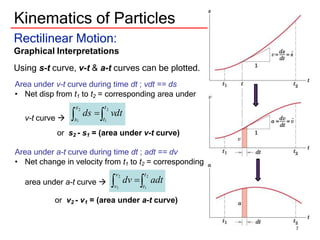
Using s-t curve, v-t & a-t curves can be plotted.
Area under v-t curve during time dt ; vdt == ds
• Net disp from t1 to t2 = corresponding area under
v-t curve à
or s2 - s1 = (area under v-t curve)
Area under a-t curve during time dt ; adt == dv
• Net change in velocity from t1 to t2 = corresponding
area under a-t curve à
or v2 - v1 = (area under a-t curve)
ò
ò
2
2
s t
s1 t1
ds = vdt
ò
7
ò
2
2
v t
v1 t1
dv = adt
Kinematics of Particles
Rectilinear Motion:
Graphical Interpretations
Two additional graphical relations:
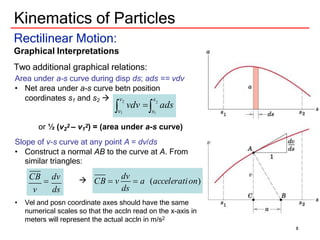
Area under a-s curve during disp ds; ads == vdv
• Net area under a-s curve betn position
coordinates s1 and s2 à
or ½ (v2
2 – v1
2) = (area under a-s curve)
Slope of v-s curve at any point A = dv/ds
• Construct a normal AB to the curve at A. From
similar triangles:
à
• Vel and posn coordinate axes should have the same
numerical scales so that the accln read on the x-axis in
meters will represent the actual accln in m/s2
ò
ò
2 s
s1
v
v1
vdv = 2
ads
v ds
CB
=
dv CB = v
dv
= a (acceleration)
ds
8
Kinematics of Particles :: Rectilinear Motion
Analytical Integration to find the position coordinate
Acceleration may be specified as a function of time, velocity, or position
coordinate, or as a combined function of these.
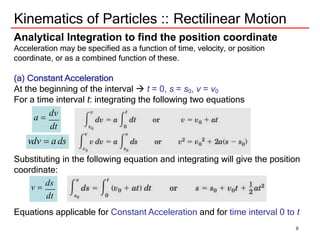
(a) Constant Acceleration
At the beginning of the interval à t = 0, s = s0, v = v0
For a time interval t: integrating the following two equations
Substituting in the following equation and integrating will give the position
coordinate:
Equations applicable for Constant Acceleration and for time interval 0 to t
v =
ds
dt
a = dv
dt
vdv = ads
9
Kinematics of Particles :: Rectilinear Motion
Analytical Integration to find the position coordinate
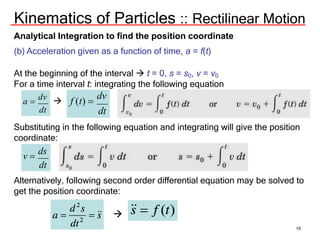
(b) Acceleration given as a function of time, a = f(t)
At the beginning of the interval à t = 0, s = s0, v = v0
For a time interval t: integrating the following equation
à
Substituting in the following equation and integrating will give the position
coordinate:
Alternatively, following second order differential equation may be solved to
get the position coordinate:
v =
ds
dt
a =
dv
dt
f (t) =
dv
dt
10
Kinematics of Particles :: Rectilinear Motion
Analytical Integration to find the position coordinate
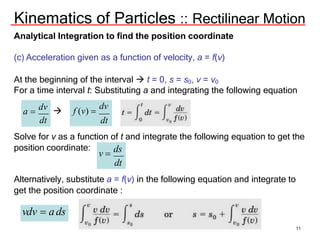
(c) Acceleration given as a function of velocity, a = f(v)
At the beginning of the interval à t = 0, s = s0, v = v0
For a time interval t: Substituting a and integrating the following equation
à
Solve for v as a function of t and integrate the following equation to get the
position coordinate:
Alternatively, substitute a = f(v) in the following equation and integrate to
get the position coordinate :
v = ds
dt
a = dv
dt
f (v) =
dv
dt
vdv = ads
11
Kinematics of Particles: Rectilinear Motion
Analytical Integration to find the position coordinate
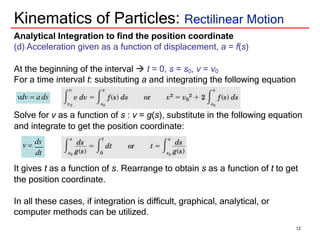
(d) Acceleration given as a function of displacement, a = f(s)
At the beginning of the interval à t = 0, s = s0, v = v0
For a time interval t: substituting a and integrating the following equation
Solve for v as a function of s : v = g(s), substitute in the following equation
and integrate to get the position coordinate:
It gives t as a function of s. Rearrange to obtain s as a function of t to get
the position coordinate.
In all these cases, if integration is difficult, graphical, analytical, or
computer methods can be utilized.
v = ds
dt
vdv = ads
12
Kinematics of Particles: Rectilinear Motion
13
Example
Position coordinate of a particle confined to move along a straight line is given by
s = 2t3 – 24t + 6, where s is measured in meters from a convenient origin and t is
in seconds. Determine: (a) time reqd for the particle to reach a velocity of 72 m/s
from its initial condition at t = 0, (b) acceleration of the particle when v = 30 m/s,
and (c) net disp of the particle during the interval from t = 1 s to t = 4 s.
Solution
Differentiating s = 2t3 – 24t + 6 à v = 6t2 – 24 m/s
à a = 12t m/s2
(a) v = 72 m/s à t = ± 4 s
(- 4 s happened before initiation of motion à no physical interest.)
à t = 4 s
(b) v = 30 m/s à t = 3 sec à a = 36 m/s2
(c) t = 1 s to 4 s. Using s = 2t3 – 24t + 6
Δs = s4 – s1 = [2(43) – 24(4) +6] – [2(13) – 24(1) + 6]
Δs = 54 m
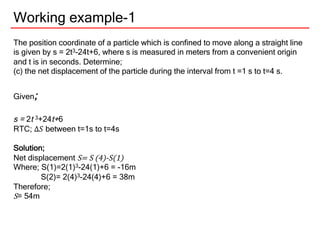
Working example-1
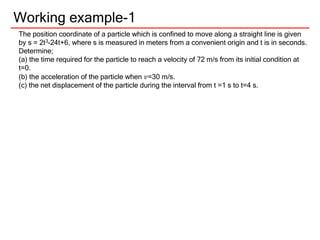
The position coordinate of a particle which is confined to move along a straight line is given
by s = 2t3-24t+6, where s is measured in meters from a convenient origin and t is in seconds.
Determine;
(a) the time required for the particle to reach a velocity of 72 m/s from its initial condition at
t=0.
(b) the acceleration of the particle when 𝑣=30 m/s.
(c) the net displacement of the particle during the interval from t =1 s to t=4 s.
Working example-1
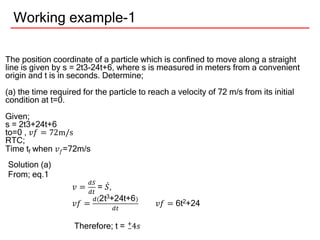
The position coordinate of a particle which is confined to move along a straight
line is given by s = 2t3-24t+6, where s is measured in meters from a convenient
origin and t is in seconds. Determine;
(a) the time required for the particle to reach a velocity of 72 m/s from its initial
condition at t=0.
Given;
s = 2t3+24t+6
to=0 , 𝑣𝑓 = 72m/s
RTC;
Time tf when 𝑣𝑓=72m/s
Solution (a)
From; eq.1
𝑣 =
)*
)+
= 𝑆̇,
𝑣𝑓 =
)(2t3+24t+6)
)+
𝑣𝑓 = 6t2+24
Therefore; t = 4
2
3 𝑠
Working example-1
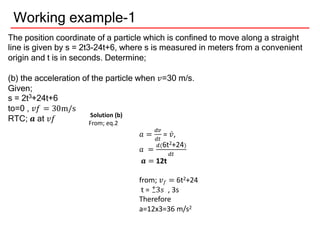
The position coordinate of a particle which is confined to move along a straight
line is given by s = 2t3-24t+6, where s is measured in meters from a convenient
origin and t is in seconds. Determine;
(b) the acceleration of the particle when 𝑣=30 m/s.
Given;
s = 2t3+24t+6
to=0 , 𝑣𝑓 = 30m/s
RTC; 𝒂 at 𝑣𝑓 Solution (b)
From; eq.2
𝑎 =
)9
)+
= 𝑣̇,
𝑎 =
)(6t2+24)
)+
𝒂 = 12t
from; 𝑣𝑓 = 6t2+24
t = 3
2
3
𝑠 , 3s
Therefore
a=12x3=36 m/s2
Working example-1
The position coordinate of a particle which is confined to move along a straight line
is given by s = 2t3-24t+6, where s is measured in meters from a convenient origin
and t is in seconds. Determine;
(c) the net displacement of the particle during the interval from t =1 s to t=4 s.
Given;
s = 2t 3+24t+6
RTC; ∆𝑆 between t=1s to t=4s
Solution;
Net displacement S= S (4)-S(1)
Where; S(1)=2(1)3-24(1)+6 = -16m
S(2)= 2(4)3-24(4)+6 = 38m
Therefore;
S= 54m
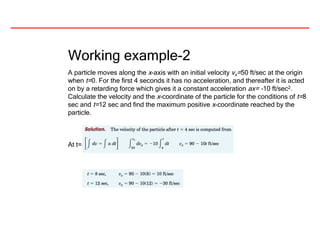
Working example-2
A particle moves along the x-axis with an initial velocity vx=50 ft/sec at the origin
when t=0. For the first 4 seconds it has no acceleration, and thereafter it is acted
on by a retarding force which gives it a constant acceleration ax= -10 ft/sec2.
Calculate the velocity and the x-coordinate of the particle for the conditions of t=8
sec and t=12 sec and find the maximum positive x-coordinate reached by the
particle.
At t=8 sec and t=12 sec, the velocities along x axis are;
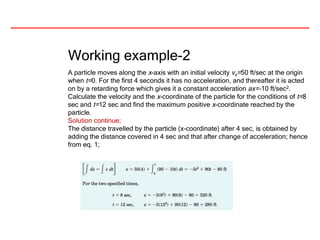
Working example-2
A particle moves along the x-axis with an initial velocity vx=50 ft/sec at the origin
when t=0. For the first 4 seconds it has no acceleration, and thereafter it is acted
on by a retarding force which gives it a constant acceleration ax=-10 ft/sec2.
Calculate the velocity and the x-coordinate of the particle for the conditions of t=8
sec and t=12 sec and find the maximum positive x-coordinate reached by the
particle.
Solution continue;
The distance travelled by the particle (x-coordinate) after 4 sec, is obtained by
adding the distance covered in 4 sec and that after change of acceleration; hence
from eq. 1;
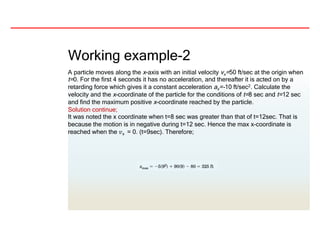
Working example-2
A particle moves along the x-axis with an initial velocity vx=50 ft/sec at the origin when
t=0. For the first 4 seconds it has no acceleration, and thereafter it is acted on by a
retarding force which gives it a constant acceleration ax=-10 ft/sec2. Calculate the
velocity and the x-coordinate of the particle for the conditions of t=8 sec and t=12 sec
and find the maximum positive x-coordinate reached by the particle.
Solution continue;
It was noted the x coordinate when t=8 sec was greater than that of t=12sec. That is
because the motion is in negative during t=12 sec. Hence the max x-coordinate is
reached when the 𝑣x = 0. (t=9sec). Therefore;
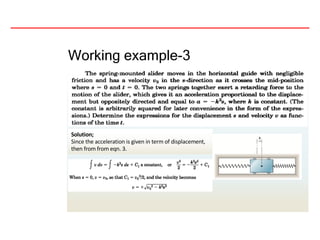
Working example-3
Solution;
Since the acceleration is given in term of displacement,
then from from eqn. 3.
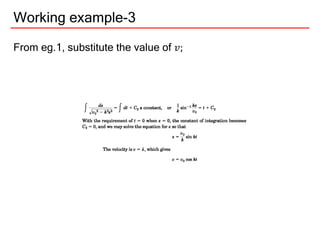
Working example-3
From eg.1, substitute the value of 𝑣;

Lecture Dynamics Kinetics of Particles.pdf

  • 1.
    ENGINEERING DYNAMICS Dr. THABITSALIM NASSOR Kinematics of Particles
  • 2.
    Kinematics of Particles Contents •Rectilinear motion; Derivation of motion equations for velocity and acceleration. • Curvilinear motion in a single plane • Rectangular coordinates for motion of particle • Polar coordinates for motion of particle • Space curvilinear motion in 3D (Velocity and acceleration)
  • 3.
    Kinematics of Particles ME101- Division III Kaustubh Dasgupta 3 • Motion – Constrained :: confined to a specific path – Unconstrained :: not confined to a specific path • Choice of coordinates – Position of P at any time t • rectangular (i.e., Cartesian) coordinates x, y, z • cylindrical coordinates r, θ, z • spherical coordinates R, θ, Φ – Path variables • Measurements along the tangent t and normal n to the curve
  • 4.
    Kinematics of Particles •Choice of coordinates 4
  • 5.
    Kinematics of Particles RectilinearMotion • Motion along a straight line t t+Δt 5
  • 6.
    •Motion along astraight line Position at any instance of time t :: specified by its distance s measured from some convenient reference point O fixed on the line :: (disp. is negative if the particle moves in the negative s-direction). Velocity of the particle: Acceleration of the particle Kinematics of Particles :: Rectilinear Motion t t+Δt +ve or –ve depending on +ve or –ve displacement 6 Both are vector quantities +ve or –ve depending on whether velocity is increasing or decreasing
  • 7.
    Kinematics of Particles RectilinearMotion: Graphical Interpretations Using s-t curve, v-t & a-t curves can be plotted. Area under v-t curve during time dt ; vdt == ds • Net disp from t1 to t2 = corresponding area under v-t curve à or s2 - s1 = (area under v-t curve) Area under a-t curve during time dt ; adt == dv • Net change in velocity from t1 to t2 = corresponding area under a-t curve à or v2 - v1 = (area under a-t curve) ò ò 2 2 s t s1 t1 ds = vdt ò 7 ò 2 2 v t v1 t1 dv = adt
  • 8.
    Kinematics of Particles RectilinearMotion: Graphical Interpretations Two additional graphical relations: Area under a-s curve during disp ds; ads == vdv • Net area under a-s curve betn position coordinates s1 and s2 à or ½ (v2 2 – v1 2) = (area under a-s curve) Slope of v-s curve at any point A = dv/ds • Construct a normal AB to the curve at A. From similar triangles: à • Vel and posn coordinate axes should have the same numerical scales so that the accln read on the x-axis in meters will represent the actual accln in m/s2 ò ò 2 s s1 v v1 vdv = 2 ads v ds CB = dv CB = v dv = a (acceleration) ds 8
  • 9.
    Kinematics of Particles:: Rectilinear Motion Analytical Integration to find the position coordinate Acceleration may be specified as a function of time, velocity, or position coordinate, or as a combined function of these. (a) Constant Acceleration At the beginning of the interval à t = 0, s = s0, v = v0 For a time interval t: integrating the following two equations Substituting in the following equation and integrating will give the position coordinate: Equations applicable for Constant Acceleration and for time interval 0 to t v = ds dt a = dv dt vdv = ads 9
  • 10.
    Kinematics of Particles:: Rectilinear Motion Analytical Integration to find the position coordinate (b) Acceleration given as a function of time, a = f(t) At the beginning of the interval à t = 0, s = s0, v = v0 For a time interval t: integrating the following equation à Substituting in the following equation and integrating will give the position coordinate: Alternatively, following second order differential equation may be solved to get the position coordinate: v = ds dt a = dv dt f (t) = dv dt 10
  • 11.
    Kinematics of Particles:: Rectilinear Motion Analytical Integration to find the position coordinate (c) Acceleration given as a function of velocity, a = f(v) At the beginning of the interval à t = 0, s = s0, v = v0 For a time interval t: Substituting a and integrating the following equation à Solve for v as a function of t and integrate the following equation to get the position coordinate: Alternatively, substitute a = f(v) in the following equation and integrate to get the position coordinate : v = ds dt a = dv dt f (v) = dv dt vdv = ads 11
  • 12.
    Kinematics of Particles:Rectilinear Motion Analytical Integration to find the position coordinate (d) Acceleration given as a function of displacement, a = f(s) At the beginning of the interval à t = 0, s = s0, v = v0 For a time interval t: substituting a and integrating the following equation Solve for v as a function of s : v = g(s), substitute in the following equation and integrate to get the position coordinate: It gives t as a function of s. Rearrange to obtain s as a function of t to get the position coordinate. In all these cases, if integration is difficult, graphical, analytical, or computer methods can be utilized. v = ds dt vdv = ads 12
  • 13.
    Kinematics of Particles:Rectilinear Motion 13 Example Position coordinate of a particle confined to move along a straight line is given by s = 2t3 – 24t + 6, where s is measured in meters from a convenient origin and t is in seconds. Determine: (a) time reqd for the particle to reach a velocity of 72 m/s from its initial condition at t = 0, (b) acceleration of the particle when v = 30 m/s, and (c) net disp of the particle during the interval from t = 1 s to t = 4 s. Solution Differentiating s = 2t3 – 24t + 6 à v = 6t2 – 24 m/s à a = 12t m/s2 (a) v = 72 m/s à t = ± 4 s (- 4 s happened before initiation of motion à no physical interest.) à t = 4 s (b) v = 30 m/s à t = 3 sec à a = 36 m/s2 (c) t = 1 s to 4 s. Using s = 2t3 – 24t + 6 Δs = s4 – s1 = [2(43) – 24(4) +6] – [2(13) – 24(1) + 6] Δs = 54 m
  • 14.
    Working example-1 The positioncoordinate of a particle which is confined to move along a straight line is given by s = 2t3-24t+6, where s is measured in meters from a convenient origin and t is in seconds. Determine; (a) the time required for the particle to reach a velocity of 72 m/s from its initial condition at t=0. (b) the acceleration of the particle when 𝑣=30 m/s. (c) the net displacement of the particle during the interval from t =1 s to t=4 s.
  • 15.
    Working example-1 The positioncoordinate of a particle which is confined to move along a straight line is given by s = 2t3-24t+6, where s is measured in meters from a convenient origin and t is in seconds. Determine; (a) the time required for the particle to reach a velocity of 72 m/s from its initial condition at t=0. Given; s = 2t3+24t+6 to=0 , 𝑣𝑓 = 72m/s RTC; Time tf when 𝑣𝑓=72m/s Solution (a) From; eq.1 𝑣 = )* )+ = 𝑆̇, 𝑣𝑓 = )(2t3+24t+6) )+ 𝑣𝑓 = 6t2+24 Therefore; t = 4 2 3 𝑠
  • 16.
    Working example-1 The positioncoordinate of a particle which is confined to move along a straight line is given by s = 2t3-24t+6, where s is measured in meters from a convenient origin and t is in seconds. Determine; (b) the acceleration of the particle when 𝑣=30 m/s. Given; s = 2t3+24t+6 to=0 , 𝑣𝑓 = 30m/s RTC; 𝒂 at 𝑣𝑓 Solution (b) From; eq.2 𝑎 = )9 )+ = 𝑣̇, 𝑎 = )(6t2+24) )+ 𝒂 = 12t from; 𝑣𝑓 = 6t2+24 t = 3 2 3 𝑠 , 3s Therefore a=12x3=36 m/s2
  • 17.
    Working example-1 The positioncoordinate of a particle which is confined to move along a straight line is given by s = 2t3-24t+6, where s is measured in meters from a convenient origin and t is in seconds. Determine; (c) the net displacement of the particle during the interval from t =1 s to t=4 s. Given; s = 2t 3+24t+6 RTC; ∆𝑆 between t=1s to t=4s Solution; Net displacement S= S (4)-S(1) Where; S(1)=2(1)3-24(1)+6 = -16m S(2)= 2(4)3-24(4)+6 = 38m Therefore; S= 54m
  • 18.
    Working example-2 A particlemoves along the x-axis with an initial velocity vx=50 ft/sec at the origin when t=0. For the first 4 seconds it has no acceleration, and thereafter it is acted on by a retarding force which gives it a constant acceleration ax= -10 ft/sec2. Calculate the velocity and the x-coordinate of the particle for the conditions of t=8 sec and t=12 sec and find the maximum positive x-coordinate reached by the particle. At t=8 sec and t=12 sec, the velocities along x axis are;
  • 19.
    Working example-2 A particlemoves along the x-axis with an initial velocity vx=50 ft/sec at the origin when t=0. For the first 4 seconds it has no acceleration, and thereafter it is acted on by a retarding force which gives it a constant acceleration ax=-10 ft/sec2. Calculate the velocity and the x-coordinate of the particle for the conditions of t=8 sec and t=12 sec and find the maximum positive x-coordinate reached by the particle. Solution continue; The distance travelled by the particle (x-coordinate) after 4 sec, is obtained by adding the distance covered in 4 sec and that after change of acceleration; hence from eq. 1;
  • 20.
    Working example-2 A particlemoves along the x-axis with an initial velocity vx=50 ft/sec at the origin when t=0. For the first 4 seconds it has no acceleration, and thereafter it is acted on by a retarding force which gives it a constant acceleration ax=-10 ft/sec2. Calculate the velocity and the x-coordinate of the particle for the conditions of t=8 sec and t=12 sec and find the maximum positive x-coordinate reached by the particle. Solution continue; It was noted the x coordinate when t=8 sec was greater than that of t=12sec. That is because the motion is in negative during t=12 sec. Hence the max x-coordinate is reached when the 𝑣x = 0. (t=9sec). Therefore;
  • 21.
    Working example-3 Solution; Since theacceleration is given in term of displacement, then from from eqn. 3.
  • 22.
    Working example-3 From eg.1,substitute the value of 𝑣;