Faculty of Engineering and Materials Science
MECHANICS II
(Dynamics)
4th MCTR, DPE,
MATS, and CIVIL
Lecture (2)
Prof. Dr. E. I. Imam Morgan
Faculty of Engineering and Materials
Science (EMS)
Mechatronics Department
elsayed.morgan@guc.edu.eg
C7.105
Prof. Dr. Imam Morgan
Former Dean EMS, MCTR Depart. 1
Ch. 1 …. Kinematics of Particles (Rectilinear Motion)
 Position
 Motion determination
 Multi connected particles and relative motions
Ch. 2 …. Kinematics of Particles (Curvilinear Motion)
 Position, velocity, and acceleration vectors in general forms and
their relations with respect to the path
 Applications in different frames of references (2D and 3D)
 Rectangular coordinates (2D and 3D)
 Intrinsic Coordinates
 Polar Coordinates
Ch. 3 …. Kinetics of a Particle
● Accelerating Force
Ch. 4 …. Kinetics of a Particle
● Impulse and Momentum
● Energy Approach
Part I
Dynamics of Particles
Lect. (2)
Prof. Dr. Imam Morgan
Former Dean EMS, MCTR Depart. 2
3
Chapter 2
Kinematics of Particles
Curvilinear Motion
Cartesian Coordinates
Intrinsic Coordinates
Polar Coordinates
II
Curvilinear Motion
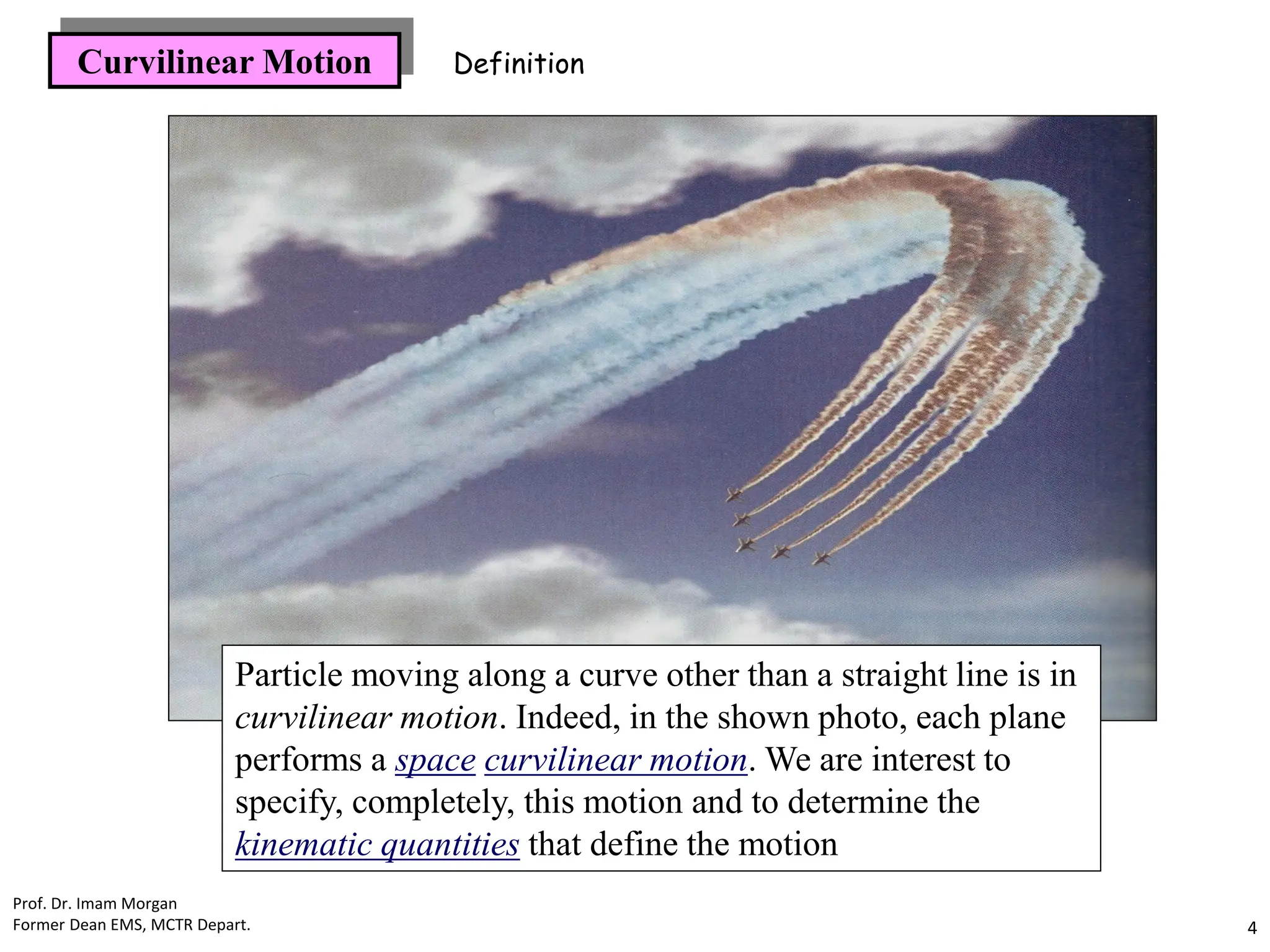
Particle moving along a curve other than a straight line is in
curvilinear motion. Indeed, in the shown photo, each plane
performs a space curvilinear motion. We are interest to
specify, completely, this motion and to determine the
kinematic quantities that define the motion
Definition
Prof. Dr. Imam Morgan
Former Dean EMS, MCTR Depart. 4
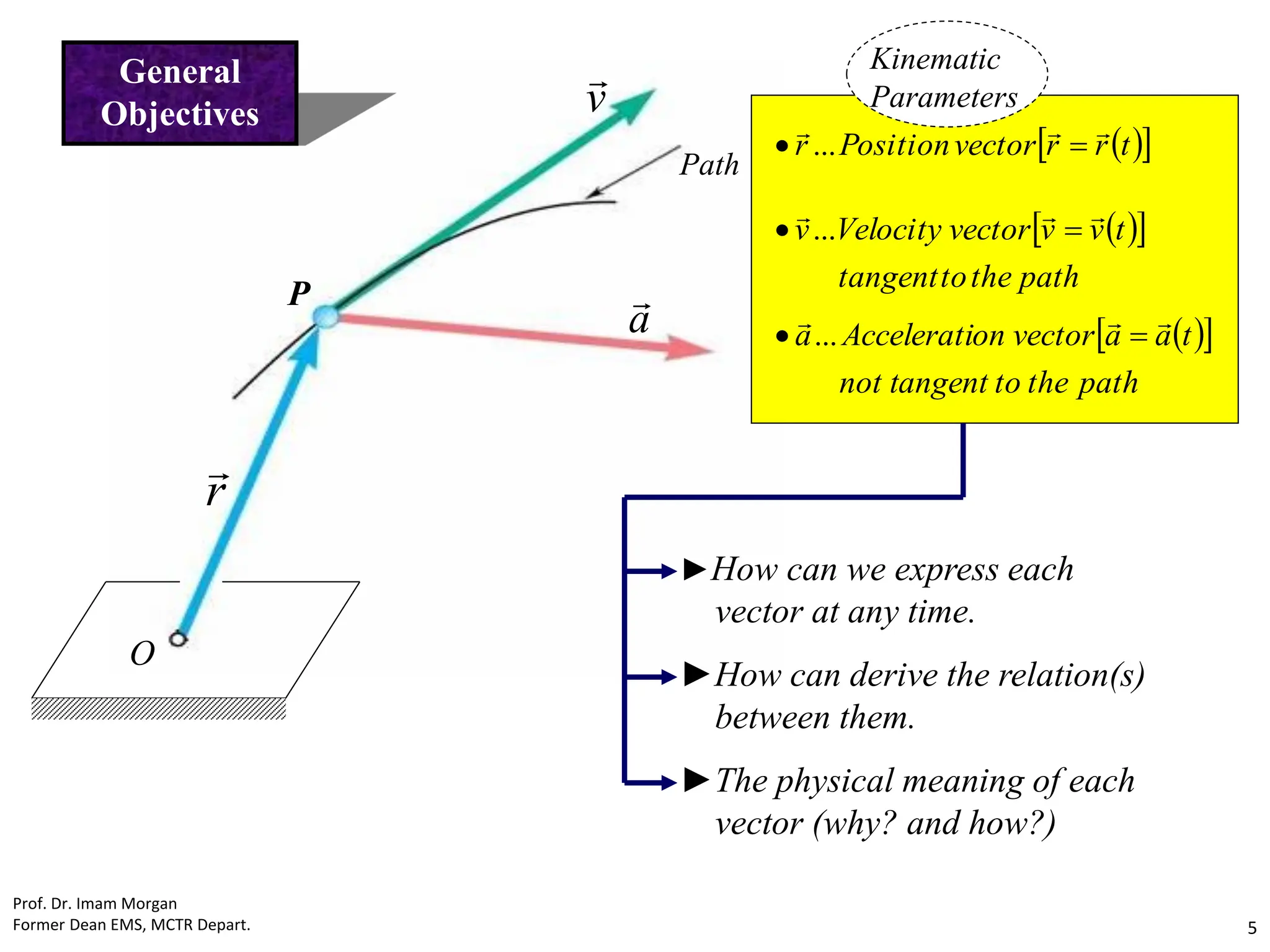
a

r

v

P
Path
O
General
Objectives
 
 
t
r
r
vector
Position
r




 ...
 
 
path
the
to
tangent
t
v
v
vector
Velocity
v




 ...
 
 
path
the
to
angent
t
not
t
a
a
vector
on
Accelerati
a




 ...
►How can we express each
vector at any time.
►How can derive the relation(s)
between them.
►The physical meaning of each
vector (why? and how?)
Kinematic
Parameters
Prof. Dr. Imam Morgan
Former Dean EMS, MCTR Depart. 5
Curvilinear Motion
(General Discussion)
Curvilinear motion occurs when the particle moves along a curved path.
Since this path is often described in three dimensions, vector analysis
(mainly components) will be used to formulate the particle’s position,
velocity, and acceleration.
1 Position Vector, Velocity Vector, and Acceleration vector
A Position Vector
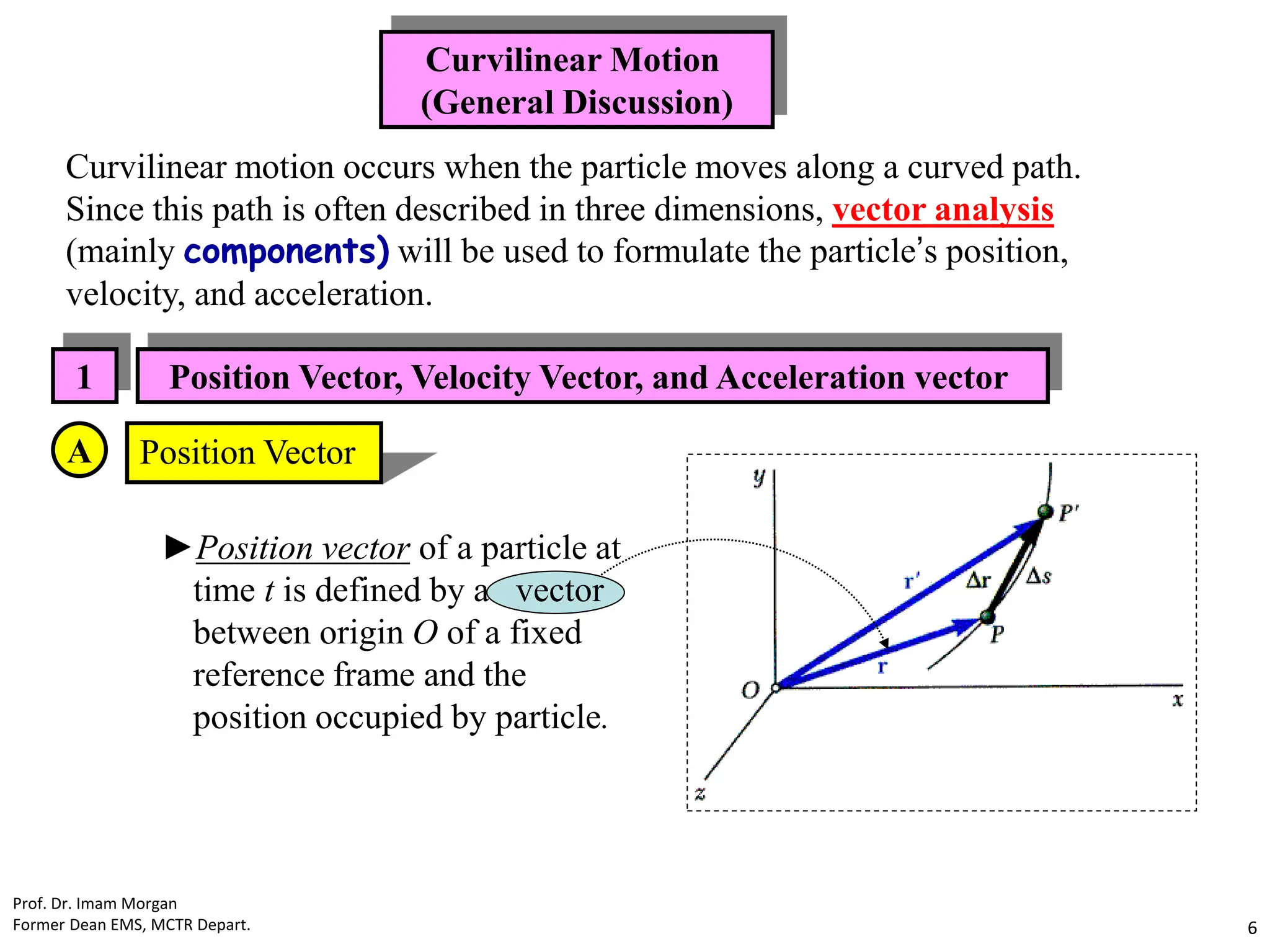
►Position vector of a particle at
time t is defined by a vector
between origin O of a fixed
reference frame and the
position occupied by particle.
Prof. Dr. Imam Morgan
Former Dean EMS, MCTR Depart. 6
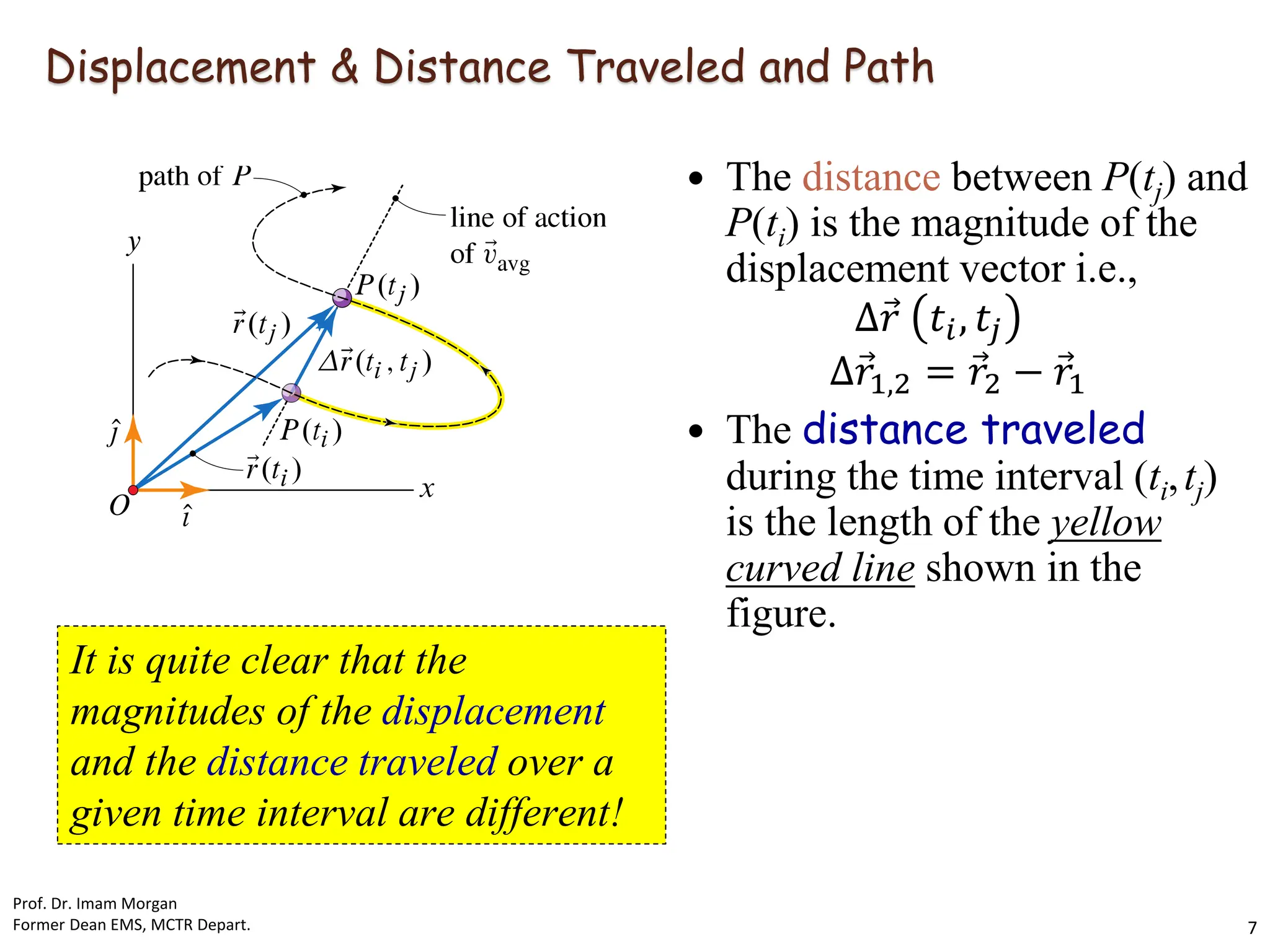
 The distance between P(tj) and
P(ti) is the magnitude of the
displacement vector i.e.,
∆Ԧ
𝑟 𝑡𝑖, 𝑡𝑗
∆Ԧ
𝑟1,2 = Ԧ
𝑟2 − Ԧ
𝑟1
 The distance traveled
during the time interval (ti,tj)
is the length of the yellow
curved line shown in the
figure.
It is quite clear that the
magnitudes of the displacement
and the distance traveled over a
given time interval are different!
Displacement & Distance Traveled and Path
Prof. Dr. Imam Morgan
Former Dean EMS, MCTR Depart. 7
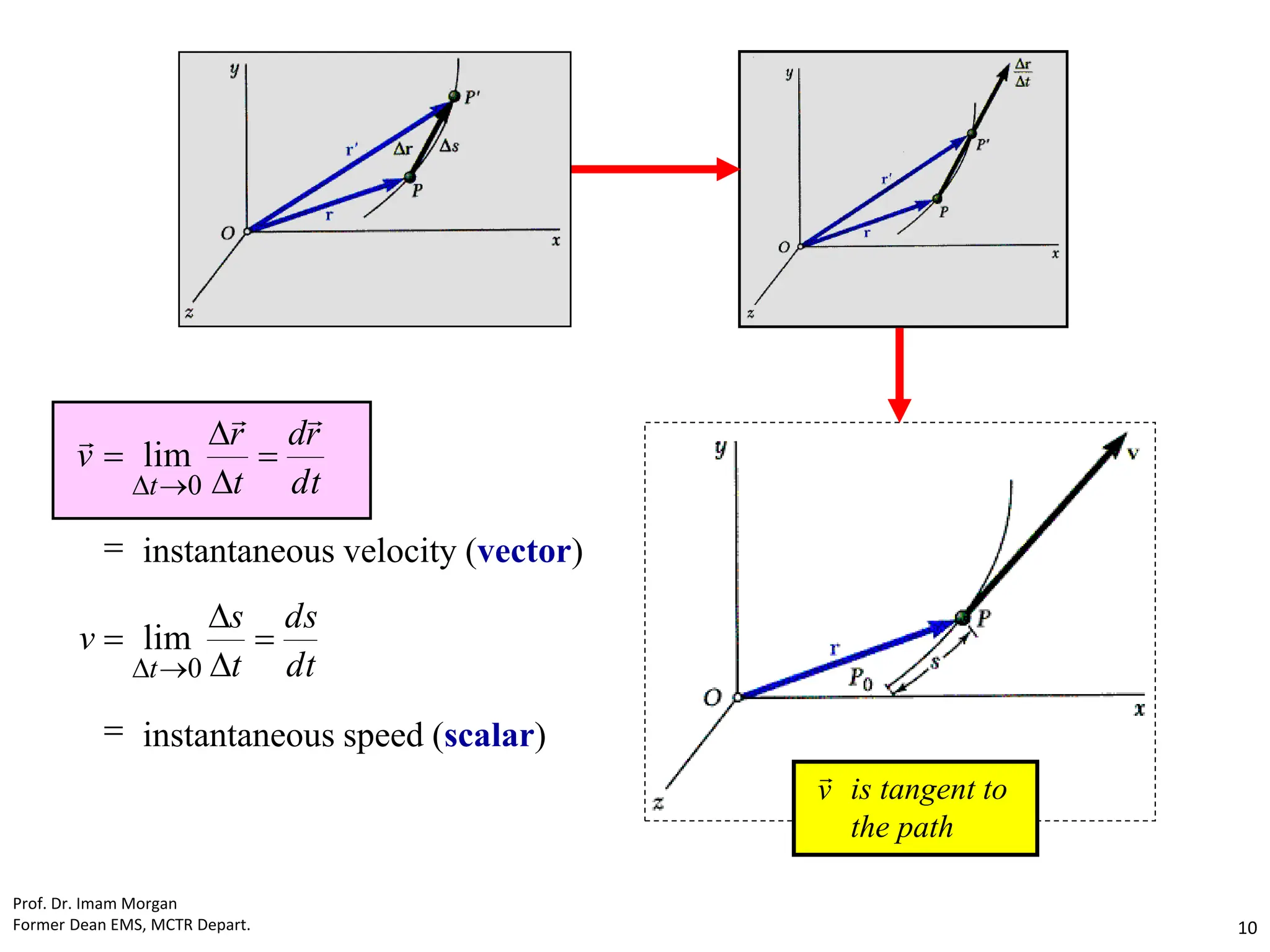
The average velocity: is defined by;
Ԧ
𝑣𝑎𝑣 =
∆Ԧ
𝑟
∆𝑡
The instantaneous velocity of the particle at
time t is obtained by considering
that𝑃′approaches P.
So, ∆Ԧ
𝑟 becomes shorter and shorter,
Hence, in the limit at t = 0 it tends to be in
tangent direction. (See next slide )
B Velocity Vector
displacement s
∆s
∆Ԧ
𝑟
Prof. Dr. Imam Morgan
Former Dean EMS, MCTR Depart. 8
Velocity and Path
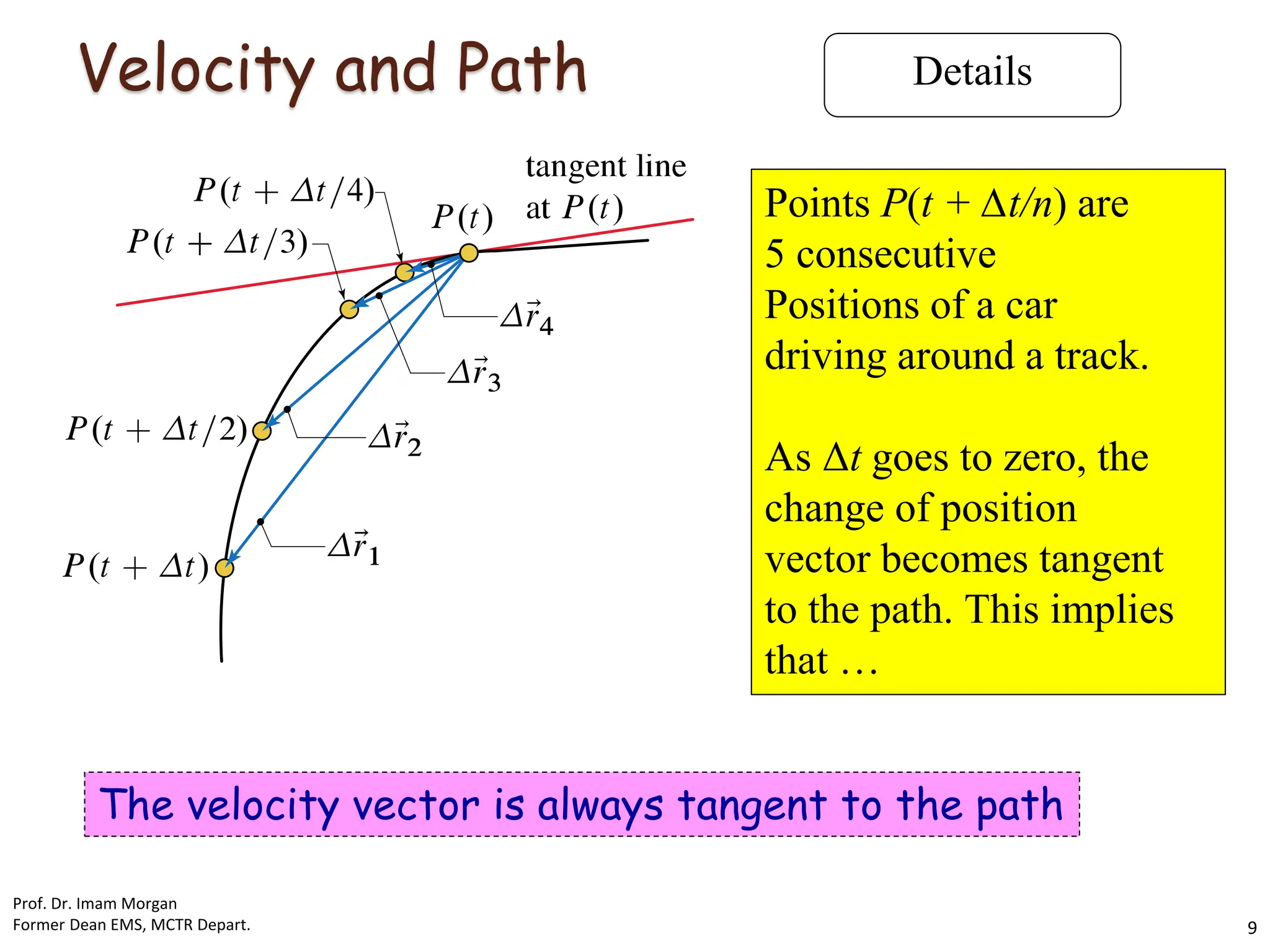
Points P(t + ∆t/n) are
5 consecutive
Positions of a car
driving around a track.
As Δt goes to zero, the
change of position
vector becomes tangent
to the path. This implies
that …
The velocity vector is always tangent to the path
Details
Prof. Dr. Imam Morgan
Former Dean EMS, MCTR Depart. 9














dt
ds
t
s
v
dt
r
d
t
r
v
t
t
0
0
lim
lim



instantaneous velocity (vector)
instantaneous speed (scalar)
is tangent to
the path
v

Prof. Dr. Imam Morgan
Former Dean EMS, MCTR Depart. 10
C Acceleration Vector
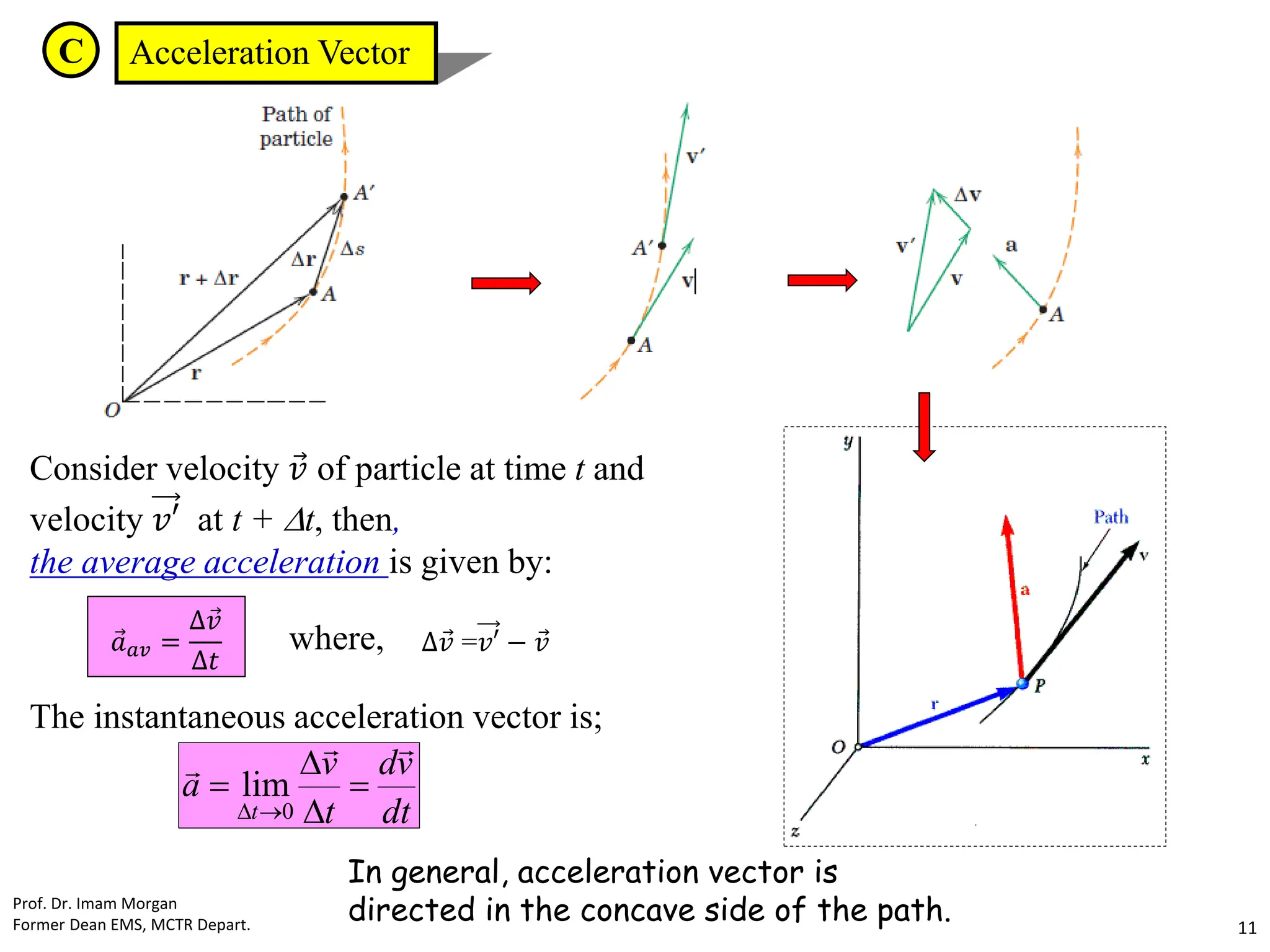
The instantaneous acceleration vector is;
Consider velocity Ԧ
𝑣 of particle at time t and
velocity 𝑣′ at t + t, then,
the average acceleration is given by:
∆ Ԧ
𝑣 =𝑣′ − Ԧ
𝑣
Ԧ
𝑎𝑎𝑣 =
∆ Ԧ
𝑣
∆𝑡
In general, acceleration vector is
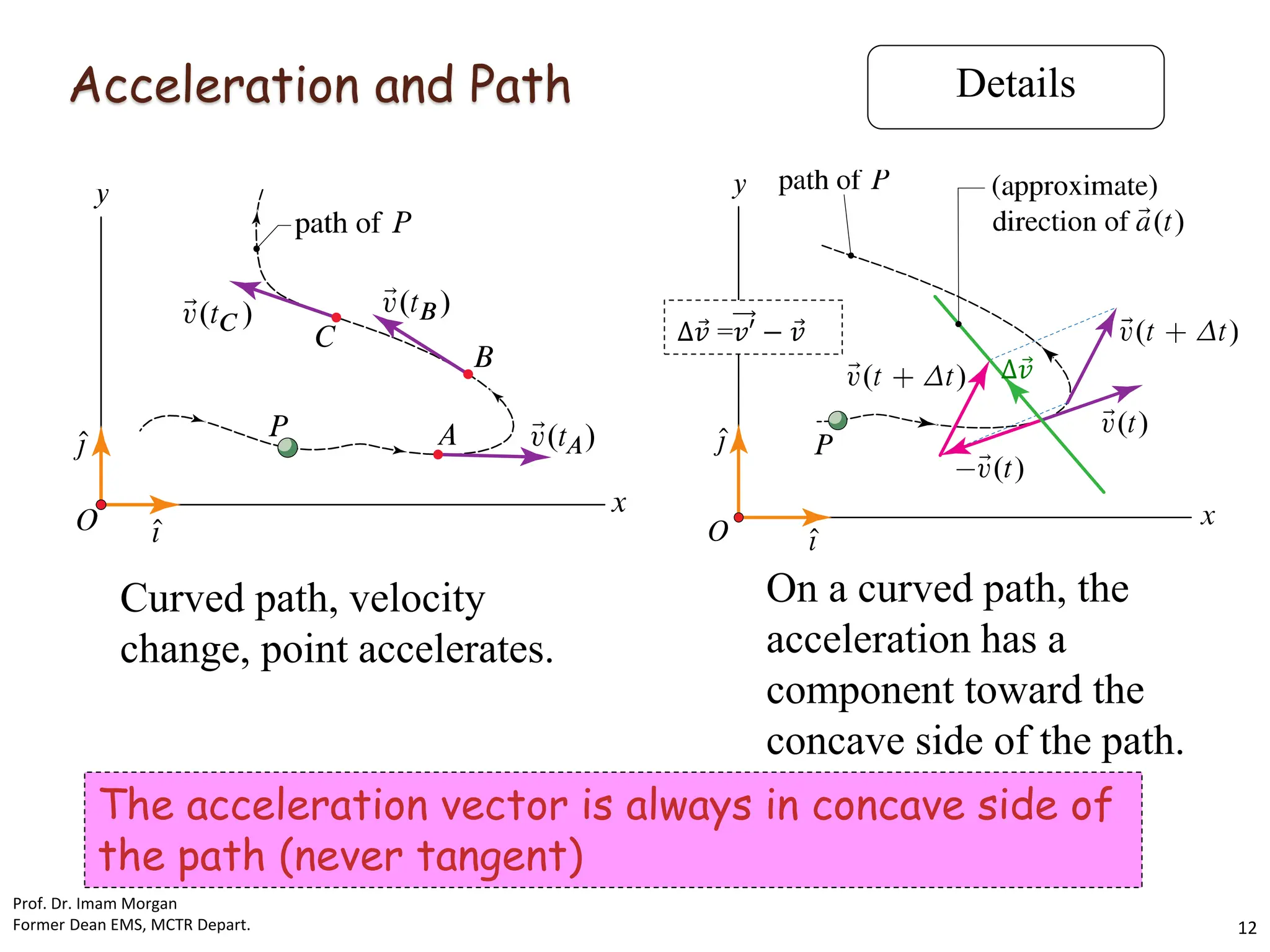
directed in the concave side of the path.
dt
v
d
t
v
a
t








 0
lim
where,
Prof. Dr. Imam Morgan
Former Dean EMS, MCTR Depart. 11
On a curved path, the
acceleration has a
component toward the
concave side of the path.
Curved path, velocity
change, point accelerates.
Acceleration and Path
The acceleration vector is always in concave side of
the path (never tangent)
Details
∆ Ԧ
𝑣 =𝑣′ − Ԧ
𝑣
∆ Ԧ
𝑣
Prof. Dr. Imam Morgan
Former Dean EMS, MCTR Depart. 12
motion
of
direction
the
give
not
does
side)
concave
(in
path
the
t to
not tangen
on vector
accelerati
...
motion
of
direction
the
gives
path
the
to
tangent
vector
velocity
...
ector
position v
...
dt
v
d
a
a
dt
r
d
v
v
r









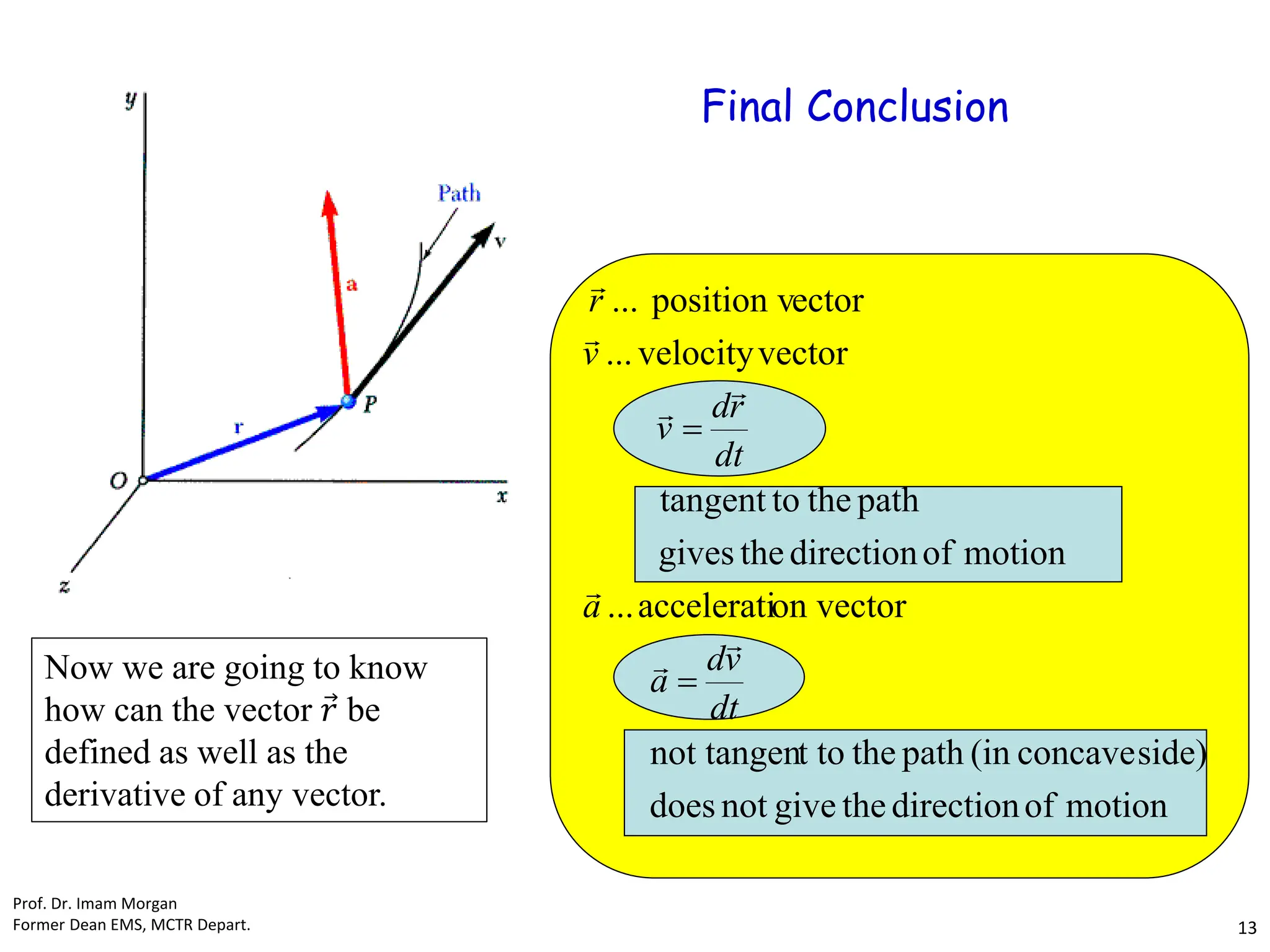
Final Conclusion
Now we are going to know
how can the vector Ԧ
𝑟 be
defined as well as the
derivative of any vector.
Prof. Dr. Imam Morgan
Former Dean EMS, MCTR Depart. 13
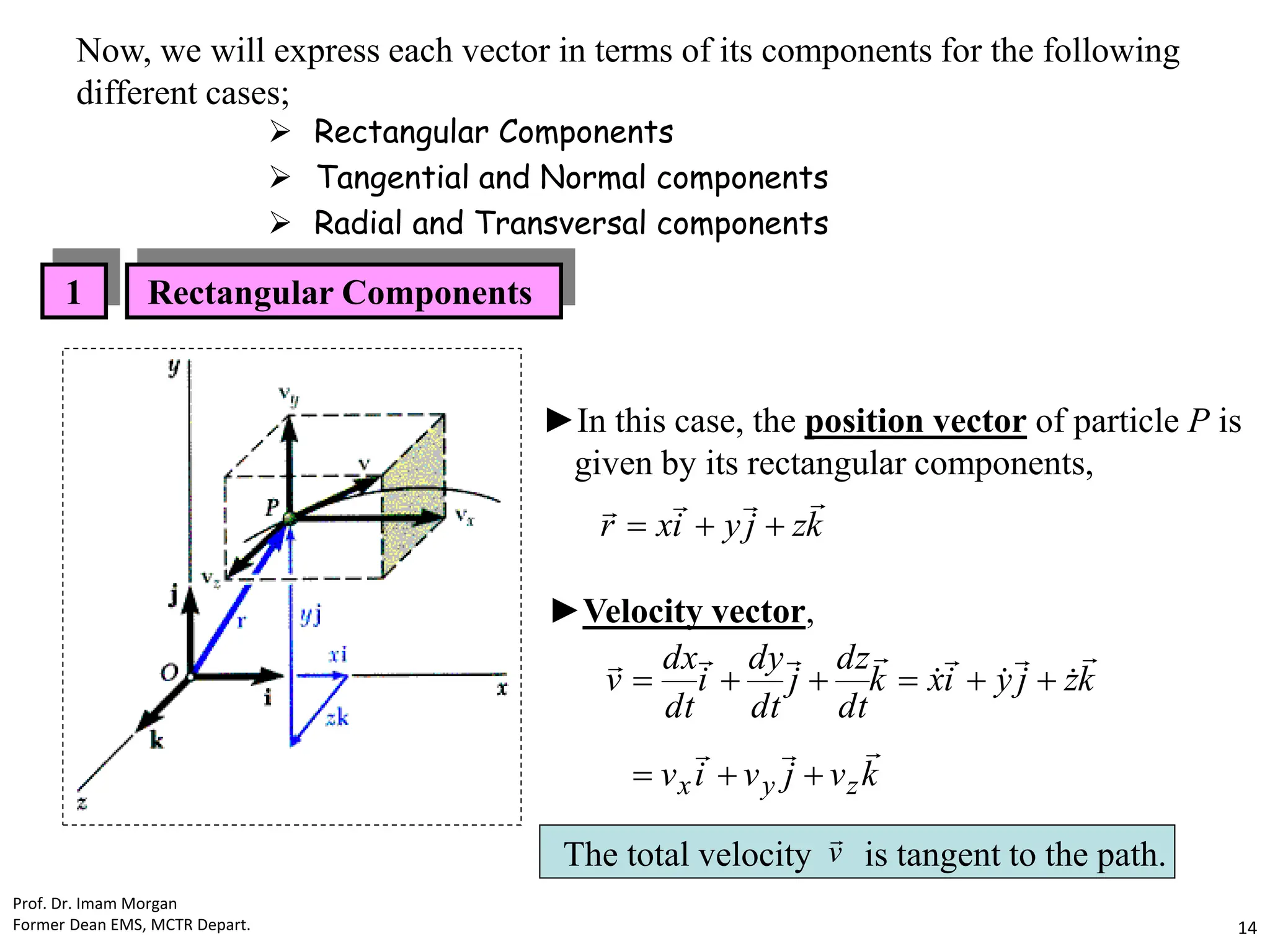
►In this case, the position vector of particle P is
given by its rectangular components,
k
z
j
y
i
x
r







►Velocity vector,
k
v
j
v
i
v
k
z
j
y
i
x
k
dt
dz
j
dt
dy
i
dt
dx
v
z
y
x






















The total velocity is tangent to the path.
v

1 Rectangular Components
Now, we will express each vector in terms of its components for the following
different cases;
 Rectangular Components
 Tangential and Normal components
 Radial and Transversal components
Prof. Dr. Imam Morgan
Former Dean EMS, MCTR Depart. 14
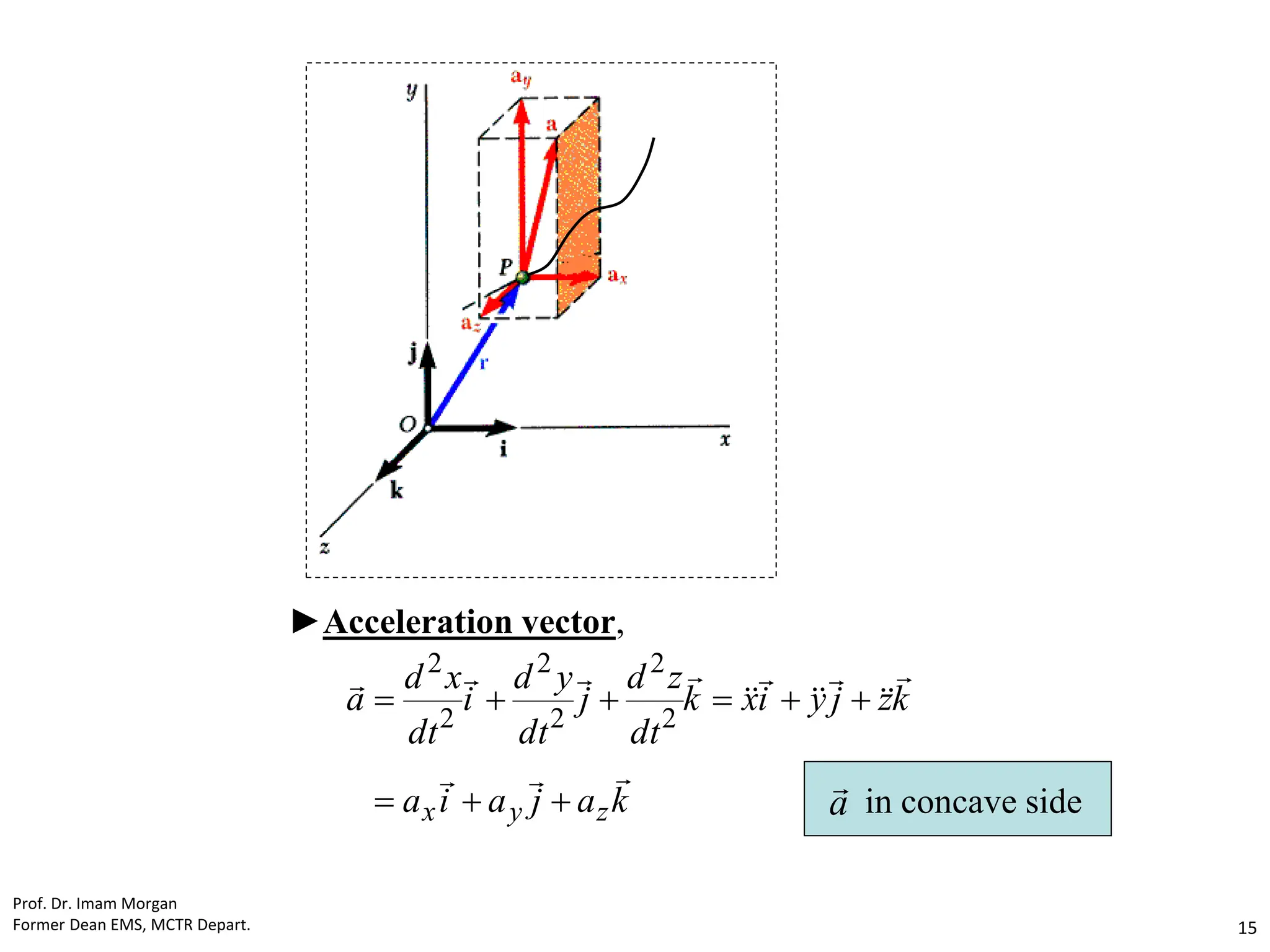
►Acceleration vector,
k
a
j
a
i
a
k
z
j
y
i
x
k
dt
z
d
j
dt
y
d
i
dt
x
d
a
z
y
x
























 2
2
2
2
2
2
a

in concave side
Prof. Dr. Imam Morgan
Former Dean EMS, MCTR Depart. 15
Prof. Dr. Imam Morgan
Former Dean EMS, MCTR Depart. 16
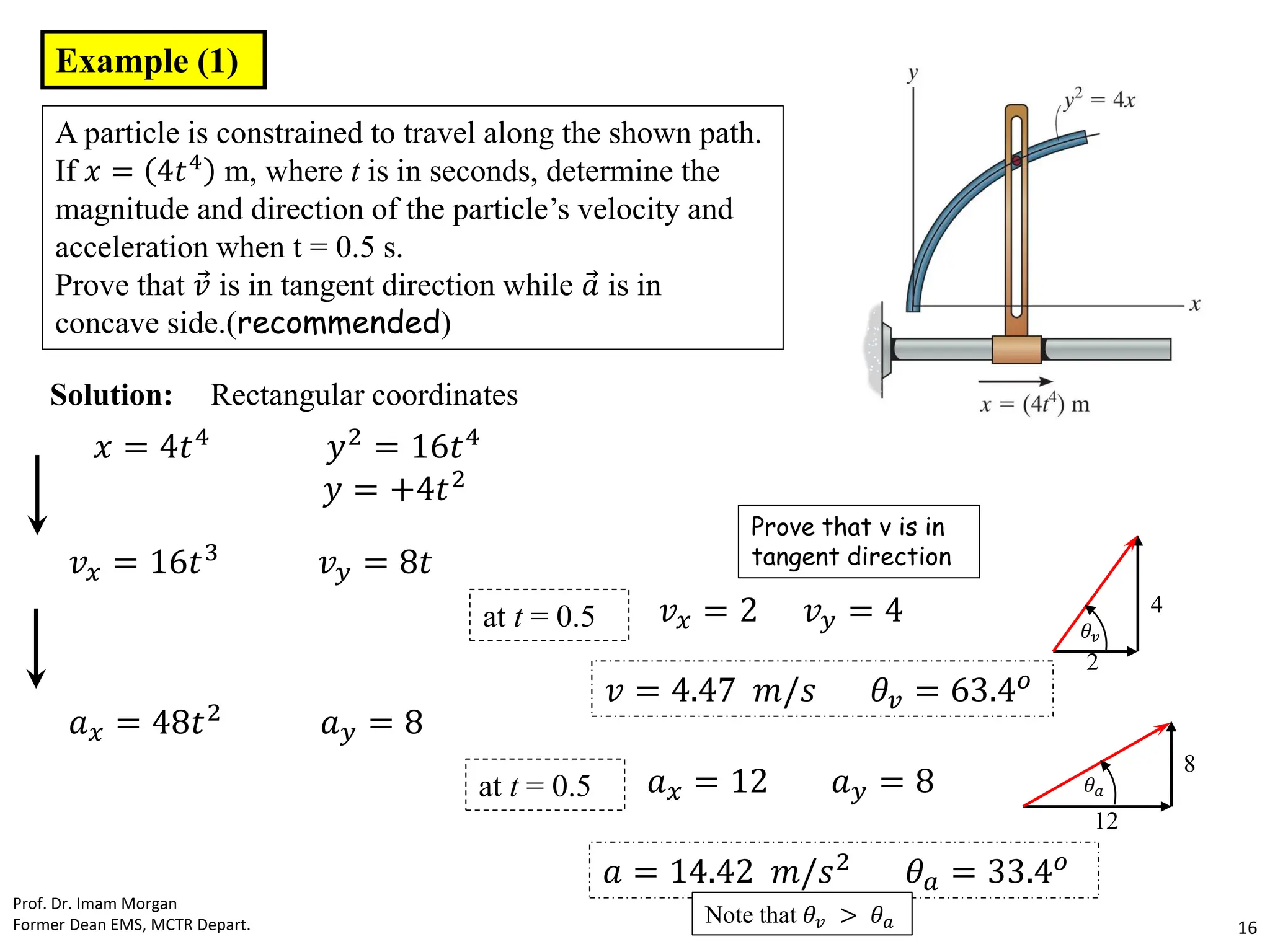
Example (1)
A particle is constrained to travel along the shown path.
If 𝑥 = 4𝑡4 m, where t is in seconds, determine the
magnitude and direction of the particle’s velocity and
acceleration when t = 0.5 s.
Prove that Ԧ
𝑣 is in tangent direction while Ԧ
𝑎 is in
concave side.(recommended)
Solution: Rectangular coordinates
𝑥 = 4𝑡4 𝑦2 = 16𝑡4
𝑦 = +4𝑡2
𝑣𝑥 = 16𝑡3 𝑣𝑦 = 8𝑡
𝑎𝑥 = 48𝑡2 𝑎𝑦 = 8
𝑣𝑥 = 2 𝑣𝑦 = 4
𝑎𝑥 = 12 𝑎𝑦 = 8
𝑣 = 4.47 𝑚/𝑠 𝜃𝑣 = 63.4𝑜
𝑎 = 14.42 𝑚/𝑠2 𝜃𝑎 = 33.4𝑜
𝜃𝑎
12
8
𝜃𝑣
2
4
at t = 0.5
at t = 0.5
Prove that v is in
tangent direction
Note that 𝜃𝑣 > 𝜃𝑎
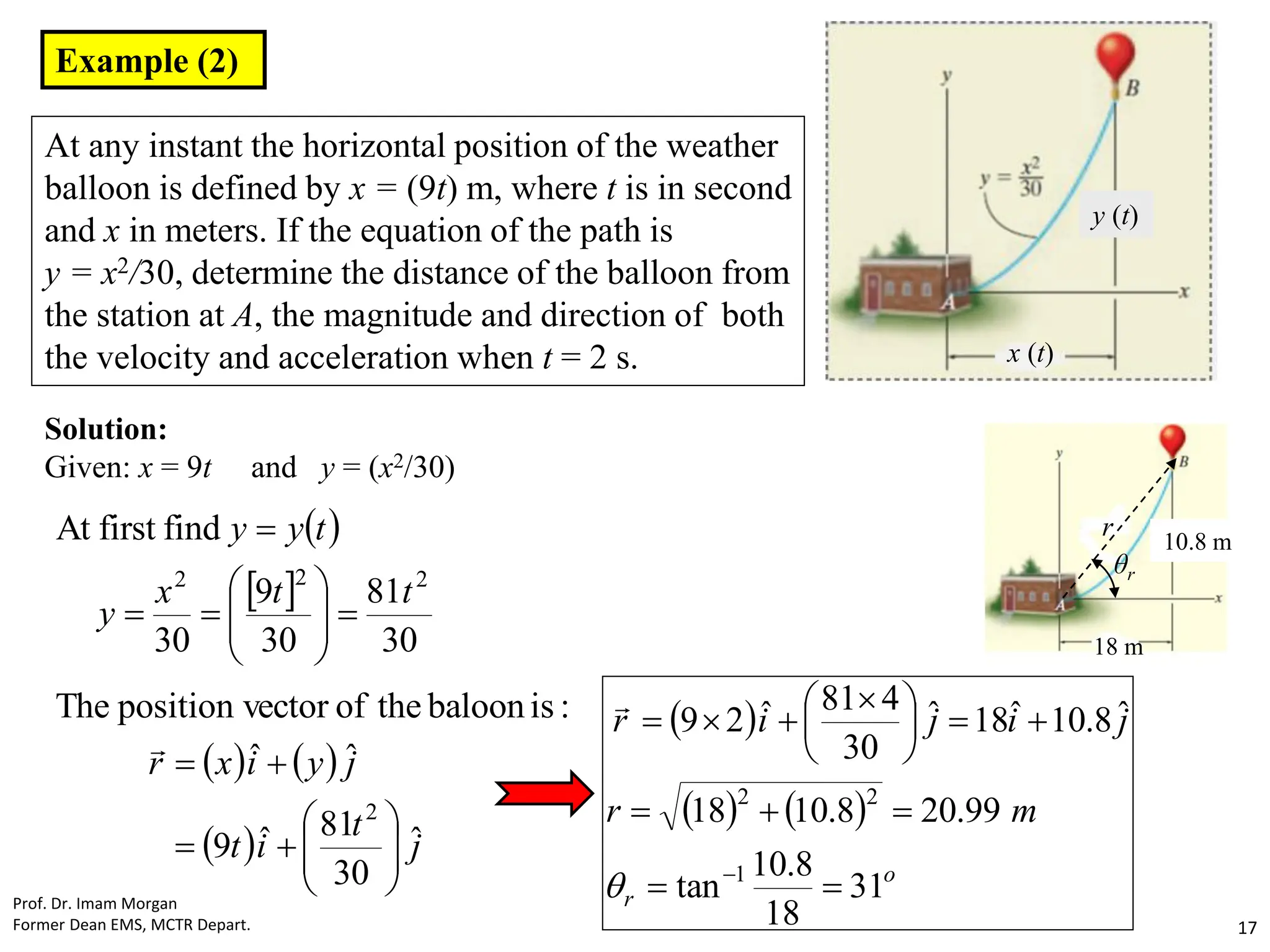
Example (2)
At any instant the horizontal position of the weather
balloon is defined by x = (9t) m, where t is in second
and x in meters. If the equation of the path is
y = x2/30, determine the distance of the balloon from
the station at A, the magnitude and direction of both
the velocity and acceleration when t = 2 s.
Solution:
Given: x = 9t and y = (x2/30)
   
  j
t
i
t
j
y
i
x
r
ˆ
30
81
ˆ
9
ˆ
ˆ
:
is
baloon
the
of
ector
position v
The
2













 
 
30
81
30
9
30
find
first
At
2
2
2
t
t
x
y
t
y
y












x (t)
y (t)
 
   
o
r
m
r
j
i
j
i
r
31
18
8
.
10
tan
99
.
20
8
.
10
18
ˆ
8
.
10
ˆ
18
ˆ
30
4
81
ˆ
2
9
1
2
2












 






r
18 m
10.8 m
θr
Prof. Dr. Imam Morgan
Former Dean EMS, MCTR Depart. 17
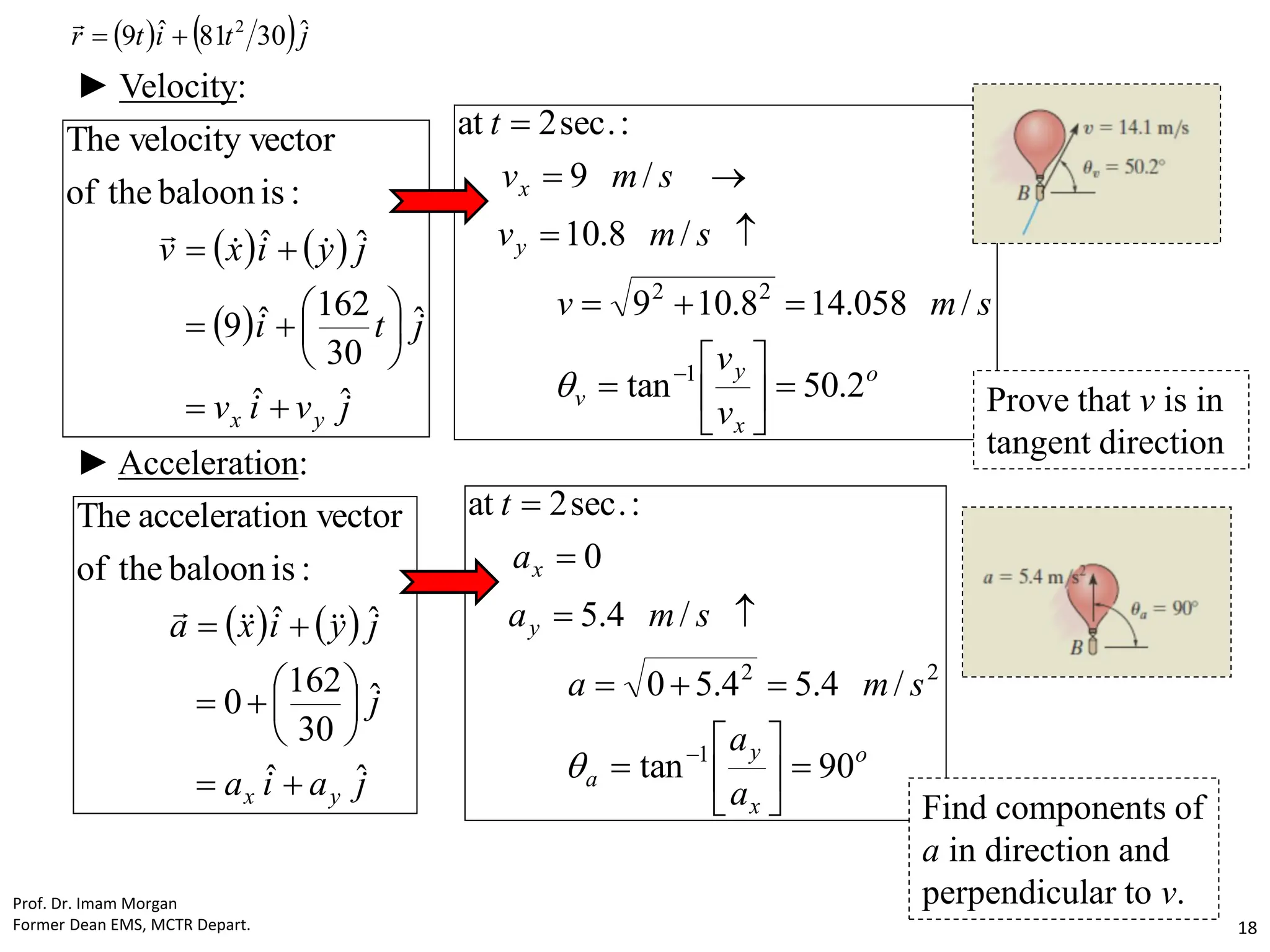
► Velocity:
   
 
j
v
i
v
j
t
i
j
y
i
x
v
y
x
ˆ
ˆ
ˆ
30
162
ˆ
9
ˆ
ˆ
:
is
baloon
the
of
vector
velocity
The











 


o
x
y
v
y
x
v
v
s
m
v
s
m
v
s
m
v
t
2
.
50
tan
/
058
.
14
8
.
10
9
/
8
.
10
/
9
:
.
sec
2
at
1
2
2


















► Acceleration:
   
j
a
i
a
j
j
y
i
x
a
y
x
ˆ
ˆ
ˆ
30
162
0
ˆ
ˆ
:
is
baloon
the
of
on vector
accelerati
The











 




o
x
y
a
y
x
a
a
s
m
a
s
m
a
a
t
90
tan
/
4
.
5
4
.
5
0
/
4
.
5
0
:
.
sec
2
at
1
2
2

















Prove that v is in
tangent direction
Find components of
a in direction and
perpendicular to v.
   j
t
i
t
r ˆ
30
81
ˆ
9 2



Prof. Dr. Imam Morgan
Former Dean EMS, MCTR Depart. 18
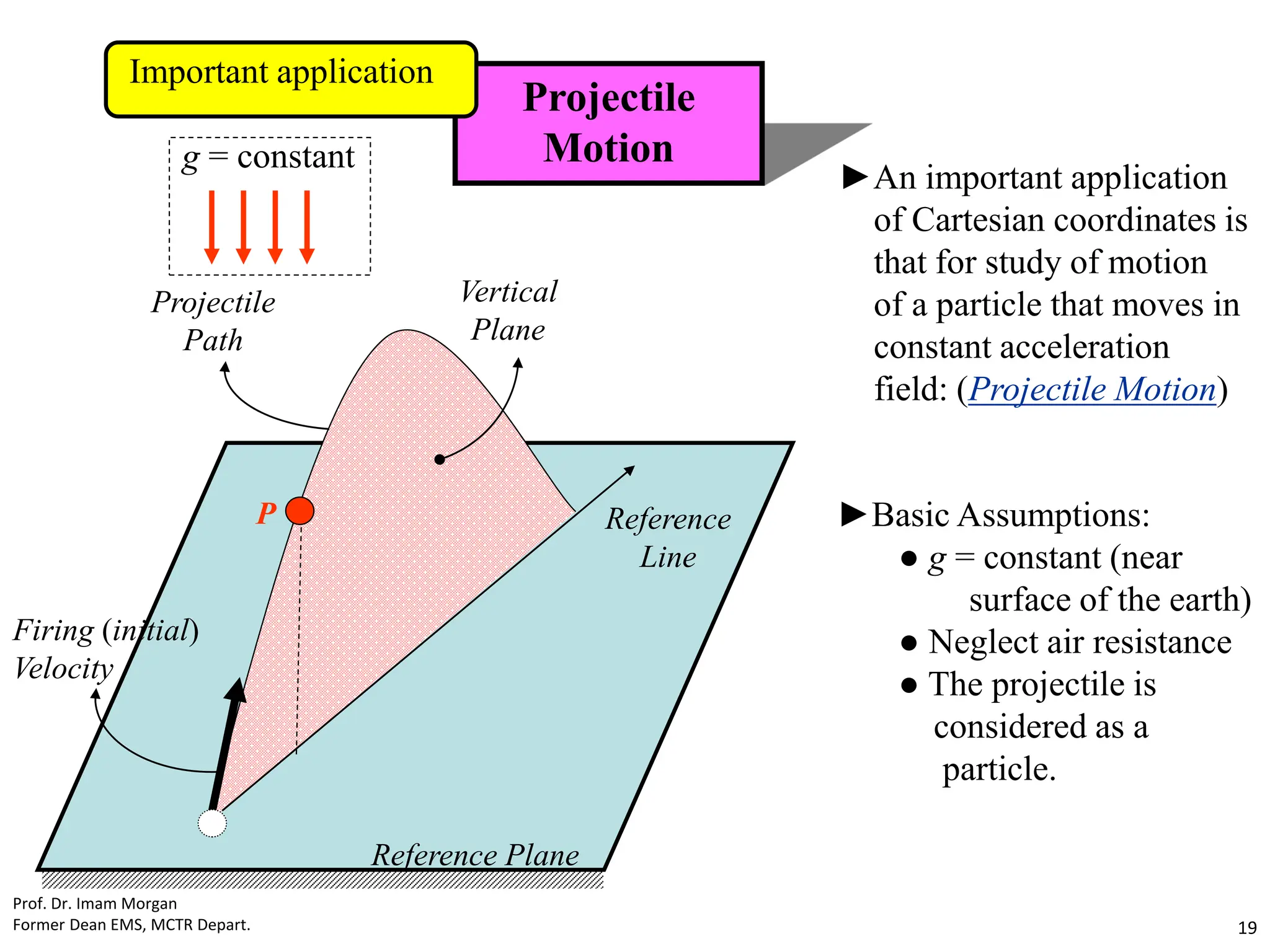
Projectile
Path
Vertical
Plane
Reference
Line
P
Firing (initial)
Velocity
Reference Plane
Projectile
Motion
►An important application
of Cartesian coordinates is
that for study of motion
of a particle that moves in
constant acceleration
field: (Projectile Motion)
►Basic Assumptions:
● g = constant (near
surface of the earth)
● Neglect air resistance
● The projectile is
considered as a
particle.
Important application
g = constant
Prof. Dr. Imam Morgan
Former Dean EMS, MCTR Depart. 19
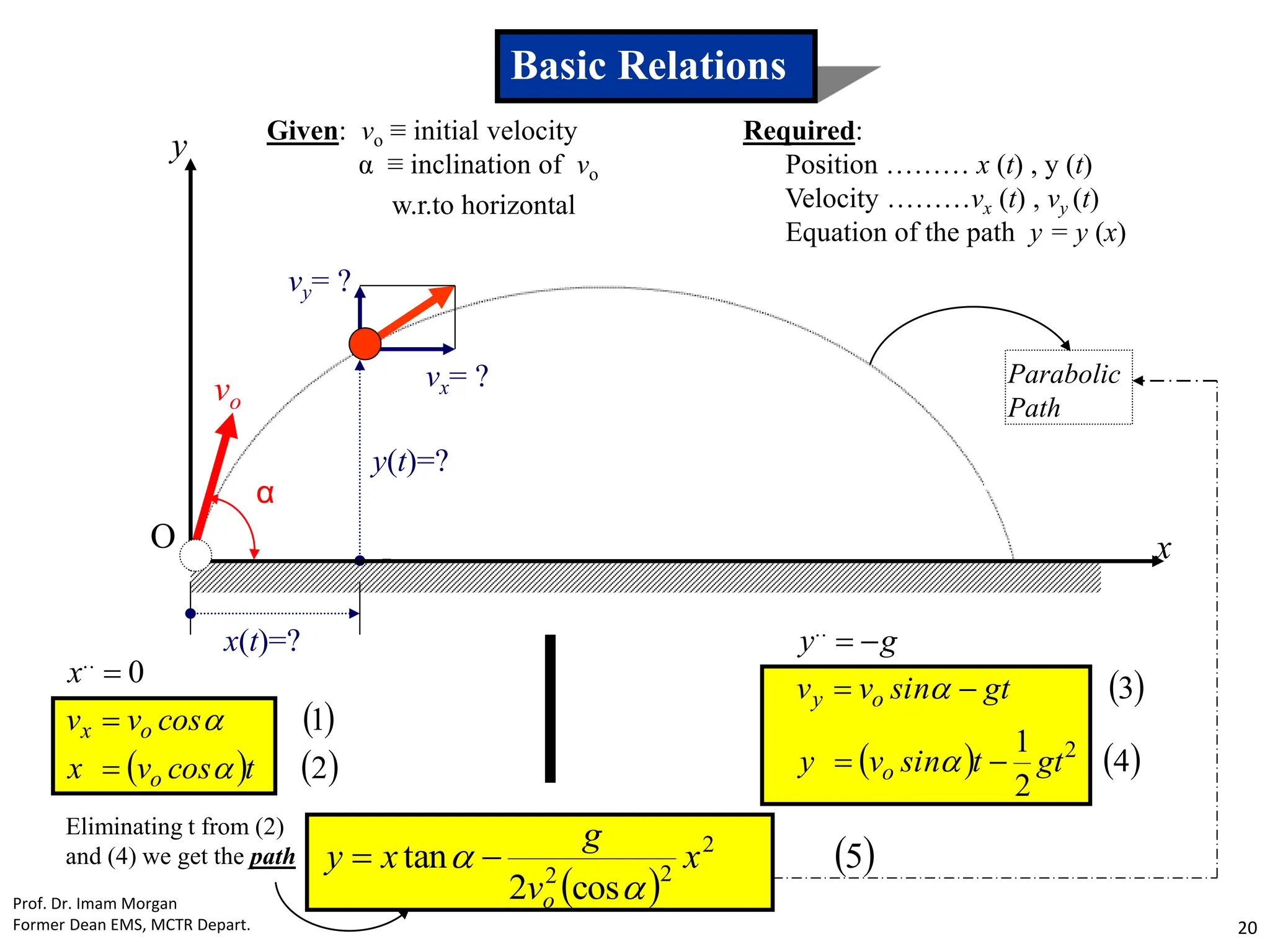
vo
vx= ?
vy= ?
y(t)=?
x(t)=?
α
Basic Relations
Given: vo ≡ initial velocity
α ≡ inclination of vo
w.r.to horizontal
Required:
Position ……… x (t) , y (t)
Velocity ………vx (t) , vy (t)
Equation of the path y = y (x)
 
   
2
1
0
t
cos
v
x
cos
v
v
x
o
o
x
..




  
   
4
2
1
3
2
gt
t
sin
v
y
gt
sin
v
v
g
y
o
o
y
..








Eliminating t from (2)
and (4) we get the path
x
y
O
 
 
5
cos
2
tan 2
2
2
x
v
g
x
y
o 
 

Parabolic
Path
Prof. Dr. Imam Morgan
Former Dean EMS, MCTR Depart. 20
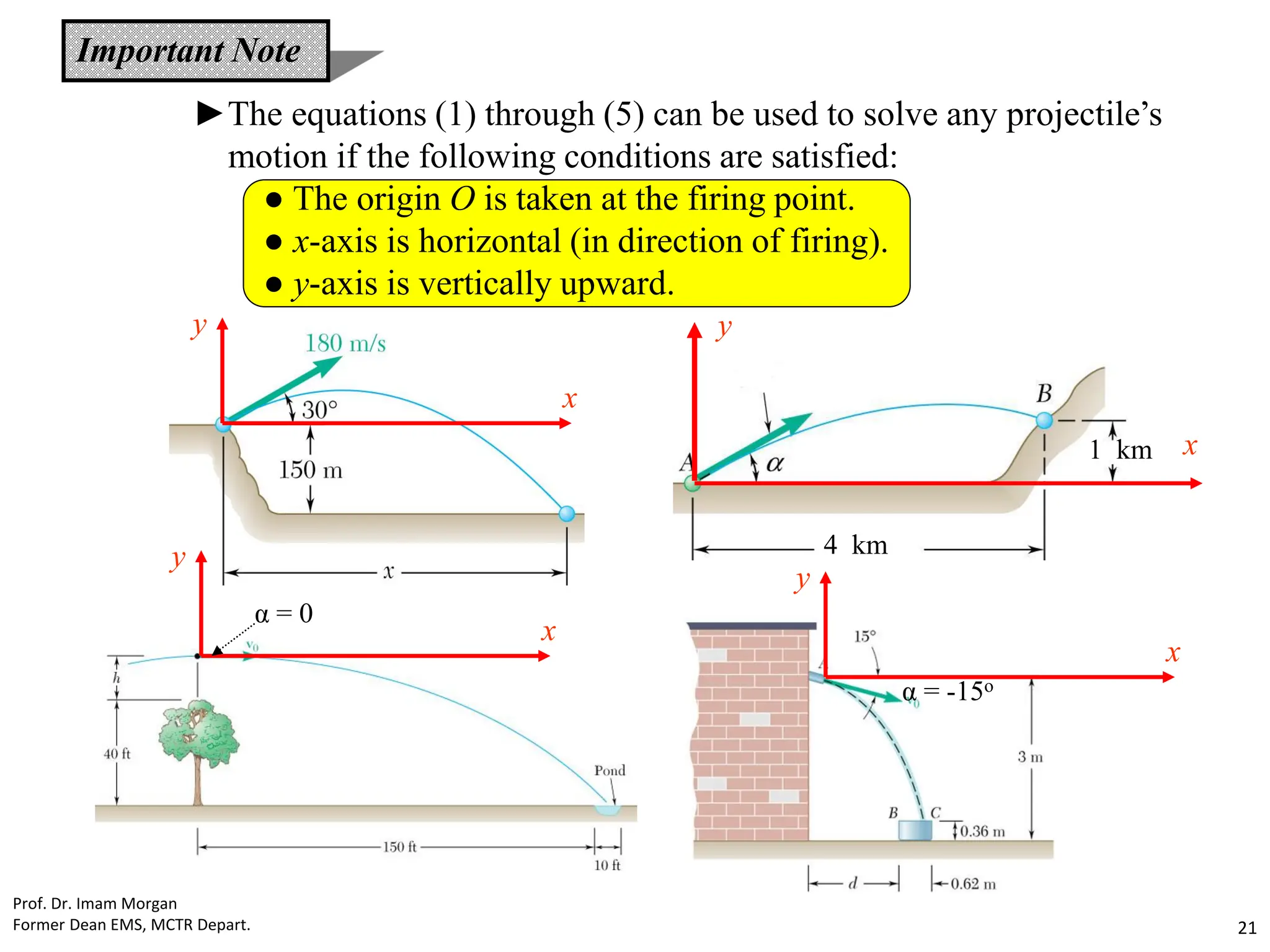
Important Note
►The equations (1) through (5) can be used to solve any projectile’s
motion if the following conditions are satisfied:
● The origin O is taken at the firing point.
● x-axis is horizontal (in direction of firing).
● y-axis is vertically upward.
x
y
α = 0
x
y
α = -15o
4 km
1 km x
y
x
y
Prof. Dr. Imam Morgan
Former Dean EMS, MCTR Depart. 21
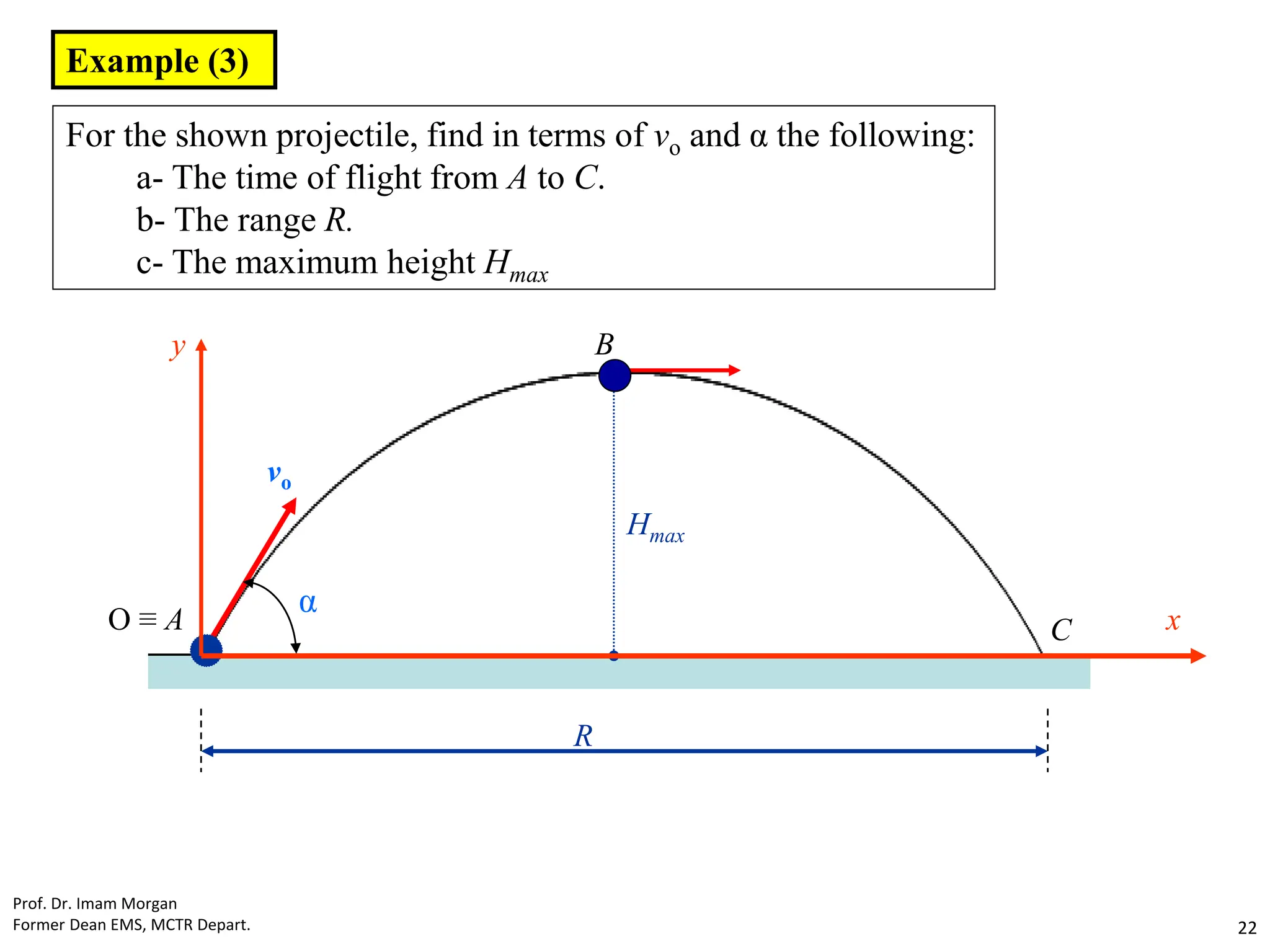
For the shown projectile, find in terms of vo and α the following:
a- The time of flight from A to C.
b- The range R.
c- The maximum height Hmax
C
B
O ≡ A
Hmax
R
x
y
vo
α
Example (3)
Prof. Dr. Imam Morgan
Former Dean EMS, MCTR Depart. 22
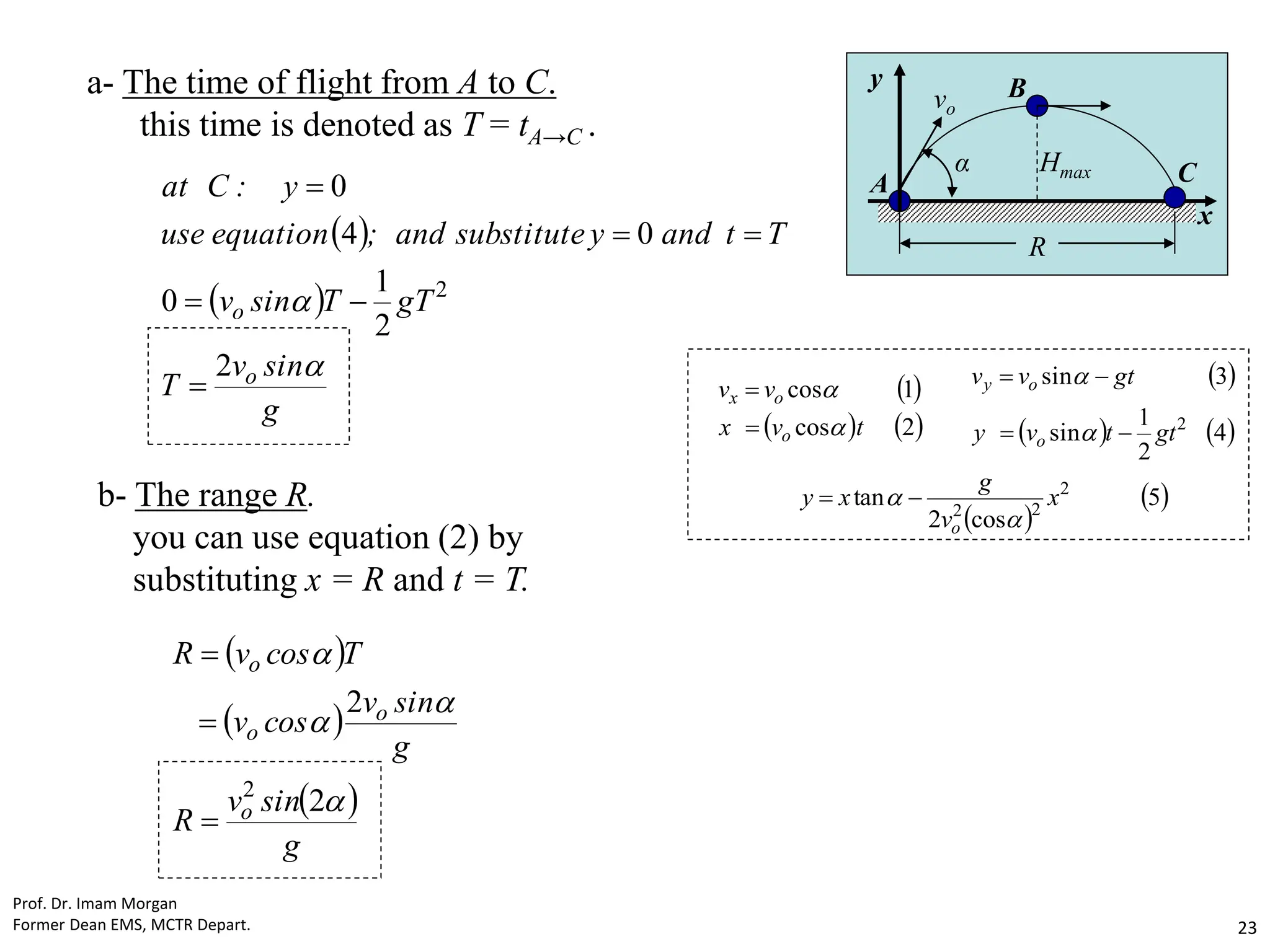
a- The time of flight from A to C.
this time is denoted as T = tA→C .
 
 
g
sin
v
T
gT
T
sin
v
T
t
and
y
substitute
and
;
equation
use
y
:
C
at
o
o


2
2
1
0
0
4
0
2






b- The range R.
you can use equation (2) by
substituting x = R and t = T.
 
 
 
g
sin
v
R
g
sin
v
cos
v
T
cos
v
R
o
o
o
o




2
2
2



C
B
A
vo
α
R
Hmax
y
x
 
   
2
cos
1
cos
t
v
x
v
v
o
o
x




 
   
4
2
1
sin
3
sin
2
gt
t
v
y
gt
v
v
o
o
y






 
 
5
cos
2
tan 2
2
2
x
v
g
x
y
o 
 

Prof. Dr. Imam Morgan
Former Dean EMS, MCTR Depart. 23
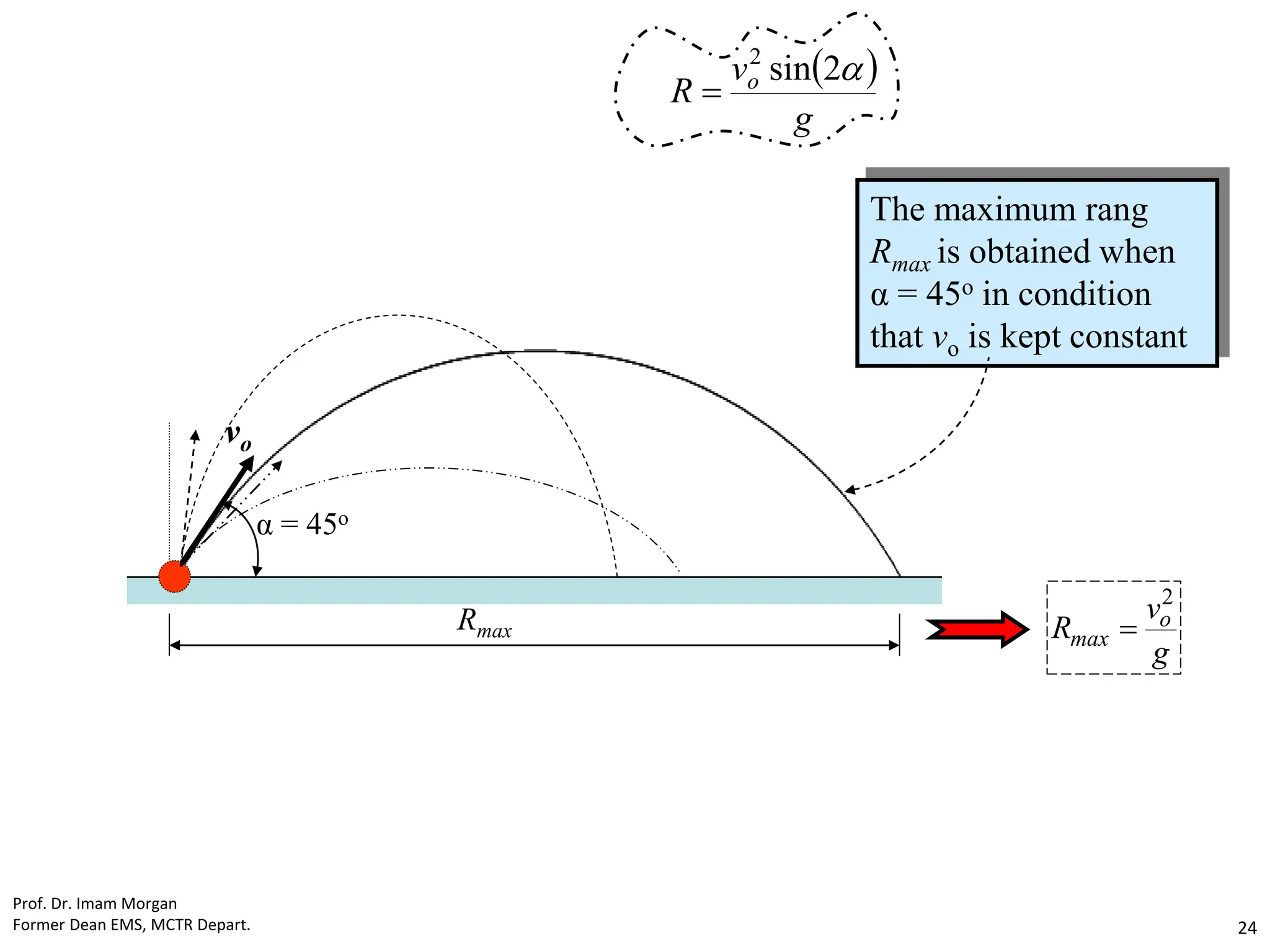
vo
α = 45o
Rmax
The maximum rang
Rmax is obtained when
α = 45o in condition
that vo is kept constant
g
v
R o
max
2

 
g
v
R o 
2
sin
2

Prof. Dr. Imam Morgan
Former Dean EMS, MCTR Depart. 24
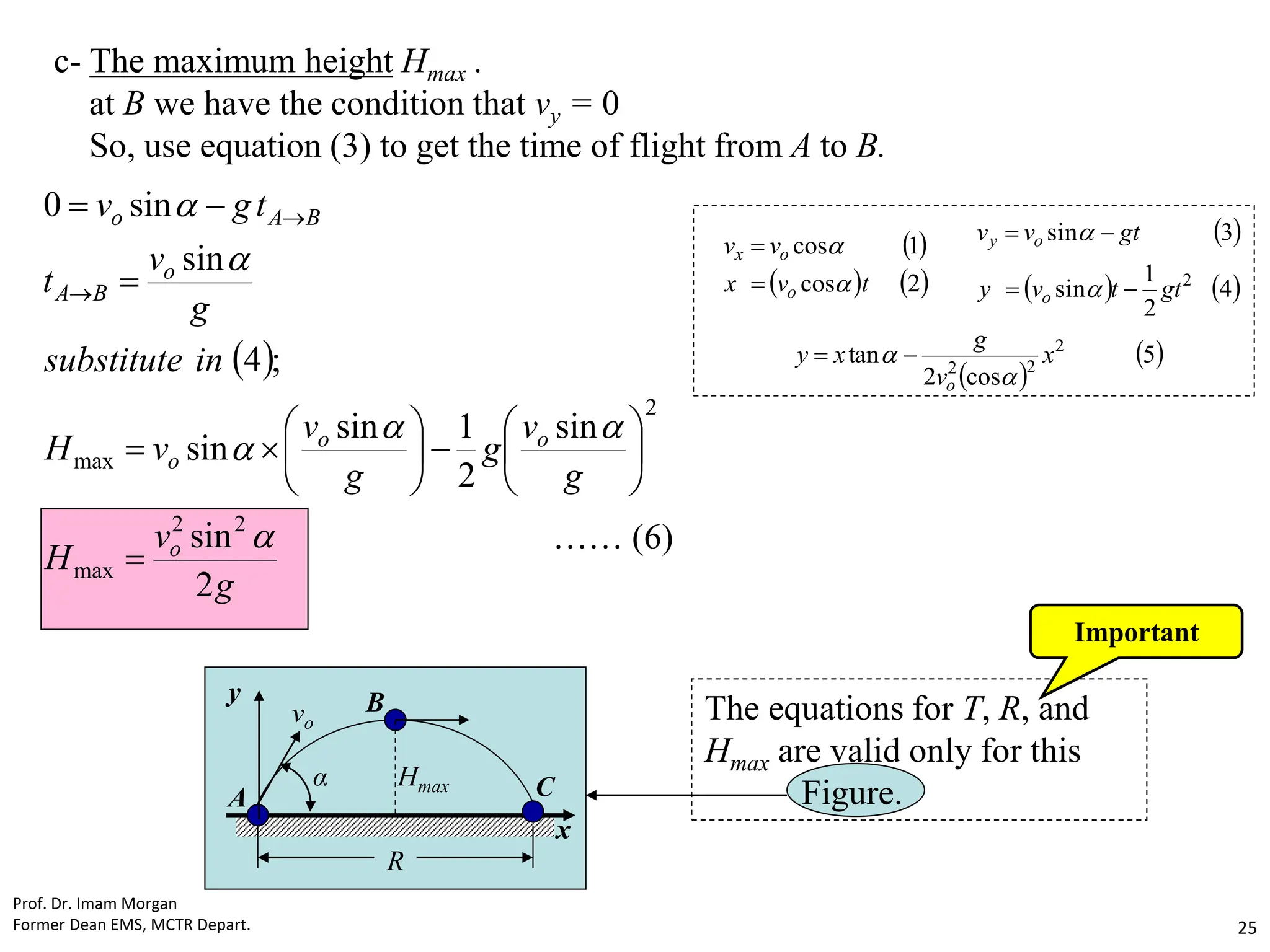
c- The maximum height Hmax .
at B we have the condition that vy = 0
So, use equation (3) to get the time of flight from A to B.
 
g
v
H
g
v
g
g
v
v
H
in
substitute
g
v
t
t
g
v
o
o
o
o
o
B
A
B
A
o
2
sin
sin
2
1
sin
sin
;
4
sin
sin
0
2
2
max
2
max



























…… (6)
The equations for T, R, and
Hmax are valid only for this
Figure.
Important
 
   
2
cos
1
cos
t
v
x
v
v
o
o
x




 
   
4
2
1
sin
3
sin
2
gt
t
v
y
gt
v
v
o
o
y






 
 
5
cos
2
tan 2
2
2
x
v
g
x
y
o 
 

C
B
A
vo
α
R
Hmax
y
x
Prof. Dr. Imam Morgan
Former Dean EMS, MCTR Depart. 25
C
B
O ≡ A
x
y
y
E
D
vE
vD
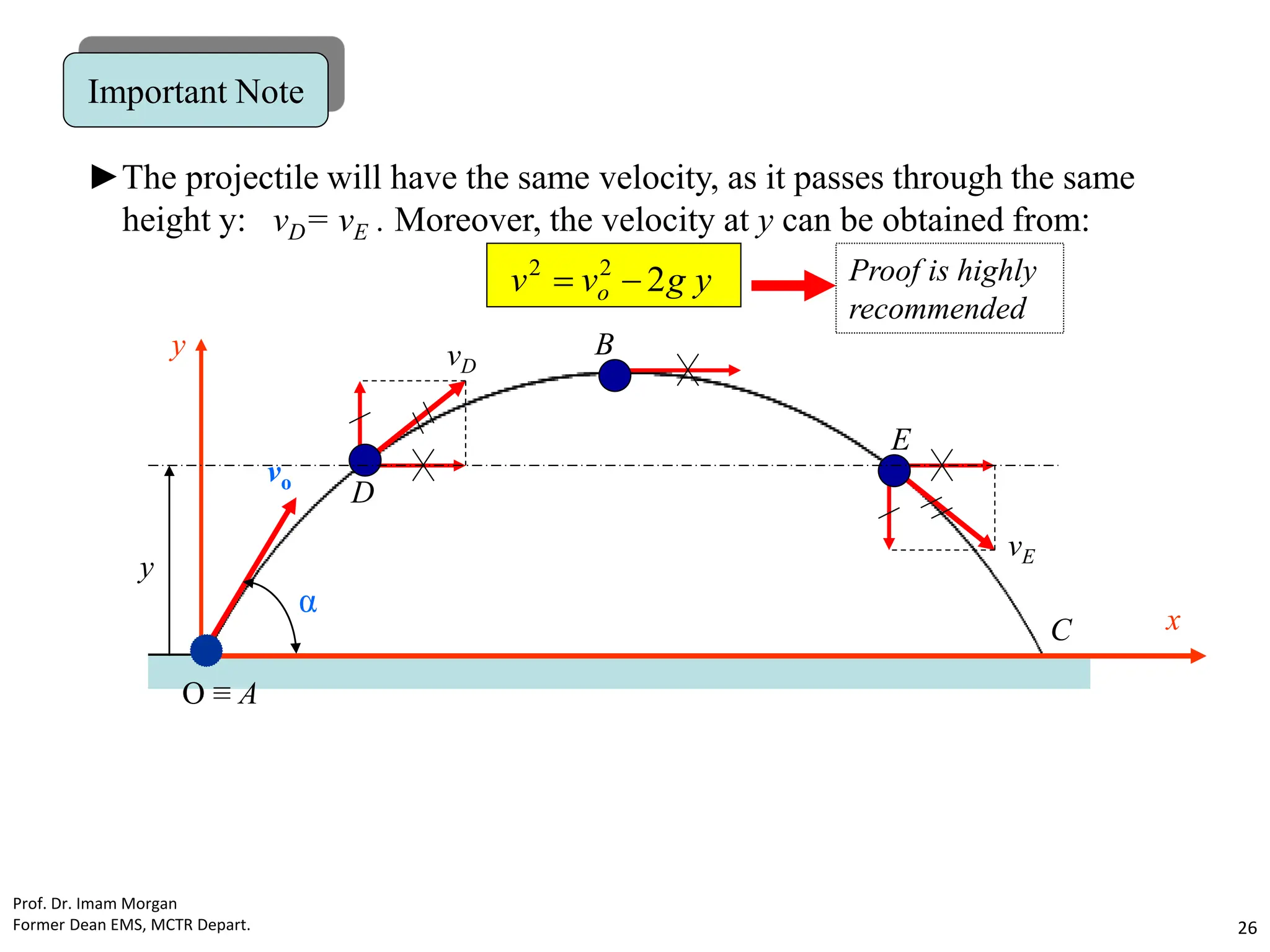
Important Note
►The projectile will have the same velocity, as it passes through the same
height y: vD= vE . Moreover, the velocity at y can be obtained from:
y
g
v
v o 2
2
2

 Proof is highly
recommended
vo
α
Prof. Dr. Imam Morgan
Former Dean EMS, MCTR Depart. 26
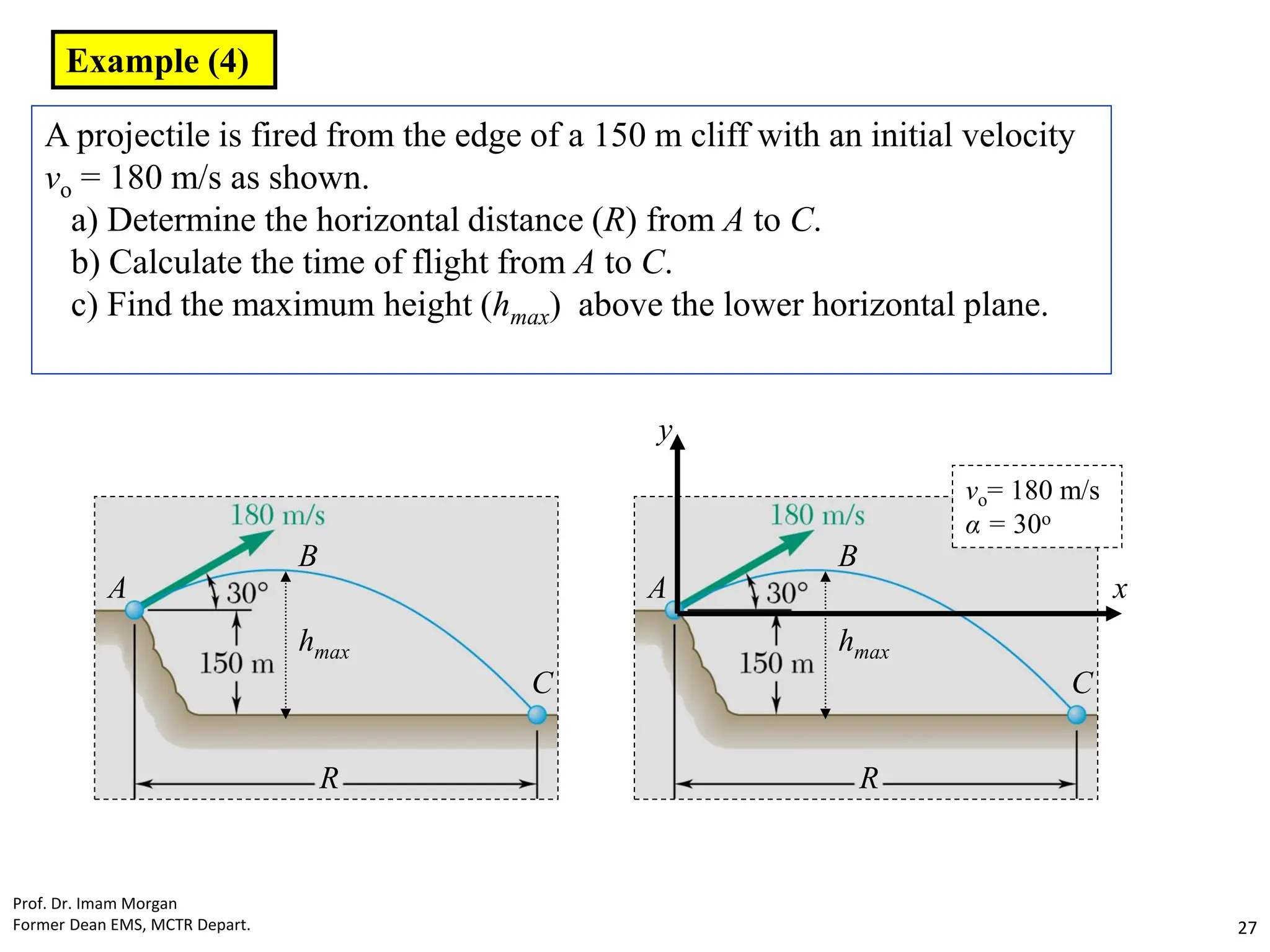
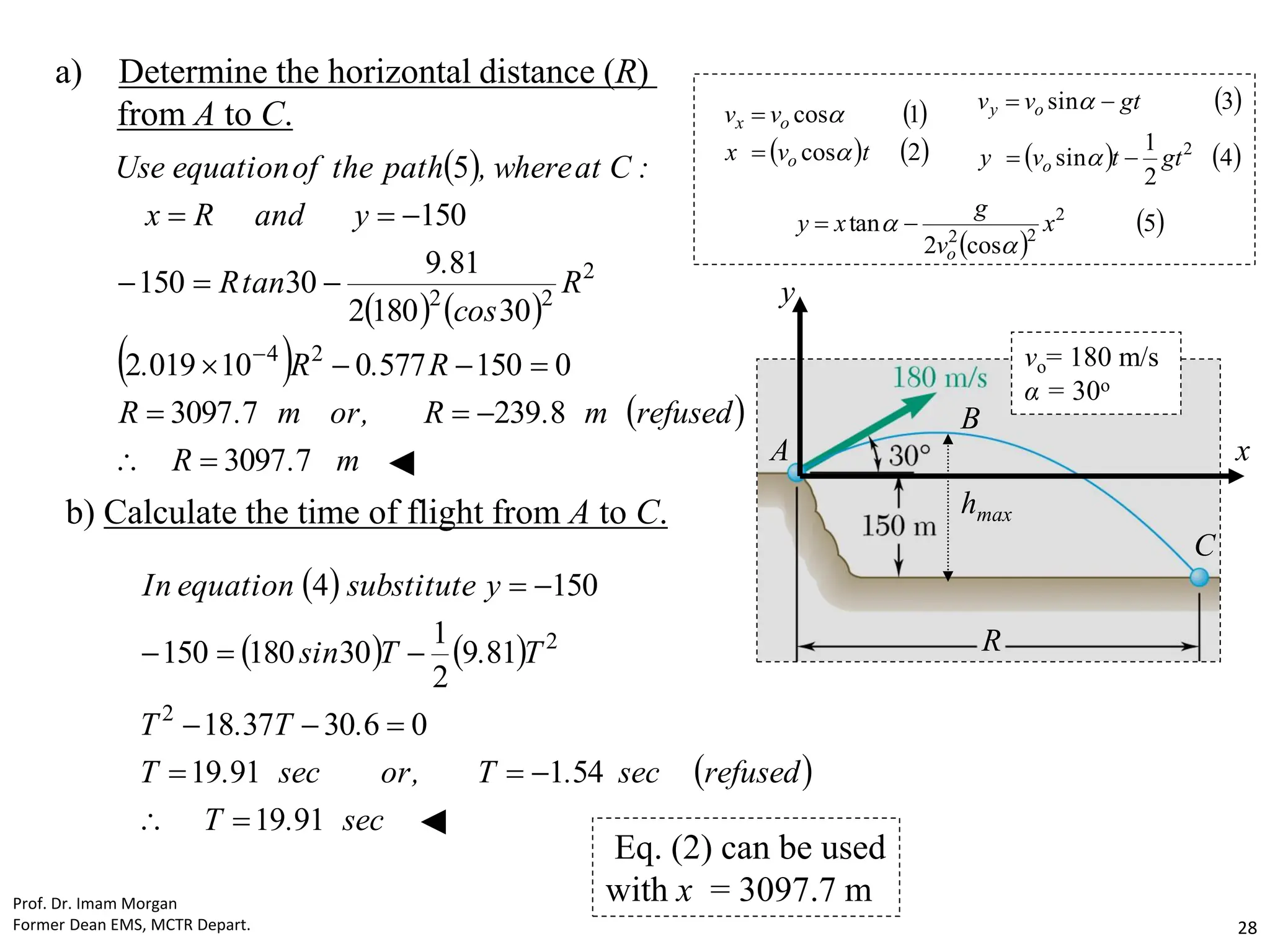
A projectile is fired from the edge of a 150 m cliff with an initial velocity
vo = 180 m/s as shown.
a) Determine the horizontal distance (R) from A to C.
b) Calculate the time of flight from A to C.
c) Find the maximum height (hmax) above the lower horizontal plane.
R
hmax
C
B
A
R
hmax
C
B
A
y
x
vo= 180 m/s
α = 30o
Example (4)
Prof. Dr. Imam Morgan
Former Dean EMS, MCTR Depart. 27
a) Determine the horizontal distance (R)
from A to C.
 
   
 
 
m
.
R
refused
m
.
R
,
or
m
.
R
R
.
R
.
R
cos
.
tan
R
y
and
R
x
:
C
at
where
,
path
the
of
equation
Use
7
3097
8
239
7
3097
0
150
577
0
10
019
2
30
180
2
81
9
30
150
150
5
2
4
2
2
2
















◄
b) Calculate the time of flight from A to C.
 
   
 
sec
.
T
refused
sec
.
T
,
or
sec
.
T
.
T
.
T
T
.
T
sin
y
substitute
equation
In
91
19
54
1
91
19
0
6
30
37
18
81
9
2
1
30
180
150
150
4
2
2













◄
R
hmax
C
B
A
y
x
vo= 180 m/s
α = 30o
Eq. (2) can be used
with x = 3097.7 m
 
   
2
cos
1
cos
t
v
x
v
v
o
o
x




 
   
4
2
1
sin
3
sin
2
gt
t
v
y
gt
v
v
o
o
y






 
 
5
cos
2
tan 2
2
2
x
v
g
x
y
o 
 

Prof. Dr. Imam Morgan
Former Dean EMS, MCTR Depart. 28
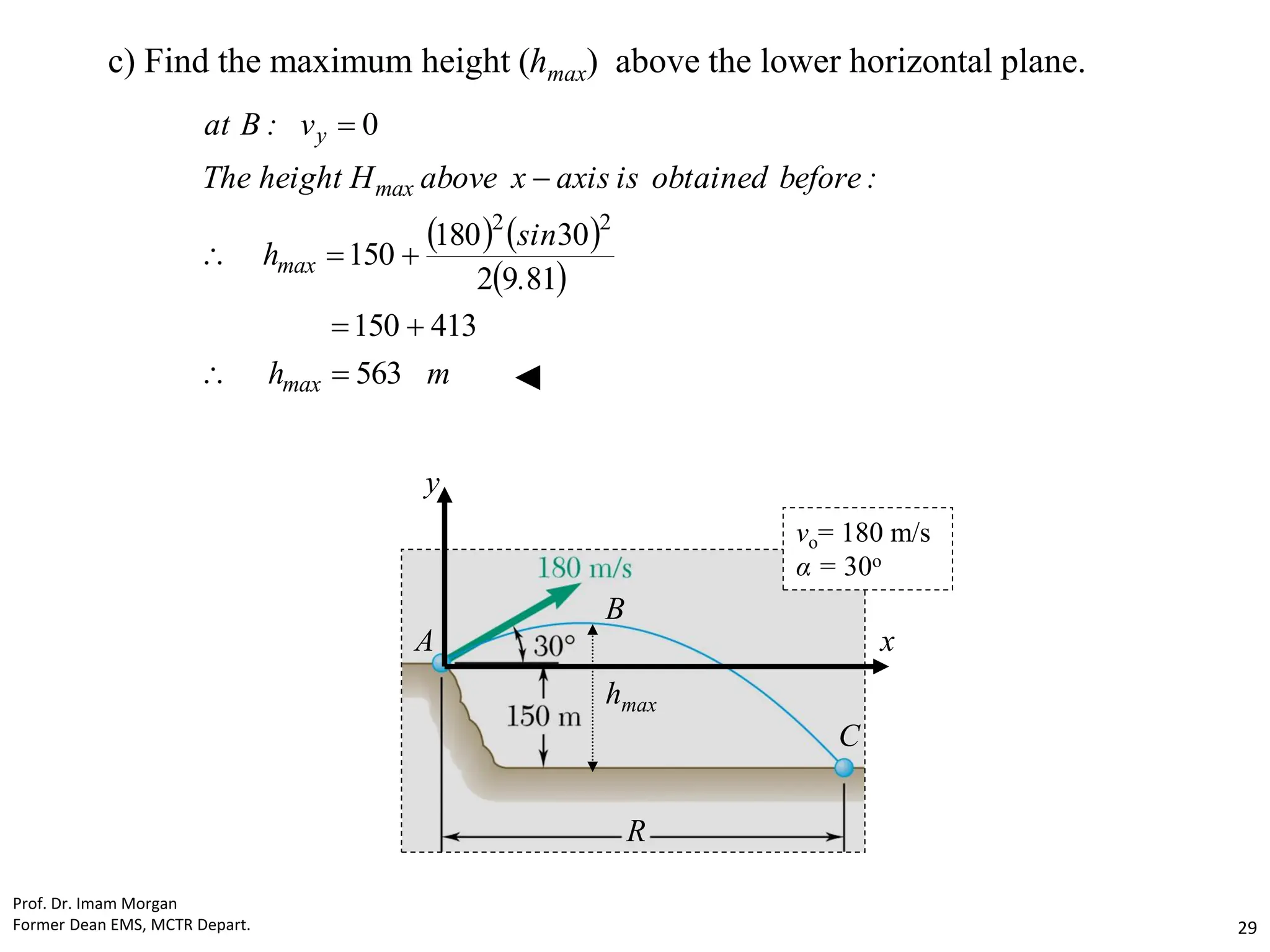
c) Find the maximum height (hmax) above the lower horizontal plane.
   
 
m
h
.
sin
h
:
before
obtained
is
axis
x
above
H
height
The
v
:
B
at
max
max
max
y
563
413
150
81
9
2
30
180
150
0
2
2









◄
R
hmax
C
B
A
y
x
vo= 180 m/s
α = 30o
Prof. Dr. Imam Morgan
Former Dean EMS, MCTR Depart. 29
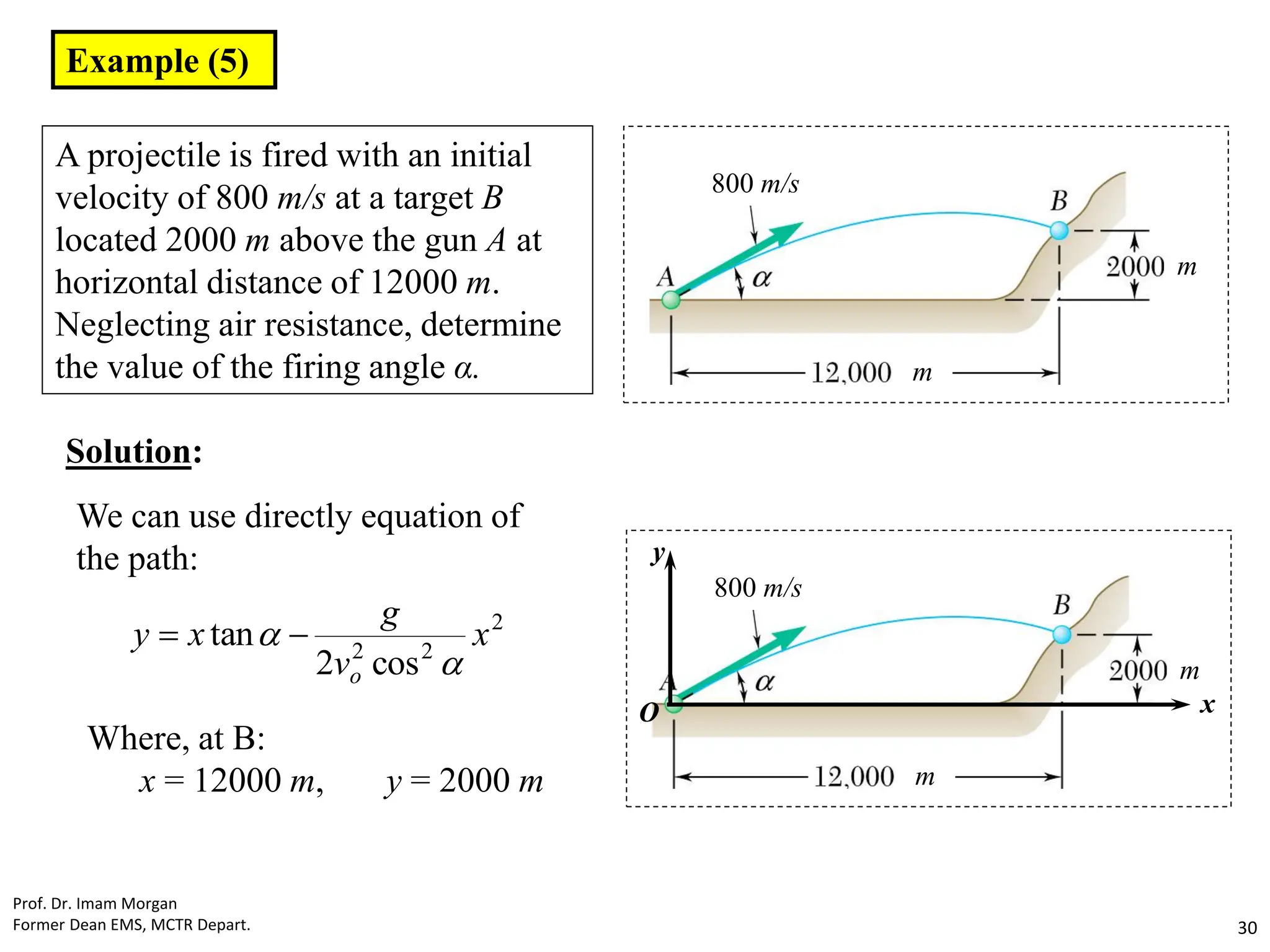
Example (5)
A projectile is fired with an initial
velocity of 800 m/s at a target B
located 2000 m above the gun A at
horizontal distance of 12000 m.
Neglecting air resistance, determine
the value of the firing angle α.
Solution:
We can use directly equation of
the path:
2
2
2
cos
2
tan x
v
g
x
y
o 
 

Where, at B:
x = 12000 m, y = 2000 m
Prof. Dr. Imam Morgan
Former Dean EMS, MCTR Depart. 30
800 m/s
m
m
800 m/s
m
m
y
x
O
 
 2
2
2
12000
cos
800
2
2
.
32
tan
12000
2000

 

Knowing that:



2
2
2
tan
1
sec
cos
1



then, 2000 = 12000 tan α – 3622.5 [ 1 + tan2α ]
3622.5 tan2α – 12000 tan α + 5622.5 = 0
tan α1 = 0.565 or, tan α2 = 2.748
α1 = 29.5o or, α2 = 70o
So, the target will be hit if either of these two firing
angles is used (two possible solutions)
Recommended:
Calculate the time of flight
from A to B in each angle.
Prof. Dr. Imam Morgan
Former Dean EMS, MCTR Depart. 31
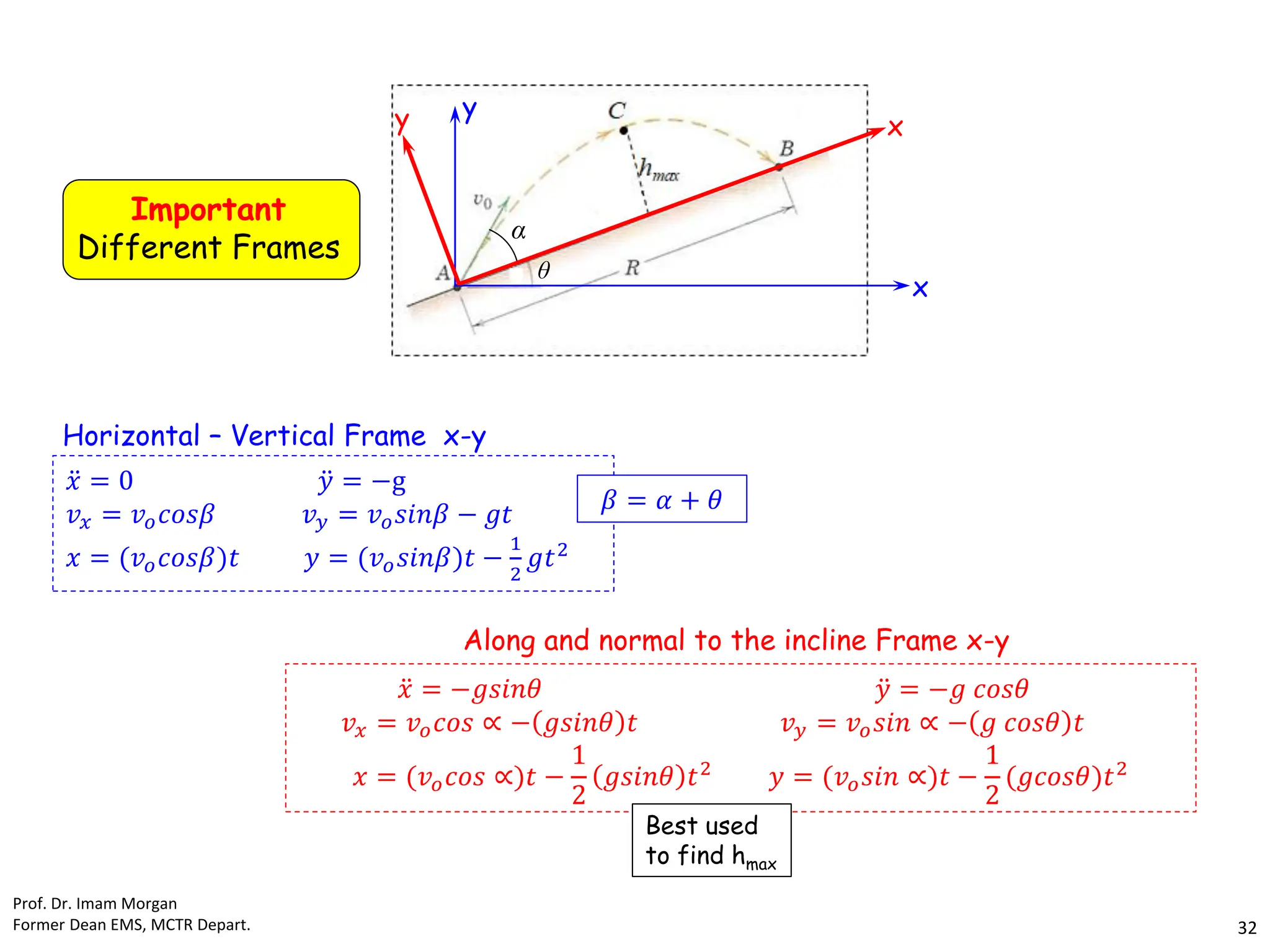
θ
α
ሷ
𝑥 = 0 ሷ
𝑦 = −g
𝑣𝑥 = 𝑣𝑜𝑐𝑜𝑠𝛽 𝑣𝑦 = 𝑣𝑜𝑠𝑖𝑛𝛽 − 𝑔𝑡
𝑥 = (𝑣𝑜𝑐𝑜𝑠𝛽)𝑡 𝑦 = (𝑣𝑜𝑠𝑖𝑛𝛽)𝑡 −
1
2
𝑔𝑡2
ሷ
𝑥 = −𝑔𝑠𝑖𝑛𝜃 ሷ
𝑦 = −𝑔 𝑐𝑜𝑠𝜃
𝑣𝑥 = 𝑣𝑜𝑐𝑜𝑠 ∝ − 𝑔𝑠𝑖𝑛𝜃 𝑡 𝑣𝑦 = 𝑣𝑜𝑠𝑖𝑛 ∝ − 𝑔 𝑐𝑜𝑠𝜃 𝑡
𝑥 = (𝑣𝑜𝑐𝑜𝑠 ∝)𝑡 −
1
2
𝑔𝑠𝑖𝑛𝜃 𝑡2
𝑦 = (𝑣𝑜𝑠𝑖𝑛 ∝)𝑡 −
1
2
(𝑔𝑐𝑜𝑠𝜃)𝑡2
Horizontal – Vertical Frame x-y
Along and normal to the incline Frame x-y
x
y
x
y
𝛽 = 𝛼 + 𝜃
Important
Different Frames
Prof. Dr. Imam Morgan
Former Dean EMS, MCTR Depart. 32
Best used
to find hmax
This type of coordinates is used
whenever the path of the particle
is known (well defined).
2 Tangential and Normal Components
(Intrinsic or,
Natural Coordinates)
or
Prof. Dr. Imam Morgan
Former Dean EMS, MCTR Depart. 33
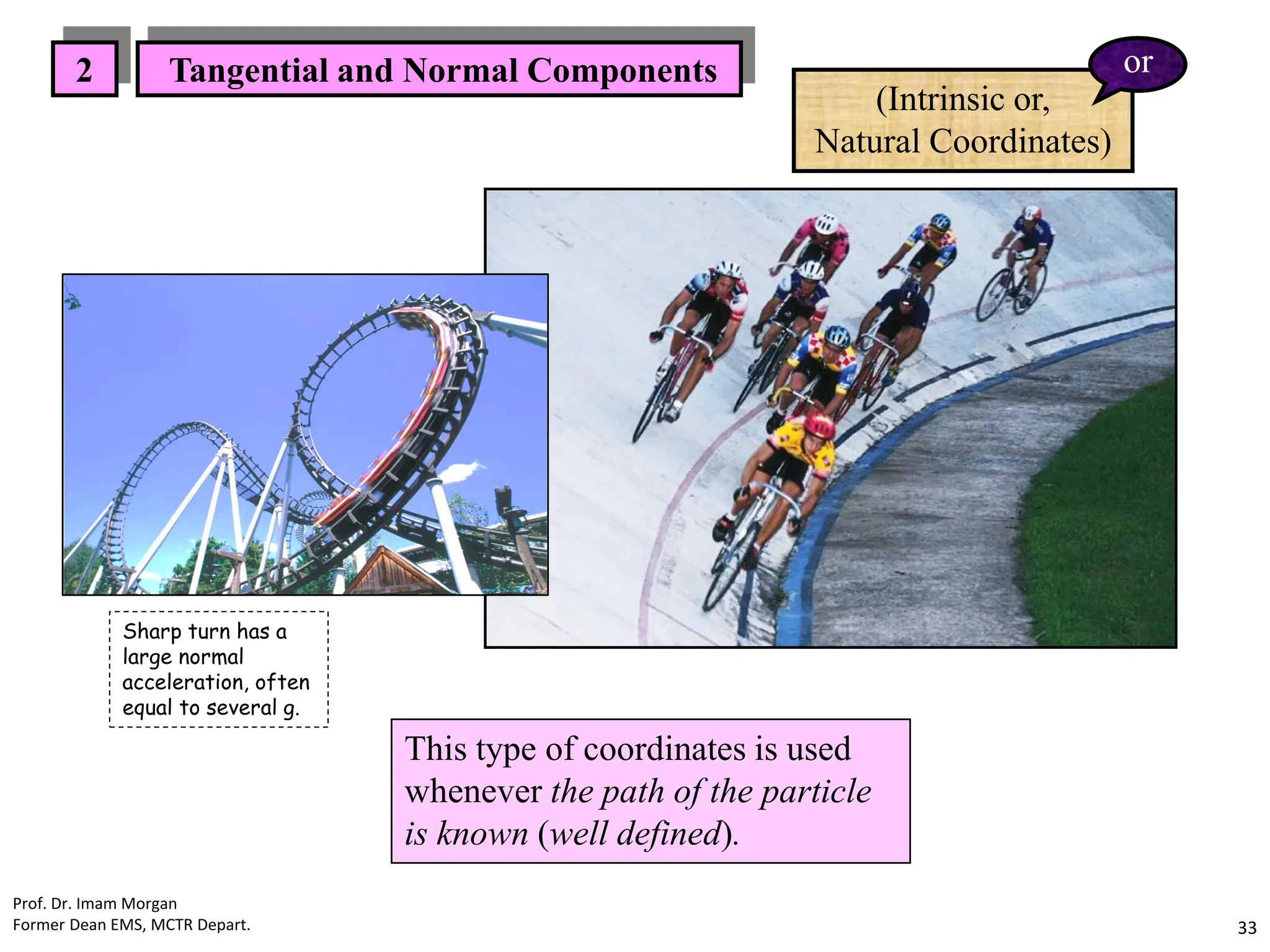
Sharp turn has a
large normal
acceleration, often
equal to several g.
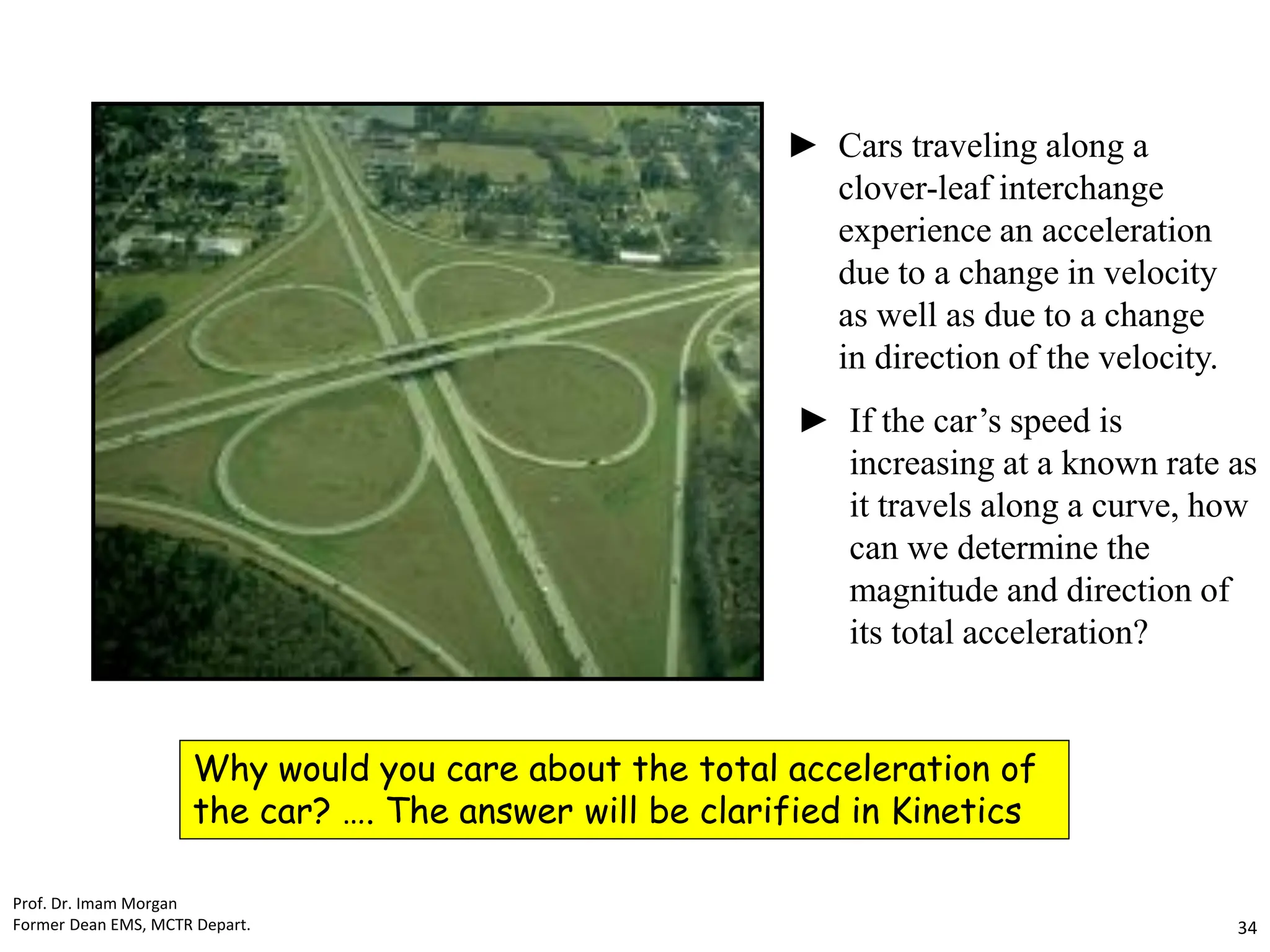
Cars traveling along a
clover-leaf interchange
experience an acceleration
due to a change in velocity
as well as due to a change
in direction of the velocity.
If the car’s speed is
increasing at a known rate as
it travels along a curve, how
can we determine the
magnitude and direction of
its total acceleration?
►
►
Why would you care about the total acceleration of
the car? …. The answer will be clarified in Kinetics
Prof. Dr. Imam Morgan
Former Dean EMS, MCTR Depart. 34
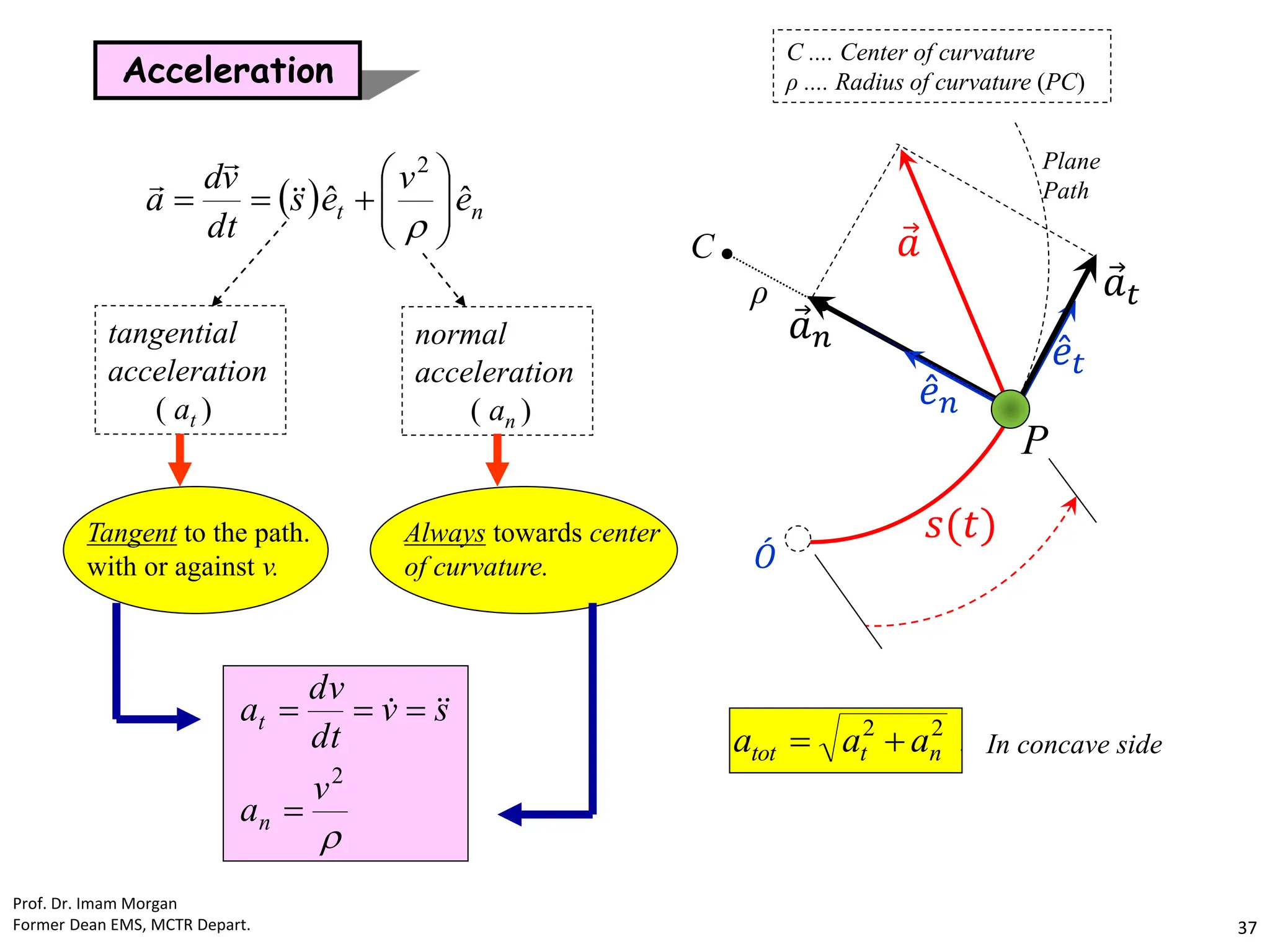
s = s(t)
Position
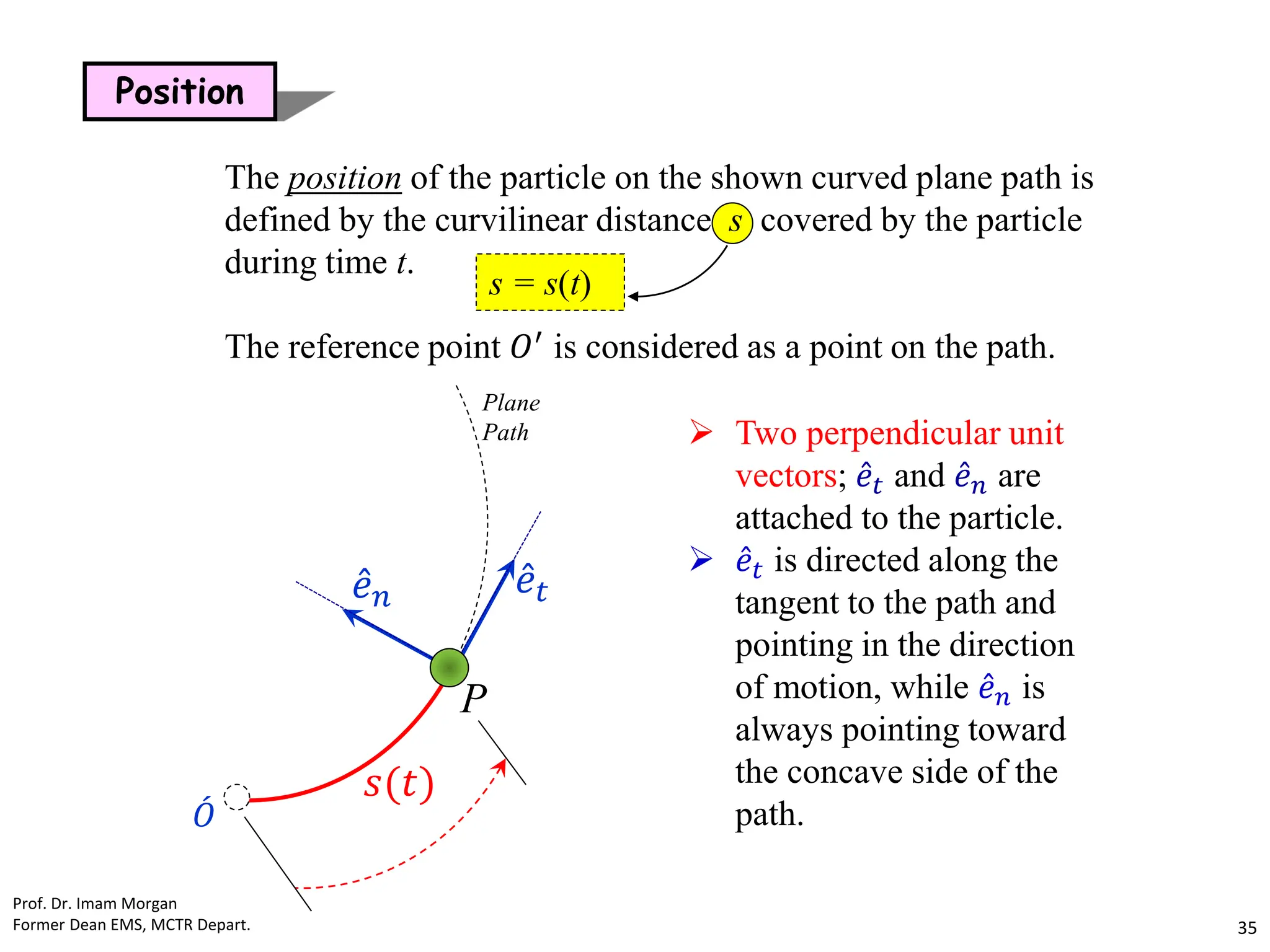
The position of the particle on the shown curved plane path is
defined by the curvilinear distance s covered by the particle
during time t.
The reference point 𝑂′
is considered as a point on the path.
Plane
Path
Ƹ
𝑒𝑛 Ƹ
𝑒𝑡
𝑠(𝑡)
ሖ
𝑂
P
 Two perpendicular unit
vectors; Ƹ
𝑒𝑡 and Ƹ
𝑒𝑛 are
attached to the particle.
 Ƹ
𝑒𝑡 is directed along the
tangent to the path and
pointing in the direction
of motion, while Ƹ
𝑒𝑛 is
always pointing toward
the concave side of the
path.
Prof. Dr. Imam Morgan
Former Dean EMS, MCTR Depart. 35
Velocity
Plane
Path
Ƹ
𝑒𝑛 Ƹ
𝑒𝑡
𝑠(𝑡)
ሖ
𝑂
P
Ԧ
𝑣
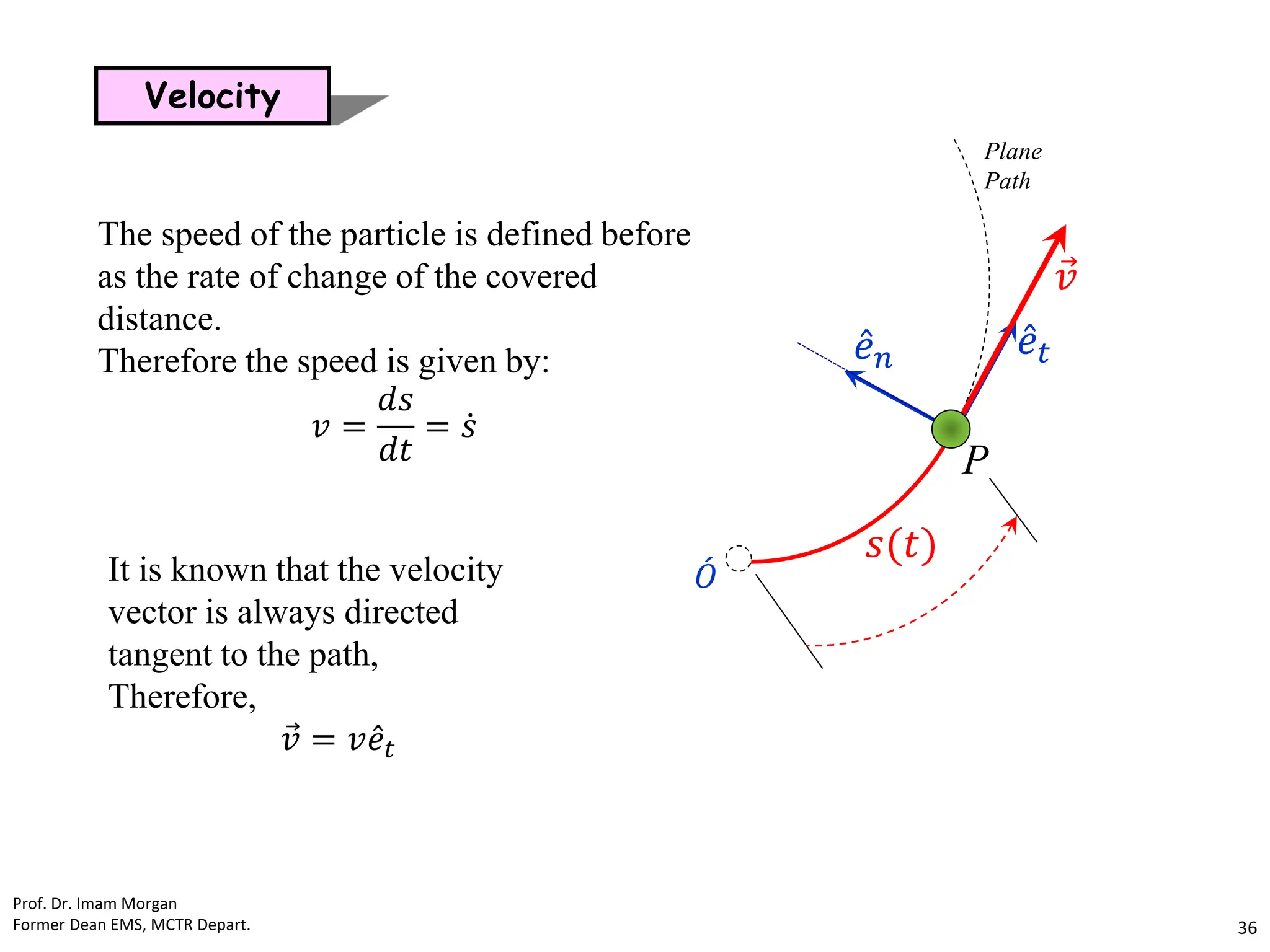
The speed of the particle is defined before
as the rate of change of the covered
distance.
Therefore the speed is given by:
𝑣 =
𝑑𝑠
𝑑𝑡
= ሶ
𝑠
It is known that the velocity
vector is always directed
tangent to the path,
Therefore,
Ԧ
𝑣 = 𝑣 Ƹ
𝑒𝑡
Prof. Dr. Imam Morgan
Former Dean EMS, MCTR Depart. 36
  n
t e
v
e
s
dt
v
d
a ˆ
ˆ
2
















tangential
acceleration
( at )
normal
acceleration
( an )

2
v
a
s
v
dt
dv
a
n
t



 


Tangent to the path.
with or against v.
Always towards center
of curvature.
concav
in
always
.......
a
a
a n
t
tot
2
2

 In concave side
Acceleration
Plane
Path
Ƹ
𝑒𝑛
Ƹ
𝑒𝑡
𝑠(𝑡)
ሖ
𝑂
P
Ԧ
𝑎𝑛
Ԧ
𝑎𝑡
Ԧ
𝑎
C
ρ
C .... Center of curvature
ρ .... Radius of curvature (PC)
Prof. Dr. Imam Morgan
Former Dean EMS, MCTR Depart. 37
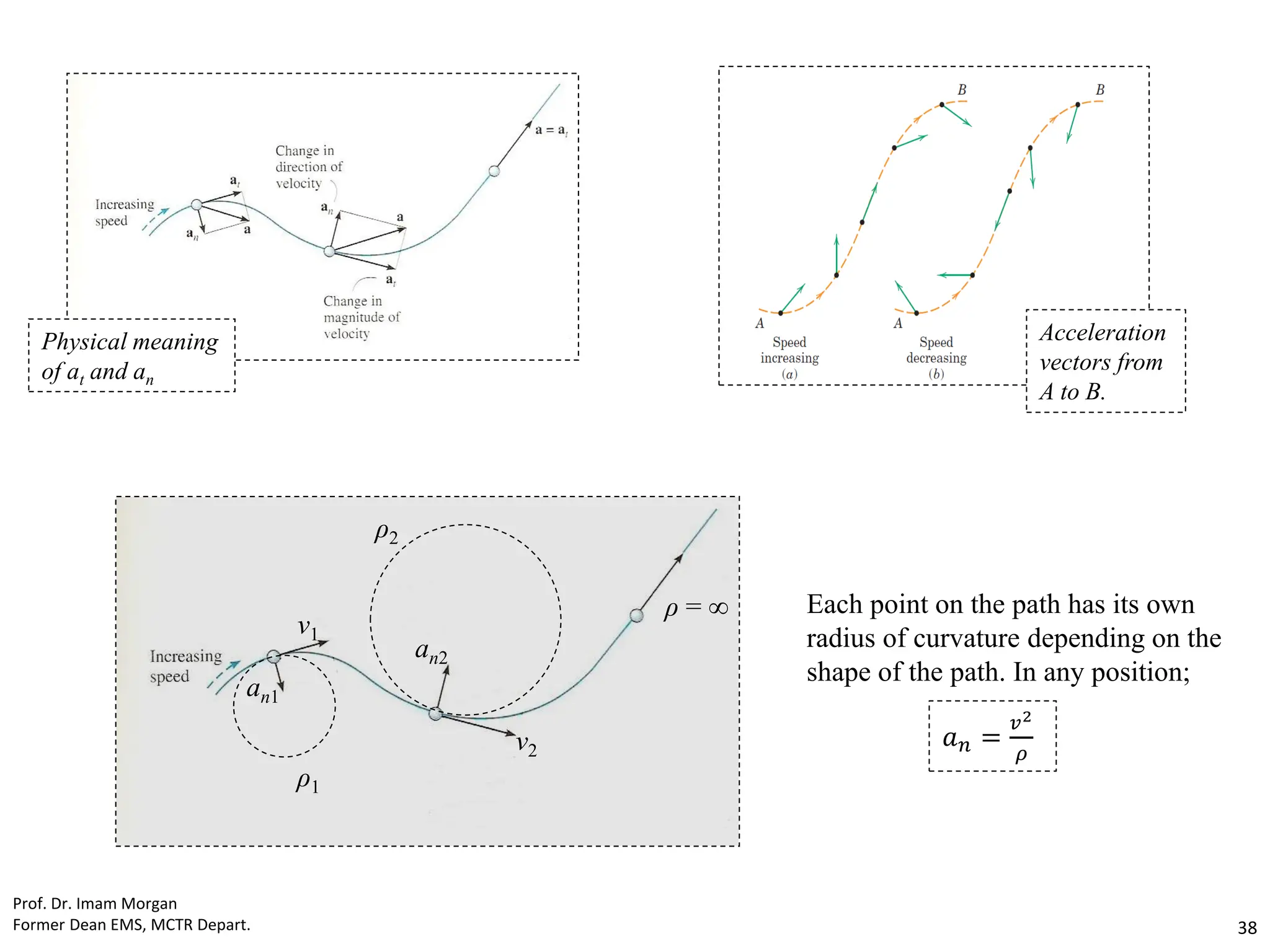
an1
ρ1
ρ2
an2
ρ = ∞
v1
v2
Each point on the path has its own
radius of curvature depending on the
shape of the path. In any position;
Physical meaning
of at and an
Prof. Dr. Imam Morgan
Former Dean EMS, MCTR Depart. 38
Acceleration
vectors from
A to B.
𝑎𝑛 =
𝑣2
𝜌
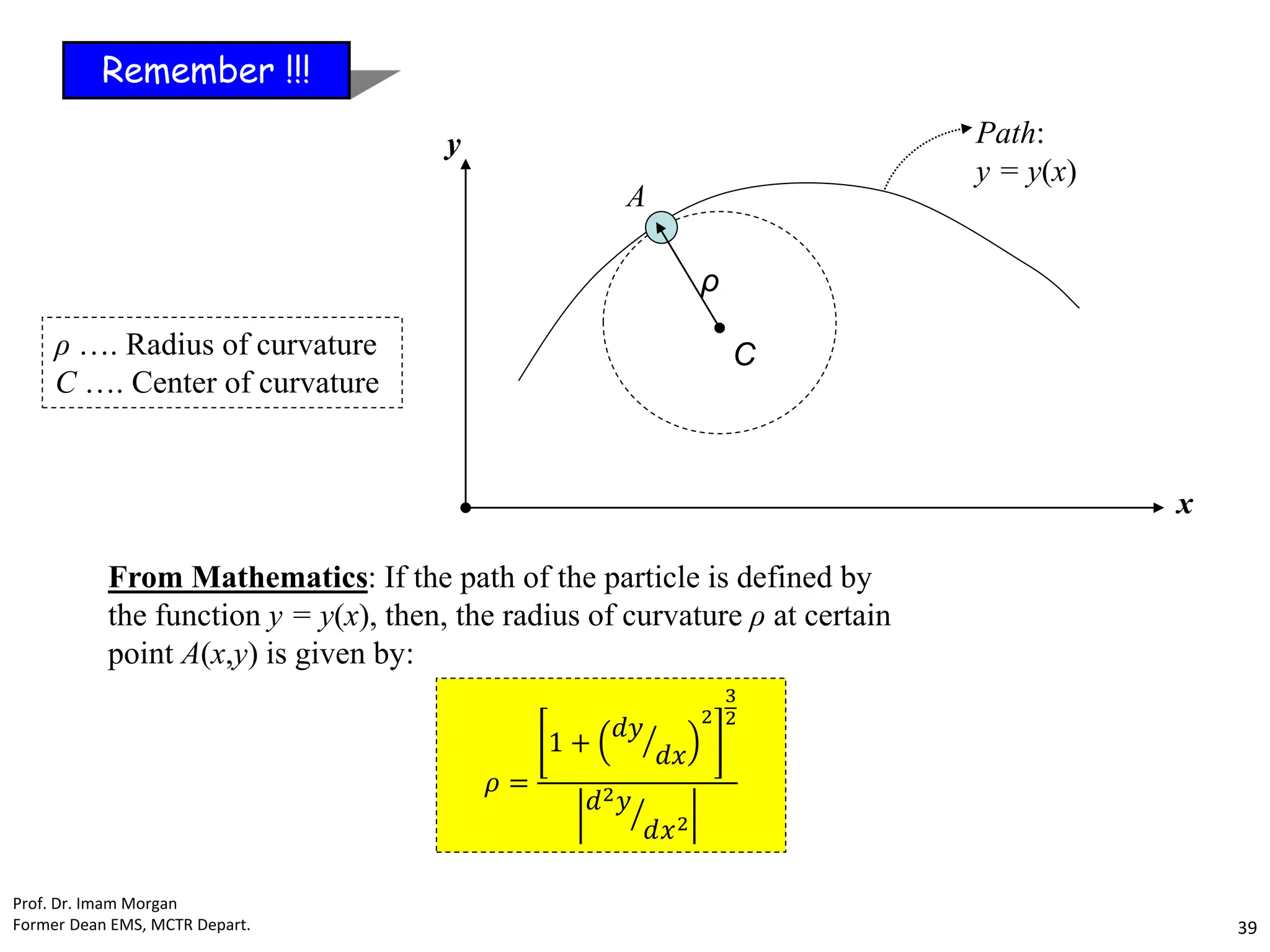
Remember !!!
From Mathematics: If the path of the particle is defined by
the function y = y(x), then, the radius of curvature ρ at certain
point A(x,y) is given by:
Path:
y = y(x)
A
y
x
ρ
C
ρ …. Radius of curvature
C …. Center of curvature
Prof. Dr. Imam Morgan
Former Dean EMS, MCTR Depart. 39
𝜌 =
1 + ൗ
𝑑𝑦
𝑑𝑥
2
3
2
ൗ
𝑑2𝑦
𝑑𝑥2
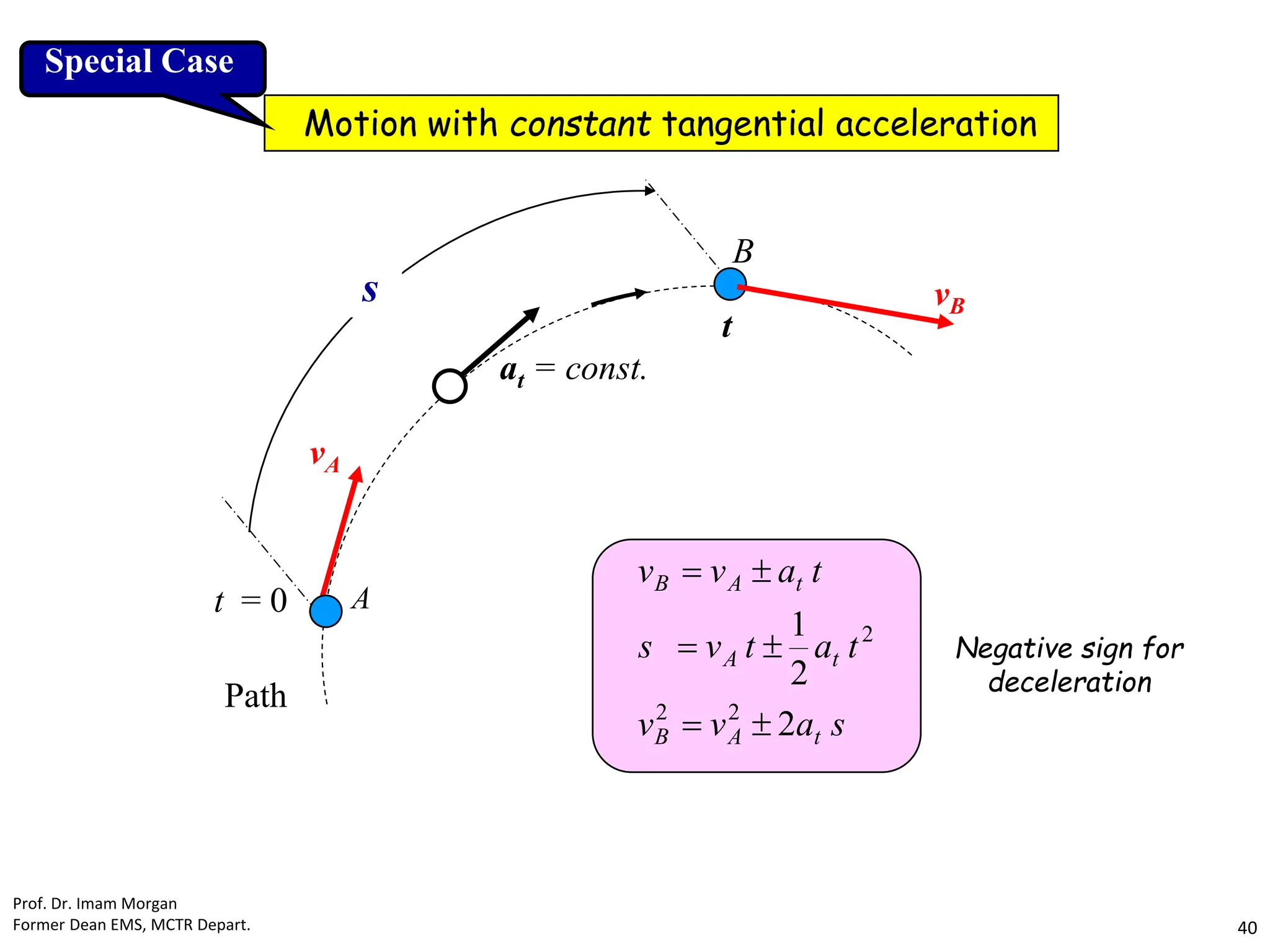
B
t
A
t = 0
vA
vB
at = const.
s
s
a
v
v
t
a
t
v
s
t
a
v
v
t
A
B
t
A
t
A
B
2
2
1
2
2
2






Negative sign for
deceleration
Motion with constant tangential acceleration
Special Case
Path
Prof. Dr. Imam Morgan
Former Dean EMS, MCTR Depart. 40
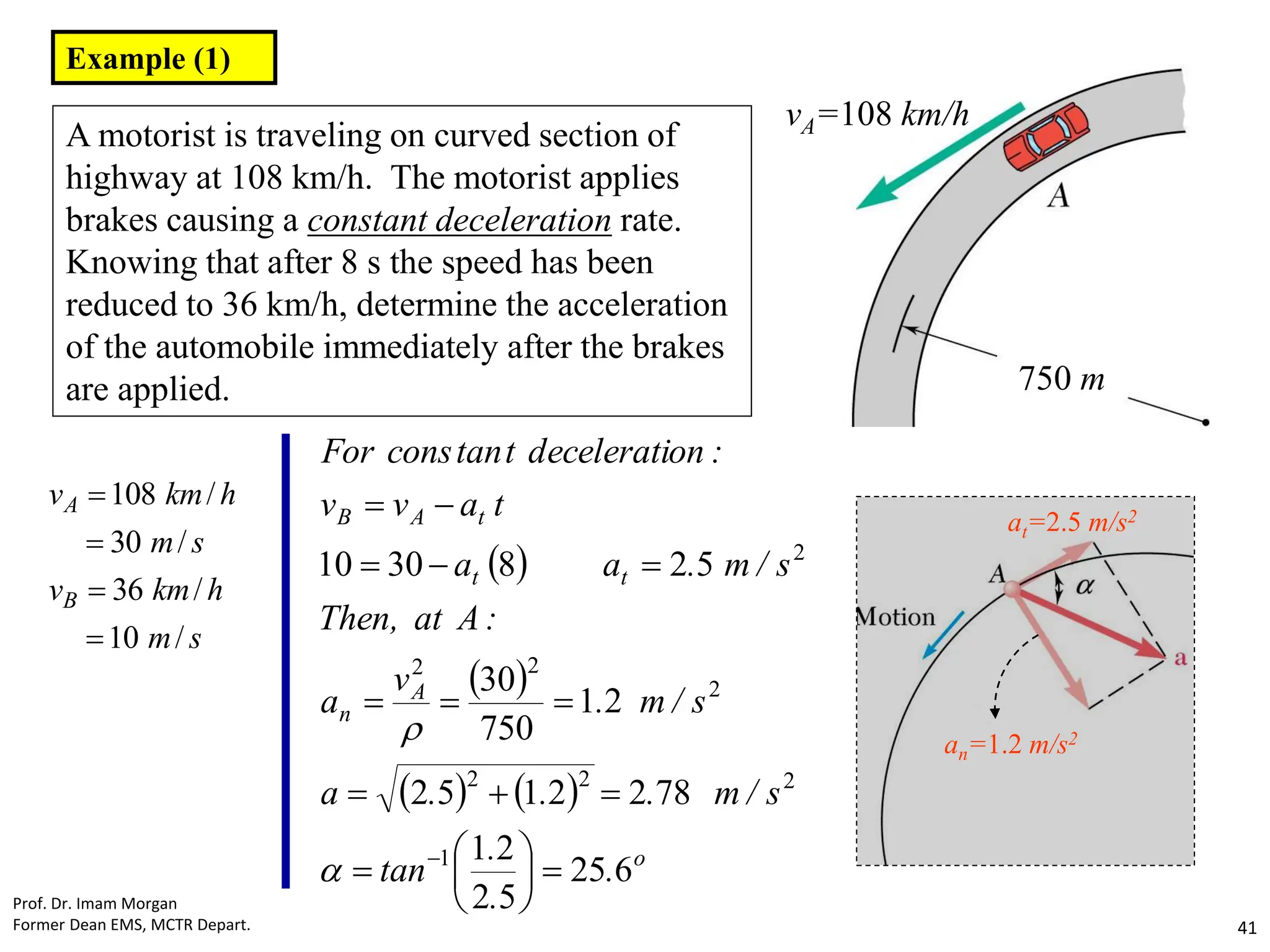
A motorist is traveling on curved section of
highway at 108 km/h. The motorist applies
brakes causing a constant deceleration rate.
Knowing that after 8 s the speed has been
reduced to 36 km/h, determine the acceleration
of the automobile immediately after the brakes
are applied.
vA=108 km/h
750 m
an=1.2 m/s2
at=2.5 m/s2
 
 
   
o
A
n
t
t
t
A
B
.
.
.
tan
s
/
m
.
.
.
a
s
/
m
.
v
a
:
A
at
,
Then
s
/
m
.
a
a
t
a
v
v
:
on
decelerati
t
tan
cons
For
6
25
5
2
2
1
78
2
2
1
5
2
2
1
750
30
5
2
8
30
10
1
2
2
2
2
2
2
2






















s
m
h
km
v
s
m
h
km
v
B
A
/
10
/
36
/
30
/
108




Example (1)
Prof. Dr. Imam Morgan
Former Dean EMS, MCTR Depart. 41
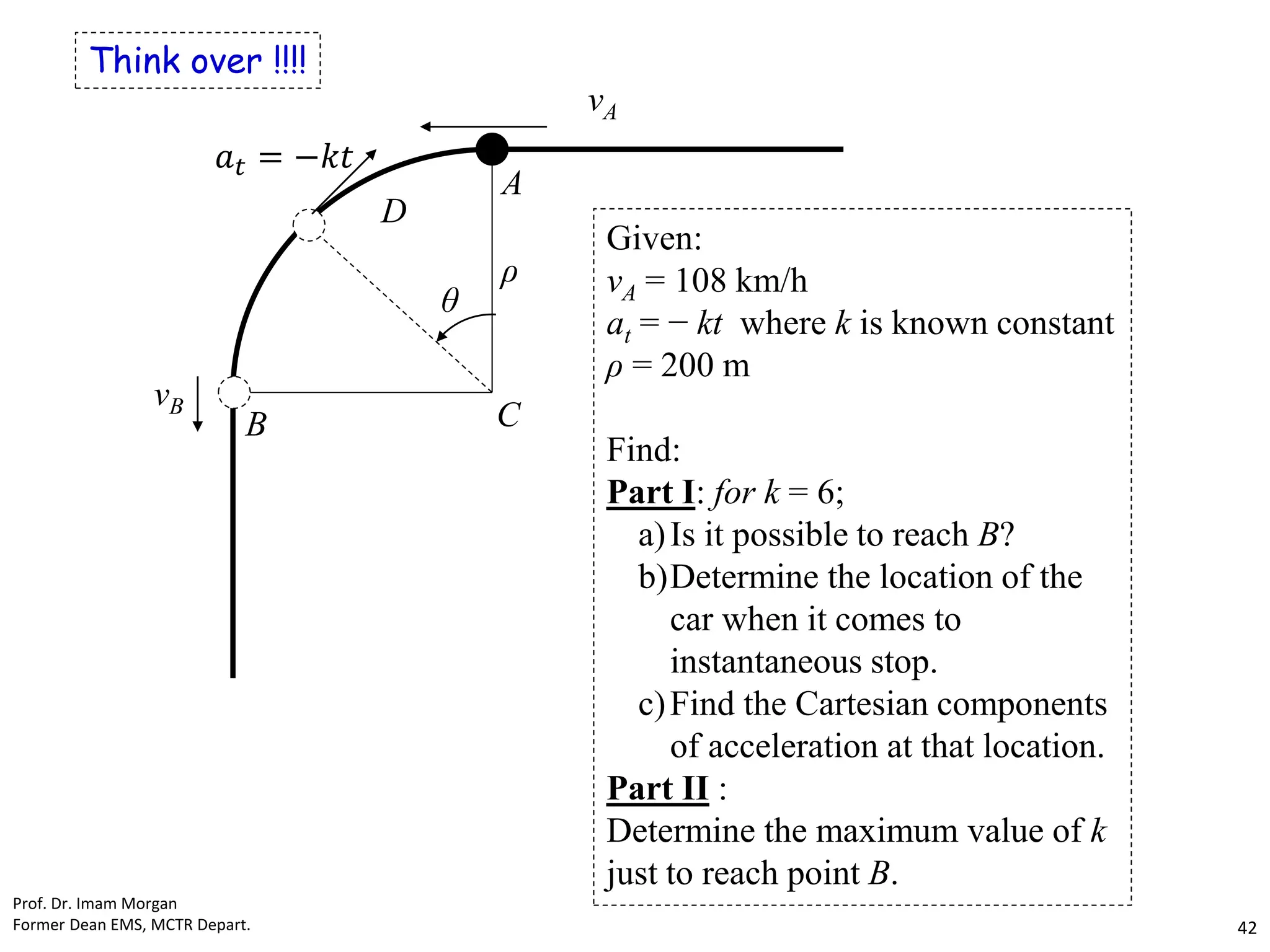
Think over !!!!
vA
vB
θ
C
D
B
A
ρ
𝑎𝑡 = −𝑘𝑡
Given:
vA = 108 km/h
at = − kt where k is known constant
ρ = 200 m
Find:
Part I: for k = 6;
a)Is it possible to reach B?
b)Determine the location of the
car when it comes to
instantaneous stop.
c)Find the Cartesian components
of acceleration at that location.
Part II :
Determine the maximum value of k
just to reach point B.
Prof. Dr. Imam Morgan
Former Dean EMS, MCTR Depart. 42
Recommended
If the motion starts from
A, determine the position
(location) of the car at this
instant.
Prof. Dr. Imam Morgan
Former Dean EMS, MCTR Depart. 43
Example (2)
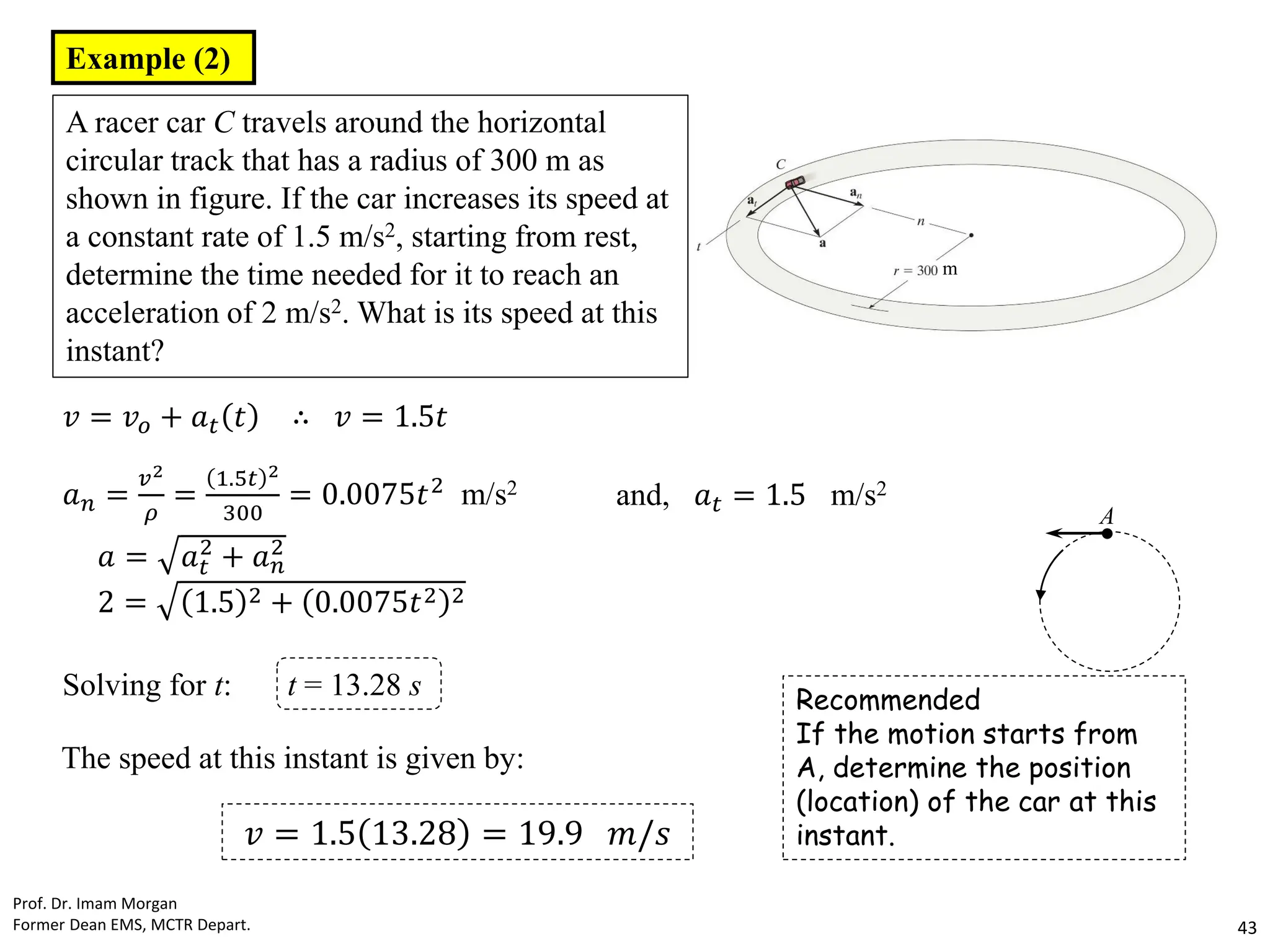
A racer car C travels around the horizontal
circular track that has a radius of 300 m as
shown in figure. If the car increases its speed at
a constant rate of 1.5 m/s2, starting from rest,
determine the time needed for it to reach an
acceleration of 2 m/s2. What is its speed at this
instant?
𝑣 = 𝑣𝑜 + 𝑎𝑡 𝑡 ∴ 𝑣 = 1.5𝑡
𝑎𝑛 =
𝑣2
𝜌
=
1.5𝑡 2
300
= 0.0075𝑡2 m/s2 and, 𝑎𝑡 = 1.5 m/s2
𝑎 = 𝑎𝑡
2
+ 𝑎𝑛
2
2 = 1.5 2 + 0.0075𝑡2 2
Solving for t: t = 13.28 s
The speed at this instant is given by:
𝑣 = 1.5 13.28 = 19.9 𝑚/𝑠
m
A
●
Example (3)
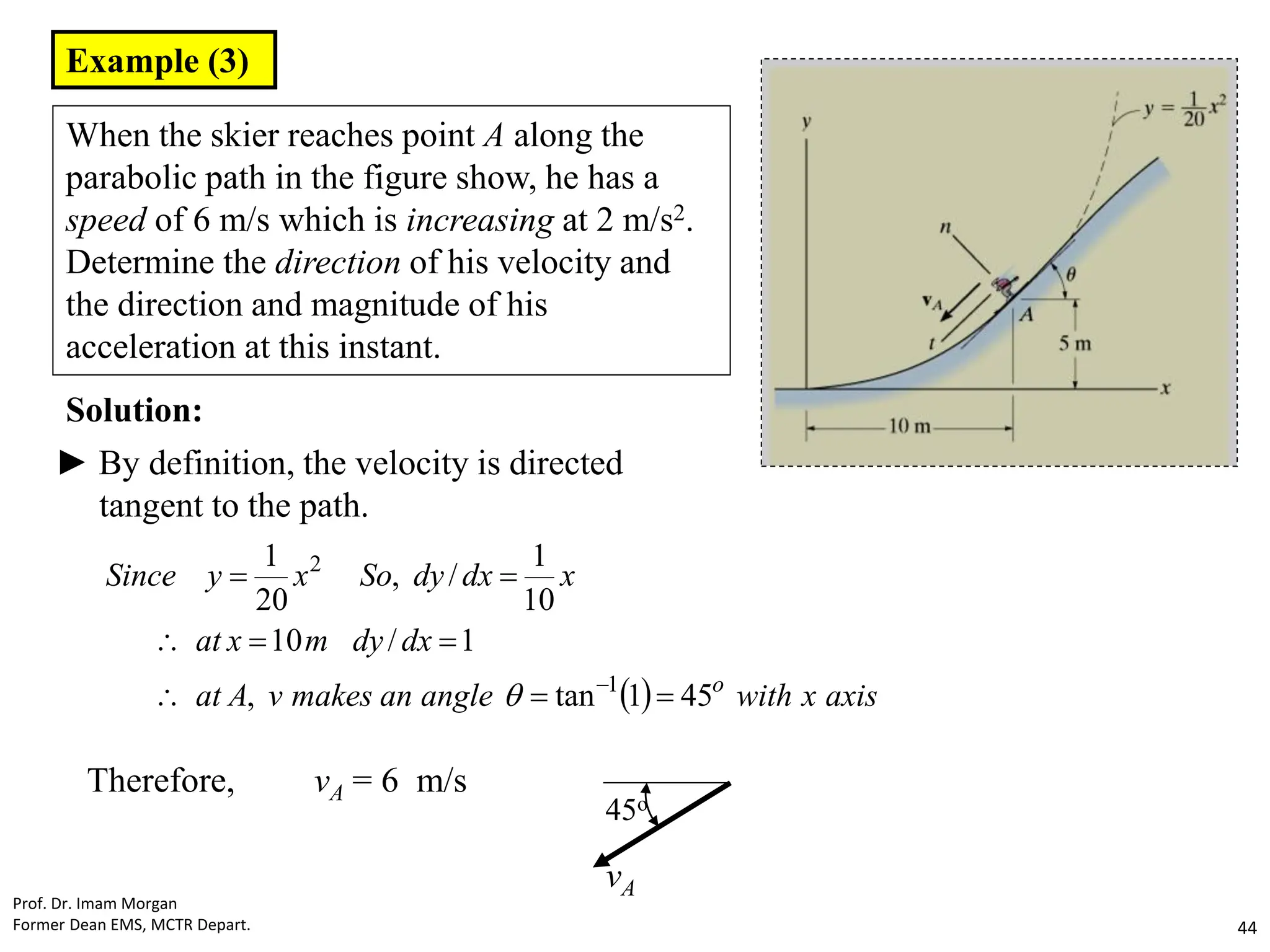
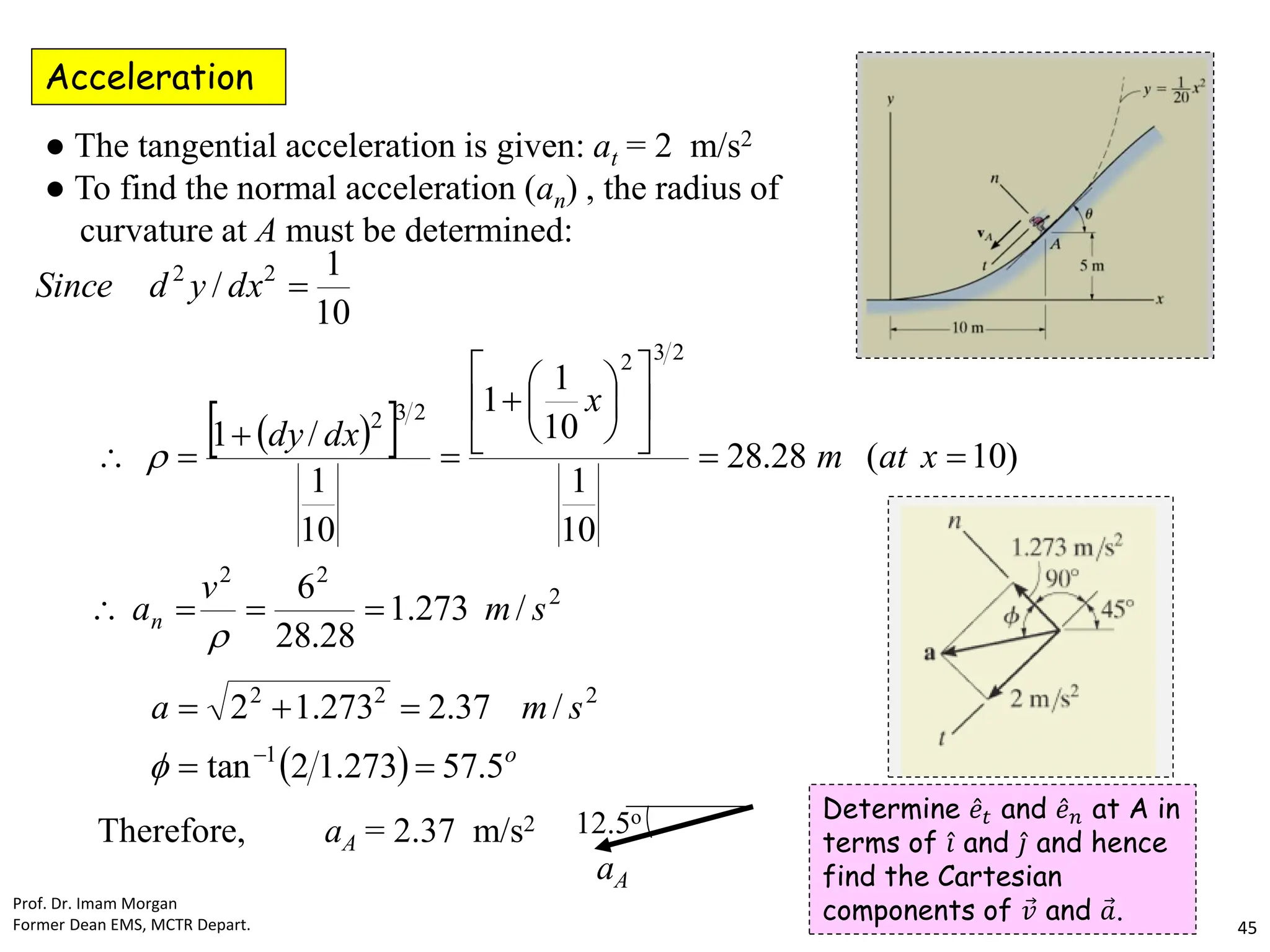
When the skier reaches point A along the
parabolic path in the figure show, he has a
speed of 6 m/s which is increasing at 2 m/s2.
Determine the direction of his velocity and
the direction and magnitude of his
acceleration at this instant.
Solution:
► By definition, the velocity is directed
tangent to the path.
  axis
x
with
angle
an
makes
v
A
at
dx
dy
m
x
at
x
dx
dy
So
x
y
Since
o
45
1
tan
,
1
/
10
10
1
/
,
20
1
1
2










Therefore, vA = 6 m/s
45o
vA
Prof. Dr. Imam Morgan
Former Dean EMS, MCTR Depart. 44
Acceleration
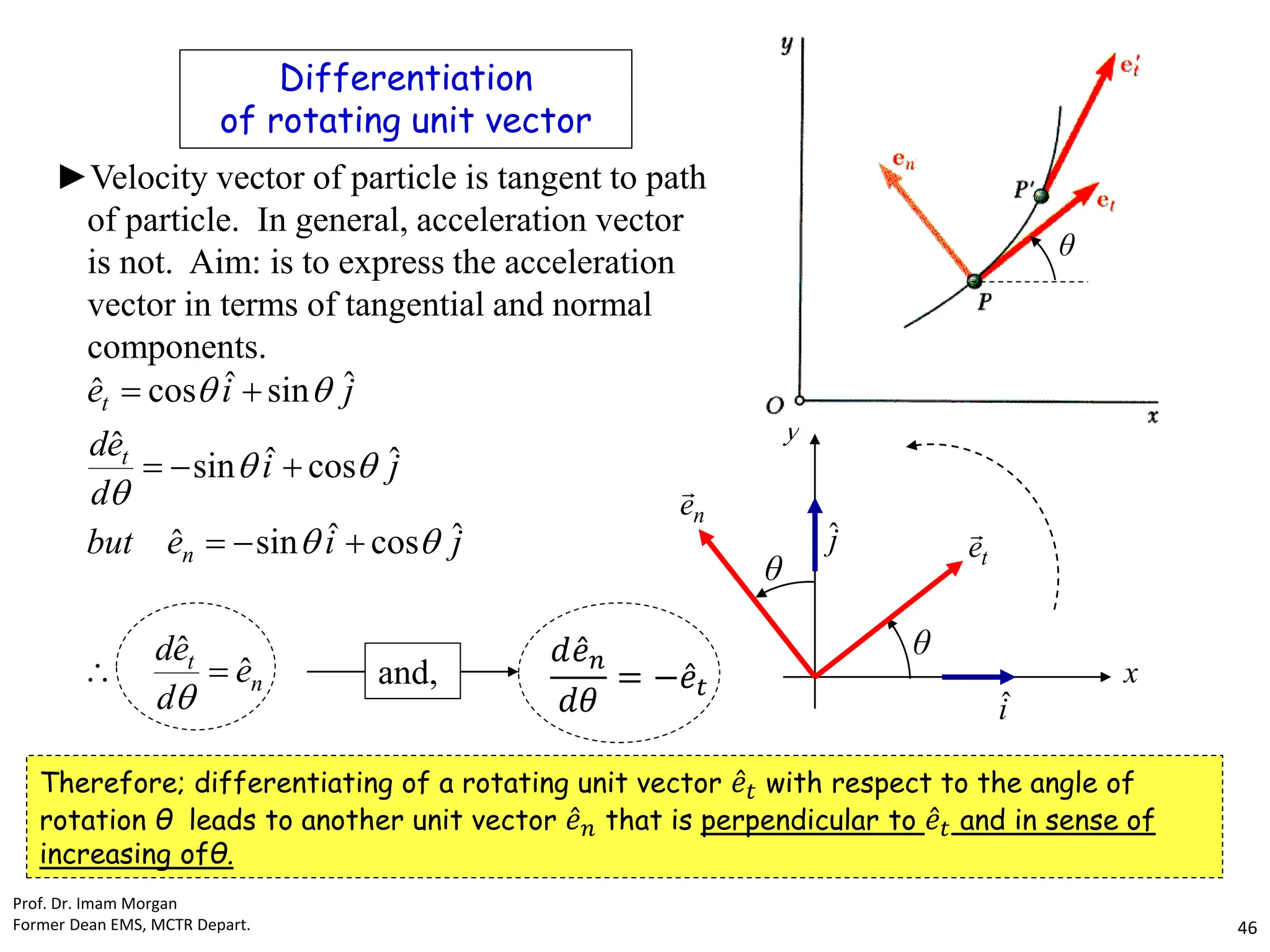
● The tangential acceleration is given: at = 2 m/s2
● To find the normal acceleration (an) , the radius of
curvature at A must be determined:
 
 
2
2
2
2
3
2
2
3
2
2
2
/
273
.
1
28
.
28
6
)
10
(
28
.
28
10
1
10
1
1
10
1
/
1
10
1
/
s
m
v
a
x
at
m
x
dx
dy
dx
y
d
Since
n 

























  o
s
m
a
5
.
57
273
.
1
2
tan
/
37
.
2
273
.
1
2
1
2
2
2







Therefore, aA = 2.37 m/s2 12.5o
aA
Prof. Dr. Imam Morgan
Former Dean EMS, MCTR Depart. 45
Determine Ƹ
𝑒𝑡 and Ƹ
𝑒𝑛 at A in
terms of Ƹ
𝑖 and Ƹ
𝑗 and hence
find the Cartesian
components of Ԧ
𝑣 and Ԧ
𝑎.
n
t
n
t
t
e
d
e
d
j
i
e
but
j
i
d
e
d
j
i
e
ˆ
ˆ
ˆ
cos
ˆ
sin
ˆ
ˆ
cos
ˆ
sin
ˆ
ˆ
sin
ˆ
cos
ˆ


















i
ˆ
θ
θ
t
e

n
e

y
x
ĵ
θ
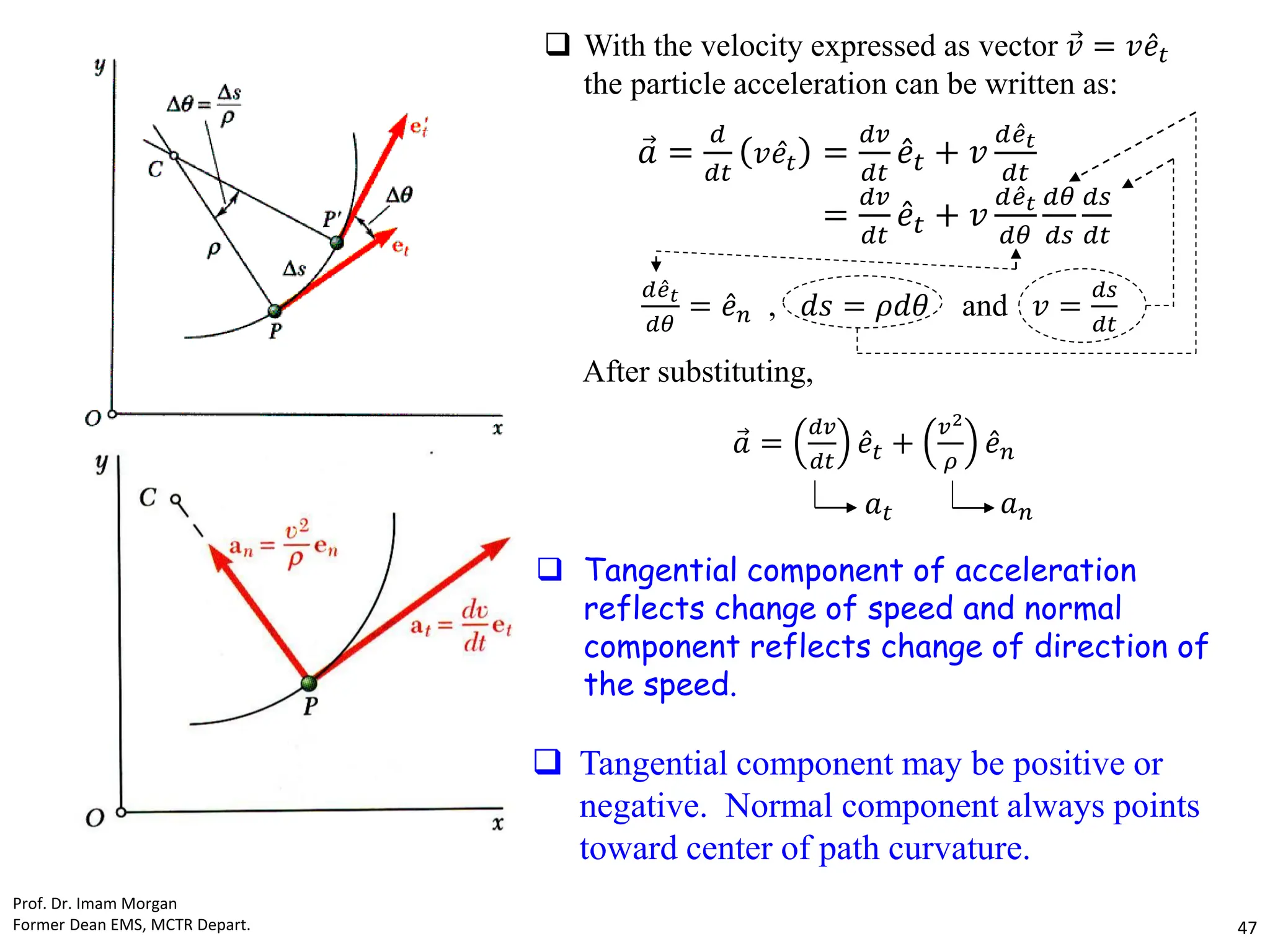
►Velocity vector of particle is tangent to path
of particle. In general, acceleration vector
is not. Aim: is to express the acceleration
vector in terms of tangential and normal
components.
Therefore; differentiating of a rotating unit vector Ƹ
𝑒𝑡 with respect to the angle of
rotation θ leads to another unit vector Ƹ
𝑒𝑛 that is perpendicular to Ƹ
𝑒𝑡 and in sense of
increasing ofθ.
Differentiation
of rotating unit vector
𝑑 Ƹ
𝑒𝑛
𝑑𝜃
= − Ƹ
𝑒𝑡
and,
Prof. Dr. Imam Morgan
Former Dean EMS, MCTR Depart. 46
After substituting,
 Tangential component of acceleration
reflects change of speed and normal
component reflects change of direction of
the speed.
 Tangential component may be positive or
negative. Normal component always points
toward center of path curvature.
 With the velocity expressed as vector Ԧ
𝑣 = 𝑣 Ƹ
𝑒𝑡
the particle acceleration can be written as:
Prof. Dr. Imam Morgan
Former Dean EMS, MCTR Depart. 47
Ԧ
𝑎 =
𝑑
𝑑𝑡
𝑣 Ƹ
𝑒𝑡 =
𝑑𝑣
𝑑𝑡
Ƹ
𝑒𝑡 + 𝑣
𝑑 Ƹ
𝑒𝑡
𝑑𝑡
=
𝑑𝑣
𝑑𝑡
Ƹ
𝑒𝑡 + 𝑣
𝑑 Ƹ
𝑒𝑡
𝑑𝜃
𝑑𝜃
𝑑𝑠
𝑑𝑠
𝑑𝑡
𝑑 Ƹ
𝑒𝑡
𝑑𝜃
= Ƹ
𝑒𝑛 , 𝑑𝑠 = 𝜌𝑑𝜃 and 𝑣 =
𝑑𝑠
𝑑𝑡
Ԧ
𝑎 =
𝑑𝑣
𝑑𝑡
Ƹ
𝑒𝑡 +
𝑣2
𝜌
Ƹ
𝑒𝑛
𝑎𝑛
𝑎𝑡


2
2
v
a
dt
dv
a
e
v
e
dt
dv
a n
t
n
t 






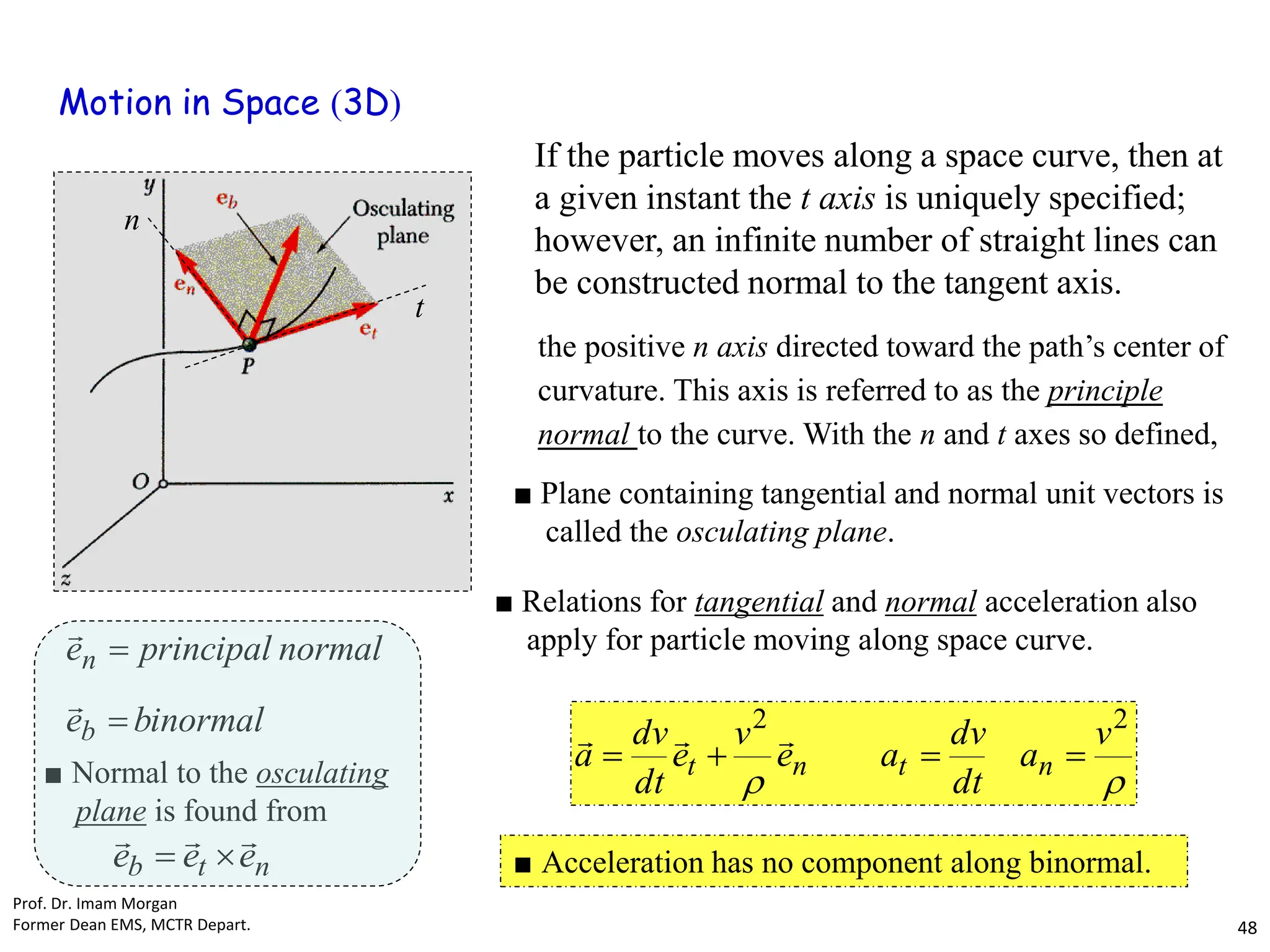
■ Relations for tangential and normal acceleration also
apply for particle moving along space curve.
■ Plane containing tangential and normal unit vectors is
called the osculating plane.
n
t
b e
e
e





■ Normal to the osculating
plane is found from
binormal
e
normal
principal
e
b
n




■ Acceleration has no component along binormal.
If the particle moves along a space curve, then at
a given instant the t axis is uniquely specified;
however, an infinite number of straight lines can
be constructed normal to the tangent axis.
t
n
the positive n axis directed toward the path’s center of
curvature. This axis is referred to as the principle
normal to the curve. With the n and t axes so defined,
Motion in Space (3D)
Prof. Dr. Imam Morgan
Former Dean EMS, MCTR Depart. 48
End of
Lecture
Thank you: Imam Morgan
Prof. Dr. Imam Morgan
Former Dean EMS, MCTR Depart. 49

Lecture (2) - Kinematics of Particles II.pdf

  • 1.
    Faculty of Engineeringand Materials Science MECHANICS II (Dynamics) 4th MCTR, DPE, MATS, and CIVIL Lecture (2) Prof. Dr. E. I. Imam Morgan Faculty of Engineering and Materials Science (EMS) Mechatronics Department elsayed.morgan@guc.edu.eg C7.105 Prof. Dr. Imam Morgan Former Dean EMS, MCTR Depart. 1
  • 2.
    Ch. 1 ….Kinematics of Particles (Rectilinear Motion)  Position  Motion determination  Multi connected particles and relative motions Ch. 2 …. Kinematics of Particles (Curvilinear Motion)  Position, velocity, and acceleration vectors in general forms and their relations with respect to the path  Applications in different frames of references (2D and 3D)  Rectangular coordinates (2D and 3D)  Intrinsic Coordinates  Polar Coordinates Ch. 3 …. Kinetics of a Particle ● Accelerating Force Ch. 4 …. Kinetics of a Particle ● Impulse and Momentum ● Energy Approach Part I Dynamics of Particles Lect. (2) Prof. Dr. Imam Morgan Former Dean EMS, MCTR Depart. 2
  • 3.
    3 Chapter 2 Kinematics ofParticles Curvilinear Motion Cartesian Coordinates Intrinsic Coordinates Polar Coordinates II
  • 4.
    Curvilinear Motion Particle movingalong a curve other than a straight line is in curvilinear motion. Indeed, in the shown photo, each plane performs a space curvilinear motion. We are interest to specify, completely, this motion and to determine the kinematic quantities that define the motion Definition Prof. Dr. Imam Morgan Former Dean EMS, MCTR Depart. 4
  • 5.
    a  r  v  P Path O General Objectives     t r r vector Position r     ...     path the to tangent t v v vector Velocity v      ...     path the to angent t not t a a vector on Accelerati a      ... ►How can we express each vector at any time. ►How can derive the relation(s) between them. ►The physical meaning of each vector (why? and how?) Kinematic Parameters Prof. Dr. Imam Morgan Former Dean EMS, MCTR Depart. 5
  • 6.
    Curvilinear Motion (General Discussion) Curvilinearmotion occurs when the particle moves along a curved path. Since this path is often described in three dimensions, vector analysis (mainly components) will be used to formulate the particle’s position, velocity, and acceleration. 1 Position Vector, Velocity Vector, and Acceleration vector A Position Vector ►Position vector of a particle at time t is defined by a vector between origin O of a fixed reference frame and the position occupied by particle. Prof. Dr. Imam Morgan Former Dean EMS, MCTR Depart. 6
  • 7.
     The distancebetween P(tj) and P(ti) is the magnitude of the displacement vector i.e., ∆Ԧ 𝑟 𝑡𝑖, 𝑡𝑗 ∆Ԧ 𝑟1,2 = Ԧ 𝑟2 − Ԧ 𝑟1  The distance traveled during the time interval (ti,tj) is the length of the yellow curved line shown in the figure. It is quite clear that the magnitudes of the displacement and the distance traveled over a given time interval are different! Displacement & Distance Traveled and Path Prof. Dr. Imam Morgan Former Dean EMS, MCTR Depart. 7
  • 8.
    The average velocity:is defined by; Ԧ 𝑣𝑎𝑣 = ∆Ԧ 𝑟 ∆𝑡 The instantaneous velocity of the particle at time t is obtained by considering that𝑃′approaches P. So, ∆Ԧ 𝑟 becomes shorter and shorter, Hence, in the limit at t = 0 it tends to be in tangent direction. (See next slide ) B Velocity Vector displacement s ∆s ∆Ԧ 𝑟 Prof. Dr. Imam Morgan Former Dean EMS, MCTR Depart. 8
  • 9.
    Velocity and Path PointsP(t + ∆t/n) are 5 consecutive Positions of a car driving around a track. As Δt goes to zero, the change of position vector becomes tangent to the path. This implies that … The velocity vector is always tangent to the path Details Prof. Dr. Imam Morgan Former Dean EMS, MCTR Depart. 9
  • 10.
  • 11.
    C Acceleration Vector Theinstantaneous acceleration vector is; Consider velocity Ԧ 𝑣 of particle at time t and velocity 𝑣′ at t + t, then, the average acceleration is given by: ∆ Ԧ 𝑣 =𝑣′ − Ԧ 𝑣 Ԧ 𝑎𝑎𝑣 = ∆ Ԧ 𝑣 ∆𝑡 In general, acceleration vector is directed in the concave side of the path. dt v d t v a t          0 lim where, Prof. Dr. Imam Morgan Former Dean EMS, MCTR Depart. 11
  • 12.
    On a curvedpath, the acceleration has a component toward the concave side of the path. Curved path, velocity change, point accelerates. Acceleration and Path The acceleration vector is always in concave side of the path (never tangent) Details ∆ Ԧ 𝑣 =𝑣′ − Ԧ 𝑣 ∆ Ԧ 𝑣 Prof. Dr. Imam Morgan Former Dean EMS, MCTR Depart. 12
  • 13.
    motion of direction the give not does side) concave (in path the t to not tangen onvector accelerati ... motion of direction the gives path the to tangent vector velocity ... ector position v ... dt v d a a dt r d v v r          Final Conclusion Now we are going to know how can the vector Ԧ 𝑟 be defined as well as the derivative of any vector. Prof. Dr. Imam Morgan Former Dean EMS, MCTR Depart. 13
  • 14.
    ►In this case,the position vector of particle P is given by its rectangular components, k z j y i x r        ►Velocity vector, k v j v i v k z j y i x k dt dz j dt dy i dt dx v z y x                       The total velocity is tangent to the path. v  1 Rectangular Components Now, we will express each vector in terms of its components for the following different cases;  Rectangular Components  Tangential and Normal components  Radial and Transversal components Prof. Dr. Imam Morgan Former Dean EMS, MCTR Depart. 14
  • 15.
  • 16.
    Prof. Dr. ImamMorgan Former Dean EMS, MCTR Depart. 16 Example (1) A particle is constrained to travel along the shown path. If 𝑥 = 4𝑡4 m, where t is in seconds, determine the magnitude and direction of the particle’s velocity and acceleration when t = 0.5 s. Prove that Ԧ 𝑣 is in tangent direction while Ԧ 𝑎 is in concave side.(recommended) Solution: Rectangular coordinates 𝑥 = 4𝑡4 𝑦2 = 16𝑡4 𝑦 = +4𝑡2 𝑣𝑥 = 16𝑡3 𝑣𝑦 = 8𝑡 𝑎𝑥 = 48𝑡2 𝑎𝑦 = 8 𝑣𝑥 = 2 𝑣𝑦 = 4 𝑎𝑥 = 12 𝑎𝑦 = 8 𝑣 = 4.47 𝑚/𝑠 𝜃𝑣 = 63.4𝑜 𝑎 = 14.42 𝑚/𝑠2 𝜃𝑎 = 33.4𝑜 𝜃𝑎 12 8 𝜃𝑣 2 4 at t = 0.5 at t = 0.5 Prove that v is in tangent direction Note that 𝜃𝑣 > 𝜃𝑎
  • 17.
    Example (2) At anyinstant the horizontal position of the weather balloon is defined by x = (9t) m, where t is in second and x in meters. If the equation of the path is y = x2/30, determine the distance of the balloon from the station at A, the magnitude and direction of both the velocity and acceleration when t = 2 s. Solution: Given: x = 9t and y = (x2/30)       j t i t j y i x r ˆ 30 81 ˆ 9 ˆ ˆ : is baloon the of ector position v The 2                  30 81 30 9 30 find first At 2 2 2 t t x y t y y             x (t) y (t)       o r m r j i j i r 31 18 8 . 10 tan 99 . 20 8 . 10 18 ˆ 8 . 10 ˆ 18 ˆ 30 4 81 ˆ 2 9 1 2 2                     r 18 m 10.8 m θr Prof. Dr. Imam Morgan Former Dean EMS, MCTR Depart. 17
  • 18.
    ► Velocity:      j v i v j t i j y i x v y x ˆ ˆ ˆ 30 162 ˆ 9 ˆ ˆ : is baloon the of vector velocity The                o x y v y x v v s m v s m v s m v t 2 . 50 tan / 058 . 14 8 . 10 9 / 8 . 10 / 9 : . sec 2 at 1 2 2                   ► Acceleration:     j a i a j j y i x a y x ˆ ˆ ˆ 30 162 0 ˆ ˆ : is baloon the of on vector accelerati The                  o x y a y x a a s m a s m a a t 90 tan / 4 . 5 4 . 5 0 / 4 . 5 0 : . sec 2 at 1 2 2                  Prove that v is in tangent direction Find components of a in direction and perpendicular to v.    j t i t r ˆ 30 81 ˆ 9 2    Prof. Dr. Imam Morgan Former Dean EMS, MCTR Depart. 18
  • 19.
    Projectile Path Vertical Plane Reference Line P Firing (initial) Velocity Reference Plane Projectile Motion ►Animportant application of Cartesian coordinates is that for study of motion of a particle that moves in constant acceleration field: (Projectile Motion) ►Basic Assumptions: ● g = constant (near surface of the earth) ● Neglect air resistance ● The projectile is considered as a particle. Important application g = constant Prof. Dr. Imam Morgan Former Dean EMS, MCTR Depart. 19
  • 20.
    vo vx= ? vy= ? y(t)=? x(t)=? α BasicRelations Given: vo ≡ initial velocity α ≡ inclination of vo w.r.to horizontal Required: Position ……… x (t) , y (t) Velocity ………vx (t) , vy (t) Equation of the path y = y (x)       2 1 0 t cos v x cos v v x o o x ..            4 2 1 3 2 gt t sin v y gt sin v v g y o o y ..         Eliminating t from (2) and (4) we get the path x y O     5 cos 2 tan 2 2 2 x v g x y o     Parabolic Path Prof. Dr. Imam Morgan Former Dean EMS, MCTR Depart. 20
  • 21.
    Important Note ►The equations(1) through (5) can be used to solve any projectile’s motion if the following conditions are satisfied: ● The origin O is taken at the firing point. ● x-axis is horizontal (in direction of firing). ● y-axis is vertically upward. x y α = 0 x y α = -15o 4 km 1 km x y x y Prof. Dr. Imam Morgan Former Dean EMS, MCTR Depart. 21
  • 22.
    For the shownprojectile, find in terms of vo and α the following: a- The time of flight from A to C. b- The range R. c- The maximum height Hmax C B O ≡ A Hmax R x y vo α Example (3) Prof. Dr. Imam Morgan Former Dean EMS, MCTR Depart. 22
  • 23.
    a- The timeof flight from A to C. this time is denoted as T = tA→C .     g sin v T gT T sin v T t and y substitute and ; equation use y : C at o o   2 2 1 0 0 4 0 2       b- The range R. you can use equation (2) by substituting x = R and t = T.       g sin v R g sin v cos v T cos v R o o o o     2 2 2    C B A vo α R Hmax y x       2 cos 1 cos t v x v v o o x           4 2 1 sin 3 sin 2 gt t v y gt v v o o y           5 cos 2 tan 2 2 2 x v g x y o     Prof. Dr. Imam Morgan Former Dean EMS, MCTR Depart. 23
  • 24.
    vo α = 45o Rmax Themaximum rang Rmax is obtained when α = 45o in condition that vo is kept constant g v R o max 2    g v R o  2 sin 2  Prof. Dr. Imam Morgan Former Dean EMS, MCTR Depart. 24
  • 25.
    c- The maximumheight Hmax . at B we have the condition that vy = 0 So, use equation (3) to get the time of flight from A to B.   g v H g v g g v v H in substitute g v t t g v o o o o o B A B A o 2 sin sin 2 1 sin sin ; 4 sin sin 0 2 2 max 2 max                            …… (6) The equations for T, R, and Hmax are valid only for this Figure. Important       2 cos 1 cos t v x v v o o x           4 2 1 sin 3 sin 2 gt t v y gt v v o o y           5 cos 2 tan 2 2 2 x v g x y o     C B A vo α R Hmax y x Prof. Dr. Imam Morgan Former Dean EMS, MCTR Depart. 25
  • 26.
    C B O ≡ A x y y E D vE vD ImportantNote ►The projectile will have the same velocity, as it passes through the same height y: vD= vE . Moreover, the velocity at y can be obtained from: y g v v o 2 2 2   Proof is highly recommended vo α Prof. Dr. Imam Morgan Former Dean EMS, MCTR Depart. 26
  • 27.
    A projectile isfired from the edge of a 150 m cliff with an initial velocity vo = 180 m/s as shown. a) Determine the horizontal distance (R) from A to C. b) Calculate the time of flight from A to C. c) Find the maximum height (hmax) above the lower horizontal plane. R hmax C B A R hmax C B A y x vo= 180 m/s α = 30o Example (4) Prof. Dr. Imam Morgan Former Dean EMS, MCTR Depart. 27
  • 28.
    a) Determine thehorizontal distance (R) from A to C.           m . R refused m . R , or m . R R . R . R cos . tan R y and R x : C at where , path the of equation Use 7 3097 8 239 7 3097 0 150 577 0 10 019 2 30 180 2 81 9 30 150 150 5 2 4 2 2 2                 ◄ b) Calculate the time of flight from A to C.         sec . T refused sec . T , or sec . T . T . T T . T sin y substitute equation In 91 19 54 1 91 19 0 6 30 37 18 81 9 2 1 30 180 150 150 4 2 2              ◄ R hmax C B A y x vo= 180 m/s α = 30o Eq. (2) can be used with x = 3097.7 m       2 cos 1 cos t v x v v o o x           4 2 1 sin 3 sin 2 gt t v y gt v v o o y           5 cos 2 tan 2 2 2 x v g x y o     Prof. Dr. Imam Morgan Former Dean EMS, MCTR Depart. 28
  • 29.
    c) Find themaximum height (hmax) above the lower horizontal plane.       m h . sin h : before obtained is axis x above H height The v : B at max max max y 563 413 150 81 9 2 30 180 150 0 2 2          ◄ R hmax C B A y x vo= 180 m/s α = 30o Prof. Dr. Imam Morgan Former Dean EMS, MCTR Depart. 29
  • 30.
    Example (5) A projectileis fired with an initial velocity of 800 m/s at a target B located 2000 m above the gun A at horizontal distance of 12000 m. Neglecting air resistance, determine the value of the firing angle α. Solution: We can use directly equation of the path: 2 2 2 cos 2 tan x v g x y o     Where, at B: x = 12000 m, y = 2000 m Prof. Dr. Imam Morgan Former Dean EMS, MCTR Depart. 30 800 m/s m m 800 m/s m m y x O
  • 31.
       2 2 2 12000 cos 800 2 2 . 32 tan 12000 2000    Knowing that:    2 2 2 tan 1 sec cos 1    then, 2000 = 12000 tan α – 3622.5 [ 1 + tan2α ] 3622.5 tan2α – 12000 tan α + 5622.5 = 0 tan α1 = 0.565 or, tan α2 = 2.748 α1 = 29.5o or, α2 = 70o So, the target will be hit if either of these two firing angles is used (two possible solutions) Recommended: Calculate the time of flight from A to B in each angle. Prof. Dr. Imam Morgan Former Dean EMS, MCTR Depart. 31
  • 32.
    θ α ሷ 𝑥 = 0ሷ 𝑦 = −g 𝑣𝑥 = 𝑣𝑜𝑐𝑜𝑠𝛽 𝑣𝑦 = 𝑣𝑜𝑠𝑖𝑛𝛽 − 𝑔𝑡 𝑥 = (𝑣𝑜𝑐𝑜𝑠𝛽)𝑡 𝑦 = (𝑣𝑜𝑠𝑖𝑛𝛽)𝑡 − 1 2 𝑔𝑡2 ሷ 𝑥 = −𝑔𝑠𝑖𝑛𝜃 ሷ 𝑦 = −𝑔 𝑐𝑜𝑠𝜃 𝑣𝑥 = 𝑣𝑜𝑐𝑜𝑠 ∝ − 𝑔𝑠𝑖𝑛𝜃 𝑡 𝑣𝑦 = 𝑣𝑜𝑠𝑖𝑛 ∝ − 𝑔 𝑐𝑜𝑠𝜃 𝑡 𝑥 = (𝑣𝑜𝑐𝑜𝑠 ∝)𝑡 − 1 2 𝑔𝑠𝑖𝑛𝜃 𝑡2 𝑦 = (𝑣𝑜𝑠𝑖𝑛 ∝)𝑡 − 1 2 (𝑔𝑐𝑜𝑠𝜃)𝑡2 Horizontal – Vertical Frame x-y Along and normal to the incline Frame x-y x y x y 𝛽 = 𝛼 + 𝜃 Important Different Frames Prof. Dr. Imam Morgan Former Dean EMS, MCTR Depart. 32 Best used to find hmax
  • 33.
    This type ofcoordinates is used whenever the path of the particle is known (well defined). 2 Tangential and Normal Components (Intrinsic or, Natural Coordinates) or Prof. Dr. Imam Morgan Former Dean EMS, MCTR Depart. 33 Sharp turn has a large normal acceleration, often equal to several g.
  • 34.
    Cars traveling alonga clover-leaf interchange experience an acceleration due to a change in velocity as well as due to a change in direction of the velocity. If the car’s speed is increasing at a known rate as it travels along a curve, how can we determine the magnitude and direction of its total acceleration? ► ► Why would you care about the total acceleration of the car? …. The answer will be clarified in Kinetics Prof. Dr. Imam Morgan Former Dean EMS, MCTR Depart. 34
  • 35.
    s = s(t) Position Theposition of the particle on the shown curved plane path is defined by the curvilinear distance s covered by the particle during time t. The reference point 𝑂′ is considered as a point on the path. Plane Path Ƹ 𝑒𝑛 Ƹ 𝑒𝑡 𝑠(𝑡) ሖ 𝑂 P  Two perpendicular unit vectors; Ƹ 𝑒𝑡 and Ƹ 𝑒𝑛 are attached to the particle.  Ƹ 𝑒𝑡 is directed along the tangent to the path and pointing in the direction of motion, while Ƹ 𝑒𝑛 is always pointing toward the concave side of the path. Prof. Dr. Imam Morgan Former Dean EMS, MCTR Depart. 35
  • 36.
    Velocity Plane Path Ƹ 𝑒𝑛 Ƹ 𝑒𝑡 𝑠(𝑡) ሖ 𝑂 P Ԧ 𝑣 The speedof the particle is defined before as the rate of change of the covered distance. Therefore the speed is given by: 𝑣 = 𝑑𝑠 𝑑𝑡 = ሶ 𝑠 It is known that the velocity vector is always directed tangent to the path, Therefore, Ԧ 𝑣 = 𝑣 Ƹ 𝑒𝑡 Prof. Dr. Imam Morgan Former Dean EMS, MCTR Depart. 36
  • 37.
      n te v e s dt v d a ˆ ˆ 2                 tangential acceleration ( at ) normal acceleration ( an )  2 v a s v dt dv a n t        Tangent to the path. with or against v. Always towards center of curvature. concav in always ....... a a a n t tot 2 2   In concave side Acceleration Plane Path Ƹ 𝑒𝑛 Ƹ 𝑒𝑡 𝑠(𝑡) ሖ 𝑂 P Ԧ 𝑎𝑛 Ԧ 𝑎𝑡 Ԧ 𝑎 C ρ C .... Center of curvature ρ .... Radius of curvature (PC) Prof. Dr. Imam Morgan Former Dean EMS, MCTR Depart. 37
  • 38.
    an1 ρ1 ρ2 an2 ρ = ∞ v1 v2 Eachpoint on the path has its own radius of curvature depending on the shape of the path. In any position; Physical meaning of at and an Prof. Dr. Imam Morgan Former Dean EMS, MCTR Depart. 38 Acceleration vectors from A to B. 𝑎𝑛 = 𝑣2 𝜌
  • 39.
    Remember !!! From Mathematics:If the path of the particle is defined by the function y = y(x), then, the radius of curvature ρ at certain point A(x,y) is given by: Path: y = y(x) A y x ρ C ρ …. Radius of curvature C …. Center of curvature Prof. Dr. Imam Morgan Former Dean EMS, MCTR Depart. 39 𝜌 = 1 + ൗ 𝑑𝑦 𝑑𝑥 2 3 2 ൗ 𝑑2𝑦 𝑑𝑥2
  • 40.
    B t A t = 0 vA vB at= const. s s a v v t a t v s t a v v t A B t A t A B 2 2 1 2 2 2       Negative sign for deceleration Motion with constant tangential acceleration Special Case Path Prof. Dr. Imam Morgan Former Dean EMS, MCTR Depart. 40
  • 41.
    A motorist istraveling on curved section of highway at 108 km/h. The motorist applies brakes causing a constant deceleration rate. Knowing that after 8 s the speed has been reduced to 36 km/h, determine the acceleration of the automobile immediately after the brakes are applied. vA=108 km/h 750 m an=1.2 m/s2 at=2.5 m/s2         o A n t t t A B . . . tan s / m . . . a s / m . v a : A at , Then s / m . a a t a v v : on decelerati t tan cons For 6 25 5 2 2 1 78 2 2 1 5 2 2 1 750 30 5 2 8 30 10 1 2 2 2 2 2 2 2                       s m h km v s m h km v B A / 10 / 36 / 30 / 108     Example (1) Prof. Dr. Imam Morgan Former Dean EMS, MCTR Depart. 41
  • 42.
    Think over !!!! vA vB θ C D B A ρ 𝑎𝑡= −𝑘𝑡 Given: vA = 108 km/h at = − kt where k is known constant ρ = 200 m Find: Part I: for k = 6; a)Is it possible to reach B? b)Determine the location of the car when it comes to instantaneous stop. c)Find the Cartesian components of acceleration at that location. Part II : Determine the maximum value of k just to reach point B. Prof. Dr. Imam Morgan Former Dean EMS, MCTR Depart. 42
  • 43.
    Recommended If the motionstarts from A, determine the position (location) of the car at this instant. Prof. Dr. Imam Morgan Former Dean EMS, MCTR Depart. 43 Example (2) A racer car C travels around the horizontal circular track that has a radius of 300 m as shown in figure. If the car increases its speed at a constant rate of 1.5 m/s2, starting from rest, determine the time needed for it to reach an acceleration of 2 m/s2. What is its speed at this instant? 𝑣 = 𝑣𝑜 + 𝑎𝑡 𝑡 ∴ 𝑣 = 1.5𝑡 𝑎𝑛 = 𝑣2 𝜌 = 1.5𝑡 2 300 = 0.0075𝑡2 m/s2 and, 𝑎𝑡 = 1.5 m/s2 𝑎 = 𝑎𝑡 2 + 𝑎𝑛 2 2 = 1.5 2 + 0.0075𝑡2 2 Solving for t: t = 13.28 s The speed at this instant is given by: 𝑣 = 1.5 13.28 = 19.9 𝑚/𝑠 m A ●
  • 44.
    Example (3) When theskier reaches point A along the parabolic path in the figure show, he has a speed of 6 m/s which is increasing at 2 m/s2. Determine the direction of his velocity and the direction and magnitude of his acceleration at this instant. Solution: ► By definition, the velocity is directed tangent to the path.   axis x with angle an makes v A at dx dy m x at x dx dy So x y Since o 45 1 tan , 1 / 10 10 1 / , 20 1 1 2           Therefore, vA = 6 m/s 45o vA Prof. Dr. Imam Morgan Former Dean EMS, MCTR Depart. 44
  • 45.
    Acceleration ● The tangentialacceleration is given: at = 2 m/s2 ● To find the normal acceleration (an) , the radius of curvature at A must be determined:     2 2 2 2 3 2 2 3 2 2 2 / 273 . 1 28 . 28 6 ) 10 ( 28 . 28 10 1 10 1 1 10 1 / 1 10 1 / s m v a x at m x dx dy dx y d Since n                             o s m a 5 . 57 273 . 1 2 tan / 37 . 2 273 . 1 2 1 2 2 2        Therefore, aA = 2.37 m/s2 12.5o aA Prof. Dr. Imam Morgan Former Dean EMS, MCTR Depart. 45 Determine Ƹ 𝑒𝑡 and Ƹ 𝑒𝑛 at A in terms of Ƹ 𝑖 and Ƹ 𝑗 and hence find the Cartesian components of Ԧ 𝑣 and Ԧ 𝑎.
  • 46.
    n t n t t e d e d j i e but j i d e d j i e ˆ ˆ ˆ cos ˆ sin ˆ ˆ cos ˆ sin ˆ ˆ sin ˆ cos ˆ                   i ˆ θ θ t e  n e  y x ĵ θ ►Velocity vector ofparticle is tangent to path of particle. In general, acceleration vector is not. Aim: is to express the acceleration vector in terms of tangential and normal components. Therefore; differentiating of a rotating unit vector Ƹ 𝑒𝑡 with respect to the angle of rotation θ leads to another unit vector Ƹ 𝑒𝑛 that is perpendicular to Ƹ 𝑒𝑡 and in sense of increasing ofθ. Differentiation of rotating unit vector 𝑑 Ƹ 𝑒𝑛 𝑑𝜃 = − Ƹ 𝑒𝑡 and, Prof. Dr. Imam Morgan Former Dean EMS, MCTR Depart. 46
  • 47.
    After substituting,  Tangentialcomponent of acceleration reflects change of speed and normal component reflects change of direction of the speed.  Tangential component may be positive or negative. Normal component always points toward center of path curvature.  With the velocity expressed as vector Ԧ 𝑣 = 𝑣 Ƹ 𝑒𝑡 the particle acceleration can be written as: Prof. Dr. Imam Morgan Former Dean EMS, MCTR Depart. 47 Ԧ 𝑎 = 𝑑 𝑑𝑡 𝑣 Ƹ 𝑒𝑡 = 𝑑𝑣 𝑑𝑡 Ƹ 𝑒𝑡 + 𝑣 𝑑 Ƹ 𝑒𝑡 𝑑𝑡 = 𝑑𝑣 𝑑𝑡 Ƹ 𝑒𝑡 + 𝑣 𝑑 Ƹ 𝑒𝑡 𝑑𝜃 𝑑𝜃 𝑑𝑠 𝑑𝑠 𝑑𝑡 𝑑 Ƹ 𝑒𝑡 𝑑𝜃 = Ƹ 𝑒𝑛 , 𝑑𝑠 = 𝜌𝑑𝜃 and 𝑣 = 𝑑𝑠 𝑑𝑡 Ԧ 𝑎 = 𝑑𝑣 𝑑𝑡 Ƹ 𝑒𝑡 + 𝑣2 𝜌 Ƹ 𝑒𝑛 𝑎𝑛 𝑎𝑡
  • 48.
      2 2 v a dt dv a e v e dt dv a n t n t        ■Relations for tangential and normal acceleration also apply for particle moving along space curve. ■ Plane containing tangential and normal unit vectors is called the osculating plane. n t b e e e      ■ Normal to the osculating plane is found from binormal e normal principal e b n     ■ Acceleration has no component along binormal. If the particle moves along a space curve, then at a given instant the t axis is uniquely specified; however, an infinite number of straight lines can be constructed normal to the tangent axis. t n the positive n axis directed toward the path’s center of curvature. This axis is referred to as the principle normal to the curve. With the n and t axes so defined, Motion in Space (3D) Prof. Dr. Imam Morgan Former Dean EMS, MCTR Depart. 48
  • 49.
    End of Lecture Thank you:Imam Morgan Prof. Dr. Imam Morgan Former Dean EMS, MCTR Depart. 49