
Constella)on	
  
Fast	
  Pass	
  
The 3 Key Ingredients
to Enabling Agility

Salah Elleithy
@selleithy
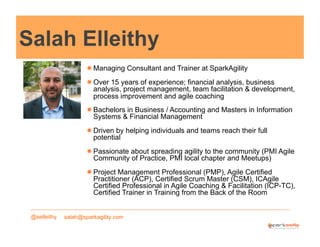
Salah Elleithy
! Managing Consultant and Trainer at SparkAgility
! Over 15 years of experience; financial analysis, business
analysis, project management, team facilitation & development,
process improvement and agile coaching
! Bachelors in Business / Accounting and Masters in Information
Systems & Financial Management
! Driven by helping individuals and teams reach their full
potential
! Passionate about spreading agility to the community (PMI Agile
Community of Practice, PMI local chapter and Meetups)
! Project Management Professional (PMP), Agile Certified
Practitioner (ACP), Certified Scrum Master (CSM), ICAgile
Certified Professional in Agile Coaching & Facilitation (ICP-TC),
Certified Trainer in Training from the Back of the Room
@selleithy

salah@sparkagility.com
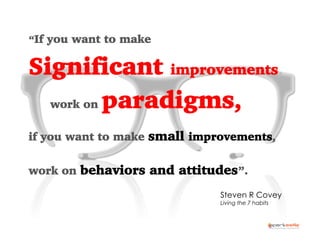
“If you want to make

Significant improvements,
work on paradigms,
if you want to make small improvements,
work on behaviors and attitudes”.
Steven R Covey
Living the 7 habits
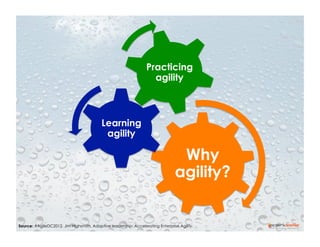
Practicing
agility

Learning
agility

Why
agility?

Source: #AgileDC2012. Jim Highsmith. Adaptive leadership: Accelerating Enterprise Agility.
Why AGILITY?
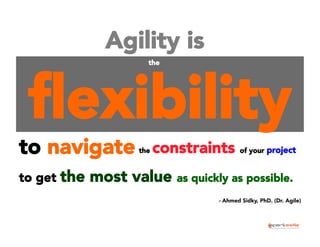
Agility is	
  
the 	
  

flexibility 	
  

to navigate 	
   constraints
the

to get the

of your project


most value as quickly as possible.
- Ahmed Sidky, PhD. (Dr. Agile)
Learning Agility
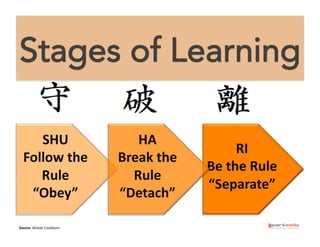
Stages of Learning
SHU	
  
Follow	
  the	
  
Rule	
  
“Obey”	
  
Source:	
  Alistair	
  Cockburn	
  

HA	
  
Break	
  the	
  
Rule	
  
“Detach”	
  

RI	
  
Be	
  the	
  Rule	
  
“Separate”	
  
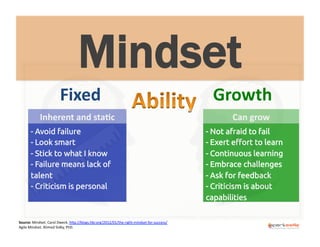
Mindset
Fixed	
  
Inherent	
  and	
  staBc	
  
- Avoid failure	
- Look smart	
- Stick to what I know	
- Failure means lack of
talent	
- Criticism is personal	

Source:	
  Mindset.	
  Carol	
  Dweck.	
  h;p://blogs.hbr.org/2012/01/the-­‐right-­‐mindset-­‐for-­‐success/	
  
Agile	
  Mindset.	
  Ahmed	
  Sidky,	
  PhD.	
  

Growth	
  
Can	
  grow	
  
- Not afraid to fail	
- Exert effort to learn	
- Continuous learning	
- Embrace challenges	
- Ask for feedback	
- Criticism is about
capabilities
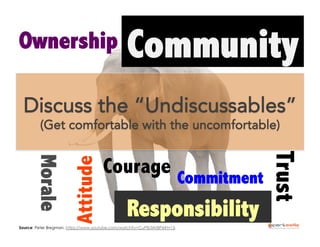
Ownership

Community

Discuss the “Undiscussables”

Courage Commitment

Responsibility

Source: Peter Bregman. https://www.youtube.com/watch?v=CuPfbTAVBP4#t=15

Trust

Morale

Attitude

(Get comfortable with the uncomfortable)
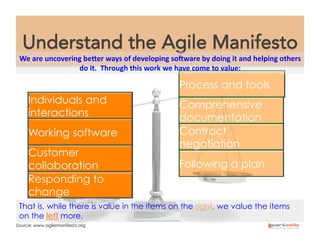
Understand the Agile Manifesto

We	
  are	
  uncovering	
  beHer	
  ways	
  of	
  developing	
  soJware	
  by	
  doing	
  it	
  and	
  helping	
  others	
  
do	
  it.	
  	
  Through	
  this	
  work	
  we	
  have	
  come	
  to	
  value:	
  

Process and tools
Individuals and
interactions
Working software
Customer
collaboration
Responding to
change

Comprehensive
documentation
Contract
negotiation
Following a plan

That is, while there is value in the items on the right, we value the items
on the left more.
Source: www.agilemanifesto.org
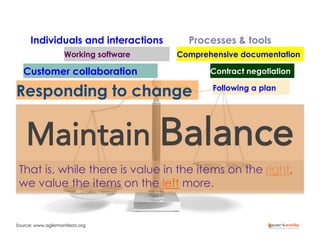
Individuals and interactions
Working software

Processes & tools
Comprehensive documentation

Customer collaboration

Responding to change

Contract negotiation
Following a plan

Maintain Balance
That is, while there is value in the items on the right,
we value the items on the left more.

Source: www.agilemanifesto.org
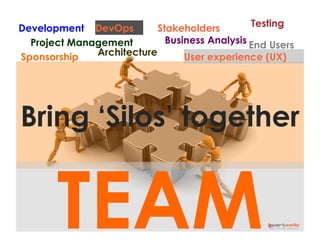
Testing
Development DevOps
Stakeholders
Business Analysis End Users
Project Management
Architecture
Sponsorship
User experience (UX)

Bring ‘Silos’ together

TEAM
Slow down to speed up
Learn to Unlearn
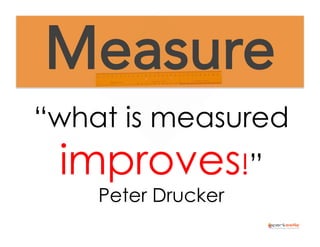
Measure
“what is measured

improves!”
Peter Drucker
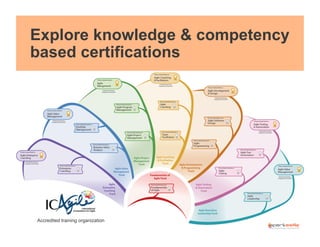
Explore knowledge & competency
based certifications

Accredited training organization
Practicing Agility?
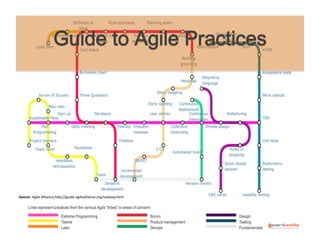
Guide to Agile Practices

Source:	
  Agile	
  Alliance,h;p://guide.agilealliance.org/subway.html	
  
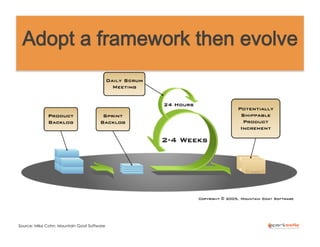
Adopt a framework then evolve

Source: Mike Cohn. Mountain Goat Software
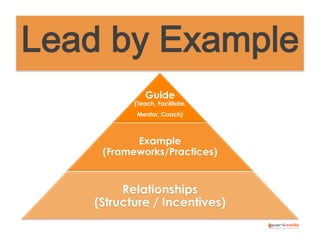
Lead by Example
Guide

(Teach, Facilitate,
Mentor, Coach)

Example
(Frameworks/Practices)

Relationships
(Structure / Incentives)
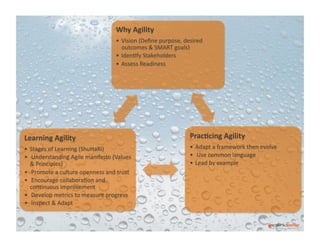
Why	
  Agility	
  
•  Vision	
  (Define	
  purpose,	
  desired	
  
outcomes	
  &	
  SMART	
  goals)	
  
•  Iden)fy	
  Stakeholders	
  
•  Assess	
  Readiness	
  

Learning	
  Agility	
  

PracBcing	
  Agility	


•  Stages	
  of	
  Learning	
  (ShuHaRi)	
  
•  	
  Understanding	
  Agile	
  manifesto	
  (Values	
  
&	
  Principles)	
  
•  	
  Promote	
  a	
  culture	
  openness	
  and	
  trust	
  
•  	
  Encourage	
  collabora)on	
  and	
  
con)nuous	
  improvement	
  
•  	
  Develop	
  metrics	
  to	
  measure	
  progress	
  
•  	
  Inspect	
  &	
  Adapt	
  

•  Adapt	
  a	
  framework	
  then	
  evolve	
  
•  	
  Use	
  common	
  language	
  
•  Lead	
  by	
  example	
  
3 key ingredients-to-enabling-agility

3 key ingredients-to-enabling-agility

  • 1.
  • 2.
    The 3 KeyIngredients to Enabling Agility Salah Elleithy @selleithy
  • 3.
    Salah Elleithy ! Managing Consultantand Trainer at SparkAgility ! Over 15 years of experience; financial analysis, business analysis, project management, team facilitation & development, process improvement and agile coaching ! Bachelors in Business / Accounting and Masters in Information Systems & Financial Management ! Driven by helping individuals and teams reach their full potential ! Passionate about spreading agility to the community (PMI Agile Community of Practice, PMI local chapter and Meetups) ! Project Management Professional (PMP), Agile Certified Practitioner (ACP), Certified Scrum Master (CSM), ICAgile Certified Professional in Agile Coaching & Facilitation (ICP-TC), Certified Trainer in Training from the Back of the Room @selleithy salah@sparkagility.com
  • 4.
    “If you wantto make Significant improvements, work on paradigms, if you want to make small improvements, work on behaviors and attitudes”. Steven R Covey Living the 7 habits
  • 5.
    Practicing agility Learning agility Why agility? Source: #AgileDC2012. JimHighsmith. Adaptive leadership: Accelerating Enterprise Agility.
  • 6.
  • 8.
    Agility is   the   flexibility   to navigate   constraints the to get the of your project   most value as quickly as possible. - Ahmed Sidky, PhD. (Dr. Agile)
  • 15.
  • 16.
    Stages of Learning SHU   Follow  the   Rule   “Obey”   Source:  Alistair  Cockburn   HA   Break  the   Rule   “Detach”   RI   Be  the  Rule   “Separate”  
  • 17.
    Mindset Fixed   Inherent  and  staBc   - Avoid failure - Look smart - Stick to what I know - Failure means lack of talent - Criticism is personal Source:  Mindset.  Carol  Dweck.  h;p://blogs.hbr.org/2012/01/the-­‐right-­‐mindset-­‐for-­‐success/   Agile  Mindset.  Ahmed  Sidky,  PhD.   Growth   Can  grow   - Not afraid to fail - Exert effort to learn - Continuous learning - Embrace challenges - Ask for feedback - Criticism is about capabilities
  • 18.
    Ownership Community Discuss the “Undiscussables” CourageCommitment Responsibility Source: Peter Bregman. https://www.youtube.com/watch?v=CuPfbTAVBP4#t=15 Trust Morale Attitude (Get comfortable with the uncomfortable)
  • 19.
    Understand the AgileManifesto We  are  uncovering  beHer  ways  of  developing  soJware  by  doing  it  and  helping  others   do  it.    Through  this  work  we  have  come  to  value:   Process and tools Individuals and interactions Working software Customer collaboration Responding to change Comprehensive documentation Contract negotiation Following a plan That is, while there is value in the items on the right, we value the items on the left more. Source: www.agilemanifesto.org
  • 20.
    Individuals and interactions Workingsoftware Processes & tools Comprehensive documentation Customer collaboration Responding to change Contract negotiation Following a plan Maintain Balance That is, while there is value in the items on the right, we value the items on the left more. Source: www.agilemanifesto.org
  • 21.
    Testing Development DevOps Stakeholders Business AnalysisEnd Users Project Management Architecture Sponsorship User experience (UX) Bring ‘Silos’ together TEAM
  • 22.
    Slow down tospeed up
  • 23.
  • 24.
  • 25.
    Explore knowledge &competency based certifications Accredited training organization
  • 26.
  • 27.
    Guide to AgilePractices Source:  Agile  Alliance,h;p://guide.agilealliance.org/subway.html  
  • 28.
    Adopt a frameworkthen evolve Source: Mike Cohn. Mountain Goat Software
  • 29.
    Lead by Example Guide (Teach,Facilitate, Mentor, Coach) Example (Frameworks/Practices) Relationships (Structure / Incentives)
  • 30.
    Why  Agility   • Vision  (Define  purpose,  desired   outcomes  &  SMART  goals)   •  Iden)fy  Stakeholders   •  Assess  Readiness   Learning  Agility   PracBcing  Agility     •  Stages  of  Learning  (ShuHaRi)   •   Understanding  Agile  manifesto  (Values   &  Principles)   •   Promote  a  culture  openness  and  trust   •   Encourage  collabora)on  and   con)nuous  improvement   •   Develop  metrics  to  measure  progress   •   Inspect  &  Adapt   •  Adapt  a  framework  then  evolve   •   Use  common  language   •  Lead  by  example