



Path To Agility
Adoption Patters To Overcome Pitfalls
David Hawks, CST, CEC
CEO & Founder
Agile Velocity
@austinagile
@Agile_Velocity
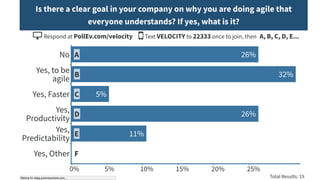
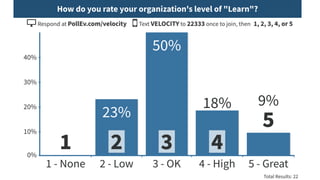
Get your mobile phone ready as we will do real
time polling during this session.TextVELOCITY to
22333 to join.
David Hawks
Agile Trainer and Coach
@austinagile
david@agilevelocity.com
AgileVelocity.com
Accelerate Agility
Transformation | Training | Coaching
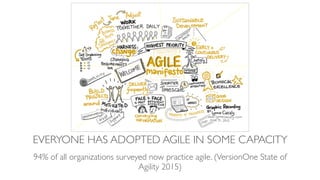
EVERYONE HAS ADOPTED AGILE IN SOME CAPACITY
94% of all organizations surveyed now practice agile. (VersionOne State of
Agility 2015)
5
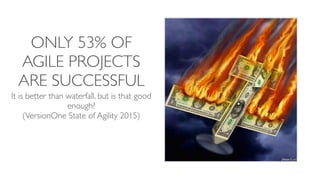
ONLY 53% OF
AGILE PROJECTS
ARE SUCCESSFUL
It is better than waterfall, but is that good
enough?
(VersionOne State of Agility 2015)
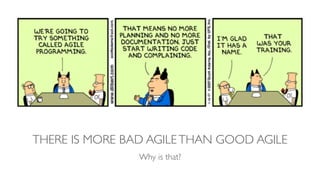
THERE IS MORE BAD AGILETHAN GOOD AGILE
Why is that?
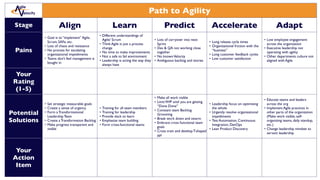
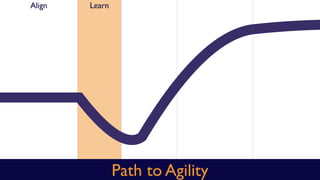
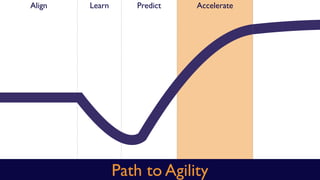
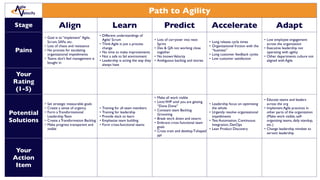
Path to Agility
Stage Align Learn Predict Accelerate Adapt
Pains
• Goal is to “implement” Agile,
Scrum, SAFe, etc.
• Lots of chaos and resistance
• No process for escalating
organizational impediments
• Teams don’t feel management is
bought in
• Different understandings of
Agile/ Scrum
• Think Agile is just a process
change
• No time to make improvements
• Not a safe to fail environment
• Leadership is acting the way they
always have
• Lots of carryover into next
Sprint
• Dev & QA not working close
together
• No knownVelocity
• Ambiguous backlog and stories
• Long release cycle times
• Organizational friction with the
“business”
• Long customer feedback cycles
• Low customer satisfaction
• Low employee engagement
across the organization
• Executive leadership not
operating with agility
• Other departments culture not
aligned with Agile
Your
Rating
(1-5)
Potential
Solutions
• Set strategic measurable goals
• Create a sense of urgency
• Form a Transformational
Leadership Team
• Create a Transformation Backlog
• Make progress transparent and
visible
• Training for all team members
• Training for leadership
• Provide slack to learn
• Emphasize team building
• Form cross-functional teams
• Make all work visible
• Limit WIP until you are getting
“Done Done”
• Constant team Backlog
Grooming
• Break work down and swarm
• Embrace cross functional team
goals
• Cross train and develop T-shaped
ppl
• Leadership focus on optimizing
the whole
• Urgently resolve organizational
impediments
• Test Automation, Continuous
Integration, DevOps
• Lean Product Discovery
• Educate teams and leaders
across the org
• Implement Agile practices in
other parts of the organization
(Make work visible, self-
organizing teams, daily standup,
etc.)
• Change leadership mindset to
servant leadership
Your
Action
Item
Pitfall #1
No Alignment on Mission
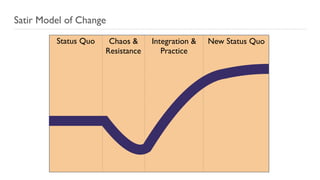
Integration &
Practice
Chaos &
Resistance
Status Quo New Status Quo
Satir Model of Change
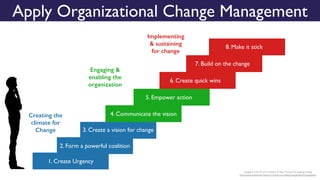
Apply Organizational Change Management
1. Create Urgency
2. Form a powerful coalition
3. Create a vision for change
4. Communicate the vision
5. Empower action
6. Create quick wins
7. Build on the change
8. Make it stick
Creating the
climate for
Change
Engaging &
enabling the
organization
Implementing
& sustaining
for change
Adapted from Dr John Kotter’s 8 Step Process for leading change
http://www.kotterinternation.com/our-principles/changesteps/changesteps
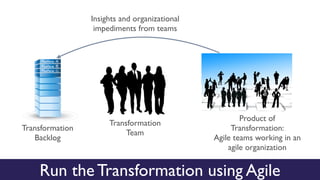
Run the Transformation using Agile
Insights and organizational
impediments from teams
Transformation
Backlog
Transformation
Team
Product of
Transformation:
Agile teams working in an
agile organization
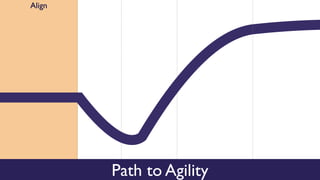
Align
Path to Agility
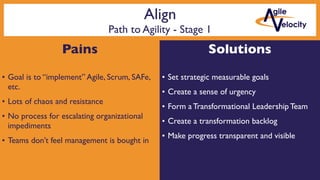
Align
Path to Agility - Stage 1
Pains
• Goal is to “implement” Agile, Scrum, SAFe,
etc.
• Lots of chaos and resistance
• No process for escalating organizational
impediments
• Teams don’t feel management is bought in
Solutions
• Set strategic measurable goals
• Create a sense of urgency
• Form a Transformational Leadership Team
• Create a transformation backlog
• Make progress transparent and visible
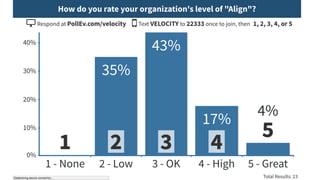
Discussion:What could your leaders
do better to support your change?
Pitfall #2
Team and Leadership not
equipped with knowledge
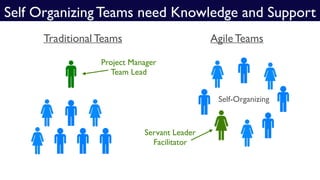
Self Organizing Teams need Knowledge and Support
Traditional Teams Agile Teams
Project Manager
Team Lead
Self-Organizing
Servant Leader
Facilitator
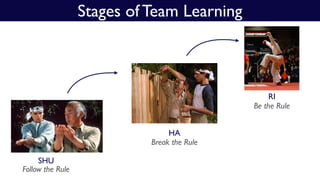
ShuHaRi
Stages of Team Learning
SHU
HA
RI
Follow the Rule
Break the Rule
Be the Rule
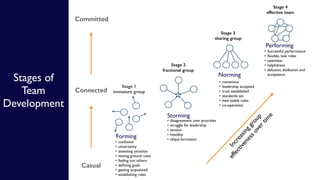
Stages of
Team
Development
Casual
Connected
Committed
Forming
• confusion
• uncertainty
• assessing situation
• testing ground rules
• feeling out others
• defining goals
• getting acquainted
• establishing rules
• disagreement over priorities
• struggle for leadership
• tension
• hostility
• clique formation
Storming
Norming
Performing
• consensus
• leadership accepted
• trust established
• standards set
• new stable roles
• co-operation
• Successful performance
• flexible, task roles
• openness
• helpfulness
• delusion, disillusion and
acceptance
Increasinggroup
effectivenessovertim
e
Stage 1
immature group
Stage 2
fractional group
Stage 3
sharing group
Stage 4
effective team
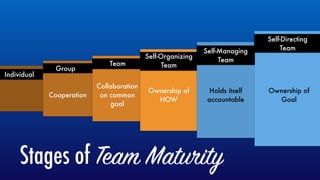
Stages of Team Maturity
Individual
Group
Team
Self-Organizing
Team
Self-Managing
Team
Self-Directing
Team
Cooperation
Collaboration
on common
goal
Ownership of
HOW
Holds itself
accountable
Ownership of
Goal
LearnAlign
Path to Agility
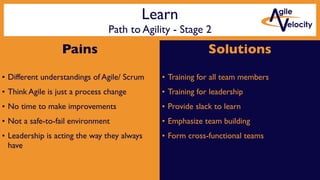
Learn
Path to Agility - Stage 2
Pains
• Different understandings of Agile/ Scrum
• Think Agile is just a process change
• No time to make improvements
• Not a safe-to-fail environment
• Leadership is acting the way they always
have
Solutions
• Training for all team members
• Training for leadership
• Provide slack to learn
• Emphasize team building
• Form cross-functional teams
Pitfall #3
Not Getting to Done
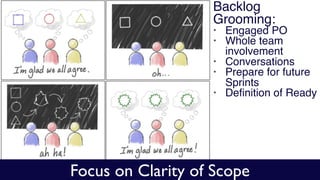
Focus on Clarity of Scope
Backlog
Grooming:
• Engaged PO
• Whole team
involvement
• Conversations
• Prepare for future
Sprints
• Definition of Ready
Story2Story3Story4Story1
Individual Efficiency != Team Effectiveness
Dev 1
Dev 2
Dev 3
Dev 4
QA 1
QA 1
QA 2
QA 2
2 Week Sprint - 4 User Stories - 4 Developers and 2 QA
Story
2b
Story
3a
Story
3b
Story
4a
Story
4b
Story
2a
Story
1b
Story
1a
Get Something “Done Done” every Few Days
Dev 1 & 2
2 Week Sprint - 4 User Stories - 4 Developers and 2 QA
QA 1
Dev 1 & 2
QA 1
Dev 3 & 4
QA 2
Dev 3 & 4
QA 2
Dev 1 & 2
QA 1
Dev 1 & 2
QA 1
Dev 3 & 4
QA 2
Dev 3 & 4
QA 2
New Skills Required:
Break Work Down (Stories/Tasks), Swarm, xFunctional Teams, Cross Training (T-Shaped ppl)
PredictLearnAlign
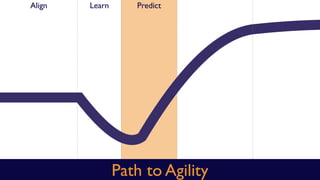
Path to Agility
Predict
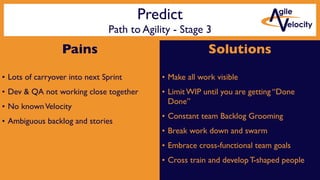
Path to Agility - Stage 3
Pains
• Lots of carryover into next Sprint
• Dev & QA not working close together
• No knownVelocity
• Ambiguous backlog and stories
Solutions
• Make all work visible
• Limit WIP until you are getting “Done
Done”
• Constant team Backlog Grooming
• Break work down and swarm
• Embrace cross-functional team goals
• Cross train and develop T-shaped people
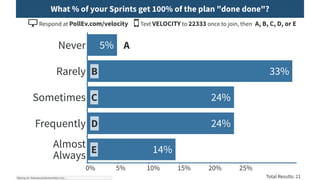
Discussion:What needs to happen to get 9 out of 10
Sprints 100% Done?
Pitfall #4
Not Optimizing the Whole
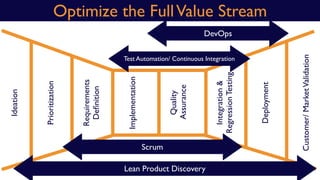
Optimize the FullValue StreamIdeation
Prioritization
Requirements
Definition
Implementation
Quality
Assurance
Integration&
RegressionTesting
Deployment
Customer/MarketValidation
Scrum
Test Automation/ Continuous Integration
DevOps
Lean Product Discovery
Discussion:Where is the main bottleneck in your Full
Value Steam?
Predict AccelerateLearnAlign
Path to Agility
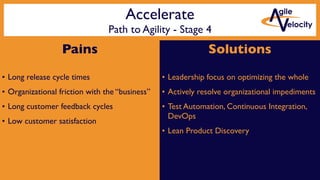
Accelerate
Path to Agility - Stage 4
Pains
• Long release cycle times
• Organizational friction with the “business”
• Long customer feedback cycles
• Low customer satisfaction
Solutions
• Leadership focus on optimizing the whole
• Actively resolve organizational impediments
• Test Automation, Continuous Integration,
DevOps
• Lean Product Discovery
Path to Agility
Stage Align Learn Predict Accelerate Adapt
Pains
• Goal is to “implement” Agile,
Scrum, SAFe, etc.
• Lots of chaos and resistance
• No process for escalating
organizational impediments
• Teams don’t feel management is
bought in
• Different understandings of
Agile/ Scrum
• Think Agile is just a process
change
• No time to make improvements
• Not a safe to fail environment
• Leadership is acting the way they
always have
• Lots of carryover into next
Sprint
• Dev & QA not working close
together
• No knownVelocity
• Ambiguous backlog and stories
• Long release cycle times
• Organizational friction with the
“business”
• Long customer feedback cycles
• Low customer satisfaction
• Low employee engagement
across the organization
• Executive leadership not
operating with agility
• Other departments culture not
aligned with Agile
Your
Rating
(1-5)
Potential
Solutions
• Set strategic measurable goals
• Create a sense of urgency
• Form a Transformational
Leadership Team
• Create a Transformation Backlog
• Make progress transparent and
visible
• Training for all team members
• Training for leadership
• Provide slack to learn
• Emphasize team building
• Form cross-functional teams
• Make all work visible
• Limit WIP until you are getting
“Done Done”
• Constant team Backlog
Grooming
• Break work down and swarm
• Embrace cross functional team
goals
• Cross train and develop T-shaped
ppl
• Leadership focus on optimizing
the whole
• Urgently resolve organizational
impediments
• Test Automation, Continuous
Integration, DevOps
• Lean Product Discovery
• Educate teams and leaders
across the org
• Implement Agile practices in
other parts of the organization
(Make work visible, self-
organizing teams, daily standup,
etc.)
• Change leadership mindset to
servant leadership
Your
Action
Item
Exercise:What is the top thing you can go implement?
Predict AccelerateLearnAlign Adapt
Path to Agility
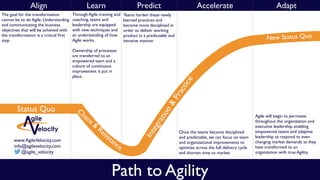
Status Quo Chaos &
Resistance Integration&
Practice
New Status Quo
The goal for the transformation
cannot be to do Agile. Understanding
and communicating the business
objectives that will be achieved with
the transformation is a critical first
step.
Through Agile training and
coaching, teams and
leadership are equipped
with new techniques and
an understanding of how
Agile works.
Ownership of processes
are transferred to an
empowered team and a
culture of continuous
improvement is put in
place.
Teams harden these newly
learned practices and
become more disciplined in
order to deliver working
product in a predictable and
iterative manner.
Once the teams become disciplined
and predictable, we can focus on team
and organizational improvements to
optimize across the full delivery cycle
and shorten time to market.
Agile will begin to permeate
throughout the organization and
executive leadership, enabling
empowered teams and adaptive
leadership to respond to ever-
changing market demands as they
have transformed to an
organization with true Agility.
www.AgileVelocity.com
info@agilevelocity.com
@agile_velocity
FREE WHITE PAPER
Leave a card with name, role, company, email
And we will send you a White Paper on
Agile for Executives
Accelerate Agility
David@AgileVelocity.com
Twitter: @AustinAgile
www.AgileVelocity.com
info@agilevelocity.com
Twitter: @agile_velocity

Agile Camp Dallas- Path to Agility

  • 1.
    Path To Agility AdoptionPatters To Overcome Pitfalls David Hawks, CST, CEC CEO & Founder Agile Velocity @austinagile @Agile_Velocity Get your mobile phone ready as we will do real time polling during this session.TextVELOCITY to 22333 to join.
  • 2.
    David Hawks Agile Trainerand Coach @austinagile david@agilevelocity.com AgileVelocity.com Accelerate Agility Transformation | Training | Coaching
  • 4.
    EVERYONE HAS ADOPTEDAGILE IN SOME CAPACITY 94% of all organizations surveyed now practice agile. (VersionOne State of Agility 2015)
  • 5.
  • 6.
    ONLY 53% OF AGILEPROJECTS ARE SUCCESSFUL It is better than waterfall, but is that good enough? (VersionOne State of Agility 2015)
  • 7.
    THERE IS MOREBAD AGILETHAN GOOD AGILE Why is that?
  • 8.
    Path to Agility StageAlign Learn Predict Accelerate Adapt Pains • Goal is to “implement” Agile, Scrum, SAFe, etc. • Lots of chaos and resistance • No process for escalating organizational impediments • Teams don’t feel management is bought in • Different understandings of Agile/ Scrum • Think Agile is just a process change • No time to make improvements • Not a safe to fail environment • Leadership is acting the way they always have • Lots of carryover into next Sprint • Dev & QA not working close together • No knownVelocity • Ambiguous backlog and stories • Long release cycle times • Organizational friction with the “business” • Long customer feedback cycles • Low customer satisfaction • Low employee engagement across the organization • Executive leadership not operating with agility • Other departments culture not aligned with Agile Your Rating (1-5) Potential Solutions • Set strategic measurable goals • Create a sense of urgency • Form a Transformational Leadership Team • Create a Transformation Backlog • Make progress transparent and visible • Training for all team members • Training for leadership • Provide slack to learn • Emphasize team building • Form cross-functional teams • Make all work visible • Limit WIP until you are getting “Done Done” • Constant team Backlog Grooming • Break work down and swarm • Embrace cross functional team goals • Cross train and develop T-shaped ppl • Leadership focus on optimizing the whole • Urgently resolve organizational impediments • Test Automation, Continuous Integration, DevOps • Lean Product Discovery • Educate teams and leaders across the org • Implement Agile practices in other parts of the organization (Make work visible, self- organizing teams, daily standup, etc.) • Change leadership mindset to servant leadership Your Action Item
  • 9.
  • 11.
    Integration & Practice Chaos & Resistance StatusQuo New Status Quo Satir Model of Change
  • 12.
    Apply Organizational ChangeManagement 1. Create Urgency 2. Form a powerful coalition 3. Create a vision for change 4. Communicate the vision 5. Empower action 6. Create quick wins 7. Build on the change 8. Make it stick Creating the climate for Change Engaging & enabling the organization Implementing & sustaining for change Adapted from Dr John Kotter’s 8 Step Process for leading change http://www.kotterinternation.com/our-principles/changesteps/changesteps
  • 13.
    Run the Transformationusing Agile Insights and organizational impediments from teams Transformation Backlog Transformation Team Product of Transformation: Agile teams working in an agile organization
  • 14.
  • 15.
    Align Path to Agility- Stage 1 Pains • Goal is to “implement” Agile, Scrum, SAFe, etc. • Lots of chaos and resistance • No process for escalating organizational impediments • Teams don’t feel management is bought in Solutions • Set strategic measurable goals • Create a sense of urgency • Form a Transformational Leadership Team • Create a transformation backlog • Make progress transparent and visible
  • 17.
    Discussion:What could yourleaders do better to support your change?
  • 18.
    Pitfall #2 Team andLeadership not equipped with knowledge
  • 21.
    Self Organizing Teamsneed Knowledge and Support Traditional Teams Agile Teams Project Manager Team Lead Self-Organizing Servant Leader Facilitator
  • 22.
    ShuHaRi Stages of TeamLearning SHU HA RI Follow the Rule Break the Rule Be the Rule
  • 23.
    Stages of Team Development Casual Connected Committed Forming • confusion •uncertainty • assessing situation • testing ground rules • feeling out others • defining goals • getting acquainted • establishing rules • disagreement over priorities • struggle for leadership • tension • hostility • clique formation Storming Norming Performing • consensus • leadership accepted • trust established • standards set • new stable roles • co-operation • Successful performance • flexible, task roles • openness • helpfulness • delusion, disillusion and acceptance Increasinggroup effectivenessovertim e Stage 1 immature group Stage 2 fractional group Stage 3 sharing group Stage 4 effective team
  • 24.
    Stages of TeamMaturity Individual Group Team Self-Organizing Team Self-Managing Team Self-Directing Team Cooperation Collaboration on common goal Ownership of HOW Holds itself accountable Ownership of Goal
  • 25.
  • 26.
    Learn Path to Agility- Stage 2 Pains • Different understandings of Agile/ Scrum • Think Agile is just a process change • No time to make improvements • Not a safe-to-fail environment • Leadership is acting the way they always have Solutions • Training for all team members • Training for leadership • Provide slack to learn • Emphasize team building • Form cross-functional teams
  • 28.
  • 30.
    Focus on Clarityof Scope Backlog Grooming: • Engaged PO • Whole team involvement • Conversations • Prepare for future Sprints • Definition of Ready
  • 31.
    Story2Story3Story4Story1 Individual Efficiency !=Team Effectiveness Dev 1 Dev 2 Dev 3 Dev 4 QA 1 QA 1 QA 2 QA 2 2 Week Sprint - 4 User Stories - 4 Developers and 2 QA
  • 32.
    Story 2b Story 3a Story 3b Story 4a Story 4b Story 2a Story 1b Story 1a Get Something “DoneDone” every Few Days Dev 1 & 2 2 Week Sprint - 4 User Stories - 4 Developers and 2 QA QA 1 Dev 1 & 2 QA 1 Dev 3 & 4 QA 2 Dev 3 & 4 QA 2 Dev 1 & 2 QA 1 Dev 1 & 2 QA 1 Dev 3 & 4 QA 2 Dev 3 & 4 QA 2 New Skills Required: Break Work Down (Stories/Tasks), Swarm, xFunctional Teams, Cross Training (T-Shaped ppl)
  • 33.
  • 34.
    Predict Path to Agility- Stage 3 Pains • Lots of carryover into next Sprint • Dev & QA not working close together • No knownVelocity • Ambiguous backlog and stories Solutions • Make all work visible • Limit WIP until you are getting “Done Done” • Constant team Backlog Grooming • Break work down and swarm • Embrace cross-functional team goals • Cross train and develop T-shaped people
  • 36.
    Discussion:What needs tohappen to get 9 out of 10 Sprints 100% Done?
  • 38.
  • 39.
    Optimize the FullValueStreamIdeation Prioritization Requirements Definition Implementation Quality Assurance Integration& RegressionTesting Deployment Customer/MarketValidation Scrum Test Automation/ Continuous Integration DevOps Lean Product Discovery
  • 40.
    Discussion:Where is themain bottleneck in your Full Value Steam?
  • 41.
  • 42.
    Accelerate Path to Agility- Stage 4 Pains • Long release cycle times • Organizational friction with the “business” • Long customer feedback cycles • Low customer satisfaction Solutions • Leadership focus on optimizing the whole • Actively resolve organizational impediments • Test Automation, Continuous Integration, DevOps • Lean Product Discovery
  • 44.
    Path to Agility StageAlign Learn Predict Accelerate Adapt Pains • Goal is to “implement” Agile, Scrum, SAFe, etc. • Lots of chaos and resistance • No process for escalating organizational impediments • Teams don’t feel management is bought in • Different understandings of Agile/ Scrum • Think Agile is just a process change • No time to make improvements • Not a safe to fail environment • Leadership is acting the way they always have • Lots of carryover into next Sprint • Dev & QA not working close together • No knownVelocity • Ambiguous backlog and stories • Long release cycle times • Organizational friction with the “business” • Long customer feedback cycles • Low customer satisfaction • Low employee engagement across the organization • Executive leadership not operating with agility • Other departments culture not aligned with Agile Your Rating (1-5) Potential Solutions • Set strategic measurable goals • Create a sense of urgency • Form a Transformational Leadership Team • Create a Transformation Backlog • Make progress transparent and visible • Training for all team members • Training for leadership • Provide slack to learn • Emphasize team building • Form cross-functional teams • Make all work visible • Limit WIP until you are getting “Done Done” • Constant team Backlog Grooming • Break work down and swarm • Embrace cross functional team goals • Cross train and develop T-shaped ppl • Leadership focus on optimizing the whole • Urgently resolve organizational impediments • Test Automation, Continuous Integration, DevOps • Lean Product Discovery • Educate teams and leaders across the org • Implement Agile practices in other parts of the organization (Make work visible, self- organizing teams, daily standup, etc.) • Change leadership mindset to servant leadership Your Action Item
  • 45.
    Exercise:What is thetop thing you can go implement?
  • 48.
    Predict AccelerateLearnAlign Adapt Pathto Agility Status Quo Chaos & Resistance Integration& Practice New Status Quo The goal for the transformation cannot be to do Agile. Understanding and communicating the business objectives that will be achieved with the transformation is a critical first step. Through Agile training and coaching, teams and leadership are equipped with new techniques and an understanding of how Agile works. Ownership of processes are transferred to an empowered team and a culture of continuous improvement is put in place. Teams harden these newly learned practices and become more disciplined in order to deliver working product in a predictable and iterative manner. Once the teams become disciplined and predictable, we can focus on team and organizational improvements to optimize across the full delivery cycle and shorten time to market. Agile will begin to permeate throughout the organization and executive leadership, enabling empowered teams and adaptive leadership to respond to ever- changing market demands as they have transformed to an organization with true Agility. www.AgileVelocity.com info@agilevelocity.com @agile_velocity
  • 49.
    FREE WHITE PAPER Leavea card with name, role, company, email And we will send you a White Paper on Agile for Executives Accelerate Agility
  • 50.