Mrs Uzma Haider
Sequence
 Ethics Theory By Socrates
 Ethics Theory By Plato
 Ethics Theory By Aristotle
Ethics Theory by Socrates
Ethics By Socrates
 Socrates (470-399 BC) was a Greek philosopher and is
considered the father of western philosophy
 He believed virtue was found primarily in human
relationships, love and friendship, not through material
gains.
What does Socrates say about ethics?
 Ethics are the norms by which acceptable and
unacceptable behavior are measured.
 One can develop ethics through maturity, wisdom and
love.
 He believed virtue was found primarily in human
relationships, love and friendship, not through material
gains.
What is morality according to Socrates?
 Socrates believed that happiness is the goal of all human
activity.
 Being ignorant of (moral) wisdom, one can even do evil or
harm to an other. He or she is consequently free
of moral charge.
 Meno is a Socratic dialogue written by Plato. It appears to
attempt to determine the definition of virtue, or arete,
meaning virtue in general, rather than particular virtues,
such as justice .
What is Socrates philosophy?
 "Socratic method," laid the groundwork for Western systems
of logic and philosophy.
 When the political climate of Greece turned, Socrates was
sentenced to death by hemlock poisoning in 399 BC.
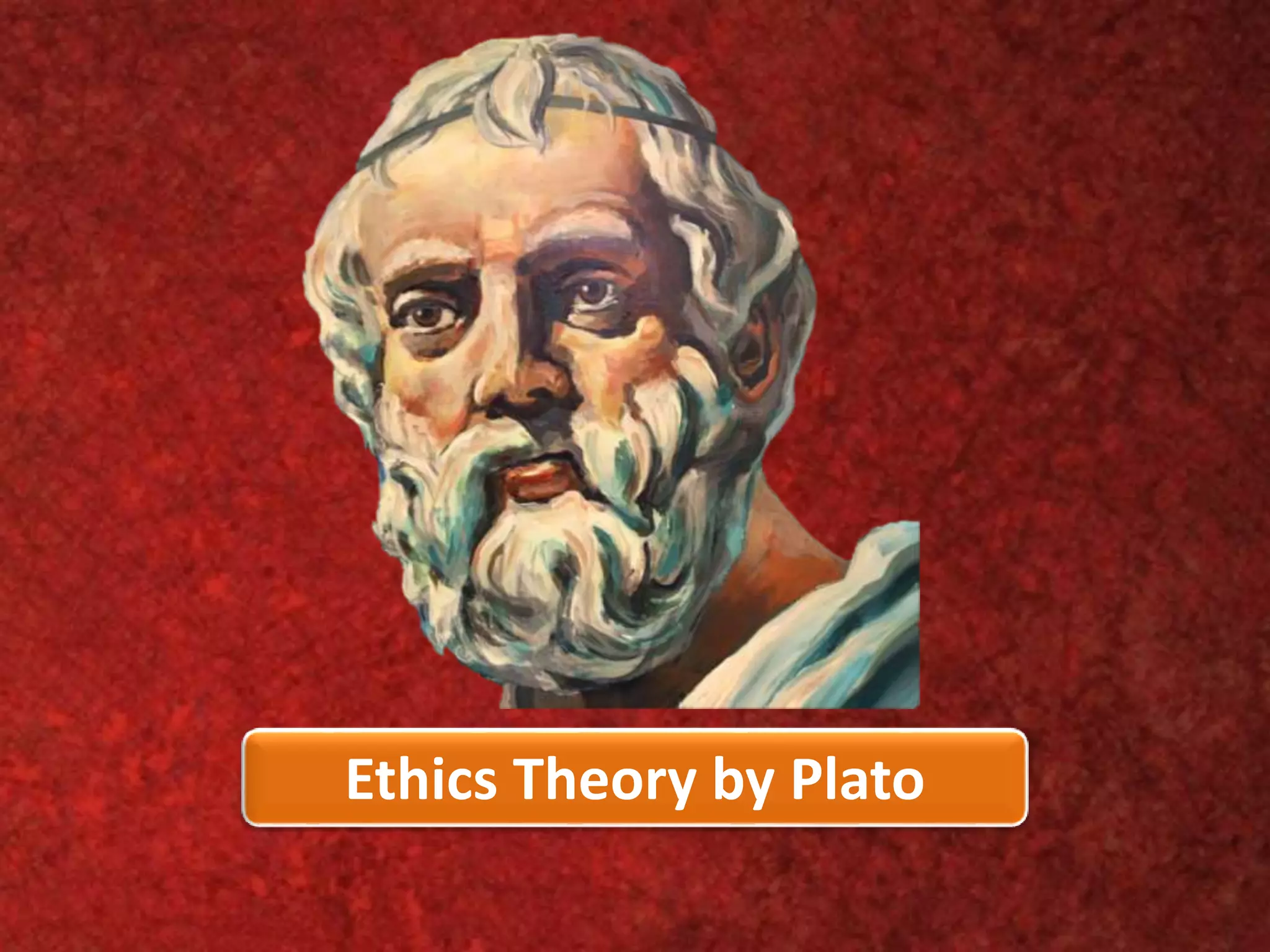
Ethics Theory by Plato
Who was Plato ?
 Plato, born in 428/427 BC in Athens, Greece— died in
348/347 in Athens
 He was a student of Socrates and teacher of Aristotle
 Founder of the Ethics Academy
 Best known as the author of philosophical works of
unparalleled influence.
Plato's Ethical Theory
 Plato maintains a virtue-based eudaemonistic conception
of ethics.
 Eudaimonism (or Eudaemonism or Eudaimonia) is a moral
philosophy that defines right action as that which leads to
the "well-being" of the individual, thus holding "well-being"
as having essential value
 That is to say, happiness or well-being is the highest aim of
moral thought and conduct, and the virtues (excellence) are
the requisite skills and dispositions needed to attain it.
What was Plato's beliefs?
 In many middle period dialogues, such as the Phaedo,
Republic and Phaedrus Plato advocates a belief in the
immortality of the soul, and several dialogues end with long
speeches imagining the afterlife. More than one dialogue
contrasts knowledge and opinion, perception and reality,
nature and custom, and body and soul.
Ethics Theory by Aristotle
Aristotle
 Aristotle was an ancient Greek philosopher, born in Greece
in 384 BC – 322 BC
 He was known as the teacher of Alexander the Great. He
was a student of Plato and is considered an important figure
in Western Philosophy
What was Aristotle contribution to
philosophy?
 Aristotle is a towering figure in ancient Greek philosophy,
making contributions to logic, metaphysics, mathematics,
physics, biology, botany, ethics, politics, agriculture,
medicine, dance and theatre. He was a student of Plato who
in turn studied under Socrates
Ethics Theory by Aristotle
 Aristotle’s ethics is a common sense ethics built on
naturalism and self realization
 Aristotle first used the term ethics to name a field of study
developed by his predecessors Socrates and Plato.
Philosophical ethics is the attempt to offer a rational
response to the question of how humans should best live.
Ethics Theory by Aristotle
 Happiness is not a state but an activity. In his NICOMACHEAN
Ethics , he writes what is supreme good for man, that is
what is the best way to lead our life and give it a meaning.
 Aristotle describes popular accounts about what kind of life
would be a happy one by classifying them into three most
common types:
 a life dedicated to vulgar pleasure;
 a life dedicated to fame and honor; and
 a life dedicated to contemplation (NE I.1095b17-19)
Moral Theory by Aristotle
 The moral theory of Aristotle, like that of Plato focuses on
virtue, recommending the virtuous way of life by its relation
to happiness.
Four Cardinal Virtues of Moral
Theory by Aristotle
 Prudence, also known as practical wisdom, is the most
important virtue for Aristotle. In war, soldiers must fight
with prudence by making judgments through practical
wisdom. This virtue is a must to obtain because courage
requires judgments to be made
 Temperance, or self-control, simply means moderation.
Soldiers must display moderation with their enjoyment
while at war in the midst of violent activities.
 Courage is “moderation or observance of the mean with
respect to feelings of fear and confidence.”
 Justice means giving the enemy what is due to them in the
proper ways; being just toward them. In other words, one
must recognize what is good for the community and one
must undertake a good course of action.
Home Assignment
 Write down difference between Ethical Theories of Socrates,
Plato and Aristotle ?

3 Greek Philosophers.pptx

  • 1.
  • 2.
    Sequence  Ethics TheoryBy Socrates  Ethics Theory By Plato  Ethics Theory By Aristotle
  • 3.
  • 4.
    Ethics By Socrates Socrates (470-399 BC) was a Greek philosopher and is considered the father of western philosophy  He believed virtue was found primarily in human relationships, love and friendship, not through material gains.
  • 5.
    What does Socratessay about ethics?  Ethics are the norms by which acceptable and unacceptable behavior are measured.  One can develop ethics through maturity, wisdom and love.  He believed virtue was found primarily in human relationships, love and friendship, not through material gains.
  • 6.
    What is moralityaccording to Socrates?  Socrates believed that happiness is the goal of all human activity.  Being ignorant of (moral) wisdom, one can even do evil or harm to an other. He or she is consequently free of moral charge.  Meno is a Socratic dialogue written by Plato. It appears to attempt to determine the definition of virtue, or arete, meaning virtue in general, rather than particular virtues, such as justice .
  • 7.
    What is Socratesphilosophy?  "Socratic method," laid the groundwork for Western systems of logic and philosophy.  When the political climate of Greece turned, Socrates was sentenced to death by hemlock poisoning in 399 BC.
  • 8.
  • 9.
    Who was Plato?  Plato, born in 428/427 BC in Athens, Greece— died in 348/347 in Athens  He was a student of Socrates and teacher of Aristotle  Founder of the Ethics Academy  Best known as the author of philosophical works of unparalleled influence.
  • 10.
    Plato's Ethical Theory Plato maintains a virtue-based eudaemonistic conception of ethics.  Eudaimonism (or Eudaemonism or Eudaimonia) is a moral philosophy that defines right action as that which leads to the "well-being" of the individual, thus holding "well-being" as having essential value  That is to say, happiness or well-being is the highest aim of moral thought and conduct, and the virtues (excellence) are the requisite skills and dispositions needed to attain it.
  • 11.
    What was Plato'sbeliefs?  In many middle period dialogues, such as the Phaedo, Republic and Phaedrus Plato advocates a belief in the immortality of the soul, and several dialogues end with long speeches imagining the afterlife. More than one dialogue contrasts knowledge and opinion, perception and reality, nature and custom, and body and soul.
  • 12.
  • 13.
    Aristotle  Aristotle wasan ancient Greek philosopher, born in Greece in 384 BC – 322 BC  He was known as the teacher of Alexander the Great. He was a student of Plato and is considered an important figure in Western Philosophy
  • 14.
    What was Aristotlecontribution to philosophy?  Aristotle is a towering figure in ancient Greek philosophy, making contributions to logic, metaphysics, mathematics, physics, biology, botany, ethics, politics, agriculture, medicine, dance and theatre. He was a student of Plato who in turn studied under Socrates
  • 15.
    Ethics Theory byAristotle  Aristotle’s ethics is a common sense ethics built on naturalism and self realization  Aristotle first used the term ethics to name a field of study developed by his predecessors Socrates and Plato. Philosophical ethics is the attempt to offer a rational response to the question of how humans should best live.
  • 16.
    Ethics Theory byAristotle  Happiness is not a state but an activity. In his NICOMACHEAN Ethics , he writes what is supreme good for man, that is what is the best way to lead our life and give it a meaning.  Aristotle describes popular accounts about what kind of life would be a happy one by classifying them into three most common types:  a life dedicated to vulgar pleasure;  a life dedicated to fame and honor; and  a life dedicated to contemplation (NE I.1095b17-19)
  • 17.
    Moral Theory byAristotle  The moral theory of Aristotle, like that of Plato focuses on virtue, recommending the virtuous way of life by its relation to happiness.
  • 18.
    Four Cardinal Virtuesof Moral Theory by Aristotle  Prudence, also known as practical wisdom, is the most important virtue for Aristotle. In war, soldiers must fight with prudence by making judgments through practical wisdom. This virtue is a must to obtain because courage requires judgments to be made  Temperance, or self-control, simply means moderation. Soldiers must display moderation with their enjoyment while at war in the midst of violent activities.  Courage is “moderation or observance of the mean with respect to feelings of fear and confidence.”  Justice means giving the enemy what is due to them in the proper ways; being just toward them. In other words, one must recognize what is good for the community and one must undertake a good course of action.
  • 19.
    Home Assignment  Writedown difference between Ethical Theories of Socrates, Plato and Aristotle ?